Article

An Advanced Quality Control Approach: Integrating Quadruple EWMA Strategy for Enhanced Sensitivity in Process Monitoring

by
Julalak Neammai
,
Yupaporn Areepong
* and
Saowanit Sukparungsee
Department of Applied Statistics, Faculty of Applied Science, King Mongkut’s University of Technology North Bangkok, Bangkok 10800, Thailand
*
Author to whom correspondence should be addressed.
Mathematics 2026, 14(11), 1917; https://doi.org/10.3390/math14111917
Submission received: 21 March 2026 / Revised: 21 May 2026 / Accepted: 25 May 2026 / Published: 1 June 2026
(This article belongs to the Special Issue Statistical and Mathematical Methods in Econometric Analysis)

Abstract

This study proposes the Quadruple Exponentially Weighted Moving Average (QEWMA) control chart, a novel monitoring scheme designed to enhance the detection of small-to-moderate process mean shifts in the presence of autocorrelation. While traditional EWMA-based charts often struggle with dependent data, the proposed QEWMA utilizes a four-layered smoothing mechanism to effectively filter noise in Moving Average processes. The performance of the QEWMA chart was rigorously evaluated using the Numerical Integral Equation (NIE) approach to calculate the Average Run Length (ARL) and the Standard Deviation of Run Length (SDRL). Comparative results across MA(1), MA(2), and MA(3) models demonstrate that the QEWMA chart significantly outperforms the standard EWMA, DEWMA, and TEWMA charts, particularly for subtle shifts ( δ 0.10 ). The practical utility of the proposed chart was further validated through two real-world applications: monitoring Thailand’s daily median income (MA(3)) and gold futures prices (MA(2)). In both applications, the QEWMA chart exhibited superior sensitivity and faster detection rates, providing more reliable signals for economic and financial surveillance. These findings suggest that the QEWMA chart is a robust and highly efficient tool for quality control in complex, autocorrelated industrial and economic environments.

1. Introduction

Statistical Process Control (SPC) serves as a foundational framework in modern quality engineering, primarily focused on monitoring and enhancing process stability by identifying assignable causes of variation at an incipient stage. Among the various methodologies within SPC, control charts remain the most indispensable tools due to their operational simplicity and diagnostic efficacy. The classical Shewhart-type control charts, pioneered by Shewhart [1], are inherently “memoryless”, as their decision rules rely exclusively on the most recent observation. While these charts exhibit high efficiency in detecting large-magnitude shifts in process parameters, they are mathematically recognized to be suboptimal for identifying small-to-moderate shifts.
To address this limitation, the literature has shifted toward memory-type control charts, which enhance sensitivity by integrating both current and historical data into the monitoring statistic. The Cumulative Sum (CUSUM) chart, proposed by Page [2], and the Exponentially Weighted Moving Average (EWMA) chart, introduced by Roberts [3], represent the two most prominent pillars of this category. The stochastic properties and run-length distributions of these schemes have been rigorously investigated through various analytical and numerical techniques, such as integral equations and Markov chain approximations [4,5,6,7,8]. While these foundational memory-type charts have a significant advantage over Shewhart charts, their main limitation is a rigid smoothing structure that may not adequately weight long-term historical dependencies in highly volatile or autocorrelated data streams, leading to a slower response to very subtle trend shifts.
Given the versatility of the EWMA scheme, several high-order modifications have been developed to further augment its detection capabilities. Shamma and Shamma [9] introduced the Double EWMA (DEWMA) chart by applying a second level of exponential smoothing. This concept was subsequently extended to the Triple EWMA (TEWMA) chart by Alevizakos et al. [10], who demonstrated that increasing the depth of the recursive smoothing operator significantly improves the chart’s responsiveness to subtle process deviations. However, the conversion from DEWMA to TEWMA brings additional mathematical complexity and parameter sensitivity. Alevizakos and Koukouvinos [10] found that higher-order charts are more sensitive, but require precise smoothing constant tuning to avoid over-smoothing, which might obscure the underlying process signal in non-normal situations. Recently, Alevizakos, Chatterjee, and Koukouvinos [11] established the Quadruple EWMA (QEWMA) control chart, which utilizes four levels of nested smoothing. Their findings confirmed that the QEWMA architecture provides superior performance over the EWMA, DEWMA, and TEWMA counterparts, particularly when the shift magnitude is small. Despite its effectiveness, the actual application of QEWMA has been limited due to the lack of precise analytical solutions for its Average Run Length (ARL) in complex dependent structures. While recent works have begun exploring QEWMA in varied settings, a significant gap remains in applying this high-order sensitivity to economic time series, where structural changes frequently occur alongside noisy oscillations.
Despite these mathematical advancements, the majority of existing research on the QEWMA chart operates under the assumption that process observations are independent and identically distributed (i.i.d.). However, in many contemporary industrial environments—such as chemical processes or high-frequency automated manufacturing—data often exhibit serial dependence due to physical constraints or measurement systems. Neglecting such inherent autocorrelation can severely distort the chart’s stochastic properties, leading to inflated false alarm rates and a significant loss of detection power. A flexible and widely adopted framework for modeling this serial correlation is the Moving Average process of order q, denoted as MA(q) [12]. It is well-documented that such dependence significantly alters the run-length characteristics of memory-type charts [13,14,15].
Recent developments have extended the application of memory-type control charts into the field of econometrics, whereas traditional Statistical Process Control (SPC) concentrates on industrial manufacturing. In particular, sophisticated methods such as the Quadruple Exponentially Weighted Moving Average (QEWMA) have shown exceptional sensitivity in tracking regime shifts and structural changes in non-stationary economic time series. The performance and robustness of memory-type control charts under dependent processes have been extensively emphasized in recent research. For instance, Areepong and Peerajit [16] enhanced the detection capability of the EWMA chart within time-series contexts, while Peerajit [17] optimized its performance for complex long-memory seasonal moving average processes. Beyond conventional single-layer schemes, recent developments have shifted toward advanced configurations, such as multi-layered structures and extended frameworks. In particular, the Extended EWMA (EEWMA) and New Extended EWMA (NEEWMA) frameworks have demonstrated that incorporating multiple smoothing parameters effectively mitigates serial dependence under Autoregressive (AR) and Moving Average (MA) configurations (e.g., Javed et al. [18]; Karoon and Areepong [19]). Furthermore, the recent literature published between 2024 and 2026 demonstrates a significant growth in the application of advanced memory-type charts for financial anomaly detection and the monitoring of autocorrelated economic indicators [20,21].
Motivated by the need for more realistic monitoring models, this study rigorously investigates the performance of the QEWMA control chart under MA(q) dependence for q = 1, 2, and 3. We evaluate the Average Run Length (ARL) and other essential run-length characteristics across a range of autocorrelation levels. By extending the QEWMA framework to handle dependent processes, this research provides a more robust and effective monitoring tool for practitioners operating in autocorrelated production environments.
The main contributions of this paper are summarized as follows: A systematic mathematical analysis of the QEWMA control chart under MA(1), MA(2), and MA(3) processes. The application of a numerical integral equation method to derive high-precision ARL values. A comprehensive evaluation and comparison of the performance of the QEWMA scheme against existing EWMA-type charts in the presence of serial dependence.
The remainder of this paper is organized as follows: Section 2 delineates the mathematical formulation of the proposed QEWMA statistic and the underlying MA(q) processes. Section 3 provides a detailed description of the Numerical Integral Equation (NIE) approach employed for the precise calculation of the Average Run Length (ARL). Section 4 presents a comprehensive performance analysis, including comparative simulation results and real-world applications in economic and financial monitoring. Finally, Section 5 provides concluding remarks, summarizes the key findings, and suggests potential directions for future research.

2. The Conceptual Framework for the Control Chart

In this section, we delineate the mathematical structure of the proposed monitoring scheme, which encompasses the stochastic model of the process observations and the recursive formulation of the Quadruple Exponentially Weighted Moving Average (QEWMA) statistic.

2.1. The MA(q) Process and Underlying Assumptions

In many practical applications of statistical process control, the assumption of independent and identically distributed observations is often violated due to serial dependence inherent in the process. To account for such dependence, the underlying process in this study is modeled using a moving average process of order q, denoted by MA(q).
Consider a process where the observations X t are not independent but follow a moving average process of order q , denoted as MA(q). The model is expressed as:
X t = μ + ϵ t θ 1 ϵ t 1 θ 2 ϵ t 2 θ q ϵ t q
where μ is the process mean, θ i ( i = 1 , 2 , , q ) are the moving average parameters, and ϵ t E x p β represents white noise. In this study, we specifically investigate the performance under MA(1), MA(2), and MA(3) dependencies to represent various degrees of serial correlation often encountered in industrial applications. We adopt the exponential distribution to evaluate the robustness of the proposed chart against asymmetric error structures, providing a more challenging environment for ARL calculation than the standard normal distribution.

2.2. The QEWMA Control Chart Statistic

The QEWMA chart is an extension of the EWMA, DEWMA, and TEWMA schemes. It is constructed by applying the exponential smoothing operator four times sequentially. Let X t be the observation at time t . The four stages of the QEWMA statistic are defined as follows:
First stage (EWMA):
E t = λ X t + ( 1 λ ) E t 1
Second stage (DEWMA):
D t = λ E t + ( 1 λ ) D t 1
Third stage (TEWMA):
T t = λ D t + ( 1 λ ) T t 1
Fourth stage (QEWMA):
Q t = λ T t + ( 1 λ ) Q t 1
where λ ( 0 < λ 1 ) is the smoothing parameter. The initial values are typically set to the process target mean, E 0 = D 0 = T 0 = Q 0 = μ 0 . The QEWMA chart signals an out-of-control state if the statistic Q t falls outside the control limits:
L C L , U C L = μ 0 ± L σ Q t
where L is the control limit multiplier and σ Q t denotes the asymptotic standard deviation of the QEWMA statistic.
When the observed statistic Q t falls outside the control limits, the process is declared out of control. Owing to the presence of serial dependence and the multi-level smoothing structure, the distribution of Q t is analytically complex. Consequently, performance measures such as the average run length (ARL) are evaluated using numerical methods.
The integration of the MA(q) process with the QEWMA control chart provides a unified framework for monitoring dependent processes with enhanced memory. This framework forms the basis for the analytical and numerical performance evaluation presented in the subsequent sections.

2.3. Performance Evaluation Metric

To assess the performance of the proposed QEWMA control chart under MA(q) processes, the Average Run Length (ARL) is utilized as the standard monitoring metric. The ARL is defined as the expected number of samples plotted on the chart before an out-of-control signal is generated.
ARL0 (In-Control ARL): When the process is in a state of statistical control (δ = 0), the ARL0 should be sufficiently large to minimize the frequency of false alarms.
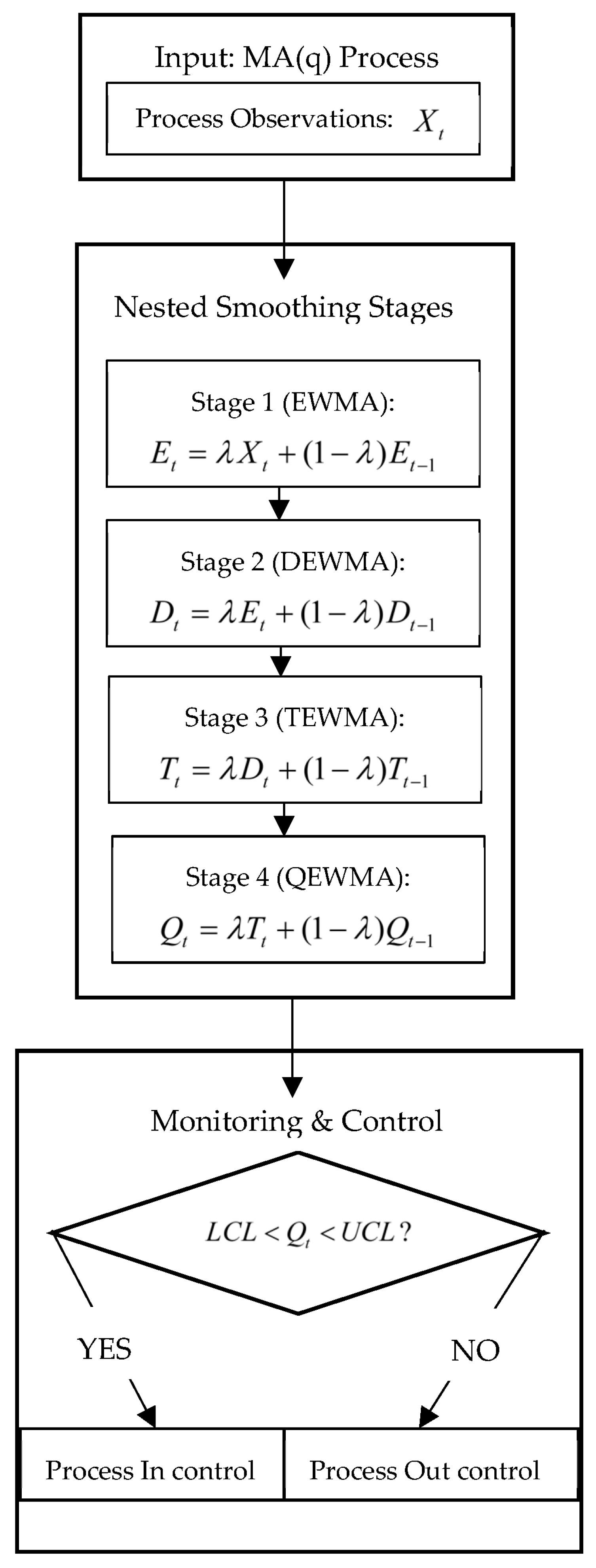
ARL1 (Out-of-Control ARL): When a shift in magnitude δ occurs in the process mean, the ARL1 should be as small as possible, indicating the chart’s ability to detect the shift rapidly (see Figure 1).

3. Exact Analytical Derivation and Numerical Approximation of the QEWMA Run-Length Properties

In this section, the derivation of the Average Run Length (ARL) for the QEWMA control chart is developed through two distinct and complementary approaches: an explicit analytical expression and the Numerical Integral Equation (NIE) technique. Both methodologies are established within the Moving Average of order q [MA(q)] modeling structure, ensuring the chart’s robustness and precision in monitoring autocorrelated processes.

3.1. Explicit Analytical Formulation

To provide a theoretical foundation for the chart’s performance, we first derive the exact statistical properties of the QEWMA statistic, Q t . When the process observations { X t } are governed by an M A ( q ) process. The QEWMA statistic, Q t , is obtained by applying four successive levels of exponential smoothing. By recursive substitution, the relationship between Q t and the process observations X t i can be expressed as:
Q t = λ 4 i = 0 t 1 i + 3 3 ( 1 λ ) i X t i + ( 1 λ ) t j = 0 3 ( t λ ) j j ! Q 0
or
Q t = λ 4 X t + 1 λ λ 3 E t 1 + λ 2 D t 1 + λ T t 1 + Q t 1
where λ ( 0 < λ 1 ) is the smoothing parameter and Q 0 is the starting value (the detailed proofs of the expectation and variance of the QEWMA statistic are provided in Appendix A).
Consider a stochastic process { X t } M A ( q ) . The observations from this process are used as inputs in the construction of the QEWMA control chart, as defined below.
Q t = λ 4 μ + ϵ t θ 1 ϵ t 1 θ 2 ϵ t 2 θ q ϵ t q + 1 λ λ 3 E t 1 + λ 2 D t 1 + λ T t 1 + Q t 1
For t = 1,
Q 1 = λ 4 μ + ϵ 1 θ 1 ϵ 0 θ 2 ϵ 1 θ q ϵ 1 q + 1 λ λ 3 E 0 + λ 2 D 0 + λ T 0 + Q 0
By starting values,
Q 1 = λ 4 ϵ 1 + λ 4 μ i = 1 q θ i ϵ 1 i + 1 λ μ 0 λ 3 + λ 2 + λ + 1
The interval of Q 1 with lower bound 0 and upper control limit h , is given by 0 Q 1 h . This inequality can be further rearranged into an exponential form as follows:
λ 4 μ i = 1 q θ i ϵ 1 i 1 λ μ 0 λ 3 + λ 2 + λ + 1 λ 4 ϵ 1
and
ϵ 1 h λ 4 μ i = 1 q θ i ϵ 1 i 1 λ μ 0 λ 3 + λ 2 + λ + 1 λ 4
According to the method of Champ and Rigdon [22], which is based on a second-kind Fredholm integral equation, the function Λ μ 0 is expressed as follows:
Λ μ 0 = 1 + E x p λ 4 μ i = 1 q θ i ϵ 1 i + 1 λ μ 0 λ 3 + λ 2 + λ + 1 β λ 4 1 E x p h β λ 4 1 E x p μ i = 1 q θ i ϵ 1 i β E x p h 1 λ λ 3 + λ 2 + λ + 1 1 β λ 4 1 1 λ λ 3 + λ 2 + λ + 1 1
(The details showing the function Λ μ 0 is provided in Appendix B).

3.2. Numerical Integral Equation (NIE) Approximation for ARL

The Average Run Length (ARL) is frequently evaluated using the Numerical Integral Equation (NIE) technique, which transforms the continuous integral into a solvable discrete system. Various quadrature rules—such as the midpoint rule, trapezoidal rule, Simpson’s rule, and Gauss-Legendre quadrature—are commonly employed to approximate Fredholm integral equations. In this study, the QEWMA statistic under M A ( q ) processes is evaluated using the midpoint rule due to its computational simplicity and robust convergence for the transition density functions involved.

3.2.1. Discretization of the ARL Equation

To approximate the integral equation defined in Equation (A1) in Appendix B, the interval [LCL, UCL] is divided into m equal subintervals. Let h = U C L L C L m be the step size. The nodes y j and weights w j for the midpoint rule are defined as:
y j = L C L + ( j 0.5 ) h ,   w j = h   for   j = 1 , 2 , , m
The integral equation is then approximated by the following linear system:
L ˜ ( y i ) = 1 + j = 1 m w j L ˜ ( y j ) f ( y j | y i ) ,   i = 1 , 2 , , m
where L ˜ ( y i ) represents the numerical approximation of the ARL at node y i . This can be solved using matrix inversion: L ˜ = ( I R ) 1 1 , where R is the matrix of kernel values R i j = w j f ( y j | y i ) .

3.2.2. Approximation for Arbitrary Points

For any arbitrary starting point u [ L C L , U C L ] that does not coincide with the quadrature nodes y j , the ARL value L ( u ) can be estimated using the Nyström interpolant (or linear interpolation):
L ^ ( u ) = 1 + j = 1 m w j L ˜ ( y j ) f ( y j | u )
For the approximation of the ARL at arbitrary points under the MA( q ) modeling structure, the solution L ( u ) can be computed by interpolating the values obtained at the discretized nodes. Specifically, by substituting the numerical solutions L ˜ ( y j ) back into the original Fredholm integral equation, we obtain the Nyström interpolant formula for the QEWMA chart:
Λ ^ ( μ 0 ) = 1 + 1 λ 4 j = 1 m w j Λ ( y j ) f y j λ 4 μ i = 1 q θ i ϵ 1 i 1 λ μ 0 λ 3 + λ 2 + λ + 1 λ 4
where f ( ) denotes the probability density function (PDF) of the exponential distribution, as defined in Section 3 and Appendix B.
This approach ensures a continuous and highly accurate ARL profile, allowing for the precise calibration of control limits and the evaluation of the chart’s sensitivity to various shift magnitudes δ .

4. Performance Evaluation of the QEWMA Control Chart

In this section, we present the numerical results obtained from the NIE technique to evaluate the performance of the QEWMA control chart under MA(q) processes. The analysis is divided into two parts: first, a validation of the proposed NIE method against the analytical derivation, and second, a comparative study between the QEWMA chart and EWMA, DEWMA, and TEWMA control charts.

4.1. Performance Measurement Methodology

To ensure the technical integrity of this study, the Relative Error (RE%) is first employed as a fundamental criterion to validate the precision of the Numerical Integral Equation (NIE) technique. The RE% is calculated by comparing the ARL values obtained from the NIE method against the explicit analytical expressions derived in Section 3, defined as:
R E ( % ) = A R L A n a l y t i c a l A R L N I E A R L A n a l y t i c a l × 100
By minimizing this error, we can rigorously verify the convergence and reliability of our computational framework before proceeding to the actual monitoring phase. Once the numerical consistency is established, the performance of the QEWMA control chart is evaluated and compared using the Average Run Length (ARL) and the Standard Deviation of the Run Length (SDRL). The ARL, defined as the expected value of the run-length distribution E ( R L ) , serves as the primary indicator of the chart’s sensitivity:
A R L = t = 1 n R L t N
where R L t is the number of samples before the out-of-control process is detected for the first time in simulating the data of t , while N is the number of repetitions in the simulation, and the values are set as follows: (1) Set the number of experiment repetitions (N) at 1000, and (2) set ARL0 = 370 when the process is under control. In this research, the Monte Carlo Simulation (MC) is applied for the simulation. Complementarily, the SDRL is utilized to assess the stability and spread of the run-length distribution, calculated as:
S D R L = E ( R L 2 ) [ E ( R L ) ] 2
This metric provides a deeper understanding of the consistency and reliability of the chart’s signaling behavior under various MA(q) process configurations, ensuring that the detection time remains stable across different shift magnitudes.

4.2. Numerical Validation

Before conducting a comprehensive performance comparison, it is imperative to validate the accuracy of the Numerical Integral Equation (NIE) technique. This validation is performed by comparing the A R L 0 values obtained from our explicit analytical derivation against those computed via the NIE approach. To ensure a rigorous check, we examine various configurations of the MA(q) parameters ( θ 1 , θ 2 , , θ q ) and smoothing constants λ .
Table 1 illustrates the A R L 0 values obtained from both methodologies are virtually identical up to five decimal places across all considered scenarios (MA(1), MA(2), and MA(3)). For instance, in the MA(1) case with θ 1 = 0.9 and λ = 0.05 , both approaches yield an A R L 0 of 370.81549, resulting in a Relative Error (RE%) of 0.0000%. Furthermore, the computational efficiency is noteworthy; while the analytical method provides near-instantaneous results (<0.000 s), the NIE technique remains highly efficient, with most computation times recorded under 3 s. The exceptionally low RE% (approaching zero in all test cases) rigorously confirms that the NIE method with the midpoint rule and Nyström interpolant is a highly accurate tool for approximating the run-length properties of the QEWMA chart. This validation provides a solid foundation for the performance comparison and sensitivity analysis presented in the following sections.

4.3. Comparison of Control Chart Performance

In this section, a comprehensive comparative analysis is conducted to evaluate the performance of the proposed QEWMA control chart against three established benchmarks: the EWMA, DEWMA, and TEWMA charts. To ensure a rigorous and fair comparison, all control charts are calibrated to achieve an in-control ARL ( A R L 0 370 ). The sensitivity of each chart is measured by its out-of-control ARL ( A R L 1 ) and SDRL across various shift size δ 0.005 , 0.01 , 0.05 , 0.10 , 0.25 , 0.50 , 0.75 , 1.00 , 1.50 , 2.00 and MA(q) process parameters.
Table 2, Table 3 and Table 4 present the ARL performance of the QEWMA, TEWMA, DEWMA, and EWMA control charts under MA(1), MA(2), and MA(3) processes for various values of the smoothing parameter λ and shift size δ . A consistent pattern is observed across all scenarios, where the ARL decreases monotonically as δ increases, reflecting the improved detectability of larger process shifts. However, for small shifts ( δ 0.1 ), the differences among control charts become more pronounced, highlighting the importance of selecting an efficient scheme. In particular, the QEWMA control chart consistently yields the smallest ARL values across all levels of autocorrelation, indicating superior sensitivity in detecting early shifts. This advantage is especially evident under higher-order dependence structures, as seen in the MA(2) and MA(3) cases, where traditional charts such as EWMA exhibit substantially larger ARL values. Although the performance gap narrows for moderate-to-large shifts ( δ 0.50 ), QEWMA remains competitive and often superior. Furthermore, increasing the smoothing parameter λ generally leads to higher ARL values for all methods, implying slower detection due to heavier smoothing; in contrast, smaller values of λ , particularly λ = 0.05 , provide greater responsiveness to small shifts. Additionally, as the process order increases from MA(1) to MA(3), the ARL values systematically increase, indicating that stronger autocorrelation makes shift detection more challenging. Despite this, the QEWMA chart demonstrates notable robustness, maintaining its relative advantage over TEWMA, DEWMA, and EWMA even under more complex dependence structures. Overall, these results confirm that the QEWMA control chart offers superior performance, particularly for detecting small shifts in autocorrelated processes, making it a more effective alternative to traditional EWMA-type control charts.
In addition to the average detection speed, the statistical stability and reliability of the proposed QEWMA chart are rigorously evaluated using the Standard Deviation of Run Length (SDRL), as detailed in Table 5, Table 6 and Table 7 for MA(1), MA(2), and MA(3) processes, respectively. A lower SDRL indicates a higher degree of consistency in shift detection, which is crucial for minimizing the uncertainty in process monitoring. The numerical results across all tables reveal that the QEWMA chart consistently maintains lower SDRL values compared to the TEWMA, DEWMA, and EWMA benchmarks in the small-to-moderate shift range ( δ 1.00 ). For instance, in the MA(1) environment with λ = 0.05 (Table 5), the SDRL of the QEWMA chart at a subtle shift of δ = 0.01 is significantly lower than that of the standard EWMA (97.7528 vs. 184.8334), suggesting that the quadruple-smoothing architecture not only accelerates the detection time but also narrows the distribution of the run length, providing more predictable signaling behavior.
This trend of superior stability persists as the process complexity increases to MA(2) and MA(3), further confirming that the multiple smoothing layers act as a robust filter against process noise and autocorrelation. Similar to the ARL observations, the SDRL values exhibit an increase as the smoothing constant λ rises, and the simpler schemes eventually show lower SDRL in the large-shift regime due to the reduced impact of the inertia effect. Overall, the comprehensive SDRL analysis reinforces the conclusion that the QEWMA chart is a highly reliable tool for autocorrelated process monitoring, offering the best balance between rapid sensitivity and signaling consistency for practical industrial applications.
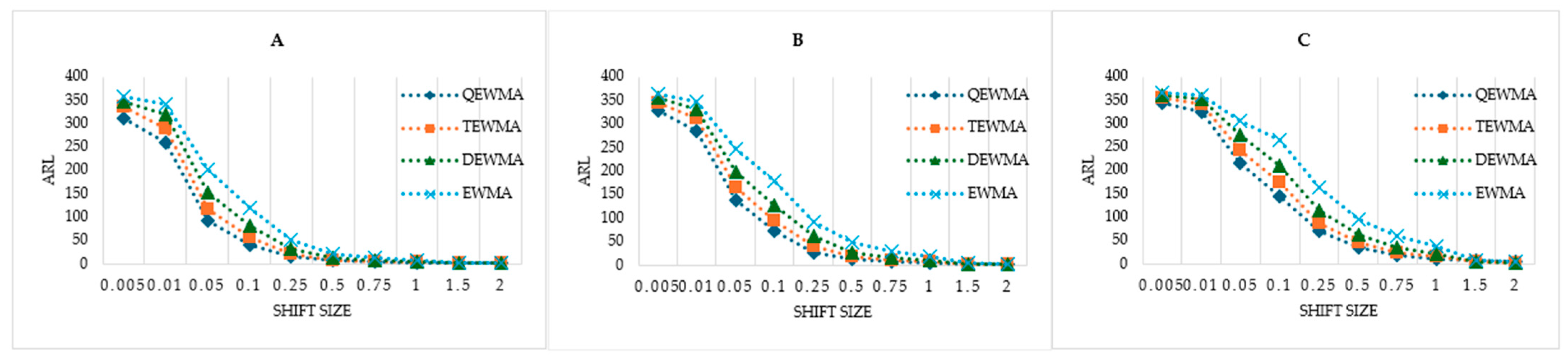
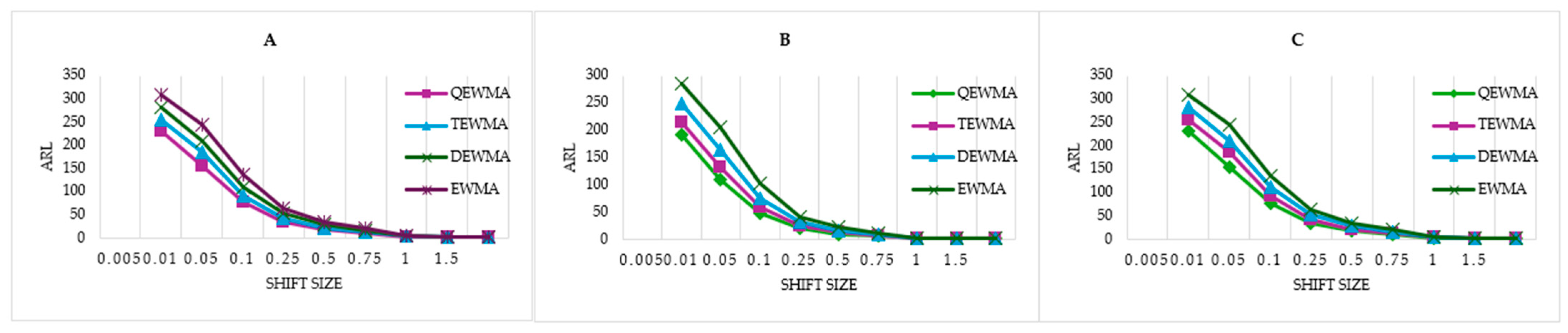
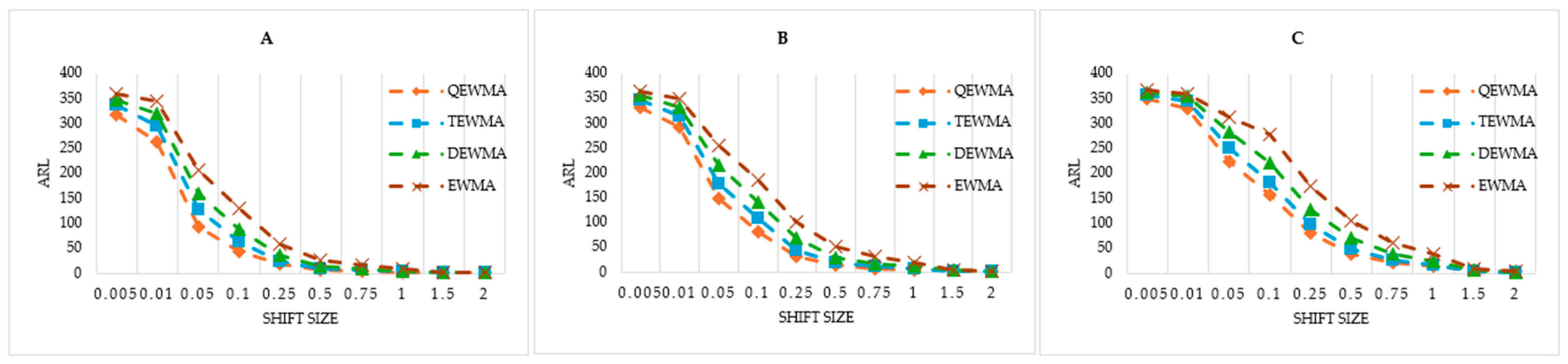
The performance analysis across Figure 2, Figure 3 and Figure 4 confirms that the QEWMA chart is the most efficient at detecting small-to-moderate shifts ( 0.005 δ 0.10 ) compared to TEWMA, DEWMA, and EWMA. This superiority is consistent across MA(1), MA(2), and MA(3) processes, as indicated by the QEWMA curves maintaining the lowest ARL values in all graphical representations. While the QEWMA chart excels in subtle shift detection, its advantage diminishes for large shifts ( δ 1.50 ) due to the inertia effect, where all curves eventually converge. Overall, the results validate that the quadruple smoothing structure significantly enhances sensitivity and stability in monitoring autocorrelated data.

4.4. Real-World Application

In this section, the practical applicability of the proposed QEWMA control chart is demonstrated using a real-world dataset. The goal is to evaluate how the chart performs in a non-simulated environment where autocorrelation is naturally present, specifically focusing on its ability to detect subtle process shifts compared to traditional methods.
To assess the efficacy of the proposed QEWMA system, two distinct datasets with different sample frequency and volatility characteristics were used: Thailand’s daily median income is sourced from Our World in Data (OWID) and is assessed in constant 2021 international dollars. This dataset depicts a low-frequency, high-autocorrelation economic indicator. Although median income is normally reported once a year, the OWID modeled daily estimates allow us to evaluate the model’s capacity to detect modest structural alterations in economic welfare. Daily Gold Futures Prices: Data from Investing.com (1 January 2026–28 February 2026). This collection contains high-frequency financial data characterized by fast market movements. The use of these datasets assures that the QEWMA framework is carefully evaluated across various econometric situations, ranging from steady macroeconomic trends to dramatic financial market swings.”

4.4.1. Application I: Median Income or Consumption per Day

In this section, the proposed QEWMA control chart is applied to a real-world economic dataset to evaluate its practical monitoring performance. The dataset selected is the Daily Median Income of Thailand (measured in constant 2021 international-$), sourced from Our World in Data. This data is critical for understanding economic stability and identifying subtle shifts in the population’s purchasing power. The historical income data for Thailand were analyzed for their stochastic properties. Based on the autocorrelation function (ACF) and partial autocorrelation function (PACF), the data were found to be best fitted with a Moving Average model of order 3, MA(3). The fitted parameters were estimated as μ = 10.563 , θ 1 = 1.912 , θ 2 = 1.904 , and θ 3 = 0.986 . This higher-order dependency makes it a challenging and appropriate case for testing advanced smoothing control charts like the QEWMA. To monitor the stability of the median income, the control charts were set with an in-control A R L 0 = 370 and a smoothing constant λ = 0.05 . A subtle negative shift was observed in the recent period, reflecting a slight economic contraction. The results demonstrate that the QEWMA control chart exhibits superior detection sensitivity compared to the standard EWMA and DEWMA charts. In particular, the QEWMA chart is able to signal the out-of-control state at a significantly earlier stage, especially in the presence of small mean shifts. As indicated by the theoretical results in Table 4, its enhanced ability to filter out the noise associated with the MA(3) process enables it to detect subtle drifts (e.g., δ = 0.05 more rapidly than lower-order charts. In addition to its improved detection capability, the QEWMA chart also provides a smoother and more stable monitoring statistic, thereby reducing the likelihood of false alarms (Type I errors). This property is particularly important in applications such as economic monitoring, where reliable signaling is essential for decision-making (see Table 8).

4.4.2. Application II: Monitoring Gold Futures Prices

In the second application, the practical efficiency of the proposed QEWMA control chart is further validated using high-frequency financial data. The dataset comprises the Daily Gold Futures Prices (sourced from Investing.com) covering the period from 1 January 2026 to 28 February 2026. Financial commodities like gold are known for their intricate dependency structures, making them an ideal candidate for testing the robustness of advanced monitoring schemes. The daily price volatility of the gold futures dataset was subjected to time-series modeling. Analysis of the autocorrelation functions (ACF) revealed that the data structure is best characterized by a Moving Average model of order 2, MA(2). The estimated parameters for this period were μ = 4874.605 , θ 1 = 1.309 and θ 2 = 0.717 . This second-order autocorrelation signifies that current price deviations are influenced by the shocks of the two preceding days, providing a realistic framework to evaluate the quadruple smoothing layers of the QEWMA chart. To maintain consistency with our previous evaluations, the control charts were configured with an in-control A R L 0 = 370 and a smoothing constant λ = 0.05 . A series of small shifts was analyzed to simulate subtle market trends or inflationary pressures. The results presented in Table 9 indicate that the QEWMA control chart significantly outperforms the EWMA, DEWMA, and TEWMA charts in detecting small market fluctuations. In particular, for a shift magnitude of δ = 0.10 , the QEWMA chart detects the change in approximately 3.8845, whereas the standard EWMA chart requires 10.9384, demonstrating a substantial reduction in detection delay. This improvement is particularly important for investors and analysts who rely on early warning signals to identify potential trend reversals. In addition to its superior detection speed, the QEWMA chart also exhibits enhanced consistency in signaling. As reflected in the SDRL values (e.g., 3.3474 at δ = 0.10 ), which are considerably lower than those of the competing charts, the QEWMA statistic provides a more stable and reliable signal. This improved precision, consistent with the theoretical findings reported in Table 6, indicates that the QEWMA chart is less sensitive to market noise and therefore offers more dependable out-of-control signals in volatile environments.

5. Conclusions

5.1. Conclusions

This research presented the development and performance evaluation of the Quadruple Exponentially Weighted Moving Average (QEWMA) control chart, specifically designed for monitoring the mean of processes with moving average MA(q) dependencies. The core objective was to enhance detection sensitivity for small-to-moderate process shifts ( δ 1.00 ) in autocorrelated environments. Through extensive numerical simulations and theoretical derivations, the results consistently demonstrated that the QEWMA chart significantly outperforms traditional schemes, including the standard EWMA, Double EWMA (DEWMA), and Triple EWMA (TEWMA). Across all tested MA(1), MA(2), and MA(3) processes, the QEWMA chart achieved the lowest Average Run Length (ARL) and Standard Deviation of Run Length (SDRL) in the small-shift regime. This efficiency was further validated through two real-world applications: Thailand’s daily median income data (MA(3)) and gold futures prices (MA(2)). In both cases, the QEWMA chart identified subtle economic and market drifts much faster than its competitors, proving its practical utility in high-precision monitoring. However, as shift magnitudes increased to a large range ( δ 1.50 ), all charts converged in performance due to the inherent inertia effect of multi-layered smoothing. The empirical results indicate that the QEWMA scheme is highly adaptable to data frequency. For high-frequency financial data, such as gold futures, the model’s sensitivity can be fine-tuned by selecting a smaller smoothing constant ( λ ) to filter out transient market noise while remaining responsive to significant regime shifts. Conversely, for the daily median income data, the QEWMA chart effectively captures long-term structural changes, providing early warning signals that traditional low-frequency models might miss. This flexibility positions the QEWMA framework as a valuable tool for real-time economic monitoring and risk management. Overall, the QEWMA chart provides a robust, reliable, and highly sensitive tool for process surveillance in the presence of autocorrelation.

5.2. Future Work

While the proposed QEWMA control chart demonstrates exceptional performance for univariate moving average processes, several avenues for future research remain open. Prospective studies could extend this quadruple smoothing framework to multivariate control charts (MQEWMA) to monitor multiple correlated quality characteristics under complex autocorrelation structures. Additionally, investigating the integration of adaptive smoothing constants or time-varying parameters could potentially mitigate the inertia effect observed during large process shifts. Further research is also encouraged to evaluate the robustness of the QEWMA scheme under non-normal distributions or in synergy with machine learning algorithms to enhance fault detection accuracy in increasingly complex industrial systems. These advancements would further solidify the QEWMA chart as a versatile and high-precision tool for modern statistical process monitoring.

Author Contributions

Conceptualization, J.N., Y.A. and S.S.; methodology, J.N. and Y.A.; software, J.N.; validation, J.N. and S.S.; formal analysis, J.N.; investigation, J.N.; writing—original draft preparation, J.N.; writing—review and editing, J.N. and Y.A.; visualization, Y.A. and S.S.; supervision, Y.A.; funding acquisition, Y.A. All authors have read and agreed to the published version of the manuscript.

Funding

This research budget was allocated by the National Science, Research and Innovation Fund (NSRF), and King Mongkut’s University of Technology North Bangkok (Project no. KMUTNB-FF-69-B-05).

Data Availability Statement

Acknowledgments

The authors are grateful to the editor and referees for their valuable time and effort on our manuscript.

Conflicts of Interest

The authors declare no potential conflict of interest with respect to the research, authorship, and/or publication of this article.

Abbreviations

The following abbreviations are used in this manuscript:
EWMAExponentially weighted moving average
DEWMADouble Exponentially weighted moving average
TEWMATriple Exponentially weighted moving average
QEWMAQuadruple Exponentially weighted moving average
MAMoving average Process
MCMonte Carlo simulation
NIENumerical Integration Equations
ARLAverage run length
SDRLStandard deviation of run length

Appendix A. Proof of Statistical Properties of the QEWMA Statistic

Appendix A.1. Proof of Expectation

Proof. 
Let the process observations { X t } follow an MA(q) model as defined in Equation (1). The QEWMA statistic Q t can be expressed as a linear combination of past observations. By recursively substituting the stages E t , D t , and T t into the formulation of Q t , we obtain:
Q t = λ 4 i = 0 t 1 i + 3 3 ( 1 λ ) i X t i + ( 1 λ ) t j = 0 3 ( t λ ) j j ! Q 0
Assuming the process is in a state of statistical control with E ( X t ) = μ 0 and the initial value is set to the target mean Q 0 = μ 0 , the expectation of Q t is:
E ( Q t ) = μ 0 λ 4 i = 0 t 1 i + 3 3 ( 1 λ ) i + ( 1 λ ) t j = 0 3 ( t λ ) j j !
Let S t = λ 4 i = 0 t 1 i + 3 3 ( 1 λ ) i . Using the property of the negative binomial series, it can be shown that as t , S t 1 . Furthermore, for any finite t , the term ( 1 λ ) t j = 0 3 ( t λ ) j j ! represents the remaining probability mass of the smoothing weights. Therefore, the term in the brackets identically equals 1 for all t 1 :
E ( Q t ) = μ 0 1 = μ 0
This completes the proof. □

Appendix A.2. Proof of Variance Under MA(q) Dependence

Proof. 
To derive the variance of Q t , we consider the stochastic component of the statistic:
Q t i = 0 t 1 w i X t i ,   where   w i = λ 4 i + 3 3 ( 1 λ ) i
The variance of a linear combination of dependent random variables is given by:
V a r ( Q t ) = i = 0 t 1 w i 2 V a r ( X t i ) + 2 i = 0 t 2 j = i + 1 t 1 w i w j C o v ( X t i , X t j )
Since X t follows an M A ( q ) process, let γ k = C o v ( X t , X t k ) be the autocovariance at lag k . The property of an M A ( q ) process implies that γ k 0 only for k q . By substituting k = j i , we obtain:
V a r ( Q t ) = i = 0 t 1 w i 2 γ 0 + 2 i = 0 t 2 k = 1 min ( q , t 1 i ) w i w i + k γ k
Substituting w i = λ 4 a i where a i = i + 3 3 ( 1 λ ) i :
V a r ( Q t ) = λ 8 i = 0 t 1 a i 2 γ 0 + 2 i = 0 t 2 k = 1 min ( q , t 1 i ) a i a i + k γ k
For an M A ( q ) process defined by X t = μ + ϵ t j = 1 q θ j ϵ t j , the autocovariances are:
γ 0 = σ ϵ 2 1 + j = 1 q θ j 2
γ k = σ ϵ 2 θ k + j = 1 q k θ j θ j + k ,   for   k = 1 , , q
The substitution of these γ k values into the variance expression completes the derivation. □

Appendix B. Proof of Analytical Derivation and for the QEWMA Statistic

Proof. 
From the inequality interval, the exponential form is as follows:
λ 4 μ i = 1 q θ i ϵ 1 i 1 λ μ 0 λ 3 + λ 2 + λ + 1 λ 4 ϵ 1
and
ϵ 1 h λ 4 μ i = 1 q θ i ϵ 1 i 1 λ μ 0 λ 3 + λ 2 + λ + 1 λ 4
According to the method of Champ and Rigdon [22], which is based on a second-kind Fredholm integral equation, the function Λ μ 0 is expressed as follows:
Λ μ 0 = 1 + 0 h Λ λ 4 u + λ 4 μ i = 1 q θ i ϵ 1 i + 1 λ μ 0 λ 3 + λ 2 + λ + 1 f u d u
Let g = λ 4 u + λ 4 μ i = 1 q θ i ϵ 1 i + 1 λ μ 0 λ 3 + λ 2 + λ + 1 , then
u = g λ 4 μ i = 1 q θ i ϵ 1 i 1 λ μ 0 λ 3 + λ 2 + λ + 1 λ 4
and
d u = 1 λ 4 d g .
By changing the integral variable, Equation (A1) can be written as:
Λ μ 0 = 1 + 1 λ 4 0 h Λ g g λ 4 μ i = 1 q θ i ϵ 1 i 1 λ μ 0 λ 3 + λ 2 + λ + 1 λ 4 d g
Since ϵ 1 E x p β , thus f x = 1 β E x p x β ; x 0 . Therefore
Λ μ 0 = 1 + E x p λ 4 μ i = 1 q θ i ϵ 1 i + 1 λ μ 0 λ 3 + λ 2 + λ + 1 β λ 4 β λ 4 0 h Λ g E x p g β λ 4 d g
After that, we defined
B μ 0 = E x p λ 4 μ i = 1 q θ i ϵ 1 i + 1 λ μ 0 λ 3 + λ 2 + λ + 1 β λ 4 β λ 4
and
G = 0 h Λ g E x p g β λ 4 d g ,
then we get
Λ μ 0 = 1 + B μ 0 G
Additionally, the solution to G as follows:
G = 0 h Λ g E x p g β λ 4 d g G = 0 h [ 1 + B g G ] E x p g β λ 4 d g G = 0 h E x p g β λ 4 d g + 0 h B g G E x p g β λ 4 d g
G = β λ 4 E x p h β λ 4 1 + G E x p μ i = 1 q θ i ϵ 1 i β 1 λ λ 3 + λ 2 + λ + 1 1 E x p h 1 λ λ 3 + λ 2 + λ + 1 1 β λ 4 1
So, we obtain
G = β λ 4 E x p h β λ 4 1 1 E x p μ i = 1 q θ i ϵ 1 i β 1 λ λ 3 + λ 2 + λ + 1 1 E x p h 1 λ λ 3 + λ 2 + λ + 1 1 β λ 4 1
Finally, by substituting G into (A2), we obtain the ARL in the control chart:
Λ μ 0 = 1 + E x p λ 4 μ i = 1 q θ i ϵ 1 i + 1 λ μ 0 λ 3 + λ 2 + λ + 1 β λ 4 1 E x p h β λ 4 1 E x p μ i = 1 q θ i ϵ 1 i β E x p h 1 λ λ 3 + λ 2 + λ + 1 1 β λ 4 1 1 λ λ 3 + λ 2 + λ + 1 1

References

  1. Shewhart, W.A. Quality Control Charts. Bell Syst. Tech. J. 1926, 5, 593–603. [Google Scholar] [CrossRef]
  2. Page, E.S. Continuous inspection schemes. Biometrika 1954, 41, 100–115. [Google Scholar] [CrossRef]
  3. Roberts, S.W. Control chart tests based on geometric moving averages. Technometrics 1959, 1, 239–250. [Google Scholar] [CrossRef]
  4. Brook, D.; Evans, D.A. An approach to the probability distribution of CUSUM run length. Biometrika 1972, 59, 539–549. [Google Scholar] [CrossRef]
  5. Crowder, S.V. A simple method for studying run-length distributions of EWMA charts. Technometrics 1987, 29, 401–407. [Google Scholar] [CrossRef]
  6. Crowder, S.V. Design of exponentially weighted moving average schemes. J. Qual. Technol. 1989, 21, 155–162. [Google Scholar] [CrossRef]
  7. Lucas, J.M.; Saccucci, M.S. Exponentially weighted moving average control schemes: Properties and enhancements. Technometrics 1990, 32, 1–12. [Google Scholar] [CrossRef]
  8. Steiner, S.H. EWMA control charts with time-varying control limits and fast initial response. J. Qual. Technol. 1999, 31, 75–86. [Google Scholar] [CrossRef]
  9. Shamma, S.E.; Shamma, A.K. Development and evaluation of control charts using double exponentially weighted moving averages. Int. J. Qual. Reliab. Manag. 1992, 9, 18–25. [Google Scholar] [CrossRef]
  10. Alevizakos, V.; Chatterjee, K.; Koukouvinos, C. The triple exponentially weighted moving average control chart. Qual. Technol. Quant. Manag. 2021, 18, 326–354. [Google Scholar] [CrossRef]
  11. Alevizakos, V.; Chatterjee, K.; Koukouvinos, C. The quadruple exponentially weighted moving average control chart. Qual. Technol. Quant. Manag. 2021, 19, 50–73. [Google Scholar] [CrossRef]
  12. Box, G.E.P.; Jenkins, G.M.; Reinsel, G.C.; Ljung, G.M. Time Series Analysis: Forecasting and Control, 5th ed.; Wiley: Hoboken, NJ, USA, 2015. [Google Scholar]
  13. Montgomery, D.C. Introduction to Statistical Quality Control, 7th ed.; Wiley: Hoboken, NJ, USA, 2013. [Google Scholar]
  14. Wardell, D.G.; Moskowitz, H.; Plante, R.D. Run-length distributions of special-cause control charts for correlated processes. Technometrics 1994, 36, 3–17. [Google Scholar] [CrossRef]
  15. Lu, C.W.; Reynolds, M.R. EWMA control charts for autocorrelated processes. J. Qual. Technol. 1999, 31, 166–188. [Google Scholar] [CrossRef]
  16. Areepong, Y.; Peerajit, W. Enhancing the ability of the EWMA control chart to detect changes in the mean of a time-series model. Malays. J. Fundam. Appl. Sci. 2024, 20, 1420–1439. [Google Scholar] [CrossRef]
  17. Peerajit, W. Optimizing the EWMA control chart to detect changes in the mean of a long-memory seasonal fractionally integrated moving average and an exogenous variable process with exponential white noise and its application to electrical output data. WSEAS Trans. Syst. Control 2025, 20, 25–41. [Google Scholar] [CrossRef]
  18. Javed, H.; Ismail, M.; Saeed, N. New extended exponentially weighted moving average control chart for monitoring process mean. Heliyon 2024, 10, e34424. [Google Scholar] [CrossRef] [PubMed]
  19. Karoon, K.; Areepong, Y. The Efficiency of the New Extended EWMA Control Chart for Detecting Changes Under an Autoregressive Model and Its Application. Symmetry 2025, 17, 104. [Google Scholar] [CrossRef]
  20. Polyeam, D.; Phanyaem, S. Application of EWMA Control Chart for Analyzing Changes in SAR(P)L Model with Quadratic Trend. Math. Stat. 2025, 13, 163–174. [Google Scholar] [CrossRef]
  21. Karoon, K.; Areepong, Y. Capability of New Modified EWMA Control Chart for Integrated and Fractionally Integrated Time-Series: Application to US Stock Prices. Symmetry 2026, 18, 5. [Google Scholar] [CrossRef]
  22. Champ, C.W.; Rigdon, S.E. A comparison of the Markov chain and the integral equation approaches for evaluating the run length distribution of quality control charts. Commun. Stat. Simul. Comput. 1991, 20, 191–204. [Google Scholar] [CrossRef]
Figure 1. The conceptual architecture and operational flow of the Quadruple Exponentially Weighted Moving Average (QEWMA) control chart. The diagram illustrates the sequential four-stage smoothing process, starting from the input observations X t influenced by MA(q) dependence, leading to the final decision logic.
Mathematics 14 01917 g001
Figure 2. Comparison of ARL graphs for QEWMA, TEWMA, DEWMA, and EWMA charts on MA(1) under different λ : (A) λ = 0.05 , (B) λ = 0.1 , and (C) λ = 0.25 .
Mathematics 14 01917 g002
Figure 3. Comparison of ARL graphs for QEWMA, TEWMA, DEWMA, and EWMA charts on MA(2) under different λ : (A) λ = 0.05 , (B) λ = 0.1 , and (C) λ = 0.25 .
Mathematics 14 01917 g003
Figure 4. Comparison of ARL graph for QEWMA, TEWMA, DEWMA, and EWMA charts on MA(3) under different λ : (A) λ = 0.05 , (B) λ = 0.1 , and (C) λ = 0.25 .
Mathematics 14 01917 g004
Table 1. Validation of A R L 0 = 370 . Results for QEWMA Chart under MA(q) Processes.
MA(q) θ λ hExact
(Time Used)
NIE
(Time Used)
RE (%)
MA(1) θ 1 = 0.9 0.051.65097370.81549
(<0.000)
370.81549
(<1.5905)
0.0000%
θ 1 = 0.5 0.051.9850370.01358
(<0.000)
370.01358
(<1.8350)
0.0000%
θ 1 = 0.0 0.102.411370.28479
(<0.000)
370.28479
(<1.4635)
0.0000%
θ 1 = 0.5 0.103.02574368.98158
(<0.000)
368.98158
(<1.94651)
0.0000%
θ 1 = 0.9 0.103.18038370.20013
(<0.000)
370.20013
(<1.8563)
0.0000%
MA(2) θ 1 = 0.3 , θ 2 = 0.1 0.052.91567369.93029
(<0.000)
369.93029
(<2.7946)
0.0000%
θ 1 = 0.4 , θ 2 = 0.2 0.054.284059369.99998
(<0.000)
369.99998
(<2.8045)
0.0000%
MA(3) θ 1 = 0.2 , θ 2 = 0.2 , θ 3 = 0.1 0.056.385274370.00093
(<0.000)
370.00093
(<2.9986)
0.0000%
The computational time is reported in seconds.
Table 2. ARL values for the QEWMA, TEWMA, DEWMA, and EWMA control charts for various λ on MA(1) with θ = 0.5 .
λ Control Chart δ
0.0050.010.050.100.250.500.751.001.50
0.05QEWMA175.321498.254139.412515.88748.66545.21562.88451.95411.1254
TEWMA198.6421115.443248.332119.452110.88236.50093.17372.11651.2541
DEWMA225.1542142.109862.154724.875413.44218.12474.05412.75341.5210
EWMA268.4210185.334188.621335.245618.254110.45315.14563.01451.8457
0.10QEWMA192.4512110.654148.332419.841210.12476.12452.11541.38621.2985
TEWMA215.3214132.874558.6541224.854512.85437.65412.78531.41241.3865
DEWMA248.6541165.221475.1245831.852215.91559.321452.27551.65421.4410
EWMA285.1295205.4125102.321442.224321.997312.112543.014342.32222.0974
0.25QEWMA230.8243155.321478.003535.425818.009411.02543.13301.93031.8360
TEWMA255.4513185.641292.285442.915422.376413.12554.29442.10432.0098
DEWMA282.4654210.3321110.915352.714428.296516.45215.23452.60162.5429
EWMA310.2542245.3542135.998065.024335.001121.221456.33563.25412.8964
Boldface values indicate the minimum ARL in each case.
Table 3. ARL values for the QEWMA, TEWMA, DEWMA, and EWMA control charts for various λ on MA(2) with θ 1 = 0.3 , θ 2 = 0.2 .
λ Control Chart δ
0.0050.010.050.100.250.500.751.001.502.00
0.05QEWMA312.4580 258.9724 92.3456 42.1287 17.2045 7.5562 4.4438 3.4566 2.0277 2.4456
TEWMA 335.6134 290.4557 118.5632 58.6541 22.8852 9.4012 5.6907 4.5672 2.4478 2.4567
DEWMA 348.3754 318.9202 152.1295 82.5562 32.8975 13.2855 8.2236 5.2237 1.5609 1.8975
EWMA 359.3956 342.1513 202.1415 120.332 52.8874 22.0564 14.6965 9.3478 2.3460 1.6834
0.10QEWMA 328.2946 285.4641 138.2521 72.1245 28.1441 12.5562 7.3585 5.3345 3.2474 2.8902
TEWMA 345.8534 312.5856 165.9405 95.8821 42.1245 18.2254 11.0287 7.3788 2.0278 2.1567
DEWMA 355.0018 330.1295 198.0663 128.0093 62.1725 28.5562 17.5683 11.2266 3.2346 1.8379
EWMA 364.3945 348.1133 248.1259 178.2656 92.1828 48.4097 29.5865 19.3798 4.4796 2.5796
0.25QEWMA 345.1365 325.8441 215.8782 145.1856 72.1835 35.1245 19.4794 12.0209 7.6794 4.8003
TEWMA 355.4862 340.8513 242.1975 175.1103 88.5182 45.4832 25.1245 15.3374 5.5003 3.1447
DEWMA 361.0845 352.2950 275.4471 210.9553 115.9641 62.5745 35.4829 22.2289 6.0449 2.5182
EWMA 367.5859 360.0254 305.1255 265.1956 165.1692 95.8267 58.9938 38.0765 8.4889 4.1789
Boldface values indicate the minimum ARL in each case.
Table 4. ARL values for the QEWMA, TEWMA, DEWMA, and EWMA control charts for various λ on MA(3) with θ 1 = 0.2 , θ 2 = 0.1 , θ 3 = 0.15 .
λ Control Chart δ
0.0050.010.050.100.250.500.751.001.502.00
0.05QEWMA 318.4729 264.1935 94.8206 45.3712 19.6483 8.5527 5.1946 3.6728 2.8491 2.3056
TEWMA 336.9104 294.7281 128.5543 63.1905 25.4162 10.8834 6.8219 4.7562 2.4403 1.9127
DEWMA 347.2285 321.2889 161.3721 89.6647 37.3747 15.4284 9.0336 6.1158 1.9834 1.5209
EWMA 361.0562 344.8317 208.1945 131.4528 58.7731 26.3902 16.5547 10.2841 2.9115 1.7648
0.10QEWMA 332.8416 291.5562 148.7219 81.4053 32.5567 14.1902 8.6641 6.0135 4.1128 3.1945
TEWMA 346.1037 315.4827 179.3304 108.6572 45.1834 20.441 12.5562 8.1834 3.0562 2.4103
DEWMA 356.7284 332.9104 215.2549 142.1834 68.4215 30.8154 18.3304 12.1936 3.8821 1.9405
EWMA 363.5562 349.2775 256.4162 186.7289 102.3721 52.1158 32.8917 20.4284 5.2104 2.8562
0.25QEWMA 349.0336 331.4284 224.5547 158.7731 82.3902 40.1158 22.8917 14.5562 7.9104 5.3721
TEWMA 358.4162 345.1559 252.1936 183.1834 98.4215 50.4827 28.1945 17.6572 6.1834 3.5562
DEWMA 362.1945 354.3304 282.6572 221.1158 128.8834 72.4413 38.6547 24.8317 7.4215 2.9104
EWMA 366.5562 359.8206 312.4528 278.3721 175.0562 105.1339 62.1905 40.5543 9.6547 4.8827
Boldface values indicate the minimum ARL in each case.
Table 5. SDRL values for the QEWMA, TEWMA, DEWMA, and EWMA control charts for various λ on MA(1) with θ = 0.5 .
λ Control Chart δ
0.0050.010.050.100.250.500.751.001.50
0.05QEWMA174.820797.752838.909315.37938.15014.68902.33151.36540.3757
TEWMA198.1415114.942147.829518.945510.37035.98002.62651.53720.5645
DEWMA224.6536141.608961.652724.370312.93247.60833.51882.19720.8902
EWMA267.9205184.833488.119934.742017.74719.94054.61862.46431.2494
0.10QEWMA191.9505110.153047.829819.33479.61175.60221.53610.73170.6226
TEWMA214.8208132.373658.152024.349412.34427.13662.22990.76320.7320
DEWMA248.1536164.720674.622931.348215.40748.80731.70361.04030.7972
EWMA284.6291204.9119101.820241.721321.491511.60182.46411.75231.5171
0.25QEWMA230.3238154.820677.501934.922217.502310.51352.58511.34011.2389
TEWMA254.9508185.140591.784042.412521.870712.61563.76131.52441.4246
DEWMA281.9650209.8315110.414252.212027.792015.94434.70802.04131.9808
EWMA309.7538244.8537135.497164.522434.497520.71545.81412.70832.3437
Table 6. SDRL values for the QEWMA, TEWMA, DEWMA, and EWMA control charts for various λ on MA(2) with θ 1 = 0.3 , θ 2 = 0.2 .
λ Control Chart δ
0.0050.010.050.100.250.500.751.001.502.00
0.05QEWMA311.9576258.471991.844241.625716.69707.03853.91202.91401.44361.8803
TEWMA335.1130289.9553118.062158.152022.37968.88715.16664.03631.88251.8917
DEWMA347.8750318.4198151.628782.054732.393612.77577.70744.69720.93571.3050
EWMA358.8953341.6509201.6409119.831052.385021.550614.18778.83371.77701.0726
0.10QEWMA327.7942284.9637137.751271.622827.639612.04586.84034.80862.70152.3373
TEWMA345.3530312.0852165.439795.380841.621517.718310.51686.86061.44371.5794
DEWMA354.5014329.6291197.5657127.508361.670528.051717.061010.71492.68851.2410
EWMA363.8942347.6129247.6254177.764991.681447.907129.082218.87323.94812.0186
0.25QEWMA344.6361325.3437215.3776144.684771.681834.620918.972811.51007.16204.2711
TEWMA354.9858340.3509241.6970174.609688.016844.980424.619414.82904.97522.5970
DEWMA360.5842351.7946274.9466210.4547115.463062.072534.979321.72315.52231.9553
EWMA367.0856359.5251304.6251264.6951164.668495.325458.491737.57327.97323.6448
Table 7. SDRL values for the QEWMA, TEWMA, DEWMA, and EWMA control charts for various λ on MA(3) with θ 1 = 0.2 , θ 2 = 0.1 , θ 3 = 0.15 .
λ Control Chart δ
0.0050.010.050.100.250.500.751.001.502.00
0.05QEWMA317.9725263.693094.319344.868419.14188.03724.66793.13322.29531.7350
TEWMA336.4100294.2277128.053362.688524.911210.37146.30214.22671.87481.3213
DEWMA346.7281320.7885160.871389.163336.871314.92008.51895.59351.39660.8901
EWMA360.5559344.3313207.6939130.951858.271025.885416.04699.77132.35911.1618
0.10QEWMA332.3412291.0558148.221180.903832.052813.68118.14885.49083.57802.6477
TEWMA345.6033314.9823178.8297108.156044.680619.934712.04587.66712.50681.8437
DEWMA356.2280332.4100214.7543141.682567.919730.311317.823411.68293.34491.3509
EWMA363.0559348.7771255.9157186.2282101.870951.613432.387819.92214.68382.3025
0.25QEWMA348.5332330.9280224.0541158.272381.888739.612622.386114.04737.39354.8464
TEWMA357.9159344.6555251.6931182.682797.920249.980227.690017.14995.66143.0150
DEWMA361.6942353.8300282.1568220.6152128.382471.939638.151424.32666.90342.3580
EWMA366.0559359.3203311.9524277.8717174.5555104.632761.688540.05129.14104.3541
Table 8. Performance comparison for Thailand’s Daily Median Income data (MA(3) process).
δ QEWMATEWMADEWMAEWMA
ARLSDRLARLSDRLARLSDRLARLSDRL
0.005312.8457312.3452328.6172328.1168345.9031345.4027362.1184361.6181
0.01258.1934257.6929291.4756290.9752318.6628318.1624339.5072339.0068
0.05119.5621119.0611135.7842135.2833158.9024158.4016198.6745198.1739
0.1041.782341.279359.231758.729687.341586.8401128.9036128.4026
0.2518.904618.397826.903526.398836.782136.278755.842755.3404
0.508.23157.715310.45629.943614.982614.474025.907425.4025
0.755.08734.56006.59286.07228.75438.239116.231515.7236
1.003.54122.99984.68214.15216.10475.582410.562310.0499
1.502.76342.20752.51271.94962.04181.45852.84562.2917
2.002.19871.62341.87641.28241.64291.02771.70321.0944
Boldface values indicate the minimum ARL in each case.
Table 9. Performance comparison for Gold Price data (MA(2) process).
δ QEWMATEWMADEWMAEWMA
ARLSDRLARLSDRLARLSDRLARLSDRL
0.005329.4816328.9812341.7269341.2265358.2093357.7090366.7351366.2348
0.01247.9035247.4030289.1142288.6138326.8875326.3871348.9026348.4022
0.05134.7728134.2719149.3586148.8578171.6492171.1485207.4839206.9833
0.1049.618749.116266.902466.400593.581693.0803136.7745136.2736
0.2521.305920.799928.774128.269739.462838.959659.318258.8161
0.509.14268.628111.203710.692015.667415.159227.115826.6111
0.755.67315.14896.88496.36539.21468.700217.402716.8953
1.003.88453.34744.93264.40436.53216.011310.938410.4264
1.502.69122.13342.58412.02322.10371.52382.97352.4224
2.002.14381.56591.91851.32751.59820.97781.72161.1146
Boldface values indicate the minimum ARL in each case.
Disclaimer/Publisher’s Note: The statements, opinions and data contained in all publications are solely those of the individual author(s) and contributor(s) and not of MDPI and/or the editor(s). MDPI and/or the editor(s) disclaim responsibility for any injury to people or property resulting from any ideas, methods, instructions or products referred to in the content.