Magnetic Control of Quantum Correlations in a Two-Qubit Spin System Under Dephasing


Abstract
1. Introduction
2. Ground-State Hydrogen: Hyperfine Coupling in a Magnetic Field
3. Dephasing Effects in Open Quantum Systems
3.1. Independent Versus Correlated Dephasing
3.2. Evolution of Density-Matrix Elements
3.2.1. Population Subspace
3.2.2. Coherence Subspace
3.3. Initial States
4. Quantifiers of Quantum Correlations: Entanglement of Formation, Quantum Steering via the CJWR Inequality, and Bell Nonlocality
4.1. Entanglement of Formation
4.2. Quantum Steering Based on the CJWR Inequality
4.3. Bell Nonlocality
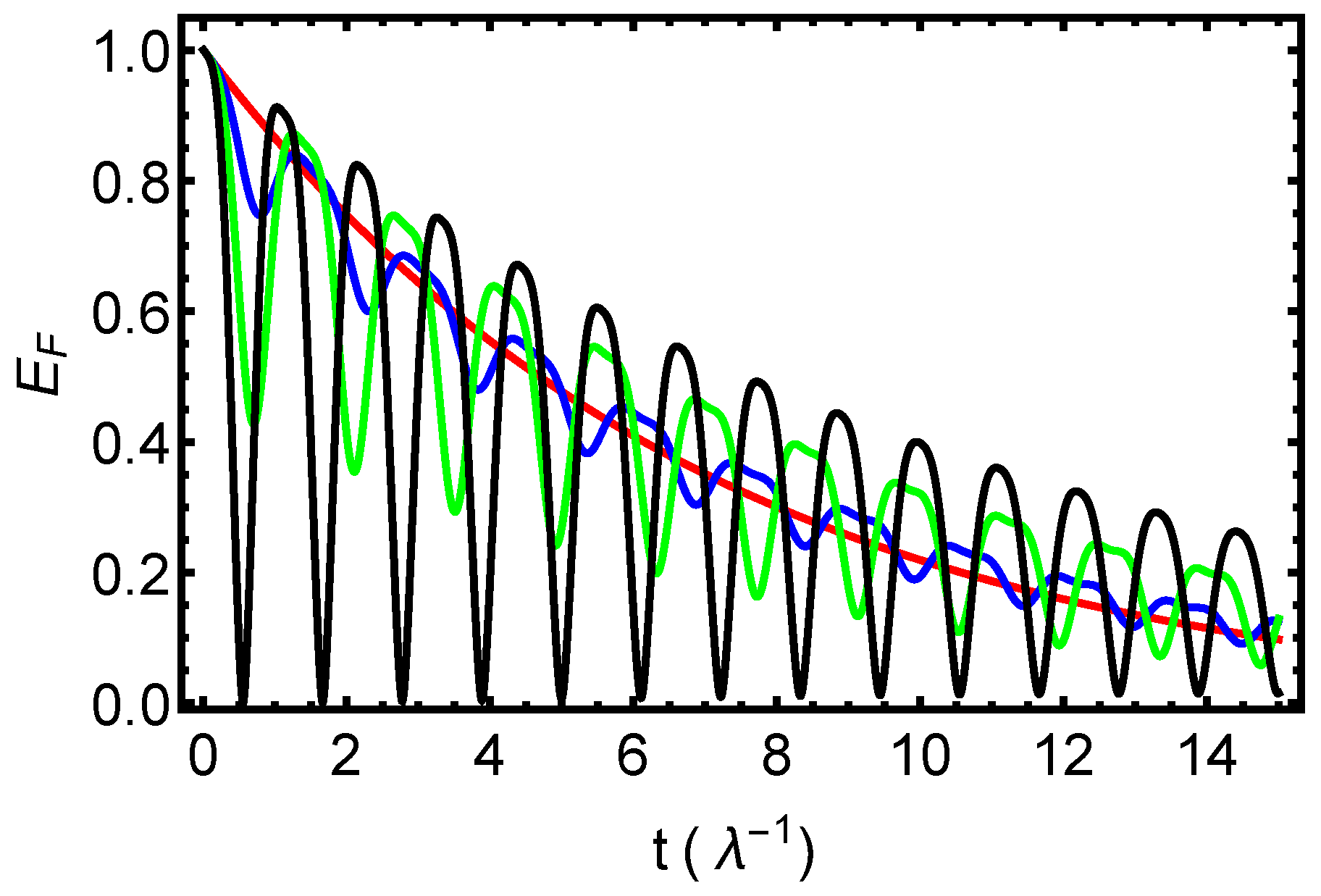
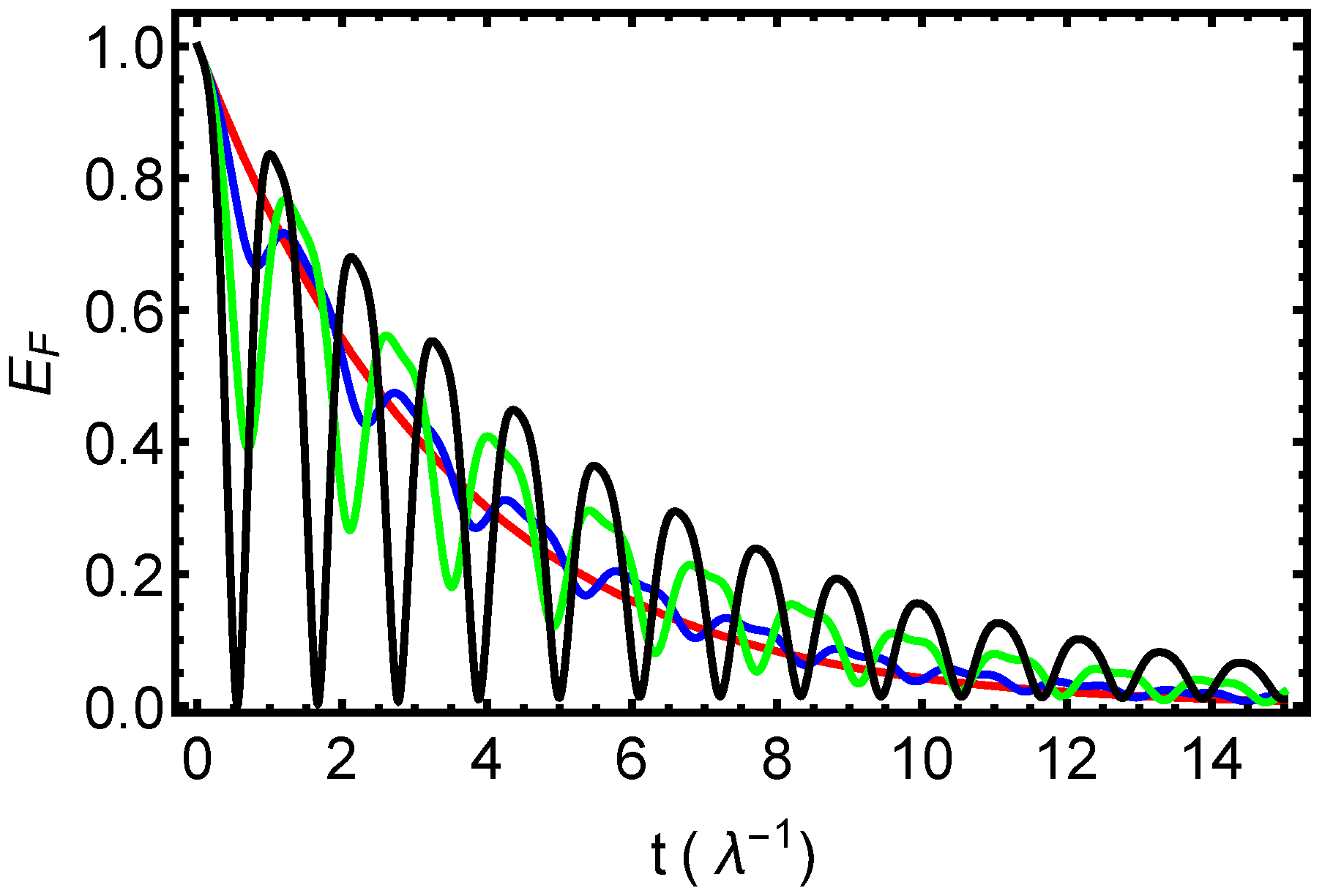
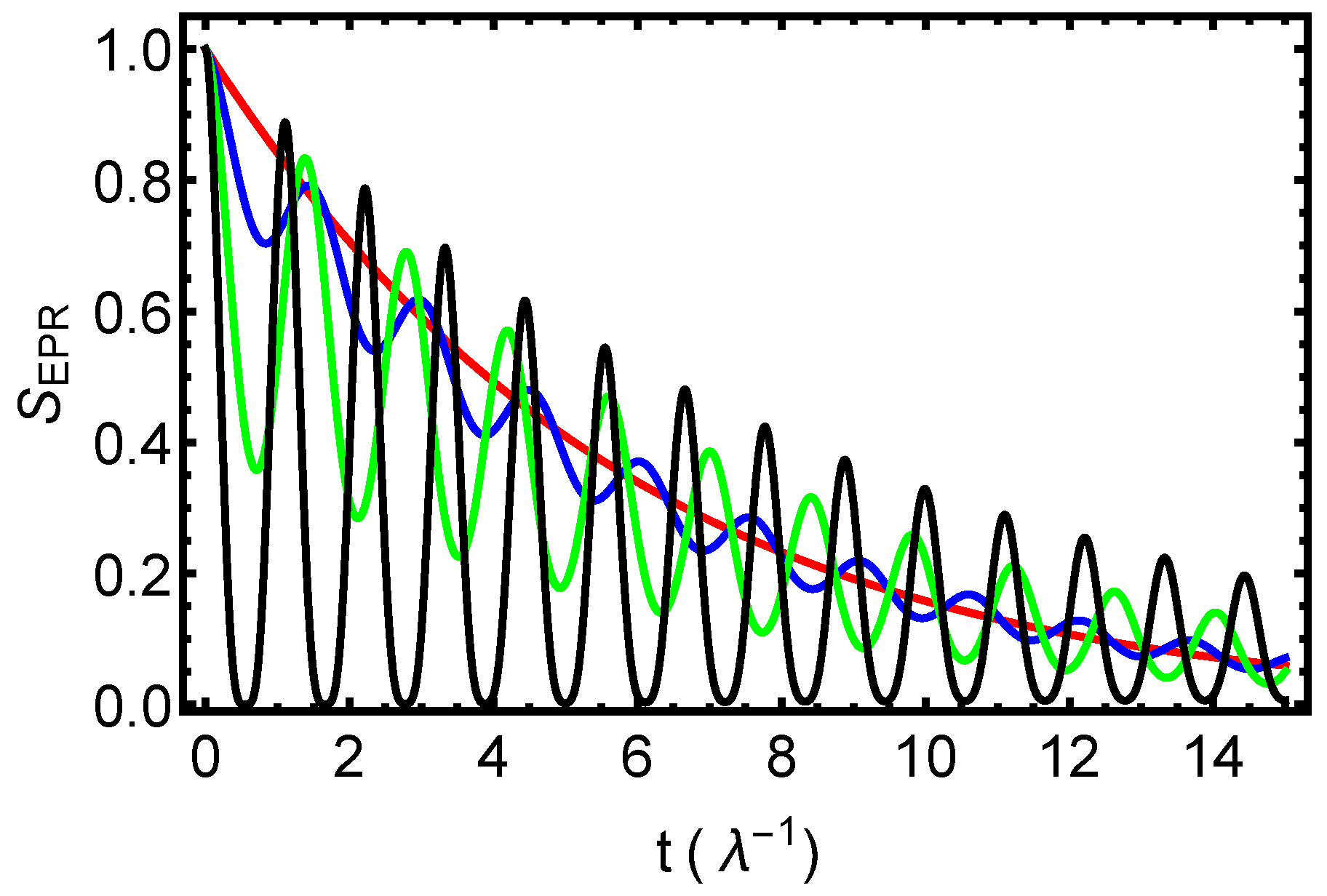
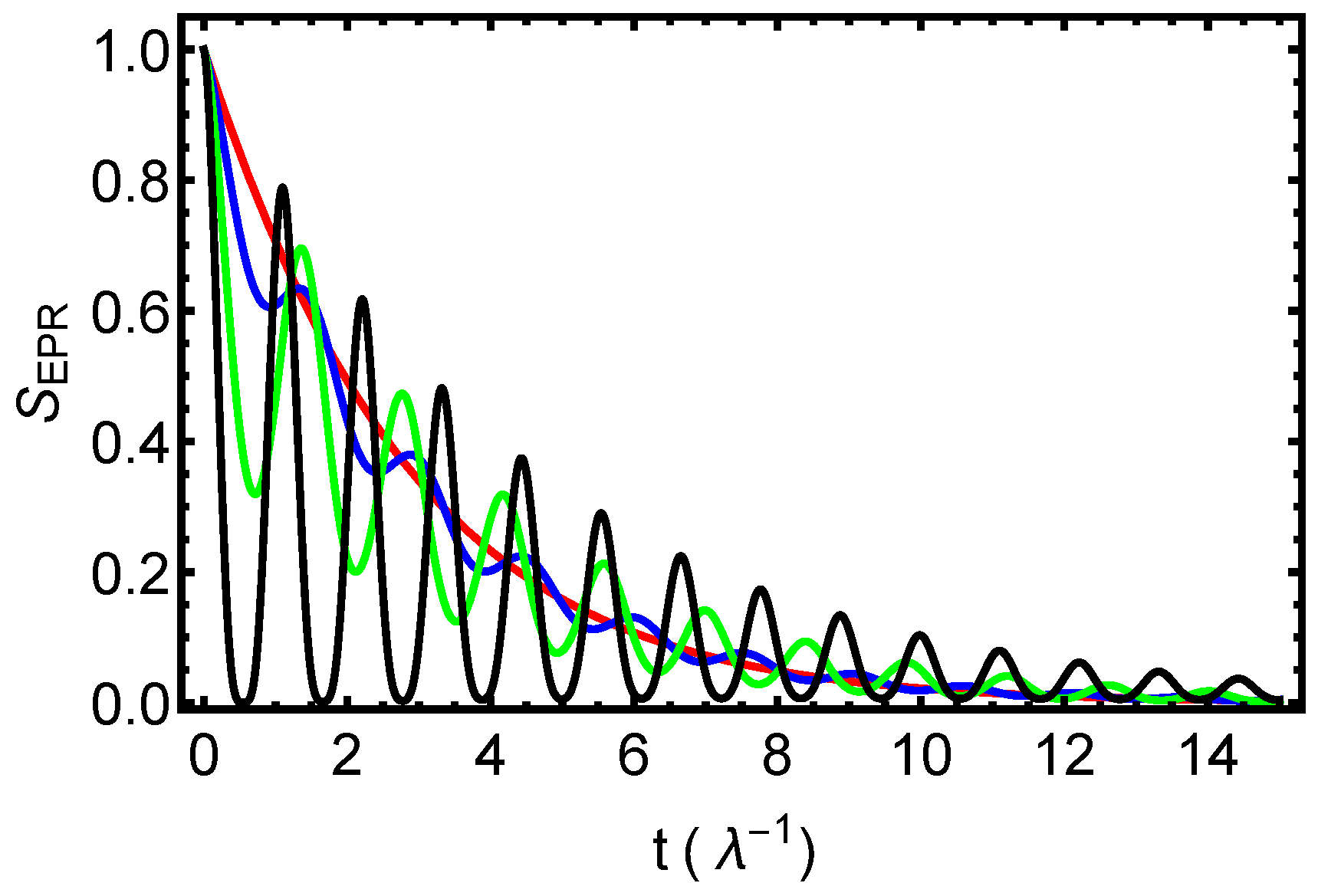
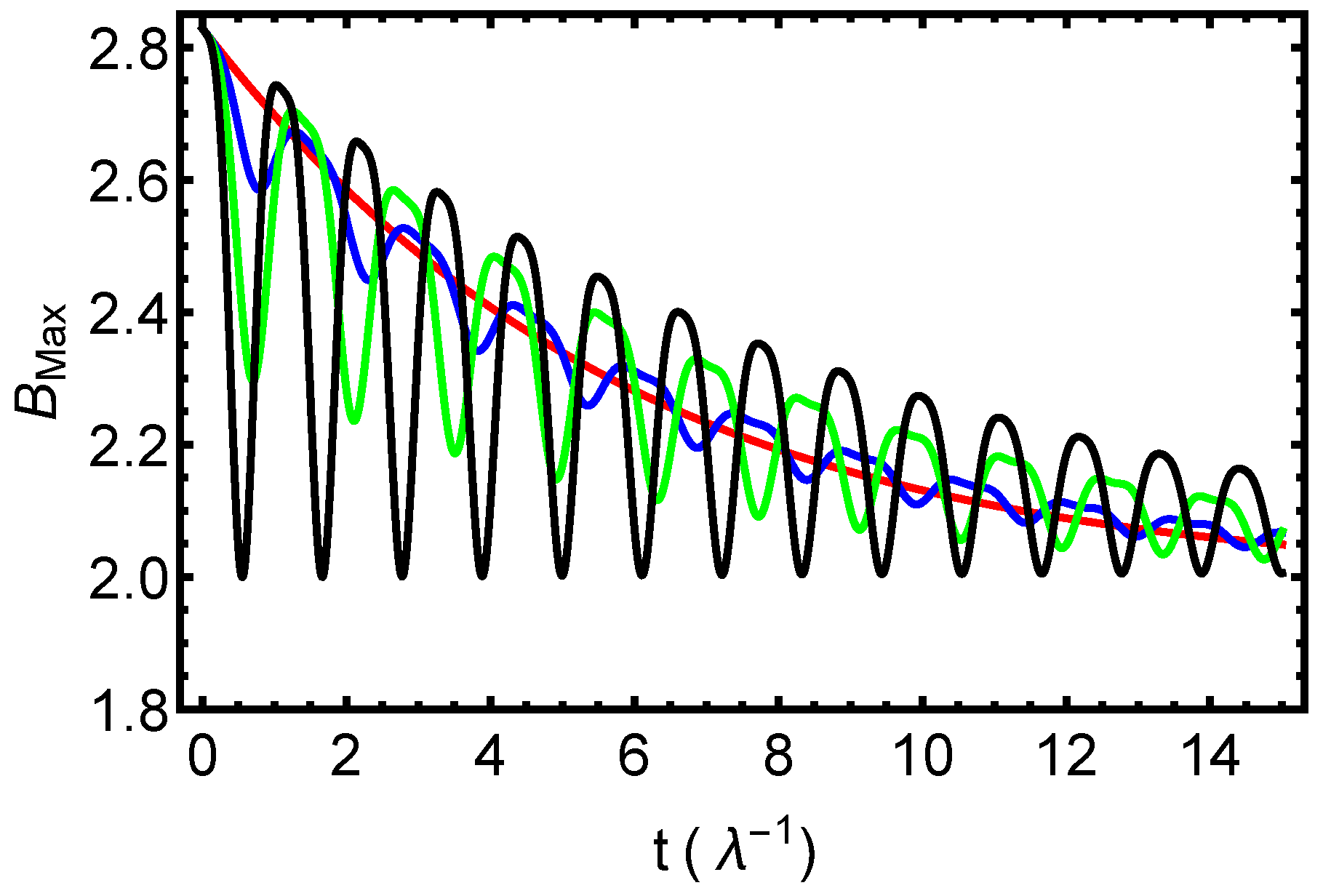
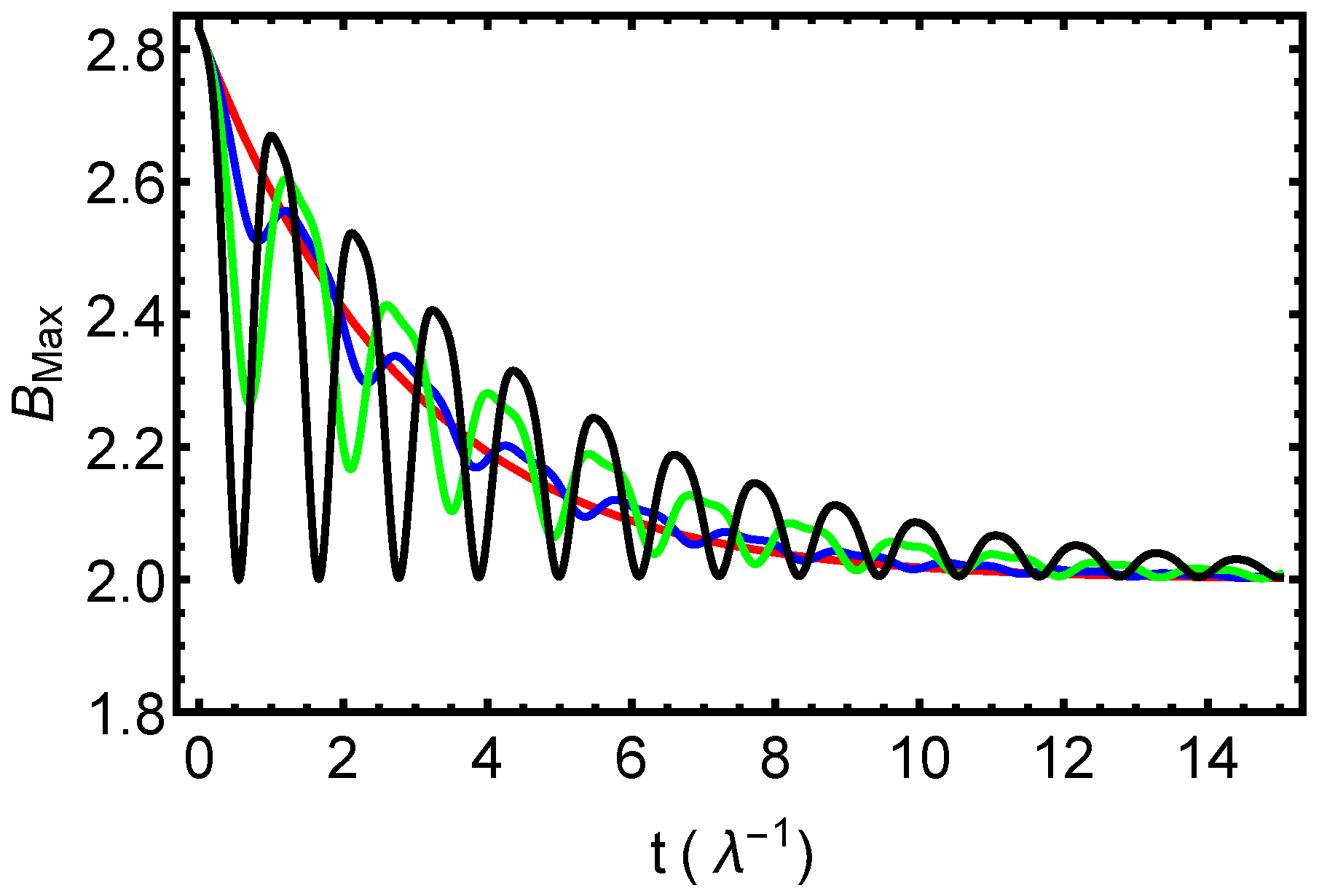
5. Numerical Results and Analysis of Quantum Correlation Quantifiers
6. Conclusions
Author Contributions
Funding
Data Availability Statement
Conflicts of Interest
Appendix A. Exact Diagonalization of the Hyperfine–Zeeman Hamiltonian
Appendix A.1. Matrix Representation
Appendix A.2. Eigenvalues and Eigenstates
Appendix A.3. Limiting Regimes
Appendix B. Analytical Solution for the Density-Matrix Dynamics
Appendix B.1. Block Structure of the Dynamics
- (i)
- The aligned-spin subspace ,
- (ii)
- The single-excitation subspace .
Appendix B.2. Aligned-Spin Subspace
Appendix B.3. Single-Excitation Subspace
Appendix B.4. Remaining Components
References
- Bohr, N. On the Constitution of Atoms and Molecules. Philos. Mag. 1913, 26, 1. [Google Scholar] [CrossRef] [Scilit]
- Bethe, H.; Salpeter, E. Quantum Mechanics of One- and Two-Electron Atoms; Springer: Berlin, Germany, 1957. [Google Scholar]
- Series, G.W. Spectrum of Atomic Hydrogen; Oxford University: New York, NY, USA, 1957. [Google Scholar]
- Landau, L.D.; Lifshitz, E.M. Quantum Mechanics: Nonrelativistic Theory; Pergamon: London, UK, 1958. [Google Scholar]
- Sheludiakov, S.; McColgan, P.T.; Lee, D.M.; Khmelenko, V.V.; Järvinen, J.; Ahokas, J.; Vasiliev, S. Formation of Nuclear-Polarized Phases of H Atoms Embedded in Solid H2 Films. Phys. Rev. Lett. 2019, 122, 225301. [Google Scholar] [CrossRef] [Scilit]
- Ahokas, J.; Vainio, O.; Novotny, S.; Järvinen, J.; Khmelenko, V.V.; Lee, D.M.; Vasiliev, S. Magnetic resonance study of H atoms in thin films of H2 at temperatures below 1 K. Phys. Rev. B 2010, 81, 104516. [Google Scholar] [CrossRef] [Scilit]
- Ahokas, J.; Järvinen, J.; Khmelenko, V.V.; Lee, D.M.; Vasiliev, S. Exotic Behavior of Hydrogen Atoms in Solid H2 at Temperatures below 1 K. Phys. Rev. Lett. 2006, 97, 095301. [Google Scholar] [CrossRef] [Scilit]
- Bigelow, N.P.; Freed, J.H.; Lee, D.M. Nuclear-spin waves in polarized atomic hydrogen gas: Temperature and density dependence in the hydrodynamic and Knudsen regimes. Phys. Rev. Lett. 1989, 63, 1609. [Google Scholar] [CrossRef] [Scilit]
- Johnson, A.C.; Petta, J.R.; Marcus, C.M.; Hanson, M.P.; Gossard, A.C. Triplet-Singlet Spin Relaxation via Nuclei in a Double Quantum Dot. Nature 2005, 435, 925–928. [Google Scholar] [CrossRef] [Scilit] [PubMed]
- Petta, J.R.; Johnson, A.C.; Taylor, J.M.; Laird, E.A.; Yacoby, A.; Lukin, M.D.; Marcus, C.M.; Hanson, M.P.; Gossard, A.C. Coherent Manipulation of Coupled Electron Spins in Semiconductor Quantum Dots. Science 2005, 309, 2180–2184. [Google Scholar] [CrossRef] [Scilit]
- Taylor, J.M.; Engel, H.A.; Dür, W.; Yacoby, A.; Marcus, C.M.; Zoller, P.; Lukin, M.D. Fault-Tolerant Architecture for Quantum Computation Using Electrically Controlled Semiconductor Spins. Nat. Phys. 2005, 1, 177–183. [Google Scholar] [CrossRef] [Scilit]
- Ladd, T.D.; Jelezko, F.; Laflamme, R.; Nakamura, Y.; Monroe, C.; O’Brien, J.L. Quantum Computers. Nature 2010, 464, 45–53. [Google Scholar] [CrossRef] [Scilit]
- Bennett, C.H.; DiVincenzo, D.P. Quantum Information and Computation. Nature 2000, 404, 247–255. [Google Scholar] [CrossRef] [Scilit] [PubMed]
- Tommasini, P.; Timmermans, E.; de Toledo Piza, A.F.R. The hydrogen atom as an entangled electron–proton system. Am. J. Phys. 1998, 66, 881–886. [Google Scholar] [CrossRef] [Scilit]
- Zhu, G.; Du, K.; Li, Y. Electron-nuclear entanglement in hydrogen atom. Phys. A Stat. Mech. Appl. 2005, 346, 295–302. [Google Scholar] [CrossRef] [Scilit]
- Wootters, W.K. Entanglement of Formation of an Arbitrary State of Two Qubits. Phys. Rev. Lett. 1998, 80, 2245. [Google Scholar] [CrossRef] [Scilit]
- Jozsa, R. Fidelity for mixed quantum states. J. Mod. Opt. 1994, 41, 2315–2323. [Google Scholar] [CrossRef] [Scilit]
- Adesso, G.; Bromley, T.R.; Cianciaruso, M. Measures and applications of quantum correlations. J. Phys. A Math. Theor. 2016, 49, 473001. [Google Scholar] [CrossRef] [Scilit]
- Wootters, W.K. Entanglement of Formation and Concurrence. Quantum Inf. Comput. 2001, 1, 27–44. [Google Scholar] [CrossRef] [Scilit]
- Uhlmann, A. The ‘transition probability’ in the state space of a*-algebra. Rep. Math. Phys. 1976, 9, 273–279. [Google Scholar] [CrossRef] [Scilit]
- Berrada, K.; Bougouffa, S. Detecting and Preserving Quantum Steering in Hydrogen Atoms: Entropic Inequalities and Lindblad Dynamics. Mathematics 2025, 13, 3953. [Google Scholar] [CrossRef] [Scilit]
- Girolami, D.; Tufarelli, T.; Adesso, G. Characterizing nonclassical correlations via local quantum uncertainty. Phys. Rev. Lett. 2013, 110, 240402. [Google Scholar] [CrossRef] [Scilit]
- Breuer, H.-P.; Petruccione, F. The Theory of Open Quantum Systems; Oxford University Press: Oxford, UK, 2002. [Google Scholar] [CrossRef] [Scilit]
- Lindblad, G. On the generators of quantum dynamical semigroups. Commun. Math. Phys. 1976, 48, 119–130. [Google Scholar] [CrossRef] [Scilit]
- Gorini, V.; Kossakowski, A.; Sudarshan, E.C.G. Completely positive dynamical semigroups of N-level systems. J. Math. Phys. 1976, 17, 821–825. [Google Scholar] [CrossRef] [Scilit]
- Žutić, I.; Fabian, J.; Sarma, S.D. Spintronics: Fundamentals and applications. Rev. Mod. Phys. 2004, 76, 323. [Google Scholar] [CrossRef] [Scilit]
- Awschalom, D.D.; Bassett, L.C.; Dzurak, A.S.; Hu, E.L.; Petta, J.R. Quantum spintronics: Engineering and manipulating atom-like spins in semiconductors. Science 2013, 339, 1174–1179. [Google Scholar] [CrossRef] [Scilit]
- Wolf, S.A.; Awschalom, D.D.; Daughton, J.M.; von Molnar, S.; Roukes, M.L.; Chtchelkanova, A.Y.; Treger, D.M. Spintronics: A spin-based electronics vision for the future. Science 2001, 294, 1488–1495. [Google Scholar] [CrossRef] [Scilit] [PubMed]
- Hanson, R.; Kouwenhoven, L.P.; Petta, J.R.; Tarucha, S.; Vandersypen, L.M.K. Spins in few-electron quantum dots. Rev. Mod. Phys. 2007, 79, 1217–1265. [Google Scholar] [CrossRef] [Scilit]
- Loss, D.; DiVincenzo, D.P. Quantum computation with quantum dots. Phys. Rev. A 1998, 57, 120. [Google Scholar] [CrossRef] [Scilit]
- Berry, M.V. Quantal phase factors accompanying adiabatic changes. Proc. R. Soc. Lond. A 1984, 392, 45–57. [Google Scholar] [CrossRef] [Scilit]
- Carollo, A.; Fuentes-Guridi, I.; Santos, M.F.; Vedral, V. Geometric phase in open systems. Phys. Rev. Lett. 2003, 90, 160402. [Google Scholar] [CrossRef] [Scilit]
- Sjöqvist, E. Geometric phases in quantum information. Int. J. Quantum Chem. 2015, 115, 1311–1326. [Google Scholar] [CrossRef] [Scilit]
- Demtröder, W. Atoms, Molecules and Photons; Springer: Berlin/Heidelberg, Germany, 2010; Volume 3. [Google Scholar] [CrossRef] [Scilit]
- Ruth, D.; Slifer, K.; Chen, J.P.; Carlson, C.E.; Hagelstein, F.; Pascalutsa, V.; Deur, A.; Kuhn, S.; Ripani, M.; Zheng, X.; et al. New spin structure constraints on hyperfine splitting and proton Zemach radius. Phys. Lett. B 2024, 859, 139116. [Google Scholar] [CrossRef] [Scilit]
- Hagelstein, F.; Lensky, V.; Pascalutsa, V. Chiral perturbation theory of the hyperfine splitting in (muonic) hydrogen. arXiv 2023, arXiv:2305.09633. [Google Scholar] [CrossRef] [Scilit]
- Jóźwiak, H.; Tscherbul, T.V.; Wcisło, P. Hyperfine and Zeeman interactions in ultracold collisions of molecular hydrogen with atomic lithium. J. Chem. Phys. 2024, 160, 124309. [Google Scholar] [CrossRef] [Scilit]
- Berrada, K.; Bougouffa, S. Harnessing quantum entanglement and fidelity in hydrogen atoms: Dynamics under dephasing noise. Appl. Sci. 2025, 15, 10938. [Google Scholar] [CrossRef] [Scilit]
- Baker, C.J.; Bertsche, W.; Capra, A.; Carruth, C.; Cesar, C.L.; Charlton, M.; Cridland, A.; Eriksson, S.; Isaac, A.; Jones, J.; et al. Precision spectroscopy of the hyperfine components of the 1S–2S transition in antihydrogen. Nat. Phys. 2025, 21, 201–207. [Google Scholar] [CrossRef] [Scilit]
- Feynman, R.P.; Leighton, R.B.; Sands, M. The Feynman Lectures on Physics, Vol. III: Quantum Mechanics; Addison-Wesley: Reading, MA, USA, 1965. [Google Scholar]
- Chen, J.-P. Spin Structure Program at Jefferson Lab. In Proceedings of the 25th International Spin Symposium (SPIN 2023), Durham, NC, USA, 24–29 September 2023. [Google Scholar] [CrossRef] [Scilit]
- Nathan, F.; Rudner, M.S. Universal Lindblad equation for open quantum systems. Phys. Rev. B 2020, 102, 115109. [Google Scholar] [CrossRef] [Scilit]
- Manzano, D. A short introduction to the Lindblad master equation. AIP Adv. 2020, 10, 025106. [Google Scholar] [CrossRef] [Scilit]
- Budini, A.A. Lindblad rate equations. Phys. Rev. A 2006, 74, 053815. [Google Scholar] [CrossRef] [Scilit]
- Yu, T.; Eberly, J.H. Finite-Time Disentanglement Via Spontaneous Emission. Phys. Rev. Lett. 2004, 93, 140404. [Google Scholar] [CrossRef] [Scilit]
- Nielsen, M.A.; Chuang, I.L. Quantum Computation and Quantum Information, 10th Anniversary ed.; Cambridge University Press: Cambridge, UK, 2010. [Google Scholar] [CrossRef] [Scilit]
- Cavalcanti, E.G.; Jones, S.J.; Wiseman, H.M.; Reid, M.D. Experimental criteria for steering and the Einstein-Podolsky-Rosen paradox. Phys. Rev. A 2009, 80, 032112. [Google Scholar] [CrossRef] [Scilit]
- Coffman, V.; Kundu, J.; Wootters, W.K. Distributed Entanglement. Phys. Rev. A 2000, 61, 052306. [Google Scholar] [CrossRef] [Scilit]
- Bennett, C.H.; Bernstein, H.J.; Popescu, S.; Schumacher, B. Concentrating Partial Entanglement by Local Operations. Phys. Rev. A 1996, 53, 2046. [Google Scholar] [CrossRef] [Scilit]
- Petz, D. Quantum Information Theory and Quantum Statistics; Springer Science & Business Media: Berlin/Heidelberg, Germany, 2007. [Google Scholar]
- Berrada, K.; Bougouffa, S. Local Quantum Uncertainty and Entanglement in the Hyperfine Structure of the Hydrogen Atom: A Lindblad Approach. Mathematics 2025, 13, 3340. [Google Scholar] [CrossRef] [Scilit]
- Costa, A.C.S.; Angelo, R.M. Quantification of Einstein-Podolsky-Rosen steering for two-qubit states. Phys. Rev. A 2016, 93, 020103. [Google Scholar] [CrossRef] [Scilit]
- Clauser, J.F.; Horne, M.A.; Shimony, A.; Holt, R.A. Proposed experiment to test local hidden-variable theories. Phys. Rev. Lett. 1969, 23, 880–884. [Google Scholar] [CrossRef] [Scilit]
- Werner, R.W. Quantum States with Einstein-Podolsky-Rosen Correlations Admitting a Hidden-Variable Model. Phys. Rev. A 1989, 40, 4277–4281. [Google Scholar] [CrossRef] [Scilit]
- Bell, J.S. On the Einstein-Podolsky-Rosen Paradox. Physics 1964, 1, 195. [Google Scholar]
- Popescu, S. Bell’s inequalities and density matrices: Revealing hidden nonlocality. Phys. Rev. Lett. 1995, 74, 2619–2622. [Google Scholar] [CrossRef] [Scilit] [PubMed]
- Horodecki, R.; Horodecki, P.; Horodecki, M. Violating Bell inequality by mixed spin-1/2 states: Necessary and sufficient condition. Phys. Lett. A 1995, 200, 340–344. [Google Scholar] [CrossRef] [Scilit]
- Scarani, V.; Gisin, N. Spectral decomposition of Bell operators for qubits. J. Phys. A Math. Gen. 2001, 34, 6043–6053. [Google Scholar] [CrossRef] [Scilit]
- Pethick, C.J.; Smith, H. Bose–Einstein Condensation in Dilute Gases; Cambridge University Press: Cambridge, UK, 2008. [Google Scholar] [CrossRef] [Scilit]


Disclaimer/Publisher’s Note: The statements, opinions and data contained in all publications are solely those of the individual author(s) and contributor(s) and not of MDPI and/or the editor(s). MDPI and/or the editor(s) disclaim responsibility for any injury to people or property resulting from any ideas, methods, instructions or products referred to in the content. |
© 2026 by the authors. Licensee MDPI, Basel, Switzerland. This article is an open access article distributed under the terms and conditions of the Creative Commons Attribution (CC BY) license.
Share and Cite
Bougouffa, S.; Berrada, K. Magnetic Control of Quantum Correlations in a Two-Qubit Spin System Under Dephasing. Mathematics 2026, 14, 1910. https://doi.org/10.3390/math14111910
Bougouffa S, Berrada K. Magnetic Control of Quantum Correlations in a Two-Qubit Spin System Under Dephasing. Mathematics. 2026; 14(11):1910. https://doi.org/10.3390/math14111910
Chicago/Turabian StyleBougouffa, Smail, and Kamal Berrada. 2026. "Magnetic Control of Quantum Correlations in a Two-Qubit Spin System Under Dephasing" Mathematics 14, no. 11: 1910. https://doi.org/10.3390/math14111910
APA StyleBougouffa, S., & Berrada, K. (2026). Magnetic Control of Quantum Correlations in a Two-Qubit Spin System Under Dephasing. Mathematics, 14(11), 1910. https://doi.org/10.3390/math14111910