Article

Sharp Arcsine-Type Bounds and Analytic Approximations for the Gauss Lemniscate Sine Function

by
Mansour Mahmoud
1,*,
Hanan Almuashi
2 and
Cristinel Mortici
3,4,5
1
Department of Mathematics, Faculty of Science, King Abdulaziz University, P.O. Box 80203, Jeddah 21589, Saudi Arabia
2
Department of Mathematics and Statistics, Faculty of Science, University of Jeddah, P.O. Box 80327, Jeddah 21589, Saudi Arabia
3
Academy of Romanian Scientists, Strada IIfov nr. 3, 050044 Bucureşti, Romania
4
Department of Science and Advanced, Faculty of Sciences and Arts, Technologies, Valahia University of Târgovişte, Aleea Sinaia 13, 130004 Târgovişte, Romania
5
Doctoral School of Applied Sciences, National University of Science and Technology Politehnica Bucureşti, Splaiul Independenţei 313, 060042 Bucureşti, Romania
*
Author to whom correspondence should be addressed.
Mathematics 2026, 14(11), 1898; https://doi.org/10.3390/math14111898
Submission received: 17 April 2026 / Revised: 28 May 2026 / Accepted: 29 May 2026 / Published: 29 May 2026

Abstract

This paper develops two novel arcsine-type analytic approximation formulas for arcsl ( x ) , the Gauss lemniscate sine function, each equipped with a monotonic and bounded remainder term of order x 29 as x 0 , which demonstrates the high accuracy of the obtained formulas near the origin. Based on these approximations, we establish several new sharp inequalities valid on the interval ( 0 , 1 ) . Numerical evidence confirms that the resulting bounds provide improved accuracy compared with existing estimates in the literature, particularly in a neighborhood of the origin.

1. Introduction

The lemniscate is defined as the set of points in the plane such that the product of their distances to two fixed points, called the foci, remains constant. Let the foci be located at ( ± α , 0 ) and let the product of the distances be β 2 . Then, the Cartesian equation of the lemniscate is
( x 2 + y 2 ) 2 = β 4 α 4 + 2 α 2 ( x 2 y 2 ) .
For β = α = 1 / 2 , we obtain the Bernoulli lemniscate curve
( x 2 + y 2 ) 2 = x 2 y 2 ,
which, when expressed in polar coordinates ( r , θ ) , becomes
r 2 = cos 2 θ .
The total arc length L of the lemniscate curve (2) can be expressed as
L = 4 0 1 d t 1 t 4 = 4 π Γ 5 4 Γ 3 4 5.24412 ,
where Γ ( x ) is the ordinary Euler Gamma function.
More generally, the arc length from the origin to a point on the curve can be represented by the integral
arcsl ( x ) = 0 x d t 1 t 4 , | x | 1 ,
which defines the arc lemniscate sine function. This function was systematically studied by Gauss during the years 1797–1798. In a similar manner, Gauss also introduced the hyperbolic arc lemniscate sine function, given by
arcslh ( x ) = 0 x d t 1 + t 4 , x R .
Further properties and discussions of the functions defined in (4) and (5) may be found in the literature; see, for example, [1,2,3,4,5,6,7,8].
Another set of lemniscate functions consists of the arc lemniscate tangent arctl and the hyperbolic arc lemniscate tangent arctlh , which were introduced in [4]. It was shown therein that
arctl ( x ) = arcsl x 1 + x 4 4 , x R ,
and
arctlh ( x ) = arcslh x 1 x 4 4 , | x | < 1 .
A variety of inequalities have been derived to obtain upper and lower bounds for the function arcsl ( x ) . In 2012, Neuman [9] presented the following bounds
x 5 2 1 x 4 + 3 < arcsl ( x ) < x 1 x 4 10 , 0 < | x | < 1 .
In 2016, Sun and Chen [10] deduced the following inequality
10 x 25 10 x 4 + 5 < arcsl ( x ) , 0 < x < 1 .
Also, in 2016, Liu and Chen [11] deduced the following inequality
x 23623 x 8 214500 x 4 + 265200 15 2445 x 8 16068 x 4 + 17680 < arcsl ( x ) , 0 < x < 1 .
In 2017, Mahmoud and Agarwal [12] proved the following double inequality for 0 < x < 1
5 x 12 + 18 x 8 + 360 x 4 240 1 x 4 + 240 480 x 3 < arcsl ( x ) < x 1 x 4 5 x 8 + 24 x 4 + 360 + 30 390 1 x 4
and they established new inequality for the function arcsl ( x ) expressed in terms of the Lerch zeta function
Φ ( x ; s ; a ) = k = 0 x k ( k + a ) s , | x | < 1 .
They showed that, for 0 < x < 1 ,
1 8 x Φ x 4 ; 3 2 ; 1 4 < arcsl ( x ) < 1 4 x Φ x 4 ; 3 2 ; 1 4 .
In 2020, Alzer and Kwong [13] demonstrated that the upper constant 1 4 can be improved by replacing it with the sharp value L 4 Φ 1 ; 3 2 ; 1 4 0.12836 .
In 2020, Wei, He, and Wang [14] proved the double inequality
L x ( L 1 ) 1 x 4 4 + 1 < arcsl ( x ) < L x ( L 1 ) 1 x 4 + 1 , 0 < | x | < 1 .
In 2021, Qian and Wang [15] presented the double inequality
x 1 2 x 4 5 4 < arcsl ( x ) < x 1 1 L 4 x 4 4 , 0 < x < 1 .
In 2024, Zhao and Wang [16] deduced the double inequality
x 1 2 1 x 4 8 / 15 + 1 2 3 / 8 < arcsl ( x ) < x 29 65 1 x 4 13 / 27 + 36 65 27 / 58 , 0 < | x | < 1 .
In 2025, Zhang, Shi, Xu and Qian [17] proved the following double inequality for 0 < | x | < 1
5 L x 2 ( 4 L 5 ) 1 x 4 4 + ( 5 3 L ) 1 x 4 + 5 < arcsl ( x ) < 75 x 16 1 x 4 4 + 7 1 x 4 + 52 .
These results show the continuing interest in obtaining sharper analytic approximations and simpler computable bounds for arcsl ( x ) .
In this paper, we present two new arcsine-type analytic approximations of the function arcsl ( x ) with monotonic, sharply bounded remainders. Unlike the previously known bounds, the proposed approximations possess monotonic remainders of order x 29 near the origin. Additionally, we derive new sharp inequalities for the function arcsl ( x ) . Numerical computations indicate that our bounds improve upon the previously mentioned inequalities in (8)–(15), particularly near zero.
In this work, Mathematica (version 10) was employed to carry out all necessary symbolic and numerical computations.

2. Main Results

Consider the power series
f ( x ) = n = 0 u n x n , g ( x ) = n = 0 v n x n ,
having a common radius of convergence R > 0 , and assume that v n > 0 for all n 0 . The following result provides an effective criterion for determining the monotonic behavior of the quotient f ( x ) / g ( x ) on the interval ( 0 , R ) . According to the Biernacki–Krzyż theorem [18], if the sequence u n v n n 0 is increasing (decreasing), then the function x f ( x ) g ( x ) is increasing (decreasing) on ( 0 , R ) . Moreover, if the sequence u n v n is strictly monotone, then the quotient f ( x ) / g ( x ) is strictly monotone on ( 0 , R ) .
The Taylor series expansion of the function sin 1 ( x 2 ) is given by
sin 1 ( x 2 ) x = n = 0 b n x 4 n + 1 = n = 0 4 n ( 2 n ) ! ( 2 n + 1 ) ( n ! ) 2 x 4 n + 1 , x ( 1 , 1 )
and the function arcsl ( x ) can be expressed in terms of the hypergeometric function as
arcsl ( x ) = x 2 F 1 1 4 , 1 2 ; 5 4 ; x 4 = n = 0 a n x 4 n + 1 = n = 0 1 4 n 1 2 n 5 4 n n ! x 4 n + 1 , x [ 1 , 1 ] .
Now, the coefficients b n , a n > 0 for n 0 and the sequence c n = a n b n satisfies that
c n + 1 c n = a n + 1 a n · b n b n + 1 = 1 4 + n 1 2 + n 5 4 + n ( n + 1 ) · 4 ( 2 n ) ! ( 2 n + 2 ) ! · 2 n + 3 2 n + 1 · ( ( n + 1 ) ! ) 2 ( n ! ) 2 = ( 4 n + 1 ) ( 2 n + 1 ) 2 ( 4 n + 5 ) ( n + 1 ) · 4 ( 2 n + 2 ) ( 2 n + 1 ) · 2 n + 3 2 n + 1 · ( n + 1 ) 2 = 8 n 2 + 14 n + 3 8 n 2 + 14 n + 5 < 1 , n 0 .
Then c n is a strictly decreasing sequence, and using Biernacki–Krzyż theorem, we have that the function arcsl ( x ) sin 1 ( x 2 ) x is strictly decreasing for 0 < x < 1 . Also,
lim x 0 arcsl ( x ) sin 1 ( x 2 ) x = lim x 0 x + x 5 10 + O ( x 7 ) x + x 5 6 + O ( x 7 ) = 1
and
lim x 1 arcsl ( x ) sin 1 ( x 2 ) x = L / 4 π / 2 = 2 Γ 5 4 π Γ 3 4 0.834627 .
Therefore, we get our first result:
Theorem 1.
The lemniscate sine function arcsl ( x ) admits the following approximation formula:
arcsl ( x ) = sin 1 ( x 2 ) x μ 1 ( x ) , 0 < x < 1 ,
where μ 1 ( x ) is a continuous, decreasing, and bounded function satisfying
L 2 π < μ 1 ( x ) < 1 , 0 < x < 1
with sharp bounds.
As a consequence, we obtain
L 2 π sin 1 ( x 2 ) x < arcsl ( x ) < sin 1 ( x 2 ) x , 0 < x < 1 .
To improve the approximations of the function arcsl ( x ) in inequality (19), we will use the power series expansions in the relations (16) and (17). Now, consider
arcsl ( x ) sin 1 x 2 x n = 0 5 q n x 4 n = n = 0 5 p n x 4 n + 1 + O ( x 25 ) , x 0
where
p 0 = 1 q 0 p 1 = q 0 6 q 1 + 1 10 p 2 = 3 q 0 40 q 2 q 1 6 + 1 24 p 3 = 5 q 0 112 q 3 q 2 6 3 q 1 40 + 5 208 p 4 = 35 q 0 1152 q 4 q 3 6 3 q 2 40 5 q 1 112 + 35 2176 p 5 = 63 q 0 2816 q 5 q 4 6 3 q 3 40 5 q 2 112 35 q 1 1152 + 3 256 .
The solution of the system p i = 0 ; i = 0 , 1 , 2 , 3 , 4 , 5 is given by
q 0 = 1 , q 1 = 1 15 , q 2 = 1 45 , q 3 = 731 61425 , q 4 = 3433 447525 , q 5 = 403531 73841625 .
Also, consider
arcsl ( x ) ( 1 x 4 ) sin 1 x 2 x n = 0 6 δ n x 4 n = n = 0 6 λ n x 4 n + 1 + O ( x 29 ) , x 0
where
λ 0 = 1 δ 0 λ 1 = 5 δ 0 6 δ 1 + 1 10 λ 2 = 11 δ 0 120 + 5 δ 1 6 δ 2 + 1 24 λ 3 = 17 δ 0 560 + 11 δ 1 120 + 5 δ 2 6 δ 3 + 5 208 λ 4 = 115 δ 0 8064 + 17 δ 1 560 + 11 δ 2 120 + 5 δ 3 6 δ 4 + 35 2176 λ 5 = 203 δ 0 25344 + 115 δ 1 8064 + 17 δ 2 560 + 11 δ 3 120 + 5 δ 4 6 δ 5 + 3 256 λ 6 = 735 δ 0 146432 + 203 δ 1 25344 + 115 δ 2 8064 + 17 δ 3 560 + 11 δ 4 120 + 5 δ 5 6 δ 6 + 231 25600 .
The solution of the system λ i = 0 ; i = 0 , 1 , 2 , 3 , 4 , 5 , 6 is given by
δ 0 = 1 , δ 1 = 14 15 , δ 2 = 41 45 , δ 3 = 55234 61425 , δ 4 = 2792903 3132675 , δ 5 = 458004278 516891375 , δ 6 = 9573093983 10854718875 .
Therefore, we get our second result:
Theorem 2.
The function arcsl ( x ) has the following approximations
arcsl ( x ) = 1 x 4 15 x 8 45 731 x 12 61425 3433 x 16 447525 403531 x 20 73841625 sin 1 x 2 x O ( x 29 ) , x 0
and
arcsl ( x ) = 1 + 14 x 4 15 + 41 x 8 45 + 55234 x 12 61425 + 2792903 x 16 3132675 + 458004278 x 20 516891375 + 9573093983 x 24 10854718875 1 x 4 sin 1 x 2 x + O ( x 29 ) , x 0 .
Now, we use our new approximations of the function arcsl ( x ) given in (22) and (23) to obtain our third result, which provides improvements to the bounds in (19).
Theorem 3.
The following double inequality holds
9573093983 x 24 10854718875 + 458004278 x 20 516891375 + 2792903 x 16 3132675 + 55234 x 12 61425 + 41 x 8 45 + 14 x 4 15 + 1 1 x 4 sin 1 x 2 x < x arcsl ( x ) < 403531 x 20 73841625 3433 x 16 447525 731 x 12 61425 x 8 45 x 4 15 + 1 sin 1 x 2 x , 0 < x < 1 .
Proof. 
Use the power series expansions in the relations (16) and (17) to get
arcsl ( x ) 403531 x 20 73841625 3433 x 16 447525 731 x 12 61425 x 8 45 x 4 15 + 1 sin 1 x 2 x = n = 0 σ n x 4 n + 2 / 516891375 π ( 2 n + 3 ) ( 2 n + 5 ) ( 2 n + 7 ) ( 2 n + 9 ) ( 2 n + 11 ) ( 2 n + 13 ) ( 4 n + 25 ) n ! < 0 ,
where
σ n = 2 ( 2 n ( 4 n ( 2 n ( n ( 798234362 n + 15270577053 ) + 113088741647 ) + 807454120911 ) + 5533310071525 ) + 7238708173125 ) Γ n + 3 / 2 > 0 , n 0 .
Also,
arcsl ( x ) 9573093983 x 24 10854718875 + 458004278 x 20 516891375 + 2792903 x 16 3132675 + 55234 x 12 61425 + 41 x 8 45 + 14 x 4 15 + 1 sin 1 x 2 x 1 x 4 1 = n = 0 ϱ n x 4 n + 29 τ n > 0 ,
where
ϱ n = 2 ( n ( 2 n ( 2 n ( 2 n ( 2 n ( 2 n ( 6 n ( 7236479250 n + 345249486277 ) + 39034505054705 ) + 779783587908595 ) + 9140558461400331 ) + 64699705852706285 ) + 270282325628780011 ) + 607882342084483281 ) + 280323693181026495 ) Γ n + 1 / 2 > 0 , n 0
and
τ n = 10854718875 π ( 2 n + 1 ) ( 2 n + 3 ) ( 2 n + 5 ) ( 2 n + 7 ) ( 2 n + 9 ) ( 2 n + 11 ) ( 2 n + 13 ) ( 2 n + 15 ) ( 4 n + 29 ) n ! > 0 , n 0 .
Our fourth result will be the following approximation formula:
Theorem 4.
The lemniscate sine function arcsl ( x ) admits the following approximation formula:
arcsl ( x ) = 1 x 4 15 x 8 45 731 x 12 61425 3433 x 16 447525 403531 x 20 73841625 sin 1 x 2 x μ 2 ( x ) , 0 < x < 1 ,
where μ 2 ( x ) is a continuous, decreasing, and bounded function satisfying
516891375 L 916008556 π < μ 2 ( x ) < 1 , 0 < x < 1
with sharp bounds.
Proof. 
For 0 < x < 1 , the function
f 1 ( x ) = 403531 x 20 73841625 3433 x 16 447525 731 x 12 61425 x 8 45 x 4 15 + 1 sin 1 x 2 x = x + x 5 10 + x 9 24 + 5 x 13 208 + 35 x 17 2176 + 3 x 21 256 + n = 0 α n x 4 n + 25 ,
where α n = Γ ( n + 3 / 2 ) d n π ( n + 6 ) ! h n with
d n = 468996380672 n 10 + 16252256212480 n 9 + 248678083388160 n 8 + 2209979295043200 n 7 + 12616411124582976 n 6 + 48279034131336960 n 5 + 125226333285927040 n 4 + 217035933885468200 n 3 + 240104235128274252 n 2 + 152799203308683510 n + 42386065121131875
and
h n = 1058593536000 n 6 + 25406244864000 n 5 + 244799755200000 n 4 + 1206796631040000 n 3 + 3192916590864000 n 2 + 4269837027456000 n + 2235203710740000 .
Also,
arcsl ( x ) = x + x 5 10 + x 9 24 + 5 x 13 208 + 35 x 17 2176 + 3 x 21 256 + n = 0 a n + 6 x 4 n + 25 .
Using the relation
α n + 1 α n a n + 7 a n + 6 = η n ς n > 0 , n = 0 , 1 , 2 ,
where
η n = 2238929649664 n 11 + 100771031791616 n 10 + 2039418896102400 n 9 + 24493089662192640 n 8 + 193920067483848192 n 7 + 1062553286436033408 n 6 + 4110697475799291200 n 5 + 11225987253486117760 n 4 + 21203144097471274944 n 3 + 26371424482193246976 n 2 + 19432340612605497600 n + 6424364864685081600
and
ς n = 3751971045376 n 13 + 211623419936768 n 12 + 5408721684104192 n 11 + 82872009932968960 n 10 + 848538869653651968 n 9 + 6125496463694555904 n 8 + 32041043986645724096 n 7 + 122822503376806119040 n 6 + 344605151580572701456 n 5 + 697997028024012424928 n 4 + 990572009074684486512 n 3 + 931172366668921949700 n 2 + 518722402192688582325 n + 129065568293846559375 .
Then β n = a n + 6 α n is a decreasing sequence, and using Biernacki–Krzyż theorem, we have that the function arcsl ( x ) f 1 ( x ) is decreasing for 0 < x < 1 . Also,
lim x 0 arcsl ( x ) f 1 ( x ) = lim x 0 x + x 5 10 + x 9 24 + O ( x 12 ) x + x 5 10 + x 9 24 + O ( x 12 ) = 1
and
lim x 1 arcsl ( x ) f 1 ( x ) = L / 4 229002139 π 516891375 = 516891375 Γ 5 4 229002139 π Γ 3 4 0.941938 .

3. Numerical Comparisons

Consider the following functions for 0 < x < 1 , which represent the upper bounds in inequalities (8)–(15):
U 1 ( x ) = x 1 x 4 10
U 2 ( x ) = x 1 x 4 5 x 8 + 24 x 4 + 360 + 30 390 1 x 4
U 3 ( x ) = arcsl ( 1 ) / Φ 1 ; 3 2 ; 1 4 x Φ x 4 ; 3 2 ; 1 4
U 4 ( x ) = L x ( L 1 ) 1 x 4 + 1
U 5 ( x ) = x 1 1 L 4 x 4 4
U 6 ( x ) = x 29 65 1 x 4 13 / 27 + 36 65 27 / 58
U 7 ( x ) = 75 x 16 1 x 4 4 + 7 1 x 4 + 52
and our new upper bound
U 8 ( x ) = 403531 x 20 73841625 3433 x 16 447525 731 x 12 61425 x 8 45 x 4 15 + 1 sin 1 x 2 x .
Using Mathematica software, we can see that
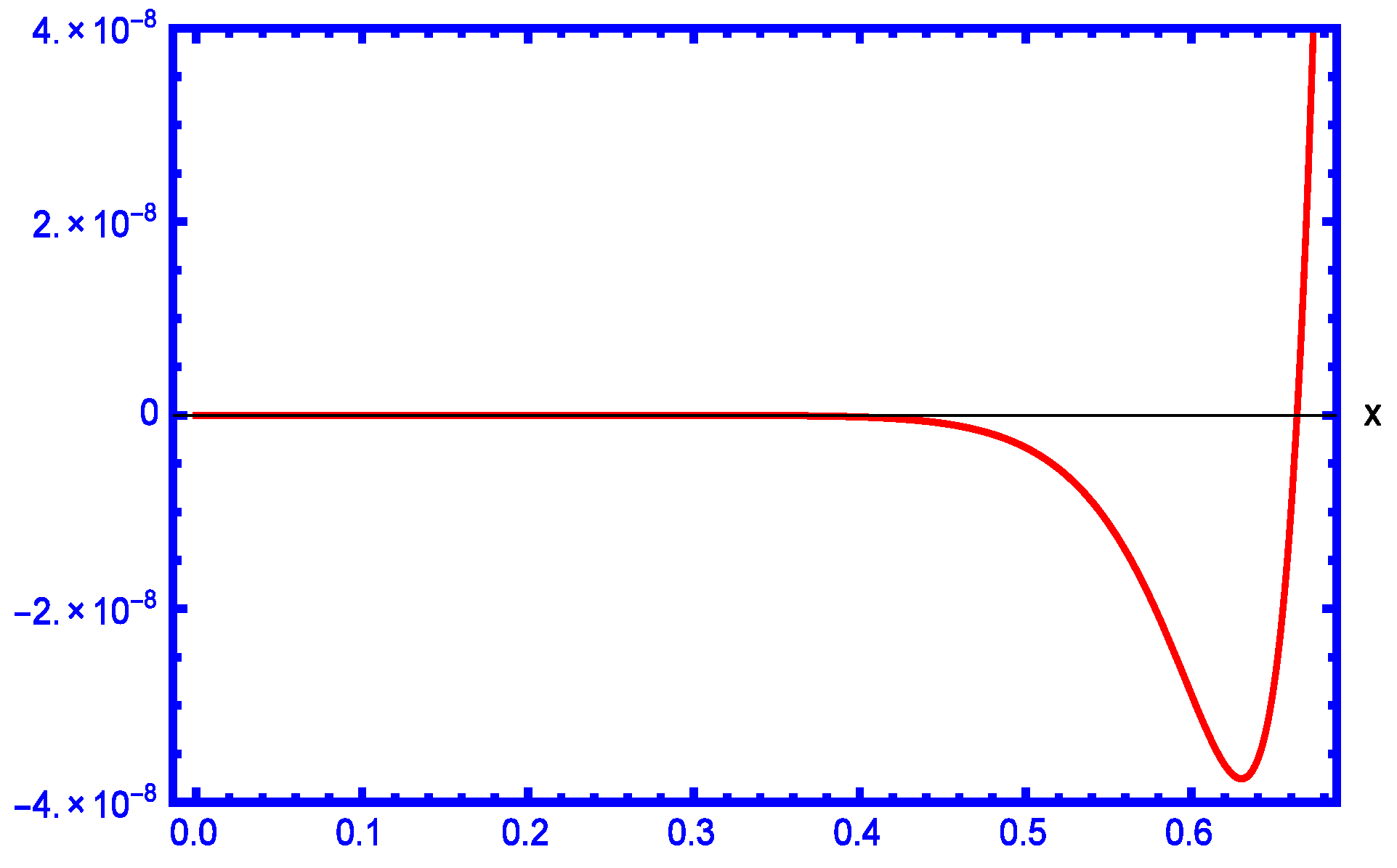
U 6 ( x ) < U 1 ( x ) , 0 < x < 0.999977 U 6 ( x ) < U 2 ( x ) , 0 < x < 1 U 6 ( x ) < U 3 ( x ) , 0 < x < 0.998996 U 6 ( x ) < U 4 ( x ) , 0 < x < 0.999597 U 6 ( x ) < U 5 ( x ) , 0 < x < 1 U 6 ( x ) < U 7 ( x ) , 0 < x < 1 and U 8 ( x ) < U 6 ( x ) , 0 < x < 0.663569 .
Hence, our new upper bound U 8 ( x ) has an advantage over the bounds U 1 ( x ) U 7 ( x ) in the domain 0 < x < 0.663569 For illustration, we present the graph of the difference U 8 ( x ) U 6 ( x ) , which clearly exhibits the intervals where one bound is superior to the other (see Figure 1).
Consider the following functions for 0 < x < 1 , which represent the lower bounds in inequalities (8)–(15):
L 1 ( x ) = x 5 2 1 x 4 + 3
L 2 ( x ) = 10 x 25 10 x 4 + 5
L 3 ( x ) = x 23623 x 8 214500 x 4 + 265200 15 2445 x 8 16068 x 4 + 17680
L 4 ( x ) = 5 x 12 + 18 x 8 + 360 x 4 240 1 x 4 + 240 480 x 3
L 5 ( x ) = 1 8 x Φ x 4 ; 3 2 ; 1 4
L 6 ( x ) = L x ( L 1 ) 1 x 4 4 + 1
L 7 ( x ) = x 1 2 x 4 5 4
L 8 ( x ) = x 1 2 1 x 4 8 / 15 + 1 2 3 / 8
L 9 ( x ) = 5 L x 2 ( 4 L 5 ) 1 x 4 4 + ( 5 3 L ) 1 x 4 + 5
and our new lower bound
L 10 ( x ) = 9573093983 x 24 10854718875 + 458004278 x 20 516891375 + 2792903 x 16 3132675 + 55234 x 12 61425 + 41 x 8 45 + 14 x 4 15 + 1 1 x 4 sin 1 x 2 x .
Using Mathematica software, we can see that
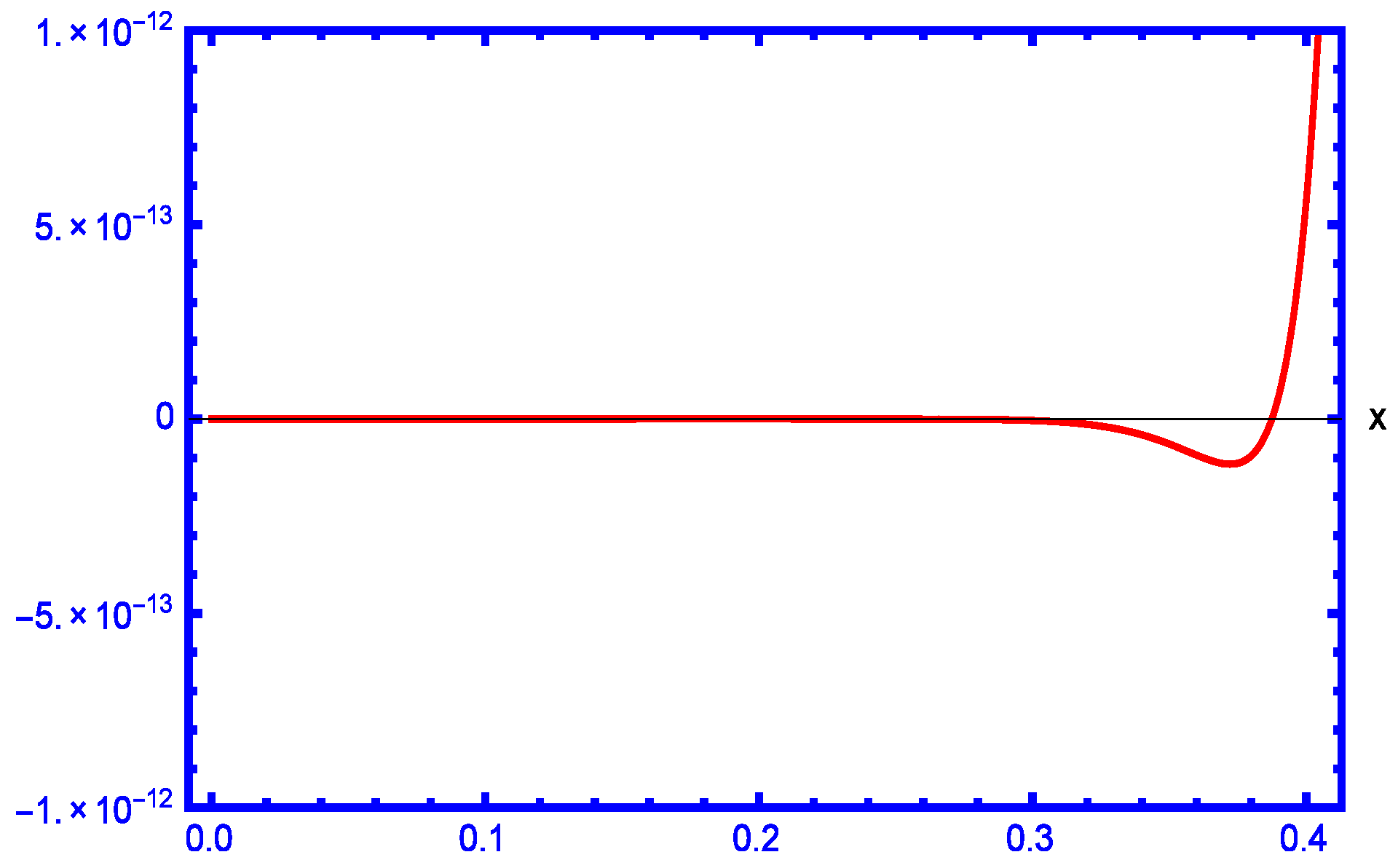
L 1 ( x ) < L 3 ( x ) , 0 < x < 0.960799 L 2 ( x ) < L 3 ( x ) , 0 < x < 1 L 4 ( x ) < L 3 ( x ) , 0 < x < 0.968077 L 5 ( x ) < L 3 ( x ) , 0 < x < 0.99025 L 6 ( x ) < L 3 ( x ) , 0 < x < 0.99914 L 7 ( x ) < L 3 ( x ) , 0 < x < 1 L 8 ( x ) < L 3 ( x ) , 0 < x < 0.850394 L 9 ( x ) < L 3 ( x ) , 0 < x < 0.98046 and L 3 ( x ) < L 10 ( x ) , 0 < x < 0.387457 .
Hence, our new lower bound L 10 ( x ) has an advantage over the bounds L 1 ( x ) L 9 ( x ) in the domain 0 < x < 0.387457 For illustration, we present the graph of the difference L 3 ( x ) L 10 ( x ) , which clearly exhibits the intervals where one bound is superior to the other (see Figure 2).

4. Discussion

We have studied several properties of the Gauss lemniscate sine function. Particularly, we established two new arcsine-type analytic approximation Formulas (18) and (25), each with a monotonic and bounded remainder of order x 29 near the origin, allowing precise control of the approximation error. These formulas lead to the sharp double inequality (24), which holds on the interval ( 0 , 1 ) . Numerical results show that the proposed bounds offer improved accuracy compared with existing estimates, especially near the origin. Furthermore, the obtained approximations may be useful in numerical computation and computer-based evaluations involving the Gauss lemniscate sine function, where accurate approximations are often required in the treatment of real applied problems. Overall, these findings provide practical and theoretical tools for further studies related to special functions, analytic inequalities, and applications involving the Gauss lemniscate sine function. As a direction for future research, it would be of interest to generalize these approximation methods to other classes of special functions and to develop higher-order expansions that may further enhance the precision of analytical and numerical results.

Author Contributions

Writing—original draft, M.M., H.A. and C.M. All authors contributed equally to the writing of this paper. All authors have read and agreed to the published version of the manuscript.

Funding

The project was funded by KAU Endowment (WAQF) at King Abdulaziz University, Jeddah, Saudi Arabia. The authors, therefore, acknowledge with thanks WAQF and the Deanship of Scientific Research (DSR) for technical and financial support.

Data Availability Statement

No new data were created or analyzed in this study.

Conflicts of Interest

The authors declare no conflicts of interest.

References

  1. Siegel, C.L. Topics in Complex Function Theory; Wiley: New York, NY, USA, 1969; Volume 1. [Google Scholar]
  2. Carlson, B.C. Algorithms Involving Arithmetic and Geometric Means. Am. Math. Mon. 1971, 78, 496–505. [Google Scholar] [CrossRef]
  3. Borwein, J.M.; Borwein, P.B. Pi and the AGM: A Study in Analytic Number Theory and Computational Complexity; John Wiley & Sons: New York, NY, USA, 1987. [Google Scholar]
  4. Neuman, E. On Gauss Lemniscate Functions and Lemniscatic Mean. Math. Pannon. 2007, 18, 77–94. [Google Scholar]
  5. Neuman, E. Two-Sided Inequalities for the Lemniscate Functions. J. Inequal. Spec. Funct. 2010, 1, 1–7. [Google Scholar]
  6. Chen, C.-P. Wilker and Huygens Type Inequalities for the Lemniscate Functions. J. Math. Inequal. 2012, 6, 673–684. [Google Scholar] [CrossRef]
  7. Chen, C.-P. Wilker and Huygens Type Inequalities for the Lemniscate Functions, II. Math. Inequal. Appl. 2013, 16, 577–586. [Google Scholar] [CrossRef]
  8. Deng, J.E.; Chen, C.-P. Sharp Shafer-Fink Type Inequalities for Gauss Lemniscate Functions. J. Inequal. Appl. 2014, 2014, 35. [Google Scholar] [CrossRef][Green Version]
  9. Neuman, E. On Gauss Lemniscate Functions and Lemniscatic Mean II. Math. Pannon. 2012, 23, 65–73. [Google Scholar]
  10. Sun, J.-L.; Chen, C.-P. Shafer-Type Inequalities for Inverse Trigonometric Functions and Gauss Lemniscate Functions. J. Inequal. Appl. 2016, 2016, 212. [Google Scholar] [CrossRef]
  11. Liu, J.; Chen, C.-P. Padé Approximant Related to Inequalities for Gauss Lemniscate Functions. J. Inequal. Appl. 2016, 2016, 320. [Google Scholar] [CrossRef]
  12. Mahmoud, M.; Agarwal, R.P. On Some Bounds of Gauss Arc Lemniscate Sine and Tangent Functions. J. Inequal. Spec. Funct. 2017, 8, 46–58. [Google Scholar]
  13. Alzer, H.; Kwong, M.K. Sharp Bounds for the Arc Lemniscate Sine Function. Appl. Math. E-Notes 2020, 20, 93–95. [Google Scholar]
  14. Wei, M.; He, Y.; Wang, G. Shafer-Fink Type Inequalities for Arc Lemniscate Functions. Rev. R. Acad. Cienc. Exactas Fís. Nat. Ser. A Mat. 2020, 114, 53. [Google Scholar] [CrossRef]
  15. Qian, W.-M.; Wang, M.-K. Sharp Bounds for Gauss Lemniscate Functions and Lemniscatic Means. AIMS Math. 2021, 6, 7479–7493. [Google Scholar] [CrossRef]
  16. Zhao, T.-H.; Wang, M.-K. Sharp Double-Exponent Type Bounds for the Lemniscate Sine Function. Appl. Anal. Discret. Math. 2024, 18, 148–172. [Google Scholar] [CrossRef]
  17. Zhang, F.; Shi, H.-Y.; Xu, H.-Z.; Qian, W.-M. Further Refinements of Shafer-Fink Type Inequalities for Lemniscatic Functions. World J. Math. Stat. 2025, 4, 2. [Google Scholar] [CrossRef]
  18. Biernacki, M.; Krzyż, J. On the Monotonicity of Certain Functionals in the Theory of Analytic Functions. Ann. Univ. Mariae Curie Sklodowska 1955, 9, 135–147. [Google Scholar]
Figure 1. Graph of the difference U 8 ( x ) U 6 ( x ) showing the intervals of superiority between the two bounds.
Mathematics 14 01898 g001
Figure 2. Graph of the difference L 3 ( x ) L 10 ( x ) showing the intervals of superiority between the two bounds.
Mathematics 14 01898 g002
Disclaimer/Publisher’s Note: The statements, opinions and data contained in all publications are solely those of the individual author(s) and contributor(s) and not of MDPI and/or the editor(s). MDPI and/or the editor(s) disclaim responsibility for any injury to people or property resulting from any ideas, methods, instructions or products referred to in the content.