Article

A Criterion-Driven Consistency Indicator for Evaluating Multicriteria Sorting and Clustering Results

by
Maiquiel Schmidt de Oliveira
1,*,
Flavio Trojan
2,
Vilmar Steffen
3 and
Maressa Fontana Mezoni
4
1
Academic Department of Physics, Statistics and Mathematics (DAFEM), Federal University of Technology—Parana (UTFPR), Rua Gelindo João Folador, 2000, Francisco Beltrão 85602-863, Paraná, Brazil
2
Academic Department of Electronics (DAELE), Federal University of Technology—Parana (UTFPR), Rua Doutor Washington Subtil Chueire, 330, Ponta Grossa 84017-220, Paraná, Brazil
3
Academic Departments of Engineering (DAENG), Federal University of Technology—Parana (UTFPR), Rua Gelindo Joao Folador, 2000, Francisco Beltrao 85602-863, Paraná, Brazil
4
Post-Graduate Program in Production Engineering (PPGEP), Federal University of Technology—Parana (UTFPR), Rua Doutor Washington Subtil Chueire, 330, Ponta Grossa 84017-220, Paraná, Brazil
*
Author to whom correspondence should be addressed.
Mathematics 2026, 14(11), 1881; https://doi.org/10.3390/math14111881
Submission received: 8 May 2026 / Revised: 21 May 2026 / Accepted: 23 May 2026 / Published: 28 May 2026
(This article belongs to the Special Issue Advances in Multi-Criteria Decision Making Methods with Applications)

Abstract

This study investigates the role of data structure in multicriteria sorting by integrating supervised and unsupervised approaches. Specifically, a hybrid framework combining TOPSIS-Sort-B and cluster analysis is proposed to define class boundaries and evaluate sorting quality. Unlike traditional studies that focus primarily on methodological performance, this work emphasizes the impact of criteria conflict and trade-offs on class formation and stability. A unified performance-based labeling scheme is introduced, and a Criterion-Driven Consistency Indicator (CDCI) is used to quantify intra-class similarity. This indicator assesses the extent to which alternatives within the same class exhibit similar performance across criteria, offering a complementary perspective to conventional distance-based metrics. The proposed framework is validated through multiple case studies with distinct structural characteristics, including a highly structured dataset, a trade-off-intensive electric vehicle dataset, and an intermediate supplier selection problem. The results show that sorting outcomes are largely driven by the intrinsic structure of the data rather than by the choice of method. Datasets with low criteria conflict yield high class consistency and clear separation, whereas strong trade-offs lead to reduced cohesion and overlapping class boundaries, especially for intermediate alternatives. Overall, the study demonstrates that incorporating criteria-level information is essential for the robust evaluation of multicriteria sorting. The proposed approach enhances interpretability, reduces subjectivity in class definition, and provides new insights into the relationship between data structure and sorting consistency.

1. Introduction

Multi-criteria sorting methods are widely used to assign alternatives to ordinal categories based on multiple criteria, which frequently arise in real-world scenarios [1]. The pioneering approaches for class definition in Multi-Criteria Decision Making (MCDM) were based on outranking (non-compensatory) methods. Among sorting approaches, the most widely used is ELECTRE (ÉLimination Et Choix Traduisant la REalité) (non-compensatory), proposed by Yu [2]. Methods of this type dominated the field until 2012, when the AHPSort method was introduced [3]. The authors proposed a variation of the AHP (Analytic Hierarchy Process) method, called AHPSort, for sorting in compensatory contexts. However, AHPSort is not widely adopted due to the complexity of its procedure for allocating alternatives to classes.
Following this development, several compensatory sorting methods have been proposed in the literature, including TOPSIS-Sort [4], MACBETHSort [5], VIKORSORT [6], TOPSIS-Sort-B and TOPSIS-Sort-C [7], PDTOPSIS-Sort-C [8], ORESTE-SORT [9], and MULTIMORA-Sort [1]. These methods are variations of the original methods: TOPSIS (Technique for Order of Preference by Similarity to Ideal Solution), MACBETH (Measuring Attractiveness by a Categorical Based Evaluation Technique), VIKOR (VlseKriterijuska Optimizacija I Komoromisno Resenje), ORESTE (Organisation, Rangement et Synthèse d’Ordres de RelatIons d’Entre les CriTères et les AlternativEs) e MULTIMORA (Multi-Objective Optimization on the basis of Ratio Analysis, plus the Full Multiplicative Form). In parallel, several studies have explored the use of cluster analysis for class determination in compensatory methods [10,11,12,13,14,15,16,17,18,19,20]. However, none of these approaches provides a systematic procedure for defining initial class boundaries or for verifying the allocation of alternatives within those classes. These aspects require further investigation, particularly because class boundaries are typically defined at the beginning of the process and rely heavily on the subjective judgment of decision-makers.
The problem of defining initial class boundaries was addressed by Trojan et al. [21] through the integration of cluster analysis and the non-compensatory ELECTRE TRI method, with validation in a real-world sanitation application aimed at prioritizing maintenance actions. Similarly, assessing whether the classes generated by MCDM and clustering techniques are consistent, in addition to determining class boundaries, can support necessary adjustments through the verification of alternative allocations. This gap is often overlooked in studies on boundary definition, which tend to rely solely on expert judgment. However, the aforementioned study considered only non-compensatory methods, whereas the present work focuses on compensatory approaches.
The most conventional clustering methods are considered unsupervised techniques [22], whereas MCDM sorting methods are regarded as supervised approaches. Since class generation using clustering techniques relies on unsupervised learning, the ability to manipulate classes by defining constraints and analyzing the allocation of alternatives within them offers a novel perspective compared to existing approaches in the literature. Furthermore, the proposed framework contributes to reducing the cognitive burden on decision-makers.
Unsupervised feature selection has important practical implications in real-world applications where labeled data are scarce or costly to obtain [23]. These methods offer the advantage of being less prone to bias and overfitting, whereas supervised approaches may struggle to generalize to new or unseen classes [24].
In this context, clustering methods partition alternatives based on similarity in their characteristics [25], whereas MCDM methods assign alternatives to predefined categories [26,27]. Alvarez et al. [28] suggest that new MCDM sorting methods incorporating unsupervised approaches and decision-maker preferences should be developed.
Despite the conceptual differences between supervised and unsupervised approaches, analyzing the consistency of the classes they produce remains a relevant and underexplored research problem. In particular, even within unsupervised clustering, different algorithms or parameter settings may yield distinct partitions when generating k clusters, raising concerns about the stability and interpretability of sorting results.
In this context, although sorting methods are extensively applied in Multi-Criteria Decision Making (MCDM), the definition of class boundaries still represents a critical and predominantly subjective stage of the process. In most practical applications, these boundaries are determined according to the decision-maker’s experience or judgment, which may introduce bias, reduce reproducibility, and affect the stability of the classification results. Furthermore, the existing literature still lacks structured frameworks capable of integrating data-driven techniques, such as clustering algorithms, with compensatory MCDM models in order to support both the construction of class boundaries and the evaluation of classification consistency.
To address this research gap, the present study proposes a hybrid framework that combines clustering techniques with the TOPSIS-Sort-B method to support the definition and analysis of class boundaries. The proposed approach seeks to reduce subjectivity by incorporating structural patterns directly extracted from the data, while preserving the compensatory rationale that characterizes Multi-Criteria Decision-making methods. In this way, the framework establishes a closer connection between data structure, class formation, and sorting behavior.
In addition, this study introduces the Criterion-Driven Consistency Indicator (CDCI) as a complementary measure for evaluating class consistency. Unlike traditional clustering validation indices that rely primarily on geometric distance measures, the CDCI evaluates the extent to which alternatives assigned to the same class exhibit coherent performance patterns across the evaluation criteria. By explicitly incorporating criteria-level information, the proposed indicator provides a more interpretable and decision-oriented assessment of sorting quality, enabling the identification of inconsistencies associated with trade-offs, overlaps between classes, and heterogeneous classification structures.
Furthermore, a unified performance-based labeling scheme is adopted, categorizing alternatives into High-, Medium-, and Low-Performance classes. This standardized classification structure improves the interpretability and consistency of results, facilitates comparisons across different methods and case studies, and provides a more intuitive understanding of classification behavior and the quality of the resulting allocations.
The main contributions of this study can be summarized as follows:
  • A comparative analysis of supervised (TOPSIS-Sort-B) and unsupervised (cluster analysis) approaches for multicriteria sorting.
  • The introduction of a Criterion-Driven Consistency Indicator (CDCI) to evaluate intra-class consistency.
  • An investigation of the impact of data structure, particularly criteria conflict and trade-offs, on class formation and stability.
  • The adoption of a unified performance-based class labeling scheme to enhance interpretability and comparability.
  • The use of multiple case studies to improve the robustness and generalizability of the findings.
The results provide evidence that sorting outcomes are largely determined by the intrinsic structure of the data rather than by the choice of method alone. In particular, high separability leads to consistent and stable class assignments, whereas strong trade-offs result in lower intra-class similarity and greater ambiguity, especially among intermediate alternatives. These findings contribute to a better understanding of multicriteria sorting and highlight the importance of integrating data-driven analysis into the evaluation of decision-making models.
This article is organized into five sections. Section 2 presents a literature review, addressing class representation in MCDM methods and the integration of cluster analysis with Multi-Criteria Decision Making. Section 3 describes the proposed methodology. Section 4 presents the results, and Section 5 discusses the conclusions, limitations, and directions for future research.

2. Theoretical Framework

2.1. Classes in Multi-Criteria Decision-Making (MCDM) Methods

One of the topics explored in Multi-Criteria Decision-Making (MCDM) methods is the construction of classes, which has historically been more extensively studied in non-compensatory approaches. This line of research was initially developed with the ELECTRE (ÉLimination Et Choix Traduisant la REalité) TRI method, proposed by Roy [29], a member of the ELECTRE family. This method is used for class construction under the assumption that the criteria are non-compensatory in nature. In this context, the assignment procedure involves comparing the performance of each alternative with reference profiles that define the lower and upper bounds of the categories [30].
Another method, known as UTADIS (Utilités Additives Discriminantes), was proposed by Devaud et al. [31] and is based on the MAUT (Multi-Attribute Utility Theory) framework, being applied to ordinal sorting problems.
There are also sorting methods based on the PROMETHEE (Preference Ranking Organization Method for Enrichment Evaluation) methodology, introduced by Brans et al. [32]. Figueira et al. [33] proposed the PROMETHEE-TRI method, which classifies alternatives in two stages using central profiles to define categories. In the first stage, single-criterion net flows are calculated for each alternative, and the central profiles are established. In the second stage, the deviation of each alternative x i from each central profile is computed using these net flows. Furthermore, Araz and Ozkarahan [34] introduced a methodology called PROMSort, which assigns alternatives to predefined ordered categories. This assignment is carried out in two stages: first, using the profiles that define the category boundaries, and second, using reference alternatives.
Within the PROMETHEE family, methods such as FlowSort and Fuzzy FlowSort can also be highlighted. Nemery and Lamboray [35] proposed FlowSort as an extension of the PROMETHEE methods to assign alternatives to completely ordered categories defined by limiting or central profiles. The assignment rules in FlowSort are based on the relative position of an alternative with respect to the reference profiles, taking into account inflow, outflow, and/or net flows. Additionally, the Fuzzy FlowSort (F-FlowSort) method, developed by Campos et al. [36], operates on a decision matrix under uncertainty, using triangular fuzzy numbers.
Regarding compensatory methods, relatively little attention has been devoted to class construction. Ishizaka et al. [3] proposed a variation of the AHP method to classify alternatives into predefined categories. This approach was motivated by the need to handle a large number of alternatives, which would otherwise require an excessive number of pairwise comparisons. To address this issue, a two-stage model was developed: AHPSort was used to classify suitable suppliers, and AHP was subsequently applied to select the best supplier. The evaluation is performed individually and pairwise for each criterion, making the process time-consuming and limiting the ability to visualize relationships among alternatives. Moreover, this procedure cannot be fully automated, as it relies on the decision-maker’s subjective judgment in each comparison.
Sabokbar et al. [4] proposed an extension of the TOPSIS method for classification, called TOPSIS-Sort. In this approach, classification requires comparison with reference profiles (two per class, representing the lower and upper bounds) derived from the original or normalized data. In the original formulation, these profiles were defined subjectively based on the decision-maker’s preferences. Ishizaka et al. [5] developed MACBETHSort, a Multi-Criteria Decision-Making method specifically designed for sorting problems, where the objective is to assign alternatives to predefined ordered categories (e.g., “High,” “Medium,” or “Low” priority). A key feature of this method is the integration of the MACBETH (Measuring Attractiveness through a Categorization-Based Evaluation Technique) approach to address subjectivity and uncertainty in defining category boundaries.
VIKORSORT, proposed by Demir et al. [6], is another MCDM method designed to classify alternatives into predefined ordered classes. It extends the traditional VIKOR (VlseKriterijuska Optimizacija I Kompromisno Resenje) method and is particularly suitable for problems involving conflicting criteria. In its original application, it was used to evaluate and categorize suppliers of environmentally friendly products for an electrical equipment manufacturer.
De Lima Silva and de Almeida Filho [7] observed that the TOPSIS-Sort method proposed by Sabokbar et al. [4] may exhibit a rank reversal problem, and provided evidence supporting this claim. To address this issue, they proposed new extensions of the TOPSIS method for classification, namely TOPSIS-Sort-B and TOPSIS-Sort-C. These methods were evaluated through a numerical application involving the assessment of economic freedom in 180 countries, resulting in five classes for each case.
PDTOPSIS-Sort-C [8] was later introduced as an adaptation of the approach proposed by de Lima Silva and de Almeida Filho [7]. According to the authors, reference alternatives are initially used to describe expectations regarding a set of ordered classes. Subsequently, characteristic profiles and weights are inferred through a mathematical programming model. This preference-learning process reduces the cognitive effort required by the more recent TOPSIS-Sort-C method.
ORESTE-SORT [9] is a multi-criteria sorting method developed to address problems in which alternatives must be allocated to predefined, ordered categories based on multiple evaluation criteria. The MULTIMORRA-Sort method [1] was proposed to enhance the explainability of sorting decisions by introducing an explanatory mechanism. To reduce the cognitive burden on decision-makers associated with parameter specification and subjective uncertainty, the authors developed a Preference Disaggregation Analysis (PDA) framework to infer model parameters from assignment examples. In addition, they introduced a counterfactual explanation framework that illustrates how changes in performance across criteria affect category assignments, thereby increasing the reliability of the results.
Recent studies have proposed advanced sorting approaches based on fuzzy and probabilistic environments, such as cloud-divergence probabilistic hesitant fuzzy sorting methods [37,38]. Although these approaches improve uncertainty modeling, the primary objective of the present study differs substantially. Rather than extending fuzzy preference representations, this work focuses on investigating how the intrinsic structure of the data, particularly criterion conflict and compensatory trade-offs, affects class consistency and sorting stability. TOPSIS-Sort-B was selected due to its compensatory logic, high interpretability, and compatibility with clustering-based boundary construction and CDCI evaluation.
Overall, the reviewed sorting methods demonstrate important advances in handling multicriteria classification problems; however, most approaches remain strongly dependent on predefined class boundaries established by decision-makers. Although several methods improve allocation procedures and uncertainty modeling, limited attention has been devoted to evaluating the structural consistency of the resulting classes, particularly in compensatory environments characterized by strong trade-offs among criteria. In this context, the present study integrates the TOPSIS-Sort-B method, Cluster Analysis (CA), and the CDCI indicator to evaluate class structures and classification consistency from both geometric and multicriteria perspectives.
Furthermore, several literature reviews on MCDM sorting methods have been analyzed [39,40,41], corroborating the finding that no study has addressed the construction of classes using predefined boundaries along with the evaluation of alternative allocation in compensatory methods.

2.2. Multi-Criteria Decision Making (MCDM) and Cluster Analysis (CA)

Oliveira et al. [42] conducted a systematic literature review mapping studies that combine Multi-Criteria Decision-Making (MCDM) methods with Cluster Analysis (CA). Based on the articles included in this review, it was possible to identify studies linking compensatory MCDM methods to cluster analysis, highlight methodologies relevant to the present study, and confirm that the proposed approach addresses an existing gap in the literature. Additional database searches were also conducted to identify further studies related to this topic. Selected publications combining MCDM and CA are summarized below.
Demir et al. [6] proposed a method called P2CLUST, an extension of PROMETHEE II inspired by the K-means clustering procedure and the FlowSort method. In this approach, central profiles are initially defined at random, and each alternative is assigned to a category using FlowSort. The central profiles are then updated iteratively, and the process is repeated until the category assignments stabilize.
Nilashi et al. [10] developed a methodology based on ANP, fuzzy logic, and cluster analysis to evaluate the influence of security, design, and content factors on customer trust in mobile commerce (m-commerce). They considered 12 sub-criteria derived from three main criteria, applying ANP to identify the key factors affecting customer trust and to select an appropriate website. Subsequently, the K-means technique was used to group customer preferences and to generate rules for a Fuzzy Inference System (FIS) to assess trust levels.
Toma [12] evaluated the financial viability of European agricultural projects between 2009 and 2013. The study focused on COP farms (Cereals, Oilseeds, and Protein Crops) and employed a combined PCA, TOPSIS, and K-means approach using FADN data from 94 regions. The results highlight increasing disparities during this period, driven by differences in agricultural policies and varying recovery rates from the financial crisis. The analysis identified three main factors, which explained 77.92% of the variance in 2009 and 79.03% in 2013.
Farman et al. [13] developed a methodology for leader selection in wireless sensor networks using ANP (Analytical Network Process) and cluster analysis. The network was divided into zones (clusters), and in each zone, a leader was selected based on five criteria. These leaders play a crucial role in ensuring network stability and extending its lifespan, making their selection particularly important.
Ijadi Maghsoodi et al. [15] applied the MULTIMOORA method (Multi-Objective Optimization based on Ratio Analysis Multiplicative Form), proposed by Brauers and Zavadskas [43], in combination with the K-means clustering technique to address a supplier selection problem at the multinational company MAMUT, based in Iran. This approach resulted in a methodology called CLUS-MCDA, in which suppliers were grouped into five clusters, followed by a ranking of these groups. This framework was later extended by Ijadi Maghsoodi et al. [44] to develop the W-CLUS-MCDA methodology, incorporating the BWM (Best-Worst Method).
Becker et al. [14] conducted a multi-criteria evaluation of European Union member states regarding the use of ICTs (Information and Communication Technologies) in companies, based on data from 2017. In this analysis, the ANP (Analytic Network Process) method, proposed by Saaty et al. [45], and the K-means clustering procedure were employed. Three groups were defined based on intergroup distances, and a ranking of countries within each group was established to characterize the level of ICT usage.
Dahooie et al. [17] assessed the financial performance of 58 industrial companies that applied for loans from a federal bank in Iran. For this purpose, the CCSD method, developed by Wang and Luo [46], was used to determine the weights of the criteria; Fuzzy C-means was applied to classify the companies based on their distances; and the ARAS (Additive Ratio Assessment) method, proposed by Zavadskas and Turskis [47], was used to rank the alternatives within each group.
Esfandi and Nourian [48] investigated the urban structural capacity to support the development of mega-malls across 22 municipal districts in Tehran. The methodology combined the multi-criteria methods SWARA (Step-wise Weight Assessment Ratio Analysis), proposed by Keršulienė et al. [49], and WASPAS (Weighted Aggregated Sum Product Assessment), proposed by Zavadskas et al. [50], with a hierarchical clustering procedure to group the districts into six homogeneous clusters.
Sarrazin et al. [51] proposed an extension of the PROMETHEE method with interval clustering (PCLUST), based on PROMETHEE I and the FlowSort method. The objective of this model is to solve multi-criteria clustering problems by defining a set of categories divided into two groups: main categories and interval categories. The number of categories is defined by the decision-maker, and the clustering procedure is based on K-means, with comparisons made to P2CLUST and other PROMETHEE-based interval clustering approaches. The authors report that, in terms of clustering quality, the PCLUST model improves the quality index score in 85% of cases across all datasets when compared to P2CLUST.
Azadnia et al. [52] developed a hybrid method combining ELECTRE and fuzzy clustering for supplier selection. The central idea is to group suppliers using the Fuzzy C-means data mining technique and then classify them using the ELECTRE method.
Nilashi et al. [16] proposed a hybrid methodology combining cluster analysis, the TOPSIS method, and neuro-fuzzy techniques to assess the impact of green hotels, with and without spa services, on traveler satisfaction. In this study, cluster analysis was used to segment hotels, and the resulting groups were subsequently ranked using the TOPSIS method.
Toma [12] applied the TOPSIS method and Principal Component Analysis (PCA), together with K-means clustering, to evaluate the evolution of European agricultural holdings. A total of 94 regions were analyzed, yielding four groups based on TOPSIS rankings.
Barak and Mokfi [53] proposed a hybrid clustering method combining PSO (Particle Swarm Optimization) and K-means. This approach was compared with other distance-based clustering techniques, which were evaluated and ranked using the TOPSIS (Technique for Order Preference by Similarity to an Ideal Solution), COPRAS (Complex Proportional Assessment), and WSM (Weighted Sum Model) methods. The results indicate that the proposed hybrid method achieved the highest ranking among the evaluated approaches.
Małkowska et al. [54] combined cluster analysis and MCDM techniques (specifically TOPSIS) to assess the impact of digital transformation in European countries. Clustering methods (hierarchical and K-means) were used to group countries based on similarities, followed by ranking within each group.
Sari et al. [18] developed a methodology to identify four locations for logistics warehouses to support humanitarian aid in response to the 2010 volcanic disaster in Indonesia. In this study, the AHP method was used to select criteria and sub-criteria based on decision-makers’ judgments, while Fuzzy TOPSIS was applied to determine the best option among the potential locations. Additionally, cluster analysis was employed to identify suitable emergency storage locations in each operational area based on distance and the number of refugees.
Hosseini et al. [19] applied SWOT analysis to evaluate the implementation of sustainable ecotourism in the Lafour region of Iran, considering eight strategies and expert input from the tourism sector. The authors proposed a heuristic clustering approach based on SWOT analysis, in which strategies were grouped into clusters and subsequently prioritized within each cluster using the TOPSIS method.
Ardielli [55] investigated the implementation of ICTs (Information and Communication Technologies) in healthcare (eHealth) across European Union member states. For this purpose, the TOPSIS method was combined with cluster analysis to assess the level of eHealth adoption by primary care physicians.
Gaur et al. [56] conducted a groundwater planning study using cluster analysis to determine the optimal number of strategy groups, followed by the application of the VIKOR and TOPSIS methods to rank the 20 identified strategies.
Omurbek et al. [57] integrated MCDM and cluster analysis methods to evaluate agricultural production. In the first stage, cities were grouped using Ward’s hierarchical clustering method based on their agricultural characteristics, resulting in six clusters. Subsequently, the CRITIC method was applied to determine criterion weights, and the TOPSIS method was used to evaluate performance and rank the groups.
Bait et al. [20] combined AHP, TOPSIS, and K-means clustering to support decision-makers in selecting industrial locations in developing countries, specifically in the textile sector in Africa. In the clustering stage, in addition to distance (commonly used in similar analyses), target values were also considered, providing valuable information for risk assessment and investment performance evaluation.
Regarding the integration of non-compensatory methods and cluster analysis for class construction, Trojan et al. [21] proposed a methodology for predefining class boundaries using clustering techniques and comparing them with the sorting results obtained from the ELECTRE TRI method. Six clustering techniques were evaluated: K-means, K-medoids, Fuzzy C-means, Particle Swarm Optimization (PSO)-based clustering, genetic algorithm-based clustering, and differential evolution. The results were compared with those obtained using the non-compensatory ELECTRE TRI method, providing insights into class boundary definition.
In conventional approaches, class boundaries are typically defined intuitively by decision-makers, as observed in the study by Sarrazin et al. [51]. In that work, the predefined boundaries for each class were determined based on mean values between classes for some criteria and on maximum values for others.
Other studies have also combined cluster analysis with Multi-Criteria Decision Analysis methods to form groups and subsequently rank them, including ANP [11,58], TOPSIS [59,60,61], and AHP [62,63,64,65]. Some researchers have focused exclusively on compensatory methods or have combined them with non-compensatory approaches [66,67,68,69].
Recent preference disaggregation approaches have proposed objective procedures for inferring class boundaries from assignment examples. However, these methods primarily focus on reconstructing decision-maker preferences, whereas the present study emphasizes the structural consistency of the resulting classes [70]. In contrast, the proposed framework integrates clustering information, compensatory sorting, and criteria-level consistency analysis in order to evaluate how trade-offs influence class formation and the reliability of class allocations.
The reviewed studies demonstrate that the integration of MCDM and clustering techniques has been applied mainly to ranking support, segmentation, and group-formation problems. However, most approaches emphasize methodological application rather than the evaluation of the structural reliability of the class formation process itself. Furthermore, existing studies rarely investigate how criterion conflict and compensatory behavior affect class cohesion, overlap, and allocation stability. These limitations reinforce the research gap addressed by the present study.
Overall, the reviewed studies indicate that the research objective of the present work remains an open gap in the literature. Although some studies address class boundary definition, these approaches are generally based on the subjective judgment of decision-makers.

3. Materials and Methods

The methodology proposed in this study is based on the construction of classes using Multi-Criteria Decision Making (MCDM) and Cluster Analysis (CA), including the predefinition of class boundaries and the verification of alternative allocation within these classes. Prior to this analysis, the compensatory nature of the criteria is assessed and, if necessary, adjusted for the two case studies considered to validate the proposed methodology.
The study by Oliveira et al. [71] has already evaluated the compensatory nature of the criteria and adjusted their weights for the electric vehicle (EV) case in Brazil. Therefore, the present study focuses exclusively on the class construction analysis for the EV application.

Presetting Limits and Allocating Alternatives for Sorting in MCDM

The second focus of this study concerns the predefinition of class boundaries in compensatory methods. Despite the growing number of studies on sorting in compensatory frameworks, the issue of defining initial class boundaries and allocating alternatives to these classes remains insufficiently addressed.
To address this gap, a procedure for constructing class boundaries and subsequently classifying alternatives is proposed, as illustrated in the flowchart presented in Figure 1:
Phase (1)
Steps 1 to 3: Definition of objectives, data collection, and normalization of the decision matrix and ICCI (Inter-Criteria Compensation Index).
The compensatory or non-compensatory nature of criteria in a multi-criteria decision matrix has been widely discussed in the literature. However, the first study to systematically analyze this issue was proposed by Oliveira et al. [71], which introduced the Inter-Criteria Compensation Index (ICCI).
Within the compensatory analysis procedure, several key aspects can be highlighted. Data normalization was performed using the min-max method proposed by Chakraborty and Yeh [72], as described in Equations (1) and (2).
r i j = r i j r j m i n r j m a x r j m i n , for the benefit criterion j
r i j = r j m a x r i j r j m a x r j m i n , for the cos t criterion j
where
x i j = raw value of alternative i under criterion j;
r i j = normalized value of alternative i under criterion j;
r j min = minimum value of criterion j;
r j max = maximum value of criterion j.
The next step is to assess the compensatory nature of the criteria. To this end, the inter-criteria compensatory behavior is evaluated using correlation coefficients, as proposed by Pearson [73] and Spearman [74], along with their respective hypothesis tests, and the standard error measure. The Inter-Criteria Compensation Index (ICCI) (Oliveira et al. [71]) is defined as follows:
I n t e r C r i t e r i a C o m p e n s a t i o n I n d e x ( I C C I ) = 1 S E
where S E (standard error) is calculated using Equation (4):
S E j k = 1 p 2 · i = 1 m k = 1 n ( x i k x ¯ i k ) 2 i = 1 m j , k = 1 n ( x i j x ¯ i j ) ( x i k x ¯ i k ) 2 i = 1 m j = 1 n ( x i j x ¯ i j ) 2
where
S E j k = standard error between criteria j and k;
p = sample size;
x i j = value of alternative i for criterion j;
x i k = value of alternative i for criterion k;
x ¯ j = mean value of criterion j;
x ¯ k = mean value of criterion k;
m = number of alternatives in the decision matrix;
n = number of criteria in the decision matrix.
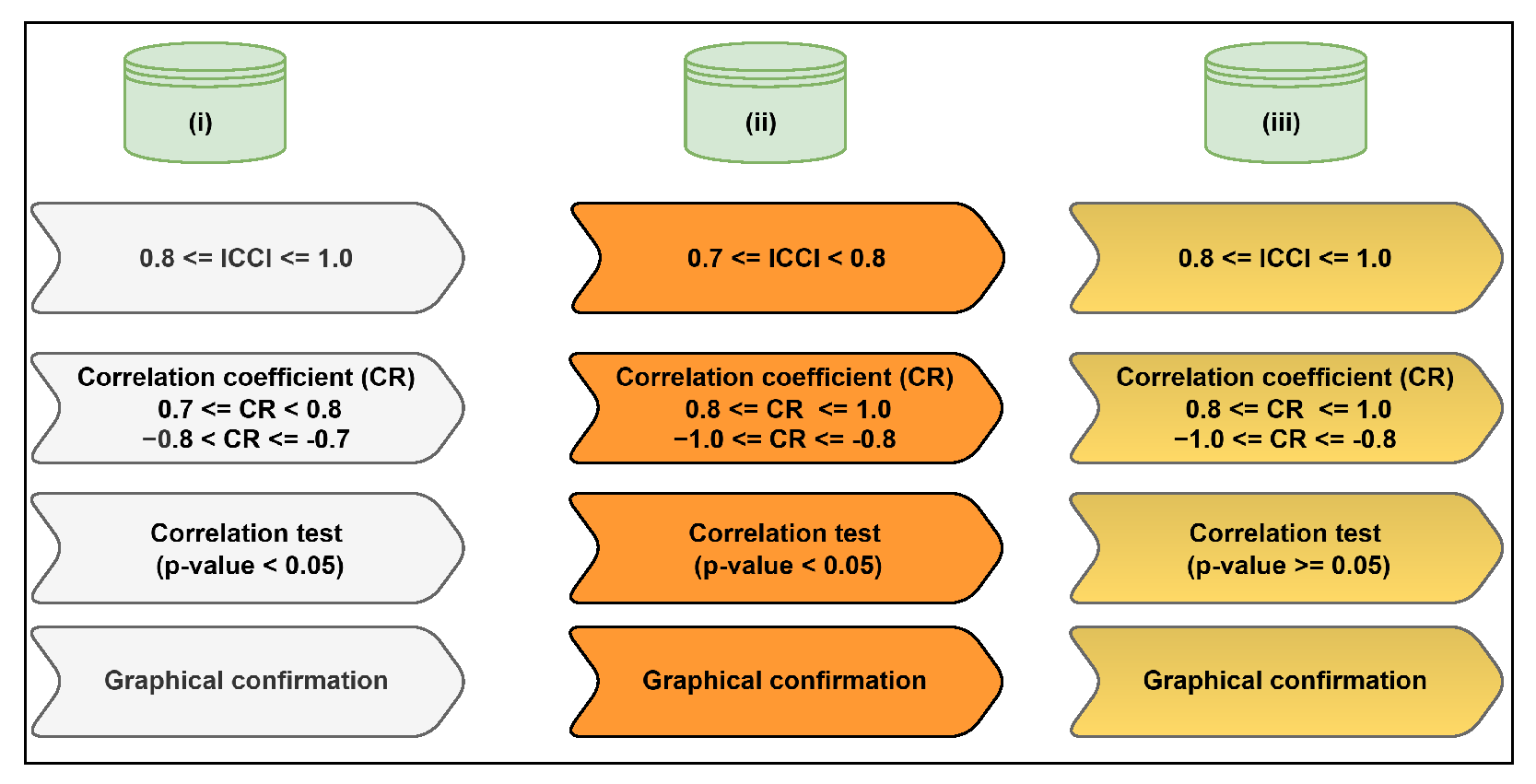
A summary of this procedure is presented in Figure 2.
The next step involves adjusting the criteria weights to account for their compensatory nature. This adjustment is performed using Equations (5) and (6):
W j = i = 1 n I C C I i j j = 1 n I C C I i j n ( 1 + w j 0 )
w j * = W j j = 1 n W j
where
I C C I i j = value of the Inter-Criteria Compensation Index for row i and criterion j;
W j = unnormalized weight of criterion j;
w j 0 = original weight of criterion j defined by the decision-maker(s);
w j * = adjusted weight of criterion j, accounting for compensatory relationships based on the ICCI;
n = number of criteria.
The final step is to perform a sensitivity analysis based on the criteria identified as compensatory in the normalized decision matrix (Step 2). This analysis is conducted in two stages: the first involves generating individual rankings for each criterion, while the second examines the effects of removing criteria according to their respective weights.
Phase (2)
Step 4: Generation of alternative classifications using cluster analysis techniques and compensatory sorting methods
To generate the classification of alternatives, it is necessary to define the number of classes (as specified by the decision-maker), as well as the clustering techniques and compensatory MCDM sorting methods to be employed. In the proposed methodology, four clustering techniques are considered: K-means, K-medoids, hierarchical clustering, and Fuzzy C-means (FCM), along with the compensatory sorting method TOPSIS-Sort-B. The objective is to identify the most suitable approach for class construction under different scenarios.
Trojan et al. [21] compared conventional clustering techniques with the non-compensatory MCDM method ELECTRE TRI in a real-world sanitation application involving the prioritization of maintenance actions. The results indicated that the Fuzzy C-means (FCM) method achieved the highest similarity in clustering when compared to ELECTRE TRI.
In this context, the present study evaluates which unsupervised methods exhibit the greatest similarity to the TOPSIS-Sort-B method. Subsequently, adjustments to the class boundaries are performed. No additional data scaling is applied, as normalization has already been conducted. For the comparison and performance evaluation of clustering techniques, the Silhouette Index is adopted. Furthermore, 100 iterations are performed for each method, following the procedure adopted by Trojan et al. [21].
A brief description of the clustering methods employed in this analysis is provided below:
(I) K-means and K-medoids
K-means is a simple and widely used method for cluster generation due to its computational efficiency and rapid convergence [75]. It is classified as a partitional clustering technique.
In the K-means algorithm, centroids are typically initialized randomly. The distance between each centroid k and an object i is calculated using Equation (7), which represents the Euclidean distance. Each object is then assigned to the cluster associated with the nearest centroid. Additionally, alternative distance metrics may also be employed.
After initialization, the centroid positions are updated using Equation (8). This process is iteratively repeated until a stopping criterion is satisfied, such as a predefined number of iterations or convergence based on a similarity measure. The objective of the algorithm is to minimize the sum of squared within-cluster distances (Sum of Squared Errors—SSE) between the data points and their respective centroids, as defined in Equation (9) [21,76]. Let N denote the number of samples, with K < N .
d i s t ( x i c k ) = x i c k 2 = d = 1 D x i , d c k , d 2
c k = 1 t k · i = 1 t k x i k
S S E = k = 1 K i = 1 n k d i s t 2 ( x i c k )
where
K = number of clusters;
D = dimensionality of each data point;
N = total number of data points;
t k = number of data points in cluster k;
x i ( k ) = i-th data point assigned to cluster k, with i = 1 , , n k ;
x i , d = value of the i-th data point in dimension d;
c k = centroid of cluster k;
c k , d = value of centroid k in dimension d.
The K-means method is highly sensitive to initialization, and since this process is performed randomly, it may lead to suboptimal performance. One way to mitigate this issue is by using the K-medoids algorithm, which is similar to K-means [21].
The execution steps are essentially the same, with the main difference lying in the initialization procedure. In K-means, K data points (alternatives) are randomly selected as initial centroids, whereas in K-medoids, representative data points (referred to as medoids)are selected as cluster centers [76].
(II) Fuzzy C-means clustering (FCM)
The Fuzzy C-means (FCM) clustering method was originally developed by Dunn [77] and later extended by Bezdek [78]. FCM is a well-established alternative for clustering tasks, as it overcomes several limitations of K-means and other partitional methods [21].
According to Silva Filho et al. [79], FCM presents several important characteristics: the number of clusters can be defined by the decision-maker; it performs well in the presence of overlapping data; and it is less sensitive to initialization and noise.
As described by Trojan et al. [21], the main difference between FCM and K-means lies in the absence of rigid boundaries between clusters. Instead, FCM generates a membership matrix { μ i j } R N × K , where each element μ i j represents the degree of membership of object i in cluster j. These values satisfy the conditions μ i j [ 0 , 1 ] and j = 1 K μ i j = 1 for all i.
The membership values are calculated using Equation (10):
μ i , j = 1 k = 1 C x i c j 2 m 1 x i c k
where · denotes a norm, typically the Euclidean norm, and m > 1 is the fuzziness parameter that controls the degree of cluster overlap.
Subsequently, the cluster centers are updated using Equation (11):
c j = i = 1 K μ i j · x i i = 1 K μ i j
This method iteratively updates the membership values μ i j for each object, followed by the update of the cluster centers. The objective of the process is to minimize the cost function, as defined in Equation (12) [21,80].
J m = i = 1 N j = 1 K μ i j m x i c j 2
(III) Agglomerative Hierarchical Clustering (AHC)
Hierarchical clustering algorithms generate groups across successive levels, where each level is built upon the previous one. In this type of approach, the result is a hierarchy of relationships rather than a fixed partition into distinct groups. To obtain k clusters, it is necessary to cut the k 1 highest links in the dendrogram [76].
Hierarchical methods produce a dendrogram, a tree-like structure that represents the sequence of nested partitions within the dataset [76,81]. These methods can be classified into two main types: agglomerative (bottom-up) and divisive (top-down) [82,83].
As noted by Dogan and Birant [27], hierarchical clustering constructs a tree of clusters by either iteratively merging smaller clusters into larger ones (agglomerative approach) or recursively splitting larger clusters into smaller ones (divisive approach).
(IV) TOPSIS-Sort-B
The TOPSIS-Sort-B method is an extension of the classical TOPSIS approach for sorting problems within a compensatory framework, proposed by Lima Silva and Almeida Filho [7], together with the TOPSIS-Sort-C method. It is among the few methods that enable the construction of classes under compensatory criteria, alongside approaches such as AHPSort [3] and TOPSIS-Sort [4].
A description of the TOPSIS-Sort-B algorithm is presented in nine steps (a to i), as outlined below:
Step (a) Define the decision matrix X = [ c i , j ] m × n .
Step (b) Establish the boundary profile matrix P = [ P k , j ] p × n , where p = q 1 , and p represents the number of class boundaries.
Step (c) Determine the domain of each criterion by identifying its maximum and minimum attainable values (i.e., the values that can be achieved by any alternative for each criterion). These values will subsequently serve as the ideal and anti-ideal solutions.
The domain is represented by the matrix
c 1 * c n * c 1 c n ,
where c j * and c j denote, respectively, the maximum and minimum possible values of criterion j.
Step (d) Construct the complete decision matrix
M = [ M i , j ] ( m + p + 2 ) × n = X P D ,
by vertically concatenating X = [ c i , j ] m × n , P = [ P k , j ] p × n , and
D = c 1 * c n * c 1 c n .
Step (e) Compute the normalized matrix V = [ V i , j ] ( m + p + 2 ) × n using the min-max normalization method proposed by Chakraborty and Yeh [72], which is also employed in the TOPSIS framework to mitigate rank reversal issues [84].
Step (f) Determine the ideal and anti-ideal solutions, as defined in Equations (13) and (14).
v * = [ v 1 * , v 2 * , , v n * ] , v j * = m a x i v i , i , f o r t h e j b e n e f i t i a l c r i t e r i a m i n i v i , i , f o r t h e j c o s t c r i t e r i a
v = [ v 1 , v 2 , , v n ] , v j = m a x i v i , i , f o r t h e j b e n e f i t i a l c r i t e r i a m i n i v i , i , f o r t h e j c o s t c r i t e r i a
Step (g) Compute the Euclidean distances for each alternative (Equations (15) and (16)) and for each profile with respect to the ideal and anti-ideal solutions (Equations (17) and (18)).
d a i * = j = 1 n v i , j v j * 2 , i = 1 , 2 , , m
d a i = j = 1 n v i , j v j 2 , i = 1 , 2 , , m
d P k * = j = 1 n v i , j v j * 2 , k = 1 , 2 , , p ; i = k + m
d P k = j = 1 n v i , j v j 2 , k = 1 , 2 , , p ; i = k + m
Step (h) Determine the proximity coefficient for each alternative (Equation (19)) and for each profile (Equation (20)) with respect to the ideal solution, based on the distances obtained in the previous step.
C l ( a i ) = d a i d a i + d a i * , i = 1 , 2 , , m
C l ( P k ) = d P k d P k + d P k * , k = 1 , 2 , , p
Step (i) Classify the alternatives by comparing their proximity coefficients C l ( a i ) with those of the limiting profiles C l ( P k ) , according to Equation (21):
a i C 1 , i f C l a i C l P 1 , i = 1 , , m a i C k , i f C l P k 1 > C l a i C l P k , i = 1 , , m ; k = 2 , , q 1 a i C q , i f C l a i < C l P q 1 , i = 1 , , m
Step 5: Adjustment of limiting profiles
After constructing the classes of alternatives, this step involves adjusting the limiting profiles of each criterion using Equation (22), and redefining the classification, if necessary:
L i m = H j ( k ) L j ( k ) 2 + L j ( k )
where
H j ( k ) = highest value of criterion j among the alternatives belonging to class k;
L j ( k ) = lowest value of criterion j among the alternatives belonging to class k.
Step 6: Criterion-Driven Consistency Indicator ( C D C I ) and Silhouette Index (SI)
The final step consists of a comprehensive evaluation of the adjusted class boundaries, considering both the decision-maker’s perspective and alternative analytical viewpoints. In this stage, experts assess whether the resulting classification is appropriate based on their experience, supported by the Criterion-Driven Consistency Indicator (CDCI) and the Silhouette Index. The objective of this step is to evaluate the allocation of alternatives to classes. The results are then jointly evaluated with the decision-maker.
(i) Criterion-Driven Consistency Indicator (CDCI)
Furthermore, an evaluation is conducted to verify whether the alternatives are correctly allocated to their respective classes, based on Equation (23).
S i = j = 1 n b i j ,
where
b i j is defined as a binary indicator that assumes a value of 1 if alternative i lies within the boundary of class k with respect to criterion j, and 0 otherwise.
If S i Z , alternative i is considered to be correctly assigned to the class. Otherwise, if S i < Z , alternative i is not considered to belong to the correct class.
Z is the threshold corresponding to 50% of the total number of criteria. The threshold Z was defined based on a majority criterion, assuming that an alternative should satisfy at least 50% of the criteria associated with the expected class boundaries in order to be considered consistently allocated. This value was adopted as an interpretative balance between restrictive and flexible allocation conditions in compensatory multicriteria environments. Lower values may indicate the presence of strong trade-offs among criteria or overlapping class structures. Nevertheless, the threshold may be adjusted according to the characteristics of the dataset and the specific requirements of the decision-maker.
Additionally, the average allocation value for the alternatives in each class is computed using Equation (24), considering the total number of criteria in the problem. This value represents the Criterion-Driven Consistency Indicator (CDCI) for alternative i.
C D C I i = S i n
where
C D C I i = Criterion-Driven Consistency Indicator for alternative i;
n = number of criteria.
The indicator C D C I provides a direct measure of how well the alternatives assigned to the same class conform to the expected criteria standards, with values ranging within the interval [ 0 , 1 ] . Unlike purely distance-based validation measures, the CDCI evaluates consistency directly at the criteria level, enabling the verification of whether alternatives assigned to the same class satisfy the expected class boundaries across multiple dimensions simultaneously. This characteristic provides greater interpretability from a decision-making perspective, particularly in compensatory environments where trade-offs among criteria may mask inconsistencies in geometric clustering structures. This measure can be interpreted as follows:
(I) High-Performance ( 0.75 C D C I 1.0 ) → high intra-class similarity
  • Strong homogeneity among alternatives;
  • Low influence of trade-offs;
  • Well-defined classes;
  • High classification reliability.
(II) Medium-Performance ( 0.50 C D C I < 0.75 ) → presence of trade-offs
  • Significant presence of trade-offs;
  • Alternatives with distinct profiles within the same class;
  • Partially overlapping classes;
  • Sensitivity to the method.
(III) Low-Performance ( 0.00 C D C I < 0.50 ) → inconsistent or poorly defined classes
  • High intra-class heterogeneity;
  • Strong compensatory effects among criteria;
  • Possible inconsistencies in allocation;
  • An indication that class definitions may require revision.
The proposed C D C I intervals were established based on interpretability criteria associated with intra-class homogeneity and the expected degree of criterion conflict in compensatory multi-criteria problems [5]. The adopted thresholds are intended to provide a practical and interpretable diagnostic assessment of class quality rather than rigid statistical cut-off values. High CDCI values indicate structurally cohesive classes with limited trade-offs among criteria, whereas low values reflect substantial compensatory effects and potential ambiguity in class allocation. These intervals may be adjusted according to the characteristics of the dataset and the specific decision-making context. In addition, the indicator is particularly useful for datasets with varying levels of criteria conflict:
  • Low conflict (structured data) → high C D C I values and clear class separation;
  • High conflict (trade-offs) → lower C D C I values and overlapping classes;
  • Medium cases → moderate consistency.
Thus, C D C I enables the analysis of how data structure influences classification outcomes, complementing the comparison between TOPSIS-Sort-B and cluster analysis.
Based on the interval in which the C D C I value falls, it is possible to determine, in percentage terms, the degree to which an alternative is assigned to a class, as given by Equation (25):
C D C I i ( % ) = S i n · 100
C D C I i ( % ) = Percentage Criterion-Driven Consistency Indicator for alternative i.
The conversion of C D C I to a percentage scale, as established in Equation (25), transforms the allocation metric into a classification reliability indicator. By expressing the extent to which an alternative is correctly assigned to a class in percentage terms, the index enables a clear identification of the impact of trade-offs and conflicts among criteria within the decision-making structure. High values (above 75%) confirm the homogeneity of the classes and the robustness of the allocation, whereas low values (below 50%) indicate that the classification is heavily influenced by compensatory effects, suggesting that the alternative exhibits a hybrid profile or that the class boundaries may require refinement.
Thus, C D C I (%) not only quantifies the precision of the methods but also provides the decision-maker with a diagnostic basis for assessing the stability and clarity of data separation relative to the expected standards.
(ii) Silhouette Index (SI)
There are several approaches for assessing the quality of clustering results and validating cluster analysis, among which the Silhouette Index (SI) is widely recognized [85]. This metric is defined for each data point with respect to a given clustering solution and ranges from 1 to 1 [76,85].
SI values close to 1 indicate that an alternative may have been incorrectly assigned to a cluster, whereas values close to 1 suggest appropriate allocation [86].
The calculation of the Silhouette Index is described by Rousseeuw [86] and Guerreiro et al. [76] and is presented in Equations (26)–(28):
S I = 1 N i = 1 N b i a i m a x i m o a i , b i
S I = 1 N k x j C k d i s t x i , x j
b i = m i n h { 1 , , K } , h k 1 N h x j C h d i s t x i , x j
where
N = number of clusters;
N k = number of objects in cluster k;
N h = number of objects in cluster h, with h k ;
a i = average distance between object i and all other objects within the same cluster;
b i = average distance between object i and all objects in another cluster h.
After the expert analysis, the results are presented to the decision-makers for final evaluation.
Although the Silhouette Index was adopted as an important metric for evaluating cluster cohesion and separation, it was not used as the sole indicator of classification quality. The proposed framework also incorporated CDCI-based consistency analysis, ICCI compensatory evaluation, similarity comparisons among alternatives assigned to the same classes, and comparative analyses between TOPSIS-Sort-B and clustering-based classifications. Therefore, the Silhouette Index was employed as a complementary clustering metric within a broader multicriteria evaluation framework.

4. Results

4.1. Compensatory Analysis in Keshtkar [87]

The study conducted by Keshtkar [87] analyzes the performance of a closed wet cooling tower (CFWCT), a type of cooling system widely used in Chemical Engineering applications, buildings, and metallurgical industries, among others [88].
The analysis was carried out in several stages: (i) description of the thermal performance characteristics and energy analysis of the CFWCT; (ii) development and presentation of a mathematical model describing mass and energy conservation for air and water flows, consisting of three Ordinary Differential Equations (ODEs); (iii) validation of the model through numerical tests using experimental data from Simpson and Sherwood [89] and Qureshi and Zubair [90]; (iv) simulation under different operating conditions, in which inlet water temperature, concentration cycle, wind speed, and air mass flow rate were varied, with validation based on Muangnoi et al. [91]; and (v) application of the TOPSIS method to evaluate nine alternatives, aiming to determine the optimal operating conditions for the CFWCT.
For the construction of the decision matrix, ten criteria were considered and validated through the aforementioned analyses: water consumption (X1), fan energy consumption (X2), pressure drop during filling (X3), thermal efficiency (X4), exergy efficiency (X5), operating cost (X6), efficiency loss due to crosswind (X7), temperature difference reduction due to crosswind (X8), tower range (X9), and water flow rate (X10). Criteria X4, X5, and X9 are classified as benefit criteria (+), whereas X1, X2, X3, X6, X7, X8, and X10 are classified as cost criteria (−). Based on these criteria, the decision matrix, along with a brief statistical description of the data, is presented in Table 1.
There is considerable variability in the values of the criteria, which makes the normalization process essential, as it ensures that all data are transformed to a common scale (0 to 1). For cost criteria, the scale is inverted so that higher original values correspond to lower normalized values. Table A1 (Appendix A) presents the normalized data. Following normalization, the next step was to calculate the Inter-Criteria Compensation Index (ICCI), with the results presented in Table A2 (Appendix A).
The ICCI results indicate a strong relationship among the criteria, with only the pairs X9–X2 and X9–X6 presenting values lower than 0.8. However, as these values fall within the range 0.7 ICCI < 0.8 , compensatory behavior can still be considered, although further analysis based on correlation measures and graphical evaluation is required. The ICCI is calculated for each ordered pair of criteria, considering each criterion as the reference variable in turn (e.g., X1–X2 and X2–X1), since the values may differ. Consequently, the ICCI matrix is not necessarily symmetric, as observed in this case and potentially in others. Therefore, all pairwise combinations were systematically evaluated.
Table A3, Table A4, Table A5 and Table A6 (Appendix A) present, respectively, the Pearson and Spearman correlation coefficients, along with their corresponding hypothesis tests. The results confirm strong relationships among the criteria, as indicated by the high correlation values (both positive and negative). The Pearson correlation coefficients range from −0.88 to 0.94, while the Spearman coefficients reach values as low as −0.94. These results are supported by p-values equal to 0 in all cases, indicating statistical significance.
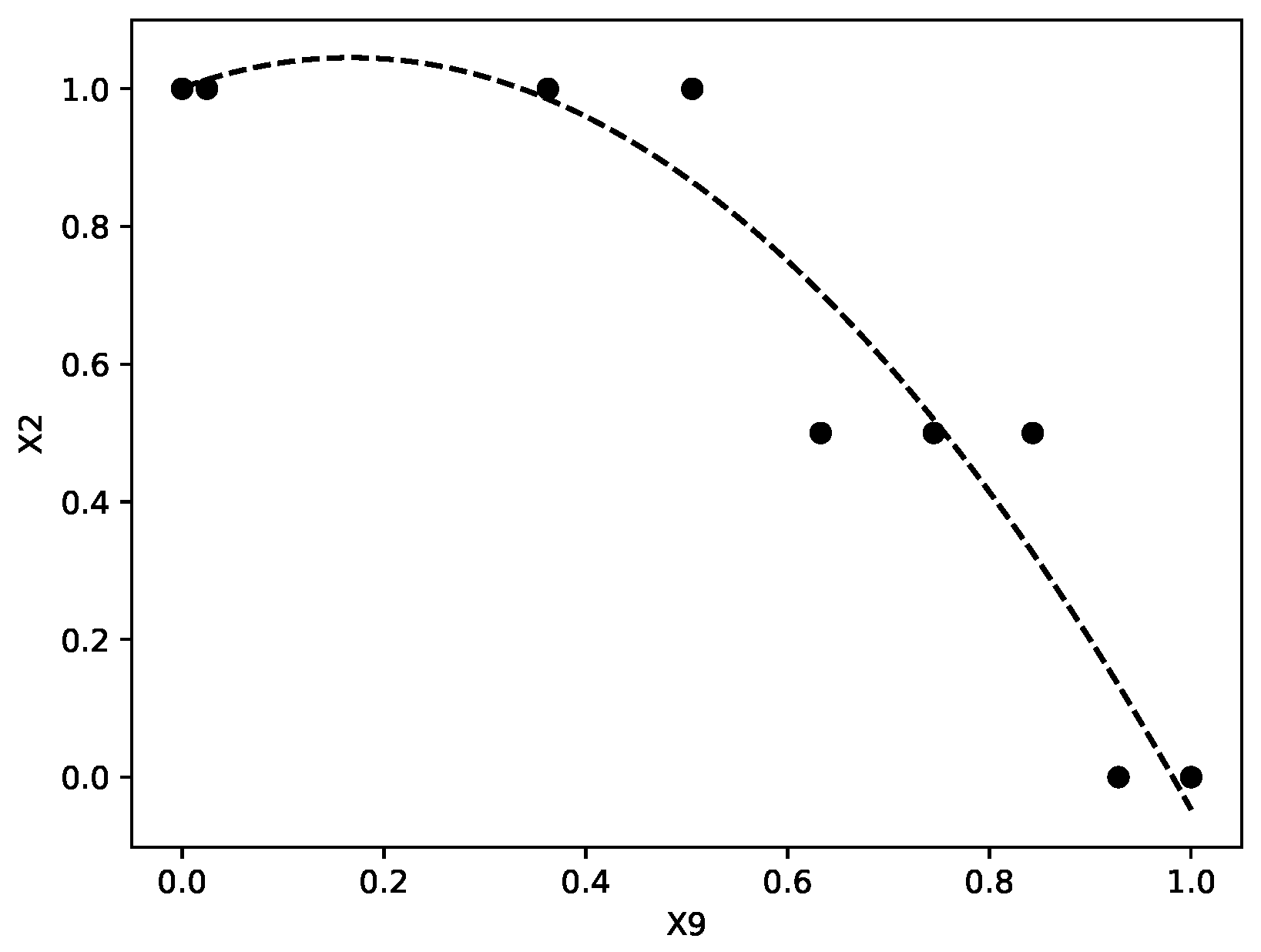
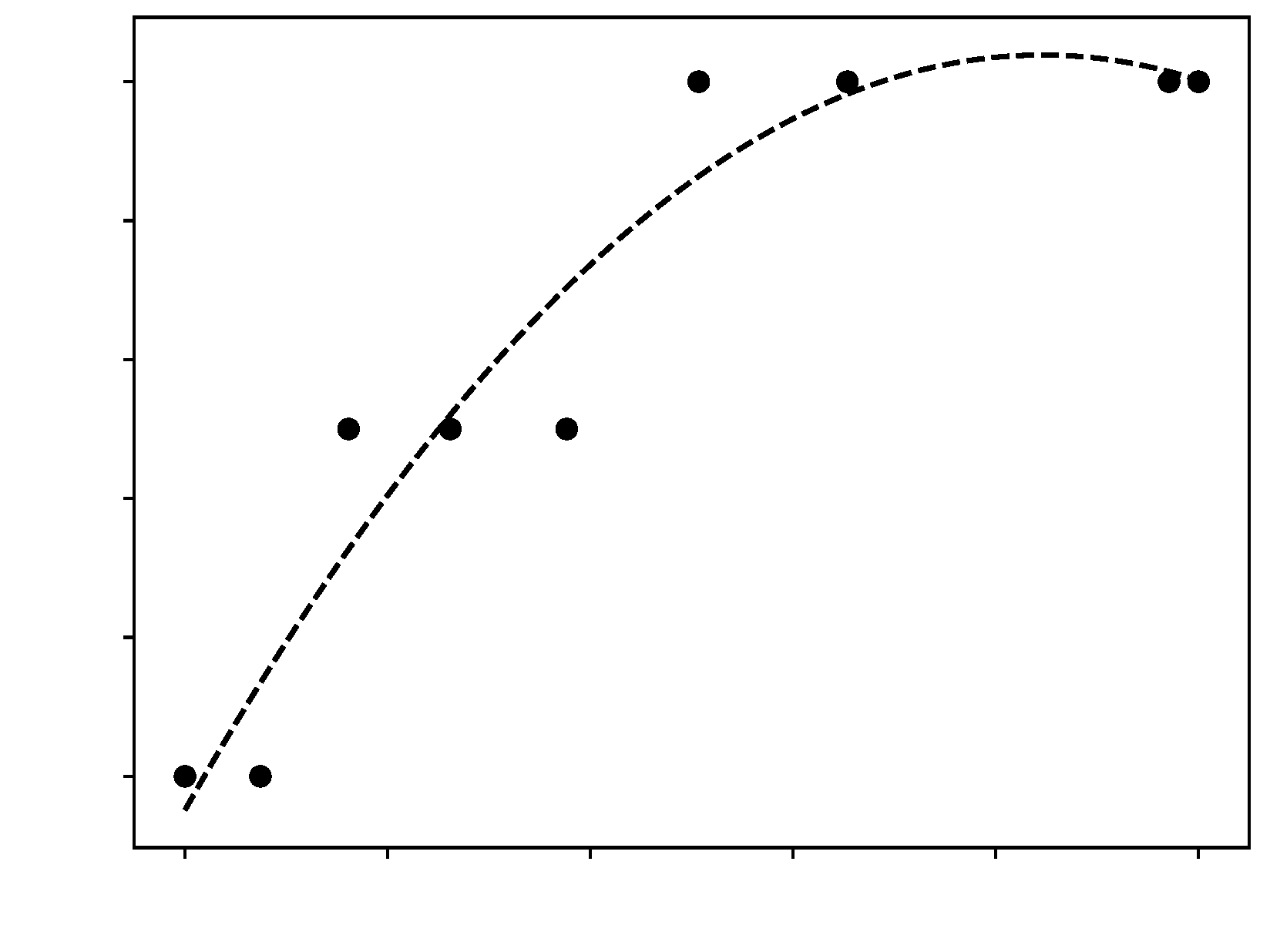
Since the Compensation Index values for the pairs X9–X2 and X9–X6 are below 0.8 but above 0.7, and their correlation coefficients are high, a graphical analysis (Figure 3 and Figure 4) was performed to further investigate the existence of a strong relationship. These figures present the fitted curves along with other relationships analyzed in this study.
The scatter plots indicate a strong relationship between the variables, as the data are well described by second-degree polynomial models with high accuracy ( R 2 = 0.92 in both cases). Therefore, it can be concluded that all criteria exhibit compensatory relationships with one another, consistent with the assumptions of this study. This finding is aligned with the use of the TOPSIS method, whose results are presented in Table 2.
The final step of the method involves adjusting the weights of the criteria. The original study did not report the weight values explicitly; instead, it described the procedure used to compute them, namely the EWM method. Based on this information, the original weights were estimated and subsequently adjusted. The adjusted criterion weights are presented in Table 3, along with the percentage variation relative to the original weight of each criterion.
The calculations presented in Table 3 were based on the ICCI adjustment procedure proposed in previous studies on inter-criteria compensation analysis. In this context, “Sum i” represents the cumulative compensatory influence exerted by criterion i over the remaining criteria, whereas “Sum j” represents the cumulative compensatory influence received by criterion j. The difference between these sums is subsequently normalized by the total number of criteria and used to perform proportional adjustments to the original weights. This procedure aims to identify compensatory imbalances among criteria and reduce potential distortions caused by strongly compensatory relationships.
The original weights were initially re-estimated from the normalized decision matrix following the standard Entropy Weight Method (EWM) procedure. Subsequently, these weights were adjusted based on the compensatory relationships identified through the ICCI matrix.
The adjustment procedure consisted of the following steps: (i) estimation of entropy-based weights; (ii) computation of pairwise ICCI values; (iii) calculation of the cumulative compensatory influences (“Sum i” and “Sum j”); (iv) determination of compensatory differences among criteria; (v) normalization of these differences by the total number of criteria; and (vi) proportional adjustment and final renormalization of the original weights.
This procedure was designed to incorporate both the informational variability of the criteria and the inter-criteria compensatory behavior into the final weighting structure.

4.2. Class Construction

The second part of the analysis proposes a methodology for predefining class boundaries in clustering problems and compares clustering techniques with MCDM methods, despite their fundamental differences. A similar comparison was previously conducted by Trojan et al. [21]; however, their study employed the ELECTRE TRI method (non-compensatory), whereas the present study adopts the TOPSIS-Sort-B method (compensatory).
To this end, studies with a compensatory structure were selected, following the methodology proposed in Phase 1, to construct classes, compare the results of cluster analysis (unsupervised methods) with those obtained from the TOPSIS-Sort-B sorting method (supervised method), and predefine class boundaries. This comparison is performed by identifying which clustering method(s) produce groupings most similar to the classes generated by the MCDM approach.
The TOPSIS-Sort-B method is largely based on the classical TOPSIS procedure, as most computational steps are equivalent. The main difference lies in the definition of limiting profiles, which depends on the number of classes to be established. Alternatives are then ranked according to their proximity coefficients relative to those of the profiles, which act as boundary references for the classes [7].
The definition of limiting profiles can rely either on decision-makers’ preferences or on mathematical and statistical techniques. In this study, the profiles were constructed based on the median values of the intervals. Additionally, to ensure robustness in the clustering analysis, 100 independent runs were performed for each method. The quality and validity of the clustering results were assessed by verifying whether each alternative was appropriately allocated to its respective cluster.
Accordingly, the Phase 2 analysis was conducted based on the study by Keshtkar [87] and its application to the case of electric vehicles in Brazil, considering scenarios with two, three, and four groups for each case.

Class Construction for the Study of Keshtkar [87]

The application of the methodology proposed in Theme 1 to the study by Keshtkar [87] confirmed that this case satisfies the conditions for compensatory analysis. Based on the normalized decision matrix, classes were constructed using the different methods proposed in this study, with the objective of identifying which clustering techniques produce groupings most similar to those obtained using the TOPSIS-Sort-B method.
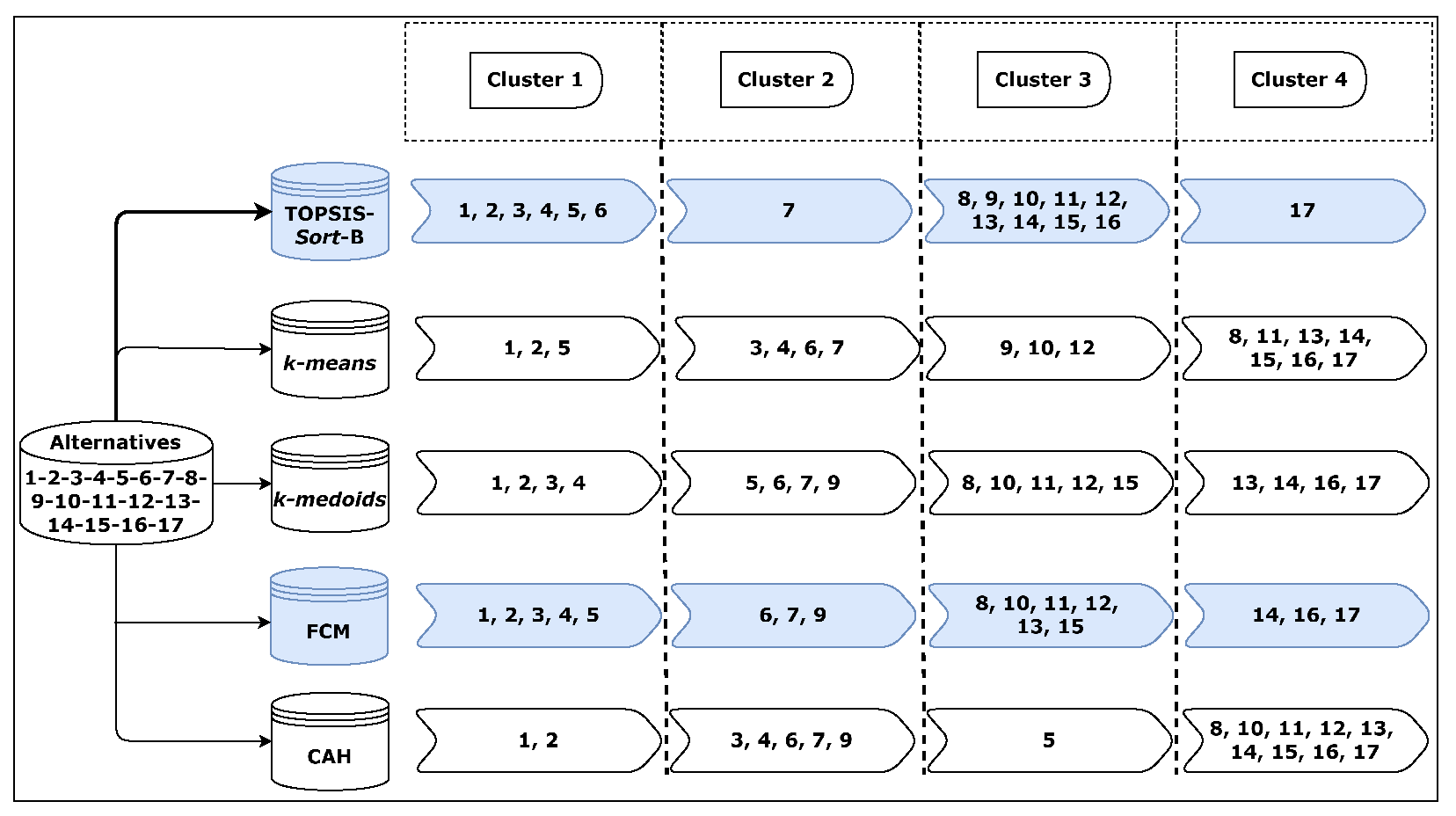
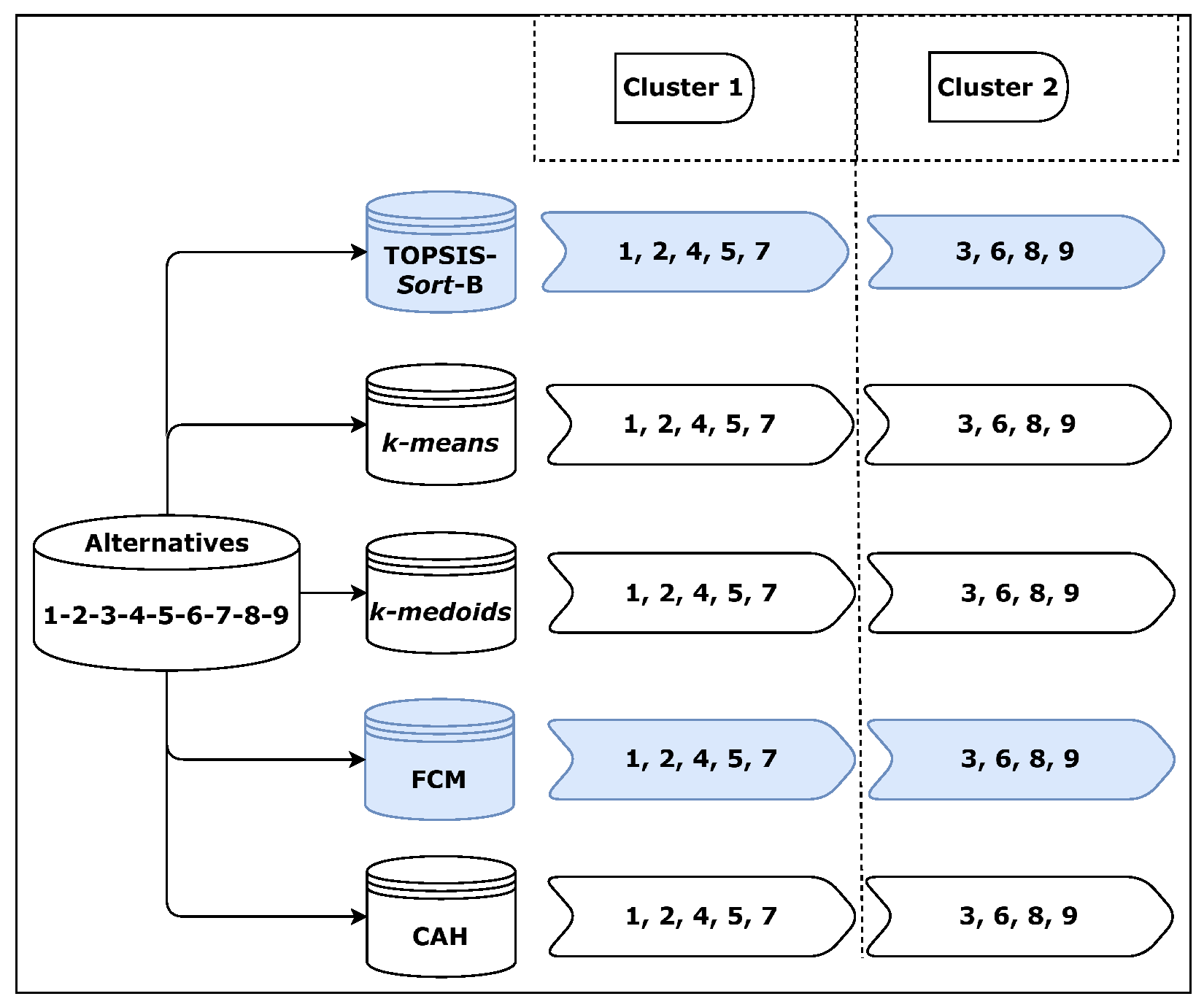
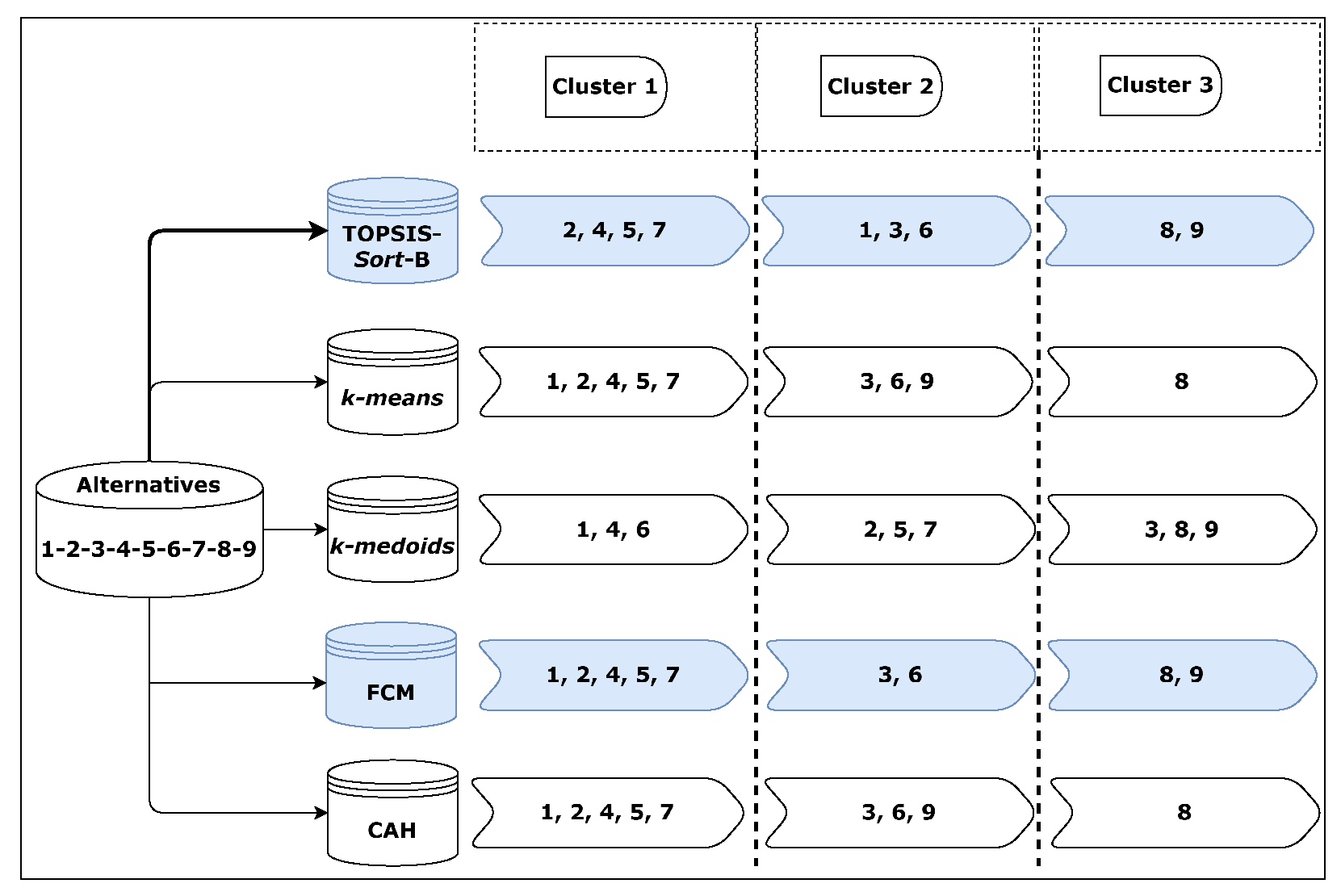
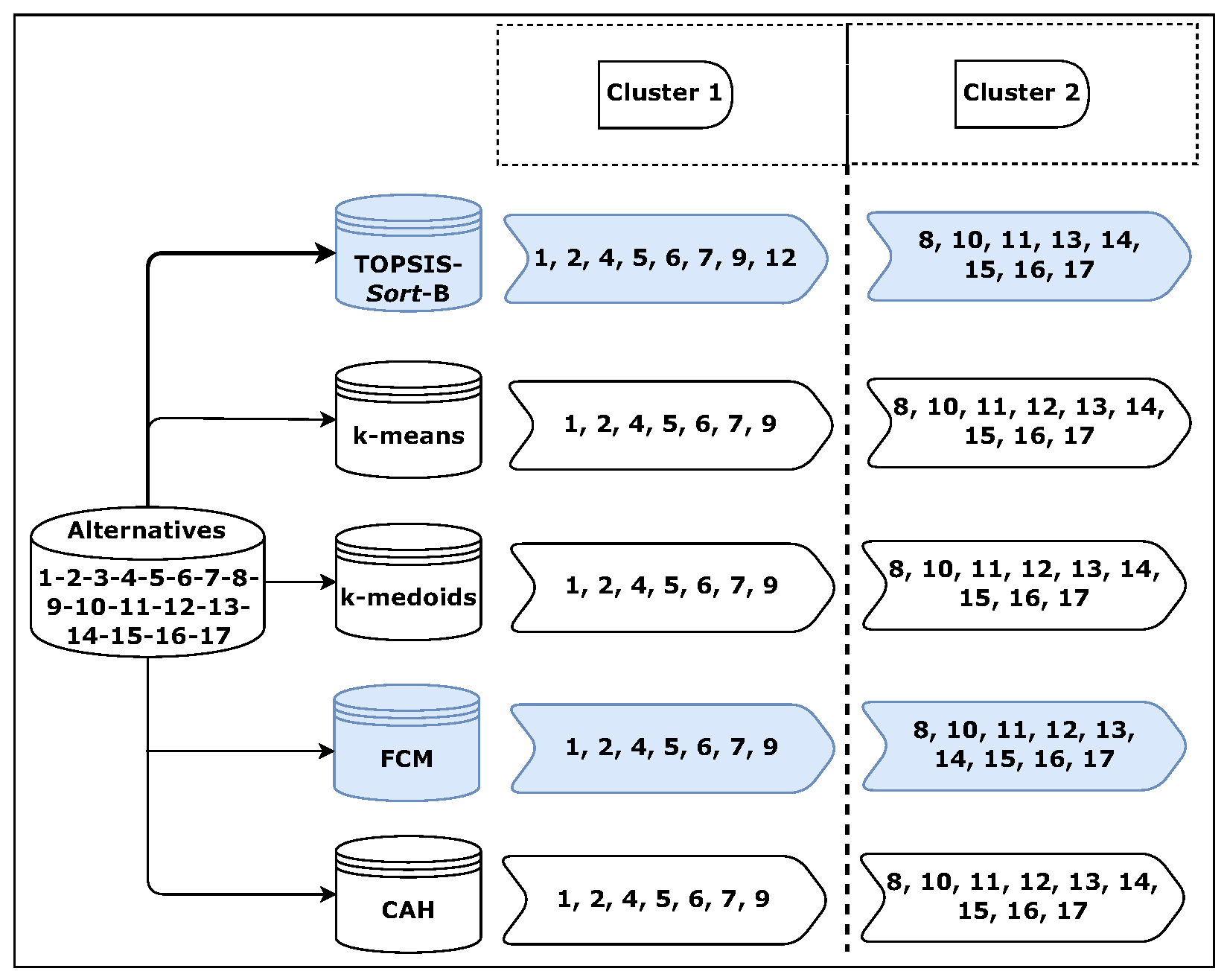
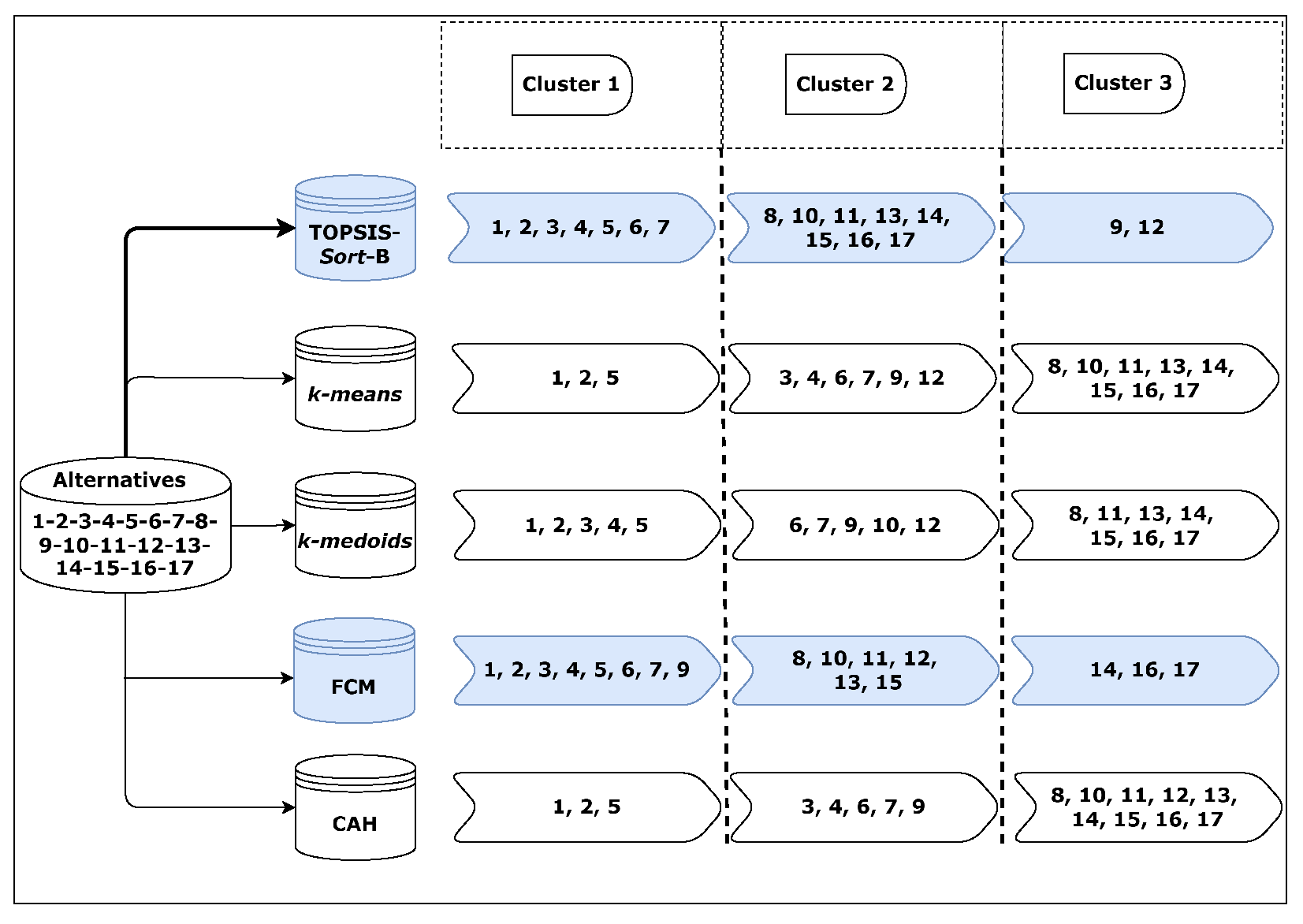
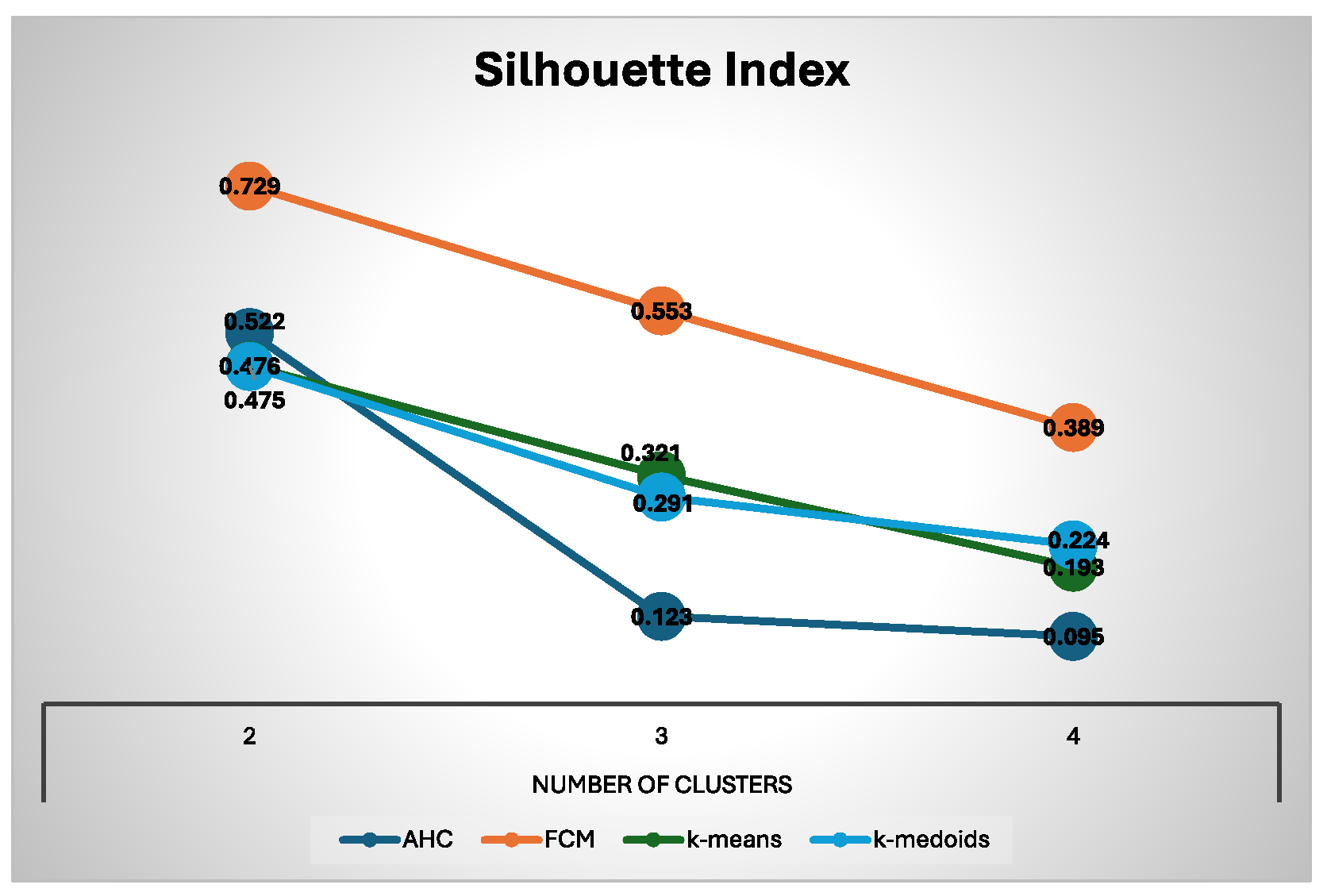
The results for the construction of classes using the clustering methods are presented in Figure 5, Figure 6 and Figure 7, corresponding to scenarios with two, three, and four classes, respectively. These figures provide a visual comparison of the classification structures generated by supervised and unsupervised approaches. The graphical representations enable the identification of class cohesion, overlap regions, and allocation stability, thereby complementing the CDCI-based consistency analysis. Figure 8 presents the results of the Silhouette Index.
All class configurations were constructed using the clustering technique identified as most suitable, based on comparisons between the resulting clusters and those obtained using the TOPSIS-Sort-B method and the Silhouette Index. For all scenarios (2, 3, and 4 classes), the selected clustering technique was Fuzzy C-Means (FCM). Based on this, the boundary values (class limits) were determined for both the TOPSIS-Sort-B and FCM methods, and subsequently compared with the original boundaries defined by the MCDM method.
In Table 4, the definition of the boundary (B1, representing the first class boundary) was calculated as the average between adjacent classes, using the lowest value of class 1 (Lo1) and the highest value of class 2 (Hi2), following the procedure adopted by Trojan et al. [21]. It is important to note that the max-min normalization method was applied, converting cost criteria into benefit criteria (i.e., higher values indicate better performance).
The boundary for criterion X1, for example, was calculated using Equation (29):
L 1 = 0.36 0.5 2 + 0.5
Table 5 presents the class boundary values, comparing the original MCDM (TOPSIS-Sort-B) boundaries with those calculated using the TOPSIS-Sort-B procedure and the FCM clustering method for the case of two classes.
The boundaries, regardless of the calculation method used, exhibit similar values. Table 6 provides an example of the calculation of the boundary factors for classes 1 and 2 using the FCM method (two-class case).
Table 7 presents an analysis of the allocation of alternatives across the two classes. Considering that Keshtkar [87] uses 10 criteria, an alternative is deemed correctly classified if the sum b i j is equal to or greater than 5. The remaining tables (Table A7, Table A8, Table A9, Table A10, Table A11, Table A12 and Table A13), which correspond to the construction of classes for 3 and 4 clusters, are provided in Appendix B.
All alternatives were assigned to the correct class. Only one alternative (b1) did not achieve a sum of 10; however, its sum was 8 ( C D C I ( % ) of 80 % ).

4.3. Building Classes for the Study of EVs

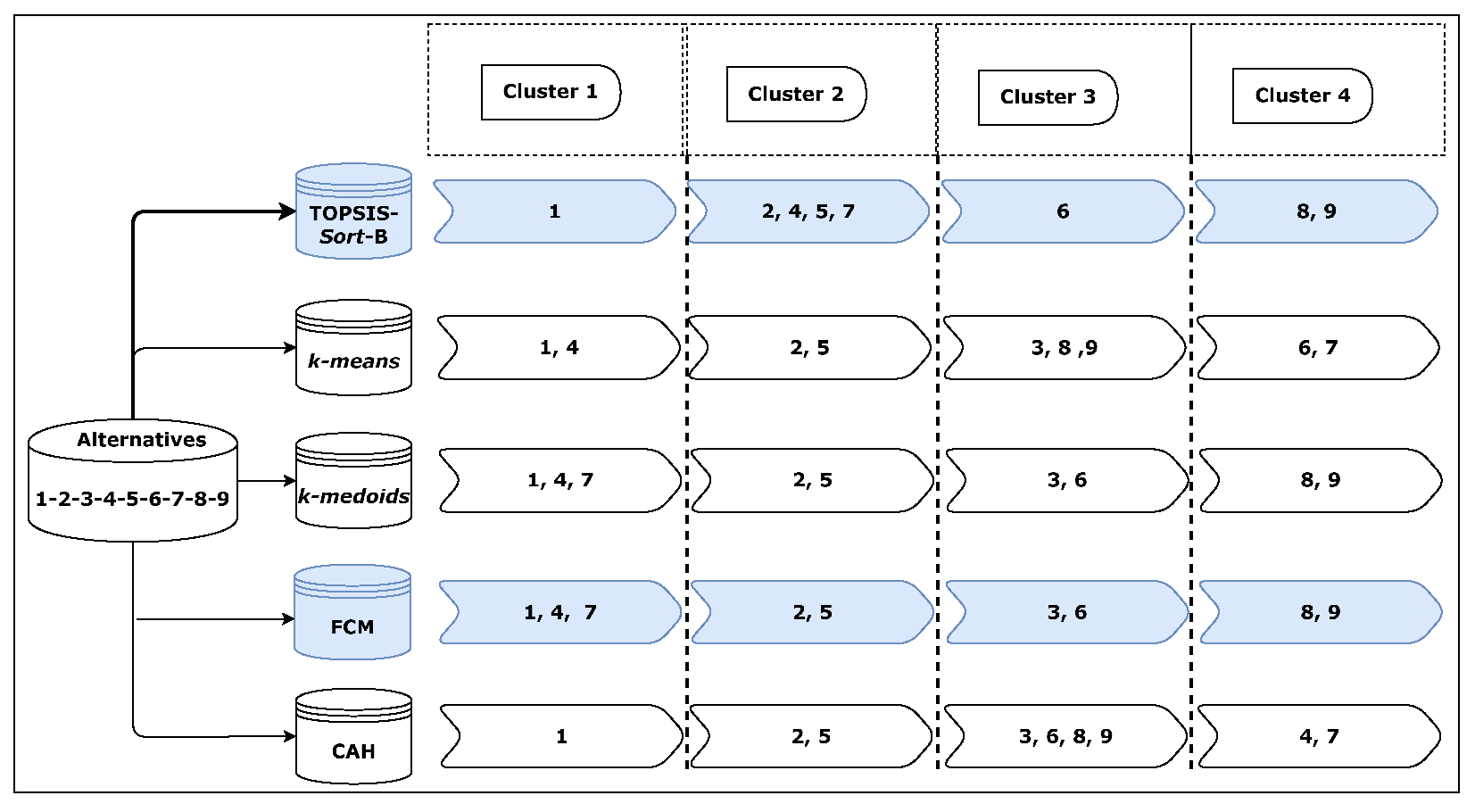
As verified in the study by Keshtkar [87], the compensatory nature of the criteria was first analyzed to propose a classification of electric vehicles (EVs) in Brazil. The compensatory nature of the criteria for EVs was further examined by Oliveira et al. [71]. The construction of classes for EVs may be more representative than in the previous case, given the larger number of alternatives. The results of the three clustering configurations are presented in Figure 9, Figure 10 and Figure 11.
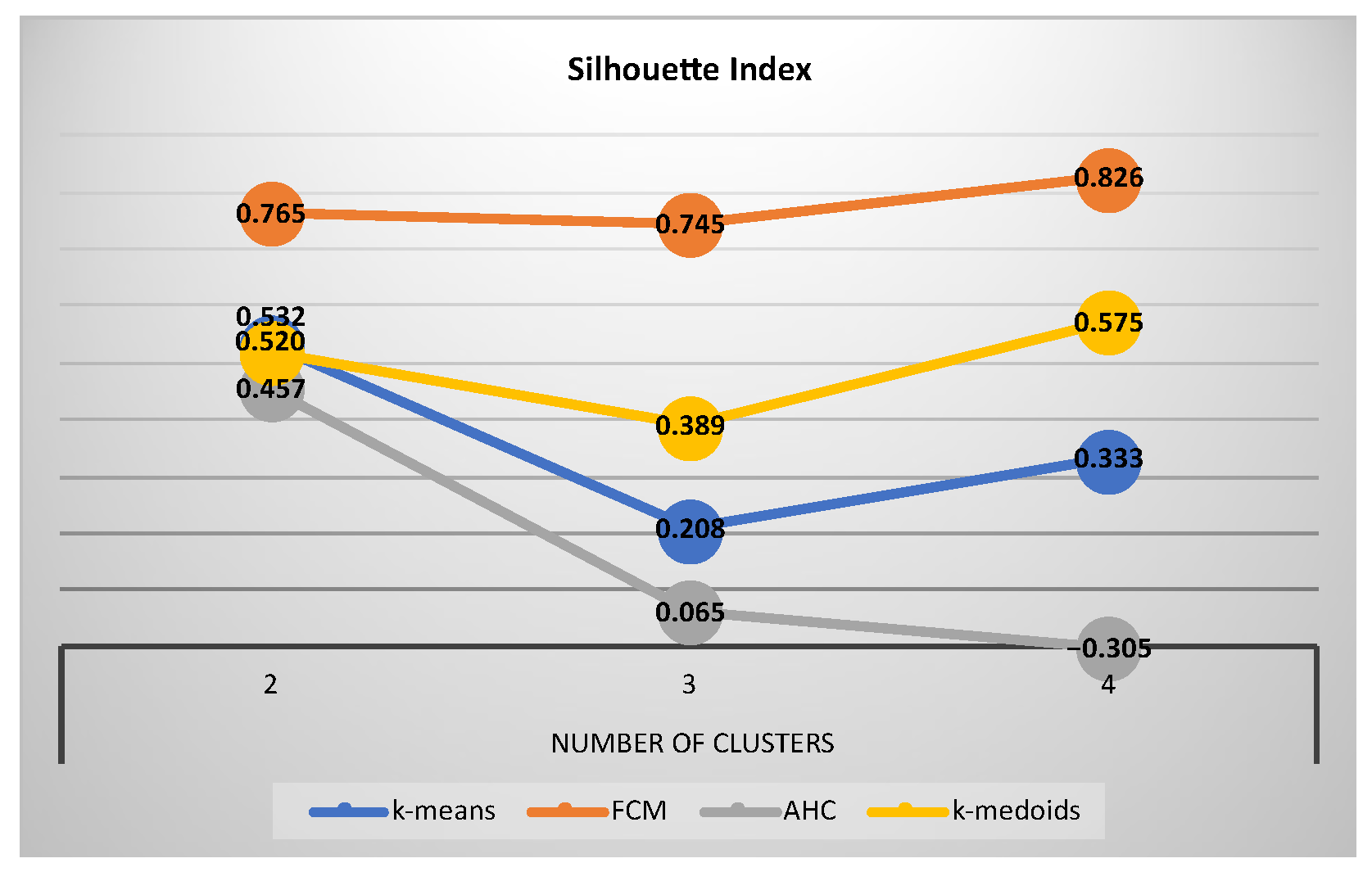
These figures further illustrate the structural behavior of the evaluated methods under different levels of criterion conflict and compensatory trade-offs. The visual analyses reinforce the interpretation provided by the CDCI, particularly with respect to intra-class homogeneity and the sensitivity of the alternatives to compensatory effects. The Silhouette Index results are shown in Figure 12. The definition of the limiting profiles in the TOPSIS-Sort-B method can be based either on decision-makers’ preferences or on mathematical and statistical techniques.
For this study, the limiting profiles were constructed using the median of the intervals. Additionally, the clustering analyses were run 100 times independently. Based on the normalized matrix data, clusters with 2, 3, and 4 groups were generated for each method to compare which clustering results most closely approximate the classes generated by the TOPSIS-Sort-B method.
As in the study by Keshtkar [87], the Fuzzy C-Means (FCM) clustering technique was applied across all cases (2, 3, and 4 classes), as highlighted by the orange color in the figures above. Table 8 presents the allocation of alternatives to their respective classes, along with the corresponding edge values calculated using the FCM method.
Table 9 presents the class boundaries, comparing the edges obtained using the original MCDM method (TOPSIS-Sort-B) with the boundaries calculated using the TOPSIS-Sort-B recalculation and the FCM method, based on Equation (27) (for the two-class configuration).
The calculated boundaries, when compared with those of the original TOPSIS-Sort-B method, exhibit similar values. However, the boundaries are not necessarily identical, particularly as the number of classes increases, since class distributions may vary. Table 10 presents the calculation of the limiting values for classes 1 and 2 using the FCM method (two-class case). The remaining calculations for the three- and four-class scenarios are provided in Appendix B.
It is worth noting that the construction of the limiting factors is based on the relationship between the highest values (Lo1 or Hi2). Table 11 presents the calculations for allocating alternatives to each class, assuming two classes. In the study of electric vehicles in Brazil, there are eight criteria; therefore, an alternative is considered to be correctly assigned if the sum b i j is equal to or greater than 4, meaning that 50% or more of the criteria assign a value of 1 to that alternative.
All alternatives are allocated to their correct classes. However, only 6 out of the 17 alternatives presented a sum S i equal to 8 ( C D C I i ( % ) de 100%). In contrast, one alternative (a9) reached the minimum sum of 4 ( C D C I i ( % ) de 50%) required to be allocated to its original class according to the method’s calculations. For comparison, in the study by Keshtkar [87], 8 out of 9 alternatives (approximately 88.89%) presented a sum equal to 8 ( C D C I i ( % ) de 100%). In the case of electric vehicles in Brazil, this corresponds to approximately 35.30% of the total alternatives. This comparison considers constructions with two classes. The analyses for the three- and four-class cases of electric vehicles in Brazil are presented in Appendix C (Table A14, Table A15, Table A16, Table A17, Table A18, Table A19 and Table A20).

4.4. Comparative Analysis Between Supervised and Unsupervised Methods in Class Construction

The analysis of the two case studies reveals consistent patterns in class formation when supervised (TOPSIS-Sort-B) and unsupervised (cluster analysis) approaches are applied. In general, a high degree of convergence between the methods is observed, particularly when the number of classes is small, along with some localized divergences mainly associated with intermediate alternatives.
Initially, in the two-class configuration, a high level of agreement between the methods is observed in both studies. In the electric vehicle case, the alternatives are clearly separated into two distinct groups: one composed of vehicles with better overall performance (greater range, power, battery capacity, and technological attributes), and another consisting of lower-performing alternatives, although in some cases more affordable in terms of cost. Similarly, in the study by Keshtkar [87], the division into two classes also shows complete agreement, distinguishing alternatives with higher thermal and exergetic efficiency from those with higher operational costs and associated losses. This demonstrates full consistency in the construction of two classes for these datasets and indicates that, when the data exhibit high separability, both supervised and unsupervised methods are able to consistently capture the underlying structure of the problem.
As the number of classes increases to three and four, the extreme groups (i.e., the best and worst alternatives) remain relatively stable across methods. In the electric vehicle study, alternatives such as A1 to A6 tend to remain in the upper groups, whereas A14, A16, and A17 are consistently assigned to the lower classes. Similarly, in Keshtkar [87], alternatives such as A8 and A9 remain grouped in the worst classes regardless of the method used. This behavior reinforces the robustness of the methods in identifying dominant and dominated alternatives.
However, the main divergences between the methods emerge in the allocation of intermediate alternatives. In the electric vehicle case, alternatives such as A9 and A12 exhibit variations in classification between TOPSIS-Sort-B and FCM, particularly as the number of classes increases. In the study by Keshtkar [87], similar behavior is observed for alternatives such as A1 and A3. These differences can be attributed to the multicriteria nature of the problems, in which trade-offs between benefit and cost criteria make classification less straightforward. Thus, small variations in the data or in the modeling process may lead to changes in the allocation of these alternatives.
From a criteria-based perspective, the classes formed are consistent with the characteristics of the data. In the electric vehicle study, the best-ranked alternatives generally present higher values for power, range, and battery capacity, although they are associated with higher costs. Conversely, lower-performing alternatives exhibit limitations in these attributes, although they may be more economically accessible. In the study by Keshtkar [87], a similar pattern is observed, in which superior alternatives combine high thermal and exergetic efficiency with lower losses, while inferior alternatives present higher operational costs and performance losses. These results indicate that both methods are capable of adequately capturing the trade-offs between benefit and cost criteria.

4.5. Analysis of Intra-Class Similarity Among Alternatives

In addition to the overall convergence between the supervised method (TOPSIS-Sort-B) and the unsupervised method (Fuzzy C-Means, FCM), a key aspect observed in both studies concerns the homogeneity of alternatives within each class, that is, the degree of intra-class similarity based on criterion values.
In general, the results indicate that the classes formed by both methods exhibit high internal coherence, particularly in the extreme classes. This characteristic suggests that the grouped alternatives share similar multicriteria profiles, reinforcing the consistency of the obtained classifications.
In the electric vehicle study, Class 1 (in the two-class configuration) is predominantly composed of alternatives such as A1, A2, A4, A5, A6, and A7, which exhibit high values in benefit criteria, such as power, range, and battery capacity. Despite minor differences (e.g., variations in energy consumption or price), these alternatives maintain a relatively homogeneous pattern of high overall performance. These vehicles combine high technical capacity with satisfactory range, making them comparable in terms of multicriteria performance.
Similarly, the lower class includes alternatives such as A13, A14, A16, and A17, which share characteristics such as lower power, reduced battery capacity, and shorter range. Although these alternatives may present advantages in terms of cost (a minimization criterion), their inferior technical attributes result in a homogeneous profile of low overall performance. Thus, intra-class similarity in this case is defined by common technical limitations among the alternatives.
In the study by Keshtkar [87], a similar pattern is observed. The class composed of alternatives A1, A2, A4, A5, and A7 exhibits high similarity in terms of thermal and exergetic efficiency (benefit criteria), along with moderate levels of operational cost and associated losses. These alternatives form a relatively homogeneous group of efficient solutions. In contrast, alternatives such as A3, A6, A8, and A9, assigned to the lower class, present higher values in cost-related criteria (such as energy consumption and operational cost) and lower gains in benefit criteria, resulting in an equally coherent grouping from a multicriteria perspective.
An important aspect is that intra-class similarity tends to decrease as the number of classes increases. In the three- and four-class configurations, greater fragmentation of the groups is observed, particularly among intermediate alternatives. In these cases, the classes represent more specific performance levels, and internal homogeneity becomes more sensitive to small variations in the criteria. For example, in the electric vehicle study, alternatives such as A9 and A12, which exhibit hybrid characteristics (intermediate values across multiple criteria), may be assigned to different classes depending on the method used, indicating lower intra-class cohesion in these regions.
The electric vehicle dataset presents weaker separation between classes. The presence of alternatives with low C D C I values suggests that some solutions are located near class boundaries, making their classification less robust. These boundary alternatives may shift between classes depending on the method or the parameter settings adopted.
This behavior highlights the existence of transition regions in the multicriteria space, where alternatives cannot be unambiguously assigned to a single class. Such regions are typical in problems with strong compensatory effects, in which trade-offs between criteria allow different combinations of attributes to produce similar overall performance.
Additionally, the analysis reveals that intra-class similarity depends not only on the absolute proximity of criterion values but also on the compensation structure among them. Alternatives may exhibit different performances across individual criteria and still be grouped into the same class due to a similar overall balance. This phenomenon is particularly evident in multicriteria problems, where different combinations of attributes can result in equivalent levels of aggregated performance. Furthermore, the dataset from Keshtkar [87] tends to be more homogeneous.
Thus, it can be observed that the dataset from Keshtkar [87] presents a more structured pattern, whereas the electric vehicle (EV) case exhibits a more conflicting structure. The comparison between the two studies shows that intra-class similarity and clustering quality are directly related to the data structure and the level of conflict among criteria. This may also be influenced by the larger number of alternatives in the EV dataset.

5. Conclusions, Limitations, and Directions for Future Studies

This methodology is based on the classification of alternatives in a compensatory analysis, comparing clustering techniques (unsupervised methods) with a Multi-Criteria Decision Making method (supervised approach) used for sorting alternatives. In addition, the nature of the criteria can be assessed through the classification results obtained using an appropriate method.
The results indicate that the same clustering technique, Fuzzy C-Means (FCM), identified as the most similar to the multi-criteria method adopted by Trojan et al. [21], also showed the highest similarity across the case studies analyzed in this work, including Keshtkar [87] and electric vehicles in Brazil.
The analysis of class boundaries also accounted for edge cases. Boundaries were calculated for all scenarios (two, three, and four classes) using both FCM and TOPSIS-Sort-B, and then compared with those generated by the latter method. The results show that, in most cases, the boundaries are consistent across the different calculation approaches.
The definition of boundaries enables decision-makers to establish limits for each class and to verify whether alternatives are correctly assigned. This verification was performed by checking whether the value of alternative (i) for criterion (j) falls within the defined limits, assigning a value of 1 if true and 0 otherwise. The sum across all criteria for each alternative must reach at least 50% of the total number of criteria. This procedure makes it possible to determine whether an alternative is correctly classified and, if not, to reassign it to a more appropriate class.
Decision-making problems can be complex, particularly when conflicting criteria are involved. Although subjectivity remains an inherent aspect of MCDM analyses, the lack of systematic techniques for method selection can hinder the development of robust solutions.
Despite the contributions of the proposed approach, some limitations remain. Future research could include a sensitivity analysis of class construction, such as removing criteria, to evaluate whether these changes lead to significant differences in the resulting classifications.
In practical applications, the accuracy of automatic allocation varied across case studies. In the study by Keshtkar [87], 88.89% of the alternatives were correctly classified, whereas in the electric vehicles case study in Brazil, this percentage decreased, likely due to the larger number of alternatives considered.
Overall, the results show that class boundaries are similar across methods, indicating structural stability regardless of the approach used. The main contribution of this study lies not only in the integration of methods but also in the operationalization of the transition between supervised and unsupervised sorting, as well as in the analysis of the allocation of alternatives to classes using the Criterion-Driven Consistency Indicator (CDCI). Furthermore, the proposed framework allows for the semi-automation of class definitions in MCDM (Multi-Criteria Decision Making), reducing (though not eliminating) the decision-maker’s dependence while preserving a necessary degree of subjectivity in the process.
Thus, the CDCI has proven to be effective in evaluating the internal consistency of classes, providing an intuitive measure that is directly related to the problem’s criteria. Unlike purely geometric metrics, this indicator incorporates the logic of Multi-Criteria Decision making, allowing for an interpretation better aligned with the problem context.
The results highlight the importance of considering the data structure when selecting a classification method. In situations with high intra-class homogeneity, different methods tend to converge toward similar solutions. On the other hand, in contexts with high heterogeneity and conflict among criteria, the choice of method can significantly influence the results, especially in the intermediate regions of the decision space.
In summary, this approach advances the literature by providing a structured and less subjective alternative for class definition in compensatory methods, thereby expanding its applicability across different decision-making contexts.
Despite the contributions of this study, some limitations must be acknowledged. First, the analysis is based on two case studies, which, although representative, may not capture the full diversity of Multi-Criteria Decision-making problems. Consequently, the generalization of the results may be limited, particularly for problems involving a large number of criteria, nonlinear relationships, or dynamic data. Second, the evaluation of intra-class similarity relies primarily on the C D C I indicator. Although this measure is interpretable and aligned with decision-making contexts, it does not fully capture all aspects of cluster structure, such as the geometric distribution of alternatives or potential correlations among criteria. Third, the unsupervised approach (FCM) requires the prior specification of the number of clusters, which may influence the results.
The present study adopted midpoint-based limiting profiles due to their simplicity, transparency, and interpretability. However, alternative boundary construction strategies, such as central profiles or preference-learning procedures, may influence the sensitivity and stability of class allocations, particularly in datasets characterized by strong criterion conflict, compensatory trade-offs, and overlapping class regions.
Future research should systematically investigate alternative boundary-definition mechanisms, including midpoint-based limiting profiles, central profiles, and preference disaggregation approaches, and should also evaluate the effects of criterion removal and structural modifications in the multicriteria framework on class behavior, allocation stability, and compensatory relationships among criteria. Additional analyses involving datasets with different dimensionalities, conflict levels, overlap structures, and data distribution patterns across multiple application domains may contribute to a deeper understanding of the robustness, interpretability, and generalizability of the proposed methodology. Moreover, the incorporation of complementary validation metrics, such as the Adjusted Rand Index, Normalized Mutual Information, and stability-based measures, together with hybrid classification approaches integrating supervised and unsupervised techniques, represents a promising direction for improving the reliability and comprehensiveness of multicriteria classification in complex decision-making environments.

Author Contributions

Conceptualization, M.S.d.O. and F.T.; methodology, M.S.d.O. and F.T.; validation, M.S.d.O. and F.T.; formal analysis, M.S.d.O. and F.T.; investigation, M.S.d.O. and F.T.; data curation, M.S.d.O. and F.T.; writing—original draft preparation, M.S.d.O., F.T., M.F.M. and V.S.; writing—review and editing, M.S.d.O., F.T., M.F.M. and V.S.; visualization, M.S.d.O., M.F.M. and V.S.; supervision, F.T.; project administration, F.T. All authors have read and agreed to the published version of the manuscript.

Funding

This research received no external funding.

Data Availability Statement

The original contributions presented in this study are included in the article. Further inquiries can be directed to the corresponding author.

Conflicts of Interest

The authors declare no conflicts of interest.

Appendix A

Table A1. Normalized decision matrix in Keshtkar [87].
bnX1X2X3X4X5X6X7X8X9X10
b10.500.630.580.570.430.620.510.500.500.56
b20.930.930.900.140.860.930.800.860.000.12
b30.210.360.330.790.210.350.260.271.000.78
b40.570.740.690.430.570.740.540.550.500.44
b51.001.001.000.001.001.001.001.000.000.00
b60.360.510.450.640.360.490.40.411.000.67
b70.710.840.800.290.570.840.570.610.50.32
b80.070.020.020.930.070.000.110.141.000.93
b90.000.000.001.000.000.030.000.001.001.00
Maximum1.001.001.001.001.001.001.001.001.001.00
Minimum0.000.000.000.000.000.000.000.000.000.00
Average0.480.560.530.530.450.550.470.480.610.53
Standard deviation0.340.350.340.330.320.350.300.300.390.33
Table A2. Compensatoriness index for Keshtkar [87].
CriteriaX1X2X3X4X5X6X7X8X9X10
X11.000.910.930.970.950.910.930.950.880.98
X20.911.000.970.910.890.980.890.890.810.90
X30.930.981.000.930.910.980.910.910.830.93
X40.970.910.931.000.950.910.930.940.860.98
X50.950.900.910.951.000.900.960.960.880.96
X60.910.980.980.910.891.000.890.890.810.90
X70.940.900.920.940.960.901.000.980.870.94
X80.950.910.920.950.970.900.981.000.880.96
X90.860.780.800.840.850.790.830.841.000.85
X100.980.910.930.980.960.910.940.950.881.00
Table A3. Pearson correlation for Keshtkar [87].
CriteriaX1X2X3X4X5X6X7X8X9X10
X11.000.970.98−1.000.990.970.980.99−0.95−1.00
X20.971.001.00−0.970.961.000.960.96−0.88−0.97
X30.981.001.00−0.980.971.000.970.97−0.90−0.98
X4−1.00−0.97−0.981.00−0.99−0.97−0.98−0.990.931.00
X50.990.960.97−0.991.000.960.991.00−0.94−0.99
X60.971.001.00−0.970.961.000.960.96−0.88−0.97
X70.980.960.97−0.980.990.961.001.00−0.93−0.99
X80.990.960.97−0.991.000.961.001.00−0.93−0.99
X9−0.95−0.88−0.900.93−0.94−0.88−0.93−0.931.000.94
X10−1.00−0.97−0.981.00−0.99−0.97−0.99−0.990.941.00
Table A4. Spearman correlation for Keshtkar [87].
CriteriaX1X2X3X4X5X6X7X8X9X10
X11.001.001.00−1.001.000.981.001.00−0.94−1.00
X21.001.001.00−1.001.000.981.001.00−0.94−1.00
X31.001.001.00−1.001.000.981.001.00−0.94−1.00
X4−1.00−1.00−1.001.00−1.00−0.98−1.00−1.000.941.00
X51.001.001.00−1.001.000.981.001.00−0.94−1.00
X60.980.980.98−0.980.981.000.980.98−0.94−0.98
X71.001.001.00−1.001.000.981.001.00−0.94−1.00
X81.001.001.00−1.001.000.981.001.00−0.94−1.00
X9−0.94−0.94−0.940.94−0.94−0.94−0.94−0.941.000.94
X10−1.00−1.00−1.001.00−1.00−0.98−1.00−1.000.941.00
Table A5. p-Value for the Pearson correlation test for Keshtkar [87].
CriteriaX1X2X3X4X5X6X7X8X9X10
X10.00000.00000.00000.00000.00000.00000.00000.00000.00010.0000
X20.00000.00000.00000.00000.00000.00000.00000.00000.00200.0000
X30.00000.00000.00000.00000.00000.00000.00000.00000.00100.0000
X40.00000.00000.00000.00000.00000.00000.00000.00000.00030.0000
X50.00000.00000.00000.00000.00000.00000.00000.00000.00010.0000
X60.00000.00000.00000.00000.00000.00000.00000.00000.00160.0000
X70.00000.00000.00000.00000.00000.00000.00000.00000.00030.0000
X80.00000.00000.00000.00000.00000.00000.00000.00000.00020.0000
X90.00010.00200.00100.00030.00010.00160.00030.00020,00000.0001
X100.00000.00000.00000.00000.00000.00000.00000.00000.00010.0000
Table A6. p-Value for the Spearman correlation test for Keshtkar [87].
CriteriaX1X2X3X4X5X6X7X8X9X10
X10.00000.00000.00000.00000.00000.00020.00000.00000.00040.0000
X20.00000.00000.00000.00000.00000.00020.00000.00000.00040.0000
X30.00000.00000.00000.00000.00000.00020.00000.00000.00040.0000
X40.00000.00000.00000.00000.00000.00000.00000.00000.00070.0000
X50.00000.00000.00000.00000.00000.00020.00000.00000.00040.0000
X60.00020.00020.00020.00000.00020,00000.00020.00020.00040.0000
X70.00000.00000.00000.00000.00000.00020.00000.00000.00040.0000
X80.00000.00000.00000.00000.00000.00020.00000.00000.00040.0000
X90.00040.00040.00040.00070.00040.00040.00040.00040.00000.0007
X100.00000.00000.00000.00000.00000.00000.00000.00000.00070.0000

Appendix B

Table A7. Composition of the three classes in the case of Keshtkar [87].
FCM
bnX1X2X3X4X5X6X7X8X9X10
Cluster 1
b1Lo1 0.50Lo1 0.63Lo1 0.580.57Lo1 0.43Lo1 0.62Lo1 0.51Lo1 0.500.500.56
b20.930.930.900.140.860.930.800.86Lo1 0.000.12
b40.570.740.690.430.570.740.540.550.500.44
b51.001.001.00Lo1 0.001.001.001.001.000.00Lo1 0.00
b70.710.840.800.290.570.840.570.610.500.32
B10.430.570.510.390.390.560.450.450.500.39
Cluster 2
b3Lo2 0.21Lo2 0.36Lo2 0.33Hi2 0.79Lo2 0.21Lo2 0.35Lo2 0.26Lo2 0.27Hi2 1.00Hi2 0.78
b6Hi2 0.36Hi2 0.51Hi2 0.45Lo2 0.64Hi2 0.36Hi2 0.49Hi2 0.40Hi2 0.41Lo2 1.00Lo2 0.67
B20.140.190.170.820.140.190.180.201.000.83
Cluster 3
b8Hi2 0.07Hi2 0.02Hi2 0.020.93Hi2 0.070.00Hi2 0.11Hi2 0.14Hi2 1.000.93
b90.000.000.00Hi2 1.000.00Hi2 0.030.000.001.00Hi2 1.00
Table A8. Boundary values for three classes in Keshtkar [87].
MethodX1X2X3X4X5X6X7X8X9X10Border
Border TOPSIS-Sort-B (original)0.640.790.750.710.570.790.550.581.000.72B1
0.290.430.390.360.290.420.330.340.50.38B2
Border TOPSIS-Sort-B (calculated)0.540.690.640.390.500.680.520.520.500.39B1
0.430.460.430.790.360.460.430.430.750.78B2
Border cluster method (calculated) FCM0.430.570.510.390.390.560.450.450.500.39B1
0.140.190.170.820.140.190.180.201.000.83B2
Table A9. Threshold values for the three classes in Keshtkar [87].
Values of the Limiters
CriteriaX1X2X3X4X5
Class 1 0.43 b i j 1 0.57 b i j 1 0.51 b i j 1 0 b i j 0.39 0.39 b i j 1
Class 2 0.14 < b i j < 0.43 0.19 < b i j < 0.57 0.17 < b i j < 0.51 0.39 < b i j < 0.82 0.14 < b i j < 0.39
Class 3 0 b i j 0.14 0 b i j 0.19 0 b i j 0.17 0.82 b i j 1 0 b i j 0.14
Values of the Limiters
CriteriaX6X7X8X9X10
Class 1 0.56 b i j 1 0.45 b i j 1 0.45 b i j 1 0 b i j 0.5 0 b i j 0.39
Class 2 0.19 < b i j < 0.56 0.18 < b i j < 0.45 0.2 < b i j < 0.45 0.5 < b i j < 1 0.39 < b i j < 0.83
Class 3 0 b i j 0.19 0 b i j 0.18 0 b i j 0.20 b i j = 1 0.83 b i j 1
Table A10. Allocation of alternatives to the three classes in Keshtkar [87].
FCM
bnX1X2X3X4X5X6X7X8X9X10 S i CDCI CDCI (%)
Cluster 1
b1111011111080.8080.00%
b21111111111101.00100.00%
b4111011111080.8080.00%
b51111111111101.00100.00%
b71111111111101.00100.00%
Cluster 2
b31111111111101.00100.00%
b6111111110190.9090.00%
Cluster 3
b81111111111101.00100.00%
b91111111111101.00100.00%
Table A11. Composition of the four classes in the case of Keshtkar [87].
FCM
bnX1X2X3X4X5X6X7X8X9X10
Cluster 1
b1Lo1 0.50Lo1 0.63Lo1 0.580.57Lo1 0.43Lo1 0.62Lo1 0.51Lo1 0.50Lo1 0.500.56
b40.570.740.690.430.570.740.540.550.500.44
b70.710.840.80Lo1 0.290.570.840.570.610.50Lo1 0.32
B10.750.820.790.210.710.810.750.750.250.22
Cluster 2
b2Lo2 0.93Lo2 0.93Lo2 0.90Hi2 0.14Lo2 0.86Lo2 0.93Lo2 0.80Lo2 0.86Lo2 0.00Hi2 0.12
b5Hi2 1.00Hi2 1.00Hi2 1.00Lo2 0.00Hi2 1.00Hi2 1.00Hi2 1.00Hi2 1.00Hi 1.00Lo2 0.00
Cluster 3
B20.640.720.670.390.610.710.600.640.500.39
b3Lo3 0.21Lo3 0.36Lo3 0.33Hi3 0.79Lo3 0.21Lo3 0.35Lo3 0.26Lo3 0.27Lo3 1.00Hi3 0.78
b6Hi3 0.36Hi3 0.51Hi3 0.45Lo3 0.64Hi3 0.36Hi3 0.49Hi3 0.40Hi3 0.41Hi3 1.00Lo3 0.67
Cluster 4
B30.140.190.170.820.140.190.180.21.000.83
b8Hi4 0.07Hi4 0.02Hi4 0.020.93Hi4 0.070.00Hi4 0.11Hi4 0.14Hi4 1.000.93
b90.000.000.00Hi4 1.000.00Hi4 0.030.000.001.00Hi4 1.00
Table A12. Class boundary values for four classes in Keshtkar [87].
MethodX1X2X3X4X5X6X7X8X9X10Border
Border TOPSIS-Sort-B (original)0.640.790.750.710.570.790.550.581.000.72B1
0.570.570.510.500.390.560.450.450.500.50B2
0.140.190.170.210.140.190.180.200.250.22B3
Border TOPSIS-Sort-B (calculated)0.750.820.790.50.710.810.750.750.500.50B1
0.460.630.570.320.460.620.470.480.500.33B2
0.290.430.390.820.290.420.330.341.000.83B3
Border cluster method (calculated) FCM0.750.820.790.210.710.810.750.750.250.22B1
0.640.720.670.390.610.710.600.640.500.39B2
0.140.190.170.820.140.190.180.201.000.83B3
Table A13. Assignment of alternatives to the four classes in Keshtkar [87].
FCM
bnX1X2X3X4X5X6X7X8X9X10 S i CDCI CDCI ( % )
Cluster 1
b11111111111101.00100.00%
b41111111111101.00100.00%
b7100110111170.7070.00%
Cluster 2
b21111111111101.00100.00%
b5111111111090.9090.00%
Cluster 3
b31111111111101.00100.00%
b61111111111101.00100.00%
Cluster 4
b81111111111101.00100.00%
b91111111111101.00100.00%

Appendix C

Table A14. Composition of the three classes in the VE case.
FCM
anC1C2C3C4C5C6C7C8
Cluster 1
a10.30Lo1 0.001.000.98Lo1 0.000.640.611.00
a20.300.130.79Lo1 0.730.441.000.730.66
a30.390.210.590.980.500.430.780.86
a4Lo1 0.000.240.591.000.510.550.910.66
a50.490.130.780.880.600.55Lo1 0.250.56
a60.510.35Lo1 0.380.780.640.610.75Lo1 0.52
a70.330.140.590.750.70Lo1 0.120.570.52
a90.510.160.290.750.810.250.570.38
B10.410.350.300.570.460.320.630.41
Cluster 2
a80.730.490.190.23Lo2 0.800.320.290.31
a100.590.460.150.190.840.170.610.27
a11Lo2 0.4Lo2 0.40Hi2 0.21Lo2 0.090.88Lo2 0.100.20Hi2 0.31
a120.800.420.15Hi2 0.410.90Hi2 0.52Hi2 1.000.31
a130.800.57Lo2 0.100.22Hi2 0.920.29Lo2 0.150.31
a15Hi2 0.82Hi2 0.620.130.370.900.430.43Lo2 0.24
B20.770.700.050.070.900.170.250.21
Cluster 3
a14Hi3 1.000.96Hi3 0.01Hi3 0.06Hi3 1.000.000.000.00
a160.85Hi3 1.000.010.001.000.23Hi3 0.35Hi3 0.17
a170.950.740.000.051.00Hi3 0.240.040.00
Table A15. Class boundary values for three classes in the VE case.
MethodC1C2C3C4C5C6C7C8Border
Border TOPSIS-Sort-B (original)0.760.500.550.750.890.510.610.52B1
0.440.190.140.210.550.240.270.29B2
Border TOPSIS-Sort-B (calculated)0.500.500.300.550.500.280.430.41B1
0.670.410.150.380.850.260.500.19B2
Border cluster method (calculated) FCM0.410.350.300.570.460.320.630.41B1
0.770.700.050.070.900.170.250.21B2
Table A16. Limiting values for the three classes in the VE case.
Values of the Limiters
CriteriaC1C2C3C4
Class 1 0 b i j 0.41 0.30 b i j 1 0.30 b i j 1 0.57 b i j 1
Class 2 0.41 < b i j < 0.77 0.05 < b i j < 0.30 0.05 < b i j < 0.30 0.07 < b i j < 0.57
Class 3 0.77 b i j 1 0 b i j 0.05 0 b i j 0.05 0 b i j 0.07
Values of the Limiters
CriteriaC5C6C7C8
Class 1 0 b i j 0.46 0.32 b i j 1 0.63 b i j 1 0.41 b i j 1
Class 2 0.46 < b i j < 0.90 0.17 < b i j < 0.32 0.25 < b i j < 0.63 0.21 < b i j < 0.41
Class 3 0.90 b i j 1 0 b i j 0.17 0 b i j 0.25 0 b i j 0.21
Table A17. Allocation of alternatives to the three classes in the VE case.
FCM
anC1C2C3C4C5C6C7C8 S i CDCI CDCI ( % )
Cluster 1
a11111110170.87587.50%
a20011011150.62562.50%
a31111111181.00100.00%
a41111111181.00100.00%
a51111111181.00100.00%
a61111110170.87587.50%
a71111101170.87587.50%
a91111101170.87587.50%
Cluster 2
a81111111181.00100.00%
a101111101170.87587.50%
a111111100160.7575.00%
a120111100150.62562.50%
a130111010150.62562.50%
a150111001150.62562.50%
Cluster 3
a141111101170.87587.50%
a161111110170.87587.50%
a171111111181.00100.00%
Table A18. Class composition for the four classes in the VE case.
FCM
anC1C2C3C4C5C6C7C8
Cluster 1
a10.30Lo1 0.001.000.98Lo1 0.000.640.611.00
a20.300.130.79Lo1 0.730.441.000.730.66
a30.390.21Lo1 0.590.980.50Lo1 0.430.780.86
a4Lo1 0.000.240.591.000.510.550.910.66
a50.490.130.780.870.600.55Lo1 0.25Lo1 0.56
B10.250.180.590.760.400.520.500.54
Cluster 2
a60.51Hi2 0.350.38Hi2 0.78Lo2 0.64Hi2 0.61Hi2 0.75Hi2 0.52
a7Lo2 0.33Lo2 0.14Hi2 0.59Lo2 0.750.70Lo2 0.12Lo2 0.570.52
a9Hi2 0.510.16Lo2 0.290.75Hi2 0.810.250.57Lo2 0.38
B20.580.380.250.580.780.320.780.34
Cluster 3
a80.730.490.190.23Lo3 0.80.320.290.31
a100.590.460.150.190.840.170.610.27
a11Lo3 0.54Lo3 0.4Hi3 0.21Lo3 0.090.88Lo3 0.100.200.31
a120.800.420.15Hi3 0.410.90Hi3 0.52Hi3 1Hi3 0.31
a130.800.57Lo3 0.10.22Hi3 0.920.29Lo3 0.150.31
a15Hi3 0.82Hi3 0.620.130.370.900.430.43Lo3 0.24
B30.770.700.050.070.90.170.250.21
Cluster 4
a14Hi4 1.000.960.01Hi4 0.06Hi4 1.000.000.000.10
a160.85Hi4 1.00Hi4 0.010.001.000.23Hi4 0.35Hi4
a170.950.740.000.051.00Hi4 0.240.040.00
Table A19. Class boundary values for four classes in the VE case.
MethodC1C2C3C4C5C6C7C8Border
Border TOPSIS-Sort-B (original)0.800.530.590.770.900.530.670.54B1
0.520.380.200.390.800.300.500.31B2
0.360.150.110.140.550.200.220.26B3
Border TOPSIS-Sort-B (calculated)0.400.210.340.740.450.320.620.45B1
0.750.580.180.390.900.340.590.31B2
0.740.570.000.020.900.120.020.05B3
Border cluster method (calculated) FCM0.250.180.590.760.400.520.500.54B1
0.580.380.250.580.780.320.780.34B2
0.770.700.050.070.900.170.250.21B3
Table A20. Allocation of alternatives to classes in the VE case.
FCM
anC1C2C3C4C5C6C7C8 S i CDCI CDCI ( % )
Cluster 1
a10111111170.87587.50%
a20110011150.62562.50%
a30011001140.5050.00%
a41011011160.7575.00%
a50111010150.62562.50%
Cluster 2
a61110101160.7575.00%
a71001101150.62562.50%
a91011001150.62562.50%
Cluster 3
a81111101170.87587.50%
a101111101170.87587.50%
a110111100150.62562.50%
a120111000140.5050.00%
a130111010150.62562.50%
a150111001150.62562.50%
Cluster 4
a141111111181.00100.00%
a161111100160.7575.00%
a171111100160.7575.00%

References

  1. Guria, S.; Dutta, B.; Guha, D.; Martínez, L. MULTIMOORA-Sort: A multi-criteria sorting framework integrating criteria interactions, explanations, and preference disaggregation. Comput. Ind. Eng. 2026, 211, 111598. [Google Scholar] [CrossRef]
  2. Yu, W. Aide Multicritère à la Décision Dans le Cadre de la Problématique du Tri: Concepts, Méthodes et Applications. Ph.D. Thesis, Université Paris-Dauphine, Paris, France, 1992. [Google Scholar]
  3. Ishizaka, A.; Pearman, C.; Nemery, P. AHPSort: An AHP-based method for sorting problems. Int. J. Prod. Res. 2012, 50, 4767–4784. [Google Scholar] [CrossRef]
  4. Sabokbar, H.F.; Hosseini, A.; Banaitis, A.; Banaitiene, N. A novel sorting method TOPSIS-Sort: An application for Tehran environmental quality evaluation. E + M Ekon. Manag. 2016, 19, 87–104. [Google Scholar] [CrossRef]
  5. Ishizaka, A.; Gordon, M. MACBETHSort: A multiple criteria decision aid procedure for sorting strategic products. J. Oper. Res. Soc. 2017, 68, 53–61. [Google Scholar] [CrossRef]
  6. Demir, L.; Akpınar, M.E.; Araz, C.; Ilgın, M.A. A green supplier evaluation system based on a new multi-criteria sorting method: VIKORSORT. Expert Syst. Appl. 2018, 114, 479–487. [Google Scholar] [CrossRef]
  7. de Lima Silva, D.F.; de Almeida Filho, A.T. Sorting with TOPSIS through boundary and characteristic profiles. Comput. Ind. Eng. 2020, 141, 106328. [Google Scholar] [CrossRef]
  8. de Lima Silva, D.F.; Ferreira, L.; de Almeida Filho, A.T. Preference disaggregation on TOPSIS for sorting applied to an economic freedom assessment. Expert Syst. Appl. 2023, 215, 119341. [Google Scholar] [CrossRef]
  9. Qin, J.; Liang, Y.; Martinez, L.; Ishizaka, A.; Pedrycz, W. ORESTE-SORT: A novel multiple criteria sorting method for sorting port group competitiveness. Ann. Oper. Res. 2023, 325, 875–909. [Google Scholar] [CrossRef]
  10. Nilashi, M.; Ibrahim, O.; Reza Mirabi, V.; Ebrahimi, L.; Zare, M. The role of Security, Design and Content factors on customer trust in mobile commerce. J. Retail. Consum. Serv. 2015, 26, 57–69. [Google Scholar] [CrossRef]
  11. Ignatius, J.; Rahman, A.; Yazdani, M.; šAparauskas, J.; Haron, S.H. An Integrated Fuzzy Anp–Qfd Approach for Green Building Assessment. J. Civ. Eng. Manag. 2016, 22, 551–563. [Google Scholar] [CrossRef]
  12. Toma, E. Ranking European COP farms in terms of financial viability through a PCA-TOPSIS approach. Sci. Pap. Ser. Manag. Econ. Eng. Agric. Rural. Dev. 2017, 17, 381–386. [Google Scholar]
  13. Farman, H.; Javed, H.; Jan, B.; Ahmad, J.; Ali, S.; Khalil, F.N.; Khan, M. Analytical network process based optimum cluster head selection in wireless sensor network. PLoS ONE 2017, 12, e0180848. [Google Scholar] [CrossRef]
  14. Becker, J.; Becker, A.; Sulikowski, P.; Zdziebko, T. ANP-based analysis of ICT usage in Central European enterprises. Procedia Comput. Sci. 2018, 126, 2173–2183. [Google Scholar] [CrossRef]
  15. Ijadi Maghsoodi, A.; Kavian, A.; Khalilzadeh, M.; Brauers, W.K. CLUS-MCDA: A novel framework based on cluster analysis and multiple criteria decision theory in a supplier selection problem. Comput. Ind. Eng. 2018, 118, 409–422. [Google Scholar] [CrossRef]
  16. Nilashi, M.; Mardani, A.; Liao, H.; Ahmadi, H.; Manaf, A.A.; Almukadi, W. A Hybrid Method with TOPSIS and Machine Learning Techniques for Sustainable Development of Green Hotels Considering Online Reviews. Sustainability 2019, 11, 6013. [Google Scholar] [CrossRef]
  17. Dahooie, J.H.; Zavadskas, E.; Firoozfar, H.; Vanaki, A.; Mohammadi, N.; Brauers, W. An improved fuzzy MULTIMOORA approach for multi-criteria decision making based on objective weighting method (CCSD) and its application to technological forecasting method selection. Eng. Appl. Artif. Intell. 2019, 79, 114–128. [Google Scholar] [CrossRef]
  18. Sari, D.P.; Wicaksono, P.A.; Handayani, N.U.; Siahaan, Y.E. Integrating AHP, cluster analysis, and fuzzy TOPSIS to evaluate emergency warehouse locations of mount merapi eruption victims. Int. J. Adv. Sci. Eng. Inf. Technol. 2020, 10, 1839–1845. [Google Scholar] [CrossRef]
  19. Hosseini, S.M.; Paydar, M.M.; Triki, C. Implementing sustainable ecotourism in Lafour region, Iran: Applying a clustering method based on SWOT analysis. J. Clean. Prod. 2021, 329, 129716. [Google Scholar] [CrossRef]
  20. Bait, S.; Marino Lauria, S.; Schiraldi, M.M. A risk-based hybrid multi-criteria approach to support managers in the industrial location selection in developing countries: A case study of textile sector in Africa. J. Clean. Prod. 2022, 335, 130325. [Google Scholar] [CrossRef]
  21. Trojan, F.; Fernandez, P.I.R.; Guerreiro, M.; Biuk, L.; Mohamed, M.A.; Siano, P.; Filho, R.F.D.; Marinho, M.H.N.; Siqueira, H.V. Class Thresholds Pre-Definition by Clustering Techniques for Applications of ELECTRE TRI Method. Energies 2023, 16, 1936. [Google Scholar] [CrossRef]
  22. Xu, Z.; Dang, Y.; Zhang, Z.; Chen, J. Typical short-term remedy knowledge mining for product quality problem-solving based on bipartite graph clustering. Comput. Ind. 2020, 122, 103277. [Google Scholar] [CrossRef]
  23. Hashemi, A.; Dowlatshahi, M.B.; Farshidi, S.; Moradi, P. AE-MCDM: An autoencoder-based multi-criteria decision-making approach for unsupervised feature selection. J. Supercomput. 2025, 81, 804. [Google Scholar] [CrossRef]
  24. Solorio-Fernández, S.; Carrasco-Ochoa, J.A.; Martínez-Trinidad, J.F. A review of unsupervised feature selection methods. Artif. Intell. Rev. 2019, 53, 907–948. [Google Scholar] [CrossRef]
  25. Ahmadinia, M.; Meybodi, M.; Esnaashari, M.; Alinejad-Rokny, H. Energy-efficient and multi-stage clustering algorithm in wireless sensor networks using cellular learning automata. IETE J. Res. 2013, 59, 774. [Google Scholar] [CrossRef]
  26. Rokach, L. Ensemble-based classifiers. Artif. Intell. Rev. 2009, 33, 1–39. [Google Scholar] [CrossRef]
  27. Dogan, A.; Birant, D. Machine learning and data mining in manufacturing. Expert Syst. Appl. 2021, 166, 114060. [Google Scholar] [CrossRef]
  28. Alvarez, P.A.; Ishizaka, A.; Martínez, L. Multiple-criteria decision-making sorting methods: A survey. Expert Syst. Appl. 2021, 183, 115368. [Google Scholar] [CrossRef]
  29. Roy, B. Classement et choix en présence de points de vue multiples. Rev. Française d’Inform. Rech. Opérationnelle 1968, 2, 57–75. [Google Scholar] [CrossRef]
  30. Mousseau, V.; Slowinski, R.; Zielniewicz, P. A user-oriented implementation of the ELECTRE-TRI method integrating preference elicitation support. Comput. Oper. Res. 2000, 27, 757–777. [Google Scholar] [CrossRef]
  31. Devaud, J.; Groussaud, G.; Jacquet-Lagreze, E. UTADIS: Une méthode de construction de fonctions d’utilité additives rendant compte de jugements globaux. Eur. Work. Group Multicriteria Decis. Aid Boch. 1980, 94, 285–298. [Google Scholar]
  32. Brans, J.; Vincke, P.; Mareschal, B. How to select and how to rank projects: The Promethee method. Eur. J. Oper. Res. 1986, 24, 228–238. [Google Scholar] [CrossRef]
  33. Figueira, J.J.; De Smet, Y.; Brans, J.P. MCDA Methods for Sorting and Clustering Problems: Promethee TRI and Promethee CLUSTER. 2005. Available online: https://difusion.ulb.ac.be/vufind/Record/ULB-DIPOT:oai:dipot.ulb.ac.be:2013/134824/Details (accessed on 22 May 2026).
  34. Araz, C.; Ozkarahan, I. Supplier evaluation and management system for strategic sourcing based on a new multicriteria sorting procedure. Int. J. Prod. Econ. 2007, 106, 585–606. [Google Scholar] [CrossRef]
  35. Nemery, P.; Lamboray, C. Flow S ort: A flow-based sorting method with limiting or central profiles. TOP 2007, 16, 90–113. [Google Scholar] [CrossRef]
  36. Campos, A.C.S.M.; Mareschal, B.; de Almeida, A.T. Fuzzy FlowSort: An integration of the FlowSort method and Fuzzy Set Theory for decision making on the basis of inaccurate quantitative data. Inf. Sci. 2015, 293, 115–124. [Google Scholar] [CrossRef]
  37. Liu, X.; Zhu, C.; Ding, W.; Deveci, M.; Zhang, S. Cloud-f-divergence based probabilistic hesitant fuzzy multi-criteria sorting method: An application to medical insurance fraud. Appl. Soft Comput. 2026, 195, 114976. [Google Scholar] [CrossRef]
  38. Anjum, R.; Mirza, M.U.; Kausar, N.; Ali, R. Decision-making framework for urban transportation using linear Diophantine fuzzy Z-numbers with Dombi aggregation, TOPSIS and VIKOR methods. Spectr. Oper. Res. 2025, 00, 1–34. [Google Scholar] [CrossRef]
  39. Doumpos, M.; Zopounidis, C. Multi–criteria Classification Methods in Financial and Banking Decisions. Int. Trans. Oper. Res. 2002, 9, 567–581. [Google Scholar] [CrossRef]
  40. Wang, R.; Li, X.; Li, C. Optimal selection of sustainable battery supplier for battery swapping station based on Triangular fuzzy entropy -MULTIMOORA method. J. Energy Storage 2021, 34, 102013. [Google Scholar] [CrossRef]
  41. Liao, H.; He, Y.; Wu, X.; Wu, Z.; Bausys, R. Reimagining multi-criterion decision making by data-driven methods based on machine learning: A literature review. Inf. Fusion 2023, 100, 101970. [Google Scholar] [CrossRef]
  42. de Oliveira, M.S.; Steffen, V.; de Francisco, A.C.; Trojan, F. Integrated data envelopment analysis, multi-criteria decision making, and cluster analysis methods: Trends and perspectives. Decis. Anal. J. 2023, 8, 100271. [Google Scholar] [CrossRef]
  43. Brauers, W.K.M.; Zavadskas, E.K. Project Management by Multimoora as an Instrument for Transition Economies/Projektu Vadyba Su Multimoora Kaip Priemone Pereinamojo Laikotarpio Ukiams. Technol. Econ. Dev. Econ. 2010, 16, 5–24. [Google Scholar] [CrossRef]
  44. Ijadi Maghsoodi, A.; Riahi, D.; Herrera-Viedma, E.; Zavadskas, E.K. An integrated parallel big data decision support tool using the W-CLUS-MCDA: A multi-scenario personnel assessment. Knowl.-Based Syst. 2020, 195, 105749. [Google Scholar] [CrossRef]
  45. Saaty, T.L. Decision Making with Dependence and Feedback: The Analytic Network Process; RWS Publications: Pittsburgh, PA, USA, 1996; Volume 4922. [Google Scholar]
  46. Wang, Y.M.; Luo, Y. Integration of correlations with standard deviations for determining attribute weights in multiple attribute decision making. Math. Comput. Model. 2010, 51, 1–12. [Google Scholar] [CrossRef]
  47. Zavadskas, E.K.; Turskis, Z. A new additive ratio assessment (ARAS) method in multicriteria decision-making. Technol. Econ. Dev. Econ. 2010, 16, 159–172. [Google Scholar] [CrossRef]
  48. Esfandi, S.; Nourian, F. Urban carrying capacity assessment framework for mega mall development. A case study of Tehran’s 22 municipal districts. Land Use Policy 2021, 109, 105628. [Google Scholar] [CrossRef]
  49. Keršulienė, V.; Zavadskas, E.K.; Turskis, Z. Selection of Rational Dispute Resolution Method by Applying New Step-Wise Weight Assessment Ratio Analysis (SWARA). J. Bus. Econ. Manag. 2010, 11, 243–258. [Google Scholar] [CrossRef]
  50. Zavadskas, E.K.; Turskis, Z.; Antucheviciene, J.; Zakarevicius, A. Optimization of weighted aggregated sum product assessment. Elektron. Ir Elektrotechnika 2012, 122, 3–6. [Google Scholar] [CrossRef]
  51. Sarrazin, R.; De Smet, Y.; Rosenfeld, J. An extension of PROMETHEE to interval clustering. Omega 2018, 80, 12–21. [Google Scholar] [CrossRef]
  52. Azadnia, A.H.; Ghadimi, P.; Mat Saman, M.Z.; Wong, K.Y.; Sharif, S. Supplier Selection: A Hybrid Approach Using ELECTRE and Fuzzy Clustering. In Informatics Engineering and Information Science; Springer: Berlin/Heidelberg, Germany, 2011; pp. 663–676. [Google Scholar] [CrossRef]
  53. Barak, S.; Mokfi, T. Evaluation and selection of clustering methods using a hybrid group MCDM. Expert Syst. Appl. 2019, 138, 112817. [Google Scholar] [CrossRef]
  54. Małkowska, A.; Urbaniec, M.; Kosała, M. The impact of digital transformation on European countries: Insights from a comparative analysis. Equilibrium. Q. J. Econ. Econ. Policy 2021, 16, 325–355. [Google Scholar] [CrossRef]
  55. Ardielli, E. Implementation of eHealth applications by primary care physicians in the European Union member states. Int. J. Electron. Healthc. 2021, 11, 378–398. [Google Scholar] [CrossRef]
  56. Gaur, S.; Srinivasa Raju, K.; Nagesh Kumar, D.; Bajpai, M. Multicriterion decision making in groundwater planning. J. Hydroinform. 2021, 23, 627–638. [Google Scholar] [CrossRef]
  57. Omurbek, N.; Akcakaya, O.; Urmak Akcakaya, E.D. Integrating cluster analysis with MCDM methods for the evaluation of local agricultural production. Croat. Oper. Res. Rev. 2021, 12, 105–117. [Google Scholar] [CrossRef]
  58. Molinos-Senante, M.; Gómez, T.; Caballero, R.; Hernández-Sancho, F.; Sala-Garrido, R. Assessment of wastewater treatment alternatives for small communities: An analytic network process approach. Sci. Total Environ. 2015, 532, 676–687. [Google Scholar] [CrossRef] [PubMed]
  59. Marć, M.; Bystrzanowska, M.; Tobiszewski, M. Exploratory analysis and ranking of analytical procedures for short-chain chlorinated paraffins determination in environmental solid samples. Sci. Total Environ. 2020, 711, 134665. [Google Scholar] [CrossRef] [PubMed]
  60. Naeini, A.A.; Homayouni, S.; Saadatseresht, M. Improving the Dynamic Clustering of Hyperspectral Data Based on the Integration of Swarm Optimization and Decision Analysis. IEEE J. Sel. Top. Appl. Earth Obs. Remote Sens. 2014, 7, 2161–2173. [Google Scholar] [CrossRef]
  61. Kolour, H.R.; Momayezi, V.; Momayezi, F. Enhancing supplier selection in public manufacturing: A hybrid multi-criteria decision-making approach. Spectr. Decis. Mak. Appl. 2026, 3, 1–20. [Google Scholar] [CrossRef]
  62. Gupta, P.; Mehlawat, M.K.; Saxena, A. A hybrid approach to asset allocation with simultaneous consideration of suitability and optimality. Inf. Sci. 2010, 180, 2264–2285. [Google Scholar] [CrossRef]
  63. Fabjanowicz, M.; Bystrzanowska, M.; Namieśnik, J.; Tobiszewski, M.; Płotka-Wasylka, J. An analytical hierarchy process for selection of the optimal procedure for resveratrol determination in wine samples. Microchem. J. 2018, 142, 126–134. [Google Scholar] [CrossRef]
  64. Joseph, M.M.; Renjith, K.R.; John, G.; Nair, S.M.; Chandramohanakumar, N. Biodiesel prospective of five diatom strains using growth parameters and fatty acid profiles. Biofuels 2016, 8, 81–89. [Google Scholar] [CrossRef]
  65. Sironen, S.; Kangas, J.; Leskinen, P. Restructuring a correlated multilevel decision hierarchy in Multi-Criteria Decision analysis. J. Multi-Criteria Decis. Anal. 2019, 27, 266–285. [Google Scholar] [CrossRef]
  66. Peng, Y.; Zhang, Y.; Kou, G.; Shi, Y. A Multi-Criteria Decision Making Approach for Estimating the Number of Clusters in a Data Set. PLoS ONE 2012, 7, e41713. [Google Scholar] [CrossRef]
  67. Hosseini Dehshiri, S.S.; Firoozabadi, B.; Afshin, H. A new application of multi-criteria decision making in identifying critical dust sources and comparing three common receptor-based models. Sci. Total Environ. 2022, 808, 152109. [Google Scholar] [CrossRef]
  68. Garre, A.; Boué, G.; Fernández, P.S.; Membré, J.; Egea, J.A. Evaluation of Multi-Criteria Decision Analysis Algorithms in Food Safety: A Case Study on Emerging Zoonoses Prioritization. Risk Anal. 2019, 40, 336–351. [Google Scholar] [CrossRef]
  69. Ozkaya, G.; Timor, M.; Erdin, C. Science, Technology and Innovation Policy Indicators and Comparisons of Countries through a Hybrid Model of Data Mining and MCDM Methods. Sustainability 2021, 13, 694. [Google Scholar] [CrossRef]
  70. Chen, Y.; Liu, X.; Deveci, M.; Wang, Z.; Zhang, S. Preference disaggregation-based multiclass Mahalanobis-Taguchi system applied to medical insurance fraud. Eng. Appl. Artif. Intell. 2026, 167, 113934. [Google Scholar] [CrossRef]
  71. de Oliveira, M.S.; Trojan, F.; Steffen, V. Model for Definition of Multi-Criteria Compensation by the ICCI (Inter-Criteria Compensation Index) in the Ranking of Electric Vehicles. Energies 2025, 18, 5553. [Google Scholar] [CrossRef]
  72. Chakraborty, S.; Yeh, C.H. A simulation based comparative study of normalization procedures in multiattribute decision making. In Proceedings of the 6th Conference on 6th WSEAS International Conference on Artificial Intelligence, Knowledge Engineering and Data Bases; Citeseer: New York, NY, USA, 2007; Volume 6, pp. 102–109. [Google Scholar]
  73. Pearson, K. On the Theory of Contingency and Its Relation to Association and Normal Correlation; Cambridge University Press: Cambridge, UK, 1904; Volume 1. [Google Scholar]
  74. Spearman, C. Correlation calculated from faulty data. Br. J. Psychol. 1910, 3, 271. [Google Scholar]
  75. MacQueen, J.B. On the Asymptotic Behavior of k-Means; Technical Report; University of California: Los Angeles, CA, USA, 1965. [Google Scholar] [CrossRef]
  76. Guerreiro, M.T.; Guerreiro, E.M.A.; Barchi, T.M.; Biluca, J.; Alves, T.A.; de Souza Tadano, Y.; Trojan, F.; Siqueira, H.V. Anomaly Detection in Automotive Industry Using Clustering Methods—A Case Study. Appl. Sci. 2021, 11, 9868. [Google Scholar] [CrossRef]
  77. Dunn, J.C. A Fuzzy Relative of the ISODATA Process and Its Use in Detecting Compact Well-Separated Clusters. J. Cybern. 1973, 3, 32–57. [Google Scholar] [CrossRef]
  78. Bezdek, J.C. Objective Function Clustering. In Pattern Recognition with Fuzzy Objective Function Algorithms; Springer: Boston, MA, USA, 1981; pp. 43–93. [Google Scholar] [CrossRef]
  79. Silva Filho, T.M.; Pimentel, B.A.; Souza, R.M.; Oliveira, A.L. Hybrid methods for fuzzy clustering based on fuzzy c-means and improved Particle Swarm Optimization. Expert Syst. Appl. 2015, 42, 6315–6328. [Google Scholar] [CrossRef]
  80. Macedo, M.; Figueiredo, E.; Soares, F.; Siqueira, H.; Maciel, A.; Gokhale, A.; Bastos-Filho, C. Clustering students based on grammatical errors for on-line education. Learn. Nonlinear Models 2018, 16, 26–40. [Google Scholar] [CrossRef]
  81. José-García, A.; Gómez-Flores, W. Automatic clustering using nature-inspired metaheuristics: A survey. Appl. Soft Comput. 2016, 41, 192–213. [Google Scholar] [CrossRef]
  82. Jiang, D.; Lin, W.; Raghavan, N. A Gaussian Mixture Model Clustering Ensemble Regressor for Semiconductor Manufacturing Final Test Yield Prediction. IEEE Access 2021, 9, 22253–22263. [Google Scholar] [CrossRef]
  83. Li, T.; Rezaeipanah, A.; Tag El Din, E.M. An ensemble agglomerative hierarchical clustering algorithm based on clusters clustering technique and the novel similarity measurement. J. King Saud Univ.-Comput. Inf. Sci. 2022, 34, 3828–3842. [Google Scholar] [CrossRef]
  84. de Farias Aires, R.F.; Ferreira, L. A new approach to avoid rank reversal cases in the TOPSIS method. Comput. Ind. Eng. 2019, 132, 84–97. [Google Scholar] [CrossRef]
  85. Nidheesh, N.; Nazeer, K.A.A.; Ameer, P.M. A Hierarchical Clustering algorithm based on Silhouette Index for cancer subtype discovery from genomic data. Neural Comput. Appl. 2019, 32, 11459–11476. [Google Scholar] [CrossRef]
  86. Rousseeuw, P.J. Silhouettes: A graphical aid to the interpretation and validation of cluster analysis. J. Comput. Appl. Math. 1987, 20, 53–65. [Google Scholar] [CrossRef]
  87. Keshtkar, M.M. Performance analysis of a counter flow wet cooling tower and selection of optimum operative condition by MCDM-TOPSIS method. Appl. Therm. Eng. 2017, 114, 776–784. [Google Scholar] [CrossRef]
  88. Xie, X.; He, C.; Zhang, B.; Chen, Q. Heat transfer enhancement for the coil zone of closed wet cooling towers through field synergy analysis. In 13th International Symposium on Process Systems Engineering (PSE 2018); Eden, M.R., Ierapetritou, M.G., Towler, G.P., Eds.; Computer Aided Chemical Engineering; Elsevier: Amsterdam, The Netherlands, 2018; Volume 44, pp. 1927–1932. [Google Scholar] [CrossRef]
  89. Simpson, W.; Sherwood, T. Performance of small mechanical draft cooling towers. Refrig. Eng. 1946, 52, 525–543. [Google Scholar]
  90. Qureshi, B.A.; Zubair, S.M. An improved non-dimensional model of wet-cooling towers. Proc. Inst. Mech. Eng. Part E J. Process Mech. Eng. 2006, 220, 31–41. [Google Scholar] [CrossRef]
  91. Muangnoi, T.; Asvapoositkul, W.; Wongwises, S. An exergy analysis on the performance of a counterflow wet cooling tower. Appl. Therm. Eng. 2007, 27, 910–917. [Google Scholar] [CrossRef]
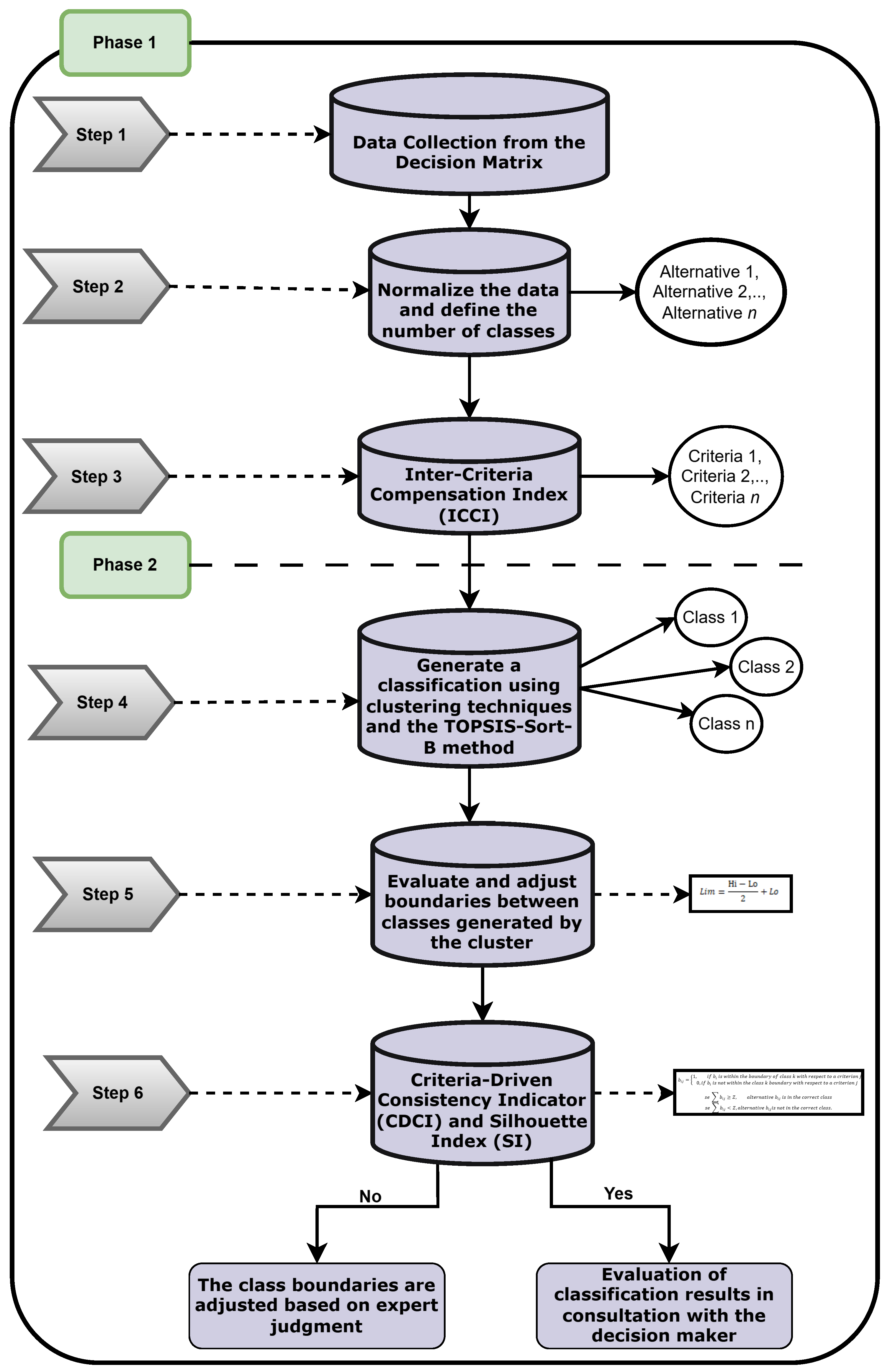
Figure 1. Flowchart of the proposed methodology.
Mathematics 14 01881 g001
Figure 2. Compensatory behavior analysis (adapted from Oliveira et al. [71]).
Mathematics 14 01881 g002
Figure 3. Relationship between variables X9 and X2 in Keshtkar [87].
Mathematics 14 01881 g003
Figure 4. Relationship between variables X9 and X6 in Keshtkar [87].
Mathematics 14 01881 g004
Figure 5. Two-class configuration for the study by Keshtkar [87].
Mathematics 14 01881 g005
Figure 6. Three-class configuration for the study by Keshtkar [87].
Mathematics 14 01881 g006
Figure 7. Four-class configuration for the study by Keshtkar [87].
Mathematics 14 01881 g007
Figure 8. Silhouette Index results for the study by Keshtkar [87].
Mathematics 14 01881 g008
Figure 9. Two classes in the EV study.
Mathematics 14 01881 g009
Figure 10. Three classes in the EV study.
Mathematics 14 01881 g010
Figure 11. Four classes in the EV study.
Mathematics 14 01881 g011
Figure 12. Silhouette Index values in the EV case.
Mathematics 14 01881 g012
Table 1. Decision matrix by Keshtkar [87].
AlternativesX1X2X3X4X5X6X7X8X9X10
A10.0317,71310,4860.470.97216,61017,384182040000.004
A20.02944869610.410.98116,37016,874166030000.002
A30.0325,28213,2400.500.97308,48017,811192050000.005
A40.0214,57392950.450.97178,51017,331180040000.003
A50.02743159210.390.9891,69016,539160030000.002
A60.0321,27411,9610.480.97259,83017,566186050000.004
A70.0211,82780870.430.97145,21017,277177040000.003
A80.0334,74216,5850.520.97423,40018,056198050000.005
A90.0335,43116,8060.530.96413,73018,250204050000.005
Maximum0.0335,43116,8060.530.98423,40018,250204050000.005
Minimum0.02743159210.390.9691,69016,539160030000.002
Average0.0319,74711,0380.460.97239,31417,454182742220.004
Standard deviation0.00974837210.050.00115,2245121347850.001
Table 2. Compensatory relationship between criteria in Keshtkar [87].
CriteriaX2X3X4X5X6X7X8X9X10
X1CCCCCCCCC
X2 CCCCCCCC
X3  CCCCCCC
X4   CCCCCC
X5    CCCCC
X6     CCCC
X7      CCC
X8       CC
X9        C
Table 3. Adjustment of criteria weights in Keshtkar [87].
CP *X1X2X3X4X5X6X7X8X9X10
S u m i 94.0191.8093.0293.6793.1991.9292.5693.2287.059.40
S u m j 94.1291.5092.9393.9993.7591.6393.6094.0884.559.43
S u m i S u m j 0.014−0.023−0.0090.0320.06−0.0290.100.09−0.250.03
( S u m i S u m j ) n 0.001−0.003−0.0010.0030.006−0.0030.01030.009−0.0250.003
Original weights0.0950.1200.1050.0920.0910.1180.0910.0920.0950.103
Adjusted weights0.0950.1190.1040.0920.0910.1180.0920.0920.0930.103
Adjusted final weights0.0950.1190.1040.0920.0910.1180.0920.0920.0930.103
Percentage relative to original weight−0.13%0.28%0.07%−0.34%−0.58%0.26%−1.06%−0.87%2.48%−0.32%
CP * = Calculation performed.
Table 4. Composition of the two classes for the case of Keshtkar [87].
FCM
bnX1X2X3X4X5X6X7X8X9X10
Cluster 1
b1Lo1   0.50Lo1 0.63Lo1 0.580.57Lo1 0.43Lo1 0.62Lo1 0.51Lo1 0.500.500.56
b20.930.930.900.140.860.930.80.86Lo1 0.000.12
b40.570.740.690.430.570.740.540.550.500.44
b51.001.001.00Lo1 0.001.001.001.001.000.00Lo1 0.00
b70.710.840.800.290.570.840.570.610.500.32
B10.430.570.500.500.390.560.450.450.500.50
Cluster 2
b30.210.360.330.790.210.350.260.27Hi2 1.000.78
b6Hi2 0.36Hi2 0.51Hi2 0.450.64Hi2 0.36Hi2 0.49Hi2 0.40Hi2 0.411.000.67
b80.070.020.020.930.070.000.110.141.000.93
b90.000.000.00Hi2 1.000.000.030.000.001.00Hi2 1.00
Table 5. Class boundary values for two classes in Keshtkar [87].
MethodX1X2X3X4X5X6X7X8X9X10Border
Border TOPSIS-Sort-B (original)0.500.630.580.570.430.620.510.500.500.56B1
Border TOPSIS-Sort-B (calculated)0.430.570.510.500.390.560.450.450.500.50B1
Border cluster method (calculated) FCM0.540.690.640.500.500.680.520.520.500.50B1
Table 6. Limiting values for the two classes in Keshtkar [87].
Values of the Limiters
CriteriaX1X2X3X4X5
Class 1 0.43 b i j 1 0.57 b i j 1 0.51 b i j 1 0 b i j < 0.5 0.39 b i j 1
Class 2 0 b i j < 0.43 0 b i j < 0.57 0 b i j < 0.51 0.5 b i j < 1 0 b i j < 0.39
Values of the Limiters
CriteriaX6X7X8X9X10
Class 1 0.56 b i j 1 0.45 b i j 1 0.45 b i j 1 0 b i j 0.5 0 b i j < 0.5
Class 2 0 b i j < 0.56 0 b i j < 0.45 0 b i j < 0.45 0.5 < b i j 1 0.5 b i j 1
Table 7. Assignment of alternatives to classes in Keshtkar [87].
FCM
bnX1X2X3X4X5X6X7X8X9X10 S i CDCI CDCI ( % )
Cluster 1
b1111011111080.8080.00%
b21111111111101.00100.00%
b41111111111101.00100.00%
b51111111111101.00100.00%
b71111111111101.00100.00%
Cluster 2
b31111111111101.00100.00%
b61111111111101.00100.00%
b81111111111101.00100.00%
b91111111111101.00100.00%
Table 8. Composition of the two classes in the EV case.
FCM
anC1C2C3C4C5C6C7C8
Cluster 1
a10.30Lo1 0.001.000.98Lo1 0.000.640.611.00
a20.300.130.79Lo1 0.730.441.000.730.66
a30.390.210.590.980.500.430.780.86
a4Lo1 0.000.240.591.000.510.550.910.66
a50.490.130.780.870.600.55Lo1 0.250.56
a60.510.350.380.780.640.610.750.52
a70.330.140.590.750.70Lo1 0.120.570.52
a90.510.16Lo1 0.290.750.810.250.57Lo1 0.38
B10.500.500.250.570.500.320.620.34
Cluster 1
a80.730.490.190.230.800.320.29Hi2 0.31
a100.590.460.150.190.840.170.610.27
a110.540.40Hi2 0.210.090.880.100.200.31
a120.800.420.15Hi2 0.410.90Hi2 0.52Hi2 1.000.31
a130.800.570.100.220.920.290.150.31
a14Hi2 1.000.960.010.06Hi2 1.000.000.000.10
a150.820.620.130.370.900.430.430.24
a160.85Hi2 1.000.010.001.000.230.350.17
a170.950.740.000.051.000.240.040.00
Table 9. Boundary values for the EV case.
MethodC1C2C3C4C5C6C7C8Border
Border TOPSIS-Sort-B (original)0.520.380.200.390.800.300.500.31B1
Border TOPSIS-Sort-B (calculated)0.500.500.180.390.500.280.430.31B1
Border cluster method (calculated) FCM0.500.500.250.570.500.320.620.34B1
Table 10. Threshold values for the two classes in the EV case.
Values of the Limiters
CriteriaC1C2C3C4
Class 1 0 b i j 0.5 0 b i j 0.5 0.25 b i j 1 0.57 b i j 1
Class 2 0.5 < b i j 1 0.5 < b i j 1 0 b i j < 0.25 0 b i j < 0.57
Values of the Limiters
CriteriaC5C6C7C8
Class 1 0 b i j 0.5 0 b i j 0.32 0 b i j 0.62 0.34 b i j 1
Class 2 0.5 < b i j 1 0.32 < b i j 1 0.62 < b i j 1 0 b i j < 0.34
Table 11. Assignment of alternatives to classes in the EV case.
FCM
anC1C2C3C4C5C6C7C8 S i CDCI CDCI ( % )
Cluster 1
a11111110170.87587.50%
a21111111181.00100.00%
a31111111181.00100.00%
a41111011170.87587.50%
a51111010160.7575.00%
a60111011160.7575.00%
a71111000150.62562.50%
a90111000140.5050.00%
Cluster 2
a81011101160.7575.00%
a101011111170.87587.50%
a111011111170.87587.50%
a121011100150.62562.50%
a131111111181.00100.00%
a141111111181.00100.00%
a151111101170.87587.50%
a161111111181.00100.00%
a171111111181.00100.00%
Disclaimer/Publisher’s Note: The statements, opinions and data contained in all publications are solely those of the individual author(s) and contributor(s) and not of MDPI and/or the editor(s). MDPI and/or the editor(s) disclaim responsibility for any injury to people or property resulting from any ideas, methods, instructions or products referred to in the content.