1. Introduction
By the late 1960s, the research program of the semiotician Algirdas Julien Greimas had begun to consolidate into what is now known as the Paris School of Structural Semiotics. Drawing on Ferdinand de Saussure’s structural linguistics of difference, Roland Barthes’s semiology of narrative, and Claude Lévi-Strauss’s analysis of constitutive units through homologation, this tradition developed a systematic framework for the analysis of meaning in both literary and visual discourses [
1]. Central to this framework is the idea that meaning emerges not from isolated elements, but from structured relations between abstract roles and their instantiations.
Greimas built a framework for structural semiotics that was based on the notion of a seme, or the smallest irreducible component of meaning, that, in combination with other semes, forms a sememe, or the smallest compound unit of meaning. A seme is analogous to a phonological feature or minimal lexical distinction in linguistics. For example, the semantic distinction between “man” and “woman” may be analyzed through differential semes such as /male/ and /female/, while “adult” and “child” may be distinguished through semes such as /mature/ and /immature/. In this sense, a seme is “smallest” not as an isolated atomic entity, but as a minimal differential component participating in a relational semantic structure. A seme is not autonomous or ‘atomistic’, but instead “exists only because of the differential gap that opposes it to other semes [
2] (p. 278)”. That is to say that semes themselves embody a structure of opposition, or what Greimas identified as semic categories [
3] (p. 16). For example, the opposition between /life/ and /death/ may constitute a semic category that organizes associated semes such as vitality, decay, danger, survival, sacrifice, or rebirth across a narrative discourse. In structural semiotics, such categories do not merely classify meanings, but organize relational oppositions that generate larger semantic and narrative structures.
These semic categories constitute the content plane, and represent the semantic or meaningful layer of signification, and thus organize concepts, values, and narrative structures [
4] (p. xix). This plane is not tied to any specific expressive medium—such as a language, image, or gesture—but is instead the deep, generative level from which meaning emerges across different forms. This sits in contrast to the expression plane, which is how the content is manifested. In the example of a literary text, the expression plane includes the syntax, vocabulary, and narrative style it uses, whereas the content plane contains the underlying narrative functions, actants (roles), and thematic structures. Greimas emphasized that the relationship between these planes is not fixed, but dynamic. It is shaped by semiotic processes such as modalization and isotopy which mediate between deep structures and surface-level manifestations.
Among Greimas’s most influential contributions is the formalization of narrative programs (NPs), which provide a minimal schema for describing transformations in a narrative. Informally, an NP describes a transformation of state involving a ‘Subject’ and an ‘Object’ within a narrative. In structural semiotics, narrative programs encode processes such as acquisition, loss, exchange, obligation, or separation. For example, the statement
“The knight acquires the sword,”
may be represented as a conjunctive narrative program in which a Subject (“the knight”) becomes joined to an Object (“the sword”). Conversely,
“The knight loses the sword,”
may be represented as a disjunctive narrative program in which the Subject becomes separated from the Object. Narrative programs therefore provide a elementary relational syntax for describing transformations between actants in a narrative discourse.
Greimas was concerned with identifying such elementary forms of narrativity, firstly between the Subject (
S) and an Object (
O), and how utterances describe their states, transformations, and relations. At this stage, Subject (
S) and Object (
O) denote abstract actantial roles within Greimasian semiotic notation rather than elements of a formally specified mathematical structure. Their categorical formalization is introduced later through the actantial schema
, where actants are represented as objects within a categorical framework. Greimas’s narrative syntax is accordingly structured around a functional relation between Subject and Object actants, where the junction between them may be either conjunctive or disjunctive [
3] (p. 90). Within Greimasian semiotics, this relation participates in the broader oppositional organization of the content plane in which meaning emerges through structured differences and transformations between actantial positions.
Greimas uses the symbols ∩ and ∪ to denote conjunctive and disjunctive junctions between actants. In the present article, these symbols are treated as part of Greimas’s semiotic notation and are not interpreted as literal set-theoretic operations on sets, nor as standard logical connectives. Rather, they function as symbolic markers of narrative relations between actants. In particular, disjunctive narrative programs typically indicate separation, absence, or non-possession between a Subject and an Object, while conjunctive programs indicate acquisition, connection, or possession. Consequently, Greimas’s use of these logical operators departs from standard mathematical usage. This can be seen in the description of a disjunctive utterance as
which would normally yield a truth statement where, when
S is true and
O is true, then both are true. However, in Greimasian semiotics, disjunctive narrative programs are usually framed as virtualizations, that is, when a Subject is ‘not in possession’ of an Object or an Object is ‘missing’. Disjunctive programs generally encode relations of separation or absence rather than inclusive logical disjunction. In this article, we use the original notation of Greimas though interpret the underlying semantics of ‘∪’ as representing an exclusive disjunction.
As Hébert notes, “the formula for the narrative program … can be verbalized or explained as follows: the function by which a subject 1 (subject of doing) causes a subject 2 (subject of state) to be conjoined with (or disjoined from) an object (object of state) [
5] (p. 160)”. NP formulas can thus be denoted in the following way:
where
is an
i-indexed narrative program with a junction type (conjunctive
, disjunctive
),
O is an object,
is a ‘subject of doing,’ and
is a ‘subject of state.’ Greimas defines a subject of doing as the actant that performs actions to acquire or relinquish an object, and their ability to perform this task is based on competence, which comprises modal states such as being-able-to-do, knowing-how-to-do, or having-to-do [
6] (p. 25). This is in contrast to the subject of state, which is also known as a ‘patient’ in a narrative programme. Here, a subject of state is an actant that is defined by its relationship to a particular state rather than by its actions. It contrasts with the subject of doing (i.e., an agent), which acts to change that state. While the subject of doing is dynamic and performs actions, the subject of state represents the modality of ‘being’ or a moment of stability (or lack thereof).
As found in the NPs given in Equations (
3) and (
4), narrative programs admit a recursive structure through the inclusion of the function
F, which allows for the nesting of transformations. For example, consider the followings NPs:
Hébert [
5] (p. 161) describes the example of
as a program of manipulation that is instantiated through the modality of causing-to-do. The conjunction in
of the subject (
) with an object (
) is the cause for another subject (
) to acquire the same object (
). This nesting feature allows for the articulation of complex narrative dynamics from simple combinatorial forms.
Despite their formal appearance, however, narrative programs have largely remained at the level of semiotic notation, without fully explicit mathematical semantics. This paper proposes a categorical formalization of narrative programs that makes their compositional structure precise. Building on previous work in which the Greimasian actantial model was interpreted as a categorical schema, we extend this perspective by introducing Kleisli instances over the List monad. This allows us to relax the atomicity of database entries and represent narrative relations as list-valued structures, capturing the multiplicity of objects and actants involved in a given program. In this setting, narrative programs are represented as list-valued bindings between actants and objects together with a mode (conjunctive or disjunctive) encoded at the schema level.
To move from data-level representations of narrative relations to their compositional realization, we reformulate these constructions within the framework of wiring diagrams. By extracting a discrete category (i.e., a category whose only morphisms are identity morphisms) of role-indexed actants from a -valued instance and freely generating a symmetric monoidal (and subsequently hypergraph) category, we obtain a diagrammatic language in which narrative programs act as generators of morphisms. This provides a compositional account of discoursivization, in which complex narratives arise through the substitution and composition of simpler programmatic units. We note that, throughout this article, terms such as “minimal representation” refer to the use of the fewest structural data necessary to encode a narrative program within the proposed framework. The term is therefore used in a modeling sense rather than in a universal, order-theoretic, or proof-theoretic sense.
Summary
Starting from the categorical schema of the Greimas actantial model
, we construct a refined typological schema of actants through the following:
which is an application of a constant functor to obtain a single-object category
whose
-valued instances yield role-indexed actants. Narrative programs (NPs) are then represented within a categorical schema
, whose morphisms are interpreted using monads on
. In particular, the List monad provides Kleisli semantics for the aspect (morphism) ‘actorializes’, allowing non-atomic, list-valued representations of actantial configurations, while the Maybe monad encodes the optional dependency relation between NPs. This yields a structured representation of narrative programs as list-valued structures equipped with compositional semantics.
To model the compositional formation of narrative trajectories, we pass from these data-level representations to a diagrammatic setting by constructing the free symmetric monoidal category on the discrete category of actants. After adjoining narrative program generators as generating morphisms, we equip this structure with Frobenius operations to obtain a hypergraph category . In this setting, narrative programs are introduced as generating morphisms in the free symmetric monoidal category generated by the discrete category of actantial types, and their composition is realized through wiring diagrams.
The main result shows that narrative trajectories admit categorical realization as morphisms
in
, where
are tensor products of actants in
constructed from narrative program generators via composition, tensor product, symmetry, and Frobenius structure. This provides a formal account of discoursivization as a compositional process in which complex narratives arise from the compositional interaction of simpler programmatic units.
2. Formalizing Narrative Programs
In previous work, we introduced a category-theoretic framework for understanding the role of actants within Greimas’s actantial model which we draw on in this article for the basis of our exploration of NPs. The actantial model of Greimas was originally developed as a refinement of the work of Propp [
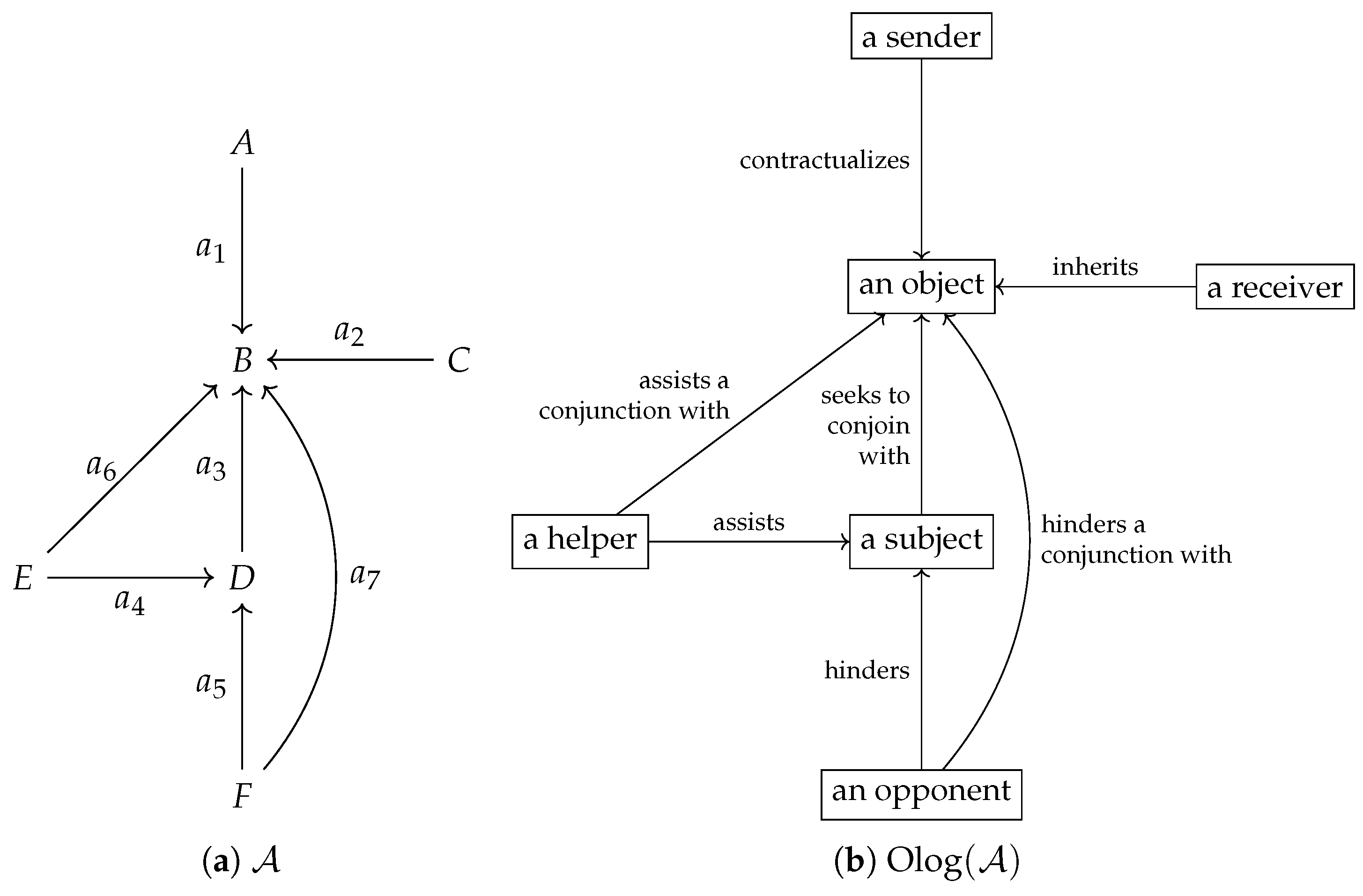
7] on Russian fairytales, and sought to describe a relational system in which roles within narratives are defined not by intrinsic properties, but by their functional positions within a narrative configuration. Greimas originally depicted the model as follows:
The model consists of a collection of actants and directed edges (indicating flow of influence). The actants are labeled ‘Subject’ (Sujet), ‘Object’ (Objet), ‘Sender’ (Destinateur), ‘Helper’ (Adjuvant), ‘Opponent’ (Opposant), and ‘Receiver’ (Destinataire) and are organized along semantic ‘axes’ corresponding to the themes of ‘desire’ ({Subject, Object}), ‘knowledge’ ({Sender, Object, Receiver}), and ‘power’ ({Helper, Subject, Opponent}).
Actants are functional or syntagmatic units that subsume narrative roles within a given trajectory rather than denoting fixed entities [
2] (p. 5). An actant does not correspond to a specific object or agent, but to an abstract role that may be instantiated by diverse kinds of entities depending on the narrative context. This further allows for actantial syncretism, or a situation in which a single actor embodies multiple actants within a story or an actant switches roles within a story. Actants themselves can be varied and are not limited to sentient beings but can include forces of nature, agents, objects, collectives, or purely abstract/conceptual elements [
5] (p. 138).Actants are thus defined by the relations they sustain within a narrative configuration and not by any intrinsic or ontological properties they posses. While the model is typically presented diagrammatically, its underlying structure admits a formal interpretation in terms of objects and relations, making it amenable to categorical reconstruction.
2.1. Categorical Schemas and the Actantial Model
Given the original visualization of the actantial model of Greimas we gave in Equation (
8), it was shown by Fowler [
8] how the model can be reconstructed under the framework of ontological logs of Spivak and Kent [
9], thus establishing an equivalence [
10] to a small category in
, which further allows for the analysis of actantial roles in a given narrative as instances on a codomain of the functor
I. Below, we give definitions of these structures following Spivak and Kent [
9].
Definition 1 (Categorical schema)
. A categorical schema is a 2-tuple , such that
An ontological log (or olog) of a categorical schema is the labeling of the vertices V and arrows A of G such that
A vertex v represents a type or set of objects that form a class, for which the label is written as a singular indefinite noun phrase inscribed in a rectangle.
An arrow a represents an aspect or function between types, for which the label is written as a verb phrase.
An olog is accompanied by a set of equations that are path equivalences statements.
Definition 2 (Instance on a schema)
. Let be a categorical schema. An instance on is a functorsuch that objects of are mapped to sets of instances and morphisms are mapped to functions respecting all specified path equivalences. In
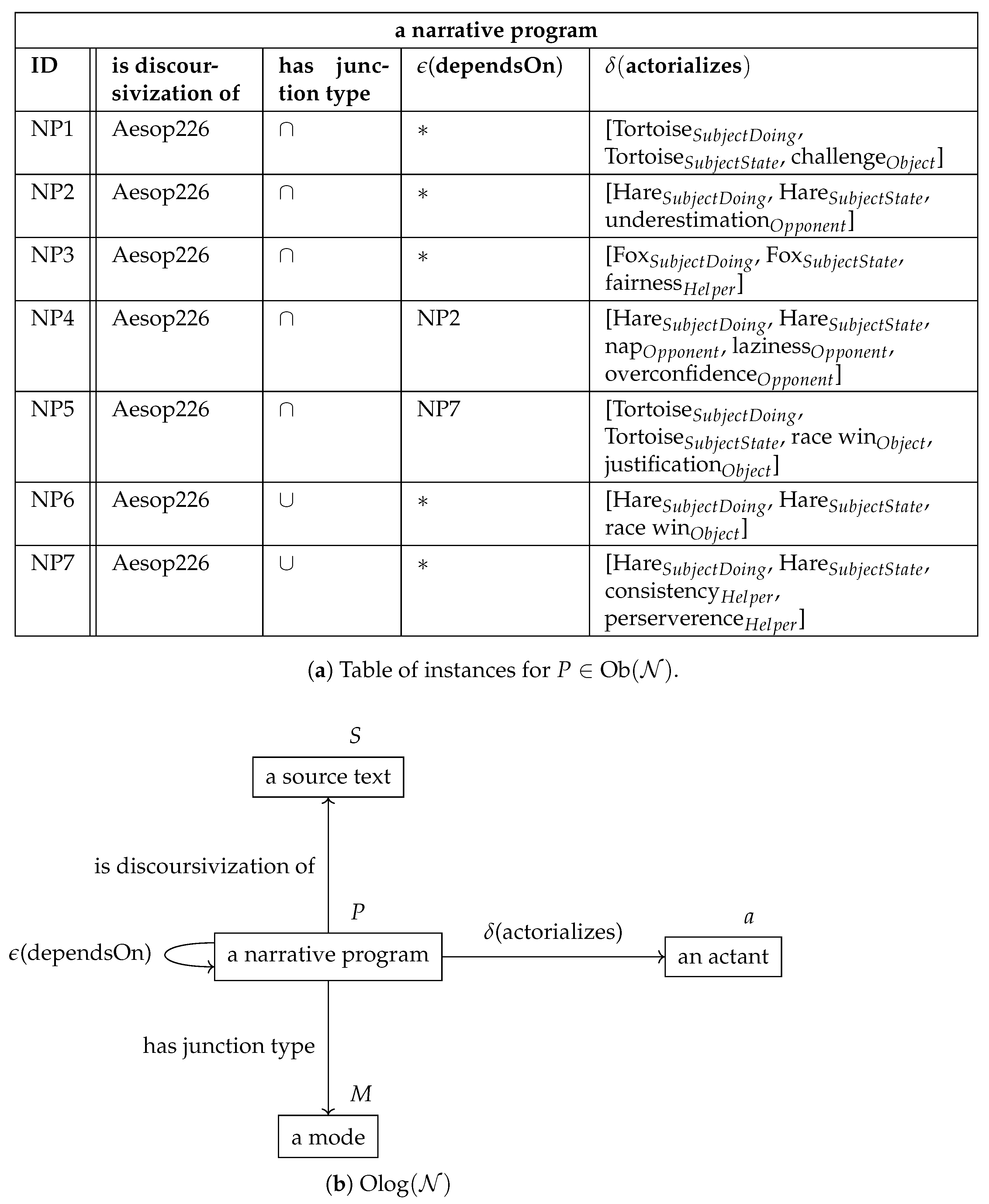
Figure 1, we give both a diagram of the small category
of the Greimas actantial model and its accompanying olog (
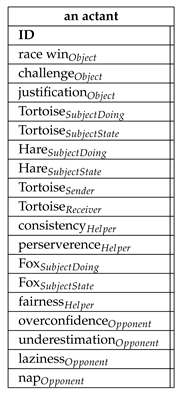
Figure 1b). In order to motivate our exploration of NP formulation, we turn to the narrative of The Hare & the Tortoise for use as an example case study (see
Appendix A). Using the actantial model as a basis for establishing the different actor roles found within Aesop’s fable, we apply
for all
to derive the following collection of actants:
As Spivak [
10] (p. 9) suggests, because each categorical scheme consists of a multigraph
G together with an equivalence relation, each object
can be represented as a table with an ‘ID’ column and instances as rows. Each arrow from an object
x to another object
in
is represented in the table of
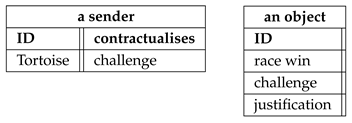
x as a foreign key—that is, a column whose label points to another table and whose row data are in the ID column of the corresponding foreign key. For example, consider the following two linked tables from
in
Figure 1b:
In this setup, we are limited to atomic database instances. By this, we mean that every instance as
is represented through a separate row. In the next section, we follow Spivak’s innovative use of Kleisli ⊤-instances [
11] in order to relax the atomicity requirement for databases. This will allow us to represent NPs that follow the form
through database entries that associate an actant to a set of actants or vice versa. This approach not only allows for more compact representations of actantial data for syncretic or typological modeling, but aligns with what Greimas and Courtés [
2] (p. 278) identify as the fundamental property of structural semiotics—that semic categories on the content plane, and their subsequent compound constructs such as NPs, isotopies, and molecules, are relational and never purely substantial.
2.2. Kleisli Database Instances
Although monads and their Kleisli categories have been commonly applied in computer science through parsers and language processing, they can provide a structural approach to semiotics with a unique utility. We will use them to firstly store NPs in list form and then use them as the basis to further explore the position that, as “simple syntactic units” [
2] (p. 206), NPs extend and compose narrative trajectories across myriad instances.
In order to represent Set-valued elements from Aesop’s fable that account for both conjunctive (Equation (
3)) and disjunctive (Equation (
4)) NPs, we begin with a refining of the categorical schema of the Greimas actantial model through deriving a category
, which is then collapsed by a constant functor
, after which a Set-valued instance
yields the underlying role-indexed actants. We summarize this construction as follows:
Definition 3 (Refined typological schema of actants)
. Let be the categorical schema corresponding to the Greimas actantial model (Figure 1a). We define its refined typological schema of actants
to be the discrete category where , with D denoting the type labeled ‘a subject’ in . We introduce two new objects, such that the morphisms of are only the following identities: Remark 1. The construction given above retains the typological distinctions of the actantial model while refining the subject position to reflect the argument structure of narrative programs. A replacement ofbyandis necessary because the original actantial schema does not distinguish between the subject of doing and the subject of state, whereas this distinction is fundamental to the internal structure of narrative programs. By introducing two distinct subject types prior to collapse via the constant functor, we ensure that list-valued Kleisli representations retain the full argument structure of Greimas’s original formulation.
Definition 4 (Actantial instance)
. Letbe the refined typological schema of actants and letbe the constant functor
for which for every object and for every morphism in . We label the unique object a in as the type ‘an actant’. An actantial instance
relative to the refined typological reduction is a functor for which we write for the underlying set of role-indexed actants. Its elements are denoted as , where x is a discourse entity and r indicates its actantial role. Using the actantial instance construction allows us to populate a database table that associates Set-valued instances to the single object
for Aesop’s fable The Hare & the Tortoise. This yields the following:
Given that the schema
is a category that establishes relations between types through an actantial grammar [
2] (p. 5) on roles, we can use its collapse in the object
as the basis for a new schema
that accounts for NP construction. In particular, we want to track the sign of the junction of an NP (i.e., ∩ or ∪) as well as the singleton or list-formatted actants that associate to
, which, in turn, form syntagmatic units that generate larger hypotactical clusters at the meso- and macro-scale of narrative. We firstly provide definitions after Spivak [
11] of a monad, Kleisli category, and ⊤-instance, as these objects serve the underlying structure of our proposed schema.
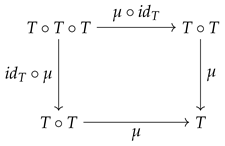
Definition 5 (Monad)
. A monad,
denoted as ⊤
on Set is the triple such that is a functor and (
the unit map
) and (
the multiplication map
) are natural transformations such that the following diagrams commute: Definition 6 (Kleisli category)
. Let be a monad on Set such that there exists a Kleisli category
associated to the monad, which we denote as , whose objects are the sets and Given and , their Kleisli composite is Definition 7 (Kleisli ⊤-instance))
. Let be a categorical schema and let be a monad on with being its associated Kleisli category. A Kleisli ⊤-instance
on is a functor in the form Consider the categorical schema
we provide in
Figure 2b that describes the relations between elements found within Greimas’s formulation of an NP we gave in Equations (
3) and (
4). In the underlying categorical schema
, we utilize the List (
) and Maybe (
) monads to assign List- and Maybe-valued semantics to the morphisms ‘actorializes’ and ‘depends on’ in the table of
. We retain
as an ordinary categorical schema, but interpret the aspect (morphism) ‘actorializes’:
by a List-valued map
Thus, ‘actorializes’ is interpreted as a Kleisli arrow in the category , while ‘depends on’ is interpreted as a Kleisli arrow in the category .
From
, we obtain the collection
of role-indexed actants from
that are actorializations of a given NP. The aspect ‘depends on’:
is defined by a Maybe-value map
where
so that a database entry ‘∗’ denotes the absence of a dependency. Thus, for each narrative program
, either
for some
or
, indicating that
p is not derived from another NP. We note here that these interpretations involve distinct monads on
Set, and hence do not arise from a single Kleisli instance but rather from assigning monadic semantics to individual morphisms. The resulting structure should therefore not be interpreted as a single Kleisli instance over a fixed monad, but rather as a categorical schema equipped with heterogeneous monadic semantics assigned to selected morphisms according to their functional role. A narrative program can thus be encoded as a list-valued Kleisli entry whose remaining elements are actants participating in the junction. Conjunctive or disjunctive modes are carried as row-level metadata rather than encoded internally in the list.
Definition 8 (List-valued narrative program)
. Let be the schema of narrative programs such thatis the Kleisli interpretation of the morphism labeled as the aspect actorializes: . A list-valued narrative program
is represented by which we interpret as taking the following standard structural form: where is the type ‘a subject of doing’, is the type ‘a subject of state’, and are actants participating in the junction. Remark 2. We use the List monad rather than a finite-set or powerset monad because the internal ordering of actantial roles in a narrative program is semantically significant. In particular, the distinction between the subject of doing , the subject of state , and subsequent actants participating in the junction reflects the syntactic organization of Greimas’s original formulation. Finite-set semantics would identify lists differing only by permutation and would therefore lose this ordered role structure. The List monad preserves both multiplicity and positional ordering, allowing narrative programs to retain their internal syntactic articulation.
Remark 3. Although Greimas formulates narrative programs in terms of a relation between a Subject and an Object in the conjunctive mode as, and in the disjunctive mode as, the term Object
in this context does not correspond strictly to the type of the actantial model (see Figure 1). Rather, it denotes a syntactic position, and therefore denotes the entity with which the subject of state is brought into a junction. Due to actantial syncretism [5] (p. 142), a given actant may occupy multiple roles within a narrative, or shift roles over time. Consequently, the elements in the list-valued representation of a narrative program are not restricted to instances of the actantial type ‘Object’, but may include actants of any type (e.g., Helper, Opponent, or Subject). For this reason, we interpret a list-valued narrative program in the form where each is an actant participating in the junction rather than enforcing a strict typing constraint on the ‘object’ position. Definition 9 (Dependent narrative program)
. Let be the schema of narrative programs and letbe the interpretation of the morphism . Let , for which a narrative program p is said to be In the dependent case, p is interpreted as extending or composing with the narrative program q.
Remark 4. The dependency relation induces a recursively compositional interpretation of narrative programs, whereby the semantic interpretation of a dependent program p is obtained compositionally through morphism composition with the programwhen defined. Thus, while a list-valued narrative program records the local actantial configuration of a transformation, the dependency relation provides a means of constructing more complex narrative trajectories through composition. If we return to Aesop’s fable of The Hare & the Tortoise, we can see how the list-valued narrative programs NP1–NP7 compiled in
Figure 2a describe the dynamics of the narrative as it unfolds over its four paragraphs. The story begins at timestamp
, where we have the following conjunctive NPs, which we parse from the database table of
:
These NPs describe the initial challenge of the Tortoise to a race that itself is based on an underestimation by the Hare of the Tortoise. Here, we see what Greimas and Courtés [
2] (p. 9) identify as the ternary articulation of the 3-tuple (virtual, actual, realized), and how it is driven by the mechanism of syncretism. That is to say that the actant ‘underestimation’, when abstractly considered as a syntagmatic unit, is virtualized through the category of an Object, yet, when actualized in an NP through a conjunction, may become an Opponent as in
.
In the second paragraph of the story that we timestamp as
, we have the conjunctive narrative program
again with the notion that the actant ‘fairness’ may be virtualized as an Object but also actualized as a Helper. Then, in the third paragraph at
, we have the following dependent NP which accounts for the modality of causing-to-be:
Here, we see how the categorical schema
of Greimas’s actantial model provides a typing system, which we use in
to define a relational structure over those types to produce NPs. That is to say, what Greimas and Courtés call factitiveness, or the structure of the factitive modality of causing-to-do or causing-to-be, suggests a “contractual communication (involving the transmission of the modal investment) between two subjects, each of which is endowed with its own narrative trajectory [
2] (p. 115)”. This hypotactic relation between Subjects (possibly self-reflective, as found at
) is captured through
, in which the semantics of NP4 are not treated as a flat list union but the composition of the process denoted by NP2 with the process denoted by NP4.
Finally, in the last paragraph of the story at
, we have the following narrative programs:
Within the present framework, the victory of the Tortoise may be interpreted compositionally through the dependent narrative program . That is to say that the disjunction between the Hare and the actualized Helper actants of ‘consistency’ and ‘perseverance’ provide the compositional basis for the realization of the conjunction between the Tortoise and the Objects of ‘race win’ and ‘justification’.
Remark 5. The list-valued representation of narrative programs introduced in Definition 8 faithfully captures the structural components of Greimas’s formulationandin the following sense:
The distinction between ‘subject of doing’ and ‘subject of state’ is preserved explicitly through the first two elements and .
The junction relation between and associated actants is represented by the list structure, together with the junction typeorencoded at the schema level.
Recursive structure, corresponding to Greimas’s use of nested programs via the operator F, is captured by the dependency morphism , whose semantics is given by composition (Definition 9 and Remark 3).
Thus, the categorical formulation preserves the essential syntactic and compositional features of Greimasian narrative programs while providing precise mathematical semantics.
In the following section, we transition from Kleisli database semantics to wiring diagram composition. The motivation emerged from the observation that list-valued narrative programs already encode typed relational configurations between actants. The passage to a symmetric monoidal and subsequently hypergraph setting reinterprets these structured actantial configurations as generators of compositional morphisms, allowing narrative dependencies to be represented diagrammatically through a wiring structure.
3. Diagramming Discoursivization
Although Greimas and others explored the idea of narrativity in relation to pragmatics, modal analysis, and the passions [
12], the Paris School of Structuralist Semiotics never formalized a descriptive diagrammatic approach to the theory of how NPs manifest and drive discoursivization. Here, we mean what Greimas and Courtés [
2] (p. 86) identify as the procedures of setting an NP into a discourse, and how it must necessarily bridge a gap between “narrative syntax and narrative semantics”. In previous work [
13], we introduced the use of wiring diagrams in symmetric monoidal categories for narrative analysis through a top-down framework oriented toward the identification of larger hypotactic clusters of discoursivization. The present article instead develops a bottom-up compositional framework in which narrative trajectories are generated from local narrative program structures and their compositional interactions. These approaches are complementary rather than opposed: the top-down perspective emphasizes the global organization of discourse-level structures, while the bottom-up perspective developed here focuses on how such structures may arise compositionally from collections of interacting narrative programs.
In the second part of this article, we take a bottom-up path and directly utilize our established categorical schema
(
Figure 2b) together with our list-valued narrative program constructions (Definitions 8 and 9) as the basis for generating a composed wiring diagram of The Hare & the Tortoise that is a function of a narrative program generator. We begin by utilizing the role-indexed types of the collapsed category
of the Greimas model as the basis for a free symmetric monoidal category.
Definition 10 (Discrete category of actantial types)
. Given an actantial instance with the underlying set X, we denote as the discrete category on X whose objects are the elements of X, and whose only morphisms are the identity morphisms. We interpret as the category of actantial types.
Deriving the new category
is analogous to what Greimas and Courtés call actorialization, or the establishing of “the actors of the discourse by uniting different elements of the semantic and syntactic components” [
2] (p. 7). Here, we directly source the instances (actors) found in Aesop’s fable, and establish them as types (objects) in
. However, in order to allow for the unique generation of NPs from this base, we require the ability for combinatorial possibilities between actants (objects), which we can accommodate through applying a symmetric monoidal structure.
Definition 11 (Symmetric monoidal category)
. A symmetric monoidal category is a category equipped with the following:
A bifunctor, called the tensor product;
A distinguished object, called the unit object;
The following natural isomorphisms:
These isomorphisms satisfy standard coherence conditions (associativity, unit, and symmetry compatibility), ensuring that tensoring is well-behaved up to canonical isomorphism.
Remark 6. Intuitively, the tensor product ⊗
represents the co-presence of actants within a narrative configuration, while the symmetry ensures that their ordering is not semantically significant. This becomes relevant at the level of figurativization [2] (p. 118), or how the structure of a story becomes generated firstly through identifying actant subsets or collections that become figurativized through conjunctive or disjunctive relations. Proposition 1 (Free symmetric monoidal category)
. Let be the actantial instance with underlying set X. Then, there exists a free symmetric monoidal categorygenerated by . Its objects are finite tensor products of elements of X, including the unit object I, and its morphisms are generated by identities, symmetries, and composition. Moreover, for any symmetric monoidal category and any functionthere exists a unique (up to isomorphism), strong symmetric monoidal functorsuch that extends f. Since
contains only identity morphisms,
is equivalently the free symmetric monoidal category generated by the set
X. However, we want to visualize these types in terms of their actantial associations (figurativization) within an NP, both as inputs (domain side) that are virtualized/actualized and as outputs (codomain side) that produce realizations according to a modality or junction. To address this need, we introduce a narrative program generator as an additional generating morphism adjoined to
following the similar proposals of [
14,
15].
Definition 12 (Narrative program generator)
. Let X be the set of role-indexed actants obtained from an instance . Consider the free symmetric monoidal category . For each list-valued narrative programwe adjoin a generating morphismto . We call the narrative program generator
associated to p. Remark 7. Narrative program generators are not derived from the structure of alone, but are freely adjoined as a family of generators indexed by list-valued narrative programs. Starting from the free symmetric monoidal category , whose objects are tensor products of actantial types and whose morphisms are generated only by identities, symmetries, and tensorial composition, we extend the generating signature by adjoining additional generating morphisms corresponding to narrative programs. Thus, each narrative program generator is a typed morphismin the extended symmetric monoidal category, where A and B are tensor products of actantial types in . The extension does not alter the underlying object structure generated from actantial types, but enlarges the class of generating morphisms by incorporating narrative program transformations. In order to visualize the dynamics of actorialization through the operations of engagement (conjunction) and disengagement (disjunction), we turn here to wiring diagrams in order to provide a visual ‘map’ of the structure of the elements of an NP within a source text.
Definition 13 (Wiring diagram)
. Let X be the set of role-indexed actants obtained from an actantial instance and let be the free symmetric monoidal category generated by X. A wiring diagram W is a morphism in the category generated from by adjoining narrative program generators (and, when specified, additional structures such as factitive morphisms or Frobenius operations), and is constructed from the following:
Graphically, a wiring diagram consists of boxes (representing generators) connected by wires (representing actants), where wires may be rearranged using symmetry and composed sequentially to form larger diagrams.
We interpret a narrative program generator as a box with one input wire labeled by
and multiple output wires labeled by
(i.e., an actorialization). Objects of
are interpreted as wire types in a diagrammatic language, and tensor products represent the simultaneous presence of multiple actants inherited from the ordered list-valued structure of the corresponding narrative programs. The category
provides the typological basis for wiring diagram representations of narrative, which are then extended by adjoining generators corresponding to narrative programs. Objects are finite tensor products of role-indexed actants, representing the co-presence of actantial elements (figurativization). We give examples of wiring diagrams in
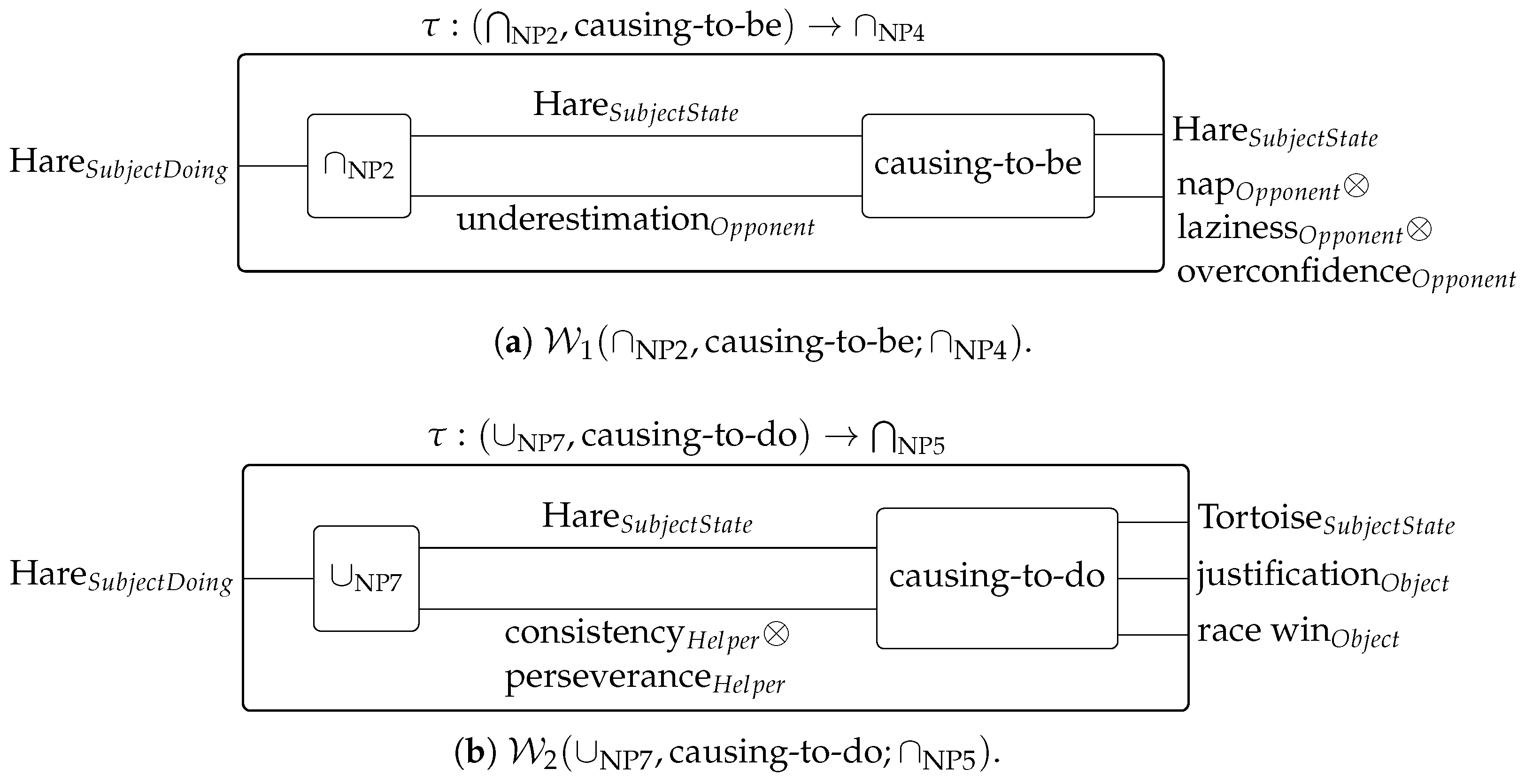
Figure 3 that describe what we previously identified in The Hare & the Tortoise as the following NPs:
Both these NPs correspond to dependent narrative programs, and the dependencies of
and
are shown in the diagrams in
Figure 3 through the labeled morphisms (boxes)
and
. We follow the convention of Rupel and Spivak [
16] and name the diagrams in long form as
, where
Y is the domain as a finite set of boxes (morphisms) and
Z is the codomain, or the ‘exterior’ containing box. Each exterior box is also labeled by a function in the form
that acts as a rule that describes the flow of information in terms of ‘supply’ and ‘demand’. We also extend the category generated from
by adjoining additional non-identity morphisms, so as to strengthen the factitive transmission between two utterances of doing.
Definition 14 (Factitive morphisms)
. In addition to narrative program generators, we adjoin a distinguished family of morphisms called factitive morphisms
corresponding to the modalities causing-to-be
and causing-to-do.
Formally, for composable narrative program generators a factitive morphism is a morphism in the category generated from by adjoining narrative program generators and factitive morphisms, where V is an object constructed from elements of X via a tensor product. These morphisms mediate the composition of dependent narrative programs, determining how their outputs are combined into a new narrative program. Remark 8. Factitive morphisms are interpreted as specifying the mode of composition between narrative programs, corresponding to the semiotic notions of ‘causing-to-be’ and ‘causing-to-do’. They do not arise from the symmetric monoidal structure alone, but are introduced as additional generators governing how outputs of narrative programs are combined.
These morphisms provide a categorical realization of the nesting operator
F in Greimas’s formulation of narrative programs (cf. Equations (
3) and (
4)). Rather than representing nested programs as lists of lists, we interpret them compositionally: a dependent narrative program is obtained by composing the transformation associated to one program with that of another. The modalities of ‘causing-to-be’ and ‘causing-to-do’ specify the manner in which this composition occurs, in accordance with the semiotic interpretation of factitivity. In diagrammatic terms, these factitive morphisms correspond to the insertion of one wiring diagram into another, as illustrated in
Figure 3. This realizes dependency as the substitution of boxes within a larger diagram.
Definition 15 (Composition via substitution)
. Let be narrative programs such that Letbe the corresponding narrative program generators in the category generated from by adjoining generators and factitive morphisms. A composition via substitution
of by is a morphism obtained by Diagrammatically, this corresponds to substituting the wiring diagram of into , connecting outputs of to the appropriate inputs of . Thus, substitution is realized as composition in the generated category.
In semiotic terms, this construction formalizes the idea that narrative meaning is not contained within individual programs, but arises from their compositional integration within a discourse. Substitution corresponds to the embedding of one transformation within another, whereby the actants and relations of a subordinate program are recontextualized within a larger syntagmatic configuration. This yields a precise account of discursivization: narrative programs function as generative units whose composition, governed by factitive modalities, produces the hierarchical and recursive organization of narrative structure. In this sense, narrative trajectories emerge not as sequences of independent events, but as compositional morphisms built from interacting transformations.
Narrative Trajectories in a Hypergraph Category
Our introduction of morphisms in was motivated by a desire to encode narrative transformations (i.e., through narrative programs) as passages that develop from the static actantial configurations of figurativization to the dynamic narrative processes of actorialization. The passage from to reinterprets instance-level actants as generating types, enabling their subsequent use as wires in a diagram of the symmetric monoidal semantics of a narrative.
Our final move is from NPs as local descriptions of the actantial dynamics of syntactic relations expressed through
and visualized via
to what Greimas and Courtés call a narrative trajectory (NT), or “a hypotactic series of either simple or complex narrative programs … [as] a logical chain in which each NP is presupposed by another, presupposing, NP [
2] (p. 207)”. For Greimas and Courtés, the term ‘narrative trajectory’ denotes a structured progression of narrative transformations within a discourse. In our compositional framework, the exterior wiring diagram label
denotes the narrative trajectory construction, while the associated morphism
realizes this trajectory in the hypergraph category
. As simple syntactic units, Greimasian NPs dictate the narrative progress of the discourse as well as the dynamics of role syncretism and the hierarchy of nesting and dependencies. As a collection of interdependent NPs, a narrative trajectory reinforces the notion that an actant is not a fixed entity but a function of actantial relations that are situated both in the pragmatic and cognitive dimensions across the duration of a narrative. In order to fully explore this within the context of wiring diagrams, we introduce the utility of Frobenius structure and hypergraph categories.
Definition 16 (Special commutative Frobenius structure)
. Letbe a symmetric monoidal category. An objectis said to carry a special commutative Frobenius structure if it is equipped with morphismssuch thatis a commutative monoid, andis a cocommutative comonoid that satisfies the Frobenius lawand specialness axiom Remark 9. We note here that the Frobenius structure enables operations that are essential for modeling narrative flow: actants may be duplicated, merged, or discarded as they participate in multiple narrative programs. This reflects the semiotic phenomena of actantial persistence and transformation across a narrative trajectory.
Definition 17 (Hypergraph category)
. A hypergraph category is a symmetric monoidal categorysuch that every objectis equipped with the structure of a special commutative Frobenius monoid, that is, with morphismssatisfying the associativity, unitality, commutativity, Frobenius, and specialness axioms. These Frobenius structures are required to be compatible with the symmetric monoidal product in the sense that, for all objects, the induced Frobenius structure on the tensor productagrees with the tensor product of the Frobenius structures on X and Y. Consider the wiring diagram
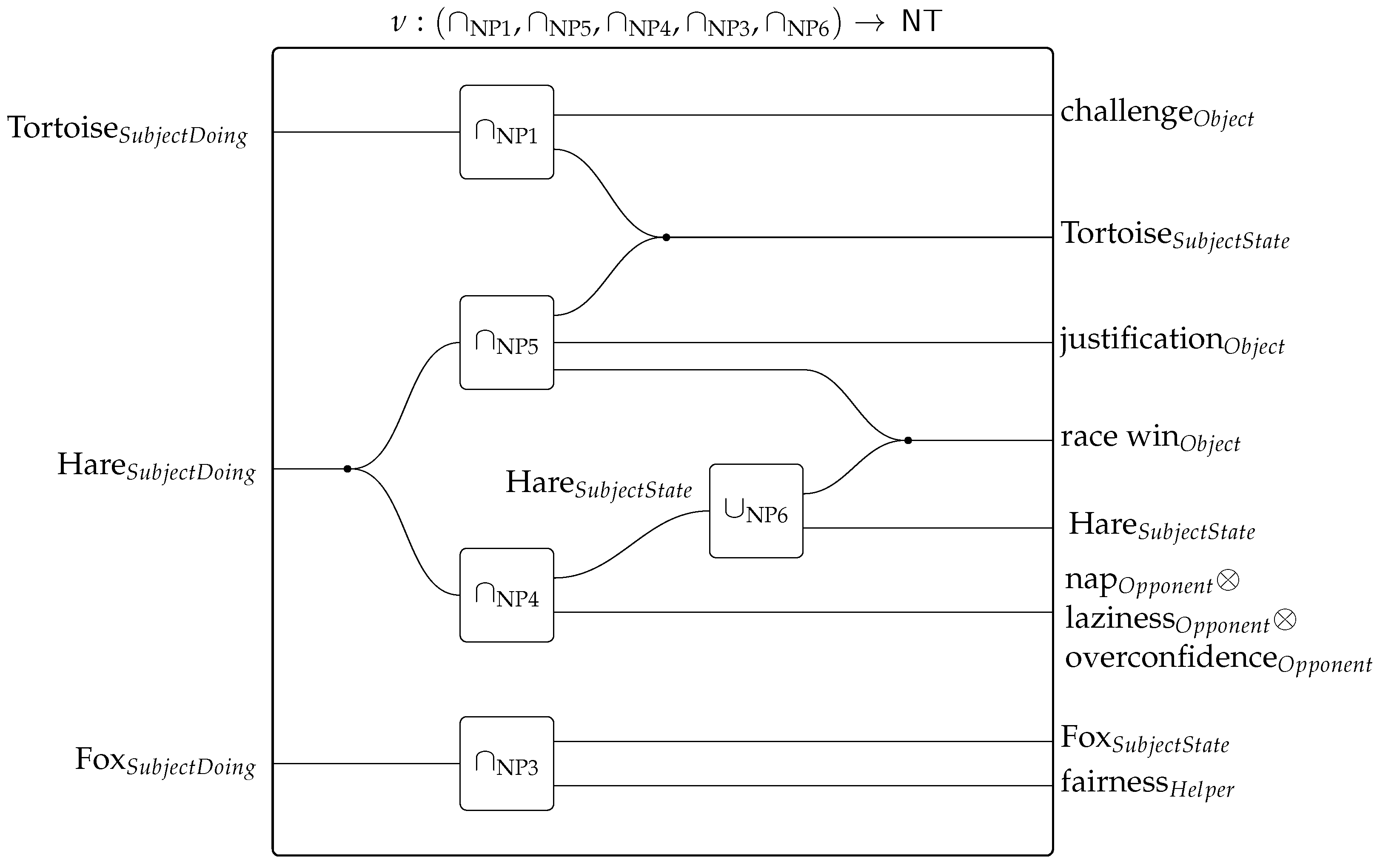
within the hypergraph category
we give in
Figure 4 as the morphism
that describes the story structure of Aesop’s fable The Hare & the Tortoise. Here, the class of ‘subject of doing’ (
) actants supply
as the actor triple
with the codomain of
, a collection of corresponding ‘subject of state’ (
) and actant junctures (Objects, Opponents, Helpers) that can be individually traced to their
-domains. Through the substitution rule we gave in Definition 15, we see that the diagrams of
(
Figure 3a) and
(
Figure 3b) can be substituted with the morphisms
and
, respectively. Composition via substitution is implemented diagrammatically using both sequential composition and Frobenius structure, which, together, allow wiring diagrams to be connected even when interfaces require duplication, merging, or reordering.
More specifically, the substitutions in
track the factitive modalities of the Hare’s underestimation of the Tortoise. This causes the Hare to be lazy, overconfident, and asleep for part of the race (causing-to-be). It also tracks the Hare’s lack of consistency and perseverance, which, in turn, allows the Tortoise to justify his initial confidence and claim the race win (causing-to-do). In
, we also see the impartiality of the Fox as Helper expressed through its actant-isolated
, while the Frobenius morphisms of
track the syntactic engagement between the Hare and the Tortoise and how particular actants express intersections of complementarity (e.g., the Object ‘race win’).
Definition 18 (Narrative trajectory)
. Let denote the hypergraph category generated from by equipping each object with a special commutative Frobenius structure. A narrative trajectory
() is a morphism in obtained from a finite family of narrative program generators by composition, tensor product, symmetry, and Frobenius operations. Equivalently, an is a composed wiring diagram whose boxes are narrative program generators and whose wires are role-indexed actants. Remark 10. We use the term “trajectory” in the Greimasian semiotic sense of a compositional progression of narrative transformations rather than in a topological or geometric sense. An is represented categorically by a composite morphism generated through the sequential composition of narrative program morphisms and associated structural operations within the hypergraph category. The notion of trajectory therefore reflects the ordered compositional propagation of actantial relations through the diagrammatic structure. Furthermore, the presence of a special communicative Frobenius structure in allows our representation of the in Aesop’s fable to be expressed in via copy
and join
distinctions on types. At the semiotic level, these operations accommodate what Greimas and Courtés identify as the multiple roles that an actant may assume in a narrative given an actant is “defined both by the position of the actant in the logical sequence of the narration (its syntactic definition) and its modal investment (its morphological definition) [2] (p. 6)”. Thus, in a hypergraph category, we can show the multiplicity of roles for an actant and track their connection to particular NP inputs (as virtualizations/actualizations) or outputs (realizations) and therefore the flow and dynamics of their modal engagement or disengagement in a discourse. A narrative trajectory is thus a hypergraph morphism generated by narrative programs. The following proposition formalizes the compositional realization of narrative trajectories generated from narrative program morphisms within the free hypergraph setting. We assume throughout that the dependency relation on the finite collection of narrative programs under consideration is acyclic. Consequently, dependent narrative programs form a directed acyclic graph admitting a well-founded compositional ordering.
Proposition 2 (Compositional realization of a narrative trajectory)
. Let X be the set of role-indexed actants obtained from the actantial instanceassociated to a given narrative, and letdenote the hypergraph category freely generated fromby adjoining narrative program generators, factitive morphisms, and the special commutative Frobenius structure on each object. Letbe a finite collection of narrative programs, and suppose that the dependency relationis acyclic on the subset. Then, the narrative programs determine a well-defined morphismin, called the narrative trajectory,, where A and B are tensor products of role-indexed actants. The morphism ν is generated from the narrative program morphisms, factitive morphisms, composition, tensor products, symmetry isomorphisms, and Frobenius operations. If, then the morphismis substituted into the construction of, and this substitution is realized as composition in. The resulting morphism is represented diagrammatically by the corresponding composed wiring diagram. Remark 11. The construction of ν is functorial with respect to the dependency structure in the sense that substitution corresponds to composition in the free hypergraph category generated by the signature of narrative program generators. Thus, a narrative program p should not itself be identified with a morphism in the hypergraph category . Rather, each narrative program determines a generating morphism in the extended symmetric monoidal category, while a narrative trajectory is realized as a composite morphism obtained from these generators through wiring diagram composition and Frobenius structure.
Proof of Proposition 2. For each narrative program
, Definition 12 assigns a typed generating morphism
in the category generated from
by adjoining narrative program generators. The objects
and
are finite tensor products of elements of
X.
The dependency relation specifies which program generators are to be composed by substitution. Since the dependency relation is assumed to be acyclic on , the dependent programs may be ordered so that each program is substituted only after the programs on which it depends have already been constructed. Thus, the construction proceeds by finite induction on the dependency structure.
At each inductive step, suppose that the morphisms corresponding to all dependencies of have already been constructed. If is independent, we take its associated generator . If , then the already constructed morphism for is composed with by means of the relevant factitive morphism, corresponding to causing-to-be or causing-to-do. Symmetry isomorphisms are used to align tensor factors, while the Frobenius maps provide the copying, merging, deleting, and introducing operations required to route actants between component programs.
Because
is closed under composition, tensor product, symmetry, and Frobenius operations, each such substitution step yields a morphism in
. Since the dependency structure is finite and acyclic, iterating this procedure terminates after finitely many steps. The result is a composite morphism
in
, where
A and
B are the external input and output interfaces of the resulting wiring diagram. This morphism is the categorical realization of the narrative trajectory. □
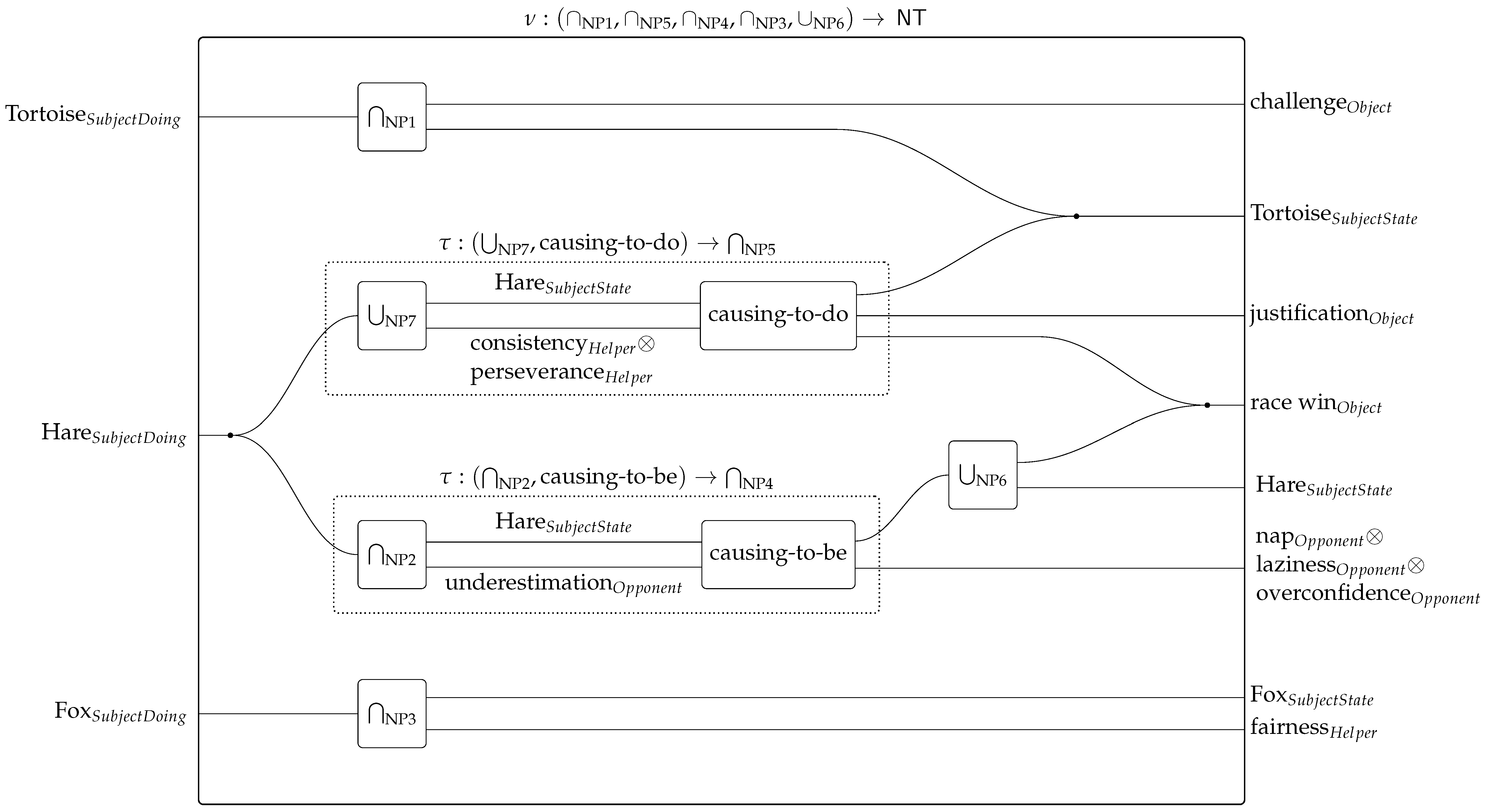
Remark 12. The wiring diagram in Figure 4 presents the narrative trajectory in a factorized form, in which dependent narrative programs (e.g., and ) are represented as single generators. Figure 5 provides an expanded representation of the same morphism in which these generators are replaced by their corresponding wiring diagrams (cf. Figure 3). This distinction mirrors the difference between a syntactic description of a process and its fully expanded operational form. The dotted regions indicate the sites of substitution. Hence, these two diagrams represent the same morphismrelated by substitution of generators rather than by additional composition. 4. Discussion
In Proposition 2, we establish that the narrative trajectory of Aesop’s fable is not a sequence of isolated transformations but a single compositional morphism whose structure is determined by the interaction of narrative programs. Thus, a narrative trajectory is realized as a hypergraph morphism generated by narrative programs. This consequently allows us to view the morphism
as a utility for what Parret identifies as the purpose of semiotic investigation, a means to “reveal a typology of competent subjects with their specific modal trajectories [
17] (p. 112)”. Indeed, Greimas and Courtés argue that a narrative trajectory, composed of multiple narrative programs, may itself be regarded as an actant—what they term a functional or syntagmatic actant:
The narrative trajectory contains as many actantial roles as there are NPs constituting it. Consequently the set of actantial roles of a narrative trajectory may be called [an] actant or, in order to distinguish it from the NP’s syntactic actants, [a] functional (or syntagmatic) actant. So defined, the actant is not a concept which is fixed once and for all, but is a virtuality subsuming an entire narrative trajectory [
2] (p. 207).
This yields a compositional categorical interpretation of narrative trajectories given that a narrative trajectory is represented as a morphism in the hypergraph category , constructed from narrative program generators via composition, tensor product, and Frobenius operations. The collection of actants participating across the trajectory corresponds to the family of wires that are composed, duplicated, and merged within this morphism.
From this perspective, the trajectory itself determines a higher-order actantial unit: not a single element of X, but a structured configuration of actants given by the interface together with the internal wiring of . In particular, may be regarded as an actant in a higher-level category of processes, where morphisms themselves become the carriers of actantial roles. This formalizes Greimas’s notion of a functional actant as a virtual entity: one that does not correspond to a fixed instance but to a compositional structure subsuming an entire narrative trajectory.
It follows then that narrative trajectories exhibit a form of categorical lifting whereby actants at the level of objects give rise to actants at the level of morphisms. Diagrammatically, this corresponds to interpreting an entire wiring diagram as a single unit, whose external interface defines its actantial role, while its internal structure encodes the interactions of its constituent actants. Thus, the functional actant is realized as a compositional diagram rather than as an individual entity.
5. Conclusions
In this article, we introduced Greimasian narrative programs and proposed a categorical formalization that makes their compositional structure explicit. Building on the reconstruction of the actantial model as the categorical schema , we introduced Kleisli semantics over the List and Maybe monads to represent narrative programs as non-atomic, list-valued structures together with a dependency relation encoding their recursive composition. This provided a basic yet expressive framework in which the internal structure of narrative programs is captured at the level of data.
To account for the dynamics of discoursivization, we then lifted these constructions into a diagrammatic setting by freely generating a symmetric monoidal, and subsequently hypergraph, category from a discrete category of role-indexed actants. In this setting, narrative programs act as generators of morphisms, and their composition is realized through wiring diagrams. The introduction of Frobenius structure allowed for the duplication, merging, and routing of actants, reflecting the persistence and transformation of roles across a narrative.
Within this framework, a narrative trajectory is understood as a single compositional morphism constructed from interacting narrative programs. This provides a precise mathematical interpretation of Greimas’s claim that narratives are formed through the combination of elementary syntactic units while also extending his insight that a trajectory itself may be regarded as a functional or syntagmatic actant. Here, such an actant is realized not as an individual entity, but as a structured process encoded by a wiring diagram. Where previous approaches emphasized discourse-level organization, the present framework demonstrates how narrative trajectories may emerge compositionally from local narrative program generators.
More broadly, this work suggests that structural semiotics admit a compositional interpretation in terms of compositional systems in which meaning emerges through the interaction and transformation of relational units. We anticipate that future work may explore extensions of this approach to richer modal structures, multi-agent narratives, and computational implementations, as well as further connections to operadic and higher-categorical formulations of narrative composition. By bringing together categorical schemas, Kleisli semantics, and diagrammatic reasoning, we provide a unified framework that connects the static representation of narrative elements with their dynamic realization in discourse.
From our perspective, the Greimasian project may be reinterpreted as an early intuition of compositionality. That is, meaning is not located in isolated units, but arises through structured relations and their transformations. The present framework makes this intuition precise, showing that narrative programs and their trajectories can be understood as morphisms in a compositional category. Narrative meaning is thus not merely represented, but constructed as a compositional process.