Article

Applications of Multisets Affected by Primal Collections in Topological Spaces

Department of Mathematics, Adham University College, Umm Al-Qura University, Makkah 21955, Saudi Arabia
Mathematics 2026, 14(11), 1840; https://doi.org/10.3390/math14111840
Submission received: 8 March 2026 / Revised: 25 April 2026 / Accepted: 17 May 2026 / Published: 25 May 2026

Abstract

This paper extends the classical approach of primal topology by embedding the multiset model. In multiset theory, the element multiplicity plays a fundamental structural role using the family [ T ] α of multisets defined over a base set T. Here, we introduce the notion of an M-primal collection and investigate its induced topological behavior. Within this setting, we define and study local M-functions, which describe specific interactions between multiplicity and primal structures. These functions lead to the development of a stronger form of M-primal topology, improving the current multiset topological space. Several properties of the introduced concept are investigated, as well as relationships and examples. The results illustrate that the introduced concept is richer and more modifiable.

1. Introduction

In classical set theory, every mathematical object is taken as occurring without repetition. However, the introduction of multisets examines this hypothesis by allowing multiple copies of the same element. Multisets have been established to be very effective in modeling problems involving repeated occurrences, such as applications employed to find multiple roots of polynomials and repeated statistical data entries in collections of atoms, molecules, and DNA strands [1,2,3,4].
Girish et al. [5] constructed a model of multiset topology (M-topology) and investigated fundamental concepts such as basis, closure, interior, limit points, and continuity. Based on these established concepts, our work extends the notion of primal topology to the notion of multisets. Moreover, we introduce M-primal topologies characterized by the concepts of local M-functions and Kuratowski-type closures [6,7].
To showcase the functional value of these results, we present a detailed application example. These examples include a graphical depiction to show how M-primal topologies can represent advanced multiset systems successfully. This example points out the importance of multiplicities in shaping topological behavior and provides an understanding of possible real-world applications.
The paper is organized as follows: Section 2 introduces the fundamental definitions and theoretical preliminaries. Section 3 presents initial notions such as M-primal topologies and local M-functions. Section 4 constructs a strong M-primal topology with a discussion of results and examples. Section 5 presents examples as applications of the concepts discussed in this paper, including figures and a comprehensive discussion. Finally, Section 6 concludes the study and presents major findings.

1.1. Literature Review

The previous studies introduce a strong foundation for studying M-primal topologies. Clements [1] and subsequent works [2,3] developed the concept of multisets, demonstrating their importance in mathematics and computer science. Wildberger [4] introduced a new way to represent multisets. Singh et al. [8,9] classified multisets and investigated a computational application.
Conder et al. [10,11] established the concept of order and M-topologies, which was further developed by Girish et al. [5,12]. Girish et al. studied M-topologies using basic topological structures, continuity, and binary-relation-based M-topologies. El-Sheikh et al. [13] contributed separation axioms in M-topology.
Outside classical topology, structures such as grills, filters, and ideals have been formed. In contrast to grills, the notion of primal collections was introduced by Acharjee et al. [6]. A subset collection P P ( T ) is classified as a primal over the set T if it satisfies the following for all A , B T : (i) The full set T must not be included in P . (ii) If A B and B P , then A P . (iii) If A B P , then either A or B belongs to P . AL-Omari et al. [7] introduced operators constructed using such primal families.
Current studies havve joined primal and soft sets [14] and and investigated matrix-induced primal topologies [15]. Moreover, primal-proximity spaces have been introduced in [16]. In particular, connectedness in primal topological spaces and its applications to rough operators have been studied in [17], highlighting further structural and applied aspects of primal-based frameworks.
Additional studies [18,19,20,21,22] introduced generalized topological structures with primal sets, identifying operators, continuity types, and separation axioms.
The previous literature establishes a strong foundation for M-primal topologies. While classical and multiset topologies provide the necessary background, primal collections and their associated operators offer the analytical tools to extend these ideas, our work connects these areas, introducing strengthened M-primal topologies with operators and applications.

1.2. Methodology

Our approach follows from classical topological theory. It depends on enhancing primal collections to multiset structures. First, we review preliminaries and study the connection between element multiplicities and primal set behavior. Later, we establish the notion of M-primal topologies through a sequence of definitions, propositions, and operators, including
  • Local M-functions: particular operators representing local behavior of elements in M-sets.
  • Kuratowski-type closure operator: a generalized closure relevant for M-primal topologies.
  • M-primal topology: a strengthened topology constructed using the above operators.
To illustrate real-world applicability, we introduce some examples of a multiset system modeled using M-primal topology, along with a diagram. This application shows how multiplicities influence topological properties. Also, it points out potential developments in computational and theoretical contexts. The methodology focuses on a step-by-step derivation from fundamental definitions to the application.

2. Preliminaries

This section presents the concepts related to M-sets and M-topology. Let T be a domain from which multisets (M-sets) are constructed. The multiset space [ T ] α consists of all M-sets in which no element occurs more than α times, while [ T ] denotes an M-space without restrictions on multiplicities.
Definition 1.
An M-set A is defined via a counting mapping γ A : T Z + , where γ A ( t ) indicates the number of occurrences of t in A. Accordingly, if T = { t 1 , t 2 , t 3 , } , then A = { m 1 / t 1 , m 2 / t 2 , } , where m i = γ A ( t i ) . The support set of A, denoted A , contains all elements t for which γ A ( t ) > 0 , and A is empty if γ A ( t ) = 0 for all t.
Operations on M-sets include equality, subset, union, and intersection, which are determined through their multiplicities. Specifically, for two M-sets A and B defined on a universe T, we say that A = B if γ A ( t ) = γ B ( t ) for all t T , and A B if γ A ( t ) γ B ( t ) for all t T . Moreover, the intersection and union of A and B are defined by multiplicity functions such that γ A B ( t ) = min { γ A ( t ) , γ B ( t ) } and γ A B ( t ) = max { γ A ( t ) , γ B ( t ) } for all t T . Complements are defined as γ A c ( t ) = α γ A ( t ) . The power M-set P ( A ) consists of all M-subsets of A, with the support set P ( A ) having cardinality Card ( P ( A ) ) = i = 1 n ( 1 + m i ) , where m i is the multiplicity of t i in A. Cartesian products, M-relations, and M-functions are defined with multiplicities determined by the products of the involved elements.
Sub-M-sets can be classified into whole, partial whole, and full sub-M-sets. A sub-M-set B of an M-set A is called a whole sub-M-set if every element in B has the same multiplicity as in A, that is, γ A ( t ) = γ B ( t ) for all t B , while it is called a partial whole sub-M-set if there exists at least one element t B such that γ B ( t ) = γ A ( t ) . On the other hand, B is called a full sub-M-set of A if γ B ( t ) γ A ( t ) for all t B . These classifications lead naturally to the concepts of the power whole set P W ( A ) and the power full set P F ( A ) , where P W ( A ) consists of all whole sub-M-sets of A with cardinality 2 n , and P F ( A ) consists of all full sub-M-sets of A with cardinality equal to the product of the cardinalities of the elements of A. Both P W ( A ) and P F ( A ) are ordinary sets whose elements are sub-M-sets of A.
Definition 2.
An M-topology T P ( A ) is a family containing A and the empty M-set, closed under arbitrary unions and finite intersections. Members of T are open M-sets, and their complements are closed. An M-basis B is a family of sub-M-sets such that for every t m A with m > 0 there exists a basis element containing m / t , and for m / t in the intersection of two basis elements L and N, there exists M L N containing m / t with appropriate multiplicities.
Closures of sub-M-sets are defined as the intersection of all closed M-sets containing them, with multiplicities given by the minimum among all such sets. In a similar manner, interiors of sub-M-sets are defined as the union of all M-open sets contained in them, where the multiplicities are determined by taking the maximum among all such sets. Comparisons between M-topologies rely on their bases: T 2 is finer than T 1 if every basis element of T 1 containing m / t is matched by an element of T 2 with smaller or equal multiplicity.
Multipoints or M-points A [ T ] α satisfy γ A ( t ) = m if t A and 0 otherwise. An M-point { m / t } is a subset of A if m γ A ( t ) , and quasi-coincident with B A if m > γ B c ( t ) . Two M-sets A and B are quasi-coincident at t, denoted A q B , if γ A ( t ) > γ B c ( t ) , in which case t A B with both γ A ( t ) and γ B ( t ) being nonzero.

3. Main Results

This section develops the features of multiset topology by introducing primal collections. This part extends classical concepts to account for element multiplicities. Based on these notions, we define a class of topological operators based on M-primal sets. We examine their behavior within fixed non-empty M-sets.

3.1. Multiset Primal Collection and Multiset Primal Topology

Here, we present the fundamental concepts of primal collections and primal topologies in the multiset context.
Definition 3.
Consider a non-empty M-set A [ T ] α . A collection P P ( A ) is called a multiset primal (or M-primal) on the M-set A , under the following conditions, for each L , N A .
(i) 
A does not belong to P .
(ii) 
If L P and γ N ( t ) γ L ( t ) for all t m A , then N P .
(iii) 
If L N P , then L P or N P .
Based on the properties of M-sets, the concept of M-primal can be formulated as follows:
Example 1.
Consider the non-empty M-set A = { 3 / a , 2 / b , 1 / c } . Define the family
P = { L P ( A ) : L A   and   L   contains   at   most   2   copies   of   a } .
We claim that P forms an M-primal on A.
Remark 1.
We start with the definition of a grill, as given by Choquet [23]. A collection G of nonempty subsets of a space X is called a grill if it satisfies the following conditions: if A G and A B X , then B G , and if A B G , then A G or B G .
In the multiset setting, we consider an M-grill as a collection of sub-M-sets of a given M-set A, that is, G P * ( A ) , satisfying analogous properties with respect to multiplicities.
On the other hand, an M-primal structure P is also a subcollection of P * ( A ) . While M-grills are closed under enlargement and unions, M-primal structures satisfy a downward condition with respect to multiplicities (condition (ii)) and a prime-type condition with respect to intersections (condition (iii)).
This shows a complementary relationship between the two concepts within the same multiset framework.
Example 2.
Let X = { a , b , c , d , } and define an M-set A on X by
A = { n / a , 2 n / b , 3 n / c , 4 n / d , n N ,   n 1 } ,
that is, γ A ( a ) = n , γ A ( b ) = 2 n , γ A ( c ) = 3 n , and so on. We define an M-grill and M-primal on A as a collection G , P P * ( A ) , respectively, given by
G = { M A : γ M ( a ) 1 } , P = { M A : γ M ( a ) = 0 } .
Then G is an M-grill on A, and P is an M-primal structure on A, thus illustrating their complementary behavior.
Theorem 1.
The union of any two M-primals P 1 and P 2 on the M-set A [ T ] α is also an M-primal.
Proof. 
First, since both P 1 and P 2 are M-primals, we have A P 1 and A P 2 . Thus A P 1 P 2 .
For the second condition, for all t m A , let L P 1 P 2 ,     with     γ N ( t ) γ L ( t ) . Hence, L P 1 or L P 2 . Since P 1 and P 2 are M-primals, it follows that N P 1 ,   or   N P 2 . Therefore, N P 1 P 2 .
Finally, let L N P 1 P 2 . Then, L N P 1 ,     or   L N P 2 . Since P 1 and P 2 are M-primals, we have L P 1 ,   or   N P 1 . Also, L P 2 ,   or   N P 2 . Hence, L P 1 P 2 ,   or   N P 1 P 2 .
Remark 2.
The intersection of two M-primals defined on the same M-set is not necessarily an M-primal.
Example 3.
Consider the M-set A = { n / a , 2 n / b , 3 n / c , 4 n / d , n N } , which is an infinite M-set constructed from the domain X = { a , b , c , d , } . Define the families of M-primals on A as follows:
P 1 = , { n / a , n / b } , { n / c , 2 n / d } , { k / b , k / d k n } , ,
P 2 = , { n / b , n / c } , { 2 n / a , n / d } , { k / a , k / c k n } , .
Both P 1 and P 2 are M-primals on A, but their intersection
P 1 P 2 = , { k / b k n } , { k / d k n } ,
is not an M-primal. For instance, consider the M-sets
L = { n / a , n / b } P 1 and N = { n / b , n / c } P 2 .
Then,
L N = { n / b } P 1 P 2 ,
while neither L P 1 P 2 nor N P 1 P 2 .
This demonstrates that the intersection of two M-primals may fail to satisfy the M-primal property when dealing with infinite collections.
Definition 4.
A multiset topological space ( A , T ) together with an M-primal P defined on A is said to be a multiset primal topological space (or an M-Primal topological space).
Remark 3.
Within an M-primal topological space, the closure and interior of sub-M-sets are defined analogously to those in multiset topology, taking into account the multiplicity structure. In particular, the closure is obtained as the intersection of all M-closed sets containing a given sub-M-set, with multiplicities determined by the minimum values, while the interior is defined as the union of all M-open sets contained in it, with multiplicities given by the maximum values. These operators satisfy the fundamental properties analogous to the classical case.
Example 4.
Let A [ T ] α be a non-empty M-set. Different families of sub-M-sets of A, together with a suitable M-primal set P defined on A, give rise to different types of M-primal topological spaces.
For instance, the family P ( A ) , which denotes the support of the power M-set P ( A ) consisting of all M-subsets of A, together with P , forms a discrete M-primal topological space, where every sub-M-set is considered open.
Similarly, the family P W ( A ) , which represents the collection of all whole sub-M-sets of A, together with P , generates an M-primal topological space based on all whole sub-M-sets of A.
On the other hand, the family consisting only of A and ⌀, together with P , constitutes an indiscrete M-primal topological space, in which only the whole set and the empty set are open.
Additionally, the family P F ( A ) , which denotes the collection of all full sub-M-sets of A, together with P , forms an M-primal topological space that incorporates all full sub-M-sets of A.
Definition 5.
In an M-primal topological space, an M-set B is called a q-neighborhood of the element m / t iff there exists an open M-set O satisfying m / t   q   O B . The family of q-neighborhood of m / t is represented by N q ( m / t ) .
Definition 6.
Let ( X , τ ) be an M-topological space equipped with an M-primal structure P . Let A X . The relative M-primal topology on A, denoted by τ A , is defined as
τ A = { U A   :   U τ } .
Moreover, the relative M-primal collection on A, denoted by P A , is defined by
P A = { P A   :   P P } .
Remark 4.
It is clear that τ A defines an M-topology on A. Moreover, P A is the restriction of the M-primal structure P to the subset A, in the sense that each element of P A is obtained as the intersection of a set in P with A.
Proposition 1.
If ( X , τ ) be an M-topological space equipped with an M-primal structure P and A X , then ( A , τ A ) equipped with an M-primal structure, then P A is also an M-primal topological space.
Proposition 2.
Let A X and let U τ . Then U A is M-open in A.
Proof. 
By the definition of τ A , every set of the form U A , where U τ , belongs to τ A . Hence, it is M-open in A. □
Proposition 3.
Let A X and let F X be M-closed. Then F A is M-closed in A.
Proof. 
Since F is M-closed in X, its complement X F is M-open. Then
A ( F A ) = A ( X F ) ,
which belongs to τ A . Hence, F A is M-closed in A. □
Definition 7.
If ( X , τ ) is an M-topological space equipped with an M-primal structure P , then X is said to be M-connected if it cannot be expressed as the union of two nonempty disjoint M-open sets. That is, there do not exist nonempty M-open sets U , V τ such that X = U V and U V = .
This definition extends the classical notion of connectedness to the M-primal setting, where the concept of openness is determined by the M-primal structure. It ensures that the space cannot be partitioned into two separate M-open parts, preserving its topological coherence under the multiset framework.
Definition 8.
If ( X , τ ) is an M-topological space equipped with an M-primal structure P , a subset A X is said to be M-compact if every cover of A by M-open sets admits a finite subcover. That is, for any family { U i } i I τ such that A i I U i , there exists a finite subcollection { U i 1 , , U i n } satisfying A k = 1 n U i k .
This concept generalizes compactness in the context of M-primal topology. It reflects the idea that even within the multiset structure, large coverings can be reduced to finite ones, which is a key property in many topological arguments and applications. In the study of M-topological and M-primal structures, it is natural to investigate how primality behaves under functions between M-sets. The following results demonstrate that primality is preserved when the function is bijective; however, this preservation may fail when bijectivity is not guaranteed.
Theorem 2.
Consider f : A B as an M-function, and let P P ( A ) . If P is an M-primal on A and f is bijective, then the family Q = { f ( P ) : P P } is an M-primal on B .
Proof. 
First, let B Q ; thus, there exists P P such that f ( P ) = B . It follows that f ( P ) = f ( A ) = B . Since f is injective, P = A ; this contradicts the assumption that P is an M-primal on A.
For the second condition, consider L Q and let N L . Then, there exists P 1 P that satisfies L = f ( P 1 ) . Let P 2 = f 1 ( N ) P 1 . Clearly, P 2 P 1 . Since P is an M-primal on A, it implies P 2 P .
Moreover, f ( P 2 ) = N , which implies that N Q . Finally, suppose L N Q . Then, there exist P 1 , P 2 P that satisfy L = f ( P 1 )   and   N = f ( P 2 ) .
Remark 5.
If f : A B is an M-function and Q is an M-primal on B, then the collection P = { f 1 ( Q ) : Q Q } is not necessarily an M-primal on A. The following example demonstrates this.
Example 5.
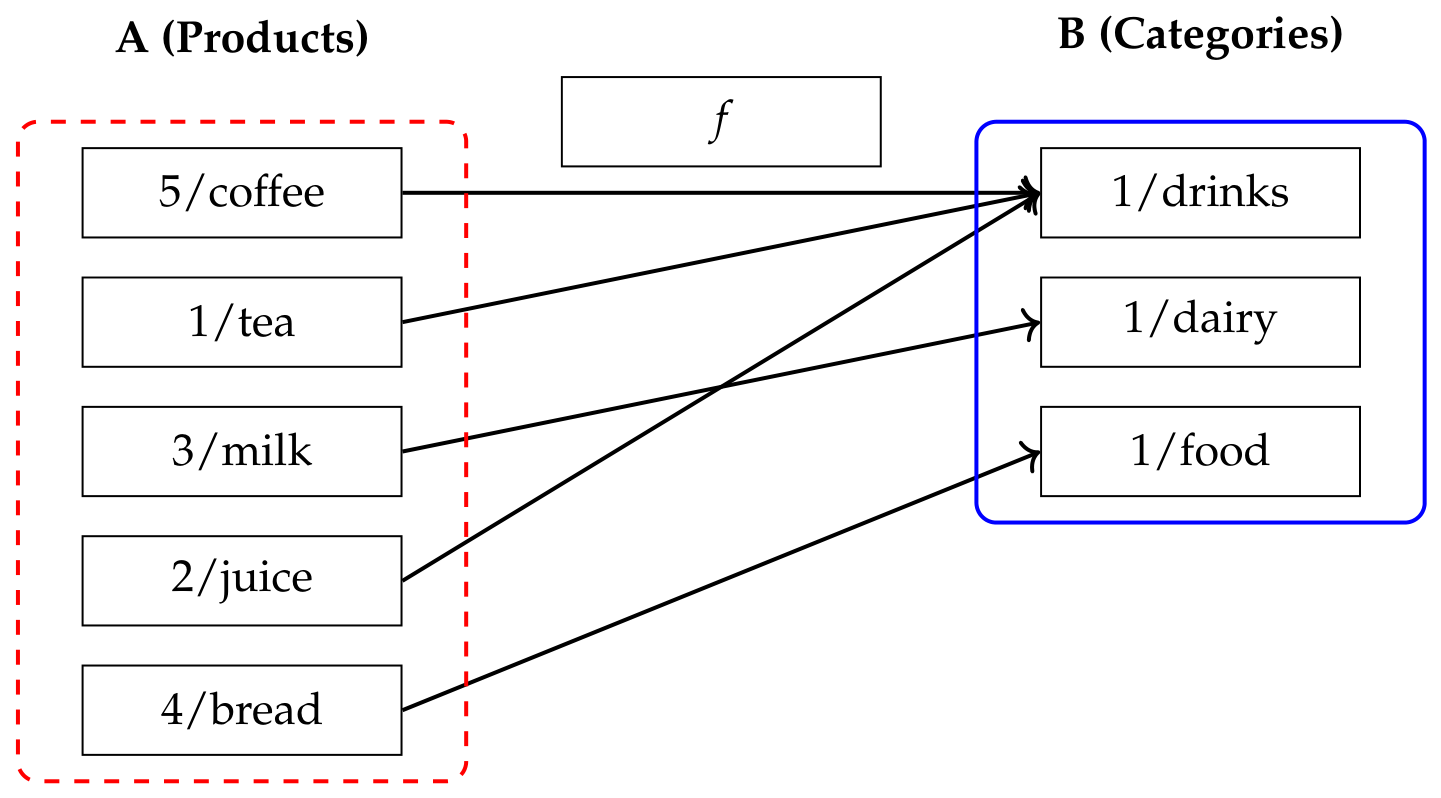
(Application) Let T be a finite set of products,
T = { coffee , tea , milk , juice , bread } .
Consider the M-set of products A over T, representing customer purchase records
A = { 5 / coffee , 1 / tea , 3 / milk , 2 / juice , 4 / bread } .
Let
B = { 1 / drinks , 1 / dairy , 1 / food }
be a finite set of product categories. Define the M-primal on B as
Q = { ,   { 1 / drinks } ,   { 1 / dairy } ,   { 1 / food } ,   { 1 / drinks , 1 / dairy } ,   { 1 / drinks , 1 / food } } .
Define the mapping f : A B by assigning each product to its category:
f ( 5 / coffee ) = 1 / drinks , f ( 1 / tea ) = 1 / drinks , f ( 3 / milk ) = 1 / dairy ,
f ( 2 / juice ) = 1 / drinks , f ( 4 / bread ) = 1 / food .
Define the preimage collection
P = { f 1 ( Q ) : Q Q } .
Explicitly, P consists of the following M-subsets of A:
P = { ,   { 5 / coffee , 1 / tea , 2 / juice } ,   { 3 / milk } ,   { 4 / bread } ,   { 5 / coffee , 1 / tea , 2 / juice , 3 / milk } ,  
{ 5 / coffee , 1 / tea , 2 / juice , 4 / bread } } .
We show that P is not an M-primal on A. Consider the M-subsets L , N P ( A )
L = { 5 / coffee , 1 / tea , 2 / juice , 3 / milk } , N = { 5 / coffee , 1 / tea , 2 / juice , 4 / bread } .
Clearly, L P and N P , since the multiplicities of milk and bread do not match those of any element in P . However,
L N = { 5 / coffee , 1 / tea , 2 / juice } P .
Thus, there exist M-subsets L , N P such that L N P , which violates condition (iii) of the definition of an M-primal. Therefore, P is not an M-primal on A.
Remark 6.
In the previous example, each product in A is mapped to a category in B, but since f is not bijective, the pre-image collection P fails to be M-primal. Figure 1 illustrates this situation.

3.2. Local M-Functions in M-Primal Topology

This section introduces local M-functions ( . ) in the framework of M-primal topologies on a fixed non-empty M-set A [ T ] α . These operators generalize classical topological notions to M-sets, capturing the interaction between open M-sets and M-primal collections. The study provides a foundation for constructing M-primal topological spaces and applications where element multiplicities play a key role.
Definition 9.
Consider ( A , T ) as an M-topological space together with an M-primal collection P given on A. The local M-function ( . ) : P ( A ) P ( A ) is defined for all U N q ( m i / t i ) and for at least one t j T by
L ( P , T ) = { m i / t i A : γ U c ( t j ) + γ L ( t j ) < γ P ( t j ) , where   P P } .
Example 6.
Let T = N and consider the infinite M-set A = {   n / t n : n N   } . Let the M-topology on A be T = { , A } . Define an M-primal collection on A by
P = { } { { 1 / t n } : n N } .
Take the M-set L = { 1 / t 1 } . Let U = A be a neighborhood of 1 / t 1 . Then U c = . Choose t j = t k for some k 2 and take P = { 1 / t k } P . Thus
γ U c ( t k ) = 0 ,    γ L ( t k ) = 0 ,    γ P ( t k ) = 1 .
Hence
γ U c ( t k ) + γ L ( t k ) = 0 < 1 = γ P ( t k ) .
Therefore,
L ( P , T ) = {   1 / t k : k 2   } .
Theorem 3.
Consider ( A , T ) as an M-topological space together with an M-primal collection P given on A. If the complement of L A is an open M-set, then L L .
Proof. 
Suppose that the complement of L A is an open M-set, and assume that   t m L but m / t L . It is follows that L c is a q-neighborhood of m / t . As t m L , we have
γ U c ( t j ) + γ L ( t j ) < γ P ( t j ) ,
for all U N q ( m i / t i ) and at least one t j T . Thus,
γ A ( t j ) = γ L c ( t j ) + γ L ( t j ) < γ P ( t j ) .
This contradicts the assumption that A P . So, L L .
Theorem 4.
Consider ( A , T ) as an M-topological space together with an M-primal collection P given on A . Then c l ( L ) = L , for all L A .
Proof. 
As L c l ( L ) always holds, we need to show that c l ( L ) L . Suppose t m c l ( L ) and let U be the q-neighborhood of m / t . Thus, U intersects L , i.e.,
min { γ U ( t ) , γ L ( t ) } 0 .
Thus, there exists t j T satisfy t j m U and t j m L . Hence,
γ U c ( t j ) + γ L ( t j ) < γ P ( t j ) ,
for some P P . So, t m L , which is implies that c l ( L ) = L .
Theorem 5.
Consider ( A , T ) as an M-topological space together with an M-primal collection P defined on A . Thus, for all L , N A , the following properties hold:
(i) 
= .
(ii) 
( L ) L .
(iii) 
If L N , then L N .
(iv) 
L N = ( L N ) .
(v) 
( L N ) L N .
Proof. 
The proof is a direct consequence of Theorems 3 and 4. □
Definition 10.
Consider ( A , T ) as an M-topological space together with an M-primal collection P defined on A . Define the operator ð : P ( A ) P ( A ) by ð ( L ) = L L , for all L A .
Example 7.
Based on Example 6, we have
L = {   1 / t n : n 2   } .
By applying the operator ð, we obtain ð ( L ) = L L . Since L = { 1 / t 1 } , it follows that
ð ( L ) = { 1 / t 1 } {   1 / t n : n 2   } = {   1 / t n : n N   } .
Theorem 6.
Consider ( A , T ) as an M-topological space together with an M-primal collection P defined on A . Define the operator ð : P ( A ) P ( A ) by ð ( L ) = L L , for all L A . Thus, ð is a Kuratowski’s closure operator.
Proof. (i)
Since = , it follows that ð ( ) = .
(ii)
We need to show that L ð ( L ) . From the definition ð ( L ) = L L , it is clear that L ð ( L ) .
(iii)
We need to show that ð ( L ) ð ( N ) = ð ( L N ) . Since L N = ( L N ) , we have
ð ( L ) ð ( N ) = ( L L ) ( N N ) , = ( L N ) ( L N ) , = ( L N ) ( L N ) , = ð ( L N ) .
So, ð ( L ) ð ( N ) = ð ( L N ) .
(iv)
We need to show that ð ( ð ( L ) ) = ð ( L ) . Since L ð ( L ) , by monotonicity it follows that ð ( L ) ð ( ð ( L ) ) .
Conversely, by Theorem 4, L is closed in A, and from Theorem 5 (ii), we have ( L ) L . Therefore,
ð ( ð ( L ) ) = ð ( L ) ( ð ( L ) ) , = ð ( L ) ( L L ) , = ð ( L ) L ( L ) , ð ( L ) L L , ð ( L ) .
Thus, ð ( ð ( L ) ) = ð ( L ) . Therefore, ð satisfies the axioms of a Kuratowski closure operator.
Building upon the concept of local M-functions ( . ) in M-primal topologies, we present a new result regarding the stability of -closed sets under intersection and an application in recommendation systems.
Theorem 7.
Let ( A , T ) be an M-topological space with an M-primal collection P . If L , N A are such that L = L and N = N (i.e., ◊-closed sets), then
( L N ) = L N .
Proof. 
From Theorem 5 (v), we have ( L N ) L N = L N . Also, by definition of closure, L N ( L N ) . Hence, ( L N ) = L N .

4. Generation of M-Primal Topologies via Kuratowski-Type Closure Operators

In this section, we introduce a new topological structure based on the concept of an M-primal collection within the framework of multiset theory. This approach extends classical topological ideas to settings where element multiplicities are considered.
Definition 11.
Consider ( A , T ) as an M-topological space together with an M-primal collection P defined on A . The collection
T ð = { L A     satisfies   ð ( L c ) = L c } .
defines an M-topology on the set A, constructed based on the initial M-topology T and the associated M-primal structure. This topology is referred to as the M-primal topology induced on the M-set A.
Example 8.
Based on Example 6 and 7, we have
L = {   1 / t n : n 2   } and ð ( L ) = L L = {   1 / t n : n N   } .
Now consider the collection T ð = { L A : ð ( L c ) = L c } .
  • For L = A , we have L c = and ð ( ) = , so ð ( L c ) = L c .
  • For L = , we obtain L c = A and ð ( A ) = A .
Therefore, T ð = { , A } , which forms an M-topology on the M-set A, called the M-primal topology induced by the operator ð.
In the previous example, the induced M-primal topology T ð coincides with the original M-topology T , so the operator ð does not generate new open M-sets. However, in the following example, the induced topology differs from the original one, showing that ð can modify the M-topology.
Example 9.
Let T = N and consider the infinite M-set A = {   n / t n : n N   } .
Define the initial M-topology on A by T = { , A , { 1 / t 1 } } . Let the M-primal collection on A be
P = { } { { 1 / t n } : n 2 } .
Take the M-set L = { 1 / t 1 } . From the definition of the local M-function, we obtain
L = {   1 / t n : n 2   } .
Hence, ð ( L ) = L L = {   1 / t n : n N   } = A . Now consider the collection T ð = { L A : ð ( L c ) = L c } .
  • For L = A , we have L c = ,    ð ( ) = . So, A T ð .
  • For L = , we have L c = A ,    ð ( A ) = A . So T ð .
However, for L = { 1 / t 1 } , we obtain L c = {   1 / t n : n 2   } , and ð ( L c ) = L c ( L c ) = A L c . Hence { 1 / t 1 } T ð . Therefore, T ð = { , A } , which is different from the original topology. Thus, the M-primal topology induced by the operator ð is strictly weaker than the initial M-topology.
It can be readily demonstrated, by virtue of Theorems 5 and 6, that this collection constitutes an M-topology on the set A.
Theorem 8.
Consider ( A , T ) as an M-topological space together with an M-primal collection P defined on A . Then, L A is a member of T ð if and only if for every t m L , there exists an open M-set O containing m / t satisfies
γ P ( t ) < γ O c ( t ) + γ L c ( t ) ,
where P P .
Proof. 
Consider L as a member of T ð . Thus,
L c ( L c ) = L c ( L c ) L c L ( ( L c ) ) c for every   t m L   , we have m / t does not belongs to   ( L c ) for every   t m L   O N q ( m / t ) : γ O c ( t ) + γ L c ( t ) > γ P ( t ) .
Therefore, γ P ( t ) < γ O c ( t ) + γ L c ( t ) , where P P .
Theorem 9.
Consider ( A , T ) as an M-topological space together with an M-primal collection P defined on A . Then, for every L A , if L c P , it follows that L T ð .
Proof. 
Suppose that L c P with t m L . Take O = A . Hence, O is an open M-set containing m / t . As L c P and
γ O c ( t ) + γ L c ( t ) = γ L c ( t ) ,
we have
γ O c ( t ) + γ L c ( t ) > γ P ( t ) ,
Then, by Theorem 8, it follows that L is a member of T ð .
Theorem 10.
Let ( A , T ) be an M-topological space together with an M-primal collection P defined on A . Suppose that for every L T , the local M-function satisfies ( L c ) L c . Then, the M-topology
T ð = { L A : ð ( L c ) = L c } , ð ( L ) = L L ,
is finer than the original M-topology T , i.e., T T ð .
Proof. 
Suppose that L T . Then L c is a closed M-set in A. By the assumption, ( L c ) L c , which implies
ð ( L c ) = L c ( L c ) = L c .
Therefore, L T ð . Since this holds for all L T , we have T T ð .
Theorem 11.
Consider ( A , T ) as an M-topological space, together with an M-primal collection P defined on A . Then, the family
B P = { L K : L   isanopenM setand K c P }
constitutes an M-base for the M-primal topology T ð .
Proof. 
Consider B as a member of B P . Hence, there exist an open M-set L and K c P satisfy B = L K . As T ð is stronger than the M-topology T , we have L T ð . However, from Theorem 9, we have K c T ð . Hence, B T ð . Thus, B P T ð .
For the other direction, suppose that N T ð and t m N . Then, from Theorem 8, there exists an open M-set O containing m / t satisfy γ P ( t ) < γ O c ( t ) + γ N c ( t ) , where P P . Put γ B ( t ) = γ O ( t ) ( γ O c ( t ) + γ N c ( t ) ) . Hence, B B P   with   m / t B N .

5. Application

This section shows practical uses of M-primal topologies and local M-functions. The goal is to explain how the theory from previous sections can be applied in real situations. These systems often have repeated or weighted elements. The examples demonstrate how M-primal structures help to model, analyze, and manage complex systems, such as communication networks, cloud computing, and parallel processing architectures.
Example 10.
Consider a communication network where each node t i T represents a server, and the multiplicity m i in the M-set
A = { m 1 / t 1 , m 2 / t 2 , , m n / t n }
denotes the number of concurrent channels or data streams that the server t i can handle.
Let α i < m i be a fixed admissible load threshold for each server t i . Define the collection
P = { L A : γ L ( t i ) α i   for   all   t i T } ,
where γ L ( t i ) denotes the multiplicity of t i in the sub-M-set L. This collection represents all load configurations that remain within the allowable capacity limits of the servers.
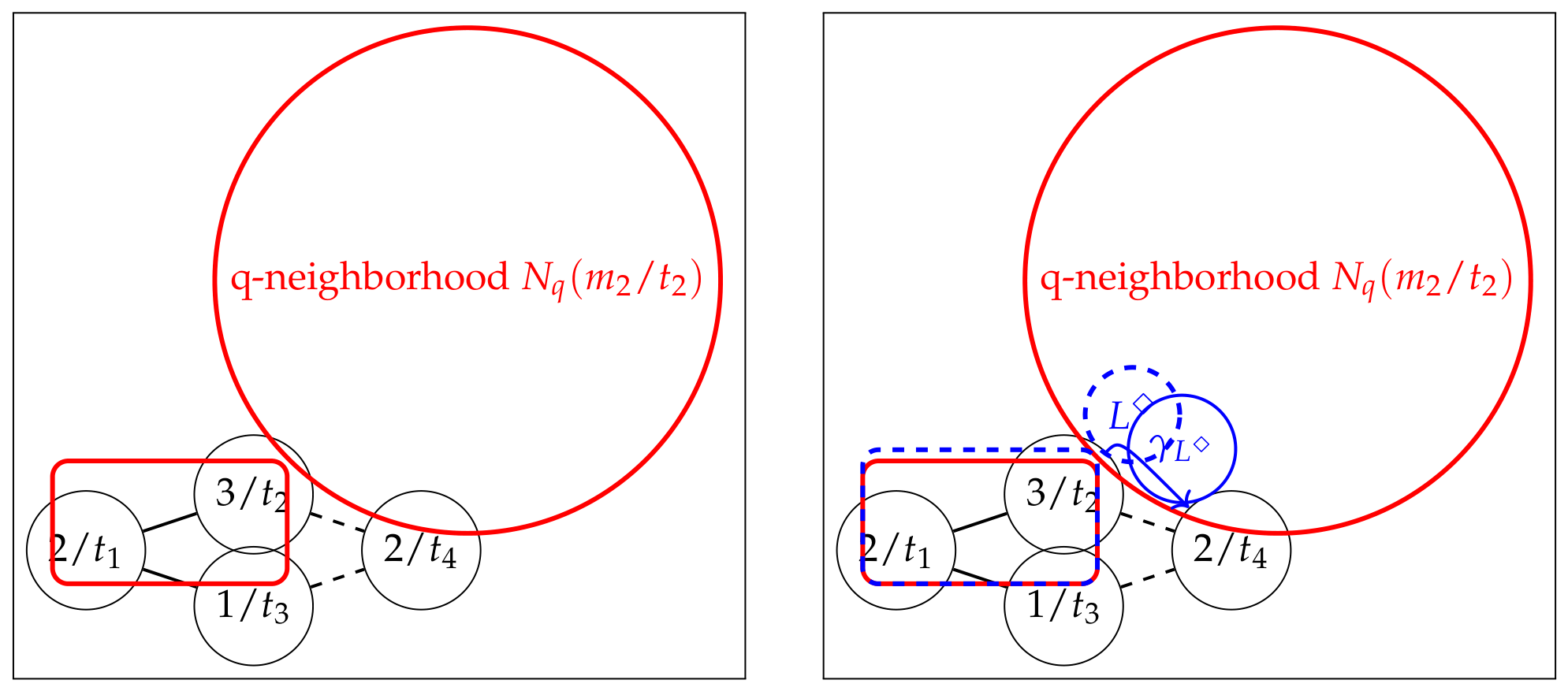
Using the local M-function ( · ) , we can identify the q-neighborhoods N q ( m i / t i ) of servers that are close to reaching their load thresholds, while the operator
ð ( L ) = L L
determines the closure of a configuration under local interactions between servers.
The effectiveness of the proposed framework is evaluated by examining whether the updated configuration ð ( L ) remains within the admissible collection P . In particular, a configuration L is considered stable if and only if ð ( L ) P . Otherwise, if ð ( L ) P , the configuration exceeds the allowable thresholds and leads to an overload state.
The induced topology T allows classification of network states into open M-sets (stable, congestion-free configurations) and closed M-sets (critical configurations approaching overload).
Figure 2 illustrates these aspects of the network: the left side shows the q-neighborhood N q ( m i / t i ) for each node, while the right side shows the expanded set L under the local M-function, including multiplicity propagation γ L indicated by arrows. Each node represents an element of A with its multiplicity, providing a concrete visualization of the underlying M-set topological structure in the network.
Remark 7.
Theorem 7 says that ◊-closed sets are stable. This means if we take two ◊-closed sets and look at the common items, we get another ◊-closed set. We can use this to make smaller M-topologies. It can also help to build networks with many layers using multisets.
Example 11.
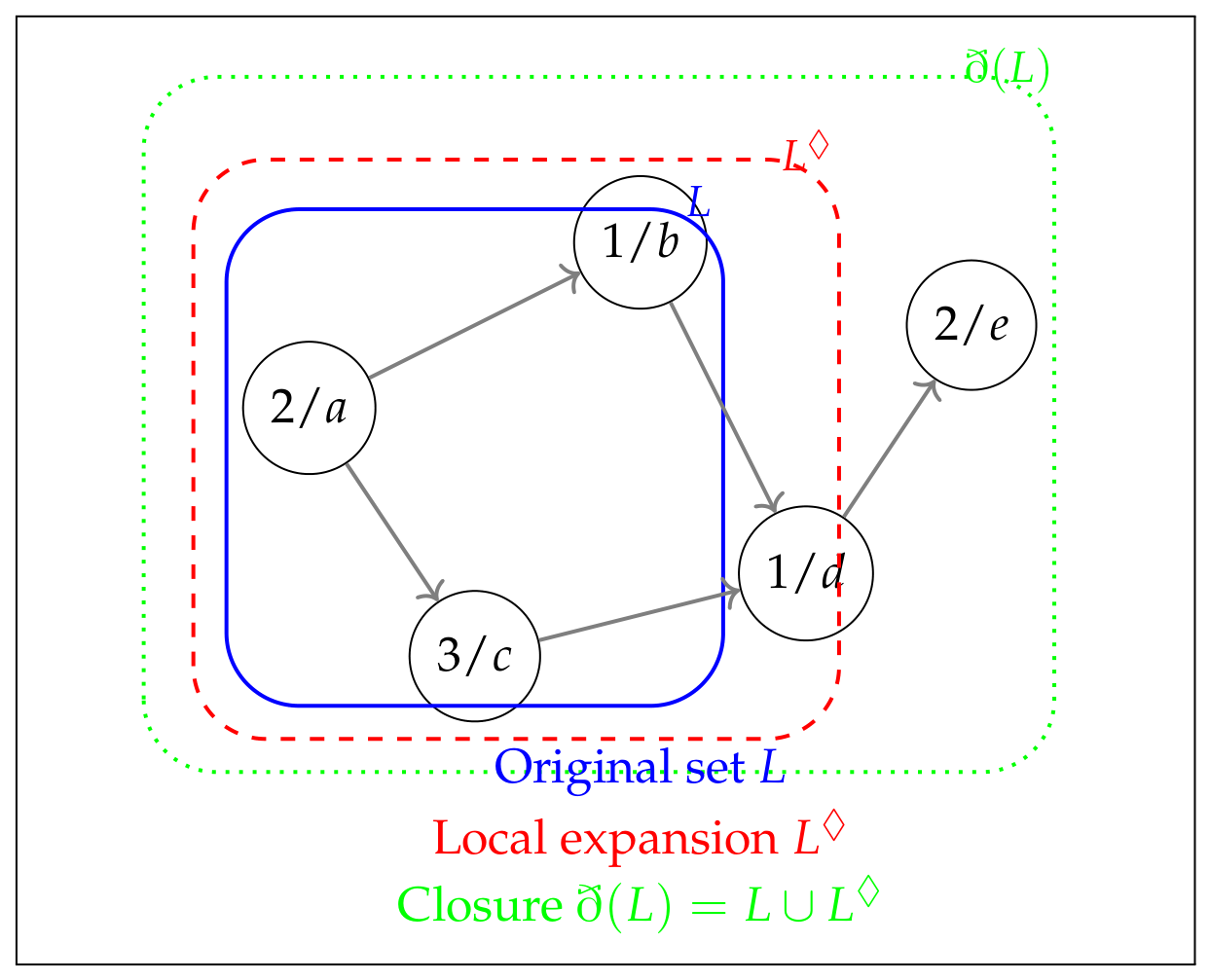
We look at a simple recommendation system.
  • A is a set of items. These can be movies, songs, or products. Each item has a multiplicity. This shows how popular it is or how many times users used it.
  • For a set L of items, L shows the “influence neighborhood”. This is the set of items that are related to the items in L. We find this using user preferences or interactions.
  • The operator ð ( L ) = L L expands L. It adds all related items to L. This way, we can give recommendations that include all important items. It keeps the main properties of the system.
This way, we can make a mathematical model for recommendation systems. It works well when items appear many times or have different importance. It gives a clear way to handle recommendations.The data in this example can be represented graphically; see Figure 3.

6. Conclusions and Future Work

This study looks at multisets and their topology. We extended primal topology to work with multisets.
First, we explained what a multiset is. Then we talked about different groups of multisets. We also explained some operations on them. Some new definitions for multiset relations and functions were given.
After that, we introduced M-primal topological spaces. We talked about base, closure, and interior in multisets. Some known theorems were also checked and proved again in this new setting.
There are still open problems. It is not clear how to work with changing or dynamic multisets. Probabilistic M-topology is another question. We do not yet know all the limits of M-primal spaces in real problems like data analysis or networks.
For future work, it is good to study how M-topology can help in computer science or combinatorics. Building simple computer tools can make it easier to use. Testing the theory with real data can show what works and what does not.
This work gives a base. Future studies can add more tools, applications, and ideas for multisets.

Funding

This research received no external funding.

Data Availability Statement

The original contributions presented in this study are included in the article. Further inquiries can be directed to the corresponding author.

Acknowledgments

The author declare she have not used artificial intelligence (AI) tools in the creation of this article.

Conflicts of Interest

The authors declare no conflicts of interest.

Abbreviations

For the convenience of the reader and to improve the clarity of the manuscript, the main abbreviations used throughout this paper are listed in the following table.
AbbreviationMeaning
M-setMultiset
M-topologyMultiset topology
M-primalMultiset primal structure
PW ( A ) Power whole set of A
PF ( A ) Power full set of A
M-grillMultiset grill
Rel. M-primalRelative M-primal structure
Rel. M-topologyRelative M-topology
M-connectedConnectedness in M-topological space
M-compactCompactness in M-topological space

References

  1. Clements, G.F. On multiset k-families. Discret. Math. 1988, 69, 153–164. [Google Scholar] [CrossRef] [Scilit]
  2. Blizard, W.D. Multiset theory. Notre Dame J. Form. Log. 1989, 30, 36–66. [Google Scholar] [CrossRef] [Scilit]
  3. Blizard, W.D. Real-valued multisets and fuzzy sets. Fuzzy Sets Syst. 1989, 33, 77–97. [Google Scholar] [CrossRef] [Scilit]
  4. Wildberger, N.J. A New Look at Multisets. 2003, Volume 2052, pp. 1–21. Available online: https://www.researchgate.net/publication/251497534_A_new_look_at_multisets (accessed on 16 May 2026).
  5. Girish, K.P.; Sunil, S.J. On multiset topologies. Theory Appl. Math. Comput. Sci. 2012, 2, 37–52. [Google Scholar]
  6. Acharjee, S.; Özkoç, M.; Issaka, F. Primal topological spaces. Bol. Soc. Paran. Mat. 2025, 43, 1–9. [Google Scholar] [CrossRef] [Scilit]
  7. AL-Omari, A.; Acharjee, S.; Özkoç, M. A new operator of primal topological spaces. Mathematica 2023, 65, 175–183. Available online: https://math.ubbcluj.ro/~mathjour/fulltext/2023-2/alomari-acharjee-ozkoc.pdf (accessed on 16 May 2026). [CrossRef] [Scilit]
  8. Singh, D.; Singh, J. Some combinatorics of multisets. Int. J. Math. Educ. Sci. Technol. 2003, 34, 489–499. [Google Scholar] [CrossRef] [Scilit]
  9. Singh, D.; Ibrahim, A.; Yohanna, T.; Singh, J. An overview of the applications of multisets. Novi Sad J. Math. 2007, 37, 73–92. [Google Scholar]
  10. Conder, M.; Marshall, S.; Arkadii, M.; Slinko, A. Orders on multisets and discrete cones. J. Theory Ordered Sets Its Appl. 2007, 24, 277–296. [Google Scholar] [CrossRef] [Scilit]
  11. Girish, K.P.; John, S.J. Rough multiset and its multiset topology. In Transactions on Rough Sets XIV; Lecture Notes in Computer Science; Springer: Berlin/Heidelberg, Germany, 2011; Volume 6600, pp. 62–80. [Google Scholar]
  12. Girish, K.P.; John, S.J. Multiset topologies induced by multiset relations. Inf. Sci. 2012, 188, 298–313. [Google Scholar] [CrossRef] [Scilit]
  13. El-Sheikh, S.; Omar, R.; Raafat, M. Separation axioms on multiset topology. J. New Theory 2015, 7, 11–21. [Google Scholar]
  14. Al-shami, T.; Ameen, Z.; Abu-Gdairi, R.; Mhemdi, A. On primal soft topology. Mathematics 2023, 11, 2329. [Google Scholar] [CrossRef] [Scilit]
  15. Mejías, L.; Vielma, J.; Guale, A.; Pineda, E. Primal topologies on finite-dimensional vector spaces induced by matrices. Int. J. Math. Math. Sci. 2023, 2023, 9393234. [Google Scholar] [CrossRef] [Scilit]
  16. AL-Omari, A.; Ozkoc, M.; Acharjee, S. Primal-proximity spaces. Mathematics 2024, 66, 151–167. [Google Scholar] [CrossRef] [Scilit]
  17. Özkoç, M.; Issaka, F.Y.; Al-shami, T.M.; Fawakhreh, A.J. Connectedness via Primal Topological Spaces with Applications of Primals to Rough Operators. J. Math. 2025, 2025, 3487928. [Google Scholar] [CrossRef] [Scilit]
  18. Al-Saadi, H.; Al-Malki, H. Generalized primal topological spaces. AIMS Math. 2023, 8, 24162–24175. [Google Scholar] [CrossRef] [Scilit]
  19. Al-Saadi, H.; Al-Malki, H. Categories of open sets in generalized primal topological spaces. Mathematics 2024, 12, 207. [Google Scholar] [CrossRef] [Scilit]
  20. Al-Saadi, H.; Al-Malki, H. Strong GP-continuity and weakly GP-closed functions on GPT spaces. J. King Saud Univ.-Sci. 2024, 36, 103259. [Google Scholar] [CrossRef] [Scilit]
  21. Al-Saadi, H.; Al-Malki, H. Symmetric Extensions of Separation Axioms via GP-Operators and Their Applications. Symmetry 2026, 18, 185. [Google Scholar] [CrossRef] [Scilit]
  22. Al-Saadi, H.; Al-Malki, H. Theory and Applications of Primal Weak Structures. Mathematics 2026, 14, 864. [Google Scholar] [CrossRef] [Scilit]
  23. Choquet, G. Sur les notions de filtre et grille. C. R. Acad. Sci. Paris 1947, 224, 171–173. [Google Scholar]
Figure 1. Preimage P under non-bijective mapping f (not M-primal).
Mathematics 14 01840 g001
Figure 2. Comparison: both networks show q-neighborhood; right network adds L effect and multiplicity propagation.
Mathematics 14 01840 g002
Figure 3. Example of M-set recommendation.
Mathematics 14 01840 g003
Disclaimer/Publisher’s Note: The statements, opinions and data contained in all publications are solely those of the individual author(s) and contributor(s) and not of MDPI and/or the editor(s). MDPI and/or the editor(s) disclaim responsibility for any injury to people or property resulting from any ideas, methods, instructions or products referred to in the content.