


Abstract
The traditional finite element method (FEM) usually exhibits significant numerical dispersion error for solving the Helmholtz equation in relatively high-frequency range, resulting in insufficiently accurate solutions. To address this problem, this paper proposes a novel enriched finite element method (EFEM) based on radial basis functions (RBFs) which are frequently used in meshless numerical techniques. In the proposed method, the partition of unity (PU) framework is retained, and nodal interpolation functions are formed using the RBFs. Furthermore, the linear dependence (LD) problem commonly encountered in many of the PU-based methods using polynomial basis functions (PBFs) is effectively avoided by using the present RBFs. To enrich the approximation space generated by the RBFs, the PBFs are introduced to construct the local enrichment functions. Several typical numerical experiments are conducted in this work. The results indicate that the proposed method can significantly reduce the dispersion error and yield accurate solutions even for relatively high-frequency Helmholtz problems. More importantly, the proposed method can be directly implemented with standard quadrilateral meshes as in FEM. Therefore, the proposed method represents a promising numerical scheme for solving relatively high-frequency Helmholtz problems.
Keywords:
Helmholtz equation; finite element method (FEM); radial basis functions (RBFs); partition of unity; pollution error MSC:
35A08; 35A09; 35A24; 65L60; 74S05
1. Introduction
The traditional finite element method (FEM) has been widely adopted across various engineering fields during the past few decades because of its inherent advantages. For example, the global matrices generated by the traditional FEM are typically banded and sparse, and the FEM is well-suited for handling structural-acoustic coupling and heterogeneous problems [1,2]. However, there are still several challenges remaining unresolved for the traditional FEM when solving acoustic problems where the linear Helmholtz equation often needs to be addressed efficiently [3]. Due to the differential nature of the Helmholtz equation, the traditional FEM generally suffers from significant dispersion errors at relatively large wave numbers, which significantly degrade computational accuracy. Therefore, the satisfactory numerical solutions can usually only be provided at relatively small wave numbers [4,5,6].
Currently, researchers have developed various alternatives to the standard FEM for acoustic simulations, including finite volume method (FVM) [7], finite difference method (FDM) [8,9,10,11,12,13], boundary element method (BEM) [14,15,16], and various meshfree methods [17,18,19,20]. Among these, the BEM is a widely used and reliable approach for underwater acoustic scattering problems. The BEM is particularly suitable for problems defined over unbounded domains due to its inherent capability. Furthermore, BEM typically requires meshing only the domain boundary, resulting in reduced meshing overhead compared to FEM. However, the BEM tends to yield dense and non-symmetric global matrices, leading to high computational costs for large-scale problems [21,22,23]. Recently, several meshfree techniques, including the reproducing kernel particle method [24], the element-free Galerkin method (EFGM) [25,26,27,28], the point interpolation method (PIM), and the radial point interpolation method (RPIM) [29,30,31,32,33], have also been applied to acoustic problems. Compared to FEM, these methods can control dispersion errors better at relatively large wave numbers and often deliver higher computational accuracy. In the PIM, the nodal interpolation functions retain the Kronecker delta property and can be constructed directly from the scattered nodes. However, the method may suffer from a singular moment matrix and the nodal interpolation functions may oscillate significantly when too many nodes are used for interpolation. In contrast, the RPIM constructs the nodal shape functions with the radial basis functions (RBFs), avoiding singularities and offering improved stability and robustness. Moreover, the RPIM has been shown to outperform the traditional FEM in terms of convergence and accuracy in acoustic analysis [34,35,36].
Numerous RBF-based methods have been developed for solving partial differential equations (PDEs) [37,38,39,40]. For instance, Kien et al. proposed an RBF-FEM to produce the shape functions simply with increasing element node number, which has been applied to solid mechanics problems [41,42]. Ma et al. developed a novel space–time collocation method based on multiquadric-radial basis functions (MQ-RBF) to solve the Benjamin–Bona–Mahony–Burgers (BBMB) equation in shallow water waves [43]. Zhang et al. proposed a modified RPIM (M-RPIM) for PDEs governing steady point current source fields [44]. Liu et al. introduced a novel approach combining second-order cone programming (SOCP) with node-based smoothed RPIM (NSRPIM) to address the limitations of traditional Newton-type methods in solving elastoplastic boundary value problems [45]. Recently, a specialized RBF-FD method has been proposed and advanced for solving a series of PDEs [46,47,48,49,50,51,52], with numerical results confirming its effectiveness. Additionally, the local discontinuous Galerkin (LDG) method has also been developed and applied to a range of PDEs [53,54,55,56,57].
However, FEM remains a predominant and essential numerical method for solving acoustic problems due to its unique advantages. In general, the interpolation error and numerical pollution/dispersion error constitute the primary numerical error sources in the numerical solutions for Helmholtz equation [58]. Several studies have shown that the magnitude of these errors is jointly determined by the physical parameters and discretization scheme. At relatively small wave numbers, the total numerical error is usually dominated by interpolation error. Here, following the rule of thumb , in which represents the wave number and denotes the mesh size, the interpolation error can be efficiently controlled. However, at relatively large wave numbers, the dispersion error becomes the primary contributor to the total numerical error. Even if the used mesh pattern satisfies the rule of thumb, the accuracy may still be insufficient, indicating that the dispersion error grows faster than the interpolation error as the wave number increases. In essence, the dispersion error reflects phase lag in the numerical solution and is inherently difficult to eliminate completely.
To address the dispersion error, researchers have developed many FEM variants, including the Galerkin/least-squares FEM [59,60], the generalized FEM (GFEM) [61], the smoothed FEM (SFEM) [62,63,64,65], the overlapping FEM (OFEM) [66,67,68,69], and the enriched FEM (EFEM) [70]. These approaches are generally able to suppress the dispersion error more effectively than the traditional FEM. It should be noted that these approaches still suffer from limitations in completely eliminating the dispersion error, especially for 2D and 3D problems. Furthermore, the linear dependence (LD) problem is commonly encountered in many of the partition of unity (PU)-based methods using the polynomial basis functions (PBFs). A previous EFEM based on the PU concept, in which standard FEM shape functions are used, has been proposed [71]. Compared to the traditional FEM, the EFEM performs much better in reducing the dispersion error at relatively large wave numbers. However, the EFEM may suffer from the LD problem because the linearly dependent nodal shape functions are used to construct the local numerical approximation, particularly in quadrilateral elements [72,73,74].
Inspired by the prior research, this paper proposes a novel EFEM based on the RBFs to reduce the dispersion error, in which the PU framework is retained and the nodal interpolation functions are formed using the RBFs. In the proposed method, the LD problem is effectively avoided by using the present RBFs. Additionally, to enrich the approximation space generated by the RBFs, the PBFs are introduced to construct the local enrichment functions, which further improves the capability of the proposed method in solving relatively high-frequency Helmholtz problems. Actually, an arbitrary order of the PBFs can be applied to construct the local enrichment functions. Generally, the higher order of the PBFs can provide higher computational accuracy but incur higher computational costs. For brevity, only the linear PBFs are used to construct the local enrichment functions in this work, leading to three additional degrees of freedom (DOFs) at each node. Therefore, the proposed method is referred to as RBF-N3. Several typical numerical experiments are conducted in this work. The findings clearly show that the RBF-N3 delivers significantly higher computational accuracy and yields lower dispersion error than the traditional FEM, especially for relatively high-frequency problems. More importantly, in the RBF-N3 no special modifications for the mesh structure are required and the nodal shape functions retain the Kronecker delta property. Therefore, for relatively high-frequency Helmholtz problems, the RBF-N3 presents a promising and efficient alternative to the traditional FEM.
In Section 2, the matrix formulation of the Helmholtz equation is constructed by using the RBFs. In Section 3, the structure of the EFEM based on the RBFs for the Helmholtz equation is given. In Section 4, a dispersion error analysis of the RBF-N3 is provided and compared with the traditional FEM. Several typical numerical experiments are conducted in Section 5.
2. Formulation of the Helmholtz Equation
For acoustic problems in an ideal fluid medium, the problem domain is denoted as and the boundary as . Based on the assumptions of linearization and adiabatic processes, the linear governing equation can be derived as
where denotes the acoustic pressure, is the Laplace operator in the Cartesian coordinate system, and represents the acoustic propagation speed.
Assuming that exhibits a steady harmonic feature, i.e., , where represents the angular frequency and denotes the amplitude of acoustic pressure distribution, the Helmholtz equation is derived as
in which denotes the wave number.
Based on the Helmholtz equation, the practical acoustic problems can be analyzed and solved by applying appropriate boundary conditions. In simple cases, the analytical solutions can be obtained directly. However, the real-world scenarios are often very complex and the actual boundary conditions are typically difficult to describe precisely in mathematical form. As a result, the exact analytical solutions are often unattainable. In such cases, suitable numerical methods are usually employed to obtain sufficiently accurate approximations for practical acoustic problems.
The boundary conditions usually fall into the following three categories:
in which denotes the Dirichlet boundary prescribing the acoustic pressure amplitude, denotes the Neumann boundary enforcing the normal particle velocity , and represents the Robin boundary defining the acoustic impedance condition. Here, is fluid density, is the acoustic admittance coefficient, and denotes the outward unit normal vector.
The equivalent integral form for Equation (2) is obtained as
in which denotes an arbitrary weight function. By applying Green’s theorem and performing integration by parts, the equation can be rewritten as
In Equation (5), denotes the unknown scalar field variable to be solved. Clearly, the solution obtained from the equation is exact if the weight function is chosen arbitrarily. However, it is generally impossible to solve for the exact solution directly based on this equation. By applying the Galerkin method to Equation (5), an approximate form can be derived, in which the variation of the acoustic pressure is chosen as a particular weight function:
Substituting Equation (6) into Equation (5) yields the corresponding approximate equation:
The above equation represents the Galerkin weak form of the Helmholtz equation. In fact, obtaining the exact acoustic pressure solution directly from Equation (7) is not inherently easier than solving the original Helmholtz equation. However, this weak form facilitates the construction of corresponding discrete numerical models.
In this work, the RBFs are used for the construction of corresponding discrete numerical models. Consider an acoustic pressure field defined over a d-dimensional problem domain discretized into elements and each element containing nodes. To construct the nodal shape functions, is expressed as
In Equation (8), represents the numerical approximation of . denotes the RBFs used for interpolation. denotes the number of the employed RBFs, which is typically equal to the number of nodes used for interpolation. The standard quadrilateral mesh is employed to construct shape functions in this work, so . represents a sequence of the PBFs, which are employed to enhance the numerical stability and to enrich the approximation space. The number of PBFs is denoted by . In this work, , that is, . The coefficients and are the unknown parameters to be determined. There exist many different types of RBFs, here the Multi-Quadrics (MQ) type of RBF is chosen as
in which is a characteristic length that is related to the average nodal spacing. and are the shape parameters of the MQ-RBF to be determined. represents the RBF corresponding to node , whose variable depends solely on the distance between the field point and node . For two-dimensional problems, this distance is given by
In this work, the values and are chosen based on well-established practices from prior research on acoustic problems. Specifically, it is recommended by previous numerical investigations that and can be utilized to yield satisfactory numerical accuracy [34,75]. Furthermore, this parameter choice has been verified by You et al. [30] to provide very accurate simulations for acoustic problems. To determine the coefficients and , the nodal acoustic pressures are substituted into Equation (8), leading to the following matrix equation:
Additionally, an extra constraint condition is introduced:
Hence, Equation (11) can be rewritten as
where
Here, denotes the coordinate vector for node . represents the vector of the nodal acoustic pressures and can be expressed as , where represents the acoustic pressure at node . According to Equation (13), the unknown coefficients can be represented as . Based on the employed quadrilateral mesh, the matrices and can be computed explicitly, and thus the unknown coefficients can be determined. Substituting into Equation (8) yields
in which is a vector-valued function of length , which can be expressed as follows:
Taking the first n terms as the nodal shape functions , we have
in which represents the nodal shape function which possesses the Kronecker delta property:
Similarly, the variation in the acoustic pressure can also be defined as
Substituting Equations (18) and (20) into Equation (7) yields the following expression:
Equation (21) can also be expressed as
where
In Equation (23), the system matrices K, M, and C represent the global stiffness matrix, global mass matrix, and global damping matrix, respectively; F denotes the global load vector and P is the global nodal acoustic pressure vector. Based on Equation (23), the process of solving the original Helmholtz equation is thus converted into solving the corresponding matrix equation. This, in turn, transforms the problem into evaluating integrals of the shape functions over the problem domain, which can then be computed using various numerical integration techniques (e.g., Gaussian quadrature). The treatment of boundary conditions for the Helmholtz equation can similarly be transformed into appropriate modifications of the matrices in Equation (23). Finally, the nodal acoustic pressure vector P can be obtained by solving the resulting matrix equation.
3. The EFEM Based on RBFs for Helmholtz Equation
The EFEM improves computational accuracy by introducing additional DOFs at each node without altering the original finite element mesh topology. Consider an acoustic pressure field defined over a d-dimensional problem domain which is discretized into nodes. In the EFEM based on RBFs, the interpolation of can be defined as [76,77,78]
In Equation (24), the interpolation of is divided into two parts. The first part is the standard interpolation constructed based on the RBFs and the second part represents the enriched numerical approximation resulting from the introduction of additional DOFs. Here, represents the nodal shape function constructed using the RBFs as shown in Section 2, is the nodal acoustic pressure, denotes a newly constructed nodal interpolation function, is a specially designed enrichment function, is the corresponding unknown coefficient.
In fact, should satisfy the PU property, i.e., . In this work, is directly chosen as the nodal shape function for simplicity, although this is not typically required. Hence, Equation (24) can be rewritten as:
In general, the enrichment function , which actually serves as a key factor in improving the accuracy of the EFEM, can be chosen as a sequence of polynomial functions or trigonometric functions, or as a combination of both. Furthermore, the enrichment function can be specially designed for different types of problems, thereby yielding the EFEM adapted to various application scenarios. However, it is evident that the approximation of at a node generally does not equal the actual nodal acoustic pressure when a general enrichment function is used. is used. This discrepancy is shown in Equation (27) and can indeed affect the imposition of Dirichlet boundary conditions.
Consider at node , we have
According to Equation (26), this leads to , thus allowing Dirichlet boundary conditions to be properly imposed. Therefore, Equation (25) needs to be modified as follows:
in which h is the characteristic length of the element introduced to enhance numerical stability.
In two-dimensional problems, if a polynomial sequence is used, the enrichment function can be expressed as
If a trigonometric function sequence is used, is given as [79]
in which and denote the relative coordinates within the element. The variable denotes the order of the polynomial or trigonometric function employed. If a combination of trigonometric and polynomial functions is used, then enrichment functions can be selected from both Equations (29) and (30).
Generally, the higher order of the enrichment functions can theoretically provide higher computational accuracy but incur higher computational costs. For brevity, only the linear PBFs are used to construct the local enrichment functions in this work, i.e., , and then there exists three DOFs at each node. Therefore, the EFEM based on the RBFs is referred to as RBF-N3 in this work.
Many of the PU-based methods using the PBFs commonly suffer from the LD problem, which compromises the numerical stability of the method, particularly when quadrilateral meshes are employed. In the RBF-N3, the LD problem can be effectively avoided by using the RBFs. Furthermore, the approximation space generated by the RBFs is enriched by the local enrichment functions, which further improves the capability of the proposed method in solving the Helmholtz problems in relatively high-frequency range.
4. Numerical Dispersion Error Analysis
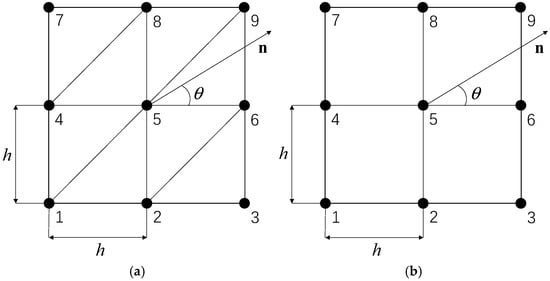
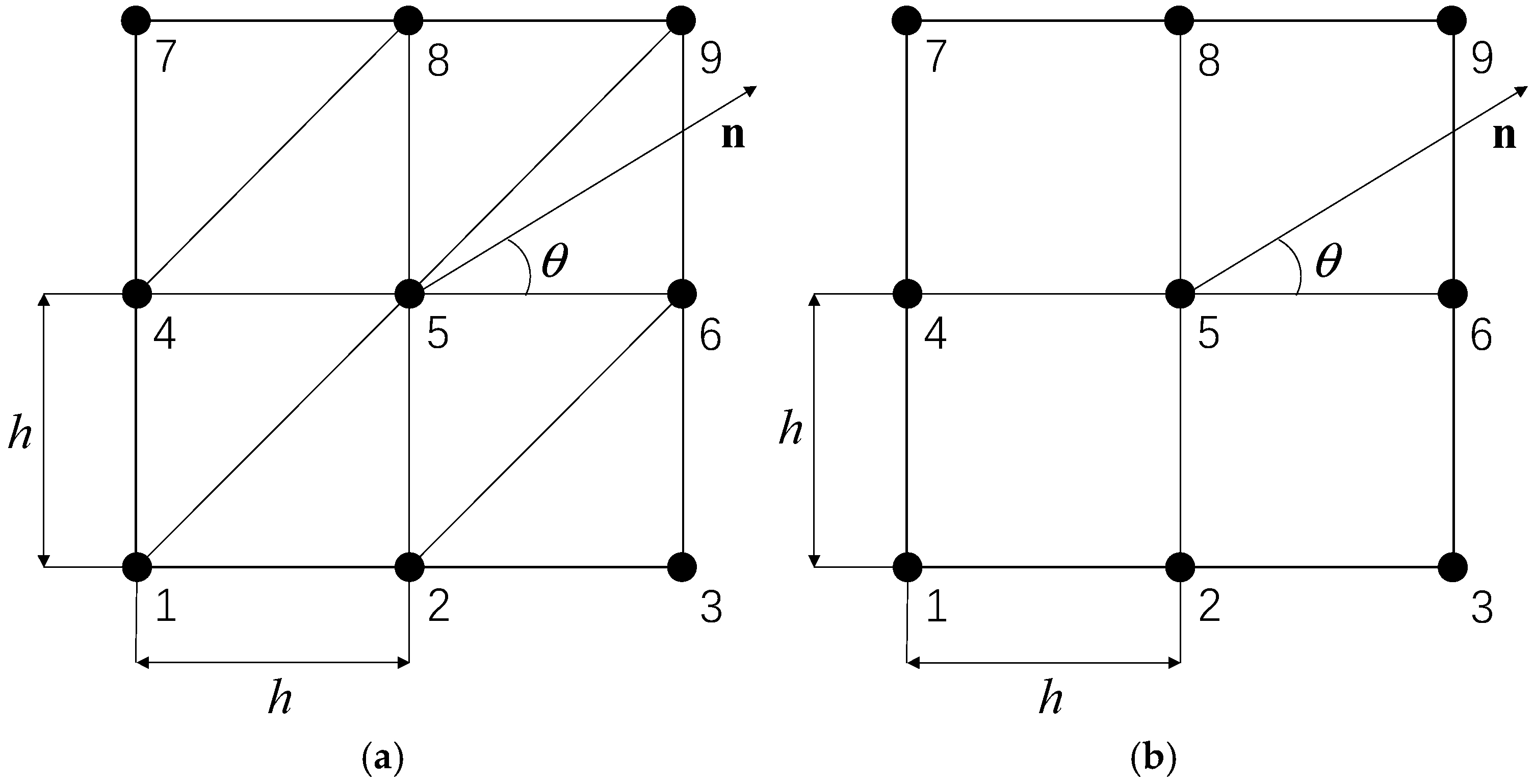
When the numerical methods are applied to the Helmholtz equation, a phase lag is generally introduced to the exact solution. Specifically, the underestimated numerical wave number causes waves to propagate faster numerically, resulting in delayed phase accumulation at observation points. At relatively small wave numbers, the traditional FEM can provide sufficiently accurate solutions due to negligible dispersion error. However, for problems involving relatively large wave numbers, the traditional FEM often exhibits significant dispersion error, which severely impacts computational accuracy. Therefore, a suitable numerical method should be capable of mitigating dispersion error at relatively large wave numbers. The dispersion error is analyzed for the proposed RBF-N3, traditional FEM, EFEM-N3 (using linear polynomial enrichment functions), and RPIM; in this work the used regular triangular and quadrilateral meshes are shown in Figure 1. For the RPIM, the same nodes distribution with h = 1 is employed and the support domain size is set to 3h, a choice proven effective in reducing dispersion errors [29,31].
Figure 1.
The regular meshes for dispersion error analysis: (a) triangular elements, (b) quadrilateral elements.
In Figure 1, the acoustic domain is uniformly discretized into nine nodes for the purpose of dispersion error analysis. Here, denotes the mesh size, represents the wave propagation direction, and is the unit direction vector of wave propagation. For the Helmholtz equation without any boundary conditions, the discretized matrix equation is derived as
Assume that
where represents the coordinate vector, and are the numerical acoustic pressure and numerical wave number, respectively. represents the vector of nodal acoustic pressures which can be expressed as
Here the vector denotes the nodal acoustic pressure amplitude vector, represents the number of DOFs at each node. In the traditional FEM, , whereas in the RBF-N3, . Using Equations (31) and (32), we obtain
The coefficient matrices and (with dimension ) are given by [80,81]
From and , the actual wave number can be calculated as
It is evident that both and are actually the function of the numerical wave number , mesh size , and wave propagation direction . Therefore, for a given numerical wave number , the actual wave number can be determined from Equation (37) if and are known. In most cases, the dispersion error causes . The ratio is used to quantify the dispersion error.
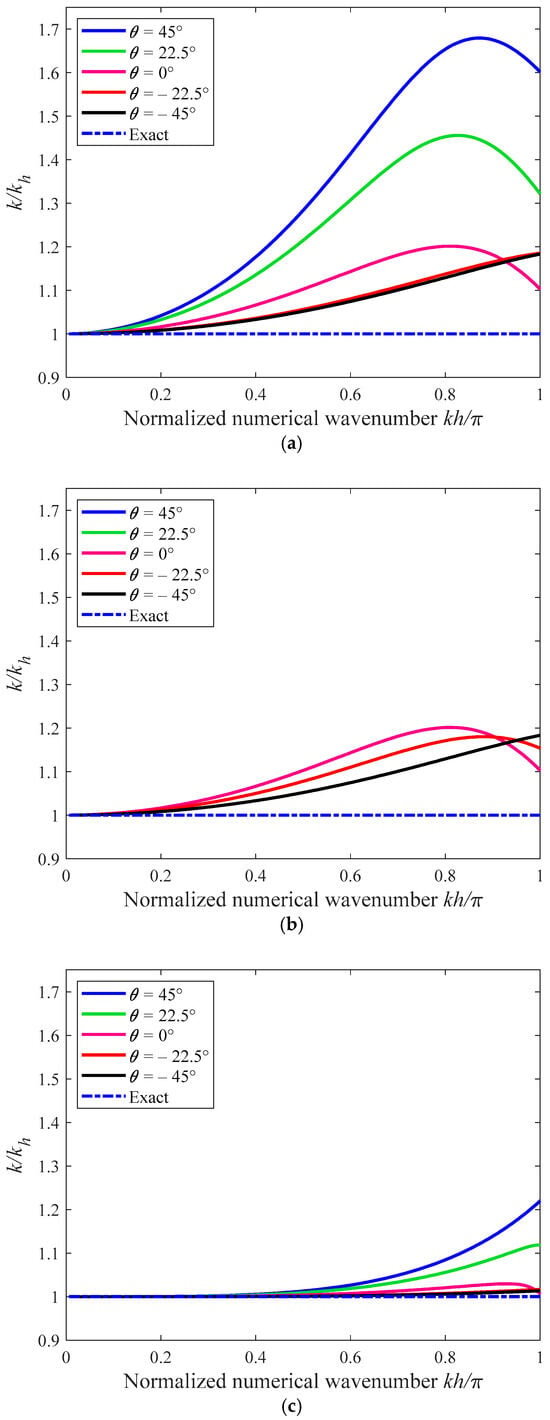
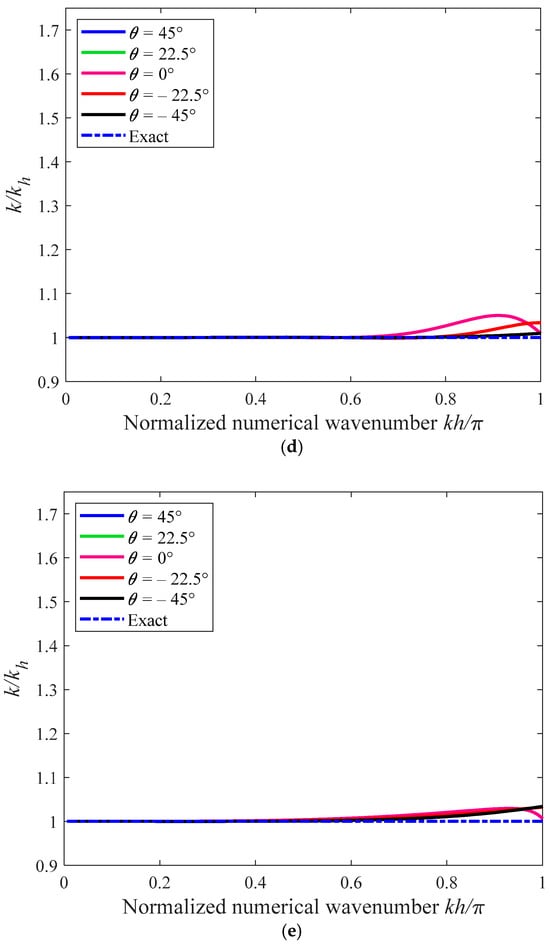
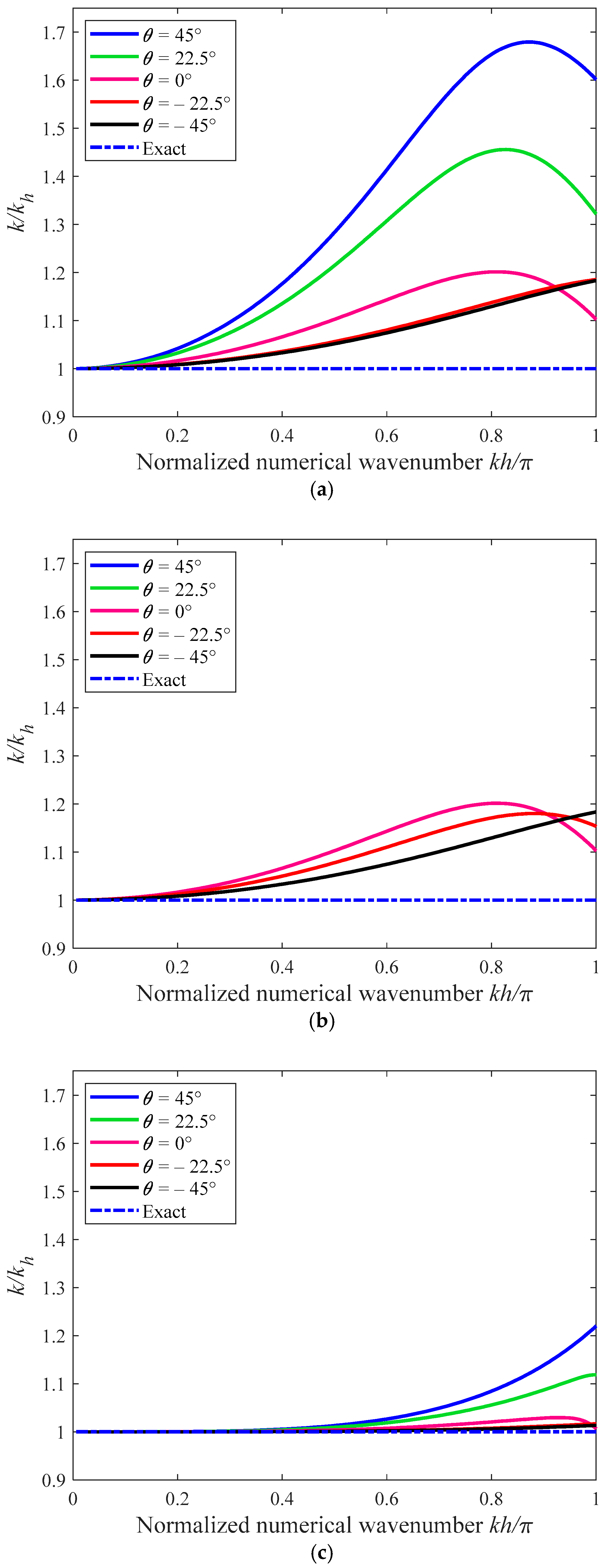
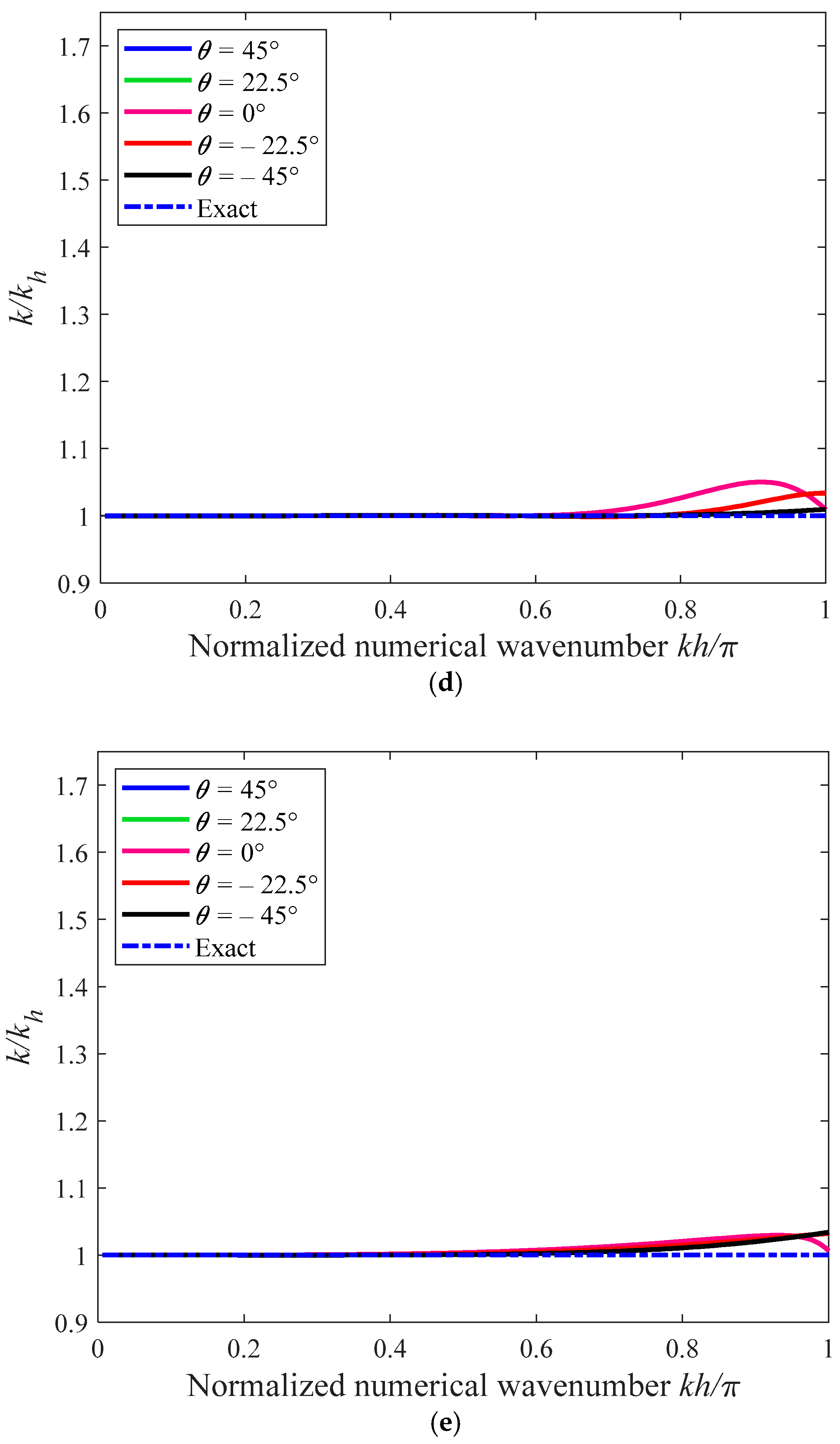
In this section, the meshes shown in Figure 1 are used for the dispersion error analysis. The numerical dispersion errors for different numerical methods under various wave propagation directions are computed using Equation (37). Figure 2 displays the dispersion errors versus the normalized wave number for different numerical methods, namely, FEM-T3 (triangular elements) in Figure 2a, FEM-Q4 (quadrilateral elements) in Figure 2b, EFEM-N3 in Figure 2c, RPIM in Figure 2d, and the proposed RBF-N3 in Figure 2e.
Figure 2.
Dispersion error curves for different numerical methods under various wave propagation directions: (a) FEM-T3; (b) FEM-Q4; (c) EFEM-N3; (d) RPIM; (e) RBF-N3.
As shown in Figure 2, the numerical dispersion errors obtained with the FEM-T3, FEM-Q4, EFEM-N3, and RPIM are larger than those of the RBF-N3 and vary significantly with different wave propagation angles, indicating that these methods suffer from pronounced numerical anisotropy. In contrast, the proposed RBF-N3 yields the smallest numerical dispersion errors over the entire range of computed normalized wave numbers and exhibits much weaker numerical anisotropy across wave propagation directions. It is worth noting that the same node discretization is employed. Therefore, these findings indicate that the approximation space generated by the RBFs, which is enriched by the linear PBFs, is particularly well-suited for suppressing the dispersion error. Moreover, the excellent performance of the RBF-N3 also suggests that the RBF-N3 could serve as a more accurate and reliable numerical method than the traditional FEM for solving practical Helmholtz problems.
5. Numerical Examples
Multiple practical numerical experiments are investigated using the traditional FEM and the RBF-N3. The numerical results obtained by different methods are compared to evaluate the performance of the RBF-N3 for practical Helmholtz problems.
5.1. The 2D Tube Acoustic Problem
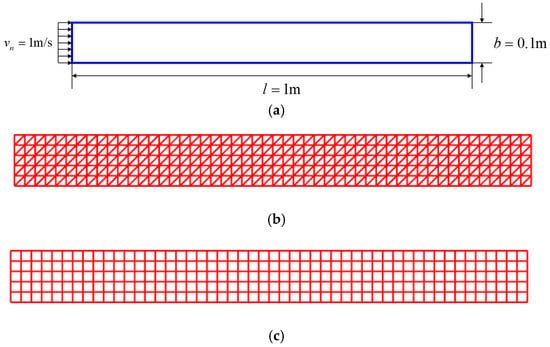
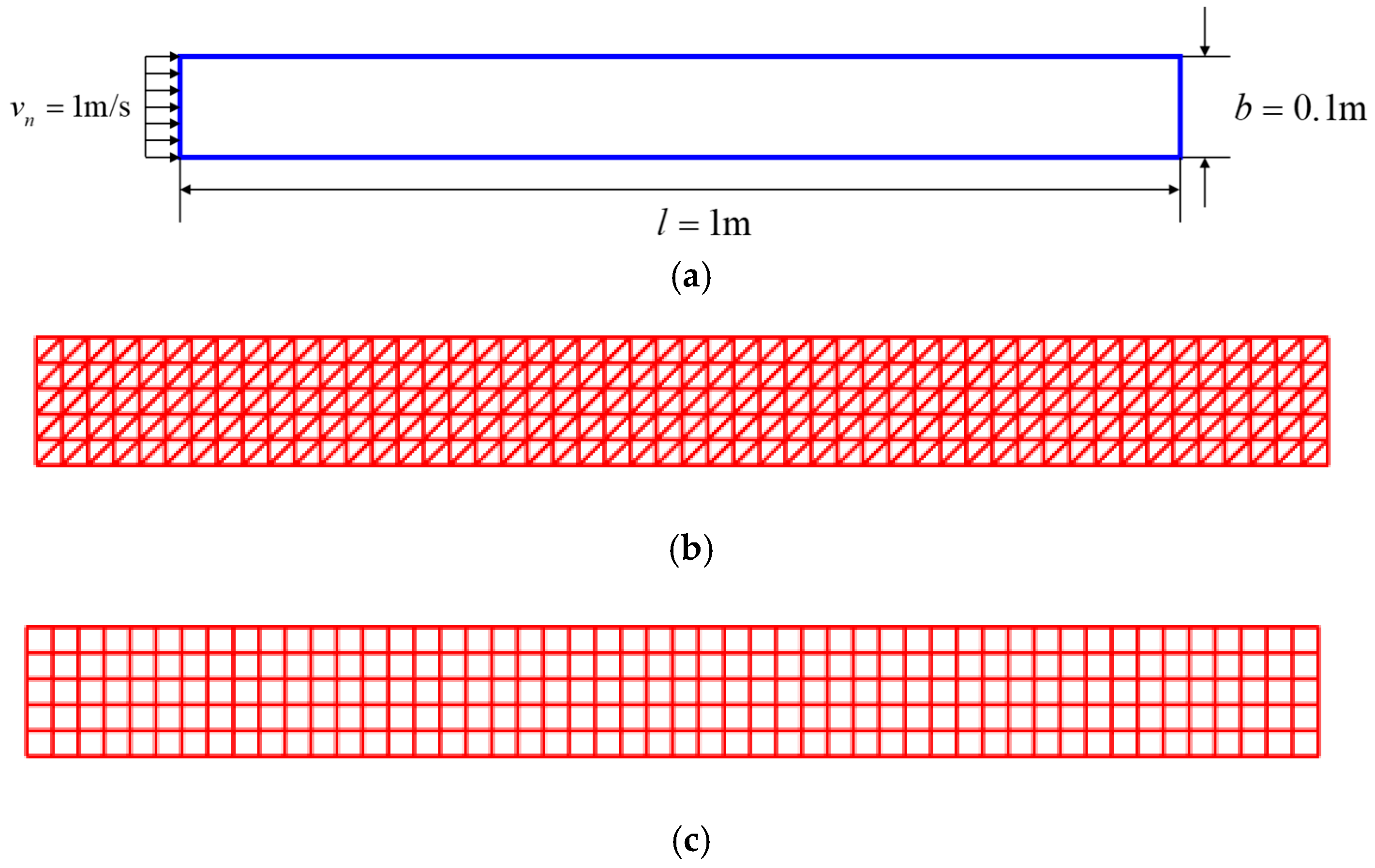
This subsection investigates the 2D tube acoustic problem and the corresponding acoustic model is shown in Figure 3. Figure 3a gives the geometry of the tube which has a length and width . The tube is filled with water with density and sound speed . The Neumann boundary conditions are applied at the left end of the tube, while all other boundaries are treated as rigid walls (zero normal velocity). The x-axis is aligned with the tube length. Figure 3b presents the structured triangular mesh used for the FEM-T3 and Figure 3c shows the structured quadrilateral mesh used for the FEM-Q4 and the RBF-N3. All the used meshes share an identical nodal distribution and exhibit uniform structuring.
Figure 3.
A 2D tube with the Neumann boundary conditions: (a) Schematic diagram of this tube; (b) The employed triangular mesh; (c) The employed quadrilateral mesh.
The analytical solution for this 2D acoustic problem is given by
in which represents the acoustic particle velocity.
Two different error norms are used to evaluate the computational accuracy in this work, defined as [58]
in which the symbol represents the analytical solutions, and the symbol represents the corresponding numerical solutions. The symbol represents the complex conjugate of . Equation (39) describes a local relative error, while Equation (40) evaluates the global error over the entire problem domain. In Equation (40), represents the component of interpolation error, and represents the component of dispersion error.
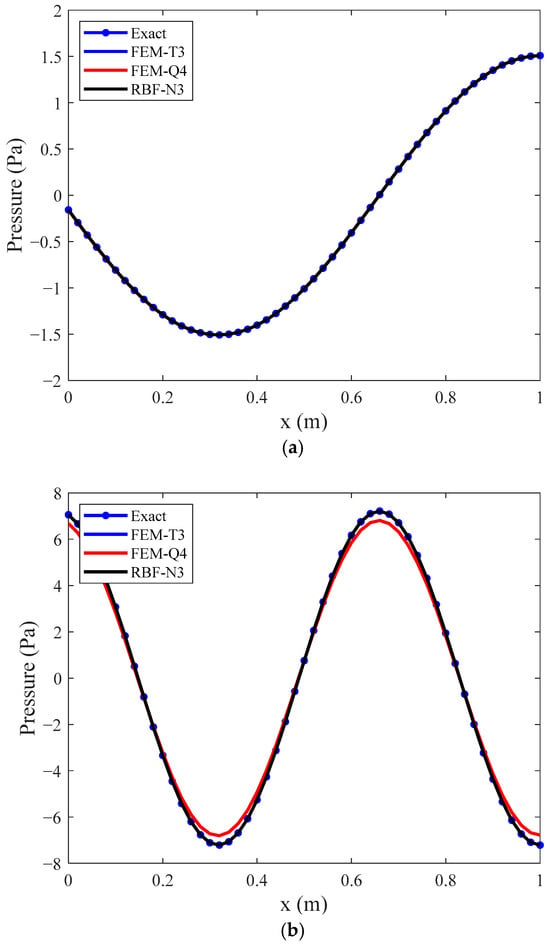
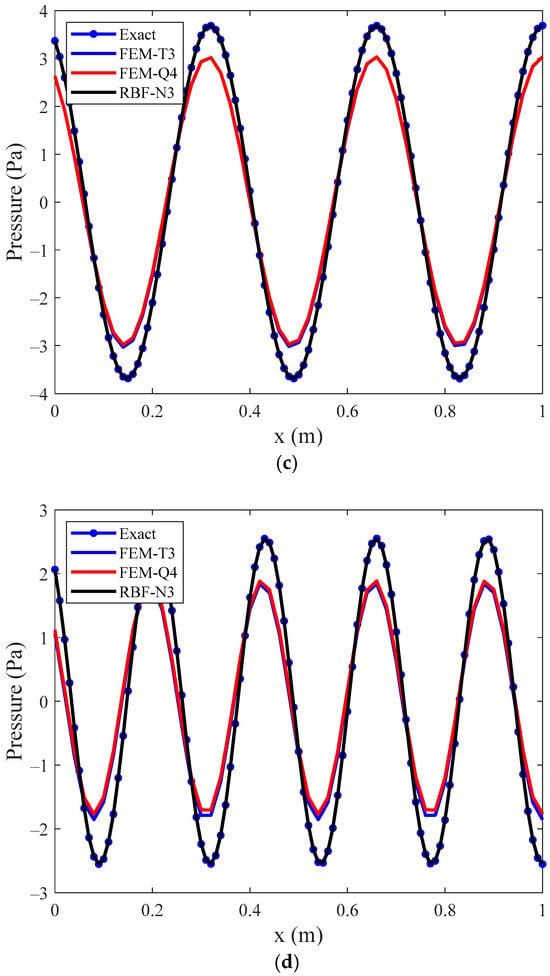
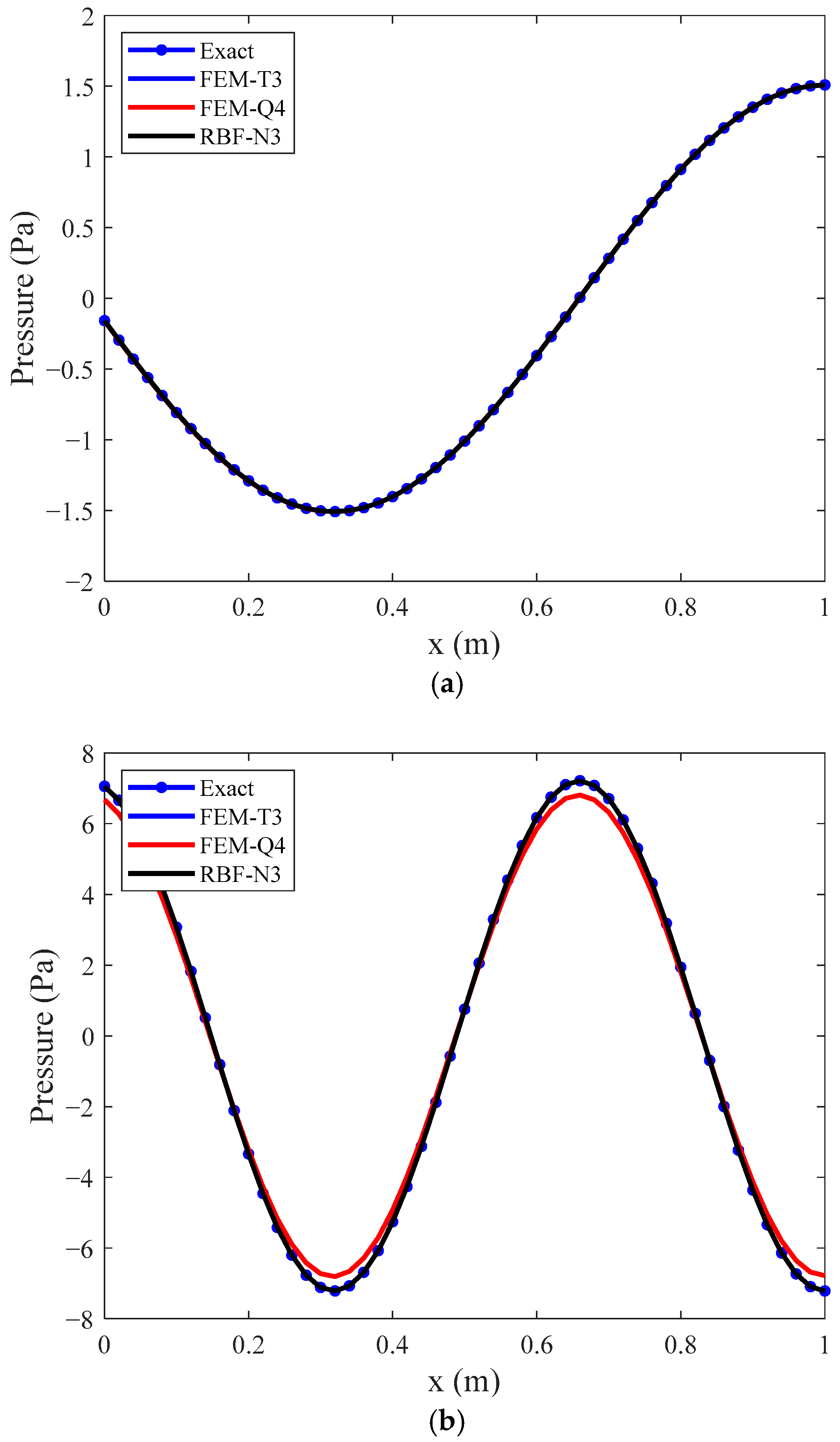
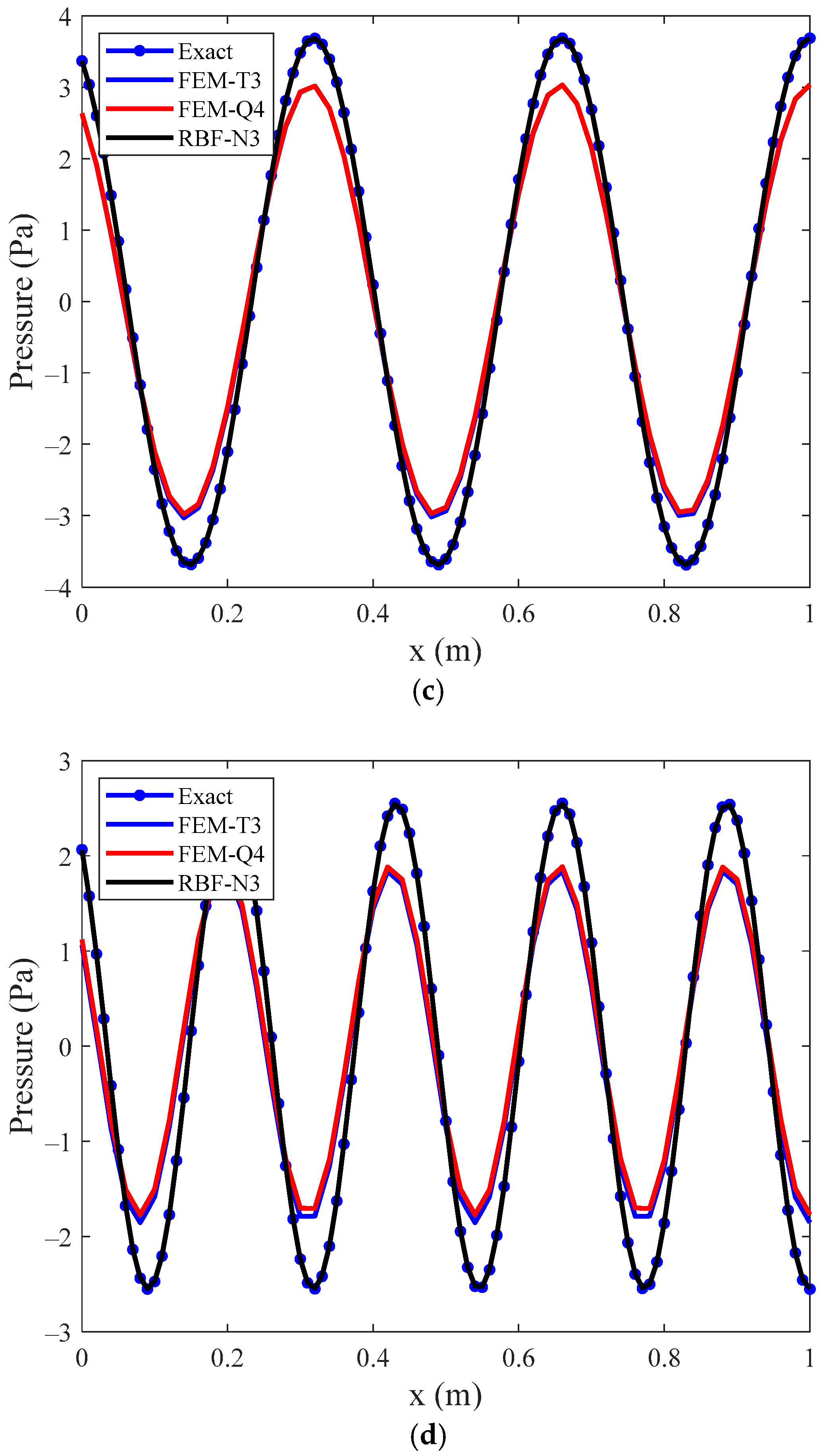
For different frequencies, the acoustic problem is solved using the FEM-T3, the FEM-Q4, and the RBF-N3. The numerical and analytical acoustic pressure distributions along the tube length are then shown in Figure 4.
Figure 4.
Acoustic pressure distributions along the tube length computed by various numerical methods for different frequencies: (a) 1100 Hz; (b) 2200 Hz; (c) 4400 Hz; (d) 6600 Hz.
In Figure 4, the analytical solutions are indicated by dotted lines, while the results obtained using the RBF-N3 are shown as solid black curves. At relatively low frequencies, it is evident that all three numerical methods can provide sufficiently accurate results that closely match the analytical solutions. However, as the frequency increases, the curves generated by the FEM-T3 and FEM-Q4 begin to deviate from the analytical solutions, indicating that their computational accuracy significantly deteriorates. As shown in Figure 4d, at 6600 Hz the results from the FEM-T3 and FEM-Q4 display noticeable phase shifts relative to the analytical solutions due to the dispersion error. In contrast, the RBF-N3 method maintains excellent agreement with the analytical solutions even at 6600 Hz, suggesting that the proposed RBF-N3 remains highly accurate in solving relatively high-frequency Helmholtz problems. Furthermore, the RBF-N3 effectively suppresses the numerical dispersion error. These findings demonstrate that, particularly at relatively high frequencies, the RBF-N3 offers considerably more accurate and reliable results than the traditional FEM.
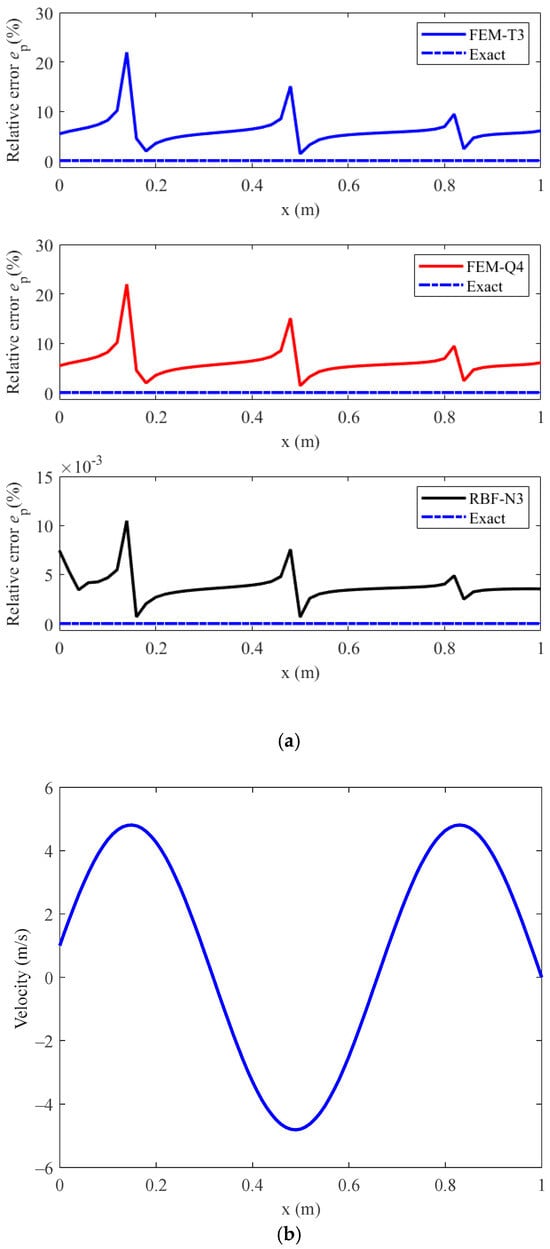
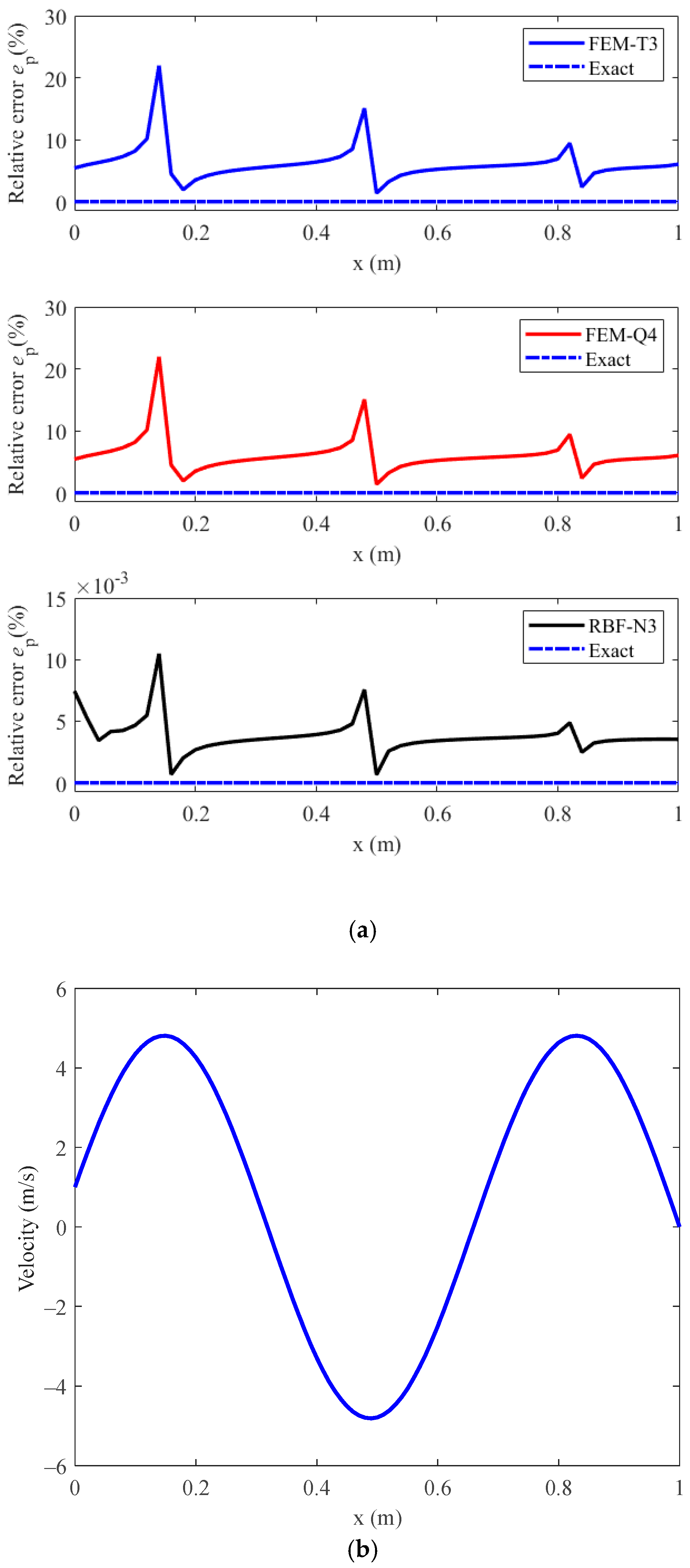
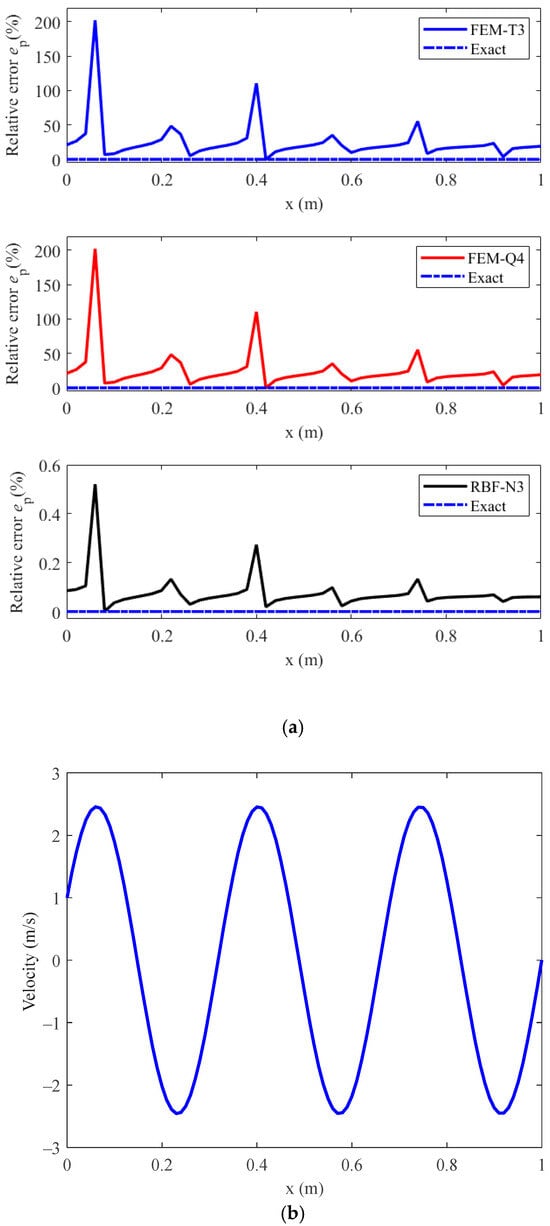
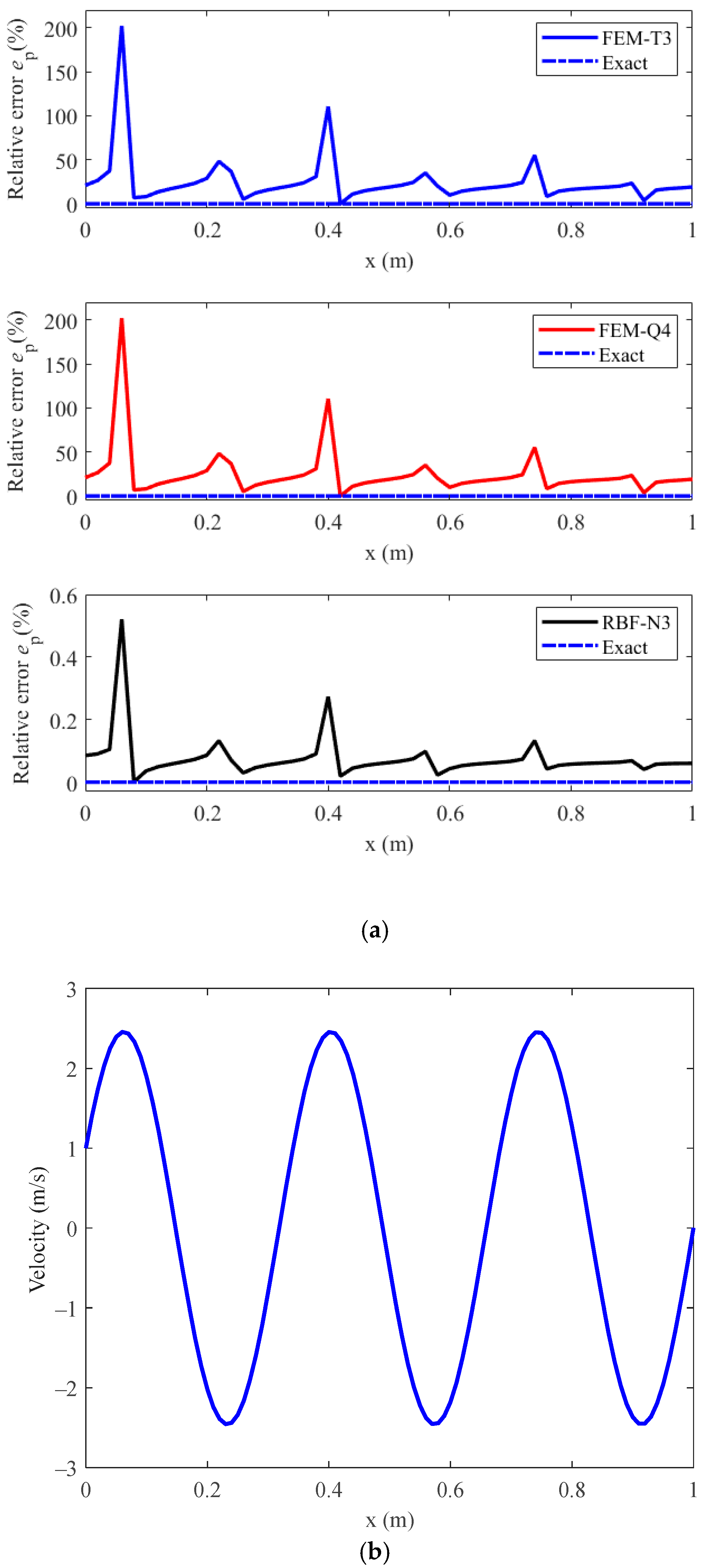
A comparative analysis of the relative error is conducted for two frequencies: 2200 Hz and 4400 Hz. Based on Equation (39), the distributions of the local relative error along the tube length are calculated for each numerical method and are presented in Figure 5 and Figure 6. For reference, the corresponding analytical particle velocity at both frequencies is also plotted in the same figures.
Figure 5.
Local relative error distributions along the tube length from various numerical methods at f = 2200 Hz: (a) The local relative error distributions; (b) The analytical particle velocity distributions.
Figure 6.
Local relative error distributions along the tube length from various numerical methods at f = 4400 Hz: (a) The local relative error distributions; (b) The analytical particle velocity distributions.
As shown in Figure 5a and Figure 6a, it is evident that the relative errors from the FEM-T3 and FEM-Q4 are significantly larger than the RBF-N3 along the tube length at 2200 Hz and 4400 Hz. Moreover, the relative error curves of the FEM-T3 and FEM-Q4 display noticeable oscillatory behaviors along the tube length. By analyzing the corresponding analytical particle velocity distributions in Figure 5b and Figure 6b, it can be observed that these oscillations in relative error become particularly pronounced at locations where the velocity magnitude reaches its peak. Especially, at 4400 Hz, the relative errors from the FEM-T3 and FEM-Q4 can even exceed 200% near such region. In contrast, the relative errors obtained using the RBF-N3 consistently remain at much lower levels across the entire tube length. Furthermore, compared to the FEM-T3 and FEM-Q4, the oscillation amplitudes in the relative error distributions produced by the RBF-N3 are significantly reduced, which remains below 0.6% even at the frequency of 4400 Hz. These findings indicate that the FEM-T3 and FEM-Q4 generally exhibit significant numerical errors in solving the Helmholtz equation, while the proposed RBF-N3 consistently performs well and provides sufficiently accurate solutions. This comparative analysis of the three numerical methods further confirms that the RBF-N3 is more suitable for solving the Helmholtz equation and consistently yields significantly smaller dispersion errors than the traditional FEM, particularly at relatively high frequencies. These observations demonstrate that the RBF-N3 offers improved accuracy and better numerical stability compared to the traditional FEM in solving Helmholtz problems.
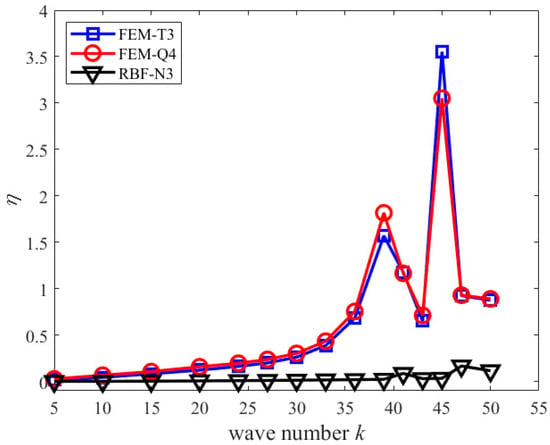
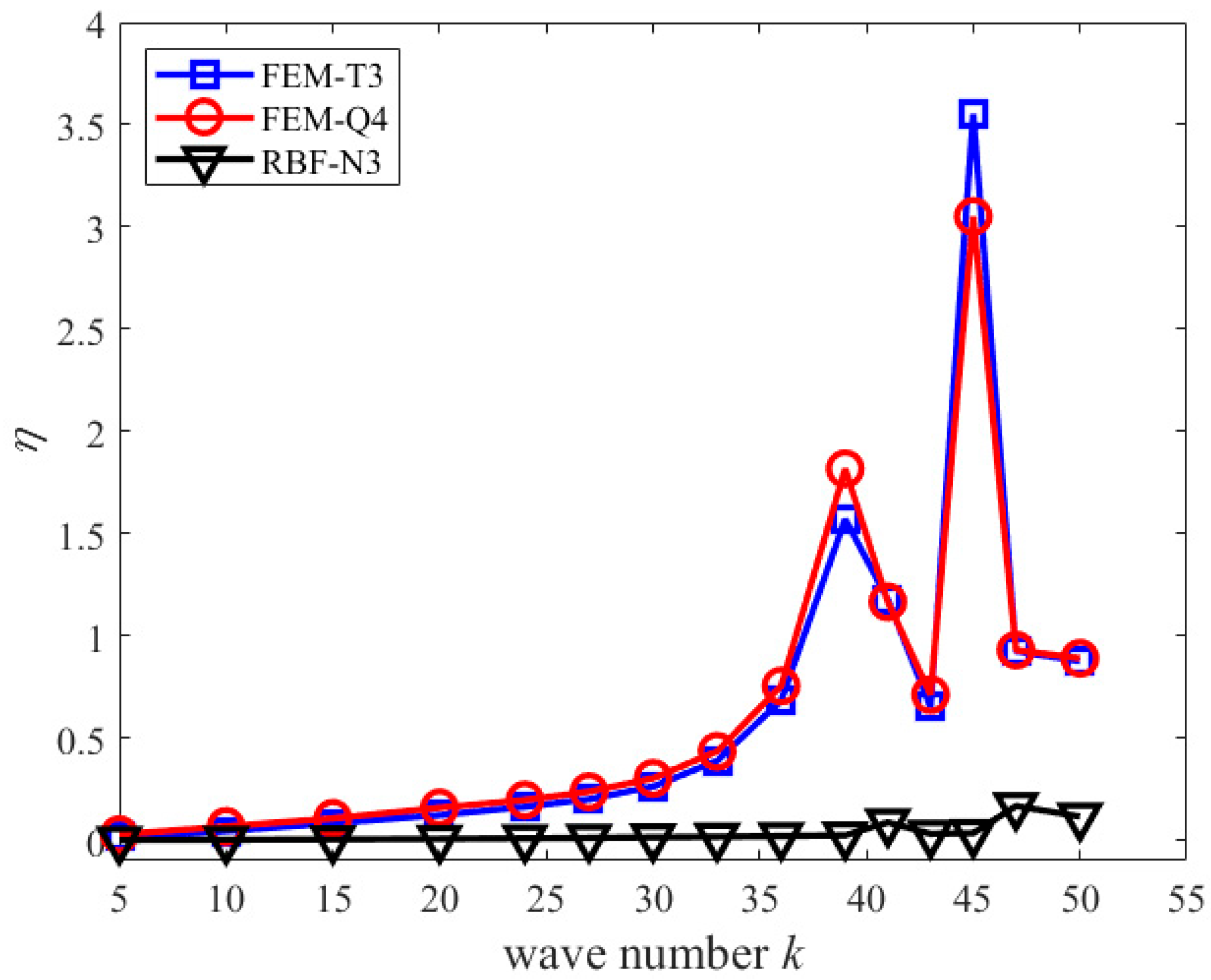
In addition to completing the analysis of the local relative error for all three numerical methods, the global error is subsequently evaluated based on Equation (40). In this process, the wave number is taken as the independent variable. For a given set of wave numbers, the global error is computed for all three numerical methods, and the resulting variation in global error with respect to is plotted in Figure 7 for comparative analysis.
Figure 7.
Global error versus wave number for the 2D tube acoustic problem.
Figure 7 shows the global error curves for all three numerical methods versus wave number ranging from 5 to 50. The curve corresponding to the RBF-N3 is marked with inverted triangle symbols. It can be observed that when the wave number is relatively small, all three methods exhibit low global error. However, as the wave number increases over 25, the global errors of the FEM-T3 and FEM-Q4 begin to grow significantly. With further increases in wave number, their global error curves display rapid growth accompanied by pronounced oscillatory behaviors. In contrast, the global error of the RBF-N3 remains consistently low for wave numbers less than 50. Therefore, even from the perspective of global error analysis, the same conclusion can be drawn: the proposed RBF-N3 exhibits significant advantages in solving the Helmholtz equation and can always yield significantly more accurate solutions than the traditional FEM. In particular, when dealing with relatively large wave numbers, the RBF-N3 is still capable of delivering results with high accuracy.
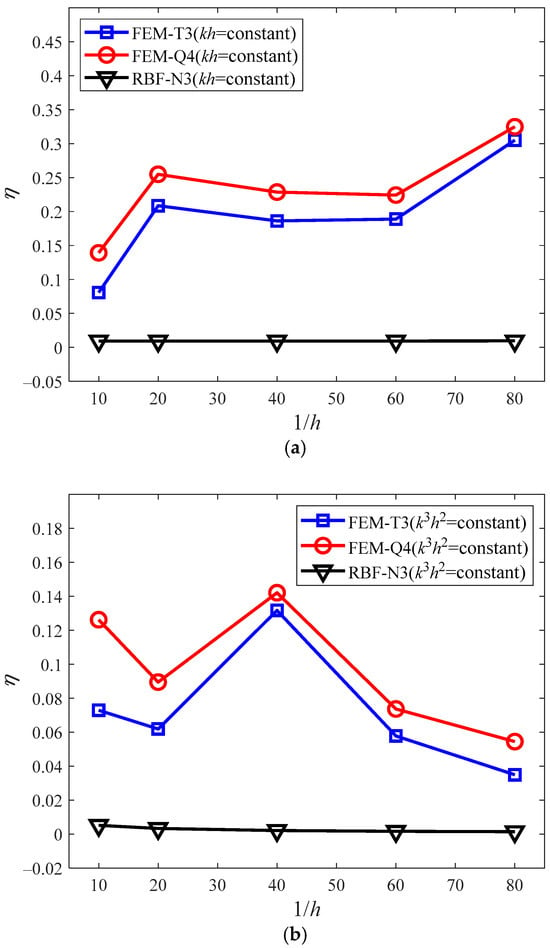
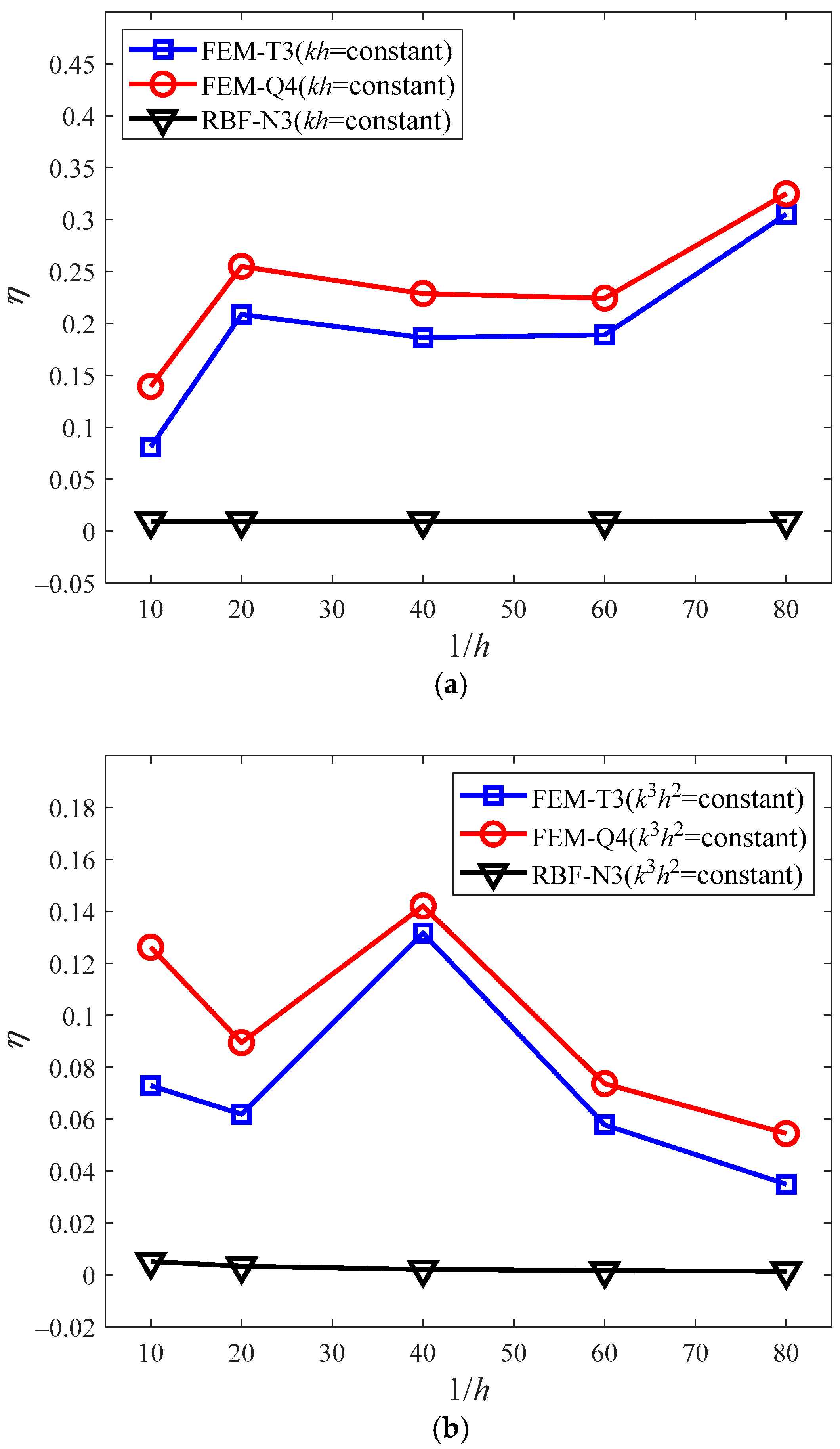
As shown in Equation (40), the numerical error mainly consists of two components: the interpolation error and dispersion error, which are generally controlled by setting and , respectively. The global error curves for all three numerical methods are shown in Figure 8a () and Figure 8b (). Additionally, the global error curves of the FEM-T3 and FEM-Q4 clearly confirm the effectiveness of these two control strategies.
Figure 8.
Global error from various numerical methods under control of different error components: (a) ; (b)
.
As shown in Figure 8, it is evident that the RBF-N3 consistently yields significantly smaller global errors and dispersion errors compared to the traditional FEM when solving the Helmholtz equation. Specifically, Figure 8a indicates that even when the interpolation error is controlled, the traditional FEM still exhibits significant numerical errors at relatively higher wave numbers due to the influence of dispersion error. In contrast, the RBF-N3 maintains low error levels under the same conditions. These results further confirm that the RBF-N3 is more effective at suppressing dispersion error and can provide more accurate solutions than the traditional FEM at relatively large wave numbers for the Helmholtz equation.
5.2. The 2D Square Domain Acoustic Problem
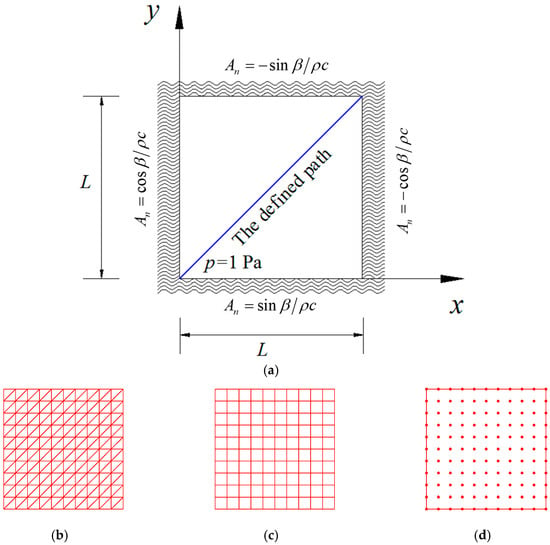
This subsection investigates the 2D square domain acoustic problem, and the corresponding acoustic model is shown in Figure 9. In Figure 9a, both the length and width of the domain are denoted by , and the interior is filled with an ideal fluid medium characterized by a density and a sound speed . As shown in Figure 9a, the Robin and Dirichlet boundary conditions are applied in the numerical model. Here, denotes the direction angle of wave propagation. The defined path indicated in the figure is used to plot and compare the acoustic pressure distributions obtained from different methods. In this subsection, the traditional FEM, EFEM-N3, meshfree RPIM, and the proposed RBF-N3 are used to solve the 2D square domain acoustic problem. All methods share a common nodal arrangement. Specifically, Figure 9b shows the structured triangular mesh used by the FEM-T3 and EFEM-N3, Figure 9c shows the structured quadrilateral mesh used by the FEM-Q4 and RBF-N3, and Figure 9d shows the node distribution used by the RPIM.
Figure 9.
A 2D square domain with the Robin and Dirichlet boundary conditions: (a) Schematic diagram of the square domain; (b) The employed triangular mesh; (c) The employed quadrilateral mesh. (d) The node distribution schemes for the RPIM.
The analytical solution for the model is given by
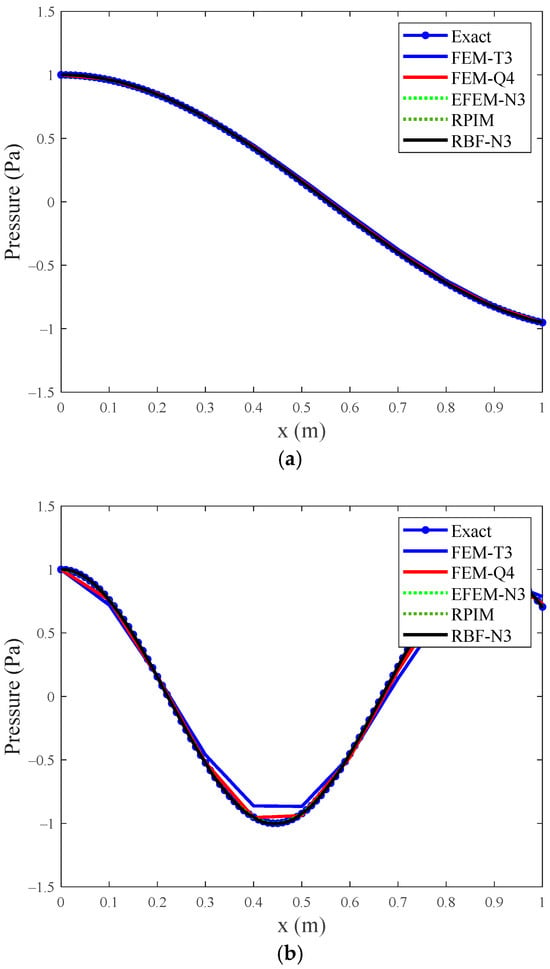
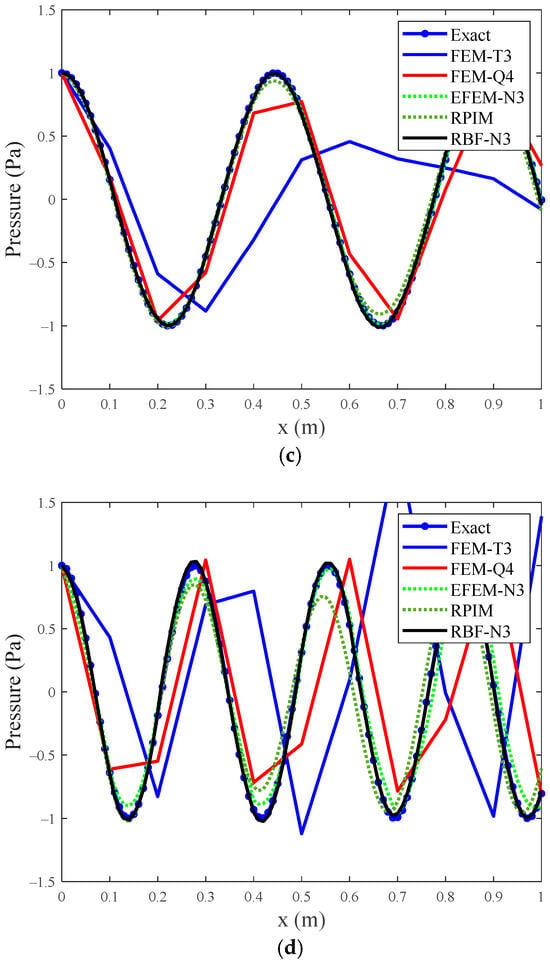
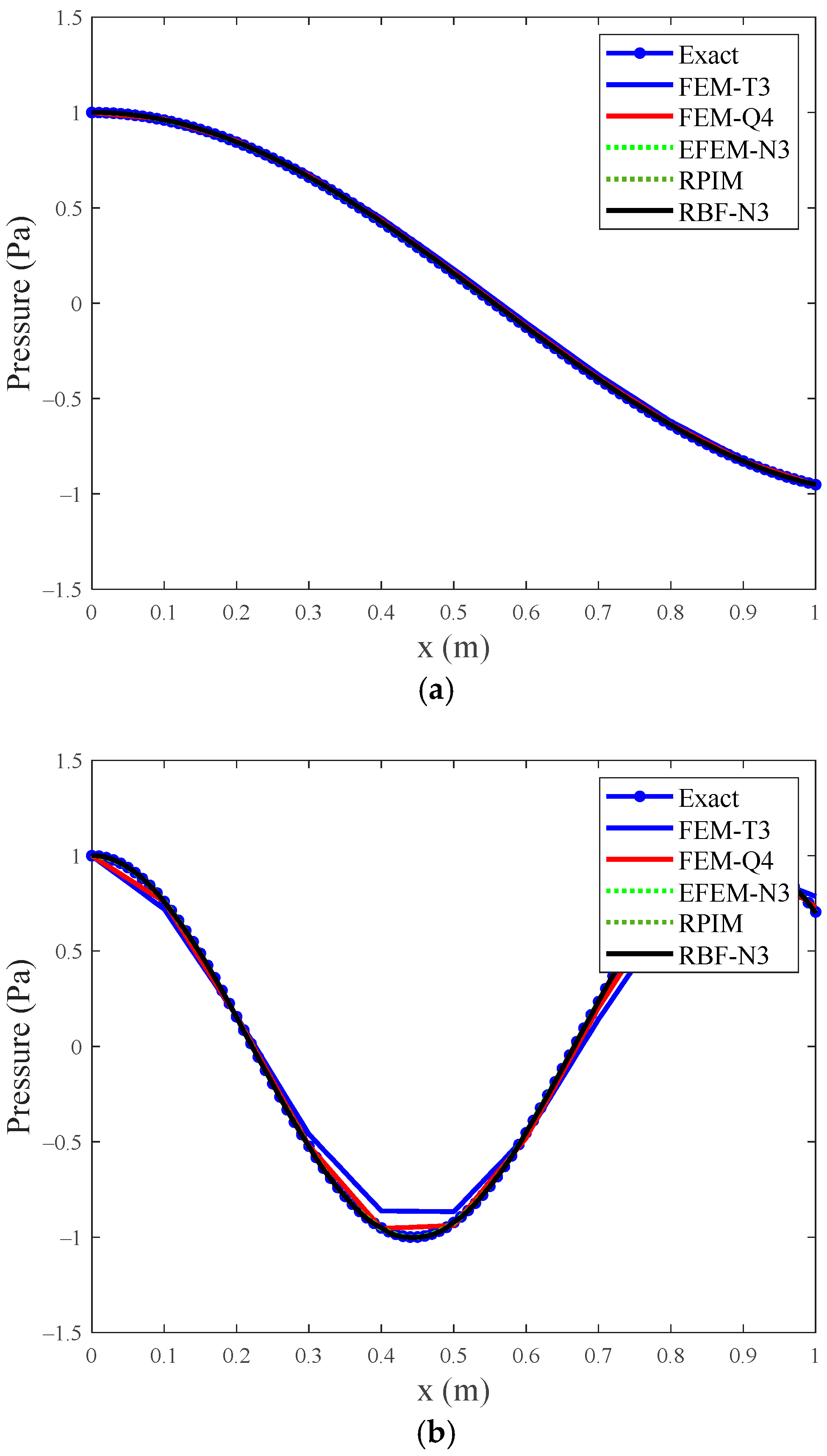
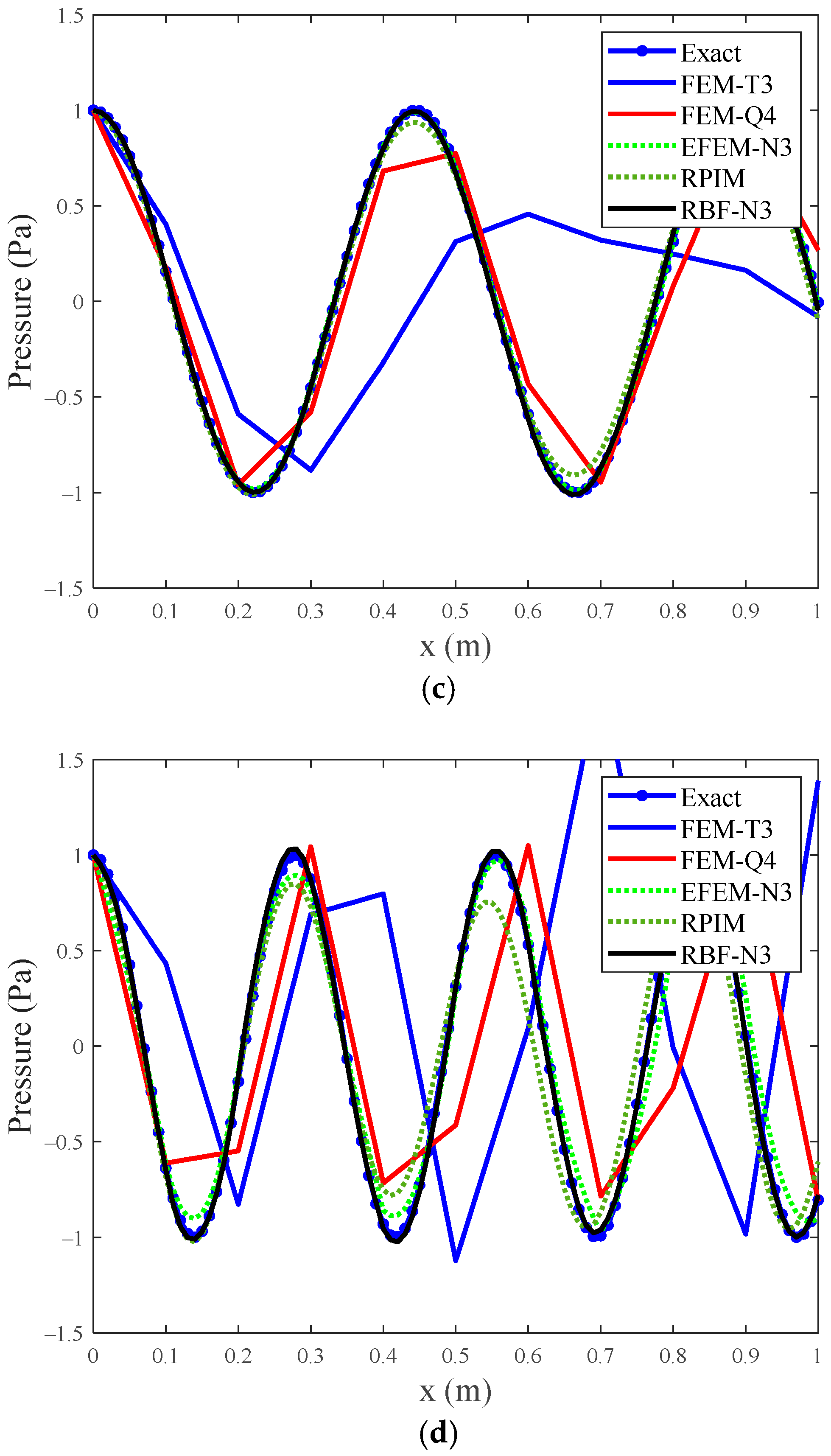
The acoustic model is solved using all five numerical methods under different wave numbers . The numerical solutions and the analytical solutions are shown in Figure 10. Specifically, Figure 10a presents the results for , Figure 10b for , Figure 10c for , and Figure 10d for . In each case, the analytical solutions are denoted by dotted curves. At wave numbers , corresponding to relatively low-frequency scenarios, sufficiently accurate solutions are provided by all methods. However, as the wave number increases to and , significant discrepancies begin to appear in the results from the FEM-T3 and FEM-Q4, which include pronounced phase shifts relative to the analytical solutions. These phase shifts indicate severe dispersion error, rendering the traditional FEM results unreliable at relatively large wave numbers. Notably, at , the results illustrate that the RBF-N3 provides the most accurate solution.
Figure 10.
Acoustic pressure distributions along the defined path computed by various numerical methods for different wave numbers: (a) ; (b) ; (c) ; (d) .
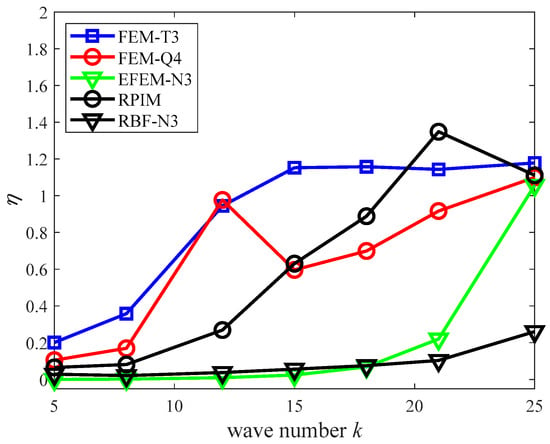
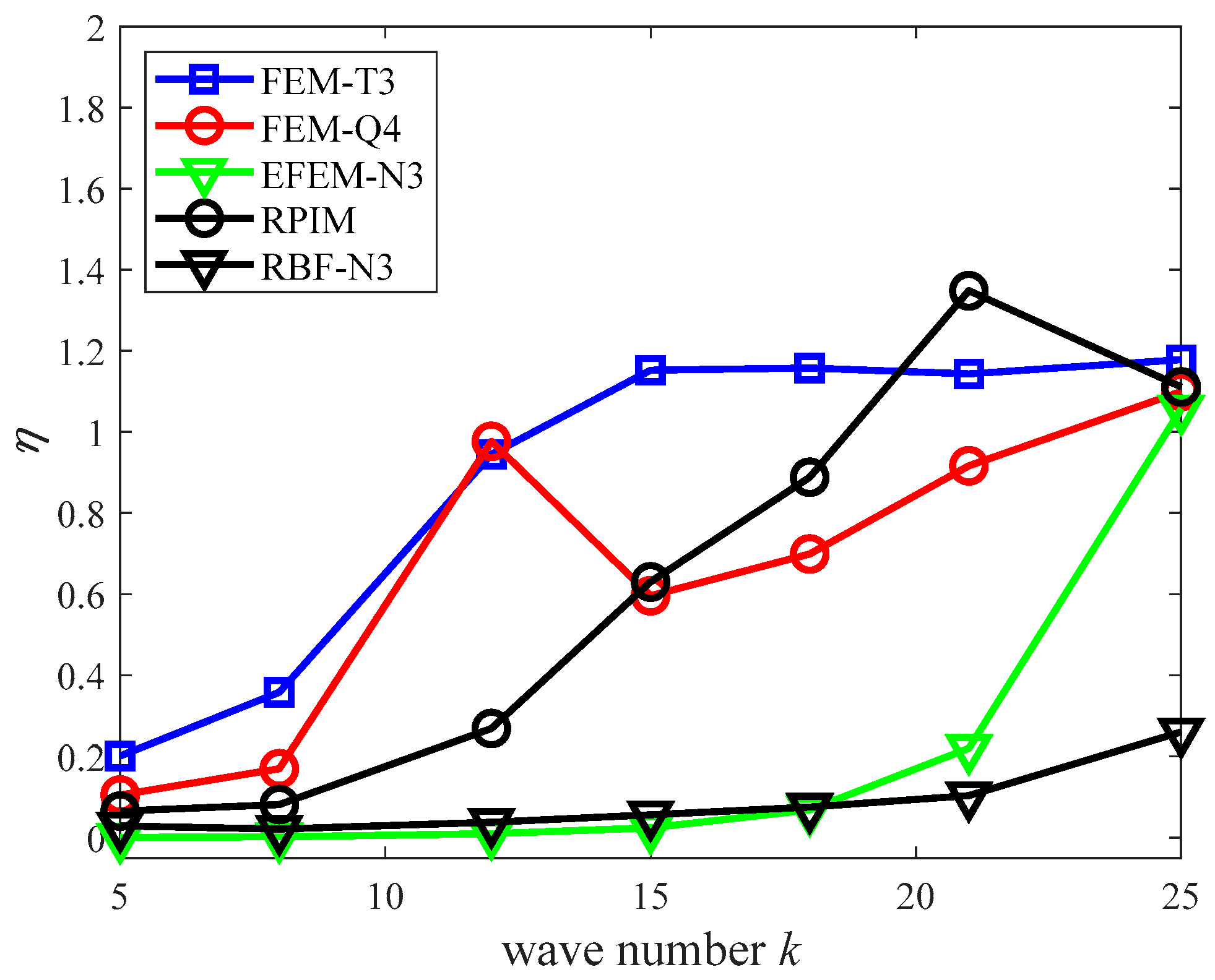
To further quantify the numerical error, the global error versus wave number is subsequently evaluated using Equation (40). As shown in Figure 11, all methods yield small global errors at relatively small wave numbers. As the wave number increases, the global errors of the FEM-T3, FEM-Q4, and RPIM grow significantly. With further increase, the global errors of the EFEM-N3 also rise rapidly. In contrast, the RBF-N3 induces the smallest global errors across the entire tested range. This numerical example confirms that the proposed RBF-N3 offers very accurate solutions and effectively reduces dispersion errors, especially at relatively large wave numbers.
Figure 11.
Global error versus wave number for the 2D square domain acoustic problem.
In this work, the RBF-N3 is introduced to avoid the LD problem, thereby ensuring the system matrix is not singular. The condition number of the matrix is typically used to assess its singularity. Accordingly, a condition number analysis is conducted for different wave number k (2, 5, 10, 16) and mesh size h (0.2, 0.1, 0.05, 0.025) to discuss this.
For the analysis, the numerical procedure developed by Gui et al. [82] is employed to eliminate the LD issue inherent to the EFEM-N3. The computed results are presented in Table 1, Table 2, Table 3 and Table 4. It is observed that the FEM-T3, FEM-Q4, and RPIM yield similar condition number, which consistently increase for larger k or smaller h. In contrast, the condition number for the proposed RBF-N3 is lower than that of the EFEM-N3 and is influenced only by h. The analysis confirms that the system matrix for the proposed RBF-N3 is not singular, demonstrating that the LD problem has been efficiently avoided.
Table 1.
Condition numbers for different wave number k (mesh size h = 0.2).
Table 2.
Condition numbers for different wave number k (mesh size h = 0.1).
Table 3.
Condition numbers for different wave number k (mesh size h = 0.05).
Table 4.
Condition numbers for different wave number k (mesh size h = 0.025).
In practical engineering applications using the FEM, distorted meshes are frequently encountered, adversely affecting computational accuracy. In this study, distorted meshes are generated from original regular meshes using the following equations [73]:
where and represent the nodal coordinates of the original regular mesh, while and denote the corresponding coordinates of the generated distorted mesh. The parameter h is defined as the characteristic element size. The random number is introduced to generate irregular nodal positions. The distortion coefficient controls the degree of mesh distortion. A larger value of results in a more severely distorted mesh.
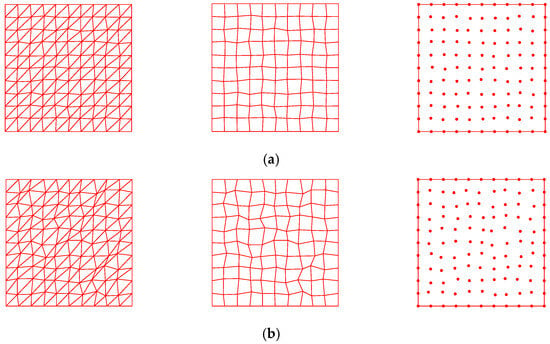
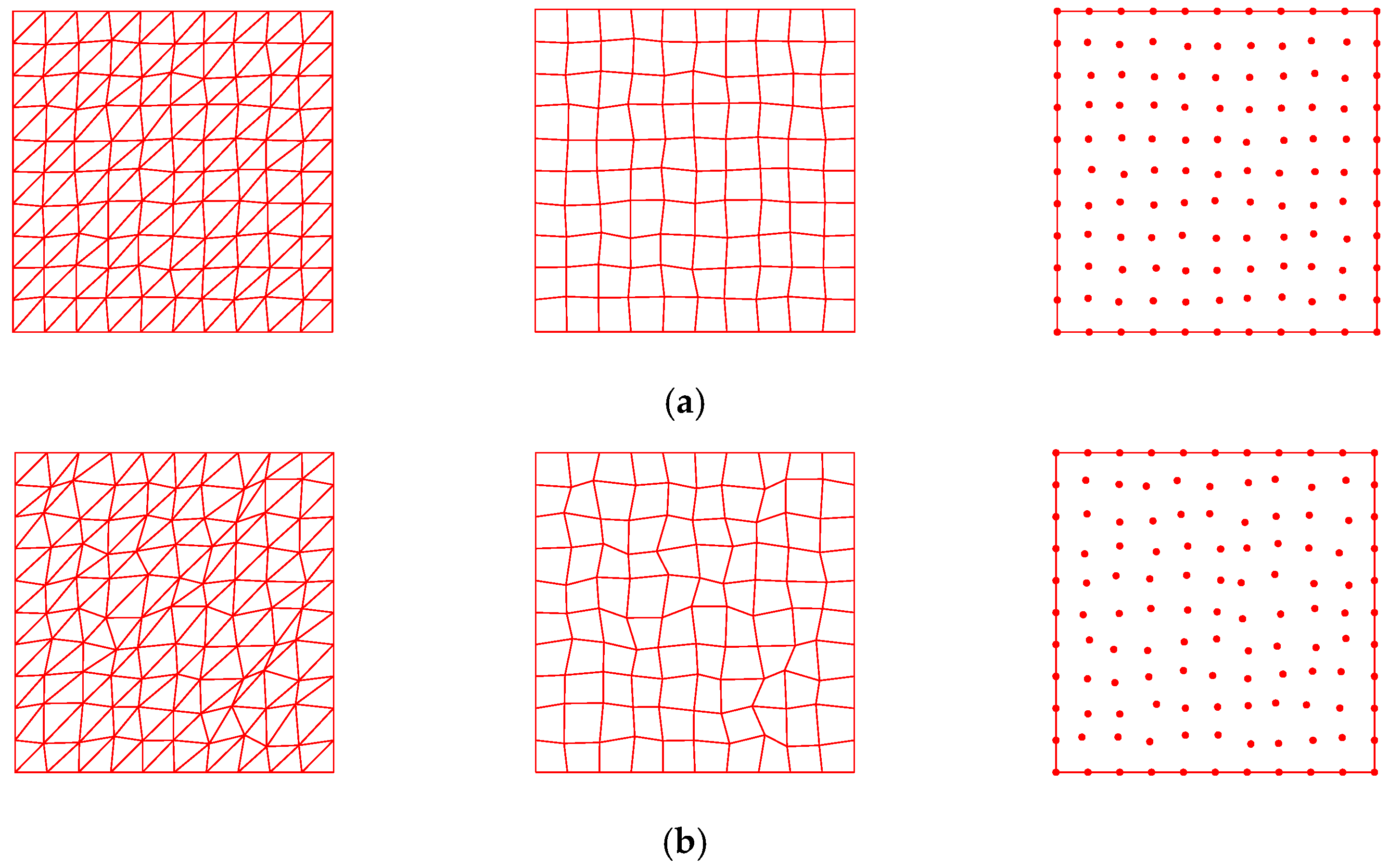
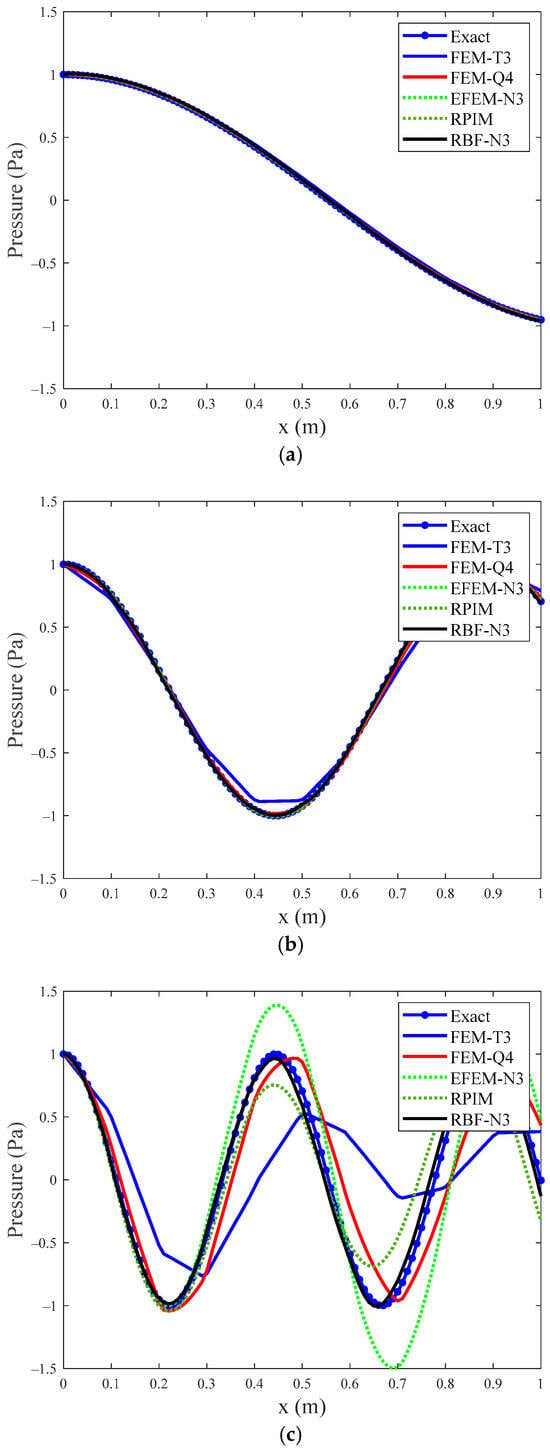
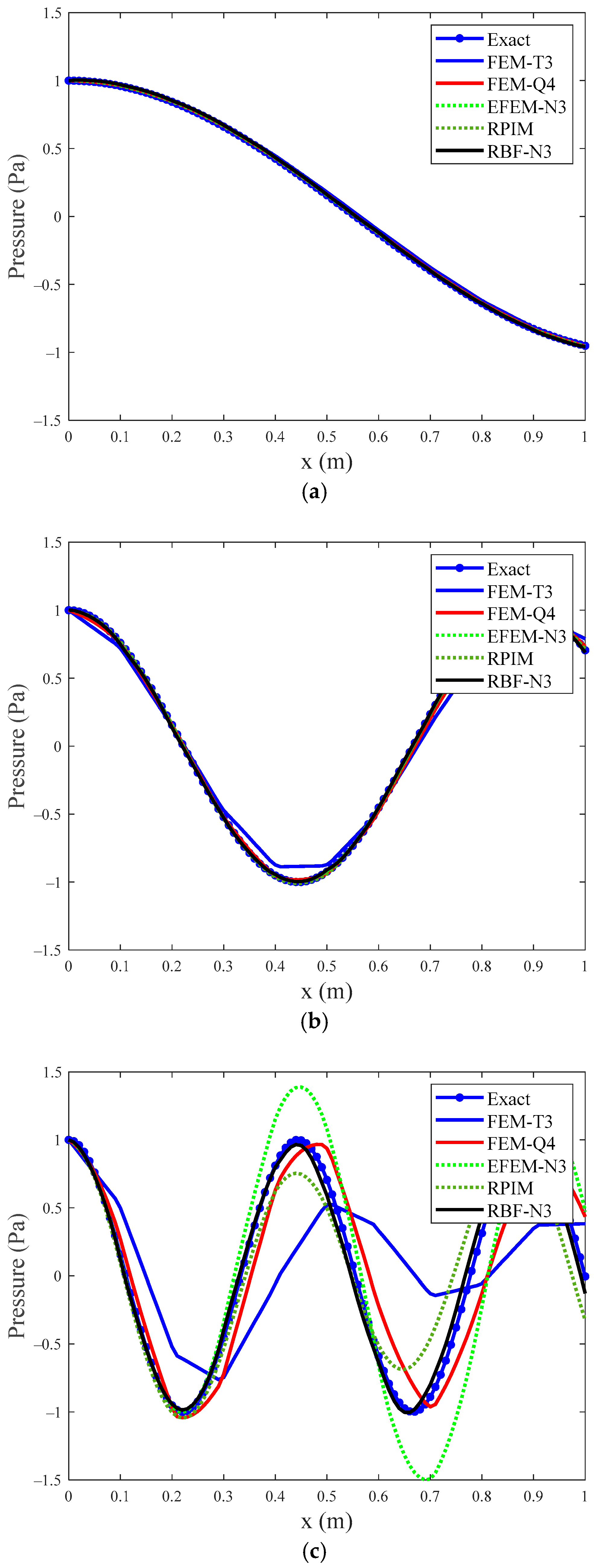
Two types of distorted meshes are generated from the regular mesh using distortion coefficients and , as illustrated in Figure 12. Acoustic pressure distributions are computed for different wave number k using these distorted meshes. The results are presented in Figure 13 () and Figure 14 ().
Figure 12.
The irregular node distribution schemes with different distortion coefficients: (a) ; (b) .
Figure 13.
Acoustic pressure distributions on the distorted mesh () for different wave numbers: (a)
; (b) ; (c) .
Figure 14.
Acoustic pressure distributions on the distorted mesh () for different wave numbers: (a)
; (b) ; (c) .
The results show that accurate solutions are provided by all method at . At , the solutions obtained using FEM-T3 exhibit obvious numerical errors, while the other methods still maintain satisfactory accuracy. At , it is observed that the proposed RBF-N3 performs optimally under the same irregular node distributions. Notably, the proposed RNF-N3 continues to provide relatively accurate solutions even at relatively large wave number and on distorted meshes.
5.3. The 2D Car Acoustic Problem
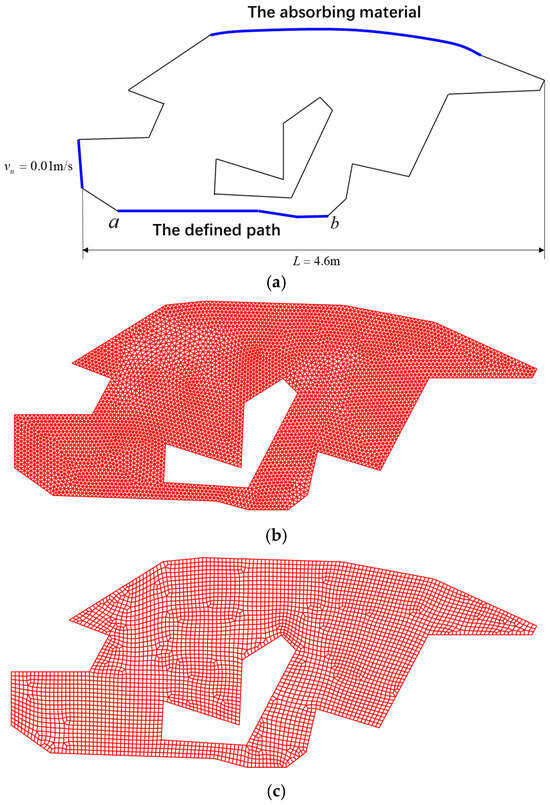
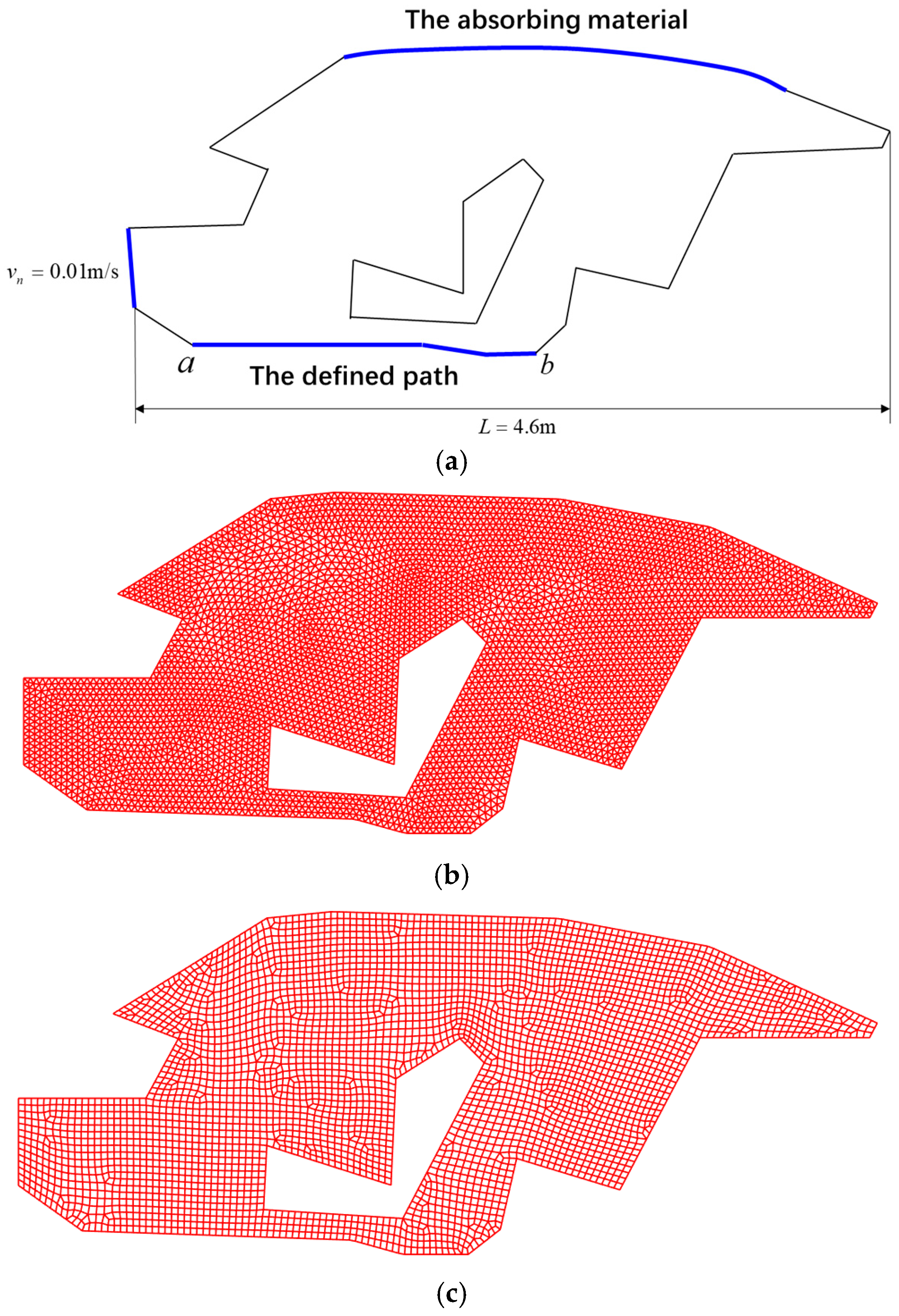
This subsection investigates the 2D car acoustic problem, and the corresponding acoustic model is shown in Figure 15. Unlike the previous case, this numerical model cannot be given an analytical solution. Therefore, a highly refined numerical solution is employed as the reference solution for validation. The schematic of the model is presented in Figure 15a. The defined path indicated in the figure is used to plot and compare the acoustic pressure distributions obtained from different methods. As shown in Figure 15, the Robin and Neumann boundary conditions are applied in the numerical model, which are highlighted with bold blue lines. The corresponding normal particle velocity and acoustic admittance coefficient are specified as and , respectively. All other boundaries are assumed to be rigid walls. The interior of the model is filled with air, with a density and a sound speed . Figure 15b shows the structured triangular mesh used for the FEM-T3, while Figure 15c shows the structured quadrilateral mesh used for the FEM-Q4 and the RBF-N3. Both meshes have identical sizing.
Figure 15.
A 2D car with the Robin and Neumann boundary conditions: (a) Schematic diagram of the car; (b) The employed triangular mesh; (c) The employed quadrilateral mesh.
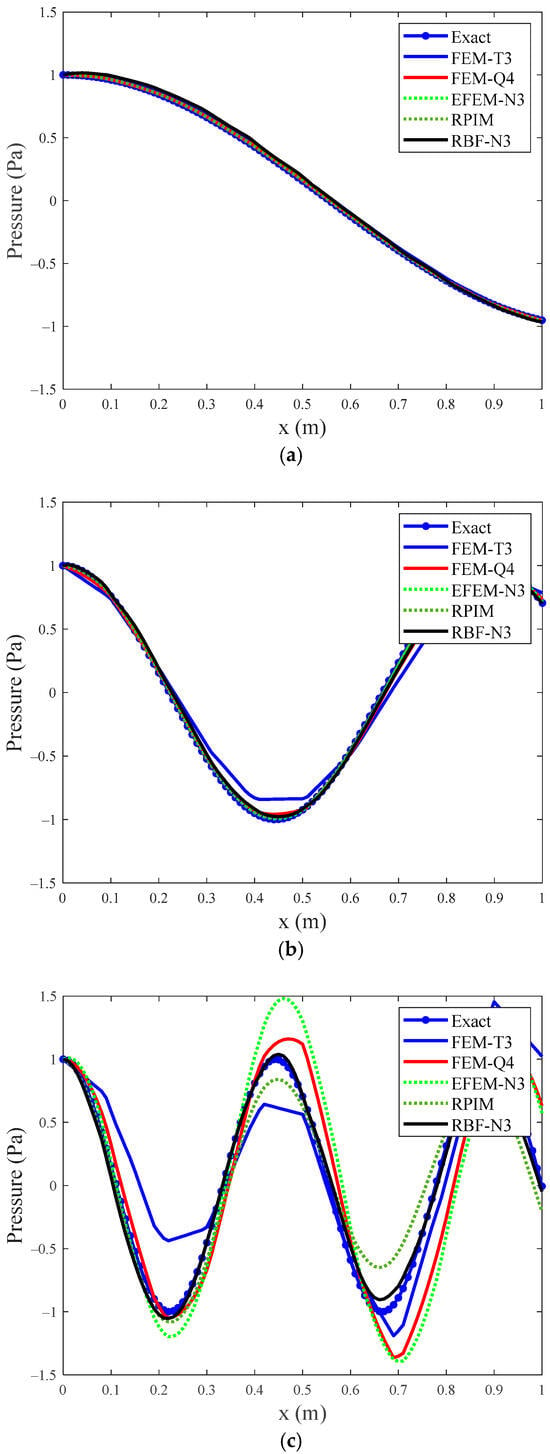
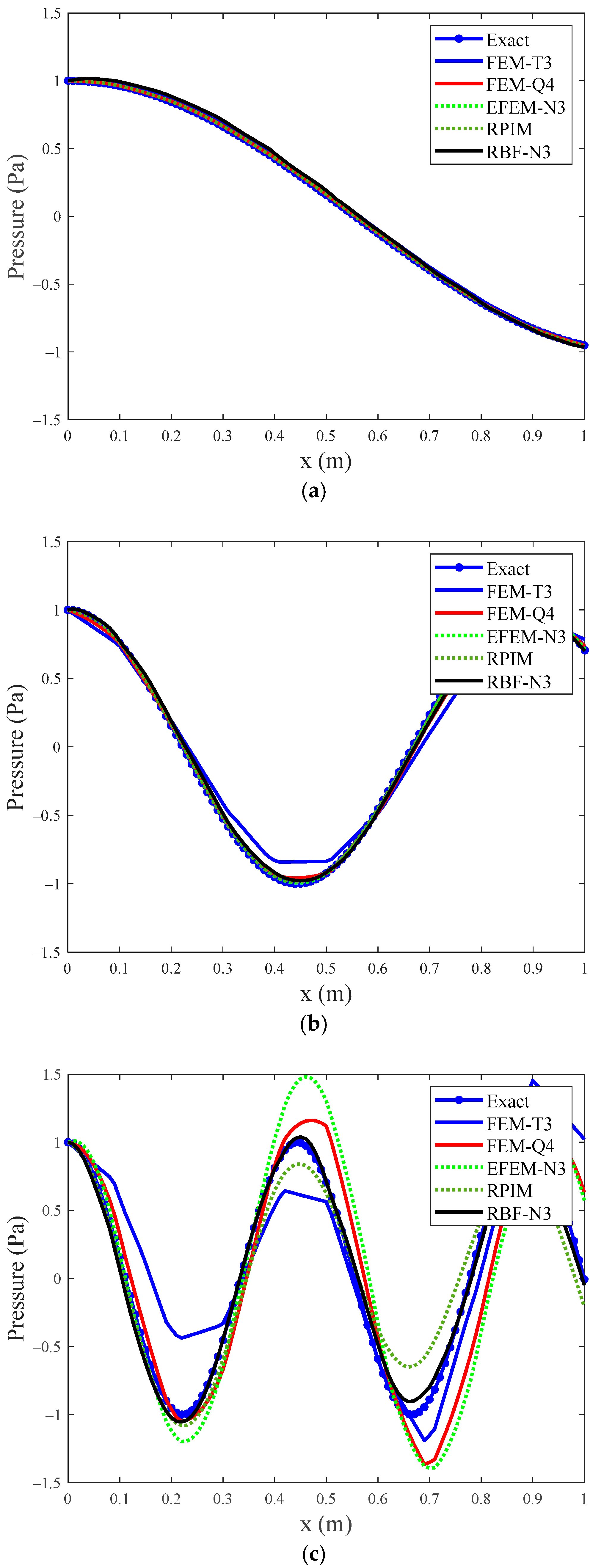
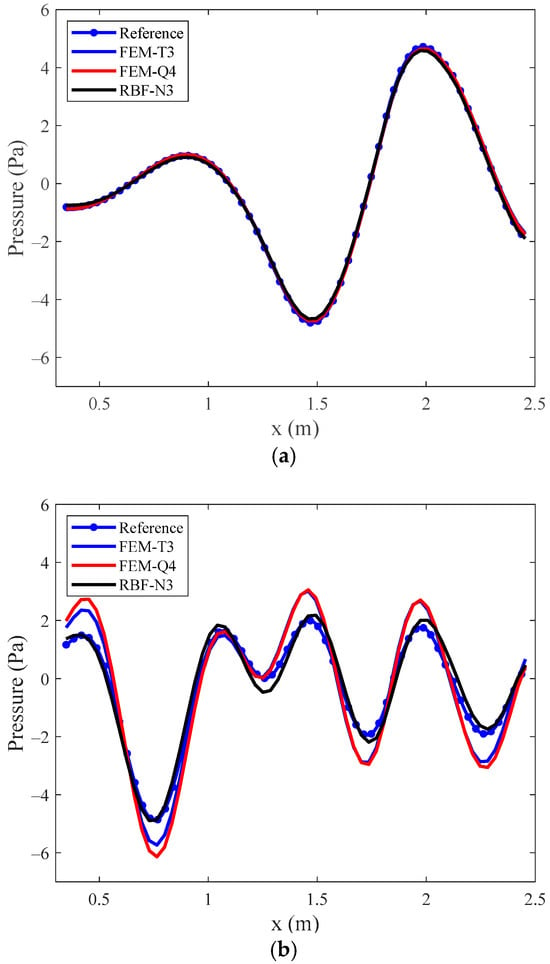
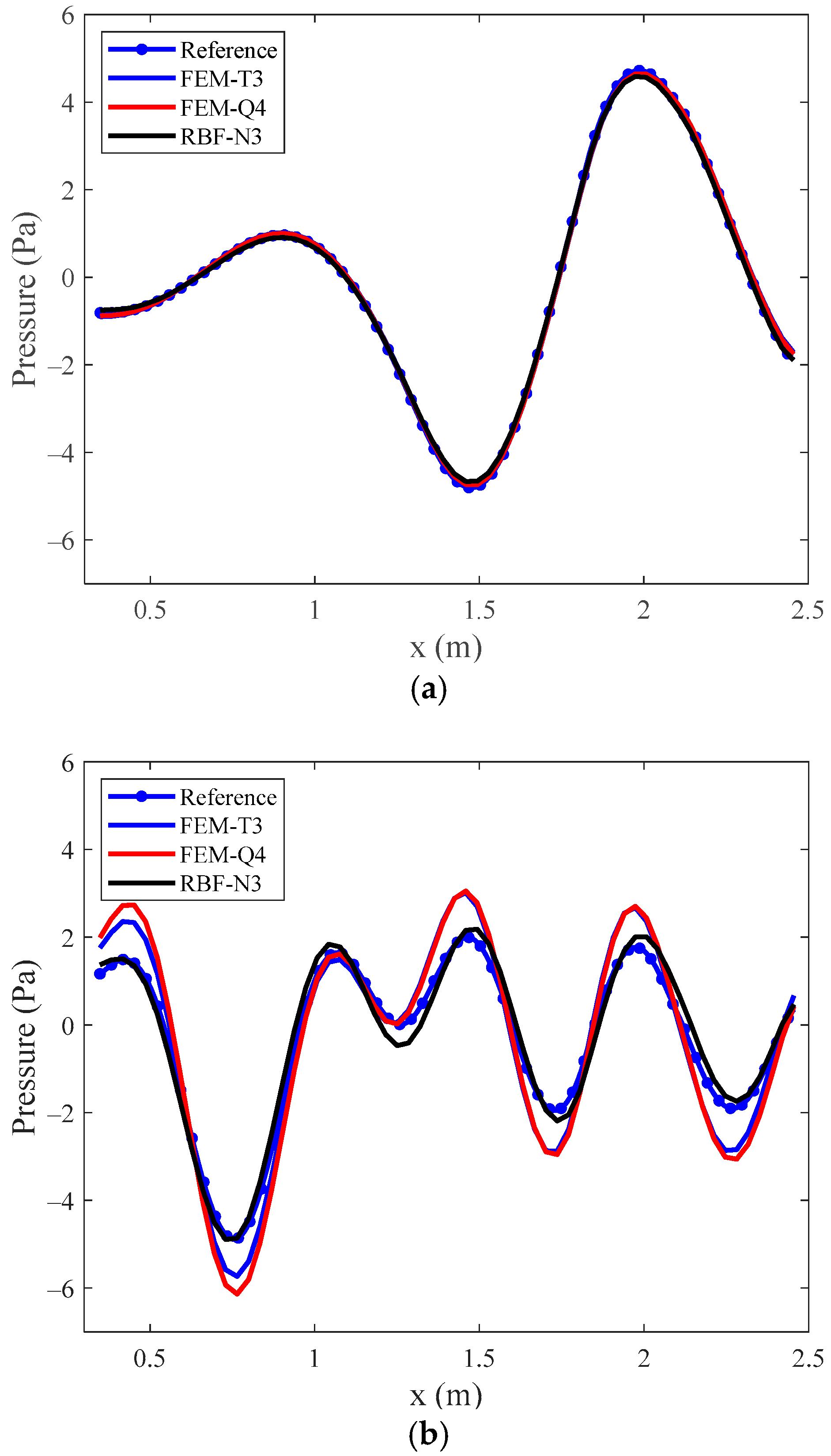
The acoustic model described in Figure 15a is analyzed at two different frequencies: 320 Hz and 650 Hz. The computed results from all three numerical methods and the reference solutions are plotted in Figure 16. Each curve represents the acoustic pressure distributions along the defined path, and the reference solutions are marked with dots for clarity. Figure 16a,b show the results at 320 Hz and 650 Hz, respectively. As observed, at 320 Hz, all three methods produce results that agree well with the reference solutions. However, at 650 Hz, the results obtained using the FEM-T3 and FEM-Q4 deviate significantly from the reference solutions, while RBF-N3 continues to match the reference solutions closely. This observation is consistent with the conclusions drawn from the examples in Section 5.1 and Section 5.2: all three methods yield accurate results for relatively low-frequency acoustic problems, but as the frequency increases, the numerical errors of the traditional FEM grow rapidly. In contrast, RBF-N3 maintains high accuracy even at relatively high frequencies.
Figure 16.
Acoustic pressure distributions along the defined path computed by various numerical methods for different frequencies: (a) 320 Hz, (b) 650 Hz.
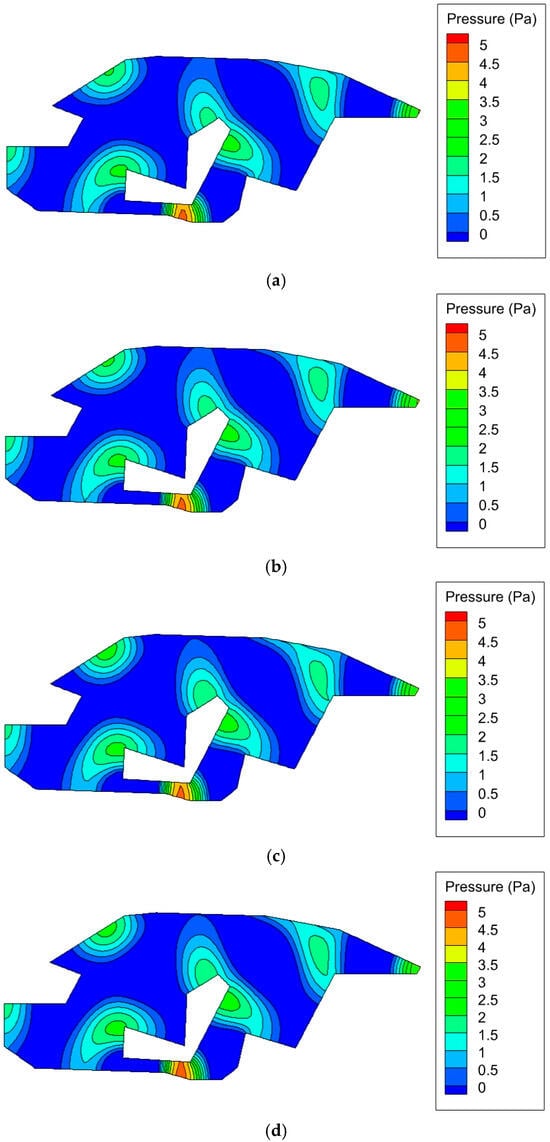
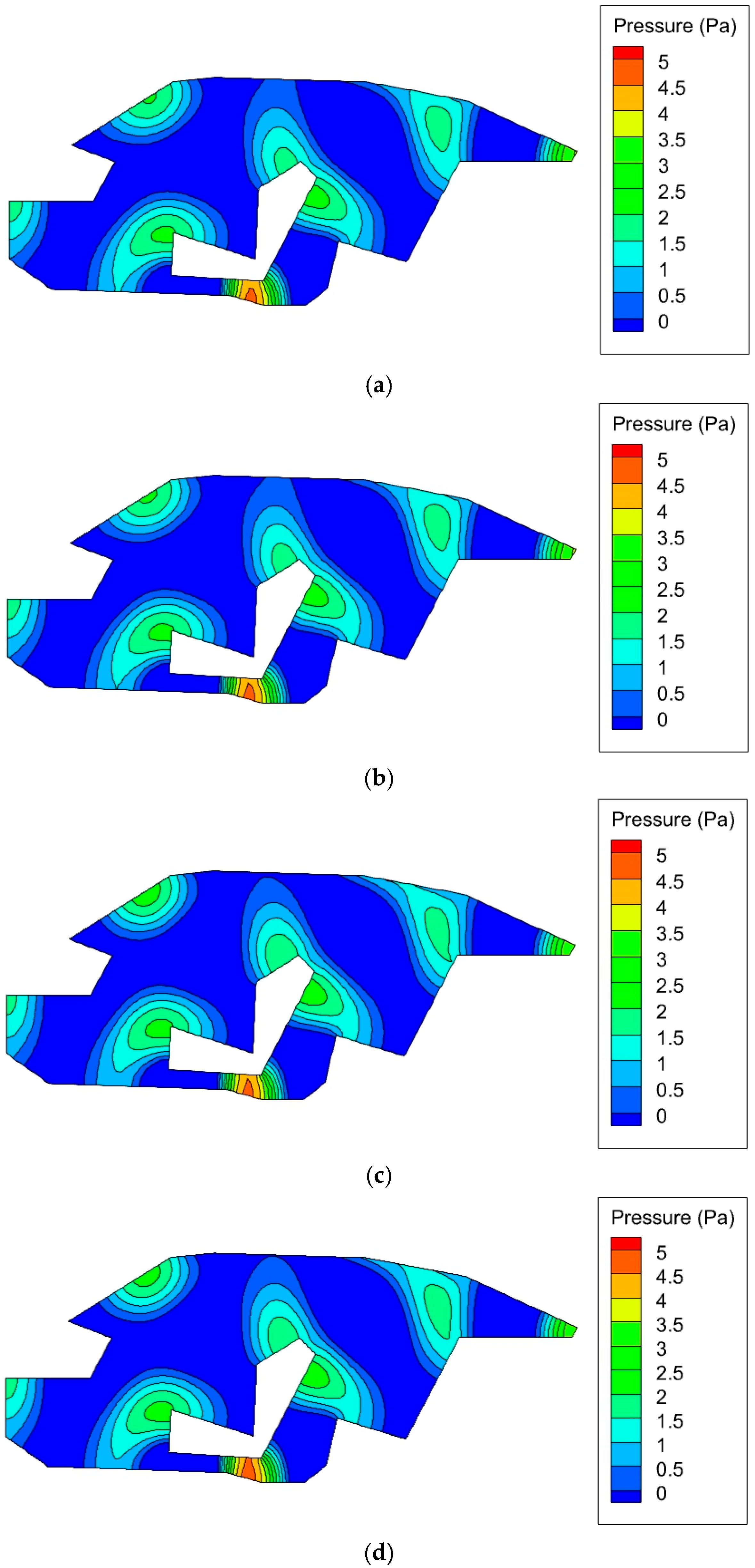
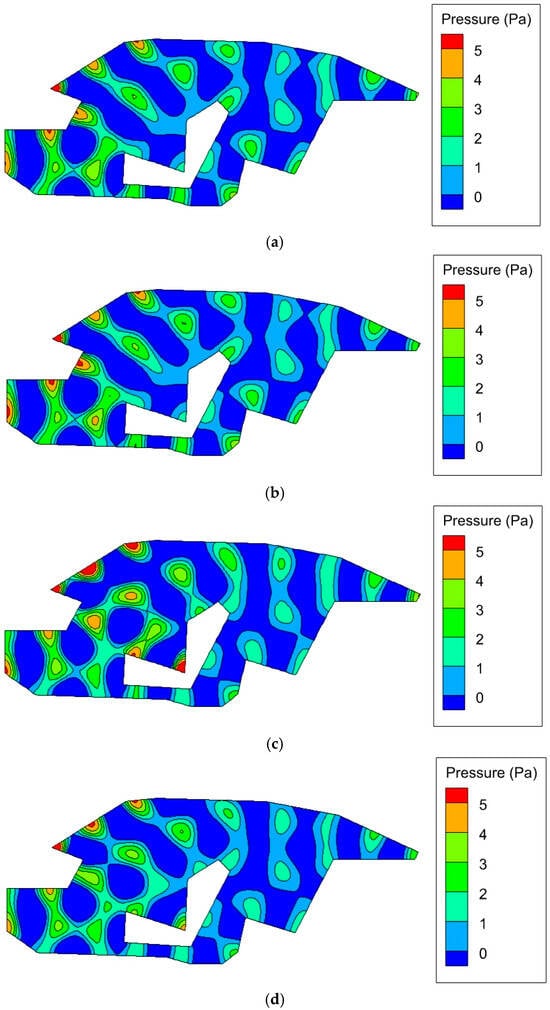
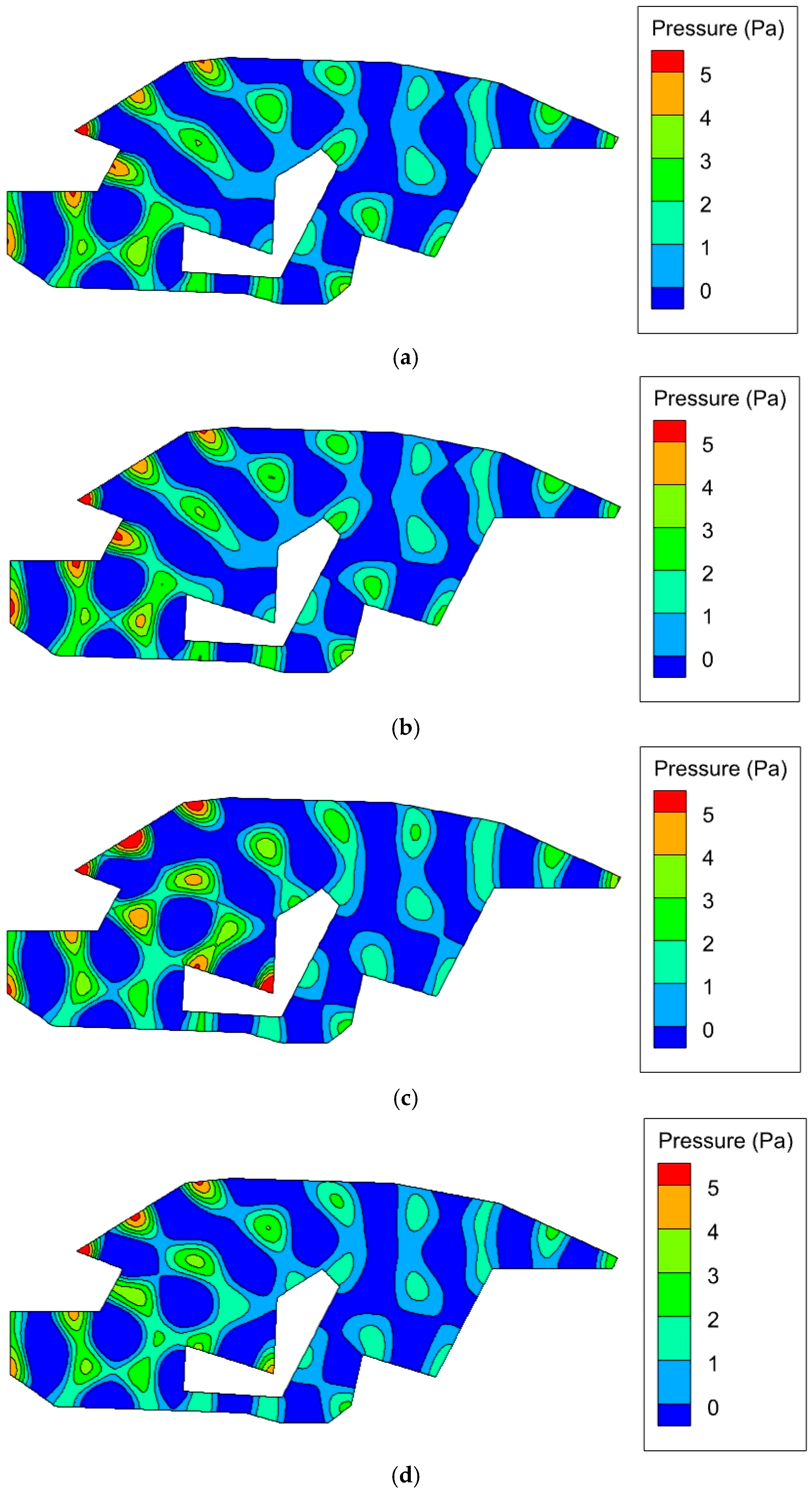
Additionally, the acoustic pressure amplitude contour plots computed by the three methods at the two frequencies are shown in Figure 17 and Figure 18. These contour plots clearly illustrate the differences in solution quality across the total problem domain. At 320 Hz (Figure 17), all three methods produce contour fields that closely match the reference solutions. However, at 650 Hz (Figure 18), noticeable discrepancies appear between the contour plots of the FEM-T3 and FEM-Q4 and that of the reference solutions, particularly in certain regions. In contrast, the contour plot obtained by the RBF-N3 remains more consistent with the reference solutions. These results further demonstrate that, from a global perspective, the RBF-N3 offers superior accuracy compared to the traditional FEM, especially for relatively high-frequency problems, providing more reliable and precise numerical solutions.
Figure 17.
Acoustic pressure contour plots obtained using various numerical methods at f = 320 Hz: (a) FEM-T3, (b) FEM-Q4, (c) RBF-N3, (d) Reference solution.
Figure 18.
Acoustic pressure contour plots obtained using various numerical methods at f = 650 Hz: (a) FEM-T3; (b) FEM-Q4; (c) RBF-N3; (d) Reference solution.
5.4. The 3D Cabin Acoustic Problem
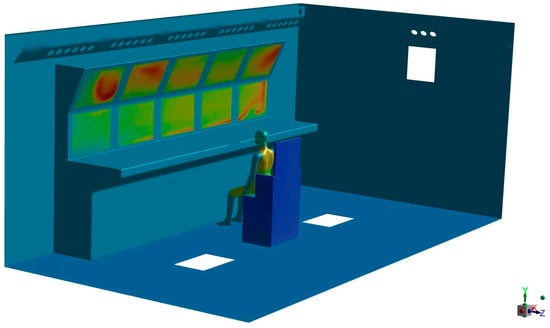
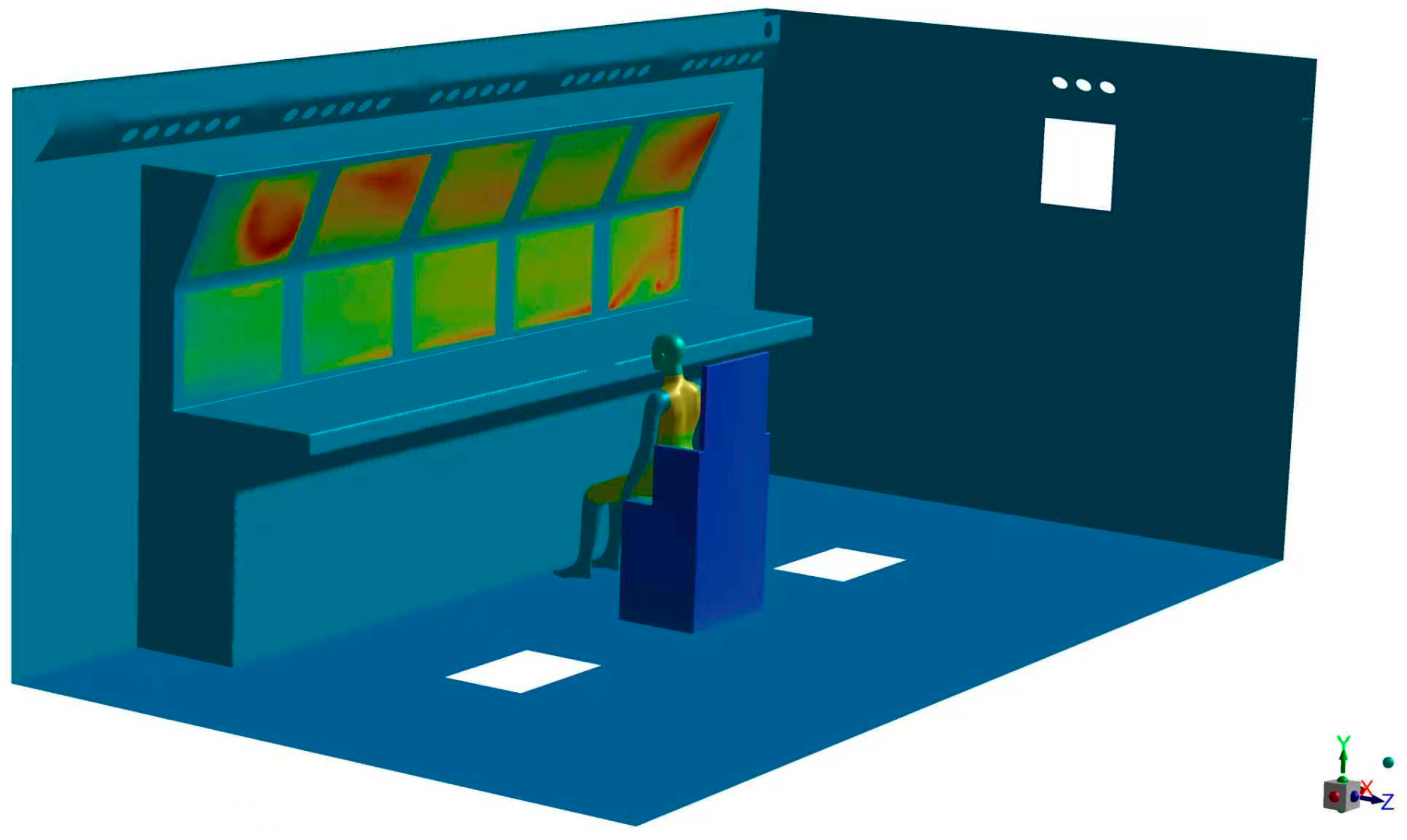
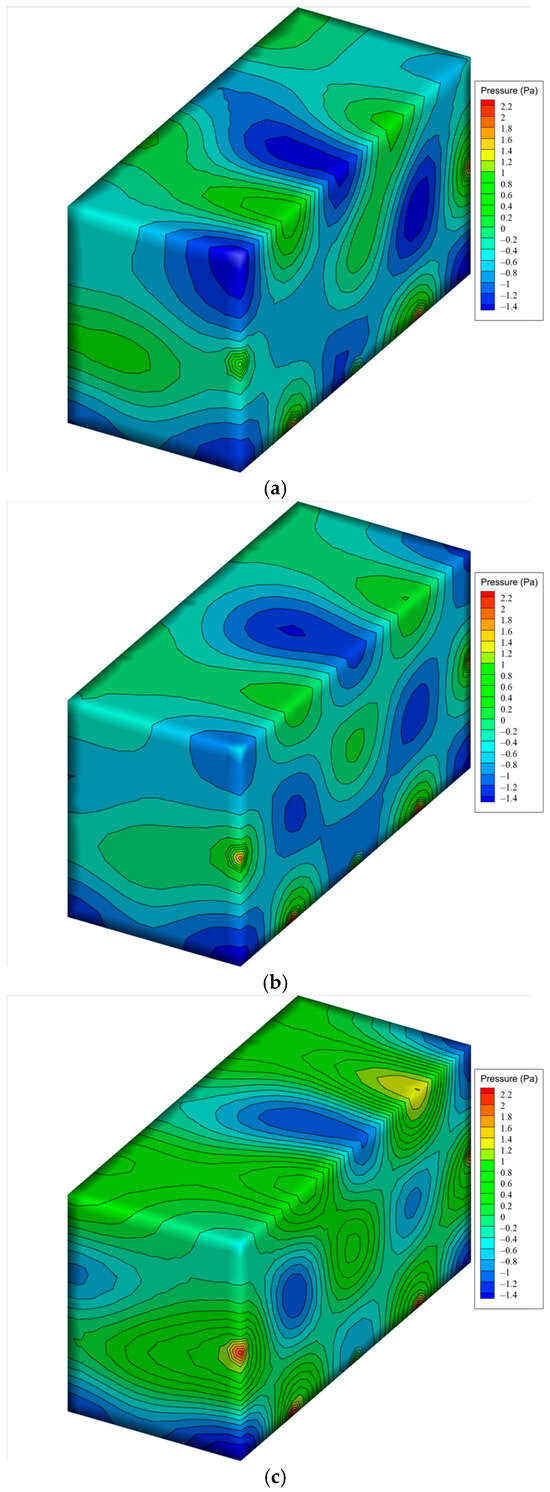
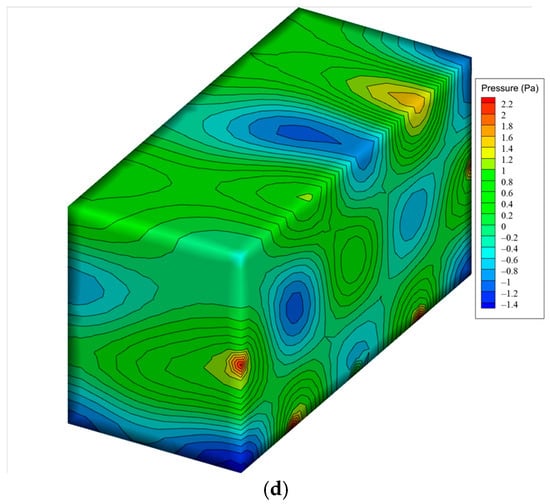
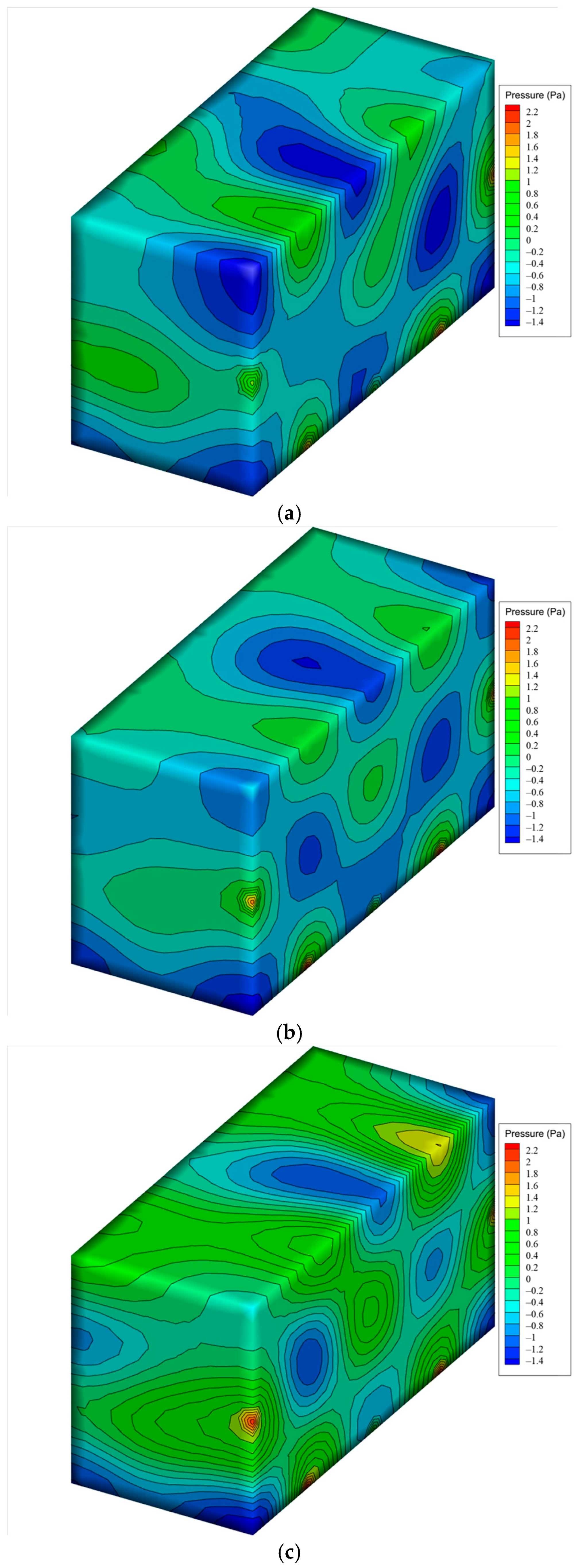
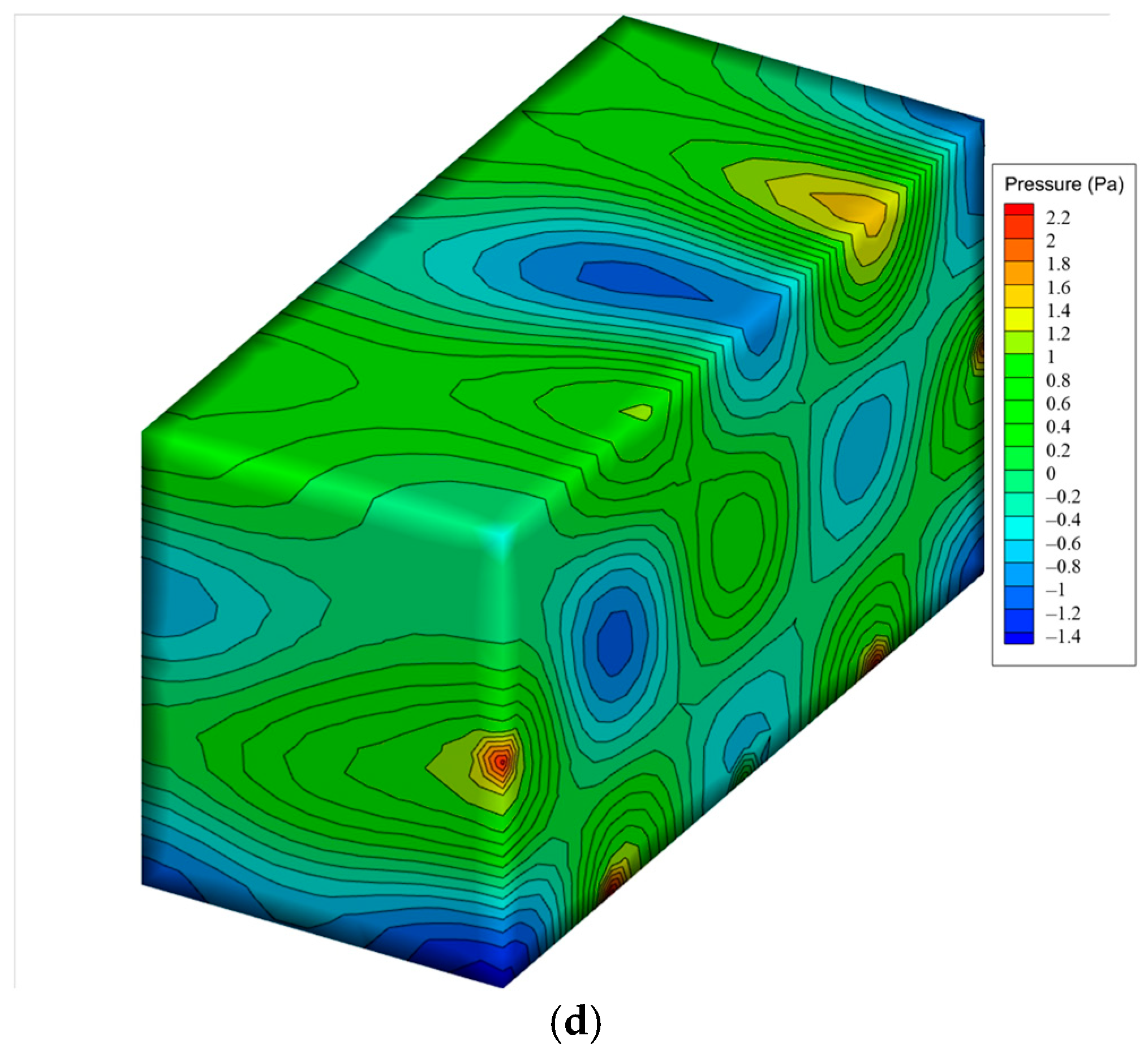
To examine the performance of the proposed RBF-N3 in solving 3D acoustic problems, this subsection investigates a practical and complex case inside a 3D cabin model (length L = 4.36 m, width B = 2.37 m, height H = 1.89 m; see Figure 19). The main noise sources are the air-conditioning outlets at the cabin top, which are simplified as point sources with an acoustic particle velocity of . The domain is discretized using eight-node hexahedral elements (FEM-H8) with an average nodal spacing of h = 0.15 m. This mesh also serves as the background integration cells for the RPIM. At a frequency of 220 Hz, the computed acoustic pressure distributions from different methods are plotted in Figure 20. Results from the proposed RBF-N3 show high consistency with the reference solution obtained using a highly refined mesh (h = 0.03 m). In contrast, visible numerical errors appear in the RPIM and FEM-H8 solutions. This example demonstrates that the proposed RBF-N3 can effectively reduce the numerical errors and provide accurate solutions for complex 3D acoustic problems.
Figure 19.
The schematic of the 3D cabin.
Figure 20.
Acoustic pressure distributions in the 3D cabin obtained using various numerical methods at f = 220 Hz: (a) FEM-H8; (b) RPIM; (c) RBF-N3; (d) Reference solution.
6. Concluding Remarks
In this work, a novel formulation of the Helmholtz equation is constructed based on the RBFs, and the theoretical formulation of the RBF-N3 is derived. In the proposed RBF-N3, the interpolation functions constructed using the RBFs are employed to avoid the LD problem and the polynomial enrichment functions are used to enrich the approximation space generated by the RBFs, which further improves the capability of the proposed method in solving relatively high-frequency Helmholtz problems. Compared to the standard EFEM, the proposed RBF-N3 yields a system matrix of the same size, resulting in no significant increase in computational cost. Dispersion error analysis shows that the numerical dispersion error is efficiently reduced by the RBF-N3 at relatively large wave numbers. Condition number analysis confirms that the RBF-N3 maintains a satisfactory condition number and successfully avoids the LD problem. Comparative analysis using various numerical examples demonstrates that the proposed RBF-N3 consistently achieves accurate solutions and small numerical errors for acoustic problems, even at relatively large wave numbers. Importantly, in the proposed RBF-N3, the nodal shape functions retain the Kronecker delta property, facilitating the imposition of essential boundary conditions. Furthermore, no special modifications to the mesh structure are required, making the RBF-N3 convenient for practical applications. Therefore, the proposed RBF-N3 represents a promising numerical scheme for solving relatively high-frequency Helmholtz problems.
Author Contributions
Conceptualization, W.C.; Software, Z.Z.; Validation, W.L.; Formal analysis, Y.C.; Data curation, W.C.; Writing—original draft, Q.L.; Supervision, W.C. All authors have read and agreed to the published version of the manuscript.
Funding
This research received no external funding.
Data Availability Statement
The raw data supporting the conclusions of this article will be made available by the authors on request.
Conflicts of Interest
The authors declare no conflict of interest.
References
- Bathe, K.J. Finite Element Procedures, 2nd ed.; Prentice Hall: Watertown, MA, USA, 2014. [Google Scholar]
- Zienkiewicz, O.C.; Taylor, R.L. The Finite Element Method, 5th ed.; Butterworth-Heinemann: Oxford, UK, 2000. [Google Scholar]
- Zienkiewicz, O.C. Achievements and some unsolved problems of the finite element method. Int. J. Numer. Methods Eng. 2000, 47, 9–28. [Google Scholar] [CrossRef] [Scilit]
- Deraemaeker, A.; Babuška, I.; Bouillard, P. Dispersion and pollution of the FEM solution for the Helmholtz equation in one, two and three dimensions. Int. J. Numer. Methods Eng. 1999, 46, 471–499. [Google Scholar] [CrossRef] [Scilit]
- Ihlenburg, F.; Babuška, I. Finite element solution of the Helmholtz equation with high wave number. Part I: The h-version of the FEM. Comput. Math. Appl. 1995, 30, 9–37. [Google Scholar] [CrossRef] [Scilit]
- Ovadia, O.; Kahana, A.; Turkel, E. A convolutional dispersion relation preserving scheme for the acoustic wave equation. Appl. Math. Comput. 2024, 461, 128317. [Google Scholar] [CrossRef] [Scilit]
- Fogarty, T.R.; LeVeque, R.J. High-resolution finite-volume methods for acoustic waves in periodic and random media. J. Acoust Soc. Am. 1999, 106, 17–28. [Google Scholar] [CrossRef] [Scilit]
- Ju, B.R.; Qu, W.Z. Three-dimensional application of the meshless generalized finite difference method for solving the extended Fisher-Kolmogorov equation. Appl. Math. Lett. 2023, 136, 108458. [Google Scholar] [CrossRef] [Scilit]
- Kumawat, S.; Malkoti, A.; Vishwakarma, S.K. A cell-centered implicit finite difference scheme to study wave propagation in acoustic media: A numerical modeling. J. Sound Vib. 2024, 590, 118601. [Google Scholar] [CrossRef] [Scilit]
- Huang, J.P.; Peng, W.T.; Yang, J.D.; Lou, L.F. Overview of computation strategies on the dispersion analysis for explicit finite difference solution of acoustic wave equation. Pet. Sci. 2024, 21, 2311–2328. [Google Scholar] [CrossRef] [Scilit]
- Sun, W.X.; Ma, H.D.; Qu, W.Z. A hybrid numerical method for non-linear transient heat conduction problems with temperature-dependent thermal conductivity. Appl. Math. Lett. 2024, 148, 108868. [Google Scholar] [CrossRef] [Scilit]
- Qu, W.Z.; Gu, Y.; Fan, C.M. A stable numerical framework for long-time dynamic crack analysis. Int. J. Solids Struct. 2024, 293, 112768. [Google Scholar] [CrossRef] [Scilit]
- Feng, Y.L.; Zhang, X.D.; Chen, Y.; Wei, L.L. A compact finite difference scheme for solving fractional Black-Scholes option pricing model. J. Inequal. Appl. 2025, 2025, 36. [Google Scholar] [CrossRef] [Scilit]
- Preuss, S.; Gurbuz, C.; Jelich, C.; Baydoun, S.K.; Marburg, S. Recent Advances in Acoustic Boundary Element Methods. J. Theor. Comput. Acoust. 2022, 30, 2240002. [Google Scholar] [CrossRef] [Scilit]
- Zhang, S.L.; Yu, B.; Chen, L.L.; Lian, H.J.; Bordas, S.P.A. Isogeometric dual reciprocity BEM for solving time-domain acoustic wave problems. Comput. Math. Appl. 2024, 160, 125–141. [Google Scholar] [CrossRef] [Scilit]
- Sun, R.; Wu, H.J.; Wang, S.Y.; Gou, Y.N.; Jiang, W.K. A fast fully coupled FEM/BEM method for structural-acoustic interaction problems with a uniformly moving source. Eng. Anal. Bound. Elem. 2025, 177, 106261. [Google Scholar] [CrossRef] [Scilit]
- Liu, G.R. Mesh Free Methods: Moving Beyond the Finite Element Method; CRC Press: Boca Raton, FL, USA, 2009. [Google Scholar]
- Gu, Y.; Fan, C.M.; Fu, Z.J. Localized method of fundamental solutions for three-dimensional elasticity problems: Theory. Adv. Appl. Math. Mech. 2021, 13, 1520–1534. [Google Scholar] [CrossRef] [Scilit]
- Shi, X.J.; Li, X.K.; Huang, Z.; Wan, Q. Unified meshfree-spectral BEM model for acoustic radiation analysis of double-walled coupled shells. J. Fluids Struct. 2025, 134, 104279. [Google Scholar] [CrossRef] [Scilit]
- Li, Z.; Wang, Q.S.; Zhong, R.; Qin, B.; Shao, W. A meshfree approach for vibro-acoustic analysis of combined composite laminated shells with variable thickness. Eng. Anal. Bound. Elem. 2024, 160, 28–44. [Google Scholar] [CrossRef] [Scilit]
- Harari, I.; Hughes, T.J.R. Galerkin/least-squares finite element methods for the reduced wave equation with non-reflecting boundary conditions in unbounded domains. Comput. Methods Appl. Mech. Eng. 1992, 98, 411–454. [Google Scholar] [CrossRef] [Scilit]
- Preuss, S.; Paltorp, M.; Blanc, A.; Henriquez, V.C.; Marburg, S. Revising the Boundary Element Method for Thermoviscous Acoustics: An Iterative Approach via Schur Complement. J. Theor. Comput. Acoust 2023, 31, 2350015. [Google Scholar] [CrossRef] [Scilit]
- Li, R.Y.; Liu, Y.J.; Ye, W.J. A fast direct boundary element method for 3D acoustic problems based on hierarchical matrices. Eng. Anal. Bound. Elem. 2023, 147, 171–180. [Google Scholar] [CrossRef] [Scilit]
- Liu, W.K.; Hao, W.; Chen, Y.; Jun, S.; Gosz, J. Multiresolution reproducing kernel particle methods. Comput. Mech. 1997, 20, 295–309. [Google Scholar] [CrossRef] [Scilit]
- Abbaszadeh, M.; Dehghan, M.; Khodadadian, A.; Heitzinger, C. Error analysis of interpolating element free Galerkin method to solve non-linear extended Fisher–Kolmogorov equation. Comput. Math. Appl. 2020, 80, 247–262. [Google Scholar] [CrossRef] [Scilit]
- Li, Y.C.; Liu, C.; Li, W.; Chai, Y.B. Numerical investigation of the element-free Galerkin method (EFGM) with appropriate temporal discretization techniques for transient wave propagation problems. Appl. Math. Comput. 2023, 442, 127755. [Google Scholar] [CrossRef] [Scilit]
- Suleau, S.; Deraemaeker, A.; Bouillard, P. Dispersion and pollution of meshless solutions for the Helmholtz equation. Comput. Methods Appl. Mech. Eng. 2000, 190, 639–657. [Google Scholar] [CrossRef] [Scilit]
- Wu, S.W.; Xiang, Y.; Liu, B.; Li, G.N. A weak-form interpolation meshfree method for computing underwater acoustic radiation. Ocean Eng. 2021, 233, 109105. [Google Scholar] [CrossRef] [Scilit]
- Xue, H.J.; Zhang, X.Y.; Cheng, J.A. Transient analyses of underwater acoustic propagation with the modified meshfree radial point interpolation method and newmark time integration techniques. Ocean Eng. 2024, 304, 117842. [Google Scholar] [CrossRef] [Scilit]
- You, X.Y.; Yin, J.C.; Yao, Y.; Li, W. Time-domain acoustic wave propagations in multi-fluids using a weak-form meshfree method. Ocean Eng. 2024, 292, 116531. [Google Scholar] [CrossRef] [Scilit]
- You, X.Y.; Li, W.; Chai, Y.B. A truly meshfree method for solving acoustic problems using local weak form and radial basis functions. Appl. Math. Comput. 2020, 365, 124694. [Google Scholar] [CrossRef] [Scilit]
- Wenterodt, C.; Estorff, O.V. Dispersion analysis of the meshfree radial point interpolation method for the Helmholtz equation. Int. J. Numer. Methods Eng. 2009, 77, 1670–1689. [Google Scholar] [CrossRef] [Scilit]
- Liu, C.; Min, S.S.; Pang, Y.D.; Chai, Y.B. The Meshfree Radial Point Interpolation Method (RPIM) for Wave Propagation Dynamics in Non-Homogeneous Media. Mathematics 2023, 11, 523. [Google Scholar] [CrossRef] [Scilit]
- Liu, G.R.; Gu, Y.T. An Introduction to Meshfree Methods and Their Programming; Springer Science & Business Media: Berlin, Germany, 2005. [Google Scholar]
- Zhang, Y.O.; Dang, S.N.; Li, W.; Chai, Y.B. Performance of the radial point interpolation method (RPIM) with implicit time integration scheme for transient wave propagation dynamics. Comput. Math. Appl. 2022, 114, 95–111. [Google Scholar] [CrossRef] [Scilit]
- Wu, S.W.; Xiang, Y.; Li, W.Y. Dispersion error control for underwater acoustic scattering problems using a coupled cell-based smoothed radial point interpolation method. Ocean Eng. 2023, 271, 113767. [Google Scholar] [CrossRef] [Scilit]
- Larsson, E.; Fornberg, B. A numerical study of some radial basis function based solution methods for elliptic PDEs. Comput. Math. Appl. 2003, 46, 891–902. [Google Scholar] [CrossRef] [Scilit]
- Fornberg, B.; Flyer, N. Solving PDEs with radial basis functions. Acta Numer. 2015, 24, 215–258. [Google Scholar] [CrossRef] [Scilit]
- Kansa, E. Multiquadrics-A scattered data approximation scheme with applications to computational fluid dynamics-I surface approximations and partial derivative estimates. Comput. Math. Appl. 1990, 19, 127–145. [Google Scholar] [CrossRef] [Scilit]
- Qiao, Y.; Zhai, S.; Feng, X. RBF–FD method for the high dimensional time fractional convection diffusion equation. Int. Commun. Heat Mass Transfer 2017, 89, 230–240. [Google Scholar] [CrossRef] [Scilit]
- Kien, D.N.; Zhuang, X.Y. Radial basis function based finite element method: Formulation and applications. Eng. Anal. Bound. Elem. 2023, 152, 455–472. [Google Scholar] [CrossRef] [Scilit]
- Kien, D.N.; Chen, X.; Zhuang, X.; Rabczuk, T. Radial Basis Function Based Finite Element Method for Bending, Vibration and Buckling Analysis of Laminated Composite Mindlin-Reissner Plates. Adv. Eng. Res. Appl. 2023, 602, 806–822. [Google Scholar]
- Ma, H.W.; Tian, Y.Q.; Wang, F.Z.; Lou, Q.F.; Yu, L.J. Solving the BBMB Equation in Shallow Water Waves via Space-Time MQ-RBF Collocation. Comput. Model. Eng. Sci. 2025, 144, 3419–3432. [Google Scholar] [CrossRef] [Scilit]
- Zhang, Y.H.; Liu, H.F.; Li, X.Q.; Zhao, Y.J.; Liu, J.X. Study on solving partial differential equations governing steady point current source field using M-RPIM. Comput. Math. Appl. 2025, 200, 431–447. [Google Scholar] [CrossRef] [Scilit]
- Liu, F.T.; Zhou, X.W.; Dai, B.B.; Yan, R.T.; Yin, Z.Y.; Yin, J.H. Large deformation analysis in geotechnics using the node-based smoothed RPIM and second order cone programming. Comput. Geotech. 2025, 187, 107514. [Google Scholar] [CrossRef] [Scilit]
- Shankar, V.; Fogelson, A.L. Hyperviscosity-based stabilization for radial basis function-finite difference (RBF–FD) discretizations of advection-diffusion equations. J. Comput. Phys. 2018, 372, 616–639. [Google Scholar] [CrossRef] [Scilit]
- Rashidinia, J.; Rasoulizadeh, M.N. Numerical methods based on radial basis function-generated finite difference (RBF–FD) for solution of GKdVB equation. Wave Motion 2019, 90, 152–167. [Google Scholar] [CrossRef] [Scilit]
- Liu, J.; Zhang, J.; Zhang, X.D. Semi-discretized numerical solution for time fractional convection–diffusion equation by RBF-FD. Appl. Math. Lett. 2022, 128, 107880. [Google Scholar] [CrossRef] [Scilit]
- Zhang, X.D.; Yao, L.; Liu, J. Numerical study of Fisher’s equation by the RBF-FD method. Appl. Math. Lett. 2021, 120, 107195. [Google Scholar] [CrossRef] [Scilit]
- Koch, M.; Borne, S.L. RBF-FD discretization of the Oseen equations. J. Comput. Phys. 2025, 542, 114375. [Google Scholar] [CrossRef] [Scilit]
- Wang, F.; Zhu, Y.; Jia, S.H.; Guo, X. The RBF-FD method for solving the time-fractional viscoelastic wave propagation in irregular domains. Eng. Anal. Bound. Elem. 2025, 173, 106121. [Google Scholar] [CrossRef] [Scilit]
- Dicech, F.; Zamolo, R.; Parussini, L. Parametric reduced order model built from RBF-FD meshless simulations of flow and temperature fields in a 3D pipe with wavy surfaces. Comput. Fluids 2025, 301, 106803. [Google Scholar] [CrossRef] [Scilit]
- Wei, L.L.; Yang, Y.F. Optimal order finite difference/local discontinuous Galerkin method for variable-order time-fractional diffusion equation. J. Comput. Appl. Math. 2021, 383, 113129. [Google Scholar] [CrossRef] [Scilit]
- Wei, L.L. Stability and convergence of a fully discrete local discontinuous Galerkin method for multi-term time fractional diffusion equations. Numer. Algor. 2017, 76, 695–707. [Google Scholar] [CrossRef] [Scilit]
- Yang, M.M.; Liu, L.J.; Wei, L.L. Local Discontinuous Galerkin Method for the Variable-Order Fractional Mobile-Immobile Advection-Dispersion Equation. Comput. Math. Math. Phys. 2025, 65, 308–319. [Google Scholar] [CrossRef] [Scilit]
- Zhang, X.D.; Wei, L.L.; Liu, J. Application of the LDG method using generalized alternating numerical flux to the fourth-order time-fractional sub-diffusion model. Appl. Math. Lett. 2025, 168, 109580. [Google Scholar] [CrossRef] [Scilit]
- Wei, L.L.; Wang, H.H.; Chen, Y.P. Local discontinuous Galerkin method for a hidden-memory variable order reaction–diffusion equation. J. Appl. Math. Comput. 2023, 69, 2857–2872. [Google Scholar] [CrossRef] [Scilit]
- Ihlenburg, F.; Babuška, I. Reliability of finite element methods for the numerical computation of waves. Adv. Eng. Softw. 1997, 28, 417–424. [Google Scholar] [CrossRef] [Scilit]
- Thompson, L.L.; Plnsky, P.M. A Galerkin least-squares finite element method for the two-dimensional Helmholtz equation. Int. J. Numer. Methods Eng. 1995, 38, 371–397. [Google Scholar] [CrossRef] [Scilit]
- Carey, G.F.; Shen, Y. Least-squares finite element approximation of Fisher’s reaction–diffusion equation. Numer. Methods Partial. Differ. Equ. 1995, 11, 175–186. [Google Scholar] [CrossRef] [Scilit]
- Babuška, I.; Ihlenburg, F.; Paik, E.T.; Sauter, S.A. A generalized finite element method for solving the Helmholtz equation in two dimensions with minimal pollution. Comput. Methods Appl. Mech. Eng. 1995, 128, 325–359. [Google Scholar] [CrossRef] [Scilit]
- Liu, M.Y.; Gao, G.J.; Zhu, H.F.; Jiang, C.; Liu, G.R. A cell-based smoothed finite element method (CS-FEM) for three-dimensional incompressible laminar flows using mixed wedge-hexahedral element. Eng. Anal. Bound. Elem. 2021, 133, 269–285. [Google Scholar] [CrossRef] [Scilit]
- Jiang, C.; Hong, C.; Wang, T.T.; Zhou, G. N-Side cell-based smoothed finite element method for incompressible flow with heat transfer problems. Eng. Anal. Bound. Elem. 2023, 146, 749–766. [Google Scholar] [CrossRef] [Scilit]
- Gottlieb, D.; Orszag, S.A. Numerical Analysis of Spectral Methods: Theory and Applications; Capital City Press: Tumwater, WA, USA, 1993. [Google Scholar]
- Xuan, G.L.; Yue, J.H.; Wang, Y.; Wang, D.X. An edge-based smoothed finite element method combined with Newmark method for time domain acoustic wave scattering problem. Eng. Anal. Bound. Elem. 2024, 158, 182–198. [Google Scholar] [CrossRef] [Scilit]
- Jiang, Z.L.; Zhang, F.; Li, K.F.; Chai, Y.B.; Li, W.; Gui, Q. A multi-physics overlapping finite element method for band gap analyses of the magneto-electro-elastic radial phononic crystal plates. Thin Wall Struct. 2025, 210, 112985. [Google Scholar] [CrossRef] [Scilit]
- Kim, K.T.; Bathe, K.J. Accurate solution of wave propagation problems in elasticity. Comput. Struct. 2021, 249, 106502. [Google Scholar] [CrossRef] [Scilit]
- Liu, C.; Li, K.F.; Min, S.S.; Chai, Y.B. Dynamic analysis of the three-phase magneto-electro-elastic (MEE) structures with the overlapping triangular finite elements. Comput. Math. Appl. 2025, 179, 148–177. [Google Scholar] [CrossRef] [Scilit]
- Gui, Q.; Li, W.; Chai, Y.B. Improved modal analyses using the novel quadrilateral overlapping elements. Comput. Math. Appl. 2024, 154, 138–152. [Google Scholar] [CrossRef] [Scilit]
- Kim, J.; Bathe, K.J. The finite element method enriched by interpolation covers. Comput. Struct. 2013, 116, 35–49. [Google Scholar] [CrossRef] [Scilit]
- Chai, Y.B.; Huang, K.Y.; Wang, S.P.; Xiang, Z.C.; Zhang, G.J. The Extrinsic Enriched Finite Element Method with Appropriate Enrichment Functions for the Helmholtz Equation. Mathematics 2023, 11, 1664. [Google Scholar] [CrossRef] [Scilit]
- An, X.M.; Li, L.X.; Ma, G.W.; Zhang, H.H. Prediction of rank deficiency in partition of unity-based methods with plane triangular or quadrilateral meshes. Comput. Methods Appl. Mech. Eng. 2011, 200, 665–674. [Google Scholar] [CrossRef] [Scilit]
- Chai, Y.B.; Li, W.; Liu, Z.Y. Analysis of transient wave propagation dynamics using the enriched finite element method with interpolation cover functions. Appl. Math. Comput. 2022, 412, 126564. [Google Scholar] [CrossRef] [Scilit]
- Yang, Y.T.; Xu, D.D.; Zheng, H. A partition-of-unity based ‘FE-Meshfree’ triangular element with radial-polynomial basis functions for static and free vibration analysis. Eng. Anal. Bound. Elem. 2016, 65, 18–38. [Google Scholar] [CrossRef] [Scilit]
- Liu, G.R.; Wang, J.G. A point interpolation meshless method based on radial basis functions. Int. J. Numer. Methods Eng. 2002, 54, 1623–1648. [Google Scholar] [CrossRef] [Scilit]
- Fries, T.P.; Belytschko, T. The extended/generalized finite element method: An overview of the method and its applications. Int. J. Numer. Methods Eng. 2010, 84, 253–304. [Google Scholar] [CrossRef] [Scilit]
- Strouboulis, T.; Copps, K.; Babuška, I. The generalized finite element method: An example of its implementation and illustration of its performance. Int. J. Numer. Methods Eng. 2000, 47, 1401–1417. [Google Scholar] [CrossRef] [Scilit]
- Li, Y.C.; Dang, S.N.; Li, W.; Chai, Y.B. Free and Forced Vibration Analysis of Two-Dimensional Linear Elastic Solids Using the Finite Element Methods Enriched by Interpolation Cover Functions. Mathematics 2022, 10, 456. [Google Scholar] [CrossRef] [Scilit]
- Kim, K.T.; Zhang, L.; Bathe, K.J. Transient implicit wave propagation dynamics with overlapping finite Elements. Comput. Struct. 2018, 199, 18–33. [Google Scholar] [CrossRef] [Scilit]
- Kim, K.T.; Bathe, K.J. Transient implicit wave propagation dynamics with the method of finite spheres. Comput. Struct. 2016, 173, 50–60. [Google Scholar] [CrossRef] [Scilit]
- Sun, T.T.; Wang, P.; Zhang, G.J.; Chai, Y.B. Transient analyses of wave propagations in nonhomogeneous media employing the novel finite element method with the appropriate enrichment function. Comput. Math. Appl. 2023, 129, 90–112. [Google Scholar] [CrossRef] [Scilit]
- Gui, Q.; Zhang, G.Y.; Chai, Y.B.; Li, W. A finite element method with cover functions for underwater acoustic propagation problems. Ocean Eng. 2022, 243, 110174. [Google Scholar] [CrossRef] [Scilit]

Disclaimer/Publisher’s Note: The statements, opinions and data contained in all publications are solely those of the individual author(s) and contributor(s) and not of MDPI and/or the editor(s). MDPI and/or the editor(s) disclaim responsibility for any injury to people or property resulting from any ideas, methods, instructions or products referred to in the content. |
© 2026 by the authors. Licensee MDPI, Basel, Switzerland. This article is an open access article distributed under the terms and conditions of the Creative Commons Attribution (CC BY) license.