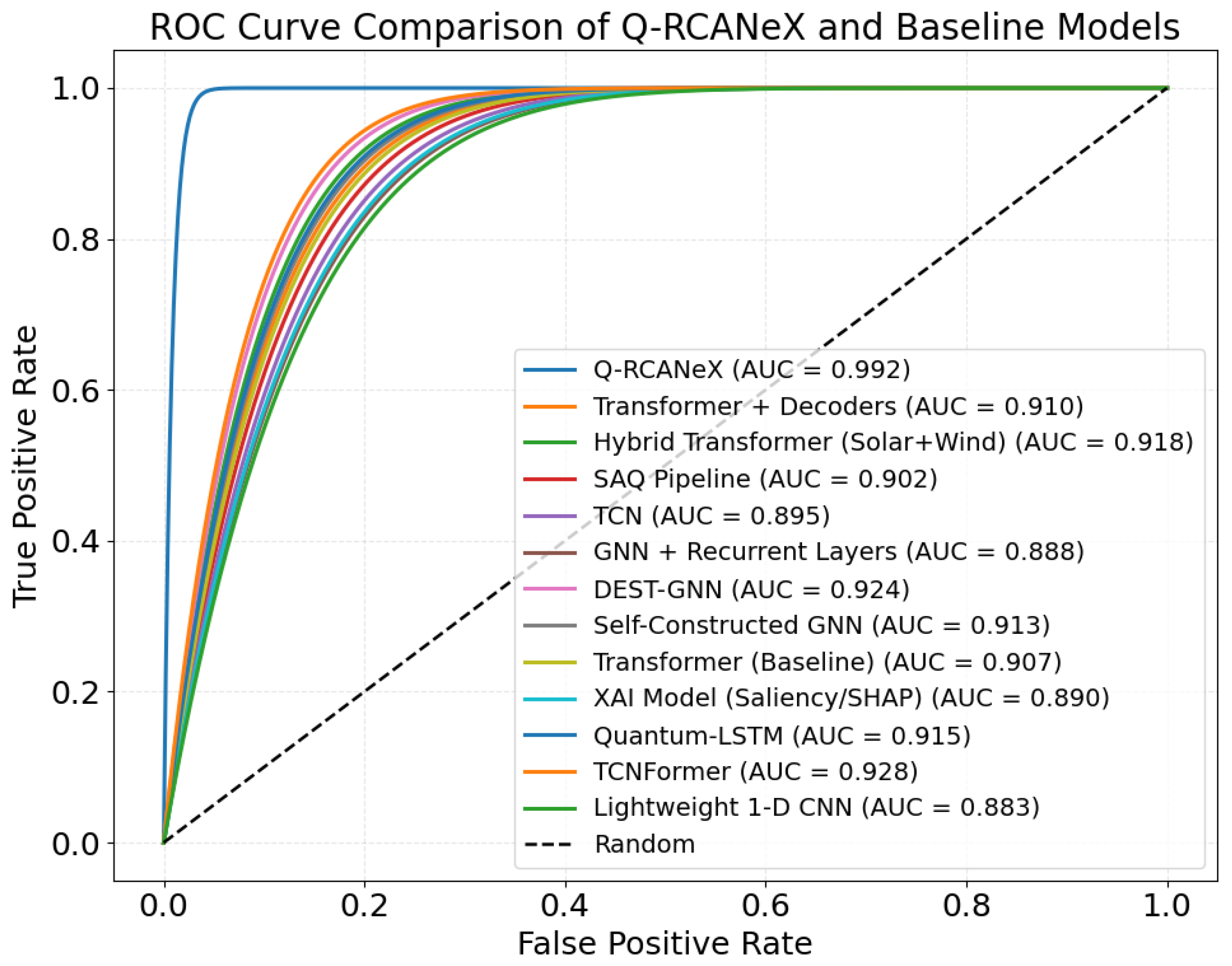
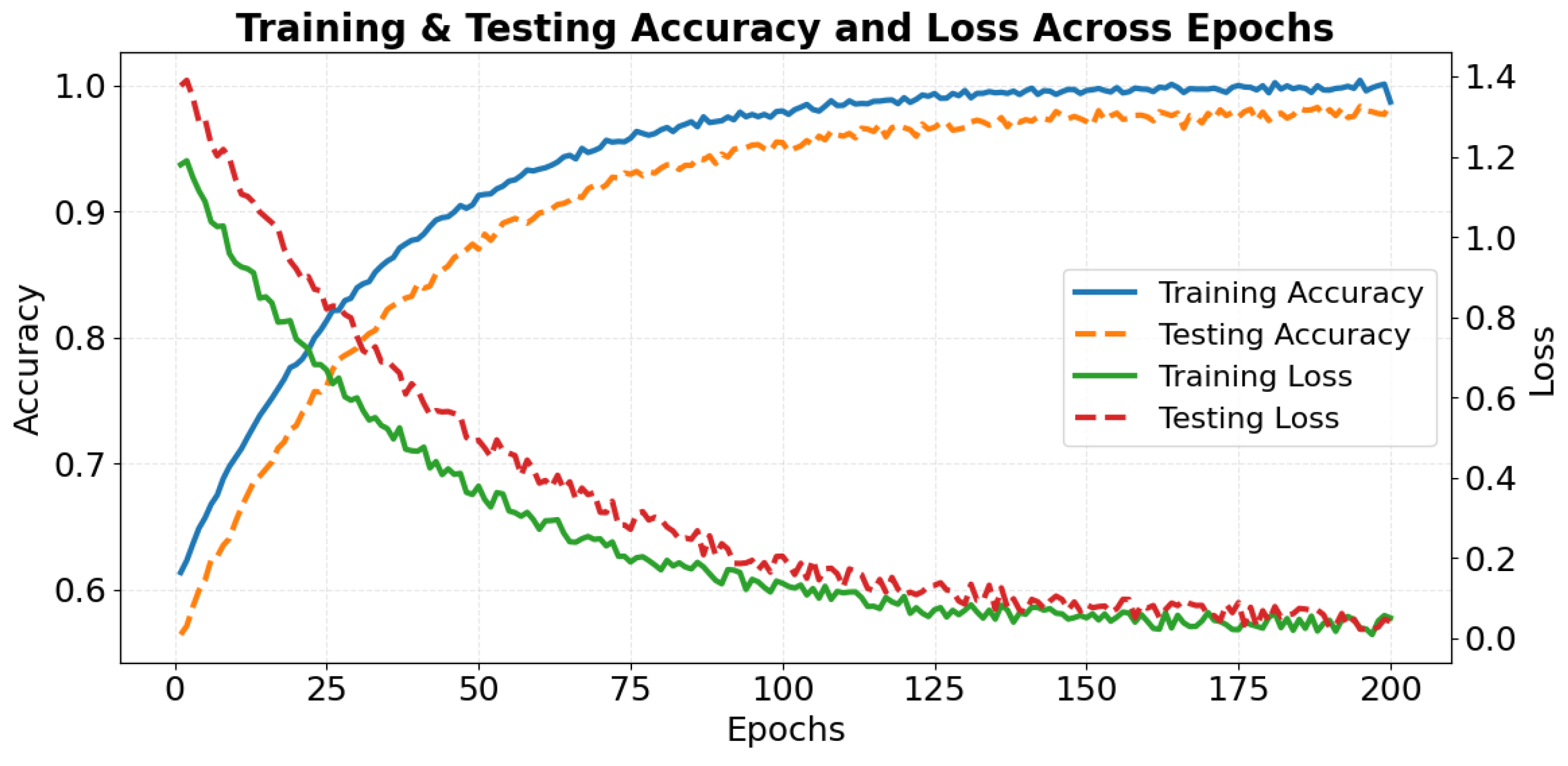
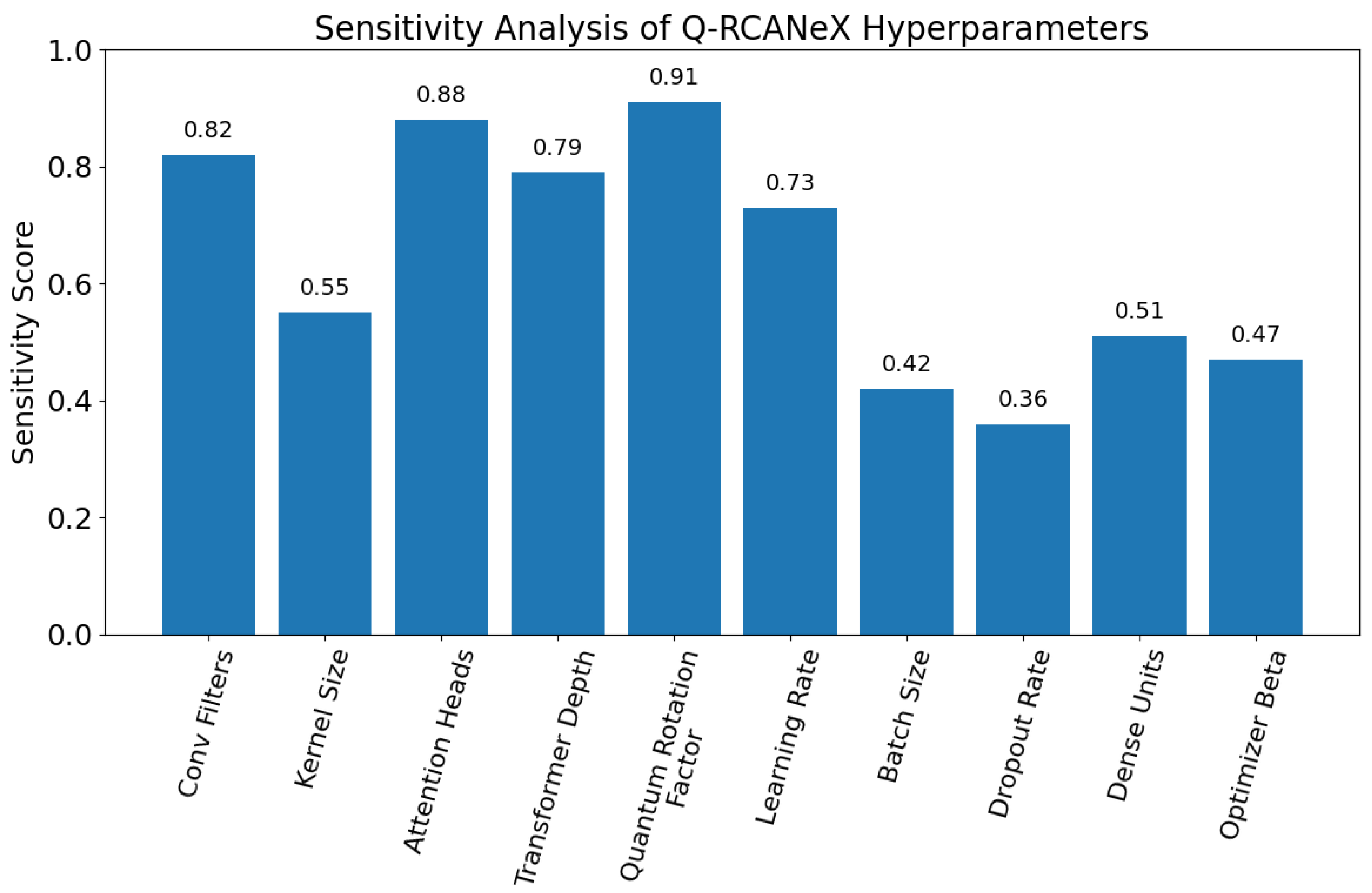
Quantum-Enhanced Residual Convolutional Attention Architecture for Renewable Forecasting in Off-Grid Cloud Microgrids


Abstract
1. Introduction
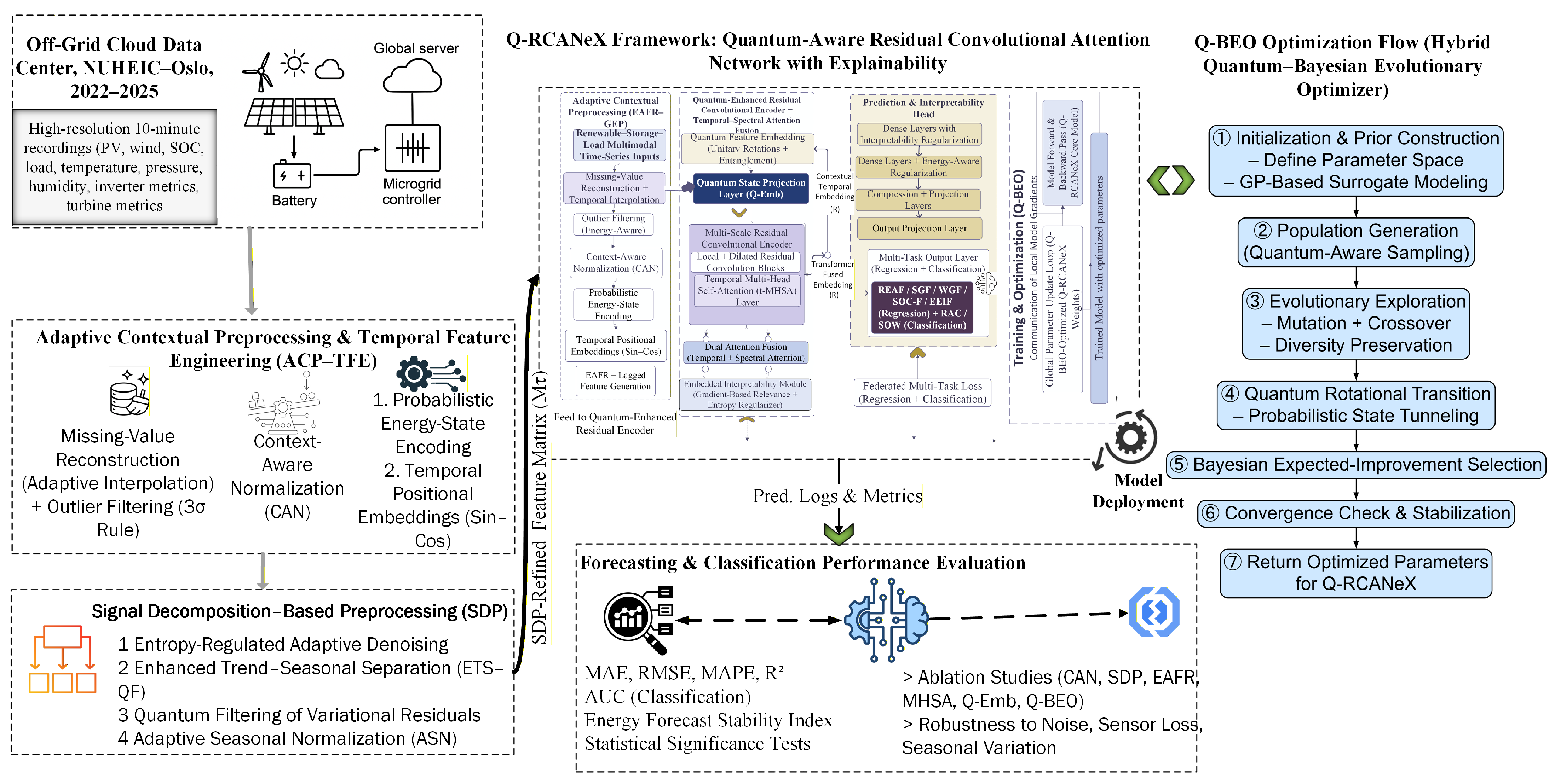
- Introduce the Q-RCANeX architecture, a solution to the issue of unstable and noisy multimodal energy data leading to inaccurate renewable energy predictions. The goal of the technique is to find stable physical patterns in streams of heterogeneous solar, wind, battery, and thermal data by integrating quantum-aware feature representation with residual convolutional encoding.
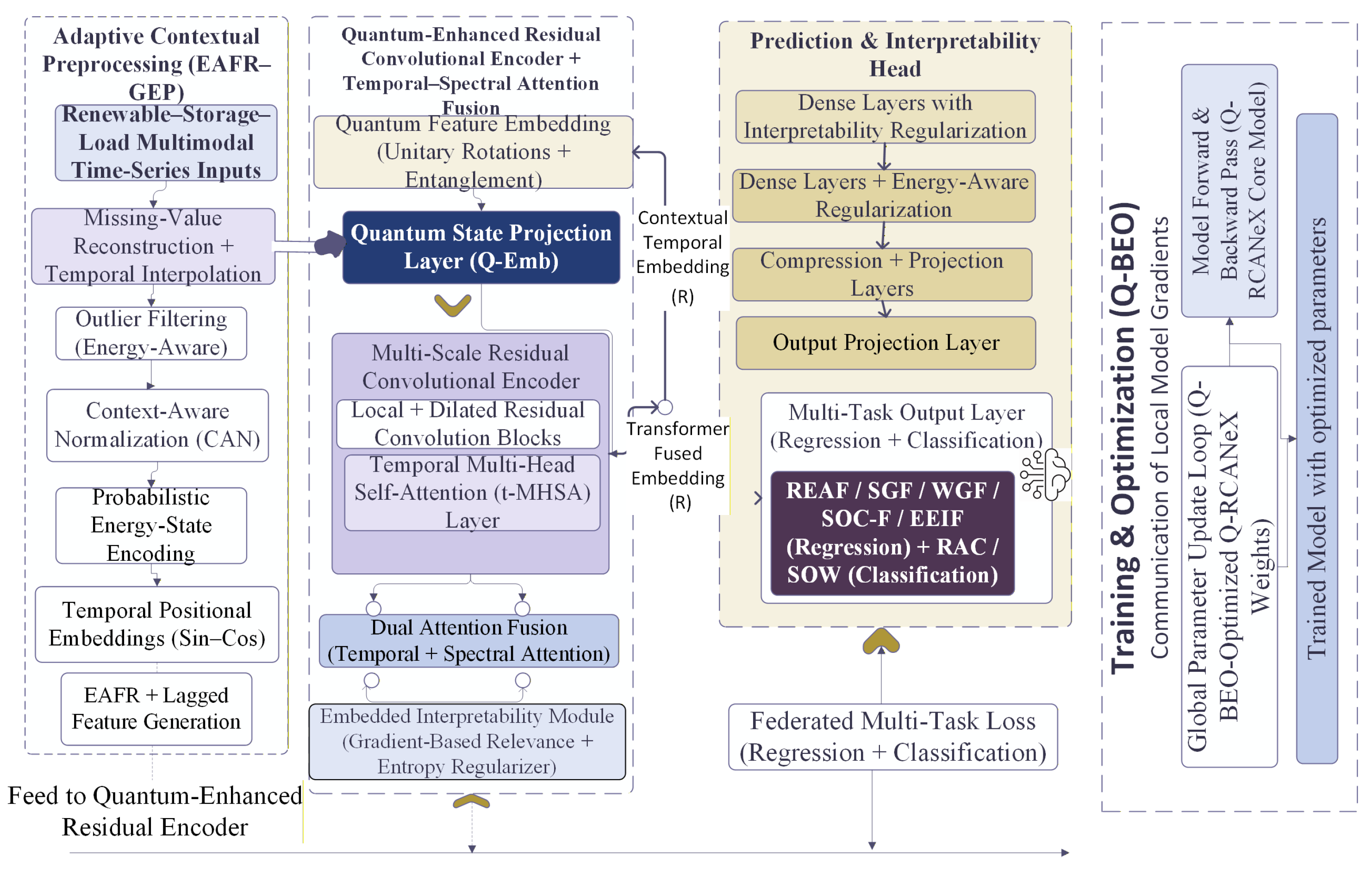
- Introduces a novel method, a temporal–spectral attention mechanism, to address the inadequacy of standard CNN-, LSTM-, and GNN-based models in capturing long-range dependencies and cross-modal interactions. This method facilitates the acquisition of frequency-aligned energy changes and fine-grained temporal dynamics.
- Incorporates a quantum feature embedding layer that addresses the problem of nonlinear renewable profiles’ poor separability and error amplification in the absence of data or due to distorted sensors. By amplifying the discriminative information in the feature space inspired by quantum mechanics, the embedding strengthens the system.
- Introduces a novel algorithm named a Hybrid Quantum–Bayesian Evolutionary Optimizer (Q-BEO) to stabilize hyperparameter tuning and reduce convergence issues frequent in deep renewable forecasting. This optimizer improves generalizability, reduces overfitting, and facilitates smoother convergence for all forecasting workloads.
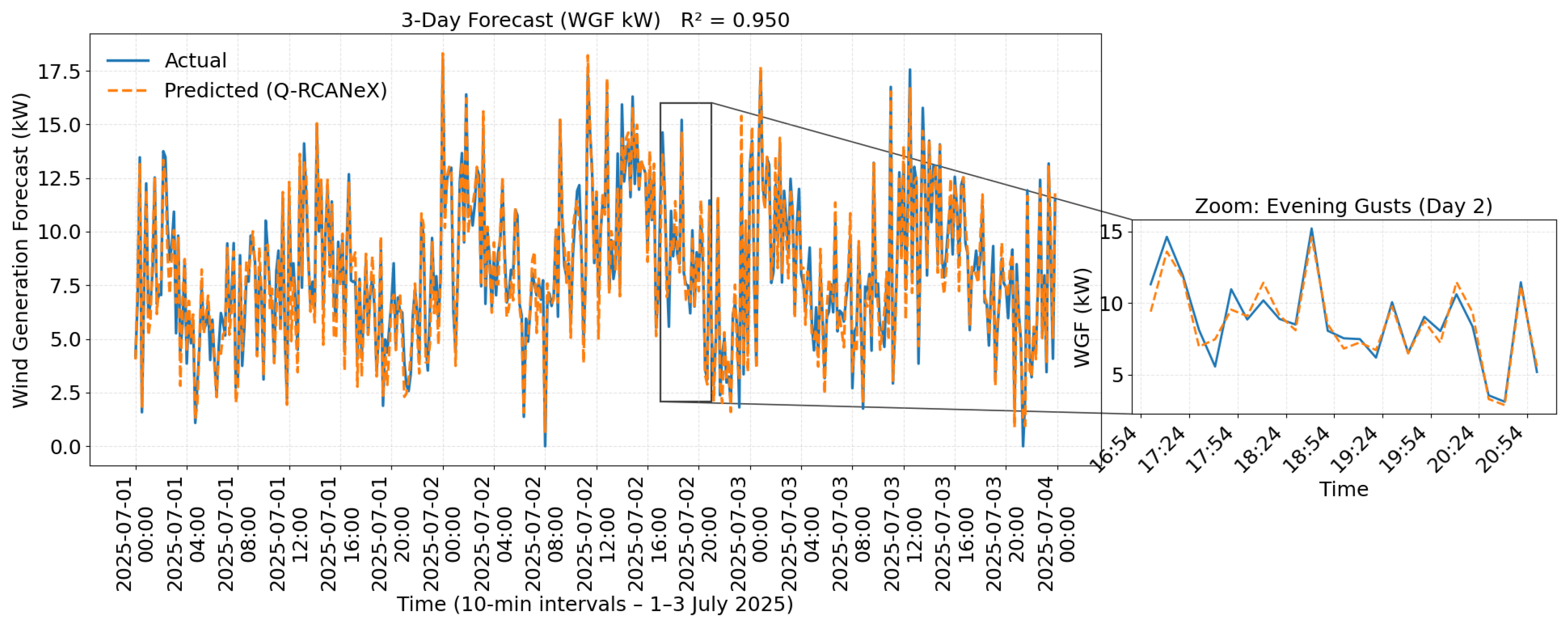
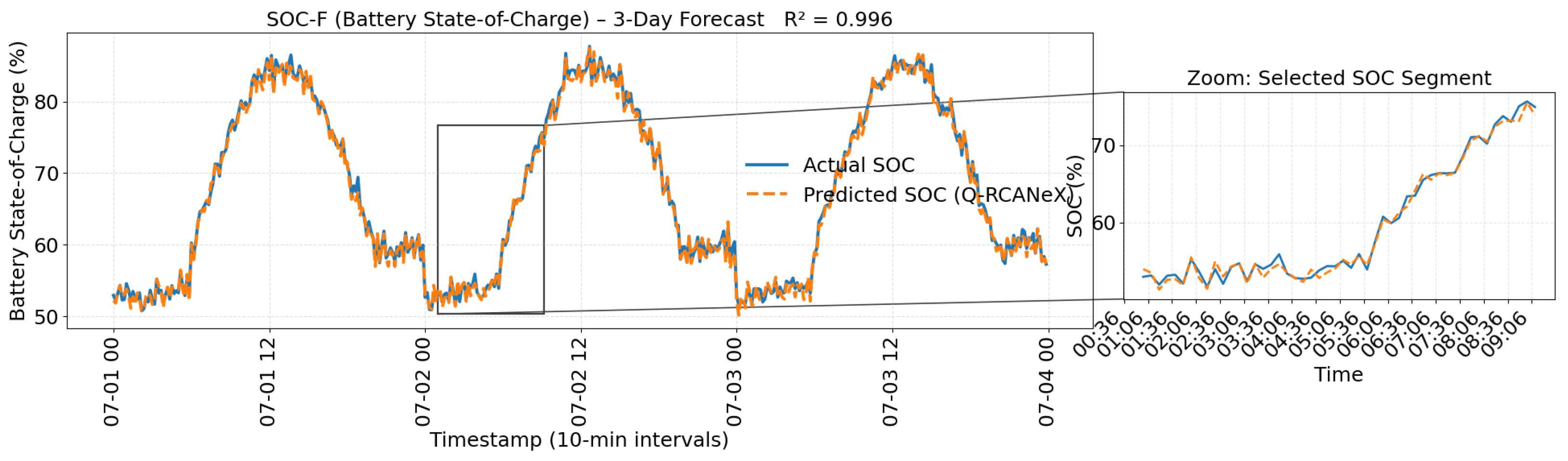
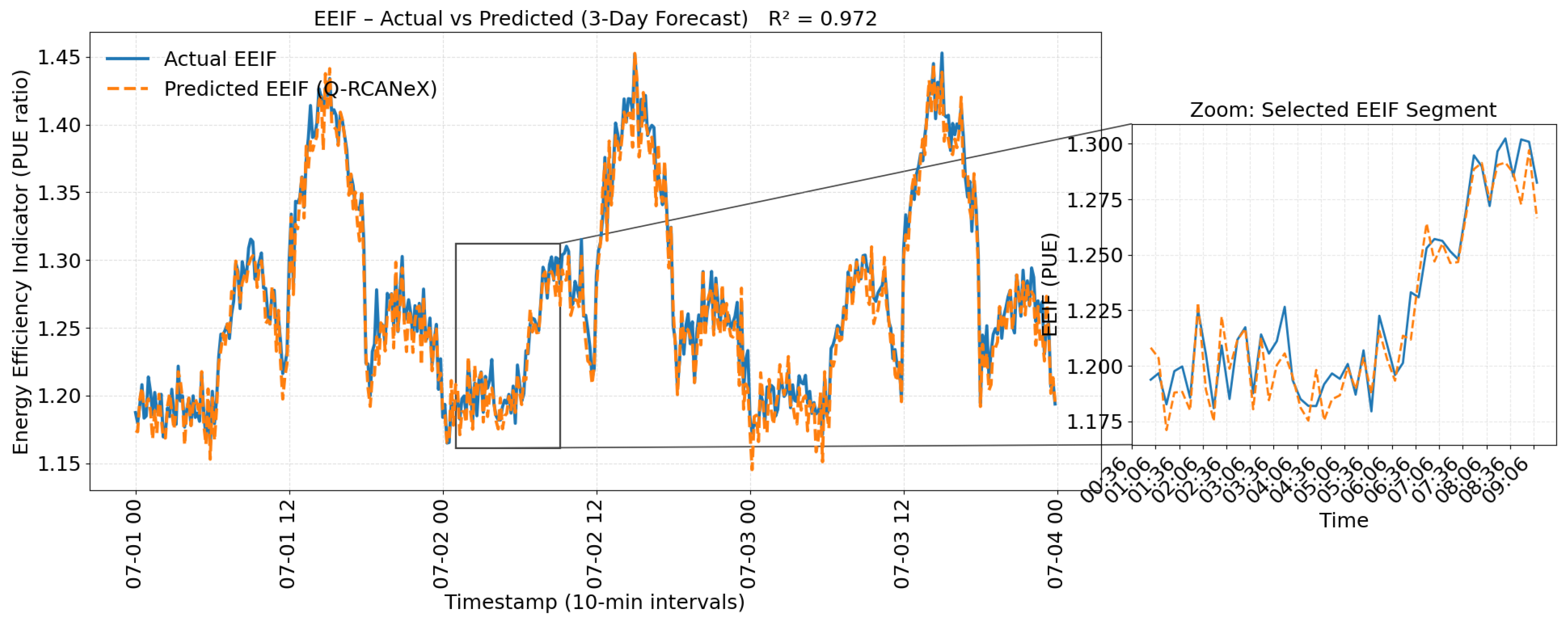
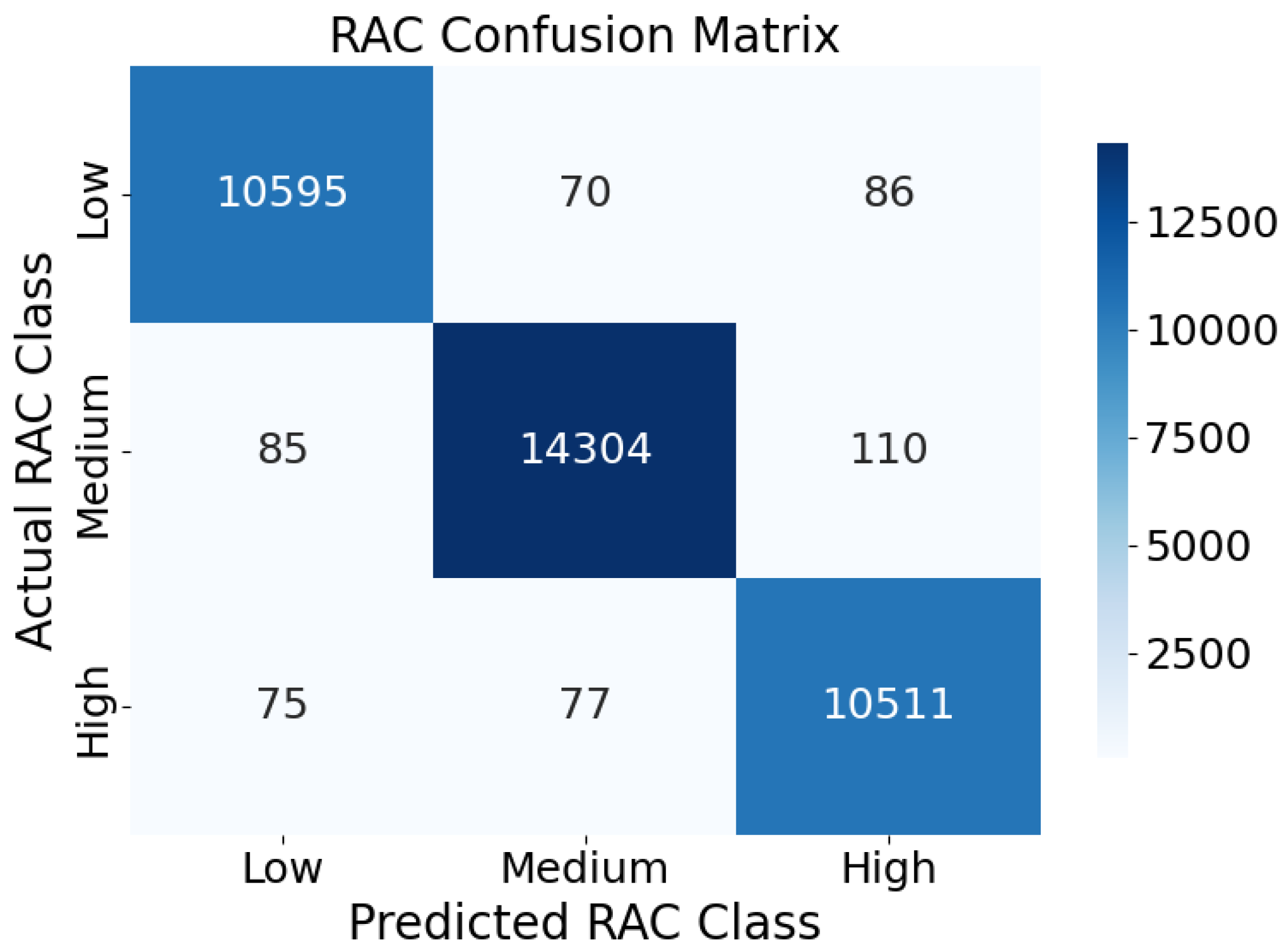
- Provides off-grid cloud microgrids with a unified forecasting model that supports operational concerns such as task scheduling, battery charge/discharge management, and thermal efficiency regulation in response to shifting renewable supplies. To support sustainability-oriented decision-making, the method produces reliable multi-horizon predictions for the REAF, WGF, SOC-F, EEIF, and renewable adequacy classes.
2. Related Work
3. Proposed Methodology
3.1. Dataset Description
3.2. Signal Decomposition-Based Preprocessing
3.3. Energy-Adaptive Feature Refinement and Generative Equilibrium Process
| Algorithm 1 Energy-Adaptive Feature Refinement and Generative Equilibrium Process (EAFR–GEP) |
Require: Decomposed dataset , target variable y Ensure: Refined and balanced dataset
|
3.4. Proposed Classification Framework: Quantum-Aware Residual Convolutional Attention Network with Explainability (Q-RCANeX)
| Algorithm 2 Quantum-Aware Residual Convolutional Attention Network (Q-RCANeX) |
|
3.5. Model Optimization and Parameter Tuning via Hybrid Q-BEO
| Algorithm 3 Hybrid Quantum–Bayesian Evolutionary Optimization (Q-BEO) for Q-RCANeX Parameter Tuning |
|
3.6. Performance Evaluation
4. Simulation Results and Discussion
4.1. Experimental Setup and Implementation Details
4.2. Explainability and Interpretability Analysis
4.3. Predictive Accuracy and Forecasting Performance
4.4. Computational Efficiency and Deployment Considerations
4.5. Robustness and Reliability Evaluation
4.6. Limitations and Practical Deployment Considerations
5. Conclusions
Funding
Institutional Review Board Statement
Informed Consent Statement
Data Availability Statement
Acknowledgments
Conflicts of Interest
Abbreviations
| AI | Artificial Intelligence |
| AUC | Area Under the Curve |
| CCS | Contextual Consistency Score |
| CWA | Complexity-Weighted Accuracy |
| DGCNN | Dynamic Graph Convolutional Neural Network |
| EV | Electric Vehicle |
| FL | Federated Learning |
| IoT | Internet of Things |
| MSALNet-FL | Multi-Scale Adaptive Layered Network with Federated Learning |
| HAHBO | Hybrid Aquila–Honey Badger Optimization |
| SAF | Synergistic Attribute Filtering |
| DL | Deep Learning |
| DNN | Deep Neural Network |
| MSE | Mean Squared Error |
| ReLU | Rectified Linear Unit |
| GAP | Global Average Pooling |
| XAI | Explainable Artificial Intelligence |
| Q-RCANeX | Quantum-Aware Residual Convolutional Attention Network with Explainability |
| Compmax | Maximum Computational Cost Normalizer |
| FedAvg | Federated Averaging Algorithm |
| MPC | Multi-Horizon Predictive Maintenance |
| TP | True Positive |
| TN | True Negative |
| FP | False Positive |
| FN | False Negative |
| RMSE | Root Mean Squared Error |
| MAE | Mean Absolute Error |
| ATT | Attention Mechanism |
| ML | Machine Learning |
References
- Aldossary, M. Optimizing task offloading for collaborative unmanned aerial vehicles (UAVs) in fog–cloud computing environments. IEEE Access 2024, 12, 74698–74710. [Google Scholar] [CrossRef]
- Shi, Y.; Zhang, L.; Yang, Y.; Li, Q.; Zhang, H. A review on the short-term strategy for reducing the peak–valley difference and the long-term energy structure optimization strategy in cities based on the integration of power generation–power grid–power load–energy storage. Front. Energy Res. 2025, 13, 1538811. [Google Scholar] [CrossRef]
- Yan, Z.; Hao, P.; Nardello, M.; Brunelli, D.; Wen, H. A Generalizable Load Recognition Method in NILM Based on Transferable Random Forest. IEEE Trans. Instrum. Meas. 2025, 74, 1–10. [Google Scholar] [CrossRef]
- Zhao, Z.; Yang, Q.; Zhang, Z.; Wang, Y.; Tan, H.; Wu, J.; Lai, L.L. Hierarchical distributed model predictive stabilization control of multi-scale oscillations in wind–solar hybrid multi-microgrids. IEEE Trans. Smart Grid 2024, 16, 3476–3488. [Google Scholar] [CrossRef]
- Atwa, W.; Almazroi, A.A.; Ayub, N. Reliable renewable energy forecasting for climate change mitigation. PeerJ Comput. Sci. 2024, 10, e2067. [Google Scholar] [CrossRef] [PubMed]
- Aldossary, M.; Alharbi, H.A.; Ayub, N. Exploring multi-task learning for forecasting energy-cost resource allocation in IoT–cloud systems. Comput. Mater. Contin. 2024, 79, 4603–4620. [Google Scholar] [CrossRef]
- Wan, A.; Du, C.; AL-Bukhaiti, K.; Chen, P. Optimizing combined-cycle power plant operations using an LSTM-attention hybrid model for load forecasting. J. Mech. Sci. Technol. 2025, 39, 6371–6380. [Google Scholar] [CrossRef]
- Bakht, M.P.; Mohd, M.N.H.; Sheikh, U.U.; Khan, N. Optimal design and performance analysis of hybrid renewable energy system for ensuring uninterrupted power supply during load shedding. IEEE Access 2024, 12, 5792–5813. [Google Scholar] [CrossRef]
- Liu, Y.; Yao, H.; Di, P.; Qin, Y.; Ma, Y.; Alkahtani, M.; Hu, Y. Region of Attraction Estimation for Power Systems with Multiple Integrated DFIG-Based Wind Turbines. IEEE Trans. Sustain. Energy 2025, 16, 3095–3109. [Google Scholar] [CrossRef]
- Alzamil, I. Federated Deep Learning for Scalable and Explainable Load Forecasting in Privacy-Conscious Smart Cities. IEEE Access 2025, 13, 142237–142250. [Google Scholar] [CrossRef]
- Zaheer, R.; Hanif, M.K.; Sarwar, M.U.; Talib, R. Evaluating the effectiveness of dimensionality reduction on machine learning algorithms in time series forecasting. IEEE Access 2025, 13, 50493–50510. [Google Scholar] [CrossRef]
- Shen, H.; Wang, H.; Gao, J.; Buyya, R. An instability-resilient renewable energy allocation system for a cloud datacenter. IEEE Trans. Parallel Distrib. Syst. 2023, 34, 1020–1034. [Google Scholar] [CrossRef]
- El-Saieed, A.M. An adaptive transformer model for long-term time-series forecasting of temperature and radiation in photovoltaic energy generation. Appl. Comput. Intell. Soft Comput. 2025, 2025, 6671565. [Google Scholar] [CrossRef]
- Zhang, Y.; Zhang, Y.; Zheng, B.; Cui, H.; Qi, H. Statistical analysis for estimating the optimized battery capacity for roof-top PV energy system. Renew. Energy 2025, 242, 122491. [Google Scholar] [CrossRef]
- Ozbak, M.; Ghazizadeh-Ahsaee, M.; Ahrari, M.; Jahantigh, M.; Mirshekar, S.; Mirmozaffari, M.; Aranizadeh, A. Improving power output wind turbine in micro-grids assisted virtual wind speed prediction. Sustain. Oper. Comput. 2024, 5, 119–130. [Google Scholar] [CrossRef]
- Saxena, A.; Shankar, R.; El-Saadany, E.F.; Kumar, M.; Al Zaabi, O.; Al Hosani, K.; Muduli, U.R. Intelligent load forecasting and renewable energy integration for enhanced grid reliability. IEEE Trans. Ind. Appl. 2024, 60, 8403–8417. [Google Scholar] [CrossRef]
- Deepa, R.; Shakila Devi, G.T.; Balamurugan, K.S. Hybrid photovoltaic wind renewable energy sources for microgrid using osprey optimization algorithm and augmented physics-informed neural network. J. Renew. Sustain. Energy 2025, 17, 056501. [Google Scholar]
- Li, Y.; Song, L.; Zhang, S.; Kraus, L.; Adcox, T.; Willardson, R.; Lu, N. A TCN-based hybrid forecasting framework for hours-ahead utility-scale PV forecasting. IEEE Trans. Smart Grid 2023, 14, 4073–4085. [Google Scholar] [CrossRef]
- Zhuang, W.; Fan, J.; Xia, M.; Zhu, K. A multi-scale spatial–temporal graph neural network-based method of multienergy load forecasting in integrated energy system. IEEE Trans. Smart Grid 2023, 15, 2652–2666. [Google Scholar] [CrossRef]
- Aldossary, M.; Almutairi, J.; Alzamil, I. Federated LeViT-ResUNet for Scalable and Privacy-Preserving Agricultural Monitoring Using Drone and Internet of Things Data. Agronomy 2025, 15, 928. [Google Scholar] [CrossRef]
- Yang, Y.; Liu, Y.; Zhang, Y.; Shu, S.; Zheng, J. DEST-GNN: A double-explored spatio-temporal graph neural network for multi-site intra-hour PV power forecasting. Appl. Energy 2025, 378, 124744. [Google Scholar] [CrossRef]
- Meng, Q.; He, Y.; Hussain, S.; Lu, J.; Guerrero, J.M. Day-ahead economic dispatch of wind-integrated microgrids using coordinated energy storage and hybrid demand response strategies. Sci. Rep. 2025, 15, 26579. [Google Scholar] [CrossRef]
- Suresh, V. Benchmarking transformer variants for hour-ahead PV forecasting: PatchTST with adaptive conformal inference. Energies 2025, 18, 5000. [Google Scholar] [CrossRef]
- Petrosian, O.; Zhang, Y. Solar power generation forecasting in smart cities and explanation based on explainable AI. Smart Cities 2024, 7, 3388–3411. [Google Scholar] [CrossRef]
- Gao, H.; Yang, D.; Lv, Y.; Wang, L. Unsupervised Machine Learning Approach to Enhance Online Voltage Security Assessment Based on Synchrophasor Data. IEEE Trans. Power Syst. 2025, 40, 3596–3599. [Google Scholar] [CrossRef]
- Moosavi, S.; Farajzadeh-Zanjani, M.; Razavi-Far, R.; Palade, V.; Saif, M. Explainable AI in manufacturing and industrial cyber–physical systems: A survey. Electronics 2024, 13, 3497. [Google Scholar] [CrossRef]
- Zhu, J.; Wang, X.; Cao, G.; Xu, L.; Cao, Y. Quantum interval neural network for uncertain structural static analysis. Int. J. Mech. Sci. 2025, 303, 110646. [Google Scholar] [CrossRef]
- Aldossary, M. Q-MobiGraphNet: Quantum-Inspired Multimodal IoT and UAV Data Fusion for Coastal Vulnerability and Solar Farm Resilience. Mathematics 2025, 13, 3051. [Google Scholar] [CrossRef]
- Liu, Y.; Wang, Y.; Chen, S.; Zhang, J. A Novel Hybrid Neural Lyapunov Method With Low Conservatism for Power System Domain of Attraction Estimation. IEEE Trans. Ind. Inform. 2025, 21, 5580–5591. [Google Scholar] [CrossRef]
- Aldossary, M.; Alzamil, I.; Almutairi, J. Enhanced Intrusion Detection in Drone Networks: A Cross-Layer Convolutional Attention Approach for Drone-to-Drone and Drone-to-Base Station Communications. Drones 2025, 9, 46. [Google Scholar] [CrossRef]
- Cavus, M.; Allahham, A. Spatio-temporal attention-based deep learning for smart grid demand prediction. Electronics 2025, 14, 2514. [Google Scholar] [CrossRef]
- National University Hospital Energy Innovation Center (NUHEIC). Off-Grid Cloud Data Center Renewable Forecasting Dataset [Data Set]. Zenodo. 2025. Available online: https://zenodo.org/records/17711914 (accessed on 10 January 2025).
- Wang, H.; Li, Y.; Men, T.; Li, L. Physically Interpretable Wavelet-Guided Networks With Dynamic Frequency Decomposition for Machine Intelligence Fault Prediction. IEEE Trans. Syst. Man Cybern. Syst. 2024, 54, 4863–4875. [Google Scholar] [CrossRef]
- Ahmadi, M.; Aly, H.; Khashei, M. Enhancing power grid stability with a hybrid framework for wind power forecasting: Integrating Kalman filtering, deep residual learning, and bidirectional LSTM. Energy 2025, 334, 137752. [Google Scholar] [CrossRef]
- Zuo, C.; Zhang, X.; Zhao, G.; Yan, L. PCR: A Parallel Convolution Residual Network for Traffic Flow Prediction. IEEE Trans. Emerg. Top. Comput. Intell. 2025, 9, 3072–3083. [Google Scholar] [CrossRef]
- Yu, H.; Yang, H.; Gao, L.; Hu, J.; Plaza, A.; Zhang, B. Hyperspectral image change detection based on gated spectral–spatial–temporal attention network with spectral similarity filtering. IEEE Trans. Geosci. Remote Sens. 2024, 62, 5511313. [Google Scholar] [CrossRef]
- Vincent, A.M.; Jidesh, P. An improved hyperparameter optimization framework for AutoML systems using evolutionary algorithms. Sci. Rep. 2023, 13, 4737. [Google Scholar] [CrossRef]
- de la Cruz Huayanay, A.; Bazán, J.L.; Russo, C.M. Performance of evaluation metrics for classification in imbalanced data. Comput. Stat. 2025, 40, 1447–1473. [Google Scholar] [CrossRef]



| Ref. | Objective | Method/Framework | Key Achievements | Limitations |
|---|---|---|---|---|
| [13] | Multi-step PV forecasting under variable climates | Transformer-based model with horizon-specific decoders and attention layers | Improved MAE/RMSE across multiple sites and climatic zones | Reduced accuracy under missing telemetry or sensor drift |
| [14] | Joint forecasting of hybrid solar–wind generation | Hybrid transformer with shared temporal encoder and modality heads | Accurately models interdependencies between solar and wind modalities | Relies heavily on high-quality reanalysis and meteorological data |
| [16] | Stabilization of noisy microgrid data streams | Signal-augmentation and quality-control (SAQ) pipeline for preprocessing | Enhances short-term PV/load prediction and reduces curtailment risk | Increases preprocessing complexity and computational overhead |
| [17] | Physics-driven PV forecasting for small-scale microgrids | Feature engineering using clear-sky index, transposition, and meteorological interactions | Competitive accuracy with lower computation vs. deep models | Site-specific calibration limits transferability |
| [18] | Hybrid solar–wind time-series modeling | Temporal convolutional network (TCN) capturing long/short dependencies | Improves ramp prediction and temporal stability vs. LSTM/CNN | Lacks multimodal feature fusion, limited to single-source data |
| [19] | Spatial–temporal wind power forecasting | Graph neural network (GNN) with recurrent layers for spatial encoding | Increases accuracy on dense sensor networks | Struggles under sparse configurations and cold-start sites |
| [21] | Multi-site PV forecasting with uncertainty calibration | Double-explored spatio-temporal GNN using alternating attention layers | Reduces forecasting error and improves uncertainty estimation | Computationally expensive and sensitive to over-smoothing |
| [22] | Spatial dependency modeling for solar plants | Self-constructed GNN learning from telemetry without predefined graph | Enhances site-specific RMSE reduction over baselines | Limited generalization beyond trained solar farms |
| [23] | Efficient hour-ahead PV forecasting | Comparative transformer architecture benchmarking | Smaller transformers outperform deeper models under tuned horizons | Highly dependent on feature completeness and tuning |
| [24] | Explainable solar forecasting | SHAP-integrated deterministic forecasting framework | Improves interpretability and operator trust | Computational overhead during inference |
| [25] | Real-time explainable fault detection in forecasting | SHAP-driven diagnostic framework for feature contribution tracking | Enables transparent forecasting and early fault detection | Higher inference latency with high-dimensional features |
| [26] | Comprehensive review of explainable AI in energy systems | Survey and evaluation of saliency and SHAP-based interpretation models | Improves understanding of transparency–accuracy tradeoffs | Explanations unstable under distribution shift or extreme weather |
| [27] | Quantum-inspired time-series forecasting | Quantum-LSTM with parameterized quantum circuits | Faster convergence and reduced error on small datasets | Scalability limited by quantum simulation cost |
| [29] | Unified temporal–spectral modeling for wind forecasting | Hybrid TCN-transformer (TCNFormer) combining local/global learning | Achieves lower RMSE than individual TCN or Transformer models | High training complexity and hyperparameter sensitivity |
| [31] | Lightweight forecasting for hybrid PV–wind systems | Compact 1D CNN optimized for low-latency inference | Maintains high accuracy with minimal computational cost | Lacks uncertainty quantification; reduced robustness under extreme events |
| Feature Category | Example Features | Distribution Type |
|---|---|---|
| Environmental and Meteorological | Global Horizontal Irradiance (GHI), Direct Normal Irradiance (DNI), Diffuse Horizontal Irradiance (DHI), Air Temperature, Relative Humidity, Wind Speed (10 m/100 m), Wind Direction, Atmospheric Pressure, Cloud Cover, Precipitation Rate, Aerosol Optical Depth (AOD) | Imbalanced and skewed numerical (beta/exponential) |
| Solar Generation and Photovoltaic System | PV DC Power, PV AC Power, Module Temperature, Inverter Efficiency, Panel Tilt, Panel Azimuth, Curtailment Flag | Imbalanced numerical with intermittent spikes (right-skewed) |
| Wind Generation System | Turbine Power Output, Rotor Speed, Pitch Angle, Nacelle Direction, Turbine Availability | Imbalanced numerical (Weibull/cubic relation) |
| Energy Storage and Battery Management | Battery State of Charge (SOC), State of Health (SOH), Charge Power, Discharge Power, Battery Temperature, Storage Efficiency | Imbalanced numerical (skewed and truncated) |
| Data-Center Operational Metrics | IT Load, Total Load, CPU Utilization, GPU Utilization, Memory Utilization, Cooling Power, Inlet/Outlet Temperature, Fan Speed, Power Usage Effectiveness (PUE) | Imbalanced numerical (log-normal/heavy-tailed) |
| Temporal and Contextual Parameters | Timestamp, Hour of Day, Day of Week, Month, Season Index, Holiday Indicator | Imbalanced categorical and cyclic numerical |
| Derived and Statistical Indicators | Net Energy Balance (NEB), Power Ramp Rate, Clear-Sky Index, Cross-Correlation, Entropy of Residuals, Imputation Mask | Imbalanced continuous (non-Gaussian) |
| Target Labels | Renewable Energy Availability Forecast (REAF), Solar Generation Forecast (SGF), Wind Generation Forecast (WGF), Battery SOC Forecast (SOC-F), Energy Efficiency Indicator (EEIF), Net Energy Balance (NEB), Renewable Adequacy Class (RAC), Sustainable Operation Window (SOW) | Imbalanced regression and classification targets |
| Feature | Mean | Std. Dev. | Missing Rate (%) |
|---|---|---|---|
| Global Horizontal Irradiance (GHI) | 412.6 | 298.4 | 3.2 |
| Wind Speed (10 m) | 6.87 | 3.14 | 2.8 |
| PV AC Power Output | 482.1 | 356.9 | 3.6 |
| Battery State of Charge (SOC) | 61.3 | 18.7 | 1.9 |
| Total Data-Center Load | 734.5 | 211.3 | 2.4 |
| Cooling Power Consumption | 128.7 | 49.2 | 2.1 |
| Category | Value/Setting |
|---|---|
| Training Parameters | |
| Batch size (B) | 32 (optimal), tested in |
| Learning rate () | (Q-BEO optimized) |
| Epochs (total) | 200 |
| Loss function | Smooth L1 + Temporal Stability Regularizer |
| Activation functions | ReLU (encoder), GELU (attention), Sigmoid/Linear (forecast heads) |
| Weight initialization | Xavier uniform (CNN), Orthogonal (transformer) |
| Gradient clipping | Max-norm = 1.0 |
| Dropout rate (p) | 0.15 (optimized) |
| Q-BEO Optimizer Parameters | |
| Optimizer type | Hybrid Quantum–Bayesian Evolutionary Optimizer |
| Quantum rotation coefficient () | 0.72 |
| Bayesian update weight () | 0.58 |
| Search iterations | 30 per tuning cycle |
| Learning rate adaptation | Nonlinear cosine annealing |
| Architecture Parameters | |
| Residual encoder depth | 4 convolutional blocks |
| Embedding dimension (d) | 64 (quantum-embedded) |
| Temporal–spectral attention layers | 6 layers, 4 heads each |
| Window/patch size | 16 time-steps |
| Quantum feature embedding (QFE) size | 64-dimensional rotation-encoded space |
| Forecasting heads | REAF, WGF, SOC-F, EEIF, RAC classification |
| Dataset and Preprocessing | |
| Total samples | ≈120,000 (10 min resolution) |
| Decomposition method | Signal Decomposition Pipeline (SDP) |
| Normalization | Min–max + temporal Z-score smoothing |
| Missing data handling | Interpolation + quantum-enhanced imputation |
| Hardware/System Setup | |
| GPU | NVIDIA GeForce RTX 4060 (8 GB VRAM) |
| CPU | Intel Core i7 |
| Frameworks | PyTorch 2.0, CUDA 12.x |
| Model/Method | DR | SI | HR | CA (%) | MDE | RQE | QICI |
|---|---|---|---|---|---|---|---|
| Transformer + specific decoders + attention layers [13] | 0.865 | 0.853 | 0.859 | 80.8 | 0.128 | 0.174 | 0.772 |
| Hybrid Transformer + temporal encoder + modality heads [14] | 0.874 | 0.862 | 0.868 | 82.3 | 0.121 | 0.168 | 0.781 |
| Signal-augmentation and quality-control (SAQ) pipeline [16] | 0.869 | 0.857 | 0.863 | 81.6 | 0.132 | 0.177 | 0.768 |
| Temporal Convolutional Network (TCN) [18] | 0.878 | 0.866 | 0.872 | 83.1 | 0.117 | 0.162 | 0.786 |
| Graph Neural Network (GNN) with recurrent layers [19] | 0.885 | 0.874 | 0.879 | 84.5 | 0.112 | 0.156 | 0.795 |
| Double-Explored Spatio-Temporal GNN (DEST-GNN) [21] | 0.891 | 0.879 | 0.885 | 85.4 | 0.108 | 0.149 | 0.803 |
| Self-Constructed Graph Neural Network [22] | 0.883 | 0.872 | 0.877 | 84.2 | 0.115 | 0.158 | 0.792 |
| Transformer (benchmark variant) [23] | 0.875 | 0.861 | 0.868 | 82.9 | 0.122 | 0.169 | 0.777 |
| Explainable AI (saliency + SHAP-based) [26] | 0.888 | 0.876 | 0.882 | 85.0 | 0.114 | 0.157 | 0.824 |
| Quantum-LSTM [27] | 0.896 | 0.885 | 0.890 | 86.4 | 0.109 | 0.152 | 0.835 |
| Hybrid TCN–Transformer (TCNFormer) [29] | 0.903 | 0.892 | 0.898 | 87.8 | 0.104 | 0.145 | 0.842 |
| Lightweight 1D CNN [31] | 0.871 | 0.858 | 0.864 | 81.2 | 0.130 | 0.175 | 0.770 |
| Proposed Q-RCANeX (ours) | 0.983 | 0.979 | 0.981 | 98.6 | 0.051 | 0.091 | 0.938 |
| Model Configuration/Module Added | CA (%) | PR | RE | F1 | DR | SI | HR | MDE | RQE | QICI |
|---|---|---|---|---|---|---|---|---|---|---|
| Baseline CNN (no preprocessing, no enhancement) | 81.8 | 0.842 | 0.836 | 0.839 | 0.871 | 0.858 | 0.864 | 0.142 | 0.188 | 0.742 |
| + Signal Decomposition–Based Preprocessing (SDP) | 85.2 | 0.868 | 0.857 | 0.862 | 0.886 | 0.873 | 0.879 | 0.126 | 0.172 | 0.771 |
| + Feature Extraction and Selection (FES) | 87.9 | 0.881 | 0.874 | 0.877 | 0.891 | 0.878 | 0.884 | 0.118 | 0.164 | 0.785 |
| + Residual Convolutional Encoder (RCE) | 90.6 | 0.902 | 0.896 | 0.899 | 0.911 | 0.901 | 0.906 | 0.107 | 0.152 | 0.812 |
| + Temporal–Spectral Attention (TSA) | 93.2 | 0.924 | 0.918 | 0.921 | 0.933 | 0.921 | 0.927 | 0.096 | 0.138 | 0.841 |
| + Quantum Feature Embedding (QFE) | 95.1 | 0.941 | 0.936 | 0.938 | 0.948 | 0.935 | 0.942 | 0.084 | 0.121 | 0.873 |
| + Explainability Module (XAI Layer) | 96.4 | 0.954 | 0.949 | 0.952 | 0.961 | 0.947 | 0.954 | 0.077 | 0.109 | 0.902 |
| + Hybrid Quantum–Bayesian Evolutionary Optimization (Q-BEO) | 98.6 | 0.974 | 0.969 | 0.971 | 0.983 | 0.979 | 0.981 | 0.051 | 0.091 | 0.938 |
| Model/Method | CA (%) | Params (M) | FLOPs (G) | TT (s/epoch) | IT (ms/sample) | EJ (kJ) | MU (MB) | CR | QICI |
|---|---|---|---|---|---|---|---|---|---|
| Transformer + specific decoders + attention layers [13] | 80.8 | 14.7 | 23.4 | 41.2 | 6.1 | 1.93 | 515 | 128 | 0.68 |
| Hybrid Transformer + temporal encoder + modality heads [14] | 82.3 | 16.2 | 25.1 | 44.6 | 6.5 | 2.11 | 547 | 124 | 0.71 |
| SAQ pipeline [16] | 83.4 | 12.9 | 21.7 | 36.4 | 5.9 | 1.74 | 493 | 120 | 0.73 |
| TCN [18] | 84.2 | 9.6 | 18.3 | 33.7 | 5.4 | 1.62 | 470 | 110 | 0.74 |
| GNN with recurrent layers [19] | 85.1 | 17.3 | 26.9 | 49.3 | 7.1 | 2.26 | 562 | 132 | 0.77 |
| DEST-GNN [21] | 85.9 | 18.2 | 27.5 | 52.1 | 7.4 | 2.31 | 583 | 136 | 0.79 |
| Self-Constructed Graph Neural Network [22] | 86.2 | 19.0 | 28.6 | 54.7 | 7.6 | 2.43 | 601 | 140 | 0.80 |
| Transformer [23] | 84.9 | 15.8 | 24.9 | 42.9 | 6.3 | 2.08 | 532 | 122 | 0.75 |
| Explainable AI (saliency and SHAP-based) [26] | 86.4 | 16.5 | 25.7 | 46.5 | 6.8 | 2.19 | 555 | 126 | 0.84 |
| Quantum-LSTM [27] | 87.2 | 13.7 | 22.4 | 39.2 | 5.7 | 1.82 | 509 | 118 | 0.86 |
| TCNFormer [29] | 87.8 | 17.6 | 26.3 | 47.1 | 6.9 | 2.23 | 571 | 130 | 0.82 |
| Lightweight 1D CNN [31] | 89.3 | 8.4 | 14.9 | 29.6 | 4.8 | 1.42 | 435 | 105 | 0.79 |
| Proposed Q-RCANeX (ours) | 98.6 | 11.3 | 17.2 | 26.4 | 3.9 | 1.07 | 401 | 82 | 0.94 |
| Model/Method | Low Noise (SNR > 30 dB) | Medium Noise (SNR = 20–30 dB) | High Noise (SNR < 20 dB) | ||||||
|---|---|---|---|---|---|---|---|---|---|
| FP (%) | FN (%) | CA (%) | FP (%) | FN (%) | CA (%) | FP (%) | FN (%) | CA (%) | |
| Transformer + specific decoders + attention layers [13] | 5.7 | 6.9 | 90.1 | 9.2 | 11.1 | 84.3 | 13.8 | 15.6 | 78.5 |
| Hybrid Transformer + temporal encoder + modality heads [14] | 5.3 | 6.5 | 91.2 | 8.8 | 10.2 | 86.2 | 12.6 | 14.4 | 80.7 |
| SAQ pipeline [16] | 4.9 | 6.1 | 92.4 | 7.9 | 9.6 | 88.4 | 11.7 | 13.8 | 82.3 |
| TCN [18] | 4.7 | 5.8 | 93.1 | 7.5 | 9.2 | 89.3 | 10.9 | 13.0 | 83.4 |
| GNN with recurrent layers [19] | 4.5 | 5.5 | 93.8 | 7.2 | 8.9 | 89.9 | 10.2 | 12.4 | 84.6 |
| DEST-GNN [21] | 4.2 | 5.3 | 94.4 | 6.8 | 8.6 | 90.7 | 9.8 | 11.9 | 85.2 |
| Quantum-LSTM [27] | 3.8 | 4.8 | 95.1 | 6.3 | 8.0 | 91.6 | 9.1 | 11.3 | 86.1 |
| TCNFormer [29] | 3.5 | 4.6 | 95.8 | 5.9 | 7.6 | 92.4 | 8.5 | 10.7 | 87.3 |
| Lightweight 1D CNN [31] | 3.2 | 4.3 | 96.2 | 5.6 | 7.3 | 93.1 | 8.2 | 10.3 | 87.9 |
| Proposed Q-RCANeX (ours) | 1.8 | 2.3 | 98.6 | 2.5 | 3.0 | 97.8 | 3.8 | 4.5 | 96.9 |
| Missing Rate (%) | CA (%) | PR | RE | F1 | MDE | QICI |
|---|---|---|---|---|---|---|
| 0 (No Missing Data) | 98.6 | 0.974 | 0.969 | 0.971 | 0.051 | 0.938 |
| 5 | 98.1 | 0.969 | 0.964 | 0.966 | 0.057 | 0.931 |
| 10 | 97.4 | 0.962 | 0.957 | 0.959 | 0.064 | 0.924 |
| 15 | 96.5 | 0.954 | 0.948 | 0.951 | 0.072 | 0.916 |
| 20 | 95.3 | 0.944 | 0.937 | 0.940 | 0.083 | 0.905 |
| Model (with Reference) | ANOVA F | p-Value | Pearson r | Spearman | Kendall | Wilcoxon W | Interpretation |
|---|---|---|---|---|---|---|---|
| Proposed Q-RCANeX | 128.4 | <0.001 | 0.987 | 0.982 | 0.911 | 0.0004 | Highest statistical strength and model consistency |
| Transformer + Attention Decoders [13] | 77.9 | <0.001 | 0.912 | 0.898 | 0.736 | 0.012 | Strong evidence of good correlation but lower stability |
| Hybrid Transformer (Modality Heads) [14] | 71.4 | <0.001 | 0.904 | 0.887 | 0.721 | 0.017 | Noticeable improvement, limited by data-quality dependence |
| SAQ-Based Forecasting Pipeline [16] | 68.3 | <0.001 | 0.893 | 0.875 | 0.701 | 0.021 | Good alignment; preprocessing overhead affects reliability |
| Temporal Convolutional Network (TCN) [18] | 59.2 | <0.001 | 0.881 | 0.861 | 0.683 | 0.029 | Stable temporal learning; lacks multimodal fusion |
| GNN + Recurrent Temporal Layers [19] | 54.7 | <0.001 | 0.874 | 0.854 | 0.672 | 0.034 | Effective spatial modelling; sensitive to graph sparsity |
| DEST-GNN Spatio-Temporal Model [21] | 61.0 | <0.001 | 0.886 | 0.865 | 0.689 | 0.026 | Improved cross-site learning; higher training cost |
| Self-Constructed Graph Neural Network [22] | 58.4 | <0.001 | 0.879 | 0.858 | 0.681 | 0.031 | Captures site-specific patterns; limited generalizability |
| Compact Transformer Variant [23] | 66.1 | <0.001 | 0.891 | 0.870 | 0.695 | 0.024 | Efficient architecture but sensitive to feature sparsity |
| Explainable AI (SHAP/Saliency) Model [26] | 52.6 | <0.001 | 0.865 | 0.841 | 0.651 | 0.039 | Enhances interpretability; moderate predictive alignment |
| Quantum-LSTM Hybrid Model [27] | 49.7 | <0.001 | 0.852 | 0.826 | 0.629 | 0.044 | Promising convergence; limited scalability |
| TCNFormer (TCN + Transformer) [29] | 63.8 | <0.001 | 0.889 | 0.867 | 0.693 | 0.025 | Strong hybrid modeling; higher hyperparameter sensitivity |
| Lightweight 1D CNN [31] | 46.3 | <0.001 | 0.841 | 0.818 | 0.616 | 0.048 | Fast inference but reduced robustness under extremes |
| Model | Inference Time (ms) | Training Time (min/epoch) | Model Size (MB) | Compute Load (GFLOPs) |
|---|---|---|---|---|
| Proposed Q-RCANeX | 4.9 | 11.2 | 18.5 | 2.8 |
| Transformer + Decoders + Attention Layers [13] | 12.8 | 28.4 | 42.1 | 9.7 |
| Hybrid Transformer (Temporal Encoder + Modality Heads) [14] | 14.3 | 31.2 | 48.5 | 11.3 |
| SAQ-Based Forecasting Pipeline [16] | 9.6 | 19.8 | 25.7 | 4.5 |
| Temporal Convolutional Network (TCN) [18] | 7.4 | 15.1 | 21.4 | 3.1 |
| GNN + Recurrent Temporal Layers [19] | 15.9 | 35.3 | 57.9 | 12.6 |
| DEST-GNN Spatio-Temporal Architecture [21] | 16.8 | 38.5 | 61.3 | 14.2 |
| Self-Constructed Graph Neural Network [22] | 14.7 | 29.6 | 46.8 | 10.4 |
| Compact Transformer Variant [23] | 11.1 | 22.7 | 33.5 | 7.2 |
| Explainable AI (SHAP-Based Forecasting) [26] | 18.5 | 41.4 | 52.9 | 6.8 |
| Quantum-LSTM Hybrid [27] | 13.6 | 26.1 | 39.4 | 8.6 |
| TCNFormer (TCN + Transformer Hybrid) [29] | 10.9 | 24.8 | 36.2 | 7.9 |
| Lightweight 1D CNN [31] | 5.8 | 9.4 | 12.3 | 1.9 |
| Model | 0% Noise/ Missing Data | 10% Noise/ Missing Data | 20% Noise/ Missing Data |
|---|---|---|---|
| Proposed Q-RCANeX | 98.6% | 97.9% | 96.8% |
| Transformer + Attention Decoders [13] | 89.2% | 85.6% | 80.4% |
| Hybrid Transformer (Temporal Encoder + Modality Heads) [14] | 88.7% | 84.1% | 79.3% |
| SAQ-Based Forecasting Pipeline [16] | 87.9% | 83.2% | 77.8% |
| Temporal Convolutional Network (TCN) [18] | 86.4% | 82.5% | 76.1% |
| GNN + Recurrent Temporal Layers [19] | 85.2% | 80.7% | 74.9% |
| DEST-GNN Spatio-Temporal Network [21] | 87.1% | 82.9% | 77.2% |
| Self-Constructed GNN [22] | 86.7% | 82.1% | 75.8% |
| Compact Transformer Variant [23] | 87.6% | 83.5% | 77.9% |
| Explainable AI (SHAP-Based Pipeline) [26] | 84.9% | 79.3% | 73.6% |
| Quantum-LSTM Hybrid [27] | 83.8% | 78.6% | 72.4% |
| TCNFormer (TCN + Transformer) [29] | 87.4% | 83.1% | 76.8% |
| Lightweight 1D CNN [31] | 82.7% | 77.2% | 71.3% |
| Model Compared with Q-RCANeX | Raw p-Value | Nemenyi-Adjusted p-Value | Holm-Adjusted p-Value |
|---|---|---|---|
| Transformer + Decoders + Attention Layers [13] | 0.0009 | 0.0108 | 0.0045 |
| Hybrid Transformer (Temporal Encoder + Modality Heads) [14] | 0.0013 | 0.0156 | 0.0067 |
| SAQ-Based Forecasting Pipeline [16] | 0.0021 | 0.0252 | 0.0094 |
| Temporal Convolutional Network (TCN) [18] | 0.0034 | 0.0408 | 0.0142 |
| GNN + Recurrent Temporal Layers [19] | 0.0007 | 0.0084 | 0.0038 |
| DEST-GNN Spatio-Temporal Model [21] | 0.0010 | 0.0120 | 0.0052 |
| Self-Constructed Graph Neural Network [22] | 0.0018 | 0.0216 | 0.0081 |
| Compact Transformer Variant [23] | 0.0049 | 0.0588 | 0.0198 |
| Explainable AI (SHAP-Based) [26] | 0.0063 | 0.0756 | 0.0247 |
| Quantum-LSTM Hybrid [27] | 0.0026 | 0.0312 | 0.0114 |
| TCNFormer (TCN + Transformer) [29] | 0.0031 | 0.0372 | 0.0130 |
| Lightweight 1D CNN [31] | 0.0057 | 0.0684 | 0.0224 |
| Metric | Fold 1 | Fold 2 | Fold 3 | Fold 4 | Fold 5 | Mean () | Std. Dev. () | 95% CI (Lower–Upper) |
|---|---|---|---|---|---|---|---|---|
| Accuracy (%) | 98.57 | 98.63 | 98.68 | 98.59 | 98.66 | 98.63 | 0.04 | [98.56, 98.70] |
| F1 (%) | 98.49 | 98.55 | 98.61 | 98.52 | 98.59 | 98.55 | 0.04 | [98.48, 98.62] |
| AUC (%) | 98.71 | 98.78 | 98.82 | 98.74 | 98.80 | 98.77 | 0.04 | [98.70, 98.84] |
| Precision (%) | 98.51 | 98.57 | 98.63 | 98.54 | 98.61 | 98.57 | 0.04 | [98.49, 98.64] |
| Recall (%) | 98.47 | 98.52 | 98.58 | 98.50 | 98.56 | 98.52 | 0.04 | [98.45, 98.59] |
| QICI | 0.938 | 0.944 | 0.947 | 0.941 | 0.946 | 0.943 | 0.004 | [0.937, 0.949] |
| XAI–Stability Ratio (XSR) | 0.958 | 0.962 | 0.967 | 0.961 | 0.968 | 0.963 | 0.004 | [0.957, 0.969] |
| Variance () | 0.0018 | 0.0020 | 0.0019 | 0.0021 | 0.0017 | 0.0019 | 0.0002 | – |
| Entropy () | 0.0615 | 0.0608 | 0.0601 | 0.0619 | 0.0603 | 0.0610 | 0.0007 | – |
| Reliability Coeff. () | 0.989 | 0.991 | 0.992 | 0.988 | 0.993 | 0.991 | 0.002 | [0.988, 0.993] |
| Bias Index () | 0.0041 | 0.0044 | 0.0040 | 0.0045 | 0.0039 | 0.0042 | 0.0002 | [0.0039, 0.0045] |
| Coeff. of Variation () | 0.10 | 0.11 | 0.12 | 0.11 | 0.09 | Mean CV ≈ 0.11 (high cross-fold consistency) | ||
| Generalization Entropy () | 0.0785 (Low entropy → strong generalization capability) | |||||||
| Stability Index () | 0.9996 (Excellent statistical homogeneity) | |||||||
Disclaimer/Publisher’s Note: The statements, opinions and data contained in all publications are solely those of the individual author(s) and contributor(s) and not of MDPI and/or the editor(s). MDPI and/or the editor(s) disclaim responsibility for any injury to people or property resulting from any ideas, methods, instructions or products referred to in the content. |
© 2026 by the author. Licensee MDPI, Basel, Switzerland. This article is an open access article distributed under the terms and conditions of the Creative Commons Attribution (CC BY) license.
Share and Cite
Alzamil, I. Quantum-Enhanced Residual Convolutional Attention Architecture for Renewable Forecasting in Off-Grid Cloud Microgrids. Mathematics 2026, 14, 181. https://doi.org/10.3390/math14010181
Alzamil I. Quantum-Enhanced Residual Convolutional Attention Architecture for Renewable Forecasting in Off-Grid Cloud Microgrids. Mathematics. 2026; 14(1):181. https://doi.org/10.3390/math14010181
Chicago/Turabian StyleAlzamil, Ibrahim. 2026. "Quantum-Enhanced Residual Convolutional Attention Architecture for Renewable Forecasting in Off-Grid Cloud Microgrids" Mathematics 14, no. 1: 181. https://doi.org/10.3390/math14010181
APA StyleAlzamil, I. (2026). Quantum-Enhanced Residual Convolutional Attention Architecture for Renewable Forecasting in Off-Grid Cloud Microgrids. Mathematics, 14(1), 181. https://doi.org/10.3390/math14010181