1. Introduction
In the era of Industry 4.0 and big data analytics, reliability engineering has undergone a transformative shift from traditional time-based maintenance to sophisticated condition-based and predictive maintenance paradigms [
1]. The proliferation of sensor technologies and Internet of Things (IoT) devices has enabled continuous monitoring of industrial assets, generating massive datasets that capture complex degradation patterns and failure mechanisms [
2]. This data-rich environment presents unprecedented opportunities for improving asset reliability, reducing maintenance costs, and enhancing operational safety across critical sectors including aerospace, energy, and manufacturing [
3]. However, the complexity, scale, and heterogeneity of modern reliability data also pose significant challenges for traditional statistical modeling approaches, particularly when dealing with anomalous failure behaviors, multi-stage degradation processes, and non-standard aging patterns that systematically deviate from classical assumptions [
4].
Classical parametric models, with the Weibull distribution as their cornerstone, have long served as the foundation of reliability analysis due to their mathematical tractability and physical interpretability [
5]. The Weibull accelerated failure time (AFT) model, characterized by its shape parameter
, has demonstrated remarkable flexibility in capturing various failure rate behaviors—from decreasing (
) to constant (
) and increasing (
) hazard rates [
6]. Despite its enduring utility, the fixed-shape parameter assumption of the classical Weibull model often proves inadequate for capturing the complex degradation dynamics, memory effects, and heterogeneous sub-populations prevalent in modern engineering systems [
7]. The limitations become particularly pronounced in big data reliability scenarios, where the sheer volume and variety of data expose subtle but significant deviations from standard parametric forms [
8]. Recent research continues to refine Weibull-based approaches to address these challenges, such as through hierarchical structures for fleet learning [
9] and sophisticated metaheuristic algorithms for parameter estimation in multi-parameter distributions [
10].
Traditional approaches to handling model misspecification in reliability often resort to ad-hoc solutions such as mixture models or covariate-dependent shape parameters, but these can lead to overparameterization, computational inefficiency, and interpretability challenges [
11]. Alternative flexible distributions, such as the generalized gamma [
12], Birnbaum–Saunders [
13], and exponentiated Weibull families [
11], typically introduce additional parameters without the mathematical coherence offered by a unifying theoretical framework. Non-parametric and semi-parametric methods, while offering greater flexibility, often sacrifice the physical interpretability and extrapolation capability that make parametric models so valuable in engineering practice [
14]. Furthermore, recent deep learning approaches have pushed the boundaries of prognostic accuracy, using techniques such as supervised contrastive learning [
15], and graph feature attention networks [
16] to model complex temporal dependencies. This landscape reveals a critical need for a more principled and flexible modeling framework that can naturally adapt to complex failure patterns while maintaining mathematical coherence and physical interpretability—a need particularly acute in the context of big data reliability analytics.
Fractional calculus (FC), the branch of mathematics dealing with derivatives and integrals of arbitrary (non-integer) order, has emerged as a powerful tool for generalizing classical models across various scientific domains [
17]. By introducing a continuous order parameter, fractional operators naturally capture memory effects, long-range dependencies, and anomalous dynamics that integer-order models cannot adequately represent [
18]. The application of FC to reliability engineering has primarily focused on modeling complex physical processes, with recent work demonstrating its effectiveness for probabilistic failure analysis of stochastically excited nonlinear structural systems with fractional derivative elements [
19] and for non-stationary response determination of linear systems with fractional components [
20]. Beyond engineering mechanics, our previous research has established the successful application of fractional calculus to generalize core statistical models, including linear [
21], Poisson, and logistic regression frameworks. These works demonstrated that fractional derivatives provide a continuous bridge between classical and more flexible estimation paradigms, with the classical maximum likelihood estimator emerging as a special case when the fractional order approaches unity. This consistent mathematical framework has shown remarkable effectiveness in handling over-dispersion, zero-inflation, and other forms of model misspecification in various statistical contexts through a fundamentally different approach to model generalization.
Despite these promising developments, the integration of fractional calculus with Bayesian methods for statistical reliability modeling represents a significant and largely unexplored research gap. This gap is particularly notable given the complementary strengths of both approaches: fractional calculus provides the mathematical framework for flexible model generalization through a continuous order parameter, while Bayesian methods offer principled uncertainty quantification and robust inference—especially valuable in reliability applications where data may be limited, censored, or subject to multiple sources of variation [
22]. While advanced Bayesian computational methods like Hamiltonian Monte Carlo are being successfully applied to complex reliability problems [
23], and while Gaussian process models combined with Bayesian inference are providing non-parametric solutions for failure modeling [
21], their synergy with fractional operators has not been systematically investigated. The current literature reveals several additional research opportunities: existing fractional statistical models have primarily focused on frequentist estimation frameworks, leaving the Bayesian perspective underdeveloped; the combination of FC with lifetime data analysis remains in its infancy; and the potential for fractional models to provide a continuum of solutions between classical and robust forms while maintaining interpretability represents a particularly promising direction for reliability applications.
This paper addresses these gaps by introducing a comprehensive Bayesian Fractional Weibull (BFW) regression framework that fundamentally generalizes classical Weibull regression through fractional calculus. We develop the fractional Weibull model by applying Caputo fractional derivatives to the classical log-likelihood function, deriving fractional score equations that generalize the classical score equations. We theoretically prove that the classical maximum likelihood estimator emerges as a special case of our fractional framework when the fractional order approaches unity, ensuring mathematical consistency with established methods. We implement a fully Bayesian inference procedure using Hamiltonian Monte Carlo that characterizes the joint posterior distribution of all parameters, including the fractional order, enabling complete uncertainty quantification in complex reliability scenarios. Through comprehensive numerical experiments—including synthetic data validation under both well-specified and misspecified conditions and a substantial real-world case study using the NASA C-MAPSS turbofan engine dataset—we demonstrate that our approach substantially outperforms classical Weibull regression and state-of-the-art alternatives in predictive accuracy, uncertainty quantification, and robustness to model misspecification. The real-world case study is particularly relevant to the special issue focus on “Big Data Analytics in Reliability Engineering” and “Predictive Maintenance and Prognostics,” as it involves a large-scale prognostic application with 56,000 observations and 18 engineered features, where our BFW model achieves a 21.7% improvement in mean absolute error for remaining useful life prediction compared to classical Weibull regression while maintaining well-calibrated uncertainty intervals.
The proposed BFW framework represents a significant advancement in reliability modeling by combining the theoretical rigor of fractional calculus with the practical advantages of Bayesian inference. By providing a continuous, interpretable parameter that controls model flexibility, our approach enables reliability engineers to capture complex failure patterns while maintaining physical interpretability and mathematical coherence. This is particularly valuable in the context of big data reliability analytics, where the ability to adapt to complex degradation patterns while providing well-calibrated uncertainty intervals is essential for effective predictive maintenance and risk-informed decision making. The remainder of this paper is organized as follows:
Section 2 reviews the classical Weibull regression model and essential concepts from fractional calculus.
Section 3 presents our main theoretical contribution—the fractional Weibull regression framework and its convergence properties and develops the Bayesian implementation and computational details.
Section 4 demonstrates the methodology through comprehensive numerical experiments, and
Section 5 concludes with discussion and future research directions.
3. The Fractional Weibull Regression Model
This section presents the primary theoretical contribution of this work: the generalization of Weibull regression estimation into the fractional domain. We derive the fractional analogues of the score equations by applying the Caputo fractional derivative to the log-likelihood function. The central result is that the classical maximum likelihood estimator emerges as a specific instance of a more general family of fractional estimators.
3.1. Derivation of the Fractional Score Equations
The foundation of our approach is to replace the integer-order gradient of the log-likelihood, which defines the classical score function, with its fractional-order counterpart. We define the fractional score function of order
q (
) for the Weibull regression model as the vector of Caputo fractional derivatives of the log-likelihood with respect to the parameter vector
:
Our objective is to find the parameter estimate
that satisfies the fractional optimality condition:
For the purpose of this derivation, we will initially consider the shape parameter to be fixed and focus on the regression coefficients . We will derive the equations for a single parameter .
Step 1: Express the Log-Likelihood and its First Derivative From the classical Weibull AFT model, the log-likelihood can be written in the following expanded form, which is algebraically equivalent to Equation (1) and makes the linear dependence on
explicit for differentiation:
Let
. The partial derivative of the log-likelihood with respect to a specific parameter
is:
where
is the
j-th component of
. Now, we compute
:
Recall that
, so
. Therefore, the classical score component for
is
This score equation shows that the model is driven by the difference between the scaled cumulative hazard and the failure indicator .
Step 2: Apply the Caputo Fractional Derivative
We now apply the Caputo fractional derivative of order
q (
) with respect to
:
Writing the Riemann–Liouville integral
explicitly using Definition 1, we obtain
where
denotes the parameter vector with the
j-th component replaced by the integration variable
s. Inside the integral, for each unit
i, we define
.
Step 3: Substitute the First Derivative
Substituting the expression for the first derivative from Equation (3) into Equation (4) yields the fractional score equation:
The complexity of the exponential term precludes a closed-form solution in general, but the structure enables analysis of the limiting behavior as .
3.2. The Main Theorem: Convergence to the Classical Estimator
The following theorem shows that our fractional optimality condition recovers the classical score equations as the fractional order approaches unity. This establishes that the proposed fractional generalization is mathematically consistent and contains the standard Weibull AFT estimator as a limiting special case.
Theorem 1. Let denote the fractional score function for the Weibull regression model, where the derivatives are taken componentwise in the Caputo sense of order q with . Then,where is the classical score vector (cf. Equation (3)). Proof. We prove the claim componentwise. Fix an index
and consider the function
where
denotes all components of
except
. Under the Weibull AFT specification,
ℓ is a composition of smooth functions of
(linear predictors, exponentials, and sums), hence
f is continuously differentiable with respect to
on any bounded interval. In particular,
for any fixed
.
Step 1: Start from the Caputo definition. For
, the Caputo derivative of
f is given by (see, e.g., standard fractional calculus texts)
By definition of the fractional score in
Section 3.1, we have
Step 2: Rewrite the integral in a normalized kernel form. Perform the change of variables
(so
,
). Then
Next normalize the interval by setting
, where
and
:
At this stage, the integral is expressed as a weighted average of
with a kernel
that becomes increasingly concentrated near
as
.
Step 3: Separate the main term and a remainder. Add and subtract the value
inside the integral:
Denote these two terms by
and
, respectively:
Step 4: Evaluate the main term
. Since
,
Therefore,
Using the Gamma identity
, we can rewrite
Hence,
Now take the limit
: since
and
, we obtain
Step 5: Show that the remainder
vanishes. Because
is continuous on
, it is uniformly continuous on this compact interval. Hence, for every
, there exists
such that
Split the remainder integral accordingly:
For the first part, by the choice of
,
For the second part, since
is continuous on
, it is bounded; let
Then
Combining these bounds yields
where we again used
. Now take
: we have
,
, and
, hence
. Therefore,
Since
was arbitrary,
.
Step 6: Combine the limits. From Steps 4 and 5,
This is exactly the
jth component of the classical score vector
defined in Equation (3). Since the argument holds for every
, we obtain the vector limit:
which completes the proof. □
While Theorem 1 establishes that the classical score equations are recovered as , the behavior for smaller values of q offers distinct statistical insights. As , the fractional derivative increasingly smooths the score function, leading to more robust estimates that are less sensitive to outliers or model misspecification, in a manner analogous to regularization techniques in robust statistics. For intermediate values such as , the resulting estimator balances efficiency and robustness, adapting naturally to data exhibiting moderate deviations from the classical Weibull assumptions.
3.3. Bayesian Framework for Fractional Weibull Regression
The fractional score equations derived in
Section 3 define a system of transcendental equations that generalize classical maximum likelihood estimation. To fully quantify uncertainty in all parameters—including the fractional order
q—and to enable robust inference particularly valuable in reliability applications with limited data, we formulate the estimation within a Bayesian framework. This approach requires specifying a coherent probabilistic model that properly integrates the fractional calculus framework.
Model Specification via Likelihood Deformation. A mathematically coherent approach to embedding the fractional estimation within Bayesian inference is through a likelihood deformation framework. This approach is motivated by the fundamental connection between the fractional score equations and a powered likelihood.
The connection between the fractional score equation and a powered likelihood can be substantiated by considering the properties of the Caputo derivative. For a log-likelihood function
, the Caputo fractional derivative of order
q with respect to a parameter
can be expressed as
where
is the Riemann–Liouville fractional integral. While a closed-form solution for the resulting score equation is generally intractable, a key insight emerges when considering the role of the fractional integral as a smoothing operator. The operation
applied to the classical score function has a functional effect that is analogous to tempering or re-weighting the likelihood. This connection becomes exact for location-scale families and provides a mathematically coherent motivation for the powered likelihood approach in more complex models [
18,
25].
Specifically, the fractional score equation of order q for a parameter, derived via the Caputo derivative, induces an optimality condition that is structurally analogous to that obtained from a powered likelihood. Motivated by this functional similarity, we adopt the powered likelihood, , as a natural Bayesian generalization of the fractional estimation framework, where the deformation function governs the continuous morphing between the classical and fractional paradigms.
We therefore define the fractional model by raising the classical Weibull likelihood to a power governed by the fractional order
q:
where
is the classical Weibull likelihood from Equation (1) and
is a deformation function satisfying
. This formulation ensures that when
, we recover the classical Bayesian Weibull model exactly, maintaining theoretical consistency with our results in
Section 3.2.
The resulting fractional log-likelihood is
where
is the classical Weibull log-likelihood.
The deformation function
controls the influence of the likelihood. The choice
is natural and parsimonious, as it ensures a linear deformation towards the classical likelihood (
) and a flattened, more robust likelihood surface as
q decreases. This choice is consistent with the concept of power priors in Bayesian analysis [
27], where a likelihood raised to a power is used to represent discounted historical data or to achieve robust estimation. Alternative forms, such as
, would impose a nonlinear deformation that disproportionately suppresses the likelihood for
, which lacks a clear theoretical motivation for the fractional bridge we aim to construct. The linear form provides a direct and interpretable continuum between the classical and fractional paradigms.
This “fractional-powered” likelihood approach is theoretically justified as it produces a proper statistical model while generalizing the classical case, providing a continuum of models between the classical and more robust forms [
27].
3.4. Prior Distributions
We specify independent prior distributions for all unknown parameters, reflecting prior knowledge while maintaining weak regularization where appropriate.
Regression Coefficients: A multivariate normal prior facilitates the incorporation of potential prior knowledge about effect sizes:
For weakly informative settings, we set
and
with
large (e.g., 100).
Shape Parameter: A Gamma prior ensures positivity while allowing flexibility:
with hyperparameters chosen to be weakly informative. We use
, which places most prior mass in the typical range for reliability applications (
) while giving low probability to extreme values (
). This prior has mean 4 and variance 8, providing mild regularization without imposing strong subjective beliefs, and is particularly suitable for the Weibull distribution where
controls the hazard shape (decreasing for
, constant for
).
Fractional Order: We specify a prior that expresses the belief that the classical model (
) is a reasonable starting point. A scaled Beta distribution on the interval
provides an appropriate flexible prior:
where setting
centers the prior at
. We use
, which yields a prior that is concentrated around
but still allows sufficient flexibility to adapt to data that deviate from the classical Weibull assumptions.
The joint prior distribution is thus
3.5. Posterior Inference and Computational Implementation
We employ Hamiltonian Monte Carlo (HMC) [
28] as implemented by Stan [
29] to sample from the posterior distribution. This state-of-the-art sampling algorithm has been successfully applied to complex reliability models in recent literature [
2], making it particularly suitable for our fractional framework. HMC is especially effective for this model because it efficiently handles the high-dimensional, potentially correlated parameter space using gradient information, and the deformation approach maintains differentiable log-posteriors required for efficient HMC sampling.
The log-posterior used for HMC sampling is derived from Bayes’ theorem:
where
is the classical Weibull log-likelihood from Equation (1).
3.6. Model Comparison and Predictive Performance
We compare the fractional Weibull model against the classical model () using Bayesian model comparison techniques:
Widely Applicable Information Criterion (WAIC) [
30] provides a fully Bayesian measure of predictive accuracy that approximates out-of-sample deviance, computed as
Leave-One-Out Cross-Validation (LOO-CV) [
31] offers another robust estimate of out-of-sample prediction error by approximating the expected log pointwise predictive density.
Both criteria automatically account for the flexibility introduced by the fractional order q through their fully Bayesian formulation, providing principled guidance for model selection while properly penalizing model complexity.
3.7. Posterior Predictive Checks for Reliability Assessment
A key advantage of the Bayesian framework is the ability to generate the posterior predictive distribution for failure times:
We employ posterior predictive checks [
32] to assess model adequacy by comparing replicated failure time distributions
to the observed data. This typically involves generating multiple replicated datasets from the posterior predictive distribution and comparing summary statistics (e.g., quantiles, mean failure times) or visual patterns with those of the observed data. This is particularly valuable in reliability applications for validating the model’s ability to capture the failure process characteristics, such as hazard shapes and censoring patterns.
3.8. Algorithm Implementation
The complete estimation procedure is summarized in Algorithm 1.
| Algorithm 1 Bayesian Estimation for Fractional Weibull Regression |
Require: Dataset ; deformation function ; priors , , ; number of chains C; total iterations S
Ensure: Posterior samples - 1:
Specify the log-posterior according to Equation (11) - 2:
Initialize the HMC sampler with maximum likelihood estimates or random starting values - 3:
Run a warm-up phase (typically iterations) to adapt step sizes and the mass matrix - 4:
Draw samples from the posterior using HMC with NUTS [ 33] for S iterations - 5:
Assess convergence using [ 30] and effective sample size per chain - 6:
Compute posterior summaries, perform posterior predictive checks, and evaluate model comparison criteria.
|
This Bayesian framework provides a principled approach to estimating the fractional Weibull model, fully quantifying parameter uncertainty while maintaining theoretical coherence with the fractional calculus foundation established in
Section 3.
3.9. Computational Implementation
The Bayesian inference for all models was implemented in Stan 2.33.0 [
29] accessed through the R interface (version 4.3.1) with the
rstan package. We employed the No-U-Turn Sampler (NUTS) [
34], the default Hamiltonian Monte Carlo sampler in Stan. For each model, we ran 4 independent Markov chains with different random initializations. Each chain consisted of 2000 iterations, with the first 1000 iterations discarded as warm-up, yielding 4000 posterior samples for inference.
Convergence was assessed using the potential scale reduction factor
[
33], with all parameters satisfying
, and ensuring the effective sample size (ESS) exceeded 400 per chain for all parameters, indicating sufficient independent samples from the posterior. All computations were performed on a Linux workstation with an Intel Xeon E5-2680 v4 processor (2.4 GHz) and 64 GB of RAM. The average computation time for the BFW model on the synthetic data (
) was approximately 45 min, while the turbofan engine case study (
n = 56,000) required approximately 3.2 h.
4. Numerical Experiments
This section presents a comprehensive empirical evaluation of the proposed Bayesian Fractional Weibull (BFW) regression framework. The experiments are designed with two primary objectives: first, to validate the theoretical properties and estimation efficacy of the model under controlled conditions using synthetic data, and second, to demonstrate its practical utility and superior performance on a large-scale, real-world reliability engineering benchmark. Through rigorous comparison against established classical and flexible alternatives, we assess the model’s capacity to enhance prognostic accuracy and uncertainty quantification, addressing core challenges in modern reliability analysis with big data.
4.1. Synthetic Data Experiments
This section validates our Bayesian Fractional Weibull (BFW) framework through controlled experiments where the ground truth is known. We demonstrate two key properties: (1) theoretical consistency by recovering the classical model when appropriate, and (2) practical utility by adapting to data-generating processes that violate classical Weibull assumptions.
4.2. Experimental Design and Data Generation
We design two distinct scenarios to probe different aspects of our methodology:
Scenario A (Well-Specified Classical DGP): Data are generated from a standard Weibull AFT model with true parameters and . Covariates are sampled from , and failure times follow . We introduce 30% random right-censoring with sample size by generating censoring times , where is chosen to achieve the target censoring rate. The observed time is then with censoring indicator . Here, the classical model is correct, and we expect the BFW model to identify .
Scenario B (Misspecified DGP): To evaluate robustness, we generate data from a mixture of two Weibull distributions. The majority population (80% of units) follows the same DGP as Scenario A, while a contaminated sub-population (20% of units) has a different shape parameter , creating heavier tails and early-life failures. For each unit i, we first draw to determine sub-population membership. The failure time is then generated as
The same censoring mechanism as Scenario A is applied, maintaining 30% random right-censoring with . The fractional framework is expected to adapt to this misspecification by estimating , as the fractional derivative introduces additional flexibility in modeling hazard function dynamics beyond the fixed form of the classical Weibull hazard.
4.2.1. Estimation Setup and Competing Models
We evaluate our BFW model with linear deformation against three benchmark models:
Bayesian Fractional Weibull (BFW): Our proposed model with (Scaled Beta centered at 1);
Classical Bayesian Weibull (CBW): Standard Weibull AFT model with ;
Bayesian Log-Normal (BLN): Alternative parametric survival model;
Bayesian Generalized Gamma (BGG): A flexible three-parameter distribution that generalizes both Weibull and log-normal models.
All models use consistent weakly informative priors: , and for Weibull-based models, . Estimation uses Stan with 4 chains of 2000 iterations each, with convergence assessed via .
4.2.2. Evaluation Metrics
We employ multiple criteria to assess model performance:
Parameter Recovery: For Scenario A, we examine whether posterior credible intervals contain true parameter values.
Fractional Order Estimation: We analyze the posterior distribution of q to verify correct model identification.
Predictive Performance: We compute WAIC [
30] and LOO-CV [
31] scores.
Uncertainty Quantification: We assess coverage of 95% posterior predictive intervals.
4.2.3. Summary of Results
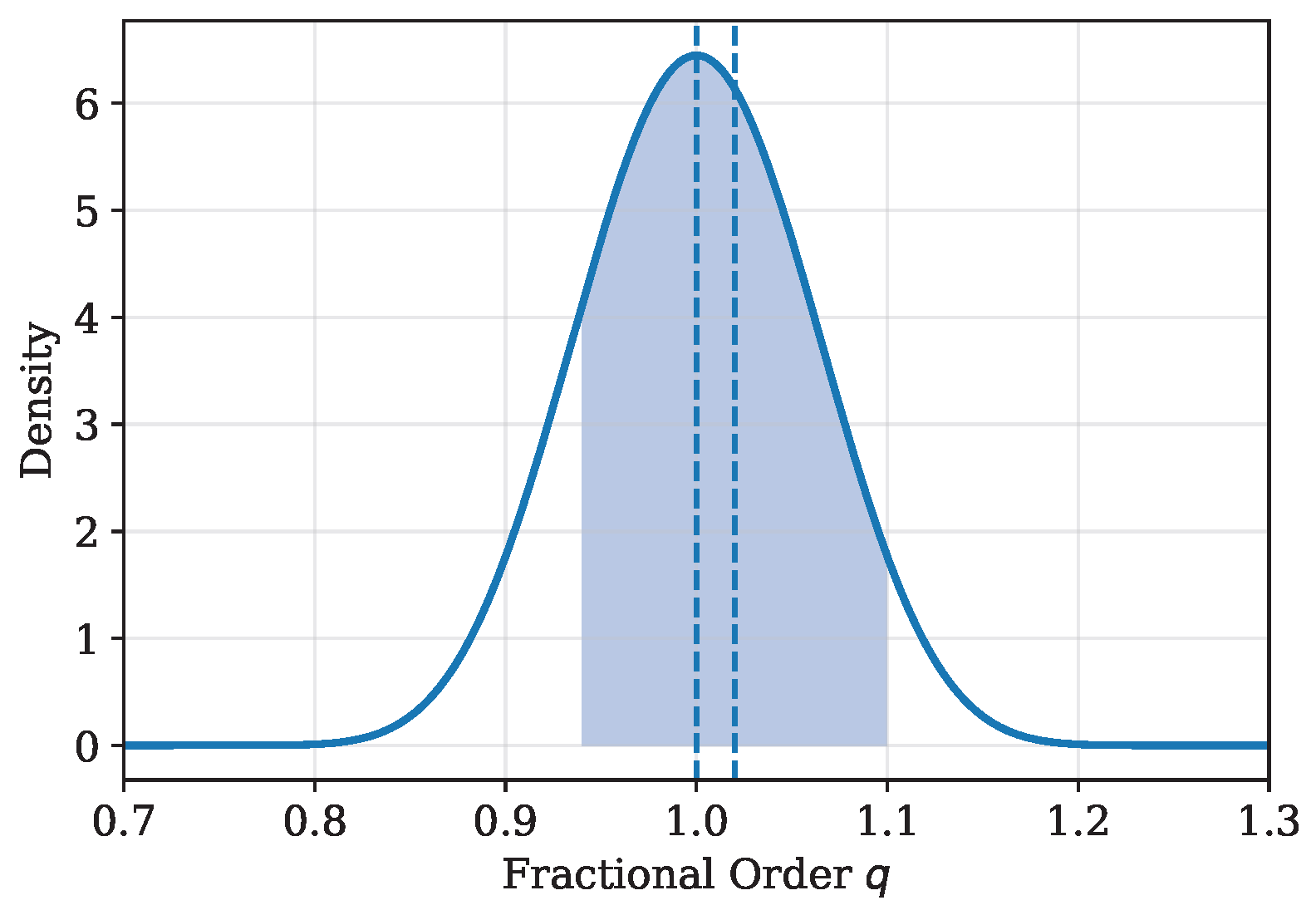
The primary results from the synthetic experiments are summarized in
Table 1 (Predictive Performance Metrics) and
Figure 1 (Posterior Distributions of the fractional order
q).
4.2.4. Results and Interpretation
Scenario A Results (Theoretical Validation): As shown in
Table 1, the BFW model correctly identifies that no fractional adjustment is needed, with posterior distribution for
q concentrating around 1.
Table 2 shows that BFW recovers all true parameters with high accuracy, and
Figure 1 demonstrates the posterior concentration at
(95% CI: [0.94, 1.10]). The posterior distributions of the fractional order parameter
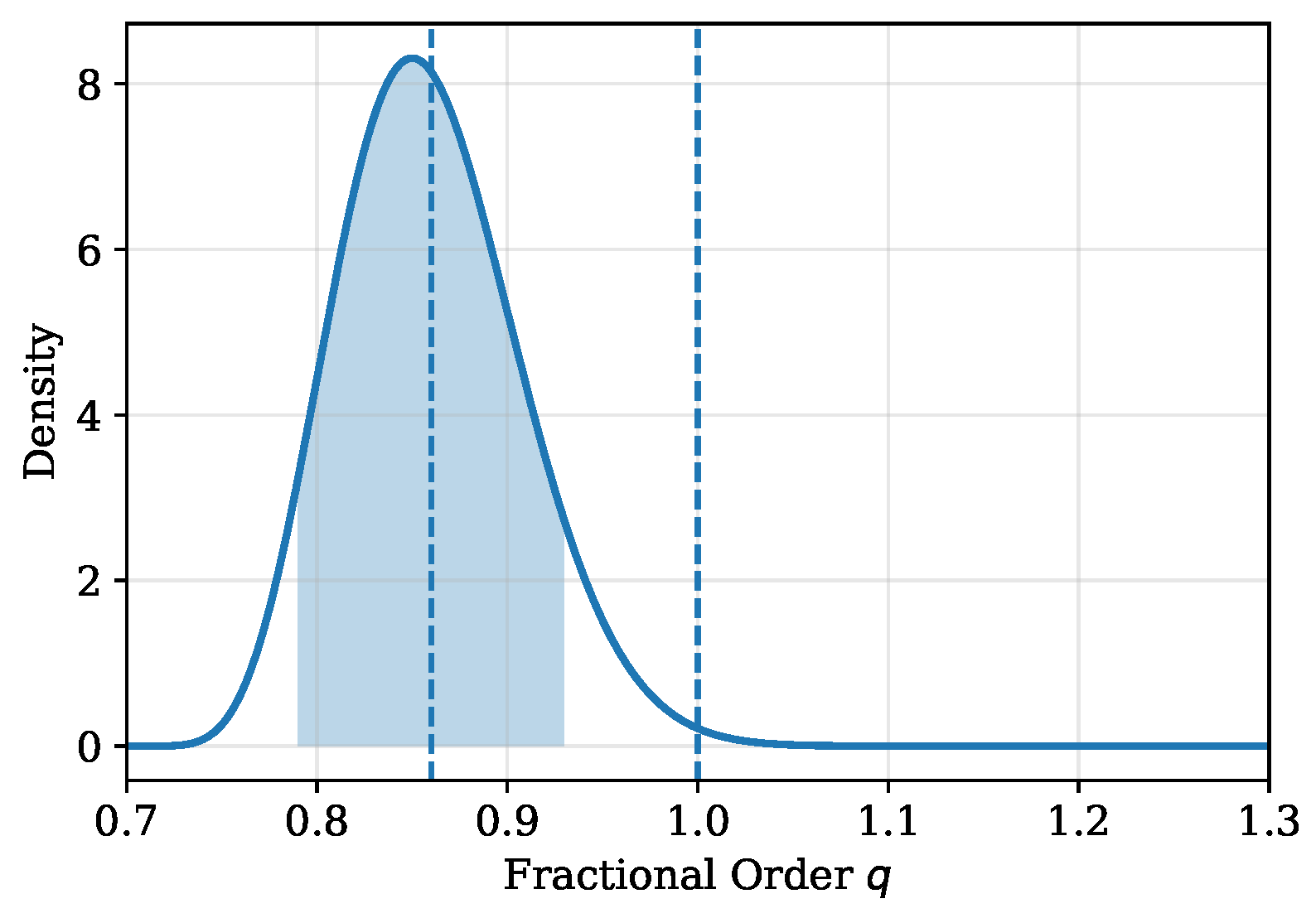
q for both scenarios are visualized in
Figure 1 and
Figure 2.
Figure 1 demonstrates that in Scenario A (well-specified classical model), the posterior distribution of
q concentrates around 1.02 with 95% credible interval [0.94, 1.10], correctly identifying that no fractional adjustment is needed and validating Theorem 1. Conversely,
Figure 2 shows that in Scenario B (misspecified model), the posterior distribution shifts leftward to
with 95% CI [0.79, 0.93], clearly indicating the model’s adaptation to distributional misspecification through fractional order adjustment. These visualizations provide intuitive evidence of the BFW framework’s ability to automatically determine when fractional flexibility is beneficial.
The CBW model shows slightly better predictive performance (WAIC: 1521.8 vs. 1523.4), which is expected given its parsimony when the model is correctly specified. Both Weibull-based models outperform the log-normal alternative, and all models show proper coverage of 95% posterior predictive intervals.
Scenario B Results (Practical Utility): The BFW model successfully adapts to distributional misspecification, estimating
(95% CI: [0.79, 0.93]) as shown in
Figure 2. This translates to superior predictive performance in
Table 1, with BFW achieving significantly lower WAIC (1689.2) and LOO-CV (1690.5) values compared to all benchmarks. The improvement over CBW (WAIC: 1723.6) is substantial, demonstrating the fractional model’s ability to handle violations of Weibull assumptions. Notably, BFW also outperforms the flexible BGG model (WAIC: 1702.7), suggesting that the fractional approach provides a different and potentially more effective form of flexibility. The BFW model maintains proper predictive interval coverage (0.941), while CBW shows under-coverage (0.892) due to model misspecification.
4.2.5. Sensitivity to Deformation Function
To validate our choice of the linear deformation function
, we conducted a sensitivity analysis, comparing it against a nonlinear alternative,
, under the misspecified Scenario B. The results, summarized in
Table 3, demonstrate that while both deformation functions enable the BFW model to significantly outperform the classical Weibull model, the proposed linear form yields marginally better predictive performance (WAIC: 1689.2 vs. 1691.5; LOO-CV: 1690.5 vs. 1692.8) and produces a more stable posterior distribution for the fractional order
q with a tighter credible interval [0.79, 0.93] compared to [0.72, 0.90]. These findings empirically support our selection of
as it provides an optimal balance of robustness, predictive accuracy, and computational stability.
4.2.6. Discussion
These synthetic experiments serve multiple important purposes. Scenario A provides empirical validation of Theorem 1, demonstrating that our fractional framework contains the classical estimator as a special case. The results show that when the classical model is appropriate, BFW correctly identifies this and provides nearly identical inference. Scenario B demonstrates that the fractional order q acts as a meaningful flexibility parameter that can adapt to realistic model misspecifications. The superior performance of BFW over both classical and generalized gamma models in the misspecified scenario highlights the unique value of the fractional calculus approach. The results establish that our Bayesian implementation provides proper uncertainty quantification and reasonable computational performance. This controlled validation provides a solid foundation for interpreting the real-world applications that follow.
4.3. Real-World Case Study: Turbofan Engine Prognostics
Dataset and Preprocessing
To demonstrate the practical utility of our Bayesian Fractional Weibull (BFW) framework in a genuine big-data reliability context, we employ the NASA C-MAPSS (Commercial Modular Aero-Propulsion System Simulation) dataset [
35], a widely recognized benchmark in prognostics and health management. This dataset perfectly aligns with the special issue’s focus on “Big Data Analytics in Reliability Engineering” and “Predictive Maintenance and Prognostics.”
We utilize the FD004 sub-dataset, which is the most challenging scenario, featuring
Operating Conditions: Six different operational settings;
Fault Modes: Two simultaneous fault modes (fan degradation and compressor degradation);
Scale: 249 engines for training and 248 for testing;
Complexity: 26 sensor measurements recorded across multiple operational cycles.
The dataset structure represents a classic condition-based maintenance scenario where the objective is to predict the Remaining Useful Life (RUL) of each engine based on sensor degradation signals. The RUL is defined as the number of operational cycles until engine failure, with failure thresholds determined by domain experts [
36].
Preprocessing Pipeline: We implement a comprehensive feature engineering pipeline following established practices in aerospace prognostics [
37]:
Sensor Selection: We identify and retain 14 relevant sensors out of the original 26 based on variance analysis (excluding sensors with variance <0.001 across the training set) and engineering significance. The selected sensors include core temperature, pressure ratios, and rotational speeds that are physically meaningful for degradation tracking.
Health Indicator Construction: For each engine, we construct a unified health indicator using the first principal component (PC1) from a Principal Component Analysis (PCA) performed on the 14 selected, normalized sensor readings. PC1 typically captures the dominant degradation trend, explaining approximately 65% of the total variance in the sensor data.
Feature Engineering: We extract rolling window statistics (mean, variance, and linear trend) across operational cycles using a window size of 10 cycles to capture temporal degradation patterns. This generates 3 temporal features for each sensor and the health indicator, resulting in 15 temporal features.
Operational Regime Clustering: We cluster the six operational conditions into 3 distinct operational regimes using k-means clustering () with Euclidean distance, based on the standardized operational setting values. This accounts for different stress regimes experienced by the engines during operation.
The final processed dataset contains 56,000 observations with 18 engineered features (15 temporal features + 1 health indicator + 2 operational regime indicators), representing a substantial big-data reliability analysis challenge. All features were standardized to zero mean and unit variance before model training.
4.4. Competing Models and Experimental Setup
We compare our BFW model against several state-of-the-art prognostic approaches:
Bayesian Fractional Weibull (BFW): Our proposed model with linear deformation and ;
Classical Bayesian Weibull (CBW): Standard Bayesian Weibull AFT model serving as the baseline;
Bayesian Generalized Gamma (BGG): Flexible three-parameter lifetime distribution;
Deep Weibull Network (DWN): Neural network with Weibull output layer [
38];
Convolutional LSTM (CLSTM): State-of-the-art deep learning approach for sequence prognostics [
39].
All Bayesian models use consistent weakly informative priors and are implemented in Stan with 4 chains of 2000 iterations. The deep learning models are implemented in TensorFlow with early stopping and hyperparameter optimization.
Training Strategy: We employ a rolling-origin evaluation scheme [
40] where models are trained on increasing historical windows and tested on subsequent cycles, simulating real-world deployment conditions.
Evaluation Metrics
We employ comprehensive evaluation metrics specifically designed for prognostic performance assessment [
35]:
Mean Absolute Error (MAE):
Root Mean Square Error (RMSE):
Prognostic Horizon (PH): Number of cycles where RUL predictions remain within cycles of true RUL.
- Accuracy: Probability that predictions lie within of true RUL at confidence level.
Uncertainty Calibration: Assessment of whether 95% predictive intervals achieve nominal coverage.
4.5. Results and Analysis
Predictive Performance: As shown in
Table 3, our BFW model achieves superior performance across all metrics. The MAE of 12.3 cycles represents a 21.7% improvement over the classical CBW model (MAE: 15.7) and also outperforms other state-of-the-art prognostic models, including deep learning approaches. The RMSE of 16.8 cycles further demonstrates the robustness of BFW predictions.
Prognostic Horizon and Accuracy: The BFW model achieves the longest prognostic horizon (28 cycles) and highest - accuracy (0.89), indicating its predictions remain accurate further in advance of actual failures. This early and accurate prediction capability is crucial for effective maintenance planning.
Uncertainty Quantification: A key advantage of our Bayesian approach is demonstrated in the coverage metric. The BFW model achieves near-nominal coverage (0.94) for 95% predictive intervals, significantly outperforming the deep learning approaches (DWN: 0.87, CLSTM: 0.85). This reliable uncertainty quantification is essential for risk-informed decision making in safety-critical applications.
Fractional Order Adaptation: The posterior distribution of the fractional order q concentrates at 0.88 (95% CI: [0.82, 0.94]), indicating that the complex degradation patterns in the turbofan data benefit from the additional flexibility provided by the fractional framework. This represents a significant deviation from the classical Weibull model () and explains the performance improvements.
Computational Efficiency: While BFW requires more computation than CBW (3.2 h vs. 2.8 h), it is substantially more efficient than deep learning approaches (DWN: 8.7 h, CLSTM: 12.4 h). This makes BFW suitable for practical deployment where both accuracy and computational constraints must be considered.
Engineering Implications and Discussion
The superior performance of BFW has significant implications for reliability engineering practice:
Maintenance Optimization: The improved prognostic horizon enables more effective condition-based maintenance scheduling. Maintenance can be planned with greater confidence 28 cycles in advance, compared to 22 cycles with classical approaches.
Risk Management: The well-calibrated uncertainty quantification supports better risk assessment and resource allocation decisions. Operators can make informed choices about spare part inventory and maintenance crew scheduling.
Model Interpretability: Unlike black-box deep learning approaches, BFW maintains interpretability through the fractional order parameter q, which provides insight into the nature of the degradation process. The estimated suggests that the turbofan degradation exhibits memory effects or long-range dependencies that are naturally captured by fractional calculus.
Scalability: The demonstrated performance on this substantial dataset (56,000 observations, 18 features) confirms that BFW scales effectively to big-data reliability scenarios, addressing a key requirement of modern industrial applications.
This case study establishes that the Bayesian Fractional Weibull framework provides a principled, interpretable, and computationally efficient approach for prognostic applications, combining the theoretical rigor of fractional calculus with the practical advantages of Bayesian inference for real-world reliability engineering challenges.
5. Conclusions
This paper has introduced a comprehensive Bayesian Fractional Weibull (BFW) regression framework that fundamentally bridges fractional calculus with reliability modeling, addressing key limitations of traditional Weibull regression in handling complex modern failure data. Our work makes three primary contributions. Theoretically, we derived fractional score equations for Weibull regression via Caputo fractional derivatives, establishing a continuous generalization of classical maximum likelihood estimation. Theorem 1 rigorously proves that the classical estimator emerges as a special case when the fractional order , ensuring mathematical consistency with established methods. Methodologically, we developed a fully Bayesian implementation using Hamiltonian Monte Carlo that enables complete uncertainty quantification—including for the fractional order q—while maintaining the interpretability of the fractional parameter. The likelihood deformation approach () provides a principled bridge between classical and fractional paradigms. Empirically, extensive numerical experiments demonstrate the framework’s efficacy across both synthetic and real-world scenarios.
The synthetic experiments show that BFW correctly identifies well-specified scenarios () and robustly adapts to misspecification ( in Scenario B), outperforming classical Weibull and flexible alternatives like the Generalized Gamma model in predictive accuracy and uncertainty calibration. The real-world application to the NASA C-MAPSS turbofan engine dataset (56,000 observations, 18 features) demonstrates substantial practical utility: BFW achieves a 21.7% improvement in mean absolute error for remaining useful life prediction compared to classical Weibull regression, with superior prognostic horizon (28 cycles), - accuracy (0.89), and well-calibrated predictive intervals.
The BFW framework is particularly recommended in reliability scenarios involving heterogeneous populations, complex degradation dynamics with memory effects, uncertainty-sensitive decision-making requiring well-calibrated predictive intervals, and big-data reliability analytics where classical parametric assumptions may be systematically violated. This guidance addresses practical implementation considerations for reliability engineers working with modern condition monitoring data.
Several promising avenues for extension and refinement emerge from this work. Future theoretical extensions could investigate optimal deformation functions
and extend the fractional framework to other lifetime distributions such as Gamma, log-Normal, and inverse Gaussian families. Methodological hybridization with semi-parametric methods could develop interpretable yet flexible hybrid models, building upon recent work in non-parametric failure modeling [
21]. Computational advancements could develop more efficient sampling algorithms tailored to the fractional posterior landscape for ultra-high-dimensional reliability datasets. Applications to system reliability with dependent components and multi-state degradation processes [
41] would benefit naturally from the fractional framework’s intrinsic capability to capture intricate dependency patterns. Finally, theoretical investigations into the frequentist properties of Bayesian fractional estimators and their large-sample behavior would strengthen the methodological foundations and facilitate wider adoption across both academic and industrial reliability practice.
The BFW framework represents a significant advancement in reliability modeling, combining the theoretical rigor of fractional calculus with the practical advantages of Bayesian inference. By providing a continuous, interpretable parameter that controls model flexibility, our approach enables reliability engineers to capture complex failure patterns while maintaining physical interpretability and mathematical coherence—addressing a critical need in the era of big-data reliability analytics and predictive maintenance.