1. Introduction
The study of human decision-making has a history spanning more than two centuries, and contemporary research in this field has advanced across diverse theoretical directions. These include resource-rational behavior under cognitive constraints [
1], decision-making under uncertainty [
2], boosting approaches to improve decision performance [
3], iterative first-order methods for computing equilibria in large-scale extensive-form games [
4], robust optimization frameworks incorporating decision-dependent information discovery [
5], and machine-learning-based models of decision processes [
6].
However, these theoretical frameworks typically assume some form of optimality in human decision-making and therefore provide limited insight into the qualitative cognitive processes underlying everyday multi-attribute decision-making, such as those observed in consumer behavior or personal life choices. Although individuals often attempt to make optimal decisions—particularly when the stakes involve financially or personally important attributes [
7,
8,
9,
10]—real-world decisions frequently involve trade-offs across multiple conflicting values. This type of judgment is referred to as multi-attribute decision-making. Empirical research has consistently shown that such contexts often lead to suboptimal choices [
11,
12,
13].
Recent developments in decision theory have increasingly aimed to improve decision quality [
9,
14,
15,
16,
17] while also seeking to explain systematic deviations from normative theories that assume perfect rationality—such as expected utility theory and nonlinear variants of utility-based models [
9,
10,
18,
19]. As a result, the field is moving toward a more comprehensive understanding of how humans form judgments and make decisions under value pluralism, cognitive constraints, and real-world uncertainty [
20,
21].
A substantial proportion of real-world human decision-making involves multi-attribute choice, wherein individuals evaluate and compare alternatives based on multiple attributes. Although such tasks provide decision makers with several dimensions of information, prior research has shown that individuals do not necessarily incorporate all available information when making a choice. Instead, they rely on systematic procedures referred to as decision strategies. A decision strategy is defined as the mental sequence through which alternatives are evaluated and ultimately selected [
22,
23]. These strategies are often characterized as decision heuristics, in contrast to algorithmic procedures designed to guarantee optimal solutions [
10].
Heuristics typically enable fast and computationally efficient decision-making, but they can also lead to suboptimal or inconsistent outcomes depending on contextual constraints. Because human decision strategies generally employ heuristic rather than algorithmic reasoning, researchers frequently analyze information search behavior to infer the underlying strategy [
22,
23]. Conceptually distinct from information search strategies, decision strategies nonetheless strongly correlate with observable search patterns. A long-standing perspective in cognitive decision theory argues that humans do not maximize utility in the normative sense [
10,
22,
23]. Numerous heuristic strategies—most associated with constraints in human information processing—have been documented [
10,
22,
23,
24].
The present study develops simple probabilistic models quantifying the information processing steps associated with several representative decision strategies. Based on these models, we aim to predict decision time and expected information search effort in multi-attribute decision tasks with varying numbers of alternatives and attributes. A major advancement was the Adaptive Decision-Maker (ADM) framework proposed by Payne, Bettman, and Johnson [
22,
23], which formalized decision strategy execution as a trade-off between cognitive effort and accuracy. Their simulation-based approach defined effort using the number of elementary information processes (EIPs), including operations such as reading values, comparing attributes, arithmetic operations (addition, subtraction, multiplication), eliminating options, moving across attributes, and final selection.
Recent computational studies extend the ADM framework to predict strategic behavior across task structures [
20,
21]. However, purely simulation-based approaches often lack closed-form expressions and, consequently, limit analytical tractability and scalability for applications such as consumer-choice forecasting. In previous research [
20,
21,
22,
23,
24,
25], decision strategies have typically been implemented via computer simulations, and decision times implied by these strategies have been measured, or alternatively, examined empirically in psychological experiments. However, under such approaches, it remains difficult to derive mathematical predictions for the time required to reach a decision or for the sequence of information processing steps associated with different decision strategies. Although prior studies have demonstrated that researchers’ choices regarding model specification and estimation procedures can substantially affect inferences, and that simpler models can in some cases yield inferential accuracy comparable to that of more complex models—thereby highlighting both theoretical and empirical limitations of response time models [
26,
27]—it would nevertheless be highly advantageous to have models that can predict decision times and information processing steps as a function of decision strategy. In particular, the ability to predict decision times using relatively simple models would be valuable for understanding and forecasting decision processes in consumer behavior. To address this issue, we attempt to propose a simple model, based on minimal assumptions, that enables explicit predictions of both the time required to reach a decision and the sequence of information processing steps involved in the decision-making process. We analytically estimate decision time in multi-attribute choice as the numbers of options and attributes vary, and we evaluate predictive validity by comparing our analytical predictions with (1) computational results derived from the ADM framework (using the Mersenne Twister pseudo-random number generator) and (2) empirical psychological data on observed decision time. We assess convergence via correlations across these data sources to establish the predictive validity of the proposed models.
2. Probabilistic Models of Information Processing Steps in Decision Strategies
2.1. Targeted Decision Strategies
In this study, we develop probabilistic models describing the expected number of information processing steps for five representative decision strategies: the additive (ADD), conjunctive (CON), disjunctive (DIS), lexicographic (LEX) including lexicographic semi-order (LEX-SEMI) strategies. However, because LEX and LEX–SEMI can be interpreted as differing only in the setting of their thresholds, we treat them jointly and refer to them collectively as LEX in the present study. Accordingly, four decision strategies are taken as the targets of analysis. The reason for focusing on these four strategies is twofold. First, they have repeatedly been identified as representative strategies in previous research on multi-attribute decision-making processes [
20,
21,
22,
23,
24,
25]. Second, our selection is informed by the results reported by Takemura et al. [
20]. In that study, 45 decision strategies, including multistage strategies, were analyzed using hierarchical cluster analysis and multi-dimensional scaling based on choice consistency rates obtained from computer simulations. The results showed that these strategies could be classified into an ADD–LEX strategy group, a CON strategy group, and a DIS strategy group [
20]. Therefore, examining the four strategies considered here is expected to be effective and informative for investigating decision strategies in multi-attribute decision-making.
Under the additive (ADD) strategy, the decision-maker evaluates all alternatives across all attributes and computes a global evaluation score for each alternative. The alternative with the highest global score is then selected. The additive strategy may take two forms: a weighted additiverule (WAD), where each attribute is assigned a distinct weight, and an equal-weight rule (EQW), where all attributes contribute equally.
Under the conjunctive (CON) strategy, a minimum acceptable threshold is set for each attribute. If an alternative fails to meet the threshold for any attribute, evaluation of that alternative is immediately terminated, and the alternative is rejected. When selecting a single option, the first alternative satisfying all attribute thresholds is chosen.
Under the disjunctive (DIS) strategy, a sufficient threshold is set for each attribute. If an alternative satisfies the threshold for any attribute, it is accepted regardless of its values on the remaining attributes.
Under the lexicographic (LEX) strategy, alternatives are compared sequentially based on the importance ranking of attributes. The alternative with the highest value on the most important attribute is chosen. If two or more alternatives tie, the comparison proceeds to the next most important attribute.
The lexicographic semi-order (LEX-SEMI) strategy is a relaxed version of the strict lexicographic rule, where small differences within a predefined tolerance are treated as equivalent, resulting in tie-breaking at the next attribute.
2.2. Assumptions and Formal Definitions
We consider multi-attribute decision tasks defined over
N attributes and
M alternatives. Let
E denote the expected number of information processing steps for a given strategy. We express expectations using the notation:
where each term denotes the expected number of information processing steps required by the corresponding strategy. We further assume that is proportional to the time required for decision-making. This assumption allows the experimental results to be analyzed.
To simplify analysis, attribute values x are assumed to be independently drawn from a uniform distribution over the interval . This assumption is admittedly strong and subject to further debate; however, it is useful for developing a more intuitive model for examining decision strategies under highly simplified assumptions.
Let or S denote the random variable representing the number of information processing steps required for a set of alternatives A. We define two random values:
When specifying a strategy explicitly, we use superscript notation, for example:
For tractability, we assume that each information processing event corresponds to a single unit step and that all processing steps are independent and identically distributed (i.i.d.). Furthermore, the independence of these two components cannot be guaranteed on theoretical grounds. In the cases of the LEX and LEX–SEMI models, the two components are inherently dependent given the structure of the models. In contrast, for the ADD, CON, and DIS models, assuming independence between the two components does not necessarily lead to any theoretical inconsistency. Moreover, given the nature of these models, the assumption of independence may even be considered natural. Although it is conceivable that the aspiration level changes as a consequence of the search among alternatives, for the sake of analytical simplicity we assume independence between the two components in these strategies.
Thresholds used in the conjunctive and disjunctive strategies are denoted by
. An attribute satisfies the requirement if its value
x satisfies:
Except for the additive strategy, the number of information processing steps is probabilistic, and therefore the model evaluates expected values rather than deterministic step counts.
2.3. Probabilistic Models and Expected Information Search Steps for Decision Strategies
2.3.1. Additive Strategy (ADD)
Expected Variance of Search Steps
The variance of the number of searches under ADD is:
Proof. Since the number of search steps is constant and does not depend on search order or probabilistic termination, its variance is trivially zero. □
2.3.2. Conjunctive Strategy (CON)
In the conjunctive strategy (CON), information search for a given alternative is terminated as soon as any attribute fails to meet the decision threshold. Conversely, if all attributes satisfy the threshold, the alternative is accepted and search stops. Assuming independence between
and
, and given independent and identically distributed (i.i.d.) attribute evaluations, the expected number of search steps can be expressed as:
Expected Search Count
Let the threshold parameter be
. If attribute values are uniformly distributed over
, the probability that a given alternative satisfies the threshold on all
N attributes is:
Since selection proceeds until the first satisfactory alternative is found, the number of alternatives inspected follows a geometric distribution with expected value:
Likewise, for attribute-level inspection, the stopping probability is
d, yielding:
Proof. Under the CON criterion, an option must exceed the threshold on all attributes. Therefore, the probability that a given option satisfies the CON criterion is
To evaluate the summation, consider the Macalurin expansion of
:
Differentiating both sides with respect to
x yields
Substituting
gives
which coincides with the summation term above. Hence, the expectation is
By an analogous argument, we obtain
Assuming independence between trials, the expected number of information searches under the CON strategy is therefore
□
2.3.3. Disjunctive Strategy (DIS)
Under the disjunctive strategy (DIS), the search process terminates as soon as any attribute of an alternative meets the threshold criterion. Thus, if at least one attribute satisfies the threshold, the search for that alternative ends immediately. Assuming independence among search trials, the expected total number of information search steps can be expressed as:
Expected Number of Search Steps
Assuming attribute values are uniformly distributed over
, the probability that a given attribute satisfies the threshold
d is
, and the probability of failing to meet the threshold is
d. Therefore, for an alternative with
N independent attributes, the probability that none of the attributes satisfy the threshold is:
Hence, the probability that at least one attribute satisfies the threshold—i.e., the probability the search terminates on a given alternative—is:
Since search stops when the first qualifying alternative is encountered, the number of inspected alternatives follows a geometric distribution, yielding:
Similarly, the attribute-level search within each alternative terminates when the first attribute exceeding the threshold is found; this probability is
. Therefore,
Thus, the expected number of information search steps is:
Proof. The result follows directly from the expectation of geometric random variables:
Applying this formulation to both alternative-level and attribute-level stopping criteria yields the above expression. □
Variance of Search Steps
The variance of total search steps under the disjunctive strategy is:
Proof. Assuming independence between alternative-level and attribute-level search processes, and using the variance identity for the product of independent random variables, together with the variance of a geometric distribution,
substitution yields the stated result. □
2.3.4. Lexicographic Strategy (LEX) and Lexicographic Semi-Order Strategy (LEX-SEMI)
Let M denote the number of alternatives and N the number of attributes. Let P be defined as the probability that the difference between the highest attribute value and the second-highest attribute value lies within the interval . Under this definition, P represents the probability of a decision tie for LEX and the probability of a near-tie (within tolerance d) under LEX-SEMI. Therefore, within the proposed mathematical modeling framework, LEX and LEX–SEMI are regarded as differing only in their threshold settings. Accordingly, we treat these two strategies jointly and consider them collectively as LEX in the present analysis.
We consider the case in which the number of attributes
N and the number of alternatives
M are both finite. Let
P denote the probability that, given
N attributes, the difference between the maximum attribute value
y and the attribute value ranked immediately below it is between 0 and
d (inclusive). In other words, Prepresents the probability of a tie in the case of LEX, and the probability of a near tie (within margin
d) in the case of LEX-SEMI. When the attribute values
are continuous or discrete, the probability is given as follows. For the discrete case,
where
Here, denotes the discrete probability distribution of attribute values.
Let
denote the number of searches required by the LEX strategy. Assuming that the probability
P is identical across all attributes, the expected number of searches can be expressed as the following geometric series:
To facilitate mathematical analysis, we next consider a continuous model. Specifically, in what follows we assume that both the number of attributes N and the number of alternatives M are infinite. Although this assumption may appear unnatural—and may be problematic when the numbers of attributes or alternatives are extremely small—it is useful for capturing the overall tendencies of the model. In particular, as M and N become large, the relevant quantities converge, making this approximation analytically tractable. By extending the discrete model above to the continuous case, we can derive the expected value of the number of searches and the expected value of its variance for lexicographic-type strategies (including LEX-SEMI) as follows.
Expected Search Steps
If the number of attributes is sufficiently large, the expected number of search steps approaches:
Similarly, under the lexicographic semi-order:
Proof. The expected number of information searches under the LEX strategy is given by
Factoring out
m, the terms
are seen to converge to
M. Similarly, grouping the terms with factor
yields
which converges to
. Proceeding in the same manner, the terms multiplied by
converge to
.
Assuming that the number of attributes is infinite, it follows that
By an analogous argument, the expected number of information searches under the LEX–SEMI strategy satisfies
□
Although the procedures used to compute the expectations for LEX and LEX–SEMI differ substantially, the resulting expectations coincide with those of a geometric distribution.
3. Numerical Evaluation of the ADD, CON, DIS, and LEX Models
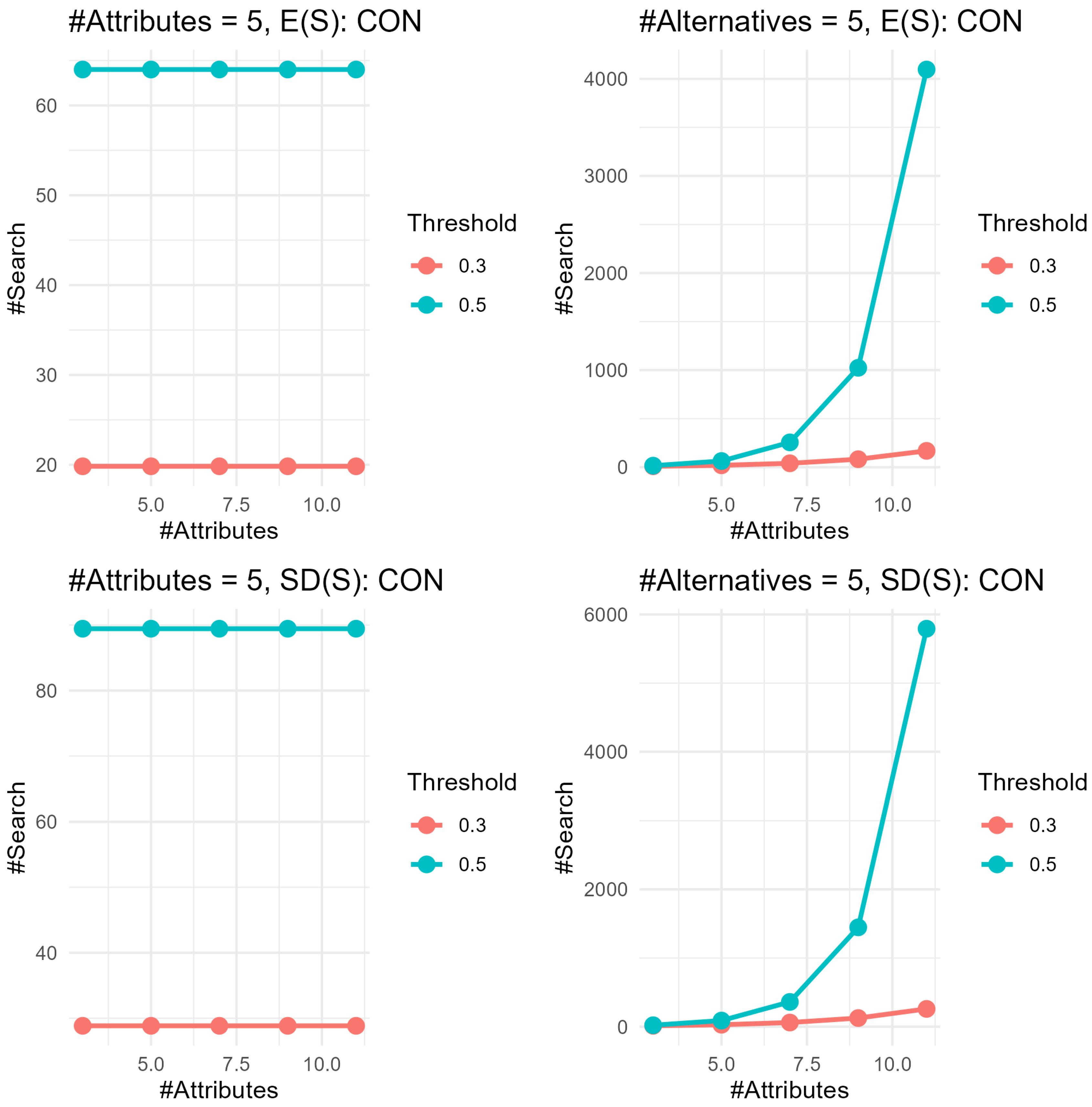
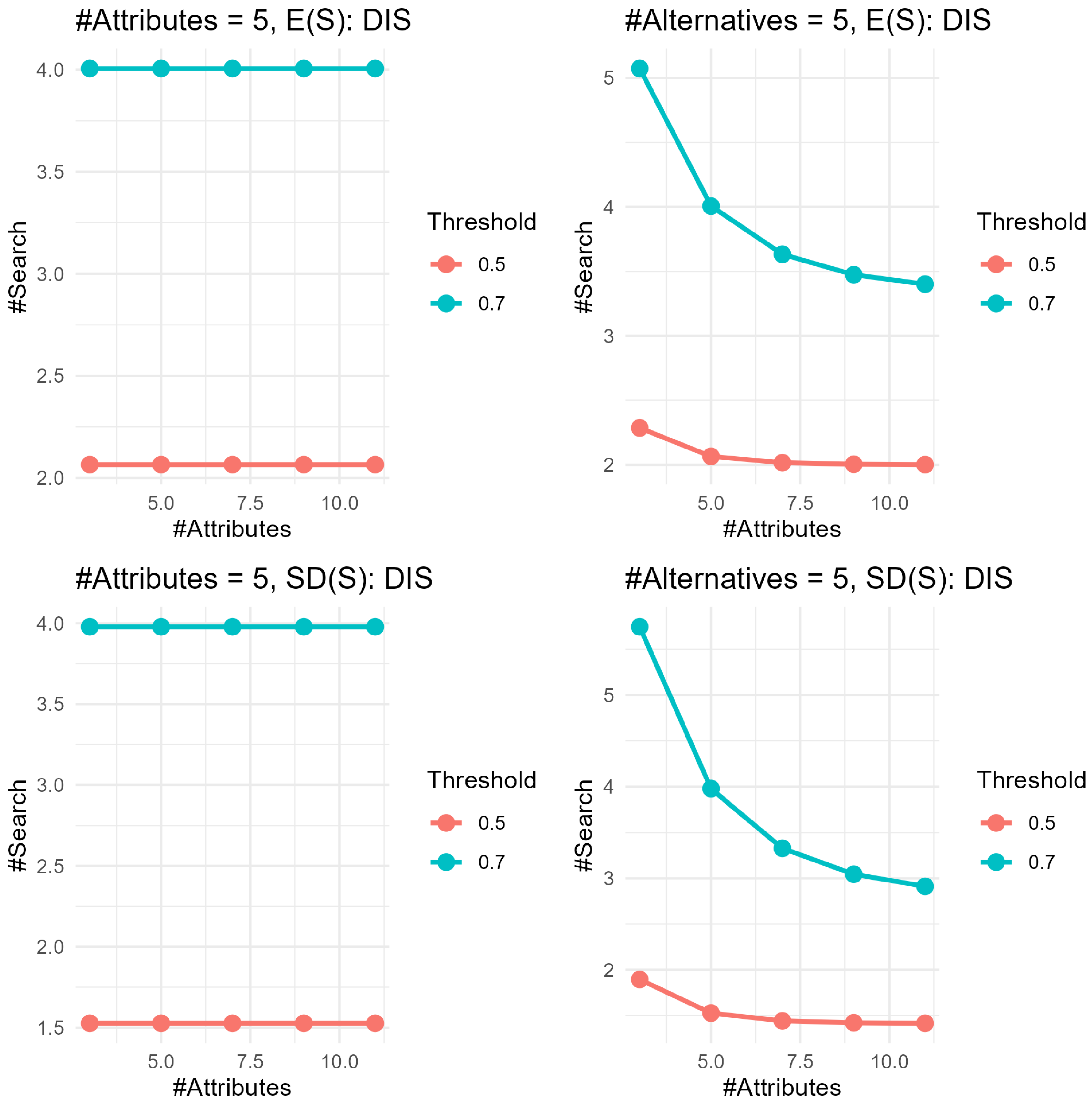
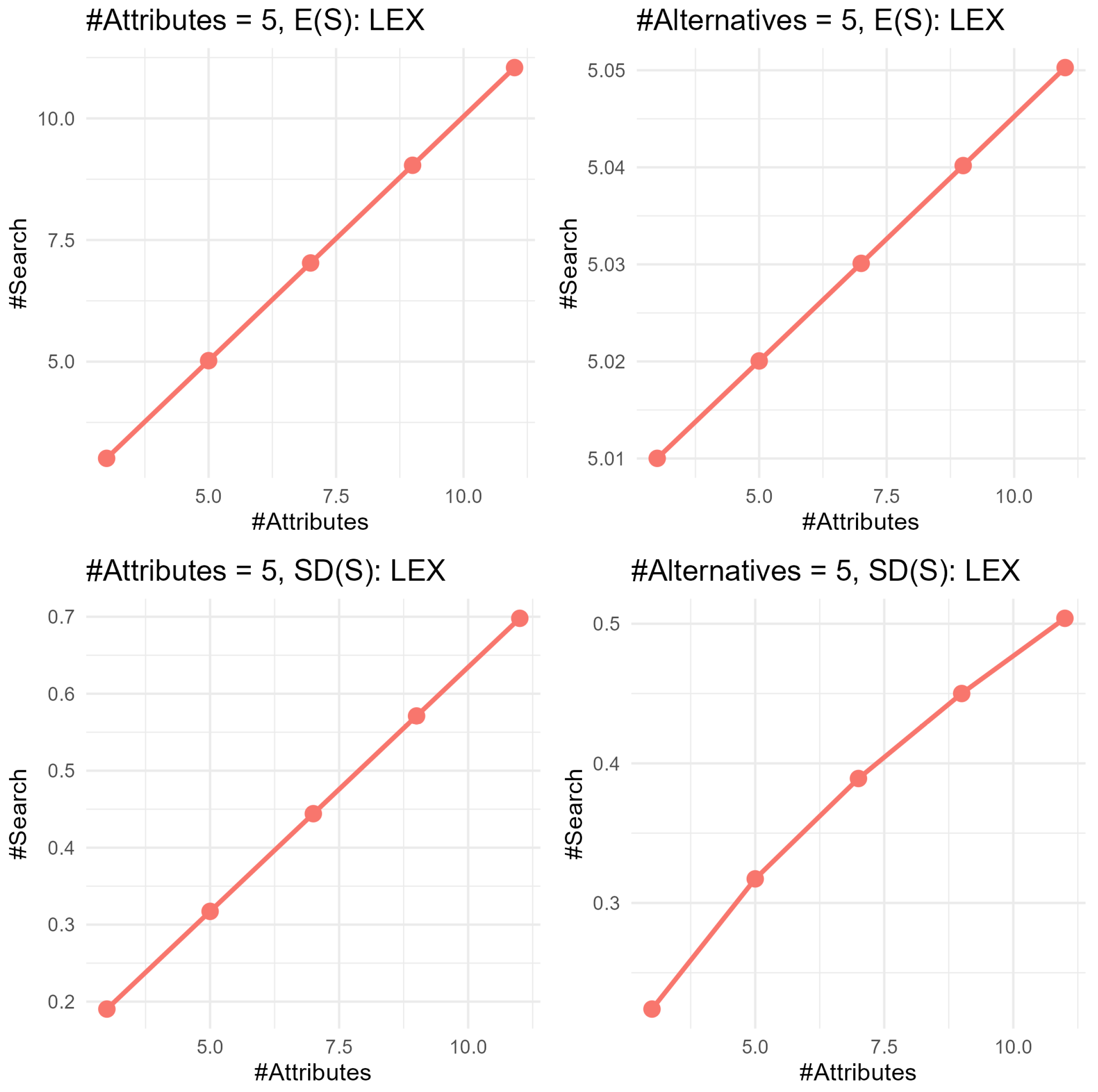
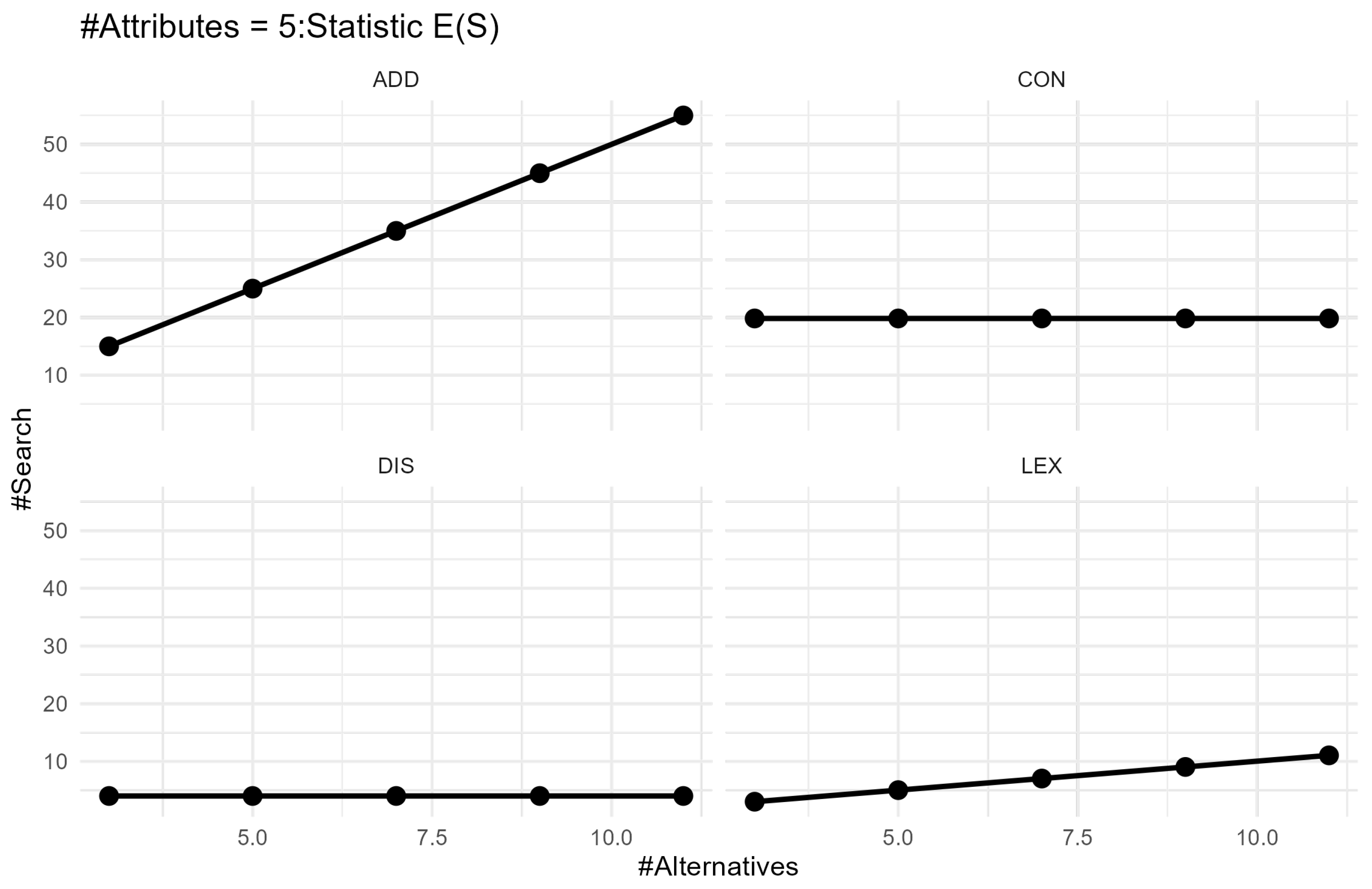
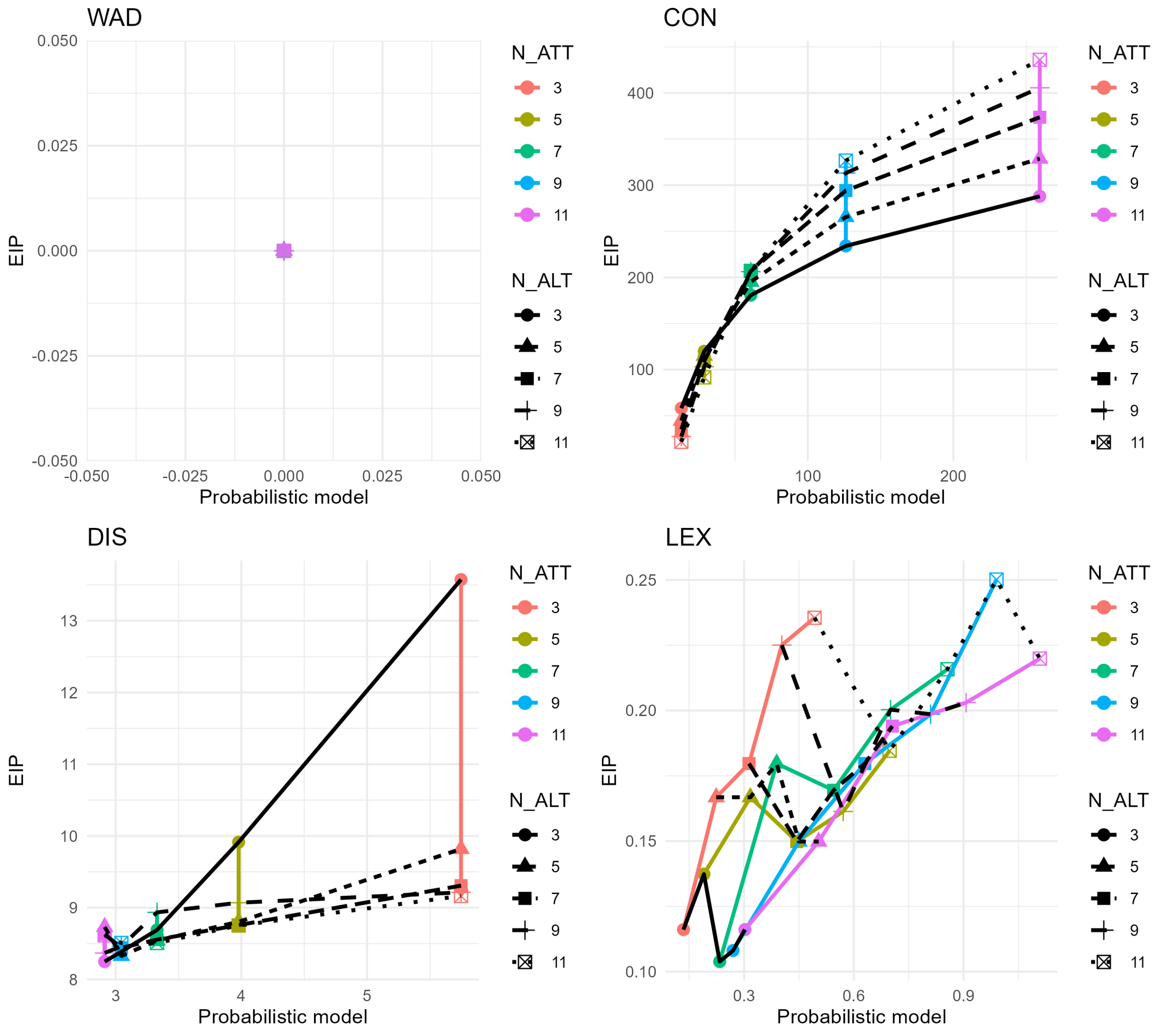
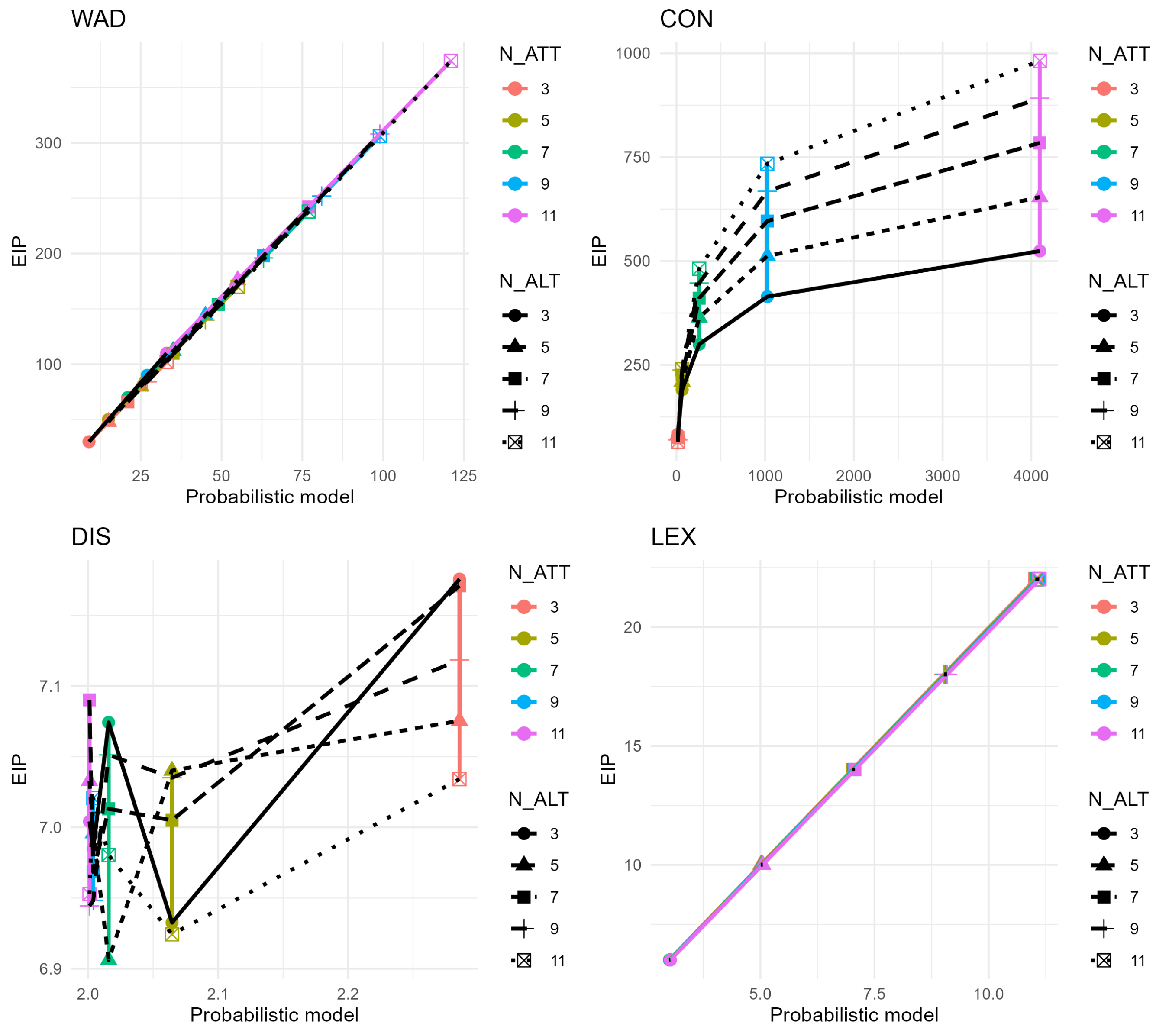
This section presents numerical evaluations of the proposed probabilistic models corresponding to the ADD, CON, DIS, and LEX decision strategies. For each strategy, expected information search counts were computed under varying numbers of alternatives and attributes. The results are summarized in
Figure 1,
Figure 2,
Figure 3 and
Figure 4.
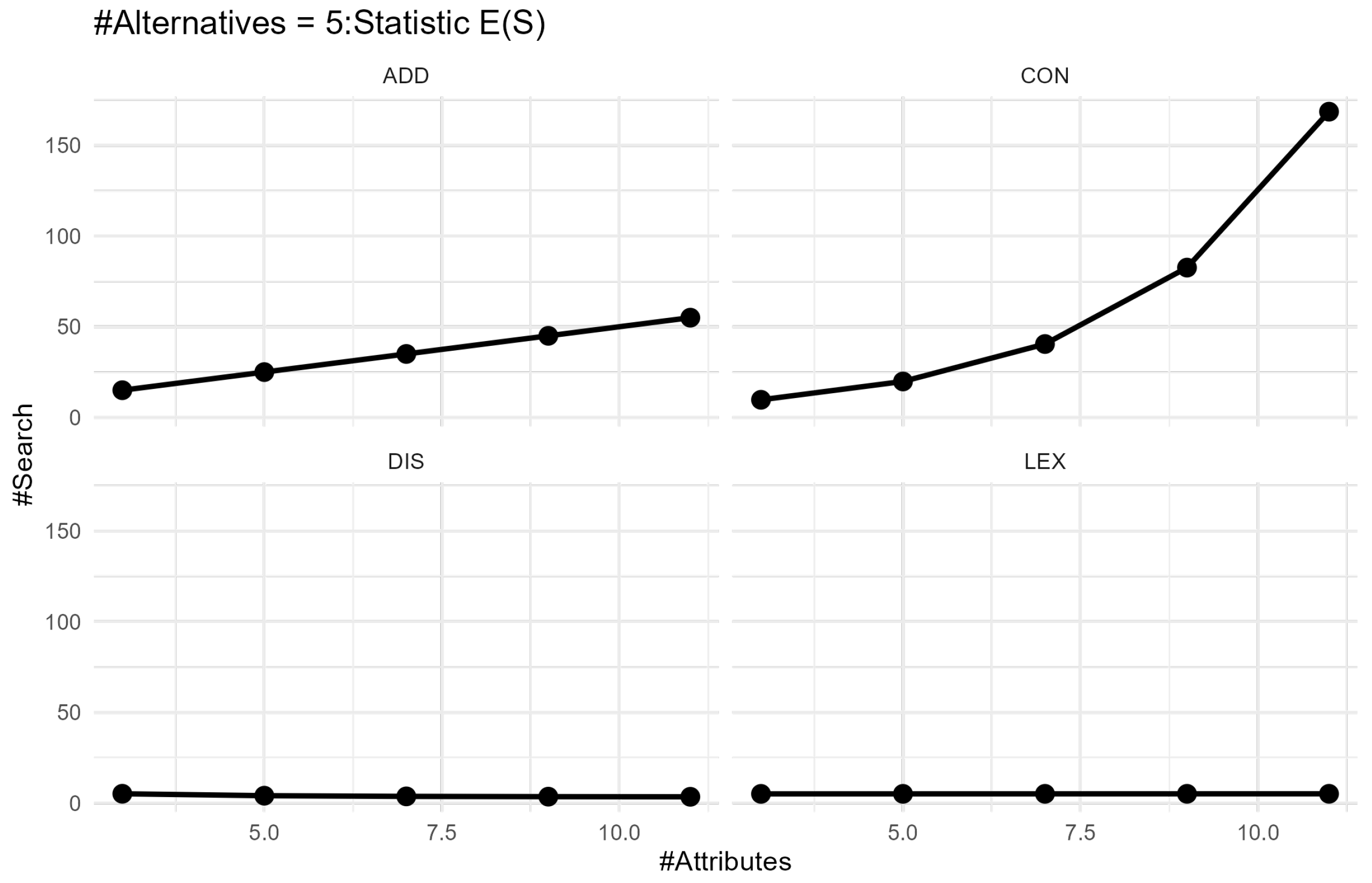
Figure 1 shows that the number of information search steps under the ADD model increases linearly as both the number of alternatives and the number of attributes increase. In contrast, the results for the CON and DIS models exhibit markedly different patterns depending on the strictness of the decision threshold parameter d. Specifically,
Figure 2 presents the results for the CON strategy under
and
, respectively, whereas
Figure 3 reports the results for the DIS strategy under
and
. In practice, under the CON condition, options often cannot be accepted unless the aspiration level is set relatively low; therefore, a lower value such as 0.3 is used. In contrast, under the DIS condition, if the aspiration level is relaxed, options are accepted too quickly; thus, a higher value such as 0.7 is used in the numerical examples. However, the specific aspiration levels actually employed by decision-makers remain open to debate. Nevertheless, assuming that these strategies are indeed adopted in practice, it is to some extent possible to inversely estimate the aspiration level (threshold) from the fit to reaction time data as shown in
Section 5.
The results indicate that the expected information search count for the CON model is largely unaffected by the number of alternatives, while it increases substantially with the number of attributes. Furthermore, comparing lines of
and
in
Figure 2 reveals that stricter threshold values lead to an even sharper increase in expected search count as the number of attributes increases. In contrast, the DIS model exhibits the opposite trend: as shown in
Figure 3, stricter thresholds lead to a greater reduction in expected search effort when the number of attributes increases. Since the stopping probabilities for CON and DIS do not depend on the number of alternatives, neither strategy is affected by the size of the choice set. This indicates that the CON and DIS strategies behave in ways that are nearly complementary.
Figure 4 illustrates the expected information search count under the LEX model. Unlike the preceding models, LEX is sensitive to the number of alternatives but shows almost no increase in search effort as the number of attributes increases. Moreover, in comparison with ADD, the effect of the number of alternatives on expected search effort remains modest.
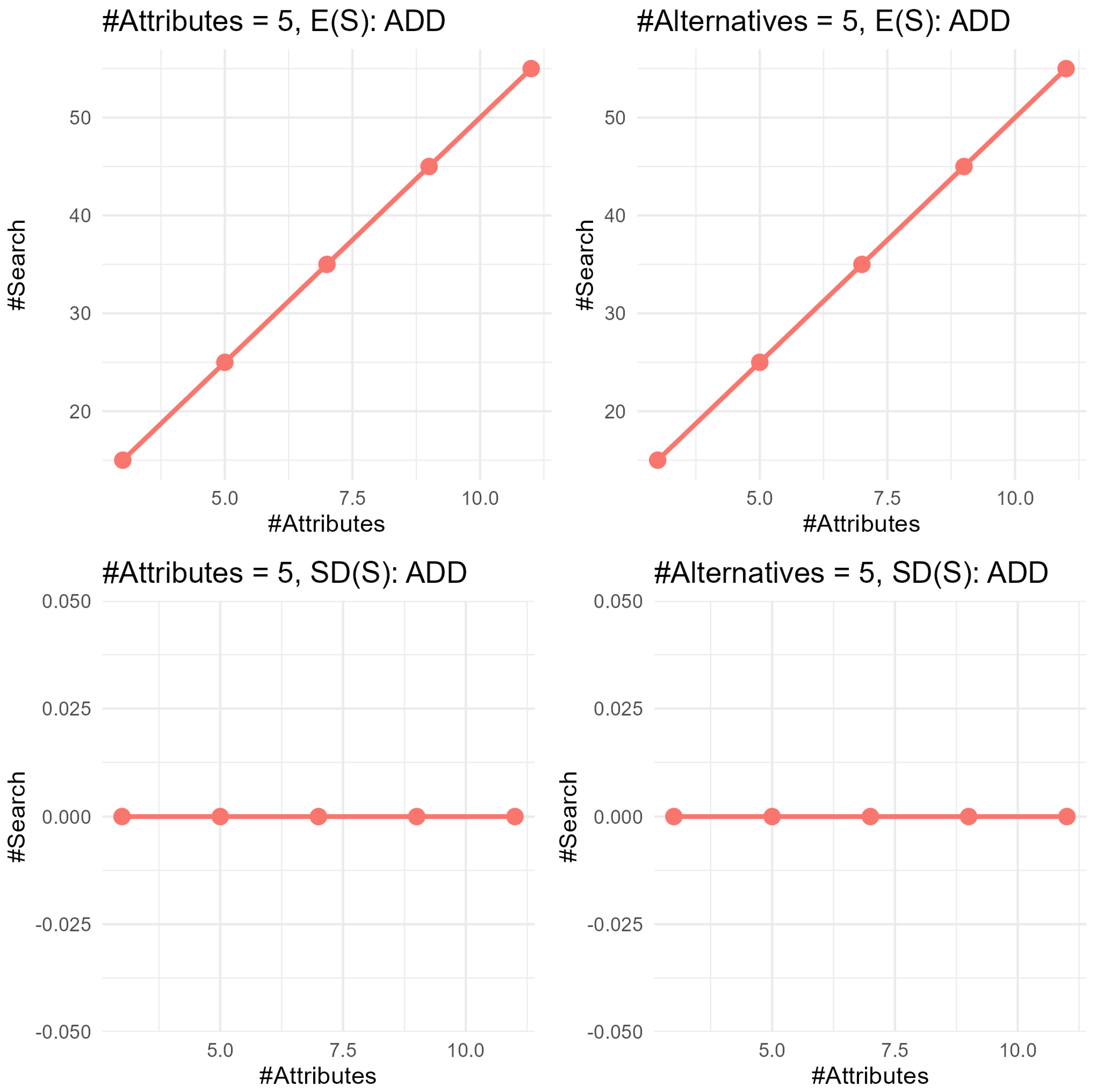
Figure 5 and
Figure 6 summarize the expected search counts for each strategy when either the number of alternatives or the number of attributes is fixed at five. These results clearly demonstrate the following patterns:
the CON strategy is highly sensitive to increases in the number of attributes,
ADD exhibits an increasing trend in response to both parameters, and
DIS and LEX show only limited sensitivity to the size of the choice set.
4. Comparison with the Adaptive Decision-Maker Model
A comparable construct to the expected number of information acquisitions in our analytical models is the Elementary Information Processing(EIP) proposed in the Adaptive Decision-Maker (ADM) framework by Payne, Bettman, and Johnson [
23,
24]. The EIP [
23,
24] is derived through computational simulations based on predefined procedural decision rules and implemented using Mersenne Twister randomization.
In this study, we compared the predictions of our mathematical framework with EIP estimates obtained from ADM-based simulations. Following established simulation protocols [
20,
21,
23,
24], we evaluated four decision strategies: weighted additive (WAD), which is a type of ADD, conjunctive (CON), disjunctive (DIS), and lexicographic (LEX). Attribute values were generated using a uniform random integer distribution ranging from 1 to 1000. The number of alternatives and attributes were systematically varied across five levels each: 3, 5, 7, 9, and 11. Attribute weights were sampled from a uniform distribution over
and normalized such that the sum of all weights equaled 1. Each simulation was repeated 10,000 times per condition.
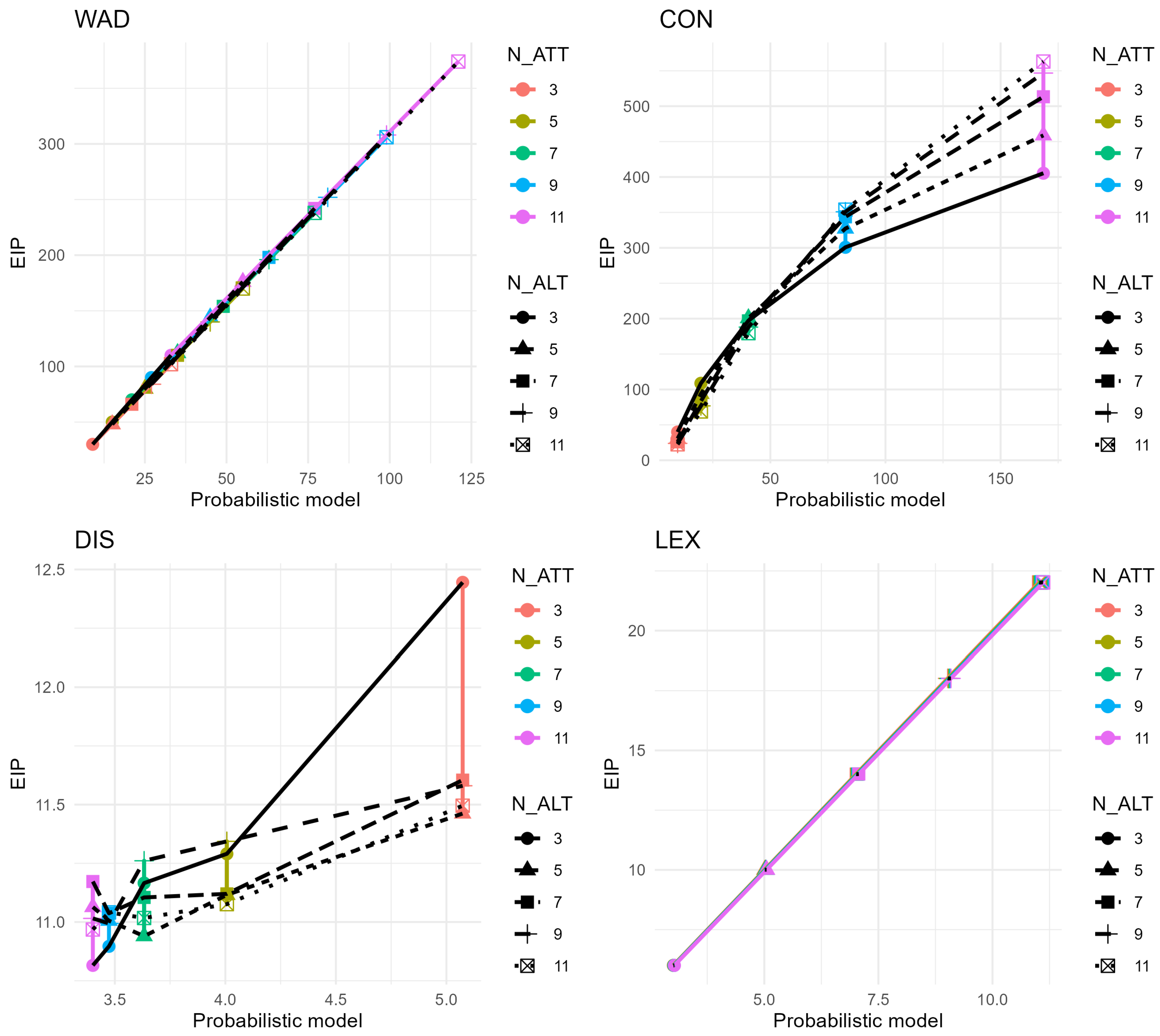
Figure 7 and
Figure 8 present a comparison between the model predictions and the simulation-derived EIP values under the parameter settings
for the conjunctive rule and
for the disjunctive rule.
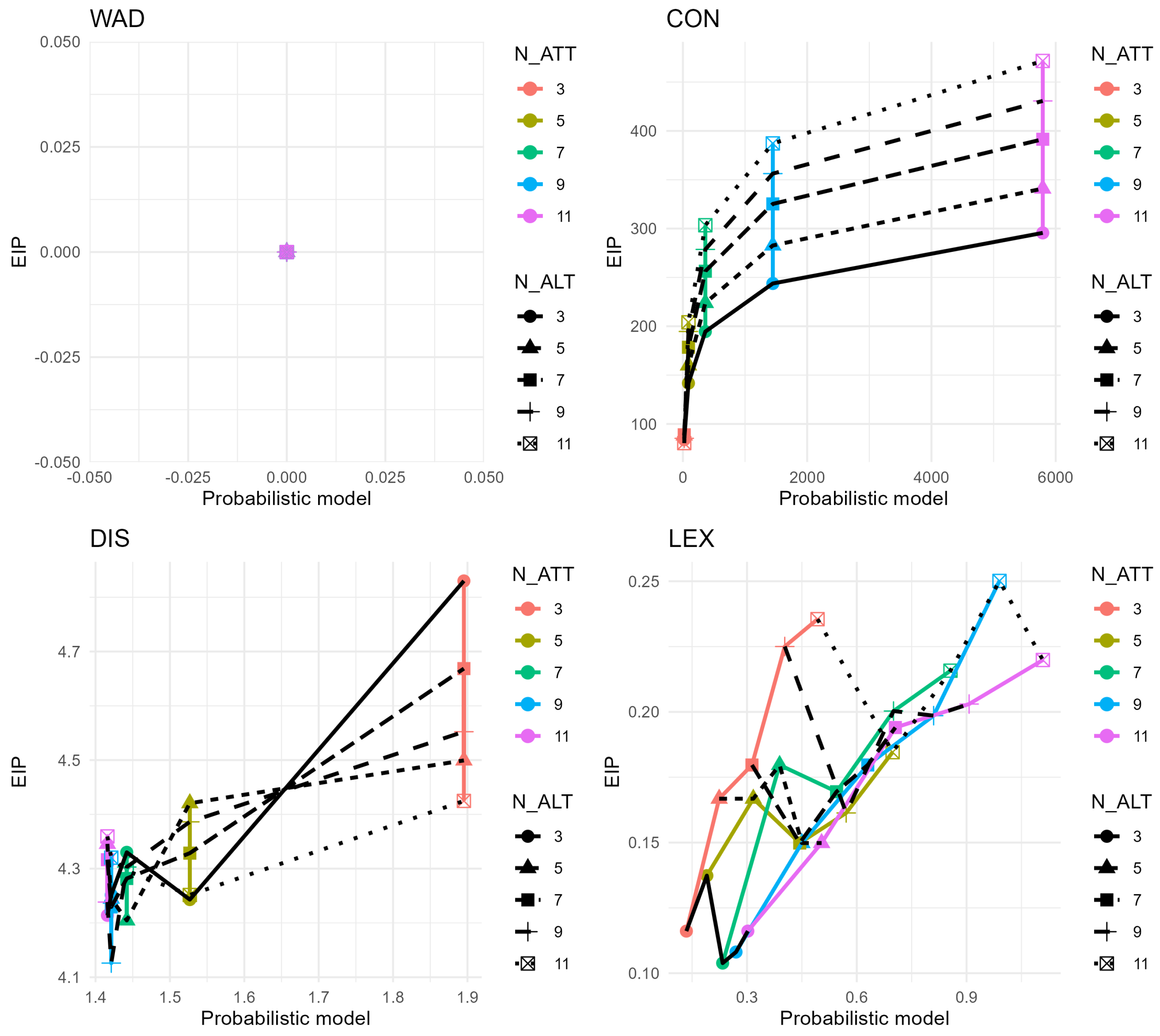
Figure 9 and
Figure 10 illustrate the corresponding mean and standard deviation values for an alternative parameter set with
for both CON and DIS. In the model prediction, the threshold
was used. Because the WAD strategy yields zero theoretical variance in search operations, standard deviation-based comparisons for WAD were omitted.
Although the computational simulation results and the analytical predictions were not identical across all conditions, both methods exhibited similar overall trends. Notably, the predicted pattern of information search complexity closely aligned with the simulated EIP across increasing decision task difficulty. These results suggest that the proposed probabilistic mathematical model captures essential structural properties of cognitive effort as defined in adaptive decision-making theory.
5. Comparison with Behavioral Decision-Making Data
Takemura [
25] conducted an empirical study to investigate differences in decision time among several decision strategies, including the additive strategy (ADD), conjunctive rule (CON), lexicographic rule (LEX), and the additive-difference strategy (ADF). A total of 208 Japanese undergraduate students (160 male, 48 female) participated in the experiment. Participants were assigned to one of four conditions defined by the number of alternatives (4 or 10) and the number of attributes (4 or 10). They were asked to select a cassette player according to the assigned decision strategy, and the time required to reach a decision was recorded. In the present analysis, the additive-difference condition was excluded, and only ADD, CON, and LEX conditions were examined.
Prior to the main task, each participant was provided with a written explanation of the assigned strategy and instructed to read and understand it. The experimenter subsequently provided a verbal explanation using a blackboard, without mathematical notation, and participants were encouraged to ask clarifying questions. Comprehension checks were administered to ensure correct understanding of the assigned strategy. Participants then completed practice trials in which they applied the assigned rule and practiced measuring decision time using a digital stopwatch.
A preliminary survey was conducted with 137 students (76 males, 61 females) to determine relevant product attributes. Participants freely listed attributes they would consider when purchasing a cassette player, and the most frequently mentioned characteristics were adopted as stimulus attributes. The final attribute set included: (1) design, (2) sound quality, (3) tape deck functionality, (4) manufacturer, (5) ease of use, (6) weight, (7) durability, (8) color, (9) size, and (10) popularity. In the low-attribute condition, only the four most frequently reported attributes were presented; in the high-attribute condition, all ten attributes were included. Each attribute was evaluated on a five-level rating scale.
To compare the empirical data with the proposed mathematical models, expected search values were computed for ADD, CON, and LEX models. For CON, three threshold values were tested (
), and for LEX the probability parameter
was set to 1/5 and
, corresponding to the five attribute value levels, then
. Correlations and coefficients of determination (
) between the empirical decision times and model predictions are reported in
Table 1, calculated separately for mean decision time and standard deviation (SD). Since the normalized expected search variance for CON does not depend on the threshold value, the correlation coefficients remained constant across thresholds; therefore, only one value is reported.
Although several discrepancies were observed between the model predictions and the empirical data, the presence of moderate to strong relationships suggests that the proposed probabilistic model adequately captures the general tendencies of human decision times.
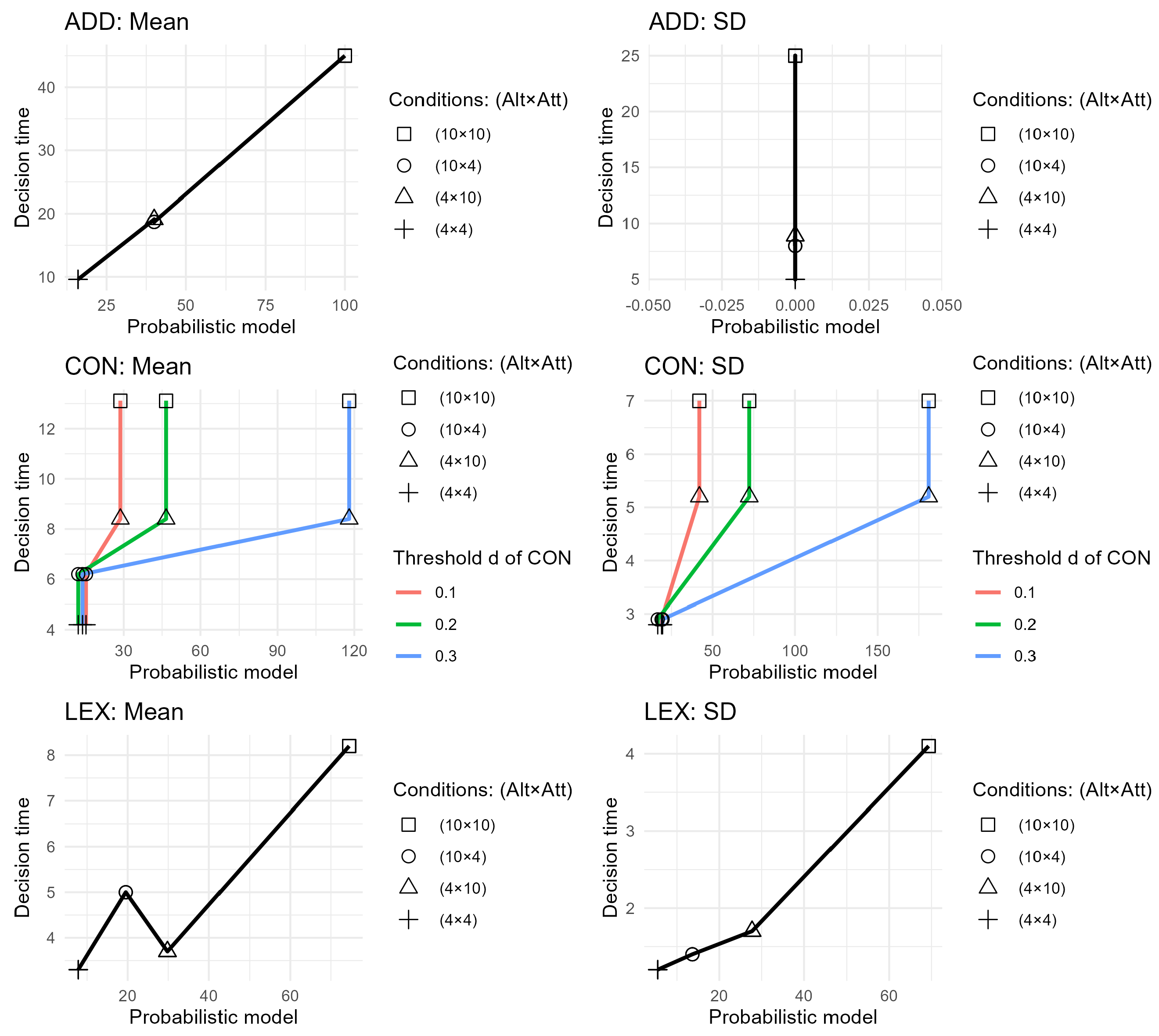
Figure 11 illustrates the relationship between observed and predicted values.
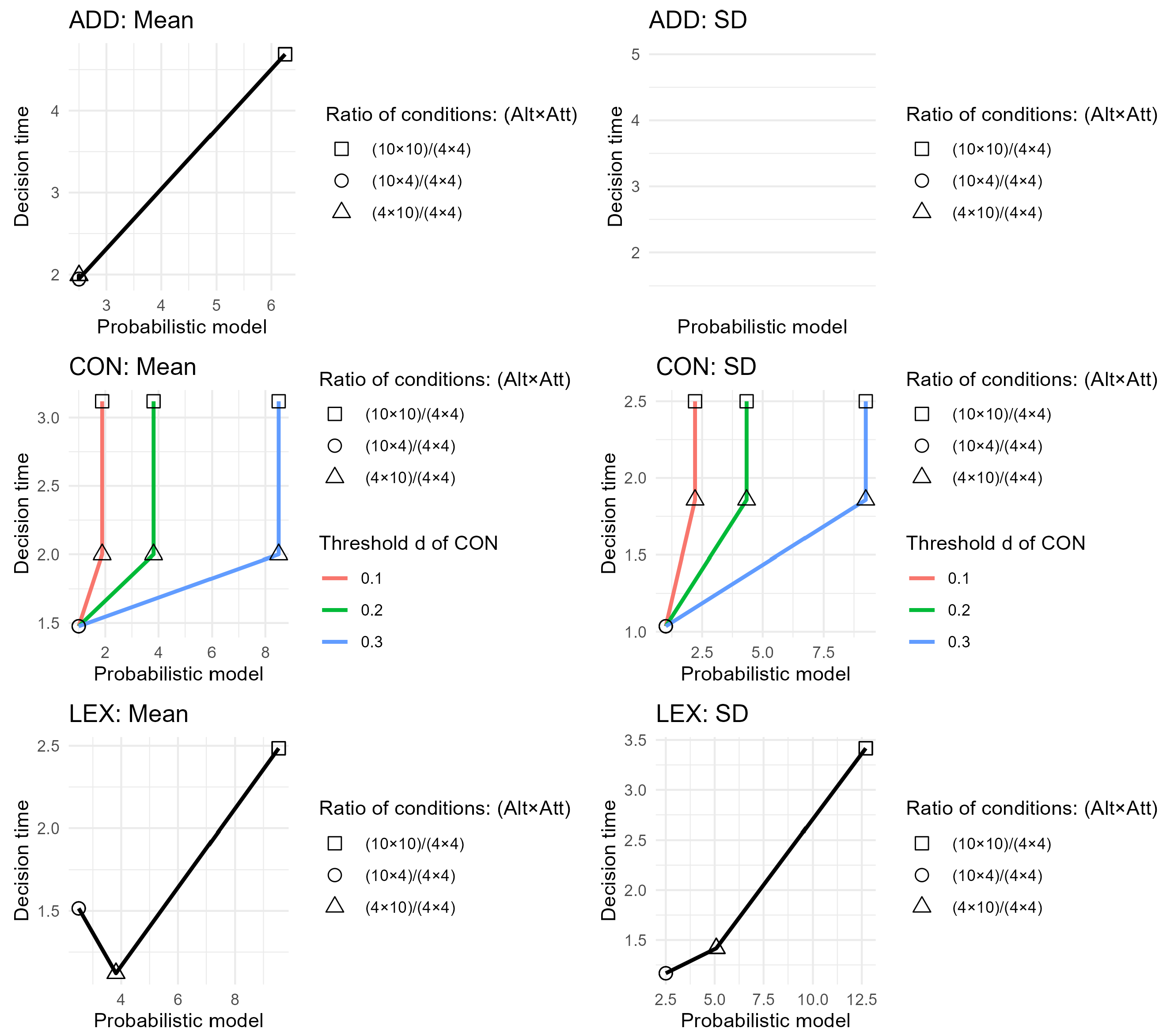
To further examine comparability, the results for each experimental condition were reanalyzed as ratios relative to the baseline condition (4 alternatives × 4 attributes) and plotted together with the corresponding theoretical expectations (see
Figure 12). Because the variance of the WAD model is theoretically zero, comparisons of standard deviations (SDs) were not conducted for this model. Overall, a generally good correspondence was observed between the model predictions and the experimental results for the WAD, LEX, and CON models.
Finally, simulation analyses were conducted for the CON model using each threshold value . Results showed that yielded the closest approximation to observed mean and SD values. Given that attribute values were distributed across five discrete levels mapping onto the interval as , this suggests that many participants applied a threshold corresponding to the lowest or second-lowest category, implying that relatively strict screening criteria were commonly used in the conjunctive strategy.
As is evident from both
Figure 11 and
Figure 12, which presents the standardized data, decision times for the CON strategy in the psychological experiments increased substantially with the number of attributes. Such discrepancies between the experimental results and the predictions of the mathematical model may be attributable to several psychological factors. One plausible explanation is that, whereas the mathematical model assumes fixed decision thresholds, participants in the experiments may have adjusted their thresholds as the number of attributes increased. The time required to adjust these thresholds, or the effects of threshold changes themselves, may have contributed to the observed increases in decision time. Although less pronounced, a similar pattern was suggested for the LEX strategy. That is, slight discrepancies between the mathematical model and the experimental results were observed as a function of the number of attributes. Although participants in both the LEX and CON conditions were instructed not to alter their decision thresholds, it cannot be ruled out that threshold adjustments occurred during actual task performance.
6. Additional Psychological Experiment
In
Section 5, we analyzed experimental data on cassette player choice conducted in Japan in 1988 [
25]. However, that experiment did not examine the DIS strategy, and the target technology (cassette players) has since become obsolete, with substantial changes in the surrounding decision-making environment. Therefore, in the present study, although the sample size was limited, we conducted an additional experiment examining the ADD, CON, DIS, and LEX decision strategies.
Five Japanese university students (four males and one female), all of whom were enrolled in a seminar on behavioral decision theory and had studied decision strategies in their undergraduate theses, participated in the experiment. Participants were assigned to conditions varying in the number of alternatives (4 or 8) and the number of attributes (4 or 8). They were asked to select a laptop computer according to a specified decision strategy, and the time required to reach a decision was measured. Participants completed two trials for each condition defined by the combination of the number of alternatives and the number of attributes (A: 4 × 4, B: 4 × 8, C: 8 × 4, and D: 8 × 8). The order of these conditions was fixed as A, B, C, and D. However, within each condition, the order of presentation of the two stimuli was randomized.
The experiment was conducted using a web-based system. Participants were provided with written instructions describing the assigned decision strategy and were instructed to read and understand them. They were then given practice tasks and asked to perform decisions using each strategy. In the main experiment, the following sequence was repeated: (1) presentation of laptop options, (2) selection of an option according to the specified decision strategy, (3) pressing a “Decision” button once a choice had been made, and (4) proceeding to the next page. Participants were informed in advance that the time from the presentation of the laptop options to pressing the “Decision” button would be measured, that they could wait after pressing the button if they wished to pause, and that the number of alternatives and attributes would vary unpredictably across trials.
The attributes used in this experiment were determined based on free-response data from a prior study by Takemura et al. [
21] The selected attributes were: (1) price, (2) weight, (3) warranty period, (4) battery life, (5) CPU, (6) memory capacity, (7) storage capacity, and (8) size. In the low-level condition, four attributes (1–4) were presented, whereas in the high-level condition all eight attributes were presented. Attribute values were represented on a five-point scale.
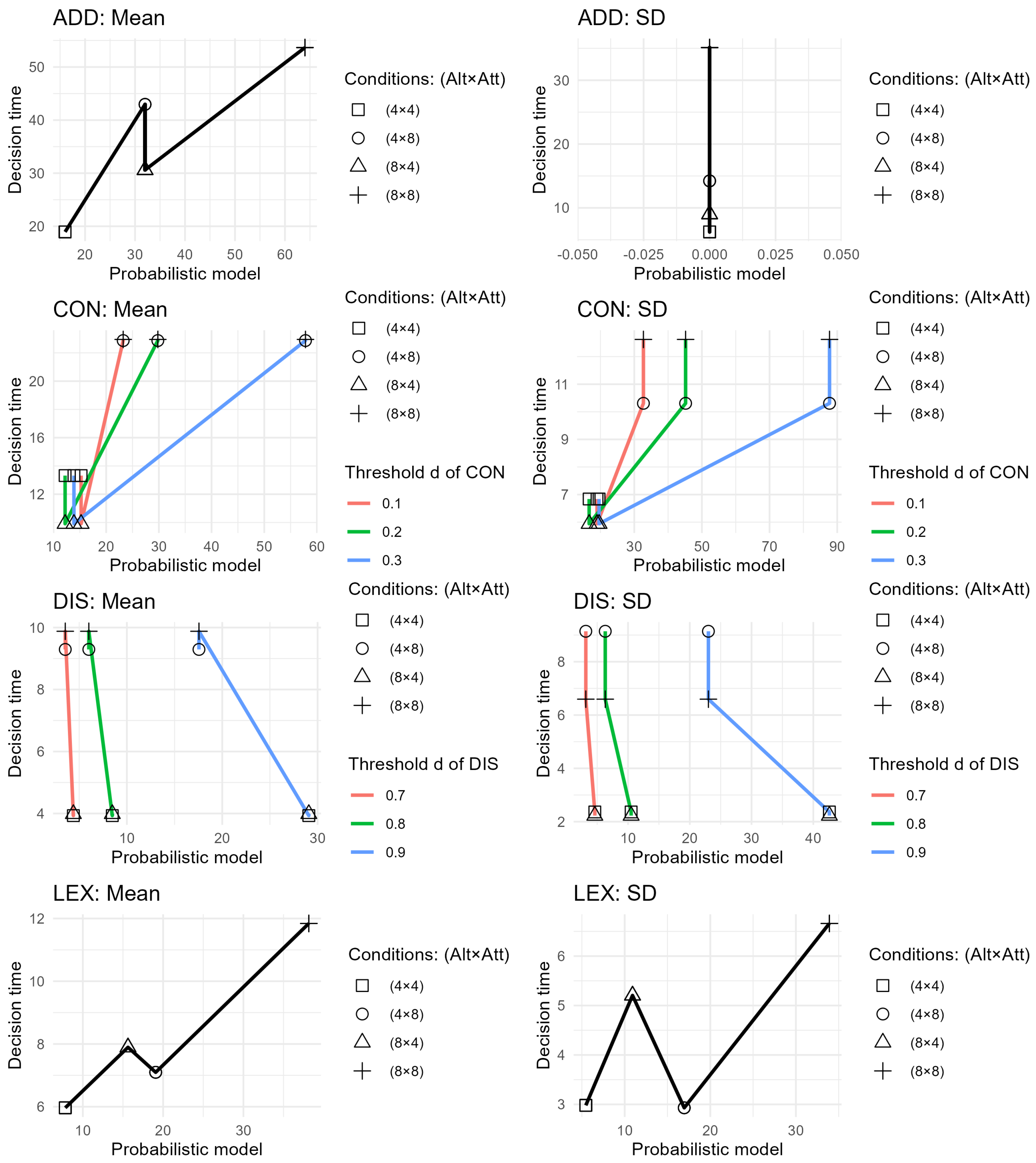
As in the previous section, comparisons were made between the mathematical models (WAD, CON, DIS, LEX) and the empirical data obtained in this experiment. In the mathematical models, the CON thresholds were set to 0.1, 0.2, and 0.3. The DIS thresholds were set to 0.7, 0.8, and 0.9. The probability used in the LEX model was set to 1/5. The correlations and coefficients of determination between the empirical data and the probabilistic models for WAD, CON, DIS, and LEX are shown in
Table 2, calculated separately for means and SDs. Because the standardized expected number of search steps (SD) in the CON model was invariant across threshold values, the correlation coefficients also remained unchanged; therefore, only a single value is reported for CON.
These results indicate that, although some discrepancies exist between the mathematical models and actual decision behavior, the correlation analyses suggest that the models generally predict decision times reasonably well. The results are also illustrated in
Figure 13 and
Figure 14.
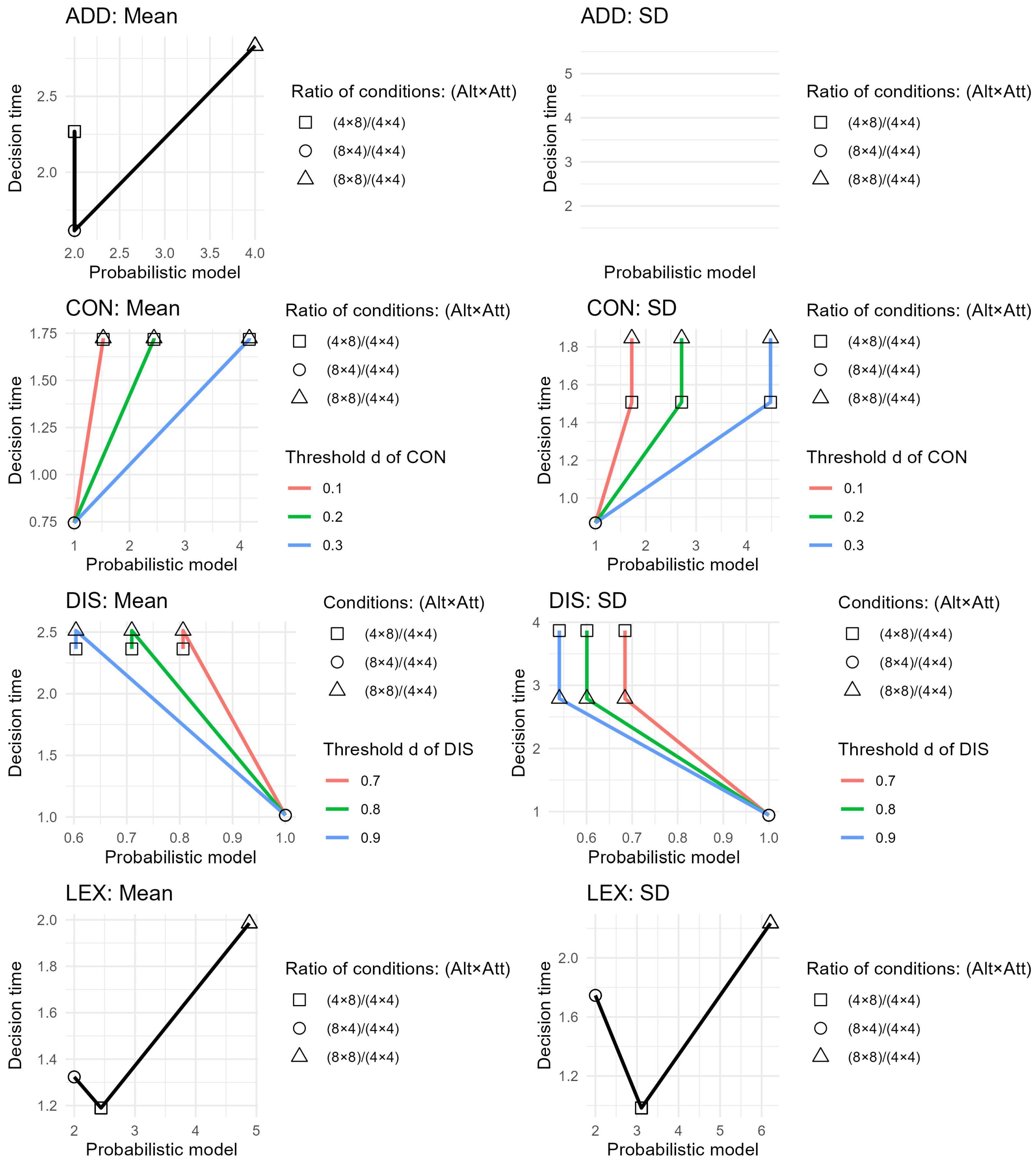
To further examine comparability, we again computed ratios using the (4 alternatives × 4 attributes) condition as the denominator and the remaining three conditions as numerators, and plotted the relationships between the mathematical model predictions and the empirical data. Because the SD of the WAD model is theoretically zero and thus cannot be computed, this portion of the plot is left blank. The results indicate that, except for DIS, the overall relationships for WAD, LEX, and CON were broadly consistent. Additional simulation analyses were conducted for the CON model using each threshold value . Results showed that yielded the closest approximation to observed mean and SD values. Given that attribute values were distributed across five discrete levels mapping onto the interval as , this suggests that many participants applied a threshold corresponding to the lowest or second-lowest category, implying that relatively strict screening criteria were commonly used in the conjunctive strategy.
Surprisingly, however, the newly added DIS strategy exhibited an extremely strong negative correlation, despite a high coefficient of determination. Although similar tendencies were observed to a lesser extent for CON and LEX, in the case of DIS it is inferred that the aspiration threshold varied substantially as a function of the number of attributes. Specifically, as the number of attributes increased, participants appear to have lowered their thresholds considerably, resulting in longer decision times than predicted by the mathematical model. Nevertheless, the empirical data confirmed the model prediction that decision time under the DIS strategy remains largely unaffected by increases in the number of alternatives.
Although some discrepancies were observed between the model predictions and the empirical data, moderate to strong correlations were obtained for WAD, CON, and LEX. In contrast, the predictions for DIS differed markedly, suggesting that humans substantially modify their thresholds as the number of attributes increases. As in the earlier analyses, results were reanalyzed as ratios relative to the baseline condition (4 alternatives × 4 attributes) and plotted alongside theoretical expectations. Because the variance of the WAD model is theoretically zero, SD comparisons were not conducted for this model.
Overall, good agreement was observed between model predictions and experimental results for WAD, LEX, and CON. For DIS, the model correctly predicted that decision time would remain largely unchanged with increases in the number of alternatives; however, with respect to the number of attributes, the empirical results showed a completely opposite pattern. Contrary to the model predictions, decision time increased substantially as the number of attributes increased. Simulation analyses for the CON model again indicated that provided the best approximation to the observed means and SDs, suggesting that relatively lenient screening criteria were commonly used in the conjunctive strategy. In contrast, for DIS, stricter criteria appear to have been adopted as the number of attributes increased. This pattern suggests that humans may regulate decision thresholds to maintain a roughly constant level of task complexity.
7. Conclusions and Future Directions
Research on judgment and decision-making has consistently shown that individuals employ a variety of decision strategies depending on the task structure and contextual constraints [
10,
20,
21,
22,
23,
24]. These strategies differ not only in the cognitive operations they require but also in the amount of information search and time needed to reach a choice. Motivated by these observations, the present study developed probabilistic mathematical models for four representative decision strategies—additive (ADD), conjunctive (CON), disjunctive (DIS), and lexicographic (LEX)—with the aim of predicting the expected number of information processing steps and decision time in multi-attribute choice environments with varying numbers of attributes and alternatives.
The analyses revealed that CON and DIS strategies are strongly influenced by the number of attributes, whereas the number of alternatives has a relatively small effect. This suggests that these non-compensatory strategies scale primarily with the dimensional complexity of the decision task. In contrast, both the number of attributes and the number of alternatives were predicted to affect processing load for the WAD and LEX strategies. However, the magnitude of this effect was substantially smaller for LEX, reflecting the efficiency of its rule-based early termination of search.
To examine the external validity of the proposed models, their predictions were compared with simulation results based on the Adaptive Decision-Maker (ADM) framework using the Mersenne Twister, as well as with existing psychological experimental data. Correlational and comparative analyses showed that the probabilistic models were generally consistent with both simulated indices of cognitive effort and previously reported experimental results. This convergence indicates that even relatively simple mathematical formulations can adequately approximate major behavioral regularities in human information search and decision time.
Furthermore, we examined the extent to which the proposed models could predict decision times in both previously published experimental data and newly collected experimental data. Although some discrepancies were observed between the model predictions and the empirical data, moderate to strong correlations were obtained for WAD, CON, and LEX, whereas substantially different predictions were observed for DIS. These results suggest that humans may markedly adjust their decision thresholds as the number of attributes increases. Possible threshold adjustments were also observed for CON and LEX, as slight discrepancies emerged between the model predictions and experimental results with changes in the number of attributes. Although participants were instructed not to change their decision thresholds in the LEX and CON conditions, it cannot be ruled out that such adjustments occurred during actual task performance. Future studies combining computational modeling with controlled psychological experiments will be necessary to examine these threshold dynamics in greater detail.
Overall, these findings suggest that the proposed probabilistic framework provides a tractable and theoretically grounded method for predicting cognitive effort in decision-making. Beyond its theoretical significance, this modeling approach has potential applications in consumer behavior analysis, the design of adaptive decision-support systems, and the computational estimation of decision strategies.For example, Bayesian inverse inference based on response-time patterns could be employed. More concretely, log data capturing the temporal dynamics of consumer purchasing behavior in E-commerce environments or physical retail settings could be collected, as could fine-grained temporal data from laboratory experiments. Based on observed decision times, it may be possible to infer the underlying decision strategies guiding consumer behavior. Such inferences could inform the optimization of in-store displays and product placement, as well as advertising and information presentation in e-commerce environments, tailored to consumers’ decision strategies. Moreover, estimating individual decision strategies through controlled psychological experiments may contribute to the development of nudges and decision-support interventions.
At the same time, the proposed models incorporate several simplifying assumptions that warrant further examination. Specifically, for analytical tractability, attribute values were assumed to be independently and identically distributed (i.i.d.) and uniformly distributed. In real-world decision environments, however, attribute distributions are not necessarily uniform, and this assumption should be empirically evaluated. In addition, for the ADD, CON, and DIS strategies, attribute search and within-alternative search were assumed to be independent. While this assumption may be reasonable for ADD, it is plausible that decision thresholds in CON and DIS change dynamically in response to ongoing information search. Such mechanisms could explain the discrepancies observed between experimental results and model predictions. Moreover, the psychological experiment reported in
Section 6 was limited in scale, and further experimental investigation is required. Future research should therefore refine the model assumptions and consider more complex models based on realistic attribute distributions.