Article

Research on the Improvement of Intuitionistic Fuzzy Entropy Measurement Based on TOPSIS Method and Its Application

1
School of Information Engineering, Sanming University, Sanming 365004, China
2
College of Liberal Arts and Sciences, University of Illinois Urbana-Champaign, Urbana-Champaign, IL 61801, USA
*
Authors to whom correspondence should be addressed.
Mathematics 2026, 14(1), 150; https://doi.org/10.3390/math14010150
Submission received: 17 November 2025 / Revised: 19 December 2025 / Accepted: 22 December 2025 / Published: 30 December 2025

Abstract

Aiming at the problem that existing intuitionistic fuzzy entropy measures fail to fully balance the interaction between intuition (determined by hesitation degree) and fuzziness (characterized by the difference between membership degree and non-membership degree), this paper proposes the concept of isentropic arc, reveals the mutual offset effect of the two in entropy composition, and provides a new theoretical perspective for the planar analysis of entropy measures. Further research finds that there are maximum and minimum entropy points in the intuitionistic fuzzy entropy plane. Based on this, two different types of isentropic arcs can be constructed. Combining this feature with the core logic of approaching the ideal solution, this paper constructs a new intuitionistic fuzzy entropy measure formula based on the TOPSIS method. This formula can characterize the synergistic influence of intuition and fuzziness at the same time, meets all the constraints of the axiomatic definition, and is more suitable for the needs of actual decision-making scenarios. Comparative analysis of numerical examples shows that the proposed new entropy measure has significantly better discrimination than existing methods for six groups of samples with a high hesitation degree and high fuzziness, and the entropy value ranking is consistent with the ranking of the uncertainty information contained in the samples. Finally, the weight decision-making model based on this entropy measure is applied to the evaluation of coal mine emergency rescue capability, verifying its practical value in solving complex uncertainty problems.

1. Introduction

In the fields of information science and decision theory, effectively managing uncertain information has long been a core issue. Real-world problems, such as complex engineering decisions, high-risk scenario assessments, and global system optimization, commonly exhibit characteristics of fuzziness and uncertainty that traditional deterministic mathematics cannot precisely characterize. These problems involve multi-dimensional and multi-type decision-making indicators, which exhibit both randomness due to stochastic environmental fluctuations and fuzziness arising from the subjectivity of human judgment and cognitive limitations. Constrained by strict assumptions of variable certainty and clear boundaries, traditional precise mathematical models cannot fully or accurately represent such complexity, nor can they provide reliable theoretical support for decision-making and optimization. To address this research dilemma, uncertainty information processing theory, which is centered on fuzzy set theory and its extensions, has emerged and continues to evolve, providing key theoretical tools and technical pathways to tackle it.
In 1965, Zadeh [1] proposed the fuzzy sets theory. Later, Atanassov [2] extended the fuzzy set and defined the intuitionistic fuzzy set in three aspects of information which are membership degree, non-membership degree, and hesitancy degree. Unlike traditional fuzzy sets, which only represent a single membership, intuitionistic fuzzy sets can more subtly describe the fuzziness and uncertainty of the objective world [3,4]. This endows them with stronger capabilities and greater flexibility in handling uncertain information than traditional fuzzy sets, leading to their wide application in multiple attribute decision-making [5,6,7,8,9,10,11,12,13], pattern recognition [14,15,16], and cluster analysis [17,18]. The interval-valued fuzzy set proposed by Zadeh [19] and the vague set proposed by Gau and Buehrer [20] are both extensions of fuzzy sets, and references [21,22,23] have theoretically proven their equivalence to intuitionistic fuzzy sets.
In the multi-attribute decision-making theory, the entropy weight method has long been a hot research topic. Entropy is a quantitative index to measure the degree of uncertainty of things, and the method is often used to determine the index weight of factors by entropy values. As an outcome of the intersection of fuzzy set theory and information entropy theory, De Luca and Termini [24] proposed an axiomatic definition of fuzzy entropy based on Shannon’s information entropy. Relevant studies show that the academic community usually uses the absolute value of the difference between membership degree and non-membership degree to determine a fuzzy set’s uncertainty. However, there is no unified conclusion on how to determine the uncertainty (intuitionistic fuzzy entropy measure) of the extended fuzzy sets. Only one work considers the influence of hesitancy. Burillo et al. [25] directly extended the axiomatic definition of fuzzy entropy to intuitionistic fuzzy sets and gave the entropy of intuitionistic fuzzy sets, but only used hesitancy degree to measure the uncertainty of intuitionistic fuzzy sets. On the other hand, some works only consider the influence of the difference between membership degree and non-membership degree. The typical achievement is that Szmidt et al. [26] proposed a new axiomatic definition based on reference [25], and successively constructed a series of new entropy measures that are valid under this definition in references [27,28,29,30,31]. At the same time, other scholars have had extensive discussions on intuitionistic fuzzy entropy and similarity measure, Pythagorean fuzzy entropy measure, neutrosophic entropy measure [32,33,34], cross entropy measure, geometric entropy measures, and probability structure entropy measure. The influence of the difference in hesitation degree, membership degree, and non-membership degree is comprehensively considered in the third category, but the conversion and offset between the two have not been effectively solved, that is, when the hesitancy degree increases and the difference value of the membership degree and non-membership degree decreases, the change in intuitionistic fuzzy entropy cannot be determined.
Burillo and Bustince [25] extended the axiomatic definition of fuzzy set entropy to intuitionistic fuzzy sets and defined their entropy to measure uncertainty. This entropy only reflects the intuitionistic degree of intuitionistic fuzzy sets and is incompatible with the entropy of fuzzy sets. Szmidt and Kacprzyk [26] have improved this axiomatic definition and proposed a new axiomatic definition, having systematically studied intuitionistic fuzzy entropy measures and similarity measures in references [27,28,29,30,31,35], and proposed a series of entropy measures. Chen and Li [36] classified and compared the intuitionistic fuzzy entropy. According to the different meanings of the intuitionistic fuzzy entropy measures, they summarized it in four aspects including hesitancy degree, geometry, probability, and non-probability frameworks, and proposed an objective weights determination method based on intuitionistic fuzzy entropy with the help of experiments. Zeng and Li [37] established the axiomatic definition of entropy of interval-valued fuzzy sets, proposed four entropy measures, and discussed the relationship between similarity measures and entropy of interval-valued fuzzy sets. Later, Vlachos and Sergiadis [38] gave an entropy measure of interval-valued fuzzy sets on the basis of references [26,37]. Zhang and Jiang [39] developed a non-probabilistic entropy for vague sets using the intersection and union operations of their membership and non-membership degrees. Szmidt and Kacprzyk [40] proposed an entropy measure derived from the geometric interpretation of intuitionistic fuzzy sets. Xia and Xu [41] proposed a new entropy measure based on the cross entropy measure of intuitionistic fuzzy sets. Ye [42] derived two intuitionistic fuzzy entropy measures using trigonometric functions. However, the above proposed methods have a problem, they do not consider the influence of the hesitancy degree on entropy. The entropy is only determined by the degree of difference between the membership degree and non-membership degree. Thus, some scholars have proposed some new intuitionistic fuzzy entropy measures [14,26,43,44,45,46,47,48], and these measures take into account the influence of the degree of difference between the membership degree and non-membership degree and the hesitancy degree on entropy. But there are still two problems, one is when the degree of difference between the membership degree and the non-membership degree of the two intuitionistic fuzzy sets is equal, but not equal to zero, the entropy decreases with the increase in the hesitancy degree. The other is when the degree of difference between the membership degree and the non-membership degree of the intuitionistic fuzzy set is equal to zero, the entropy is always equal to one, which has nothing to do with the change in the hesitancy degree. It is worth noting that existing studies, whether focusing on a single factor or integrating both factors, have not constructed entropy measures via TOPSIS (Technique for Order Preference by Similarity to an Ideal Solution). A research gap persists in the collaborative quantification of the hesitation degree and the difference between membership degree and non-membership degree using this method.
In summary, existing intuitionistic fuzzy entropy measures still exhibit logical flaws and application limitations, rendering them inadequate for meeting the high-precision requirements of complex multi-attribute decision-making scenarios. Accordingly, this paper sets the following research objectives: First, construct a new axiomatic system for intuitionistic fuzzy entropy that is both logically sound and scenario-adaptable, addressing current shortcomings in synergistically quantifying the hesitation degree and the difference between membership and non-membership, and, on this basis, propose a new TOPSIS-based intuitionistic fuzzy entropy measure; second, apply the improved measure to multi-attribute decision-making practices and verify its effectiveness in weight assignment and alternative selection.
To achieve these goals, the following hypotheses are proposed and verified in sequence: On one hand, a geometrically constructed intuitionistic fuzzy entropy measure can simultaneously capture the impacts of the hesitation degree and the difference between the membership degree and non-membership degree, with entropy value changes aligning with the basic logic of uncertainty quantification. On the other hand, integrating this improved measure into decision models significantly enhances the scientific validity and accuracy of decision outcomes.
The methodology involves the following steps in turn: First of all, geometrically analyze the connotation of intuitionistic fuzzy entropy, redefine its axiomatic criteria, and construct four new measures; next, theoretically verify the rationality of these new measures; finally, compare decision effectiveness between the new method and traditional methods using multi-attribute decision-making examples. To tackle the aforementioned issues, this paper formulates a novel axiomatic definition of intuitionistic fuzzy set entropy, interprets its intuitive implications geometrically, and specifies the spatial coordinates of the maximum and minimum entropy points. Based on the principle that the entropy value increases when the distance to the maximum entropy point becomes shorter and the distance to the minimum entropy point becomes longer, a novel TOPSIS-based intuitionistic fuzzy entropy measure is developed.
The rest of this paper is organized as follows. In Section 2, we introduce fuzzy entropy. In Section 3, the existing entropy measures of intuitionistic fuzzy sets are classified. Their shortcomings are also pointed out through some examples. In Section 4, a new axiomatic definition of the entropy measure of intuitionistic fuzzy sets is given, and its essential meaning is explained on the spatial geometry. Then, four new entropy measures are proposed. Finally, the rationality and validity of the new entropy measures are verified by an example. In Section 5, a decision-making model is proposed based on the new entry model and applied in the evaluation of coal mine emergency rescue capability. Section 6 draws some conclusions.

2. Fuzzy Entropy

In order to understand the fuzzy entropy, we first introduce the concept of fuzzy sets. Let X be a universe of discourse with n elements.
If there is a mapping,
μ A : X 0 , 1 .
A is called a fuzzy set in X . It is generally noted as
A = x i , μ A x i x i X .
For convenience, all the fuzzy sets in X are noted as F S X , give a fuzzy set A , its own complement is denoted as A c , i.e.,
A c = x i , 1 μ A x i x i X .
Based on the fuzzy sets, quantifying their uncertainty is the core issue of fuzzy set theory, and fuzzy entropy is precisely the key to addressing this problem. If an expression conforms to the axiomatic definition proposed by De Luca and Termini [24], based on Shannon’s information entropy, it can be defined as fuzzy entropy.
If the mapping E D T : F S X 0 , 1 is a fuzzy entropy which is a measure of fuzziness, then it has to satisfy the following four conditions.
(1)
E D T A = 0 if and only if A is a crisp set;
(2)
E D T A = 1 if and only if μ A x i = 0.5 , for each x i = X ;
(3)
Let A and B be two fuzzy sets. For each x i = X , if μ A x i μ B x i 0.5 or μ A x i μ B x i 0.5 , then we have E D T A E D T B ;
(4)
E D T A = E D T A c .

3. Intuitionistic Fuzzy Entropy Measurement and Comparative Study

Let X = x 1 , x 2 , , x n be a given set, A is called the intuitionistic fuzzy of X with the following condition, i.e., exist a mapping
μ A : X 0 , 1 ,   v A : X 0 , 1 .
And for each x i = X , v A : X 0 , 1 is always established. A is generally noted as
A = x i , μ A x i , v A x i x i X .
where μ A x i and v A x i are membership degree and non-membership degree of x i on A , respectively.
π A x i = 1 μ A x i v A x i .
Equation (6) is called the hesitancy degree of x i on A , also in the unknown degree. For each x i = X , 0 π A x i 1 .
Generally, we use I F S X to denote the intuitionistic fuzzy set in X . If A and B are two intuitionistic fuzzy sets, then
(1)
For each x i = X , A B if and only if μ A x i μ B x i , v A x i v B x i ;
(2)
A = B if and only if A B and B A are established at the same time;
(3)
For each x i X , A B if and only if μ A x i μ B x i , v A x i v B x i ;
(4)
A B = x i , min ( μ A ( x i ) , μ B ( x i ) ) , max ( v A ( x i ) , v B ( x i ) ) x i X ;
(5)
A B = x i , max ( μ A ( x i ) , μ B ( x i ) ) , min ( v A ( x i ) , v B ( x i ) ) x i X ;
(6)
A c = x i , v A x i , μ A x i x i X .
Let A = x i , μ A x i , v A x i x i X be an intuitionistic fuzzy set, since the intuitionistic fuzzy sets are the extended from fuzzy sets, the study on the intuitionistic fuzzy entropy should be based on fuzzy entropy, and fuzzy entropy only considers the fuzziness which means the distance between membership degree and 0.5. The reason is that the fuzzy sets only contain the membership information, but the intuitionistic fuzzy sets contain the unknown information. Therefore, the intuitionistic fuzzy entropy should be composed of two parts, one is the fuzziness measured by μ A x i v A x i , and the other is the intuitiveness which can be measured by π A x i . References [18,25,26,30,37,38,39,40,41,42,44,45,46,49,50,51,52,53,54,55] proposed the methods of calculating intuitionistic fuzzy entropy measures, but these measures are deficient. Here are three scenarios to discuss.

3.1. The Intuitionistic Fuzzy Set Entropy Measure Only Considers Intuition

Burillo and Bustince [25] extended the axiomatic definition of fuzzy entropy to intuitionistic fuzzy sets, and proposed axiomatic definition of intuitionistic fuzzy sets entropy to measure the degree of uncertainty.
Mapping E B B : I F S X 0 , 1 is called an intuitionistic fuzzy entropy, with the following conditions:
(1)
E B B A = 0 when and only if A is a fuzzy set;
(2)
For any x i X , E B B A = n if and only if μ A x i = v A x i = 0 ;
(3)
If A B , then E B B A E B B B ;
(4)
E B B A = E B B A c .
Some common intuitionistic fuzzy entropy measures E B B 1 , E B B 2 , E B B 3 , E B B 4 can be given on the premise of the above axiomatic definitions.
E B B 1 A = i = 1 n 1 μ A x i + v A x i = i = 1 n π A x i .
E B B 2 A = i = 1 n 1 μ A x i + v A x i k ,   k = 2 , 3 , , .
E B B 3 A = i = 1 n 1 μ A x i + v A x i e 1 μ A x i + v A x i .
E B B 4 A = i = 1 n 1 μ A x i + v A x i sin π / 2 μ A x i + v A x i .
It is easy to verify that the above four entropy measures can only reflect the influence of the hesitancy degree of intuitionistic fuzzy sets on uncertainty, but not the influence of the distance between the membership degree and non-membership degree on the uncertainty. An example is used to demonstrate this issue.
Give two intuitionistic fuzzy sets A 1 = x i , 0.1 , 0.7 x i X and A 2 = x i , 0.4 , 0.4   x i = X , and calculate by the entropy measure E B B 1 , we have E B B 1 A 1 = E B B 1 A 2 = 0.2 . However, further analysis shows that although the hesitancy degree of x i belonging to intuitionistic fuzzy sets A 1 and A 2 is equal, it is obvious that the distance between the non-membership degree of x i belongs to A 1 and the membership degree is greater than that of A 2 , so the degree of uncertainty of A 1 is smaller than A 2 . But the calculations A 1 and A 2 of entropy E B B 1 , E B B 2 , E B B 3 and E B B 4 are equal, it is clearly not convincing enough.
In fact, if any two intuitionistic fuzzy sets A = x i , μ A x i , v A x i x i X and B = x i , μ B x i , v B x i x i X satisfy μ A x i + v A x i = μ B x i + v B x i , then we have E B B A = E B B B based on each entropy measure.

3.2. The Intuitionistic Fuzzy Set Entropy Measure Only Considers Fuzziness

References [37,38] proposed several entropy measures of interval-valued fuzzy sets, considering the equivalence between interval-valued fuzzy sets and intuitionistic fuzzy sets, we transformed them into the entropy measures of intuitionistic fuzzy sets E V S 1 , E Z L 1 and E Z L 2 .
E V S 1 A = 1 n i = 1 n min μ A x i , v A x i + min 1 v A x i , 1 μ A x i i = 1 n max μ A x i , v A x i + max 1 v A x i , 1 μ A x i = 1 n n i = 1 n μ A x i v A x i n + i = 1 n μ A x i v A x i .
E Z L 1 A = 1 1 n i = 1 n μ A x i v A x i .
E Z L 2 A = 1 1 n i = 1 n μ A x i v A x i 2 .
The fuzzy sets and the intuitionistic fuzzy sets are equivalent, and the two fuzzy entropy measures given in reference [39] are converted into the entropy measures E Z J 1 and E Z J 2 of the intuitionistic fuzzy sets.
E Z J 1 A = 1 n i = 1 n μ A x i + 1 v A x i 2 log 2 μ A x i + 1 v A x i 2 + v A x i + 1 μ A x i 2 log 2 v A x i + 1 μ A x i 2 ] .
E Z J 2 A = 1 n i = 1 n min μ A x i , v A x i max μ A x i , v A x i .
Reference [40] proposed an entropy measure E S K 1 after analyzing the spatial graph property of intuitionistic fuzzy sets. Cross entropy is also an important part of entropy theory research. Reference [41] used it to induce a new entropy measure E X X .
E S K 1 A = 1 1 2 n i = 1 n μ A x i v A x i .
E X X A = 1 n i = 1 n 2 1 2 1 p 1 μ A x i + 1 v A x i 2 p 1 μ A x i p + 1 v A x i p 2 + 1 .
where 1 < p < 2 .
Reference [42] obtained two entropy measures E Y 1 and E Y 2 by using the operation relation between trigonometric functions.
E Y 1 A = 1 n i = 1 n sin π × 1 + μ A x i v A x i 4 + sin π × 1 μ A x i + v A x i 4 1 × 1 2 1 .
E Y 2 A = 1 n i = 1 n cos π × 1 + μ A x i v A x i 4 + cos π × 1 μ A x i + v A x i 4 1 × 1 2 1 .
In fact, it turns out that we can obtain E Y 1 A = E Y 2 A .
Although the above entropy measures meet the axiomatic conditions, these measures only take into account the difference between the membership degree and non-membership degree of intuitionistic fuzzy sets, they do not consider the influence of the hesitancy degree on entropy in intuitionistic fuzzy sets. Therefore, we use the following examples to demonstrate them and point out the shortages of them.
Let A 1 = x i , 0.5 , 0.4 x i X , A 2 = x i , 0.4 , 0.3 x i X and A 3 = x i , 0.2 , 0.1 x i X be I F S s .
To calculate the entropy of A 1 , A 2 , and A 3 with the entropy measures E V S 1 , E Z L 1 , E Z L 2 , E Z J 1 , E Z J 2 , E S K 1 , E X X , and E Y 1 , where P = 2 . Results are shown in Table 1.
Obviously, the absolute deviation is μ A j x i v A j x i = 0.1 , j = 1 , 2 , 3 of the membership degree and non-membership degree of A 1 , A 2 , and A 3 . Hesitancy degrees are 0.1, 0.3, 0.7, and they are gradually increasing. However, all the entropy measures of E V S 1 , E Z L 1 , E Z L 2 , E Z J 1 , E S K 1 , E X X , and E Y 1 are the same, and E Z J 2 decreases with the increase in the hesitancy degree. These results are clearly not very reasonable.

3.3. The Intuitionistic Fuzzy Set Entropy Measures Consider Fuzziness and Intuition

The axiomatic definition was established in [25] where the comparison of A B should be satisfied, that is when μ A x i + v A x i μ B x i + v B x i , i.e., π A x i π B x i , we have E B B A E B B B . Therefore, the entropy measure that was established on the basis of it can only measure the intuitionistic degree of I F S . Szmidt et al. [30] improved the axiomatic definition, and proposed an entropy measure by using the geometric interpretation of I F S [26].
If mapping E S K : I F S X 0 , 1 satisfies the following four conditions, then it is called intuitionistic fuzzy entropy.
(1)
E S K A = 0 if and only if A is a crisp set;
(2)
E S K A = 1 if and only if μ A x i = v A x i , for each x i X ;
(3)
For each x i X , when μ B x i v B x i , μ A x i μ B x i and v A x i v B x i , or when μ B x i v B x i , μ A x i μ B x i and v A x i v B x i , E S K A E S K B is always established;
(4)
E S K A = E S K A c .
This axiomatic definition is based on the distance between x i and x n e a r , a simple entropy measure E S K 2 A can be given before
E S K 2 A = 1 n i = 1 n a i b i .
where a i is denoted as d i s t a n c e x i , x n e a r to represent the proximity degree of x i and x n e a r which concludes M 1 , 0 , 0 and N 0 , 1 , 0 . b i is denoted as d i s t a n c e x i , x f a r to represent the proximity degree of x i and x f a r which conclude M 1 , 0 , 0 and N 0 , 1 , 0 .
With respect to A , we can define the following two cardinal numbers.
The minimum cardinal number is
min c o u n t A = i = 1 n μ A x i .
The maximum cardinal number is
max c o u n t A = i = 1 n μ A x i + π A x i .
The entropy measure E S K 3 A of A is determined with the help of the above two cardinal numbers
E S K 3 A = 1 n i = 1 n max c o u n t A i A i c max c o u n t A i A i c .
where
A i A i c = x i , min μ A x i , v A x i , max v A x i , μ A x i .
A i A i c = x i , max μ A x i , v A x i , min v A x i , μ A x i .
Reference [44] proposed another form of entropy measure of A .
E W L A = 1 n i = 1 n min μ A x i , v A x i + π A x i max v A x i , μ A x i + π A x i .
Reference [45] proposed an entropy measure of A with the help of affine theory.
E H L A = 1 n i = 1 n 1 μ A x i v A x i + π A x i 1 + μ A x i v A x i + π A x i .
Wei et al. [49] proved E S K 3 A = E W L A = E H L A , and proposed a new entropy measure E W G .
E W G A = 1 n i = 1 n cos μ A x i v A x i 2 1 + π A x i π .
Note that we let A = x i , μ A x i , v A x i x i X and B = x i , μ B x i , v B x i x i X be two I F S s . If μ A x i = v A x i , μ B x i = v B x i , for x i X , then we calculate the entropy of A and B by the above measures, the results are the same and the hesitancy degree has nothing to do with them. Obviously, it does not fit people’s intuition.
Entropy measure E V S 2 can be deduced by the cross entropy of I F S .
E V S 2 A = 1 n ln 2 i = 1 n μ A x i ln μ A x i + v A x i ln v A x i 1 π A x i ln 1 π A x i π A x i ln 2 .
However, this measure still has some limitations. In fact, we use the measure E V S 2 to calculate the entropy of intuitionistic fuzzy sets A 1 , A 2 and A 3 in Section 3.2, we can obtain E V S 2 A 1 = 0.9920 , E V S 2 A 2 = 0.9897 and E V S 2 A 3 = 0.9755 . The absolute deviations between the membership degree and non-membership degree of intuitionistic fuzzy sets A 1 , A 2 , and A 3 are the same, the hesitancy degree increases in turn, thus, the uncertainties of them increases in turn as well. But the entropy of the three intuitionistic fuzzy sets by using measure E V S 2 decreases. This is contrary to people’s intuition.
Vlachos et al. [46] proposed an entropy measure E V S 3 by using the inner product of two vectors.
E V S 3 A = 1 n i = 1 n 2 μ A x i v A x i + π A 2 x i μ A 2 x i + v A 2 x i + π A 2 x i .
Use the measure E V S 3 to calculate the entropy of I F S of A 1 , A 2 and A 3 in Section 3.2, we can obtain E V S 3 A 1 = 0.9762 , E V S 3 A 2 = 0.9906 and E V S 3 ( A 3 ) = 0.9815 . But, through the analysis of the data, we can see that in the uncertainties of intuitionistic fuzzy sets A 1 , A 2 , and A 3 are increasing. It is known from the calculation results of E V S 3 that E V S 3 A 1 < E V S 3 A 2 , and this is the same as people’s consciousness. But E V S 3 A 2 > E V S 3 A 3 is contrary to people’s consciousness. Through the study, the entropy E V S 3 has the following properties.
For convenience, let constant α 0 , 1 , J α denotes all the sets that correspond to I F S   A = x i , μ A x i , v A x i x i X with the condition μ A x i v A x i = α . For each A J α , we have μ A x i = 1 π A x i + α 2 , v A x i = 1 π A x i α 2 or μ A x i = 1 π A x i α 2 , v A x i = 1 π A x i + α 2 from π A x i = 1 μ A x i v A x i . So
E V S 3 A = 2 μ A x i v A x i + π A 2 x i μ A 2 x i + v A 2 x i + π A 2 x i = 2 1 π A x i α 2 1 π A x i + α 2 + π A 2 x i 1 π A x i α 2 2 + 1 π A x i + α 2 2 + π A 2 x i = 1 α 2 2 π A x i + 3 π A 2 x i 1 + α 2 2 π A x i + 3 π A 2 x i .
Let π A x i = y , f y = 1 α 2 2 y + 3 y 2 1 + α 2 2 y + 3 y 2 , then
f y = 2 α 2 6 y 2 1 + α 2 2 y + 3 y 2 2 .
When 0 y < 1 3 , f y < 0 , i.e., E V S 3 A is strictly monotonic decreasing on π A x i in J α ;
When 1 3 < y 1 , f y < 0 , i.e., E V S 3 A is strictly monotonic increasing on π A x i in J α .
It is worth noting that the shortcomings of the above entropy measures are not isolated. In recent years, several improved entropy measures have been proposed [18,50,51,52,53,54,55]. While these approaches introduce innovations in axiomatic conditions, functional formulation, or application-specific optimization, they are often affected by special values, thereby making it impossible to compare the magnitudes of entropy measures. The underlying issue is that their design logic often fails to fully account for the dynamic transformation relationship between fuzziness and intuition.

4. Research on Improvement of Intuitionistic Fuzzy Entropy Measure

4.1. New Axiomatic Definition and Geometric Interpretation

The above research shows that the uncertainty of intuitionistic fuzzy sets is mainly affected by two aspects. One is fuzziness, which is determined by the distance between the membership degree and non-membership degree. The other is intuition, which is determined by the hesitancy degree. Since both intuition and fuzziness can influence the determination of entropy, then these two quantities can complement each other. Therefore, the influence of these two factors on the uncertainty of the set should be comprehensively considered when constructing the axiomatic definition of intuitionistic fuzzy entropy measures.
For convenience, I F S X denotes all the intuitionistic fuzzy sets in the universe of discourse X . Generally, when the intuitionistic fuzzy entropy measure is given, the rationality of the entropy is considered. At present, the axiomatic definition with constraints is widely used to guarantee the rationality of the entropy measures. However, most of the existing research results have a common problem, that is, when μ A x i v A x i is zero, the entropy is the largest, and it has nothing to do with hesitancy degree, it is obviously not reasonable enough. At the same time, the continuity of entropy is also seldom considered. In order to overcome the above shortages, it is necessary to strengthen and refine the constraints of intuitionistic fuzzy entropy.
On the basis of the above analysis, the constraint conditions are supplemented, and the axiomatic definition of intuitionistic fuzzy entropy is given as follows.
Definition 1. 
A mapping  E : I F S X 0 , 1  is said to be an entropy if it satisfies the following conditions.
(1) 
E A = 0  if and only if  A  is crisp set;
(2) 
E A = 1  if and only if  μ A x i = v A x i = 0  for every  x i X ;
(3) 
If  π A x i = π B x i  and  μ A x i v A x i < μ B x i v B x i , for each  x i X , then  E A > E B ;
(4) 
If  μ A x i v A x i = μ B x i v B x i  and  π A x i < π B x i , for each  x i X , then  E A < E B ;
(5) 
E A = E A c ;
(6) 
With the change in intuitionistic fuzzy sets, the value of intuitionistic fuzzy entropy is in interval [0,1].
Next, we elaborate on the essential meaning of axiomatic definition from geometric figures. Let intuitionistic fuzzy set A = x i , μ A x i , v A x i x i X , where μ A x i and v A x i denote membership degree and non-membership degree of A on x i , respectively. If x i A , generally use A x i = μ A x i , v A x i , π A x i to represent the corresponding value of x i in A , π A x i denotes the hesitancy degree and π A x i = 1 μ A x i v A x i . In fact, the triple μ A x i , v A x i , π A x i corresponding to any x i X can be regarded as a point coordinate in a three-dimensional space. This three-dimensional coordinate system is explicitly defined as follows:
X -axis: Membership degree axis ( μ -axis), the coordinate value ranges from 0 to 1 , representing the membership degree μ A ( x i ) of element x to set A ;
Y -axis: Non-membership degree axis ( v -axis), the coordinate value ranges from 0 to 1 , representing the non-membership degree v A ( x i ) of element x to set A ;
Z -axis: Hesitancy degree axis ( π -axis), the coordinate value ranges from 0 to 1 , representing the hesitancy degree π A ( x i ) of element x to set A .
And, since the component of coordinate on each axis satisfied the condition 0 μ A x i 1 , 0 v A x i 1 , 0 π A x i 1 , and μ A x i + v A x i + π A x i = 1 , all such triples μ A x i , v A x i , π A x i must lie on the triangular plane region Δ A B C in the three-dimensional space, where the three vertices of the triangle are defined as
A ( 1 , 0 , 0 ) : Corresponding to the state where membership degree is 1 , non-membership degree is 0 , hesitancy degree is 0 (complete membership);
B ( 0 , 1 , 0 ) : Corresponding to the state where membership degree is A , non-membership degree is 1 , hesitancy degree is 0 (complete non-membership);
C ( 0 , 0 , 1 ) : Corresponding to the state where membership degree is 0 , non-membership degree is 0 , hesitancy degree is 1 (maximum hesitancy).
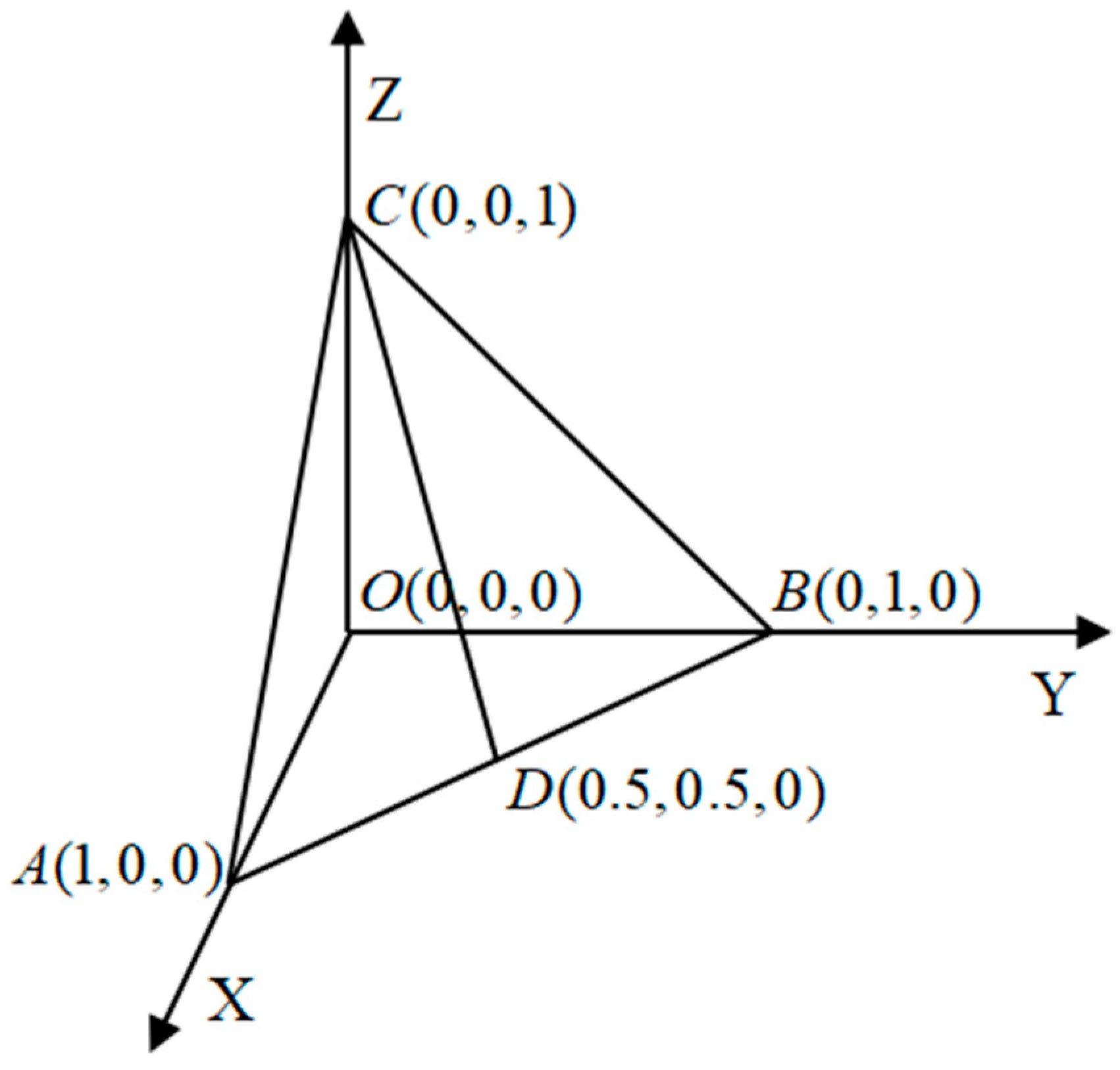
This triangular region Δ A B C is the geometric representation space of all possible states of intuitionistic fuzzy sets(Figure 1), and each point in the region uniquely corresponds to an intuitionistic fuzzy number (i.e., the triple μ A x i , v A x i , π A x i . Based on the axiomatic definition, the entropy corresponding to points in Δ A B C satisfies the following geometric properties:
Points on edge A B : All satisfy π A x i = 0 , which is consistent with the characteristic of classical fuzzy sets ( μ A x i + v A x i = 1 ). For these points, the entropy E = 0 (since they are crisp in the sense of classical fuzzy sets), e.g., E ( A ) = E ( B ) = 0 ;
Point C: Satisfies μ A ( x i ) =   v A ( x i ) = 0 ,   π A ( x i ) = 1 , where both fuzziness (since μ A ( x i ) v A ( x i ) = 0 ) and intuition (since π A ( x i ) = 1 ) reach the maximum, so the entropy ( E ( C ) = 1 ) (maximum entropy);
Midline C D (where D ( 0 . 5 , 0 . 5 , 0 ) is the midpoint of A B ): For all points on C D , the membership degree equals non-membership degree ( μ A ( x i ) =   v A ( x i ) ), i.e., μ A ( x i ) v A ( x i ) = 0 , so fuzziness is the maximum. As the point moves from D to C , the hesitancy degree π A ( x i ) increases from 0 to 1 , and intuition continuously enhances. Therefore, the entropy of points on C D increases monotonically from 0 (at D ) to 1 (at C );
Symmetry: For any point P in Δ A B C , there exists a symmetric point P with respect to the midline C D , and their entropies are equal ( E ( P ) = E ( P ) ). This is a direct reflection of axiom (5) ( E A = E A c ), since the complement of an intuitionistic fuzzy set swaps its membership and non-membership degrees, corresponding to geometric symmetry about C D .
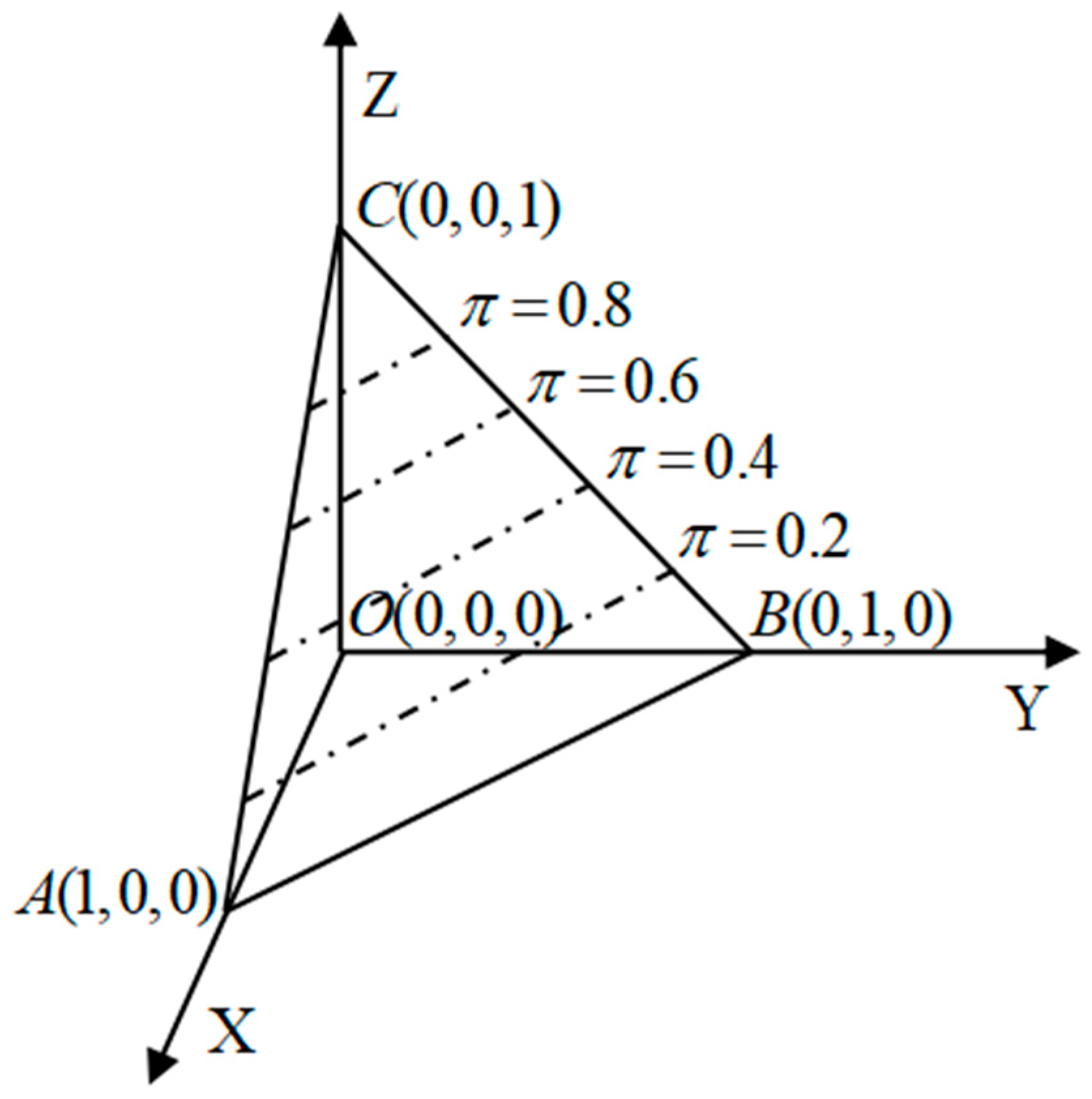
To further clarify the influence of hesitancy degree on entropy, we draw the isoline of the hesitancy degree in Δ A B C —line segments parallel to edge A B (Figure 2). The key characteristics of these isolines are as follows:
All points on the same isoline have the same hesitancy degree π A ( x i ) (constant π A ( x i ) );
As the isoline approaches point C , the value of π A ( x i ) increases (e.g., the isolines in Figure 2 are labeled π A ( x i ) = 0 . 2 , 0 . 4 , 0 . 6 , 0 . 8 from near A B to near C ).
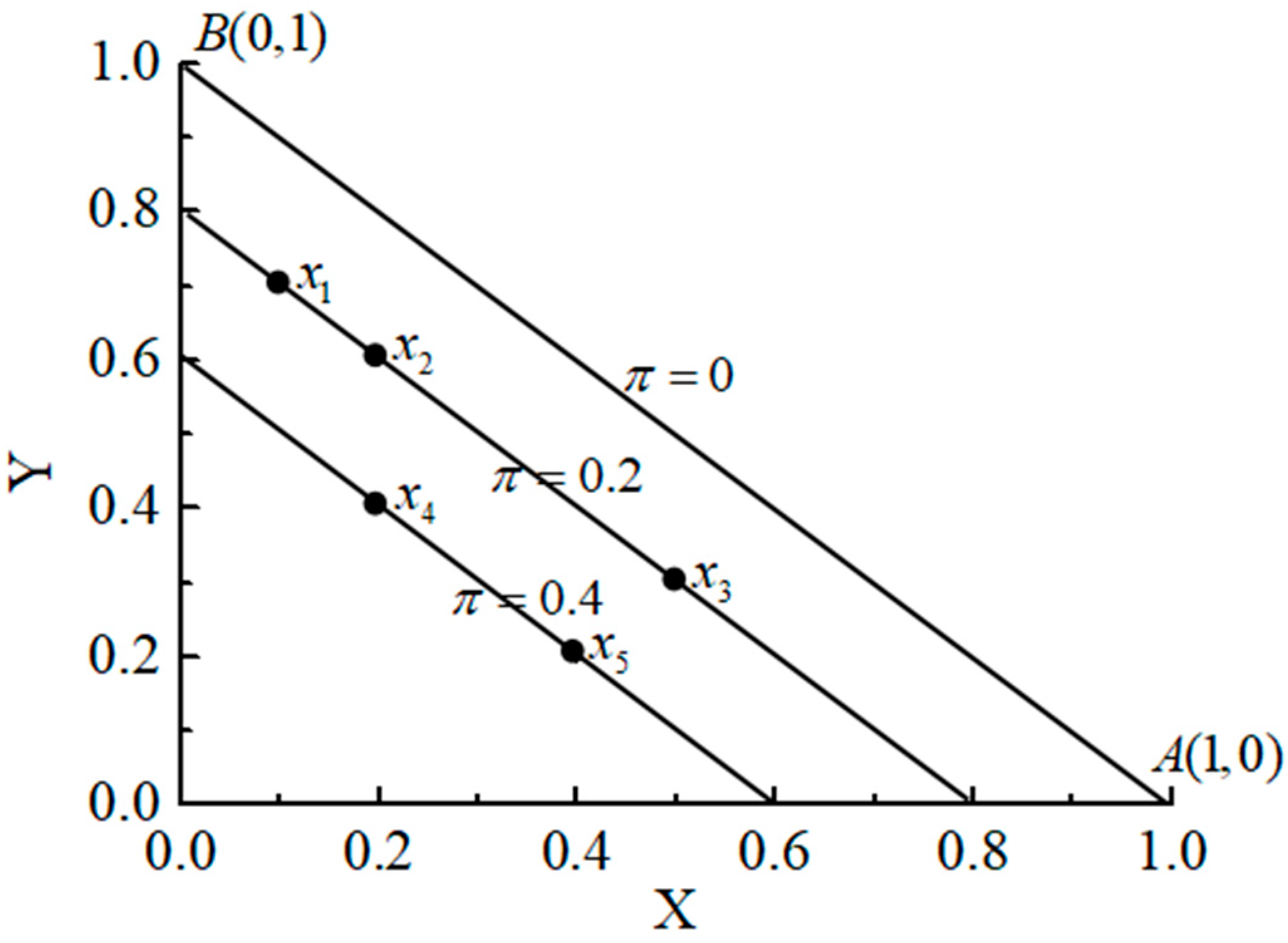
Figure 3 can be obtained by projecting it into two-dimensional plane A O B , let x 1 0.1 , 0.7 , 0.2 , x 2 0.2 , 0.6 , 0.2 , x 3 0.5 , 0.3 , 0.2 , x 4 0.2 , 0.4 , 0.4 , x 5 0.4 , 0.2 , 0.4 be five points in Figure 3. On the line segment π A x i = 0.2 , since the point x 1 , x 2 , and x 3 are closer to the midpoint of a line segment, thus the comparison between the corresponding intuitionistic fuzzy entropy is E x 1 < E x 2 < E x 3 . On the line segment π A x i = 0.4 , since the point x 4 and x 5 are symmetrical on the midpoint of a line segment, the comparison between their intuitionistic fuzzy entropy is E x 4 = E x 5 .
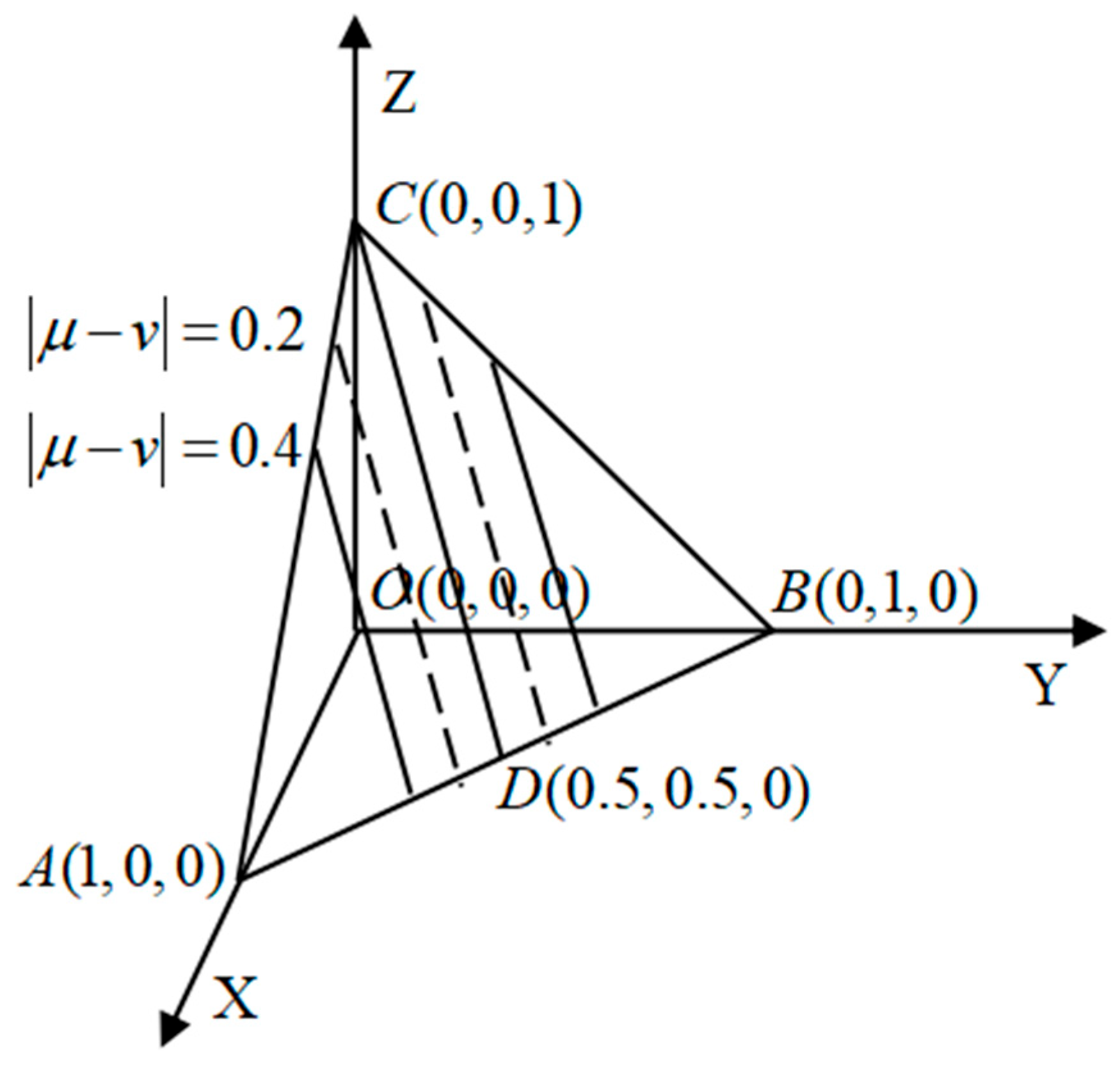
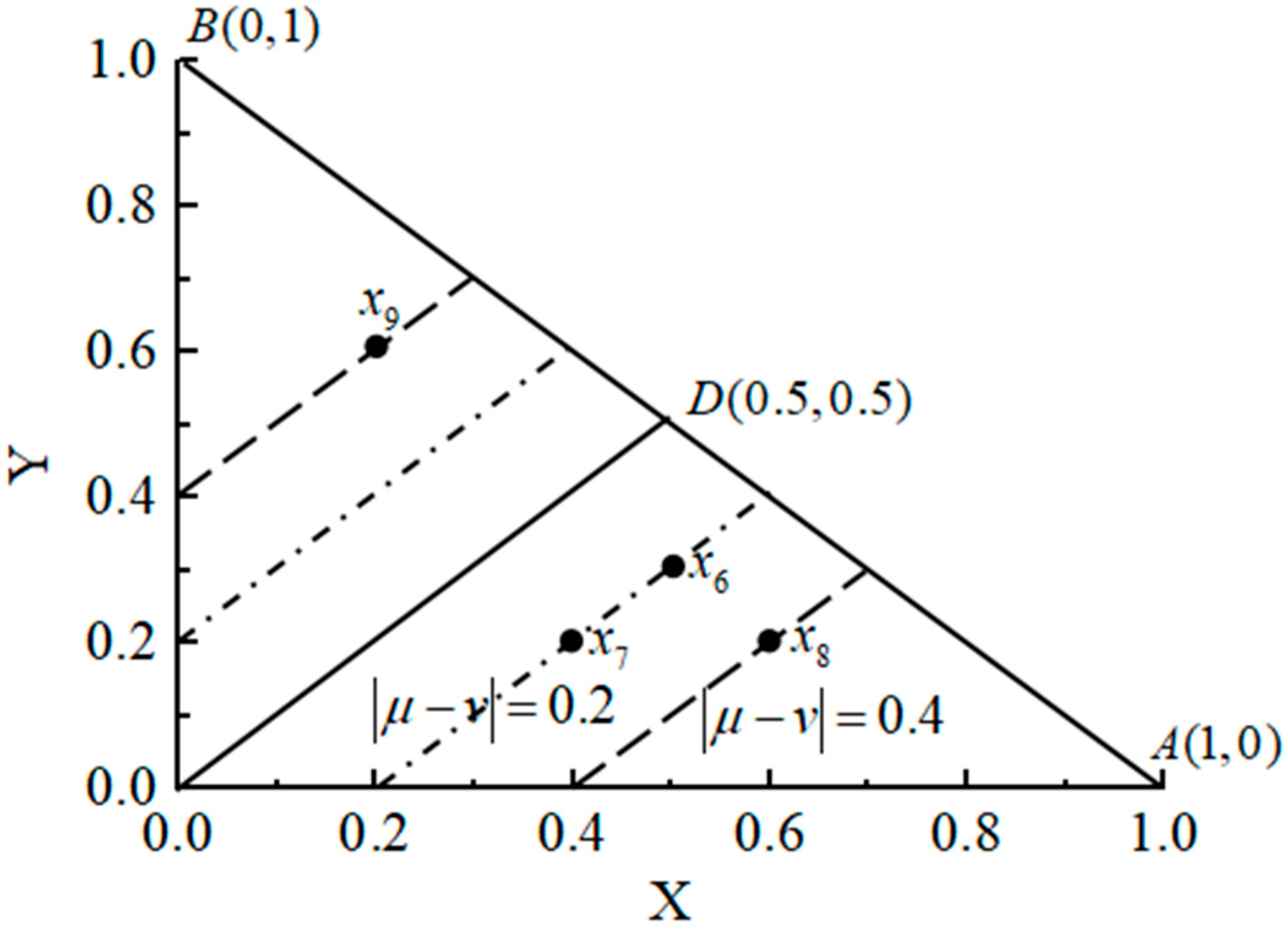
To analyze the influence of the difference between the membership degree and non-membership degree ( μ A ( x i ) v A ( x i ) ) on entropy, we draw the isoline of μ A ( x i ) v A ( x i ) in Δ A B C —line segments parallel to midline C D (Figure 4). The key characteristics of these isolines are as follows:
All points on the same isoline have the same μ A ( x i ) v A ( x i ) value (constant μ A ( x i ) v A ( x i ) );
The μ A ( x i ) v A ( x i ) value presents a symmetric distribution about the midline C D (e.g., the isolines in Figure 4 are labeled μ A ( x i ) v A ( x i ) = 0 . 2 , 0 . 4 );
For any fixed isoline (fixed μ A ( x i ) v A ( x i ) ), the entropy of points on the line increases as the point approaches point C . This is because the closer to C , the larger π A ( x i ) , and the greater the intuition (consistent with axiom (4)).
Figure 5 can be obtained by projecting Figure 4 into two-dimensional plane A O B , let x 6 0.5 , 0.3 , 0.2 , x 7 0.4 , 0.2 , 0.4 , x 8 0.6 , 0.2 , 0.2 , x 9 0.2 , 0.6 , 0.2 be four points in it, on the line segment μ A x i v A x i = 0.2 , since the point x 7 is closer to the point O than the point x 6 , thus the comparison between the corresponding intuitionistic fuzzy entropy is E x 7 > E x 6 . On the line segment μ A x i v A x i = 0.4 , since the point x 8 and x 9 are symmetrical on line segment O D , thus the comparison between the corresponding intuitionistic fuzzy entropy is E x 8 > E x 9 .

4.2. Construct New Intuitionistic Fuzzy Entropy Measures

First, the core symbolic definition of the intuitionistic fuzzy set is clarified: Let X = x 1 , x 2 , x n be a universe of discourse. For any x i X , the intuitionistic fuzzy set A is jointly characterized by the membership degree μ A ( x i ) 0 , 1 (representing x i the degree of belonging to A ), the non-membership degree ν A ( x i ) 0 , 1 (representing x i the degree of not belonging to A ), and the hesitation degree π A ( x i ) =   1 - μ A ( x i ) - ν A ( x i ) 0 , 1 (representing x i the degree of uncertainty about belonging to A ).
Theorem 1. 
Let  X = x 1 , x 2 , , x n  be a universe of discourse,  A = x i , μ A x i , v A x i   x i X I F S X , if
E 1 A = 1 n i = 1 n 1 μ A x i v A x i 2 + 2 π A 2 x i 2 μ A x i v A x i 2 + π A 2 x i .
then  E 1  is the entropy of intuition fuzzy sets.
Proof of Theorem 1. 
Next we prove E 1 meets all the conditions in the axiomatic definition as follows.
(1)
E 1 A = 0 if and only if 1 μ A x i v A x i 2 + 2 π A 2 x i 2 μ A x i v A x i 2 + π A 2 x i = 0 , that is 1 μ A x i v A x i 2 + 2 π A 2 x i = 0 , i.e., for x i X , we have μ A x i = 1 , v A x i = 0 and π A x i = 0 , or μ A x i = 0 , v A x i = 1 , π A x i = 0 . So A is crisp set;
(2)
E 1 A = 1 if and only if 1 μ A x i v A x i 2 + 2 π A 2 x i 2 μ A x i v A x i 2 + π A 2 x i = 1 , after finishing π A 2 x i = 1 , i.e., for x i X , we have μ A x i = 0 , v A x i = 0 , π A x i = 1 ;
(3)
When π A x i = π B x i and μ A x i v A x i < μ B x i v B x i , we have
1 1 π A 2 x i 2 μ A x i v A x i 2 + π A 2 x i > 1 1 π B 2 x i 2 μ B x i v B x i 2 + π B 2 x i .
Since 1 μ A x i v A x i 2 + 2 π A 2 x i 2 μ A x i v A x i 2 + π A 2 x i = 1 1 π A 2 x i 2 μ A x i v A x i 2 + π A 2 x i and
1 μ B x i v B x i 2 + 2 π B 2 x i 2 μ B x i v B x i 2 + π B 2 x i = 1 1 π B 2 x i 2 μ B x i v B x i 2 + π B 2 x i .
Thus, E 1 A > E 1 B .
(4)
When μ A x i v A x i = μ B x i v B x i and π A x i < π B x i , we have 
2 3 μ A x i v A x i 2 2 μ A x i v A x i 2 + π A 2 x i < 2 3 μ B x i v B x i 2 2 μ B x i v B x i 2 + π B 2 x i .
Since 1 μ A x i v A x i 2 + 2 π A 2 x i 2 μ A x i v A x i 2 + π A 2 x i = 2 3 μ A x i v A x i 2 2 μ A x i v A x i 2 + π A 2 x i
and 1 μ B x i v B x i 2 + 2 π B 2 x i 2 μ B x i v B x i 2 + π B 2 x i = 2 3 μ B x i v B x i 2 2 μ B x i v B x i 2 + π B 2 x i .
Thus, E 1 A < E 1 B .
(5)
Since 1 μ A x i v A x i 2 + 2 π A 2 x i 2 μ A x i v A x i 2 + π A 2 x i = 1 v A x i μ A x i 2 + 2 π A 2 x i 2 v A x i μ A x i 2 + π A 2 x i ,
Thus, E 1 A = E 1 A c .
(6)
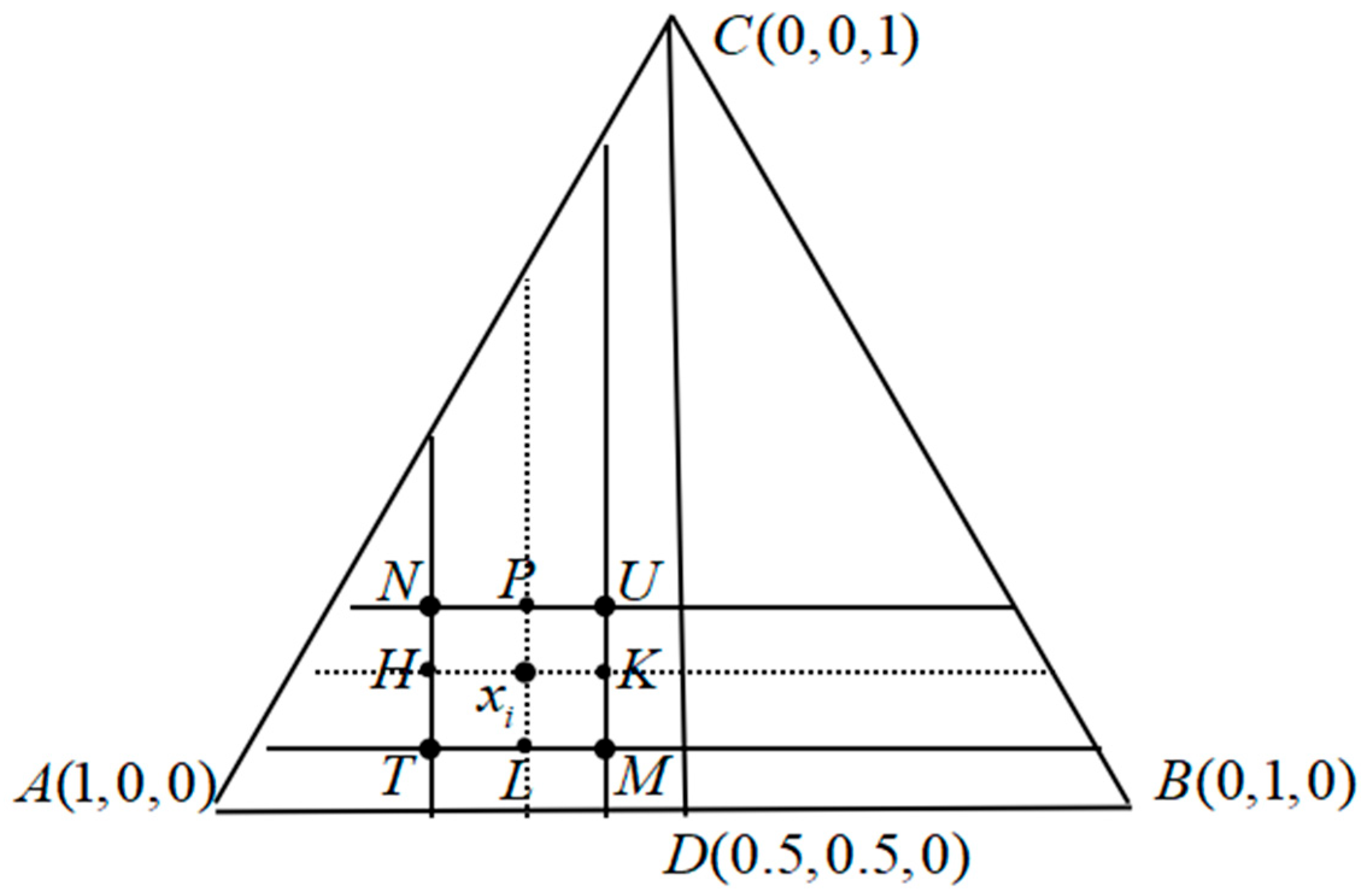
Obviously, intuitionistic fuzzy entropy E 1 A changes continuously with different I F S in interval [0,1]. Find any point x i in Δ A B C , then draw some lines paralleled to A B and C D , as it shows in Figure 6.
Figure 6. Position relation between point x i and key points around.
Mathematics 14 00150 g006
Based on Theorem 1, the entropy between x i and the horizontal points around it and the vertical points can be compared. As E 1 H < E 1 x i < E 1 K , E 1 L < E 1 x i < E 1 P . Since E 1 x i < E 1 K , E 1 K < E 1 U , so E 1 x i < E 1 U . Since E 1 x i > E 1 L , E 1 L > E 1 T , thus E 1 x i > E 1 T . But the entropy between x i and M and the entropy between x i and N cannot be compared, because when x i moves to M , though the fuzziness is increasing, the intuitionistic is decreasing, and the results of these two aspects are not clear. The entropy relation between x i and N is similar.
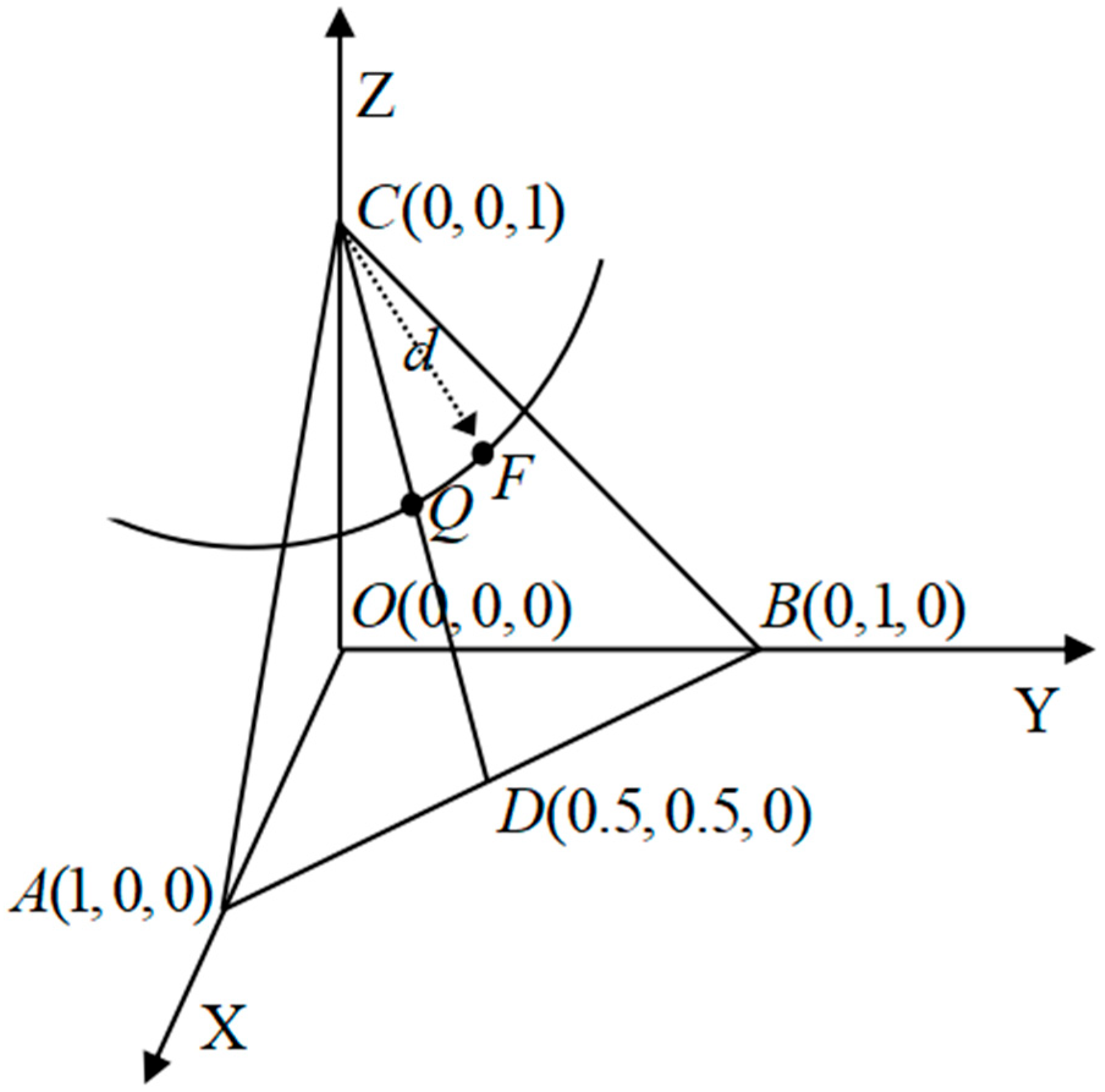
In order to solve this problem, we take the point C as the center of the circle to make an arc in Δ A B C , as shown in Figure 7, when F is becoming closer to Q , the fuzziness is enhanced and the intuition is weakened, obviously their interaction can offset each other, so that the uncertain information of this point remains the same, that is, the entropy does not change. We call this the isentropic arc. To clarify the mathematical definition of the isentropic arc, combined with the geometric space Δ A B C (where A 1 , 0 , 0 , B 0 , 1 , 0 , and C 0 , 0 , 1 are the three poles of the intuitionistic fuzzy set), the isentropic arc refers to the locus of points within Δ A B C that satisfy a constant entropy value.
As seen in Figure 7, the points on the isentropic arc have the characteristics of equal entropy. At the same time, with the point on the line segment C F becoming closer to point C , both intuitive and fuzziness are increasing, that means the intuitionistic fuzzy entropy has an obvious trend of increasing. Therefore, according to the distance between any point in Δ A B C and point C , it is possible to measure the size of intuitionistic fuzzy entropy of that point, then we can establish a more reasonable and reliable entropy formula based on that. Then, Theorem 2 is obtained as follows. □
Theorem 2. 
Let  X = x 1 , x 2 , , x n  be a universe of discourse,  A = x i , μ A x i , v A x i   x i X I F S X , if
E 2 A = 1 n i = 1 n 1 1 2 μ A 2 x i + v A 2 x i + 1 π A x i 2 .
then  E 2  is the entropy of intuitionistic fuzzy set.
Proof of Theorem 2. 
First, the theoretical basis of the Euclidean distance is explained: The three parameters μ A ( x i ) , v A ( x i ) , π A ( x i ) of the intuitionistic fuzzy set can be regarded as a point in a three-dimensional space, and μ A 2 ( x i ) + v A 2 ( x i ) + 1 π A ( x i ) 2 corresponds to the square of the Euclidean distance from the maximum entropy point 0 , 0 , 1 .
The following proves that E 2 satisfies the conditions in the axiomatic definition of entropy.
(1)
E 2 A = 0 if and only if 1 1 2 μ A 2 x i + v A 2 x i + 1 π A x i 2 = 0 , after simplifying and finishing μ A 2 x i + v A 2 x i + 1 π A x i 2 = 2 . That is, for each x i X , μ A x i = 1 , v A x i = 0 , π A x i = 0 , or μ A x i = 0 , v A x i = 1 , π A x i = 0 . Thus, A is a crisp set;
(2)
E 2 A = 1 if and only if 1 1 2 μ A 2 x i + v A 2 x i + 1 π A x i 2 = 1 , after simplifying and finishing μ A 2 x i + v A 2 x i + 1 π A x i 2 = 0 is obtained. That is, for each x i X , μ A x i = 0 , v A x i = 0 , π A x i = 1 are established;
(3)
Let π A x i = β , μ A x i v A x i = y , then μ A x i = 1 β + y 2 , v A x i = 1 β y 2 , or μ A x i = 1 β y 2 , v A x i = 1 β + y 2 . Note
f β , y = 1 1 2 μ A 2 x i + v A 2 x i + 1 π A x i 2 = 1 1 π A x i 2 μ A x i v A x i = 1 1 β 2 1 β 2 y 2 4 .
When y 1 < y 2 , then f β , y 1 > f β , y 2 . Thus, E 2 A > E 2 B ;
(4)
Let μ A x i v A x i = α and π A x i = y , then μ A x i = 1 y + α 2 , v A x i = 1 y α 2 or μ A x i = 1 y α 2 , v A x i = 1 y + α 2 .
Note
f α , y = 1 1 2 μ A 2 x i + v A 2 x i + 1 π A x i 2 = 1 1 2 μ A x i v A x i 2 + 2 μ A x i v A x i + 1 π A x i 2 = 1 1 2 α 2 + 1 y 2 α 2 2 + 1 y 2 .
When y 1 < y 2 , then f α , y 1 < f α , y 2 . Thus, E 2 A < E 2 B ;
(5)
Since 1 1 2 μ A 2 x i + v A 2 x i + 1 π A x i 2 = 1 1 2 v A 2 x i + μ A 2 x i + 1 π A x i 2 , thus E 2 A > E 2 A c ;
(6)
Obviously, with different intuitionistic fuzzy sets, intuitionistic fuzzy entropy changes continuously in interval [0,1]. □

4.3. The Geometric Construction Method of Intuitionistic Fuzzy Entropy Based on TOPSIS Method

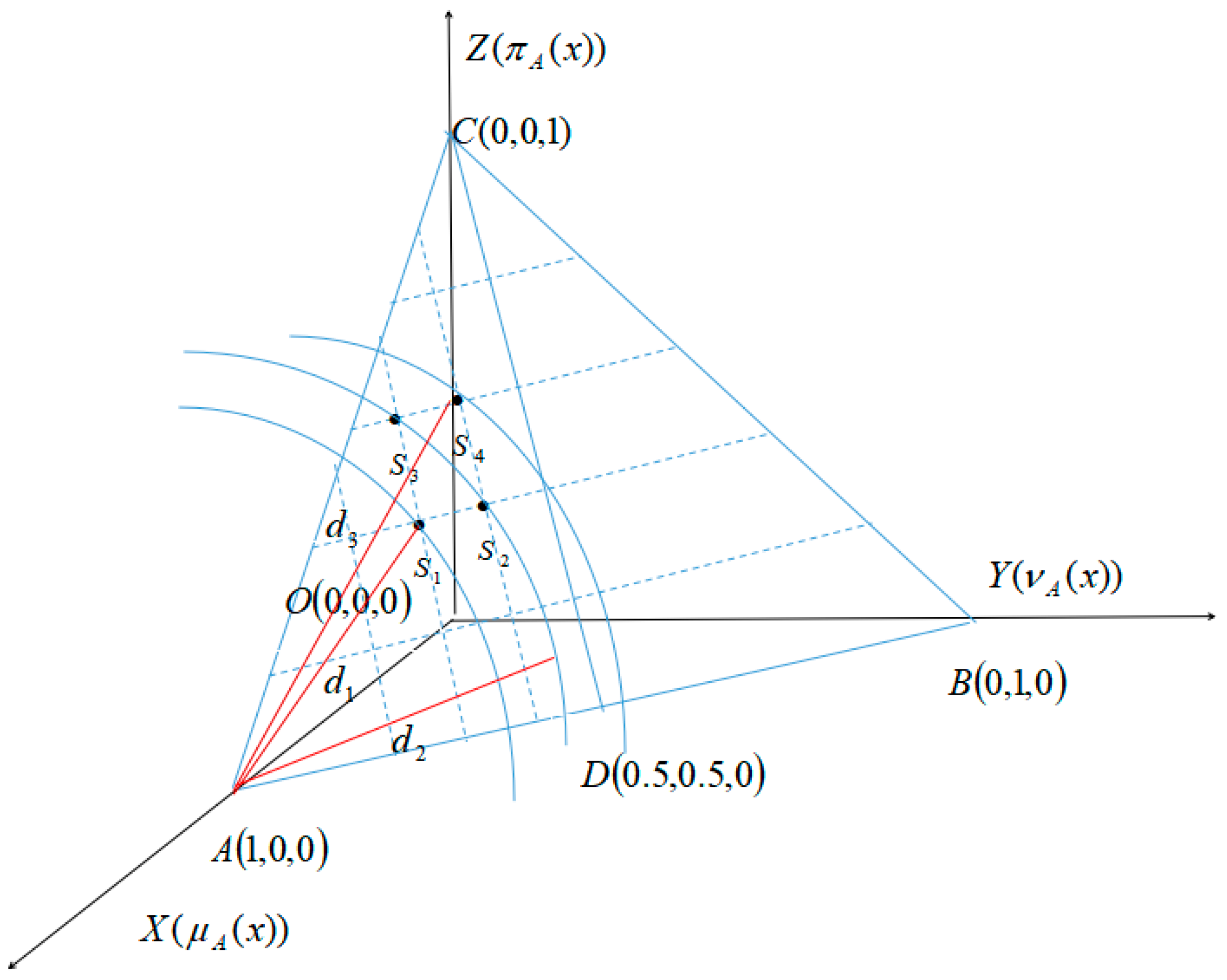
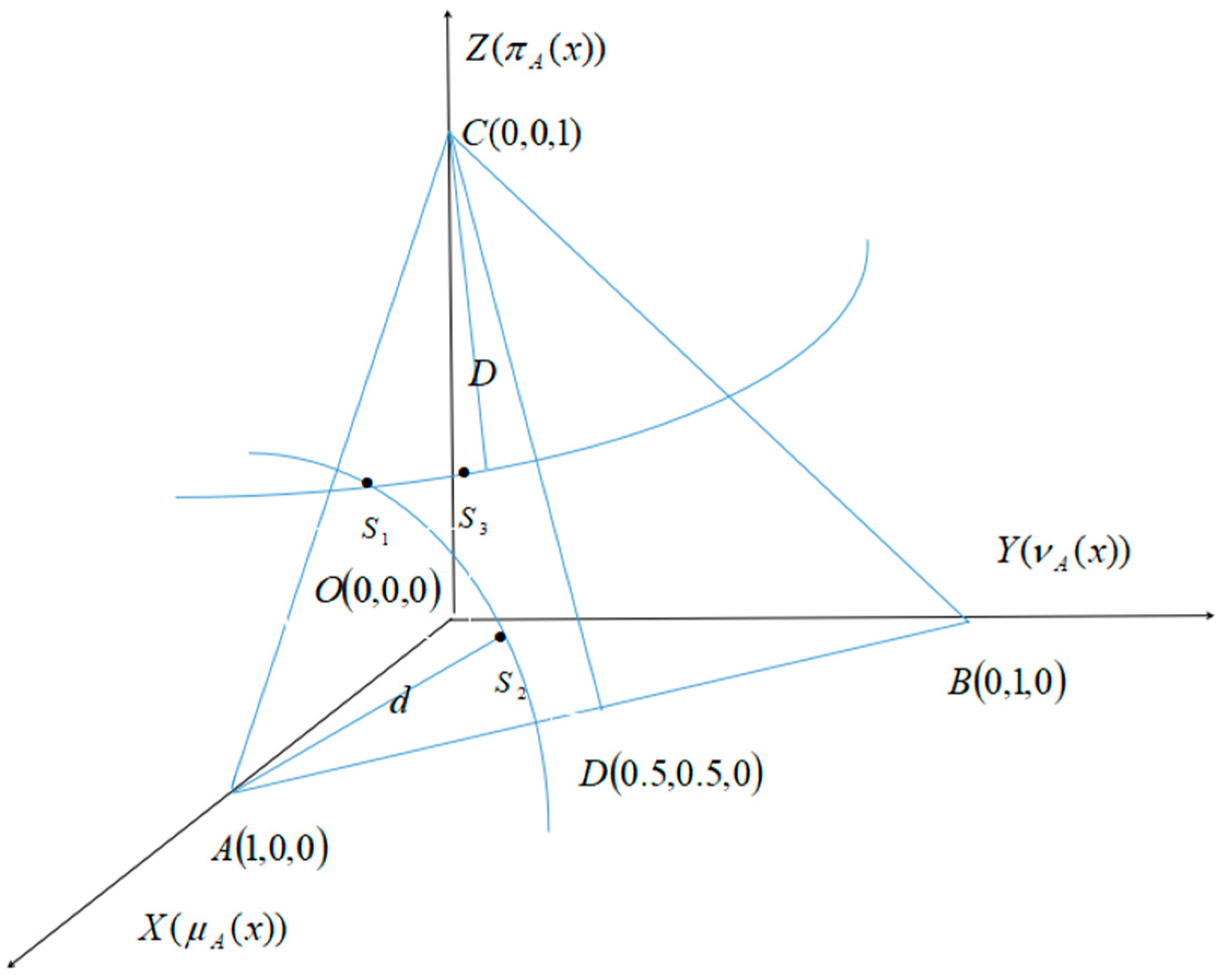
As shown in Figure 8, with the zero entropy point 1 , 0 , 0 as the center of the circle, the mathematical definition of the isentropic arc is the locus of intuitionistic fuzzy set points in a three-dimensional space that are equidistant from the zero entropy point in terms of Euclidean distance. Its parametric form is 1 μ A ( x i ) 2 + v A 2 ( x i ) + π A 2 ( x i ) = d 2 (where d is a constant corresponding to the radius of the isentropic arc). The larger the radius d , the greater the entropy. Based on this, a new intuitionistic fuzzy entropy can be constructed.
Theorem 3. 
Let  X = x 1 , x 2 , , x n  be a universe of discourse,  A = x i , μ A x i , v A x i   x i X I F S X , if
E 3 ( A ) = 1 n i = 1 n 2 2 d x i
Among,  d ( x i ) = min ( 1 μ A ( x i ) ) 2 + ν A 2 ( x i ) + π A 2 ( x i ) , μ A 2 ( x i ) + ( 1 ν A ( x i ) ) 2 + π A 2 ( x i ) .
It means that
E 3 ( A ) = 1 n i = 1 n 2 2 min ( 1 μ A ( x i ) ) 2 + ν A 2 ( x i ) + π A 2 ( x i ) , μ A 2 ( x i ) + ( 1 ν A ( x i ) ) 2 + π A 2 ( x i )
for intuitionistic fuzzy entropy.
Proof of Theorem 3. 
(1)
E 3 ( A ) = 0 if and only if
2 2 ( 1 μ A ( x i ) ) 2 + ν A 2 ( x i ) + π A 2 ( x i ) = 0 , or 2 2 μ A 2 ( x i ) + ( 1 ν A ( x i ) ) 2 + π A 2 ( x i ) = 0
That is, for each x i X , we have μ A ( x i ) = 1 , ν A ( x i ) = 0 , π A ( x i ) = 0 , or μ A ( x i ) = 0 , ν A ( x i ) = 1 , π A ( x i ) = 0 . Thus, A is crisp set.
(2)
E 3 ( A ) = 1 if and only if
2 2 ( 1 μ A ( x i ) ) 2 + ν A 2 ( x i ) + π A 2 ( x i ) = 1 , also 2 2 μ A 2 ( x i ) + ( 1 ν A ( x i ) ) 2 + π A 2 ( x i ) = 1
That is, for each x i X , μ A ( x i ) = ν A ( x i ) = 0 and π A x i = 1 are established.
(3)
Let π A 1 ( x i ) = π A 2 ( x i ) , μ A 1 ( x i ) ν A 1 ( x i ) < μ A 2 ( x i ) ν A 2 ( x i ) , for each x i X are established.
E 3 ( A 1 ) E 3 ( A 2 ) = 2 2 min ( 1 μ A 1 ( x i ) ) 2 + ν A 1 2 ( x i ) + π A 1 2 ( x i ) , μ A 1 2 ( x i ) + ( 1 ν A 1 ( x i ) ) 2 + π A 1 2 ( x i ) 2 2 min ( 1 μ A 2 ( x i ) ) 2 + ν A 2 2 ( x i ) + π A 2 2 ( x i ) , μ A 2 2 ( x i ) + ( 1 ν A 2 ( x i ) ) 2 + π A 2 2 ( x i )
When 1 μ A 1 ( x i ) ν A 1 ( x i ) 0 , E 3 ( A 1 ) = 2 2 ( 1 μ A 1 ( x i ) ) 2 + ν A 1 2 ( x i ) + π A 1 2 ( x i ) ;
When 0 μ A 1 ( x i ) < ν A 1 ( x i ) 1 , E 3 ( A 1 ) = 2 2 μ A 1 2 ( x i ) + ( 1 ν A 1 ( x i ) ) 2 + π A 1 2 ( x i ) ;
When 1 μ A 2 ( x i ) ν A 2 ( x i ) 0 , E 3 ( A 2 ) = 2 2 ( 1 μ A 2 ( x i ) ) 2 + ν A 2 2 ( x i ) + π A 2 2 ( x i ) ;
When 0 μ A 2 ( x i ) < ν A 2 ( x i ) 1 , E 3 ( A 2 ) = 2 2 μ A 2 2 ( x i ) + ( 1 ν A 2 ( x i ) ) 2 + π A 2 2 ( x i ) .
The following proves that when
1 μ A 1 ( x i ) ν A 1 ( x i ) 0 , 1 μ A 2 ( x i ) ν A 2 ( x i ) 0 , π A 1 ( x i ) = π A 2 ( x i ) , entropy E 3 ( A 1 ) > E 3 ( A 2 ) , the other three situations can be proved by similar methods.
E 3 ( A 1 ) E 3 ( A 2 ) = 2 2 ( 1 μ A 1 ( x i ) ) 2 + ν A 1 2 ( x i ) + π A 1 2 ( x i ) 2 2 ( 1 μ A 2 ( x i ) ) 2 + ν A 2 2 ( x i ) + π A 2 2 ( x i )
Because
π A 1 ( x i ) = π A 2 ( x i ) , μ A 1 ( x i ) + ν A 2 ( x i ) + π A 3 ( x i ) = 1 , μ A 2 ( x i ) + ν A 2 ( x i ) + π A 2 ( x i ) = 1 , μ A 1 ( x i ) ν A 2 ( x i ) < μ A 2 ( x i ) ν A 2 ( x i ) , μ A 1 ( x i ) μ A 2 ( x i ) < ν A 2 ( x i ) ν A 1 ( x i ) , for each x i X are established.
So μ A 1 ( x i ) 1 μ A 1 ( x i ) π A 1 < μ A 2 ( x i ) 1 μ A 2 ( x i ) π A 2 , That is μ A 1 ( x i ) < μ A 2 ( x i ) , ν A 1 ( x i ) > ν A 2 ( x i ) .
And because
( 1 μ A 1 ( x i ) ) 2 + ν A 1 2 ( x i ) + π A 1 2 ( x i ) ( 1 μ A 2 ( x i ) ) 2 + ν A 2 2 ( x i ) + π A 2 2 ( x i ) = ( 1 μ A 1 ( x i ) ) 2 + ν A 1 2 ( x i ) ( 1 μ A 2 ( x i ) ) 2 + ν A 2 2 ( x i ) = ( 1 μ A 1 ( x i ) ) ( 1 μ A 2 ( x i ) ) ( 1 μ A 1 ( x i ) ) + ( 1 μ A 2 ( x i ) ) + ( ν A 1 ( x i ) ν A 2 ( x i ) ν A 1 ( x i ) + ν A 2 ( x i ) = μ A 2 ( x i ) μ A 1 ( x i ) 2 μ A 1 ( x i ) μ A 2 ( x i ) + ( ν A 1 ( x i ) ν A 2 ( x i ) ν A 1 ( x i ) + ν A 2 ( x i ) > μ A 2 ( x i ) μ A 1 ( x i ) 2 μ A 1 ( x i ) μ A 2 ( x i ) ν A 1 ( x i ) + ν A 2 ( x i ) = μ A 2 ( x i ) μ A 1 ( x i ) π A 1 ( x i ) + π A 2 ( x i )
Because μ A 1 ( x i ) < μ A 2 ( x i ) ,
So ( 1 μ A 1 ( x i ) ) 2 + ν A 1 2 ( x i ) + π A 1 2 ( x i ) > ( 1 μ A 2 ( x i ) ) 2 + ν A 2 2 ( x i ) + π A 2 2 ( x i ) .
Therefore E 3 ( A 1 ) E 3 ( A 2 ) > 0 , that is, E 3 ( A 1 ) > E 3 ( A 2 ) is established.
(4)
When π A 1 ( x i ) < π A 2 ( x i ) , μ A 1 ( x i ) ν A 1 ( x i ) = μ A 2 ( x i ) ν A 2 ( x i ) , and for each x i X ,
E 3 ( A 1 ) E 3 ( A 2 ) = 2 2 min ( 1 μ A 1 ( x i ) ) 2 + ν A 1 2 ( x i ) + π A 1 2 ( x i ) , μ A 1 2 ( x i ) + ( 1 ν A 1 ( x i ) ) 2 + π A 1 2 ( x i ) 2 2 min ( 1 μ A 2 ( x i ) ) 2 + ν A 2 2 ( x i ) + π A 2 2 ( x i ) , μ A 2 2 ( x i ) + ( 1 ν A 2 ( x i ) ) 2 + π A 2 2 ( x i )
The following proves that when 1 μ A 1 ( x i ) ν A 1 ( x i ) 0 ,
1 μ A 2 ( x i ) ν A 2 ( x i ) 0 , π A 1 ( x i ) = π A 2 ( x i ) , entropy E 3 ( A 1 ) < E 3 ( A 2 ) , the other three situations can be proved by similar methods.
E 3 ( A 1 ) E 3 ( A 2 ) = 2 2 ( 1 μ A 1 ( x i ) ) 2 + ν A 1 2 ( x i ) + π A 1 2 ( x i ) 2 2 ( 1 μ A 2 ( x i ) ) 2 + ν A 2 2 ( x i ) + π A 2 2 ( x i )
Because
π A 1 ( x i ) < π A 2 ( x i ) , μ A 1 ( x i ) + ν A 1 ( x i ) + π A 1 ( x i ) = 1 , μ A 2 ( x i ) + ν A 2 ( x i ) + π A 2 ( x i ) = 1 ,
μ A 1 ( x i ) ν A 1 ( x i ) = μ A 2 ( x i ) ν A 2 ( x i ) , μ A 1 ( x i ) μ A 2 ( x i ) = ν A 1 ( x i ) ν A 2 ( x i ) , so
μ A 1 ( x i ) > μ A 2 ( x i ) .
And because
( 1 μ A 1 ( x i ) ) 2 + ν A 1 2 ( x i ) + π A 1 2 ( x i ) ( 1 μ A 2 ( x i ) ) 2 + ν A 2 2 ( x i ) + π A 2 2 ( x i ) = ( 1 μ A 1 ( x i ) ) 2 + ν A 1 2 ( x i ) ( 1 μ A 2 ( x i ) ) 2 + ν A 2 2 ( x i ) + π A 1 2 ( x i ) π A 2 2 ( x i ) = ( 1 μ A 1 ( x i ) ) ( 1 μ A 2 ( x i ) ) ( 1 μ A 1 ( x i ) ) + ( 1 μ A 2 ( x i ) ) + ( ν A 1 ( x i ) ν A 2 ( x i ) ν A 1 ( x i ) + ν A 2 ( x i ) + π A 1 2 ( x i ) π A 2 2 ( x i ) = μ A 2 ( x i ) μ A 1 ( x i ) 2 μ A 1 ( x i ) μ A 2 ( x i ) + ( ν A 1 ( x i ) ν A 2 ( x i ) ν A 1 ( x i ) + ν A 2 ( x i ) + π A 1 2 ( x i ) π A 2 2 ( x i ) = μ A 2 ( x i ) μ A 1 ( x i ) 2 μ A 1 ( x i ) μ A 2 ( x i ) ν A 1 ( x i ) + ν A 2 ( x i ) + π A 1 2 ( x i ) π A 2 2 ( x i ) = μ A 2 ( x i ) μ A 1 ( x i ) π A 1 ( x i ) + π A 2 ( x i ) + π A 1 2 ( x i ) π A 2 2 ( x i ) = π A 1 ( x i ) + π A 2 ( x i ) μ A 2 ( x i ) μ A 1 ( x i ) + π A 1 ( x i ) π A 2 ( x i )
Because μ A 1 ( x i ) > μ A 2 ( x i ) , π A 1 ( x i ) < π A 2 ( x i ) , so
( 1 μ A 1 ( x i ) ) 2 + ν A 1 2 ( x i ) + π A 1 2 ( x i ) < ( 1 μ A 2 ( x i ) ) 2 + ν A 2 2 ( x i ) + π A 2 2 ( x i )
Therefore E 3 ( A 1 ) E 3 ( A 2 ) < 0 , that is, E 3 ( A 1 ) < E 3 ( A 2 ) is established.
(5)
Let A = x i , μ A ( x i ) , ν A ( x i ) x i X , then A c = x i , ν A ( x i ) , μ A ( x i ) x i X . When
μ A ( x i ) ν A ( x i ) , E 3 ( A c ) = 2 2 ν A 2 ( x i ) + ( 1 μ A ( x i ) ) 2 + π A 2 ( x i )
E 3 ( A ) = 2 2 ( 1 μ A ( x i ) ) 2 + ν A 2 ( x i ) + π A 2 ( x i ) .
When μ A ( x i ) < ν A ( x i ) , E 3 ( A ) = 2 2 μ A 2 ( x i ) + ( 1 ν A ( x i ) ) 2 + π A 2 ( x i ) ,
E 3 ( A c ) = 2 2 ( 1 ν A ( x i ) ) 2 + μ A 2 ( x i ) + π A 2 ( x i ) . So E 3 ( A ) = E 3 ( A c ) .
(6)
It is obvious that the intuitionistic fuzzy entropy E 3 ( A ) changes continuously in interval [0,1] as different intuitionistic fuzzy sets are taken. So
E 3 ( A ) = 1 n i = 1 n 2 2 min ( 1 μ A ( x i ) ) 2 + ν A 2 ( x i ) + π A 2 ( x i ) , μ A 2 ( x i ) + ( 1 ν A ( x i ) ) 2 + π A 2 ( x i )
meet the conditions. □
As shown in Figure 9, the intuitionistic fuzzy entropy proposed by Theorem 3 is based on the construction of an isentropic arc with the zero entropy point as the center of the circle, while the isoentropy in Theorem 2 is based on the construction of an isentropic arc with the point with the greatest entropy as the center of the circle. Therefore, it is obtained E 3 ( A S 1 ) = E 3 ( A S 2 ) according to the method constructed by Theorem 3, and obtained E 2 ( A S 1 ) = E 2 ( A S 3 ) according to the construction method of Theorem 2, and by constructing with both of the above two methods, the entropy of A S 2 and the entropy of A S 3 are not equal. For this reason, we propose to construct a new intuitionistic fuzzy entropy based on the TOPSIS method, that is, the closer to the maximum entropy point (0,0,1) and the farther away from the minimum entropy point (1,0,0), the greater the entropy value corresponding to the point. The necessity and optimality of this design can be illustrated from three aspects as follows:
(1)
Theoretical Adaptability: The core of intuitionistic fuzzy entropy is to measure uncertainty. The essence of the TOPSIS method is to evaluate merits and demerits through distance ranking. The two are highly consistent in the logic of “quantifying target attributes based on relative positions”. An intuitionistic fuzzy point with stronger uncertainty should be closer to the maximum entropy point (complete uncertainty). It should also be farther from the zero entropy point (complete certainty). The dual-reference distance comparison mechanism of TOPSIS can accurately depict this relative relationship. However, single-reference distance measurement cannot simultaneously meet the dual requirements of “approaching the optimal” and “staying away from the worst”.
(2)
Comparative Advantages over Other Distance Methods: Take Minkowski distance as an example. Its essence is a single-dimensional distance measurement. It can only describe the absolute distance from an intuitionistic fuzzy point to a certain reference point. It cannot reflect the relative merits between the two points. If Minkowski distance is used to replace the TOPSIS method, it is necessary to calculate the distances to the maximum entropy point and the zero entropy point separately, and then perform manual weighting. This approach not only lacks a unified weight determination standard, but also loses the core advantage of TOPSIS—“relative closeness”.
(3)
Engineering Practicality: In complex engineering decision-making, decision objectives often need to consider both “optimal reference” and “worst reference” (e.g., a scheme’s optimal performance and worst-case risk). The dual-reference design of TOPSIS naturally matches the actual needs of engineering decision-making. The entropy constructed based on this method can be directly integrated into the decision model. This realizes the integration of uncertainty quantification and scheme ranking. In contrast, other distance methods require the additional construction of decision frameworks, which increases model complexity and the risk of error transmission.
Theorem 4. 
Let  X = x 1 , x 2 , , x n  be a universe of discourse,  A = x i , μ A x i , v A x i   x i X I F S X , if
E 4 ( A ) = 1 n i = 1 n d x i d x i + D x i .
Among,  d ( x i ) = min ( 1 μ A ( x i ) ) 2 + ν A 2 ( x i ) + π A 2 ( x i ) , μ A 2 ( x i ) + ( 1 ν A ( x i ) ) 2 + π A 2 ( x i ) ,  D ( x i ) = ( μ A 2 ( x i ) + ν A 2 ( x i ) + ( 1 π A ( x i ) ) 2 , then  E 4 A  is the entropy of intuition fuzzy sets.
Proof of Theorem 4. 
(1)
E 4 ( A ) = 0 if and only if d ( x i ) = 0 , that is
( 1 μ A ( x i ) ) 2 + ν A 2 ( x i ) + π A 2 ( x i ) = 0 , or μ A 2 ( x i ) + ( 1 ν A ( x i ) ) 2 + π A 2 ( x i ) = 0 .
That is, for each x i X , we have μ A ( x i ) = 1 , ν A ( x i ) = 0 , π A ( x i ) = 0 , or μ A ( x i ) = 0 , ν A ( x i ) = 1 , π A ( x i ) = 0 . Thus, A is crisp set.
(2)
E 4 ( A ) = 1 if and only if D ( x i ) = 0 , that is
μ A 2 ( x i ) + ν A 2 ( x i ) + ( 1 π A ( x i ) ) 2 = 1
That is, for each x i X , μ A ( x i ) = ν A ( x i ) = 0 and π A x i = 1 are established.
(3)
Let π A 1 ( x i ) = π A 2 ( x i ) , μ A 1 ( x i ) ν A 1 ( x i ) < μ A 2 ( x i ) ν A 2 ( x i ) , for each x i X is always established.
E 4 ( A 1 ) E 4 ( A 2 ) = d A 1 x i d A 1 x i + D A 1 x i d A 2 x i d A 2 x i + D A 2 x i
From Theorem 2 and Theorem 3, we know that
d A 1 x i d A 1 x i + D A 1 x i d A 2 x i d A 2 x i + D A 2 x i = d A 1 x i D A 2 x i d A 2 x i d A 1 x i + D A 1 x i d A 2 x i + D A 2 x i , D A 2 x i > D A 1 x i > 0 , thus
d A 1 x i d A 1 x i + D A 1 x i d A 2 x i d A 2 x i + D A 2 x i = d A 1 x i D A 2 x i d A 2 x i D A 1 x i d A 1 x i + D A 1 x i d A 2 x i + D A 2 x i > 0
so E 4 ( A 1 ) E 4 ( A 2 ) > 0 , that is E 4 ( A 1 ) > E 4 ( A 2 ) .
(4)
When π A 1 ( x i ) < π A 2 ( x i ) , μ A 1 ( x i ) ν A 1 ( x i ) = μ A 2 ( x i ) ν A 2 ( x i ) , for each x i X , E 4 ( A 1 ) E 4 ( A 2 ) = d A 1 x i d A 1 x i + D A 1 x i d A 2 x i d A 2 x i + D A 2 x i
From Theorem 2 and Theorem 3, we know that
d A 2 x i > d A 1 x i > 0 , D A 1 x i > D A 2 x i > 0 , thus
d A 1 x i d A 1 x i + D A 1 x i d A 2 x i d A 2 x i + D A 2 x i = d A 1 x i D A 2 x i d A 2 x i D A 1 x i d A 1 x i + D A 1 x i d A 2 x i + D A 2 x i < 0
so E 4 ( A 1 ) E 4 ( A 2 ) < 0 , that is E 4 ( A 1 ) < E 4 ( A 2 ) .
(5)
Let A = x i , μ A ( x i ) , ν A ( x i ) x i X , then A c = x i , ν A ( x i ) , μ A ( x i ) x i X ,
d A x i = d A c x i , D A x i = D A c x i . Thus, E 4 ( A ) = E 4 ( A c )
(6)
Obviously, E 4 ( A ) changes continuously in interval [0,1].
So E 4 ( A ) = 1 n i = 1 n d x i d x i + D x i meet the conditions. □
From the perspective that intuition and fuzziness can be transformed into each other, this paper deeply analyzes the influence of the variation laws of μ A ( x i ) ν A ( x i ) and π A ( x i ) on the entropy value. Meanwhile, based on the geometric characteristics of the intuitionistic fuzzy entropy plane, isentropic arcs with the minimum entropy point (1,0,0) and the maximum entropy point (0,0,1) as the centers are, respectively, constructed. By comparing and analyzing the advantages and disadvantages of the above two isentropic arcs: the isentropic arc centered at the zero entropy point can only describe the entropy increase trend of “moving away from the state with the lowest uncertainty”, but cannot accurately match the intuitive cognition of “approaching the state with the highest uncertainty”; on the contrary, the isentropic arc centered at the maximum entropy point has the defect of “ignoring the constraint of the zero entropy point benchmark”. Based on this, the intuitionistic fuzzy entropy measurement formula based on the TOPSIS method is further constructed. The conversion from the geometric characteristics of isentropic arcs to the analytical entropy formula is supported by the distance measurement logic of the TOPSIS method: the relative proximity to the maximum entropy point and the relative distance from the minimum entropy point are quantified by geometric distance, and then integrated into the entropy calculation through normalization and weighted synthesis, which ensures the rigor of the conversion process. The validity of the entropy measure proposed in this paper is verified with multiple sets of data. The above-mentioned research not only enriches the entropy weight theory, but also provides a theoretical basis for complex engineering decision-making problems.
During entropy calculation, Euclidean distance serves as the distance metric for the TOPSIS method. Since it satisfies the positivity, symmetry, and triangle inequality of distance measurement, the rationality of distance calculation is inherently guaranteed. As the three-dimensional indicators of intuitionistic fuzzy sets share the same dimension (all distributed within [0,1]), no extra normalization is needed. For practical applications with inconsistent indicator dimensions, the linear normalization method can be used to project all indicators onto [0,1], thus ensuring the validity of distance calculation.
Let A 1 = x i , 1 , 0 x i X , A 2 = x i , 0.9 , 0.1 x i X , A 3 = x i , 0.8 , 0 x i X , A 4 = x i , 0.7 , 0.1 x i X , A 5 = x i , 0.3 , 0.3 x i X and A 6 = x i , 0 , 0 x i X be I F S s . Calculate the entropy of A 1 , A 2 , A 3 , A 4 , A 5 and A 6 by using the entropy measures E B B 1 , E Z L 1 , E Z J 2 , E Y 1 , E S K 3 , E W G , E V S 2 , E V S 3 , E 1 , E 2 , E 3 , and E 4 to obtain the results listed in Table 2, because the hesitancy degrees of A 1 , A 2 , A 3 , A 4 , A 5 , and A 6 are 0, 0, 0.2, 0.2, 0.4, and 1, they are increasing, and the absolute deviations between membership degree and non-membership degree of A 1 , A 2 , A 3 , A 4 , A 5 , and A 6 are 1, 0.8, 0.8, 0.6, 0, and 0, they are decreasing. Their degree of uncertainty is strictly monotonically increasing, i.e., E A 1 < E A 2 < E A 3 < E A 4 < E A 5 < E A 6 . According to this order and Table 2, we can know that only the values of E 1 , E 2 , E 3 , and E 4 are correct, and this means that the new entropy measure proposed in this paper has higher reliability.

5. Group Decision-Making Model and Application

5.1. Group Decision Method

5.1.1. Basic Concepts of Intuitionistic Fuzzy Sets

Definition 2 
([8]). Let  a ˜ j = a j , b j   j = 1 , 2 , , n  be a set of intuitionistic fuzzy numbers, then we call the following formula the intuitionistic fuzzy weighted averaging operator
I I F W A w a ˜ 1 , a ˜ 2 , , a ˜ n = 1 j = 1 n 1 a j w j , j = 1 n b j w j .
where  w = w 1 , w 2 , , w n T  is the weight vector of  a ˜ j   j = 1 , 2 , , n , w j 0 , 1 and j = 1 n w j = 1 .

5.1.2. Determination of Weights of Index Factors

Let I F S   A = x i , μ A x i , v A x i , π A x i x i X , the research of intuitionistic fuzzy entropy is more complex than fuzzy sets, intuitionistic fuzzy entropy does not only come from the intuition, for which we use the hesitancy degree π A x i to describe intuitionistic fuzzy sets, but also comes from the fuzziness, which we use the absolute deviation μ A x i v A x i between the membership degree and non-membership degree to describe intuitionistic fuzzy sets. Let X = x 1 , x 2 , , x m be a universe of discourse.
Equation (35) is called a intuitionistic fuzzy entropy. We can obtain the entropy E 4 i j that corresponds to each intuitionistic fuzzy number in the evaluation matrix by Equation (35). Then, we determine the weights of factors by
ω j = 1 1 m i = 1 m E 4 i j j = 1 n 1 1 m i = 1 m E 4 i j .
where i = 1 , 2 , , m ; j = 1 , 2 , , n .

5.1.3. Score Function with Parameters

Definition 3. 
Let  a ˜ = a , b  be an  I F N , then
s a ˜ = a b + λ 1 λ 2 π λ 1 1 λ 2 π .
Equation (38) is called the score function of a ˜ , where parameter λ 1 denotes the conversion rate of hesitancy degree, λ 2 and 1 λ 2 , respectively, denote the ratio of the conversion to support and the conversion to opposition with condition 0 λ 1 1 and 0 λ 2 1 .

5.2. Evaluation Procedure

Evaluation procedure for the proposed method is as follows.
Step 1: Obtain the weight w j k   j = 1 , 2 , , n ; k = 1 , 2 , , l of each second-level index by Equation (37).
Step 2: Integrate the evaluation matrix R ˜ k = r ˜ i j k m × n   i = 1 , 2 , , m ; j = 1 , 2 , , n ;   k = 1 , 2 , , l of each second-level index by Equation (36), and we can achieve comprehensive matrix R ˜ k = r ˜ i j k m × 1 .
Step 3: Obtain the weight w k   k = 1 , 2 , , l of each fist-level index by Equation (37).
Step 4: Integrate the evaluation matrix R ˜ k = r ˜ i j k m × 1 of each first-level index by Equation (36), and we can obtain comprehensive matrix R ˜ * = r ˜ i j * m × 1 , r ˜ * = I I F W A w r i 1 , r i 2 , , r i k = 1 k = 1 l 1 a i k w k , k = 1 l b i k w k , where r ˜ i k = a i k , b i k .
Step 5: Determine the score function s x ˜ i   i = 1 , 2 , , m of x i by Equation (38).
Step 6: Rank according to the s x ˜ i then make the decision.

5.3. Application

To improve the emergency rescue system and fully verify the practicality, distinguishability, and universality of the proposed improved intuitionistic fuzzy entropy measure, this study constructs a systematic, multi-level evaluation index system for mine emergency rescue capability, fully incorporating indicator factors related to disaster accident impact control to achieve comprehensive coverage of evaluation dimensions. By adopting intuitionistic fuzzy numbers to build the evaluation matrix, completing the objective assignment of index weights via the improved intuitionistic fuzzy entropy measure, and realizing information integration through fuzzy weighted operators, this study innovatively defines a two-parameter scoring function with a hesitancy conversion rate and support conversion ratio, ultimately achieving dynamic and precise evaluation of emergency rescue capability.

5.3.1. Refinement of Evaluation Objects and Decision-Making Scenarios

The decision-making scenario for this evaluation is set as follows: A local coal mine safety supervision department needs to conduct an annual verification of emergency rescue capability grades for four typical coal mines within its jurisdiction (denoted as x 1 , x 2 , x 3 , x 4 , representing a high gas outburst mine, a mine with complex hydrogeological conditions, a rock burst mine, and an ordinary fully mechanized mine, respectively). The evaluation results will serve as the core basis for coal mine safety rating and rescue resource allocation. These four coal mines exhibit significant differences in basic characteristics (see Table 3), with distinct weak links and risk types in their emergency rescue work, providing diverse scenarios for verifying the effectiveness of the proposed method.
Combined with national standards (e.g., Coal Mine Safety Regulations, Specifications for Evaluation of Mine Emergency Rescue Capability) and on-site research data from over 10 coal mines, this study finally establishes a mine emergency rescue capability evaluation index system, comprising 4 primary indicators and 27 secondary indicators (see Table 4). The primary indicators include hazard detection and prevention B 1 , emergency rescue preparation B 2 , emergency rescue and mitigation capacity B 3 , and post-recovery capability B 4 . The secondary indicators decompose the core elements of each primary indicator, ensuring the system’s scientificity and operability.

5.3.2. Data Structure of Evaluation and Construction of Matrices

The evaluation data are derived from the joint scoring by five experts in coal mine safety and emergency management (with titles including senior engineers and researchers, each having over 10 years of experience). Under the assignment rules of intuitionistic fuzzy numbers, the membership degree represents the “degree of compliance with standards”, the non-membership degree denotes the “degree of non-compliance with standards”, and the hesitancy degree indicates the “degree of inability to determine”. The experts independently evaluated the 27 second-level indicators of the four coal mines. Finally, four sets of evaluation matrices ( R ˜ 1 , R ˜ 2 , R ˜ 3 and R ˜ 4 ), each corresponding to one of the four first-level indicator dimensions, were obtained through integration via the mean method and are detailed below:
Hazard detection and prevention evaluation matrix R ˜ 1 .
R ˜ 1 = 0.72 , 0.19 0.55 , 0.33 0.62 , 0.21 0.78 , 0.12 0.90 , 0.03 0.92 , 0.03 0.26 , 0.43 0.67 , 0.14 0.71 , 0.19 0.76 , 0.17 0.45 , 0.12 0.35 , 0.45 0.89 , 0.02 0.66 , 0.25 0.23 , 0.56 0.57 , 0.22 .
Evaluation matrix of emergency rescue preparation R ˜ 2 . R ˜ 2 = R ˜ 1 2 , R ˜ 2 2 ,
R ˜ 1 2 = 0.63 , 0.24 0.37 , 0.47 0.66 , 0.31 0.77 , 0.19 0.01 , 0.91 0.77 , 0.15 0.48 , 0.38 0.72 , 0.21 0.04 , 0.88 0.79 , 0.12 0.63 , 0.27 0.49 , 0.22 0.69 , 0.22 0.63 , 0.27 0.81 , 0.13 0.88 , 0.04 0.35 , 0.43 0.54 , 0.18 0.03 , 0.92 0.92 , 0.03 , R ˜ 2 2 = 0.55 , 0.42 0.79 , 0.02 0.83 , 0.12 0.56 , 0.41 0.72 , 0.11 0.43 , 0.35 0.89 , 0.01 0.73 , 0.18 0.62 , 0.21 0.58 , 0.31 0.77 , 0.12 0.17 , 0.79 0.59 , 0.23 0.75 , 0.15 0.64 , 0.18 0.82 , 0.11 0.53 , 0.29 0.43 , 0.48 0.83 , 0.13 0.81 , 0.10 .
Evaluation matrix of emergency rescue and disaster reduction capability R ˜ 3 .
R ˜ 3 = 0.71 , 0.11 0.69 , 0.21 0.54 , 0.41 0.78 , 0.12 0.92 , 0.03 0.91 , 0.01 0.47 , 0.37 0.77 , 0.19 0.62 , 0.18 0.43 , 0.49 0.63 , 0.23 0.26 , 0.63 0.62 , 0.18 0.63 , 0.29 0.59 , 0.24 0.53 , 0.39 0.81 , 0.13 0.71 , 0.15 0.72 , 0.19 0.42 , 0.50 0.72 , 0.23 0.81 , 0.13 0.49 , 0.22 0.26 , 0.53 0.57 , 0.41 0.79 , 0.12 0.66 , 0.25 0.89 , 0.01 0.71 , 0.19 0.83 , 0.02 0.62 , 0.31 0.43 , 0.51 .
Recovery ability evaluation matrix R ˜ 4 .
R ˜ 4 = 0.79 , 0.17 0.29 , 0.53 0.72 , 0.19 0.23 , 0.63 0.79 , 0.02 0.73 , 0.13 0.37 , 0.49 0.57 , 0.41 0.66 , 0.25 0.62 , 0.30 0.13 , 0.61 0.71 , 0.17 0.61 , 0.13 0.50 , 0.42 0.47 , 0.38 0.54 , 0.23 0.71 , 0.11 0.43 , 0.49 0.79 , 0.12 0.89 , 0.01 .

5.3.3. Implementation Steps of the Evaluation

The evaluation steps of emergency rescue capability are as follows.
Step 1: According to Equation (37), the weights of each secondary index are determined
w B 1 = 0.28 , 0.27 , 0.21 , 0.24 ,
w B 2 = 0.10 , 0.08 , 0.10 , 0.11 , 0.11 , 0.10 , 0.10 , 0.10 , 0.10 , 0.10 ,
w B 3 = 0.12 , 0.13 , 0.12 , 0.13 , 0.13 , 0.13 , 0.11 , 0.13 ,
w B 4 = 0.19 , 0.19 , 0.20 , 0.21 , 0.21 .
Step 2: Integrate R ˜ 1 , R ˜ 2 , R ˜ 3 and R ˜ 4 by Equation (33), we can obtain new comprehensive matrix R * ,
R * = 0.68 , 0.20 0.64 , 0.22 0.77 , 0.11 0.63 , 0.18 0.81 , 0.08 0.67 , 0.19 0.55 , 0.30 0.61 , 0.29 0.62 , 0.21 0.65 , 0.22 0.66 , 0.22 0.52 , 0.29 0.69 , 0.14 0.71 , 0.16 0.73 , 0.12 0.72 , 0.11 .
Step 3: Determine the weight of the primary index by Equation (37) w A = ( 0.29 , 0.24 , 0.26 , 0.21 ) .
Step 4: Integrate R * by Equation (36), we can obtain new comprehensive matrix R ˜ * ,
R ˜ * = ( 0.69 , 0.17 ) ( 0.68 , 0.19 ) ( 0.62 , 0.23 ) ( 0.71 , 0.13 ) .
Step 5: Determine the score function s x ˜ i of coal mine x i   i = 1 , 2 , 3 , 4 by Equation (38),
s ( x ˜ 1 ) = 0.52 + 0.28 λ 1 λ 2 0.14 λ 1 ,   s ( x ˜ 2 ) = 0.49 + 0.28 λ 1 λ 2 0.14 λ 1 s ( x ˜ 3 ) = 0.38 + 0.30 λ 1 λ 2 0.15 λ 1 ,   s ( x ˜ 4 ) = 0.58 + 0.31 λ 1 λ 2 0.15 λ 1 .
Step 6: When the parameter λ 1 = λ 2 = 0.5 , the score value of the coal mine emergency rescue capability are s ( x ˜ 1 ) = 0.52 , s ( x ˜ 2 ) = 0.49 , s ( x ˜ 3 ) = 0.38 , s ( x ˜ 4 ) = 0.58 .

5.3.4. Evaluation Results and Multi-Dimensional Validation

(1)
Basic Evaluation Results
When parameters λ 1 = 0.6 and λ 2 = 0.7, meaning the decision-making department prioritizes the positive conversion of hesitancy degree and the enhancement of supporting information, the emergency rescue capability scores of the 4 coal mines are s ( x ˜ 1 ) = 0.55 , s ( x ˜ 2 ) = 0.52 , s ( x ˜ 3 ) = 0.42 , s ( x ˜ 4 ) = 0.62 . The final ranking is x 4 > x 1 > x 2 > x 3 , with x 4 as the optimal coal mine.
(2)
Sensitivity Analysis
To verify the robustness of the proposed method to parameters, set the value range of λ 1 to [ 0 . 3 ,   0 . 9 ] and that of λ 2 to [ 0 . 4 ,   0 . 8 ] , then conduct parameter traversal calculations with MATLAB 7.0. The results show that under 90 parameter combinations, the core ranking of coal mine rescue capabilities, the optimal and the worst, remains consistent. Only the relative ranking of x 1 and x 2 is slightly adjusted when λ 1 > 0 . 4 and λ 2 < 0 . 5 , with s ( x ˜ 1 ) = 0.67 and s ( x ˜ 3 ) = 0.68 at this time. The overall ranking stability reaches 95 . 6 % , which proves the proposed method has low sensitivity to parameter fluctuations and the decision results are reliable.
(3)
Robustness Analysis
An index weight disturbance test is introduced next: impose random disturbances of ± 10 % on the weights of each second-level indicator, repeat the calculation 100 times, and count the consistency of the ranking results. The results show that the basic ranking ( x 4 > x 1 > x 2 > x 3 ) appears 92 times in 100 tests, with a consistency rate of 92 % . In the other 8 disturbances, only the rankings of x 1 and x 2 are swapped, and the judgment of the optimal and worst schemes is unchanged. This indicates the method has strong anti-interference ability against weight disturbances.
(4)
Systematic Comparison with Multiple Methods
To fully verify the superiority of the proposed method, select three types of mainstream intuitionistic fuzzy decision-making methods for comparison, including reference [10], reference [17], and reference [47]. The comparison results are shown in Table 5.
According to the data analysis in Table 5, it can be seen that among the evaluation results obtained by the four methods, the coal mines with the best emergency rescue capability are all x 4 . However, there are certain differences between the method of this article and the sorting results of reference [10]. The main reason is that reference [10] relies on the AHP method in the process of weight determination, and the influence of subjective judgment factors, is significant, which may lead to deviations in weight distribution. In contrast, reference [17] uses the subjective and objective comprehensive empowerment method to determine the index weight, and constructs a new intuitionistic fuzzy score function for scheme sorting; reference [47] determines the weight based on the entropy weight method and sorts it in combination with the TOPSIS method. Although the method in this article is completely consistent with the sorting results of the references [17,47], and verifies the robustness of the sorting conclusion, the method in this article has obvious advantages in the following aspects: first, on the basis of maintaining the consistency of sorting, it has a strong distinguishing ability and can more clearly reflect the differences between schemes; second, it introduces a dynamic parameter adjustment mechanism to make the decision-making process more flexible and adaptable, and provides a wider application space for the assessment of emergency capabilities under different decision-making preferences.

6. Conclusions

This paper proposes an axiomatic definition of intuitionistic fuzzy entropy measure, which differs from the findings of Burillo and Bustince and Szmidt and Kacprzyk. Most existing studies take the entropy as maximum when the difference between the membership degree and non-membership degree equals zero, while ignoring both the impact of the hesitation degree and the continuity of entropy. By supplementing constraint conditions, the axiomatic definition proposed in this paper clarifies that intuitionistic fuzzy entropy measures must comprehensively consider the synergistic effect of intuition and fuzziness. The study reveals an offsetting relationship between intuition and fuzziness in intuitionistic fuzzy entropy: enhanced fuzziness can be balanced by weakened intuition to maintain relative entropy stability and vice versa. Based on this core characteristic, four types of intuitionistic fuzzy entropy measure formulas are constructed successively, and an intuitionistic fuzzy entropy measure scheme based on the TOPSIS method is finally proposed. Numerical example verification shows that this new entropy measure characterizes the uncertainty of intuitionistic fuzzy sets in a more comprehensive manner, with significant improvements in rationality and effectiveness compared with existing results.
In order to improve the accuracy of the evaluation of coal mine emergency rescue ability, on the basis of fully considering the influence of various factors on the rescue ability, a coal mine emergency rescue capacity evaluation index system composed of 4 first-level indexes and 27 second-level indexes is constructed. In particular, the influence of disaster accident and the influence of controlling it on the emergency rescue results are considered for the first time. With the intuitionistic fuzzy entropy proposed in this paper, the weight of each index can be determined more reasonably, and the evaluation matrix of each level index can be merged by a weighted average operator. Finally, the dynamic decision of coal mine emergency rescue ability evaluation can be realized according to the two-parameter scoring function. The above research not only further perfects the intuitionistic fuzzy entropy measurement theory, but also provides a reference for government departments to evaluate the emergency rescue ability of coal mines.
Despite the progress achieved in the theory of intuitionistic fuzzy entropy measure and its application in evaluating coal mine emergency rescue capabilities, this study still has the following limitations:
(1)
Limited application scenarios of the entropy measure: The geometric construction logic of the intuitionistic fuzzy entropy measure formula based on TOPSIS proposed in this paper relies on the triangular region representation of intuitionistic fuzzy sets in three-dimensional space. When dealing with high-dimensional intuitionistic fuzzy decision-making problems, projection dimensionality reduction is required for calculation, and this process may lead to the loss of some uncertain information, thus affecting the accuracy of evaluation results.
(2)
Room for improvement in the quantitative accuracy of the offsetting characteristic: The study only qualitatively reveals the offsetting effect between intuition and fuzziness, without providing a quantitative calculation model for this effect. When both types of factors change significantly at the same time, the calculation accuracy of the entropy value may be affected.
(3)
Need for in-depth empirical verification: Numerical examples only verify the rationality of the entropy measure. They neither perform multi-scenario comparisons with mainstream methods like the Analytic Hierarchy Process (AHP) nor use long-term tracking data to validate the practical application effect of dynamic decision-making.
In response to the above limitations, future in-depth research can be conducted from the following aspects:
(1)
Optimize the high-dimensional adaptability of the entropy measure model: Explore high-dimensional intuitionistic fuzzy entropy construction methods that do not require dimensionality reduction. Introduce theories such as tensor analysis and manifold learning to accurately characterize the uncertainty of intuitionistic fuzzy sets in high-dimensional space, and expand the model’s application scope in complex multi-attribute decision-making problems.
(2)
Quantify the offset effect between intuition and fuzziness: Establish a quantitative function for the offset effect of intuition and fuzziness, clarify their offset coefficients under different variation ranges, and further improve the calculation accuracy and logical rigor of the entropy measure formula.
(3)
Strengthen empirical research and cross-field expansion: Conduct long-term tracking on different types of coal mining enterprises, and verify the superiority of the evaluation system and decision-making model through multi-method comparison. Extend the entropy measure method to emergency rescue fields such as chemical industry and fire protection to test its cross-scenario applicability.

Author Contributions

Conceptualization, X.-G.C.; methodology, X.-G.C.; validation, X.-G.C.; data curation, X.-G.C. and W.-Y.X.; writing—original draft preparation, W.-Y.X., N.C., Y.-Z.Z., and Y.Y.; writing—review and editing, W.-Y.X., N.C.,Y.-Z.Z., and Y.Y.; supervision, Y.-Z.Z., Y.Y., and X.-G.C.; project administration, X.-G.C., Y.-Z.Z., and Y.Y. All authors have read and agreed to the published version of the manuscript.

Funding

This work was supported by the General Program of Natural Science Foundation of Fujian Province, under Grant No. 2024J01315; 2024J01318.

Data Availability Statement

Data are contained within the article.

Acknowledgments

Special thanks to the reviewers who provide valuable advice for improving this paper.

Conflicts of Interest

The authors declare no conflicts of interest.

Abbreviations

The following abbreviations are used in this manuscript:
TOPSISTechnique for Order Preference by Similarity to an Ideal Solution

References

  1. Zadeh, L.A. Fuzzy sets. Inf. Control. 1965, 8, 338–353. [Google Scholar] [CrossRef]
  2. Atanassov, K. Intuitionistic fuzzy sets. Fuzzy Sets Syst. 1986, 20, 87–96. [Google Scholar] [CrossRef]
  3. Boffa, S.; Ciucci, D.; Marsala, C. Extending intuitionistic operations, orderings, and entropy measures on generalized fuzzy orthopartitions. Fuzzy Sets Syst. 2025, 513, 109381. [Google Scholar] [CrossRef]
  4. Guan, Z.; Zihao, F.; Yingxin, H.; Jintao, C.; Jinyu, R. An adaptive strategy quantum particle swarm optimization method based on intuitionistic fuzzy entropy and evolutionary game theory. Appl. Soft Comput. 2025, 183, 113654. [Google Scholar]
  5. Xu, Z. A deviation-based approach to intuitionistic fuzzy multiple attribute group decision making. Group Decis. Negot. 2010, 19, 57–76. [Google Scholar] [CrossRef]
  6. Yu, G.F.; Fei, W.; Li, D.F. A compromise-typed variable weight decision method for hybrid multi-attribute decision making. IEEE Trans. Fuzzy Systems 2019, 27, 861–872. [Google Scholar] [CrossRef]
  7. Khan, M.J.; Jiang, S.; Ding, W.; Akram, M. Construction methods for entropy measures of circular intuitionistic fuzzy sets and their application. Eng. Appl. Artif. Intell. 2025, 160, 111809. [Google Scholar] [CrossRef]
  8. Xu, Z. Approaches to multiple attribute group decision making based on intuitionistic fuzzy power aggregation operators. Knowl. Based Syst. 2011, 24, 749–760. [Google Scholar] [CrossRef]
  9. Zhang, Y.; Huang, H.L. The distance and entropy measures-based intuitionistic fuzzy c-means and similarity matrix clustering algorithms and their applications. Appl. Soft Comput. 2025, 169, 112581. [Google Scholar] [CrossRef]
  10. Zolfani, S.H.; Kumar, M.Y.A.; Zavadskas, E.K. An integrated intuitionistic fuzzy AHP and TOPSIS method with a novel weighting approach based on regret theory for healthcare supplier selection. Econ. Res. 2024, 37, 1–25. [Google Scholar]
  11. Suo, C.; Li, X.; Li, Y. Distance-Based Knowledge Measure and Entropy for Interval-Valued Intuitionistic Fuzzy Sets. Mathematics 2023, 11, 3468. [Google Scholar] [CrossRef]
  12. Chen, J.; Zhao, Y.; Liu, Z.; Yang, S.; Zhou, Z. Prediction of Rockburst Propensity Based on Intuitionistic Fuzzy Set—Multisource Combined Weights—Improved Attribute Measurement Model. Mathematics 2023, 11, 3508. [Google Scholar] [CrossRef]
  13. Joshi, R.; Kumar, S. An intuitionistic fuzzy (δ, γ)-norm entropy with its application in supplier selection problem. Comput. Appl. Math. 2018, 37, 5624–5649. [Google Scholar] [CrossRef]
  14. Alreshidi, N.A.; Shah, Z.; Khan, M.J. Similarity and entropy measures for circular intuitionistic fuzzy sets. Eng. Appl. Artif. Intell. 2024, 131, 107786. [Google Scholar] [CrossRef]
  15. Xu, Z.S. On similarity measures of interval-valued intuitionistic fuzzy sets and their application to pattern recognitions. J. Southeast Univ. 2007, 23, 139–143. [Google Scholar]
  16. Yuan, J.; Luo, X. Approach for multi-attribute decision making based on novel intuitionistic fuzzy entropy and evidential reasoning. Comput. Ind. Eng. 2019, 135, 643–654. [Google Scholar] [CrossRef]
  17. Wei, G.; Wang, J.; Lu, M.; Wu, J. A novel multi-attribute decision-making method based on intuitionistic fuzzy sets and its application in selecting sustainable supplier. Inf. Sci. 2023, 648, 119528. [Google Scholar]
  18. Krishankumar, R.; Ravichandran, K.S.; Aggarwal, M.; Pamucar, D. An improved entropy function for the intuitionistic fuzzy sets with application to cloud vendor selection. Decis. Anal. J. 2023, 7, 100262. [Google Scholar] [CrossRef]
  19. Zadeh, L.A. The concept of a linguistic variable and its application to approximate reasoning. Inf. Sci. 1975, 8, 199–249. [Google Scholar] [CrossRef]
  20. Gau, W.L.; Buehrer, D.J. Vague sets. IEEE Trans. Syst. Man Cybern. 1993, 23, 610–614. [Google Scholar] [CrossRef]
  21. Bustince, H.; Burillo, P. Vague sets are intuitionistic fuzzy sets. Fuzzy Sets Syst. 1996, 79, 403–405. [Google Scholar] [CrossRef]
  22. Jin, J.L.; Garg, H. Intuitionistic fuzzy three-way ranking-based TOPSIS approach with a novel entropy measure and its application to medical treatment selection. Adv. Eng. Softw. 2023, 180, 103459. [Google Scholar] [CrossRef]
  23. Wang, T.; Wu, X.; Garg, H.; Liu, Q. Novel strict intuitionistic fuzzy similarity measures-based on fuzzy negation and their applications. Expert Syst. Appl. 2024, 252, 124192. [Google Scholar] [CrossRef]
  24. De Luca, A.; Termini, S. A definition of non probabilistic entropy in the setting of fuzzy theory. Inf. Control. 1972, 20, 301–312. [Google Scholar] [CrossRef]
  25. Burillo, P.; Bustince, H. Entropy on intuitionistic fuzzy sets and on interval-valued fuzzy sets. Fuzzy Sets Syst. 1996, 78, 305–316. [Google Scholar] [CrossRef]
  26. Szmidt, E.; Kacprzyk, J. Entropy for intuitionistic fuzzy sets. Fuzzy Sets Syst. 2001, 118, 467–477. [Google Scholar] [CrossRef]
  27. Szmidt, E.; Baldwin, J. Entropy for intuitionistic fuzzy set theory and mass assignment theory. Notes IFSs 2004, 10, 15–28. [Google Scholar]
  28. Szmidt, E.; Baldwin, J. New similarity measure for intuitionistic fuzzy set theory and mass assignment theory. Notes IFSs 2003, 9, 60–76. [Google Scholar]
  29. Jiang, Q.; Wang, H. Hybrid Intuitionistic Fuzzy Entropy-BWM-WASPAS Approach for Supplier Selection in Shipbuilding Enterprises. Sustainability 2025, 17, 1701. [Google Scholar] [CrossRef]
  30. Szmidt, E.; Kacprzyk, J. A new similarity measure for intuitionistic fuzzy sets: Straightforward approaches may not work. In Proceedings of the 2007 IEEE International Fuzzy Systems Conference, London, UK, 23–26 July 2007; Institute of Electrical and Electronics Engineers: Piscataway, NJ, USA, 2007; pp. 1–6. [Google Scholar]
  31. Szmidt, E.; Kacprzyk, J. Entropy and similarity of intuitionistic fuzzy sets. In Proceedings of the 11th International Conference on IPMU, Paris, France, 2–7 July 2006; Éditions EDK: Paris, France, 2006; pp. 2375–2382. [Google Scholar]
  32. Rani, S.; Dhanasekar, S. Type-2 Trapezoidal Pythagorean fuzzy number with novel entropy measure and aggregation operators extended to MCDM. Complex Intell. Syst. 2025, 11, 451. [Google Scholar] [CrossRef]
  33. Fei, F. A Neutrosophic Entropy-Based Statistical Model for Uncertainty Quantification in Mixed-Type Linguistic Data: Application to University Korean Language Teaching Management Innovation Evaluation. Neutrosophic Sets Syst. 2025, 91, 262–275. [Google Scholar]
  34. Senbagam, K.; Ramesh, R. A Pythagorean Fuzzy Entropy with Multi-Distributive Weighted Function-Based Decision-Making for Transportation Problem. Cogn. Comput. 2025, 17, 169. [Google Scholar] [CrossRef]
  35. Bozyiğit, M.C.; Olgun, M.; Ünver, M.; Söylemez, D. Parametric picture fuzzy cross-entropy measures based on d-Choquet integral for building material recognition. Appl. Soft Comput. 2024, 166, 112167. [Google Scholar] [CrossRef]
  36. Chen, T.Y.; Li, C.H. Determining objective weights with intuitionistic fuzzy entropy measures: A comparative analysis. Inf. Sci. 2010, 180, 4207–4222. [Google Scholar] [CrossRef]
  37. Zeng, W.; Li, H. Relationship between similarity measure and entropy of interval valued fuzzy sets. Fuzzy Sets Syst. 2006, 157, 1477–1484. [Google Scholar] [CrossRef]
  38. Vlachos, I.K.; Sergiadis, G.D. Subsethood, entropy, and cardinality for interval-valued fuzzy sets–An algebraic derivation. Fuzzy Sets Syst. 2007, 158, 1384–1396. [Google Scholar] [CrossRef]
  39. Zhang, Q.S.; Jiang, S.Y. A note on information entropy measures for vague sets and its application. Inf. Sci. 2008, 178, 4184–4191. [Google Scholar] [CrossRef]
  40. Szmidt, E.; Kacprzyk, J. New measures of entropy for intuitionistic fuzzy sets. In Proceedings of the International Conference of IFSs, Sofia, Bulgaria, 7–8 May 2005; Notes on Intuitionistic Fuzzy Sets: Sofia, Bulgaria, 2005; pp. 12–20. [Google Scholar]
  41. Xia, M.M.; Xu, Z.S. Entropy/cross entropy-based group decision making under intuitionistic fuzzy environment. Inf. Fusion 2012, 13, 31–47. [Google Scholar] [CrossRef]
  42. Ye, J. Two effective measures of intuitionistic fuzzy entropy. Computing 2010, 87, 55–62. [Google Scholar] [CrossRef]
  43. Wei, C.P.; Gao, Z.H.; Guo, T.T. An intuitionistic fuzzy entropy measure based on the trigonometric function. Control Decis. 2012, 27, 571–574. [Google Scholar]
  44. Wang, Y.; Lei, Y.J. A technique for constructing intuitionistic fuzzy entropy. Control. Decis. 2007, 22, 1390–1394. [Google Scholar]
  45. Huang, G.S.; Liu, Y.S. The fuzzy entropy of vague sets based on non-fuzzy sets. Comput. Appl. Softw. 2005, 22, 16–17. [Google Scholar]
  46. Vlachos, I.K.; Sergiadis, G.D. Inner product based entropy in the intuitionistic fuzzy setting. Int. J. Uncertain. Fuzziness Knowl. Based Syst. 2006, 14, 351–366. [Google Scholar] [CrossRef]
  47. Liu, P.; Teng, F. A new multi-attribute decision-making method using intuitionistic fuzzy entropy and similarity measure for project selection in strategic management. Expert Syst. Appl. 2022, 199, 117155. [Google Scholar]
  48. Wei, A.P.; Li, D.F.; Jiang, B.Q.; Lin, P.P. The Novel Generalized Exponential Entropy for Intuitionistic Fuzzy Sets and Interval Valued Intuitionistic Fuzzy Sets. Int. J. Fuzzy Syst. 2019, 21, 2327–2339. [Google Scholar] [CrossRef]
  49. Wei, C.P.; Wang, P.; Zhang, Y.Z. Entropy, similarity measure of interval-valued intuitionistic fuzzy sets and their applications. Inf. Sci. 2011, 181, 4273–4286. [Google Scholar] [CrossRef]
  50. Singh, A.; Kumar, S. Intuitionistic fuzzy entropy-based knowledge and accuracy measure with its applications in extended VIKOR approach for solving multi-criteria decision-making. Granul. Comput. 2023, 8, 1609–1643. [Google Scholar] [CrossRef]
  51. Bisht, D.; Singhz, Y.; Goyal, G.; Kumar, R. Intuitionistic fuzzy set entropy: A novel measure for uncertainty management in complex group decision-making. Math. Eng. Sci. Aerosp. (MESA) 2024, 15, 2041–3165. [Google Scholar]
  52. Kashyap, S.; Paradowski, B.; Gandotra, N.; Saini, N.; Sałabun, W. A Novel Trigonometric Entropy Measure Based on the Complex Proportional Assessment Technique for Pythagorean Fuzzy Sets. Energies 2024, 17, 431. [Google Scholar] [CrossRef]
  53. Patel, A.; Jana, S.; Mahanta, J. Intuitionistic fuzzy EM-SWARA-TOPSIS approach based on new distance measure to assess the medical waste treatment techniques. Appl. Soft Comput. 2023, 144, 110521. [Google Scholar] [CrossRef]
  54. Xu, C.; Lan, Y. A Multi-criteria Decision-Making Method Based on Intuitionistic Fuzzy Entropy and Three-Way Ranking TOPSIS with Applications. Int. J. Fuzzy Syst. 2025, 27, 1–24. [Google Scholar] [CrossRef]
  55. Kumar, N.; Mandal, R.K.; Sarkar, A.; Mahanta, J. An Intuitionistic Fuzzy Metric and its Application in Varied Decision Making Approaches. Int. J. Uncertain. Fuzziness Knowl. Based Syst. 2025, 33, 1029–1055. [Google Scholar] [CrossRef]
Figure 1. Intuitionistic fuzzy entropy plane in three-dimensional space.
Mathematics 14 00150 g001
Figure 2. Hesitancy degree of isoline in intuitionistic fuzzy entropy plane.
Mathematics 14 00150 g002
Figure 3. Projective of hesitancy degree of isoline in two-dimensional plane A O B .
Mathematics 14 00150 g003
Figure 4. Isoline μ A x i v A x i in intuitionistic fuzzy entropy plane.
Mathematics 14 00150 g004
Figure 5. Projective of isoline μ A x i v A x i in two-dimensional plane A O B .
Mathematics 14 00150 g005
Figure 7. Geometric representation for equivalent entropy curved bank.
Mathematics 14 00150 g007
Figure 8. Intuitionistic fuzzy isentropic arc.
Mathematics 14 00150 g008
Figure 9. Two intuitionistic fuzzy isentropic arc geometric figures.
Mathematics 14 00150 g009
Table 1. Calculations of A 1 , A 2 and A 3 with different entropy measures.
E V S 1 E Z L 1 E Z L 2 E Z J 1 E Z J 2 E S K 1 E X X E Y 1
A 1 0.81820.90.90.99280.80.950.990.9895
A 2 0.81820.90.90.99280.750.950.990.9895
A 3 0.81820.90.90.99280.50.950.990.9895
Table 2. Calculated value of different entropy measure on A 1 , A 2 , A 3 , A 4 , A 5 , and A 6 .
E B B 1 E Z L 1 E Z J 2 E Y 1 E S K 3 E W G E V S 2 E V S 3 E 1 E 2 E 3 E 4
A 1 000000000000
A 2 00.20.11110.34790.250.3090.4690.21950.26470.04610.10.095
A 3 0.20.200.34790.20.50.20.05880.31430.20.20.2
A 4 0.20.40.14290.62790.33330.7070.63490.33330.42860.2450.2650.26
A 5 0.411111110.71740.48040.6080.539
A 6 111111111111
Table 3. Basic Characteristics and Core Rescue Risks of 4 Coal Mines.
Coal Mine NumberMine TypeProduction Scale (10,000 Tons/Year)Core Rescue RisksCurrent Rescue Configuration Level
x 1 High gas outburst mine 500 Gas explosion, suffocationEquipped with full-time gas rescue team; monitoring equipment is complete
x 2 Mine with complex hydrogeological conditions 300 Water inrush, mine floodingSufficient emergency drainage equipment; lacks professional hydrogeological rescue experts
x 3 Rock burst mine 450 Rock collapse, personnel burialRescue support equipment is complete; emergency drill frequency is low
x 4 Ordinary fully mechanized mine 600 Electrical accidents, fireRescue supplies are sufficient; the command and coordination system needs improvement
Table 4. Evaluation index system of mine emergency rescue capability.
The Target LayerLevel IndicatorsThe Secondary Indicators
Evaluation index system of mine emergency rescue capability A Hazard detection and prevention B 1 Hazard monitoring equipment C 11
Safety hazard inspection C 12
On duty system and risk reporting system C 13
Hazard control system C 14
Emergency rescue preparation B 2 Rescue teams C 21
Relief supplies C 22
Rescue equipment C 23
Emergency rescue system C 24
Rescue personnel training C 25
Publicity and education C 26
Emergency protective equipment C 27
Alarm system C 28
Emergency shelter C 29
Emergency mechanism setting C 210
Emergency rescue and mitigation capacity B 3 The identification and analysis of the disaster C 31
Implementation of contingency plan C 32
Responders’ response C 33
Command and coordination in the rescue process C 34
Expert and information system support C 35
Social relief C 36
Reduction in casualties C 37
Loss of property C 38
Post-recovery capability B 4 Production recovery C 41
Analysis and summary of accidents C 42
Revision of contingency plans C 43
Control of the impact of disasters C 44
After the good work C 45
Table 5. Program sorting.
The Source of the MethodRanking of Emergency Rescue Capabilities of Coal MinesThe Best Coal Mine
Reference [10] x 4 > x 1 > x 3 > x 2 x 4
Reference [17] x 4 > x 1 > x 2 > x 3 x 4
Reference [47] x 4 > x 1 > x 2 > x 3 x 4
The method of this article x 4 > x 1 > x 2 > x 3 x 4
Disclaimer/Publisher’s Note: The statements, opinions and data contained in all publications are solely those of the individual author(s) and contributor(s) and not of MDPI and/or the editor(s). MDPI and/or the editor(s) disclaim responsibility for any injury to people or property resulting from any ideas, methods, instructions or products referred to in the content.