Abstract
In this paper, we investigate efficient numerical methods for highly oscillatory integrals with Bessel function kernels over finite and infinite domains. Initially, we decompose the two types of integrals into the sum of two integrals. For one of these integrals, we reformulate the Bessel function as a linear combination of the modified Bessel function of the second kind , subsequently transforming it into a line integral over an infinite interval on the complex plane. This transformation allows for efficient approximation using the Cauchy residue theorem and appropriate Gaussian quadrature rules. For the other integral, we achieve efficient computation by integrating special functions with Gaussian quadrature rules. Furthermore, we conduct an error analysis of the proposed methods and validate their effectiveness through numerical experiments. The proposed methods are applicable for any real number and require only the first derivatives of f at 0, rendering them more efficient than existing methods that typically necessitate higher-order derivatives.
MSC:
65R10; 65R20
1. Introduction
In this paper, we are concerned with the problem of evaluating highly oscillatory integrals with the Bessel function of the form
where , is an arbitrary non-negative real number, and is the Bessel function of the first kind of order [1] (p. 358). These integrals appear in many applications, such as scattering problems, image processing, optics, and astronomy [1,2,3,4]. When is large, the integrand integrals oscillate rapidly, making classical quadrature rules, such as Newton–Cotes, Gauss, Clenshaw–Curtis, and Fejér-type rules, inefficient for their approximation. Therefore, it is significant to develop new effective methods for such integrals.
The computation of highly oscillatory integrals has attracted significant attention, with various methods having been proposed. These include asymptotic methods [5,6,7,8], Levin-type method [9,10,11,12], Filon-type method [13,14,15,16,17,18,19,20,21,22,23,24], numerical steepest descent method (also called complexethod) [25,26,27,28,29,30,31,32,33], and so on. The steepest descent method, which has been widely applied to nonlinear problems including elliptic PDEs [34] and gradient flow systems [35,36], works particularly well for exponential kernels [26,29]. However, extending it to Bessel kernels remains challenging. These integrals are hard to solve analytically, and classical numerical methods are inaccurate for higher frequencies.
The numerical computation of oscillatory integrals with Bessel kernels has been extensively studied in the literature. Wong’s pioneering work [32] established an early Gaussian quadrature method by reformulating the integral as a linear combination of Hankel function integrals, resulting in two line integrals with positive weight functions connected to modified Bessel functions of the second kind. Subsequent developments by Xu and Xiang [24] introduced an algorithm for computing integrals of the form
where represents Hankel functions of the first kind. Their approach innovatively combined the fast Fourier transform with special function theory through Meijer G-functions and Lommel functions.
Significant progress has also been made in evaluating Cauchy principal value integrals involving oscillatory functions. Various techniques [16,30,37,38] have been developed for such problems, with Wang and Zhang [31] particularly advancing the analysis and computation of Hilbert transforms with oscillatory trigonometric kernels
Parallel developments by Xu and colleagues [31,39] have produced efficient methods for Hilbert transforms containing oscillatory Bessel functions
However, these existing methods generally cannot be directly applied to the integral (1) and (2) considered in this work, with only limited studies addressing this specific formulation.
The development of numerical steepest descent methods for Bessel-type integrals has followed an evolutionary path. Chen’s initial work [40] established the framework for integrals with , but proved inapplicable to the case. This limitation was partially addressed in [41], where the method was extended to but remained restricted to integer orders . Xu and Milovanović [42] later proposed an alternative approach using Whittaker W function representations, achieving broader applicability to non-negative real while maintaining computational efficiency. The quantitative comparison of these methods with the proposed approach is summarized in Table 1.
Table 1.
Comparison of method requirements and capabilities.
Recent methodological innovations have further expanded the capabilities for handling oscillatory Bessel integrals. Sakhi Zaman et al. [43] integrated Bessel function representations with Levin-type methods, albeit with limitations regarding singular integrands. Kang’s team [44] advanced these techniques by developing modified integration paths and enhanced steepest descent approaches for singular cases. Despite these advances, current methods remain constrained by either restrictive parameter requirements (particularly regarding ) or inadequate handling of singularities.
To overcome these challenges, this paper presents a novel numerical steepest descent method that is valid for any real and requires only the first derivatives of f at 0. Our approach exploits the connection between and the modified Bessel function , transforming the problem into line integrals with exponential decay, which are efficiently approximated using tailored Gaussian quadrature rules. Theoretical and numerical results demonstrate the method’s superiority in accuracy and computational efficiency, particularly for large .
The innovations of this paper are as follows: (1) it accommodates any real , (2) it requires only derivatives of f at 0 (fewer than [41,42]), and (3) it achieves higher efficiency through Gaussian quadrature applied to transformed integrals with exponential decay. This provides broader applicability and improved performance, particularly for large .
2. Numerical Methods for the Integrals in (1) and (2)
This section focuses on the numerical methods for evaluating the integrals presented in Equations (1) and (2). Throughout this paper, we adopt the convention of using C and R to represent generic constants without distinguishing between their specific instances. Additionally, we define the principal value of the logarithm as .
2.1. Complex Integration Method for the Integral
In this subsection, we propose an efficient method for the computation of integrals (1). We know that the Bessel function is connected to the modified Bessel function of the second kind by the relation [1]
The new method proposed in this paper is based on this formula and the properties of . Without loss of generality, we assume that the function is a real value function. The modified Bessel function exhibits a singularity as , with its asymptotic behavior given by [1]
Together with the ideas in [41,42], we can rewrite the integral (1) as . In this case, we define and as
respectively, where , denotes the greatest integer not more than . The value of the integral can be evaluated analytically by
where can be represented with a closed form [22]
where is the Lommel function of the second kind which can be efficiently computed by the following truncation expansion [22] when z is large
For the integral , since is the conjugate of for a real number z, we have
In addition, as is a real-valued function, we can simplify the integral to obtain
For convenience, we denote by
We transform the integral into the following two line integrals
We denote the left-hand side of Equation (15) as and the right-hand side as , yielding the decomposition . For the integrand , Gaussian quadrature with the weight function provides an efficient approximation. Due to the singularity of at , the Gauss–Laguerre quadrature rule is unsuitable. Instead, we evaluate as follows
For the integrand , the Gauss–Laguerre quadrature rule is applicable since is nonsingular at . Denoting this approximation by , we evaluate as follows:
While operator-based approximations (e.g., Bernstein–Kantorovich [45] and Bézier-type [46,47] operators) rely on polynomial basis adaptation, our method adopts a fundamentally different approach: Gaussian quadrature with orthogonal polynomials tailored to the oscillatory kernel . This design avoids the saturation limits of classical operators and guarantees spectral accuracy for analytic integrands.
Then, we can rewrite as
The modified Bessel function of the second kind decays exponentially as that can be seen from [1]
By this character, can be efficiently approximated by this new method with similar skills as in [1,26].
Theorem 1.
Suppose that f is an analytic function in the infinity half-strip region of the complex plane . If there are two constants M and such that for
then the integral can be transformed into two line integrals on the complex plane
where
and
Proof.
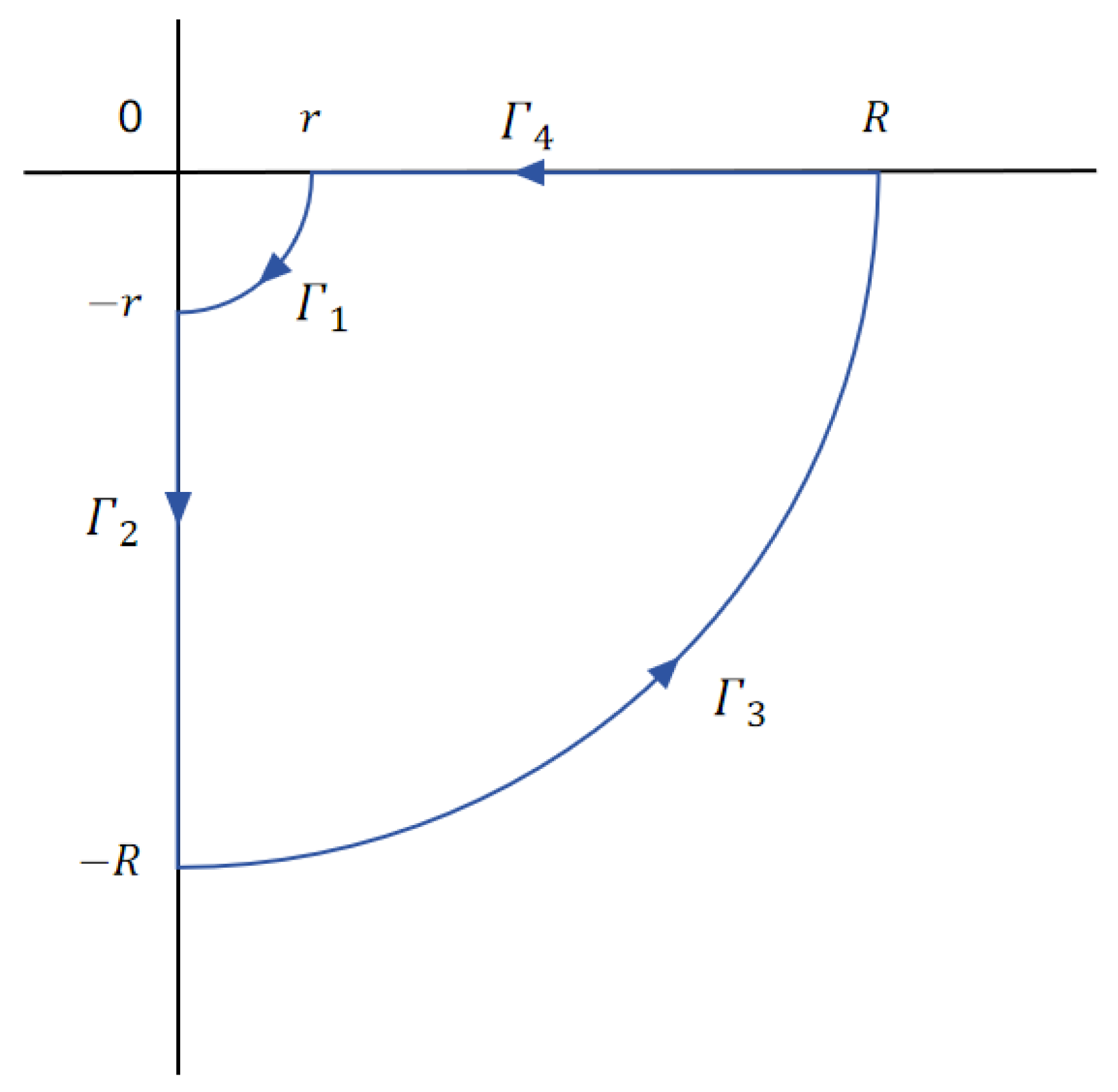
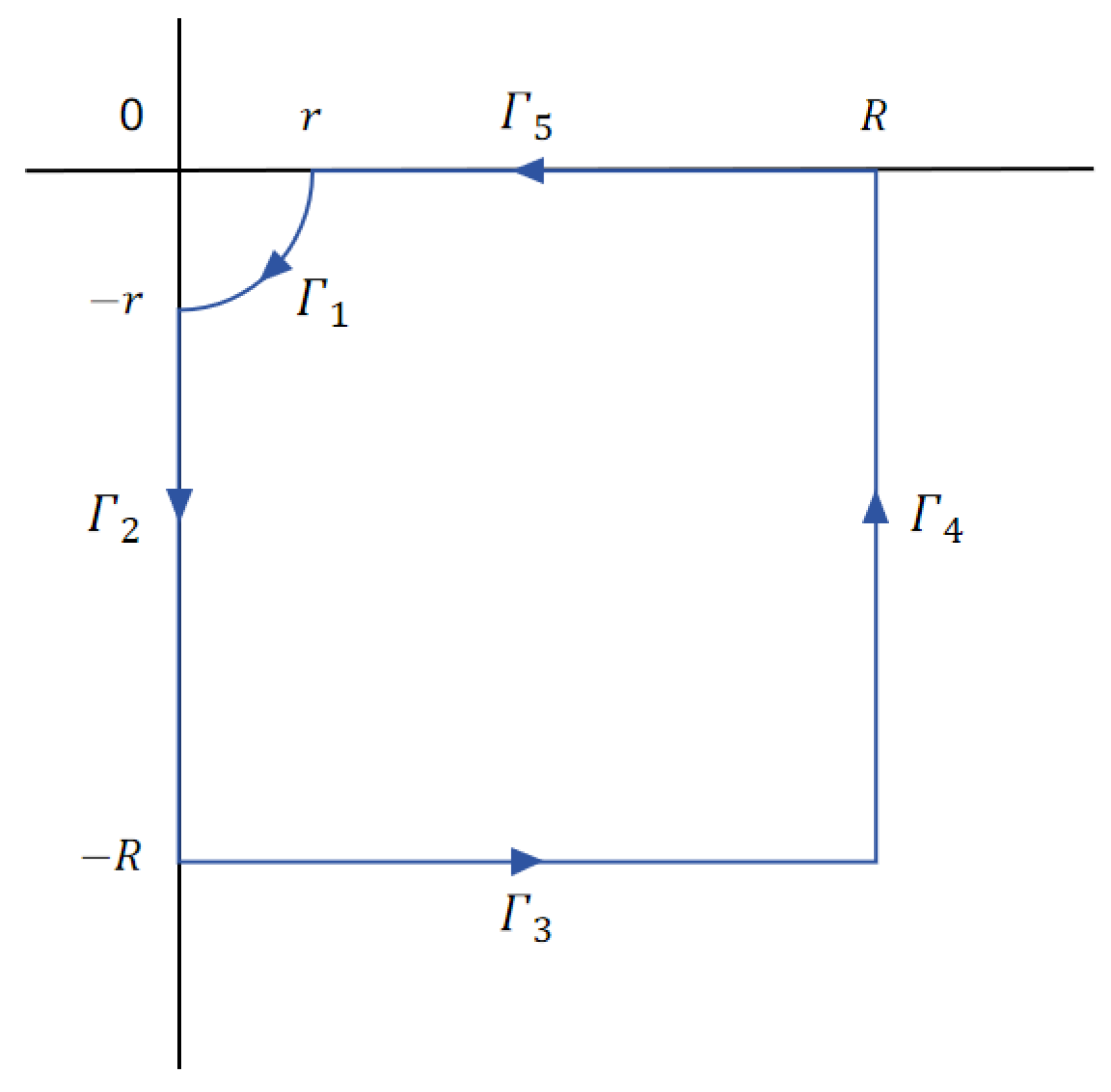
The proof relies on Cauchy’s residue theorem [48,49], which states that for an analytic function in a simply connected domain, the integral along a closed contour equals the sum of residues inside. Here, we apply this theorem to the rectangular contour in the lower half-plane
where all contours are oriented as shown in Figure 1. Since the integrand is analytic in this region, the left-hand side vanishes by Cauchy’s theorem.
Figure 1.
The illustration of integration paths for the integral (24). The paths to are chosen to avoid singularities and ensure exponential decay of the integrand.
Note that
Similarly, we have
For the integral over the contour , yields
Next, we consider the line integral on
together with the assumption of and (7), we have
Similarly, together with the assumption of and (19), we obtain
Therefore, we can obtain the desired result by
Thus, the proof is completed. □
2.2. Complex Integration Method for the Integral
In this subsection, we consider the numerical evaluation of the oscillatory integral (2). Similar to the discussion above, we focus on the case where , although the new method presented in this paper is also valid for due to .
The case of : we begin by expressing the integral in terms of the modified Bessel function . By equality (6), we have
Since is the conjugate of for a real number z, and is a real-valued function, it yields
For convenience, we denote by
then, we can rewrite (33)
Theorem 2.
Suppose that f is an analytic function in the infinity half-strip region of the complex plane . If there are two constants M and such that for
then, the integral can be transformed into line integrals on the complex plane for
Proof.
By Cauchy’s residue theorem, we have
with all contours taken in the directions that are depicted in Figure 2.
Figure 2.
The illustration of integration paths for the integral (37). The paths to are chosen to avoid singularities and ensure exponential decay of the integrand.
Note that
by the weak singularity at 0 for when that can be seen in (9), we have the following result:
here, we used .
Next, we consider the line integral on
Since (35), it yields
which means that
Together with (36), (38), and (40), we have
Thus, the proof is completed. □
The case of : For this case, we adopt the skill in [42], rewriting the integral in the following form:
where . Let be the greatest integer less than or equal to , and decompose into a polynomial part and a remainder
Therefore, we have
For the first integral in the right-hand side of the above equality, it can be expressed explicitly by the formula [50]
where
where is the hypergeometric function. Now, we return our attention to the second integral in the right-hand side of (47). Similarly, by using the conclusions from the previous subsection, it is easy to have
and
which can be effectively computed by a Gaussian quadrature rule
where are the nodes and weights of the Gaussian quadrature rule associated with the weight function . Therefore, we give a new numerical method for computing the integral (2) for the case of
Similarly, it is easy to verify that the Formula (53) is also valid for the case of . In such a case, and . Therefore, for convenience, we regard Formula (53) as the new numerical method for approximating (2) in this paper.
3. Error Analysis of the Numerical Method for the Integral (1) and (2)
In this section, we discuss the asymptotic order with respect to for the presented methods (2). Since all the line integrals are approximated by Gauss-type quadrature rules, we introduce the following lemma.
Lemma 1
(see [51]). Let . Then, the error for the Gaussian quadrature formula of order N is given by
for some , where are Gaussian quadrature formula nodes and weights, is the corresponding orthogonal polynomial of degree N associated with the weight function .
Using the above lemma, we can derive the asymptotic order on of the new numerical method (2).
Theorem 3.
Proof.
The errors of the new method for approximating the integral (1) are from the Gaussian quadrature rules for two line integrals on the complex plane. For the first line integral (35), by Lemma 1, we have
that is
For the second line integral, using Lemma 1 as well, we have the following result:
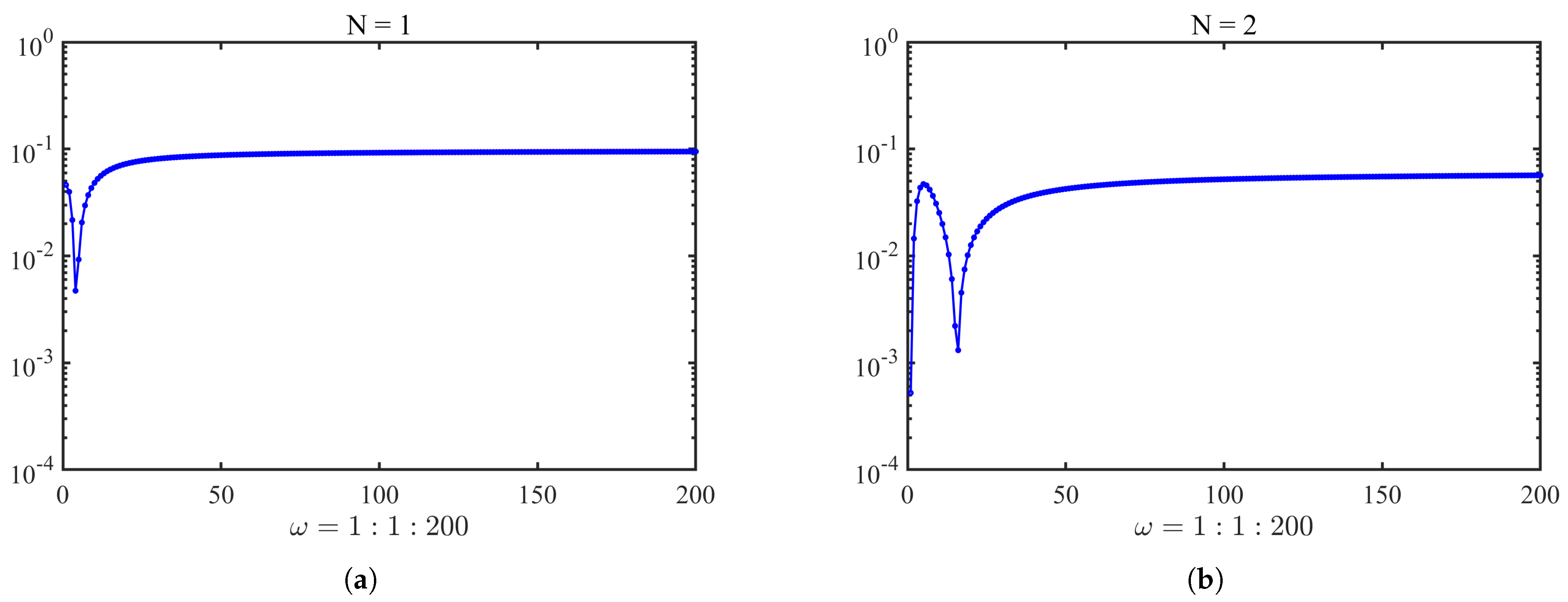
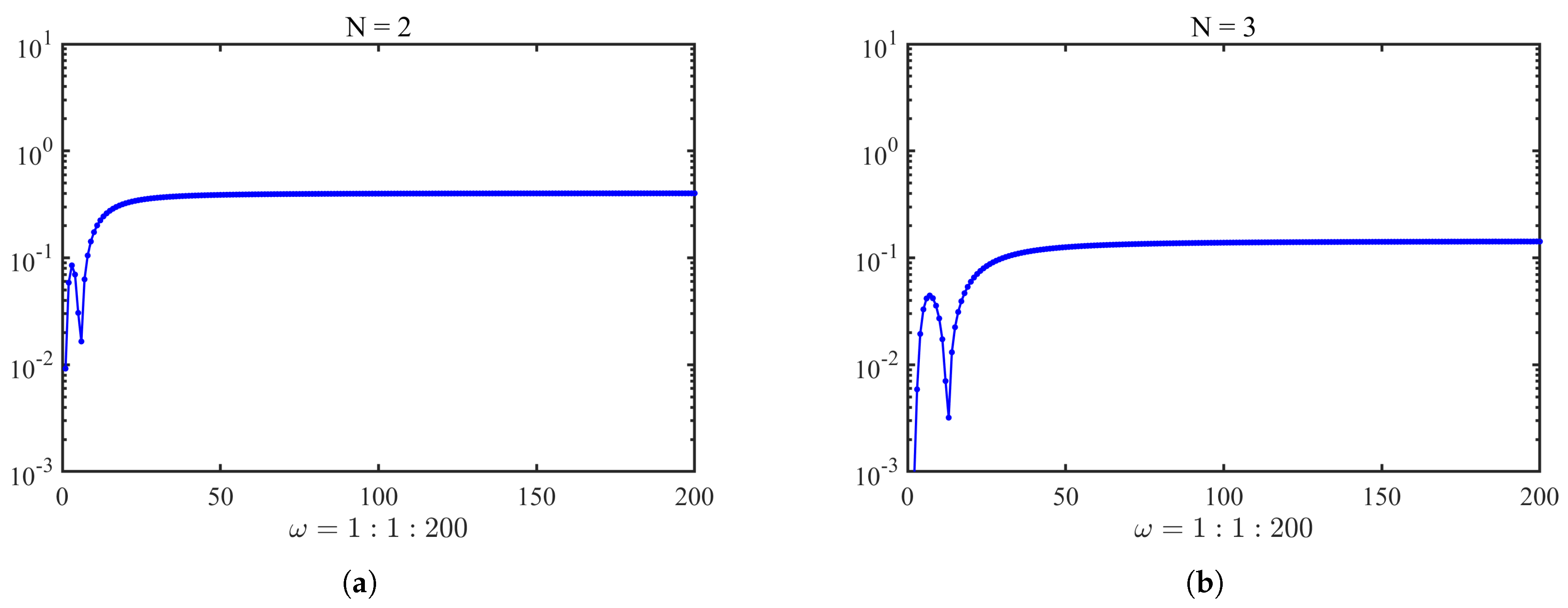
For the large , according to the Formula (19), it follows
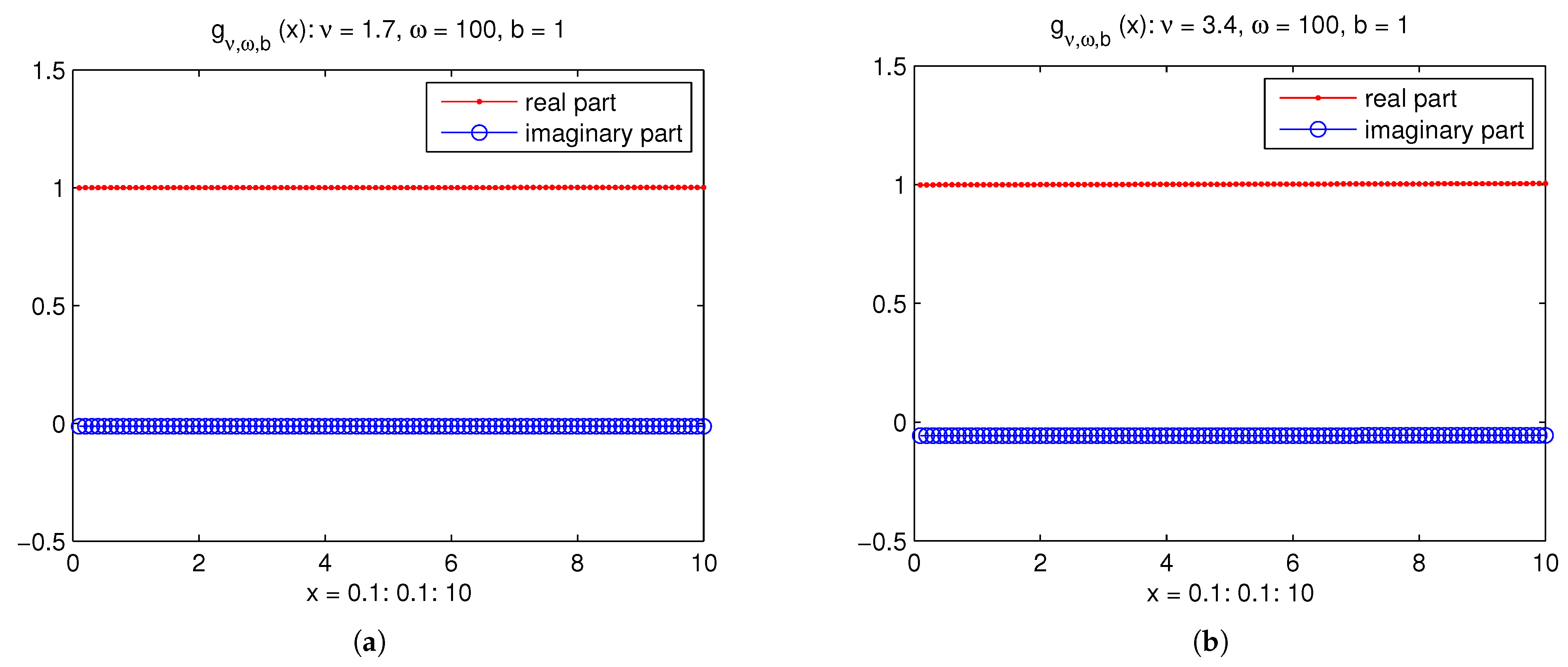
Figure 3 and Figure 4 display the real and imaginary parts of the function
Figure 3.
(a) The real and imaginary parts of the function with . (b) The real and imaginary parts of the function with .
Figure 4.
(a) The real and imaginary parts of the function with . (b) The real and imaginary parts of the function with .
Using (59), it is easy to show that
□
Theorem 4.
Proof.
The desired results can be derived easily from Lemma 1, (54). □
4. Numerical Examples
To illustrate the efficiency and accuracy of the new method described in Section 2, we give some numerical examples. In addition, we verify the asymptotic convergence order about in Theorems 3 and 4 by several numerical examples. The experiments are implemented on the R2013a version of the Matlab system. All the true values are obtained through Maple 17 with 32-digit arithmetic.
In this section, we present a series of numerical experiments to demonstrate the effectiveness of the new method. These examples demonstrate the effectiveness of our method for different values of , particularly for both and . Additionally, we compare our method with the method proposed by Xu and Milovanović [42], highlighting the advantages of our approach, especially for . Finally, we provide visualizations of the error decay trends to further validate the theoretical error analysis.
Example 1.
Let us consider the integral with and .
From the results in Table 2, the errors decrease rapidly as increases, and the method achieves machine precision even for small values of N. This demonstrates the effectiveness of our method for and .
Table 2.
The absolute errors of the new method for approximating .
Example 2.
Let us consider the integral with and .
Similar to the previous example, the errors decrease rapidly as increases, and the method achieves high accuracy even for small N. As shown in Table 3, Table 4 and Table 5, these results further validate the robustness of our method for both finite and infinite integration domains, particularly for different values of .
Table 3.
The absolute errors of the new method for approximating .
Table 4.
The absolute errors of the new method for approximating .
Table 5.
The absolute errors of the new method for approximating .
These results illustrate that our method is robust and efficient for both and , making it a versatile tool for computing highly oscillatory integrals with Bessel function kernels.
To further validate the superiority of our method, we compare it with the method proposed by Xu and Milovanović [42] for the integral . The results are summarized in Table 6, which shows the absolute errors of both methods for different values of and N.
Table 6.
The absolute errors of the new method for approximating .
Example 3.
Let us consider the integral with .
Table 6 clearly demonstrates that our method outperforms Xu and Milovanović’s method, especially for larger values of . For and , our method achieves errors that are several orders of magnitude smaller than those of Xu and Milovanović’s method [42]. This is particularly significant for , where our method’s ability to handle higher-order Bessel functions without requiring additional derivatives provides a clear advantage.
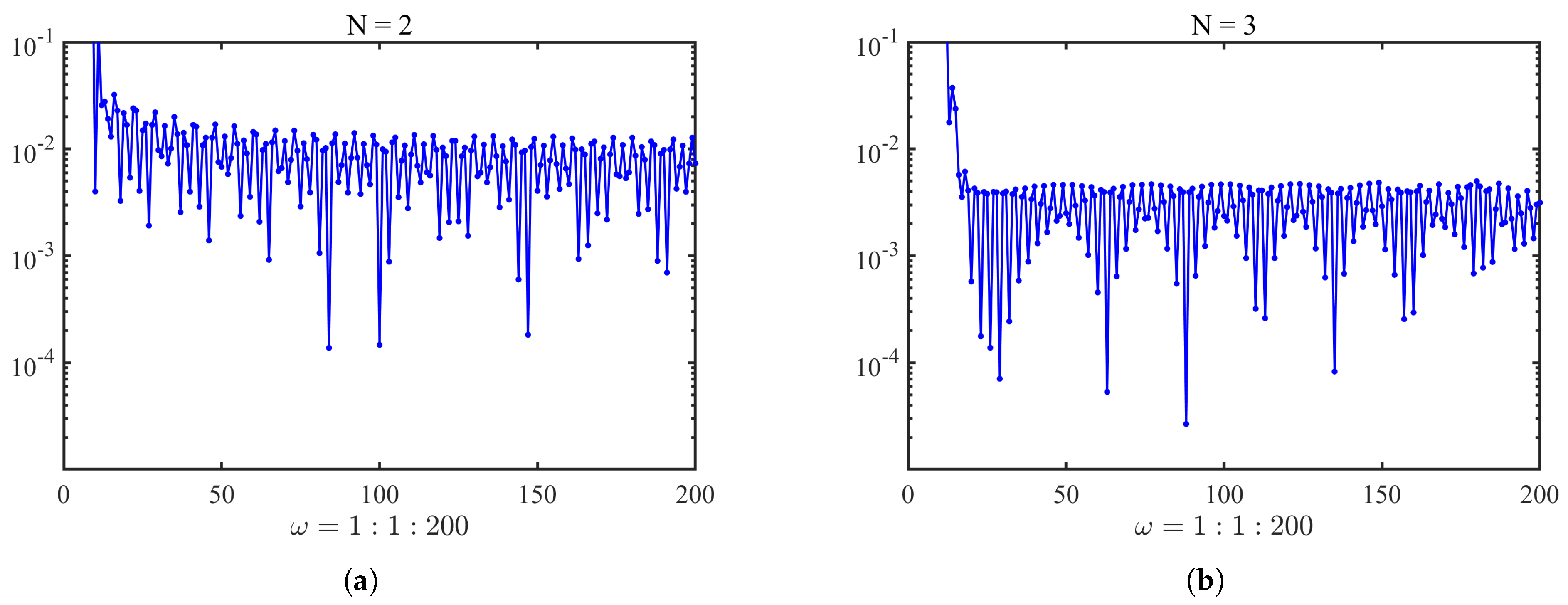
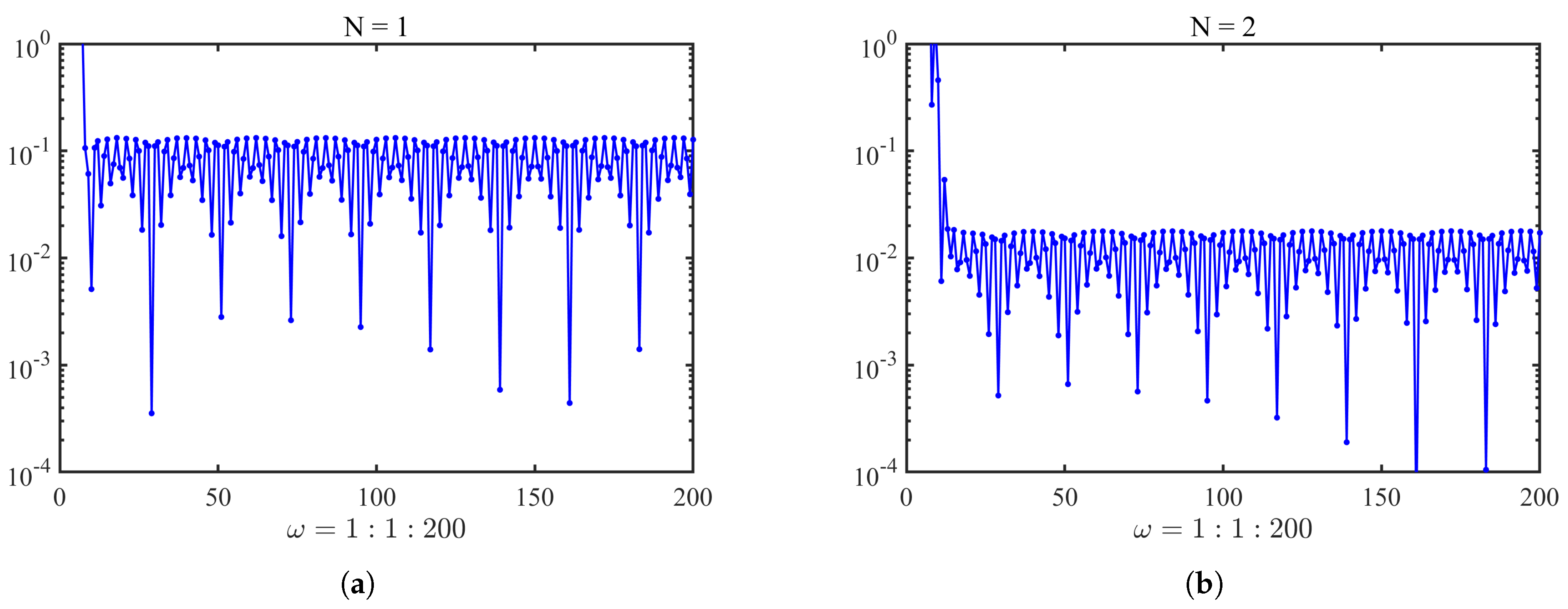
To better demonstrate the error decay trends predicted by our theoretical analysis, we provide visualizations of the absolute errors scaled by and for different values of and N. These visualizations are presented in Figure 5, Figure 6, Figure 7, Figure 8, Figure 9 and Figure 10.
Figure 5.
The absolute errors of the numerical method for approximating scaled by , (a) , (b) .
Figure 6.
The absolute errors of the numerical method for approximating scaled by , (a) , (b) .
Figure 7.
The absolute errors of the numerical method for approximating scaled by , (a) , (b) .
Figure 8.
The absolute errors of the numerical method for approximating scaled by , (a) , (b) .
Figure 9.
The absolute errors of the numerical method for approximating scaled by , (a) , (b) .
Figure 10.
The absolute errors of the numerical method for approximating scaled by , (a) , (b) .
Figure 5 shows the error decay trends for . The errors scaled by exhibit a clear decay trend, confirming the theoretical error estimate of for .
Figure 6, Figure 7 and Figure 8 show the error decay trends for . The errors scaled by and demonstrate the expected decay trends, validating the theoretical error estimates of and for .
Figure 9 and Figure 10 further illustrate the error decay trends for integrals with infinite domains, showing that our method maintains its high accuracy and efficiency even for more challenging integrals.
These visualizations provide strong evidence that our method achieves the predicted error decay rates, further validating the theoretical analysis presented in Section 3.
5. Conclusions
In this paper, we propose an efficient numerical method for computing highly oscillatory integrals with Bessel function kernels, which are ubiquitous in wave propagation, acoustic scattering, and signal processing. By decomposing the integrals based on their domains and leveraging the connection between Bessel functions and modified Bessel functions, our method transforms the problem into efficiently computable forms using Gaussian quadrature and residue calculus. For finite domains, we achieve rapid convergence via Fourier-type integral representations, while for infinite domains, we combine quadrature rules with specialized function evaluations.
Our approach overcomes key limitations of existing methods: it applies to arbitrary real orders , requires only the first derivatives of f at zero, and maintains high accuracy even for large frequencies . Such improvements are particularly valuable in practical applications—for instance, in computational electromagnetics (e.g., Sommerfeld integrals in antenna theory) and seismic imaging, where Bessel-based oscillatory integrals arise frequently.
Future work will focus on extending the algorithm to higher-order Bessel kernels and oscillators with singularities, further broadening its applicability in scientific computing and engineering.
Author Contributions
Conceptualization, G.H.; methodology, G.H. and Y.L.; formal analysis, Y.L.; writing—original draft preparation, G.H.; writing—review and editing, Y.L. All authors have read and agreed to the published version of the manuscript.
Funding
While this research received no external funding, it was supported by Jinan University through academic resources and research facilities.
Data Availability Statement
All the data have been presented in the manuscript.
Conflicts of Interest
The authors declare no conflicts of interest.
References
- Olver, F.W.J.; Lozier, D.W.; Boisvert, R.F.; Clark, C.W. (Eds.) NIST Handbook of Mathematical Functions; Cambridge University Press: New York, NY, USA, 2010. [Google Scholar]
- Bao, G.; Sun, W. A fast algorithm for the electromagnetic scattering from a large cavity. SIAM J. Sci. Comput. 2005, 27, 553–574. [Google Scholar] [CrossRef]
- Duncan, D.B. Stability and convergence of collocation schemes for retarded potential integral equations. SIAM J. Numer. Anal. 2005, 42, 1167–1188. [Google Scholar]
- Bisseling, R.; Kosloff, R. The fast Hankel transform as a tool in the solution of the time dependent Schrödinger equation. J. Comput. Phys. 1985, 59, 136–151. [Google Scholar] [CrossRef]
- Erdélyi, A. Asymptotic representations of Fourier integrals and the method of stationary phase. J. Soc. Indust. Appl. Math. 1955, 3, 17–27. [Google Scholar] [CrossRef]
- Iserles, A.; Nørsett, S.P. Efficient quadrature of highly oscillatory integrals using derivatives. Proc. R. Soc. A 2005, 461, 1383–1399. [Google Scholar] [CrossRef]
- Iserles, A.; Nørsett, S.P. Quadrature methods for multivariate highly oscillatory integrals using derivatives. Math. Comput. 2006, 75, 1233–1258. [Google Scholar] [CrossRef]
- Wang, H.; Xiang, S. Asymptotic expansion and Filon-type methods for a Volterra integral equation with a highly oscillatory kernel. IMA J. Numer. Anal. 2010, 31, 469–490. [Google Scholar] [CrossRef]
- Levin, D. Procedures for computing one-and-two dimensional integrals of functions with rapid irregular oscillations. Math. Comput. 1982, 38, 531–538. [Google Scholar] [CrossRef]
- Levin, D. Fast integration of rapidly oscillatory functions. J. Comput. Appl. Math. 1996, 67, 95–101. [Google Scholar] [CrossRef]
- Levin, D. Analysis of a collocation method for integrating rapidly oscillatory functions. J. Comput. Appl. Math. 1997, 78, 131–138. [Google Scholar] [CrossRef]
- Olver, S. Moment-free numerical integration of highly oscillatory functions. IMA J. Numer. Anal. 2006, 26, 213–227. [Google Scholar] [CrossRef]
- Chen, R.; An, C. On evaluation of Bessel transform with oscillatory and algebraic singular integrands. J. Comput. Appl. Math. 2014, 264, 71–81. [Google Scholar] [CrossRef]
- Domínguez, V.; Graham, I.G.; Smyshlyaev, V.P. Stability and error estimates for Filon-Clenshaw-Curtis rules for highly-oscillatory integrals. IMA J. Num. Anal. 2011, 31, 1253–1280. [Google Scholar] [CrossRef]
- Filon, L.N.G. On a quadrature formula for trigonometric integrals. Proc. R. Soc. Edinb. 1928, 49, 38–47. [Google Scholar] [CrossRef]
- He, G.; Xiang, S. An improved algorithm for the evaluation of Cauchy principal value integrals of oscillatory functions and its application. J. Comput. Appl. Math. 2015, 280, 1–13. [Google Scholar] [CrossRef]
- Kang, H.; Ling, C. Computation of integrals with oscillatory singular factors of algebraic and logarithmic type. J. Comput. Appl. Math. 2015, 285, 72–85. [Google Scholar] [CrossRef]
- Piessens, R.; Branders, M. On the computation of Fourier transforms of singular functions. J. Comput. Appl. Math. 1992, 43, 159–169. [Google Scholar] [CrossRef]
- Piessens, R.; Branders, M. Modified Clenshaw-Curtis method for the computation of Bessel functions. BIT Numer. Math. 1983, 23, 370–381. [Google Scholar] [CrossRef]
- Xiang, S.; He, G.; Cho, Y. On error bounds of Filon-Clenshaw-Curtis quadrature for highly oscillatory integrals. Adv. Comput. Math. 2015, 41, 573–597. [Google Scholar] [CrossRef]
- Xiang, S.; Wang, H. Fast integration of highly oscillatory integrals with exotic oscillators. Math. Comput. 2010, 79, 829–844. [Google Scholar] [CrossRef]
- Xiang, S.; Cho, Y.J.; Wang, H.; Brunner, H. Clenshaw-Curtis-Filon-type methods for highly oscillatory Bessel transforms and applications. IMA J. Num. Anal. 2011, 31, 1281–1314. [Google Scholar] [CrossRef]
- Xu, Z.; Xiang, S. Numerical evaluation of a class of highly oscillatory integrals involving Airy functions. Appl. Math. Comput. 2014, 246, 54–63. [Google Scholar] [CrossRef]
- Xu, Z.; Xiang, S. On the evaluation of highly oscillatory finite Hankel transform using special functions. Numer. Algorithms 2016, 72, 37–56. [Google Scholar] [CrossRef]
- He, G.; Xiang, S.; Zhu, E. Efficient computation of highly oscillatory integrals with weak singularities by Gauss-type method. Int. J. Comput. Math. 2016, 93, 83–107. [Google Scholar] [CrossRef]
- Huybrechs, D.; Vandewalle, S. On the evaluation of highly oscillatory integrals by analytic continuation. SIAM J. Numer. Anal. 2006, 44, 1026–1048. [Google Scholar] [CrossRef]
- Kang, H.; Xiang, S. On the calculation of highly oscillatory integrals with an algebraic singularity. Appl. Math. Comput. 2010, 217, 3890–3897. [Google Scholar] [CrossRef]
- Kang, H.; Shao, X. Fast computation of singular oscillatory Fourier Transforms. Abstr. Appl. Anal. 2014, 2014, 984834. [Google Scholar] [CrossRef]
- Milovanović, G.V. Numerical calculation of integrals involving oscillatory and singular kernels and some applications of quadratures. Comput. Math. Appl. 1998, 36, 19–39. [Google Scholar] [CrossRef]
- Wang, H.; Xiang, S. On the evaluation of Cauchy principal value integrals of oscillatory functions. J. Comput. Appl. Math. 2010, 234, 95–100. [Google Scholar] [CrossRef]
- Wang, H.; Zhang, L.; Huybrechs, D. Asymptotic expansions and fast computation of oscillatory Hilbert transforms. Numer. Math. 2013, 123, 709–743. [Google Scholar] [CrossRef]
- Wong, R. Quadrature formulas for oscillatory integral transforms. Numer. Math. 1982, 39, 351–360. [Google Scholar] [CrossRef]
- Xu, Z.; Milovanović, G.V.; Xiang, S. Efficient computation of highly oscillatory integrals with Hankel kernel. Appl. Math. Comput. 2015, 261, 312–322. [Google Scholar] [CrossRef]
- Feng, W.; Salgado, A.J.; Wang, C.; Wise, S.M. Preconditioned steepest descent methods for some nonlinear elliptic equations involving p-Laplacian terms. J. Comput. Phys. 2016, 334, 45–67. [Google Scholar] [CrossRef]
- Feng, W.; Wang, C.; Wise, S.M.; Zhang, Z. A second-order energy stable backward differentiation formula method for the epitaxial thin film equation with slope selection. Numer. Methods Partial Differ. Equ. 2018, 34, 1975–2007. [Google Scholar] [CrossRef]
- Cheng, K.; Wang, C.; Wise, S.M. An Energy Stable BDF2 Fourier Pseudo-Spectral Numerical Scheme for the Square Phase Field Crystal Equation. arXiv 2019, arXiv:1906.12255. [Google Scholar]
- Hasegawa, T.; Sugiura, H. Uniform approximation to finite Hilbert transform of oscillatory functions and its algorithm. J. Comput. Appl. Math. 2019, 358, 327–342. [Google Scholar] [CrossRef]
- Chen, R. Fast integration for Cauchy principal value integrals of oscillatory kind. Acta Appl. Math. 2013, 123, 21–30. [Google Scholar] [CrossRef]
- Xu, Z.; Xiang, S.; He, G. Efficient evaluation of oscillatory Bessel Hilbert transforms. J. Comput. Appl. Math. 2014, 258, 57–66. [Google Scholar] [CrossRef]
- Chen, R. Numerical approximations to integrals with a highly oscillatory Bessel kernel. Appl. Numer. Math. 2012, 62, 636–648. [Google Scholar] [CrossRef]
- Chen, R. Numerical approximations for highly oscillatory Bessel transforms and applications. J. Math. Anal. Appl. 2015, 421, 1635–1650. [Google Scholar] [CrossRef]
- Xu, Z.; Milovanović, G.V. Efficient method for the computation of oscillatory Bessel transform and Bessel Hilbert transform. J. Comput. Appl. Math. 2016, 308, 117–137. [Google Scholar] [CrossRef]
- Zaman, S.; Siraj-ul-Islam; Khan, M.M.; Ahmad, I. New algorithms for approximation of Bessel transforms with high frequency parameter. J. Comput. Appl. Math. 2022, 399, 113705. [Google Scholar] [CrossRef]
- Kang, H.; Wang, R.; Zhang, M.; Xiang, C. Efficient computation of oscillatory Bessel transforms with a singularity of Cauchy type. J. Comput. Appl. Math. 2023, 429, 115220. [Google Scholar] [CrossRef]
- Ansari, K.J.; Özger, F. Pointwise and weighted estimates for Bernstein-Kantorovich type operators including beta function. Indian J. Pure Appl. Math. 2024, 1–13. [Google Scholar] [CrossRef]
- Savaş, E.; Mursaleen, M. Bézier Type Kantorovich q-Baskakov Operators via Wavelets and Some Approximation Properties. Bull. Iran. Math. Soc. 2023, 49, 68. [Google Scholar] [CrossRef]
- Alamer, A.; Nasiruzzaman, M. Approximation by Stancu variant of λ-Bernstein shifted knots operators associated by Bézier basis function. J. King Saud Univ. Sci. 2024, 36, 103333. [Google Scholar] [CrossRef]
- Fokas, A.S. Complex variables: Introduction and applications. Math. Gaz. 2003, 83, 530–534. [Google Scholar]
- Henkici, P. Applied and Computational Complex Analysis; Wiley-Interscience: New York, NY, USA, 1974; Volume I. [Google Scholar]
- Gradshteyn, I.S.; Ryzhik, I.M. Table of Integrals, Series, and Products, 8th ed.; Academic Press: Cambridge, MA, USA; Elsevier Inc.: Amsterdam, The Netherlands, 2014. [Google Scholar]
- Kress, R. Numerical Analysis; Springer: New York, NY, USA, 1998. [Google Scholar]
Disclaimer/Publisher’s Note: The statements, opinions and data contained in all publications are solely those of the individual author(s) and contributor(s) and not of MDPI and/or the editor(s). MDPI and/or the editor(s) disclaim responsibility for any injury to people or property resulting from any ideas, methods, instructions or products referred to in the content. |
© 2025 by the authors. Licensee MDPI, Basel, Switzerland. This article is an open access article distributed under the terms and conditions of the Creative Commons Attribution (CC BY) license (https://creativecommons.org/licenses/by/4.0/).