
Abstract
In this paper, group therapy behavior is studied from the viewpoint of cooperative control. To describe the range of emotional changes in each participant, nonconvex constraint sets are employed, which can be used to quantitatively represent the differences among all the participants. Then, a cooperative control model is proposed to describe the interaction between participants. Based on this model, emotion analysis is performed, and it is shown that all participants finally reach an emotion consensus regardless of facilitators being involved. In particular, when facilitators are absent, the final states of all participants cannot be controlled, while when facilitators are involved, the final states of all participants can be driven to a desired state of mental health. Numerical simulation examples are given to illustrate the theoretical conclusions.
MSC:
93C95
1. Introduction
As an important branch of mental health problems, group therapy has received more and more attention from researchers in the education system [1,2,3,4,5,6,7,8,9,10]. For example, in [2], the self-growth process in the graduate school of counseling was studied through a group art therapy class. In [6], a single-session approach was studied for creative art university students for group therapy. In [7,8], group cohesion and group alliance were studied to improve mental health recovery. All of these works have greatly promoted the development of group therapy. However, research [1,2,3,4,5,6,7,8,9,10] has focused on the impact of some group therapy behaviors on the mental health of participants and has not considered the process of emotional changes.
In this study, we were interested in group therapy and investigated the emotional changes in participants from the viewpoint of cooperative control. Cooperative control was first studied in [11,12,13]. Existing studies focus on applying cooperative control theory to subject services and embedded services [14,15,16], including collaborative filtering algorithms for library data mining [17], models for collaborative learning spaces in Korean university libraries [18], and analysis of abnormal collaborative behaviors in smart libraries [19], aiming to optimize group collaboration dynamics. While less attention has been paid to solving group dynamics by using cooperative control theory. The objective of cooperative control is to propose algorithms to drive all agents to complete a task in a cooperative manner. Group therapy is essentially a kind of group control of behavior. To better understand the role of group therapy, in this paper, we first use nonconvex constraint sets to describe the range of emotional changes for each participant, which can be used to quantitatively represent the differences among all the participants. Then, we propose a cooperative control model to describe the interaction between participants. Based on this model, emotion analysis is performed, and it is shown that all participants finally reach an emotional consensus regardless of facilitators being involved. In particular, when facilitators are absent, the final states of all participants cannot be controlled, while, when facilitators are involved, the final states of all participants can be driven to a desired state of mental health.
2. Main Results
2.1. Graph Theory
Let denote a group therapy space, where = ⋯ denotes the set of participants, denotes the set of edges, and denotes the weighted adjacency matrix. Define , if ; otherwise, = 0. Let the neighbor set of i be defined as and be the number of neighbors in .
2.2. Problem Formulation
The objective of this paper is to try to understand the process of emotional changes during group therapy in a quantitative way so as to promote the effects of group therapy, which is different from most of the existing works, which focused on the behaviors and phenomena that might appear.
Consider a group of participants, where each participant is assumed to have the following dynamics:
where denotes the ith participant’s emotion state at time k, and
In (1), the term denotes the weighted emotion interaction between participants; the term denotes the weighted effect of on . As the emotion interaction might widely differ between different participants, the operator , which was first proposed in [20] and successfully studied in [21], is introduced to describe the different interaction parts of . When , means that participants are highly similar; they are more likely to understand both themselves and others. When , the whole term denotes the sum of the emotional interaction between participants.
It should be noted that the specific form of is not given here because, in the following theorems, it is shown that all participants reach a consensus state no matter what form takes.
Group identification according to the psychological conditions of participants should be performed before we start our analyses. Some projects on group emotion identification and classification have made headway. For example, based on the six basic emotions of human beings, the participants of the “Libraries of emotions” project redistributed their collected resources and developed an open-source methodology for presenting the role of reading therapy and emotion in reading. With this method, this project helped readers connect their emotional experience during reading with their experiences in real life, which had a positive impact on their mental health [22]. The “Dan Dan growth” of “Dan Dan happy reading” activities, carried out by Fudan University Library, are other examples. The applicants’ psychological disorders, mental needs, reading habits, and other information were identified using a questionnaire survey. Then, based on this questionnaire, selected applicants who were appropriate for the current topic participated in a group therapy activity. In this program, Fudan University Library invited internal and external psychologists, who guided participants to read together and carried out various face-to-face group activities.
In the following, we analyze the group therapy behaviors between participants based on the system dynamics in (1). First, we present some necessary assumptions.
Assumption 1.
Suppose that for some constant .
Assumption 2 ([20]).
for all i.
Suppose that each , is nonempty and closed.
Assumption 2 means that the distance from any point outside to the origin is lower-bounded by a positive constant. That is, the participants can interact from all directions, and, no matter what happens, the emotional states of all participants are upper-bounded.
Under this assumption, we have the following theorem:
Theorem 1.
Suppose that the communication graph is connected. Under Assumption 1, the emotional state of all participants reaches a consensus as time evolves. That is, for all .
Proof.
When , we define . When and , we have . When and , from the definition of operator , we have
Using , (1) is equivalent to
Writing (2) in matrix form, we have
where , is the th entry of ; if , is the th entry of ; if , . It can be easily checked that each row sum of is 1, and each entry is non-negative. Hence, is a stochastic matrix.
That is,
With a similar approach, it can be proved that
Therefore,
As a result,
for each . Moreover, under Assumption 1,
Therefore, is nonzero for all i, and each nonzero entry of is lower-bounded by a positive constant.
Let
Now, we prove that each nonzero entry of is lower-bounded by a positive constant. First, consider the quantity , where .
Since is a stochastic matrix, each is a convex combination of all , and hence
Next, we prove the consensus convergence of the system. Consider a matrix sequence, , , ⋯, where . Note that the communication graph is connected under Assumption 2. Since is nonzero for all i, and each nonzero entry of is lower-bounded by a positive constant, it follows from graph theory that each entry of is nonzero and lower-bounded by a constant, denoted by c. Note that . It follows that
for all i, where .
Similarly, it can be obtained that for all x. Then,
This means that for all . From the definition of the limitation, there must exist a constant for any such that
This means that for all . By analogy, it can be proven that for all . This completes the proof. □
Theorem 1 means that all participants can reach a consensus emotional mental health state, indicating that mutual interaction might result in the same emotional state. This is consistent with the idea of the Swiss psychologist Jean Piaget: the formation of cognition is a process of the gradual assimilation and adaptation of psychology [23].
Mutual interactions among participants are spontaneous, and they might have professional limitations. In order to avoid being affected by each other’s negative emotions, the psychological intervention and guidance of facilitators should play an oriented role in group therapy. On the one hand, under the constraints of the rules and regulations of the facilitators, participants transform spontaneous conflict into cohesion with others. On the other hand, the rational distribution of facilitator resources can match the library collection of resources with the needs of participants more effectively. At the same time, it can strengthen the cooperation between a university library and the other departments of a university, in particular for the departments of psychological counseling and psychological education, to establish a sound long-term mechanism together to solve the professional limitation problem with participants.
In Theorem 1, the case where there are no facilitators or constraint conditions is studied. In the following, we study the case where there are facilitators, where each participant is assumed to have the following dynamics:
for all , where is the desired emotional state given by the facilitator, and if the ith participant can receive the information from the facilitator, and otherwise.
Assumption 3.
Suppose that for some constant and all k, and for some i and all k.
Under this assumption, we have the following theorem:
Theorem 2.
Suppose that the communication graph is connected. Under Assumption 3, the behaviors of all participants reach the desired state as time evolves. That is, for all i.
Proof.
Under Assumption 3, it follows from graph theory that each row sum of is no larger than a positive constant, denoted as . From Gasgolin’s theorem, all of the norms of the eigenvalues of are no larger than . From control theory, it follows that for all i. Similar to the proof of Theorem 1, we have for all i. That is, for all i. This completes the proof. □
Let . Then, system (6) can be written as
Writing (7) in matrix form, we have
where , is the th entry of , is the th entry of if , and if .
Consider a matrix sequence , , ⋯, where . When
Theorem 2 shows that all participants can be driven to a desired emotional mental health state under the guidance of facilitators. In future studies, we will consider treating indicators such as the evaluation of participants’ psychotherapy effects as optimization functions for each agent in [24] to achieve the optimal psychotherapy effect.
3. Simulations
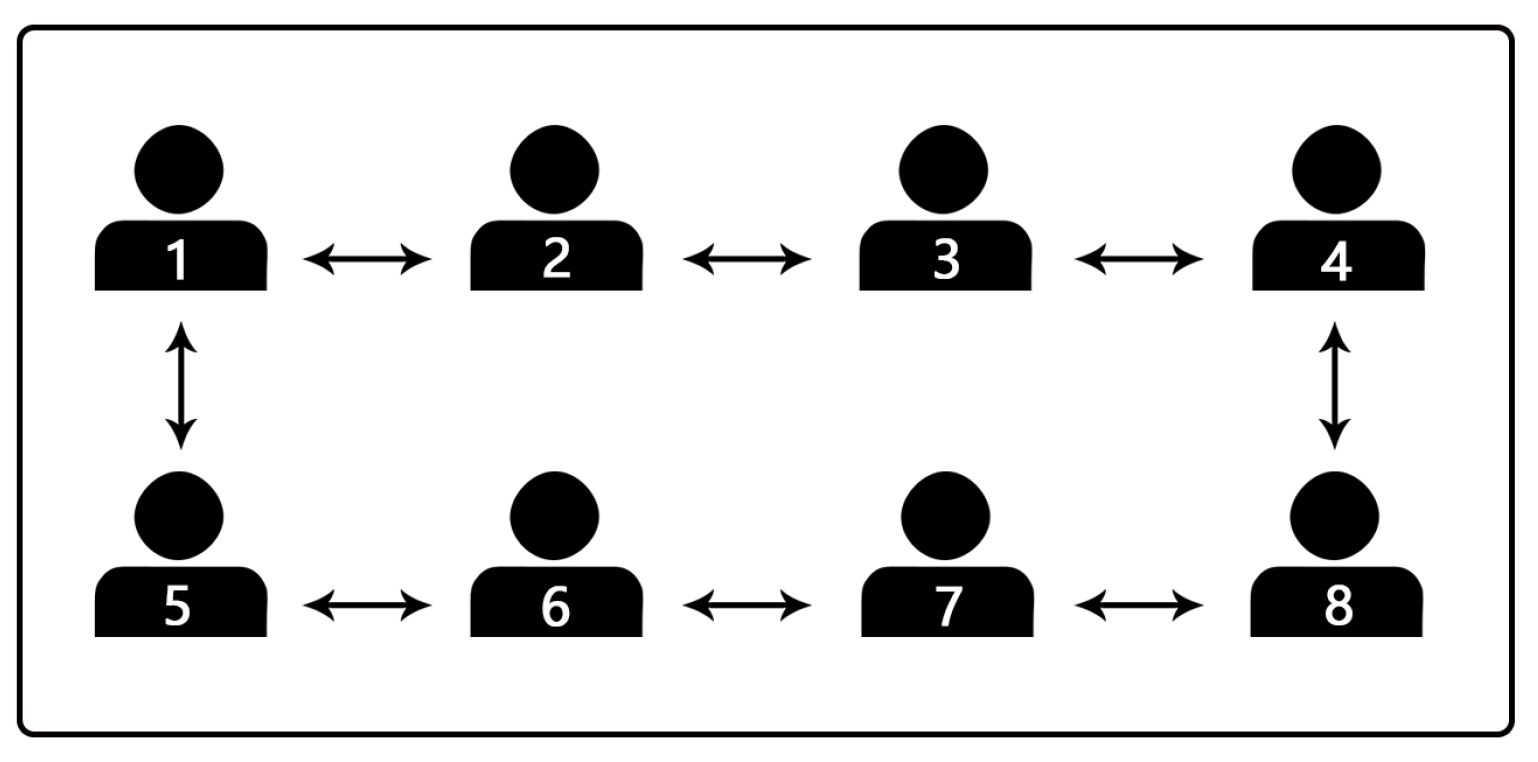
Consider a group of 8 participants. Figure 1 shows the communication graph between participants, where each nonzero is , and the sampling time of simulation is chosen as 0.1 s. Each constraint set was adopted as , and the desired state was . The initial emotion states for the participants were , , and .
Figure 1.
A group of 8 participants without a facilitator.
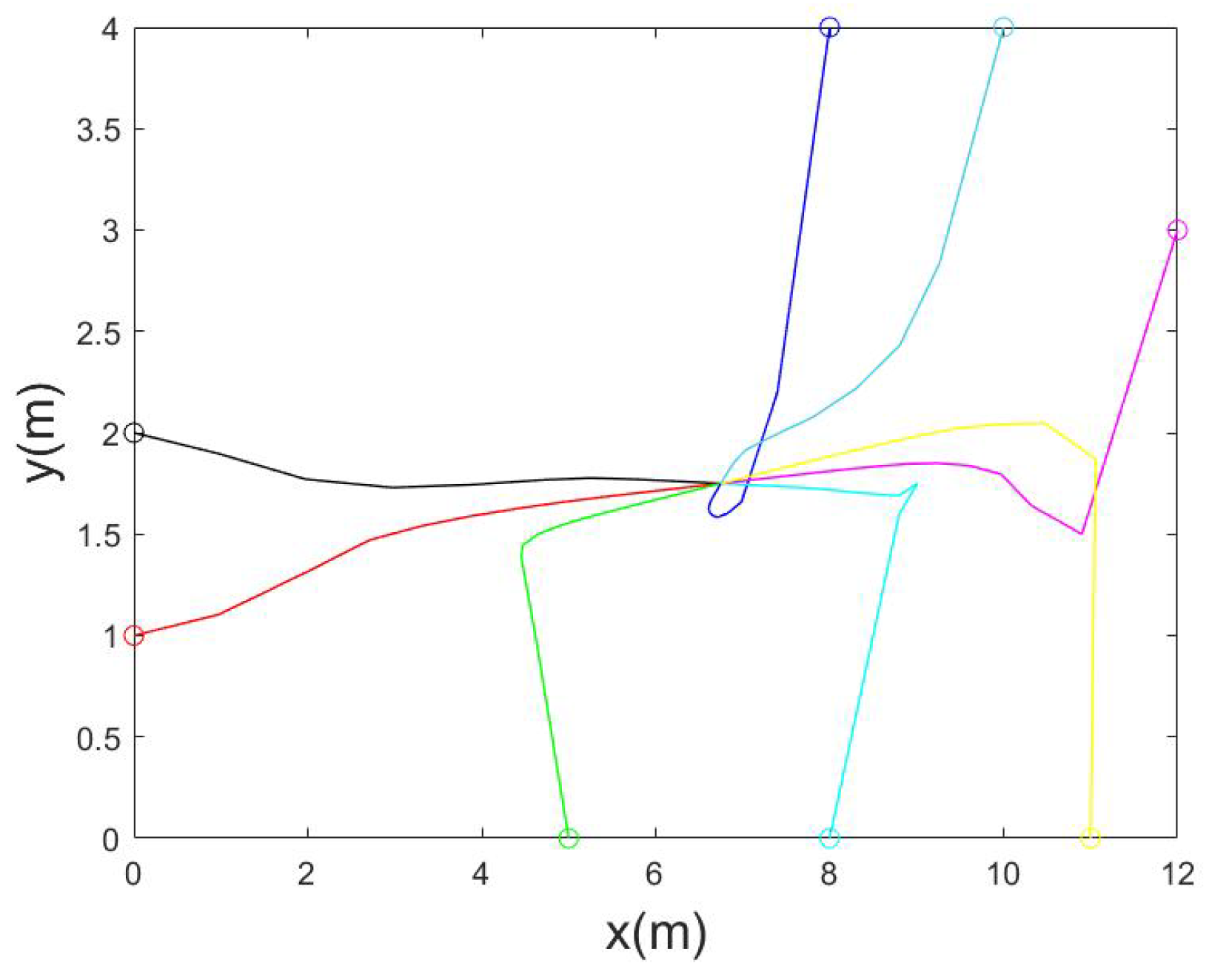
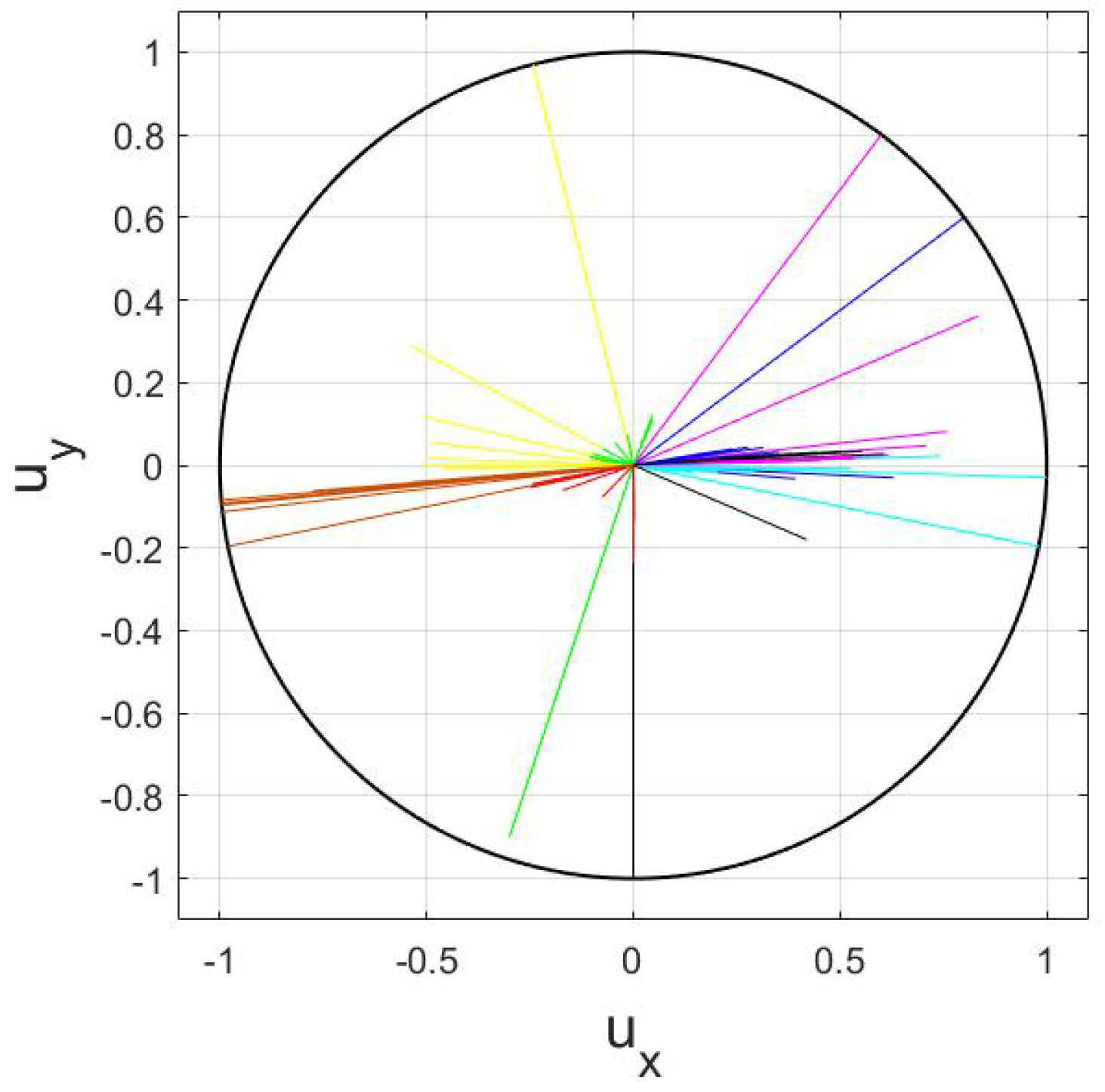
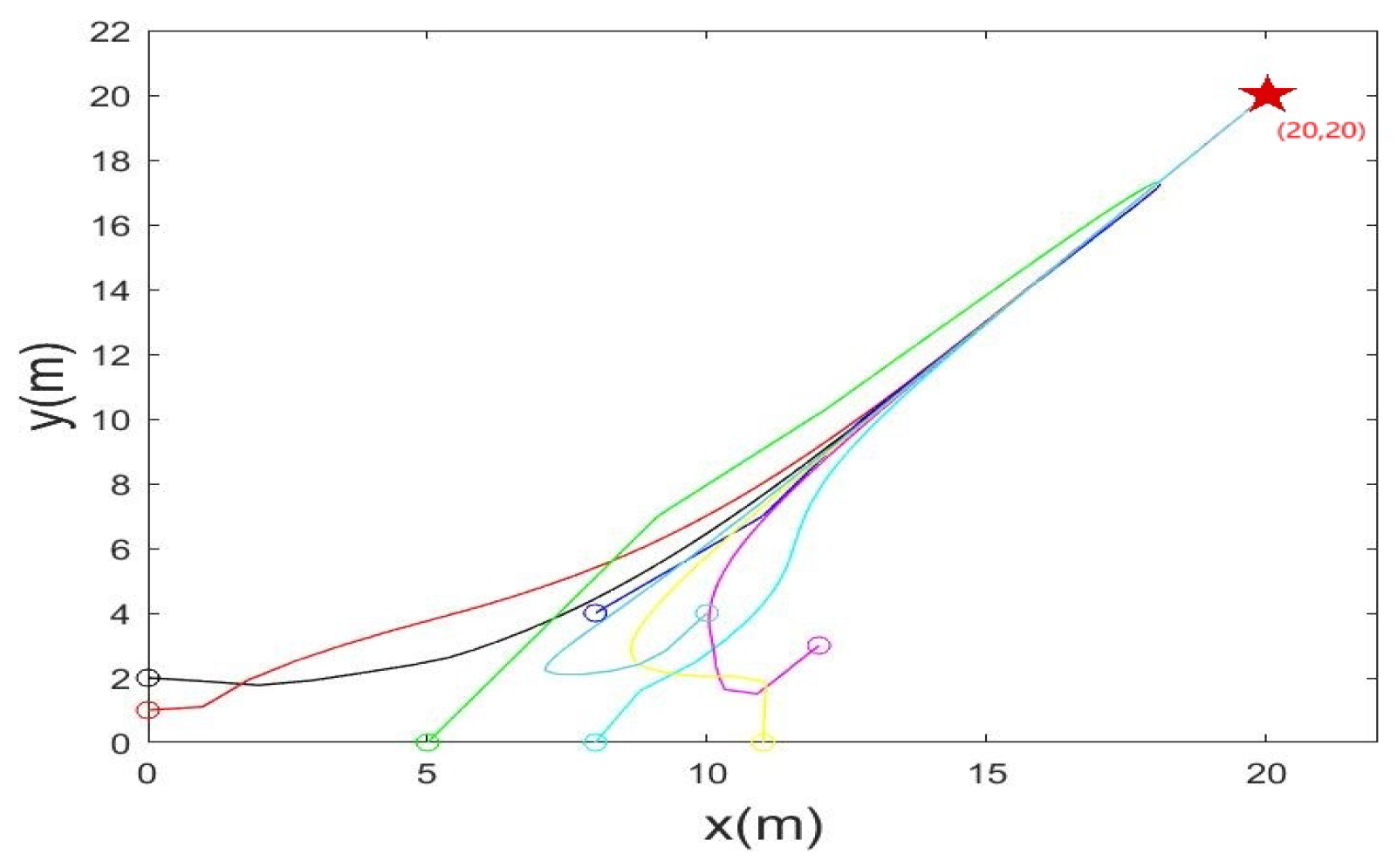
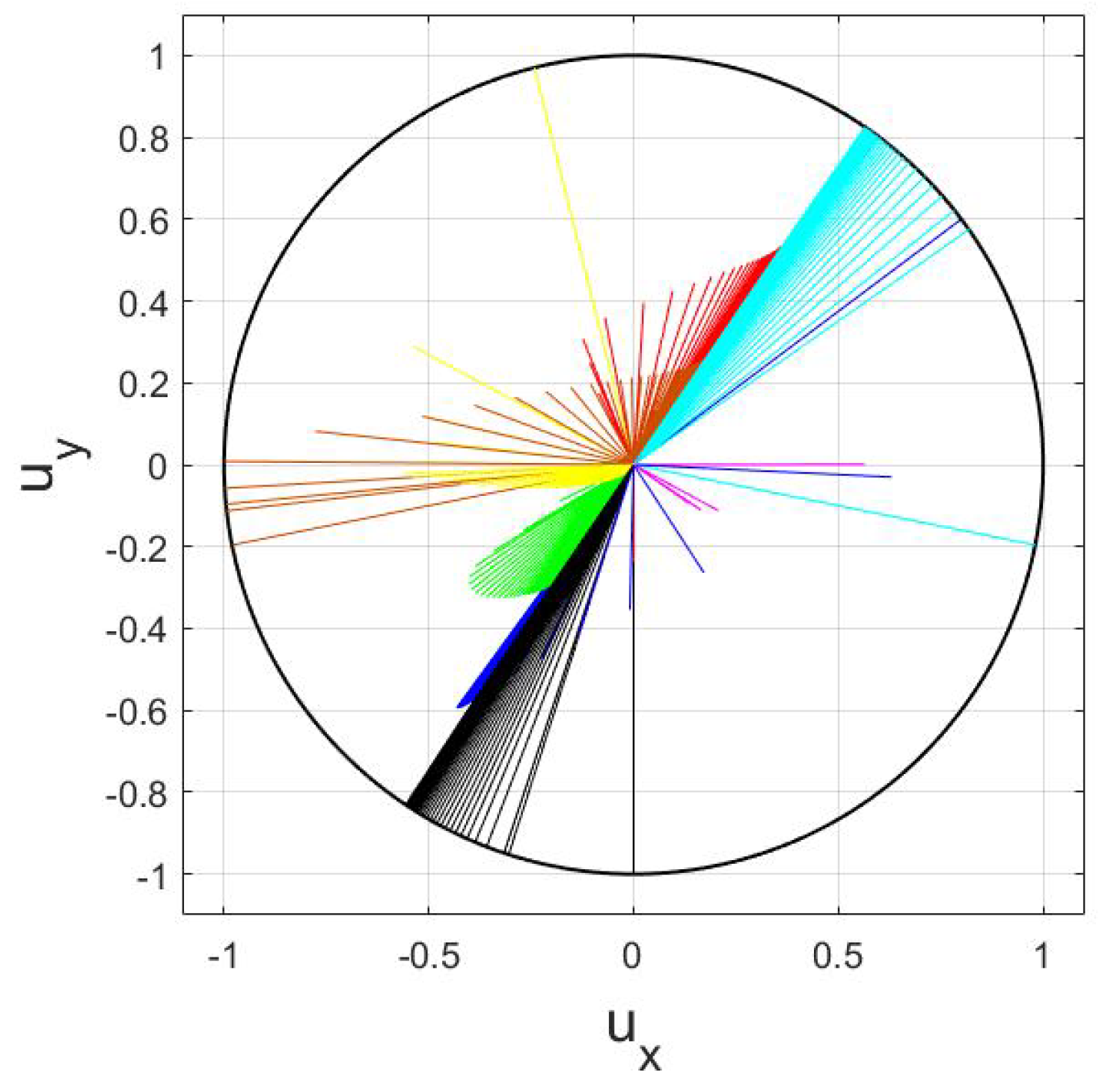
First, we consider the case where there is no facilitator to guide the participants. Figure 2 and Figure 3 show the simulation results. It is clear that the participants cannot reach the desired state . Note that, in this case as discussed in the proof of Theorem 1, system (1) is equivalent to (2) which is a time-varying linear system; hence the final common emotion state is strongly related to the initial states. In this case, all participants update their emotional state based on the states of their neighbors. The final consensus state is generally a function of the initial states of all participants, converging to a weighted average or another combination of these initial conditions. Without external guidance from facilitators, the intrinsic dynamics drive the system toward a state that reflects these starting values.
Figure 2.
The participants without facilitator cannot reach the desired state.
Figure 3.
The weighted emotion interaction between all participants without a facilitator.
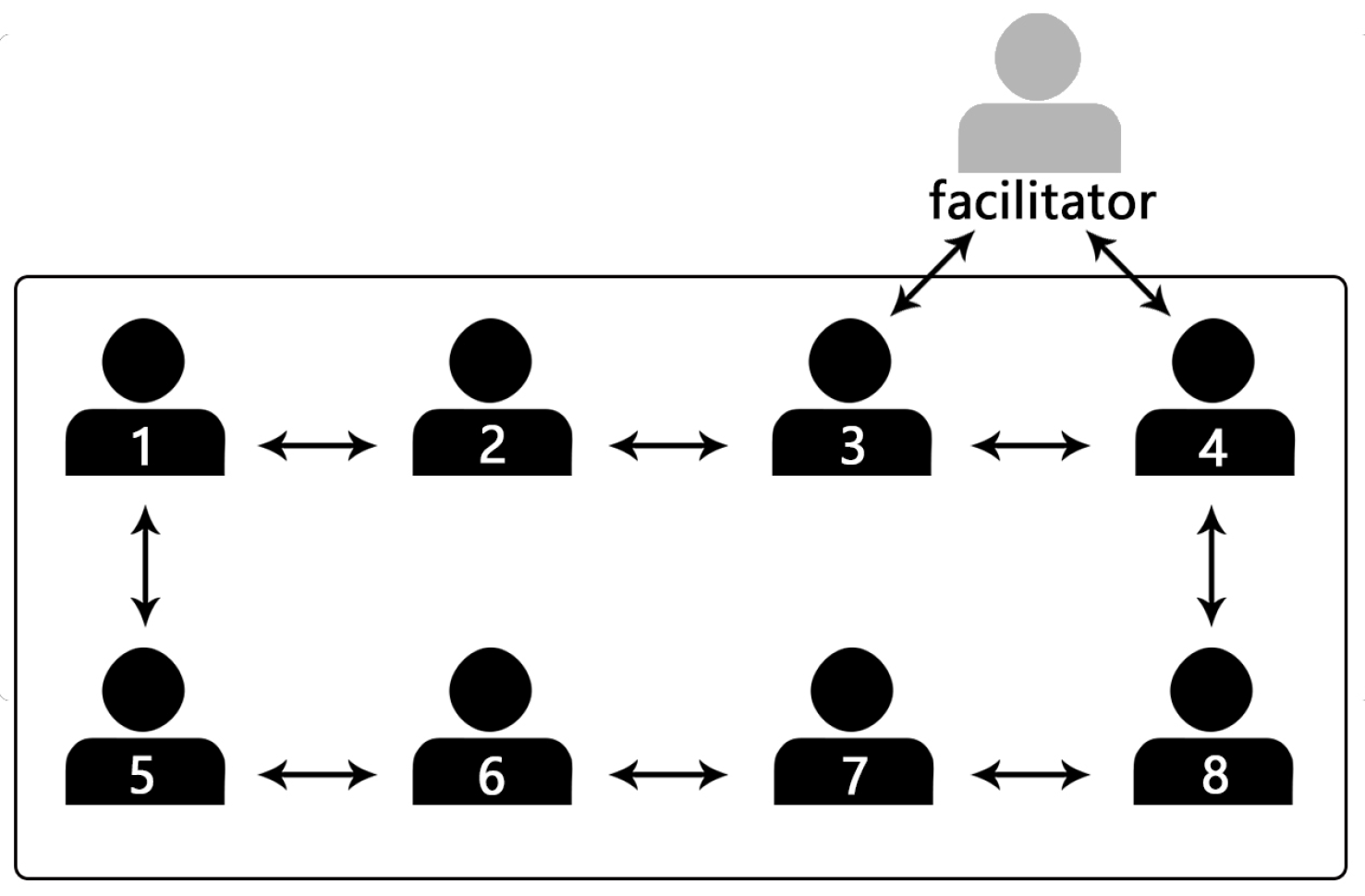
Now, we consider the case where there is a facilitator to guide participants 3 and 4, and the communication graph is shown in Figure 4. Figure 5 and Figure 6 show the simulation results. It is clear that the final common state has no relationship with the initial emotional states of the participants, and, under the guidance of a facilitator, all participants reach the desired state with for all .
Figure 4.
There is a facilitator to guide participants 3 and 4.
Figure 5.
All participants reach the desired state with a facilitator.
Figure 6.
The weighted emotional interaction between all participants with a facilitator.
4. Conclusions
In this paper, group therapy behavior was studied from the viewpoint of cooperative control. To describe the range of emotional changes for each participant, nonconvex constraint set was employed, which was used to quantitatively represent the differences among all the participants. Then a cooperative control model was constructed to describe the interactions between participants. Based on this model, it was shown that all participants finally reached an emotional consensus regardless of facilitators being involved. In particular, when facilitators were absent, the final states of all participants could not be controlled, while, when facilitators were involved, the final emotion states of all participants could be driven to a desired emotional mental health state.
Author Contributions
Conceptualization, L.Y.; methodology, L.Y.; software, L.Y.; validation, L.Y. and J.X.; formal analysis, W.Z.; investigation, L.Y.; resources, J.X. and W.Z.; data curation, L.Y. and W.Z.; writing—original draft, L.Y.; writing—review and editing, J.X.; visualization, L.Y.; supervision, J.X. and W.Z.; project administration, W.Z.; funding acquisition, W.Z. All authors have read and agreed to the published version of this manuscript.
Funding
This research received no external funding.
Data Availability Statement
The original contributions presented in the study are included in the article, further inquiries can be directed to the corresponding author.
Conflicts of Interest
The authors declare no conflicts of interest.
References
- Jiří, K.; Miroslav, C.; Libuše, L. Czech Arts Therapies in Educational Institutions. Educ. Sci. 2019, 9, 82. [Google Scholar] [CrossRef]
- Chae, Y. A Study on the Self-growth Process of the Graduate School of Counseling through the Group Art Therapy Class. Korea Open Access J. 2019, 9, 1–21. [Google Scholar]
- Shir, H.; Dafna, R.; Sharon, S.; Racheli, R. Perceptions of Art Therapy in Adolescent Clients Treated within the School System. Front. Psychol. 2020, 11, 518304. [Google Scholar]
- Theresa, V.L.; Andrea, C.; Scott, M.P.; Gregg, D.S.; Megan, B. Mindfulness based art therapy study protocol to determine efficacy in reducing college stress and anxiety. BMC Psychol. 2021, 9, 134. [Google Scholar]
- Tal, S.; Hod, O.; Felicity, A.B.; David, G.; Girija, K. Editorial: The State of the Art in Creative Arts Therapies. Front. Psychol. 2020, 11, 68. [Google Scholar]
- Elizabeth, W. Novel Solutions to Student Problems: A Phenomenological Exploration of a Single Session Approach to Art Therapy with Creative Arts University Students. Front. Psychol. 2021, 11, 600214. [Google Scholar]
- Jennifer, L.B.; McFerran, K.S. Musical recovery: The role of group singing in regaining healthy relationships with music to promote mental health recovery. Nord. J. Music. Ther. 2018, 27, 235–251. [Google Scholar]
- Marziali, E.; Munroe-Blum, H.; McCleary, L. The contribution of group cohesion and group alliance to the outcome of group psychotherapy. Int. J. Group Psychother. 1997, 47, 475–497. [Google Scholar] [CrossRef]
- Burlingame, G.M.; McClendon, D.T.; Alonso, J. Cohesion in group therapy. Psychotherapy 2011, 48, 34–42. [Google Scholar] [CrossRef]
- Wang, J. Investigation and Analysis on the Status Quo of Reading Therapy Practice in Chinese University Libraries. J. Natl. Libr. China 2021, 30, 75–82. [Google Scholar]
- Degroot, M.H. Reaching a consensus. J. Am. Stat. Assoc. 1974, 69, 118–121. [Google Scholar] [CrossRef]
- Reynolds, C.W. Flocks, herds and schools: A distributed behavioral model. ACM SIGGRAPH Comput. Graph. 1987, 21, 25–34. [Google Scholar] [CrossRef]
- Vicsek, T.; Czirok, A.; Jacob, E.B. Novel type of phase transaction in a system of self-driven particles. Phys. Rev. Lett. 1995, 75, 1226–1229. [Google Scholar] [CrossRef] [PubMed]
- Xie, S. Collaborative Information Behavior between Subject Libraries and Researchers Based on Embedded Scientific Research Service. Inf. Stud. Theory Appl. 2017, 40, 88–92. [Google Scholar]
- Song, X.; Li, L.; Wei, Y. Research on Data Curation Embedded Librarianship Model in the Research Context in College and University Libraries. Res. Libr. Sci. 2020, 3, 54–60. [Google Scholar]
- Zhang, Y.; Wang, H.; Li, G.; Du, X.; Wang, Q. E-Reserves Service of University Library Embedded in Digital Campus from the Perspective of “Information Collaboration”. J. Acad. Libr. 2022, 40, 27–35. [Google Scholar]
- Liu, Y. Data Mining of University Library Management Based on Improved Collaborative Filtering Association Rules Algorithm. Wirel. Pers. Commun. 2018, 102, 3781–3790. [Google Scholar] [CrossRef]
- Jung, Y.; Ju, L.E. A Study on the Development of Creative and Cooperative Learning Spaces for University Libraries in Korea. J. Korean Libr. Inf. Sci. Soc. 2020, 51, 201–225. [Google Scholar]
- Bai, S. Analysis and Reflections on Abnormal Collaborative Information Behavior in Smart Libraries. Inf. Stud. Theory Appl. 2022, 45, 146–151+145. [Google Scholar]
- Lin, P.; Ren, W.; Gao, H. Distributed velocity-constrained consensus of discrete-time multi-agent systems with nonconvex constraints, switching topologies, and delays. IEEE Trans. Autom. Control 2017, 62, 5788–5794. [Google Scholar] [CrossRef]
- Lin, P.; Tian, Y.; Gui, G.; Yang, C. Cooperative control for multiple train systems: Self-adjusting zones, collision avoidance and constraints. Automatica 2022, 144, 110470. [Google Scholar] [CrossRef]
- Libraries of Emotions. “Libraries of Emotions” Project Website. 2022. Available online: http://librariesofemotions.eu/ (accessed on 6 September 2022).
- Wang, M. Experiment and Trend of “Interactive Reading Therapy”: A Case of the Reading Promotion Work of Shandong University of Technology Library. Libr. Work. Coll. Univ. 2017, 37, 23–26. [Google Scholar]
- Lin, P.; Xu, J.; Ren, W.; Yang, C.; Gui, W. Angle-based analysis approach for distributed constrained optimization. IEEE Trans. Autom. Control 2021, 66, 5569–5576. [Google Scholar] [CrossRef]
Disclaimer/Publisher’s Note: The statements, opinions and data contained in all publications are solely those of the individual author(s) and contributor(s) and not of MDPI and/or the editor(s). MDPI and/or the editor(s) disclaim responsibility for any injury to people or property resulting from any ideas, methods, instructions or products referred to in the content. |
© 2025 by the authors. Licensee MDPI, Basel, Switzerland. This article is an open access article distributed under the terms and conditions of the Creative Commons Attribution (CC BY) license (https://creativecommons.org/licenses/by/4.0/).