


Abstract
The nonlinear deformation and vibrations of elastic plates represent a fundamental problem in structural vibration analysis, frequently encountered in engineering applications and classical mathematical studies. In the field of studying the nonlinear phenomena of elastic plates, numerous methods and techniques have emerged to obtain approximate and exact solutions for nonlinear differential equations. A particularly powerful and flexible method, known as the extended Rayleigh–Ritz method (ERRM), has been proposed. In this approach, the temporal variable is introduced as an additional dimension in the formulation. Through expanded integration across both the physical domain and a vibration period, the temporal variable is eliminated. The ERRM builds on the traditional RRM that offers a straightforward, sophisticated, and highly effective way to approximate solutions for nonlinear vibration and deformation issues in the realm of structural dynamics and vibration. In the case of circular plates, the method incorporates the linear displacement function along with high-frequency terms. As a result, it can accurately determine the nonlinear axisymmetric vibration frequencies of circular plates. For scenarios involving smaller deformations, its accuracy is on par with other approximate solution methods. This approach provides a valuable and novel procedure for the nonlinear analysis of circular structural vibrations.
MSC:
74S30
1. Introduction
Vibrations of elastic plates, one of the most important structural components, are of practical interest in theoretical analysis and various applications due to their widespread utilization and critical functions. Besides the popular applications of linear analysis of plate vibrations for obtaining characteristic frequencies in the design stage [1], there are also demands for dynamic properties from nonlinear vibrations. This is usually because of the large amplitudes of vibrations under excessive excitation and the use of nonlinear materials with relatively large higher-order elastic constants [2,3]. Nonlinear vibrations occur quite frequently and are closely related to the large amplitudes and varying frequencies of vibrations in flexible structures under seismic, wind, impact, and other common types of loadings. The analysis of nonlinear vibrations of structures can provide accurate results of amplitudes and frequencies. This ensures that structural functions can be properly evaluated in engineering applications through stress, deformation, and functional properties. This analysis, of course, is related to the nonlinear theory of structures for specific components such as beams, plates, and their combinations [4,5]. More complexly, it is also related to complex structures, such as functionally graded circular plates, circular plates with variable thickness, and inhomogeneous structures [6,7,8,9]. Circular plates with cutouts are also important concerns for engineers [10,11]. The complete theory of nonlinear vibrations encompasses large deformation, nonlinear strain, and nonlinear materials, as explained in books and research papers [12,13].
There are different approaches to the analysis of the nonlinear vibrations of plates in terms of method choices [14]. The primary objective is usually to find the exact solutions of the nonlinear vibration equations. However, this is generally not possible because, in most cases, the nonlinear equations are difficult to solve with closed-form solutions. Then, it is natural to resort to numerical methods such as the finite element method for accurate and relatively fast solutions [15,16]. Other widely used approximate methods and techniques include the harmonic balance method (HBM) [15], the homotopy analysis method (HAM) [17], the finite element method (FEM) [18,19], and many others [20]. While these methods can be used for mutual validation, there are also other approximate methods like the Rayleigh–Ritz method (RRM) [21]. The RRM combines mode shapes from linear analytical solutions with a numerical procedure similar to the finite element method. In most cases, the RRM, which is equivalent to the Galerkin method, is usually efficient and accurate in obtaining the lower-order vibration frequencies when proper displacement functions are chosen. This method has been widely adopted for obtaining approximate solutions due to its simpler procedure. Of course, when applied to nonlinear problems, the RRM is actually a modification of the Galerkin method with an additional integration over the vibration frequency period. This is presented as the extended Rayleigh–Ritz method (ERRM) and extended Galerkin method (EGM) in recent studies [22,23]. These methods, which integrate over the temporal variable within the vibration period, have been applied to typical nonlinear vibrations, such as those of nonlinear beams, with satisfactory results and a simpler calculation procedure. Inspired by these successful examples, it is reasonable to apply the ERRM to the nonlinear vibrations of plates as another effective and novel technique for this typical nonlinear vibration problem. Similar to the cases of nonlinear beams, the nonlinear material properties of these circular plates are not considered in the formulation of this study, thus simplifying the calculation. The results are comparable to those from earlier studies, further demonstrating the effectiveness of the ERRM for a class of nonlinear vibration problems. It is expected that in this study, the ERRM and EGM can be perfectly combined with the analysis of the nonlinear vibrations of circular plates to showcase the advantages of this novel technique. That is, integrating the temporal variable over harmonic terms in the dominant vibration period can effectively solve practical nonlinear problems in some basic scientific fields and practical engineering applications.
In this work, we propose an analysis of the nonlinear axisymmetric structural vibrations of a circular plate using the ERRM. In real-world applications, circular plate structures are widely used, such as disks, rotors, chips, sensors, etc. They usually give rise to complex nonlinear vibration problems under large structural deformations, and solving the nonlinear vibrations of circular plates has always been relatively complex. This study, similar to our recent work on nonlinear vibrations and wave propagation in structural elements such as beams and elastic solids, provides a complete procedure for solving nonlinear equations of practical importance [24,25]. It should be pointed out that in our recent analyses, material nonlinearity is not considered because it is negligible for most structural materials. However, if material nonlinearity is to be considered, the current procedure can still be applied with no significant changes except for the addition of some terms in the calculation. Furthermore, it should be mentioned that in this study, linear mode shapes have been utilized as the approximate mode shapes in the nonlinear vibrations, and their applicability to similar plate problems is already known and proven. It is hoped that such examples will promote the application of the ERRM and EGM to the general nonlinear vibrations of structures with both kinematic and physical nonlinearities.
2. The ERRM for Nonlinear Axisymmetric Vibrations of Circular Plates
As is known from the theories of elastic plates, the analysis of circular plates can be simpler because axisymmetric deformation involves only one variable, making it a one-dimensional problem. In this study, the axisymmetric vibrations of a simply supported circular plate are considered using simple equations to validate and demonstrate the applicability of the ERRM. For simplicity, only kinematic nonlinearity is considered in the following formulation and analysis.
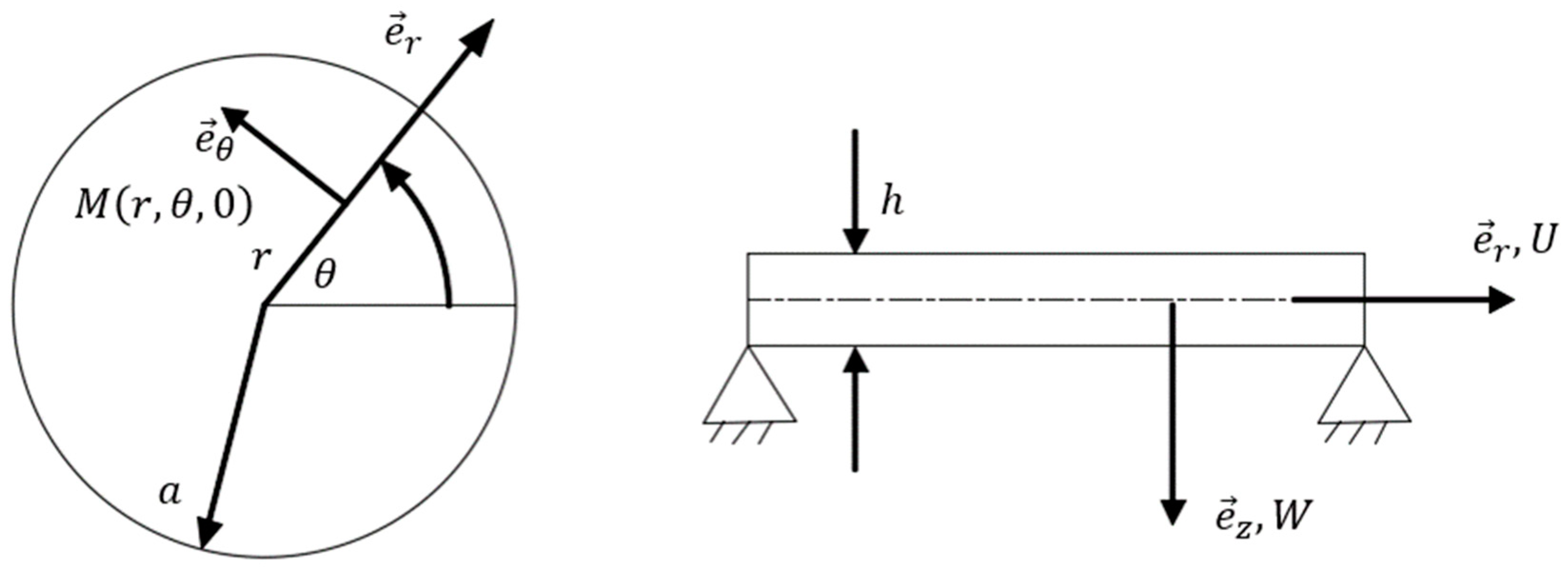
For axisymmetric vibrations of a simply supported circular elastic plate shown in Figure 1 with displacements and and parameters of plate configuration, the bending strain energy of the circular plate with the deflection is given by [15]
in which is the bending stiffness of the plate with E and is the Young’s modulus and Poisson’s ratio of the plate material, respectively. The thickness of the plate is h.
Figure 1.
A simply supported circular elastic plate.
In terms of displacements and , the expression for the membrane strain energy induced by large deflections, or with the nonlinear theory of plates, is to be obtained. Geometric nonlinearity is reflected in the nonlinear strain-displacement relationship caused by large deformations, which leads to the appearance of higher-order derivatives and product terms of displacement in the equation. Thus, for an axisymmetric circular plate, the membrane strain energy is given by
Then, the total strain energy V is the sum of the bending energy and membrane energy from Equations (1) and (2) is as follows:
The strain energy is needed with the RRM for the formulation of this nonlinear vibration problem.
The kinetic energy of the circular plate with both deflection and in-plane displacements is as follows:
where is the density of the plate material.
Customarily, the displacement functions are assumed as follows:
where are amplitudes, displacements, vibration frequency, numbers of modes, and time, respectively. It should be pointed out that displacements in Equation (5) are from an earlier study [15], implying the high frequency components of the in-plane deformation have to be considered, because the squares of the harmonic terms mean the high frequency components in the form of .
To utilize the RRM, the Lagrangian functional is as follows:
The RRM requires:
With Equation (6), it is obtained:
As the extension of the traditional RRM, the Lagrangian in Equation (6) or the partial derivatives in Equations (7) and (8) are now further integrated over the time domain of [0, ], or by applying the ERRM. The integrated results of the partial derivatives with the harmonic terms eliminated are as follows:
After the integration over the physical domain of the elastic plate, algebraic equations of the amplitudes and frequency are obtained with known deformation functions. The amplitudes and frequency are the approximate solutions of the nonlinear axisymmetric vibrations of the plate.
From Equations (7) and (9), the nonlinear algebraic equations for the amplitudes and frequency are as follows:
with the parameters as
Furthermore, the non-dimensional formulation is introduced by using , where is the non-dimensional radial coordinate. is a non-dimensional geometrical parameter representing the ratio of the plate thickness to its radius. With these parameters and the non-dimensional formulation, the non-dimensional parameters associated with the quantities in Equation (11) are now defined as follows:
With known structural and material properties, and deformation functions, the above parameters in Equation (12) can be evaluated, and the algebraic equations in Equation (10) are ready for approximate solutions. It is clear that these equations are different from the linear ones, but the nonlinear harmonic terms have been eliminated in the simplifying procedure, similar to other techniques for solving nonlinear vibration equations.
3. Numerical Examples
With the procedure outlined above, it is straightforward to form the nonlinear algebraic equations for the calculation of the fundamental frequency of the circular plate with a simply supported edge in the axisymmetric vibration mode.
By carrying out the integrations and evaluation, Equation (10) can be rewritten as follows:
The relationship between and is as follows [15]:
Substituting Equation (14) into Equation (13) leads to
Then, the first-order nonlinear frequency from Equation (15) is as follows:
Since it is known that the first-order linear vibration frequency is
then it is obvious
With the maximum non-dimensional vibration amplitude , it is clear that
where
Since the chosen basis functions from linear axisymmetric deformation of a circular plate are [15] as follows:
where are the Bessel and the modified Bessel functions of the first- and second-kind with the order of , respectively. The parameters and are given by Haterbouch and Benamar [15].
The in- and out-of-plane mode shape functions are orthogonal, so that the mass coefficients are as follows:
With the Poisson’s ratio , the parameters in Equation (12) are calculated with the expressions of Then, the frequencies are calculated from
with numerical data for different parameters shown in Table 1.
Table 1.
The comparison of fundamental axisymmetric vibration frequencies of a simply supported circular plate with different methods.
It is clear from Table 1 that the fundamental axisymmetric frequencies of nonlinear vibrations of a simply supported circular plate from this study with the ERRM are very close to the approximate solution with the HBM. Of course, the results are also close to the numerical solution with the FEM and perturbation method. It should be noted that the results match well with other methods, even though only one term is involved in the basis functions. With the increase in the vibration amplitudes, it is shown that the difference is also increasing, as can be seen in Table 1. This means the higher-order components of the mode shapes and frequency should be included for an improvement of accuracy, as it is stated in the beginning. It is known from the analysis of high-frequency vibrations of elastic plates that the in-plane modes have a much higher vibration frequency, and their contribution to the deformation and energy components should also be included in the formulation with higher frequency harmonic terms. The results presented in this study can be further improved by introducing high-frequency components with more vibration modes in future studies.
4. Conclusions
Starting from the nonlinear equations of axisymmetric vibrations of circular plates, the Lagrangian functional is derived for the RRM. By eliminating the higher-order terms of harmonics through integration over the vibration period, or by applying the ERRM for the approximate analysis of nonlinear vibration problems, the vibration frequency for the nonlinear vibrations of a simply supported plate can be calculated more accurately. The present methodology can be extended to circular plates with clamped and free boundary conditions as long as appropriate displacement functions can be chosen. The techniques and procedures are illustrative for the nonlinear analysis of structural vibrations with similar equations and characteristics. Through solving the nonlinear algebraic equations resulting from the systematic treatment of the Lagrangian functional for different vibration amplitudes, the corresponding vibration frequencies are obtained and compared with known results satisfactorily. It is demonstrated that the ERRM is effective in solving nonlinear vibration problems with a simple procedure while achieving relatively accurate solutions. Regarding nonlinearity, although we only considered kinematic nonlinearity in this study, material nonlinearity can be easily incorporated. As long as a suitable displacement function can be found, this method is also approximately applicable to problems considering material nonlinearity [26,27,28]. Its accuracy can be further enhanced by including higher-order terms of the mode shape and frequency harmonics due to the existence of high-frequency deformation. This builds on recent studies using the EGM and ERRM for the nonlinear vibrations of elastic beams. It further shows that the method of integrating over the vibration period, or averaging over the vibration period, can be used to solve a wide range of linear and nonlinear vibration problems with a relatively simple and novel procedure and satisfactory accuracy. This study also has the potential to be applied to more nonlinear vibration problems of circular plates in real-world engineering structures.
Author Contributions
Conceptualization, revision, and submission, H.J. and J.W.; mathematical formulation, investigation, formal analysis, J.H., X.G., B.H., Y.Z. and H.J.; writing—original draft preparation, J.H., X.G. and H.J.; writing—review and editing, C.L., H.J., B.H. and J.W. All authors have read and agreed to the published version of the manuscript.
Funding
This research was funded by the National Natural Science Foundation of China (Grant 11672142) with additional support through the Technology Innovation 2025 Program (Grant 2019B10122) of the Municipality of Ningbo and the Yongjiang Innovation 2035 Key R&D Program (Grant No. 2024H015). Supplementary support from Sanmen Nuclear Power Corporation, Limited, is also acknowledged.
Data Availability Statement
The study data are available from the authors upon reasonable request.
Conflicts of Interest
The funders and institutions had no role in the design of the study, in the collection, analysis, or interpretation of data, in the writing of the manuscript, or in the decision to publish the results.
References
- Touzé, C.; Thomas, O.; Chaigne, A. Asymmetric non-linear forced vibrations of free-edge circular plates. Part 1: Theory. J. Sound. Vib. 2002, 258, 649–676. [Google Scholar] [CrossRef]
- Stoykov, S.; Ribeiro, P. Periodic geometrically nonlinear free vibrations of circular plates. J. Sound. Vib. 2008, 315, 536–555. [Google Scholar] [CrossRef]
- Hu, Y.D.; Wang, T. Nonlinear free vibration of a rotating circular plate under the static load in magnetic field. Nonlinear Dynam. 2016, 85, 1825–1835. [Google Scholar] [CrossRef]
- Tho, N.C.; Ta, N.T.; Thom, D.V. New numerical results from simulations of beams and space frame systems with a tuned mass damper. Materials 2019, 12, 1329. [Google Scholar] [CrossRef]
- Sherif, H.A. Non-linear forced flexural vibrations of a clamped circular unsymmetrical sandwich plate. J. Sound. Vib. 1995, 182, 495–503. [Google Scholar] [CrossRef]
- Javani, M.; Kiani, Y.; Eslami, M.R. Geometrically nonlinear free vibration of FG-GPLRC circular plate on the nonlinear elastic foundation. Compos. Struct. 2021, 261, 113515. [Google Scholar] [CrossRef]
- Singh, B.; Saxena, V. Axisymmetric vibration of a circular plate with double linear variable thickness. J. Sound. Vib. 1995, 179, 879–897. [Google Scholar] [CrossRef]
- Elishakoff, I. Axisymmetric vibration of inhomogeneous free circular plates: An unusual exact, closed-form solution. J. Sound. Vib. 2000, 234, 167–170. [Google Scholar] [CrossRef]
- Mohammadi, M.; Farajpour, A.; Danesh, M. Buckling analysis of variable thickness nanoplates using nonlocal continuum mechanics. Phys. E 2012, 44, 719–727. [Google Scholar]
- Lee, W.M.; Chen, J.T. Free vibration analysis of a circular plate with multiple circular holes by using the multipole Trefftz method. Cmes. Comp. Model. Eng. 2009, 50, 141–160. [Google Scholar] [CrossRef]
- Avramov, K.V.; Tyshkovets, O.; Maksymenko-Sheyko, K.V. Analysis of nonlinear free vibration of circular plates with cut-outs using R-function method. J. Vib. Acoust. 2010, 132, 051001. [Google Scholar] [CrossRef]
- Srinivasan, A.V. Non-linear vibrations of beams and plates. Int. J. Nonlin Mech. 1996, 1, 179–191. [Google Scholar] [CrossRef]
- Yu, Y.Y. Vibrations of Elastic Plates; Springer: New York, NY, USA, 1996. [Google Scholar]
- Amabili, M. Nonlinear Vibrations and Stability of Shells and Plates; Cambridge University Press: Cambridge, UK, 2014. [Google Scholar]
- Haterbouch, M.; Benamar, R. Geometrically nonlinear free vibrations of simply supported isotropic thin circular plates. J. Sound. Vib. 2005, 280, 903–924. [Google Scholar] [CrossRef]
- Reddy, J.N. An Introduction to Nonlinear Finite Element Analysis; Oxford University Press: Oxford, UK, 2004. [Google Scholar]
- Wu, R.; Wang, J.; Du, J.; Huang, D.; Yan, W.; Hu, Y. An analysis of nonlinear vibrations of coupled thickness-shear and flexural modes of quartz crystal plates with the Homotopy Analysis Method. IEEE T Ultrason. Ferr. 2012, 59, 30–39. [Google Scholar] [CrossRef]
- Decha-Umphai, K.; Mei, C. Finite element method for non-linear forced vibrations of circular plates. Int. J. Numer. Methods Eng. 1986, 23, 1715–1726. [Google Scholar] [CrossRef]
- Dumir, P.C.; Bhaskar, A. Some erroneous finite element formulations of non-linear vibrations of beams and plates. J. Sound. Vib. 1988, 123, 517–527. [Google Scholar] [CrossRef]
- Sedighi, H.M.; Shirazi, K.H.; Noghrehabadi, A. Application of recent powerful analytical approaches on the non-linear vibration of cantilever beams. Int. J. Nonlinear Sci. Numer. Simul. 2012, 13, 487–494. [Google Scholar] [CrossRef]
- Ilanko, S.; Monterrubio, L.E.; Mochida, Y. The Rayleigh–Ritz Method and Simple Applications. In The Rayleigh–Ritz Method for Structural Analysis; John Wiley & Sons: New York, NY, USA, 2014; pp. 21–31. [Google Scholar]
- Wang, J. The extended Rayleigh-Ritz method for an analysis of nonlinear vibrations. Mech. Adv. Mater. Struct. 2022, 29, 3281–3284. [Google Scholar] [CrossRef]
- Jing, H.; Gong, X.; Wang, J.; Wu, R.; Huang, B. An analysis of nonlinear beam vibrations with the Extended Rayleigh-Ritz Method. J. Appl. Comput. Mech. 2022, 8, 1299–1306. [Google Scholar]
- Lian, C.; Meng, B.; Jing, H.; Wu, R.; Lin, J.; Wang, J. The analysis of higher-order nonlinear vibrations of an elastic beam with the Extended Galerkin Method. J. Vib. Eng. Technol. 2023, 12, 2743–2758. [Google Scholar] [CrossRef]
- Wang, J.; Wu, R. The extended Galerkin method for approximate solutions of nonlinear vibration equations. Appl. Sci. 2022, 12, 2979. [Google Scholar] [CrossRef]
- Zhang, Y.; Sun, W.; Yang, J.; Han, Q.K. Analytical analysis of forced vibration of the hard-coating cylindrical shell with material nonlinearity and elastic constraint. Comp. Struct. 2023, 187, 281–293. [Google Scholar] [CrossRef]
- Aimmanee, S.; Chutima, S.; Hyer, M.W. Nonlinear analysis of RAINBOW actuator characteristics. Smart Mater. Struct. 2009, 18, 045002. [Google Scholar] [CrossRef]
- Amenzadeh, R.Y.; Kiyasbeyli, E.T. Critical time of a long multilayer viscoelastic shell. Mech. Comps. Mater. 2007, 43, 419–426. [Google Scholar] [CrossRef]
Disclaimer/Publisher’s Note: The statements, opinions and data contained in all publications are solely those of the individual author(s) and contributor(s) and not of MDPI and/or the editor(s). MDPI and/or the editor(s) disclaim responsibility for any injury to people or property resulting from any ideas, methods, instructions or products referred to in the content. |
© 2025 by the authors. Licensee MDPI, Basel, Switzerland. This article is an open access article distributed under the terms and conditions of the Creative Commons Attribution (CC BY) license (https://creativecommons.org/licenses/by/4.0/).


