Abstract
This paper aims to establish a new hybrid class of special polynomials, namely, the Fubini–Bell-based Appell polynomials. The monomiality principle is used to derive the generating function for these polynomials. Several related identities and properties, including symmetry identities, are explored. The determinant representation of the Fubini–Bell-based Appell polynomials is also established. Furthermore, some special members of the Fubini–Bell-based Appell family—such as the Fubini–Bell-based Bernoulli polynomials and the Fubini–Bell-based Euler polynomials—are derived, with analogous results presented for each. Finally, computational results and graphical representations of the zero distributions of these members are investigated.
Keywords:
Fubini polynomials; Bell polynomials; Appell polynomials; monomiality principle; generating function; determinant representation; differential equations MSC:
11B83; 11B68; 05A15; 33C47
1. Introduction and Preliminaries
In the last decade, several researchers, namely Kargin [1], Duran and Acikgoz [2], Kim et al. [3,4], Kilar and Simsek [5], and Su and He [6], have discussed certain worthy results related to Fubini polynomials and numbers and degenerate forms of these polynomials. The Bell polynomial family stands out as one of the most prominent special polynomials due to its wide-ranging applications across numerous mathematical frameworks (see [7,8,9]). Appell polynomials are widely utilized in both pure and applied mathematics. These versatile polynomials find applications in fields such as chemistry, theoretical physics, and various branches of mathematics, including the study of polynomial expansions of analytic functions, numerical analysis, and number theory. Throughout this study, the following notations and definitions are employed: refers to the set of complex numbers, refers to the set of real numbers, and .
The two-variable Bell polynomials (2VBelP) [10,11] are defined by
The generalized class of Bell polynomials (GBelP) [13] is given as
The two-variable Fubini polynomials (2VFP) of order are defined by
Taking in generating function (5), we get
where denotes the classical Fubini polynomials [1]. Moreover, for denotes the Fubini numbers (the ordered Bell numbers).
The Appell polynomials are widely utilized across various mathematical and physical disciplines, such as algebraic geometry, differential equations, and quantum mechanics. They also exhibit strong associations with other families of special functions, including hypergeometric functions, Jacobi polynomials, and many other special polynomials. Recently, many researchers have discussed various special polynomials related to Appell polynomials, see for example [14,15,16,17]. The sequences of Appell polynomial (AP) surface in various applicable problems in applied and pure mathematics, such as the investigation and study of analytic problems and polynomial expansions in physics and chemistry [18].
The AP () [19] satisfy the following relation:
The AP are also specified by [20]
such that
Some members of the AP are listed in Table 1.
Table 1.
Certain members of AP family .
Over the last few years, there has been significant interest in a new approach related to special functions, that is, the determinant approach. Costabile et al. [24] have established a new definition to Bernoulli polynomials based on a determinant approach. Furthermore, Longo an Costabile have established determinant approaches to Sheffer and Appell polynomials (see [25,26]). This led the authors to shed light on the determinant approach of some new hybrid polynomials.
Recently, many researchers have utilize the monomiality principle [27] based on operational methods to introduce and investigate new hybrid classes of special polynomials [14,15,16,28,29,30,31,32].
The Hybrid special polynomials extend the utility of classical special polynomials by addressing complexity, dimensionality, and adaptability limitations. These polynomials play a critical role in advancing theoretical and applied sciences. The established results in this work are useful in various fields including physics, engineering, machine learning, and number theory, demonstrating their versatility in both theoretical and applied contexts.
In this work, by combining the Fubini–Bell polynomials and Appell polynomials, we construct a new hybrid class of special polynomials, namely the Fubini–Bell-based Appell polynomials, seen in Definition 1. Next, the Fubini–Bell-based Appell polynomials’ series representations and some remarkable properties are derived. In Section 3, we establish some symmetry identities that include these polynomials. In Section 4, we acquire the determinant representation for the Fubini–Bell-based Appell polynomials. Finally, certain special cases of the Fubini–Bell-based Appell polynomials are discussed, and the computational results and graphical representations of zero distributions of these members are investigated.
2. Fubini–Bell-Based Appell Polynomials
In this section, we present a novel and intriguing class of hybrid special polynomials, referred to as the Fubini–Bell-based Appell polynomials. We also explore and analyze various associated properties and identities.
According to the generating function (3), the Fubini–Bell polynomials (FBP) of order can be defined as
Moreover, the FBP of order are quasi-monomial in relation to the following operators:
and
respectively.
In view of the monomiality principle [33,34], the FBP satisfy the following identities:
Using Equation (16) in the above equation and denoting by the resultant Fubini–Bell-based Appell polynomials (FBAP) , we obtain
By applying relation (10) to the equation above, we obtain the following definition.
Definition 1.
The Fubini–Bell-based Appell polynomials of order σ are defined by the generating function:
Setting in generating relation (19), we get the Fubini–Bell-based Appell numbers of order , which are given by
Note that
Differentiating Equation (19) partially with respect to , gives
Now, utilizing identity (22) and comparing the coefficients of same powers of in the resultant equation, we get
Using Equations (13) and (14) (for ) in (24) and (22), respectively, we obtain the following theorem.
Theorem 1.
The Fubini–Bell-based Appell polynomials demonstrate quasi-monomial properties in relation to the following multiplicative and derivative operators:
and
respectively.
Remark 1.
Finally, on comparing the coefficients of on both sides of (29), we establish the following theorem.
Theorem 2.
The following series representation for the FBAP holds true:
Similarly, we can get
Utilizing (19), we have
Equation (32) leads to the following theorem.
Theorem 3.
The FBAP satisfy the following series representation:
Replacing by in (19), we have
Equation (34) leads to the following theorem.
Theorem 4.
For , and , we have
From (36), we arrive at the following theorem.
Theorem 5.
For , and , we have
Remark 2.
Taking in (37), we get
From (19), we have
From (39), we reach at the following theorem.
Theorem 6.
For and , we have
From (19), we have
where denotes the Euler numbers [21], denotes Fubini–Appell polynomials [15], and denotes Bell–Euler polynomials [35].
From (41), we arrive at the following theorem.
Theorem 7.
For and , we have
3. Symmetry Identities
Here, we present certain symmetric identities of the Fubini–Bell-based Appell polynomials. Let us consider
Similarly, we can get
Theorem 8.
For and , we have
Remark 3.
Taking in (45), we get
Remark 4.
Taking in (45), we get
Let
Similarly, we can get
Theorem 9.
For and , we have
Remark 5.
Taking in (50), we get
Remark 6.
Taking in (50), we get
4. Determinant Representation
In this section, we provide the determinant representation for the Fubini–Bell-based Appell polynomials.
Theorem 10.
The Fubini–Bell-based Appell polynomials of degree τ are defined by
where , and are the Fubini–Bell polynomials defined by Equation (10).
Proof.
We start with the determinant definition of the AP of degree which is given as follows [25]:
where
By setting in the series definition (31) and subsequently applying Equation (55) to the resulting expression, we derive the assertion (53).
In order to achieve assertion (54), the determinant of the Appell polynomials presented in Equation (56) are expanded with respect to the first row, so that
5. Special Members and Graphical Representations
Here, we acquire certain special hybrid members of the FBAP . By leveraging the findings established in the earlier sections, we explore and analyze the results associated with these newly introduced special hybrid members.
5.1. Fubini–Bell-Based Bernoulli Polynomials
For , the FBAP (19) reduce to the Fubini–Bell-based Bernoulli polynomials (FBBP) which are expressed as follows:
The FBBP satisfy the following representations:
For and , we have
For and , the FBBP satisfy the following symmetry identities:
In [25], it was demonstrated that when and for , the determinant-based definition of Appell polynomials , as given by Equations (55) and (56), simplifies to the determinant-based definition of Bernoulli polynomials [24]. Consequently, by setting and for in Equations (53) and (54), the following determinant representation of the FBBP is obtained.
Corollary 1.
The Fubini–Bell-based Bernoulli polynomials of degree τ are defined by
where are the Fubini–Bell polynomials of degree τ.
The first four Fubini–Bell-based Bernoulli polynomials are as follows:
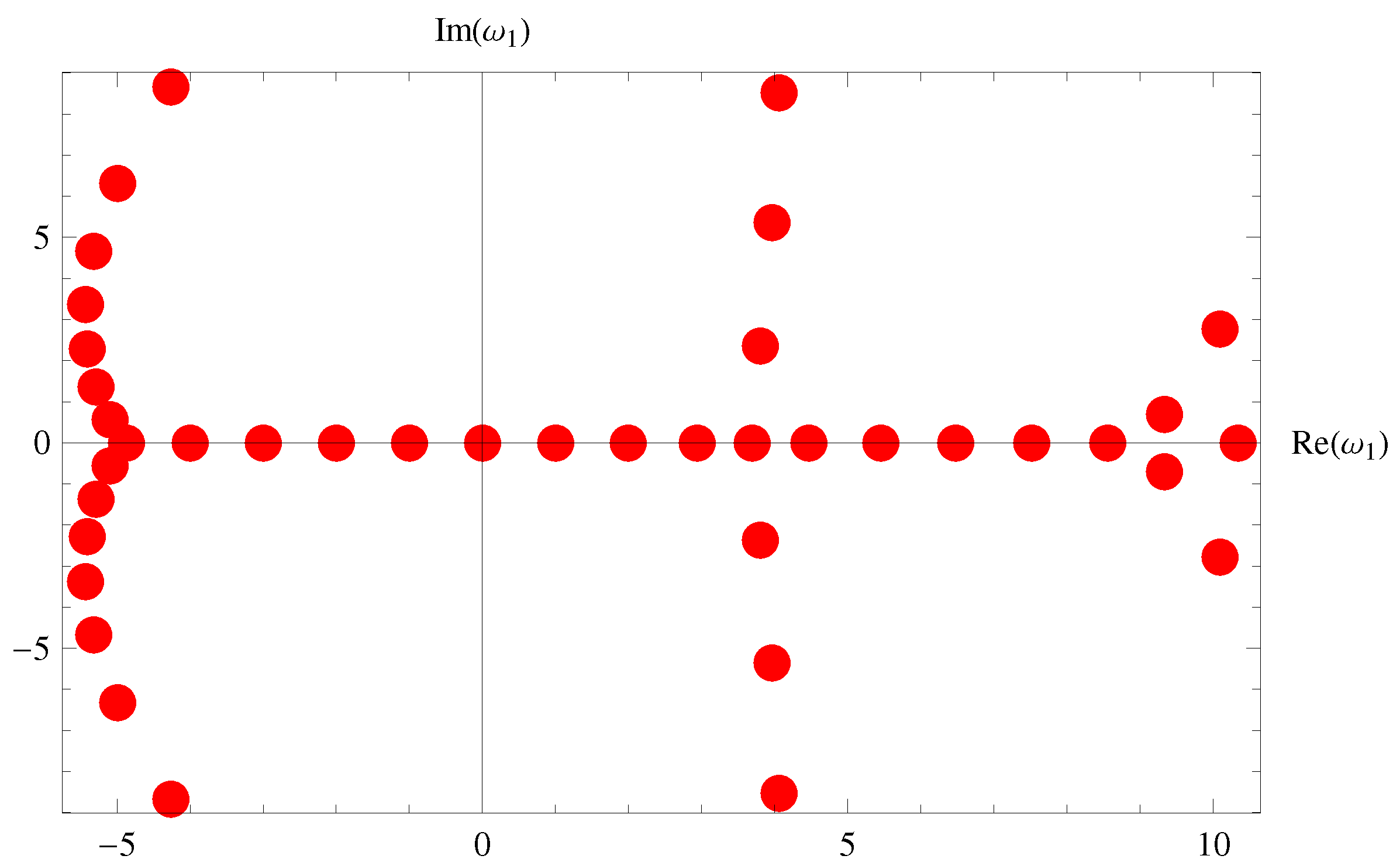
Figure 1.
Zeros of .
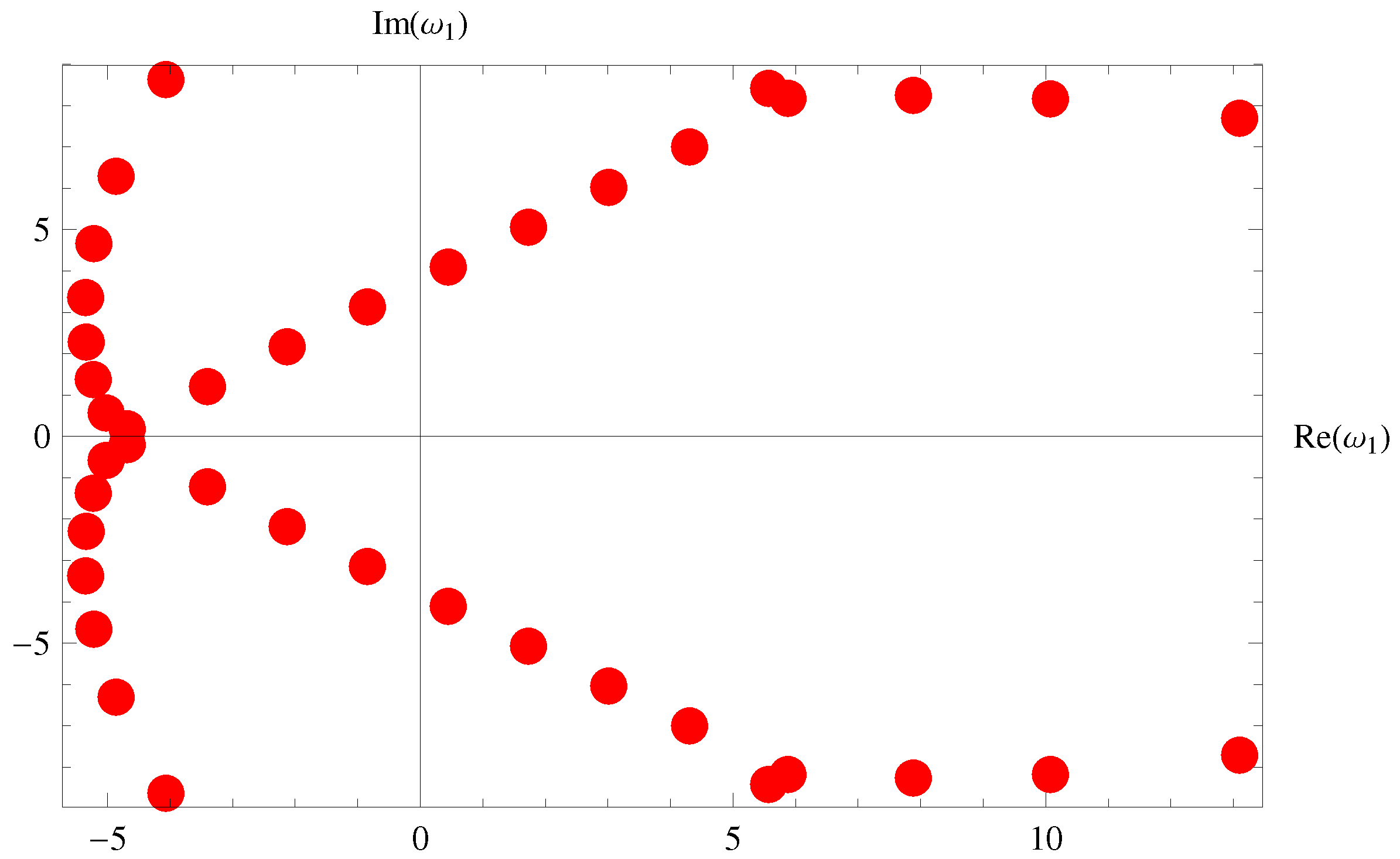
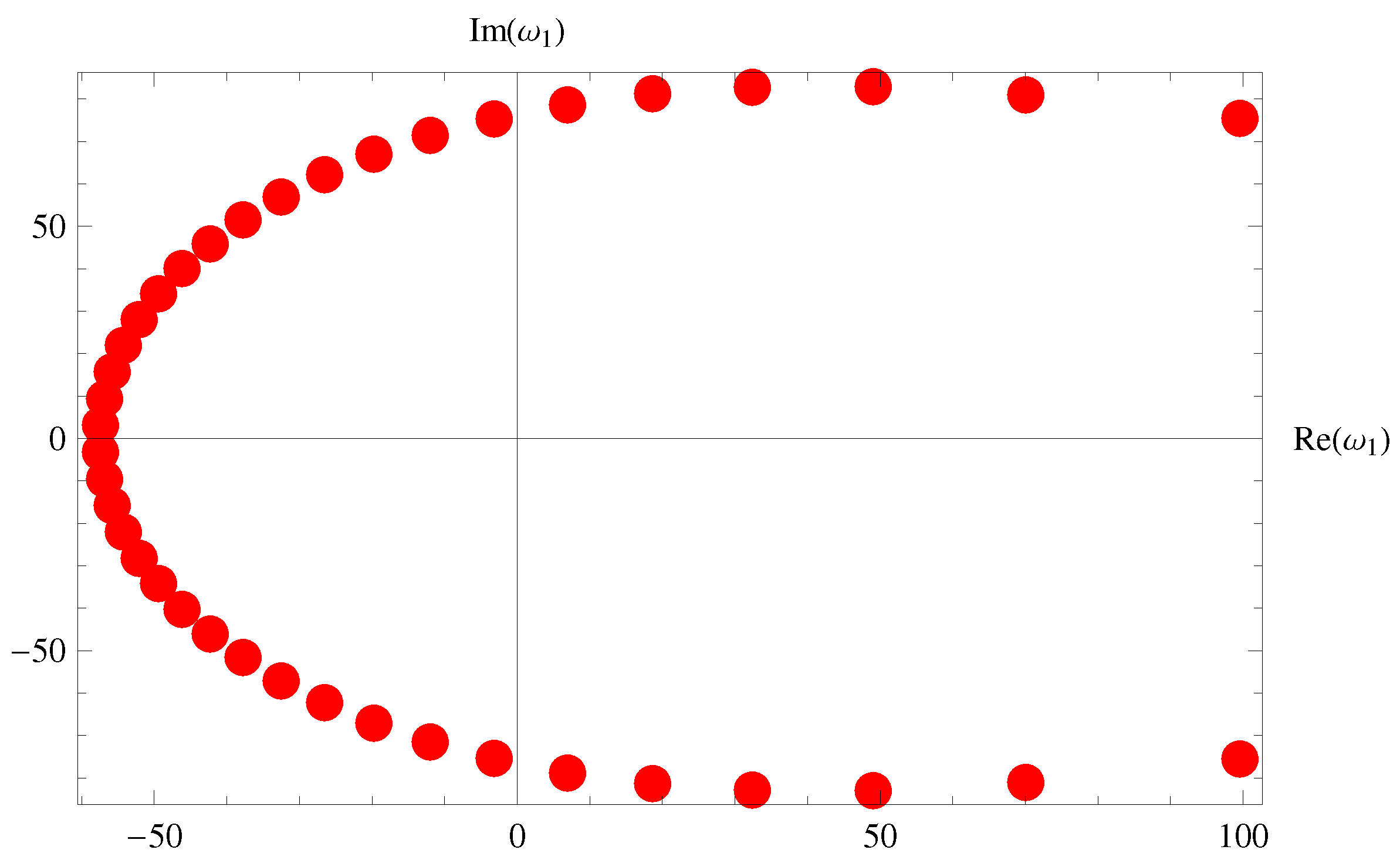
Figure 2.
Zeros of .
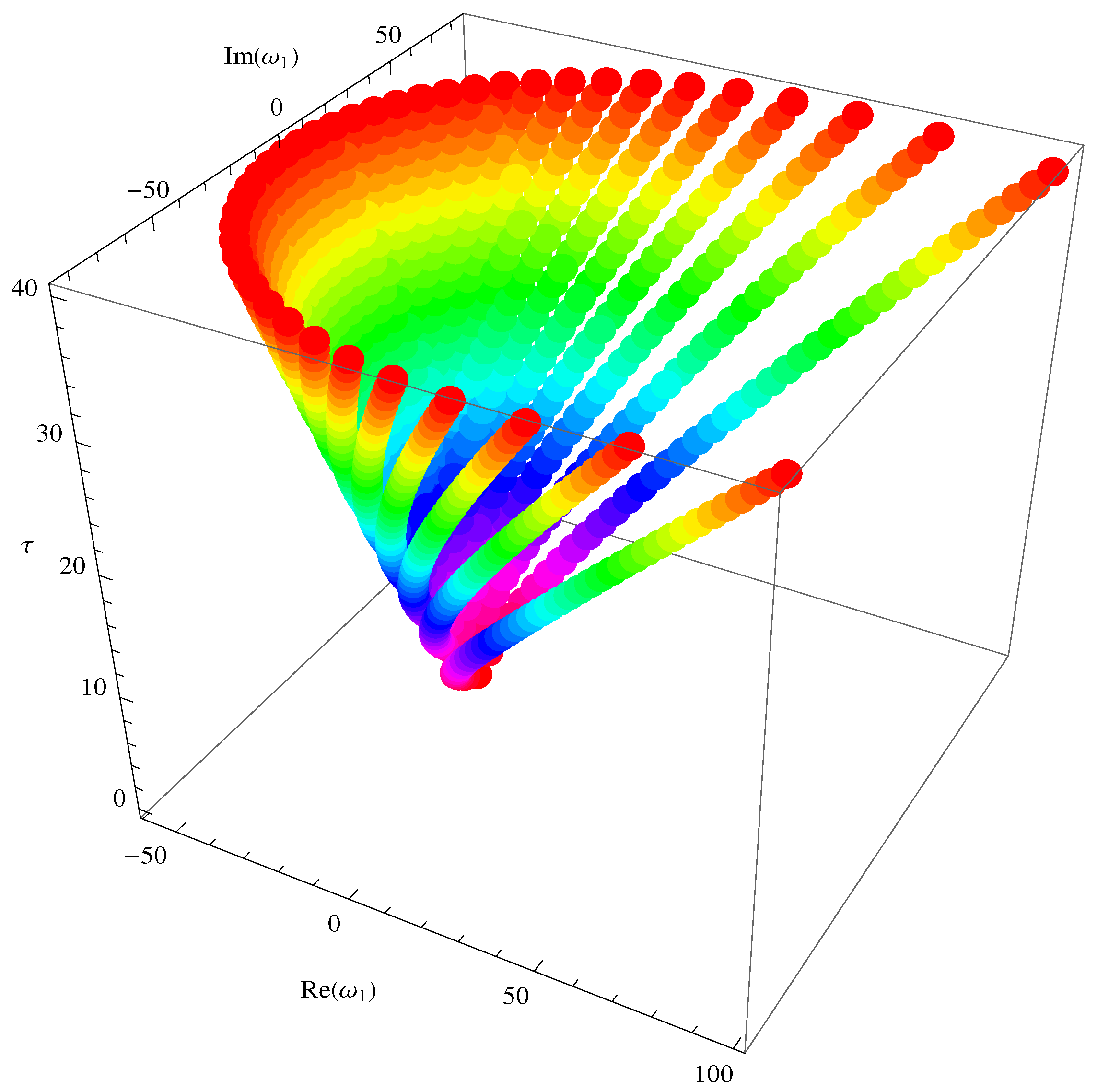
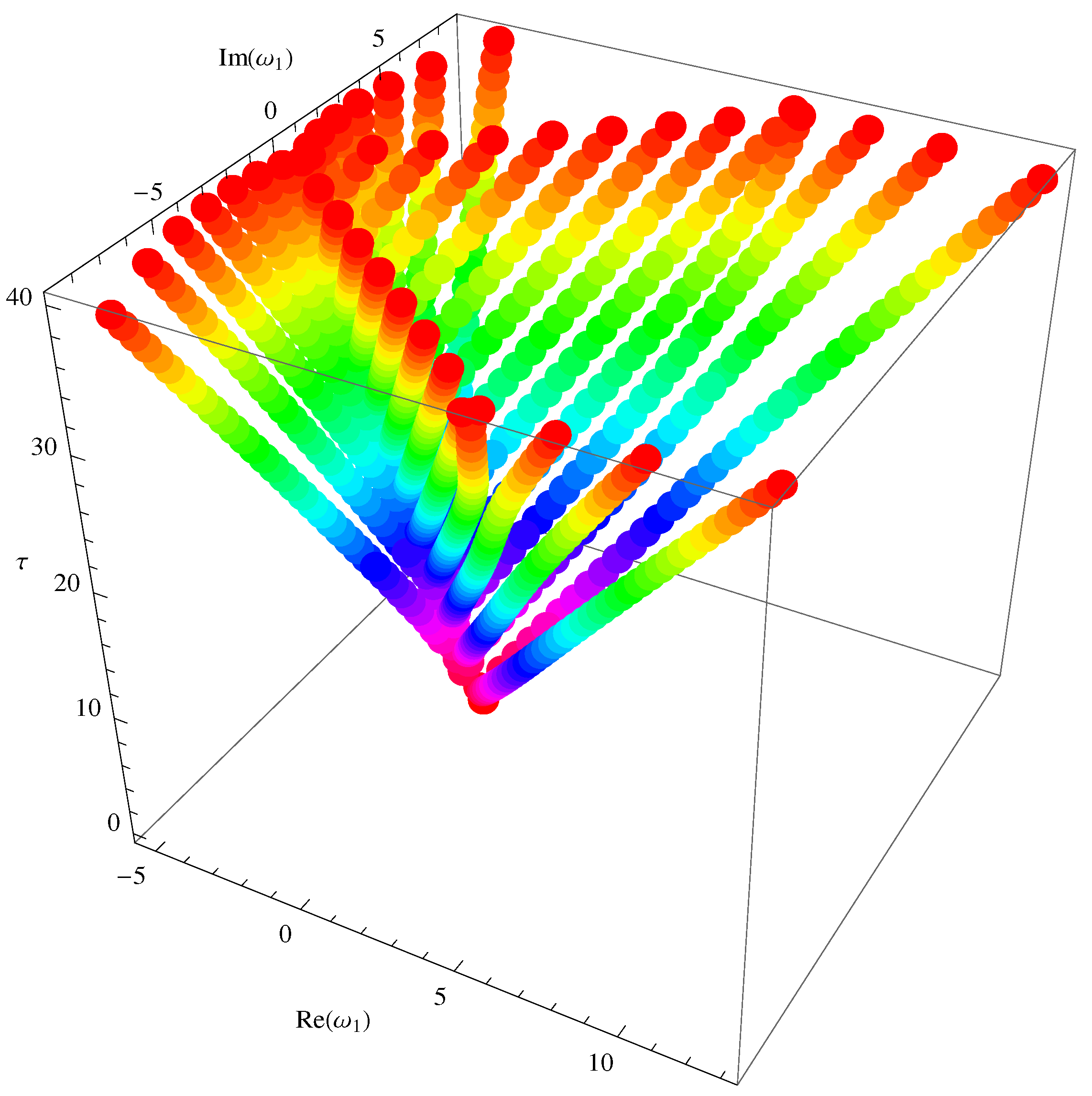
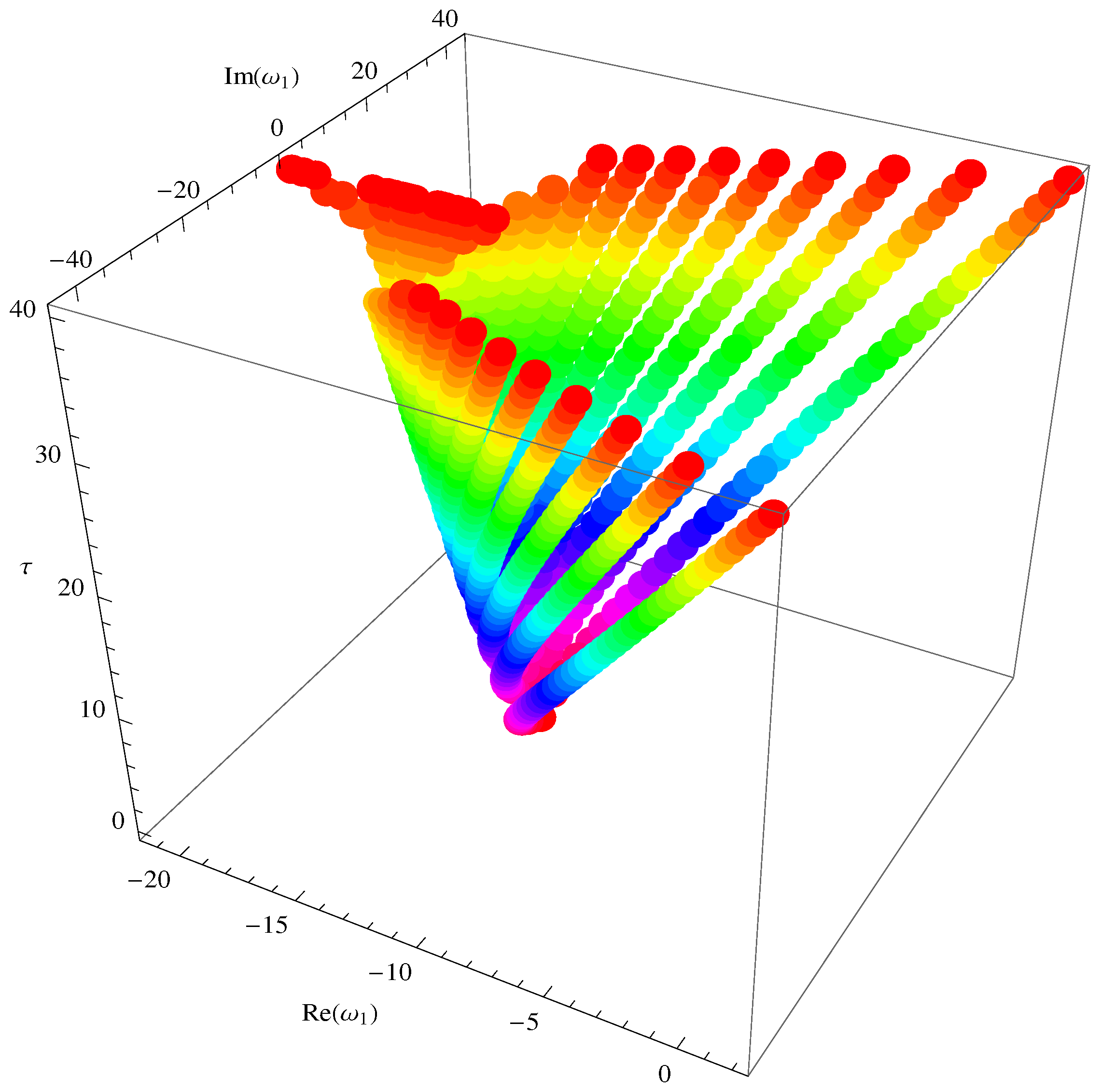
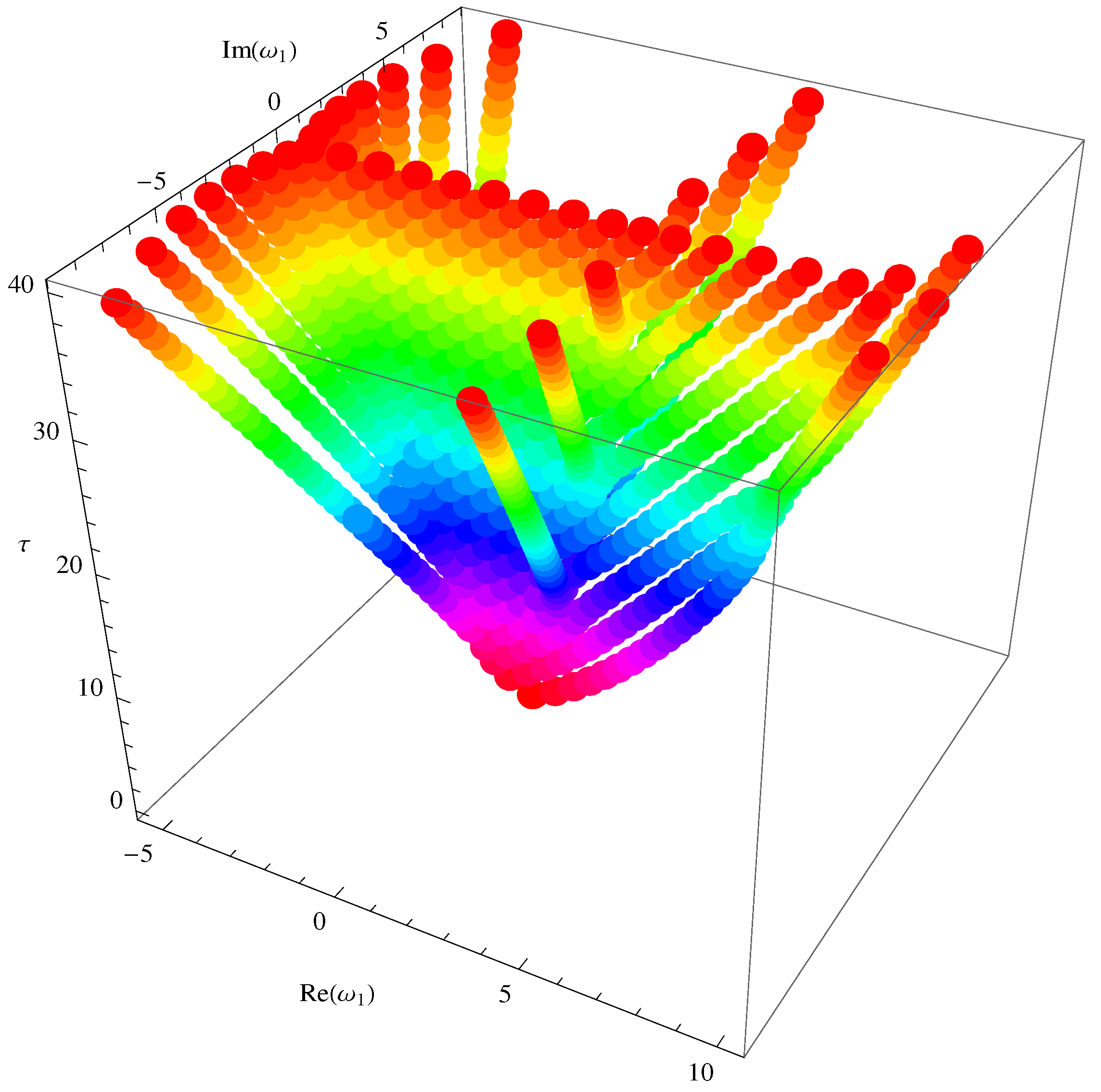
Furthermore, the 3D structure of zeros distributions of FBBP , for and are presented in Figure 3 and Figure 4, respectively.
Figure 3.
Zero distribution of . This figure illustrates the 3D plot of the zeros of Fubini–Bell-based Bernoulli polynomials for , and .
Figure 4.
Zero distribution of . This figure illustrates the 3D plot of the zeros of Fubini–Bell-based Bernoulli polynomials for , and .
5.2. Fubini–Bell-Based Euler Polynomials
For , the FBAP (19) simplifies to the Fubini–Bell-based Euler polynomials (FBEP) , which are expressed as follows:
The FBEP satisfy the following representations:
For and , we have
For and , the FBEP satisfy the following symmetry identities:
Moreover, when and for , Equations (55) and (56) simplify to the determinant form of Euler polynomials [25]. Consequently, by setting and for in Equations (53) and (54), they reduce to the following determinant form of FBEP .
Corollary 2.
The generalized Fubini–Bell-based Euler polynomials of degree τ are defined by
where are the Fubini–Bell polynomials of degree τ.
The first four Fubini–Bell-based Euler polynomials are as follows:
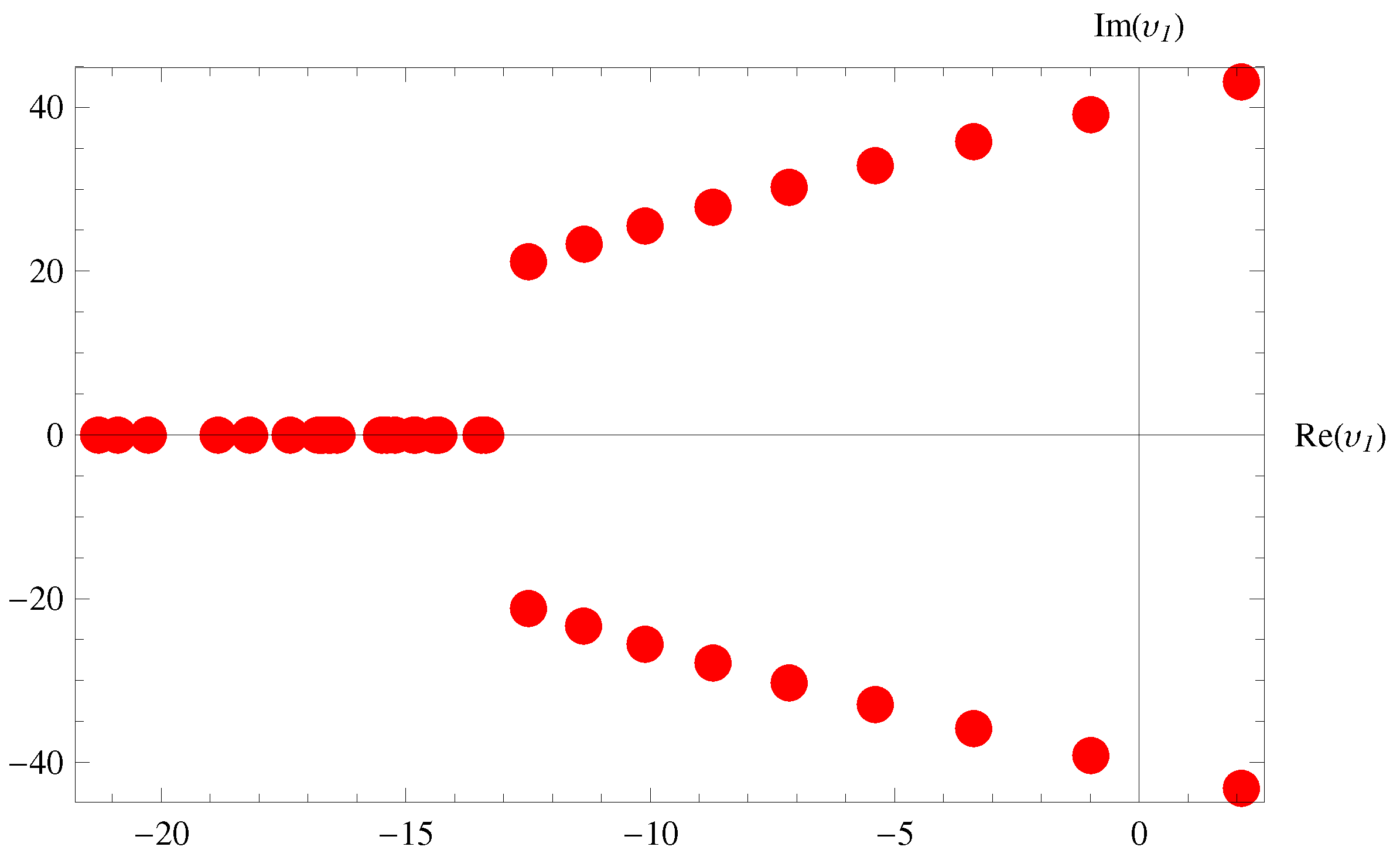
Figure 5.
Zeros of .
Figure 6.
Zeros of .
Furthermore, the 3D structure of zeros distributions of , for and are presented in Figure 7 and Figure 8, respectively.
Figure 7.
Zero distribution of . This figure illustrates the 3D plot of the zeros of Fubini–Bell-based Euler polynomials for , and .
Figure 8.
Zero distribution of . This figure illustrates the 3D plot of the zeros of Fubini–Bell-based Euler polynomials for , and .
Furthermore, by taking certain other choices of , we can obtain some other special members of the Fubini–Bell-based Appell polynomials as follows:
- For , the FBAP (19) reduce to the Fubini–Bell-based Genocchi polynomials, which are expressed as
- For , the FBAP (19) reduce to the Fubini–Bell-based Stirling polynomials, which are expressed as
- For , the FBAP (19) reduce to the Fubini–Bell-based Apostol-type polynomials, which are defined by
- For , the FBAP (19) reduce to the Fubini–Bell-based Apostol–Bernoulli polynomials, which are defined by
- For , the FBAP (19) reduce to the Fubini–Bell-based Apostol–Euler polynomials, which are defined by
- For , the FBAP (19) reduce to the Fubini–Bell-based Apostol–Genocchi polynomials, which are defined by
- For , the FBAP (19) reduce to the Fubini–Bell-based Apostol-type Forbenius–Euler polynomials, which are defined by
The series representations and other findings derived in the earlier sections can be utilized to explore the outcomes associated with the aforementioned special members.
6. Conclusions
The hybrid form of special polynomials and numbers has garnered considerable interest among researchers. In this study, we introduced a novel hybrid class of special polynomials, referred to as the Fubini–Bell-based Appell polynomials (FBAP). We explored their generating function and investigated several related properties. Symmetry identities involving the FBAP were also examined, and a determinant representation was derived. Specific members of the Fubini–Bell-based Appell family—such as the Fubini–Bell-based Bernoulli polynomials and the Fubini–Bell-based Euler polynomials—were obtained, with analogous results presented for each. Additionally, we analyzed computational outcomes and graphical representations of the zero distributions for these members. The method used in [36,37] can be considered in further studies. Future research could delve into the differential and integral representations of these special polynomials, as well as their potential applications.
Author Contributions
Conceptualization, Y.A.M.; Methodology, A.T.; Software, K.S.M.; Formal analysis, Y.A.M. and A.T.; Investigation, Y.A.M. and A.T.; Writing—original draft, A.M.; Writing—review & editing, K.A. and R.H.E.; Project administration, K.A.; Funding acquisition, K.S.M. All authors have read and agreed to the published version of the manuscript.
Funding
This research received no external funding.
Data Availability Statement
The original contributions presented in the study are included in the article, further inquiries can be directed to the corresponding authors.
Acknowledgments
The authors extend their gratitude to the Islamic University of Madinah. The authors extend their appreciation to the Deanship of Scientific Research at Northern Border University, Arar, KSA for funding this research work through the project number “NBU-FPEJ-2025-2917-01”. This study is supported via funding from Prince Sattam bin Abdulaziz University project number (PSAU/2025/R/1446).
Conflicts of Interest
The authors declare no conflicts of interest.
References
- Kargin, L. Some formulae for products of geometric polynomials with applications. J. Integer Seq. 2017, 20, 15. [Google Scholar]
- Duran, U.; Acikgoz, M. Truncated Fubini polynomials. Mathematics 2019, 7, 431. [Google Scholar] [CrossRef]
- Kim, D.S.; Kim, T.; Jang, G.-W. A note on degenerate Fubini polynomials. Proc. Jangjeon Math. Soc. 2017, 20, 521–531. [Google Scholar]
- Kim, D.S.; Kim, T.; Kwon, H.I.; Park, J.W. Two variable higher-order Fubini polynomials. J. Korean Math. Soc. 2018, 55, 975–986. [Google Scholar] [CrossRef]
- Kilar, N.; Simsek, Y. A new family of Fubini type numbers and polynomials associated with Apostol-Bernoulli numbers and polynomials. J. Korean Math. Soc. 2017, 54, 1605–1621. [Google Scholar]
- Su, D.D.; He, Y. Some identities for the two variable Fubini polynomials. Mathematics 2019, 7, 115. [Google Scholar] [CrossRef]
- Benbernou, S.; Gala, S.; Ragusa, M.A. On the regularity criteria for the 3D magnetohydrodynamic equations via two components in terms of BMO space. Math. Methods Appl. Sci. 2014, 37, 2320–2325. [Google Scholar] [CrossRef]
- Boas, R.B.; Buck, R.C. Polynomial Expansions of Analytic Functions; Springer: Berlin/Heidelberg, Germany, 2013. [Google Scholar]
- Sándor, J.; Crstici, B. Handbook of Number Theory; Kluwer Academic Publishers: Dordrecht, The Netherlands, 2004; Volume II. [Google Scholar]
- Duran, U.; Araci, S.; Acikgoz, M. Bell-based Bernoulli polynomials with applications. Axioms 2021, 10, 29. [Google Scholar] [CrossRef]
- Duran, U.; Acikgoz, M. Bell-based Genocchi polynomials. NTMSCI 2021, 9, 50–55. [Google Scholar] [CrossRef]
- Carlitz, L. Some remarks on the Bell numbers. Fibonacci Quart. 1980, 18, 66–73. [Google Scholar] [CrossRef]
- Al-Jawfi, R.A.; Muhyi, A.; Al-shameri, W.F.H. On generalized class of Bell polynomials associated with geometric applications. Axioms 2024, 13, 73. [Google Scholar] [CrossRef]
- Costabile, F.A.; Khan, S.; Ali, H. A Study of the q-Truncated Exponential–Appell Polynomials. Mathematics 2024, 12, 3862. [Google Scholar] [CrossRef]
- Muhyi, A.; Araci, S. A note on q-Fubini-Appell polynomials and related properties. J. Funct. Spaces 2022, 2021, 3805809. [Google Scholar] [CrossRef]
- Srivastava, H.M.; Özarslan, M.A.; Yılmaz, B. Some families of differential equations associated with the Hermite-based Appell polynomials and other classes of Hermite-based polynomials. Filomat 2014, 28, 695–708. [Google Scholar] [CrossRef]
- Özat, Z.; Özarslan, M.A.; Çekim, B. On Bell based Appell polynomials. Turk. J. Math. 2023, 47, 1099–1128. [Google Scholar] [CrossRef]
- Avram, F.; Taqqu, M.S. Noncentral limit theorems and Appell polynomials. Ann. Probab. 1987, 15, 767–775. [Google Scholar] [CrossRef]
- Andrews, L.C. Special Functions for Engineers and Applied Mathematics; Macmillan Publishing Company: New York, NY, USA, 1985. [Google Scholar]
- Srivastava, H.M.; Manocha, H.L. A Treatise on Generating Functions; Halsted Press-Ellis Horwood Limited-John Wiley & Sons: New York, NY, USA, 1984. [Google Scholar]
- Rainville, E.D. Special Functions; Chelsea Publishing Co.: Bronx, NY, USA, 1971. [Google Scholar]
- Lu, D.Q.; Luo, Q.M. Some properties of the generalized Apostol type polynomials. Bound. Value Probl. 2013, 2013, 64. [Google Scholar] [CrossRef]
- Kurt, B.; Simsek, Y. On the generalized Apostol-type Frobenius-Euler polynomials. Adv. Differ. Equ. 2013, 2013, 1–9. [Google Scholar] [CrossRef]
- Costabile, F.A.; Dell’Accio, F.; Gualtieri, M.I. A new approach to Bernoulli polynomials. Rend. Mat. Appl. 2006, 26, 1–12. [Google Scholar]
- Costabile, F.A.; Longo, E. A determinantal approach to Appell polynomials. J. Comput. Appl. Math. 2010, 234, 1528–1542. [Google Scholar] [CrossRef]
- Costabile, F.A.; Longo, E. An algebraic approach to Sheffer polynomial sequences. Integral Transforms Spec. Funct. 2013, 25, 295–311. [Google Scholar] [CrossRef]
- Cocolicchio, D.; Dattoli, G.; Srivastava, H.M. (Eds.) Advanced Special Functions and Applications; Aracne Editrice: Rome, Italy, 2000. [Google Scholar]
- Muhyi, A. A new class of Gould-Hopper-Eulerian-type polynomials. Appl. Math. Sci. Eng. 2022, 30, 283–306. [Google Scholar] [CrossRef]
- Ramírez, W.; Cesarano, C.; Wani, S.A.; Yousef, S.; Bedoya, D. About properties and the monomiality principle of Bell-based Apostol-Bernoulli-type polynomials. Carpathian Math. Publ. 2024, 16, 379–390. [Google Scholar] [CrossRef]
- Srivastava, H.M.; Srivastava, R.; Muhyi, A.; Yasmin, G.; Islahi, H.; Araci, S. Construction of a new family of Fubini-type polynomials and its applications. Adv. Differ. Equ. 2021, 2021, 1–25. [Google Scholar] [CrossRef]
- Srivastava, H.M.; Araci, S.; Khan, W.A.; Acikgoz, M. A note on the truncated-exponential based Apostol-type polynomials. Symmetry 2019, 11, 538. [Google Scholar] [CrossRef]
- Yasmin, G.; Muhyi, A. Extended forms of Legendre-Gould-Hopper-Appell polynomials. Adv. Stud. Contemp. Math. 2019, 29, 489–504. [Google Scholar]
- Masjed-Jamei, M.; Beyki, M.R.; Koepf, W. A new type of Euler polynomials and numbers. Mediterr. J. Math. 2018, 15, 138. [Google Scholar] [CrossRef]
- Steffensen, J.F. The poweriod, an extension of the mathematical notion of power. Acta Math. 1941, 73, 333–366. [Google Scholar] [CrossRef]
- Khan, N.; Husain, S. Analysis of Bell based Euler polynomials and their application. Int. J. Appl. Comput. Math. 2021, 7, 195. [Google Scholar] [CrossRef]
- Lyapin, A.P.; Akhtamova, S.S. Recurrence relations for the sections of the generating series of the solution to the multidimensional difference equation. Vestn. Udmurtsk. Univ. Mat. Mekh. 2021, 31, 414–423. [Google Scholar] [CrossRef]
- Leinartas, E.; Shishkina, O. The Euler-Maclaurin Formula in the Problem of Summation over Lattice Points of a Simplex. J. Sib. Fed. Univ. Math. Phys. 2022, 15, 108–113. [Google Scholar] [CrossRef]
Disclaimer/Publisher’s Note: The statements, opinions and data contained in all publications are solely those of the individual author(s) and contributor(s) and not of MDPI and/or the editor(s). MDPI and/or the editor(s) disclaim responsibility for any injury to people or property resulting from any ideas, methods, instructions or products referred to in the content. |
© 2025 by the authors. Licensee MDPI, Basel, Switzerland. This article is an open access article distributed under the terms and conditions of the Creative Commons Attribution (CC BY) license (https://creativecommons.org/licenses/by/4.0/).