1. Introduction
Appell polynomials, a notable category of special functions, have found widespread utility in mathematical domains. Introduced by Paul Appell in 1880, these polynomials are characterized by distinctive properties that contribute to their significance across various mathematical and scientific fields.
The generating function for two-variable general polynomials (2VgP), represented as
, is established as follows in the literature [
1,
2]:
where
has (at least the formal) series expansion
In the 18th century, the foundation of
q-calculus began, establishing a framework integral to the theory of special functions. Recently,
q-calculus has garnered significant attention due to its applicability across fields like applied mathematics, mechanical engineering, and physics, bridging classical mathematics and quantum calculus. The development of
q-analogues, inspired by classical calculus, has led to foundational results in combinatorics, number theory, and other mathematical disciplines. Key
q-special polynomials, such as the
q-binomial coefficient
and the
q-Pochhammer symbol
, hold central roles in
q-analog structures across combinatorics, representation theory, and statistical mechanics. The algebraic and analytic richness of these polynomials offers essential tools for exploring
q-analogue phenomena. In this paper, we set
, with
, and employ
q-notations as per Andrews et al. [
3]. In recent years, advancements have been made in the study of two-variable
q-Hermite polynomials, notably by Zayed et al. [
4] and Riyasat and Khan [
5], highlighting their importance in extending classical Hermite polynomials into
q-calculus frameworks. Additionally,
q-special functions have been formulated and explored within the representations of quantum algebras [
6,
7,
8] underscoring the role of
q-calculus in quantum groups and quantum mechanics.
The
q-shifted factorial
is defined as follows:
In q-calculus, this notation assumes a fundamental significance, embodying the discrete characteristics of q-analogues and enabling a range of identities and transformations crucial to the theoretical framework.
For a complex number
, the
q-analogue of
is given by
The
q-factorial is given by
The Gauss’s
q-binomial formula is given by [
3]
where the Gauss
q-binomial coefficient is
Two
q-exponential functions are given by [
9]
and
The product of both
q-exponential functions is given by
The
q-derivative of a function
is defined as [
10,
11]
The
q-derivative of the exponential function is given by
and
where
denotes the
kth order
q-derivative with respect to
.
The
q-derivative of the product of functions
and
has been established in the literature [
2,
4,
12]
The
q-derivative of the division of functions
and
is given by
The
q-integral of a function
is defined as [
3,
4]
By virtue of (
17), we can conclude that
More specifically,
, and by using the method of mathematical induction, we have
For some papers on
q-generalizations of the special polynomials, we refer to [
9,
13,
14,
15,
16]. The
q-Gould–Hopper polynomials, denoted as
(
), can be defined following generating function
and the series definition
For
, (
20) reduces to 2-variable
q-Hermite polynomials defined by Raza et al. [
11]. The operational identity of
q-Gould–Hopper polynomials
is as follows:
The
q-dilatation operator
, which acts on any function of the complex variable
, in the following manner [
8,
10]
satisfies the property
The
q-derivative of the
q-exponential function
is given as [
9]
where
The generating function of
q-Appell polynomials
is elucidated by Al Salam, as delineated in the formula presented in [
17,
18].
The following list (see
Table 1) demonstrates an appropriate option for certain individuals within the class of
q-Appell polynomials:
The elements of the
q-Appell polynomials class
generate the corresponding
q-numbers
when
.
Table 2 illustrates the initial occurrences of three specific
q-numbers: the
q-Bernoulli numbers
[
16,
19], the
q-Euler numbers
[
16,
19], and the
q-Genocchi numbers
[
16,
19].
The monomiality principle stands as a fundamental tool for investigating specific special polynomials and functions, as well as their properties. Originating from Steffensen’s work in the early 19th century, this concept underwent significant refinement and expansion through Dattoli’s contributions in 2000. Recent academic research has utilized the monomiality principle to explore innovative hybrid special polynomial sequences and families [
14,
15]. Notably, Cao et al. [
10] extended the application of the monomiality principle to
q-special polynomials, opening avenues for the creation of novel
q-special polynomial families and shedding light on the quasi monomiality of certain existing
q-special polynomials. Through the application of
q-operation specific techniques, researchers can derive additional classes of
q-generating functions and various generalizations of
q-special functions. Among these techniques, the
q-operational process demonstrates greater alignment with traditional mathematical approaches and implementations employed in the resolution of
q-differential equations. In the context of a
q-polynomial set
, two
q-operators are defined as
and
. These operators, known as the
q-multiplicative and
q-derivative operators, respectively, are implemented as described in [
10]
and
The operators
and
satisfy the following commutation relation:
An analysis of the
and
operators facilitates the determination of polynomial
properties. When
and
demonstrate differential realization, the polynomials
conform to a particular differential equation.
and
In view of (
28) and (
29), we have
More specifically, we have
where
is the
q-sequel of polynomial
. Furthermore, the generating function of
can be obtained as
The subsequent
q-multiplicative and
q-derivative operators associated with the
q-Appell polynomials
are presented as follows [
12]
or, alternatively,
and
respectively.
Inspired by the above papers, in this paper, we examine the specific characteristics of two-variable q-general Appell polynomials through the implementation of the q-analog monomiality principle. Additionally, we present some applications of these newly established two-variable q-general Appell polynomials with graphical representations. Our findings suggest that these polynomials are promising for diverse applications across multiple disciplines.
2. Two-Variable q-General Appell Polynomials
In this section, we introduce the concept of two-variable q-general Appell polynomials, denoted as . We elucidate their series definition, q-quasi-monomiality characteristics, operational identities, and associated q-differential equations. Our analysis begins with the formulation of two-variable q-general polynomials, referred to as 2VqgP .
Here, we consider the two-variable
q-general polynomials (2V
qgP)
defined by the following generating function:
where
has (at least the formal) series expansion
With the simplification of the left-hand side of Equation (
40) through the application of Equations (
7) and (
41), the following series definitions of the two-variable
q-general polynomials
are obtained as follows:
We hereby establish the following result concerning the q-quasi-monomial identities of the two-variable q-general polynomials .
Theorem 1. The two-variable q-general polynomials demonstrate quasi-monomial characteristics when subjected to the aforementioned q-multiplicative and q-derivative operators as follows:and repectively, where denote the q-dilation operator given by Equation (23). Proof. Taking the
q-derivative on both sides of Equation (
40), partially with respect to
t and by using Equation (
15), we have
which by using Equation (
15) by taking
and
, and then simplifying the resultant equation by using Equations (
12), (
26), and (
28) on the right-hand side, we have
Since
and
has a
q-power series expansion in
t, as
is an invertible series of
t.
Therefore, by (
40) and (
46), we have
Comparing the coefficients of like powers of
t on both sides, gives
In accordance with the monomiality principle Equation (
28), the aforementioned equation substantiates assertion (
43) of Theorem 1. Furthermore, with the application of identity (
13) to Equation (
40), we have
Upon comparing the coefficients of equivalent powers of
t on both sides of Equation (
50), we derive
Upon examining the monomiality principle Equation (
29), we can conclude that assertion (
44) of Theorem 1 is validated. □
Theorem 2. The following q-differential equation for two-variable q-general polynomials holds: Proof. In view of Equations (
31), (
43), and (
44), we obtain the assertion (
52) of Theorem 2. □
Remark 1. Since , in view of monomiality principle Equation (35), we have Furthermore, in view of Equations (
35), (
40) and (
43), we have
Subsequently, we introduce the two-variable
q-general-Appell polynomials (
), in order to derive the generating functions for the two-variable
q-general-Appell polynomials by means of exponentially generating the function of
q-Appell polynomials. Thus, replacing
on the left-hand side of (
43) by the
q-multiplicative operator of
, given by (
40) and denoting the resultant of two-variable
q-general-Appell polynomials
, we obtain
which, by using Equation (
43), we obtain the following two equivalent forms of
:
The generating function for the two-variable
q-general Appell polynomials
can be formulated by applying the relation (
54) to the left-hand side of Equation (
55), resulting in the following representation:
Theorem 3. The two-variable q-general-Appell polynomials are defined by the following series:where is given by Equation (27). Proof. In view of Equations (
27) and (
40), we can write
By employing the expansion (
27) of
on the left side of Equation (
59), performing simplification, and subsequently comparing the coefficients of equivalent
t powers on both sides of the resulting expression, we arrive at assertion (
58). □
By using a similar approach given in [
20,
21], and in view of Equation (
57), the following determinant form for
is obtained.
Theorem 4. The determinant representation of two-variable q-general Appell polynomials of degree n iswhere and are the two-variable q-general polynomials defined by Equation (40). Theorem 5. The two-variable q-general Appell polynomials are quasi-monomials under the following q-multiplicative and q-derivative operators:andrespectively, where denote the q-dilatation operators given by Equation (23). Proof. Taking the
q-derivative on both sides of Equation (
57) with respect to
t by using Equation (
15), we obtain
which by using Equation (
15) by taking
and
, and then simplifying the resultant equation by using Equations (
14), (
23) and (
28) on the left-hand side, we have
Let
and
be invertible series of
t,
and
have a
q-power series expansion in
t. Since
Equation (
64) becomes
which, by using (
57), gives
An examination of the coefficients of
t on both sides of Equation (
67), in conjunction with a consideration of Equation (
28), leads to the derivation of assertion (
61). Furthermore, upon applying identity (
13) to Equation (
57), we have
Upon comparing the coefficients of equivalent powers of
t on both sides of Equation (
68), we derive
Upon examining the monomiality principle Equation (
29), we can conclude that assertion (
62) of Theorem 5 is validated. □
Theorem 6. The following q-differential equation for holds true: Proof. Using (
61) and (
62) in (
31), we obtain the assertion (
70). □
5. Distribution of Zeros and Graphical Representation
In this section, we aim to provide the graphical representations and zeros for the
q-Gould–Hopper-based Bernoulli
and
q-Gould–Hopper-based Euler
polynomials. By appropriately choosing the function
from
Table 1 in Equation (
57), we can establish the following generating functions for the
q-Gould–Hopper-based Bernoulli
polynomial:
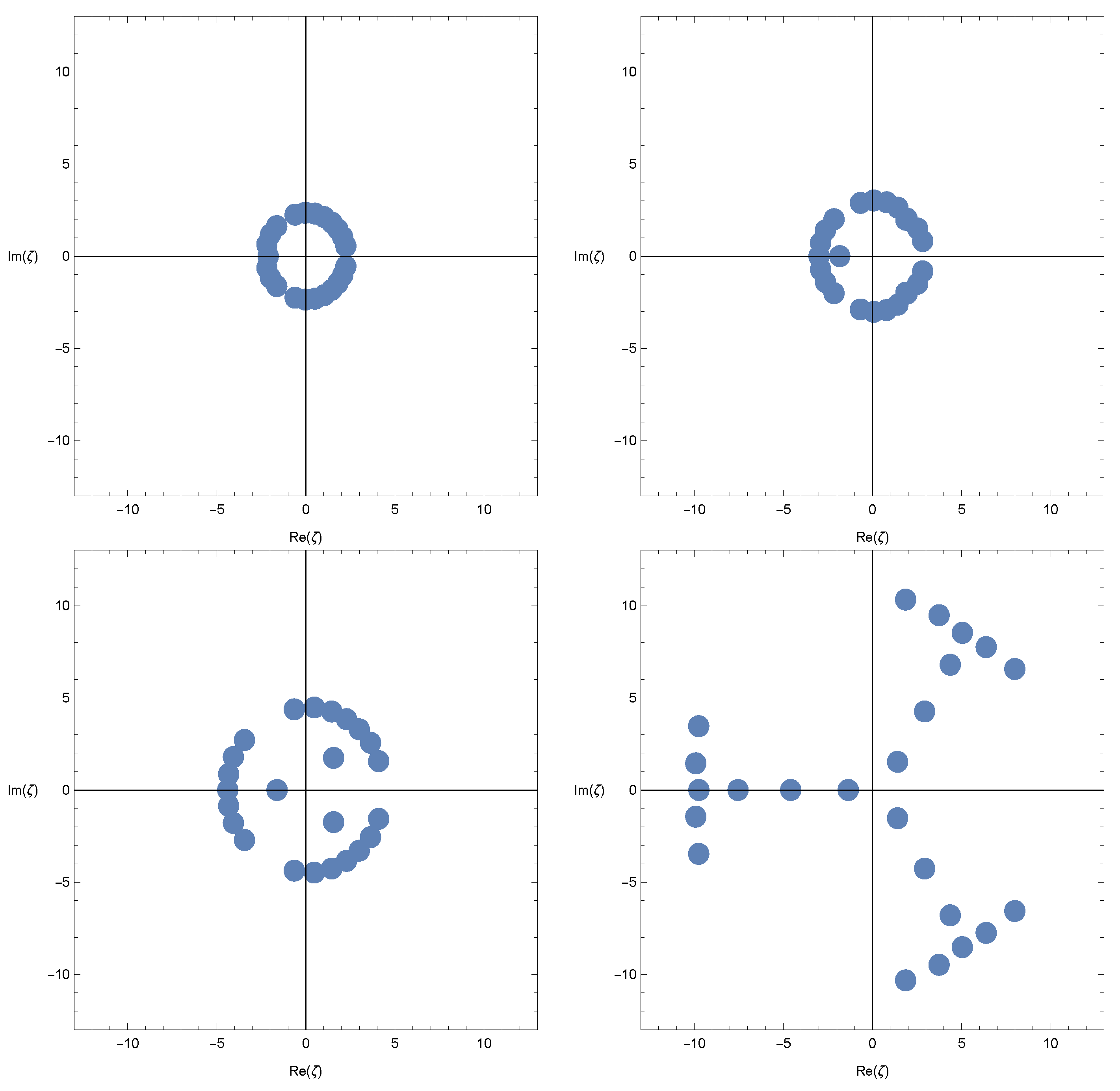
We investigate the beautiful zeros of the
q-Gould–Hopper-based Bernoulli
by using a computer. We plot the zeros of
q-Gould–Hopper-based Bernoulli
for
(
Figure 1).
In
Figure 1 (top-left), we choose
and
. In
Figure 1 (top-right), we choose
and
. In
Figure 1 (bottom-left), we choose
and
. In
Figure 1 (bottom-right), we choose
and
.
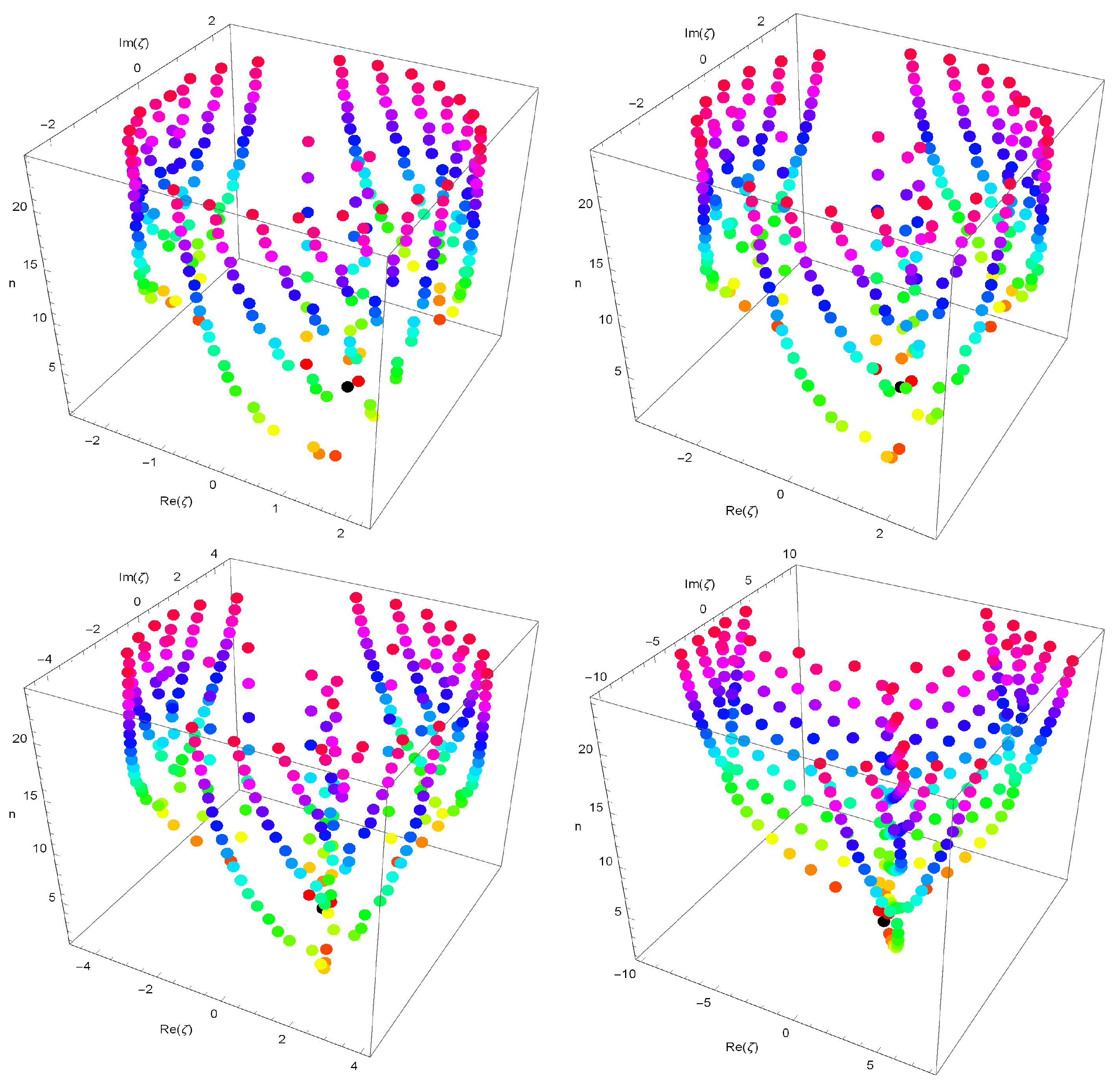
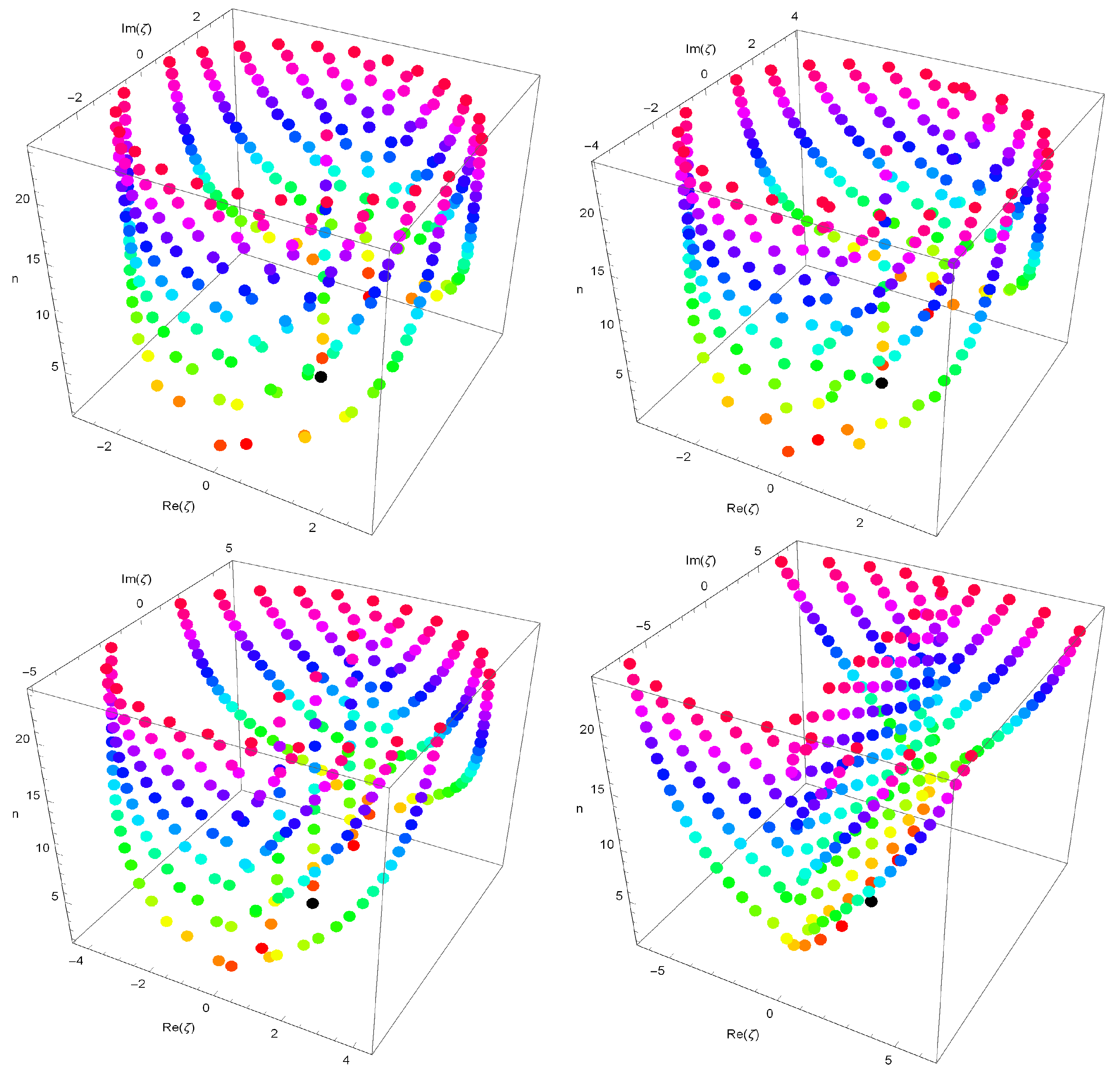
Stacks of zeros of the
q-Gould–Hopper-based Bernoulli
for
, forming a 3D structure, are presented (
Figure 2).
In
Figure 2 (top-left), we choose
and
. In
Figure 2 (top-right), we choose
and
. In
Figure 2 (bottom-left), we choose
and
. In
Figure 2 (bottom-right), we choose
and
.
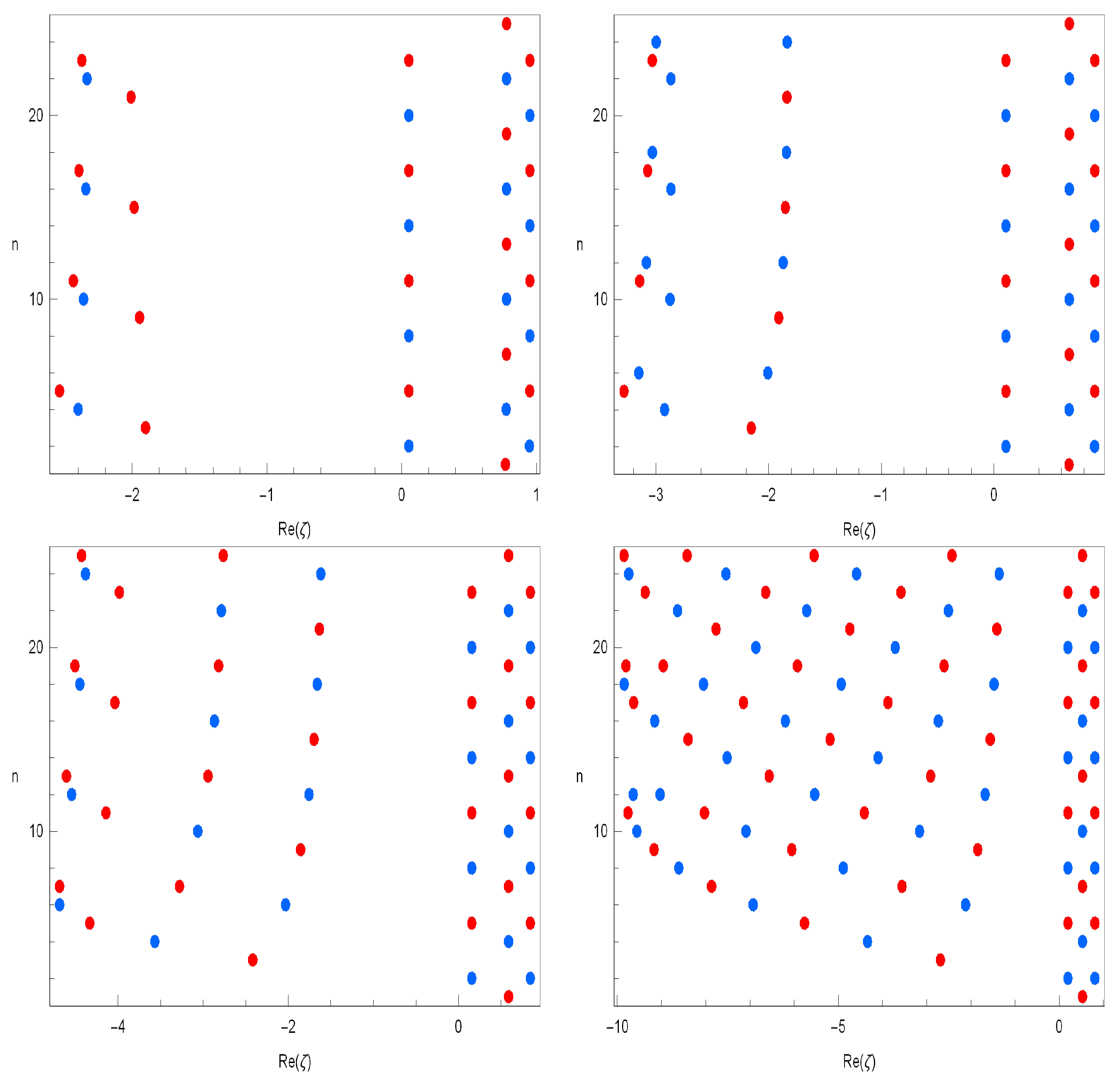
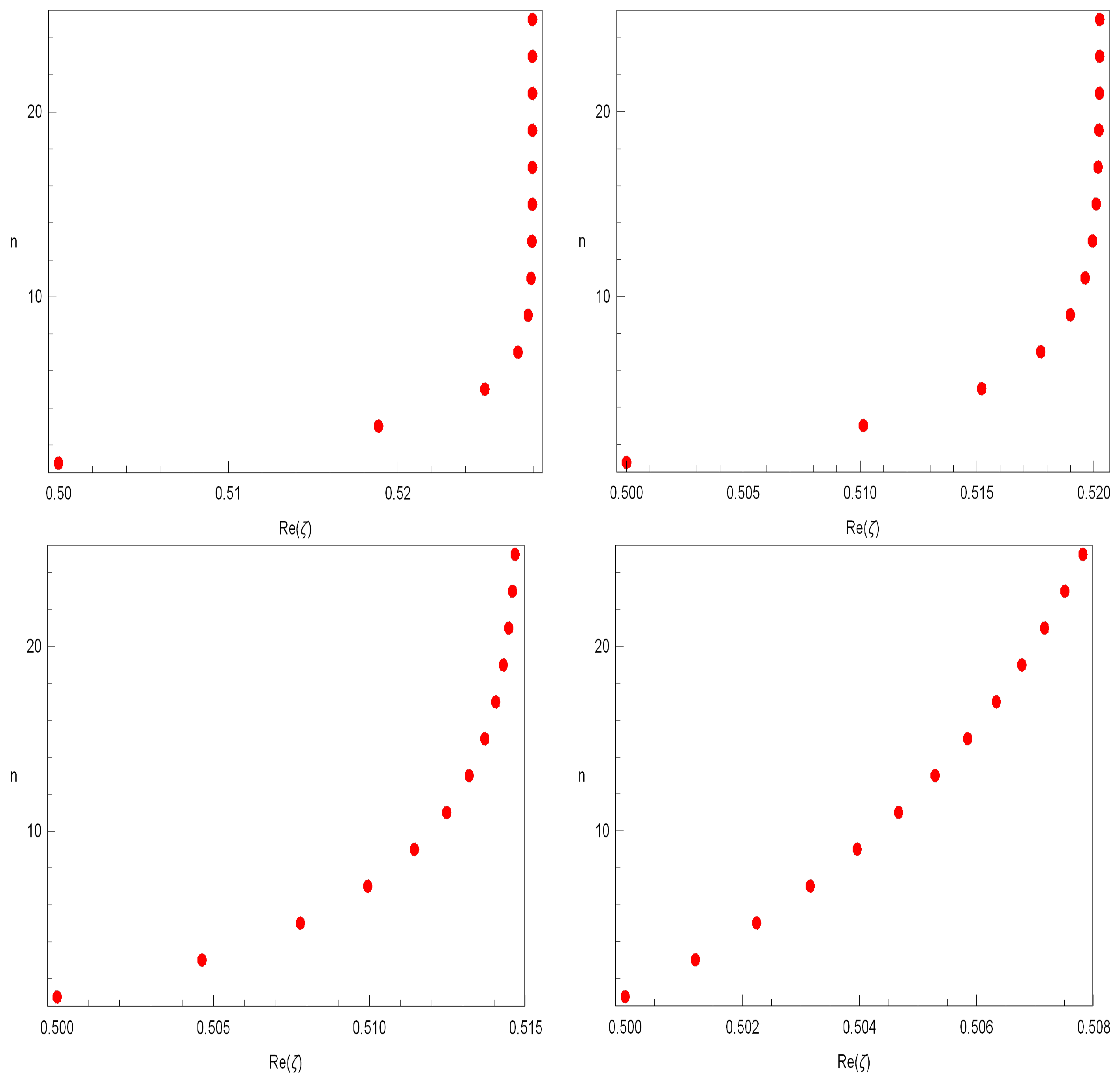
Plots of the real zeros of the
q-Gould–Hopper-based Bernoulli
for
are presented (
Figure 3).
In
Figure 3 (top-left), we choose
and
. In
Figure 3 (top-right), we choose
and
. In
Figure 3 (bottom-left), we choose
and
. In
Figure 3 (bottom-right), we choose
and
.
Next, we calculate an approximate solution satisfying the
q-Gould–Hopper-based Bernoulli
for
and
. The results are given in
Table 3.
Similarly, by appropriately choosing the function
from
Table 1 in Equation (
57), we can obtain the following generating functions for the
q-Gould–Hopper-based Euler
polynomial:
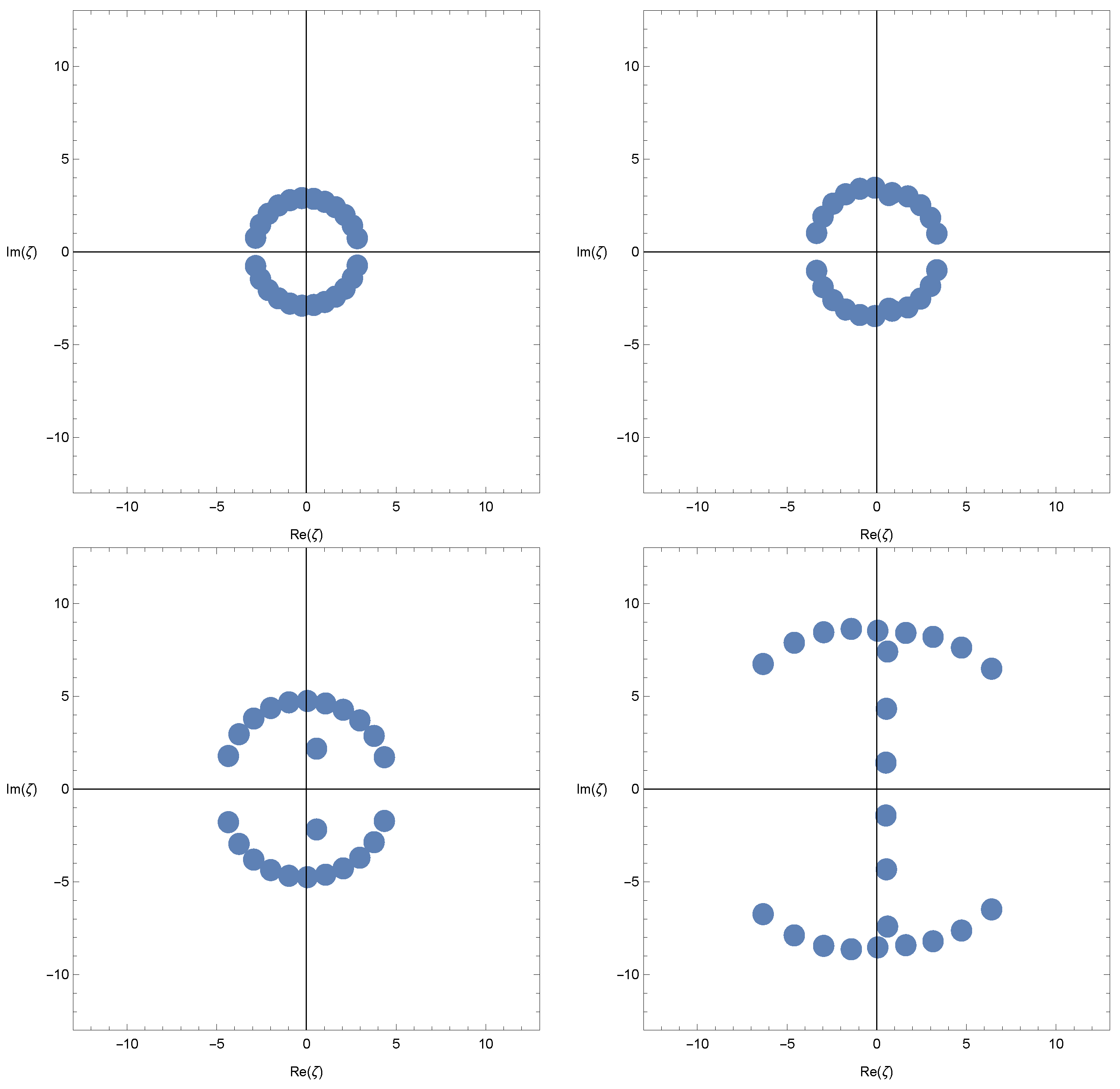
We investigate the beautiful zeros of the
q-Gould–Hopper-based Euler
by using a computer. We plot the zeros of
q-Gould–Hopper-based Euler
for
(
Figure 4).
In
Figure 4 (top-left), we choose
and
. In
Figure 4 (top-right), we choose
and
. In
Figure 4 (bottom-left), we choose
and
. In
Figure 4 (bottom-right), we choose
and
.
The stacks of zeros of the
q-Gould–Hopper-based Euler
for
, forming a 3D structure, are presented (
Figure 5).
In
Figure 5 (top-left), we choose
and
. In
Figure 5 (top-right), we choose
and
. In
Figure 5 (bottom-left), we choose
and
. In
Figure 5 (bottom-right), we choose
and
.
Plots of the real zeros of the
q-Gould–Hopper-based Euler
for
are presented (
Figure 6).
In
Figure 6 (top-left), we choose
and
. In
Figure 6 (top-right), we choose
and
. In
Figure 6 (bottom-left), we choose
and
. In
Figure 6 (bottom-right), we choose
and
.
Next, we calculated an approximate solution satisfying the
q-Gould–Hopper-based Euler
for
and
. The results are given in
Table 4.