1. Introduction
In general topology, open sets underpin the creation of new classes of sets and the characterization of essential topological properties. Within this framework, Tong [
1] defined difference sets (
D-sets) from open sets and formulated separation axioms
(
). Later refinements advanced these ideas: Caldas [
2] used semi-open sets to define
spaces, and Jafari [
3] introduced
-sets using
p-open sets. Additional generalizations include the
spaces defined by Caldas et al. [
4] and the
D-continuity decompositions of Ekici and Jafari [
5]. Keskin [
6] subsequently defined
-sets as the difference of two
b-open sets and used them to obtain weak separation axioms, while Balasubramanian [
7] presented a new generalization of separation axioms to
spaces. In subsequent work by Balasubramanian and Lakshmi [
8],
spaces were defined using
; Sreeja and Janaki introduced new generalized
-separation axioms [
9]; and Gnanachandra and Thangavelu proposed
-sets [
10], broadening the area. Recent contributions include Padma et al.’s
-sets [
11] and the
axioms introduced by Vithya [
12], with certiain lower separation axioms characterized through these schemes.
A continuous function
is termed perfect if
is Hausdorff,
is closed, and each fiber
is a compact subset of
. First introduced for metric spaces by Vainstein [
13], perfect functions were independently studied by Leray [
14] and Bourbaki [
15] in locally compact spaces and by Yousif [
16] in fibrewise ij-perfect bitopological spaces. Recent work by Atoom et al. [
17,
18,
19,
20] generalized this notion to Lindelöf perfect functions.
Throughout this paper, and denote arbitrary topological spaces unless specified. Product topologies are denoted as . Standard notations include , , , and for real numbers, integers, natural numbers, and rationals, respectively. For cardinalities, we write for the cardinality of any countably infinite set and for the cardinality of the continuum, so that .
This paper is organized as follows:
Section 2 introduces
D-Lindelöf spaces and their fundamental features, relating them to other topological spaces.
Section 3 expands on this foundation by defining
D-Lindelöf perfect functions and presenting examples to explain their behavior.
Section 4 explores the features of these functions, their interactions with other types of spaces, and their significance in maintaining topological invariants.
Section 5 investigates how
D-Lindelöf perfect functions maintain essential topological features, including compactness, regularity, and paracompactness. In
Section 6, we introduce three properness variants tailored to
D-covers. Finally, in
Section 7, we apply topological mechanisms to statistics with explicit assumptions. This systematic approach ensures a full comprehension of
D-Lindelöf perfect functions, from foundational concepts to advanced applications.
3. Conceptualizing -Lindelöf Perfect Functions with Practical Examples
This section introduces the notions of D-Lindelöf perfect functions in topological spaces and provides illustrative examples to clarify the definition.
Definition 13. A function is termed a D-Lindelöf perfect function if Ψ is continuous and closed and for every , is a D-Lindelöf set in .
Example 1. Consider equipped with the lower limit topology . Let with the usual topology Π
, and defineThen, Ψ
is a D-Lindelöf perfect function. Every open set in is a union of open rays, each of which is a union of left–open intervals and thus open in . Thus, is open in ; therefore, is continuous.
Closed sets in the lower limit topology are of the form and are hence Borel and therefore closed in the usual topology. Thus, is closed in , so is a closed map.
For each
,
In the lower limit topology, every singleton is closed and Lindelöf, and every
D-cover of a singleton trivially admits a countable subcover (indeed, the singleton itself is a
D-set). Hence, each fiber is
D-Lindelöf.
Since is continuous, closed, and has D-Lindelöf fibers, it follows that is a D-Lindelöf perfect function.
Example 2. Let with the co–countable topology , and let with the usual topology Π
. DefineThen, Ψ
is a D–Lindelöf perfect function. If is open in the usual topology, then V is also open in the co-countable topology whenever is countable. Every usual open interval can be written as a union of such sets. Hence, is open in , so Ψ is continuous.
Closed sets in have the form , where C is countable. Such sets are closed in the usual topology as countable sets have an empty interior. Thus, is closed in , so Ψ is a closed map.
For each ,In the co-countable topology, singletons are closed and D-sets are precisely differences with being co-countable. Any D-cover of a singleton contains at least one co-countable set, and thus, a countable subcover exists trivially. Therefore, each fiber is D–Lindelöf. Since Ψ is continuous, closed, and has D–Lindelöf fibers, it is a D–Lindelöf perfect function.
Example 3. Let with the usual topology , and with the discrete topology . Define the identity function by . Hence, Ψ is not a D-Lindelöf perfect function.
Ψ is closed but it is not continuous. Then, Ψ is not a D-Lindelöf perfect function.
Corollary 1. If is a D-Lindelöf perfect function, Ψ is a Lindelöf perfect function. The inverse is not true in general.
Theorem 1. Let be a continuous and closed function. Assume that in , the following equivalence holds:Then, Ψ
is a perfect mapping if and only if Ψ
is a D-Lindelöf perfect function. Proof. Suppose first that is perfect. Then, is continuous and closed, and every is compact. Based on the hypothesis on , compact subsets coincide with D-Lindelöf subsets; hence, each is D-Lindelöf. Thus, is a D-Lindelöf perfect function.
Conversely, assume that is a D-Lindelöf perfect function. By definition, is continuous and closed, and for every , the is D-Lindelöf. Using again the hypothesis that D-Lindelöf subsets of are precisely the compact subsets, we conclude that every is compact. Therefore, is a classical perfect mapping. □
Example 4. Let with the usual topology and let with the usual topology. Define (1)
is not a perfect function.
For every , the fiber is finite and therefore compact. However, Ψ
is not closed in the usual topology. Indeed, the closed set haswhich is not closed in . Consequently, Ψ
is not a perfect function.(2) is a D–Lindelöf perfect function. Finite sets are D–Lindelöf for all difference-based structures commonly used in generalized compactness theory. Hence, every is D–Lindelöf in .
Furthermore, Ψ is D–closed: for any closed set , the image is an interval or a closed ray, and such sets are closed with respect to the D–topology on induced by difference sets. Since Ψ is continuous, closed in the D–sense, and has D–Lindelöf fibers, it satisfies the definition of a D–Lindelöf perfect function.
4. The Structure and Behavior of -Lindelöf Perfect Functions
In this section, we study D-Lindelöf perfect functions in topological spaces, analyze their core properties, and relate them to other classes of spaces.
Theorem 2. Let be a D–Lindelöf perfect function. If is a D–Lindelöf subspace, then is D–Lindelöf in .
Proof. Let
be a
D–cover of
, that is,
For each
, the fiber
is
D–Lindelöf (because
is
D–Lindelöf perfect). Hence, there exists a countable index set
such that
Set
Since
is closed, the set
is closed in
; hence,
is open in
. We now show the following:
- (1)
. If , then , so there exists with , i.e., , contradicting .
- (2)
. If , then , and hence, ; thus, .
Now consider the subspace
, where
is the topology induced from
. The family
is an open cover of
Z (because
for each
). By our convention that every open set is a
D–set (since
),
is a
D–cover of
Z.
Because
Z is
D–Lindelöf, there exists a countable subfamily
with
Applying
, we obtain
The index set
is a countable union of countable sets and thus countable. Therefore,
is a countable subfamily of
that covers
. Thus,
is
D–Lindelöf in
. □
Corollary 2. A D-Lindelöf space is preserved under preimages of D-Lindelöf perfect functions.
Theorem 3. If and are D-Lindelöf perfect functions, then is also a D-Lindelöf perfect function.
Proof. The composition
is continuous, as both
and
are continuous by definition. Let
be closed. Then,
Since
is closed,
is closed in
. As
is closed,
is closed in
. Thus,
preserves closedness.
For any
,
Since
is
D-Lindelöf perfect,
is a
D-Lindelöf subset of
. By Theorem 2,
is
D-Lindelöf in
.
Thus, satisfies all conditions of a D-Lindelöf perfect function. □
Theorem 4. Letbe a homeomorphism and letbe a continuous function. If the compositionis a D-Lindelöf perfect function, then ρ is also a D-Lindelöf perfect function. Proof. Since is a homeomorphism, both and are continuous and closed, and is bijective.
Write
The map
is
D-Lindelöf perfect by assumption, hence closed. The inverse
is a homeomorphism, so it is also closed. The composition of two closed maps is closed, hence
is closed.
Let
. Since
is
D-Lindelöf perfect, its fibre
is
D-Lindelöf in
by definition.
Because
is bijective, we have
Let be D-Lindelöf in and put . Let be a D-cover of in , that is, each is a D-set in and .
For every
,
is a
D-set in
. The family
is a
D-cover of
Y, because
Since
Y is
D-Lindelöf, there exists a countable index set
such that
Applying
gives
Thus, every
D-cover of
in
admits a countable subcover, and
is
D-Lindelöf.
Applying this to and shows that is D-Lindelöf for every .
Hence is a D-Lindelöf perfect function. □
Theorem 5. Let there be a topological space and . The subspace is D-Lindelöf if and only if every cover of B through D-sets in admits countable subcover.
Proof. (⇒) Assume is D-Lindelöf. Let be a cover of B by D-sets in , where every for open sets with . In , is a D-open set in B. Thus, is a D-open cover of B. Then, there exists that covers B. Consequently, is a countable subcover of B in .
(⇐) Assume each cover of B by D-sets in admits a countable subcover. Consider is a D-open cover of B in . Therefore, covers B in . Then, is a countable subcover of in . Hence, is D-Lindelöf. □
Theorem 6. Let be a D-Lindelöf perfect function. For every subset , is also D-Lindelöf perfect.
Proof. Let
be closed. Then,
for some closed
. Since
is closed,
is closed in
, thus
is closed in
B. Hence,
is closed.
The restriction inherits continuity from . Now, for every , . Since is a D-Lindelöf perfect function, is D-Lindelöf in . Any D-cover of in corresponds to a D-cover in , which admits a countable subcover. Thus, remains D-Lindelöf in .
Since is closed and continuous and has D-Lindelöf fibers, it is D-Lindelöf perfect. □
Theorem 7. Let there be a continuous bijection function . If is a Hausdorff space and is D-Lindelöf, it follows that Ψ is a homeomorphism.
Proof. Since is D-Lindelöf and closed subsets of D-Lindelöf spaces are D-Lindelöf, F is D-Lindelöf. The continuous image of a D-Lindelöf set is D-Lindelöf. Thus, is D-Lindelöf in .
D-Lindelöf subsets of a Hausdorff space are closed. Hence, is closed in .
Since is a continuous, closed bijection, it is a homeomorphism. □
Theorem 8. Let be a strongly continuous surjective function. If is D–Lindelöf, then is D–Lindelöf.
Proof. Let be a D–cover of . For each , write where are open in .
For each
, define
Since
is closed (strong continuity implies images of closed sets are contained in closed sets),
is open in
and hence a
D–set (open
).
We claim that the family is a D–cover of .
Let
. Since
is surjective, choose
with
. As
covers
, there exists
with
. Then,
, so
, hence
. Thus,
so
is a
D–cover of
.
Since
is
D–Lindelöf, there exists a countable index set
such that
Therefore, is a countable D–subcover of . Hence, is D–Lindelöf. □
5. Preservation of Topological Properties via -Lindelöf Perfect Functions
This section explores how D-Lindelöf perfect functions preserve fundamental topological properties across spaces.
Theorem 9. Let be a D-Lindelöf perfect function, that is, Ψ is continuous and closed, and each fiber is D-Lindelöf. Assume in addition that for every , is D-countably compact. If is D-countably compact, then is D-countably compact.
Proof. Let
be a countable
D-cover of
, that is, each
is a
D-set in
and
For each
n, write
with
open in
. Define
Since
is closed and
is closed,
is closed in
; hence, each
is open in
, and therefore a
D-set.
Claim 1. The family is a D-cover of .
Let . Then the fiber is nonempty (by surjectivity of )
and D-countably compact by hypothesis. The familyis a countable D-cover of the subspace , since covers and intersections of D-sets with a subspace are D-sets in that subspace. Because is D-countably compact, there exists a finite set such that Suppose, toward a contradiction, that for every . Then for each such n, , so there exists with . Thus , contradicting the above inclusion .
Hence, there exists some with . Therefore, and is a countable D-cover of . Claim 2. is D-countably compact.
Since is D-countably compact and is a countable D-cover of , there exists a finite set such that ThenBy construction, so for each n. Hence, We have shown that every countable D-cover of admits a finite subcover. Therefore, is D-countably compact. □
Theorem 10. If is normal Hausdorff, and is a surjective D-Lindelöf perfect function with closed fibers, then is Hausdorff.
Proof. Let be a surjective D-Lindelöf perfect function with closed fibers, where is normal Hausdorff. We show that is Hausdorff.
Let in . Since is D-Lindelöf perfect, and are D-Lindelöf, fibers are closed, and .
As
is normal, disjoint closed sets can be separated. Thus, ∃ disjoint open sets
:
Since
is
D-Lindelöf perfect which implies that it is closed,
and
are closed in
. Define
and
are open in
. Now,
: If
, then
with
, so
, representing a contradiction. Thus,
. Similarly,
.
Finally,
Since
, we have
, so
Thus,
and
are disjoint open neighborhoods separating
and
. □
Theorem 11. Let and be topological spaces. If is D-Lindelöf and is D-compact, then is closed.
Proof. Since is a D-Lindelöf and is D-compact, then is D-Lindelöf. Therefore, the projection is a closed function. □
6. New Relations, Variants, and Tools for -Lindelöf Perfect Maps
In this section, we provide three D-cover-specific properness variations, relate them to choosing rules and a point-D-open competition, and obtain stability findings (products, sums, and images) as well as sharp cardinal bounds. Stronger D-Lindelöf ideal assumptions are indicated where they are permitted, but many transitions really just require surjective continuity.
Definition 14. A function is
- 1.
D-proper if for every compact , is D-compact in ;
- 2.
D-quasi-perfect if Ψ is closed and every is D-compact;
- 3.
D-Lindelöf proper if Ψ is closed and is D-Lindelöf for every compact .
Example 5. Let S be an uncountable set and fix . Equip with the Fortissimo topology Π: a set is open if either or and are countable. Then, every compact subset of is finite: if is infinite with , the family is an open cover of K with no finite subcover. If K is infinite and , enumerate and cover K by ; once more, there is no finite subcover.
Let be any infinite set with the discrete topology Υ, and select an injection whose range is infinite and . Next, Ψ is continuous. Each and every compact we have is K finite and hence finite. On a discrete space, D-sets correspond with open sets, so D-compactness corresponds with compactness; finite sets are D-compact. Thus, Ψ is D-proper.
Ψ is not closed: grab the closed set with . In , the closure of B is , so B is not closed. Hence, Ψ unable to meet the closedness requirement in D-quasi-perfect.
Consequently, Ψ is D-proper but not D-quasi-perfect (and a fortiori, not D-Lindelöf proper).
Example 6. Let with the discrete topology Υ, let with the discrete topology Π, and define by .
Ψ
is closed. In discrete spaces, D-sets are exactly the open sets, so D-Lindelöf ⇔ Lindelöf and D-compact ⇔ compact. Compact subsets of are precisely the finite sets . For such K,which is countable discrete. Hence, is Lindelöf (thus D-Lindelöf) but not compact (thus not D-compact).As a consequence, Ψ is D-Lindelöf proper. Ψ is not D-proper, since fails D-compactness whenever . Ψ is not D-quasi-perfect either, because is not D-compact.
Proposition 1. For Hausdorff : . If Ψ is D-Lindelöf perfect and is σ-compact, then Ψ is D-Lindelöf proper.
Definition 15. : for every sequence in , choose so that D-covers . In the same way, with finite selections.
Example 7. Let be countable with the discrete topology. Then every D-set is open. In the same way, every D-cover is an open cover. List . Considering any sequence of D-covers of , for each n, choose with (feasible because covers ). Then covers , so satisfies . Consequently, holds true as well.
Example 8. Let be an uncountable set with the co-countable topology. Every nonempty open set is co-countable. For D-sets, if are open and nonempty, then is countable; if , then is co-countable. Hence, any D-cover of has to have a minimum of one co-countable member. Without a union of countably, many countable sets could not cover uncountable .
Create a predetermined sequence where each . Each is a D-cover of .
- (1)
is unsuccessful: Select any . If infinitely many choices are countable, their union is countable; if cofinitely, many are co-countable. The union of the selected sets nevertheless loses points since the cross-section of their complements is limitless. Therefore, not just one choice can cover .
- (2)
fails: Choose any finite . Then, consists of a countable mixture of sets that are all countable or co-countable. The portion they cover is countable if an unlimited number of chosen sets are countable. The complements of finitely many co-countable sets have infinite intersection if cofinitely many are co-countable, leaving uncovered points. Therefore, no series of limited choices encompasses .
Therefore, satisfies neither nor .
Theorem 12. Let be D-Lindelöf perfect and onto.
- 1.
If satisfies , then satisfies .
- 2.
If satisfies , then satisfies .
Proof. Let be onto and continuous.
- (1)
Assume
satisfies
. Let
be a sequence of
D-covers of
. For each
n, the pullback
is a
D-cover of
since
is onto and
with
open in
. By
on
, pick
so that
D-covers
. Write
with
. Then,
so
D-covers
. Hence,
satisfies
.
- (2)
Assume
satisfies
. For each
n, apply
to the
D-cover
to get a finite
such that
D-covers
. Write
with a finite
. Then, as above,
so
is a sequence of finite selections covering
. Thus,
satisfies
.
□
Definition 16. Point-D-open game : ONE plays D-covers ; two responses , two wins if D-covers .
Example 9. Let with the usual topology. Make a compact reduction modification.For each inning n, one plays the D-coverEach member of is a D-set: opens are , and is open since is compact (hence closed). There are two replies at inning n by choosing any with . Then,Hence, D-covers . Thus, there is a double victory in the present match run. The above instance illustrates how a σ-compact two can convert because it is exhausted. D-covers of the form “outside or any open superset of ” into a covering sequence by selecting the compact cores’ open neighborhoods.
Proposition 2. If two has a winning strategy in and is D-Lindelöf perfect onto, then two has a winning strategy in .
Proof. Assume two has a winning strategy in . Define a strategy for two in as follows.
In inning
n, ONE plays a
D-cover
of
. Create a reversal:
Since
with
open in
implies
with
open in
, each
is a
D-set in
. Because
is onto,
covers
.
Feed the history to . Let choose . Pick any with , and set ’s move to be .
We show that is winning. Let . Choose with . Since is winning on , there exists n with . Hence, . Thus, covers , is a D-cover of . Therefore, is a winning strategy for two in . □
Definition 17. The D-Lindelöf number is the least κ such that every D-cover has a subcover of size . A family is a D-network if for every D-open L and there exists with . Let be the smallest size of a D-network.
Example 10. Let S be an uncountable set of size and fix . Give the Fortissimo topology: is open if either or and is countable. Then, the D-sets are exactly Claim 3. .
Lower bound.
Fix a countably infinite and consider the D-cover Every subcover must include to cover p and must include for each . Hence, any subcover has size . So .Upper bound.
Let be any D-cover of . Some must contain p; hence, is co-countable. Its complement is countable. For each choose with . Then is a countable subcover. Thus, . After combining them, . Claim 4. .
Upper bound.
Let be a cofinal family of countable subsets under ⊆
with . SetWe check the D-network property: If L is countable and , then and .If L is co-countable and : If , again, . If , pick with ; then , , and .
Hence, is a D-network of size , so .
Lower bound.
Let be any D-network. ConsiderFor every countable , we must have some with ; equivalently, . Thus, is cofinal in . If , then and the union has size . Choose a countably infinite . Then, no contains C, contradicting cofinality. Hence, , so .Therefore .
Proposition 3. For every : . If is D-Lindelöf perfect and onto, then .
Proof. (1) : Every open set L is a D-set (), so every open cover is a D-cover. Any bound for D-covers bounds open covers.
(2)
: Let
be a
D-network with
. Given a
D-cover
of
, define
For each
, choose and fix one
with
. Then,
has size
and covers
: indeed, for any
, pick
with
; by the
D-network property, there is
with
, and hence,
. Thus, every
D-cover has a subcover of size
.
(3) If
is onto and continuous, then
: Let
. Given a
D-cover
of
, the pullback
is a
D-cover of
. Choose
with
covering
. For each
pick
with
. Then,
so
is a subcover of
of size
. Hence,
.
Combining (1) and (3) gives and the monotonicity under . □
Definition 18. Given a D-cover and , define . is star-D-Lindelöf if there exists a countable such that for every D-cover .
Example 11. Let with the discrete topology. Then every D-set is open. Take the countable set .
Claim: For every D-cover of , .
Indeed, since each satisfies , we haveThus, is star-D-Lindelöf with the fixed countable set . Sharpness in the discrete case: if is countable, the D-coversatisfies . Hence, no proper subset of can serve as a universal star core. Theorem 13. If is paracompact and is D-Lindelöf perfect onto, then Proof. Assume is star-D-Lindelöf. Fix a countable with for every D-cover of . Let ; B is countable.
Let
be any
D-cover of
. Its pullback
is a
D-cover of
. Hence,
Apply
:
But
iff
, so
Since
was arbitrary,
is star-
D-Lindelöf. □
Theorem 14. Let be D-Lindelöf and be σ-compact. Then, is D-Lindelöf. More generally, if with each compact, any D-cover of admits a countable subcover.
Proof. Let
K be compact and
a
D-cover of
, with
D-Lindelöf. Fix
. For each
choose
with
and write
with
open in
. Since
is open and
, there exist basic rectangles
containing
. Then,
is an open cover of
K, so by compactness, pick
with
and set
We have
Hence,
is an open (thus
D-) cover of
. Since
is
D-Lindelöf, choose a countable subfamily
covering
. Then,
is a countable subfamily of
covering
. Therefore, every
D-cover of
admits a countable subcover.
Let with each being compact and let be a D-cover of . For each n, restricts to a D-cover of , so there is a countable subfamily covering . Then, is countable and covers . □
Proposition 4. For a topological sum , Proof. Lower bound.
- (1)
The family is a D-cover of , so any subcover has size . Hence, .
- (2)
Fix
. Take a
D-cover
of
whose minimal subcover size is
. Then,
is a
D-cover of
, and any subcover of
projects to a subcover of
. Thus,
. Taking the supremum over
gives
.
Upper bound. Let
be a
D-cover of
. For each
i, the restricted family
is a
D-cover of
. Choose
of size
with
covering
. Then
covers
and has cardinal
wherein the last equivalence is easy if all are finite and there is basic cardinal mathematics for infinite cardinals. Therefore,
. □
7. Statistical Applications of -Lindelöf Perfect Functions
Theorem 15. Let be D-Lindelöf perfect, where are Hausdorff spaces, with every being D-Lindelöf. Assume X is D-Lindelöf. Let be a collection such that is a D-cover of X. Then there exists a with .
If, moreover, μ is a Radon probability on X, then is tight on Y. Consequently, any countable is uniform Glivenko–Cantelli under ν.
Proof. Since
X is
D-Lindelöf and
is a
D-cover of
X, there exists
with
. As
f is onto,
so
.
For tightness, let
. Since
is Radon, choose a compact
with
. A perfect
f maps compact sets to compact sets, so
is compact in
Y. Then
so
is tight. Finally, any countable measurable
is uniform Glivenko–Cantelli by the strong law on a countable collection and a diagonal argument. □
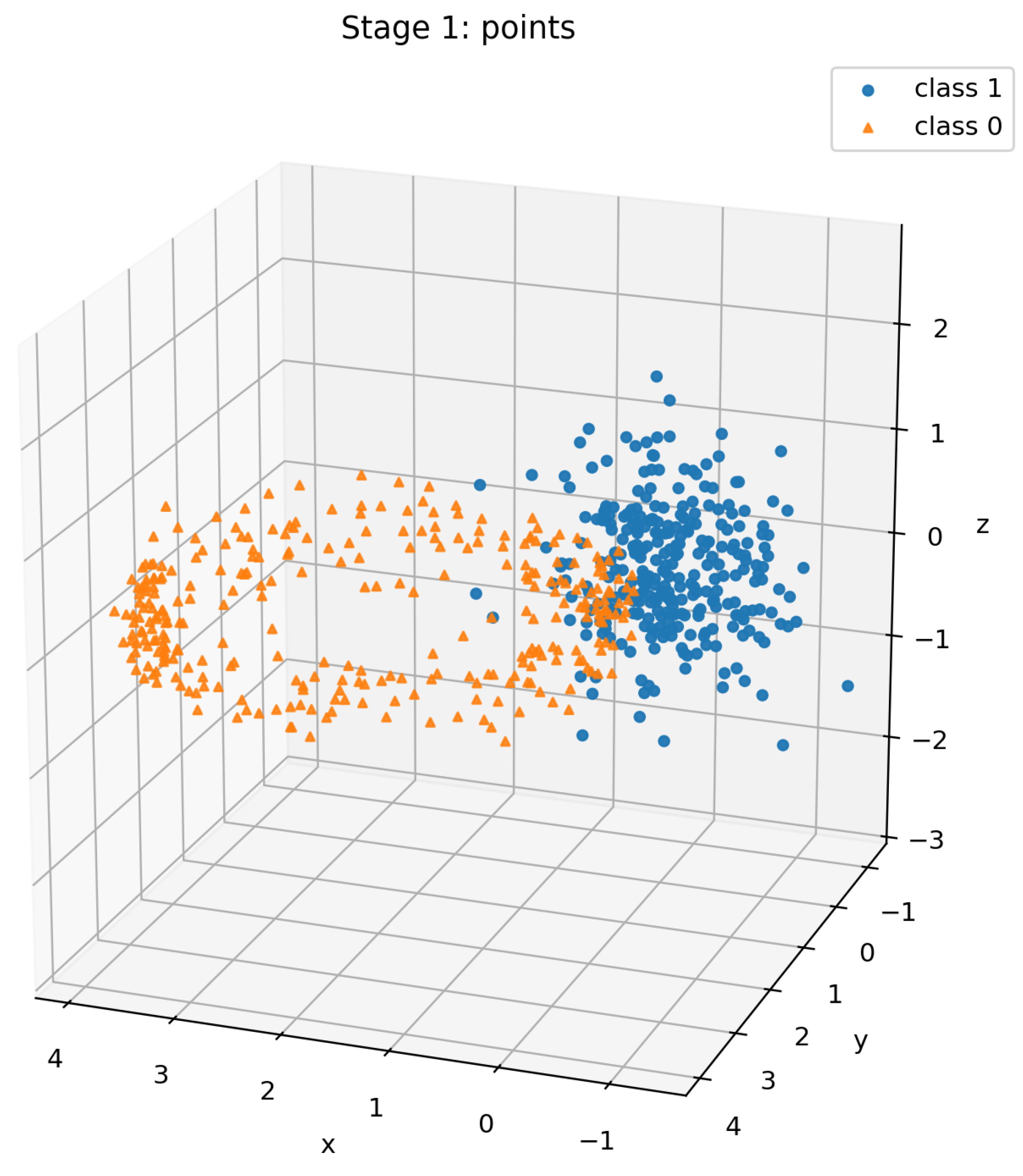
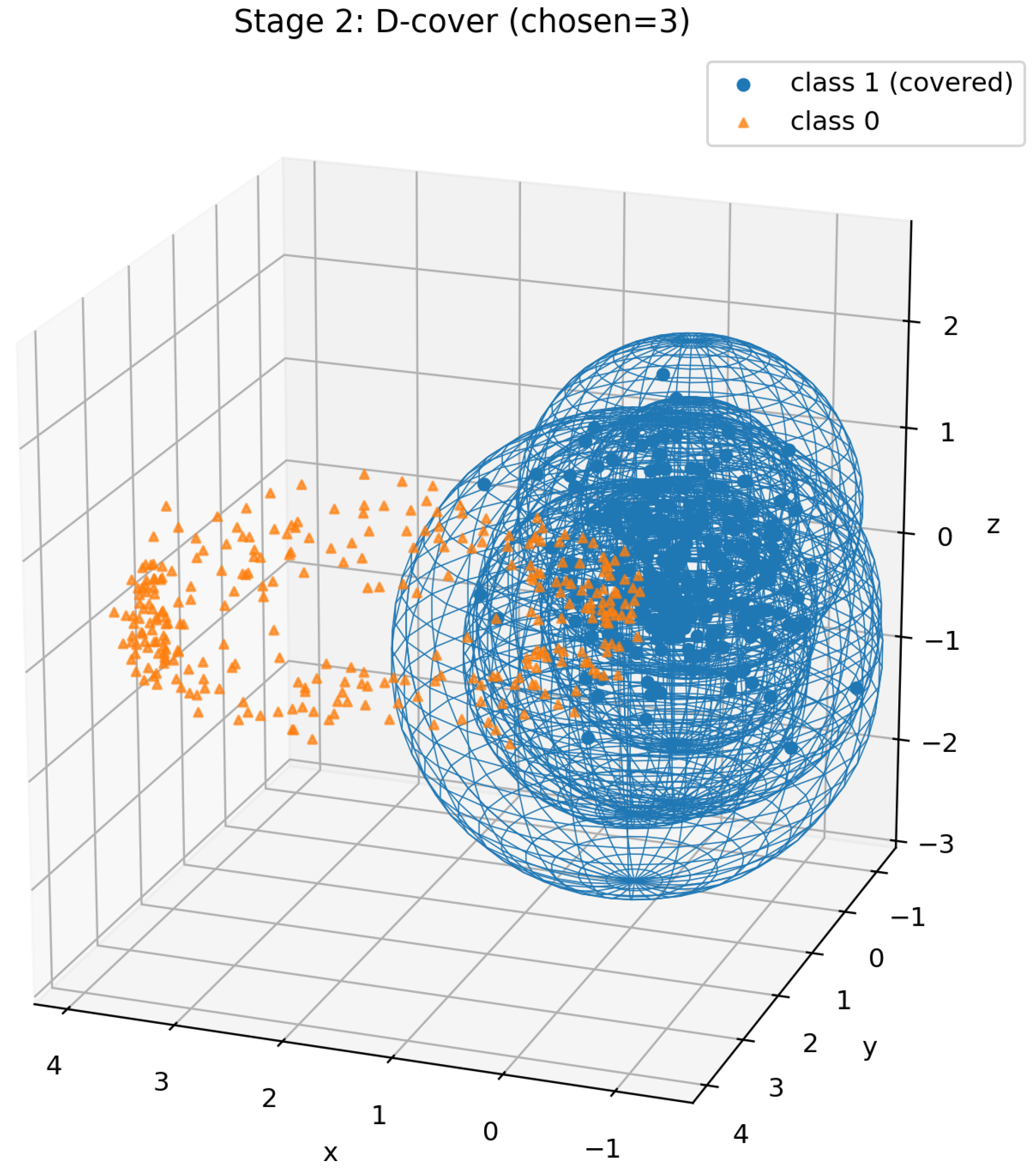
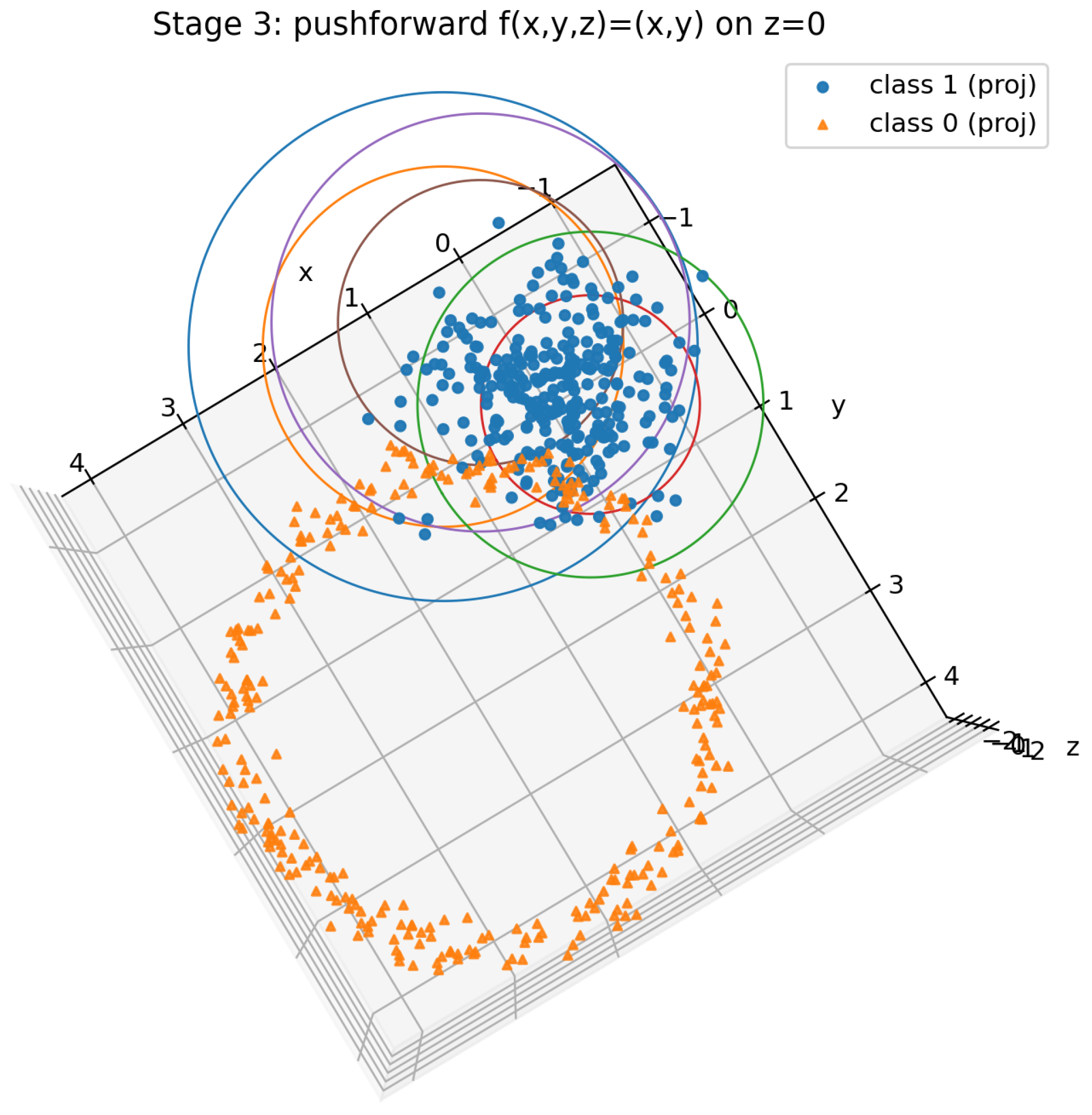
Proposition 5. Let X be D-Lindelöf and be lower semicontinuous in x for each . For , define D-setsSuppose covers X. Then there exists a countable with covering X. In particular, the induced set class on X admits a countable bracket skeleton, yielding separability of the empirical process indexed by for each t. Example 12. Let with the usual topology. Consider a positive class regiona union of spherical shells (D-sets). If these shells cover the positive samples, D-Lindelöf on X gives a countable subfamily covering them. With the perfect function , the induced decision region on is . According to Theorem 15, any measurable family on Y whose pullbacks D-cover X admits a countable covering family on Y, and tight pushforwards preserve learnability of countable decision classes. Example 13. Suppose X be D-Lindelöf and is a loss family. For fixed t and a grid with , the D-family covers X. Proposition 5 generates a countable sufficient to bracket , providing a countable parameter skeleton for screening and uniform LLN on the resulting countable class.
D-covers formalize selectable decision regions. D-Lindelöf supplies countable reduction. Perfect maps transfer coverage properties to observation spaces while maintaining tightness, enabling uniform laws on countable pushforward classes and practical model selection by countable cores.
8. Conclusions
We examined the connections among the topological spaces that functions arise, including perfect spaces and
D-Lindelöf perfect functions. Using the previously introduced notion of
D-Lindelöf perfect functions, we identified conditions that align
D-sets with locally indiscrete spaces. We established structural and preservation properties, and we specified when
D-covers admit countable reductions. We identified their main characteristics in general and made clear the requirements for establishing comparable links between them. We also formulated applications to statistics under explicit assumptions. Numerous instances were included to illustrate these points, and the results delineate immediate directions for further study. Prospective research may be conducted to further investigate variations of these functions. Furthermore, defining and studying
D-Lindelöf perfect properties within bitopological spaces, defining and studying fuzzy
D-Lindelöf perfect functions, and finding a use for our new results of
D-Lindelöf perfect functions in data analysis, optimization, and computational topology are our future objectives. Looking ahead, this work opens several promising avenues for research: unifying Lindelöf-type properties with
D-set operations to generalize compactness [
17]; investigating compatibility between topologies governed by
D-Lindelöfness [
22]; and extending decomposition theorems for
D-covers in manifold theory [
25].




 ,
,