1. Introduction
Convexity and compactness of sets play a crucial role in fixed-point theory in normed spaces. A lot of work has been done to relax the convexity and compactness of sets from various fixed-point results. The notion of the measure of noncompactness was introduced by Kuratowski [
1] in 1930, and its significance as a tool in nonlinear analysis has since grown. Following Kuratowski, Eisenfeld and Lakshmikantham introduced a measure of non-convexity in 1975, which has some useful properties similar to the measure of noncompactness. Their measure quantifies the deviation of a bounded set from convexity via the Hausdorff distance to its convex hull, establishing a foundational link between geometry, topology, and analysis in infinite-dimensional spaces [
2]. Subsequent decades witnessed significant generalizations of fixed-point theorems—most famously through extensions of Schauder’s and Sadovskii’s theorems—to broader classes of nonconvex, noncompact sets, frequently relying on quantitative invariants such as measures of noncompactness (cf. Petryshyn and Fitzpatrick [
3]) and geometric concepts like normal structure and Chebyshev centers. The work by Marrero has deepened this line of inquiry by characterising weak compactness and reflexivity in Banach spaces through the Cantor property for the Eisenfeld–Lakshmikantham measure of nonconvexity [
2,
4], thereby enabling the removal/relaxing of classical convexity assumptions from several fixed-point theorems for condensing and non-expansive operators. Such results underscore a major trend in functional analysis: the quantitative measurement of geometric properties to generalize classical theorems to more flexible and applicable settings. However, many structures of interest in modern analysis extend beyond the realm of normed spaces. In particular,
p-normed spaces (
) and more generally
p-seminormed spaces have emerged naturally in nonlinear analysis, approximation theory and other areas, presenting new challenges due to their non-convex geometry and altered metric properties. In these spaces, the triangle inequality and homogeneity are replaced by their
p-powered analogues, and standard geometric notions must be carefully reconsidered. Accordingly, there is a need to revisit the classical results of convexity, compactness, and fixed points within the framework of
p-seminormed and
p-normed spaces. We consider the following question: Do the Schauder-type and Sadovski-type theorems hold for operators on non-
p-convex domains?
Many spaces arising in nonlinear analysis, approximation theory, and non-Archimedean mathematics—including p-seminormed and p-normed spaces for —fall outside the realm of local convexity. In such settings, standard geometric and topological arguments relying on convex structure become inapplicable, and classical results from functional analysis no longer hold in their usual form. Measures of non-p-convexity are crucial in quantifying the deviation from convexity and in transferring powerful fixed-point, compactness, and continuity principles to these more general spaces. They provide indispensable tools for extending existence theorems, stability criteria, and operator methods to environments where traditional convexity is absent, thus enabling deep applications in the analysis of nonlinear equations, nonlocally convex function spaces, and non-Archimedean frameworks.
Our work focuses on reformulating key measures—such as the measure of non-
p-convexity— appropriately for the
p-seminorm context, analyzing their properties, and establishing analogue fixed-point results without assuming traditional convexity. We provide an answer to above question as an application of measure of non-
p-convexity. More precisely, this paper aims to introduce and investigate two measures of non-
p-convexity and to develop them for applications in
p-normed spaces. We are also interested in extending and generalizing important properties previously published by Marrero [
5] and Eisenfeld and Lakshhmikantham [
4], as well as some important results of fixed-point theory.
2. Preliminaries
We recall some basic notions and results.
Definition 1
([
6,
7,
8])
. Let . A set in a vector space is called p-convex (respectively, absolutely p-convex) if for all and such that (respectively, for all and such that ). The definition of standard convex sets, as we know, is obtained when . Definition 2
([
6,
7,
8])
. Let . If is a subset of a topological vector space , the closure of is represented by , then the p-convex hull of and its closed p-convex hull are denoted by and , respectively, which is the smallest p-convex set containing and the smallest closed p-convex set containing , respectively. Definition 3
([
6,
7,
8])
. Let . If is p-convex and , and , . Then is called a p-convex combination of for . If , then is called an absolutely p-convex combination. It is easy to see that for a p-convex set . Definition 4
([
6])
. A subset of a vector space is called balanced (or circled) if holds for all scalars λ satisfying . We say that is absorbing if for each there is a real number such that for all with . A balanced set is symmetric, and thus . In particular, every set determines the smallest circled subset of in which it is contained: is called the circled hull of . It is clear that holds so that is circled if and only if (in short, iff) . We use to denote the closed circled hull of . In addition, if is a topological vector space, then we use the to denote the interior of set and if , then is also circled; also, we use to denote the boundary of in .
Definition 5
([
6,
7,
8])
. Let be a vector space and . A mapping is called a p-seminorm if for ():- (i)
for all ;
- (ii)
for all and ;
- (iii)
for all .
Example 1.
Consider , , and let and . Then and are p-seminorms on .
A p-seminorm is said to be a p-norm if whenever . A vector space with a p-norm is a p-normed space.
Proposition 1
([
6])
. Let be a topological vector space, be a p-seminorm on and . Then is continuous if and only if , where is the interior of V. Note that for a p-seminorm , the p-seminorm topology determined by (in short, the p-topology) is the class of unions of open balls for and .
Definition 6
([
7,
8,
9])
. Let be an absorbing subset of a vector space . For and , set , then the nonnegative real-valued function is called the p-gauge (gauge if ). The p-gauge of is also known as the Minkowski p-functional. By Proposition 4.1.10 of Balachandran [
9], we have the following proposition.
Proposition 2
([
6,
7,
8])
. Let be an absorbing subset of . Then a p-gauge has the following properties:- (i)
;
- (ii)
if ;
- (iii)
for all provided that is circled;
- (iv)
for all provided that is p-convex.
In particular, is a p-seminorm if is absolutely p-convex (and also absorbing).
Definition 7
([
6])
. A topological vector space is called a topological p-vector space (in short, p-vector space) if the base of the origin in is generated by a family of Minkowski p-functionals (p-gauges), where . Recall that if is a pseudometric space. We can define the following sets
is the power set of all nonempty sets;
;
;
;
.
If is a p-seminormed space, where and , then we denote:
;
;
.
Definition 8
([
10])
. Suppose that is a pseudometric space, and , define- (i)
the distance between and as follows:
Specifically, for a point
, the distance from
to the set
is expressed as
.
Definition 9
([
10])
. Suppose that is a pseudometric space and . We define the excess functional as: Remark 1
([
10])
. if and only if . Definition 10
([
6])
. Let denote a Hausdorff locally p-convex topological vector space and denote the family of continuous p-seminorms generating the topology of . For each and , we can defineand Remark 2.
Though is only a p-seminorm, is a Hausdorff metric on .
Lemma 1
([
11])
. Suppose that is a p-seminormed space and . Then we have:- (1)
if and only if .
- (2)
.
Lemma 2
([
11])
. Let be a complete p-seminormed space. Then:- (1)
, for all , ().
- (2)
, for all .
- (3)
, for all .
- (4)
, for all .
Theorem 1
([
12])
. Suppose that is a complete p-seminormed space, where , and a bounded subset of . If , then , where . Definition 11
([
6])
. A topological vector space is called locally p-convex if the origin in has a fundamental set of absolutely p-convex 0-neighborhoods. This topology can be determined by p-seminorms (see p. 52 of Bayoumi [13], Jarchow [14], or Rolewicz [15]). It is worth mentioning that for , a locally p-convex space is reduced to being a usual locally convex space. By Proposition 4.1.12 of Balachandran [
9], we also have the following proposition.
Proposition 3.
Let be a subset of a vector space , which is absolutely p-convex () and absorbing. Then, we have
- (i)
The p-gauge is a p-seminorm such that ifthen ; in particular, , where . - (ii)
or , according to whether is open or closed in the -topology.
Remark 3
([
10])
. From the above definition, we have that if is a pseudometric space, , then:- (1)
, where .
- (2)
, where .
- (3)
If is a p-seminormed space, then .
Lemma 3
([
6,
13,
16,
17])
. Let be a subset of a vector space , then we have:- (i)
If is r-convex with , then for any and any .
- (ii)
If is convex and , then is s-convex for any .
- (iii)
If is r-convex for some , then is s-convex for any .
- (iv)
If are s-convex, then is s-convex.
- (v)
The ball is s-convex, where .
Remark 4
([
18])
. It should be noted that conclusions (i) and (iii) of Lemma 3 are not valid when . Indeed, in any topological vector space, every singleton set is convex in the usual sense. However, if , the set fails to be p-convex for any . Proposition 4
([
14] Proposition 6.7.2)
. Let be compact on a topological vector and (). Then the closure of the p-convex hull and the closure of the absolutely p-convex hull of are compact if and only if and are complete, respectively. Definition 12.
The Minkowski sum and subtraction of two sets and in the vector space defined to be the sets Remark 5.
It should be noted that the following is true for any set and in . .
Definition 13
([
6])
. Suppose that is a complete p-seminormed space, where and let denote the family of bounded subsets of . For every , we define the Kuratowski operator and the Hausdorff operator as follows: Proposition 5
([
6,
12,
17])
. Suppose that is a complete p-seminormed space. A measure of noncompactness satisfies the following properties:- (1)
Regularity: if and only if is a relatively compact set.
- (2)
Invariant under closure: .
- (3)
Semi-additivity: .
- (4)
Monotonicity: , then .
- (5)
Generalized Cantor’s intersection theorem: A decreasing sequence of nonempty, closed, and bounded subsets of with , then is nonempty and compact.
- (6)
Semi-homogeneity: , for all .
- (7)
Algebraic semi-additivity: .
- (8)
Invariance under translations: , for any .
- (9)
Lipschitzianity: ,
where (or ) depending on (or ).
- (10)
The invariant under passage to the p-convex hull:
Theorem 2
([
17,
19] Schauder-type)
. Suppose that is a compact s-convex subset of a complete p-normed space , where , . If is a continuous operator, then f has a fixed point. Theorem 3
([
6,
12,
17] Sadovski-type)
. Suppose that is a bounded closed s-convex subset of a complete p-normed space , where , . If is a continuous -condensing (or -condensing) operator, then f has a fixed point in and the set of fixed points of f in is compact. 3. Eisenfeld and Lakshmikantham Type Measure of Non-p-Convexity
Definition 14.
Suppose that is a bounded subset of a complete p-seminormed space with . A Eisenfeld and Lakshmikantham type measure of non-p-convexity (E-L measure of non-p-convexity, for short) is defined byAlternatively, We now discuss the following properties of :
Proposition 6.
Let be a complete p-seminormed space, where and be bounded subsets of .
- (1)
if and only if is p-convex;
- (2)
= for ;
- (3)
;
- (4)
;
- (5)
;
- (6)
if and if ;
- (7)
.
Proof. - (1)
if and only if and if and only if and . Thus, if and only if if and only if is p-convex.
- (2)
Since
, we have
- (3)
In view of Lemma 2, we obtain
- (4)
Since
by Remark 5, we have
Consequently,
Now, if we interchange
and
in the above inequality and then use the property
, we can get
Combining inequalities (
5) and (
6), we derive
- (5)
- (6)
By Theorem 1 and the definition of
, we get
- (7)
By Lemma 2, we have
Consequently,
That is,
Now, in inequality (
8), alternating
and
, we obtain
From (
9) and (
10), we get
and so
□
Remark 6. - 1.
It is worth mentioning that the measure of non-p-convexity enjoys properties similar to properties of the measure of non-compactness (see Proposition 5).
- 2.
The measure of noncompactness is monotonic; that is, whenever . However, the E-L measure of non-p-convexity is not monotonic in the sense that if . Indeed, if is monotonic, then implies . Consider any closed set . Since , we have . This implies , and consequently is p-convex. In other words, every closed set is p-convex, which is not true.
- 3.
The union of two compact sets is a compact set, so the measure has the semi-additivity property, that is . However, the union of two p-convex sets is not necessarily a p-convex set, which means that the E-L measure of non-p-convexity, in general, does not have the semi-additivity property, that is, .
- 4.
Based on Proposition 6 for the E-L measure and a similar inequality for Kuratowski’s measure , the continuity of the Hausdorff metric implies the continuity of the two measures.
Example 2.
Let and consider the p-seminormLet Clearly, is closed but not p-convex. NoticeNow and the E-L measure of , . But . Proposition 7.
Suppose that is a sequence of nonempty bounded subsets of a complete p-seminormed space such that . Then
- (a)
are -measurable () and - (b)
Proposition 8.
Suppose that is a decreasing sequence of nonempty closed bounded subsets of a complete p-seminormed space , where . Suppose that . Then is a nonempty p-convex and compact and if and only if and .
Proof. Suppose . We conclude from Proposition 5 (5) that is a nonempty and compact set, and converges to in the Hausdorff metric. Furthermore, if , then Proposition 7 guarantees that . Clearly, , being the arbitrary intersection of closed sets, is closed. Proposition 6 (1) guarantees that is p-convex.
Assume that is a nonempty compact p-convex set. Proposition 5 (1) and Proposition 6 (1) imply and . Also, since , Proposition 7 confirms that and . □
Proposition 9.
Suppose that is a decreasing sequence of nonempty closed bounded subsets of a complete p-normed space , where , such that and . Assume is a continuous operator such that , for all . Then f has a fixed point in .
Proof. Certainly, by Proposition 8,
is a nonempty
p-convex and compact subset of
. Moreover, we observe that
Thus, the operator
is continuous. By Theorem 2,
f has a fixed point on
. □
Definition 15
([
20])
. Let be a point and let be a nonempty subset. We will say that a function is- (i)
upper semi-continuous from the right at if - (ii)
upper semi-continuous from the right on if it is upper semi-continuous from the right at every ;
- (iii)
upper semi-continuous from the right if it is upper semi-continuous from the right on .
Definition 16
([
4] Comparison function
)
. A function is called a comparison function if it satisfies the following conditions:- (1)
, for ;
- (2)
;
- (3)
φ is upper semi-continuous from the right.
Definition 17
([
4,
5])
. Suppose that is a complete p-seminormed spaces, where . Suppose is a continuous operator. We say that f is- (1)
a φ-contraction if for every .
- (2)
a φ-set-contraction with respect to p-convexity (respectively, compactness) if given any -measurable (respectively, bounded) set in , is -measurable (respectively, bounded) in andwhere (respectively, ) denotes the E-L measure of non-p-convexity (respectively, measure of noncompactness) in .
The following result generalizes a related result of Darbo [
21].
Proposition 10.
Suppose that is a complete p-seminormed spaces, where . Suppose is a φ-contraction. Then
- (i)
f is φ-set-contraction with respect to compactness;
- (ii)
with ;
- (iii)
if for every bounded set , , then f is a φ-set-contraction with respect to p-convexity.
Proof. - (i)
Suppose that
is a bounded subset of
, and suppose
. By definition of
, given
, we can write
, such that
. Thus,
and since
f is a
-contraction,
Now let
be a sequence of positive numbers converging to zero such that
, that is,
. Then, by upper semi-continuity from the right,
Hence,
.
- (ii)
Let
and
be bounded subsets of
. Under the
-contraction condition, we have
, for all
and
. Taking the infimum on both sides and using the upper semi-continuity of the function
from the right, we obtain:
Similarly, we have:
Combining (
17) and (
18), we deduce that
.
- (iii)
Let
be a bounded subset of
. Then, by
above and Lemma 1, we have:
Thus,
f is a
-set-contraction with respect to
p-convexity.
□
Remark 7.
While is a strong assumption, it is satisfied if f is continuous and affine, or generally p-convexity-preserving (f is called p-affine if for every family such that , we have ). In applications, continuity (and occasionally affinity) is sufficient to ensure the feasibility of the inclusion. In fixed-point theory, such assumptions enable extending measure-of-nonconvexity arguments and set-contractive operators to the realm of generalized convexity.
Remark 8
([
4])
. The relationship between a σ-contraction (or σ-set-contraction) and a φ-contraction (or φ-set-contraction) can be seen by setting . Theorem 4.
Suppose that is a nonempty closed bounded subset of a complete p-seminormed space , where and is an onto operator. If f is φ-set-contraction with respect to p-convexity (or compactness), then is p-convex (or compact), and the set of all fixed points of the operator f is p-convex (or compact).
Proof. Since
f is onto
-set-contraction with respect to
p-convexity (or compactness), we have
and
We can rewrite (
20) using
d as appearing in (
19)
. According to the definition of a comparison function Definition 16 part
, we have
. However, this is impossible. It is evident that
.
Let
. Then we have
, and consequently,
is closed due to the continuity of
f. Since
and
f is a
-set-contraction,
From this, it follows that
implying that
is
p-convex (or compact). □
Proposition 11
([
4])
. Suppose that φ is a comparison operator and is a sequence of non-negative real numbers such that , . Then the sequence converges to zero. Theorem 5.
Suppose that is a nonempty closed bounded subset of a complete p-normed space and is a -set-contraction with respect to p-convexity and a -set-contraction with respect to compactness. The set is nonempty p-convex and compact.
Proof. Let , and define . As a consequence, . Denote and . From Proposition 11, we infer that and According to Proposition 9, the is nonempty. Furthermore, according to Theorem 4, it is also p-convex and compact. □
Definition 18
([
5])
. Suppose that is a complete p-seminormed spaces, where . The E-L measure of non-p-convexity is said to have the Cantor property if for every decreasing sequence of nonempty closed bounded subsets of such that , the closed bounded set is nonempty and p-convex. Lemma 4.
Suppose that is a decreasing sequence of nonempty closed bounded subsets of a complete p-seminormed space , where . Assume that , and . Then .
Definition 19
([
22])
. A p-seminormed space , where , is said to be satisfy property if for every decreasing sequence of nonempty closed bounded p-convex sets, is nonempty. Theorem 6.
In a p-seminormed space , where , the following statement are equivalent:
- (a)
has property ;
- (b)
The E-L measure of non-p-convexity in satisfies the Cantor Property.
Proof. : Assume that has property . Let be a decreasing sequence of nonempty closed bounded subsets of with . From Lemma 4, , where is a decreasing sequence of nonempty closed bounded p-convex subsets of and since has property , is nonempty and p-convex. Thus, satisfies the Cantor Property.
: Suppose that doesn’t have property . Then there exists a decreasing sequence of nonempty closed bounded p-convex subsets of with empty intersection, although which implies . □
Definition 20
([
5])
. A nonempty subset of a complete p-seminormed space , where , is said to be- (i)
set of uniqueness if for every , there is at most one such that ;
- (ii)
a proximinal set if for every , there is at least one such that ;
- (iii)
Chebyshev set if it is both, a set of uniqueness and a proximinal set.
Theorem 7.
Suppose that is a complete p-seminormed space, where . Given a nonempty closed subset of and a point , letbe the distance from to , and defineIf has property , then every nonempty closed subset of such that with the E-L measure of non-p-convexity and is a set of proximinal. Proof. Assume that
is a nonempty closed subset of
and
. Define
These sets form a decreasing sequence of nonempty closed bounded sets. If
then according to Lemma 4,
is
p-convex. Any point in
serves as the nearest point to
in
. Since
has the property
, Theorem 6 guarantees that
is nonempty. □
Definition 21.
Suppose that is a nonempty bounded subset of a complete p-seminormed space , where , and let diam be the diameter function in . An operator is called diam-condensing iffor every with and . Definition 22
([
5])
. Suppose that is a nonempty closed bounded subset of a p-seminormed space , where . An operator is said to possess property if , where is a decreasing sequence of nonempty closed bounded subsets of defined by Theorem 8.
Suppose that is a nonempty closed bounded subset of a complete p-seminormed space , where , and assume satisfies property . Suppose have property . Then contains a nonempty closed p-convex set such that .
Proof. Let
be given by (
22). The set
is closed with
. Since
f has property
, we have
. Since
has the property
, Theorem 6 yields that
is nonempty and
p-convex. □
Theorem 9
(Zorn’s lemma). Suppose that is a partially ordered set. If every totally ordered subset of has an upper bound, then contains a maximal element.
The following result is an analogue of the main Theorem in [
23].
Theorem 10.
Suppose is a nonempty closed bounded p-convex subset of a complete p-normed space , where . Assume satisfies property , and let be an operator such thatfor every closed and p-convex subset of containing more than one element and mapped into itself by f. Then f has a fixed point in . Proof. Let
Using property
and Zorn’s Lemma 9, we can deduce that
has a minimal element, say as
. Since
, it follows that
, and hence,
This implies
, and by the minimality of
, we have
According to Theorem 1,
for every
in
. Equation (
25) implies
Now, utilizing (
23), we conclude that
is a singleton, say
. Therefore,
z is a fixed point of
f. □
Theorem 11.
Suppose is a nonempty closed bounded subset of a complete p-normed space , where . Assume that satisfies property and the operator is diam-condensing and has property . Then f has a fixed point.
Proof. This result follows from Theorems 8 and 10. □
Theorem 12.
Suppose that is a nonempty closed bounded subset of a complete p-normed space where . Assume that satisfies property , and the operator is continuous, -condensing and has property . Then f has a fixed point.
Proof. This follows from Theorems 3 and 8. □
4. Hausdorff Measure of Non-p-Convexity
In the section, we extend the notion and results of Martinón [
24] to
p-seminormed spaces.
Definition 23.
Suppose that is bounded subset of a complete p-seminormed space , where . Let denote the family of nonempty bounded and p-convex subsets of . We define a Hausdorff measure of non-p-convexity as follows: Lemma 5
([
12])
. Let , . Then , and . Lemma 6.
In general, for a bounded subset of a complete p-seminormed space , where .
Proof. Consider and let , where . We show that is a p-seminormed space:
- P-1:
For all
,
- P-2:
For all
and
,
- P-3:
By using Lemma 5 and for all
, we have
Let us find the E.L. non-
p-convexity measure, denoted as
for the given set
, where
,
,
,
and
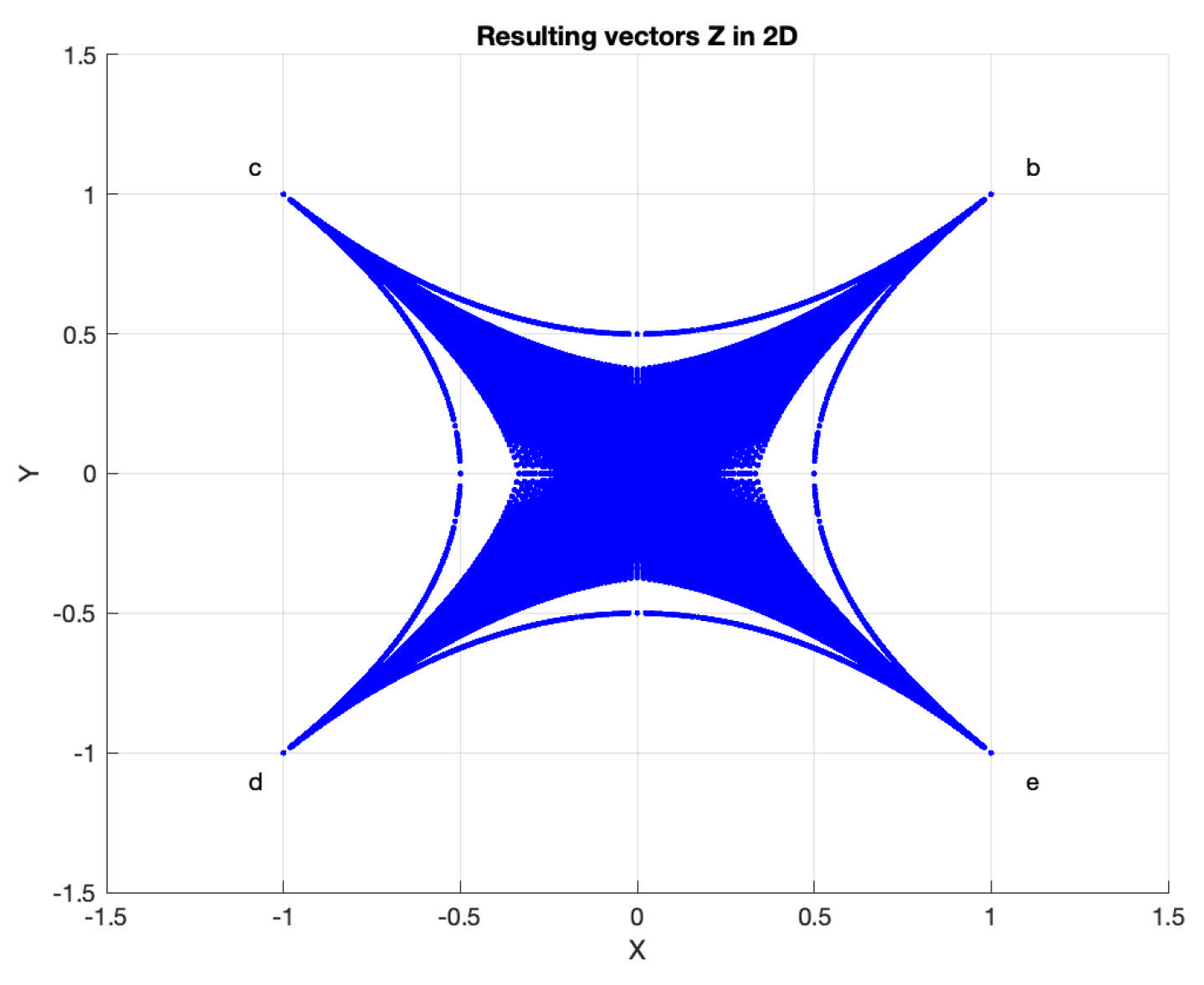
. The shape of
is shown in
Figure 1 with vertices
. Then
Let
. We have
, and hence,
. That is,
. □
The following result contains the essential properties of the Hausdorff measure of non-p-convexity, .
Proposition 12.
Suppose that is a complete p-seminormed space, where . Then for every bounded subsets and of , we have:
- (1)
, that is, and are equivalent;
- (2)
if and only if is p-convex;
- (3)
;
- (4)
, for every scalar λ;
- (5)
;
- (6)
;
- (7)
;
- (8)
In general, ;
- (9)
if and if .
Proof. - (1)
From the definition of
it is immediate that
. Let
be a nonempty bounded subset of
and
. Then
Then there exists a nonempty bounded
p-convex subset
of
such that
, and hence
Since
is
p-convex, we have
From (
27):
. By the definition of the Minkowski sum, this implies that for every
, there exists
such that
, i.e.,
. Consequently,
which implies
From (
28):
. This implies that for every
, there exists
such that
. Consequently,
which implies
Taking the maximum of (
29) and (
30), we conclude by the definition of
that:
Therefore,
Hence,
.
- (2)
Based on part (1) above, we find that . We can directly deduce the result using Proposition 6 (1).
- (3)
- (4)
If
, then the result is obvious. Otherwise,
. Assume that
. From the definition of the Hausdorff measure of non-
p-convex, we have
such that
Hence,
As
, from the above inclusions, we obtain
so
, and hence,
since
is
p-convex. That is,
We now establish the reversed inequality. Suppose that
. There exists a
such that
and hence,
and
and so
, and therefore,
since
is
p-convex. Consequently,
.
- (5)
Suppose that
. Choose
,
such that
,
and
. Let
such that
and
. Then
From this, we obtain
and hence,
. Since
is
p-convex, we have that
. Consequently,
.
- (6)
Any
verifies
. If
runs over all the nonempty bounded
p-convex subsets of
, taking the infimum, we obtain
That is,
Now, in inequality (
31), interchange
and
, we obtain
From (
31) and (
32), we get
and so,
- (7)
and also (8) follow from the properties of the p-convex sets.
- (8)
follow from part (1) above and Proposition 6 (6).
□
Let
be a complete
p-seminormed space (
), and let
be bounded subsets of
. The following
Table 1 summarizes the properties of the Kuratowski measure of noncompactness (
), the Eisenfeld–Lakshmikantham measure of non-
p-convexity (
), and the Hausdorff measure of non-
p-convexity (
).
It would be interesting to extend results of this paper to
b-Banach spaces or quasi-normed spaces. For definitions and results on
b-Banach spaces and quasi-normed spaces, we refer the readers to [
25,
26,
27].