1. Introduction
The present study is concerned with general discrete-time Markov chains (MCs) in an arbitrary measurable phase space , where X is an infinite set, and is an arbitrary sigma algebra of its subsets. The MCs are defined by transition probabilities , which are countably additive in the second argument. All of the investigation described in this article were carried out within the framework of the functional operator approach.
The fundamentals of the operator approach to studying general MCs have been briefly presented in two papers by Kryloff and Bogoliouboff (1937) [
1,
2]. The essence is that a Markov chain is defined by a transition function (probability)
which, as a kernel, generates two dual integral Markov operators—namely,
T and
A—in the spaces of measurable functions and in the spaces of measures, respectively. The measures are assumed to be countably additive. The Markov operators constructed allow for the wide use of functional analysis methods. In particular, in [
1,
2], it was proved that the fulfillment of certain operator conditions implies “quasi-ergodicity.” In the same year (i.e., 1937), Doeblin [
3], obtained new conditions
using the operator approach, under which the MCs have ergodic properties. Subsequently, other authors conducted studies devoted to comparing the ergodicity conditions of Kryloff and Bogoliouboff
and the Doeblin condition
. In particular, Doob (1953) [
4] obtained a number of other conditions of this type. In [
4], only countably additive measures were used.
In 1941, in a large paper [
5], Yosida and Kakutani constructed a significant extension of the operator approach to the study of the general theory of MCs. In particular, in [
5], the quasi-compactness conditions in [
1,
2], and [
5] were compared. In [
5], different source spaces were used to construct various Markov operators (note that all measures used were also countably additive).
The extension of Markov operators to spaces of finitely additive measures only began to be used in papers in the 1960s. We mention only a few of these papers: Šidak (1962) [
6], Foguel (1966) [
7], Horowitz (1972) [
8], Lin (1975) [
9], and Ramakrishnan (1981) [
10]. We also note the monograph by Revuz (1984) [
11]. To date, this is the only monograph that systematically presents the general theory of operator MCs with the active use of purely finitely additive measures.
The literature on the various aspects of ergodic theory and its applications is particularly extensive. The history of ergodic theory and ergodic theorems has been described in detail in the book by Dunford and Schwartz (1958) [
12]. There, in Chapter VIII, Markov processes and Markov chains are singled out in several places, and their classical ergodic properties and theorems are briefly analyzed.
In this paper, we supplement and generalize the results of our previous works [
13,
14]. We present theorems with brief proofs (see Theorems 1–4 and Corollary 1 below). We further examine MC examples in detail, in which we demonstrate the methodology of applying finitely additive measures to the analysis of MCs (see Examples 1–5) with proofs of their non-simple properties. In this case, theorems from [
15,
16]—which were not present in the articles [
13,
14]—were also used.
This paper consists of eight sections. In
Section 2,
Section 3 and
Section 4, we recall the definitions and some information about finitely additive measures and Markov operators for general Markov chains that will be needed later.
In
Section 5, a number of new theorems are proved. We point out three of them. In an earlier paper of ours [
15], it was proved that if all invariant finitely additive measures of the MC are countably additive, then the set of all such measures of the MC is finite-dimensional. In the present paper, we prove the converse of the theorem under certain conditions in Theorem 1. In Theorem 3, we prove an ergodic theorem for the adjoint operator
; i.e., for the most general case (classical ergodic theorems are proved only for the Markov operators
T or
A). In Theorem 4, we prove an ergodic theorem in cases where the MC has no cycles. In such cases, the convergence of the sequence of operators
is uniform with respect to all initial measures, including purely finitely additive measures, and Cesaro means are not used (but these means also converge uniformly).
In
Section 6, Examples 1–5 of interconnected Markov chains (MC1–MC5) on the interval
are constructed and studied. The scheme of the possible transitions is the same for all five MCs. MC1–MC5 differ in the type of transition probability
. We demonstrate and prove the complex diversity of the asymptotic (ergodic) properties of MCs determined by different types of probabilities
. We consider the second part of the article, with examples of Markov chains, to be the important part of this work.
In
Section 7, we discuss the obtained results, and how they can be interpreted in light of previous research, and how they relate to the results of other authors.
Finally, some brief conclusions are presented in
Section 8.
3. Operator Representation of Markov Chains
In this section (as in the previous
Section 2) we present some constructions and formulations of theorems from the sources already mentioned such that the text can be read more autonomously.
Markov chains are an important type of random processes with discrete time.
Markov chains on a (phase) measurable space are given by their transition function (probability) , under ordinary conditions:
- (1)
- (2)
- (3)
In probability theory, the expression is interpreted as the probability that one can move from point to set in one step.
We emphasize that the transition function is a countably additive measure with respect to the second argument, i.e., we are considering classical MCs.
If the set X is finite or countable, then the corresponding MC is also called finite or countable.
In this article, we consider general MCs.
The transition function generates two Markov linear bounded positive integral operators:
Here, the Lebesgue integral over an arbitrary bounded countably additive measure is used.
Let the initial measure be . Then, the iterative sequence of countably additive probability measures is usually identified with the Markov chain.
In this paper, as in the author’s previous works [
13,
14] and others, some problems lying in the area of contact between the operator theory of general Markov chains and the theory of finitely additive measures are studied.
Topologically conjugate to the space
is the (isomorphic) space of finitely additive measures:
(see, for example, [
12]). In this case, the topological adjoint to
T is the operator
.
is a bounded extension of the operator
A to the entire space
, preserving its analytic form; that is,
The integral of a bounded measurable function over a bounded finitely additive measure is constructed using the same scheme as the Lebesgue integral over an arbitrary bounded countably additive measure (see, for example, [
12,
17]). The operator
has its own invariant subspace
, i.e.,
, on which it coincides with the original operator
A. Now, the construction of the Markov operators
T and
is already functionally closed. We will continue to denote the operator
as
A, provided it does not cause contradictions.
In such a formulation, it is natural to also consider Markov sequences of probability finitely additive measures:
where the countable additivity of the transition function
with respect to the second argument is preserved. Despite this circumstance, the image
of a purely finitely additive measure
can remain purely finitely additive; i.e., generally speaking,
. Here the notation of the operator
A can be replaced by the notation of
.
It is also possible to radically change the problem statement—i.e., to allow the transition function
itself to only be finitely additive. Such MCs have also been studied (for example, in our work [
18]), and are called “finitely additive MCs”, but they are not considered in the present article. Thus, in our case, the following terminology is appropriate: we study countably additive Markov chains defined in the space of finitely additive measures.
Definition 2. If, for some measure , we have , then we will call such a measure invariant for the operator (and for the MC). An invariant countably additive measure is also often called a stationary distribution of the MC. In terms of functional analysis, an invariant measure is a fixed point of the operator , or its eigenvector with eigenvalue .
Let us denote the sets of invariant probability measures for the MC:
A classical countably additive Markov chain may or may not have invariant probability countably additive measures; i.e., it is possible that (for example, for a symmetric random walk on ).
In [
6] (Theorem 2.2), Šidak proved that any countably additive MC on an arbitrary measurable space
, which is extended to the space of finitely additive measures, has at least one invariant finitely additive measure; i.e., it always holds that
. This result was then proved in a simpler way in the paper [
15], as a simple consequence of the Krein–Rutman theorem [
19] (Theorem 3.1).
In [
6] (Theorem 2.5), Šidak also established that, in the general case, if a finitely additive measure
is invariant,
, and has a decomposition
into a countably additive and a purely finitely additive component, then each of them is also invariant:
,
. Therefore, it suffices to study such invariant measures separately.
We will say that the MC has a finite-dimensional (or simply finite) set of invariant finitely additive measures if the linear dimension . In this case, the set has m basis measures . We will use the same words for and for .
5. Theoretical Results
In this section, we prove a converse of Theorem 8.2 from [
15]; i.e., we generalize Theorem 8.3 from [
15] for arbitrary dimension
, but under an additional condition.
The symbol denotes the linear convex closed hull of the corresponding sets.
Theorem 1. Let , . Let all basis measures from be pairwise singular, and let condition be satisfied for each of them:Then, —i.e., the ergodicity condition is satisfied—all invariant finitely additive measures of the Markov chain are countably additive, and the MC does not have invariant purely finitely additive measures. Proof. From the pairwise singularity of a finite family of measures in , it follows that there exist pairwise disjoint sets such that for and for .
Then, by condition , for each measure , , there exists a set such that and for all .
We form subspaces of the space by the rule , for . We restrict all measures to the subspaces .
We restrict the transition function to each subspace by the identity rule: , , . It is easy to check that all measures are unique invariant finitely additive measures for particular Markov chains that generate transition functions on for .
Now, we can say that, on each measurable space
, there is a Markov chain with a unique invariant finitely additive measure
. Therefore, by Theorem 8.3 [
15], all invariant measures
are countably additive on the measurable spaces
.
We extend these measures
to measures
on the entire original measurable space
by the rule
for each
; i.e., “zeros”. Evidently, the countable additivity of the measures
is preserved and they will be invariant on the whole
; i.e.,
for all
, and
. The rest follows from our Theorem 12.2 in [
16]. This completes the proof. □
It is clear that, for the condition is trivially satisfied for .
If we assume in advance that the measure
is countably additive, then condition
is also satisfied [
15] (Theorem 6.2).
Theorem 2. Let . Then the MC has invariant purely finitely additive measures, i.e., and .
Proof. Let us consider two possible variants for . Let , including the case . Then, since , then and , and the statement of the theorem is true.
Now, let
. Then, by our Theorem 8.1 (see [
15])
and
. The theorem is proved. □
Theorem 8.1 is proved in [
15] using the technique of Banach limits and
-weak topology.
Theorem 2 does not use condition () for the measures from . However, the use of the condition () in Theorem 1 does not allow us to combine both theorems and formulate them as another necessary and sufficient condition for the existence (or non-existence) of invariant purely finitely additive measures.
Corollary 1. Let the conditions of Theorem 1 be satisfied. Then, the MC satisfies the Doeblin condition , condition , and our condition , the MC does not have invariant purely finitely additive measures. Additionally, the MC is quasi-compact, and it has all the corresponding ergodic properties.
Thus, under the conditions in Theorem 1, the Markov chain is quasi-compact. Therefore, our ergodic Theorem 12 from [
14] can be applied to such a Markov chain, as shown in the following theorem.
Theorem 3. (ergodic). Let some MC on an arbitrary phase space satisfy the conditions of Theorem 1, including the condition. Then, for the operator , there exists a finite-dimensional projection onto the space of all invariant finitely additive measures of such that the following statement holds for : Proof. Let the conditions of Theorem 3 be satisfied, including the condition from Theorem 1. Then, from Corollary 1, it follows that the given MC is quasi-compact and the ergodic conditions are satisfied for it. The theorem is proved. □
Theorem 4. Let be a quasi-compact MC that has no cycles (i.e., the MC is acyclic). Then, the following uniform limit relation holds:where is a finite-dimensional projection of the space onto the finite-dimensional space of all invariant measures of . The rate of convergence of the specified sequence is uniform over all initial finitely additive measures (including purely finitely additive measures) and it is exponentially fast. Proof. The theorem follows from a statement in Doob’s book ([
4], Chapter V, §5). There, in Point e), it is stated that if the MC has no cycles, then, in ergodic limit theorems, it is sufficient to take the usual limits of the degrees of Markov operators (or transition functions) and not the limits of their Cesaro means (where the limits coincide). The theorem is proved. □
Note. It is said that a certain positive numerical sequence converges to 0 exponentially quickly as , if it converges to 0 as quickly as the numerical sequence , where . The same meaning is given to exponentially quickly converging sequences in Theorem 4. If the sequences under consideration satisfy Doeblin’s condition , then the corresponding rates of convergence can be specified. For this, we use the parameter from condition , setting , for .
The statement of the above theorem is a consequence of our Theorem 3.
In Theorem 12 [
14], it is also proved that, for operator
, similar statements about the ergodicity of operator
A under some condition
are true. It is also proved there that conditions
and
are equivalent.
Next, we use the Theorem 7.8 from [
15] (Chapter 1, §7), which gives analytical conditions (criterion
G) for the existence of invariant purely finitely additive measures for general MCs on arbitrary phase spaces. We present these conditions, as we will use them in subsequent examples.
Theorem 7.8 (see [
15]): Let a countably additive MC be defined on an arbitrary measurable space
and let its transition function
satisfy the following condition (criterion
):
Then, there exists an invariant purely finitely additive measure for the MC, and for all .
In [
16] (Theorem 12.4 and Corollary 12.3), it is shown that this condition
is necessary and sufficient for the original MC not to be quasi-compact.
6. Examples and Methods of Their Study
In classical countably additive measure theory, the concepts of a support of a measure and of a measure atom are used. However, if we pass to the space of finitely additive measures, these two concepts turn out to be degenerate. Indeed, in [
18] (see Lemma 1), it is proved that a purely finitely additive measure is equal to zero on any finite set. However, similar concepts are needed in the theory of finitely additive measures. Similar questions have been studied; for example, in the study of Rao and Rao [
21], where finitely additive measures are called “charge.”
Let be a measure and . Then, if , , such that and , then we say that D is a set of full measure and is the support of on E.
Let us explain these terms using a simple example, when . Let a purely finitely additive measure be defined on the space . Let , . Then, .
Evidently, for any , , and , then any set is a set of full measure on the space , and also a support of the measure .
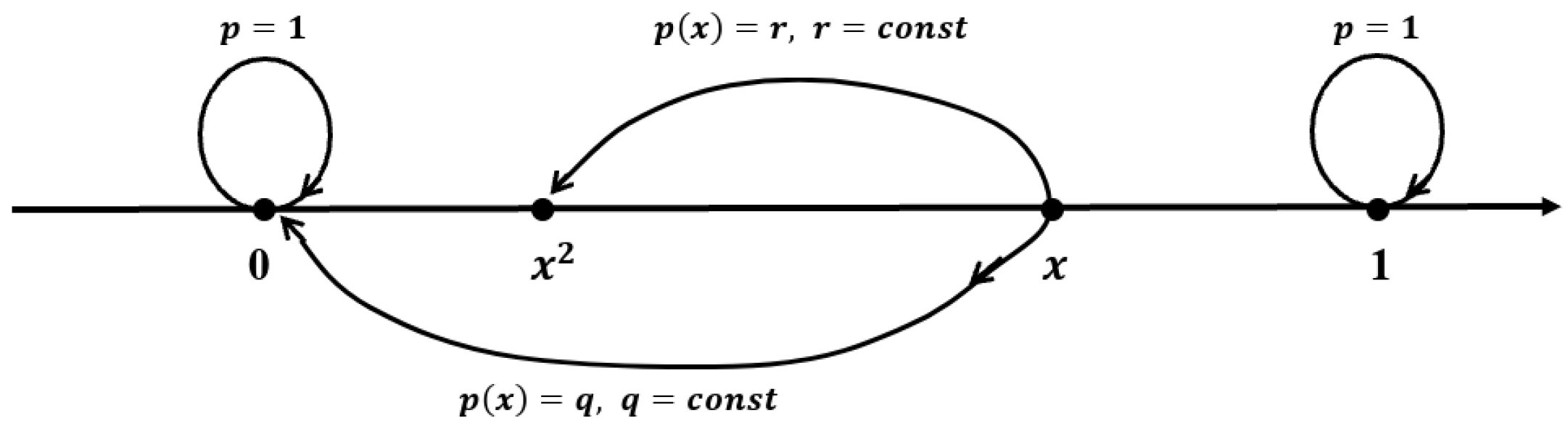
Below, we consider five interconnected Markov chains, MC1–MC5, defined on the interval with the usual Borel sigma-algebra (we keep the notation ), and we give some methodologies for using finitely additive measures in the study of MCs.
The scheme of possible transitions is the same for all MCs. From any initial point
, only two transitions are possible: to the point
with probability
, and to the point 0 (zero) with probability
. The points 0 (zero) and 1 (one) with probability 1 go into themselves; i.e., they are absorbing (stationary). MC1–MC5 differ only in the form of the probability function
. We will see what a non-simple variety of asymptotic (ergodic) properties of MCs are led by different types of probabilities
. In the author’s work [
15] only Example 1, (MC1) was given, but without studying its asymptotic and other properties.
Since the stationary absorbing point
is unreachable from
(“isolated”), and there are no cyclic subclasses in all five examples, then, following Doob ([
4], Chapter V, §5), we can do without using the Cesaro means of the transition probabilities
. In other words, we can avoid using finitely averaged MCs, studying only this sequence itself for
.
Example 1. The Markov chain, let us call it MC1, is defined on the segment by the following rules:
For any , the following transitions are possible in one step: to the point with probability and to the point 0 (zero) with probability . The points 0 (zero) and 1 (one) transition into themselves with probability 1; i.e., they are absorbing (stationary).
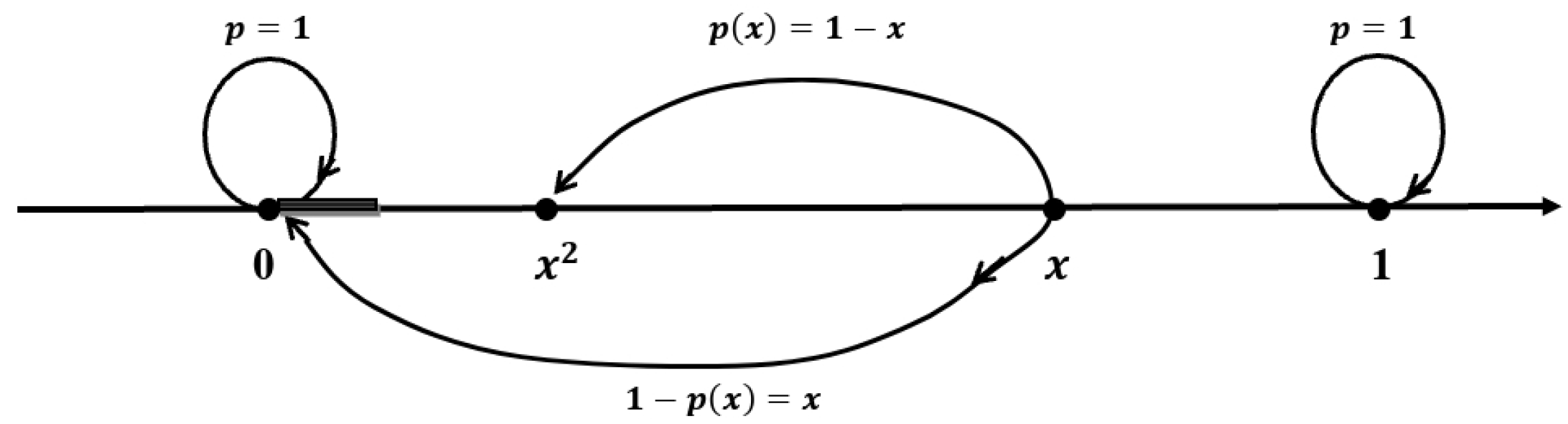
Let us formalize the transition function of such a Markov chain. For any , we define The phase portrait of such an MC is given in
Figure 1.
In
Figure 1, the conditional location of the supports of invariant purely finitely additive measures “near one” is highlighted with a bold line.
The above task of MC1 is complete enough to find explicitly the measures for arbitrary initial finitely additive measures . In the case when , we can also write , and so on. However, we obtain rather cumbersome expressions if this is performed. We will only use some simple properties of the measures and give the corresponding explanations where necessary. We will do the same when considering Examples 2–5.
We will study all five examples of MCs using the same scheme, so we will number all further steps.
- 1.
“Visible” invariant measures
It is easy to see that MC1 has at least two invariant singular measures; these are the Dirac measures and , which are concentrated at the points 0 and 1, respectively. Both measures are countably additive. Other possible invariant measures are not yet visible to the “naked eye”. However, we will show below that such measures exist. We will call them implicit measures. In fact, these are purely finitely additive measures.
- 2.
Asymptotics
Let us consider the asymptotic behavior of MC1. We restrict ourselves to the case when MC1 “starts” from an arbitrary fixed point
, which corresponds to the initial Dirac measure
, which is concentrated at point
. The initial measure
generates a Markov sequence of countably additive measures
The corresponding random variables in this Example 1 can take only two values: with probability , and with probability . Next, we use the known formulas for the products of numerical sequences.
Direct calculation by induction yields the following formulas:
Let us construct an infinite “trajectory set” , of all possible nonzero values of the random variables generated by the initial point .
Let us take the Dirac measure
, which is invariant for MC1:
. Evidently,
. Then, for
, it holds that
Since there are no other points in the “carriers” of the measures
and
, we obtain the distance between them as follows:
for any
as
.
Thus, for any initial , the sequence of countably additive Markov measures converges to an invariant countably additive measure in the strong metric topology in the space , where .
However, for any
, we have
This means that the strong convergence is not uniform over the initial points . Moreover, this convergence is not uniform over all possible initial measures on .
Note also that if , then ; i.e., formally as . If , then and as .
- 3.
Quasi-compactness
If MC1 were quasi-compact, then the strong convergence of would be uniform in . Therefore, MC1 is not quasi-compact.
What prevents this in Example 1? Based on our Theorem 1 and its Corollary 1, we can assume that MC1 has some other invariant measures and in large numbers, which we did not see during the first superficial examination in point 1.1; i.e., “implicit” invariant measures.
- 4.
Properties of “implicit” invariant measures (if they exist)
Let
be an arbitrary finitely additive probability measure. We perform the following integral transformations with operator
of MC1:
Now, suppose that the measure
is invariant for MC1, and it is singular with the invariant measures
and
; i.e.,
. Then, we have
from which we obtain
Note that the integrand is strictly greater than zero for all . This is not an “equality”, but an “equation” with respect to the unknown measure , which we must solve.
Let
be given; i.e.,
. Then,
Therefore, if
, then, from the left-hand side of the inequalities, it follows that
and we obtain a contradiction. Thus, for any
,
. It is clear that, for any set
,
for an arbitrary
,
. In particular,
for any
.
Similarly, we can obtain that, for any , and, accordingly, .
We will now show that such measures are not countably additive (although this is almost obvious). We construct a sequence of sets
for which
Then,
, and
This means that the measure is not continuous; i.e., not countably additive. Thus, all finitely additive measures that satisfy the conditions and are purely finitely additive, and for them, for any , and are true, these measures are concentrated “near unity”.
In the general theory of finitely additive measures (see, for example, [
17]), it has been proved that such measures exist and there are a great deal of them, where the cardinality of the entire family of such measures “near one” is the hypercontinuum (
).
Thus far, we have only shown that if the MC1 has an invariant finitely additive measure , , then it falls into the family of purely finitely additive measures described above.
- 5.
Proof of the existence of “implicit” invariant measures
For MC1, we construct the two sequences
and
described under the conditions of Theorem 7.8 [
15] given at the end of
Section 5 (criterion
). Let
be arbitrary and fixed,
. Hence,
and
as
.
Now, we construct a sequence of sets
:
Evidently, , .
Let ; i.e., . Then, .
Now, the conditions of Theorem 7.8 (criterion
G) [
15] are satisfied. Consequently, for our MC1, there exists an invariant purely finitely additive measure
, and
for
. In particular,
and
for any
. In addition,
and
.
As such, at least one invariant purely finitely additive measure “near one” for MC1 has been discovered.
- 6.
Number of “implicit” invariant measures
Let us show that, in fact, there are infinitely many such invariant measures (linearly independent).
Let us take as the initial point of our MC1 the transcendental number (), and let us construct the entire “trajectory set” of the points generated by it and add to it points 0 and 1. The countable set is stochastically closed; i.e., , for all . Therefore, we can narrow MC1 from the phase space to the phase space , where , while preserving the form of its transition function. We obtain a new particular MC1. All the properties of the general MC1 that we have previously discovered (except for the Feller property, which loses its meaning here) are also preserved for the particular MC1 on . In particular, it has invariant countably additive measures and .
It is not difficult (but cumbersome) to verify that the conditions of Theorem 7.8. (criterion
G) from [
15] is also satisfied for it, which implies the existence for the particular MC1 of an invariant purely finitely additive measure
“near one”. This is only defined on the countable set
and satisfies the following condition:
for all
. Theorem 7.8. [
15] is also applicable in this case, as formulated and proved in [
15] for any measurable spaces
.
Now, we extend the invariant measure from space to the entire original space by defining it by “zeros” on all sets outside . It is easy to see that such an extended measure will remain purely finitely additive and will become invariant for the original general MC1 on .
Next, we take another transcendental number as the initial point of our MC1 and construct its trajectory set (together with the points 0 and 1) . Evidently, for , all the arguments and conclusions made above for the trajectory set will be true. Its invariant purely finitely additive measure also extends “by zeros” to the invariant measure on the original space for the general MC1.
The numbers and are incommensurable, and the trajectory sets and generated by them (without the points 0 and 1) do not intersect. Consequently, their invariant measures and are singular and linearly independent, and their extensions by zeros to the entire space are also singular.
Thus, we have already obtained two invariant purely finitely additive measures of MC1 “near unity”, which are singular with each other. The set of all transcendental pairwise incommensurable numbers in the interval has the cardinality of the continuum , and each such number generates its own trajectory set with its own invariant purely finitely additive measure. These are pairwise singular and linearly independent with all other such invariant measures.
We have shown that our MC1 has at least a continuum of invariant pairwise singular and linearly independent purely finitely additive measures “near unity”.
Above, in Point 1.5 in Example 1, we can see that there are no “near other places” in for the MC1 invariant measures. In particular, there are no invariant purely finitely additive measures for MC1 “near zero” with the condition for all .
Thus, MC1 has invariant purely finitely additive measures “near one” and does not have any “near zero”, although MC1 converges to zero (for ). This fact is quite surprising.
For this reason, we cannot use our Theorem 1 for MC1. The conditions of Theorem 1 require that , and for MC1 it turns out that ; i.e., the conditions of Theorem 1 are not satisfied. For the same reason, MC1 does not have uniform convergence and is not quasi-compact.
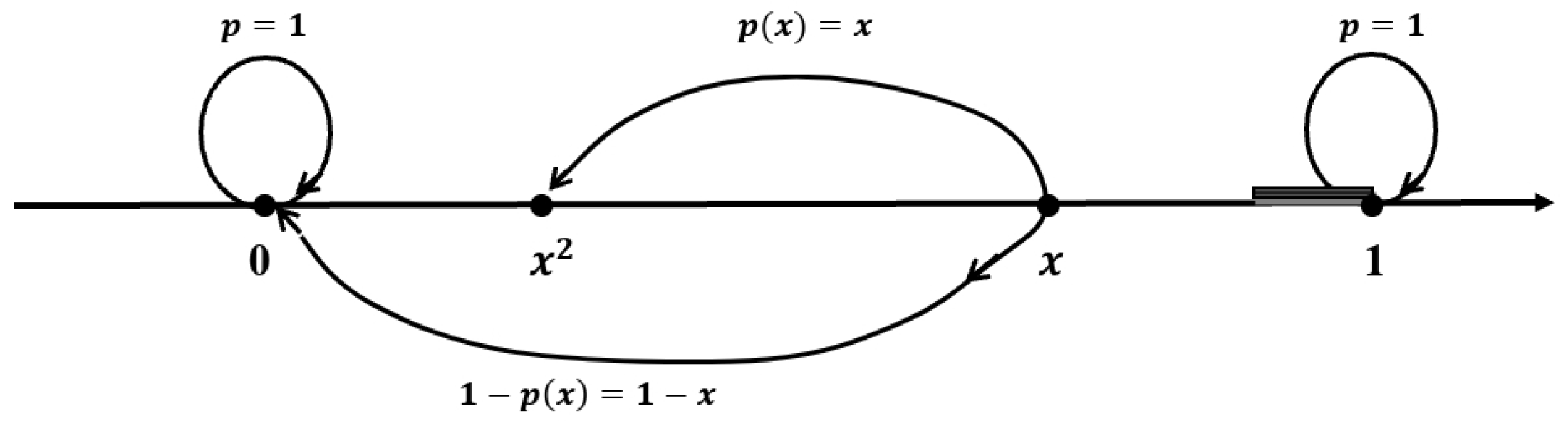
Example 2. We take, as a basis, the previous Example 1 with the same possible transitions to , and the probabilities of these transitions—i.e., (see Figure 2)—are swapped. We call the resulting new chain MC2. The phase portrait of such an MC is given in
Figure 2.
In
Figure 2, the conventional location of the supports of invariant purely finitely additive measures “near zero” is highlighted with a bold line. The transition function of MC2 takes the following form: for any
, we have
Let us conduct an analysis of MC2 using the same scheme as the analysis of MC1, but shortening the accompanying reasoning.
- 1.
“Visible” invariant measures
The invariant measures of MC2 are the same as those of MC1; namely, two invariant countably additive measures and . It is also not yet clear whether there are other invariant measures.
- 2.
Asymptotics
We fix an arbitrary initial point with the corresponding initial measure . We construct a Markov sequence of measures defining random variables that can take only two values with the following corresponding probabilities: , .
By direct calculation by induction we obtain the following formulas:
Since the series satisfies
(i.e., it converges), then the resulting products also, monotonically decreasing, converge to a positive number
:
Accordingly, the sequence monotonically increases and converges to a positive number ; i.e., does not converge to 0 and for any initial . Consequently, the distance as .
Thus, for any initial , the sequence of measures does not converge to the invariant measure in the strong metric topology. Moreover, the measures rapidly and monotonically move away from the measure to a distance . However, the positive supports of the measures , , as a numerical sequence, rapidly and monotonically converge to the point 0—i.e., to the support of the measure —in the usual Euclidean metric of the real line.
Just in case, we note that ; i.e., the sequence , naturally, does not converge strongly to the second invariant measure .
If measures and are considered elements of the Banach space , then the sequence does not converge to either in the weak and *-weak topologies since there exists a set such that as .
If we consider measures
and
elements of the Banach space
, then we must take into account that space
(equal to
) is topologically dual to space
since the segment
is compact (see, for example, [
12]); therefore, the *-weak topology in
is the well-known
-topology. Moreover, in this
-topology, sequence
converges to
. It is easy to verify that, for any
and for all
, the following holds:
Thus, for MC2, for any initial , the Markov sequence of measures only converges to the invariant measure in the -weak topology.
Trivial cases with or are also clear (but we will not comment on these).
- 3.
Quasi-compactness
From the asymptotic properties of MC2, it follows that it is not quasi-compact. Therefore, we can assume that MC2, just like MC1 (
Figure 1), has other “implicit” invariant measures besides
and
.
- 4.
Properties of “implicit” invariant measures
Let us perform the integral transformations made earlier for MC1 in Point 1.4, taking into account the change in the places of the transition probabilities (omitted). We obtain the following.
If a finitely additive measure with condition is invariant for MC2, then it satisfies the equation .
The difference here from the similar equation for MC1 is in the integrand. For MC1, the integrand was , and for MC2, it is the function . Having analyzed this equation for MC2, using the same scheme that was used for MC1, we obtain the following.
If a finitely additive measure is a solution of the integral equation for MC2, then it has the following properties:
- (1)
for any segment ;
- (2)
for any ;
- (3)
and for any .
Such measures for MC2 are located “near zero” (see
Figure 2), and similar measures for MC1 were located “near unity” (see
Figure 1).
In the same way as for MC1, we show that any such measure is purely finitely additive; i.e., there are no positive countably additive measures satisfying the corresponding integral equation.
If the MC2 has an invariant finitely additive measure , , then it falls into the above-described family of purely finitely additive measures located “near zero”.
- 5.
Proof of the existence of “implicit” invariant measures
The proof for MC2 is similar to the proof for MC1 when using the condition (criterion
G) of Theorem 7.8 [
15], which is given above at the end of
Section 5. The only difference is that if for MC1 we constructed a sequence of sets
“near one”, now we construct it “near zero”.
For an arbitrary
, we take
We show that
for all
. The conditions of Theorem 7.8. [
15] are satisfied.
Therefore, for MC2, there exists an invariant purely finitely additive measure , and for all .
- 6.
The number of “implicit” invariant measures
For an arbitrary , the trajectory sets generated by it for MC1 and MC2 coincide. Therefore, for MC2, we can repeat all the arguments given in Point 1.6 for MC1. The only difference is that the invariant purely finitely additive measures for MC1 satisfy the condition for , and for MC2, they satisfy the condition for . However, this does not affect the following general conclusion.
Our MC2 has at least a continuum of invariant pairwise singular and linearly independent purely finitely additive measures located “near zero”, and there are no other such invariant measures located in other “places” on . The conditions of Theorem 1 are not satisfied.
Thus, MC2 has purely finitely additive measures “near zero” and does not have them “near one”.
For MC2, the remarks that we made for MC1 at the end of the text from Example 1 are valid.
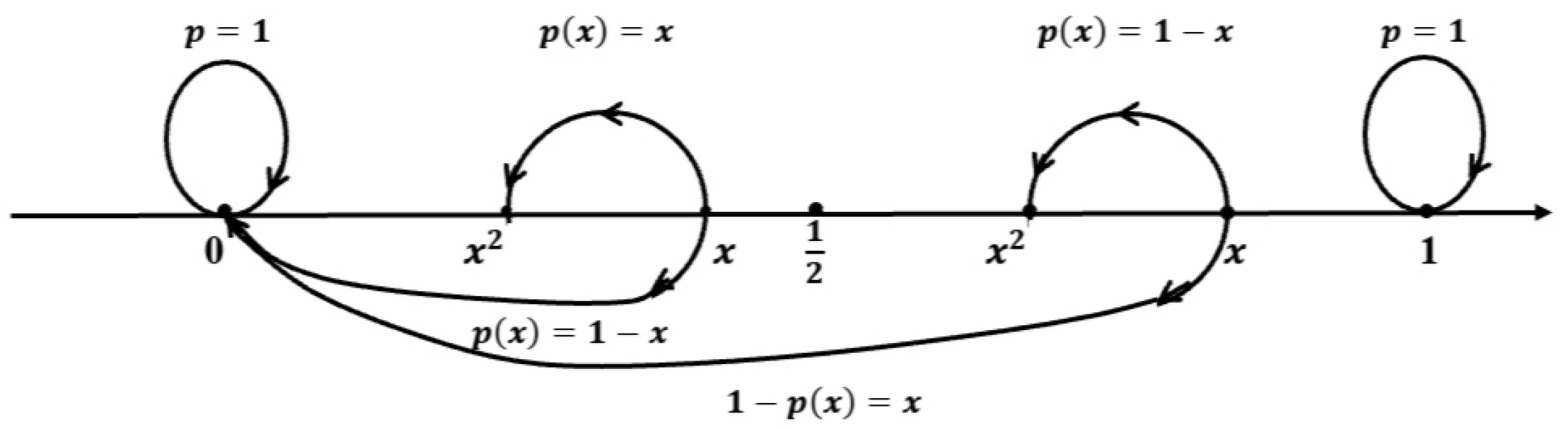
Example 3. We combine a new MC3 (see Figure 3) from two MC1 and MC2 from Examples 1 and 2 with the transition rules on ; i.e., the same as for MC1 from Examples 1 and on as for MC2 from Examples 2 (see Figure 3). The phase portrait of such an MC is given in
Figure 3.
As we show below, MC3 does not have invariant purely finitely additive measures. Therefore, its phase portrait does not have a corresponding mark on the segment .
Let us write its transition function:
Let
. Then, we have
Let
. Then, we have
Both transition functions coincide at ; i.e., they are continuously glued together at this point.
This combination of transition functions MC1 and MC2 is made for the following reasons. MC1 did not have invariant purely finitely additive measures “near zero,” but there were some “near one.” To the contrary, MC2 had such measures “near zero,” but there were none “near one.” In the hope that we will obtain MC3 without any invariant purely finitely additive measures both “near zero” and “near one,” we have chosen the transition function from MC1 on the left interval and the transition function from MC2 on the right interval .
For MC3, we will immediately proceed to the main point. First, we will only note that MC3 has the same “visible” invariant measures and .
Let us make integral transformations for MC3 by analogy with the transformations for MC1 and MC2. As a result, for any invariant finitely additive measure
of MC3 on
; i.e., for
. we obtain the following:
Since both integrals on the right are non-negative, they are both equal to zero:
Let us solve the first equation.
Therefore, .
We then solve the second equation.
Therefore, , which implies that .
It follows that MC3 has no non-zero invariant finitely additive measures on the interval ; i.e., there are no invariant measures that are either countably additive or purely finitely additive, as expected.
Now, although it may be obvious, we formally check that our conditions and Theorem 1 from this paper are satisfied for MC3.
Above we proved that, for MC3, there exist only two invariant finitely additive measures and —i.e., —and the dimension is finite and . The measures and are singular, and their supports and are stochastically closed; thus, conditions and the conditions of Theorem 1 are satisfied. Consequently, all invariant measures of MC3 are countably additive; i.e., .
By Corollary 1 of Theorem 1, MC3 satisfies the Doeblin conditions , our condition , and MC3 is q-uasi-compact.
Let us confirm that conditions are satisfied. Let us take the measure , , .
For sets and , we have , and there is no need to consider .
Let . Then, . If , then . If , then . In addition, and .
For any other “smaller” set , , then it is all the more so and for all . Thus, condition is indeed satisfied, and MC3 is quasi-compact.
The quasi-compactness of MC3 guarantees the strong metric convergence of the measures to the invariant measures and , and this is uniformly convergence with respect to the initial measures . However, we will show how this looks in this particular case; i.e., Example 3.
From the estimates obtained above, when checking condition
for
for all
,
, it is satisfied that
Next, for
, we make the following transformations and estimates:
We omit the trivial cases for and (they should be considered separately).
By induction, we obtain for and for all . Consequently, for . This is uniform convergence with an exponential rate of convergence.
Next, we omit simple details and obtain the main conclusion.
The Markov sequence of measures of MC3 for converges in the strong metric topology to the invariant measure ; i.e., . This is uniform convergence over all initial points , which is also exponentially fast. It can be shown that this convergence is uniform over all initial probability countably additive measures , and not only over the initial Dirac measures .
In Examples 1 and 2, the strong uniform convergence of MC1 to and MC2 to was prevented by powerful families of the invariant purely finitely additive measures stuck in the -topology to the invariant countably additive measures and , respectively.
As such, MC3 has no invariant purely finitely additive measures “near zero” and “near unity,” and it is quasi-compact.
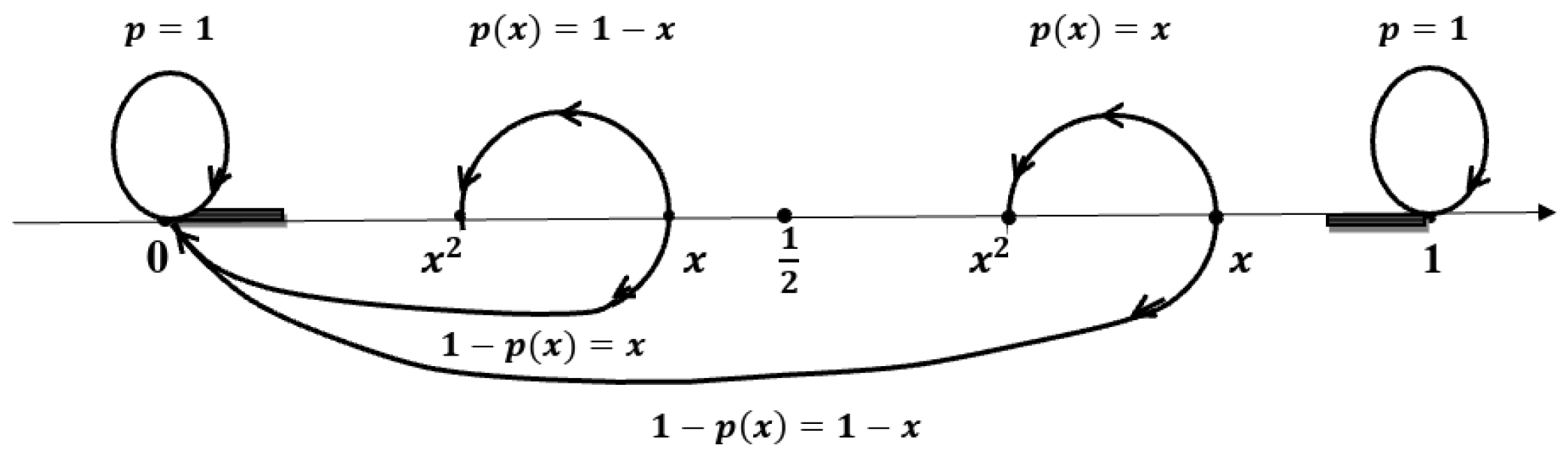
Example 4. Just like in Example 3, we combined two MC1 and MC2 into a new MC4, but in a different order. On the interval , we take the transition rule from MC2, and on the half-interval we take the transition rule from MC1 (see Figure 4). In
Figure 4, the conventional arrangement of the supports of invariant purely finitely additive measures “near zero” and “near one” is highlighted with a bold line (in two places). We will not describe the obvious formulas for the new transition function for MC4.
In the previous MC3, we took the “best” transition functions from MC1 and MC2 on the specified intervals for convergence. Now, for MC4, we take the “worst” transition functions from MC2 and MC1 on these intervals, which “slow down” convergence. It is intuitively clear that MC4 will inherit the “worst” properties of MC2 and MC1 for convergence (in our opinion, these “worst” properties are more complex and interesting).
Investigating the properties of MC4 using the scheme of studying MC1 and MC2, we obtain the following. MC4 has two powerful families of invariant purely finitely additive measures near zero and near one, it has two invariant countably additive measures, and is not quasi-compact. However, for any initial , the Markov sequence of countably additive measures -weakly converges to the invariant countably additive Dirac measure , but it does not converge to in the metric topology.
Example 5. Here, we consider the same general scheme for defining a Markov chain on segment as in MC1–MC4; i.e., with possible transitions for any to points and 0. However, we simplify the probabilities of these transitions as much as possible. We assume thatwhere the probabilities r and q do not depend on and . We still assume and . We denote the constructed new Markov chain by MC5 (see Figure 5). All our MC1–MC5 are homogeneous in time, and the new MC5 is also homogeneous in space in the indicated sense. In
Figure 5, there are no marks with the conditional arrangement of families of invariant purely finitely additive measures since they are not in this example.
Applying our scheme for studying MC1 and MC2, it is easy to show the following. For any MC5 has only two invariant countably additive Dirac measures and and no invariant purely finitely additive measures; i.e., . The conditions of our Theorem 1 are satisfied with all the ensuing consequences.
Ergodic properties of the simplified MC5 are easy to see, even without using purely finitely additive measures. However, we provide Example 5 to show that all of this simplicity is only possible because MC5 does not have invariant purely finitely additive measures. Additionally, they can also appear as soon as we start varying the parameters of MC5 depending on the point (state) x, which will lead to a sharp change in the asymptotic and qualitative properties of the MC.
Thus, MC5 does not have invariant purely finitely additive measures “near zero” and “near unity,” and is quasi-compact.
In addition, we make a general informal comment on the analysis of MC1–MC5. Invariant countably additive measures for an MC, by themselves, provide very little information about the asymptotic properties of the MC. They may be absent altogether, but the MC may have good asymptotics and converge in some sense to a non-invariant measure, or to a purely finitely additive measure (such a situation was studied in the author’s paper [
16], as well as Theorems 13.1 and 13.2). In Examples 1–5, it is shown that invariant purely finitely additive measures bear a greater “responsibility” for the asymptotic properties of the MC. Moreover, the mere fact of their absence already ensures the best possible ergodicity for the MC.