Article

A Fermatean Fuzzy Game-Theoretic Framework for Policy Design in Sustainable Health Supply Chains


1
College of Science and Engineering, Hamad bin Khalifa University, Doha 23874, Qatar
2
Department of Industrial Engineering, Karadeniz Technical University, Trabzon 61080, Turkey
3
Quality Coordination Office, İzmir Katip Çelebi University, İzmir 35620, Turkey
4
Department of Industrial Engineering, Istanbul Topkapi University, Istanbul 34087, Turkey
*
Author to whom correspondence should be addressed.
Mathematics 2025, 13(22), 3644; https://doi.org/10.3390/math13223644
Submission received: 7 October 2025 / Revised: 5 November 2025 / Accepted: 12 November 2025 / Published: 13 November 2025

Abstract

Medicine and vaccine supply chains in Nigeria are socio-technical systems exposed to persistent uncertainty and disruption. Existing studies rarely integrate systems thinking with uncertainty-aware decision tools to jointly prioritize challenges and policy responses. This study asks which policy mix most effectively strengthens these supply chains while balancing multiple, conflicting criteria and stakeholder judgments. We develop a two-stage Fermatean fuzzy framework that first weights 35 challenges using Fermatean Fuzzy Stepwise Weight Assessment Ratio Analysis (FF-SWARA) and then ranks four policy alternatives via Fermatean Fuzzy VIšeKriterijumska Optimizacija I Kompromisno Resenje (FF-VIKOR), based on expert elicitation and linguistic assessments. Results identify interruption of drug supplies, limited vaccine funding, cold-chain potency loss, human resource shortages, and product damage as the most critical challenges. FF-VIKOR prioritizes Effective Implementation of Existing Policies as the best alternative, followed by Improving Access to Medicines and Vaccines, indicating that governance quality and access-enabling infrastructure are complementary levers for resilience. To further enhance robustness, we embed the VIKOR outcomes into a policy-oriented game-theoretic analysis, where strategic weighting scenarios (e.g., cost-focused, infrastructure-driven, human-capital focused) interact with policy choices. The equilibrium results reveal that a mixed strategy combining Effective Implementation of Existing Policies and Strengthening Distribution and Storage Systems guarantees the best compromise performance across adversarial scenarios. The proposed framework operationalizes systems thinking for uncertainty-aware and strategically robust policy design and can be extended with real-time data integration, scenario planning, and regional replication to guide adaptive supply chain governance.

1. Introduction

Guarantee broad access to vital medications and vaccines is among the primary objectives outlined in the third SDG of the United Nations [1]. This objective is pivotal in achieving universal healthcare coverage. Health product supply chains (SCs) work to ensure compatible accessibility of healthcare products at locations where healthcare services are provided, all while doing so in a cost-effective and timely way [2]. A robust health product SC undeniably forms the basis for providing high-quality healthcare services [3]. This not only guarantees the distribution of appropriate products to vendors but also furnishes essential information to healthcare system planners, thereby enhancing service delivery [2]. While the significance of managing medicine and vaccine supply chains (MVSCs) is widely acknowledged, the persistent challenge lies in ensuring access to exceptional medicines in Nigeria [4]. Existing research has identified several obstacles within Nigeria’s medicine SCs, encompassing issues such as insufficient infrastructure, inadequate policy enforcement, and the prevalence of substandard or counterfeit drugs, all of which compromise quality [3]. Additionally, concerns such as drug shortages, suboptimal SC practices, and a shortage of qualified personnel have all been documented [2,5,6]. In response to these challenges, various policies and programs have been instituted for the management of the MVSCs in Nigeria. Furthermore, measures have been taken to regulate human resource development and engage professionals possessing the requisite skills [7]. However, despite these efforts, the MVSCs in Nigeria continues to grapple with inadequacies and inefficiencies [4]. Given this context, decision-makers are actively exploring ways to standardize and professionalize the field of medicine logistics. In light of the persistent shortcomings within the country’s MVSCs, recent studies have suggested novel approaches. These include promoting and enhancing local drug manufacturing to enhance accessibility, simplify quality monitoring, and ensure adherence to current good manufacturing practices. Additionally, there is a recognized need for the training and capacity building of pharmacists. It is crucial to emphasize the vital role of effective collaboration among diverse stakeholders to translate knowledge into actionable strategies and adapt existing MVSC management plans. Furthermore, to ensure the sustainability of MVSCs, it is essential to thoroughly assess the challenges and recommend appropriate policies via multi-criteria decision-making (MCDM) tools.
The central aim of this study is to establish a clear and practical methodological framework that can aid policymakers and regulators in pinpointing effective actions and setting priorities within the critical sphere of MVSCs. Notably, the study pioneers the in-depth exploration of identifying appropriate policies for addressing the challenges in sustaining MVSCs via the MCDM approach. Furthermore, it seeks to investigate the key decision criteria associated with this issue and present a pragmatic framework. The study introduces an integrated Fermatean Fuzzy (FF) model for prioritizing policies related to the sustainability of MVSCs, illustrated through a real-world case study involving Nigeria. This methodology combines the Stepwise Weight Assessment Ratio Analysis (SWARA) and VIšeKriterijumska Optimizacija I Kompromisno Resenje (VIKOR) methods with a policy-oriented game-theoretic layer that embeds scenario-based weighting schemes into the decision process, thereby identifying equilibrium policy mixes that remain robust under adversarial strategic conditions.

1.1. Motivation for Using Fermatean Fuzzy Sets

Decision-making processes are inherently uncertain due to the subjective nature of human evaluations and judgments. To manage such uncertainty, Zadeh [8] introduced the fuzzy set theory, which was later extended to MCDM problems by Bellman and Zadeh [9]. Since then, fuzzy logic, rooted in Zadeh’s pioneering work, has become a valuable tool for addressing imprecise and ambiguous data [10,11,12], leading to numerous fuzzy-based extensions of MCDM methods applied to complex real-world problems. Over time, several advanced frameworks have been proposed to enhance the representation of uncertainty, including Type-2 fuzzy sets [8,11,13], Z-numbers [14], and complex fuzzy sets [15]. Although these extensions have improved modeling flexibility, they often involve increased computational complexity or limited capability in representing higher-order hesitation. Earlier generalizations, such as Intuitionistic Fuzzy Sets (IFS) [16] and Pythagorean Fuzzy Sets (PFS) [17], enhanced interpretability but still fell short in capturing the multidimensional uncertainty present in decision environments with conflicting stakeholder perspectives. In this regard, the Fermatean Fuzzy Set (FFS) [18] provides a broader representational domain, offering greater expressive power in modeling both hesitation and dual uncertainty. Since its introduction, FFS theory has been effectively applied across various domains, demonstrating its adaptability and robustness in handling complex decision-making problems [18,19,20,21,22].
Recent studies [23] have further emphasized that FFS theory is a more advanced and flexible approach for representing complex human preferences compared to IFS and PFS, particularly when dealing with conflicting or incomplete evaluations. This feature makes the FF environment especially suitable for multi-stakeholder decision contexts, such as healthcare supply chain strategy evaluation.
However, there has been no prior work utilizing FFS-based MCDM approaches to address challenges specifically in Nigeria’s MVSC. This study therefore develops a novel FFS-based framework tailored to evaluating and selecting supply chain strategies within the Nigerian healthcare context.

1.2. Motivation for SWARA Method Application

It is employed for subjective criteria weighting [24]. In contrast to methods that rely on predetermined standards or scales, SWARA allows experts to express their opinions freely, thus fostering a more open evaluation process. Through weight evaluation, SWARA serves the purpose of resolving disputes. Notably, SWARA offers advantages over the Analytic Hierarchy Process (AHP) technique by eliminating the need for pairwise comparisons, resulting in enhanced stability, reduced computational complexity, and simplified operations. However, despite SWARA’s success for sustainable development [25], transportation infrastructure performance [26,27], wastewater treatment [28], transport accidents [29], urban sustainable development [30], e-scooter location choice [31], solar park selection [32], cleaner production strategy choice [33], bus rapid transit system operation and implementation [34], and service quality assessment [35], it has not been applied under FF logic for assessing the challenges related to sustaining MVSCs in Nigeria. Our study seeks to address this specific research gap.

1.3. Motivation for VIKOR Method Application

The VIKOR method is designed for optimizing intricate systems with multiple criteria [36]. Its strength lies in achieving a balance between optimizing group benefits and minimizing individual regrets [36]. Despite its widespread application across various domains such as resilient transportation [37], dental restoration [38], machine tool choice [39], bike sharing level of service [40], and organ transplantation choice [41], there is no single research that assess alternative solutions in the context of addressing challenges in sustaining MVSCs in Nigeria. Our study seeks to address this specific research gap.

1.4. Motivation for Game-Theoretic Layer Application

While fuzzy MCDM techniques such as SWARA and VIKOR provide powerful tools for weighting criteria and ranking alternatives under uncertainty, they generally assume a fixed set of preferences or weight distributions. In practice, however, policymakers often operate under varying strategic orientations (e.g., cost-focused, infrastructure-driven, governance-oriented), which may lead to different prioritizations of criteria. Traditional MCDM outcomes therefore risk being sensitive to the initial weighting scheme. The integration of a game-theoretic layer addresses this limitation by embedding policy alternatives into a strategic interaction framework where scenario-based weighting schemes are treated as adversarial strategies. This allows the identification of equilibrium policy mixes that remain robust even when state priorities shift or conflict. By doing so, the approach captures the dynamic nature of health supply chain governance, ensuring that the selected policy recommendations are not only optimal under one set of assumptions but also resilient across competing strategic contexts.

1.5. Contribution of the Study

Despite the growing literature on fuzzy MCDM applications in healthcare decision-making, limited research has simultaneously addressed uncertainty management and strategic conflict resolution in multi-stakeholder environments. Existing studies have predominantly focused on improving fuzzy evaluation mechanisms or optimizing aggregation procedures, without integrating behavioral and strategic dynamics into decision frameworks. To fill this gap, the present study develops a comprehensive three-stage framework that merges FF logic with SWARA–VIKOR and a policy-oriented game-theoretic layer to support robust and equitable healthcare supply chain strategies.
Unlike conventional MCDM techniques that rely on fixed weights and deterministic judgments, the proposed FF game-theoretic framework explicitly addresses both uncertainty in expert evaluations and strategic conflicts among decision-makers. By integrating FF logic, the model captures higher degrees of hesitation and linguistic vagueness, allowing a more realistic representation of human reasoning under incomplete information. Furthermore, the embedded game-theoretic layer overcomes the static nature of traditional MCDM methods by simulating adversarial or competing policy priorities (e.g., cost-driven versus governance-focused strategies). This integration enables the identification of robust equilibrium solutions that remain valid across shifting priorities, thereby offering a more resilient and adaptive decision-support tool for sustainable health supply chain policy design.
The following points are the contributions.
  • This study underscores the pressing necessity for Nigeria to give a higher priority to enhancing its SCs for vital medications and vaccines. Ineffective MVSCs are hampering healthcare coverage and access. New business strategies and alternatives are required to address MVSC challenges in Nigeria. Implementing appropriate strategies is critical to overcoming issues and expanding access.
  • The study utilizes fuzzy logic techniques to manage uncertainties in decision-making. Criteria to evaluate strategies were defined via previous studies and viewpoints of experts.
  • A novel integrated FF-SWARA-VIKOR framework was applied to assess MVSC strategies specifically for the Nigerian context, further extended with a policy-oriented game-theoretic layer.
  • Key findings provide new insights, identify knowledge gaps, and offer evidence to inform policymakers on MVSC challenges.
  • The remainder of this paper is organized to guide the reader through our research process systematically. Section 2 provides an in-depth review of the literature, establishing the theoretical framework and highlighting key developments in the field. In Section 3, we clearly define the research problem and articulate the central challenges addressed by our study. Building on this foundation, Section 4 details the proposed game-theoretic methodology, while Section 5 demonstrates its practical application. Section 6 then presents a comprehensive sensitivity analysis to evaluate the robustness of our approach. In Section 6, we critically discuss the findings and presents managerial insights, and the paper concludes in Section 7 with research recommendations and suggestions for future work.

2. Literature Review

Efficient logistics networks form the backbone of healthcare systems, ensuring the timely and equitable distribution of medicines and vaccines. When these networks fail, for example due to poor coordination, inadequate infrastructure, or weak policy support, the resulting disruptions directly threaten public health outcomes. Therefore, the governance and strategic design of MVSCs are crucial to sustainable healthcare delivery. Addressing such complexity requires decision-making frameworks that can accommodate uncertainty, conflicting objectives, and expert-driven evaluations. Fuzzy logic-based MCDM approaches have thus emerged as effective tools for analyzing policy trade-offs and operational challenges in uncertain environments. Building on these theoretical and practical perspectives, the existing literature can be grouped into three main strands: (i) decision-making approaches shaping MVSC performance, (ii) fuzzy and hybrid MCDM applications for MVSC evaluation, and (iii) conceptual gaps motivating integrated frameworks for sustainable supply chain governance.

2.1. Decision-Making Approaches Related to MVSCs

SCs are fundamental infrastructures underpinning global trade and health systems, providing the necessary flow of goods and information to ensure effective delivery of essential products [42,43,44,45,46]. Within healthcare, the performance of MVSCs determines the accessibility and quality of medical services, particularly in developing countries where logistical inefficiencies and governance issues persist [47,48,49,50,51,52,53,54,55,56,57]. Recent studies emphasize that decision-making in MVSCs has evolved from deterministic models toward integrated frameworks that incorporate uncertainty, resilience, and sustainability dimensions. For example, Lin, Zhao, and Lev [47,53] investigated distribution decisions for cold and non-cold chain vaccine transportation, supply and demand systems while Abbasi et al. [48] and Valizadeh et al. [49] formulated green and bi-level optimization models to enhance environmental and operational sustainability. Similarly, Sazvar et al. [50] and Kamran et al. [52] introduced fuzzy-based and stochastic optimization approaches for sustainable vaccine supply networks.
However, empirical evidence increasingly shows that policy-related factors, including governance, regulatory coherence, and human resource capacity, are equally critical. Studies from Nigeria and India demonstrate how weak institutional frameworks, inadequate policy enforcement, and limited infrastructure degrade MVSC performance and sustainability [58,59]. Chukwu and Adibe [59] identify compliance deficiencies in Nigerian cold-chain systems, while Olutuase et al. [58] report persistent fragmentation in supply governance. Complementary research highlights that effective supply chain governance substantially improves healthcare accessibility and quality by promoting coordination, information sharing, and timely resource allocation [60,61].
Recent works also underline the increasing integration of digital technologies and decision analytics into MVSC design. AI, blockchain, and drone-based delivery systems are now viewed as strategic enablers of transparency and resilience in vaccine logistics [62,63]. Such innovations enhance demand forecasting and last-mile distribution efficiency, particularly in geographically fragmented areas like Nigeria. Yet, despite technological progress, most prior models remain descriptive, lacking conceptual grounding in decision-theoretic or fuzzy-based reasoning.
To address this gap, the present study extends existing MVSC decision frameworks by embedding fuzzy logic into a multi-criteria, policy-oriented environment, explicitly linking operational performance with strategic governance considerations. Table 1 summarizes the major methodological approaches previously applied to MVSC problems, indicating that while quantitative and optimization models dominate, few frameworks account for multi-stakeholder decision heterogeneity or policy trade-offs under uncertainty.

2.2. Applications of MCDM Models to MVSCs

The increasing complexity of MVSCs has motivated the use of MCDM methods to handle conflicting economic, environmental, and social objectives under uncertainty. Unlike deterministic optimization, MCDM frameworks integrate qualitative judgments and quantitative performance criteria, supporting transparent and structured evaluations crucial for sustainable supply chain governance [50,64].
Empirical applications have demonstrated the adaptability of MCDM models to various decision problems in vaccine logistics. Chandra, Vipin, and Kumar [65] analyzed enablers and barriers in next-generation vaccine supply chains using fuzzy AHP and MOORA, while Chandra and Kumar [60] prioritized vaccine distribution challenges via ISM–ANP. Sudarmin and Ardi [66] performed a DEMATEL–ANP-based risk assessment to identify the most critical bottlenecks in vaccine delivery networks. Similarly, Yadav and Kumar [67,68] developed hybrid BWM–MARCOS and fuzzy DEMATEL models to address sustainability and environmental impact in vaccine distribution. Chowdhury et al. [69] applied multi-objective programming and TOPSIS to optimize vaccine supply chain performance, while Suri et al. [70] and Mahmud et al. [71] incorporated fuzzy DEMATEL to assess interrelations among strategic and operational challenges during the pandemic. Collectively, these studies demonstrate that MCDM approaches facilitate the systematic prioritization of risks, sustainability factors, and resource constraints across medicine and vaccine logistics [72,73]. A concise summary of representative MCDM applications in MVSCs is provided in Table 2, which synthesizes their methodological approaches, decision contexts, and principal focus.
Further evidence shows that MCDM enhances decision robustness under uncertainty. Rastegar et al. [72] combined mixed-integer linear programming with MCDM for equitable vaccine allocation, while Alam et al. [54] used fuzzy DEMATEL to capture interdependencies among pandemic-related supply barriers. Golan et al. [73] and Kazançoğlu et al. [74] integrated AHP and DEMATEL to identify resilience drivers and stakeholder coordination mechanisms, proving the capability of multi-criteria tools to improve operational adaptability. These approaches demonstrate that MCDM provides a structured means of incorporating diverse stakeholder preferences and ensuring transparent policy evaluation [75].
Recent developments show a clear methodological shift toward hybrid and fuzzy-integrated MCDM models. Researchers have combined fuzzy DEMATEL with BWM or WASPAS for resilient supplier selection [42] and AHP with EDAS under spherical fuzzy environments for pharmaceutical warehouse siting [76]. Other studies propose fuzzy multi-objective optimization models to strengthen both sustainability and resilience dimensions in pharmaceutical logistics [77]. Such hybridization reflects growing attention to data ambiguity and expert judgment uncertainty in health systems [78].
The theoretical rationale underlying these applications is anchored in sustainability and resilience frameworks that balance the triple bottom line, economic, environmental, and social performance, while embedding scenario and sensitivity analyses for policy robustness [64,79]. The integration of fuzzy logic with AI and IoT further enhances the adaptability and real-time responsiveness of vaccine logistics models [80].
In summary, MCDM applications in MVSC research have evolved from purely operational analyses toward hybrid, fuzzy, and theory-driven frameworks that integrate resilience, sustainability, and stakeholder participation. By enabling structured evaluation under uncertainty, MCDM models offer both analytical depth and conceptual grounding, addressing the core gap identified by reviewers regarding theoretical integration.
Table 2. MCDM applications to the SCs of medicines and vaccines.
AuthorsEmpirical FocusEnv.Method(s)Country
[65]Barrier and enabler assessment for the next VSC generationFuzzyAHP, MOORAIndia
[81]VSC problem prioritizationFuzzyISM, ANPIndia
[66]VSC risk assessmentCrispDEMATEL, ANPIndonesia
[67]Solving the issue related to sustainable vaccine distributionCrispBWM, MARCOSIndia
[68]Strategy analysis to address the environmental effect of VSCFuzzyDEMATELIndia
[69]Sustainable VSC modelingCrispMOSEO, MOFEPSO, TOPSISBangladesh
[70]Optimization of the VSC challengesCrispDEMATEL-
[71]Establishment of strategies for a durable and flexible VSCFuzzyDEMATELBangladesh
This studyPrioritizing the policies for sustainable MVSCsFuzzySWARA, VIKOR, Game TheoryNigeria

2.3. Research Gaps

Existing research on MVSCs demonstrates notable progress in applying MCDM-based frameworks; however, several methodological and conceptual gaps persist that limit their practical and theoretical robustness. Empirical studies reveal that most MCDM models addressing healthcare logistics remain data-dependent and narrowly operational, overlooking resilience and governance dimensions essential for sustainable decision-making [58,82,83]. Data quality issues, particularly in low-resource contexts, reduce the reliability of derived insights, while reactive, post-event analyses dominate the literature instead of anticipatory approaches designed to manage uncertainty and disruption [73,84]. Moreover, although resilience has been widely recognized as a strategic necessity, few studies have successfully embedded resilience factors into MCDM structures capable of modeling interdependencies among flexibility, responsiveness, and collaboration [85,86,87].
From a methodological standpoint, previous fuzzy MCDM applications such as AHP, VIKOR, and DEMATEL have faced persistent challenges related to system complexity, data imprecision, and hybridization inconsistencies. Many rely on oversimplified pairwise comparisons that obscure complex relational dynamics within healthcare logistics [88,89]. Additionally, fuzzy extensions often fail to capture nuanced expert judgments when linguistic variables are poorly defined [90,91]. Integration of multiple fuzzy techniques, although promising, introduces new sources of methodological ambiguity and can compromise weighting stability [92,93]. These weaknesses underscore the need for more coherent fuzzy frameworks capable of reflecting real-world complexity and decision heterogeneity.
Conceptually, current models remain fragmented, focusing on isolated supply chain stages or assuming ideal operational conditions that fail to capture dynamic real-world interactions [94,95]. Weak policy frameworks and poor implementation in low- and middle-income countries further constrain the sustainability of MVSC systems [58,96]. Scholars increasingly call for decision-making frameworks that integrate sustainability, resilience, and governance through more sophisticated, adaptive methods [64,97].
Emerging research emphasizes hybrid MCDM approaches, particularly those combining SWARA, WASPAS, and fuzzy logic, for improved adaptability and real-time decision integration [98,99]. Incorporating technologies such as AI, blockchain, and big data analytics is also proposed to strengthen transparency and responsiveness [100,101]. Yet, despite these advances, no study has yet introduced an FF multi-criteria framework integrated with a game-theoretic layer, which collectively enables policy prioritization under uncertainty and strategic competition.
Addressing these gaps, the present study contributes a novel FF-SWARA–VIKOR–Game Theory model that bridges operational decision-making with policy-level dynamics. By capturing both expert uncertainty and stakeholder strategy shifts, it offers a robust and theoretically grounded mechanism for sustainable MVSC policy formulation, an aspect largely absent from the current literature.

3. Problem Definition

3.1. Alternatives Definition

Four solutions have been identified via previous studies and experts’ points of view.
A1—Effective implementation of existing policies: Access to appropriate health products remains a challenge at national level. To address this, Nigeria has implemented strategies like the engagement of skilled professionals and the regulation of human resources development. Despite these efforts, the goals set by these policies have not been fully realized [4]. Therefore, the current state of the pharmaceutical sector should be known, and strategies should be developed for effective implementation of essential medicines and vaccines access in Nigeria.
A2—Improved security: To improve medicine security in Nigeria, a key strategy is to address the challenges affecting both local medicine manufacturing and the effective management of medicine SCs [102]. The restrictions on international travel during the pandemic could be a significant concern for the healthcare system [103], given Nigeria’s heavy reliance on imported medicines.
A3—Health system reinforcement via appropriate budgetary grants: Onwujekwe et al. [104] underscore the need for an enhanced healthcare financing system in Nigeria. They advocate for an increase in the government’s healthcare budget and emphasize the importance of involving key decision-makers in advocating for additional funding based on tangible results and evidence. To improve the social health insurance framework, they propose various changes. This includes amending the legislation that currently makes health insurance voluntary within the Nigerian National Health Insurance Scheme (NHIS). They also recommend expanding insurance coverage to include the informal sector and engaging in negotiations with labor unions to encourage government employees to contribute. Furthermore, they suggest that service provision within the FSSHIP should be primarily driven by strategic purchasing to enhance both efficiency and equity. It is crucial to raise awareness among beneficiaries of their rights within the scheme [105]. To address the distrust between state and federal governments, NHIS and the Federal Ministry of Health (FMOH) should provide support for the establishment and management of State Health Insurance Schemes (SHIS) [106]. Proper regulation of Health Maintenance Organizations (HMOs) is also vital. Regarding the government budget, the provision of a huge healthcare budget is important to ameliorate efficiency. Healthcare spending should prioritize results and be informed by evidence [106]. Lastly, they stress the significance of collaboration across multiple sectors when designing and implementing healthcare financing strategies.
A4—Infrastructure facilities provision including steady electricity access: Infrastructure, specifically a consistent electricity supply, is crucial for the success of Nigeria’s MVSC [58]. It preserves the efficacy and quality of vaccines and medicines through effective cold chain management. Reliable electricity is also essential for quality control procedures and the operation of electronic data systems for inventory management and order processing. A stable power supply improves efficiency and reliability, reducing disruptions and enabling timely delivery of healthcare products. During health emergencies, dependable electricity is necessary for maintaining the cold chain and distributing medical supplies quickly.

3.2. Criteria Definition

The main criteria are categorized into eight groups based on reviews and experts’ points of view. The sub-criteria under these eight groups are presented in Table 3.
C1—Human resource: Pharmacists play crucial roles in various facets of medicine SCs within their professional capacity. Nevertheless, they encounter issues [107]. In Nigeria, issues related to the medicine SC includes a lack of support for logistics personnel, the tragic loss of personnel due to insurgency, shortages of workforce. Furthermore, a study aimed at assessing access to immunization services in some regions of Nigeria revealed inadequacies of human resources [108].
C2—Financial: It has been indicated that inappropriate fund and lack of vaccine are the main issues that lead to poor coverage during the expanded program on immunization [108]. Moreover, financial challenges within MVSCs have been highlighted, including issues related to corruption in the funds provision for medicine supply [82].
C3—Delay, transportation, and distributions: In a study conducted in Nigeria, various challenges within the healthcare SC have been brought to light. These encompass delays in the importation of antimalarials and the challenges of maintaining delivery vehicles [109]. Likewise, some authors have reported issues related to the distribution of medications for multidrug-resistant tuberculosis (TB). These problems arise from delayed inventory report submissions, inaccuracies in reporting, and transportation obstacles, including vehicle breakdowns [110].
C4—Policy and standard functioning process: Ineffective policies or their inadequate implementation are the main issues of medicine SCS. A latest qualitative study from Amadi and Tsui 3, for instance, spotlighted the difficulties arising from the absence of strict plans or fragile application of actual plans for the dissemination of medicines. Moreover, there is supporting evidence indicating weaknesses in SC practices and deficiencies in the regulatory framework 4.
C5—Infrastructure and storage: Surakat et al. [111] prominently highlighted challenges associated with infrastructure, with more than 50% of participants identifying poor storage facilities as a primary obstacle in the provision of ivermectin. Furthermore, Aigbavboa and Mbohwa 2 pointed out that the loss of storage facilities has resulted in the disruption of the SC. Issues with substandard and inadequate vaccine storage facilities, particularly in Nigeria’s local government areas, have also been identified [112].
C6—Medicines or vaccines stockouts: Mohammed et al. [113] documented a significant number of instances of vaccine stockouts. Insufficient and unreliable vaccine supply has been recognized as a key factor leading to incomplete immunization and acting as a barrier to children’s immunization [114]. Reports have also highlighted that inadequate vaccine supply can result in incomplete immunization schedules [113].
C7—Technical problems: Aigbavboa and Mbohwa [2] highlighted the recurring emergence of technical challenges, encompassing insufficient pharmaceutical infrastructure, the utilization of substandard or obsolete equipment in vaccine management, and inadequate monitoring of required temperature standards for vaccines. Onyeka et al. [115] identified a shortage of essential ice packs as a noteworthy challenge for maintaining optimal temperatures within the cold chain. Furthermore, Dairo and Osizimete [116] reported that the absence of a reliable power supply, resulting in temperature fluctuations in vaccines, constitutes a significant obstacle in vaccine supply management in Nigeria.
C8—Insufficient data management: Sarley et al. [82] pinpointed challenges within the VSC in Lagos State, such as insufficient data collection, problems with data quality, and suboptimal data utilization. Likewise, Wallace et al. [117] addressed the quality of data related to vaccine stock in their study on vaccine wastage in Nigeria. Moreover, Omole et al. [56] exposed difficulties associated with the dependability and availability of data for prediction and decision-making.

4. Proposed Game-Theoretic Methodology

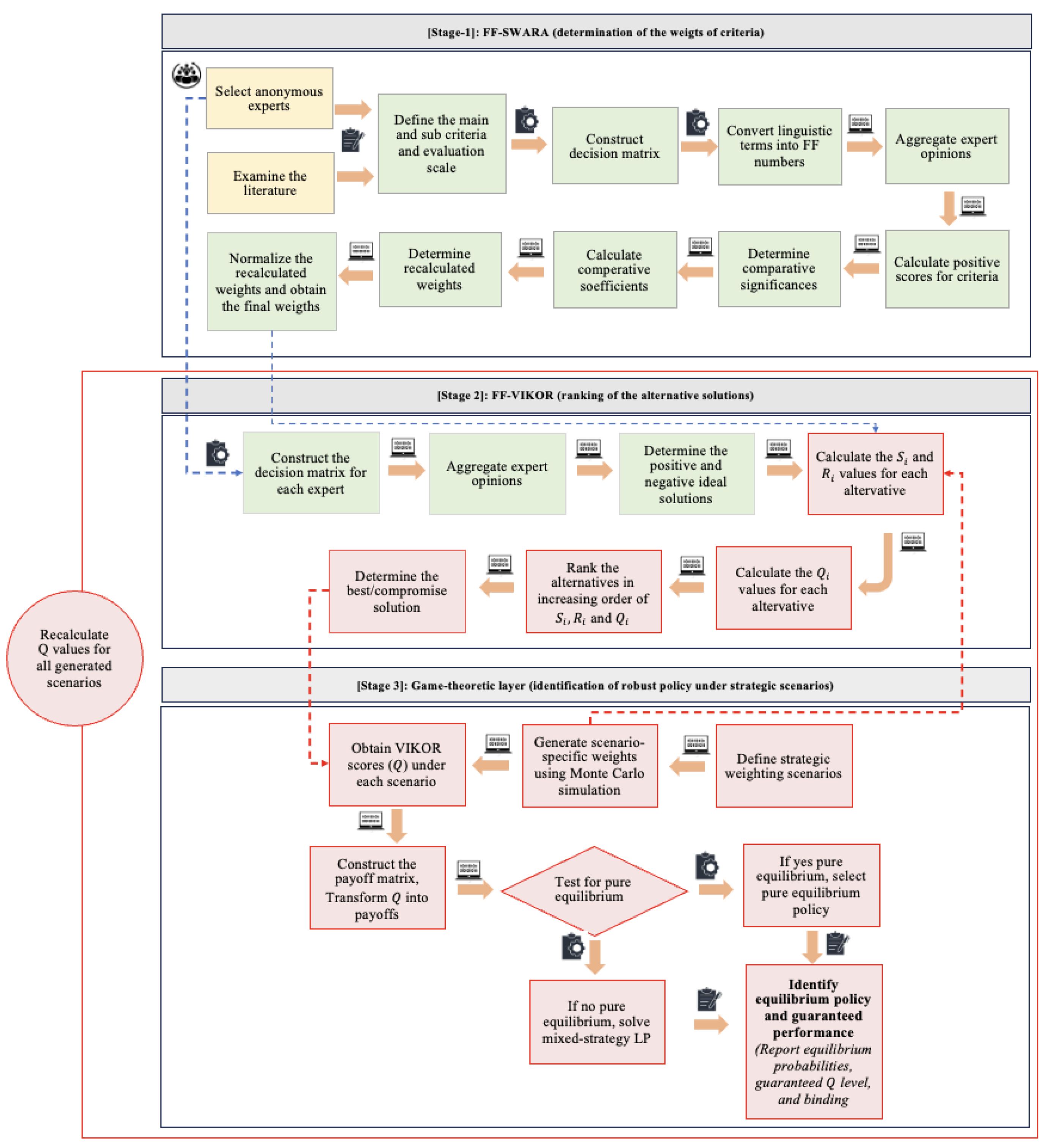
The integrated framework developed in this study consists of three complementary stages that combine fuzzy MCDM methods with a game-theoretic analysis to evaluate strategies and determine robust policy solutions for sustaining medicine and vaccine supply chains. Fuzzy set theory has progressively evolved from its classical form to richer, application-driven formulations that better capture imprecision and hard operating constraints in complex systems [118]. This design ensures adaptability to complex decision environments by capturing both expert perceptions and the dynamic nature of strategic trade-offs across different policy scenarios. Algorithm 1 presents the pseudocode of the proposed methodology.
Stage 1—FF-SWARA (determination of criteria weights): In the first stage, the FF-SWARA technique is applied to determine the weights of the evaluation criteria. Expert judgments are elicited to reflect the relative importance of criteria, while FFSs handle the subjectivity and uncertainty embedded in these assessments. The SWARA method is chosen because it captures expert opinions without imposing the computational burden of pairwise comparisons, ensuring a more streamlined, transparent, and expert-driven weighting process.
Stage 2—FF-VIKOR (ranking of alternatives): In the second stage, policy alternatives are evaluated against the weighted criteria using FF-VIKOR. This method provides a compromise solution by balancing group utility with individual regret, thereby accommodating the inherent subjectivity of expert evaluations. The process yields scenario-specific performance scores S i ,   R i ,   Q i and identifies the best compromise solution under each weighting scheme.
Stage 3—Game-theoretic layer (identification of robust policy under strategic scenarios): To ensure robustness across different strategic priorities, a game-theoretic layer is incorporated as the third stage. Here, multiple scenario-based weighting schemes (e.g., cost-focused, infrastructure-driven, human-capital, governance-oriented, balanced) are generated through expert adjustments and Monte Carlo simulation. For each scenario, VIKOR scores are recalculated, and the resulting payoff matrix is constructed by transforming   Q   values into payoffs P = Q . The matrix game is then analyzed to test for a pure equilibrium (saddle point). If none exists, a mixed-strategy equilibrium is solved via linear programming for both the policy and scenario players. The equilibrium outcome identifies the optimal policy (or policy mix) and the guaranteed performance level, along with the binding scenarios and strategies that shape robustness.
Algorithm 1. Three-Stage FF–SWARA–VIKOR–Game Theoretic Framework
Stage 1. FF-SWARA
Input:
   Expert set E = E 1 , E 2 , , E e ,
   Criteria set C = C 1 , C 2 , , C n ,
   Fermatean fuzzy linguistic scale//see Table 4
Output:
   Final normalized FF–SWARA weights w j for all criteria.
Begin
    A ˜ j ← Establish the aggregated decision matrix:
      LT jk ← Obtain expert evaluations for each criterion C j using FF LTs//see Table 4.
      A ˜ jk = μ jk , ν jk Translate each LT jk into an FFN//see Table 4.
      A ˜ j ← Aggregate expert opinions for each criterion using the FFWG operator//see Equation (10).
    S + j ← Compute the positive score for each criterion//see Equation (11).
   Rank criteria in descending order based on the positive score values.
    c j ← Excluding the first-ranked criterion, compute the comparative significance of each remaining criterion by comparing its S + j value with that of the previous criterion in the ordered list.
    k j ← Set the comparative coefficient of the first-ranked criterion to 1; compute it for each of the remaining criteria accordingly//see Equation (12).
    q j ← Set the recalculated weight of the first-ranked criterion to 1; iteratively determine it for the remaining criteria//see Equation (13).
    w j ← Normalize all recalculated weights using sum-based normalization to obtain the final weights//see Equation (14).
End
Stage 2. FF-VIKOR
Input:
   Final weights w j (from Stage 1),
   Alternatives   A = A 1 , A 2 , , A m ,
   Strategy weight τ for balancing group utility and individual regret; typically set to 0.5
Output:
   Compromise ranking of alternatives and the best alternative(s)
Begin
    LT ij ← Obtain expert evaluations of each alternative A i under every criterion C j using the FF linguistic terms//see Table S1.
    A ˜ ij agg ← Aggregate expert evaluations into the aggregated FF decision matrix using the FFWG operator//see Equation (9).
   Determine ideal solutions:
      A * ← Determine the positive ideal solution containing the best performance values for each criterion//see Equation (15).
      A ← Determine the negative ideal solution containing the worst performance values for each criterion//see Equation (16).
    S i , R i ← Compute the group utility and individual regret measures for each alternative using the weighted Euclidean distance calculation//see Equations (17) and (18).
    Q i ← Calculate the compromise index integrating S i and R i through the strategy weight τ //see Equation (19).
   Rank alternatives in ascending order of their Q i values:
      If two alternatives have equal Q i , use S i and R i as tie-breakers.
      Identify the alternative with the lowest Q i as the candidate compromise solution (Alt′) and the second-lowest as (Alt″).
      Verify the two VIKOR acceptability conditions for (Alt′).
        Acceptable advantage: Q Alt Q Alt D Q , where D Q = 1 / m 1 //see Condition-1.
        Acceptable stability in decision-making: (Alt′) must also rank first in either S i or R i ordering//see Condition-2.
      Determine compromise solution:
        If both Condition-1 and Condition-2 are satisfied, (Alt′) is the unique compromise solution.
        If only Condition-2 fails, include (Alt′) and (Alt″) in the compromise set.
        If only Condition-1 fails, extend the set to include all alternatives up to A H such that Q A H Q Alt < 1 / m 1 .
End
Stage 3. Game-Theoretic Layer
Input:
   Strategic weighting scenarios set S = S 1 , , S t representing different governmental orientations,
   Alternatives   A = A 1 , A 2 , , A m
Output:
   Equilibrium policy (pure or mixed) and the guaranteed VIKOR level Q guaranteed
Begin
    Q A i , S l ← For each S l , run the FF-VIKOR procedure to evaluate the performance of each policy A i .
    P ← Convert Q A i , S l values into a payoff matrix to fit the zero-sum game formulation//see Equation (20).
    P _ S l , P - A i ← Compute security level for scenarios (strategy selector) and upper value for policy alternatives (policy maker)//see Equations (21) and (22).
    minimax , maximin Determine minimum of P - A i values and maximum of P _ S l values.
   Examine whether a saddle point exists:
      A saddle point (i.e., pure-strategy Nash equilibrium) exists at A i * , S i * where P A i * , S i * = maximin = minimax .
      If no saddle point exists (maximin ≠ minimax), formulate the mixed-strategy linear programming model for the policy player (row)//see Equation (23).
    𝓋 * , 𝓍 * ← Solve the model for the optimal value of the game ( 𝓋 * ) and probability vector (optimal mixed policy 𝓍 * ).
    Q guaranteed ← Compute the guaranteed VIKOR level//see Equation (24).
    𝓌 * , 𝒴 ← Formulate and solve the dual LP for the strategy selector (column)//see Equation (25).
End of Algorithm
This three-stage framework, i.e., FF-SWARA, FF-VIKOR, and the game-theoretic layer, operationalizes systems thinking by combining expert-driven weighting, compromise-based ranking, and equilibrium-based robustness testing. By integrating FFSs throughout all stages, the framework effectively addresses uncertainty in expert judgments and delivers policy recommendations that are both context-sensitive and strategically resilient. Figure 1 presents the flowchart of the integrated framework.
Before delving into the detailed methodology, essential definitions related to FFSs are provided.
Equation (1) defines an FF number in a given set as F ˜ [8]:
F ˜   x ,   μ F ˜ x ,   v F ˜ x ; x X
The levels of membership and non-membership of component x X to F ˜ are defined as μ F ˜ x : X   0 , 1 and v F ˜ x : X   0 , 1 , where Equation (2) must be satisfied:
0 μ F ˜ x 3 + v F ˜ x 3 1
The uncertainty level is calculated using Equation (3):
π p ˜ x =   1 μ F ˜ x 3 + v F ˜ x 3 3
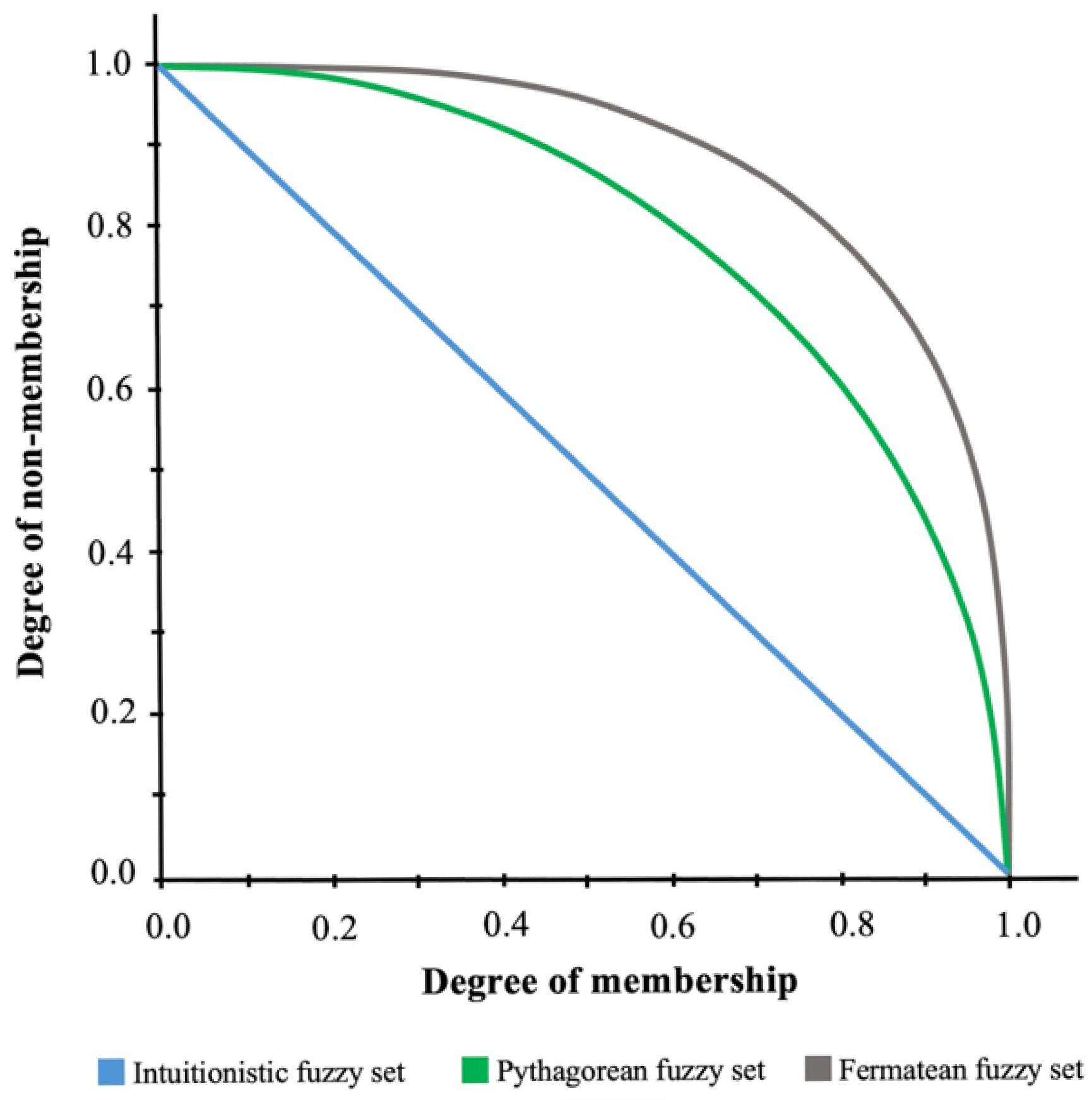
Figure 2 provides a visual representation that depicts the relationships among the parameters of FFSs, enabling comparisons with Intuitionistic and Pythagorean fuzzy sets [119].
Definition 1. 
FF numbers (FFNs)  α ˜ = μ α ˜ ,   v α ˜  and  β ˜ = μ β ˜ ,   v β ˜  as sum and combination of numeric operations are given in Equations (4) and (5), respectively [8]:
α ˜ β ˜ = μ α ˜ 3 + μ β ˜ 3 μ α ˜ 3 μ β ˜ 3 3 , v α ˜ v β ˜
α ˜ β ˜ = μ α ˜ μ β ˜ , v α ˜ 3 + v β ˜ 3 v α ˜ 3 v β ˜ 3 3
Definition 2. 
Multiplication by scalar and the power  λ 0  of an FF number  α ˜ = μ α ˜ ,   v α ˜  are defined in Equations (6) and (7), respectively [119]:
λ α ˜ = 1 1 μ α ˜ 3 λ 3 , v α ˜ λ
α ˜ λ = μ α ˜ λ , 1 1 v α ˜ 3 λ 3
Definition 3. 
The Euclidean distance between two FFNs, depicted as  α ˜  and  β ˜ , is defined as in Equation (8) [120]:
d α ˜ ,   β ˜ = 1 / 2 μ α ˜ 3 μ β ˜ 3   2 + v α ˜ 3 v β ˜ 3 2 + π α ˜ 3 π β ˜ 3 2
Definition 4. 
Let  F ˜ k = μ F ˜ k , v F ˜ k  be several FFNs and  δ 1 , δ 2 , , δ l T  be a weight vector of the experts  k = 1 , 2 , , l  with  k = 1 l δ k = 1 .
Later, the function FFWG represents an FF-weighted geometric (FFWG) operator (see Equation (9)) [8]:
F F W G F ˜ 1 , F ˜ 2 ,   , F ˜ e = k = 1 e μ F ˜ k δ k , k = 1 e v F ˜ k δ k
In the following formulations, i denotes alternatives i = 1 , 2 , , m ,   j indicates criteria j = 1 , 2 , , n ,   k represents the experts k = 1 , 2 , , e .

4.1. Stage-1: SWARA Method Equipped with FFNs (FF-SWARA)

The steps of the FF-SWARA approach are as follows.
Step 1: Constructing the decision matrix L T j k with expert input for each criterion, using the linguistic terms (LTs) from Table 4 [25].
Step 2: Translating the FF linguistic assessments from each expert into FFNs by referring to the scale specified in Table 4. Let A ˜ j k = μ j k , v j k be an FFNs-based assessment of criterion j by expert k . Later, an F F W G operator is applied for the aggregation of the expert judgments for each criterion to establish aggregated FF decision matrix via Equation (10).
A ˜ j = F F W G A ˜ j 1 , A ˜ j 2 ,   , A ˜ j e = k = 1 e μ F ˜ k δ k , k = 1 e v F ˜ k δ k   j = 1 , 2 , , n   a n d   k = 1 , 2 , , e
where δ k denotes the importance weight of the expert k .
Step 3: Computing the positive score S + j for each criterion using Equation (11).
S + j = 1 + μ j 3 v j 3
Step 4: Ranking criteria in descending order based on S + j values. The higher the score, the greater the relative significance of the criterion.
Step 5: Determining the comparative significance c j by subtracting S + j of criterion j from that of the previous criterion j 1 .
Step 6: Computing the comparative coefficient k j for each criterion using Equation (12).
k j = 1 ,   j = 1 S + j + 1 , j > 1
Step 7: Computing the recalculated weight q j iteratively using Equation (13).
q j = 1 , j = 1 q j 1 k j ,   j > 1
Step 8: Driving final weight for each criterion by normalizing the recalculated weights, as given in Equation (14).
w j = q j j = 1 n   q j

4.2. Stage-2: VIKOR Method Equipped with FFNs (FF-VIKOR)

Herein, alternative solutions are ranked [120], aiming to identify compromise solutions that closely align with the ideal choice [121]. The FF-VIKOR steps are shown bellows.
Step 1: Consulting experts to obtain performance evaluations of alternatives for each criterion, using the LTs listed in Table S1 (see Supplementary Materials) [121].
Step 2: Establishing the aggregated FF decision matrix via Equation (9).
Step 3: Determining the positive ( A * ) and negative ( A ) ideal solutions via Equations (15) and (16).
A * = x ˜ i j   w h e r e   max i   x ˜ i j i = 1 , 2 , , m
A = x ˜ i j   w h e r e   min i   x ˜ i j i = 1 , 2 , , m
In this context, x ˜ i j is FF performance value of the i t h alternative for the j t h criterion. Additionally, the elements of A * are represented as x j * = μ j * ,   v j * , while the elements in A   are denoted as x j = μ j ,   v j .
Step 4: Computing S i   as the average gap between alternative and ideal solutions, and R i as the maximum gap for improvement priority. These metrics, based on FFS principles, are computed via Equations (17) and (18).
S i = j = 1 n w j d e u c x i j ,     x j * d e u c x j ,       x j *
R i = m a x w j d e u c x i j ,       x j * d e u c x j ,       x j *
where d e u c indicates the Euclidean distance (Equation (8)).
Step 5: Computing Q i , which integrates both average and maximum gaps, via Equation (19).
Q i = τ S i S * S S * + 1 τ R i R * R R *
where S * = min i   S i ,   S = max i   S i , R * = min i   R i , R = max i   R i . In this context, τ —weight for maximizing group utility, while 1 τ —weight of individual regret. These two strategies can potentially find a middle ground when τ is set to 0.5.
Step 6: Ranking alternatives in ascending order based on their S i , R i and Q i values. Low Q i value of alternative is the most appropriate choice A l t . To be considered as a compromise solution, the following two conditions must be adhered to by the alternative.
Condition-1: “Acceptable advantage”: The disparity between Q A l t and Q A l t must be equal to or greater than D Q , where A l t represents the alternative with the second smallest value based on the Q i measure, and D Q is equivalent to 1 / m 1 .
Condition-2: “Acceptable stability in decision-making”: The alternative A l t should occupy the top position in the ascending order of S or R rankings.
A compromise solution is found when these conditions are unfulfilled.
When only Condition-2 is not satisfied, a set that includes both alternative A l t and alternative A l t   is taken into consideration.
When only Condition-1 is not satisfied, a set is created, which includes alternative A l t , alternative A l t , and potentially other alternatives up to alternative H . The determination of alternative H is based on the condition that Q H Q A l t < 1 / m 1   for the maximum value of H .

4.3. Stage-3: Game-Theoretic Layer

At this stage, we incorporate a game-theoretic framework, grounded in the classical minimax formulation of zero-sum games [79] and enriched by the strategic interaction perspective introduced by Stackelberg [80], to evaluate robust policy selection under adversarial scenarios. Let Q A i , S l 0 , 1 denote the VIKOR compromise index of policy A i = A 1 , A m under strategic weighting scenario S l = S 1 , S t (lower is better). Here, m   denotes the number of policy alternatives (rows), whereas t   represents the number of strategic weighting scenarios (columns). To obtain a game payoff where “larger is better”, then we define Equation (20):
P A i , S l = Q A i , S l
Now, the column player (scenario selector) minimizes payoff, and the row player (policy-maker) maximizes it. Payoffs are defined as P A i , S l = Q A i , S l , ensuring that larger values indicate better performance for the policy maker. Rows correspond to policy alternatives, and columns correspond to strategic weighting scenarios.
Given the payoff matrix   P , define for each column S l   its security level is defined in Equation (21) and for each row A i its upper value is defined in Equation (22), respectively.
P _ S l = min A i   P A i , S l
P ¯ A i = max S l   P A i , S l
The compute, m a x i m i n = max S l   P _ S l and m i n i m a x = min A i   P ¯ A i . If m a x i m i n = m i n i m a x , a saddle point exists at some A i * , S l * with P A i * , S i * = m a x i m i n = m i n i m a x , which is a pure-strategy Nash equilibrium: S l * vs. A i * . Interpretation under the transformation P = Q : the equilibrium policy A i *   maximizes the guaranteed (worst-case) payoff P , while the equilibrium scenario S l *   minimizes it, representing the adversarial condition where the scenario player seeks to reduce the policy maker’s performance. If the equality does not hold (e.g., m a x i m i n m i n i m a x ), a mixed-strategy formulation is applied by using linear programming and it should be found mixed-strategy equilibrium. When no saddle point exists, the row player seeks a probability vector 𝓍 k over policies A i 𝓍 A i = 1 ,   𝓍 A i 0   that maximizes the guaranteed payoff 𝓋 against any scenario:
max 𝓍 , 𝓋 𝓋 s . t . A i = A 1 A m P A i , S l 𝓍 A i 𝓋 ,   S l = S 1 , , S t A i = A 1 A m 𝓍 A i = 1 ,   𝓍 A i 0
The optimal value 𝓋 * is the value of the game, and 𝓍 * is the optimal mixed policy. In this study, since P = Q , the guaranteed VIKOR level is
Q g u a r a n t e e d = 𝓋 *
For completeness, the dual identifies the adversarial mixture over scenarios 𝒴 m   S i = S 1 S t 𝒴 S l = 1 , 𝒴 S l 0 :
min 𝒴 , 𝓌 𝓌 s . t . S i = S 1 S t P A i , S l 𝒴 S l 𝓌 ,   A i = A 1 , , A m S i = S 1 S t 𝒴 S l = 1 ,   𝒴 S l 0
With 𝓌 * = 𝓋 * . Rows binding at optimum (constraints tight) indicates the critical scenarios that shape at equilibrium.

5. Application of the Proposed Methodology

In this research, 35 challenges to the promotion of sustainable MVSCs have been successfully identified and categorized into eight distinct groups, and four potential alternative solutions have been put forward to address them. The complete list of these challenges, together with their definitions and corresponding main criteria, is provided in Table 3. To ensure a consistent and trustworthy evaluation, an interview is conducted with experts of the field.
This group of experts consists of three consultants and four medical officers, all possessing considerable expertise in policymaking and industry. They were carefully selected based on specific criteria, including their proficiency in MVSCs, each with a minimum of ten years of experience.
To manage consistency in expert judgments, we used a structured consensus protocol: experts first provided independent linguistic assessments, then participated in a moderated clarification session to discuss scale usage and resolve large divergences, followed by a second pass to confirm stability. Agreement was finalized by majority consensus, after which the linguistic terms were converted to FFNs for aggregation.

5.1. Criteria Weights Determination

Experts are instrumental in model development, where they assess defined criteria and sub-criteria using a set of predetermined LTs listed in Table 4. The resulting evaluations are carefully organized into a decision matrix presented in Table 5.
LTs were converted into FFNs following the scale given in Table 4. The complete set of converted values, along with detailed challenge definitions, is presented in Supplementary Materials Table S2. Expert assessments were subsequently combined using Equation (9), resulting in the aggregated evaluations given in Table 6.
Aggregated evaluations in Table 6 are used to calculate criteria scores with Equation (11). The criteria are ranked by their scores in descending order. The steps 4–8 in the first stage are used for criteria weight determination, as shown in Table 7, which includes both scores and weights.
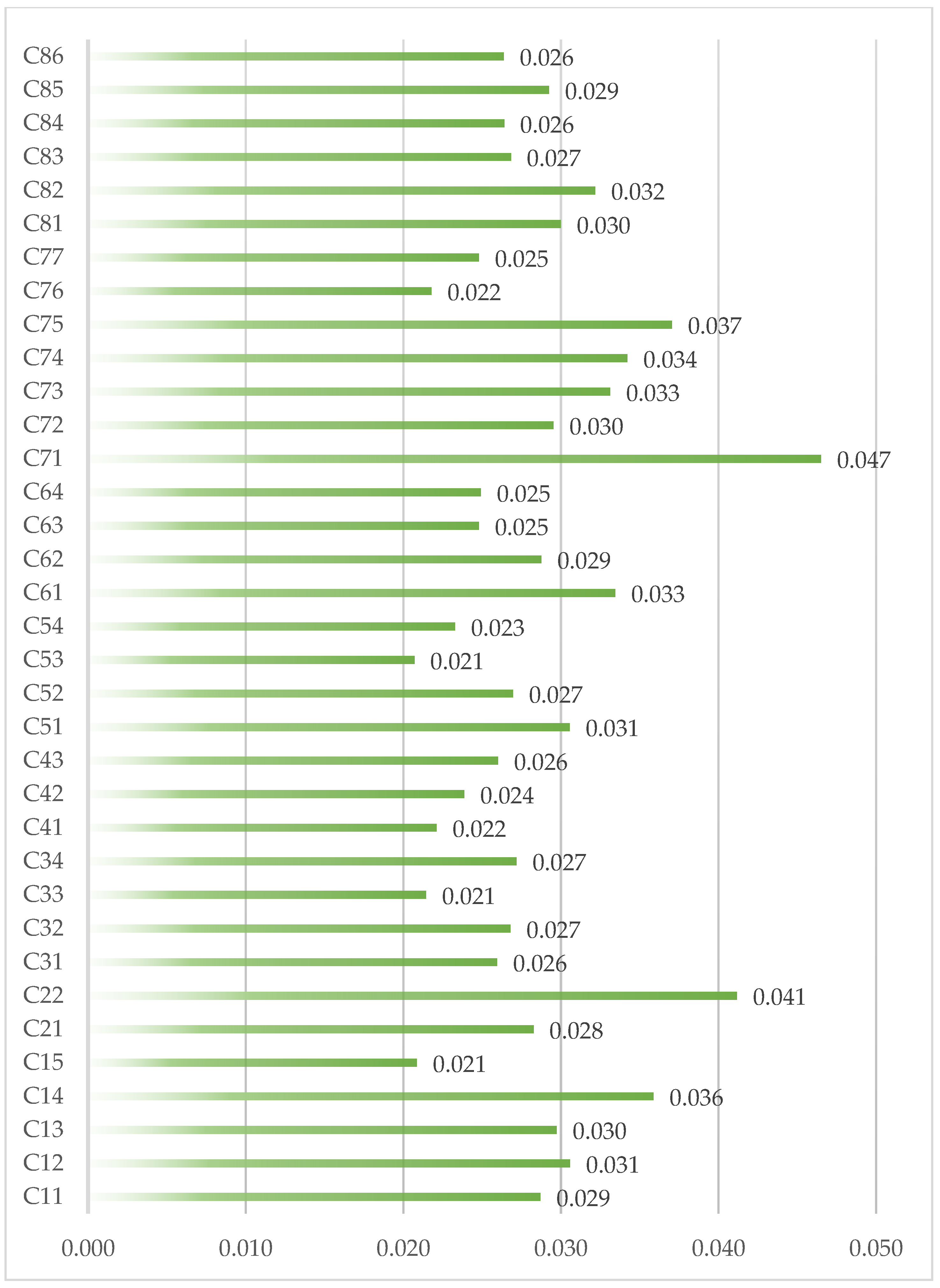
Figure 3 shows the values and rankings related to all 35 challenges for the promotion of sustainable MVSCs, without taken into consideration their group. The analysis reveals that the most critical challenge is “C71- interruption of drug supplies”, followed by C22, C75, C14, and C74, respectively. These findings highlight that interruption of drug supplies (C71), poor funding for vaccine supply (C22), loss of potency of cold chain medical supplies (C75), lack of human resources (C14), and damaged products and packages (C74) are the most significant challenges hindering the sustainability of MVSCs in Nigeria.

5.2. Evaluating the Alternatives

This study seeks to find the right policy to improve MVSCs in developing countries. Four different policies were identified and evaluated by experts based on predetermined criteria. The expert evaluations, as displayed in Table S3 (see in Supplementary Materials), are a pivotal part of this study.
Following the translation of LTs into FFNs, decision matrices were created and merged using the FFGM operator, defined in definition 4. Subsequently, best ( X ˜ * ) and worst ( X ˜ ) values were found for each criterion. In the next step, utilizing the aggregated values, S i , R i and Q i were computed. This process involved applying final criteria weights with a parameter λ set to 0.5, following the methodology outlined by Ayyildiz [25]. The resulting S i , R i and Q i   values for each alternative strategy are detailed in Table 8, providing a comprehensive picture of their performance and suitability within the study’s context.
In the Q i ranking, A4, which addresses “infrastructure facilities provision including steady electricity access,” takes the top spot. It meets condition 2 for “acceptable stability in decision-making” and is ranked first in the R i   ranking. However, it falls short of satisfying condition 1, which requires “acceptable advantage”. The difference (0.1711) between Q 1 and Q 4 (A1—effective policy implementation, the second-appropriate alternative) is insufficient to exceed the threshold of 0.3333 (1/(4−1)). Therefore, the most optimal approach involves a compromise solution that combines both A4 and A1, emerging as the most favorable choice.
The top ranking of “infrastructure facilities provision including steady electricity access (A4)” aligns well with the findings of Olutuase et al. [58] study, which underscores the crucial role of infrastructure, specifically the uninterrupted electricity supply, in the success of Nigeria’s MVSCs. This strategy excels in preserving the quality and effectiveness of medicines and vaccines through effective cold chain management, a critical concern in MVSCs. However, the inability of “effective implementation of existing policies (A1)” to meet the condition of “acceptable advantage” suggests that policy improvements alone may not suffice for achieving the desired impact. Consequently, the need for a combined approach, involving both A4 and A1, emerges as a promising solution. This finding resonates with our study’s central theme, emphasizing the multifaceted challenges in healthcare access and the necessity of adopting comprehensive strategies to enhance access to medicines and vaccines in Nigeria.

5.3. Sensitivity Analysis

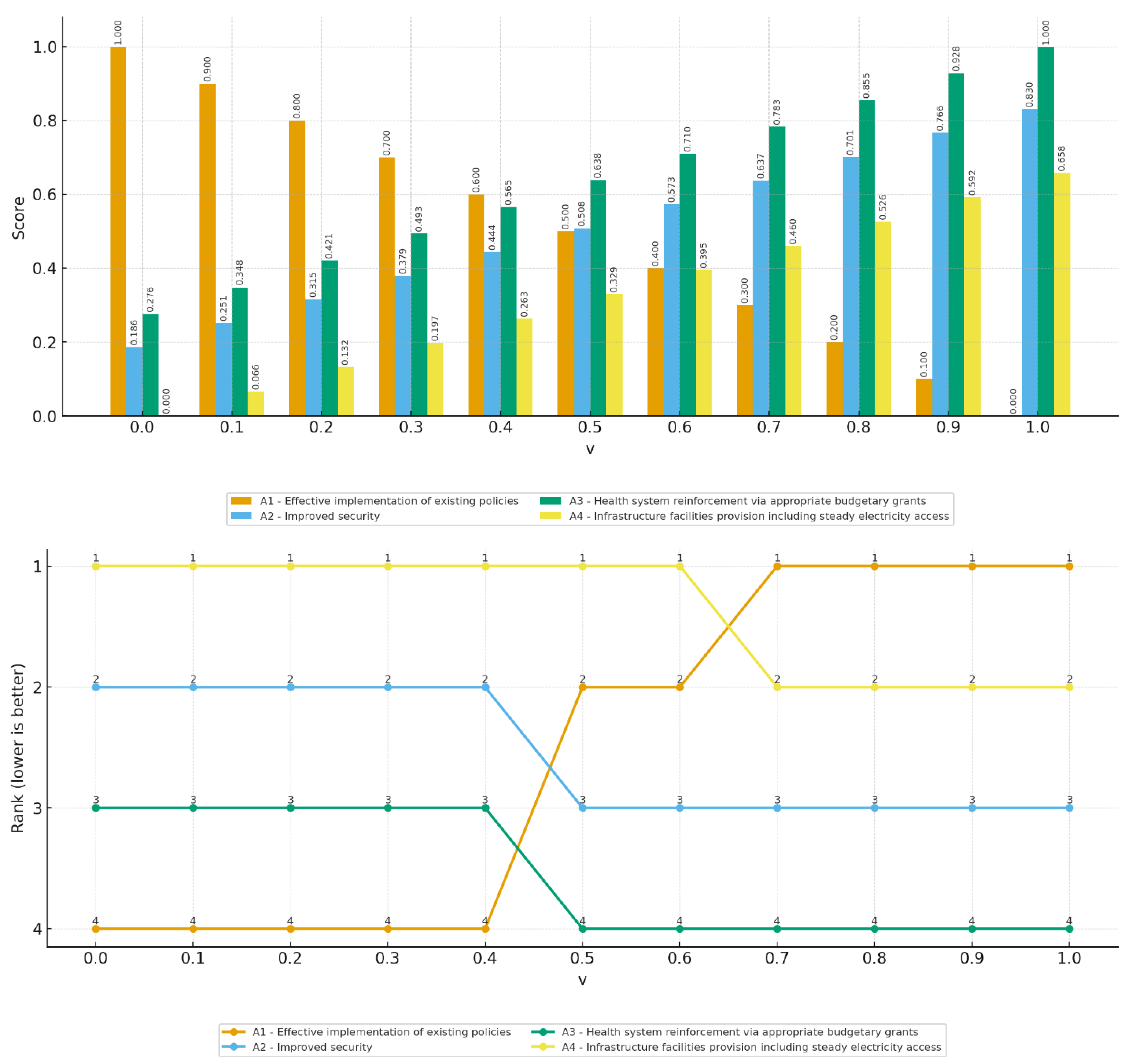
A sensitivity analysis was conducted to test the robustness of the proposed framework for evaluating the alternative strategies. We varied the VIKOR compromise parameter v from 0.1 to 0.9 in steps of 0.1 and recomputed the results at each setting. This procedure examines how changes in v affect the scores and rankings, allowing us to assess the framework’s stability under different decision-maker preferences. The resulting score trajectories ( S i , R i , and Q i ) are presented in Figure 4, and the corresponding rankings of the alternatives for each v   are also shown in Figure 4.
Reading Figure 4, the sensitivity to the VIKOR compromise parameter v reveals two clear regimes. For v 0.4 (greater emphasis on minimizing the worst individual regret), Infrastructure facilities provision including steady electricity access (A4) ranks first, Improved security (A2) second, Health system reinforcement via appropriate budgetary grants (A3) third, and Effective implementation of existing policies (A1) fourth. Around v = 0.5 0.6 , the ordering pivots: A4 remains first while A1 rises to second. For v 0.7 (greater emphasis on group utility), A1 becomes the top alternative and A4 moves to second, with A2 consistently third and A3 fourth across the upper half of the range. In short, the policy-focused A1 dominates when aggregate benefit is prioritized, the infrastructure-focused A4 leads when conservatism toward worst-case outcomes is stronger, and A2/A3 show relatively stable but lower positions throughout.

5.4. Comparative Analysis

In this subsection, to assess the robustness of our findings and compare them with alternative approaches, a validation analysis was conducted using Technique for Order Preference by Similarity to Ideal Solution equipped with FFNs (FF-TOPSIS) and Simple Additive Weighting equipped with FFNs (FF-SAW) methods. The ranking results obtained from these methods, along with the initial FF-VIKOR rankings, are presented in Table 9.
However, the positioning of A1 (effective policy implementation) across the different methods provides additional insight into its importance. While FF-VIKOR ranked A1 s, both FF-TOPSIS and FF-SAW positioned it as the most suitable alternative. This difference may stem from the structural variations of the methods. Nevertheless, the fact that A1 and A4 consistently occupy the top two positions across all methods indicates their significance in improving MVSC access.
As previously discussed, the compromise solution combining A1 and A4 emerges as the most effective strategy. This comparative analysis further supports the idea that infrastructure improvements (A4) must be complemented by effective policy measures (A1) to achieve the best results.
Additionally, the ranking stability of A2 and A3 across all methods supports the conclusion that these alternatives are relatively less effective compared to A1 and A4. In particular, A3 consistently occupies the lowest rank, indicating that it is the least favorable strategy for improving MVSC access.
The validation analysis confirms the robustness of the initial findings, emphasizing that a combined strategy integrating A4 (infrastructure investment) and A1 (policy implementation) remains the most optimal approach. This aligns with our earlier conclusion that achieving sustainable improvements in MVSCs requires both physical infrastructure enhancements and effective governance frameworks.
This comparative analysis sheds light on the relative advantages and disadvantages of the FF-VIKOR algorithm, in addition to confirming the consistency of the rankings. A notable advantage of FF-VIKOR is its ability to handle uncertainty through FFSs. This provides a more nuanced representation of imprecision compared to classical or less advanced fuzzy techniques. Furthermore, in multi-criteria decision contexts such as MVSCs, where trade-offs between competing criteria are inevitable, its focus on compromise solutions is particularly valuable. However, the complexity of the method may be higher than that of simpler approaches such as FF-TOPSIS and FF-SAW. This may pose challenges in terms of parameter selection and computational complexity. In addition, FF-VIKOR’s reliance on threshold-based trade-offs may require more in-depth domain expertise for effective interpretation of its results. Overall, the comparison highlights that FF-VIKOR provides a robust framework for identifying compromise solutions in complex, fuzzy environments.
In addition to ranking consistency, the use of FF-TOPSIS and FF-SAW also offers perspective on computational efficiency. FF-SAW is computationally the simplest method among the three, as it relies on weighted summation of normalized performance values and does not require iterative optimization or pairwise comparison structures. FF-TOPSIS remains relatively light as well: although it involves calculating distances to fuzzy positive and negative ideal solutions, the procedure is direct and scales linearly with the number of criteria and alternatives. By contrast, FF-VIKOR requires additional steps such as computing the group utility ( S i ), individual regret ( R i ), and the compromise measure ( Q i ), followed by acceptability and stability checks.
The combined insights from the sensitivity and comparative analyses provide strong evidence of the computational stability and robustness of the proposed FF-SWARA and FF-VIKOR framework. The sensitivity analysis demonstrated that the ranking of alternatives remained consistent across varying values of the VIKOR compromise parameter v , confirming the model’s low susceptibility to minor parameter changes. Similarly, the comparative analysis using FF-TOPSIS and FF-SAW yielded nearly identical ranking patterns, reinforcing the reliability of the results. Although methodological differences among these techniques introduce slight variations in ranking positions—such as the interchange between A1 and A4—the overall consistency across all methods underscores the robustness of the decision-making framework. These findings collectively validate that the proposed FF-SWARA and FF-VIKOR approach maintains strong computational reliability, effectively manages uncertainty, and ensures credible, stable decision outcomes under varying analytical conditions.

5.5. Investigating Policy Robustness Through Game Theory

To strengthen the robustness and policy relevance of the decision-making process, we extend the baseline analysis by incorporating multiple strategic weighting scenarios. While the initial case study (denoted as S 1 ) relies on expert-elicited judgments to determine the weights of the eight main criteria and their sub-criteria, governments may prioritize these dimensions differently depending on their strategic orientation. To capture such heterogeneity in decision priorities, we introduce five additional weighting schemes S 2 S 5 that reflect plausible state strategies:
S 1 —Case study (Expert-Based Weights): This baseline scenario represents the status quo, where weights are derived directly from expert elicitation. In this setting, the eight main criteria and their sub-criteria are prioritized according to the real-world judgments of practitioners with extensive experience in medicine and vaccine supply chains. This scenario anchors the analysis by reflecting how decision-makers currently perceive the importance of different challenges in practice.
S 2 —Cost-Focused Strategy: In this scenario, financial constraints and budget efficiency are treated as paramount. Criteria such as inadequate funding for vaccine supply (C22), lack of financial resources (C21), and frequent stock-outs (C61, C63, C64) receive disproportionately high weights. Technical and infrastructure factors remain relevant but secondary, while human resource-related aspects are deprioritized. This weighting scheme reflects the conditions of states operating under strict budgetary limitations.
S 3 —Infrastructure and Technology-Driven Strategy: This scenario emphasizes technical robustness and infrastructure development, recognizing that physical bottlenecks often undermine supply chain resilience. Cold chain reliability (C75), storage facilities (C51–C53), stable electricity and power systems (C76), and transportation delays (C31–C34) are heavily weighted. While financial and governance issues are not ignored, they are considered less pressing relative to the urgent need for infrastructural reinforcement.
S 4   —Human Capital and Capacity Development Strategy: Here, the highest priority is given to workforce availability, skills, and institutional capacity. Challenges such as inadequate personnel (C13), lack of support for logistics staff (C12), and systemic human resource shortages (C14) dominate the weighting distribution. Infrastructure and financial concerns receive considerably less emphasis. This scenario simulates contexts where policymakers seek long-term improvements by investing in people rather than short-term infrastructure fixes.
S 5   —Governance-Oriented Strategy: In this strategy, the focus shifts to regulatory quality, policy enforcement, and data-driven decision-making. Sub-criteria such as non-adherence to policies (C43), inadequate policy implementation (C41–C42), and poor data management and reliability (C82–C86) receive the largest share of weights. Human resource, infrastructure, and financial aspects are assigned relatively lower importance. This scenario reflects states aiming to strengthen institutional effectiveness and transparency.
S 6 —Balanced/Inclusive Strategy: Finally, in this scenario, all criteria are treated equally, with weights distributed uniformly across the 35 sub-criteria. This approach avoids privileging any single dimension and represents a neutral standpoint where decision-makers consider all possible challenges. It serves as a robustness check, testing whether the ranking of policy alternatives remains stable when no clear strategic bias is imposed.
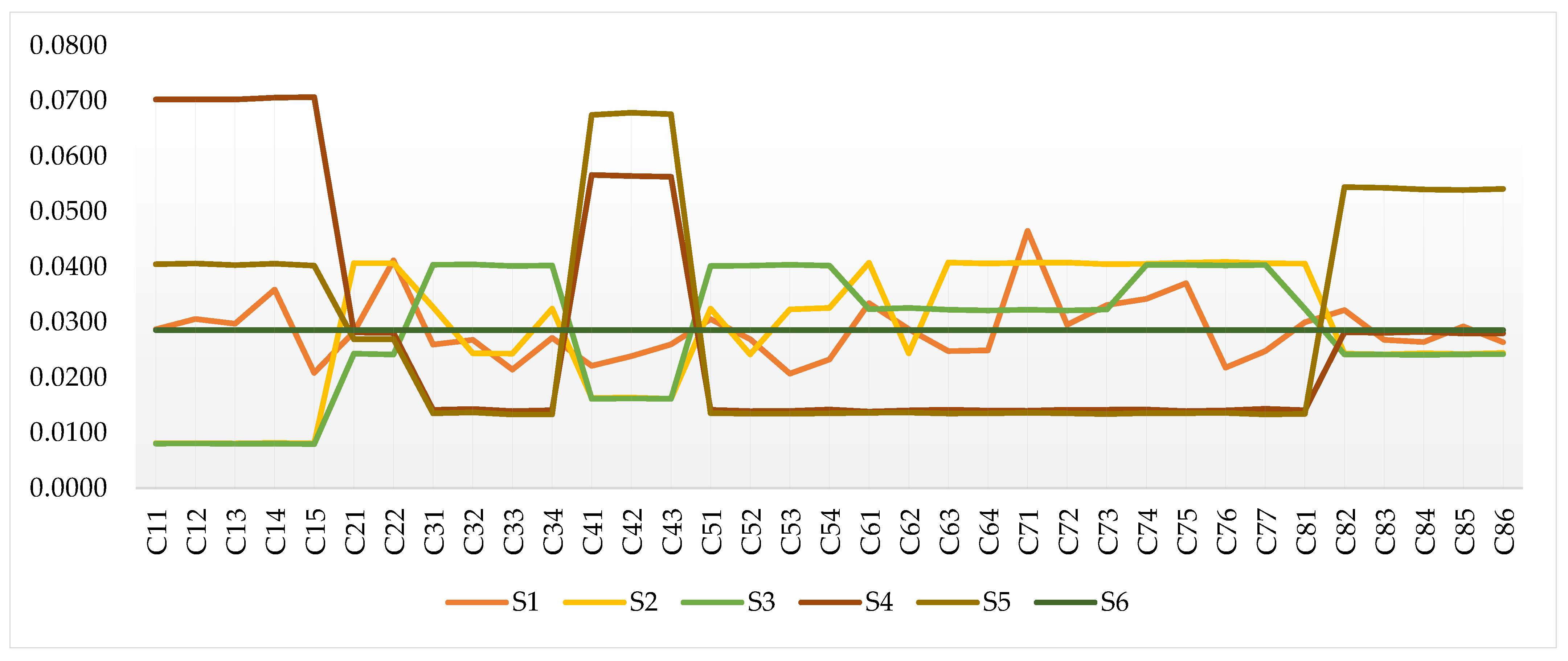
For each scenario, criteria weights were generated through a Monte Carlo Dirichlet-based simulation, which allows the assignment of stochastic, yet strategically biased distributions aligned with the logic of each state priority. This procedure ensures that the sum of weights across all sub-criteria equals one, while systematically shifting emphasis toward the categories most aligned with the strategic focus. The resulting distributions of criteria weights across scenarios are presented in Figure 5, which illustrates how the relative importance of challenges changes depending on the state’s strategic orientation. The figure highlights how the relative importance of criteria shifts depending on whether the focus is on cost, infrastructure and technology, human capital, governance, or balanced priorities. These differentiated weighting schemes serve as inputs to the VIKOR evaluation, producing scenario-specific policy rankings. In the subsequent step, these results are used to construct a game-theoretic payoff matrix, enabling the identification of the most robust policy alternative under diverse government strategies. The game-theoretic payoff matrix, constructed based on VIKOR scores derived from the scenario-specific weighting schemes S 1 S 6 , is reported in Table 10.
Now, we model the interaction between state priorities and policy alternatives as a zero-sum game. The row player is the strategic weighting S i , and the column player is the policy alternative Table 10 presents the payoff matrix derived from the scenario-specific VIKOR results.
In this study, the saddle point is identified (e.g., m a x i m i n m i n i m a x ), mixed-strategy probabilities are investigated; therefore, for both the row player and the column player, linear programming models are established and solved in GAMS 51 Cplex Solver package. The corresponding equilibrium strategies together with the game value are reported in Table 11. Table 11 summarizes the equilibrium of the zero-sum game constructed from scenario-specific VIKOR payoffs. The table reports the game value, the guaranteed VIKOR level, and the optimal mixed strategies of both the scenario (column) player and the policy (row) player.
The analysis indicates that no pure (saddle-point) equilibrium exists; instead, the solution is mixed for both players. The adversarial scenario mixture assigns nearly all probability to S 1   79 % with residual weight on S 2   21 % , which are the binding scenarios that determine the game value. On the other side, the robust policy mixture distributes probability mass between A 1   68.6 % and A 4   31.4 % , while A 2 and A 3 drop out of the support set as their constraints are slack at optimum. The guaranteed performance for the decision maker is Q 0.446 , irrespective of which strategy priority S 1 S 6 materializes. Any deviation from the equilibrium policy mix 𝓍 * can be exploited by the row player to increase the compromise index beyond this guaranteed level.

6. Findings and Discussion

After a comprehensive review of existing literature and consultations with experts, it is evident that several challenges hinder the establishment of sustainable MVSCs. Five primary challenges have been pinpointed that have the potential to render these SCs unsustainable. To gauge the significance of these challenges, the FF-SWARA approach has been employed to establish the criteria values. The results indicate that experts have identified “interruption of drug supplies” as the most significant challenge, giving it a weight of 0.0465. This strong emphasis aligns with the observations made by Faiva et al. [122], who highlighted several factors lead to the shortage of drugs in Nigeria. They noted that along with imported finished pharmaceutical products, there has been a notable growth in both wholesale and retail pharmacy businesses. Simultaneously, the expansion in local pharmaceutical manufacturing exists, which requires meeting stringent industrial standards for raw materials, drug formulation processes, equipment, and production environments. Moreover, the dominance of multinational pharmaceutical companies in the global pharmaceutical market has led to unfair competition between imported products and locally manufactured medicines. The necessity to normalize numerous circulating herbal medicines and the country’s struggle to effectively utilize research findings from its scientists have resulted in a brain drain of scientific talent to foreign laboratories. Additionally, the government’s inadequacies in regulating illegal importation, production, adulterated, substandard, and expired pharmaceutical products, often facilitated by dishonest drug dealers and corrupt officials, have exacerbated the issue. The ineffectiveness in R&D due to insufficient support has contributed to the shortage of drugs at the national level. Hence, the federal government must eliminate barriers in the importation of pharmaceuticals and develop alternative effective strategies to safeguard Nigeria from potential disruptions in the supply of essential drugs. This entails optimizing the efficiency of public pharmaceutical supply by leveraging the strengths of the public sector while introducing greater adaptability and competition. Following interruptions in drug supplies, the next most significant challenge is the poor funding for MVSC. As per Sarley et al. [82], inadequate funding for the distribution of vaccines represents some of the most prominent challenges in Nigeria’s MVSC. Their study documented the extensive efforts at the federal level to transform MVSCs and specifically highlighted collaborative work at the state level. They underscored the significance of adopting a comprehensive end-to-end approach and addressing the fundamental causes of system underperformance. Despite achieving impressive results, they noted that states have difficulty for funding straight deliveries. Therefore, it is recommended to diversify funding through partnerships establishment and donor coordination improvement. The third most crucial issue concerns the loss of potency of cold chain medical supplies. This aligns with research by Ojo et al. [123], suggesting that the main reason for reduced effectiveness in medicines and vaccines is not their expiration date, but rather poor and delayed handling. They stress that temperature-sensitive pharmaceuticals are perishable and need to be stored and distributed in controlled environments. To maintain vaccines and medicines at their best effectiveness, it is essential to exercise the utmost care in handling practices at every step of the cold chain. Furthermore, it is advisable to expedite the movement of vaccines and medicines within the SC and use them well before their expiry dates. Given the frequent power failures despite the presence of backup generators, it is also suggested to include in WHO criteria the maintenance of records for power outage durations, generator running times, and a comprehensive log of fuel consumption. Continuous training is additionally recommended to enhance the attitudes of vaccination staff and improve vaccine handling.
This study identifies the lack of human resources as the fourth most significant challenge, which is consistent with Olutuase et al. [58] study’s which highlight the issue in Nigeria’s medicine SC. To address this shortage in Nigeria’s MVSCs, a comprehensive approach is essential. This strategy begins with investments in education and training programs to develop a skilled workforce proficient in pharmaceutical SC management. Collaboration with educational institutions can facilitate the creation of specialized courses and certifications in logistics. Capacity-building initiatives, including workshops and on-the-job training, are vital for enhancing the skills of existing healthcare and SC professionals. To attract and retain talent, competitive compensation packages and opportunities for career advancement within the SC sector should be provided. Leveraging public–private partnerships can tap into external expertise and resources to optimize SC efficiency. The use of technology and data analytics for streamlined operations is equally crucial. Additionally, decentralizing responsibilities, cross-training, implementing incentives and recognition programs, and fostering international collaboration and data-driven research are all integral components of a comprehensive strategy to fortify the SC workforce and ensure the dependable distribution of medicines and vaccines throughout Nigeria.
Damaged products and packages are the fifth most significant challenge. This aligns with research by Raju et al. [124] noting that product and package damage during transportation, storage, or retail display often stems from poor packaging quality. Establishing a robust packaging strategy is essential for SC effectiveness. An effective packaging design seeks to minimize materials used while still providing necessary protection and support during transit.
The results obtained through the application of a two-stage FF-oriented methodology, which integrates the SWARA approach and the VIKOR technique, underscore the critical factors influencing the efficiency of Nigeria’s MVSC. These findings emphasize the significance of both implementing existing policies and developing essential infrastructure, with a particular focus on ensuring a reliable electricity supply. To achieve these objectives, a multifaceted approach is imperative. Effective policy implementation necessitates strict adherence to regulatory requirements, transparent practices, the cultivation of public–private partnerships, optimization of inventory management, and the maintenance of the cold chain for vaccines. Concurrently, infrastructure development entails improvements in transportation and logistics, the establishment of well-equipped warehouses, the adoption of advanced information technology systems, and the enhancement of security measures. Ensuring a consistent electricity supply is a foundational requirement, which involves improvements in both power generation and distribution, as well as the implementation of backup power solutions such as generators and solar energy. Continuous monitoring and evaluation, conducted through audits and data-driven decision-making, community engagement, emergency response planning, and resource mobilization for funding, further bolster this comprehensive strategy. The overarching goal is to guarantee the continued accessibility and high quality of medicines and vaccines, thereby contributing significantly to the enhancement of public health outcomes in Nigeria. Effective collaboration among all stakeholders is essential for surmounting challenges and translating these improvements into tangible, real-world results.

Managerial Insights

The study’s findings provide several actionable insights for healthcare policymakers and industry professionals in Nigeria:
Policy reforms and system strengthening
Remove barriers in pharmaceutical importation.
Develop alternative strategies to ensure a steady supply of essential drugs.
Diversify funding sources and improve donor coordination.
Cold chain and quality assurance
Emphasize careful handling throughout the cold chain.
Implement stricter monitoring of power outages, generator usage, and fuel consumption.
Adopt robust packaging strategies to minimize product and package damage.
Human resources and capacity building
Invest in education and training programs to nurture a skilled pharmaceutical supply chain workforce.
Develop specialized courses, certifications, and on-the-job training for logistics and SC professionals.
Provide competitive compensation and career development opportunities to attract and retain talent.
Strategic robustness from game-theoretic analysis
No pure saddle-point solution exists; instead, a mixed strategy emerges as the most robust option.
A1 (Effective Implementation of Existing Policies) is the backbone of a resilient policy.
A4 (Strengthening Distribution and Storage Systems) complements A1 to hedge against shifts between S 1 and S 2 .
If S 1 is more likely, emphasis should tilt toward A1; if S 1 dominates, the share of A4 gains strategic importance.

7. Conclusions and Further Recommendations

This study emphasizes the significance of prioritizing the critical factors in MVSC strategies. It represents a significant milestone in addressing and resolving the challenges associated with assessing these systems and the policies required to overcome them in Nigeria. In this study, 35 challenges affecting MVSCs were identified and organized into eight main groups, based on a comprehensive literature review and expert validation. Furthermore, four strategic alternatives were introduced to strengthen MVSCs, offering practical solutions aimed at improving system resilience. Although the study relied on the judgments of seven experts, careful attention was paid to ensure diversity among their professional backgrounds, including representatives from academia, public institutions, and the private sector. This diversity mitigated the potential biases that might arise from a limited sample. Moreover, the aggregation of expert opinions through the Fermatean fuzzy environment helped reduce the influence of individual subjectivity by capturing hesitation and uncertainty in linguistic assessments. Nevertheless, future studies could expand the expert panel size or apply Delphi-based consensus methods to further validate and generalize the findings.
An innovative three-stage framework was proposed, integrating FF logic with SWARA, VIKOR, and a policy-oriented game-theoretic layer. The fuzzy MCDM stages provided a structured and practical approach for addressing complex real-world decision-making challenges, while the game-theoretic layer enhanced robustness by evaluating policy performance under different strategic weighting scenarios. The most pressing challenges identified include the interruption of drug supplies, poor funding for MVSCs, the loss of potency in cold chain medical supplies, lack of human resources, and damage to products and packaging. Among the proposed strategies, the implementation of existing policies and the development of essential infrastructure, with a particular emphasis on ensuring a reliable electricity supply, emerged as the most appropriate approaches for mitigating these challenges. The game-theoretic analysis further revealed that no pure equilibrium exists; instead, a mixed strategy involving the effective implementation of existing policies (A1) and the strengthening of distribution and storage systems (A4) provides the most robust policy mix, ensuring resilience under adversarial or shifting state priorities. While this study has certainly made valuable contributions, it is important to acknowledge its limitations. Firstly, the research was conducted at a national level without accounting for Nigeria’s regional, rural, and urban diversity in healthcare infrastructure and service delivery, which may limit the generalizability of the findings. Secondly, only a limited number of domain experts were involved in the data collection process. Although these experts were selected based on relevant qualifications and experience in public health and supply chain management, the sample may not fully represent the broader spectrum of stakeholders involved in MVSC systems across the country. Thirdly, although the methodological framework proposed has been rigorously developed and theoretically validated, it has not yet been tested through real-time, on-field application due to time and resource constraints.
The proposed hybrid equilibrium policy mix, A1 (effective implementation of existing policies) and A4 (infrastructure provision with steady electricity), directly advances SDG 3 by reducing stockouts, preserving cold-chain potency, and improving timely access to essential medicines and vaccines. It also supports SDG 9 through reliable energy, storage and transport capacity, and improved digital traceability, which together enable resilient and innovative health logistics. Coupling governance quality with reliable physical and digital infrastructure creates a robust socio-technical system that is effective in the short term and sustainable in the long term. This mix offers clear policy levers and measurable targets such as stockout rates, vaccine wastage, delivery lead times, and cold-chain uptime for monitoring SDG progress.
Consequently, future research is encouraged to conduct practical field studies to empirically validate the proposed model’s effectiveness and refine its applicability. Moreover, the existing multi-criteria and game-theoretic framework holds promise for further expansion to address additional decision-making challenges, such as evaluating long-term sustainability, minimizing transportation-related carbon emissions, and incorporating dynamic policy adjustments under real-time uncertainty. These limitations and potential areas for extension present valuable opportunities for future research and practical implementation of the proposed methodology.

Supplementary Materials

The following supporting information can be downloaded at: https://www.mdpi.com/article/10.3390/math13223644/s1, Table S1: Fermatean fuzzy linguistic terms for alternative assessment.; Table S2: Detailed definitions and Fermatean fuzzy representations of MVSC challenges.; Table S3: Strategy evaluations by each expert.

Author Contributions

Conceptualization, E.A. and M.M.; methodology, M.M. and G.O.; validation, G.O., M.M. and E.A.; formal analysis, M.M., B.Y.K. and G.O.; data curation, B.Y.K. and T.K.K.; writing—original draft preparation, M.M. and G.O.; writing—review and editing, B.Y.K. and T.K.K.; supervision, E.A. All authors have read and agreed to the published version of the manuscript.

Funding

This research received no external funding.

Data Availability Statement

The original contributions presented in this study are included in the article. Further inquiries can be directed to the corresponding author.

Conflicts of Interest

The authors declare that they have no known competing financial interests or personal relationships that could have appeared to influence the work reported in this paper.

Abbreviations

The following abbreviations are used in this manuscript:
FF-SWARAFermatean Fuzzy Stepwise Weight Assessment Ratio Analysis
FF-VIKORFermatean Fuzzy VIšeKriterijumska Optimizacija I Kompromisno Resenje
SCsupply chain
MVSCmedicine and vaccine supply chains
MCDMmulti-criteria decision-making
FFFermatean fuzzy
FFSFermatean fuzzy set
FFNFermatean fuzzy number
VSCvaccine supply chain
LTlinguistic terms

References

  1. United Nations. Transforming Our World: The 2030 Agenda for Sustainable Development|Department of Economic and Social Affairs. Available online: https://sdgs.un.org/2030agenda (accessed on 5 November 2025).
  2. Aigbavboa, S.; Mbohwa, C. The Headache of Medicines’ Supply in Nigeria: An Exploratory Study on the Most Critical Challenges of Pharmaceutical Outbound Value Chains. Procedia Manuf. 2020, 43, 336–343. [Google Scholar] [CrossRef]
  3. Amadi, C.; Tsui, E.K. How the Quality of Essential Medicines Is Perceived and Maintained through the Pharmaceutical Supply Chain: A Perspective from Stakeholders in Nigeria. Res. Soc. Adm. Pharm. 2019, 15, 1344–1357. [Google Scholar] [CrossRef]
  4. Chukwu, O.A.; Chukwu, U.; Lemoha, C. Poor Performance of Medicines Logistics and Supply Chain Systems in a Developing Country Context: Lessons from Nigeria. J. Pharm. Health Serv. Res. 2018, 9, 289–291. [Google Scholar] [CrossRef]
  5. Akiny, O. Counterfeit Drugs in Nigeria: A Threat to Public Health. Afr. J. Pharm. Pharmacol. 2013, 7, 2571–2576. [Google Scholar] [CrossRef]
  6. Fatokun, O. Curbing the Circulation of Counterfeit Medicines in Nigeria. Lancet 2016, 388, 2603. [Google Scholar] [CrossRef] [PubMed][Green Version]
  7. Ogbonna, B.O.; Ilika, A.L.; Nwabueze, S.A. National Drug Policy in Nigeria, 1985–2015. World J. Pharm. Res. 2015, 4, 248–264. [Google Scholar][Green Version]
  8. Zadeh, L.A. Fuzzy Sets. Inf. Control 1965, 8, 338–353. [Google Scholar] [CrossRef]
  9. Bellman, R.E.; Zadeh, L.A. Decision-Making in a Fuzzy Environment. Manag. Sci. 1970, 17, B-141–B-164. [Google Scholar] [CrossRef]
  10. Pelissari, R.; Oliveira, M.C.; Abackerli, A.J.; Ben-Amor, S.; Assumpção, M.R.P. Techniques to Model Uncertain Input Data of Multi-criteria Decision-making Problems: A Literature Review. Int. Trans. Oper. Res. 2021, 28, 523–559. [Google Scholar] [CrossRef]
  11. Saisud, D.; Kongkaew, W. A Hybrid CORELAP-Association Rules and Fuzzy AHP Framework for Plant Layout Optimization in the Para Rubber Plywood Industry. Expert Syst. Appl. 2026, 295, 128766. [Google Scholar] [CrossRef]
  12. Oztaysi, B.; Onar, S.C.; Cebi, S.; Kahraman, C. Fuzzy MCDM Approaches in Sustainability Research: A Literature Review. In Intelligent and Fuzzy Systems; Kahraman, C., Cebi, S., Oztaysi, B., Cevik Onar, S., Tolga, C., Ucal Sari, I., Otay, I., Eds.; Lecture Notes in Networks and Systems; Springer Nature: Cham, Switzerland, 2025; Volume 1528, pp. 830–838. ISBN 978-3-031-97984-2. [Google Scholar]
  13. Karnik, N.N.; Mendel, J.M. Operations on Type-2 Fuzzy Sets. Fuzzy Sets Syst. 2001, 122, 327–348. [Google Scholar] [CrossRef]
  14. Zadeh, L.A. A Note on Z-Numbers. Inf. Sci. 2011, 181, 2923–2932. [Google Scholar] [CrossRef]
  15. Ramot, D.; Milo, R.; Friedman, M.; Kandel, A. Complex Fuzzy Sets. IEEE Trans. Fuzzy Syst. 2002, 10, 171–186. [Google Scholar] [CrossRef]
  16. Atanassov, K.T. Intuitionistic Fuzzy Sets. Fuzzy Sets Syst. 1986, 20, 87–96. [Google Scholar] [CrossRef]
  17. Yager, R.R. Pythagorean Fuzzy Subsets. In Proceedings of the 2013 Joint IFSA World Congress and NAFIPS Annual Meeting (IFSA/NAFIPS), Edmonton, AB, Canada, 24–28 June 2013; IEEE: Piscataway, NJ, USA, 2013; pp. 57–61. [Google Scholar]
  18. Senapati, T.; Yager, R.R. Fermatean Fuzzy Weighted Averaging/Geometric Operators and Its Application in Multi-Criteria Decision-Making Methods. Eng. Appl. Artif. Intell. 2019, 85, 112–121. [Google Scholar] [CrossRef]
  19. Garg, H.; Shahzadi, G.; Akram, M. Decision-Making Analysis Based on Fermatean Fuzzy Yager Aggregation Operators with Application in COVID-19 Testing Facility. Math. Probl. Eng. 2020, 2020, 7279027. [Google Scholar] [CrossRef]
  20. Simić, V.; Ivanović, I.; Đorić, V.; Torkayesh, A.E. Adapting Urban Transport Planning to the COVID-19 Pandemic: An Integrated Fermatean Fuzzy Model. Sustain. Cities Soc. 2022, 79, 103669. [Google Scholar] [CrossRef]
  21. Akram, M.; Shahzadi, G.; Ahmadini, A.A.H. Decision-Making Framework for an Effective Sanitizer to Reduce COVID-19 under Fermatean Fuzzy Environment. J. Math. 2020, 2020, 3263407. [Google Scholar] [CrossRef]
  22. Sindhu, M.S.; Siddique, I.; Ahsan, M.; Jarad, F.; Altunok, T. An Approach of Decision-Making under the Framework of Fermatean Fuzzy Sets. Math. Probl. Eng. 2022, 2022, 8442123. [Google Scholar] [CrossRef]
  23. Bouraima, M.B.; Ayyildiz, E.; Ozcelik, G.; Tengecha, N.A.; Stević, Ž. Alternative Prioritization for Mitigating Urban Transportation Challenges Using a Fermatean Fuzzy-Based Intelligent Decision Support Model. Neural Comput. Appl. 2024, 36, 7343–7357. [Google Scholar] [CrossRef]
  24. Keršulienė, V.; Zavadskas, E.K.; Turskis, Z. Selection of Rational Dispute Resolution Method By Applying New Step-Wise Weight Assessment Ratio Analysis (SWARA). J. Bus. Econ. Manag. 2010, 11, 243–258. [Google Scholar] [CrossRef]
  25. Ayyildiz, E. Fermatean Fuzzy Step-Wise Weight Assessment Ratio Analysis (SWARA) and Its Application to Prioritizing Indicators to Achieve Sustainable Development Goal-7. Renew. Energy 2022, 193, 136–148. [Google Scholar] [CrossRef]
  26. Bouraima, M.B.; Qiu, Y.; Stević, Ž.; Marinković, D.; Deveci, M. Integrated Intelligent Decision Support Model for Ranking Regional Transport Infrastructure Programmes Based on Performance Assessment. Expert Syst. Appl. 2023, 222, 119852. [Google Scholar] [CrossRef]
  27. Bouraima, M.B.; Qiu, Y.; Ayyildiz, E.; Yildiz, A. Prioritization of Strategies for a Sustainable Regional Transportation Infrastructure by Hybrid Spherical Fuzzy Group Decision-Making Approach. Neural Comput. Appl. 2023, 35, 17967–17986. [Google Scholar] [CrossRef]
  28. Ayyildiz, E.; Yildiz, A.; Taskin Gumus, A.; Ozkan, C. An Integrated Methodology Using Extended Swara and Dea for the Performance Analysis of Wastewater Treatment Plants: Turkey Case. Environ. Manag. 2021, 67, 449–467. [Google Scholar] [CrossRef]
  29. Bouraima, M.B.; Qiu, Y.; Yusupov, B.; Ndjegwes, C.M. A Study on the Development Strategy of the Railway Transportation System in the West African Economic and Monetary Union (WAEMU) Based on the SWOT/AHP Technique. Sci. Afr. 2020, 8, e00388. [Google Scholar] [CrossRef]
  30. Bouraima, M.B.; Qiu, Y.; Stević, Ž.; Simić, V. Assessment of Alternative Railway Systems for Sustainable Transportation Using an Integrated IRN SWARA and IRN CoCoSo Model. Socio-Econ. Plan. Sci. 2023, 86, 101475. [Google Scholar] [CrossRef]
  31. Ayyildiz, E. A Novel Pythagorean Fuzzy Multi-Criteria Decision-Making Methodology for e-Scooter Charging Station Location-Selection. Transp. Res. Part D Transp. Environ. 2022, 111, 103459. [Google Scholar] [CrossRef]
  32. Badi, I.; Pamucar, D.; Gigović, L.; Tatomirović, S. Optimal Site Selection for Sitting a Solar Park Using a Novel GIS-SWA’TEL Model: A Case Study in Libya. Int. J. Green Energy 2021, 18, 336–350. [Google Scholar] [CrossRef]
  33. Tanackov, I.; Badi, I.; Stević, Ž.; Pamučar, D.; Zavadskas, E.K.; Bausys, R. A Novel Hybrid Interval Rough SWARA–Interval Rough ARAS Model for Evaluation Strategies of Cleaner Production. Sustainability 2022, 14, 4343. [Google Scholar] [CrossRef]
  34. Bouraima, M.B.; Tengecha, N.A.; Stević, Ž.; Simić, V.; Qiu, Y. An Integrated Fuzzy MCDM Model for Prioritizing Strategies for Successful Implementation and Operation of the Bus Rapid Transit System. Ann. Oper. Res. 2024, 342, 141–172. [Google Scholar] [CrossRef]
  35. Pamucar, D.; Yazdani, M.; Montero-Simo, M.J.; Araque-Padilla, R.A.; Mohammed, A. Multi-Criteria Decision Analysis towards Robust Service Quality Measurement. Expert Syst. Appl. 2021, 170, 114508. [Google Scholar] [CrossRef]
  36. Khan, M.J.; Ali, M.I.; Kumam, P.; Kumam, W.; Aslam, M.; Alcantud, J.C.R. Improved Generalized Dissimilarity Measure-based VIKOR Method for Pythagorean Fuzzy Sets. Int. J. Intell. Syst. 2022, 37, 1807–1845. [Google Scholar] [CrossRef]
  37. Deveci, M.; Gokasar, I.; Pamucar, D.; Zaidan, A.A.; Wen, X.; Gupta, B.B. Evaluation of Cooperative Intelligent Transportation System Scenarios for Resilience in Transportation Using Type-2 Neutrosophic Fuzzy VIKOR. Transp. Res. Part A Policy Pract. 2023, 172, 103666. [Google Scholar] [CrossRef]
  38. Yadav, R.; Singh, M.; Meena, A.; Lee, S.-Y.; Park, S.-J. Selection and Ranking of Dental Restorative Composite Materials Using Hybrid Entropy-VIKOR Method: An Application of MCDM Technique. J. Mech. Behav. Biomed. Mater. 2023, 147, 106103. [Google Scholar] [CrossRef]
  39. Li, H.; Wang, W.; Fan, L.; Li, Q.; Chen, X. A Novel Hybrid MCDM Model for Machine Tool Selection Using Fuzzy DEMATEL, Entropy Weighting and Later Defuzzification VIKOR. Appl. Soft Comput. 2020, 91, 106207. [Google Scholar] [CrossRef]
  40. Liang, X.; Chen, T.; Ye, M.; Lin, H.; Li, Z. A Hybrid Fuzzy BWM-VIKOR MCDM to Evaluate the Service Level of Bike-Sharing Companies: A Case Study from Chengdu, China. J. Clean. Prod. 2021, 298, 126759. [Google Scholar] [CrossRef]
  41. Salimian, S.; Mousavi, S.; Antucheviciene, J. An Interval-Valued Intuitionistic Fuzzy Model Based on Extended VIKOR and MARCOS for Sustainable Supplier Selection in Organ Transplantation Networks for Healthcare Devices. Sustainability 2022, 14, 3795. [Google Scholar] [CrossRef]
  42. Tirkolaee, E.B.; Torkayesh, A.E.; Tavana, M.; Goli, A.; Simic, V.; Ding, W. An Integrated Decision Support Framework for Resilient Vaccine Supply Chain Network Design. Eng. Appl. Artif. Intell. 2023, 126, 106945. [Google Scholar] [CrossRef]
  43. Tirkolaee, E.B.; Goli, A.; Ghasemi, P.; Goodarzian, F. Designing a Sustainable Closed-Loop Supply Chain Network of Face Masks during the COVID-19 Pandemic: Pareto-Based Algorithms. J. Clean. Prod. 2022, 333, 130056. [Google Scholar] [CrossRef]
  44. Goodarzian, F.; Taleizadeh, A.A.; Ghasemi, P.; Abraham, A. An Integrated Sustainable Medical Supply Chain Network during COVID-19. Eng. Appl. Artif. Intell. 2021, 100, 104188. [Google Scholar] [CrossRef] [PubMed]
  45. Govindan, K.; Kannan, D.; Jørgensen, T.B.; Nielsen, T.S. Supply Chain 4.0 Performance Measurement: A Systematic Literature Review, Framework Development, and Empirical Evidence. Transp. Res. Part E Logist. Transp. Rev. 2022, 164, 102725. [Google Scholar] [CrossRef]
  46. Tirkolaee, E.B.; Aydin, N.S. Integrated Design of Sustainable Supply Chain and Transportation Network Using a Fuzzy Bi-Level Decision Support System for Perishable Products. Expert Syst. Appl. 2022, 195, 116628. [Google Scholar] [CrossRef]
  47. Lin, Q.; Zhao, Q.; Lev, B. Cold Chain Transportation Decision in the Vaccine Supply Chain. Eur. J. Oper. Res. 2020, 283, 182–195. [Google Scholar] [CrossRef]
  48. Abbasi, S.; Zahmatkesh, S.; Bokhari, A.; Hajiaghaei-Keshteli, M. Designing a Vaccine Supply Chain Network Considering Environmental Aspects. J. Clean. Prod. 2023, 417, 137935. [Google Scholar] [CrossRef]
  49. Valizadeh, J.; Boloukifar, S.; Soltani, S.; Jabalbarezi Hookerd, E.; Fouladi, F.; Andreevna Rushchtc, A.; Du, B.; Shen, J. Designing an Optimization Model for the Vaccine Supply Chain during the COVID-19 Pandemic. Expert Syst. Appl. 2023, 214, 119009. [Google Scholar] [CrossRef]
  50. Sazvar, Z.; Tafakkori, K.; Oladzad, N.; Nayeri, S. A Capacity Planning Approach for Sustainable-Resilient Supply Chain Network Design under Uncertainty: A Case Study of Vaccine Supply Chain. Comput. Ind. Eng. 2021, 159, 107406. [Google Scholar] [CrossRef]
  51. Hu, H.; Xu, J.; Liu, M.; Lim, M.K. Vaccine Supply Chain Management: An Intelligent System Utilizing Blockchain, IoT and Machine Learning. J. Bus. Res. 2023, 156, 113480. [Google Scholar] [CrossRef]
  52. Kamran, M.A.; Kia, R.; Goodarzian, F.; Ghasemi, P. A New Vaccine Supply Chain Network under COVID-19 Conditions Considering System Dynamic: Artificial Intelligence Algorithms. Socio-Econ. Plan. Sci. 2023, 85, 101378. [Google Scholar] [CrossRef] [PubMed]
  53. Lin, Q.; Zhao, Q.; Lev, B. Influenza Vaccine Supply Chain Coordination under Uncertain Supply and Demand. Eur. J. Oper. Res. 2022, 297, 930–948. [Google Scholar] [CrossRef]
  54. Alam, S.T.; Ahmed, S.; Ali, S.M.; Sarker, S.; Kabir, G.; Ul-Islam, A. Challenges to COVID-19 Vaccine Supply Chain: Implications for Sustainable Development Goals. Int. J. Prod. Econ. 2021, 239, 108193. [Google Scholar] [CrossRef]
  55. Michael, O.T.; Olusegun, A.; Paul, O.A.; Felix, S.O.; Kaniki, F.R.; Ayosanmi, O.S.; Wade, D.; Faith, A.O.; Terna, G.Z.; Musa, A.; et al. The Use of UAV/Drones in the Optimization of Nigeria Vaccine Supply Chain. Int. J. Sci. Eng. Res. 2019, 10, 1273–1279. [Google Scholar]
  56. Omole, T.M.; Sanni, F.O.; Olaiya, P.A.; Ajani, O.F.; Aiden, P.J.; Njemanze, C.G. The Challenges of Nigeria Vaccine Supply Chain, a Community of Practice Perspective. Int. J. Res. Sci. Innov. 2019, 6, 151–157. [Google Scholar]
  57. Abiodun, O.P.; Sanni, F.; Aiden, J.; Musa, A.; Njemanze, C.; Ayosanmi, O.; Olusegun, A.; Ajani, F.; Kaniki, F.; Wade, D. Thermostable Vaccines in the Optimization of African Vaccine Supply Chain the Perspective of the Nigerian Health Supply Chain Professionals. Glob. Sci. J. 2020, 7, 1377–1386. [Google Scholar]
  58. Olutuase, V.O.; Iwu-Jaja, C.J.; Akuoko, C.P.; Adewuyi, E.O.; Khanal, V. Medicines and Vaccines Supply Chains Challenges in Nigeria: A Scoping Review. BMC Public Health 2022, 22, 11. [Google Scholar] [CrossRef]
  59. Chukwu, O.A.; Adibe, M. Quality Assessment of Cold Chain Storage Facilities for Regulatory and Quality Management Compliance in a Developing Country Context. Int. J. Health Plan. Manag. 2022, 37, 930–943. [Google Scholar] [CrossRef]
  60. Chandra, D.; Kumar, D. Two-Way Assessment of Key Performance Indicators to Vaccine Supply Chain System in India. Int. J. Product. Perform. Manag. 2019, 68, 194–230. [Google Scholar] [CrossRef]
  61. Maliyogbinda, J.; Tijjani, U. Framework for Integration of Vertical Public Health Supply Chain Systems: A Case Study of Nigeria. Int. J. Supply Chain Manag. 2022, 7, 1–27. [Google Scholar] [CrossRef]
  62. Yadav, A.K.; Wijethilaka, H.P.G.D. Post-COVID-19 Vaccine Supply Chain: Challenges, Disruptions, and Digital Transformation. In Revolutionizing Supply Chains Through Digital Transformation; IGI Global: Hershey, PA, USA, 2024; pp. 251–280. ISBN 979-8-3693-4427-9. [Google Scholar]
  63. Krishna Varigonda, V.; Borole, A.; Hudge, A.; Yadav, C.; Kumar Annamalai, V. Feasibility of Multi-Configuration Unmanned Aerial Vehicle for Last Mile Delivery of Medical Supplies. In Proceedings of the 2021 Asian Conference on Innovation in Technology (ASIANCON), Pune, India, 27–29 August 2021; IEEE: Piscataway, NJ, USA, 2021; pp. 1–7. [Google Scholar]
  64. Duarte, I.; Mota, B.; Barbosa-Póvoa, A.P. Pharmaceutical Industry Supply Chains: Planning Vaccines’ Distribution. In Computer Aided Chemical Engineering; Elsevier: Amsterdam, The Netherlands, 2022; Volume 51, pp. 1009–1014. ISBN 978-0-323-95879-0. [Google Scholar]
  65. Chandra, D.; Vipin, B.; Kumar, D. A Fuzzy Multi-Criteria Framework to Identify Barriers and Enablers of the next-Generation Vaccine Supply Chain. Int. J. Product. Perform. Manag. 2023, 72, 827–847. [Google Scholar] [CrossRef]
  66. Sudarmin, A.C.; Ardi, R. DEMATEL-Based Analytic Network Process (ANP) Approach to Assess the Vaccine Supply Chain Risk in Indonesia. In Proceedings of the 2020 IEEE International Conference on Industrial Engineering and Engineering Management (IEEM), Singapore, 14–17 December 2020; IEEE: Piscataway, NJ, USA, 2020; pp. 726–730. [Google Scholar]
  67. Yadav, A.K.; Kumar, D. A LAG-Based Framework to Overcome the Challenges of the Sustainable Vaccine Supply Chain: An Integrated BWM–MARCOS Approach. J. Humanit. Logist. Supply Chain Manag. 2023, 13, 173–198. [Google Scholar] [CrossRef]
  68. Yadav, A.K.; Kumar, D. Analysis of Strategies to Tackle the Environmental Impact of the Vaccine Supply Chain: A Fuzzy DEMATEL Approach. In Advances in Modelling and Optimization of Manufacturing and Industrial Systems; Singh, R.P., Tyagi, M., Walia, R.S., Davim, J.P., Eds.; Lecture Notes in Mechanical Engineering; Springer Nature: Singapore, 2023; pp. 533–547. ISBN 978-981-19-6106-9. [Google Scholar]
  69. Chowdhury, N.R.; Ahmed, M.; Mahmud, P.; Paul, S.K.; Liza, S.A. Modeling a Sustainable Vaccine Supply Chain for a Healthcare System. J. Clean. Prod. 2022, 370, 133423. [Google Scholar] [CrossRef]
  70. Suri, M.; Srivastav, P.; Dhiman, A.; Shuaib, M. A Statistical Study for Optimizing the Challenges in Vaccine Supply Chain During Critical Times Using DEMATEL Method. In Advances in Mechanical Engineering and Technology; Singari, R.M., Kankar, P.K., Moona, G., Eds.; Lecture Notes in Mechanical Engineering; Springer: Singapore, 2022; pp. 429–438. ISBN 978-981-16-9612-1. [Google Scholar]
  71. Mahmud, P.; Ahmed, M.; Janan, F.; Xames, M.D.; Chowdhury, N.R. Strategies to Develop a Sustainable and Resilient Vaccine Supply Chain in the Context of a Developing Economy. Socio-Econ. Plan. Sci. 2023, 87, 101616. [Google Scholar] [CrossRef]
  72. Rastegar, M.; Tavana, M.; Meraj, A.; Mina, H. An Inventory-Location Optimization Model for Equitable Influenza Vaccine Distribution in Developing Countries during the COVID-19 Pandemic. Vaccine 2021, 39, 495–504. [Google Scholar] [CrossRef]
  73. Golan, M.S.; Trump, B.D.; Cegan, J.C.; Linkov, I. Supply Chain Resilience for Vaccines: Review of Modeling Approaches in the Context of the COVID-19 Pandemic. Ind. Manag. Data Syst. 2021, 121, 1723–1748. [Google Scholar] [CrossRef]
  74. Kazancoglu, Y.; Sezer, M.D.; Ozbiltekin-Pala, M.; Kucukvar, M. Investigating the Role of Stakeholder Engagement for More Resilient Vaccine Supply Chains during COVID-19. Oper. Manag. Res. 2022, 15, 428–439. [Google Scholar] [CrossRef]
  75. Yazici, E.; Üner, S.İ.; Demir, A.; Dinler, S.; Alakaş, H.M. Prioritizing Individuals Who Will Have Covid-19 Vaccine with Multi-Criteria Decision Making Methods. Gazi Univ. J. Sci. 2023, 36, 1277–1290. [Google Scholar] [CrossRef]
  76. Erdogan, M.; Ayyildiz, E. Investigation of the Pharmaceutical Warehouse Locations under COVID-19—A Case Study for Duzce, Turkey. Eng. Appl. Artif. Intell. 2022, 116, 105389. [Google Scholar] [CrossRef]
  77. Kayani, S.A.; Warsi, S.S. Exploring the Synergy between Sustainability and Resilience in Supply Chains under Stochastic Demand Conditions and Network Disruptions. Results Eng. 2025, 26, 104954. [Google Scholar] [CrossRef]
  78. Pandey, S.M.; Shukla, O.J.; Kumar, A. An Integrated Fuzzy Dematel-BWM Method to Analyse Critical Factors for Sustainable Vaccine Supply Chain in Low-Middle Income Nations. Int. J. Multicriteria Decis. Mak. 2024, 10, 10068245. [Google Scholar] [CrossRef]
  79. Sripada, S.; Jain, A.; Ramamoorthy, P.; Ramamohan, V. A Decision Support Framework for Optimal Vaccine Distribution across a Multi-Tier Cold Chain Network. Comput. Ind. Eng. 2023, 182, 109397. [Google Scholar] [CrossRef]
  80. Mizrak, F.; Cantürk, S. Strategic Multi-Criteria Assessment for Cold Chain Logistics Optimization in the Aviation Sector. Res. Transp. Bus. Manag. 2025, 63, 101500. [Google Scholar] [CrossRef]
  81. Chandra, D.; Kumar, D. Prioritizing the Vaccine Supply Chain Issues of Developing Countries Using an Integrated ISM-Fuzzy ANP Framework. J. Model. Manag. 2019, 15, 112–165. [Google Scholar] [CrossRef]
  82. Sarley, D.; Mahmud, M.; Idris, J.; Osunkiyesi, M.; Dibosa-Osadolor, O.; Okebukola, P.; Wiwa, O. Transforming Vaccines Supply Chains in Nigeria. Vaccine 2017, 35, 2167–2174. [Google Scholar] [CrossRef]
  83. Chowdhury, P.; Paul, S.K.; Kaisar, S.; Moktadir, M.A. COVID-19 Pandemic Related Supply Chain Studies: A Systematic Review. Transp. Res. Part E Logist. Transp. Rev. 2021, 148, 102271. [Google Scholar] [CrossRef]
  84. Qrunfleh, S.; Vivek, S.; Merz, R.; Mathivathanan, D. Mitigation Themes in Supply Chain Research during the COVID-19 Pandemic: A Systematic Literature Review. Benchmarking Int. J. 2023, 30, 1832–1849. [Google Scholar] [CrossRef]
  85. Laganà, I.R.; Colapinto, C. Multiple Criteria Decision-making in Healthcare and Pharmaceutical Supply Chain Management: A State-of-the-art Review and Implications for Future Research. J. Multi-Criteria Decis. Anal. 2022, 29, 122–134. [Google Scholar] [CrossRef]
  86. Rehman, O.U.; Ali, Y. Enhancing Healthcare Supply Chain Resilience: Decision-Making in a Fuzzy Environment. Int. J. Logist. Manag. 2022, 33, 520–546. [Google Scholar] [CrossRef]
  87. Atcha, P.; Vlachos, I.; Kumar, S. Inventory Sharing in Healthcare Supply Chains: Systematic Literature Review and Future Research Agenda. Int. J. Logist. Manag. 2024, 35, 1107–1141. [Google Scholar] [CrossRef]
  88. Zavadskas, E.K.; Čereška, A.; Matijošius, J.; Rimkus, A.; Bausys, R. Internal Combustion Engine Analysis of Energy Ecological Parameters by Neutrosophic MULTIMOORA and SWARA Methods. Energies 2019, 12, 1415. [Google Scholar] [CrossRef]
  89. Wang, L.; Ren, J.; Wang, J.; Paraskevadakis, D.; Morecroft, C. A Comprehensive Analysis of Diverse Risk Management Strategies in Healthcare Supply Chain. In Proceedings of the 2023 7th International Conference on Transportation Information and Safety (ICTIS), Xi’an, China, 4–6 August 2023; IEEE: Piscataway, NJ, USA, 2023; pp. 1247–1254. [Google Scholar]
  90. Ortiz-Barrios, M.; Gul, M.; Yucesan, M.; Alfaro-Sarmiento, I.; Navarro-Jiménez, E.; Jiménez-Delgado, G. A Fuzzy Hybrid Decision-Making Framework for Increasing the Hospital Disaster Preparedness: The Colombian Case. Int. J. Disaster Risk Reduct. 2022, 72, 102831. [Google Scholar] [CrossRef] [PubMed]
  91. Thakur, V.; Mangla, S.K.; Tiwari, B. Managing Healthcare Waste for Sustainable Environmental Development: A Hybrid Decision Approach. Bus. Strategy Environ. 2021, 30, 357–373. [Google Scholar] [CrossRef]
  92. Belhadi, A.; Mani, V.; Kamble, S.S.; Khan, S.A.R.; Verma, S. Artificial Intelligence-Driven Innovation for Enhancing Supply Chain Resilience and Performance under the Effect of Supply Chain Dynamism: An Empirical Investigation. Ann. Oper. Res. 2024, 333, 627–652. [Google Scholar] [CrossRef]
  93. Kritchanchai, D.; Senarak, D.; Supeekit, T.; Chanpuypetch, W. Evaluating Supply Chain Network Models for Third Party Logistics Operated Supply-Processing-Distribution in Thai Hospitals: An AHP-Fuzzy TOPSIS Approach. Logistics 2024, 8, 116. [Google Scholar] [CrossRef]
  94. Settanni, E.; Harrington, T.S.; Srai, J.S. Pharmaceutical Supply Chain Models: A Synthesis from a Systems View of Operations Research. Oper. Res. Perspect. 2017, 4, 74–95. [Google Scholar] [CrossRef]
  95. Bouchenine, A.; Almaraj, I. A Multi-Objective Robust Optimization Model with Defective Vaccine and Reverse Supply Chain under Uncertainty. J. Model. Manag. 2025, 20, 1537–1562. [Google Scholar] [CrossRef]
  96. Iwu-Jaja, C.J.; Jordan, P.; Ngcobo, N.; Jaca, A.; Iwu, C.D.; Mulenga, M.; Wiysonge, C. Improving the Availability of Vaccines in Primary Healthcare Facilities in South Africa: Is the Time Right for a System Redesign Process? Hum. Vaccines Immunother. 2022, 18, 1926184. [Google Scholar] [CrossRef]
  97. Brandenburg, M.; Gruchmann, T.; Oelze, N. Sustainable Supply Chain Management—A Conceptual Framework and Future Research Perspectives. Sustainability 2019, 11, 7239. [Google Scholar] [CrossRef]
  98. Debnath, B.; Bari, A.B.M.M.; Haq, M.M.; De Jesus Pacheco, D.A.; Khan, M.A. An Integrated Stepwise Weight Assessment Ratio Analysis and Weighted Aggregated Sum Product Assessment Framework for Sustainable Supplier Selection in the Healthcare Supply Chains. Supply Chain Anal. 2023, 1, 100001. [Google Scholar] [CrossRef]
  99. Saha, A.; Debnath, B.K.; Chatterjee, P.; Panaiyappan, A.K.; Das, S.; Anusha, G. Generalized Dombi-Based Probabilistic Hesitant Fuzzy Consensus Reaching Model for Supplier Selection under Healthcare Supply Chain Framework. Eng. Appl. Artif. Intell. 2024, 133, 107966. [Google Scholar] [CrossRef]
  100. Razavian, S.B.; Tirkolaee, E.B.; Simic, V.; Ali, S.S.; Görçün, Ö.F. Blockchain-Enabled Healthcare Supply Chain Management: Identification and Analysis of Barriers and Solutions Based on Improved Zero-Sum Hesitant Fuzzy Game Theory. Eng. Appl. Artif. Intell. 2025, 154, 110991. [Google Scholar] [CrossRef]
  101. Sumrit, D. Unveiling the Effects of Big Data Analytic Capability on Improving Healthcare Supply Chain Resilience: An Integrated MCDM with Spherical Fuzzy Information Approach. Results Eng. 2025, 25, 104499. [Google Scholar] [CrossRef]
  102. Akande-Sholabi, W.; Adebisi, Y.A. The Impact of COVID-19 Pandemic on Medicine Security in Africa: Nigeria as a Case Study. Pan Afr. Med. J. 2020, 35, 73. [Google Scholar] [CrossRef]
  103. Lucero-Prisno, D.E.; Adebisi, Y.A.; Lin, X. Current Efforts and Challenges Facing Responses to 2019-nCoV in Africa. Glob. Health Res. Policy 2020, 5, 21. [Google Scholar] [CrossRef]
  104. Onwujekwe, O.; Ezumah, N.; Mbachu, C.; Obi, F.; Ichoku, H.; Uzochukwu, B.; Wang, H. Exploring Effectiveness of Different Health Financing Mechanisms in Nigeria; What Needs to Change and How Can It Happen? BMC Health Serv. Res. 2019, 19, 661. [Google Scholar] [CrossRef]
  105. Basaza, R.K.; O’Connell, T.S.; Chapčáková, I. Players and Processes behind the National Health Insurance Scheme: A Case Study of Uganda. BMC Health Serv. Res. 2013, 13, 357. [Google Scholar] [CrossRef]
  106. Uzochukwu, B.; Ughasoro, M.; Etiaba, E.; Okwuosa, C.; Envuladu, E.; Onwujekwe, O. Health Care Financing in Nigeria: Implications for Achieving Universal Health Coverage. Niger. J. Clin. Pract. 2015, 18, 437–444. [Google Scholar] [CrossRef]
  107. Chukwu, O.A.; Ezeanochikwa, V.N.; Eya, B.E. Supply Chain Management of Health Commodities for Reducing Global Disease Burden. Res. Soc. Adm. Pharm. 2017, 13, 871–874. [Google Scholar] [CrossRef]
  108. Eboreime, E.; Abimbola, S.; Bozzani, F. Access to Routine Immunization: A Comparative Analysis of Supply-Side Disparities between Northern and Southern Nigeria. PLoS ONE 2015, 10, e0144876. [Google Scholar] [CrossRef] [PubMed]
  109. Palafox, B.; Patouillard, E.; Tougher, S.; Goodman, C.; Hanson, K.; Kleinschmidt, I.; Rueda, S.T.; Kiefer, S.; O’Connell, K.A.; Zinsou, C.; et al. Understanding Private Sector Antimalarial Distribution Chains: A Cross-Sectional Mixed Methods Study in Six Malaria-Endemic Countries. PLoS ONE 2014, 9, e93763. [Google Scholar] [CrossRef] [PubMed]
  110. Jatau, B.; Avong, Y.; Ogundahunsi, O.; Shah, S.; Tayler Smith, K.; Van Den Bergh, R.; Zachariah, R.; Van Griensven, J.; Ekong, E.; Dakum, P. Procurement and Supply Management System for MDR-TB in Nigeria: Are the Early Warning Targets for Drug Stock Outs and over Stock of Drugs Being Achieved? PLoS ONE 2015, 10, e0128500. [Google Scholar] [CrossRef]
  111. Surakat, O.A.; Sam-Wobo, S.O.; Ademolu, K.O.; Adekunle, M.F.; Adekunle, O.N.; Monsuru, A.A.; Awoyale, A.K.; Oyinloye, N.; Omitola, O.O.; Bankole, S.O.; et al. Assessment of Community Knowledge and Participation in Onchocerciasis Programme, Challenges in Ivermectin Drug Delivery, Distribution and Non-Compliance in Ogun State, Southwest Nigeria. Infect. Dis. Health 2018, 23, 137–145. [Google Scholar] [CrossRef]
  112. Shittu, E.; Harnly, M.; Whitaker, S.; Miller, R. Reorganizing Nigeria’s Vaccine Supply Chain Reduces Need for Additional Storage Facilities, but More Storage Is Required. Health Aff. 2016, 35, 293–300. [Google Scholar] [CrossRef]
  113. Mohammed, S.; Magaji, M.; Lawal, G.; Masoud, M. Medicine Supply Management in Nigeria: A Case Study of Ministry of Health, Kaduna State. Niger. J. Pharm. Sci. 2008, 6, 116–120. [Google Scholar]
  114. Obioha, E.E.; Ajala, A.S.; Matobo, T.A. Analysis of the Performance of Expanded Programme on Immunization (EPI) for Four Child Killer Diseases under the Military and Civilian Regimes in Nigeria, 1995–1999; 2000–2005. Stud. Ethno-Med. 2010, 4, 43–52. [Google Scholar] [CrossRef]
  115. Onyeka, I.; Ilika, A.; Ilika, F.; Umeh, D.; Onyibe, R.; Okoye, C.; Diden, G.; Onubogu, C. Experiences from Polio Supplementary Immunization Activities in Anambra State, Nigeria. Niger. J. Clin. Pract. 2014, 17, 808–813. [Google Scholar] [CrossRef] [PubMed]
  116. Dairo, D.M.; Osizimete, O.E. Factors Affecting Vaccine Handling and Storage Practices among Immunization Service Providers in Ibadan, Oyo State, Nigeria. Afr. Health Sci. 2016, 16, 576–583. [Google Scholar] [CrossRef] [PubMed]
  117. Wallace, A.S.; Willis, F.; Nwaze, E.; Dieng, B.; Sipilanyambe, N.; Daniels, D.; Abanida, E.; Gasasira, A.; Mahmud, M.; Ryman, T.K. Vaccine Wastage in Nigeria: An Assessment of Wastage Rates and Related Vaccinator Knowledge, Attitudes and Practices. Vaccine 2017, 35, 6751–6758. [Google Scholar] [CrossRef]
  118. Zhang, Q.; He, D.; Li, X.; Liu, H.; Shao, X. Enhanced State-Constrained Adaptive Fuzzy Exact Tracking Control for Nonlinear Strict-Feedback Systems. Fuzzy Sets Syst. 2026, 522, 109598. [Google Scholar] [CrossRef]
  119. Simic, V.; Gokasar, I.; Deveci, M.; Isik, M. Fermatean Fuzzy Group Decision-Making Based CODAS Approach for Taxation of Public Transit Investments. IEEE Trans. Eng. Manag. 2023, 70, 4233–4248. [Google Scholar] [CrossRef]
  120. Gul, M.; Lo, H.-W.; Yucesan, M. Fermatean Fuzzy TOPSIS-Based Approach for Occupational Risk Assessment in Manufacturing. Complex Intell. Syst. 2021, 7, 2635–2653. [Google Scholar] [CrossRef]
  121. Aydoğan, H.; Ozkir, V. A Fermatean Fuzzy MCDM Method for Selection and Ranking Problems: Case Studies. Expert Syst. Appl. 2024, 237, 121628. [Google Scholar] [CrossRef]
  122. Faiva, E.; Hashim, H.T.; Ramadhan, M.A.; Musa, S.K.; Bchara, J.; Tuama, Y.D.; Adebisi, Y.A.; Kadhim, M.H.; Essar, M.Y.; Ahmad, S.; et al. Drug Supply Shortage in Nigeria during COVID-19: Efforts and Challenges. J. Pharm. Policy Pract. 2021, 14, 17. [Google Scholar] [CrossRef]
  123. Ojo, T. Challenges in the Logistics Management of Vaccine Cold Chain System in Ile-Ife, Osun State, Nigeria. J. Community Med. Prim. Health Care 2019, 31, 1–12. [Google Scholar]
  124. Raju, G.; Sarkar, P.; Singla, E.; Singh, H.; Sharma, R.K. Comparison of Environmental Sustainability of Pharmaceutical Packaging. Perspect. Sci. 2016, 8, 683–685. [Google Scholar] [CrossRef]
Figure 1. Methodology flowchart.
Mathematics 13 03644 g001
Figure 2. The interrelationships among Intuitionistic, Pythagorean, and Fermatean fuzzy sets.
Mathematics 13 03644 g002
Figure 3. Weights of MVSC challenges.
Mathematics 13 03644 g003
Figure 4. Results of sensitivity analysis.
Mathematics 13 03644 g004
Figure 5. Distribution of sub-criteria weights across scenarios S 1 S 6 .
Mathematics 13 03644 g005
Table 1. Approaches related to MVSCs.
Author (s)Empirical FocusGDMSAMethod(s)Country
[47]Discussion of the distributor’s transport decision for cold chain vaccine adoptionNoNoCold chain transportation decision modelChina
[48]VSC activities analysis on economy and environmentNoNoMulti-objective mixed-integer programming modelIran
[49]Optimization model design of VSCNoNoBi-level optimization modelIran
[50]SC network designNoNoFuzzy optimization approachIran
[51]Intelligent VSC management establishmentNoNoMachine learning, sentiment analysis-
[52]Design of a system dynamic frame for COVID-19 emergenceNoNoStochastic simulation-optimization model-
[53]Coordination of Influenza VSCNoNoTwo-ordering strategy model-
[54]Assessment of challenges to COVID-19 VSCYesNoIF-DEMATELDeveloping countries
[56]Exploration of the VSC ecosystemYesNoQuestionnaireNigeria
[55]Optimization of VSC via drones’ usageYesNoQuestionnaireNigeria
Optimization of VSC through health professionals’ perspectiveYesNoQuestionnaireNigeria
This studyPrioritizing the policies for
sustainable MVSCs
YesYesFF-SWARA-VIKOR,
Game Theory
Nigeria
Table 3. Sub-criteria set for the problem.
CriteriaSub-Criteria
Human resource challenges (C1)Challenges experienced by pharmacists with the various aspects of the supply chain (C11)
Lack of support for personnel involved in medicine logistics (C12)
Inadequate personnel (C13)
Lack of human resources as well as corruption (C14)
Killing of personnel due to insurgency (C15)
Financial challenges (C2)Lack of financial resources (C21)
Poor funding for vaccine supply (C22)
Delay, transportation and distributions challenges (C3)Delays in importation and difficulty in maintaining delivery vehicles (C31)
Distribution issues due to delayed or inaccurate inventory reporting (C32)
Insecurity during transportation of vaccines and logistics distance between manufacturer and Nigeria (C33)
Inability to monitor and maintain optimum temperatures for vaccines during transportation (C34)
Policies and standard operating Procedure challenges (C4)Inadequate implementation of medicine distribution policies (C41)
Sub-optimal implementation of policies (C42)
Non-adherence to policies (C43)
Infrastructure and storage challenges (C5)Disruption of the supply chain through the destruction of storage facilities (C51)
Inadequate storage facilities for ivermectin (C52)
Inadequate cold storage facilities (C53)
Inadequate ice-packs (C54)
Issues including medicines or vaccines stockouts (C6)Stock-outs (C61)
Substandard medicines (C62)
Shortages and unreliable vaccine supply (C63)
Regular stock-outs of essential medicines due to inefficient inventory management systems (C64)
Technical issues (C7)Interruption of drug supplies (C71)
Unreliable vaccine supply (C72)
Inefficient procurement systems (C73)
Damaged products and packages (C74)
Loss of potency of cold chain medical supplies (C75)
Irregular power supply and use of archaic technology in vaccine handling (C76)
Inadequate ice blocks to maintain a cold chain (C77)
Poor data management of medicines and vaccines supply (C8)Poor procurement (C81)
Incomplete forecasting (C82)
Poor data collection, use and management (C83)
Poor reliability and availability of data for forecasting and decision making (C84)
Sub-optimal data on vaccine stock (C85)
Poor reliability and availability of data for forecasting and decision making (C86)
Table 4. FF linguistic terms for criteria evaluation.
Linguistic TermsAbbreviations μ v
Absolutely LowAL0.10.975
Very LowVL0.150.9
LowL0.20.85
Medium LowML0.350.7
MediumM0.50.45
Medium HighMH0.60.4
HighH0.70.35
Very HighVH0.850.2
Absolutely HighAH0.9750.1
Table 5. Criteria evaluation by the experts.
E1E2E3E4E5E6E7
C11HMLVHMMLMML
C12HMALAHHMLH
C13HMHMMLHML
C14VHVLVHHMVHVH
C15MHALALALMHML
C21VHHVLHMHVLM
C22AHHHMHVHMH
C31MMLMMHLMH
C32MLAHMLLHMLML
C33MHMALMLLL
C34MHLLMVHHML
C41HMHLLMLLML
C42LLLLAHMHL
C43LMLMHMHMML
C51MHMLMHVHMMLMH
C52MHHMLMLMMLM
C53LLLMHMLML
C54LMHLMLMHMHL
C61VHMHMMMHM
C62MHMLMHMLMMHMH
C63MLMLMLHMLHML
C64VLMHVLMHAHVLVL
C71AHVHVHMVHMHVH
C72MLMMHMVHMML
C73HMHMHMLHMHH
C74MHHMHHMHMMH
C75MHMHMHHAHMMH
C76MHMHVLMHVLVLVL
C77MLHMLMLMLHML
C81VHMLMLMAHMLML
C82MHMMMMHHMH
C83MMMVLMMM
C84MHMLMHLMHMLMH
C85HMLMHVLMVHMH
C86LMMMHVLH
AL: Absolutely Low, VL: Very Low, L: Low, ML: Medium Low, M: Medium, MH: Medium High, H: High, VH: Very High, AH: Absolutely High.
Table 6. Aggregated criteria evaluations.
μ v μ v μ v
C110.48570.4672C420.29340.5622C730.59350.4092
C120.47980.3877C430.42660.5304C740.61090.3916
C130.52160.4584C510.52670.4323C750.64050.3274
C140.59820.3016C520.46210.5159C760.27170.6358
C150.23180.6637C530.28890.6779C770.42670.5742
C210.43210.4471C540.34690.5985C810.48400.4161
C220.70350.2854C610.58090.3802C820.56730.4128
C310.40540.5218C620.50110.4773C830.42100.4968
C320.41300.4936C630.42670.5742C840.43970.5227
C330.27530.6490C640.29120.5216C850.47710.4397
C340.42490.4857C710.76450.2246C860.40660.5064
C410.32840.6361C720.50000.4471
Table 7. Computed scores, coefficients, and final weights of criteria derived from FF-SWARA.
CriteriaScore c j k j q j Weight
C711.3965-1.00001.00000.0465
C221.26670.12981.12980.88510.0412
C751.15560.11111.11110.79660.0370
C141.12310.03251.03250.77160.0359
C741.07470.04841.04840.73590.0342
C611.05140.02321.02320.71920.0334
C731.04160.00991.00990.71220.0331
C821.01220.02941.02940.69180.0322
C120.96010.05201.05200.65760.0306
C510.95920.00091.00090.65700.0306
C810.94020.01901.01900.64480.0300
C130.93180.00841.00840.63940.0297
C720.92510.00671.00670.63510.0295
C850.91530.00981.00980.62900.0293
C620.89800.01721.01720.61830.0288
C110.89630.00181.00180.61720.0287
C210.88080.01551.01550.60780.0283
C340.84080.03991.03990.58440.0272
C520.83260.00831.00830.57970.0270
C830.82780.00481.00480.57690.0268
C320.82670.00101.00100.57630.0268
C840.81180.01501.01500.56780.0264
C860.81080.00101.00100.56720.0264
C430.79630.01441.01440.55920.0260
C310.79430.00201.00200.55800.0260
C640.75270.04171.04170.53570.0249
C630.74790.00481.00480.53320.0248
C770.74790.00001.00000.53320.0248
C420.70920.03871.03870.51330.0239
C540.68350.02571.02570.50050.0233
C410.63080.05271.05270.47540.0221
C760.61580.01501.01500.46840.0218
C330.59970.01621.01620.46090.0214
C150.57200.02771.02770.44850.0209
C530.56460.00741.00740.44520.0207
Table 8. S i , R i and Q i values and ranking of alternatives.
Alternative S i R i Q i Rank (Si)Rank (Ri)Rank (Qi)
A10.39170.04650.5000142
A20.55890.03590.5082323
A30.59310.03700.6378434
A40.52420.03340.3289211
Table 9. Comparative analysis result.
AlternativeFF-VIKORFF-TOPSISFF-SAW
A1211
A2343
A3434
A4122
Table 10. Payoff matrix P constructed from scenario-specific VIKOR indices.
Alternative Q S 1 Q S 2 Q S 3 Q S 4 Q S 5 Q S 6
A1−0.5000−0.244−0.229−0.301−0.000−0.000
A2−0.5082−0.248−0.723−0.827−0.659−0.434
A3−0.6378−0.816−0.879−0.710−0.869−1.000
A4−0.3289−0.887−0.401−0.127−0.470−0.390
Table 11. Equilibrium value and mixed strategies of the zero-sum game.
IndicatorValue
Game value 𝓋 * –0.446196
Guaranteed VIKOR level Q g u a r a n t e e d = 𝓋 * 0.446196
Row player (Policies) optimal mix 𝒴 * S 1 : 0.790 S 2 : 0.210 S 3 S 6 : 0.000
Column player (Scenarios) optimal mix 𝓍 * A 1 : 0.686 A 4 : 0.314 A 2 A 3 : 0.000
Note:  P = Q so larger payoff is better for the policy player; 𝓋 * is the equilibrium payoff. The guaranteed VIKOR level is the worst-case compromise index the optimal policy mix can ensure.
Disclaimer/Publisher’s Note: The statements, opinions and data contained in all publications are solely those of the individual author(s) and contributor(s) and not of MDPI and/or the editor(s). MDPI and/or the editor(s) disclaim responsibility for any injury to people or property resulting from any ideas, methods, instructions or products referred to in the content.