


Abstract
This paper investigates the fixed-time stabilization and synchronization of a class of memristor inertial BAM neural networks with mixed delays using a non-order reduction method. By constructing a Lyapunov function and leveraging novel fixed-time stability lemmas, we design an aperiodic switching controller that addresses the inflexibility of traditional periodic control in high-order systems. Theoretical analysis proves that the controller ensures system states converge to equilibrium within a fixed time, independent of initial conditions. The inclusion of mixed delays further enhances the model’s practicality. Notably, the proposed method is applied to secure communication, demonstrating its capability to protect information transmission in realworld scenarios. Numerical simulations validate the effectiveness of the approach, with secure communication experiments specifically confirming its encryption potential. This work bridges theoretical control design with critical cybersecurity applications.
Keywords:
memristive inertial BAM neural networks; non-reduced method; mixed delays; fixed-time stabilization; fixed-time synchronization; aperiodically switching strategy MSC:
93D05; 93D40
1. Introduction
Research on neural networks (NNs) originated in the 1940s. Inspired by the information processing mechanism of biological neurons, scientists proposed the concept of artificial neural networks. By the 1980s, with the proposal of the backpropagation algorithm and the advancement of computing hardware, NNs once again became a research hotspot. Since the 21st century, with the rise of deep learning, NNs have made breakthrough progress in fields such as computer vision, natural language processing, and reinforcement learning. Currently, there are also many research results on NNs [1,2,3,4,5,6,7]. Later, many NNs were discovered, such as the Hopfield neural network [8], Cohen–Grossberg neural network [9], etc.
In 1988, Kosko expanded the above-mentioned unidirectional memory neural network into a bidirectional memory neural network, which was called the bidirectional associative aemory neural network (BAMNNs) [10,11]. The BAMNN adopts a bidirectional connection structure, allowing information to propagate bidirectionally between two associated layers (such as the input layer and the output layer). This characteristic enables it to achieve bidirectional associative memory, that is, it can not only associate from the input mode to the output mode (forward retrieval), but also associate from the output mode to the input mode in reverse (reverse retrieval). This feature has important application value in tasks such as pattern matching and data recovery. BAMNNs have unique advantages in fields such as pattern recognition, optimization computing, and brain-like hardware due to their bidirectional association ability, global stability, structural simplicity, noise robustness, and scalability. In recent years, there have also been many research achievements on BAMNNs [12,13,14,15,16,17,18].
In recent years, by combining with memristors [19], inertia terms [20,21], time-delay dynamics, etc., the research on BAMNNs has further expanded to the fields of neuromorphic computing and intelligent control, demonstrating broad application potential. Memristor neural networks [22] have become one of the core models in brain-like computing and intelligent information processing due to their unique memory characteristics and nonlinear dynamic behaviors. As an extension of the traditional BAMNNs, the memristor inertial BAM neural network (BAM-IMNN) can describe the dynamic response process of biological neurons under external stimuli more accurately by introducing the inertia term [23]. “Memristor–inertia” dynamics describes a complex nonlinear system that can not only adjust its internal connection structure (memristor) according to its own historical activities but also exhibit non-instantaneous, oscillatory dynamic responses (inertia) to external stimuli. It greatly enhances the expressive power and biological authenticity of neural network models by coupling short-term dynamics (inertia) with long-term memory (memristor). Such models have shown significant advantages in fields such as associative memory, pattern recognition, and optimization solutions. However, the existence of the inertia term leads to an increase in the system dimension, and its stability analysis often requires complex nonlinear processing techniques, which brings dual challenges to theoretical research and practical applications.
Most of the existing studies [23,24,25,26] adopt the order reduction method to transform the inertial system into a first-order differential equation system. However, this process will lose some dynamic information of the system, and the design of the controller will become more complex. Non-reduced-order methods can directly construct Lyapunov functions based on second-order models, which can directly capture and utilize the real energy flow and dynamic structure of the system. Moreover, the controller and stability analyses designed in this paper are conducted for the original and unsplit dynamics of the system, so the conclusions drawn are more realistic and accurate. Therefore, the non-order reduction method is more suitable for studying BAM-IMNNs. It is worth noting that there are relatively few research [27,28,29,30] results on studying BAM-IMNNs through the non-order reduction method.
The signal transmission of NNs usually contains both discrete delays and distributed delays simultaneously, that is, mixed delays. Such time delays can cause system oscillations and even instability. Although there have been many discussions on single-type delays in existing works [31,32,33], the coupled analysis of mixed delays and memristor effects still lacks systematic achievements. Especially in inertial systems, the introduction of delay terms will further intensify the complexity of the construction of Lyapunov functions, which poses higher requirements for the derivation of stability conditions. Therefore, the research on the control problem of NNs with mixed delays is of great significance.
Compared with finite-time stabilization, fixed-time stabilization (FS) and fixed-time synchronization (FTS) have the characteristic that the upper bound of the convergence time is predictable, independent of the initial conditions, and more suitable for the real-time requirements in engineering applications. Moreover, the FS and FTS methods show significant advantages in terms of convergence time, robustness, and application scope. Therefore, the research on the FS and FTS problems of BAM-IMNNs can not only enrich the existing related theoretical content but also provide a more reliable control strategy for practical applications. At present, there are also many research results on the fixed-time problem of NNs [34,35,36,37,38].
However, most of the existing fixed-time control strategies are designed for continuous control or periodic intermittent control, which have high control energy consumption and insufficient flexibility. Compared with the control methods mentioned above, aperiodic switching control (APSC) can not only reduce control costs but also adapt to dynamic environments by relaxing the rigid constraints of time intervals. Due to this advantage, APSC has been adopted by many researchers in recent years and has achieved some outstanding research results [31,39,40,41,42,43].
In view of the above discussion, we aim to design an effective controller to achieve FS and FTS of BAM-IMNNs with mixed delays. The main contributions of this article are summarized as follows:
- (1)
- The BAM-IMNN considered in this paper includes mixed delays, inertial items, and state switching, which is more comprehensive compared to common NNs and can enrich the existing theoretical findings regarding FS and FTS for NNs.
- (2)
- Different from many of the results in [16,44] for BAMNNs, the order reduction method they used lacked precision; we can effectively avoid these problems by using a non-reduced-order method to solve the problem of the discussed BAM-IMNNs.
- (3)
- We devised easy aperiodically switching controllers to realize FS and FTS for the considered systems, which makes our outcomes more practical and feasible.
The arrangement of this study is as follows: In Section 2, preliminaries are illustrated. In Section 3, FS and FTS standards for BAM-IMNNs are given. In Section 4, simulations are displayed. Lastly, in Section 5, conclusions are presented.
Notations: Let , , , is k-dimensional Euclidean space. And for , , is the convex closure of set . is Dini derivative with top right of that is continuous function. Let , demonstrates all continuous-functions from into and , demonstrates all continuous-functions from into . , , , , , , .
2. Preliminaries
2.1. Model and Assumptions
The BAM-IMNN is
where
where , otherwise . and are external inputs, and . Other connection weights , , and are all constants. is the feedback function. Time delays , , , and satisfy , , , and , respectively. The initial data of BAM-IMNNs (1) are prescribed as , and , , .
Assumption 1.
The activation function satisfies , , , .
Remark 1.
Different from the model constructed in [7,12,13], the research model in this paper includes BAM-IMNNs, mixed delays, and APSC. However, there are relatively few studies that consider the FS and FTS problems of this model using non-order reduction methods. The research content of this paper can enrich the existing theoretical knowledge.
2.2. Difinition of Filippov Solution
Owing to switched connections (2) and (3), BAM-IMNN (1) is discontinuous. By using the theory of differential inclusions [45] and (1), we obtain the following:
equivalent
where , , , , , and .
Definition 1
([29]). The function , is a Fillippov solution of BAM-IMNNs (1) with initial position , and , , . For all compact intervals of , the function , meets system (4) and (5).
2.3. Stabilization Model of BAM-IMNN (1)
The stabilization model of BAM-IMNN (1) is
where and represent the controller, and the other parameters remain consistent with those in (1).
2.4. Error System and Response System of BAM-IMNN (1)
Now, we take the corresponding response model of BAM-IMNN (1) below:
where
where is the -th neural status, is the -th neural status, and the other parameters remain consistent with those in the BAM-IMNN (1). And the initial data of BAM-IMNN (7) are prescribed as , and , , .
and represent synchronization error state. Then, we have the error model of BAM-IMNNs (1) and (7) below:
where , , , , , and .
2.5. Lemmas and Definitions
Definition 2
([16]). BAM-IMNN (1) experiences FS, if, for and settling time function , there exists , such that , and , where , , , , , and is named settling time.
Definition 3
([16]). BAM-IMNNs (1) and (7) experience FTS, and error system (10) is named fixed-time stable if, for and settling time function , there exists , such that , , and . is settling time.
Definition 4
([42]). For APSC, let , where .
Lemma 1
([46]). Let , such that
Lemma 2
([47]). For all functions that are regular function with radially unbounded, and positive define, pretty much all results of (6) fulfill
in which ; then, (6) is FS and settling time is
Remark 2.
In APSC, if , , the APSC is converted to continuous control. If , , , the APSC is transformed into periodically intermittent control, discussed earlier [31], and we can see that APSC can be flexibly adjusted.
3. Results
3.1. FS of BAM-IMNN (1)
The controllers and in (6) are presented below:
where , are all non-negative constants. Let
Theorem 1.
If Assumption 1 and hold, and , , then BAM-IMNN (1) can attain FS with APSC (14), and the settling time shown in (13).
Proof.
We design a positive function:
where
For , using the solution to (6) and through simple calculation, we obtain
From Assumption 1 and (24), we know
Based on Lemma 1, (16), (17), (20), and (21), we obtain
Based (15), (18), (19), and (22), then,
Then, based on (23), one obtains
Now, for , using processes similar to the discussed computational methods, one obtains
From (28) and (29), we can figure out that (12) holds. Then by using Lemma 2, we obtain BAM-IMNN (6) with FS and settling time . This proof is complete. □
3.2. FTS of BAM-IMNNs (1) and (7)
Controllers and in (7) are presented below:
where , are all non-negative constants. Let
Theorem 2.
If Assumption 1 and hold, and , , then BAM-IMNNs (1) and (7) can attain FTS with APSC (30) and the settling time shown in (13).
Proof.
We design a positive function:
where
For , through simple calculation, we obtain
From Assumption 1 and (40), we know
Based on Lemma 1, (32), (33), (36), and (37), we obtain
Based on (31), (34), (35), and (38), then,
Then, based on (39), one obtains
Now, for , using processes similar to the discussed computational methods, one obtains
From (42) and (43), we can figure out that (30) holds. Then by using Lemma 2, we obtain BAM-IMNNs (1) and (7) with FTS and settling time . This proof is complete. □
Remark 3.
The result of finite time control is related to the initial data of the system, but the settling time of FS and FTS is not related to the initial data, so the settling time of FS and FTS is easier to calculate. Moreover, previous results have rarely studied the fixed-time control problem of systems based on APSC. Therefore, the outcomes of this paper can further enrich existing research, with several examples provided at the end of the paper to demonstrate the feasibility of our theoretical results.
Remark 4.
Compared with periodic control, the APSC proposed in this paper fundamentally overcomes its inherent problem of resource waste. Periodic control acts continuously at a fixed frequency and cannot be adjusted according to the system dynamics. It is particularly inefficient and rigid when dealing with the high-order, nonlinear inertial memristor neural network involved in this work. Compared with event-triggered control [48], APSC offers higher design freedom. The action of event-triggered control is entirely determined by whether the system state crosses a certain fixed threshold. Its triggering conditions are sensitive to measurement noise, and there are complex Zeno behavior analysis problems. In contrast, the switching time series of our APSC is pre-designed and non-periodic, but it is not disturbed by instantaneous state measurements, thereby simplifying theoretical analysis while ensuring performance. Compared with adaptive control, our method achieves a higher level of convergence performance–fixed-time stability. Most adaptive control schemes can only guarantee asymptotic stability or exponential stability, and their convergence speed is highly dependent on the initial conditions. The APSC designed in this paper ensures that the stability time of the system has a uniformly bounded upper bound that is independent of the initial state, which is a decisive advantage in application scenarios such as secure communication, where there are strict requirements for convergence speed.
3.3. Numerical Simulations
Let us give some simulation results to explain FS and FTS, as follows.
Example 1.
The two-dimensional BAM-IMNN is shown below:
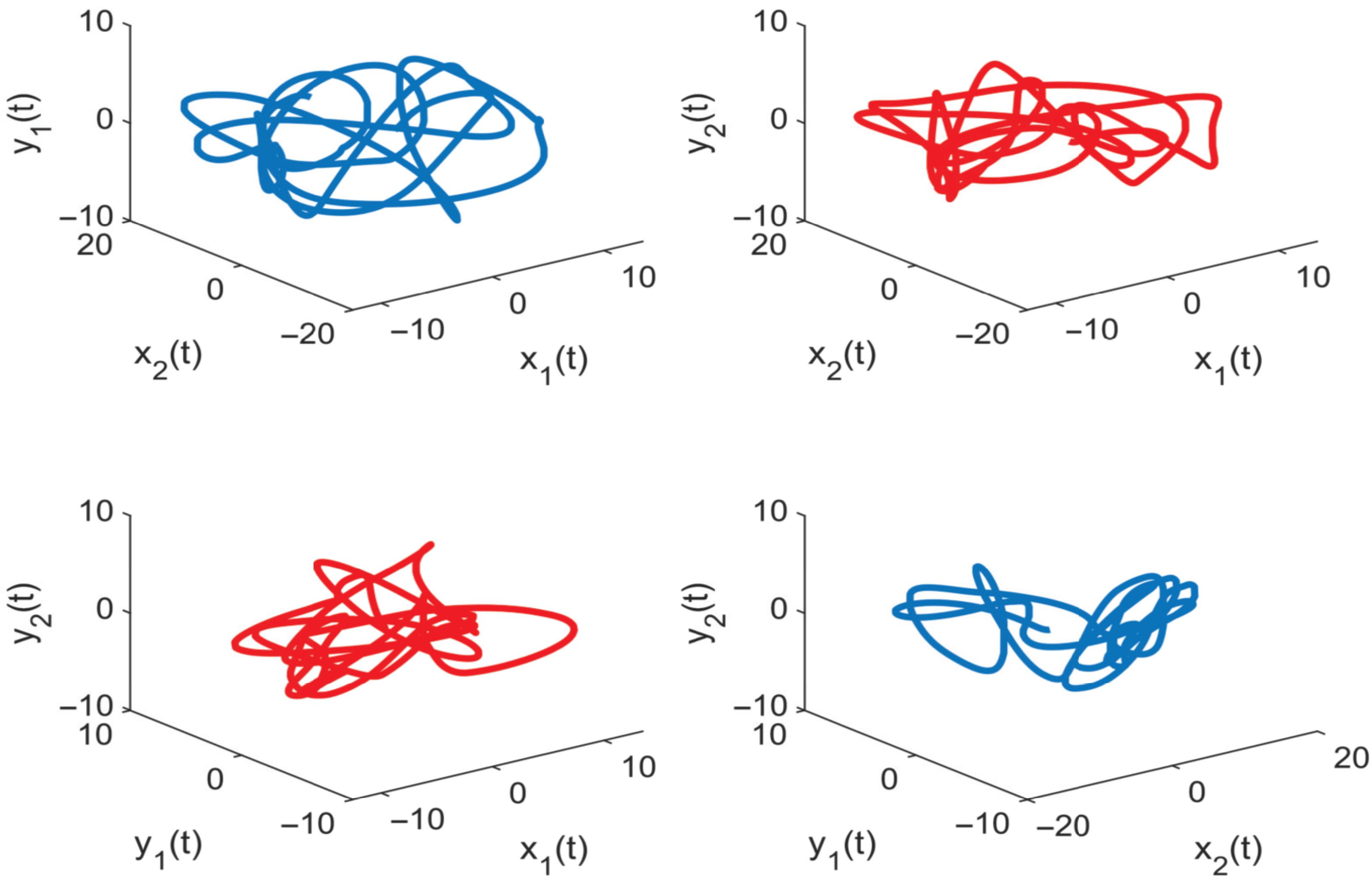
where , , , , and . Other parameters are shown in Table 1. Phase trajectories of BAM-IMNNS (46) via initials , , , , , , , , , let’s drew it in Figure 1.
Table 1.
The parameters of system (46).
Figure 1.
Phase trajectories of BAM-IMNN (46).
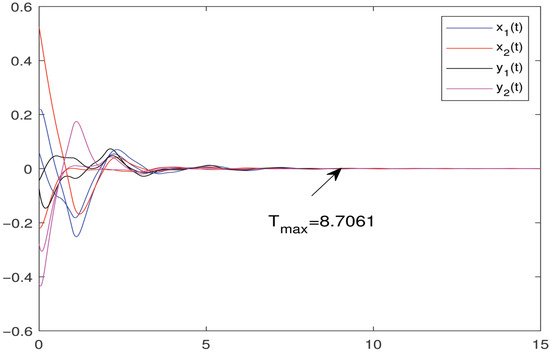
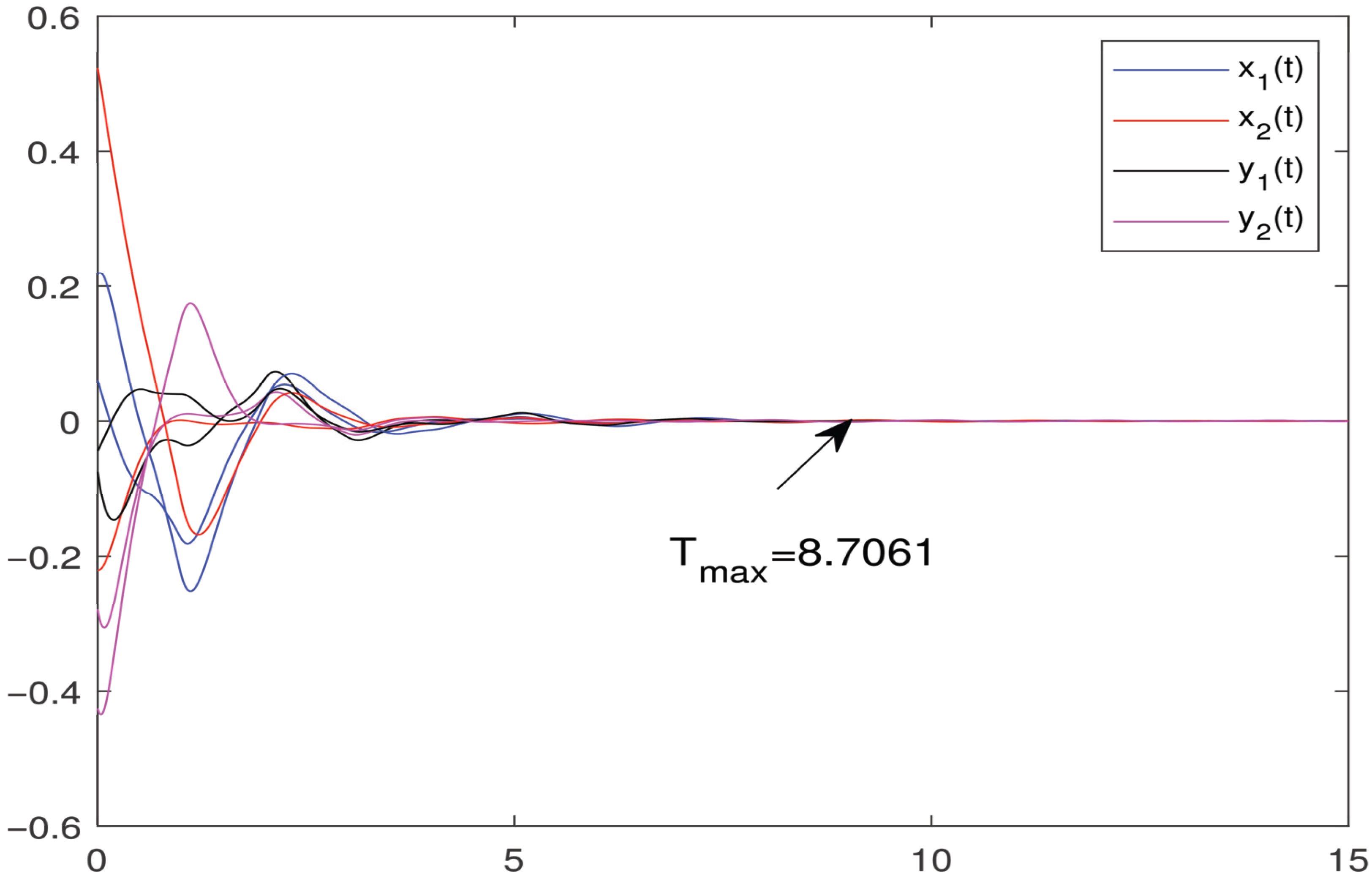
From (46), one has , . We select , , . The first control subintervals are , , , , , the total operation time is 15 s, and . Oher parameters of (14) are shown in Table 2. By easy calculation, we get , and all requirements of Theorem 1 hold. Then, system (46) can achieve FS and . Now, choose two initial values for each state randomly, and Figure 2 shows the FS of BAM-IMNN (46).
Table 2.
The parameters of control APSC , (10).
Figure 2.
State trajectories of BAM-IMNN (46) under the controller (14).
Example 2.
The response system for BAM-IMNNs is shown below:
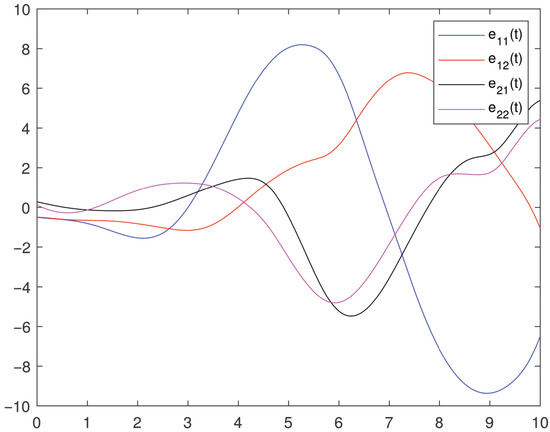
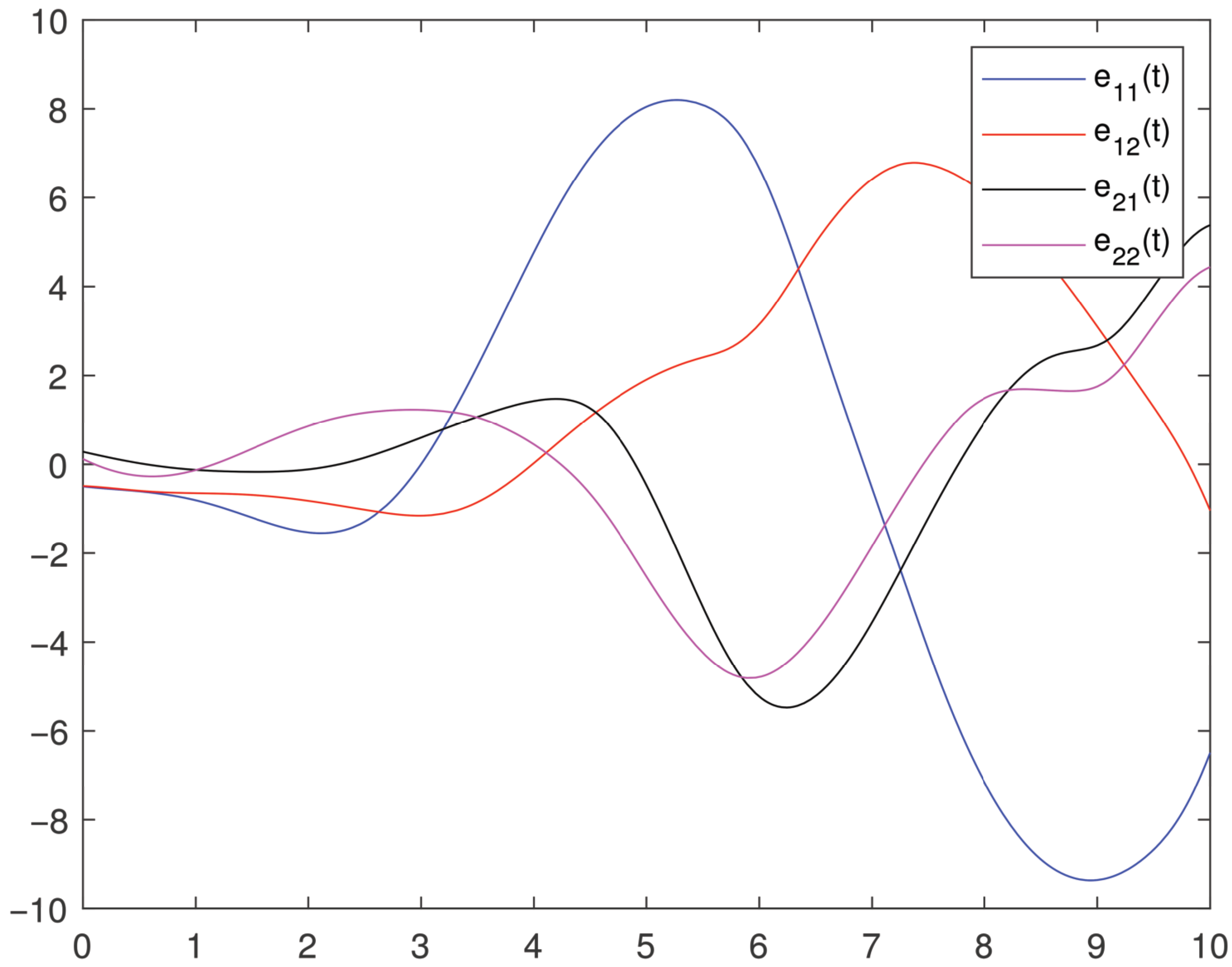
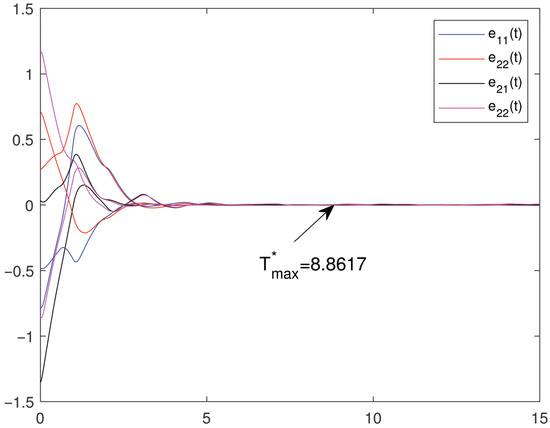
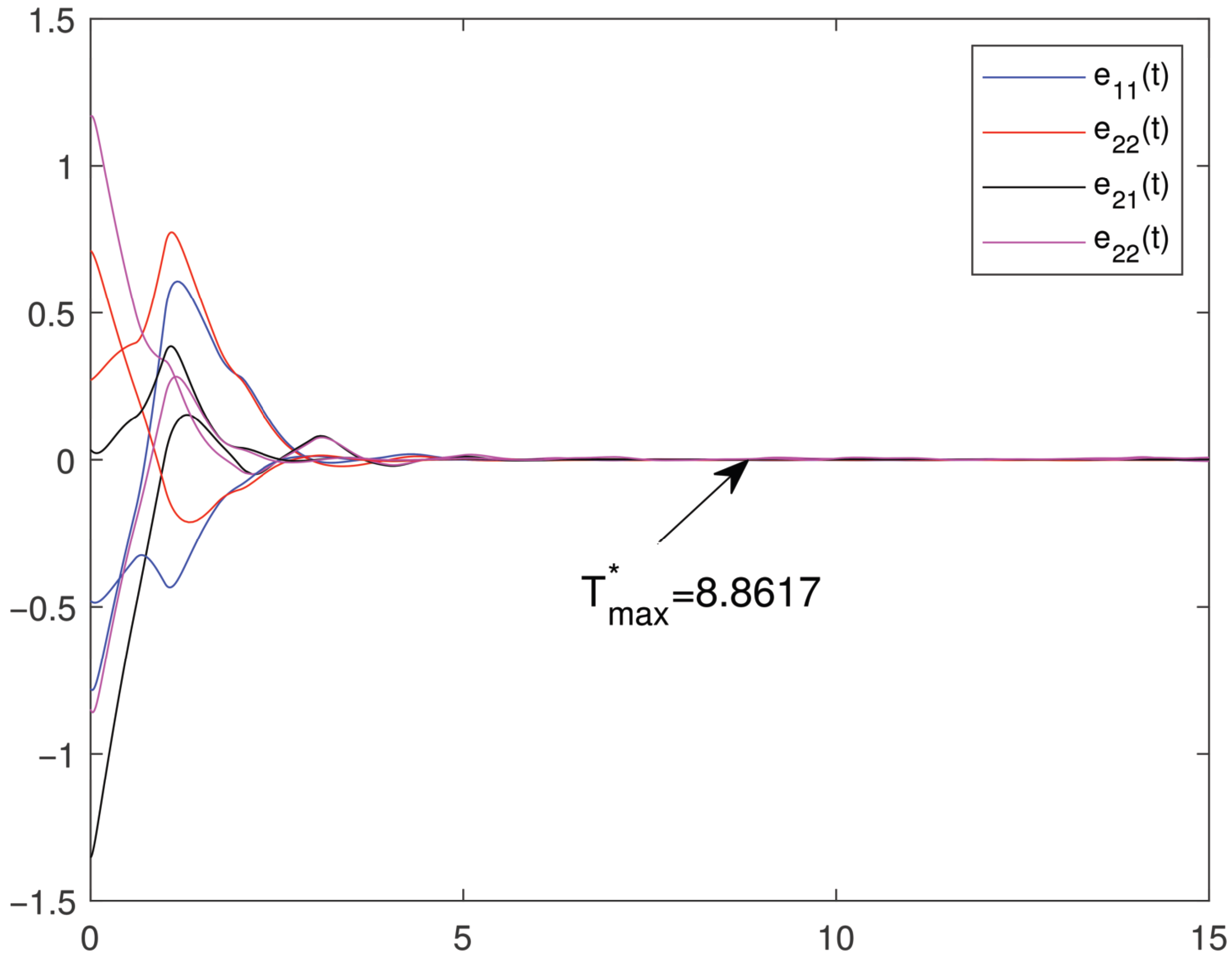
the data are the same as those in BAM-IMNN (46). The initial values of (47) are , , , , . The first control subintervals are , , , , the total operation time is 15 s, and , , , , , , , , , , , , , , , , , , , Through simple calculations, we obtain , , , , and all the requirements of Theorem 2 hold. Then, system (1) and (7) can achieve FTS, and . Figure 3 shows the error trajectories of BAM-IMNNs (1) and (7) without control. Now, choose two initial values for each state randomly, and Figure 4 shows the FTS of BAM-IMNNs (1) and (7).
Figure 3.
Trace of error of BAM-IMNNs (1) and (7) without control.
Figure 4.
Trace of error , , and .
4. Application to Communication Security
Secure communication [32,49,50] refers to a communication method that ensures that information is not eavesdropped on, tampered with, or forged during transmission through encryption, authentication, and other security measures. Its core objective is to protect the confidentiality, integrity, and availability of data, while verifying the identities of both communicating parties.
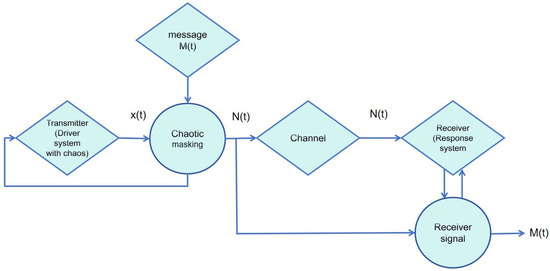
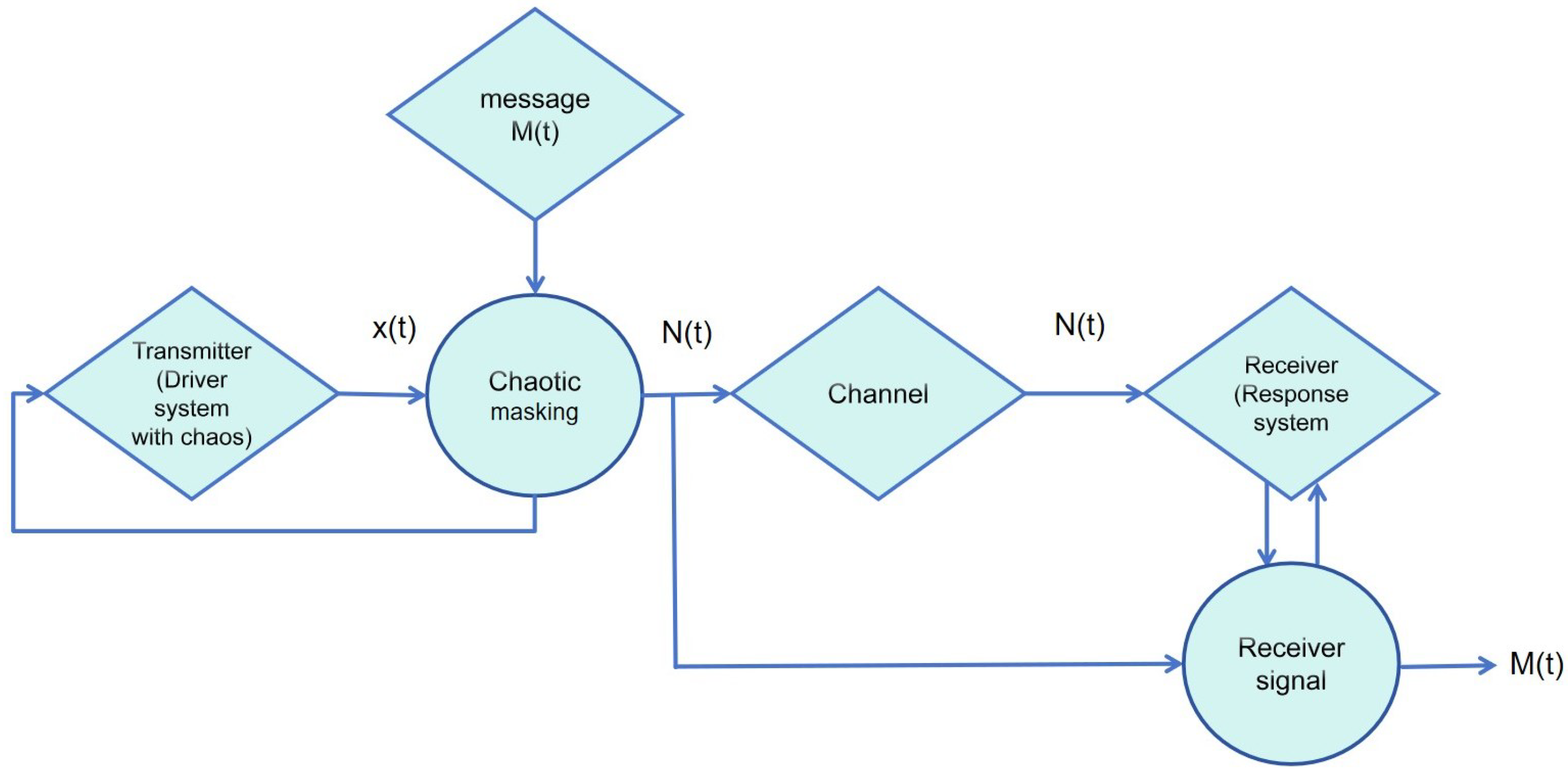
Here we use the signal shielding strategy in chaotic communication, where , shown in Figure 5. The sender and receiver are given as follows. The sender is
The parameters remain consistent with those in BAM-IMNN (46). is the information message, while and .
Figure 5.
Secure communication system.
The receiver is
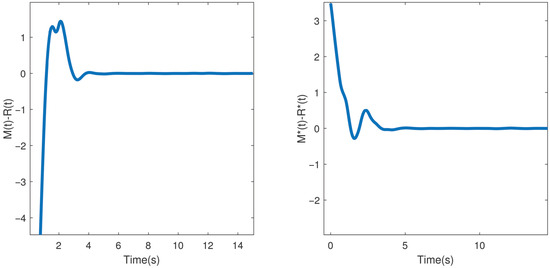
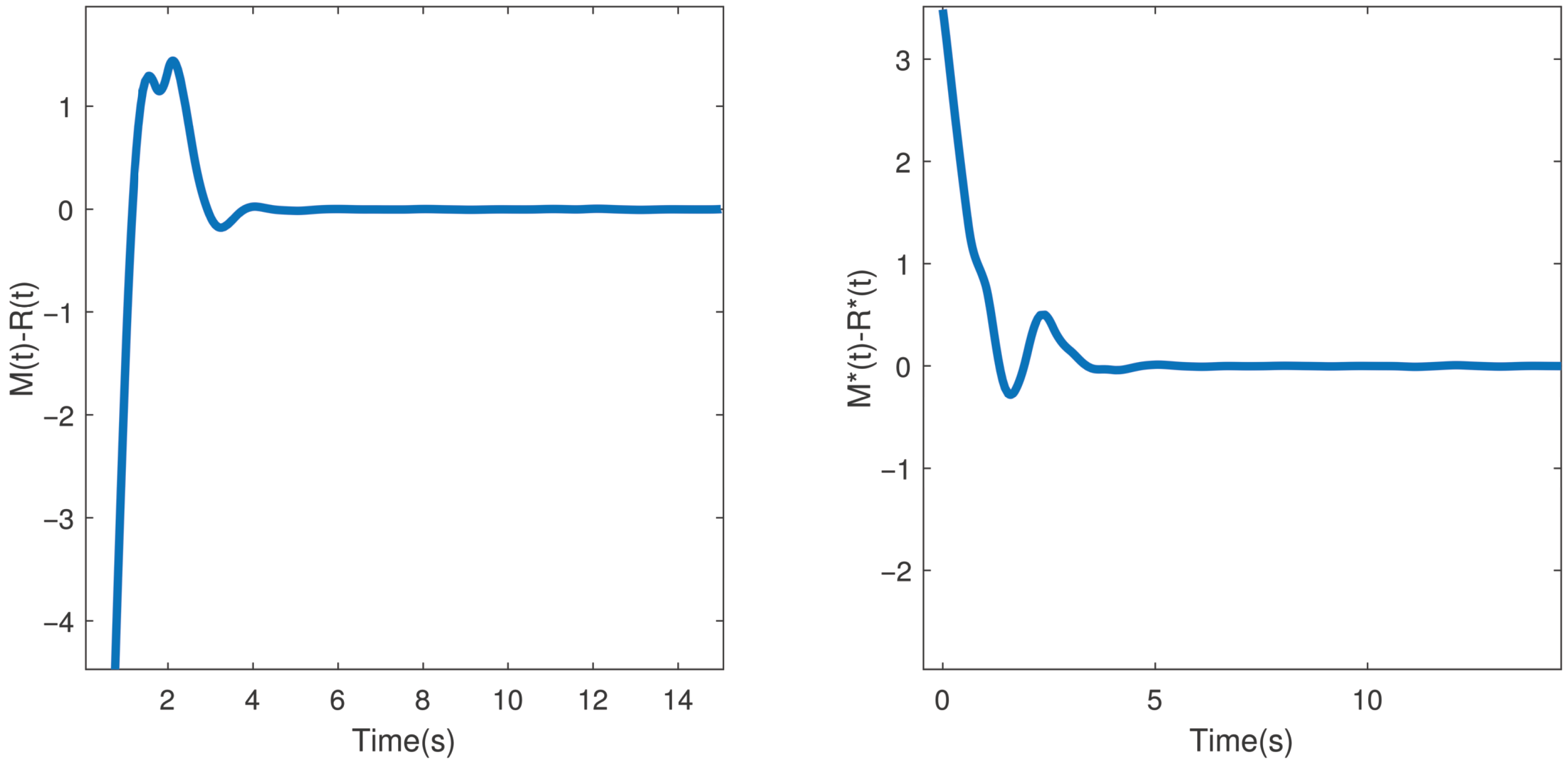
where , is the transmitted signal. And we let , . We assume is the information message, so can be recovered by , . Based on Example 2 and using , Figure 6 shows the error system between (46) with and (47) with , . We can see that the signal can be restored through controller (30).
Figure 6.
Error and .
5. Conclusions
This paper studies the FS and FTS of a class of BAM-IMNNs with mixed delays based on the APSC. Compared with the traditional order reduction methods, this paper directly deals with the second-order inertial system, avoiding the loss of model information. Meanwhile, the combination of mixed delays more truly represents the dynamic behavior of NNs. The aperiodic switching controller designed in this paper breaks through the limitations of the traditional periodic intermittent control, and the effectiveness of this method is verified through numerical simulation. The research in this paper provides a new theoretical tool for stability analysis of high-order memristor BAMNNs.
Author Contributions
Writing—original draft preparation, writing—review and editing, software, X.Z.; writing—review and editing, investigation, J.H.; writing—review and editing, Y.L.; writing—review and editing, supervision, conceptualization, methodology, G.Z. All authors have read and agreed to the published version of the manuscript.
Funding
This work is supported by the National Science Foundation of China under Grant Nos. 62476292 and 61976228. The Science and Technology Plan Guiding project of Hubei Provincial Department of Education under Grant B2024273. And the Fundamental Research Funds of South-Central Minzu University (CZQ24020).
Data Availability Statement
The original contributions presented in this study are included in the article. Further inquiries can be directed to the corresponding author.
Conflicts of Interest
The authors declare no conflicts of interest.
References
- Hu, X.; Wang, L.; Zhang, C.K.; Wan, X.; He, Y. Fixed-time stabilization of discontinuous spatiotemporal neural networks with time-varying coefficients via aperiodically switching control. Sci. China Inf. Sci. 2023, 66, 152204. [Google Scholar] [CrossRef] [Scilit]
- Li, X.; She, K.; Zhong, S.; Shi, K.; Kang, W.; Cheng, J.; Yu, Y. Extended robust global exponential stability for uncertain switched memristor-based neural networks with time-varying delays. Appl. Math. Comput. 2018, 325, 271–290. [Google Scholar] [CrossRef] [Scilit]
- Tang, Q.; Jian, J. Global exponential convergence for impulsive inertial complex-valued neural networks with time-varying delays. Math. Comput. Simul. 2019, 159, 39–56. [Google Scholar] [CrossRef] [Scilit]
- Wang, L.; He, H.; Zeng, Z. Global synchronization of fuzzy memristive neural networks with discrete and distributed delays. IEEE Trans. Fuzzy Syst. 2019, 28, 2022–2034. [Google Scholar] [CrossRef] [Scilit]
- Li, H.; Li, C.; Huang, T.; Zhang, W. Fixed-time stabilization of impulsive Cohen–Grossberg BAM neural networks. Neural Netw. 2018, 98, 203–211. [Google Scholar] [CrossRef] [Scilit]
- Babcock, K.L.; Westervelt, R.M. Stability and dynamics of simple electronic neural networks with added inertia. Phys. D Nonlinear Phenom. 1986, 23, 464–469. [Google Scholar] [CrossRef] [Scilit]
- Wang, Z.; Liu, Y.; Xia, H.; Shen, H. Quasi-multisynchronization and quasi-monosynchronization of delayed neural networks with parameter mismatch via impulsive control. IEEE Trans. Autom. Sci. Eng. 2025, 22, 14646–14656. [Google Scholar] [CrossRef] [Scilit]
- Hopfield, J.J. Neural networks and physical systems with emergent collective computational abilities. Proc. Natl. Acad. Sci. USA 1982, 79, 2554–2558. [Google Scholar] [CrossRef] [Scilit] [PubMed]
- Cohen, M.A.; Grossberg, S. Absolute stability of global pattern formation and parallel memory storage by competitive neural networks. IEEE Trans. Syst. Man Cybern. 1983, SMC-13, 815–826. [Google Scholar] [CrossRef] [Scilit]
- Kosko, B. Bidirectional associative memories. IEEE Trans. Syst. Man Cybern. 1988, 18, 49–60. [Google Scholar] [CrossRef] [Scilit]
- Kosko, B. Adaptive bidirectional associative memories. Appl. Opt. 1987, 26, 4947–4960. [Google Scholar] [CrossRef] [Scilit] [PubMed]
- Song, Q.; Cao, J. Dynamics of bidirectional associative memory networks with delays and reaction–diffusion terms. Nonlinear Anal. 2007, 8, 345–361. [Google Scholar] [CrossRef] [Scilit]
- Cao, J.D.; Xiao, M. Stability and Hopf bifurcation in a simplified BAM neural network with two time delays. IEEE Trans. Neural Netw. 2007, 18, 416–430. [Google Scholar] [CrossRef] [Scilit] [PubMed]
- Du, S.Z.; Chen, Z.Q.; Yuan, Z.Z.; Zhang, X.H. Sensitivity to noise in bidirectional associative memory (BAM). IEEE Trans. Neural Netw. 2005, 16, 887–898. [Google Scholar] [CrossRef]
- Duan, L.; Li, J. Finite-time synchronization for a fully complex-valued BAM inertial neural network with proportional delays via non-reduced order and non-separation approach. Neurocomputing 2025, 611, 128648. [Google Scholar] [CrossRef] [Scilit]
- Duan, L.; Li, J. Fixed-time synchronization of fuzzy neutral-type BAM memristive inertial neural networks with proportional delays. Inf. Sci. 2021, 576, 522–541. [Google Scholar] [CrossRef] [Scilit]
- Arslan, E.; Narayanan, G.; Ali, M.S.; Arik, S.; Saroha, S. Controller design for finite-time and fixed-time stabilization of fractional-order memristive complex-valued BAM neural networks with uncertain parameters and time-varying delays. Neural Netw. 2020, 130, 60–74. [Google Scholar] [CrossRef] [Scilit]
- Ge, J.H.; Xu, J. Computation of synchronized periodic solution in a BAM network with two delays. IEEE Trans. Neural Netw. 2010, 21, 439–450. [Google Scholar]
- Zhang, Y.; Jiang, M.; Fang, X. A new fixed-time stability criterion and its application to synchronization control of memristor-based fuzzy inertial neural networks with proportional delay. Neural Process. Lett. 2020, 52, 1291–1315. [Google Scholar] [CrossRef] [Scilit]
- Zhang, Z.; Cao, J. Finite-time synchronization for fuzzy inertial neural networks by maximum value approach. IEEE Trans. Fuzzy Syst. 2021, 30, 1436–1446. [Google Scholar] [CrossRef] [Scilit]
- Jian, J.; Duan, L. Finite-time synchronization for fuzzy neutral-type inertial neural networks with time-varying coefficients and proportional delays. Fuzzy Sets Syst. 2020, 381, 51–67. [Google Scholar] [CrossRef] [Scilit]
- Jo, S.H.; Chang, T.; Ebong, I.; Bhadviya, B.B.; Mazumder, P.; Lu, W. Nanoscale memristor device as synapse in neuromorphic systems. Nano Lett. 2010, 10, 1297–1301. [Google Scholar] [CrossRef] [Scilit] [PubMed]
- Babcock, K.; Westerveit, R. Dynamics of simple electronic neural networks. Phys. D Nonlinear Phenom. 1987, 28, 305–316. [Google Scholar] [CrossRef] [Scilit]
- Xu, C.J.; Zhang, Q.M. Existence and global exponential stability of anti-periodic solutions for BAM neural networks with inertial term and delay. Neurocomputing 2015, 153, 108–116. [Google Scholar] [CrossRef] [Scilit]
- Tu, Z.W.; Cao, J.D.; Hayat, T. Global exponential stability in Lagrange sense for inertial neural networks with time-varying delays. Neurocomputing 2016, 171, 524–531. [Google Scholar] [CrossRef] [Scilit]
- Zhang, Z.Q.; Chen, M.; Li, A.L. Further study on finite-time synchronization for delayed inertial neural networks via inequality skills. Neurocomputing 2020, 373, 15–23. [Google Scholar] [CrossRef] [Scilit]
- Huang, C.X.; Liu, B.W. New studies on dynamic analysis of inertial neural networks involving non-reduced order method. Neurocomputing 2019, 325, 283–287. [Google Scholar] [CrossRef] [Scilit]
- Huang, C.X.; Yang, L.S.; Liu, B.W. New results on periodicity of non-autonomous inertial neural networks involving non-reduced order method. Neural Process. Lett. 2019, 50, 595–606. [Google Scholar] [CrossRef] [Scilit]
- Zhang, G.D.; Zeng, Z.G. Stabilization of second-order memristive neural networks with mixed time delays via nonreduced order. IEEE Trans. Neural Netw. Learn. Syst. 2020, 31, 700–706. [Google Scholar] [CrossRef] [Scilit]
- Chaouki, A.; El Abed, A. Effect of fuzziness on the stability of inertial neural networks with mixed delay via non-reduced order method. Int. J. Comput. Math. Comput. Syst. Theory 2019, 4, 151–170. [Google Scholar]
- Liu, M.; Jiang, H.J.; Hu, C. Finite-time synchronization of delayed dynamical networks via aperiodically intermittent control. J. Frankl. Inst. 2017, 354, 5374–5397. [Google Scholar] [CrossRef] [Scilit]
- Alimi, A.M.; Aouiti, C.; Assali, E.A. Finite-time and fixed-time synchronization of a class of inertial neural networks with multi-proportional delays and its application to secure communication. Neurocomputing 2019, 332, 29–43. [Google Scholar] [CrossRef] [Scilit]
- Zhang, G.D.; Shen, Y.; Chen, B.S. Positive periodic solutions in a non-selective harvesting predator–prey model with multiple delays. J. Math. Anal. Appl. 2012, 395, 298–306. [Google Scholar] [CrossRef] [Scilit]
- Gui, S.Y.; Wang, Z.H. Fixed/predefined-time projective synchronization of delayed discontinuous fuzzy neural networks via adaptive aperiodically switching strategy. J. Nonlinear Dyn. Appl. 2025, 1, 10–25. [Google Scholar] [CrossRef] [Scilit]
- Aouiti, C.; Hui, Q.; Jallouli, H.; Moulay, E. Fixed-time stabilization of fuzzy neutral-type inertial neural networks with time-varying delay. Fuzzy Sets Syst. 2021, 411, 48–67. [Google Scholar] [CrossRef] [Scilit]
- Chen, C.; Li, L.; Peng, H.; Yang, Y.; Mi, L.; Wang, L. A new fixed-time stability theorem and its application to the synchronization control of memristive neural networks. Neurocomputing 2019, 349, 290–300. [Google Scholar] [CrossRef] [Scilit]
- Hu, C.; He, H.; Jiang, H. Fixed/preassigned-time synchronization of complex networks via improving fixed-time stability. IEEE Trans. Cybern. 2020, 51, 2882–2892. [Google Scholar] [CrossRef] [Scilit]
- Gan, Q.; Li, L.; Yang, J.; Qin, Y.; Meng, M. Improved results on fixed/preassigned-time synchronization for memristive complex-valued neural networks. IEEE Trans. Neural Netw. Learn. Syst. 2021, 33, 5542–5556. [Google Scholar] [CrossRef] [Scilit]
- Liu, M.; Jiang, H.J.; Hu, C. Synchronization of hybrid-coupled delayed dynamical networks via aperiodically intermittent pinning control. J. Frankl. Inst. 2016, 353, 2722–2742. [Google Scholar] [CrossRef] [Scilit]
- Liu, X.W.; Chen, Z.; Zhou, L.J. Synchronization of coupled reaction–diffusion neural networks with hybrid coupling via aperiodically intermittent pinning control. J. Frankl. Inst. 2017, 354, 7053–7076. [Google Scholar] [CrossRef] [Scilit]
- Liu, L.J.; Chen, W.H.; Lu, X.M. Aperiodically intermittent H∞ synchronization for a class reaction–diffusion neural networks. Neurocomputing 2017, 222, 105–115. [Google Scholar] [CrossRef] [Scilit]
- Gan, Q.T.; Xiao, F.; Qin, Y.; Yang, J. Fixed-time cluster synchronization of discontinuous directed community networks via periodically or aperiodically switching control. IEEE Access 2019, 7, 83306–83318. [Google Scholar] [CrossRef] [Scilit]
- Zhang, W.; Li, C.D.; Huang, T.W.; Xiao, M.Q. Synchronization of neural networks with stochastic perturbation via aperiodically intermittent control. Neural Netw. 2015, 71, 105–111. [Google Scholar] [CrossRef] [Scilit] [PubMed]
- Zhang, Z.; Quan, Z. Global exponential stability via inequality technique for inertial BAM neural networks with time delays. Neurocomputing 2015, 151, 1316–1326. [Google Scholar] [CrossRef] [Scilit]
- Filippov, A.F. Differential Equations with Discontinuous Right-Hand Sides; Kluwer Academic Publishers: Dordrecht, The Netherlands, 1988. [Google Scholar]
- Han, J.; Chen, G.; Wang, L.; Zhang, G.D.; Hu, J. Direct approach on fixed-time stabilization and projective synchronization of inertial neural networks with mixed delays. Neurocomputing 2023, 535, 97–106. [Google Scholar] [CrossRef] [Scilit]
- Xiao, Z.; Zhang, G.D.; Wang, L.M.; Xiao, Q. Novel results on fixed-time stabilization and synchronization for delayed memristive inertial neural networks via aperiodically switching control. Commun. Nonlinear Sci. Numer. Simul. 2025; under review.
- He, H.; Zhou, Y.; Jiang, G.; Wang, L.M. Distributed practical prescribed-time secondary control of microgrid under event-triggered communication. J. Nonlinear Dyn. Appl. 2025, 1, 36–51. [Google Scholar] [CrossRef] [Scilit]
- Xia, Y.; Yang, Z.; Han, M. Lag synchronization of unknown chaotic delayed Yang Yang-type fuzzy neural networks with noise perturbation based on adaptive control and parameter identification. IEEE Trans. Neural Netw. 2009, 20, 1165–1180. [Google Scholar]
- Yang, T. A survey of chaotic secure communication systems. Int. J. Comput. Cogn. 2004, 2, 81–130. [Google Scholar]


Disclaimer/Publisher’s Note: The statements, opinions and data contained in all publications are solely those of the individual author(s) and contributor(s) and not of MDPI and/or the editor(s). MDPI and/or the editor(s) disclaim responsibility for any injury to people or property resulting from any ideas, methods, instructions or products referred to in the content. |
© 2025 by the authors. Licensee MDPI, Basel, Switzerland. This article is an open access article distributed under the terms and conditions of the Creative Commons Attribution (CC BY) license (https://creativecommons.org/licenses/by/4.0/).