


Abstract
Several topological indices are possibly the most widely applied graph-based molecular structure descriptors in chemistry and pharmacology. The capacity of topological indices to discriminate is a crucial component of their study. In light of this, the literature has introduced the exponential vertex-degree-based topological index. The exponential atom-bond connectivity index is defined as follows: where is the degree of the vertex in . In this paper, we prove that the double star is the second maximal graph with respect to the index of trees of order n. We give an upper bound on of unicyclic graphs of order n and characterize the maximal graphs. The graph gives the maximal graph with respect to the index of bicyclic graphs of order n. We present several relations between and of graph . Finally, we provide a conclusion summarizing our findings and discuss potential directions for future research.
Keywords:
graph; atom-bond connectivity index; exponential atom-bond connectivity index; unicyclic graph; bicyclic graph MSC:
05C90; 05C07; 05C35
1. Introduction
Molecular descriptors are crucial in various fields, such as chemistry, pharmacology, and related sciences. These descriptors provide valuable information about the molecular structure and properties, aiding in the analysis and prediction of molecular behavior. Among these descriptors, topological indices are particularly significant [1]. Topological indices are numerical values derived from the graph representation of a molecule. They encapsulate information about the molecule’s topology, which refers to the spatial arrangement of its atoms and bonds. These indices play a pivotal role in Quantitative Structure–Property Relationships and Quantitative Structure–Activity Relationships studies, where they help in understanding and predicting the properties and activities of chemical compounds.
In the chemical literature, topological indices can be broadly categorized based on different criteria. One major category includes indices classified under graph distance. Graph distance-based indices are derived from the distances between pairs of vertices (atoms) in the molecular graph. These indices provide information on the overall shape and size of the molecule, as well as the spatial relationships between its parts and references therein. Another significant category consists of indices based on vertex degree. The vertex degree refers to the number of edges (bonds) connected to a vertex (atom) in the molecular graph. Vertex-degree-based topological indices focus on the connectivity and branching patterns within the molecule. These indices are particularly useful in identifying molecular features related to reactivity and interaction with other molecules (see [2] and references therein). Several vertex-degree-based topological indices have been developed and are extensively used in QSPR/QSAR studies. These indices help researchers in modeling and predicting the physical, chemical, and biological properties of compounds, facilitating drug discovery, environmental chemistry, and materials science. In summary, topological indices, whether based on graph distance or vertex degree, are invaluable tools in molecular research. They provide a bridge between the molecular structure and its properties, enabling a deeper understanding and more accurate predictions in various scientific domains.
In general, the vertex-degree-based (VDB) topological index is defined for any set of numbers as
Some of the most explored VDB topological indices are the first Zagreb index [3], the Second Zagreb index [3], the Randić index [4], the Harmonic index [5], the Sum-Connectivity index [6,7], the neighborhood inverse sum indeg index [8], the Geometric-Arithmetic index [9], the Atom-Bond-Connectivity index [10,11,12], the Atom-Bond Sum-Connectivity index [13], the Sombor index [14], and the Augmented Zagreb index [15]. An analysis of the discrimination power and its crucial role in topological indices is discussed in [16,17,18]. Taking this into account, Rada [19] introduced exponential degree-based indices, significantly enhancing the discriminative power of topological indices. For a given vertex-degree-based topological index defined as in (1), the exponential of , denoted by , is defined as
For those interested in exploring further research on exponential degree-based indices, comprehensive sources include [20,21,22,23,24,25,26,27,28,29,30,31,32]. The current study focuses on the exponential atom-bond connectivity [19], which is defined as a refined topological index, offering new insights into the structure–property relationships of chemical compounds. The exponential atom-bond connectivity index is defined as follows:
where , and is the degree of the vertex in . For its basic mathematical properties, including various lower and upper bounds, see [23,33].
In this paper, all graphs are assumed to be finite and simple. Let be a graph with vertex set and edge set . The degree of a vertex , denoted by or simply , is the number of vertices adjacent to in . For a subset of , denotes the subgraph obtained by deleting the edges in . When , we abbreviate as . For any two nonadjacent vertices and in , denotes the graph obtained by adding the edge to . We denote by , , , and the complete graph, the path, the star, and the cycle on n vertices throughout this paper. Let be a double star of order n obtained from joining the central vertices of the two stars and . The join of the two graphs and is a graph formed from disjoint copies of and by connecting every vertex of to every vertex of . For additional notations and terminology related to graph theory that are not defined here, readers should consult [34]. Let be an edge in such that . Then, we obtain
The paper is organized as follows: In Section 2, we prove that the double star is the second maximal graph with respect to the index of trees of order n. In Section 3, we give an upper bound on of unicyclic graphs of order n and characterize the maximal graphs. The graph gives the maximal graph with respect to the index of bicyclic graphs of order n. In Section 4, we present several relations between and of graph . Finally, in Section 5, we provide a conclusion summarizing our findings and discuss potential directions for future research.
2. On the Second Maximal Trees of Exponential Atom-Bond Connectivity Index
In their study, Cruz and Rada [22] established that among all trees of order n, the star graph maximizes the exponential atom-bond connectivity index . In this section, we identify the second maximal tree for the index.
From Equation (3), it is evident that each term in reaches its maximum when the vertex with the highest degree is adjacent to a pendant vertex. Consequently, trees with a larger number of pendant edges achieve a higher index, as fewer non-pendant edges contribute to the sum. This insight forms the basis for the proof of the following result, which ranks trees by their index according to the number of non-pendant edges.
Theorem 1.
Let be a tree of order n. Then,
Moreover, the first equality holds if and only if .
Proof.
Let be any edge in T with . Let r be the number of non-pendant edges in T. Since , we have . We consider the following two cases:
Case 1.
. In this case, T is a double star . Let and be the non-pendant vertices in T such that . Then, . Now,
If , then with
and hence the equality holds in (4). Otherwise, . One can easily see that
Thus, we have
We consider two cases:
Case 1.1.

. In this case, . For each value of , by Mathematica [35], we obtain the maximum value of in the Table 1 and Table 2 (see Appendix A for more details):
Table 1.
Maximum value of and for .
Table 2.
Maximum value of and for .
Case 2.
□. In this case, . For any non-pendant edge with , we obtain
For any pendant edge with , we obtain
Using the above results, we obtain
as . The result (4) strictly holds. This completes the proof of the theorem.
Remark 1.
Theorem 1 establishes a sharp upper bound for the exponential atom-bond connectivity index of a tree T of order n, excluding the star . This result highlights that among such trees, the double star uniquely achieves the equality in (4), thereby demonstrating its extremal nature. This conclusion unifies the structural insights about trees and their exponential atom-bond connectivity index, providing a foundation for further exploration of extremal graph structures.
3. Upper Bounds on of Unicyclic and Bicyclic Graphs
A unicyclic graph is a connected graph that contains exactly one cycle. For a graph with n vertices and m edges , G is unicyclic if and G is connected. We establish an upper bound on for unicyclic graphs in terms of n and characterize the extremal graphs that achieve this bound. The key idea of the proof involves dividing the terms of into contributions from pendant edges and non-pendant edges. Using (3), the maximum contribution of each term to is evaluated separately for these two types of edges.
Theorem 2.
Let be a unicyclic graph of order n. Then,
with equality if and only if .
Proof.
For , one can easily check that
with equality if and only if and . Moreover, for ,
with equality if and only if or . Let be the cycle in and . For ,
with equality if and only if . Using the above results, we obtain
Moreover, the equality holds if and only if , or for and , for ; that is, if and only if . □
Remark 2.
Theorem 2 identifies a precise upper bound for the exponential atom-bond connectivity index of a unicyclic graph of order n. The extremal case is uniquely achieved by the graph , underscoring its special structural property. This result enriches the study of unicyclic graphs by characterizing those with maximal exponential atom-bond connectivity indices.
A bicyclic graph is a graph with n vertices and edges, containing exactly two independent cycles. Let be a graph of order 4 obtained from the complete graph by deleting one edge. Define as a graph obtained by attaching pendent edges to one of the vertices of degree 3 in (see Figure 1). Similarly, define as a graph obtained by attaching pendent edges to the vertex of degree 2 in (see Figure 1). We now present an upper bound on of bicyclic graphs in terms of n, and characterize the extremal graphs.
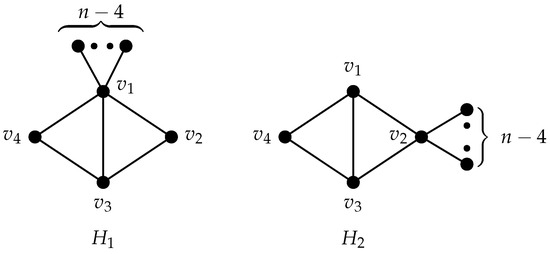
Figure 1.
Two graphs and .
From Equation (3), it is evident that any term in corresponding to a pendant edge is greater than or equal to a term corresponding to a non-pendant edge. Furthermore, each term in reaches its maximum value when the vertex with the highest degree is adjacent to a pendant vertex. Since the graph G has edges, graphs with a larger number of pendant edges achieve a higher index, as the contribution of non-pendant edges to the sum is minimized. Therefore, the proof of the following result is based on analyzing the number of non-pendant edges.
Theorem 3.
Let be a bicyclic graph of order n. Then,
with equality if and only if or .
Proof.
For , by Sage [36], one can easily check that the result (10) holds. So, now we can assume that . For , one can easily check that
with equality holding if and only if and . Moreover, for ,
with equality if and only if or . For ,
with equality if and only if .
Let q be the number of non-pendant edges in . Since is bicyclic, we have . We consider the following two cases:
Case 1.
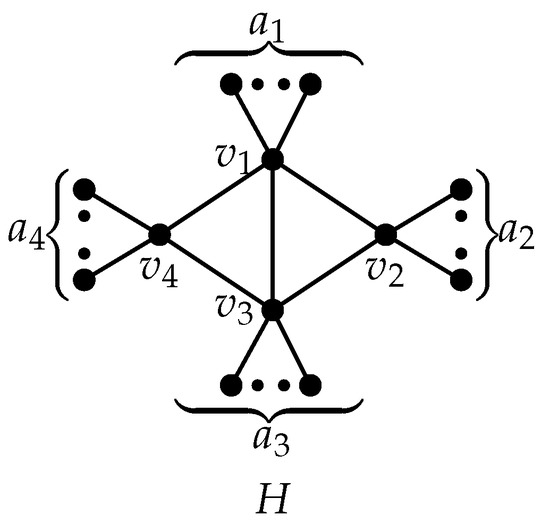
. Since is bicyclic, in this case, (see, Figure 2). Let , and be the non-pendant vertices of degrees and in H, respectively, where , and . Without loss of generality, we can assume that and . We consider the following four cases ; ; ; .
Figure 2.
A graph H.
Case 1.1.
, . In this case, . Then, with
and hence the equality holds in (7).
Case 1.2.
. We have . First, we assume that . Then, and hence (see, Figure 1).
Case 1.
Proof of Claim 1.
For , by Mathematica [35], one can easily check that the result (10) holds. Otherwise, . Thus, we have , that is,
that is,
By the arithmetic-geometric-mean inequality with the above result, we obtain
that is,
that is,
as This proves the Claim 1. □
Using Claim 1 with
we obtain
The inequality (7) strictly holds.
Next, we assume that . We have . Since , and , we obtain
Moreover, we obtain
and
that is,
Using the above results, we obtain
The inequality (7) strictly holds.
Case 1.4.
. In this case, we have . Now,
Thus, we have
Since , has pendant edges, and hence
Using the above results, we obtain
The inequality (7) strictly holds.
Remark 3.
Theorem 3 establishes an upper bound for the exponential atom-bond connectivity index of bicyclic graphs of order n. The equality in (7) is attained exclusively by the graphs or , highlighting their extremal nature. This result contributes to the understanding of bicyclic graph structures and their influence on the exponential atom-bond connectivity indices.
4. Some Relations Between and ABC() of Graphs
In this section, we present several lower and upper bounds on of graphs in terms of different graph parameters, and characterize the corresponding extremal graphs. We begin with some relations between and of any graph as follows:
Proposition 1.
Let be a graph with m edges. Then,
where is the atom-bond connectivity index of the graph Υ. If Υ is connected, then the above equality holds if and only if for each vertex , , or for .
Proof.
By arithmetic-geometric-mean inequality, we obtain
Moreover, the equality holds if and only if
that is, if and only if
that is, if and only if , or for as is connected. This completes the proof of the theorem. □
We now give two relations between and of graph .
Theorem 4.
Let be a graph with m edges and maximum degree Δ. Then,
Proof.
Since
from the definition of , we obtain
This completes the proof. □
Theorem 5.
Let be a graph with m edges and maximum degree Δ. Then,
Proof.
Let be any edge in with . Since is the maximum degree in , one can easily see that
For any real number x,
This completes the proof of the theorem. □
Remark 4.
In Theorems 4 and 5, a compelling comparison is provided of and . These results emphasize the relationships and differences between the exponential atom-bond connectivity index and the classical atom-bond connectivity index. To further enrich the discussion and underline the value of the exponential weighting, it would be insightful to include a brief exploration of its unique advantages.
For example, a discussion could address scenarios where the exponential weighting in might offer superior discrimination among molecular graphs. Specifically, the exponential nature of the index may amplify subtle variations in graph topology or degree distributions, making it particularly effective in distinguishing between structurally similar molecules. Such insights would not only underscore the practical utility of the index but also offer guidance on its application in chemical and pharmacological research.
5. Conclusions and Future Work
Topological indices are among the most commonly used graph-based molecular structure descriptors in chemistry and pharmacology. The ability of these indices to differentiate between molecular structures is a key aspect of their utility. Recently, researchers have introduced the exponential atom-bond connectivity index to enhance this discriminative power. In this paper, we establish that the double star is the second-highest graph with respect to the exponential atom-bond connectivity index among trees of order n. We provide an upper bound for the index of unicyclic graphs of order n and identify the maximal graphs. The graph is shown to be the maximal graph concerning the index among bicyclic graphs of order n. Finally, we explore several relationships between and for the graph . In this paper, we determine the maximal graphs for different classes of graphs. The characterization of minimal graphs for the can be considered a future direction of research.
Funding
This research received no external funding.
Institutional Review Board Statement
Not applicable.
Informed Consent Statement
Not applicable.
Data Availability Statement
The original contributions presented in this study are included in the article. Further inquiries can be directed to the corresponding author.
Conflicts of Interest
The author declares no conflicts of interest.
Appendix A
Table A1.
.
Table A1.
.
| q | f (6, q) |
|---|---|
| 1 | 11.189 |
| 2 | 10.998 |
Table A2.
.
Table A2.
.
| q | |
|---|---|
| 1 | 13.84 |
| 2 | 13.564 |
Table A3.
.
Table A3.
.
| q | f (46, q) |
|---|---|
| 1 | 119.614 |
| 2 | 119.159 |
| 3 | 118.923 |
| 4 | 118.778 |
| 5 | 118.68 |
| 6 | 118.608 |
| 7 | 118.554 |
| 8 | 118.512 |
| 9 | 118.478 |
| 10 | 118.45 |
| 11 | 118.428 |
| 12 | 118.409 |
| 13 | 118.393 |
| 14 | 118.38 |
| 15 | 118.37 |
| 16 | 118.361 |
| 17 | 118.354 |
| 18 | 118.348 |
| 19 | 118.344 |
| 20 | 118.341 |
| 21 | 118.339 |
| 22 | 118.338 |
Table A4.
.
Table A4.
.
| q | |
|---|---|
| 1 | 116.897 |
| 2 | 116.441 |
| 3 | 116.206 |
| 4 | 116.061 |
| 5 | 115.963 |
| 6 | 115.892 |
| 7 | 115.838 |
| 8 | 115.795 |
| 9 | 115.762 |
| 10 | 115.735 |
| 11 | 115.712 |
| 12 | 115.694 |
| 13 | 115.678 |
| 14 | 115.666 |
| 15 | 115.655 |
| 16 | 115.647 |
| 17 | 115.64 |
| 18 | 115.635 |
| 19 | 115.631 |
| 20 | 115.628 |
| 21 | 115.627 |
References
- Todeschini, R.; Consonni, V. Handbook of Molecular Descriptors; Wiley-VCH: Weinheim, Germany, 2000. [Google Scholar]
- Furtula, B.; Gutman, I.; Dehmer, M. On structure-sensitivity of degree-based topological indices. Appl. Math. Comput. 2013, 219, 8973–8978. [Google Scholar] [CrossRef]
- Gutman, I.; Trinajstić, N. Graph theory and molecular orbitals. Total π-electron energy of alternant hydrocarbons. Chem. Phys. Lett. 1972, 17, 535–538. [Google Scholar] [CrossRef]
- Randić, M. On characterization of molecular branching. J. Am. Chem. Soc. 1975, 97, 6609–6615. [Google Scholar] [CrossRef]
- Zhong, L. The harmonic index for graphs. Appl. Math. Lett. 2012, 25, 561–566. [Google Scholar] [CrossRef]
- Chen, X. General sum-connectivity index of a graph and its line graph. Appl. Math. Comput. 2023, 443, 127779. [Google Scholar] [CrossRef]
- Zhou, B.; Trinajstić, N. On a novel connectivity index. J. Math. Chem. 2009, 46, 1252–1270. [Google Scholar] [CrossRef]
- Das, K.C.; Mondal, S. On neighborhood inverse sum indeg index of molecular graphs with chemical significance. Inf. Sci. 2023, 623, 112–131. [Google Scholar] [CrossRef]
- Vukičević, D.; Furtula, B. Topological index based on the ratios of geometrical and arithmetical means of end-vertex degrees of edges. J. Math. Chem. 2009, 46, 1369–1376. [Google Scholar] [CrossRef]
- Estrada, E.; Torres, L.; Rodríguez, L.; Gutman, I. An atom-bond connectivity index: Modelling the enthalpy of formation of alkanes. Indian J. Chem. 1998, 37A, 849–855. [Google Scholar]
- Li, F.; Ye, Q. Extremal graphs with given parameters in respect of general ABS index. Appl. Math. Comput. 2024, 482, 128974. [Google Scholar] [CrossRef]
- Xing, R.; Zhou, B.; Dong, F. On atom–bond connectivity index of connected graphs. Discret. Appl. Math. 2011, 159, 1617–1630. [Google Scholar] [CrossRef]
- Albalahi, A.M.; Milovanović, E.; Ali, A. General atom-bond sum-connectivity index of graphs. Mathematics 2023, 11, 2494. [Google Scholar] [CrossRef]
- Gutman, I. Geometric approach to degree-based topological indices: Sombor indices. MATCH Commun. Math. Comput. Chem. 2021, 86, 11–16. [Google Scholar]
- Furtula, B.; Graovac, A.; Vukičević, D. Augmented Zagreb index. J. Math. Chem. 2010, 48, 370–380. [Google Scholar] [CrossRef]
- Dehmer, M.; Grabner, M. The discrimination power of molecular identification numbers revisited. MATCH Commun. Math. Comput. Chem. 2013, 69, 785–794. [Google Scholar]
- Dehmer, M.; Grabner, M.; Varmuza, K. Information indices with high discriminative power for graphs. PLoS ONE 2012, 7, e31214. [Google Scholar] [CrossRef]
- Konstantinova, E.V. On some applications of information indices in chemical graph theory. In General Theory of Information Transfer and Combinatorics; Ahlswede, R., Ed.; Lecture Notes of Computer Science; Springer: Berlin/Heidelberg, Germany, 2006; pp. 831–852. [Google Scholar]
- Rada, J. Exponential vertex-degree-based topological indices and discrimination. MATCH Commun. Math. Comput. Chem. 2019, 82, 29–41. [Google Scholar]
- Carballosa, W.; Quintana, Y.; Rodríguez, J.M.; Sigarreta, J.M. Exponential topological indices: Optimal inequalities and applications. J. Math. Chem. 2023, 61, 933–949. [Google Scholar] [CrossRef]
- Cruz, R.; Monsalve, J.; Rada, J. Trees with maximum exponential Randić index. Discrete Appl. Math. 2020, 283, 634–643. [Google Scholar] [CrossRef]
- Cruz, R.; Rada, J. The path and the star as extremal values of vertex-degree-based topological indices among trees. MATCH Commun. Math. Comput. Chem. 2019, 82, 715–732. [Google Scholar]
- Das, K.C.; Elumalai, S.; Balachandran, S. Open problems on the exponential vertex-degree-based topological indices of graphs. Discret. Appl. Math. 2021, 293, 38–49. [Google Scholar] [CrossRef]
- Das, K.C.; Mondal, S.; Huh, D. On the exponential augmented Zagreb index of graphs. J. Appl. Math. Comput. 2024, 70, 839–865. [Google Scholar] [CrossRef]
- Das, K.C.; Mondal, S. On exponential geometric-arithmetic index of graphs. J. Math. Chem. 2023, 62, 2740–2760. [Google Scholar] [CrossRef]
- Das, K.C.; Mondal, S. On EAZ index of unicyclic and bicyclic graphs, general graphs in terms of the number of cut edges. J. Appl. Math. Comput. 2024, 70, 2995–3010. [Google Scholar] [CrossRef]
- Das, K.C.; Mondal, S.; Huh, D. Open Problem on the Maximum Exponential Augmented Zagreb Index of Unicyclic Graphs. Comput. Appl. Math. 2024, 43, 317. [Google Scholar] [CrossRef]
- Eliasi, M. Unicyclic and bicyclic graphs with maximum exponential second Zagreb index. Discret. Appl. Math. 2022, 307, 172–179. [Google Scholar] [CrossRef]
- Gao, W.; Gao, Y. The extremal trees for exponential vertex-degree-based topological indices. Appl. Math. Comput. 2024, 472, 128634. [Google Scholar] [CrossRef]
- Mondal, S.; Das, K.C. Complete Solution to Open Problems on Exponential Augmented Zagreb Index of Chemical Trees. Appl. Math. Comput. 2024, 482, 128983. [Google Scholar] [CrossRef]
- Xu, C.; Horoldagva, B.; Buyantogtokh, L. The exponential second Zagreb index of (n,m)-graphs. Mediterr. J. Math. 2023, 20, 181. [Google Scholar] [CrossRef]
- Zeng, M.; Deng, H. An open problem on the exponential of the second Zagreb index. MATCH Commun. Math. Comput. Chem. 2021, 85, 367–373. [Google Scholar]
- Cruz, R.; Monsalve, J.; Rada, J. On chemical trees that maximize atom-bond connectivity index, its exponential version, and minimize exponential geometric-arithmetic index. MATCH Commun. Math. Comput. Chem. 2020, 84, 691–718. [Google Scholar]
- Bondy, J.A.; Murty, U.S.R. Graph Theory with Applications; Macmillan Press: New York, NY, USA, 1976. [Google Scholar]
- Wolfram Research, Inc. Mathematica, Version 7.0; Wolfram Research, Inc.: Champaign, IL, USA, 2008. [Google Scholar]
- Stein, W.A. Sage Mathematics Software, Version 6.8; The Sage Development Team, 2015. Available online: http://www.sagemath.org (accessed on 21 December 2024).
Disclaimer/Publisher’s Note: The statements, opinions and data contained in all publications are solely those of the individual author(s) and contributor(s) and not of MDPI and/or the editor(s). MDPI and/or the editor(s) disclaim responsibility for any injury to people or property resulting from any ideas, methods, instructions or products referred to in the content. |
© 2025 by the author. Licensee MDPI, Basel, Switzerland. This article is an open access article distributed under the terms and conditions of the Creative Commons Attribution (CC BY) license (https://creativecommons.org/licenses/by/4.0/).