Article

Rényi Entropy-Based Shrinkage with RANSAC Refinement for Sparse Time-Frequency Distribution Reconstruction


Department of Automation and Electronics, Faculty of Engineering, University of Rijeka, 51000 Rijeka, Croatia
Mathematics 2025, 13(13), 2067; https://doi.org/10.3390/math13132067
Submission received: 23 May 2025 / Revised: 18 June 2025 / Accepted: 21 June 2025 / Published: 22 June 2025

Abstract

Compressive sensing in the ambiguity domain facilitates high-performance reconstruction of time-frequency distributions (TFDs) for non-stationary signals. However, identifying the optimal regularization parameter in the absence of prior knowledge remains a significant challenge. The Rényi entropy-based two-step iterative shrinkage/thresholding (RTwIST) algorithm addresses this issue by incorporating local component estimates to guide adaptive thresholding, thereby improving interpretability and robustness. Nevertheless, RTwIST may struggle to accurately isolate components in cases of significant amplitude variations or component intersections. In this work, an enhanced RTwIST framework is proposed, integrating the random sample consensus (RANSAC)-based refinement stage that iteratively extracts individual components and fits smooth trajectories to their peaks. The best-fitting curves are selected by minimizing a dedicated objective function that balances amplitude consistency and trajectory smoothness. Experimental validation on both synthetic and real-world electroencephalogram (EEG) signals demonstrates that the proposed method achieves superior reconstruction accuracy, enhanced auto-term continuity, and improved robustness compared to the original RTwIST and several state-of-the-art algorithms.

1. Introduction

Time-frequency distributions (TFDs) are foundational tools in modern signal processing, enabling the simultaneous representation of a signal’s spectral content as it evolves over time. This capability is especially critical for non-stationary signals, whose frequency characteristics change dynamically and cannot be adequately captured by classical Fourier analysis [1]. TFDs are widely applied in real-world scenarios involving non-stationary signals, including applications in biomedical engineering, radar, communications, and mechanical diagnostics [2,3,4,5,6]. Among various TFDs, quadratic TFDs (QTFDs) are widely used but often suffer from cross-term interference when analyzing multi-component signals [1]. Although cross-term suppression in the ambiguity function (AF) domain can mitigate these artifacts, it often compromises the clarity of auto-terms—the true signal components [1,7]. To overcome these limitations, various advanced methods have been proposed, including the synchrosqueezing transform (SST) [8], synchroextracting transform (SET) [9], and sparse time-frequency (TF) representations via compressive sensing (CS) [10,11]. The latter has attracted significant attention for its ability to reconstruct high-resolution TFDs from a reduced set of measurements, exploiting the inherent sparsity of many real-world signals in the TF plane [12,13,14,15,16].
This study focuses on reconstructing TFDs within the AF framework, exploiting its ability to enable compressive sampling of non-stationary signals [10,11]. Unlike classical CS approaches that aim to recover entire signals, the objective here is to reconstruct only the meaningful auto-terms. Prior research has demonstrated that sparse TFD reconstructions can achieve high-resolution auto-term representations while suppressing cross-terms and noise across diverse signal classes [10,11,17,18,19].
A critical challenge in CS-based TFD reconstruction, however, is the selection of the regularization parameter, which must balance artifact removal with auto-term preservation [10,11,20]. In practical scenarios, where the amplitude contrast between auto-terms and cross-terms is unknown and may change across TFD, applying a single regularization parameter equally in the entire TFD often proves challenging and unreliable [19,21,22]. Consequently, manual and experimental tuning have been prevalent procedures to determine the optimal regularization parameter, despite being often time-consuming, inaccurate, and subjective [11,23,24,25,26].
To alleviate this problem, prior work introduced the use of local Rényi entropy (LRE) to guide regularization by utilizing the estimated local number of signal components within each TF slice [19]. This enabled component-wise shrinkage through the Rényi-based two-step iterative shrinkage/thresholding (RTwIST) algorithm [19], enhancing robustness, interpretability, and reconstruction quality by jointly exploiting amplitude and positional information of the auto-terms.
Despite these advancements, integrating positional information into the reconstruction process presents several challenges. The detection of local maxima in each TFD slice becomes particularly complex when components are closely spaced or intersect, as side lobes may dominate over the main lobes, leading to discontinuities and erroneous classifications in the reconstructed signal components. This issue is exacerbated in signals containing components with low amplitude, where side lobes or unresolved interference/noise terms may be mistakenly classified as valid auto-terms, while actual auto-terms may be omitted. These challenges undermine the performance of the reconstructed TFD, particularly with respect to auto-term preservation and interference suppression. Furthermore, they hinder the convergence of the RTwIST algorithm, as misclassification errors can accumulate and propagate through successive iterations. Therefore, the current RTwIST framework lacks a dedicated correction step to remove these outliers, resulting in suboptimal performance. Limitations of previous studies that are addressed in this work are summarized in Table 1.
Interestingly, these difficulties parallel challenges in instantaneous frequency (IF) estimation, where accurately detecting peaks and linking them into continuous trajectories is important. Classical approaches, such as ridge tracking and connected component linking [27], offer simplicity but falter in the presence of intersecting or closely spaced components. More sophisticated methods, such as ridge path regrouping [28], Radon transform-based techniques [29], and Viterbi-based tracking [30,31,32,33,34], have been proposed, with Viterbi methods excelling under noisy conditions albeit with higher computational cost. Alternatively, random sample consensus (RANSAC) methods, such as quasi-maximum likelihood-RANSAC (QML-RANSAC) [35,36] and adaptive directional TFD-RANSAC (ADTFD-RANSAC) [37], have demonstrated an effective trade-off between robustness and complexity, particularly for signals with closely spaced or intersecting components.
Motivated by these insights, this paper proposes an enhancement of the RTwIST framework by integrating the most recent RANSAC-based refinement mechanism. A novel shrinkage algorithm is developed that extracts components based on LRE estimates and subsequently refines them through RANSAC, fitting smooth trajectories to peak candidates and selecting the best model according to amplitude, continuity, and smoothness criteria.
The main contributions of this work are summarized as follows:
  • Introduction of a RANSAC-based refinement stage into the RTwIST framework, which significantly reduces outliers and improves trajectory continuity.
  • Dual use of LRE for both estimating the number of auto-terms and guiding automated component extraction, thereby enhancing robustness and reducing manual intervention.
  • Demonstrated improvements in TFD reconstruction quality, including higher auto-term resolution and reduced cross-term and noise artifacts, validated on both synthetic and real-world signals.
  • Increased robustness under low to moderate noise conditions, maintaining consistent performance across challenging scenarios.
  • Improved convergence speed compared to the original RTwIST algorithm by reducing error accumulation during reconstruction.
Extensive experimental validation, including synthetic signals and real-world electroencephalogram (EEG) recordings contaminated with additive white Gaussian noise (AWGN), confirms the effectiveness and robustness of the proposed approach compared to conventional and state-of-the-art TFD reconstruction techniques.
The remainder of this paper is structured as follows. Section 2.1 presents an overview of sparse TFD reconstruction and the existing RTwIST algorithm, highlighting its key limitations. Section 2.5 introduces the proposed RANSAC-based refinement of RTwIST. Experimental results are discussed in Section 3, and concluding remarks are provided in Section 4.

2. Materials and Methods

2.1. Time-Frequency Distributions

A widely adopted TFD that avoids cross-term interference is the spectrogram (SPEC), represented as S s ( t , f ) . It is computed as the squared magnitude of the short-time Fourier transform (STFT), F s ( t , f ) , as defined in [1]:
S s ( t , f ) = | F s ( t , f ) | 2 ,
F s ( t , f ) = s ( τ ) w ( τ t ) e j 2 π f τ d τ ,
where s ( τ ) is a real signal, and w ( τ ) is a real-valued, even window used to balance the time-frequency resolution trade-off. While the spectrogram is computationally efficient and robust, its resolution is fundamentally limited by the windowing operation. This limitation is especially problematic for signals with closely spaced or rapidly varying components, where the spectrogram may fail to resolve individual features. A contrasting example is the Wigner–Ville distribution (WVD), which offers high resolution and is defined as [1]:
W z ( t , f ) = z t + τ 2 z * t τ 2 e j 2 π f τ d τ ,
where z ( t ) is the analytic associate of s ( t ) and ( · ) * denotes complex conjugation. The WVD provides nearly ideal IF estimation for single-component linear frequency-modulated (LFM) signals. However, when applied to multi-component signals with M components, defined as z ( t ) = k = 1 M a k ( t ) e j φ k ( t ) , where a k ( t ) and φ k ( t ) are the instantaneous amplitude and phase of the k-th component, it introduces cross-terms between each pair of components. These artifacts are located halfway between auto-terms and significantly degrade interpretability. This necessitates the suppression of cross-terms, which is typically achieved in the AF, A z ( ν , τ ) , a two-dimensional (2D) Fourier transform (FT) of WVD calculated as [1]:
A z ( ν , τ ) = W z ( t , f ) e j 2 π ( f τ ν t ) d t d f .
Kernel function-based methods involve applying kernels g ν , τ as 2D low-pass filters, resulting in the general form of a QTFD, represented as ρ z ( t , f ) [1]:
ρ z ( t , f ) = A z ( ν , τ ) e j 2 π ( ν t f τ ) d ν d τ ,
A z ( ν , τ ) = A z ( ν , τ ) g ( ν , τ ) ,
The kernel design, which can be treated as a window function, is also bound by the uncertainty principle [1]. That is, cross-terms filtration usually involves reduction of the auto-terms, which leads to the degradation in their resolution.

2.2. Compressed Sensing-Based Time-Frequency Distributions

To address the limitations of classical TFDs, CS principles are applied to reconstruct sparse TFDs, Υ z ( t , f ) [10,11]. The core idea of CS is to exploit signal sparsity to reduce the number of required samples while preserving high reconstruction accuracy. The CS-based method used in this study compressively samples the AF representation of the signal to obtain a sparse TFD. Since cross-terms in the TF domain are highly oscillatory, they are situated away from the AF origin. Therefore, a general workflow of the CS-based method involves designing a suitable sampling region, referred to as the CS-AF area A z C S ( ν , τ ) , which is a rectangle centered around the AF origin and ideally encompasses only signal auto-terms. This study utilizes an adaptive rectangular CS-AF area characterized by dimensions N τ × N ν , where N τ and N ν denote the respective counts of lag and Doppler frequency bins [11].
Once the CS-AF area is selected, the objective is to reconstruct the sparsest possible TFD while preserving the auto-terms. Since the cardinality of A z C S ( ν , τ ) is smaller than that of Υ z t , f ( N t × N f ), where N t and N f represent the total number of time samples and frequency bins, respectively, multiple Υ z ( t , f ) solutions exist. The goal of the reconstruction algorithm is to determine the most accurate estimate of the TFD, formulated as [11]:
Υ z ( t , f ) = Ψ H · A z C S ( ν , τ ) ,
where Ψ H denotes the Hermitian transpose of a domain transformation matrix (e.g., the 2D FT in similar form to that shown in (4)). To enhance the prominence of auto-terms while mitigating the impact of cross-terms and noise, a regularization-based approach is adopted. This leads to an unconstrained optimization formulation aimed at recovering the sparse TFD [11]:
Υ ^ z ( t , f ) = arg min Υ z ( t , f ) 1 2 | | Υ z ( t , f ) Ψ H A z C S ( ν , τ ) | | 2 2 + λ c ( Υ z ( t , f ) ) .
Here, c Υ z t , f : R 2 R denotes the regularization function, and λ > 0 is the regularization parameter which controls the sparseness of Υ z ( t , f ) . The choice of the λ parameter is crucial, as its inappropriate selection can lead to the absence of auto-terms in the reconstructed TFD [11,19].
A widely adopted strategy to enforce sparsity is to minimize the 1 of the solution [7,10,11,17], which yields the following constrained optimization problem [11]:
Υ z 1 ( t , f ) = arg min Υ z ( t , f ) | | Υ z ( t , f ) | | 1 , subject to : | | Υ z ( t , f ) Ψ H A z C S ( ν , τ ) | | 2 2 ϵ ,
where ϵ defines the tolerance threshold for approximation accuracy. The solution to (9) is obtained via soft-thresholding:
Υ z 1 ( t , f ) = soft λ { Υ z ( t , f ) } ,
where soft λ { Υ z ( t , f ) } = sgn Υ z ( t , f ) max | Υ z ( t , f ) | λ , 0 is a soft-threshold function. The final TFD is reconstructed when the stopping criterion ϵ is satisfied or the maximum number of iterations N i t is reached [11].

2.3. Renyi Entropy-Based Shrinkage Algorithm

To address the limitations of global regularization and further enhance the adaptivity of sparse TFD reconstruction, the RTwIST algorithm was developed [19,21]. RTwIST builds on the two-step iterative shrinkage/thresholding (TwIST) framework [38] but introduces a data-driven, locally adaptive shrinkage operator based on the LRE method. The LRE method leverages the counting property of Rényi entropy (RE) to estimate the number of signal components (auto-terms) present in each time or frequency slice of the TFD [19,39]. This is accomplished by comparing the entropy of the observed TFD slice to that of a reference distribution:
M t ρ z ( t , f ) ( t 0 ) = 2 R ( χ t 0 { ρ z ( t , f ) } ) R ( χ t 0 { ρ ref ( t , f ) } ) ,
M f ρ z ( t , f ) ( f 0 ) = 2 R ( χ f 0 { ρ z ( t , f ) } ) R ( χ f 0 { ρ ref ( t , f ) } ) ,
where R ( · ) denotes the RE, χ t 0 and χ f 0 operators localize the calculation of LRE on intervals [ t 0 Θ t / 2 , t 0 + Θ t / 2 ] and [ f 0 Θ f / 2 , f 0 + Θ f / 2 ] , while ρ ref t , f is the reference QTFD. The RE itself is defined as [40,41]:
R ( ρ z ( t , f ) ) = 1 1 α R log 2 ρ z α R ( t , f ) d t d f ,
where α R is usually chosen as an odd integer. The exponent indicates that lower values of R indicate a TFD with higher performance.
The RTwIST algorithm replaces the conventional global soft-thresholding with a locally adaptive shrinkage operator, shrink t , f , which retains only the largest M t ( t ) or M f ( f ) surface areas around local maxima in each time and frequency slice, respectively. These maxima are assumed to correspond to true auto-terms, justified by the fact that the CS-AF area emphasizes auto-terms and suppresses interference [19]. Surface regions are calculated around each local maxima as a sum of samples to the left and right from the observed local maximum until local minima are detected. The size of the retained areas is controlled by parameters δ t and δ f : lower values reduce oversparsity risk but at the cost of resolution, while higher values improve resolution but risk oversparsity [19].
The iterative update in RTwIST is given by [19,38]:
Υ z 1 ( t , f ) [ n + 1 ] = ( 1 α ) Υ z 1 ( t , f ) [ n 1 ] + ( α β ) Υ z 1 ( t , f ) [ n ] + + β shrink t , f Υ z 1 ( t , f ) [ n ] + Ψ H A z C S ( ν , τ ) Ψ Υ z 1 ( t , f ) [ n ] ,
where α and β are user-defined parameters.
The result of the shrink t , f operator, denoted as ς z ( t , f ) , is obtained via iterative shrinkage over time and frequency slices (notations t and f), expressed as [19,21]:
[ ς z t , f ( t , f ) ] [ n + 1 ] = shrink t , f [ ς z ( t , f ) ] [ n + 1 ] ,
where ς z ( t , f ) = Υ z 1 ( t , f ) [ n ] + Ψ H A z C S ( ν , τ ) Ψ Υ z 1 ( t , f ) [ n ] . The time-based and frequency-based outputs are then combined via weighted averaging [19,21]:
[ ς z ( t , f ) ] [ n + 1 ] = p · ς z t ( t , f ) + ( 1 p ) · ς z f ( t , f ) ,
where p [ 0 , 1 ] allows the user to emphasize time or frequency localization depending on the signal characteristics. Studies have shown that the accuracy of the LRE depends on the observed signal component shapes and slopes towards reference components, which benefit from localization through either time or frequency slices [19,42].
Studies in [19,42] have shown many benefits of the RTwIST algorithm over the competing algorithms. TFD shrinkage using the LRE has been shown to be more interpretable, robust and precise than the conventional regularization parameter λ which performs equally over the whole TFD, completely disrespecting the position of the signal’s auto-terms. This shrinkage has led to reconstructed TFDs with higher auto-term preservation and resolution, and better interference and noise suppression across different signal cases [19,42].

2.4. Limitations of the Existing Approach

Despite its strong performance, the RTwIST algorithm may experience limitations in complex signal scenarios, where reconstructed components can lose their connectivity and consistency. These scenarios typically involve crossing components or the presence of multiple components with significantly different amplitudes. In such cases, components that are closely spaced—especially near intersection points—or components with very low amplitudes, often suffer considerable resolution loss when processed via the CS-AF area. This can result in several issues, including the following: artificial merging of distinct components, biasing of a true component away from its ideal position, or misclassification of pronounced side lobes as true auto-terms, potentially overwhelming weaker signal components. Importantly, the component surface estimation within each TFD slice—used by the shrinkage algorithm—is highly sensitive. Prominent side lobes or unresolved interference can distort surface calculations, leading to errors in auto-term classification.
In addition to degrading the visual coherence of the reconstructed TFD (which may appear discontinuous), such inaccuracies also slow down convergence of the reconstruction algorithm. Specifically, larger differences between successive iteration results delay the fulfillment of the stopping criterion, ϵ . While execution time is not critical in offline TF analysis, previous studies [18,19,22] have shown that RTwIST typically requires longer execution time compared to competing algorithms.
Finally, the original RTwIST algorithm attempts to mitigate component discontinuities through adjustment of the δ t , f parameters, which control surface area retention around local maxima in time and frequency slices. Reducing δ t , f increases the number of retained samples per surface by expanding the retention window. While this can improve trajectory continuity by preserving more candidate peaks, it introduces resolution degradation of the reconstructed TFD.
To illustrate these limitations, two synthetic signals are defined, each composed of multiple LFM components with different amplitudes, sampled over N t = 256 points. The first signal is defined as:
z S 1 ( t ) = e j 2 π ( 0.00039 t 2 ) + 0.5 e j 2 π ( 0.1 t + 0.00039 t 2 ) + 1.5 e j 2 π ( 0.2 t + 0.00039 t 2 ) ,
while the second signal, embedded in AWGN with signal-to-noise ratio (SNR) SNR = 3 dB, is given by:
z S 2 ( t ) = Π t 70 40 e 2 j π 0.0037 ( t 50 ) 2 + 1.2 e 2 j π 0.2 ( t 50 ) + 0.0037 ( t 50 ) 2 + + Π t 220 40 e 2 j π 0.0037 ( t 200 ) 2 + 1.2 e 2 j π 0.2 ( t 200 ) + 0.0037 ( t 200 ) 2 .
In this context, the rectangular window is represented by Π t t 0 k + t f k 2 T k , where t 0 k and t f k , correspond to the initial and final time instants of the k - th signal component, while T k denotes its temporal extent or duration.
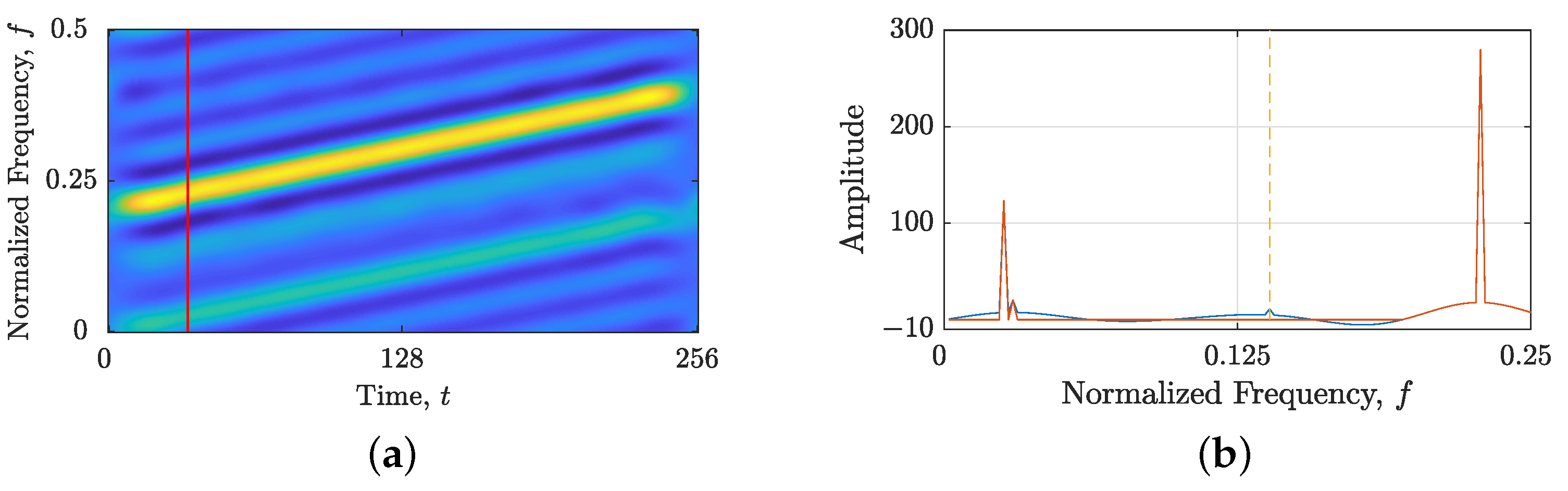
Figure 1 illustrates the TFD derived from the CS-AF area and a time slice extracted at t = 35 for signal z S 1 ( t ) . Notice that there are notable amplitude differences among the components. After several iterations of the RTwIST algorithm, the extracted time slice demonstrates how the side lobe of the stronger component may accumulate a larger surface area, leading it to be misclassified as an auto-term. As shown in the next section, this results in inconsistent auto-term representation in the reconstructed TFD, and introduces similar artifacts that obscure the true signal components.
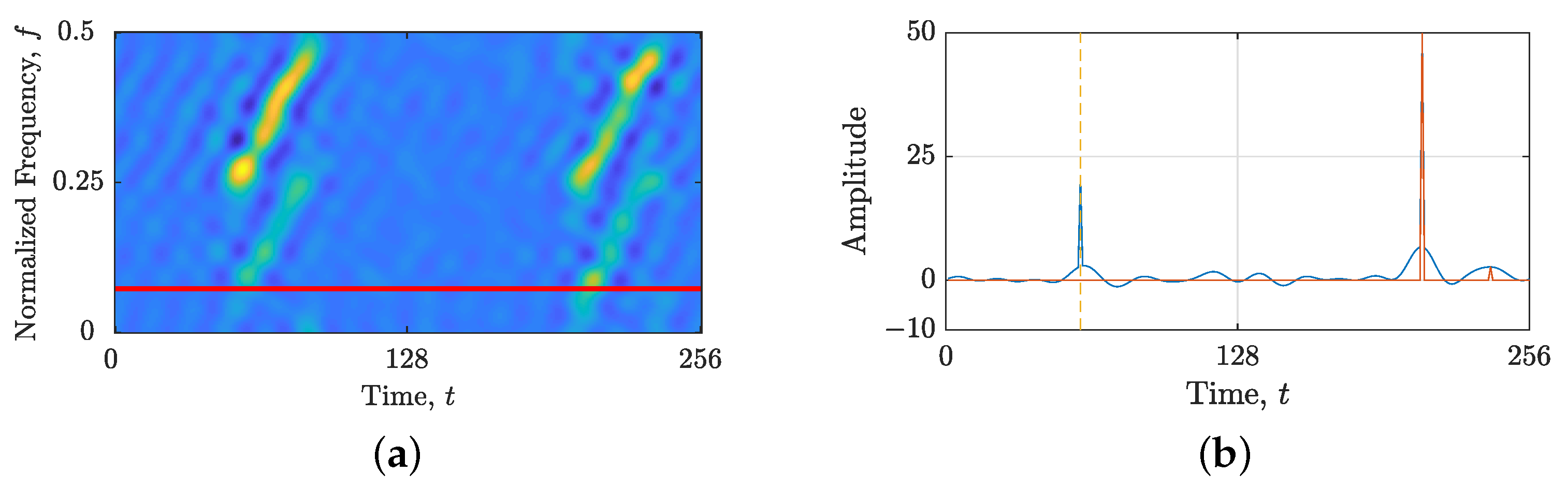
Similarly, Figure 2 presents the TFD and a frequency slice extracted at f = 38 for signal z S 2 ( t ) . Because noise cannot be fully removed by the CS-AF area, it amplifies the side lobe of a stronger component, causing it to be mistakenly identified as a second auto-term in this frequency slice. Moreover, this slice illustrates the fragility of surface estimation: the true weaker component (near the yellow dashed line) appears as two local maxima, leading to detection of two small surfaces for a single auto-term. These fragmented surfaces are smaller and therefore more easily overpowered by side lobes from stronger components.

2.5. The Proposed RTwIST-RANSAC Algorithm

The original RTwIST algorithm employs a shrinkage procedure that can introduce outliers, particularly under the challenging scenarios outlined in the previous section. To mitigate this, a RANSAC-based iterative procedure [37] is employed. The RANSAC algorithm operates by iteratively selecting random subsets of estimated signal components, fitting a parametric curve to these points, and evaluating the fit quality. The curve that minimizes a predefined fitness criterion is selected as the optimal estimate. The correction framework comprises two principal stages: model fitting and model evaluation. This approach is applicable to components extracted from either time or frequency slices, as detailed below.

2.5.1. Model Fitting

Assuming the estimated components are slowly varying functions, denoted as x ( t ) , they can be effectively modeled using a truncated Fourier series:
x ( t ) = a 0 + k = 1 P a k cos t π k N s + b k sin t π k N s ,
where N s is the number of points in the auto-term, and P denotes the number of Fourier coefficients.
This model can be expressed in matrix form as:
X = H ψ ,
where X = [ x ( t 0 ) , x ( t 1 ) , , x ( t N s 1 ) ] , ψ = [ a 0 , a 1 , , a P , b 1 , , b P ] , and the design matrix H is calculated as H = [ H ( t 0 ) , H ( t 1 ) , , H ( t N s 1 ) ] . Note that H ( t c ) is expressed as H ( t c ) = 1 , cos π t c N s , , cos P π t c N s , sin π t c N s , , sin P π t c N s .
The parameters ψ are estimated using the least squares method:
ψ = H ˜ H ˜ 1 H ˜ X ˜ ,
where H ˜ and X ˜ comprise only the rows corresponding to the selected auto-term points. The reconstructed auto-term curve is then obtained as:
X ^ = H ψ .
To enhance precision, a neighborhood search is applied to refine each point of the curve:
x max ( t ) = arg max f ς z ( t , f ) , x ^ ( t ) Δ x x ^ ( t ) + Δ ,
where Δ is a user-defined search interval. This refinement is iteratively applied to a number of randomly selected subsets to improve robustness.

2.5.2. Model Evaluation

Candidate curves are assessed using an objective function, as proposed in [37], which enforces smoothness and continuity while promoting alignment with high-energy TF points. The auto-term is modeled as a slowly varying curve, penalizing abrupt changes and discontinuities. Additionally, the principal directions between consecutive auto-term points are constrained to vary smoothly. The objective function is defined as:
x ^ ( t ) = arg min x ( t ) q ( x ( t ) ) + d d t x ( t ) + d d t θ ( t , x ( t ) ) d t ,
where:
  • q ( x ( t ) ) penalizes deviations from high-energy TF points,
  • d d t x ( t ) measures the degree of smoothness by calculating its differential and penalizing abrupt changes,
  • d d t θ ( t , x ( t ) ) enforces continuity in auto-term ridge directions by calculating the integral of the absolute value of the differential of the auto-term curve.
Beyond the RANSAC procedure, the proposed shrinkage algorithm introduces a novel aspect: it leverages the estimated local number of components, obtained via the LRE, to extract the signal auto-terms. This enables dynamic determination of the number of auto-terms per time or frequency slice, and facilitates tracking of changes in the estimated component count across M t , f curves, thereby localizing the signal auto-terms.

2.5.3. Summary of the Proposed Algorithm

The main steps of the proposed shrinkage algorithm are as follows:
  • Remove negative samples from the entire TFD using the hard threshold operator hard 0 { · } :
    hard 0 { ς z ( t , f ) } = ς z ( t , f ) , ς z ( t , f ) 0 , 0 , otherwise .
    This removes spurious local minima that may distort ridge detection.
  • Use Algorithm 1 to identify local maxima in each TFD slice and compute surfaces by summing surrounding values bounded by local minima. Ascendantly sort surfaces in each time and frequency slice.
  • Identify the slice with the largest surface area and extract its maximum as a candidate point.
  • Construct the auto-term curve x max ( t ) by linking the largest surface maxima across slices, tracking M t , f until a change in the number of components is detected, i.e., d d t M t ( t ) or d d f M f ( f ) 0 .
  • Initialize iteration counter k = 1 .
  • For each iteration, randomly sample points to estimate the auto-term curve, named as x k ( t ) , using the RANSAC fitting step.
  • Increment k, i.e. k = k + 1 , and repeat the model-fitting step for K iterations.
  • Model Evaluation: Evaluate all auto-term curves, i.e., x k ( t ) for k = 1 , 2 , , K , using the objective function given in (24) and select the curve x ^ ( t ) that minimizes the objective.
  • Update the time or frequency slices with the refined auto-term maxima in ς z ( t , f ) .
  • Remove the surfaces corresponding to the selected maxima from the candidate set.
  • Repeat the process until no components remain ( M t , f = 0 ).
Algorithm 1 Calculation of localized surfaces
1:
Input:  hard 0 { ς z ( t f , f t ) }
2:
Output: Sorted surface s u r f
3:
for  i 1  to  l e n g t h ς z ( : , f t )  do
4:
   if  M t , f > 0  then
5:
     Extract the current slice: s l i c e ( : ) ς z ( i , : ) ;
6:
     Identify local maxima: m a x i n d ( : ) ;
7:
     for  j 1 to l e n g t h m a x i n d  do
8:
        Set peak index: s u r f ( j , 3 ) = m a x i n d ( j ) ;
9:
        Identify left-bound minimum: x max : s u r f ( j , 2 ) ;
10:
      Identify right-bound minimum: x max : s u r f ( j , 1 ) ;
11:
   Compute surface area: s u r f ( j , 0 ) sum samples inside [ s u r f ( j , 2 ) , s u r f ( j , 1 ) ] ;
12:
     end for
13:
     Sort surface entries s u r f in ascending order w.r.t. the s u r f ( : , 0 ) ;
14:
   end if
15:
end for
The full pseudocode is provided in Algorithm 2, detailing the iterative reconstruction procedure. Compared to the original RTwIST approach [19], several improvements are introduced. Firstly, the RANSAC-based approach eliminates the need for user-tuned parameters δ t , f , as they are fixed at δ t , f = 1 , thereby removing the trade-off between resolution and auto-term connectivity and preserving the maximum amplitude of the auto-terms in the reconstructed TFD. Secondly, the algorithm selectively applies shrinkage over time or frequency slices based on the parameter p, enhancing computational efficiency when p = 1 or p = 0 .
Algorithm 2 RTwIST-RANSAC reconstruction algorithm
Require:   A z C M ( ν , τ ) , Ψ , Ψ H , M t , M f , α , β , ϵ , N i t , p .
Ensure:  Reconstructed sparse TFD, Υ z ( t , f ) .
1:
Υ z 1 ( t , f ) [ 1 ] , Υ z 1 ( t , f ) [ 0 ] Ψ H A z C M ( ν , τ ) ;
2:
while (( c ϵ and ( n N i t )) do
3:
    ς z ( t , f ) = Υ z 1 ( t , f ) [ n ] + Ψ H A z C S ( ν , τ ) Ψ Υ z 1 ( t , f ) [ n ] ;
4:
   if  p > 0  and  p < 1  then
5:
      ς z t ( t , f ) s h r i n k ( ς z ( t , f ) , M t ) ;
6:
      ς z f ( t , f ) s h r i n k ( ς z ( t , f ) T , M f ) ;
7:
     else if   p = 1 then
8:
      ς z t ( t , f ) s h r i n k ( ς z ( t , f ) , M t ) ;
9:
     else if  p = 0 then
10:
      ς z f ( t , f ) s h r i n k ( ς z ( t , f ) T , M f ) ;
11:
     end if
12:
     Solve (16);
13:
     Solve (14);
14:
      c stopping criterion;
15:
      n n + 1 ;
16:
end while

3. Experimental Results and Discussion

3.1. Signal Examples and Selection of Setup Parameters

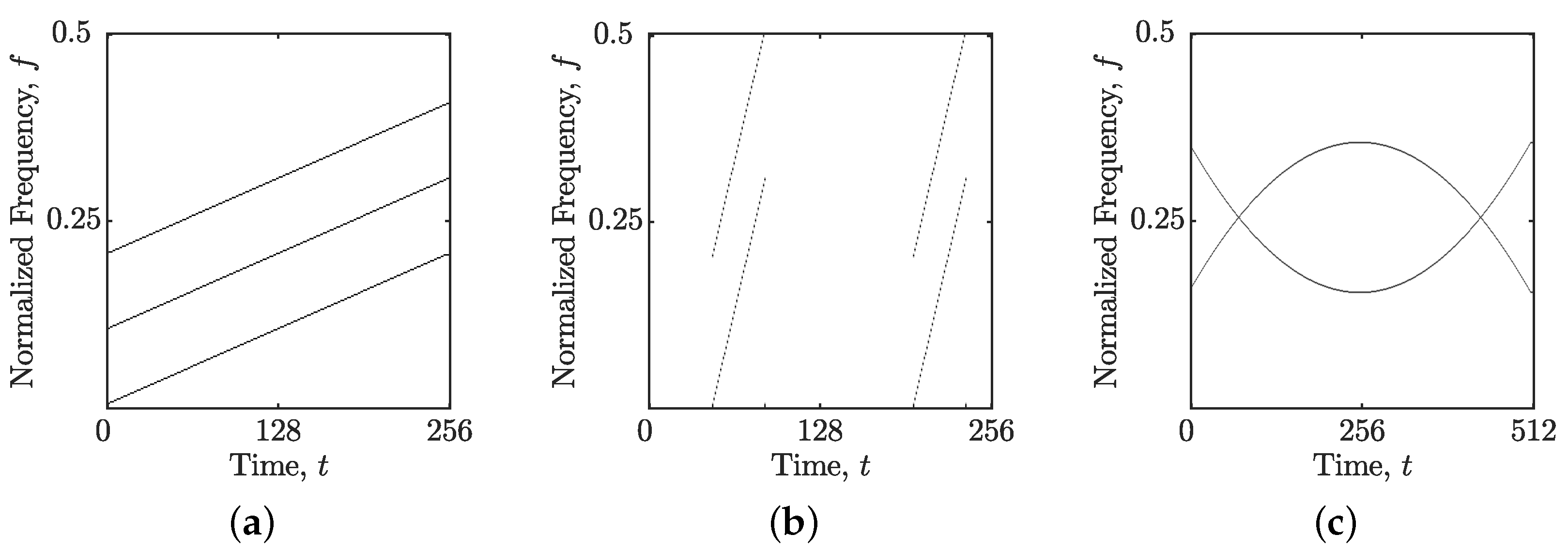
The performance of the proposed RTwIST-RANSAC algorithm was evaluated using three synthetic signals and one real-world EEG seizure signal. The first two signals, z S 1 ( t ) and z S 2 ( t ) , are defined in (17) and (18), respectively. The third synthetic signal, denoted as z S 3 ( t ) , comprises two crossing quadratic FM (QFM) components:
z S 3 ( t ) = e j 2 π ( 0.3531 t 0.0016 t 2 + 4.101 · 10 6 t 3 ) + e j 2 π ( 0.1469 t + 0.0016 t 2 4.101 · 10 6 t 3 ) .
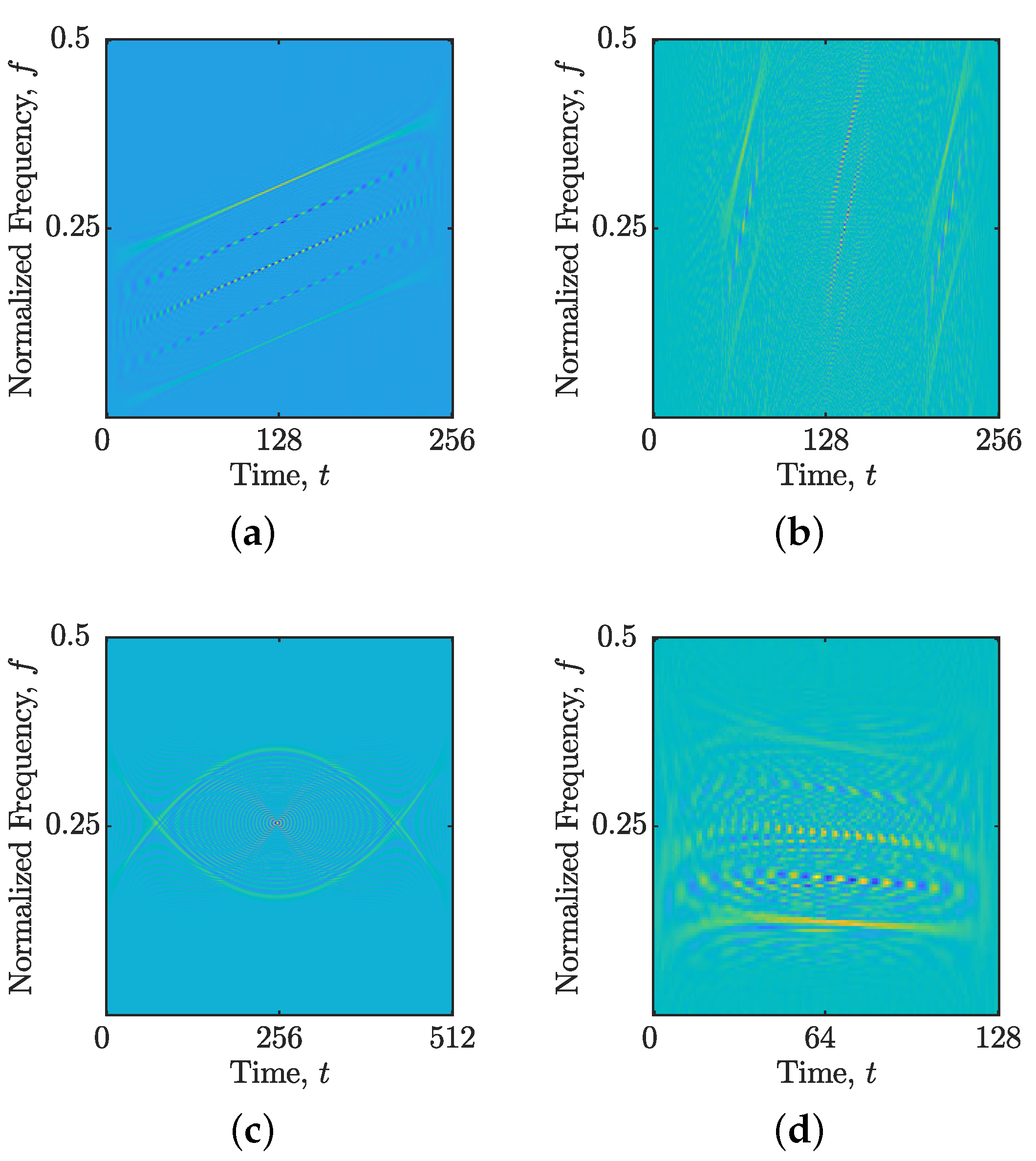
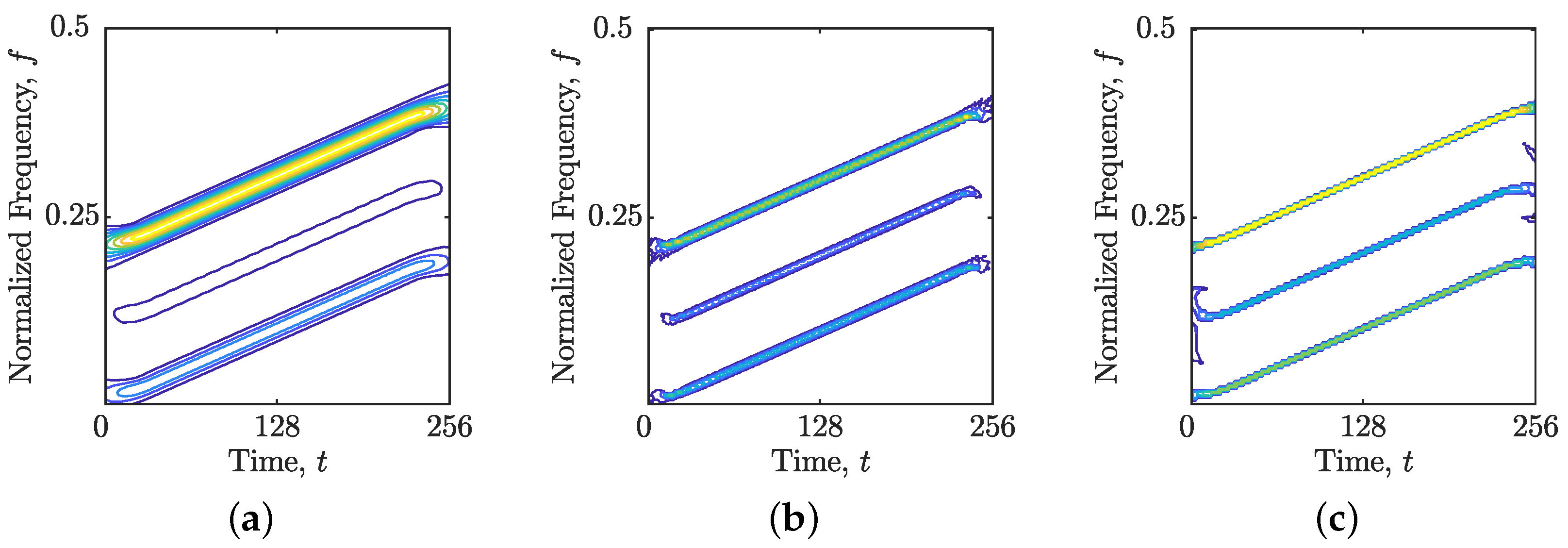
The real-world EEG seizure signal example was sourced from [43], along with several other studies that analyzed such signals [42,44,45,46,47,48,49]. The EEG signal undergoes a structured preprocessing pipeline to ensure signal quality and reduce computational complexity [43]. Initially, an analog band-pass filter ranging from 0.5 to 70 Hz is applied to attenuate slow drifts and prevent aliasing. This is followed by a 50 Hz notch filter to eliminate power line interference. To further limit high-frequency content, a low-pass filter with a cutoff at 16 Hz is employed, serving as an anti-aliasing filter. Finally, the signals are downsampled to 32 Hz, balancing the trade-off between temporal resolution and computational efficiency. The WVDs of the considered signals are shown in Figure 3, serving as initial QTFDs for this CS-based approach. Their ideal TFD counterparts are depicted in Figure 4.
The performance of the proposed RTwIST-RANSAC algorithm was evaluated in comparison to conventional TFDs, specifically the WVD and the SPEC, as well as the SST and SET. Additionally, it was benchmarked against several state-of-the-art reconstruction algorithms that have demonstrated high performance in previous studies [11,18,19]. These include RTwIST [19], TwIST [38], the your-augmented Lagrangian algorithm for 1 (YALL1) [50], and the split-augmented Lagrangian shrinkage algorithm (SALSA) [51].
The adaptive CS-AF areas N τ × N ν were determined for each signal as follows: 15 × 15 for z S 1 ( t ) , 31 × 17 for z S 2 ( t ) , 23 × 41 for z S 3 ( t ) , and 9 × 11 for z EEG ( t ) . The reconstruction parameters were set to N i t = 200 and ϵ = 10 3 , following recommendations in [11,18,19,21]. For LRE computation, α R = 3 and Θ t = Θ f = 11 were adopted [22,39,52]. The RANSAC parameters were configured following the guidelines in [37]. The search interval was set to Δ = 4 to enhance auto-term accuracy. A first-order Fourier series approximation ( P = 1 ) was employed to model the auto-term curve as in [37]. For the auto-term curve, 12.5% of TF points were randomly selected, and K = 500 simulations were conducted to reliably determine the optimal auto-term trajectory as recommended in [37]. Simulations were executed using MATLAB R2018a (The MathWorks, Inc., Natick, MA, USA) on a PC with a Ryzen 9 5900X processor (3.70 GHz base clock) and 32 GB of DDR4 RAM, averaged over 1000 independent runs.

3.2. Performance Comparison

Reconstruction quality was assessed using two global concentration metrics: the RE from (13), and the energy concentration measure (ECM) [53]:
E C M = 1 N t N f ρ z ( t , f ) ρ z ( t , f ) d t d f 1 p s d t d f p s , p s > 1 N ,
with p s = 2 as recommended [53]. Lower ECM values indicate sharper TFD concentration, as marked by the downward arrow.
Since global metrics can favor overly sparse solutions and fail to reflect auto-term accuracy [19,21], an additional measure was adopted. Specifically, the LRE-based mean squared error (MSE) between the original and reconstructed TFDs was used to quantify the preservation of signal structure in the reconstructed TFD [19]:
M S E t , f L R E = 1 N t t = 1 N t M t ρ ^ z ( t , f ) ( t ) M t Υ z 1 ( t , f ) ( t ) max M t ρ ^ z ( t , f ) ( t ) , M t Υ z 1 ( t , f ) ( t ) 2 + + 1 N f f = 1 N f M f ρ ^ z ( t , f ) ( f ) M f Υ z 1 ( t , f ) ( f ) max M f ρ ^ z ( t , f ) ( f ) , M f Υ z 1 ( t , f ) ( f ) 2 ,
which indicates how closely the auto-term energy is preserved across time and frequency.
Reconstructed TFDs with the optimal parameters were determined by using the multi-objective optimization problem formulated as in [19], now given for the proposed RTwIST-RANSAC algorithm:
min { E C M , M S E t , f L R E } , s . t . α 0 , 1 ] , β 0 , 2 α ] , p [ 0 , 1 ] ,
where both ECM and LRE-based MSE are minimized simultaneously. Multi-objective particle swarm optimization (MOPSO) [54,55,56], configured as in [19], was employed for parameter tuning. From the generated Pareto front, the best solution was selected using the fuzzy satisfying method (FSM) [18,19].
Finally, the quality of the reconstructed TFDs was quantified using the normalized 1 distance from the ideal TFD:
1 = 1 N t N f | | Υ z ( t , f ) ρ ^ z ( t , f ) | | 1 .

3.3. Synthetic Signals: Results

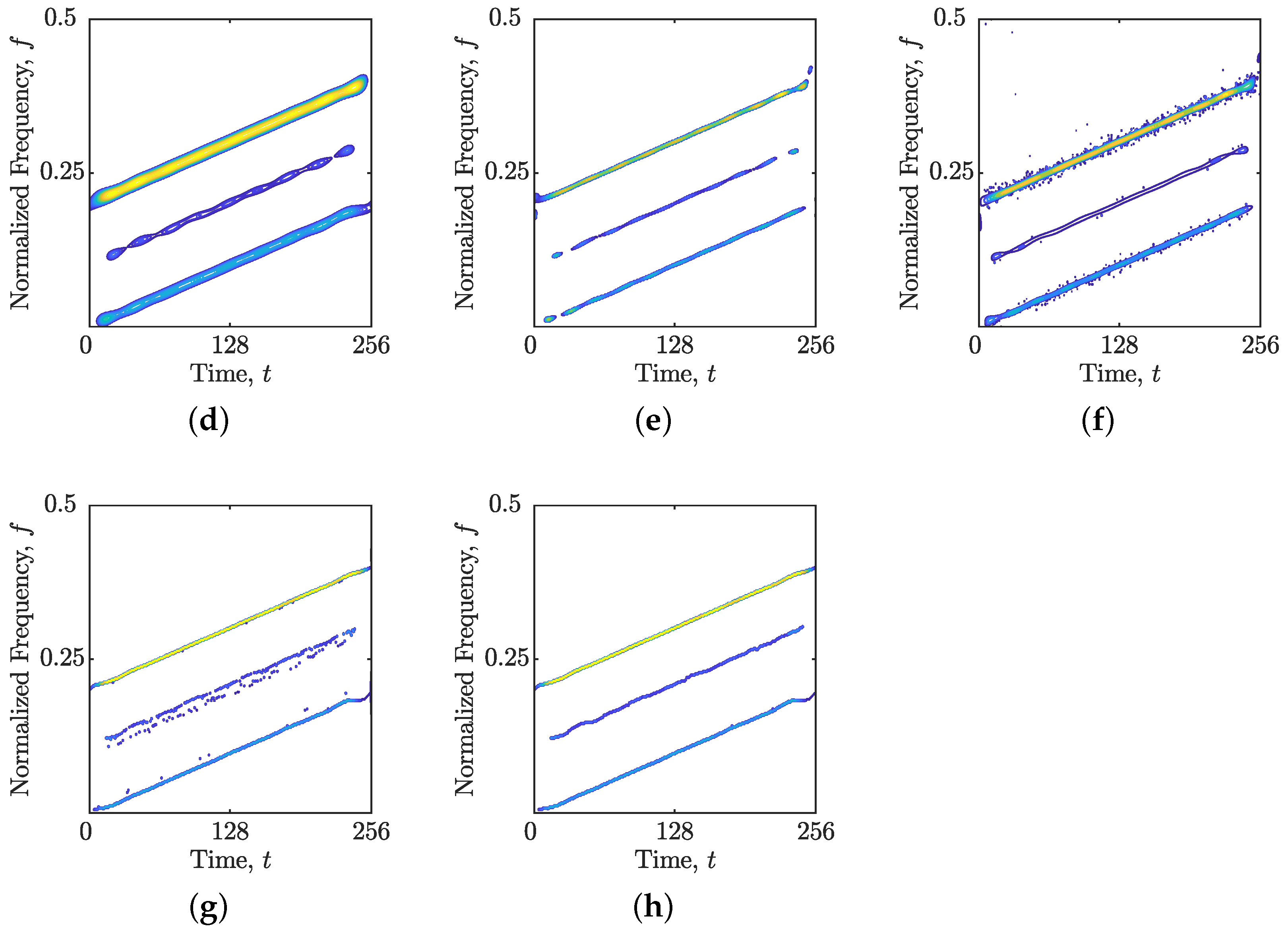
Figure 5 presents a comprehensive comparison of the considered TFDs of signal z S 1 ( t ) . The SPEC (Figure 5a) exhibits the lowest auto-term resolution among all techniques, resulting in a blurred representation, but with fully retained auto-terms. Improved auto-term resolution is observed in the SST and SET methods (Figure 5b,c), where the auto-terms are also preserved. The YALL1 (Figure 5e) produces a TFD with high auto-term resolution, allowing for clear visualization of the signal components, but suffers from missing samples in two components. The TwIST algorithm (Figure 5f) generates a reconstructed TFD with numerous interference artifacts in the vicinity of the auto-terms, which can obscure the true signal components and complicate interpretation. RTwIST (Figure 5g) achieves high resolution, enabling clear visualization of the signal components, but shows inconsistency in the lowest amplitude component, with many samples exhibiting bias from their ideal positions. It is apparent that for certain time slices an incorrect side lobe of the stronger component was selected as the auto-term instead of a true one. The proposed RTwIST-RANSAC method (Figure 5h) effectively addresses these limitations by successfully reconstructing all signal components with consistency and retention of their characteristics. It solves the problem of biased low-amplitude components observed in RTwIST, resulting in a more accurate and reliable representation of the weakest component.
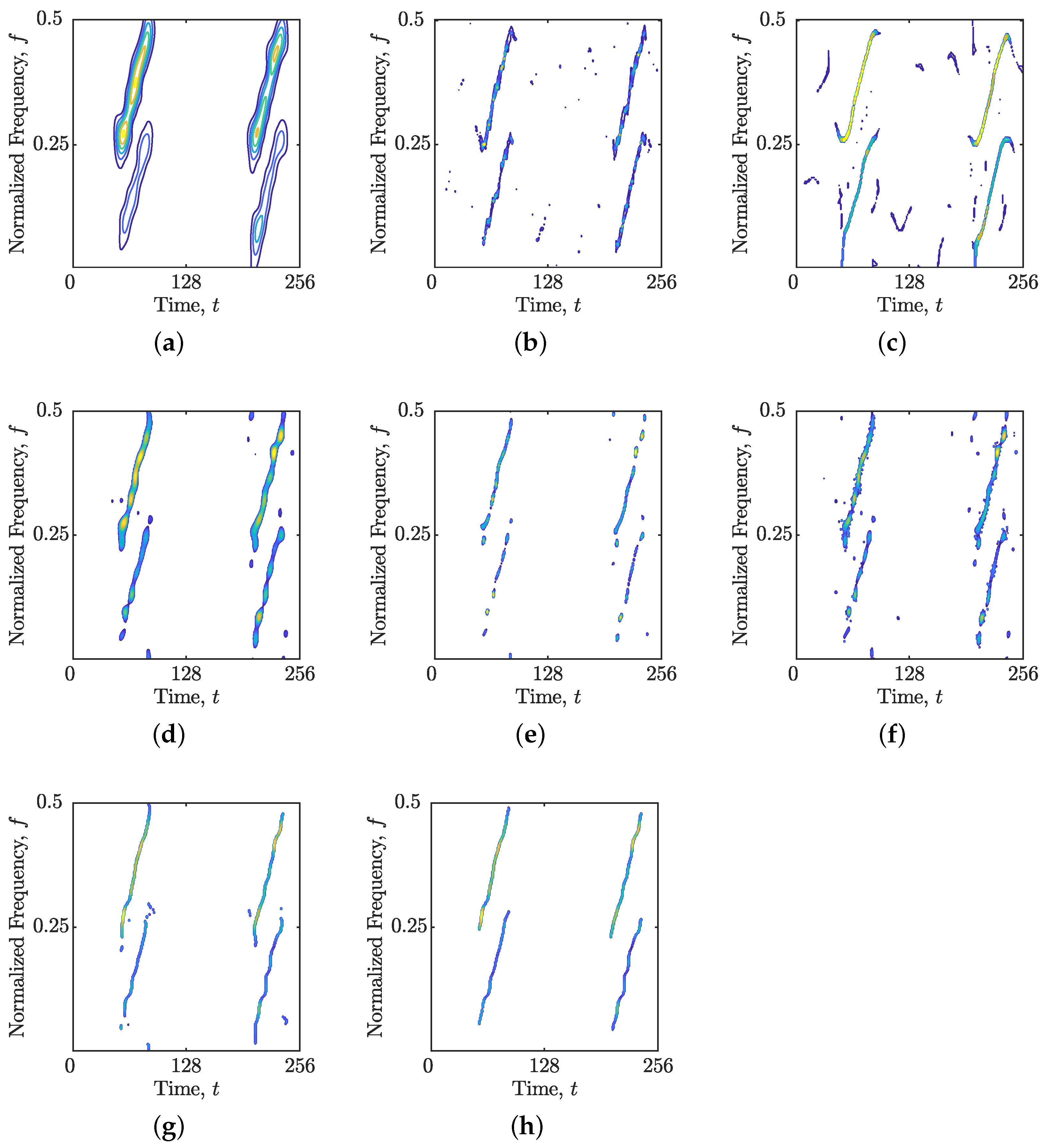
Figure 6 presents a comprehensive comparison of the considered TFDs of signal z S 2 ( t ) . Again, SPEC (Figure 6a) retains the auto-terms but exhibits the lowest auto-term resolution, resulting in a blurred representation. While SST and SET (Figure 6b,c) preserve the auto-terms, they are unable to fully suppress interference and noise-related artifacts. The YALL1 algorithm (Figure 6e) produces a TFD with high auto-term resolution, allowing for clear visualization of signal components, but suffers from discontinuous auto-terms. SALSA and TwIST algorithms (Figure 6d and Figure 6f, respectively) exhibit lower auto-term resolution compared to YALL1 but reconstruct noise samples, which can interfere with accurate signal components. The RTwIST algorithm (Figure 6g) achieves high-resolution auto-terms but fails to suppress noise completely. This is a result of some noise-related surfaces being larger than those belonging to the auto-terms, leading to errors. The proposed RTwIST-RANSAC algorithm (Figure 6h) effectively addresses these limitations by retaining the high-resolution auto-terms of RTwIST while simultaneously removing noise outliers during component refinement.
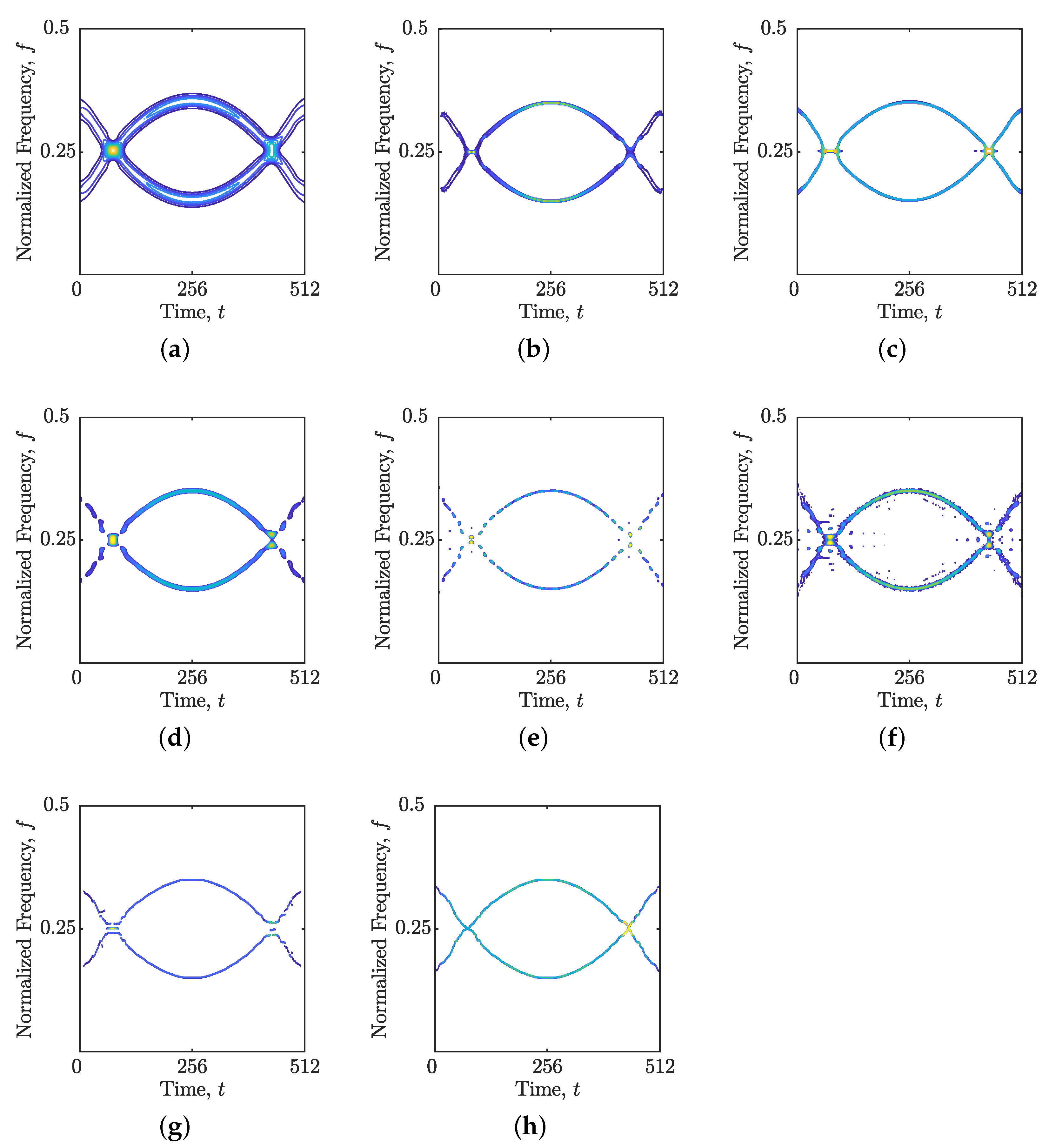
Figure 7 presents a comparison of the considered TFDs of signal z S 3 ( t ) , specifically focusing on their performance at the intersection points of the signal components. The SALSA, YALL1, and TwIST algorithms (Figure 7d, Figure 7e, and Figure 7f, respectively) exhibit inaccuracies in the vicinity of the intersection points, where the loss of auto-terms and the inclusion of cross-terms are evident. The RTwIST algorithm (Figure 7g) fails to address these issues, as it also distorts both components when they intersect, further complicating their accurate representation. In contrast, the proposed RTwIST-RANSAC algorithm (Figure 7h) effectively resolves these challenges by refining the reconstruction using the RANSAC method. This refinement leads to significant improvements in component retention at the intersection points, ensuring that the auto-terms are preserved and the cross-terms are suppressed.
The analysis of Table 2 provides a numerical comparison of the considered TFDs of the synthetic signals z S 1 ( t ) , z S 2 ( t ) , and z S 3 ( t ) . The WVD emerges as the worst-performing TFD among those selected, as indicated by all measures except R. This poor performance is attributed to unresolved cross-terms and noise. Interestingly, the R measure, with the Rényi entropy parameter α R = 3 , correctly indicates that the WVD has better auto-term resolution than the SPEC due to its ability to integrate out the cross-terms and focus on the auto-terms. The lower E C M and R measures demonstrate high resolution of the reconstructed TFDs obtained using the YALL1 algorithm. However, it is important to note that this is also caused by fewer samples related to the auto-terms. This highlights the significance of the M S E t , f L R E measure, which indicates lower auto-term retention of the YALL1 algorithm in signal z S 2 ( t ) , and lower resolution and reconstruction of the cross-terms or noise for the SALSA, YALL1, and TwIST algorithms in signals z S 2 ( t ) and z S 3 ( t ) . For signal z S 1 ( t ) , discontinuities in the component with the lowest amplitude result in RTwIST being ranked worse than YALL1 and TwIST according to the 1 and M S E t , f L R E measures. These measures also account for the inaccuracies of the RTwIST algorithm in other signal examples.
The proposed RTwIST-RANSAC algorithm’s reconstructed TFD is highlighted by all considered measures as the best performing for all signals, with one exception. For signal z S 2 ( t ) , the R measure slightly favors YALL1. However, this is due to missing auto-term samples in the YALL1 reconstructed TFD, which this measure cannot appropriately account for. Notably, the 1 measure consistently proves that the proposed RTwIST-RANSAC’s reconstructed TFD is the closest to an ideal TFD for all signal examples. When compared to the RTwIST algorithm, consistent improvement is achieved. For z S 1 ( t ) , RTwIST-RANSAC shows improvements of 15.32% in E C M , 0.65% in R, 36.82% in 1 , and 45.60% in M S E t , f L R E . For z S 2 ( t ) , the improvements are 11.25% in E C M , 1.58% in R, 18.22% in 1 , and 51.14% in M S E t , f L R E . For z S 3 ( t ) , RTwIST-RANSAC demonstrates improvements of 13.33% in E C M , 0.03% in R, 52.06% in 1 , and 34.37% in M S E t , f L R E .
The analysis of the execution time in Table 2 reveals significant variations across the different TFD methods. For all signal examples, WVD and SPEC are considerably faster than all the reconstruction algorithms. Notice that the RTwIST algorithm is usually slower than the SALSA and TwIST algorithms, but considerably faster than the YALL1 algorithm. The results show that the proposed RTwIST-RANSAC is faster than RTwIST and YALL1, showing a 61.39% improvement over RTwIST for z S 1 ( t ) . For z S 2 ( t ) , RTwIST-RANSAC shows a significant 69.57% improvement over RTwIST, and is faster even than the SALSA algorithm. For z S 3 ( t ) , RTwIST-RANSAC again demonstrates a 49.39% improvement over RTwIST and is again faster than the YALL1 and SALSA algorithms. While RTwIST-RANSAC is not the fastest algorithm, it consistently shows significant speed improvements over RTwIST across all signals.

3.4. Real-World EEG Signal: Results

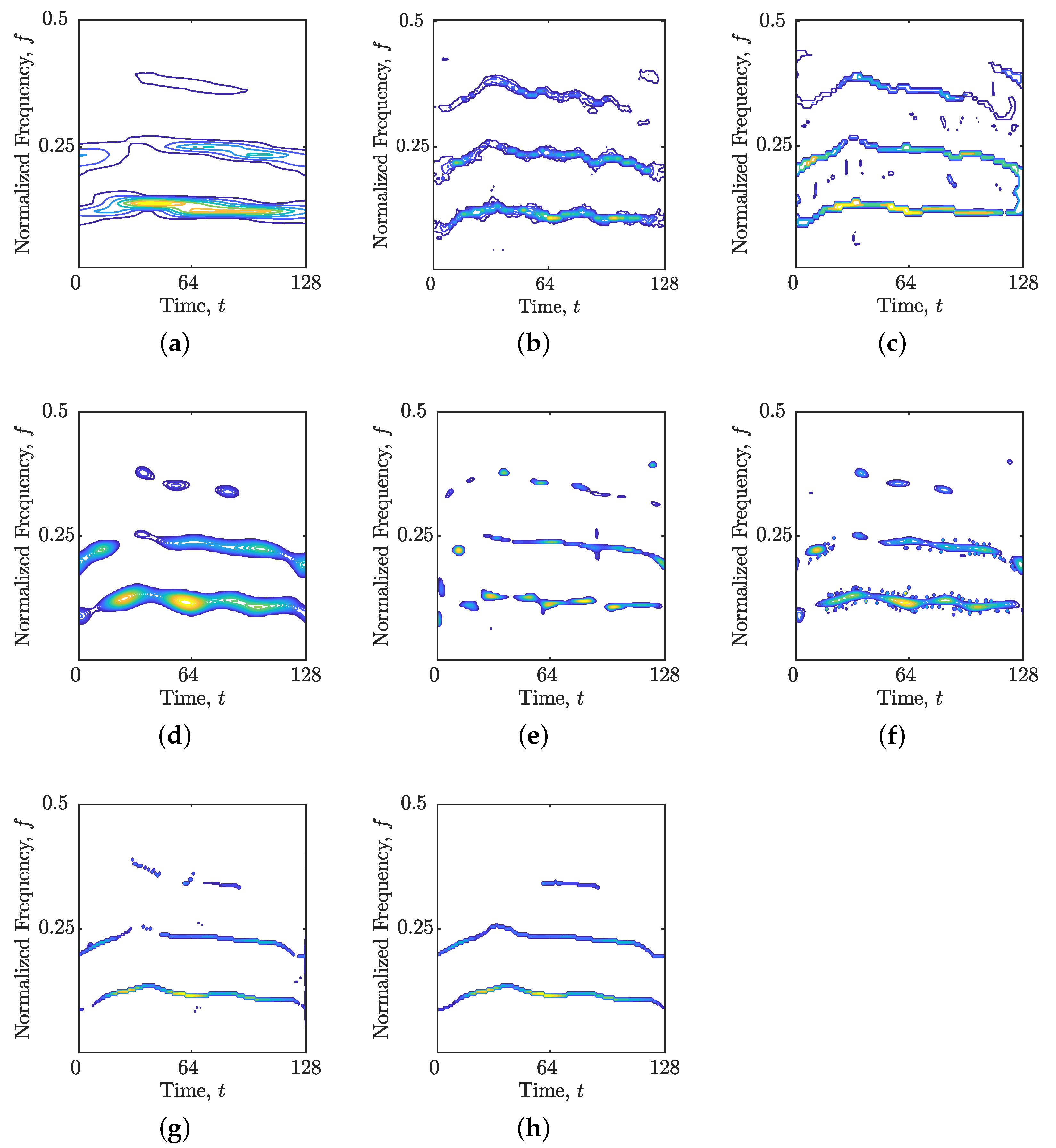
Figure 8 presents a comparison of the considered TFDs of a real-world EEG signal z EEG ( t ) , highlighting their performance in terms of auto-term resolution and continuity. Although SST and SET (Figure 8b,c) demonstrate strong auto-term retention, they are unable to fully suppress interference and achieve high auto-term resolution. The SALSA and TwIST algorithms (Figure 8d and Figure 8f, respectively) produce reconstructed TFDs with discontinuous components and low resolution, which can complicate accurate signal analysis. YALL1 (Figure 8e) also results in discontinuous components but with higher resolution compared to SALSA and TwIST. The RTwIST algorithm (Figure 8g) achieves better auto-term resolution than the aforementioned methods but suffers from dislocated auto-term samples, which are replaced by interference. In contrast, the proposed RTwIST-RANSAC algorithm (Figure 8h) retains the high resolution of RTwIST while effectively circumventing interference and achieving continuous auto-terms.
The observations from synthetic signals are consistent with the results for the real-world EEG signal z EEG ( t ) , as shown in Table 3. All performance measures favor the proposed RTwIST-RANSAC algorithm as the best-performing. Specifically, the E C M and R measures highlight RTwIST-RANSAC’s ability to produce reconstructed TFDs with high resolution and minimal interference, while the lowest M S E t , f L R E indicates superior auto-term preservation and continuity. RTwIST-RANSAC demonstrates improvements over RTwIST, with a 23.63% reduction in E C M , 2.56% in R, and 45.60% in M S E t , f L R E . Furthermore, RTwIST-RANSAC achieves a notable improvement in execution time, being 76.95% faster than RTwIST and 25.55% faster than SALSA.

3.5. Noise Sensitivity Analysis

To evaluate the impact of noise on the RTwIST and RTwIST-RANSAC algorithms, the synthetic signals were subjected to AWGN across four SNR levels ranging from 9 dB to 0 dB. The results in terms of the 1 measure, based on 1000 independent noise realizations, are summarized in Table 4. RTwIST-RANSAC consistently produces better-performing reconstructed TFDs for low to moderate noise levels, specifically, at SNR = 3 dB, 6 dB, and 9 dB. This improvement is attributed to the component refinement using the RANSAC method, which effectively corrects noise outliers that appear in the reconstructed TFDs using RTwIST. More precisely, at SNR = 9 dB, RTwIST-RANSAC achieves a 22.30% improvement over RTwIST for signal z S 1 ( t ) , 9.39% for z S 2 ( t ) , and 51.24% for z S 3 ( t ) . At SNR = 6 dB, RTwIST-RANSAC shows improvements of 27.23% for z S 1 ( t ) , 15.97% for z S 2 ( t ) , and 58.43% for z S 3 ( t ) . At SNR = 3 dB, RTwIST-RANSAC improves by 52.39% for z S 1 ( t ) , 18.25% for z S 2 ( t ) , and 71.35% for z S 3 ( t ) compared to RTwIST. Interestingly, RTwIST is more suitable for high-noise conditions, i.e., SNR = 0 dB, where it outperforms RTwIST-RANSAC.

3.6. Interpretation of the Results and Limitations

The results collectively demonstrate that the proposed RTwIST-RANSAC algorithm outperforms both conventional and advanced methods, including its predecessor, RTwIST. Its primary advantages lie in achieving high auto-term resolution, robust performance, and effective suppression of interference and noise across a range of synthetic and real-world signals characterized by varying amplitudes, noise levels, and component intersections. A key improvement introduced by RTwIST-RANSAC is its ability to enhance auto-term continuity by connecting auto-term samples across adjacent time and frequency slices—addressing a critical limitation of the original RTwIST approach. Furthermore, by refining each signal component individually, RTwIST-RANSAC efficiently eliminates outlier samples that may otherwise result from interference or noise influencing the reconstruction in specific regions. Notably, the algorithm also improves the interpretability of the regularization process, a feature that distinguishes it from widely used methods such as SST and SET. These combined benefits make RTwIST-RANSAC a compelling choice for accurate and reliable TFD reconstruction in complex signal processing scenarios.
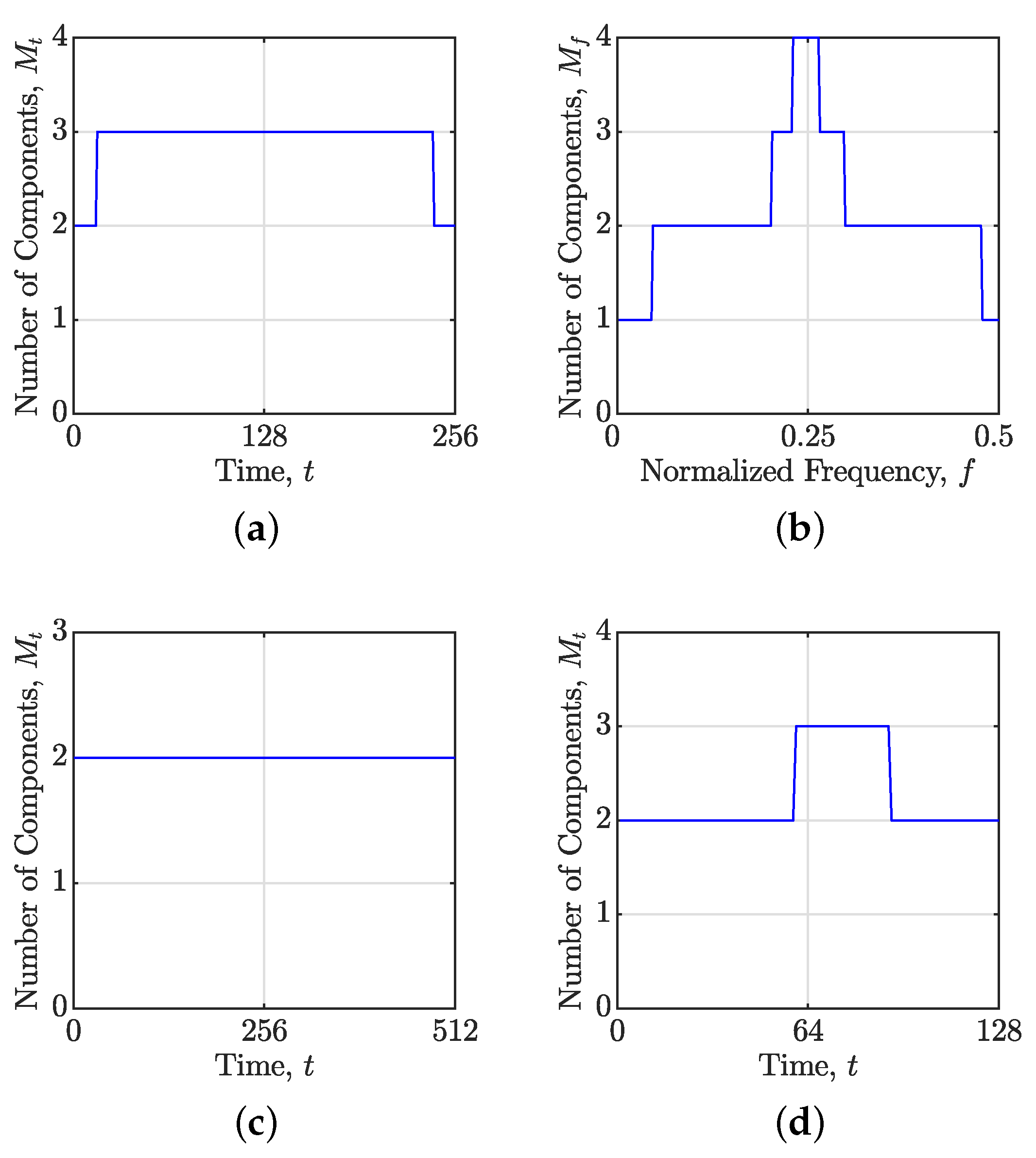
Observations from Figure 9 indicate that the proposed shrinkage algorithm is suitable for signals with constant or varying numbers of components, meaning that taking a full component or part of a component is allowed. However, a limitation arises when dealing with multi-component signals where the amplitude changes notably within a component. In such cases, the algorithm may incorrectly merge different components if the RANSAC inputs are selected from multiple components. This issue necessitates that each input to RANSAC must be related to a single full component or part of one component.
For the EEG signal example, the component with the lowest amplitude appears to not be fully preserved, which is primarily due to the limitations of the original LRE approach used. As shown in Figure 9d, the weakest component is not adequately detected by the LRE method and, consequently, is not considered by either the RTwIST or RTwIST-RANSAC algorithms. To improve the detection of low-amplitude components, one could employ the iterative LRE approach described in [57], which progressively removes stronger components to reveal weaker ones. However, this iterative method tends to amplify interference and noise, often resulting in inaccurate component estimation [58]. Additionally, it presents challenges for signals with intersecting components, as both components may be removed simultaneously at the intersection point during a single iteration. Therefore, while the iterative approach may be suitable for specific scenarios, the original LRE method used in this study remains more robust and reliable for general applications [58]. An alternative LRE approach based on convolutional neural networks (CNNs), introduced in [58], has shown improved component estimation compared to both the original and iterative variants. However, the CNN-based method often produces highly volatile component curves, which poses challenges for the proposed shrinkage algorithm. Such volatility may lead to the inclusion of interference points as auto-terms or fragmentation of components. To address this, future research could explore post-processing filters to smooth CNN-based LRE outputs before application within the RTwIST-RANSAC framework.
The computational complexity of the original RTwIST is O ( n 2 ) [19]. The RTwIST-RANSAC algorithm, however, incurs additional complexity due to K pseudo-inverse computations on N 0 random samples for each component, resulting in an additional complexity of O ( M K N 0 2 ) . Despite this, RTwIST-RANSAC demonstrates significant improvements in execution time compared to RTwIST. In some cases, it even outperforms SALSA in speed, while YALL1 remains consistently much slower. This efficiency gain is primarily due to RTwIST-RANSAC’s ability to satisfy the stopping energy criterion earlier by refining auto-terms in each iteration. Although this work focuses on offline signal analysis—consistent with other studies where accuracy and robustness are prioritized over speed [11,18,19,37,42]—the improved computational time achieved by RTwIST-RANSAC represents a step towards real-time applications in practical scenarios. Future research will explore integrating machine learning techniques to further accelerate the reconstruction process and optimize parameter tuning. It is worth noting that tuning the RANSAC parameters does not increase the complexity of the RTwIST-RANSAC algorithm relative to RTwIST. In fact, the multi-objective optimization problem formulated in (29) is simplified, since the δ t , f parameters present in the RTwIST formulation [19] are now fixed to 1, reducing the parameter search space.
The choice of RANSAC parameters should be considered. The Fourier series approximation is employed to model the auto-term curve, as it can represent a wide class of functions satisfying the Dirichlet conditions [37]. Since this study focuses on signals with LFM and/or QFM components, the first-order Fourier series approximation ( P = 1 ) is recommended, consistent with [37]. Experiments on all considered synthetic signals in this work confirm that increasing the order P does not improve reconstruction performance. The selection of parameter Δ depends on expected variation in the auto-term curve. If the auto-terms experience fast-changing behavior, larger Δ should be assigned [37]. However, selecting too large a value can be problematic if two or more components are closely spaced or intersected. Table 5 shows experimental results for several Δ values which justify the selected value of Δ = 4 .
The number of randomly selected samples used as input to RANSAC is related to the parameter K. Increasing the number of points for model evaluation raises the required number of simulations K, as selecting many points heightens the risk of including incorrect TF peaks [37]. Moreover, too many points increase the chance of sampling interference, which must be corrected, while too few points risk generating inaccurate curve fits. Table 6 shows results for varying percentages of randomly selected points and K values, confirming that the chosen parameters strike a balance between performance and computational complexity.
Finally, the results further indicate that RTwIST-RANSAC effectively mitigates noise-related outliers under low to moderate noise conditions by refining components through RANSAC. However, in heavy-noise scenarios, the method’s effectiveness diminishes: if most randomly selected TF samples are biased or originate from interference/noise rather than true auto-terms, RANSAC may generate incorrect curves. This can lead to erroneous repositioning of auto-term samples—an issue typically less pronounced in the original RTwIST algorithm.

4. Conclusions

The RTwIST algorithm enhances interpretation of the regularization parameter in CS-based TFD reconstruction by using the LRE method. While achieving competitive performance in terms of high resolution and interference suppression, the selection of the largest auto-term-related surfaces that is prone to errors often leads to reconstruction inaccuracies.
This study addresses this problem by presenting the RTwIST-RANSAC algorithm. This novel algorithm incorporates a refined component detection and extraction process followed by a RANSAC-based refinement stage to exclude interference/noise and enforce auto-term consistency and LFM/QFM behavior. The results demonstrate that RTwIST-RANSAC consistently outperforms other algorithms across various synthetic and real-world signals, showcasing its ability to enhance auto-term consistency and remove noise-related outliers effectively. This is reflected in performance measures highlighting its enhanced resolution and auto-term preservation. Furthermore, RTwIST-RANSAC also improves execution time compared to RTwIST, making it a more efficient choice when speed is important. Also, RTwIST is outperformed in the case of a moderate noisy environment, where the RTwIST-RANSAC algorithm can reposition noise-related samples closer to the actual auto-terms.
However, the algorithm exhibits limitations in high-noise scenarios, where the increased prevalence of erroneous TF samples can compromise the accuracy of auto-term refinement via RANSAC. Additionally, the use of the original LRE method may limit the detection of components with relatively low amplitudes.
In summary, RTwIST-RANSAC provides an effective and efficient solution for TFD reconstruction, yielding high-resolution and accurate representations of complex signals. Its demonstrated advantages underscore the value of CS-based approaches over both conventional and advanced alternatives. Future work will focus on improving robustness under high-noise conditions and for multi-component signals with widely varying amplitudes, as well as integrating machine learning techniques to further accelerate reconstruction speed and enhance accuracy.

Funding

This research was funded by the University of Rijeka, Croatia; grant number: uniri-mladi-tehnic-23-2 (Analysis of non-stationary signals using time-frequency algorithms and deep learning).

Data Availability Statement

The data presented in this study are available on request from the corresponding author.

Conflicts of Interest

The author declares no conflicts of interest.

Abbreviations

The following abbreviations are used in this manuscript:
ADTFDAdaptive directional time-frequency distribution
AFAmbiguity function
AWGNAdditive white Gaussian noise
CNNConvolutional neural network
CSCompressive sensing
CS-AFCompressively sensed ambiguity function
ECMEnergy concentration measure
EEGElectroencephalogram
FMFrequency modulation
FSMFuzzy satisfying method
FTFourier transform
IFInstantaneous frequency
LFMLinear frequency-modulation
LRELocalized Renyi entropy
MOPSOMulti-objective particle swarm optimization
MSEMean squared error
QFMQuadratic frequency-modulation
QMLQuasi-maximum likelihood
QTFDQuadratic time-frequency distribution
RANSACRandom sample consensus
RERényi entropy
RTwISTRényi entropy-based two-step iterative shrinkage/thresholding
SALSASplit-augmented Lagrangian shrinkage algorithm
SETSynchroextracting transform
SNRSignal-to-noise ratio
SPECSpectrogram
SSTSynchrosqueezing transform
STFTShort-time Fourier transform
TFTime-frequency
TFDTime-frequency distribution
TwISTTwo-step iterative shrinkage/thresholding
WVDWigner–Ville distribution
YALL1Your-augmented Lagrangian algorithm for 1

References

  1. Boashash, B. Time-Frequency Signal Analysis and Processing, A Comprehensive Reference, 2nd ed.; EURASIP and Academic Press Series in Signal and Image Processing; Elsevier: London, UK, 2016. [Google Scholar]
  2. Dózsa, T.; Jurdana, V.; Šegota, S.B.; Volk, J.; Radó, J.; Soumelidis, A.; Kovács, P. Road Type Classification Using Time-Frequency Representations of Tire Sensor Signals. IEEE Access 2024, 12, 53361–53372. [Google Scholar] [CrossRef]
  3. Zhang, C.; Mousavi, A.A.; Masri, S.F.; Gholipour, G. The State-of-the-Art on Time-Frequency Signal Processing Techniques for High-Resolution Representation of Nonlinear Systems in Engineering. Arch. Comput. Methods Eng. 2025, 32, 785–806. [Google Scholar] [CrossRef]
  4. Yan, T.; Xing, X.; Wang, D.; Tsui, K.L.; Xia, M. Interpretable degradation tensor modeling through multi-scale and multi-level time-frequency feature fusion for machine health monitoring. Inf. Fusion 2025, 117, 102935. [Google Scholar] [CrossRef]
  5. Wu, J.; Yang, C. Time–frequency extracting transform and its applications in vibration signal processing. Measurement 2025, 243, 116284. [Google Scholar] [CrossRef]
  6. He, X.; Ding, J.; Wang, X.; Zhang, Q.; Zhao, W.; Wang, K. Adaptive extraction of characteristic ridges from time-frequency representation for wheelset bearings failure diagnosis under time-varying speed. Measurement 2025, 242, 115987. [Google Scholar] [CrossRef]
  7. Stankovic, L.; Dakovic, M.; Thayaparan, T. Time-Frequency Signal Analysis with Applications; Artech House Publishers: Boston, MA, USA, 2013. [Google Scholar]
  8. Liu, N.; Gao, J.; Zhang, Z.; Jiang, X.; Lv, Q. High-resolution characterization of geologic structures using the synchrosqueezing transform. Interpretation 2017, 5, T75–T85. [Google Scholar] [CrossRef]
  9. Yu, G.; Yu, M.; Xu, C. Synchroextracting Transform. IEEE Trans. Ind. Electron. 2017, 64, 8042–8054. [Google Scholar] [CrossRef]
  10. Sejdić, E.; Orović, I.; Stanković, S. Compressive sensing meets time-frequency: An overview of recent advances in time-frequency processing of sparse signals. Digit. Signal Process. 2018, 77, 22–35. [Google Scholar] [CrossRef]
  11. Volaric, I.; Sucic, V.; Stankovic, S. A Data Driven Compressive Sensing Approach for Time-Frequency Signal Enhancement. Signal Process. 2017, 141, 229–239. [Google Scholar] [CrossRef]
  12. Guan, Y.; Li, Y.; Ke, Z.; Peng, X.; Liu, R.; Li, Y.; Du, Y.P.; Liang, Z.P. Learning-Assisted Fast Determination of Regularization Parameter in Constrained Image Reconstruction. IEEE Trans. Biomed. Eng. 2024, 71, 2253–2264. [Google Scholar] [CrossRef]
  13. Zhang, Z.; Xu, Y.; Yang, J.; Li, X.; Zhang, D. A survey of sparse representation: Algorithms and applications. IEEE Access 2015, 3, 490–530. [Google Scholar] [CrossRef]
  14. Yuan, S.; Ji, Y.; Shi, P.; Zeng, J.; Gao, J.; Wang, S. Sparse Bayesian Learning-Based Seismic High-Resolution Time-Frequency Analysis. IEEE Geosci. Remote Sens. Lett. 2019, 16, 623–627. [Google Scholar] [CrossRef]
  15. Liu, N.; Lei, Y.; Liu, R.; Yang, Y.; Wei, T.; Gao, J. Sparse Time–Frequency Analysis of Seismic Data: Sparse Representation to Unrolled Optimization. IEEE Trans. Geosci. Remote Sens. 2023, 61, 5915010. [Google Scholar] [CrossRef]
  16. Lin, H.; Huang, X.; Chen, Z.; He, G.; Xi, C.; Li, W. Matching Pursuit Network: An Interpretable Sparse Time–Frequency Representation Method Toward Mechanical Fault Diagnosis. IEEE Trans. Neural Netw. Learn. Syst. 2024, 1–12. [Google Scholar] [CrossRef]
  17. Stanković, L.; Orović, I.; Stanković, S.; Amin, M. Compressive sensing based separation of nonstationary and stationary signals overlapping in time-frequency. IEEE Trans. Signal Process. 2013, 61, 4562–4572. [Google Scholar] [CrossRef]
  18. Jurdana, V.; Lopac, N.; Vrankic, M. Sparse Time-Frequency Distribution Reconstruction Using the Adaptive Compressed Sensed Area Optimized with the Multi-Objective Approach. Sensors 2023, 23, 4148. [Google Scholar] [CrossRef]
  19. Jurdana, V.; Volaric, I.; Sucic, V. Sparse time-frequency distribution reconstruction based on the 2D Rényi entropy shrinkage algorithm. Digit. Signal Process. 2021, 118, 103225. [Google Scholar] [CrossRef]
  20. Afkham, B.M.; Chung, J.; Chung, M. Learning regularization parameters of inverse problems via deep neural networks. Inverse Probl. 2021, 37, 105017. [Google Scholar] [CrossRef]
  21. Jurdana, V.; Volaric, I.; Sucic, V. The local Rényi entropy based shrinkage algorithm for sparse TFD reconstruction. In Proceedings of the 2020 International Conference on Broadband Communications for Next Generation Networks and Multimedia Applications (CoBCom), Graz, Austria, 7–9 July 2020; pp. 1–8. [Google Scholar] [CrossRef]
  22. Jurdana, V. Local Rényi entropy-based Gini index for measuring and optimizing sparse time-frequency distributions. Digit. Signal Process. 2024, 147, 104401. [Google Scholar] [CrossRef]
  23. Flandrin, P.; Borgnat, P. Time-frequency energy distributions meet compressed sensing. IEEE Trans. Signal Process. 2010, 58, 2974–2982. [Google Scholar] [CrossRef]
  24. Huang, Y.; Bao, W.; Li, F.; Li, X. Sparse Time-Frequency Analysis Based on Instantaneous Frequency Estimation and Fault Diagnosis Application. IEEE Trans. Instrum. Meas. 2022, 71, 3525509. [Google Scholar] [CrossRef]
  25. Tong, C.; Wang, S.; Selesnick, I.; Yan, R.; Chen, X. Ridge-Aware Weighted Sparse Time-Frequency Representation. IEEE Trans. Signal Process. 2021, 69, 136–149. [Google Scholar] [CrossRef]
  26. Jurdana, V. Deep Neural Networks for Estimating Regularization Parameter in Sparse Time–Frequency Reconstruction. Technologies 2024, 12, 251. [Google Scholar] [CrossRef]
  27. Rankine, L.; Mesbah, M.; Boashash, B. IF estimation for multicomponent signals using image processing techniques in the time–frequency domain. Signal Process. 2007, 87, 1234–1250. [Google Scholar] [CrossRef]
  28. Chen, S.; Dong, X.; Xing, G.; Peng, Z.; Zhang, W.; Meng, G. Separation of Overlapped Non-Stationary Signals by Ridge Path Regrouping and Intrinsic Chirp Component Decomposition. IEEE Sens. J. 2017, 17, 5994–6005. [Google Scholar] [CrossRef]
  29. Bruni, V.; Dei, M.; Pampaloni, F. Hormonal Contraception. In Female Reproductive Dysfunction; Petraglia, F., Fauser, B.C., Eds.; Springer International Publishing: Cham, Switzerland, 2020; pp. 1–30. [Google Scholar] [CrossRef]
  30. Khan, N.A.; Mohammadi, M.; Djurović, I. A modified viterbi algorithm-based IF estimation algorithm for adaptive directional time-frequency distributions. Circuits Syst. Signal Process. 2019, 38, 2227–2244. [Google Scholar] [CrossRef]
  31. Li, P.; Zhang, Q.H. An improved Viterbi algorithm for IF extraction of multicomponent signals. Signal Image Video Process. 2018, 12, 171–179. [Google Scholar] [CrossRef]
  32. Khan, N.A.; Ali, S. A robust and efficient instantaneous frequency estimator of multi-component signals with intersecting time-frequency signatures. Signal Process. 2020, 177, 107728. [Google Scholar] [CrossRef]
  33. Khan, N.A.; Mohammadi, M.; Ali, S. Instantaneous frequency estimation of intersecting and close multi-component signals with varying amplitudes. Signal Image Video Process. 2019, 13, 517–524. [Google Scholar] [CrossRef]
  34. Khan, N.A.; Ali, S. Multi-component instantaneous frequency estimation in mono-sensor and multi-sensor recordings with application to source localization. Multidimens. Syst. Signal Process. 2021, 32, 959–973. [Google Scholar] [CrossRef]
  35. Djurović, I. A WD-RANSAC Instantaneous Frequency Estimator. IEEE Signal Process. Lett. 2016, 23, 757–761. [Google Scholar] [CrossRef]
  36. Djurović, I. QML-RANSAC Instantaneous Frequency Estimator for Overlapping Multicomponent Signals in the Time-Frequency Plane. IEEE Signal Process. Lett. 2018, 25, 447–451. [Google Scholar] [CrossRef]
  37. Khan, N.A.; Djurović, I. ADTFD-RANSAC For multi-component IF estimation. Signal Process. 2022, 195, 108494. [Google Scholar] [CrossRef]
  38. Bioucas-Dias, J.M.; Figueiredo, M.A.T. A new TwIST: Two-step iterative shrinkage/thresholding algorithms for image restoration. IEEE Trans. Image Process. 2007, 16, 2992–3004. [Google Scholar] [CrossRef]
  39. Sucic, V.; Saulig, N.; Boashash, B. Analysis of local time-frequency entropy features for nonstationary signal components time supports detection. Digit. Signal Process. 2014, 34, 56–66. [Google Scholar] [CrossRef]
  40. Baraniuk, R.G.; Flandrin, P.; Janssen, A.J.E.M.; Michel, O.J.J. Measuring time-frequency information content using the Rényi entropies. IEEE Trans. Inf. Theory 2001, 47, 1391–1409. [Google Scholar] [CrossRef]
  41. Aviyente, S.; Williams, W.J. Minimum entropy time-frequency distributions. IEEE Signal Process. Lett. 2005, 12, 37–40. [Google Scholar] [CrossRef]
  42. Jurdana, V.; Vrankic, M.; Lopac, N.; Jadav, G.M. Method for automatic estimation of instantaneous frequency and group delay in time-frequency distributions with application in EEG seizure signals analysis. Sensors 2023, 23, 4680. [Google Scholar] [CrossRef] [PubMed]
  43. Boashash, B.; Ouelha, S. Automatic signal abnormality detection using time-frequency features and machine learning: A newborn EEG seizure case study. Knowl.-Based Syst. 2016, 106, 38–50. [Google Scholar] [CrossRef]
  44. Khan, N.A.; Ali, S. Classification of EEG signals using adaptive time-frequency distributions. Metrol. Meas. Syst. 2016, 23, 251–260. [Google Scholar] [CrossRef]
  45. Boashash, B.; Azemi, G.; Ali Khan, N. Principles of time–frequency feature extraction for change detection in non-stationary signals: Applications to newborn EEG abnormality detection. Pattern Recognit. 2015, 48, 616–627. [Google Scholar] [CrossRef]
  46. Khan, N.A.; Ali, S.; Choi, K. An instantaneous frequency and group delay based feature for classifying EEG signals. Biomed. Signal Process. Control. 2021, 67, 102562. [Google Scholar] [CrossRef]
  47. Khan, N.A.; Ali, S. A new feature for the classification of non-stationary signals based on the direction of signal energy in the time–frequency domain. Comput. Biol. Med. 2018, 100, 10–16. [Google Scholar] [CrossRef] [PubMed]
  48. Mohammadi, M.; Ali Khan, N.; Hassanpour, H.; Hussien Mohammed, A. Spike Detection Based on the Adaptive Time-Frequency Analysis. Circuits Syst. Signal Process. 2020, 39, 5656–5680. [Google Scholar] [CrossRef]
  49. Mohammadi, M.; Pouyan, A.A.; Khan, N.A.; Abolghasemi, V. Locally Optimized Adaptive Directional Time-Frequency Distributions. Circuits Syst. Signal Process. 2018, 37, 3154–3174. [Google Scholar] [CrossRef]
  50. Yang, J.; Zhang, Y. Alternating direction algorithms for 1-problems in compressive sensing. SIAM J. Sci. Comput. 2011, 33, 250–278. [Google Scholar] [CrossRef]
  51. Afonso, M.V.; Bioucas-Dias, J.M.; Figueiredo, M.A.T. Fast image recovery using variable splitting and constrained optimization. IEEE Trans. Image Process. 2010, 19, 2345–2356. [Google Scholar] [CrossRef]
  52. Saulig, N.; Lerga, J.; Miličić, S.; Tomasović, Z. Block-adaptive Rényi entropy-based denoising for non-stationary signals. Sensors 2022, 22, 8251. [Google Scholar] [CrossRef]
  53. Stanković, L. A measure of some time–frequency distributions concentration. Signal Process. 2001, 81, 621–631. [Google Scholar] [CrossRef]
  54. Durillo, J.J.; García-Nieto, J.; Nebro, A.J.; Coello, C.A.C.; Luna, F.; Alba, E. Multi-objective particle swarm optimizers: An experimental comparison. In Proceedings of the Evolutionary Multi-Criterion Optimization, Nantes, France, 7–10 April 2009; Springer: Berlin/Heidelberg, Germany, 2009; pp. 495–509. [Google Scholar] [CrossRef]
  55. He, X.; Fu, X.; Yang, Y. Energy-efficient trajectory planning algorithm based on multi-objective PSO for the mobile sink in wireless sensor networks. IEEE Access 2019, 7, 176204–176217. [Google Scholar] [CrossRef]
  56. Deb, K.; Jain, H. An Evolutionary Many-Objective Optimization Algorithm Using Reference-Point-Based Nondominated Sorting Approach, Part I: Solving Problems With Box Constraints. IEEE Trans. Evol. Comput. 2014, 18, 577–601. [Google Scholar] [CrossRef]
  57. Saulig, N.; Pustelnik, N.; Borgnat, P.; Flandrin, P.; Sucic, V. Instantaneous counting of components in nonstationary signals. In Proceedings of the 21st European Signal Processing Conference (EUSIPCO 2013), Marrakech, Morocco, 9–13 September 2013; pp. 1–5. [Google Scholar]
  58. Jurdana, V.; Baressi Šegota, S. Convolutional Neural Networks for Local Component Number Estimation from Time–Frequency Distributions of Multicomponent Nonstationary Signals. Mathematics 2024, 12, 1661. [Google Scholar] [CrossRef]
Figure 1. For signal z S 1 ( t ) : (a) TFD from CS-AF area. The solid red line marks the observed time slice at t = 35 ; (b) Slice at t = 35 before (blue) and after (red) applying shrinkage. Yellow dashed line indicates the true auto-term position. The number of detected components using the LRE for this slice is M t ( 35 ) = 3 .
Mathematics 13 02067 g001
Figure 2. For signal z S 2 ( t ) : (a) TFD from CS-AF area. The solid red line marks the observed frequency slice at f = 38 ; (b) Slice at f = 38 before (blue) and after (red) applying shrinkage. The dashed yellow line indicates the true auto-term location. The number of detected components using the LRE for this slice is M f ( 38 ) = 2 .
Mathematics 13 02067 g002
Figure 3. WVDs of the considered synthetic and real-world signals: (a) z S 1 ( t ) ; (b) z S 2 ( t ) ; (c) z S 3 ( t ) ; (d) z EEG ( t ) .
Mathematics 13 02067 g003
Figure 4. Ideal TFDs of the considered synthetic signals: (a) z S 1 ( t ) ; (b) z S 2 ( t ) ; (c) z S 3 ( t ) .
Mathematics 13 02067 g004
Figure 5. Obtained TFDs of the considered synthetic signal z S 1 ( t ) : (a) SPEC; (b) SST; (c) SET; (d) SALSA; (e) YALL1; (f) TwIST; (g) RTwIST; (h) the proposed RTwIST-RANSAC.
Mathematics 13 02067 g005aMathematics 13 02067 g005b
Figure 6. Obtained TFDs of the considered synthetic signal z S 2 ( t ) : (a) SPEC; (b) SST; (c) SET; (d) SALSA; (e) YALL1; (f) TwIST; (g) RTwIST; (h) the proposed RTwIST-RANSAC.
Mathematics 13 02067 g006
Figure 7. Obtained TFDs of the considered synthetic signal z S 3 ( t ) : (a) SPEC; (b) SST; (c) SET; (d) SALSA; (e) YALL1; (f) TwIST; (g) RTwIST; (h) the proposed RTwIST-RANSAC.
Mathematics 13 02067 g007
Figure 8. Obtained TFDs of the considered synthetic signal z EEG ( t ) : (a) SPEC; (b) SST; (c) SET; (d) SALSA; (e) YALL1; (f) TwIST; (g) RTwIST; (h) the proposed RTwIST-RANSAC.
Mathematics 13 02067 g008
Figure 9. Local number of components calculated using the LRE for the considered signals: (a) z S 1 ( t ) ; (b) z S 2 ( t ) ; (c) z S 3 ( t ) ; (d) z EEG ( t ) .
Mathematics 13 02067 g009
Table 1. Summary of the main limitations of previous approaches.
Main Limitations
Global regularization parameter [10,11,23]1. Limited interpretability.
2. Requires manual, case-specific tuning.
3. Uniformly applied across the entire TFD, preventing
local adaptation.
RTwIST with LRE-based local regularization [19]1. Reconstructed components can be discontinuous.
2. Interference or noise samples may be reconstructed instead
of true components in complex signal scenarios.
Table 2. Performance measures calculated for the considered TFDs shown in Figure 5, Figure 6 and Figure 7 for signals z S 1 ( t ) , z S 2 ( t ) and z S 3 ( t ) . Bolded values indicate the best-performing TFD according to the respective measure.
WVDSPECSSTSETSALSAYALL1TwISTRTwISTRTwIST-RANSAC
Signal z S 1 ( t )
E C M 2.28850.18260.15960.03750.09930.01960.06650.01240.0105
R 9.709012.253811.17379.910911.88899.840111.28309.08669.0274
1 0.09790.08780.02590.02480.02550.01920.01650.02390.0151
M S E t , f L R E 0.47870.28980.05780.06110.08780.03450.08110.03640.0198
t [s]0.02020.04640.11210.12140.48333.68010.38602.56110.9887
Signal z S 2 ( t )
E C M 5.49590.49730.30930.05160.05080.00730.02880.00800.0071
R 11.219511.694710.46329.699510.79888.391510.19178.79128.6523
1 0.08680.06870.04870.04760.03220.03240.02270.02140.0175
M S E t , f L R E 0.41120.27890.12780.12990.09780.11200.12480.07450.0364
t [s]0.01140.01690.12580.12780.50814.20110.20821.57220.4785
Signal z S 3 ( t )
E C M 4.61850.11990.0700.01460.03900.00570.04200.00450.0039
R 12.404712.893811.140710.719012.44099.961912.53779.89229.8894
1 0.05070.04780.2010.2040.02980.02140.03680.01940.0093
M S E t , f L R E 0.36580.31250.07120.07340.07450.07110.10220.06780.0445
t [s]0.01310.01010.147880.16782.50116.14781.66214.32322.1878
Table 3. Performance measures calculated for the considered TFDs shown in Figure 8 for the real-world signal z EEG ( t ) . Bolded values indicate the best-performing TFD according to the respective measure.
WVDSPECSSTSETSALSAYALL1TwISTRTwISTRTwIST-RANSAC
Signal z EEG ( t )
E C M 2.92170.24960.29900.08290.13260.03150.06560.02180.0166
R 9.26299.23299.59419.031710.46778.31749.52807.95107.7484
M S E t , f L R E 0.47870.28980.07850.07770.08780.03450.08110.03640.0198
t [s]0.00140.00160.08780.10040.13710.72610.05210.44430.1023
Table 4. Performance comparison based on 1 of reconstructed TFDs obtained using RTwiST algorithm versus the proposed RTwIST-RANSAC algorithm for signals z S 1 ( t ) , z S 2 ( t ) , and z S 3 ( t ) embedded in AWGN with SNR = [ 0 , 3 , 6 , 9 ] dB. 1 values are averaged over 1000 noise realizations. Bolded values indicate the best-performing TFD.
0 dB3 dB6 dB9 dB
z S 1 ( t )
RTwIST0.10230.03780.02230.0202
RTwIST-RANSAC0.12110.01800.01620.0157
z S 2 ( t )
RTwIST0.11030.02140.02010.0181
RTwIST-RANSAC0.12890.01750.01690.0164
z S 3 ( t )
RTwIST0.08110.04220.02510.0201
RTwIST-RANSAC0.09230.01210.01050.0098
Table 5. Performance comparison based on 1 of reconstructed TFDs obtained using the proposed RTwIST-RANSAC algorithm for signals z S 1 ( t ) , z S 2 ( t ) , and z S 3 ( t ) with varying Δ parameter.
Δ = 2 Δ = 4 Δ = 6 Δ = 8
z S 1 ( t ) 0.01620.01510.01510.0152
z S 2 ( t ) 0.01880.01750.01770.0185
z S 3 ( t ) 0.01080.00930.01010.0124
Table 6. Performance comparison based on 1 of reconstructed TFDs obtained using the proposed RTwIST-RANSAC algorithm for signals z S 1 ( t ) , z S 2 ( t ) , and z S 3 ( t ) with varying numbers of randomly selected points and K simulations.
6.25% Points12.5% Points25% Points37.5% Points K = 400 K = 500 K = 600 K = 700
z S 1 ( t ) 0.01820.01510.01610.01660.01540.01510.01510.0151
z S 2 ( t ) 0.01980.01750.01810.01860.01790.01750.01750.0175
z S 3 ( t ) 0.01310.00930.01090.01110.00990.00930.00930.0092
Disclaimer/Publisher’s Note: The statements, opinions and data contained in all publications are solely those of the individual author(s) and contributor(s) and not of MDPI and/or the editor(s). MDPI and/or the editor(s) disclaim responsibility for any injury to people or property resulting from any ideas, methods, instructions or products referred to in the content.