Abstract
Using the concepts of multiplicative calculus and subordination of analytic functions, we define a new class of starlike bi-univalent functions based on a symmetric operator, which involved the three parameter Mittag-Leffler function. Estimates for the initial coefficients and Fekete–Szegő inequalities of the defined function classes are determined. Moreover, special cases of the classes have been discussed and stated as corollaries, which have not been discussed previously.
Keywords:
generalized Mittag-Leffler function; multiplicative calculus; bi-univalent function; starlike; subordination MSC:
30C45
1. Introduction
For , we let
and let . Throughout this paper, we let and denote the sets of complex numbers, negative integers and natural numbers, respectively.
Mittag-Leffler function is a special function that gained prominence for its role in fractional calculus. Indeed, the Mittag–Leffler function appears in the kernels of most of the fractional derivative operators. The Mittag–Leffler function (see [1] Equation (21)) and its two-parameter extension are defined, respectively, by
and thesewere first considered by Gösta Mittag-Leffler in [2] and Wiman in [3]. Srivastava et al. [4] introduced the following multi-index Mittag-Leffler functions:
The special case of the multi-index Mittag-Leffler functions , known as the Prabhakar function ([5] Equation (1.3)) or the generalized Mittag-Leffler three-parameter function, is very popular among researchers. Explicitly, the generalized Mittag-Leffler three-parameter function is defined by
Using the Mittag-Leffler function, Murat et al. [6] defined the operator by
where The operator was motivated by the operator defined by Ibrahim and Darus [7,8]. The operator defined in (1) is closely related to the operator recently studied by Umadevi and Karthikeyan [9].
Let denote family of analytic functions with normalization and also maps the unit disc onto a right half plane. We denote the classes of the starlike and convex functions by and , respectively. For , we say that is subordinate to if holds true, where is analytic if satisfies and . We will denote it as .
Using the concept of the subordination of the analytic function, the classes and are defined, respectively, by
where . Various authors have studied interesting subclasses of starlike and convex functions by specializing to be some functions that map the domain onto the regions like lune-shaped, cardioid, leaf-like, lemniscate of Bernoulli, and leaf-like in the right-half of the complex plane. Another important class that will be denoted as , which is very useful in obtaining the properties of univalence, is defined by
We let denote the class of functions univalent in . Note that in has an inverse , defined by and , where
A function defined on is said to be bi-univalent if both and its inverse are one-to-one in . In practice, we call a class a subclass of bi-univalent if and its inverse satisfy the same conditions. We review a number of functions in the family shown in Srivastava et al. [10] as follows:
with the inverses that relate to them being
The known extremal function in class does not belong to the family , but note that the class is not empty. Also, the functions and are not bi-univalent. Bi-starlike functions of order denoted by and bi-convex functions of order denoted by were presented, and the bounds of coefficients of bi-univalent functions have been studied by many authors. Here, we let ([11] Definition 2) denote the class of functions in satisfying the conditions
The class was studied by Ali et al. [12]. Further, they obtained the coefficient inequalities (see [12] Corollary 2.1) for functions in that satisfy the subordination conditions
1.1. Motivation and Novelty
Recently, researchers have introduced and studied various subclasses of analytic function by replacing the classical derivative with quantum derivatives or fractional-order derivatives. The study of univalent function theory in combination with multiplicative calculus was initiated recently by Karthikeyan and Murugusundaramoorthy in [13] when they replaced with in the analytic characterization of . Further, recently, Breaz et al. in [14] studied a new family of meromorphic functions involving the multiplicative derivative. Here, in this paper, we will introduce two new subclasses by replacing the ordinary derivatives involved in and with a multiplicative derivative.
1.2. A Brief Introduction to Multiplicative Calculus
Bashirov, Kurpinar and Özyapıin ([15] p. 37) (also see [16,17,18]) studied a restrictive calculus titled Multiplicative calculus that has proved its usefulness in economics and mathematical finance. For , the multiplicative derivative is given by
where is the classical derivative. The multiplicative derivative of at belonging to a domain in a complex plane where is non-vanishing and differentiable is given by
Recently, Karthikeyan and Murugusundaramoorthy in [13] (also see [14,19]) introduced and studied a class of analytic functions motivated by the definition of , satisfying the subordination condition
where has a series expansion in the form
The class is defined by replacing with in the definition of (see (2)). Notice that we did not use the multiplicative derivative explicitly in (4). The repercussions of using multiplicative derivative explicitly in would have left us working outside the existing framework of geometric function theory. Such a class would not be well defined, as is a prerequisite.
Further, by replacing the classical derivative in with the multiplicative derivative, we define the class as the class of functions satisfying
1.3. Definitions
Motivated by the study of Bi-starlike functions and the definition of the multiplicative derivative, we will now define to denote the collections of functions in satisfying the conditions
where , and .
Example 1.
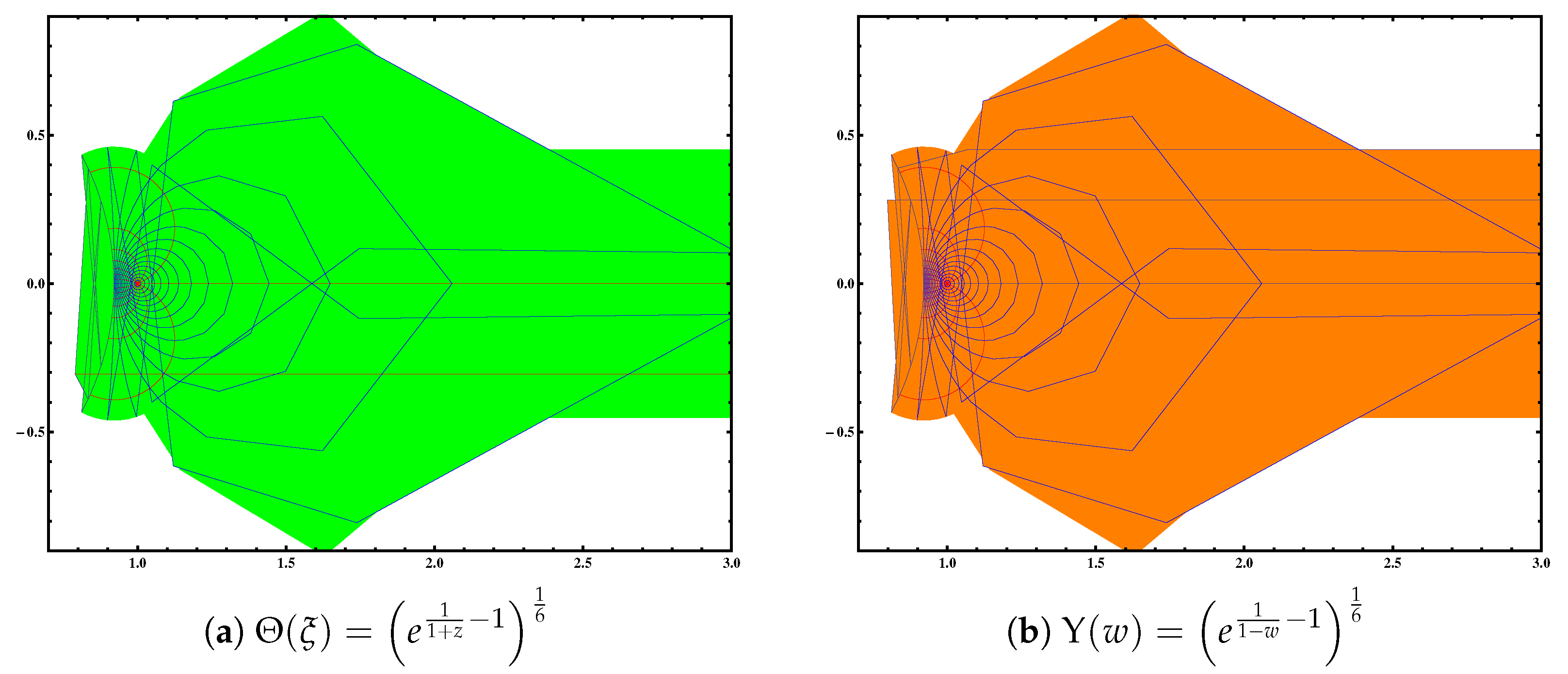
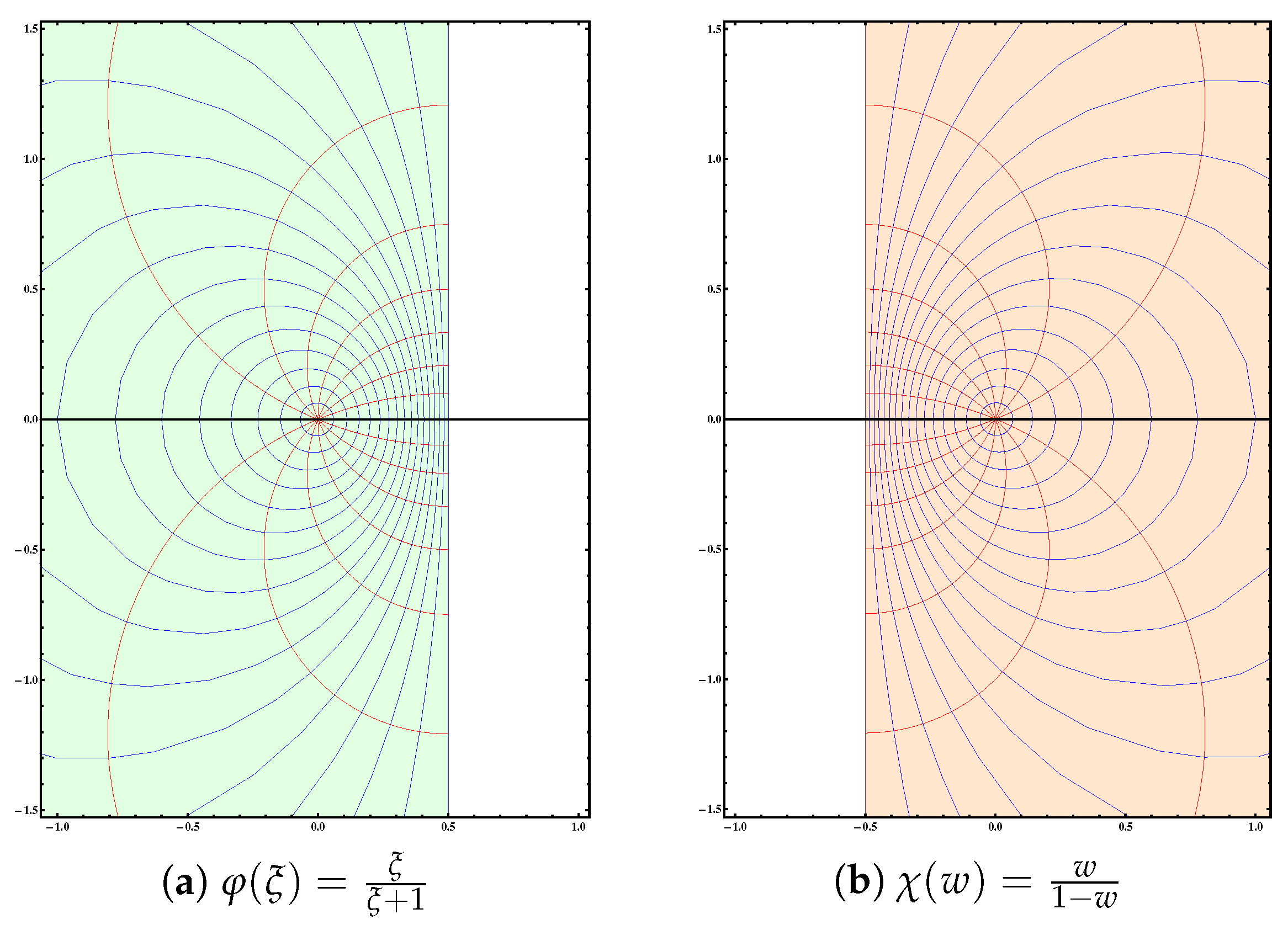
In this example, we will show that the class is non-empty. Let ; then, the inverse function of φ is given by . The function satisfies the normalization and maps the unit disc onto region (see Figure 1a). And the inverse function χ maps the unit disc onto region (see Figure 1b). In contrast, the function maps the unit disc onto a region in the right half plane (see Figure 2a). Also, the inverse function satisfies and maps the unit disc onto a region in the right half place (see Figure 2b). Hence, the function is in class for .
Figure 1.
The images of under and , respectively.
Figure 2.
The images of the unit disc under and , respectively.
Motivated by and the recent study [20], we now define the new subclasses using a symmetric operator that involved a three-parameter Mittag-Leffler function.
Definition 1.
Analogous to , we now define the following:
Definition 2.
Remark 1.
Example 1 illustrates that class is non-empty. Similarly, the function and its corresponding inverse function can be used to illustrate that the class is non-empty.
Estimates for the initial coefficients and Fekete–Szegő inequalities of the defined function classes are investigated. Moreover, special cases of the classes and are discussed and stated to be corollaries.
2. Coefficient Estimates for the Class
To begin with, we will obtain the coefficient bounds for functions belonging to the class .
Lemma 1
([21]). Let be the family of all functions which are analytic in with and given by
then
Theorem 1.
Let and let χ be the inverse of φ defined by
then
and
where .
Proof.
Let ; then, we have
and
where and w belong to . The functions and are Schwartz functions and have the following respective series expansion: and with .
In light of the known inequalities and for all , (15) reduces to the result (6). To obtain (7), by subtracting (13) with (11), we obtain
Simplifying the expression (18), we have
Corollary 1.
Let and let χ be the inverse of φ defined by
satisfying the conditions
where , . Then,
3. Fekete-Szegő Inequalities
Making use of the values of and and motivated by the recent work of Zaprawa [22], we prove the following Fekete–Szegő result for . We recall the following lemma to discuss Fekete-Szegő results:
Lemma 2
([22,23]). Let and . If , then
Theorem 2.
Let and , then
where
Proof.
From (16), we have
Now applying Lemma 2, we can obtain the desired result directly. Thus, we complete the proof. □
Remark 2.
Let the function and , then
4. Coefficient Estimates for the Class
Theorem 3.
Let ψ be defined as in (5) with and let χ be the inverse of φ defined by
If , then
and
where .
Proof.
; then, we have
and
where and w belong to . The functions and are Schwartz functions and have the respective series expansions and with .
Taking and in Theorem 3, we obtain the following result:
Corollary 2.
Let and let χ be the inverse of φ defined by
satisfying the conditions
then
and
Letting and in the Corollary 2, we can obtain the following result:
Corollary 3.
Let and let χ be the inverse of φ defined by
satisfying the conditions
then
5. Conclusions
The classes studied in this paper are neither a subclass nor a generalization of the well-known classes like spirallike, starlike and convex. The present study is an extension of new class studied by Karthikeyan and Murugusundaramoorthy in [13], where we can find detailed the properties and applications of the defined function class. Specializing the parameters involved in Definitions 1 and 2, the introduced function classes reduce to classes with good geometrical implications. So, the results that we have obtained have lots of applications other than those that were pointed out here.
If we let in (4), then it would lead to , which is absurd. Now the question arises regarding how the definition should be reformulated so that the inequalities remain valid for all values of . Further, could the classes be extended by replacing the ordinary derivative with a higher-order multiplicative derivative in the analytic characterization of the well-known geometrically defined subclasses of univalent functions?
Author Contributions
K.R.K., D.B., G.M. and G.T. contributed equally to this work. All authors have read and agreed to the published version of this manuscript.
Funding
This research study received no external funding.
Data Availability Statement
No data were used to support this study.
Conflicts of Interest
All authors declare that they have no conflicts of interest.
References
- Srivastava, H.M. A survey of some recent developments on higher transcendental functions of analytic number theory and applied mathematics. Symmetry 2021, 13, 2294. [Google Scholar] [CrossRef]
- Mittag-Leffler, G.M. Sur la nouvelle fonction Eα(x). Comptes Rendus Acad. Sci. Paris 1903, 137, 554–558. [Google Scholar]
- Wiman, A. Über den Fundamentalsatz in der Teorie der Funktionen Ea(x). Acta Math. 1905, 29, 191–201. [Google Scholar] [CrossRef]
- Srivastava, H.M.; Bansal, M.; Harjule, P. A study of fractional integral operators involving a certain generalized multi-index Mittag-Leffler function. Math. Methods Appl. Sci. 2018, 41, 6108–6121. [Google Scholar] [CrossRef]
- Prabhakar, T.R. A singular integral equation with a generalized Mittag Leffler function in the kernel. Yokohama Math. J. 1971, 19, 7–15. [Google Scholar]
- Murat, C.; Karthikeyan, K.R.; Murugusundaramoorthy, G. Inequalities on a class of analytic functions defined by generalized Mittag-Leffler function. Filomat 2024, 37, 6277–6288. [Google Scholar]
- Ibrahim, R.W.; Darus, M. Subordination inequalities of a new Salagean-difference operator. Int. J. Math. Comput. Sci. 2019, 14, 573–582. [Google Scholar]
- Ibrahim, R.W. On a Janowski formula based on a generalized differential operator. Commun. Fac. Sci. Univ. Ank. Ser. A1 Math. Stat. 2020, 69, 1320–1328. [Google Scholar]
- Umadevi, E.; Karthikeyan, K.R. A subclass of close-to-convex function involving Srivastava-Tomovski operator. In Recent Developments in Algebra and Analysis, Proceedings of the International Conference on Recent Developments in Mathematics (ICRDM), Dubai, United Arab Emirates, 24–26 August 2022; Leung, H.H., Sivaraj, R., Kamalov, F., Eds.; ICRDM 2022. Trends in Mathematics; Birkhäuser: Cham, Switzerland, 2024. [Google Scholar] [CrossRef]
- Srivastava, H.M.; Mishra, A.K.; Gochhayat, P. Certain subclasses of analytic and bi-univalent functions. Appl. Math. Lett. 2010, 23, 1188–1192. [Google Scholar] [CrossRef]
- Altinkaya, S.; Yalcin, S. Coefficient estimates for a certain subclass of analytic and bi-univalent functions. Acta Univ. Apulensis Math. Inform. 2014, 40, 347–354. [Google Scholar]
- Ali, R.M.; Lee, S.K.; Ravichandran, V.; Supramaniam, S. Coefficient estimates for bi-univalent Ma-Minda starlike and convex functions. Appl. Math. Lett. 2012, 25, 344–351. [Google Scholar] [CrossRef]
- Karthikeyan, K.R.; Murugusundaramoorthy, G. Properties of a class of analytic functions influenced by multiplicative calculus. Fractal Fract. 2024, 8, 131. [Google Scholar] [CrossRef]
- Breaz, D.; Karthikeyan, K.R.; Murugusundaramoorthy, G. Applications of Mittag–Leffler functions on a subclass of meromorphic functions influenced by the definition of a non-Newtonian derivative. Fractal Fract. 2024, 8, 509. [Google Scholar] [CrossRef]
- Bashirov, A.E.; Kurpinar, E.M.; Özyapıcı, A. Multiplicative calculus and its applications. J. Math. Anal. Appl. 2008, 337, 36–48. [Google Scholar] [CrossRef]
- Bashirov, A.E.; Mısırlı, E.; Tandoğdu, Y.; Özyapıcı, A. On modeling with multiplicative differential equations. Appl. Math. J. Chin. Univ. 2011, 26, 425–438. [Google Scholar] [CrossRef]
- Bashirov, A.E.; Riza, M. On complex multiplicative differentiation. TWMS J. Appl. Eng. Math. 2011, 1, 75–85. [Google Scholar]
- Riza, M.; Özyapici, A.; Mısırlı, E. Multiplicative finite difference methods. Quart. Appl. Math. 2009, 67, 745–754. [Google Scholar] [CrossRef]
- Karthikeyan, K.R.; Varadharajan, S. A class of analytic functions with respect to symmetric points involving multiplicative derivative. Commun. Appl. Nonlinear Anal. 2024, 31, 540–551. [Google Scholar] [CrossRef]
- Murugusundaramoorthy, G.; Vijaya, K.; Karthikeyan, K.R.; El-Deeb, S.M.; Ro, J.-S. Bi-univalent functions subordinated to a three leaf function induced by multiplicative calculus. AIMS Math. 2024, 9, 26983–26999. [Google Scholar] [CrossRef]
- Pommerenke, C. Univalent Functions; Vandenhoeck & Ruprecht: Göttingen, Germany, 1975. [Google Scholar]
- Zaprawa, P. On the Fekete-Szegő problem for classes of bi-univalent functions. Bull. Belg. Math. Soc. Simon Stevin 2014, 21, 169–178. [Google Scholar] [CrossRef]
- Zaprawa, P. Estimates of initial coefficients for bi-univalent functions. Abst. Appl. Anal. 2014, 6, 357480. [Google Scholar] [CrossRef]
Disclaimer/Publisher’s Note: The statements, opinions and data contained in all publications are solely those of the individual author(s) and contributor(s) and not of MDPI and/or the editor(s). MDPI and/or the editor(s) disclaim responsibility for any injury to people or property resulting from any ideas, methods, instructions or products referred to in the content. |
© 2025 by the authors. Licensee MDPI, Basel, Switzerland. This article is an open access article distributed under the terms and conditions of the Creative Commons Attribution (CC BY) license (https://creativecommons.org/licenses/by/4.0/).