


Abstract
Similarity measures on trapezoidal-valued intuitionistic fuzzy numbers (TrVIFNs) are functions that measure the closeness between two TrVIFNs, which has a lot of applications in the area of pattern recognition, clustering, decision-making, etc. Researchers around the world are proposing various similarity measures on the generalizations of fuzzy sets. However, many such measures do not satisfy the condition that “the similarity between two fuzzy numbers is equal to 1 implies that both the fuzzy numbers are equal” and this gives a pathway for the researchers to introduce different similarity measures on various classes of fuzzy sets. Also, all of them try to find out the similarity by using a single function, and in the present study, we try to propose a combined similarity measure principle by using four functions (four similarity measures). Thus, the main aim of this work is to introduce a few sets of similarity measures on the class of TrVIFNs and propose a combined similarity measure principle on TrVIFNs based on the proposed similarity measures. To do this, in this paper, firstly, we propose four distance-based similarity measures on TrVIFNs using score functions on TrVIFNs and study their mathematical properties by establishing various propositions, theorems, and illustrations, which is achieved by using numerical examples. Secondly, we propose the idea of a combined similarity measure principle by using the four proposed similarity measures sequentially, which is a first in the literature. Thirdly, we compare our combined similarity measure principle with a few important similarity measures introduced on various classes of fuzzy numbers, which shows the need for and efficacy of the proposed similarity measures over the existing methods. Fourthly, we discuss the trapezoidal-valued intuitionistic fuzzy TOPSIS (TrVIF-TOPSIS) method, which uses the proposed combined similarity measure principle for solving a multi-criteria decision-making (MCDM) problem. Then, we discuss the applicability of the proposed modified TrVIF-TOPSIS method by solving a model problem. Finally, we discuss the sensitivity analysis of the proposed approaches by using various cases.
Keywords:
trapezoidal-valued intuitionistic fuzzy number; membership score; core length; non-hesitancy score; non-membership score; distance measure; similarity measure; MCDM MSC:
03B52; 03E72; 26E50
1. Introduction
Zadeh thought about a new class of sets that can generalize the idea of classical sets and named them fuzzy sets. Mathematically, the main idea of fuzzy sets is that the sum of the degree of membership and non-membership value of any element in the underlying set must be equal to one. That is, the information about an object is 100%, but in real life, it may be possible to have incomplete information in addition to imprecision, which leads to the introduction of intuitionistic fuzzy sets (IFSs), an idea introduced by Atanassov [1]. In the year 2011, Zadeh [2] introduced the idea of fuzzy Z-numbers by incorporating the uncertainty of the decision-maker’s opinion. Fuzzy Z-numbers could be a better option for modelling real-life decision problems than picture fuzzy sets [3], Pythagorean fuzzy sets [4], fuzzy-rough sets [5], spherical fuzzy sets [6], etc., since these generalizations did not consider the decision-maker’s uncertainty. Tian et al. [7] extended the idea of fuzzy Z-numbers to “extended fuzzy z-numbers (ZE-numbers)” to incorporate the uncertainty of decision-makers and experts’ opinions in two different groups. The introduction of fuzzy ZE numbers played a significant role in GDM. Atanassov and other researchers studied various mathematical properties in subsequent years. Ecer et al. [8] proposed a decision framework by integrating the Logarithm Methodology of Additive Weights (LMAW) and TOPSIS methods under an extended fuzzy Z-number environment. Also, they applied the proposed framework in solving a case example within the “Indian health sector”. Senapati and Yager [9] introduced Feramtean fuzzy sets (FFS) as a generalization to IVIFSs. Apart from the above discussions, there are many more generalizations available in the literature to model real-life problems. Each type of fuzzy set has its advantages in modelling real-life problems. We shall not say that a specific type of fuzzy set is best for modelling a real-life problem.
In this study, we consider intuitionistic fuzzy sets for modelling a decision-making problem. In particular, we use trapezoidal-valued intuitionistic fuzzy numbers (TrVIFNs) for the modelling. Many researchers from diverse areas have proposed different classes of fuzzy sets as a generalization to IFSs; trapezoidal-valued intuitionistic fuzzy numbers (TrVIFNs) are one among them which generalizes the idea of real-valued and interval-valued intuitionistic fuzzy sets (IVIFSs). Also, different ranking principles were discussed in the literature for ranking IVIFSs, interval-valued Pythagorean fuzzy sets, and generalized trapezoidal fuzzy numbers. “Conventional trapezoidal intuitionistic fuzzy numbers (CTrIFNs)” were discussed long before; however, the concept of TrVIFNs was recently proposed by Jeevaraj et al. [10] in 2023. Jeevaraj et al. [10] introduced the set of TrVIFNs as a real generalization of IVIFNs, and it overlapped with the set of CTrIFNs. They defined various basic definitions of TrVIFNs, studied numerous mathematical properties by establishing various theorems and propositions and discussed the applications of TrVIFNs in decision-making. Distance measures on the set of intuitionistic fuzzy sets have been widely studied, and various distance-based similarity measures have been introduced in the literature by renowned researchers worldwide. Researchers have applied the idea of similarity measures in various fields. Xu and Chen [11] gave an overview of a few similarity measures on IFSs and studied their mathematical properties properly. In 2011, Ye [12] proposed the idea of a cosine similarity measure and studied its mathematical properties. Further, he applied cosine similarity to solve pattern recognition problems. Later, Ye [13] proposed another similarity measure on the set of IVIFNs and discussed its application in decision-making. Song et al. [14] proposed a new similarity measure which could overcome the issues of a few earlier similarity measures. Also, they studied the application of the proposed similarity measure to the field of pattern recognition. Song and Wang [15] introduced a new similarity measure on the set of IFSs and showed the efficacy of their proposed similarity measure using a detailed comparative analysis. Jeevaraj [16] proposed a new similarity measure on IVIFNs using a score function and studied its mathematical properties. He also compared the proposed score-based similarity measure with a few existing methods, and finally, the proposed similarity measure was used to solve a decision-making problem.
Various similarity measures are available on different classes and generalizations of fuzzy sets. One of the important properties of similarity measure is that “ iff ”, and many similarity measures satisfy the condition “ implies ”. However, many such measures do not satisfy the condition that “the similarity between two fuzzy numbers is equal to 1 implies that both the fuzzy numbers are equal (that is, implies )” and this gives a pathway for researchers to introduce different similarity measures on various classes of fuzzy sets. Also, all of them try to find out the similarity by using a single function (similarity measure) and, in the present study, we try to propose a combined similarity measure principle by using four functions (four similarity measures) which is the first in the literature. Thus, the main aim of this work is to introduce a few sets of similarity measures on the class of TrVIFNs and propose a combined similarity measure principle on TrVIFNs based on the proposed similarity measures. In this study, we aim to introduce a few similarity measures on the set of TrVIFNs and propose a similarity principle based on the introduced similarity measures. The main contribution of this paper is given as follows:
- To propose four new distance-based similarity measures by using four score functions on TrVIFNs.
- To analyse the mathematical properties of the proposed similarity measures by deriving propositions and theorems.
- To define a combined similarity measure principle on TrVIFNs using the proposed four similarity measures.
- To compare the proposed combined similarity measure with a few existing similarity measures on different classes of fuzzy sets.
- To establish a new MCDM algorithm by using a combined similarity measure-based TOPSIS method for solving a decision-making problem.
- To study the sensitivity analysis of the proposed MCDM algorithm by changing the weights of the criteria.
The remainder of the paper is arranged in the following manner. After the introduction, a few important basic definitions are given in Section 2. Section 3 is used to discuss four similarity measures on TrVIFNs and study their mathematical properties. Also, a combined similarity measure principle is proposed in Section 3. A detailed comparative analysis is given in Section 4. Section 5 establishes a new multi-criteria decision-making algorithm by modifying the steps of the trapezoidal-valued intuitionistic fuzzy TOPSIS (TrVIF-TOPSIS) method by integrating the proposed combined similarity measure principle in TrVIFNs. The applicability of the proposed MCDM algorithm in solving some real-life decision-making problems is discussed in Section 6 by using numerical examples. The sensitivity analysis of the proposed decision-making algorithm is discussed by considering different weights for the criteria in Section 7, and Section 8 discusses the conclusions.
2. Preliminaries
This section discusses a few important definitions related to the proposed study.
Definition 1
(Atanassov [1]). An intuitionistic fuzzy set (IFS) T in a non-empty set is defined as , where and with , where and denote the degree of membership and non-membership of u to lie in T, respectively. For each intuitionistic fuzzy subset T in , is called the incompleteness degree of u to lie in T.
Definition 2
(Atanassov and Gargov [17]). Let be the collection of closed sub-intervals of the unit interval (). An IVIFS on a non-empty set is given by , where with the condition .
The intervals and denote the membership degree and non-membership degree of u in T. For each , and are closed intervals with lower and upper endpoints represented by , and , , respectively. We denote
where .
For each , the unknown degree can be calculated by .
Definition 3
(Jeevaraj et al. [10]). Let be the collection of trapezoidal fuzzy numbers in the unit interval (). A trapezoidal-valued intuitionistic fuzzy set on a non-empty set is defined by , where , with the condition .
The trapezoidal fuzzy numbers and denote, respectively, the membership degree and non-membership degree of u in T, and for each and , are trapezoidal fuzzy numbers (TrFNs) with their legs represented by and . We denote , where .
We denote the set of TrVIFNs in by TrVIFN(). A TrVIFN is denoted by with for convenience. If and , then the TrVIFNs become “triangular-valued intuitionistic fuzzy numbers (TVIFNs)” and we denote the collection of all TVIFNs in by TVIFN(). A TVIFN is denoted by with convenience.
Definition 4
(Jeevaraj et al. [10]). Let . Then, the arithmetic operations between T and V are defined as follows:
where are strictly positive.
3. A Few Similarity Measures on the Set of TrVIFNs
Usually, any similarity measure divides the entire class of TrVIFNs into two clusters. One cluster consists of elements that are closely related to each other, and the other one consists of elements that do not possess common properties. In this work, we aim to increase the number of clusters to obtain effective results in clustering/pattern recognition problems. The idea of this paper is to introduce four different similarity measures on the class of TrVIFNs using four different score functions defined on TrVIFNs. Here, we discuss the definition of distance and similarity measures between any two TrVIFNs.
Definition 5.
A real-valued function is called a distance measure between two TrVIFNs , if satisfies the following axioms:
- (d1)
- ;
- (d2)
- ;
- (d3)
- ;
- (d4)
- If , then and , .
Definition 6.
A real-valued function is called a similarity measure between two TrVIFNs , if satisfies the following axioms:
- (s1)
- ;
- (s2)
- ;
- (s3)
- ;
- (s4)
- If , then and , .
3.1. Similarity Measure Using Membership Score
This subsection proposes a new similarity measure on TrVIFNs using the membership score proposed on TrVIFNs.
Definition 7
(Jeevaraj et al. [10]). Let . The membership score function M of is given by .
Definition 8.
Let and be two TrVIFNs. The distance measure between T and V on TrVIFNs is denoted by and defined as .
Definition 9.
Let T and V be two TrVIFNs. Then, the similarity measure between T and V on TrVIFNs is denoted by and defined as .
The following theorems are derived from Definition 9.
Theorem 1.
is the distance between any two TrVIFNs T and V.
Proof.
It is trivial from Definitions 5, 7, and 9. Hence, it is omitted. □
Theorem 2.
is the similarity measure between any two TrVIFNs T and V.
Proof.
, and are obvious from Definition 9. We claim that where . If we apply Definition 8 to , and W, we obtain , , and . Hence, the proof. □
Proposition 1.
Let be a fuzzy number (FN). Then, , .
Proposition 2.
Let be an intuitionistic fuzzy number (IFN). Then, .
Proposition 3.
Let be an interval-valued fuzzy number (IVFN). Then, .
Proposition 4.
Let be an IVIFN. Then, , .
Proposition 5.
Let be a triangular-valued fuzzy number (TVFN). Then, , .
Proposition 6.
Let be a TVIFN. Then, , .
Definition 10.
Let be a trapezoidal fuzzy number (TrFN). Then, , .
Proposition 7.
Translation invariance: Let , and W be any three TrVIFNs. Then, .
Proposition 8.
Let , and W be any three TrVIFNs and let and . Then, . if and .
Proposition 9.
Let , and W be any three TrVIFNs and let . Then, . if and .
From , we note that is the sum of the midpoint of the membership core and half of the non-membership core length, which implies that when and are the same. However, if then T and V must be identical, i.e., in some places, fails to define an efficient similarity measure on the class of TrVIFNs, which we can see using Example 1.
Example 1.
Let , , and be three patterns denoted as TrVIFNs. Assume that the sample is given. If we use Definition 7, we obtain , and . Hence, are identical with pattern P, which is a contradiction, i.e., if we apply , the pattern V cannot be identified. Hence, we need another similarity principle for clustering the classes of TrVIFNs which are not correctly clustered by .
3.2. Similarity Measure Using Core Length
This subsection proposes a new similarity measure on TrVIFNs using the core length of a TrVIFN.
Definition 11
(Jeevaraj et al. [10]). Let . The core length function of is given by .
Definition 12.
Let and be two TrVIFNs. Then, the core length-based distance measure between T and V on TrVIFNs is denoted by and defined as .
Definition 13.
Let T and V be two TrVIFNs. Then, the similarity measure between T and V on TrVIFNs is denoted by and defined as .
The following theorems are derived from Definition 13.
Theorem 3.
is the distance between any two TrVIFNs T and V.
Proof.
The proof is trivial from Definitions 5, 11, and 13. Hence, it is omitted. □
Theorem 4.
is the similarity measure between any two TrVIFNs T and V.
Proof.
, and are obvious from Definition 13. We claim that , where . If we apply Definition 12 to , and W, we obtain , , and . Hence, the proof. □
Proposition 10.
Translation invariance: Let , and W be any three TrVIFNs. .
Proposition 11.
Let , and W be any three TrVIFNs, and let and . Then, . if and .
Proposition 12.
Let , and W be any three TrVIFNs and let . Then, . if and .
From , we note that is the sum of the core length of the membership and non-membership function, which implies that when and are the same. However, if , then T and V must be identical, i.e., in some places, fails to define an effective similarity measure on the class of TrVIFNs, which we can see using Example 2.
Example 2.
Let , , and be three patterns denoted as TrVIFNs. Assume that the sample is given. By applying Definition 7 to the given TrVIFNs, we obtain , . Hence, are identical with pattern P, which is a contradiction. Suppose we apply similarity measure to ; then, we obtain , i.e., if we apply , the pattern V can be identified correctly. Hence, the patterns are clustered correctly using when they are not clustered using . We need another similarity principle for clustering the classes of TrVIFNs that are not correctly clustered by .
Example 3.
Let , , and be three patterns denoted as TrVIFNs. Assume that the sample is given. If we apply Definitions 7 and 11 then we obtain and , which implies that and . This implies that are identical with pattern P which is a contradiction, i.e., if we apply , the pattern V cannot be identified correctly. Hence, we need another similarity measure for clustering the classes of TrVIFNs which are not correctly clustered by .
3.3. Similarity Measure Using Accuracy Score
This subsection introduces a new similarity measure on TrVIFNs using the accuracy score of a TrVIFN.
Definition 14.
Let . The accuracy score function of is defined as
Definition 15.
Let and . Then, the accuracy score-based distance measure between T and V on TrVIFNs is denoted by and defined as .
Definition 16.
Let . Then, the accuracy score-based similarity measure between T and V on TrVIFNs is denoted by and defined as .
The following theorems are derived from Definition 16.
Theorem 5.
is the distance between any two TrVIFNs T and V.
Proof.
The proof is immediate from Definitions 5, 14, and 16. Hence, it is omitted. □
Theorem 6.
is the similarity measure between any two TrVIFNs T and V.
Proof.
, and are obvious from Definition 16. We claim that , where . If we apply Definition 15 to , and W, we obtain , , and . Hence, the proof. □
Proposition 13.
Translation invariance: Let , and W be any three TrVIFNs. .
Proposition 14.
Let , and W be any three TrVIFNs, and let and . Then, . if and .
Proposition 15.
Let , and W be any three TrVIFNs, and let . Then, . if and .
From , we note that is the sum of the midpoint of the membership and non-membership function which implies that when and are the same. However, if , then T and V must be identical, i.e., in some places, fails to define an effective similarity measure on the class of TrVIFNs which can be seen from the following examples.
Example 4.
Let , , and be three patterns denoted as TrVIFNs. Assume that the sample is given. If we apply Definitions 7 and 11, we obtain and , which implies that and . This implies that are identical with pattern P, which is a contradiction. Suppose we apply similarity measure to ; then, we obtain . Hence, the patterns are clustered correctly using when they are not clustered using and .
Example 5.
Let , , and be three patterns denoted as TrVIFNs. Assume that the sample is given. If we apply Definitions 7, 11, and 14, we obtain , and , which implies that , and . This implies that are identical with pattern P, which is a contradiction, i.e., if we apply , the pattern V cannot be identified correctly. Hence, we need another similarity principle for clustering the classes of TrVIFNs which are not correctly clustered by and .
3.4. Similarity Measure Using Non-Membership Score
This subsection introduces a new similarity measure on TrVIFNs using the non-membership score of a TrVIFN.
Definition 17.
Let . The non- membership score function of is given as
Definition 18.
Let and be two TrVIFNs. Then, the non-membership score-based distance measure between T and V on TrVIFNs is denoted by and defined as .
Definition 19.
Let T and V be two TrVIFNs. Then, the non-membership score-based similarity measure between T and V on TrVIFNs is denoted by and defined as .
The following theorems are derived from Definition 19.
Theorem 7.
is the distance between any two TrVIFNs T and V.
Proof.
The proof of this theorem is trivial from Definitions 5, 17, and 19. Hence, it is omitted. □
Theorem 8.
is the similarity measure between any two TrVIFNs T and V.
Proof.
, , and are obvious from Definition 19. We claim that , where . If we apply Definition 15 to , and W, we obtain , , and . Hence, the proof. □
Proposition 16.
If is an FN, then .
Proposition 17.
If is an IFN, then .
Proposition 18.
Let be an IVFN. Then, .
Proposition 19.
Let be an IVIFN. Then, .
Proposition 20.
Let be a TVFN. Then, .
Proposition 21.
Let be a TVIFN. Then, .
Proposition 22.
Translation invariance: Let , and W be any three TrVIFNs. Then, .
Proposition 23.
Let , and W be any three TrVIFNs and let and . Then, . if and .
Proposition 24.
Let , and W be any three TrVIFNs and let . Then, . if and .
From , we note that is the sum of the length of the membership core and the midpoint of the non-membership core.
Example 6.
Let , , and be three patterns denoted as TrVIFNs. Assume that the sample is given. If we use Definitions 7, 11, and 14, we obtain , and , which implies that , and . This implies that are identical with pattern P, which is a contradiction. Suppose we apply similarity measure to ; then, we obtain . Hence, the patterns are clustered correctly using , whereas they are not clustered using and .
3.5. A Combined Similarity Measure Principle on the Set of TrVIFNs
This subsection proposes the idea of a combined similarity measure principle on the set of TrVIFNs. In the literature, every researcher uses only one similarity measure to measure the closeness between any two intuitionistic fuzzy sets. Because of this, the similarity measures on various sets of intuitionistic fuzzy sets have their own drawbacks, which are studied in Section 4. In most of the similarity measures, , but . Our main aim in this work is to overcome this drawback, which we achieve by defining different similarity measures on the set of TrVIFNs and proposing a new combined similarity measure principle on the set of TrVIFNs which can overcome most of the famous similarity measures on different classes of fuzzy and intuitionistic fuzzy sets.
Definition 20.
Let . The similarity measure between T and V is denoted by and defined as
- 1.
- If , then ;
- 2.
- If and , then ,
- 3.
- If , , and , then ,
- 4.
- If , , , and , then ,
- 5.
- If , , , , then ,
4. Comparative Analysis
This section discusses the detailed comparative study of the proposed combined similarity measure with various existing similarity measures.
4.1. Ye’s [12] Cosine Similarity Measure
In this subsection, we discuss the drawbacks of the cosine similarity measure and how the proposed combined similarity measure overcomes those drawbacks.
Definition 21
(Ye [12]). Let , be any two IFNs. The cosine similarity measure between T and V is given by .
A few limitations of the cosine similarity measure:
- Suppose and are two IFNs, if we use cosine similarity measure to identify their similarity, we obtain . This shows that the cosine similarity measure is unsuitable for a few classes of IFNs.
- Let and be any two IFNs. Then, . . But .
- Let and be any two IFNs. Then, . . But .
- Let , , be any three IFNs with . Then, . In these cases, the cosine similarity might not perform well, and the similarity measure fails to discriminate T, V, and W.
Results of the proposed similarity measure:
- Let be any two IFNs. By using Definition 20 with T and V, we obtain . This shows the effectiveness of the combined similarity measure.
- Let and be any two IFNs. By applying Definition 20 to T and V, we obtain , which means that a combined similarity measure identifies the correct closeness between two given IFNs.
- Let and be any two IFNs. By applying Definition 20 to T and V, we obtain , and . This shows the efficacy and the need for a combined similarity measure principle.
- Let , , and be any three IFNs. By applying Definition 20 to and W, we obtain , and . ⇒. Hence, our proposed method is superior to the cosine similarity measure in all the above cases.
4.2. Ye’s [13] Similarity Measure on the Set of IVIFSs
This subsection discusses how the combined similarity measure principle overcomes the limitations of the similarity measure on IVIFSs proposed by Ye [13].
Definition 22
(Ye [13]). Let and . The similarity measure between T and V is defined as .
A few limitations of the similarity measure on IVIFNs from (Ye [12]):
- Suppose , , and are three IVIFNs. Then, and . In this case, Ye’s method fails to distinguish the considered IVIFNs.
- Let , , and be any three IVIFNs. Then, and . Thus, from this case, we conclude that Ye’s similarity measure on IVIFSs might not perform well for a few classes of IVIFSs.
Results of the combined similarity measure principle:
- Let , , and be any three IVIFNs. By applying Definition 20 to , we obtain . Hence, our proposed method is more reliable in this case.
- Let , , and be any three IVIFNs. By applying Definition 20 to , and W, we obtain . Hence, our proposed combined similarity measure performs better in both cases.
4.3. Song and Wang’s [15] Similarity Measure on IFNs
This subsection compares the combined similarity measure principle with Song and Wang’s similarity measure on IFNs by discussing a few limitations.
Definition 23
(Song and Wang [15]). Let and be any two IFNs. Then, the similarity measure between T and V is defined as
and
A few drawbacks of the similarity measure proposed by Song and Wang [15]:
- Suppose , , and are three IFNs. Then, = and = ⇒. This shows that Song and Wang’s similarity measure on IFNs is not a better choice for these kinds of IFNs.
- Let , and be any three IFNs. Then, = and = ⇒. In this case, Song and Wang’s similarity measure fails to show which IFN is similar to T.
- Let , , and be any three IFNs. Then, = , and = ⇒. This shows that the similarity measure proposed by Song and Wang is not the right choice for finding similarities between these kinds of IFNs.
Result of the combined similarity measure principle:
- Let , , and be any three IFNs. By applying Definition 20 to , and W, we obtain . Similarly, . Hence, .
- Let , , and be any three IFNs. By applying Definition 20 to , and W, we obtain . Similarly, . Hence, , which shows that these kinds of IFNs are properly distinguishable using our combined similarity measure.
- Let , , andbe any three TrVIFNs. By applying Definition 20 to , and W, we obtain . Similarly, . Hence, . Thus, the proposed combined similarity measure principle outperforms Song and Wang’s similarity measure.
4.4. Xu and Chen’s [11] Similarity Measure
This subsection explores the advantages of the combined similarity measure principle when compared with Xu and Chen’s [11] similarity measure.
Definition 24
(Xu and Chen [11]). Let and be any two IVIFN. Then, the similarity measure between T and V is defined as , .
This method also has the same drawback as discussed in Section 4.3. So, the detailed explanation is omitted here.
4.5. Comparison with Jeevaraj’s [16] IVIF Similarity Measure
In this subsection, we discuss the efficacy of the combined similarity measure principle over the similarity measure proposed by Jeevaraj [16].
Definition 25
(Jeevaraj [16]). Let and . The similarity measure between T and V is given as . where , and
Drawbacks of Jeevaraj’s [16] similarity measure:
- Let and be any two IVIFNs. Then, , since . In this case, Jeevaraj’s method fails to distinguish the considered IVIFNs.
- Let and be any two IVIFNs. Then, , since . In this case, Jeevaraj’s method fails to distinguish the considered IVIFNs.
- Let and be any two IVIFNs. Then, , since . In this case, Jeevaraj’s method fails to distinguish the considered IVIFNs.
- Let and be any two IVIFNs. Then, , since . In this case, Jeevaraj’s method fails to distinguish the considered IVIFNs.
Results of our proposed similarity measure:
- Let and be any two IVIFNs. By applying Definition 20, we obtain . This shows that the combined similarity principle is more suitable for these classes of IVIFNs.
- Let and be any two IVIFNs. By applying Definition 20, we obtain . This shows that the combined similarity principle is more suitable for these classes of IVIFNs.
- Let and be any two IVIFNs. By applying Definition 20, we obtain . This shows that the combined similarity principle is more suitable for these classes of IVIFNs.
- Let and be any two IVIFNs. By applying Definition 20, we obtain . This shows that the combined similarity principle is more suitable for these classes of IVIFNs.
5. A New Algorithm for Solving an MCDM Problem Modelled under a Trapezoidal-Valued Intuitionistic Fuzzy Environment
In this section, we establish a new MCDM algorithm (modified TOPSIS) for solving an MCDM problem modelled under a trapezoidal-valued intuitionistic fuzzy environment by modifying a few steps of the conventional TOPSIS method. The TOPSIS method was first developed by Hwang and Yoon [18] and has a lot of applications in decision-making. We modified the TOPSIS algorithm by including a combined similarity measure principle for calculating the closeness coefficient. The trapezoidal-valued intuitionistic fuzzy TOPSIS (TrVIF TOPSIS) method is a more generalized method since it can deal with all types of IFNs (such as real-valued fuzzy numbers, interval-valued fuzzy numbers, intuitionistic fuzzy numbers, interval-valued intuitionistic fuzzy numbers, and triangular-valued intuitionistic fuzzy numbers).
The TrVIF TOPSIS method for solving the MCDM problem using the proposed combined similarity measure principle is described in the following algorithm:
Let us consider a set of alternatives among which the best one is to be selected. There are n criteria, say . The evaluated information of the alternative with respect to the criterion can be represented by a TrVIFN , , , in which represents the degree of belongingness, and represents the degree of non-belongingness.
- Step 1: Let us consider a TrVIF decision matrix using linguistic terms given by the experts (decision-makers). In general, the TrVIF decision matrix , which contains the alternatives and the criteria row-wise and column-wise, respectively, is defined as follows:where,,,,.
- Step 2: Let be the weight of each criterion with and given by the decision-maker. Then, we calculate the weighted TrVIF matrix by using the Definition (4).
- Step 3: The trapezoidal-valued intuitionistic fuzzy positive ideal solution (TrVIFPIS) and the trapezoidal-valued intuitionistic fuzzy negative ideal solution (TrVIFNIS) for the alternatives are found bywhere .where .
- Step 4: The similarity measure and for each alternative based on the separation from the TrVIFPIS and TrVIFNIS , respectively, that can be derived from the following formulas:andwhere and are distance measures.
- Step 5: The relative closeness of alternative with the PIS which is defined in the following formula given byand . Thus, the alternative with the highest value of is chosen as the best choice.
6. Numerical Example
In this section, we solve a real-life problem by using our proposed algorithm, which utilizes the combined similarity measure principle.
Let us consider an MCDM problem consisting of five alternatives, out of which the best alternative is chosen. The alternatives are (1) is a food company; (2) is a computer company; (3) is a car company; (4) is an arms company; (5) is a financial company. They invest money subject to the following criteria: (1) is the growth analysis; (2) is the environmental risk analysis; (3) is the analysis of the future; (4) is the impact analysis.
- Step 1: Table 1 represents the linguistic information given by the decision-maker for evaluating the best alternative among five alternatives based on the four criteria and Table 2 represents the TrVIFN equivalent for different linguistic terms present in Table 1. So the linguistic information given by the decision-maker in Table 1 can be converted to TrVIFNs in Table 3 by using the conversion table given in Table 2.
- Step 2: Let , , , and be the weights for the criteria , , , and , respectively. Also, . Table 4 represents the weighted TrVIF decision matrix by using the weights of criteria , and the Definition (4).
- Step 5: Table 5 represents the closeness coefficient of each alternative , . Thus, from the value of the closeness coefficient, we can rank the alternatives as . Therefore, is the best alternative among all.
Table 1.
linguistic MCDM matrix.
Table 2.
Conversion of linguistic variable to TrVIFNs.
Table 3.
Conversion from linguistic to TrVIFN matrix.
Table 4.
Weighted TrVIFN MCDM matrix.
Table 5.
Similarity measure between alternatives and ideal solutions and its closeness coefficient.
7. Sensitivity Analysis
A sensitivity analysis is very important when we talk about establishing any new algorithm. For the sensitivity analysis, we checked the ranking of alternatives by introducing small changes in the weights of criteria. To find the changes “in the result due to the changes in the criteria weights”, we considered various cases. We considered different weights for a set of different criteria and ran the algorithm to find out the final ranking of alternatives. In Section 6, we considered an MCDM problem with four criteria whose sum of weights was equal to one. In this section, we considered 10 different cases for criteria weights and in each case, we used the TrVIF TOPSIS method to solve the MCDM problem; the results are given under a “Ranking order of Alternatives”. For example, if an alternative always comes first among changes in different criteria weights (multiple times in different ways), then that alternative is considered the best among all.
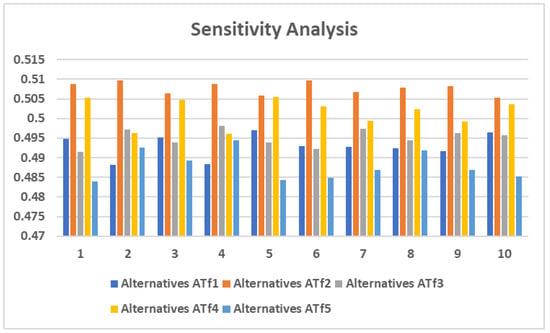
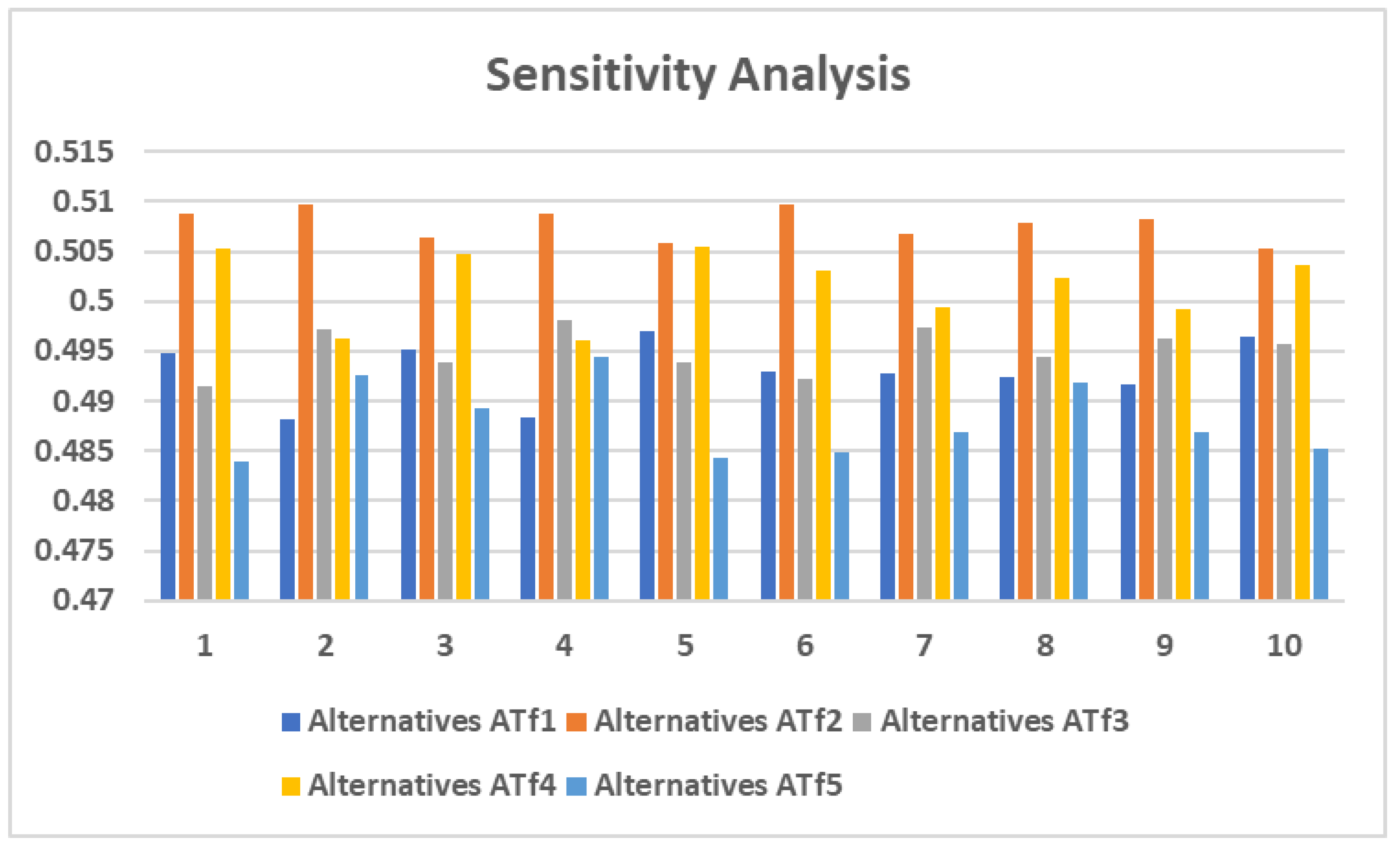
Table 6 represents the different sets of criteria weights and their ranking of alternatives. From the column corresponding to the “ Ranking order of Alternatives” in Table 6, we can say that the alternative is the best alternative among all. Figure 1 represents the pictorial representation of the sensitivity analysis for all 10 cases.
Table 6.
Sensitivity analysis with respect to various weights of the criteria.
Figure 1.
Sensitivity analysis with respect to various weights of the criteria.
8. Conclusions and Future Work
In this paper, we introduced a few similarity measures on the set of TrVIFNs using score functions and discussed their important mathematical properties by using propositions and theorems. For the first time in the literature, in this paper, we proposed the idea of a combined similarity measure principle on the set of TrVIFNs. Further, we showed the efficacy of the proposed combined similarity measure principle by analysing and discussing the drawbacks of a few important similarity measures on various classes of fuzzy sets. Then, we established a new MCDM algorithm by integrating the idea of a combined similarity measure principle and modifying the steps of the TOPSIS algorithm under a trapezoidal-valued intuitionistic fuzzy environment. Also, we discussed the applicability of the proposed MCDM algorithm in solving a numerical problem. Finally, a sensitivity analysis was performed by considering various weights for different criteria.
The combined similarity measure proposed in this paper overcomes the limitations of many similarity measures available on different classes of fuzzy sets. However, the number of similarity measures used for the proposed combined similarity measure principle is still debatable, and in the future, one shall work on this issue. The idea of the proposed combined similarity measure principle can be extended to the other generalized classes of fuzzy sets such as GTrFNs, IVIFNs, TVIFNs, TrIFNs, interval-valued Pythagorean fuzzy sets (IVPFS), FFSs, Spherical fuzzy sets, etc. In this study, we concentrated on defining a combined similarity measure principle mathematically; in future work, we will study the application of the proposed combined similarity measure principle in the field of pattern recognition, clustering, image processing, and decision sciences.
Author Contributions
Conceptualization, J.S.; methodology, J.S. and M.A.; validation, J.S. and M.A.; formal analysis, J.S.; investigation, J.S. and M.A.; resources, J.S.; data curation, M.A.; writing—original draft, J.S.; writing—review and editing, J.S. and M.A.; visualization, J.S.; supervision, J.S.; funding acquisition, M.A. All authors have read and agreed to the published version of the manuscript.
Funding
This work was supported by the Deanship of Scientific Research, Vice Presidency for Graduate Studies and Scientific Research, King Faisal University, Saudi Arabia [Grant No. A105].
Data Availability Statement
Inquiries regarding data accessibility should be addressed to the authors.
Acknowledgments
The authors would like to thank the anonymous reviewers, associate editor, and editor for their constructive comments that helped them to enhance this manuscript’s quality.
Conflicts of Interest
The authors declare that they have no conflicts of interest.
References
- Atanassov, K.T. Intuitionistic fuzzy sets. Fuzzy Sets Syst. 1986, 20, 87–96. [Google Scholar] [CrossRef] [Scilit]
- Zadeh, L.A. A note on Z-numbers. Inf. Sci. 2011, 181, 2923–2932. [Google Scholar] [CrossRef] [Scilit]
- Cuong, B.C.; Kreinovich, V. Picture fuzzy sets. J. Comput. Sci. Cybern. 2014, 30, 409–420. [Google Scholar]
- Yager, R.R. Pythagorean fuzzy subsets. In Proceedings of the 2013 Joint IFSA World Congress and NAFIPS Annual Meeting (IFSA/NAFIPS), Edmonton, AB, Canada, 24–28 June 2013; pp. 57–61. [Google Scholar]
- Dubois, D.; Prade, H. Rough fuzzy sets and fuzzy rough sets. Int. J. Gen. Syst. 1990, 17, 191–209. [Google Scholar] [CrossRef] [Scilit]
- Kutlu Gündoğdu, F.; Kahraman, C. Spherical fuzzy sets and spherical fuzzy TOPSIS method. J. Intell. Fuzzy Syst. 2019, 36, 337–352. [Google Scholar] [CrossRef] [Scilit]
- Tian, Y.; Mi, X.; Ji, Y.; Kang, B. ZE-numbers: A new extended Z-numbers and its application on multiple attribute group decision making. Eng. Appl. Artif. Intell. 2021, 101, 104225. [Google Scholar] [CrossRef] [Scilit]
- Ecer, F.; Haseli, G.; Krishankumar, R.; Hajiaghaei-Keshteli, M. Evaluation of sustainable cold chain suppliers using a combined multi-criteria group decision-making framework under fuzzy ZE-numbers. Expert Syst. Appl. 2024, 245, 123063. [Google Scholar] [CrossRef] [Scilit]
- Senapati, T.; Yager, R.R. Fermatean fuzzy sets. J. Ambient. Intell. Humaniz. Comput. 2020, 11, 663–674. [Google Scholar] [CrossRef] [Scilit]
- Jeevaraj, S.; Rajesh, R.; Lakshmana Gomathi Nayagam, V. A complete ranking of trapezoidal-valued intuitionistic fuzzy number: An application in evaluating social sustainability. Neural Comput. Appl. 2023, 35, 5939–5962. [Google Scholar] [CrossRef] [Scilit]
- Xu, Z.S.; Chen, J. An overview of distance and similarity measures of intuitionistic fuzzy sets. Int. J. Uncertain. Fuzziness Knowl.-Based Syst. 2008, 16, 529–555. [Google Scholar] [CrossRef] [Scilit]
- Ye, J. Cosine similarity measures for intuitionistic fuzzy sets and their applications. Math. Comput. Model. 2011, 53, 91–97. [Google Scholar] [CrossRef] [Scilit]
- Ye, J. Interval-valued intuitionistic fuzzy cosine similarity measures for multiple attribute decision-making. Int. J. Gen. Syst. 2013, 42, 883–891. [Google Scholar] [CrossRef] [Scilit]
- Song, Y.; Wang, X.; Lei, L.; Xue, A. A new similarity measure between intuitionistic fuzzy sets and its application to pattern recognition. Abstr. Appl. Anal. 2014, 2014, 384241. [Google Scholar] [CrossRef] [Scilit]
- Song, Y.; Wang, X. A new similarity measure between intuitionistic fuzzy sets and the positive definiteness of the similarity matrix. Pattern Anal. Appl. 2017, 20, 215–226. [Google Scholar] [CrossRef] [Scilit]
- Jeevaraj, S. Similarity measure on interval valued intuitionistic fuzzy numbers based on non-hesitance score and its application to pattern recognition. Comput. Appl. Math. 2020, 39, 212. [Google Scholar] [CrossRef] [Scilit]
- Atanassov, K.T.; Gargov, G. Interval-valued intuitionistic fuzzy sets. Fuzzy Sets Syst. 1989, 31, 343–349. [Google Scholar] [CrossRef] [Scilit]
- Yoon, K. Multiple Attributes Decision Making Methods and Applications; Wydawnictwo Springer: New York, NY, USA, 1981. [Google Scholar]

Disclaimer/Publisher’s Note: The statements, opinions and data contained in all publications are solely those of the individual author(s) and contributor(s) and not of MDPI and/or the editor(s). MDPI and/or the editor(s) disclaim responsibility for any injury to people or property resulting from any ideas, methods, instructions or products referred to in the content. |
© 2024 by the authors. Licensee MDPI, Basel, Switzerland. This article is an open access article distributed under the terms and conditions of the Creative Commons Attribution (CC BY) license (https://creativecommons.org/licenses/by/4.0/).