Article

Improving Unsupervised Network Alignment with Matched Neighborhood Consistency

1
School of Mathematics and Computer Science, Tongling University, Tongling 244061, China
2
Anhui Engineering Research Center of Intelligent Manufacturing of Copper-Based Materials, Tongling 244061, China
*
Author to whom correspondence should be addressed.
Mathematics 2024, 12(8), 1211; https://doi.org/10.3390/math12081211
Submission received: 26 February 2024 / Revised: 2 April 2024 / Accepted: 16 April 2024 / Published: 17 April 2024

Abstract

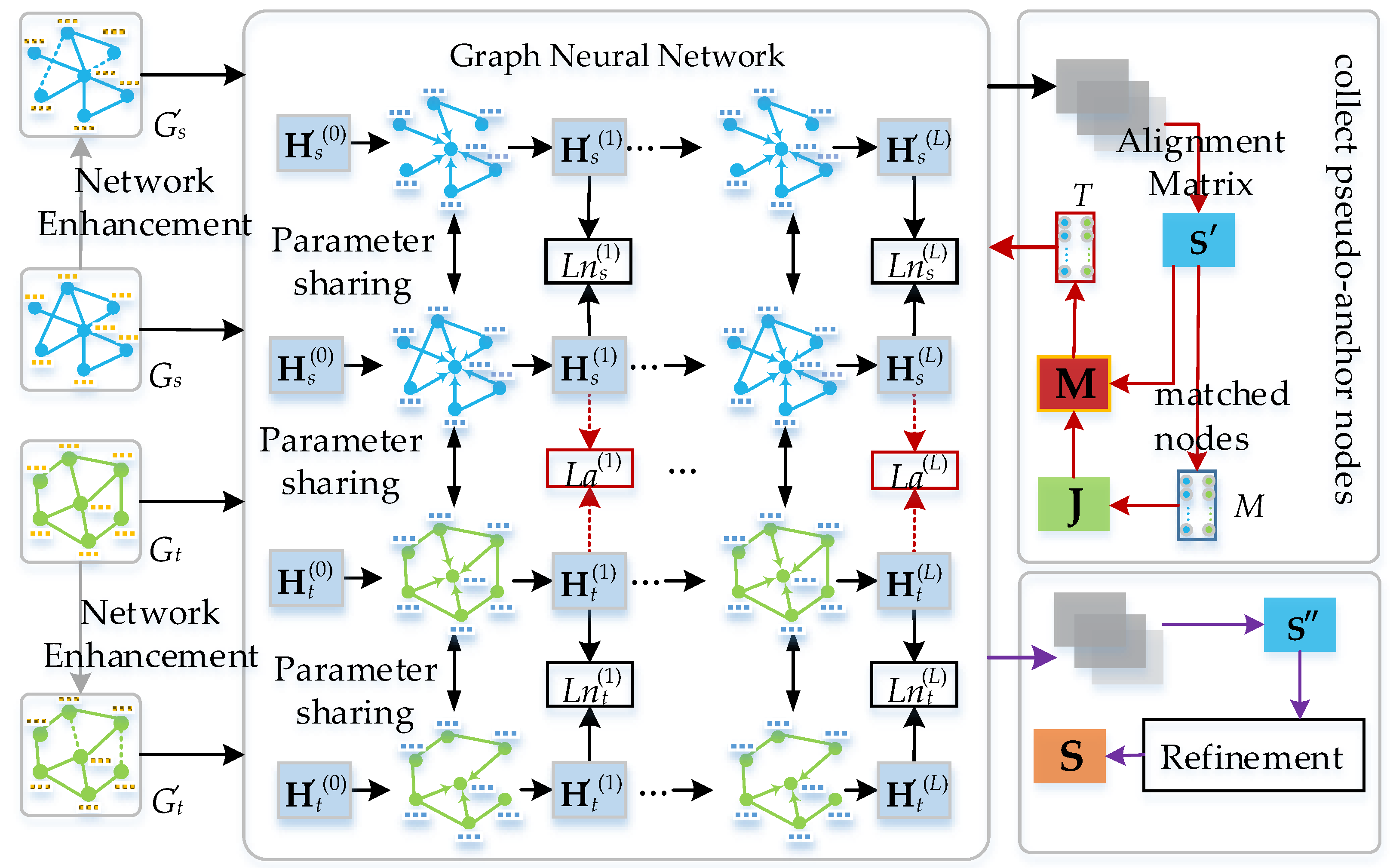
Network alignment is an important technique with applications in diverse domains, such as social network analysis, bioinformatics, and knowledge graph construction. Many of the alignment methods rely on predefined anchor nodes, which are often unavailable in real-world scenarios. To overcome this limitation, we propose MANNA (MAtched Neighbor consistency for Network Alignment), an unsupervised approach to network alignment that exploits the concept of Matched Neighborhood Consistency (MNC). The hypothesis of MANNA is that nodes with higher similarity within their local neighborhood structures are more likely to be aligned across different networks. To learn the structural and attribute features of networks, MANNA uses a Graph Neural Network (GNN). It extracts multi-order node embeddings to capture multi-scale neighborhood features, which are then used to construct similarity matrices for the alignment process. MANNA introduces a key innovation by using pseudo-anchor nodes identified by the MNC strategy to provide self-supervised learning signals in the absence of real anchor nodes. This approach enhances the model’s ability to learn accurate network representations and improve alignment accuracy. Alignment results are iteratively refined by applying the MNC strategy, which strengthens the consistency of neighborhood structures between matched nodes. Extensive experiments on three public datasets show that MANNA outperforms existing network alignment methods.
Keywords: network alignment; graph neural network; matched neighborhood consistency; pseudo-anchor nodes; self-supervised learning network alignment; graph neural network; matched neighborhood consistency; pseudo-anchor nodes; self-supervised learning