Article

Automatic Differentiation-Based Multi-Start for Gradient-Based Optimization Methods

by
Francesco Della Santa
1,2
1
Dipartimento di Scienze Matematiche (DISMA), Politecnico di Torino, Corso Duca degli Abruzzi 24, 10129 Turin, Italy
2
INdAM-GNCS Research Group, Istituto Nazionale di Alta Matematica, Piazzale Aldo Moro 5, 00185 Rome, Italy
Mathematics 2024, 12(8), 1201; https://doi.org/10.3390/math12081201
Submission received: 22 March 2024 / Revised: 11 April 2024 / Accepted: 13 April 2024 / Published: 17 April 2024
(This article belongs to the Special Issue Modeling and Numerical Analysis with Neural Networks)

Abstract

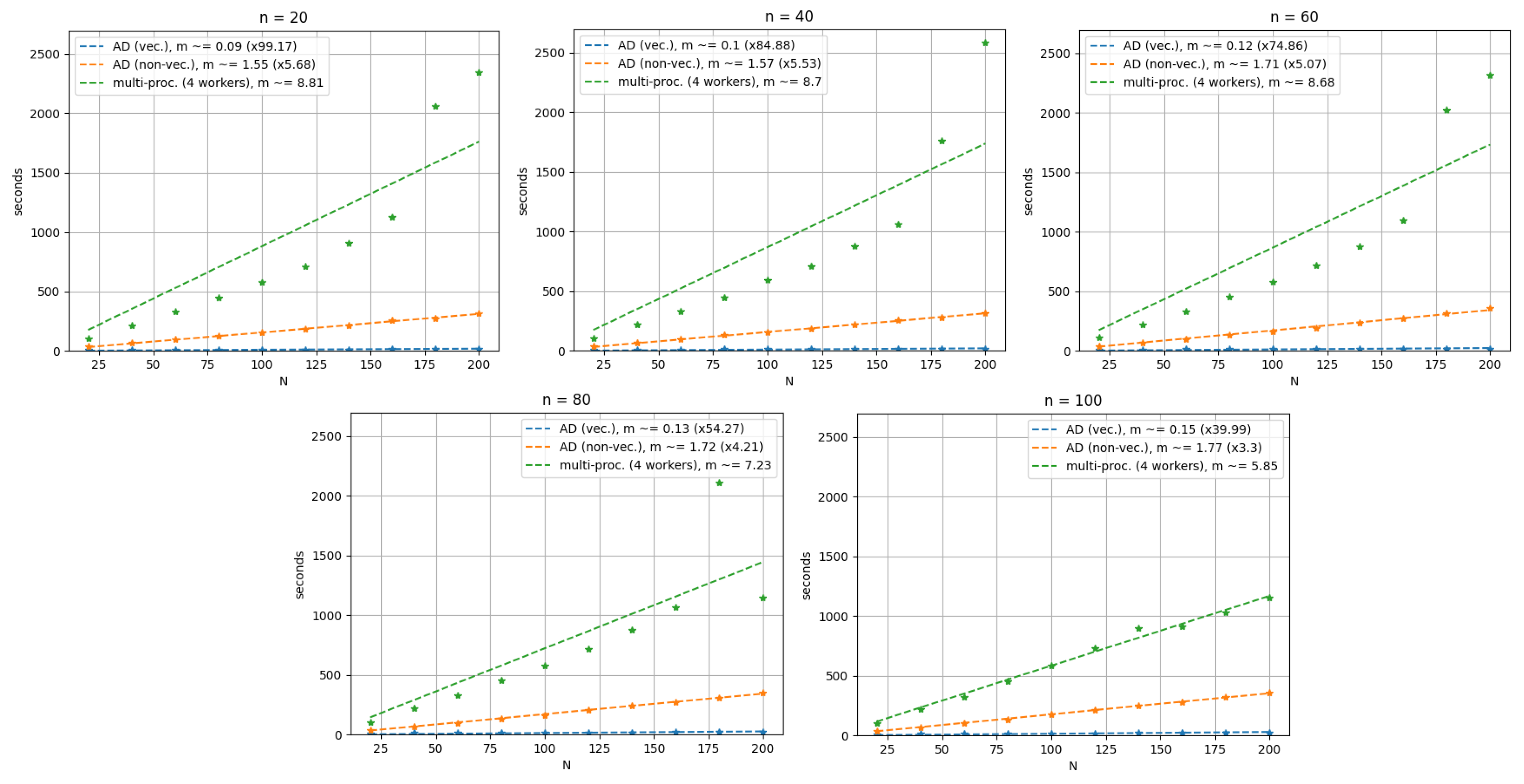
In global optimization problems, diversification approaches are often necessary to overcome the convergence toward local optima. One approach is the multi-start method, where a set of different starting configurations are taken into account to designate the best local minimum returned by the multiple optimization procedures as the (possible) global optimum. Therefore, parallelization is crucial for multi-start. In this work, we present a new multi-start approach for gradient-based optimization methods that exploits the reverse Automatic Differentiation to perform efficiently. In particular, for each step, this Automatic Differentiation-based method is able to compute the N gradients of N optimization procedures extremely quickly, exploiting the implicit parallelization guaranteed by the computational graph representation of the multi-start problem. The practical advantages of the proposed method are illustrated by analyzing the time complexity from a theoretical point of view and showing numerical examples where the speed-up is between ×40 and ×100, with respect to classic parallelization methods. Moreover, we show that our AD-based multi-start approach can be implemented by using tailored shallow Neural Networks, taking advantage of the built-in optimization procedures of the Deep Learning frameworks.
Keywords: global optimization; multi-start methods; Automatic Differentiation; Neural Networks global optimization; multi-start methods; Automatic Differentiation; Neural Networks