Abstract
In this paper, the problem of clustering component synchronization of nonlinearly coupled complex networks with nonidentical nodes and asymmetric couplings is investigated. A pinning control strategy is designed to achieve the clustering component synchronization with respect to the specified components. Based on matrix analysis and stability theory, clustering component synchronization criteria are established. Two numerical simulations are also provided to show the effectiveness of the theoretical results.
Keywords:
clustering component synchronization; complex network; nonlinearly coupled; pinning control MSC:
34D06; 34H05; 93D05
1. Introduction
Synchronization, a ubiquitous and fascinating collective behavior in complex networks, has been extensively studied through the past decades [1,2,3,4,5,6,7,8]. In reality, the complex network may be split into a few subnetworks called clusters due to some partition laws. When the dynamical nodes within a cluster synchronize with each other but desynchronize among different clusters, cluster synchronization appears. Due to its potential applications in neural networks, secure communication, etc., cluster synchronization has been intensively investigated and has yielded fruitful research results [9,10,11,12,13,14,15,16,17,18,19,20,21,22]. For example, in [11], cluster synchronization on multiple nonlinearly coupled dynamical subnetworks of complex networks with nonidentical nodes and stochastic perturbations was considered by Zhou et al., and the criteria that can ensure the network synchronizes to the reference state exponentially were established. In [12], Liu et al., discussed the asymptotic and finite-time cluster synchronization for coupled fractional-order neural networks with time delay, derived sufficient conditions for both synchronizations, respectively, and estimated the upper bound of the settling time in the case of finite-time cluster synchronization. In 2020, Della Rossa et al. [13] discussed the problem of symmetries and cluster synchronization in arbitrary multilayer networks, defined and computed the symmetries of the networks, and investigated the cluster synchronization that emerged analytically and experimentally. In 2023, Lu et al. [17] studied the cluster synchronization problem of a directed reaction-diffusion complex network with stochastic noise and Markovian switching, proposed switched constant gain, centralized adaptive and decentralized adaptive pinning control strategy, respectively, to realize the cluster synchronization in mean square of the network.
The pinning control strategy, which drives a complex network to the selected synchronization state only by controlling a small portion of the nodes in the network, has been widely adopted to synchronize the network since it was first introduced by Wang and Chen [23] in 2002. Much work has been dedicated to the investigation of the synchronization of complex networks via pinning control [24,25,26,27,28,29,30,31,32,33,34]. For instance, in [24], by adding linear negative feedback controllers to the last node of each cluster, Wu et al., successfully drove a general linearly coupled network to a specified cluster synchronization pattern for any initial value and delivered the pinning cluster synchronization criteria. Feng et al. [25] extended the results of [24] to nonlinearly coupled networks with symmetric coupling and tamed the network to prescribed cluster synchronization patterns by pinning the first nodes of each cluster. In [26], the problem of adaptive cluster synchronization for directed networks with nonidentical nodes was addressed by Wang et al., by controlling the root nodes of all the clusters.
The synchronization mentioned above refers to the convergence of all components of the node’s state variables in the complex network. However, in the synchronization study of complex networks, especially when the complex network is composed of high-dimensional chaotic systems, the requirement of convergence of all state components is sometimes difficult or even impossible due to the sensitivity of dynamic behavior to initial conditions. Moreover, in some instances, one may only focus on the convergence of some components of the node’s state variables rather than all components. These raise the necessity of studying partial component synchronization (consensus). Ma and his team worked a lot on this issue (one can see [35,36,37,38,39] and references therein). For example, Li et al., addressed the partial component synchronization problem on connected complex networks and derived sufficient conditions ascertaining the synchronization in [36]. Moreover, in [37], the authors studied the clustering component synchronization problem of unconnected complex networks. With the help of pinning control, the first m components of the node’s state variables in each cluster of the network were synchronized to the presetting synchronous trajectories.
It is worth noting that the clustering component synchronization studied in [37] is on a linearly coupled network, with the assumption that the coupling matrix is symmetric. In reality, however, most networks are directed and the state variables cannot be observed directly. Therefore, the study of clustering component synchronization for nonlinearly coupled complex networks with asymmetric couplings is necessary in both theoretical research and applications. Enlightened by the literature mentioned above, in this paper, we investigate the clustering component synchronization problem for nonlinearly coupled complex networks via pinning control. The novelty of this paper is that the synchronization studied herein is the convergence on any m specified components of the node’s state variables of the network rather than all components. For the purpose that the synchronization behavior of the specified components can be investigated, we move these components to the front by rearranging the components of error variables through a suitable transformation. Hence, the investigation of the clustering component synchronization with respect to these specified components transforms into the study of the stability of partial variables. Then, the stability theory of partial variables is applied, and sufficient conditions ensuring the realization of the clustering component synchronization are established. The main contributions of this paper can be summarized as follows:
- (1)
- The inner coupling of the complex networks studied in this paper is nonlinear, which is more realistic since the observed data are usually a nonlinear function of the state variable rather than itself.
- (2)
- The coupling matrix of the complex network investigated in this paper is asymmetric, which means that the complex network is directed. Moreover, the intrinsic dynamics of the nodes are uniform within a cluster but not the same in different ones. Therefore, the complex network under investigation in this paper is more in line with reality.
- (3)
- The synchronization investigated in this paper is clustering component synchronization, which is concerned with the asymptotic convergence of specified components of the node’s state variables in each cluster of the network rather than all components. When the specified components are all state components, clustering component synchronization becomes cluster synchronization in general. Hence, compared with traditional cluster synchronization investigated in [24,26], clustering component synchronization has more potential applications.
The rest of this paper is arranged as follows. In Section 2, some notations, definitions and lemmas that will be used later are presented. In Section 3, the criteria for clustering component synchronization are obtained. Two numerical simulations are provided to verify the effectiveness of the theoretical results in Section 4, and the paper is concluded in Section 5.
2. Preliminaries
In this section, we provide some notations, definitions and lemmas that will be used later. Throughout this paper, , and denote the sets of nonnegative real numbers, n-dimensional real column vectors with Euclidean norm and real matrices, respectively. I denotes the identity matrix with appropriate dimension, denotes the diagonal matrix with diagonal entries to . The superscript “T” stands for the transpose of a matrix and the notation ⊗ represents the Kronecker product. means the symmetric part of a square matrix A which is defined as . For symmetric matrix B, means that B is negative definite and means the maximum eigenvalue of B.
What follows are some basic definitions and lemmas.
Definition 1
([9]). An irreducible matrix is said to belong to class , denoted by , if the elements besides the diagonal entries are nonnegative and the diagonal elements .
Definition 2
([9]). For an matrix A, which can be written as
where , , here, , is said to belong to class , denoted by , if each row-sum of is zero and , .
Definition 3
([1]). A nonlinear function is said to belong to the acceptable nonlinear coupling function class, denoted by , if there are nonnegative scalars β and δ, such that satisfies the following Lipschitz condition:
where .
Definition 4
([37,40]). A function is said to belong to the class function, denoted by , if ϕ is continuous, strictly monotone increasing and .
Consider the s-dimensional non-autonomous system
where , here and , and for .
Assume that the existence and uniqueness of solutions to (1) subject to as well as their dependence on initial values are guaranteed.
Lemma 1
Lemma 2.
Let and . Then, for any permutation of , there exist orthogonal matrices and such that the equality
holds.
Proof.
For any permutation of , we define
and
where () is an -dimensional row vector whose lth element is 1 and all the other elements are 0, while () is an n-dimensional row vector whose sth element is 1 and all the other elements are 0. Then, it is obvious that P and Q are orthogonal matrices, and (4) is true after direct calculation. □
Lemma 3
([41]). For any and positive definite matrix ,
Lemma 4
([42]). For symmetric matrix , if each row-sum of W is zero, then for any two vectors and ,
Lemma 5
([43]). If are symmetric, is a nonzero vector, and , then
- (1)
- is symmetric;
- (2)
- is symmetric;
- (3)
- (4)
3. Main Results
Consider a nonlinearly coupled complex network composed of L nodes with index set . Suppose these nodes are split into k () nonempty clusters. Without loss of generality, let be the partition, where , here , , , . Then the network can be described as
where is the state variable of the node i at time t; denotes the index of the cluster that the node i belongs to; is a continuous function which describes the intrinsic dynamic of the nodes in the th cluster and for ; is the nonlinear coupling function, which is defined by for and h satisfies . denotes the topological structure of the complex network, which is defined as follows: if there is a connection from node j to node i(), then ; otherwise, and . Here, A can be asymmetric or reducible. represents the coupling strength between node i and node j, which is defined as follows: if , then ; if , then , . Denote . According to the partition, G can be written as:
where , . In this paper, we always assume that .
Suppose are the target trajectories of the k clusters, satisfying , and for , , . Here, we assume that the existence and uniqueness of solutions to subject to and their dependence on initial values are guaranteed. Select any components of the node’s state variables as the components that are required to be synchronized. Denote these m components as , and the remaining components as . The objective of this paper is to design an appropriate pinning control strategy such that the network (5) can achieve clustering component synchronization with respect to the specified components. To this end, we add controllers on the first () nodes of the uth cluster, .
In what follows, we consider the pinning controlled network
where , is the controller defined by
with . For convenience, if , then let . Hence, (6) can be rewritten as
Define the error variable , , . Define
Then, we have the following definition of clustering component synchronization with respect to the specified components :
Definition 5.
If , then the pinning controlled network (8) is said to achieve clustering component synchronization with respect to the specified components .
In order to derive the synchronization criteria for the pinning controlled network (8), we make the following assumptions:
(A1) There exist constants such that for any , the inequalities
hold, where , here
(A2) For , there exist constants such that .
Now, we give a general sufficient condition for the pinning controlled network (8) to achieve clustering component synchronization with respect to the specified components, which implies the relationship between the synchronization of the specified components and the topological structure of the network, strength of couplings, self-dynamics of the isolated node, inner couplings and the control.
Theorem 1.
Suppose that (A1) and (A2) hold. If the following conditions are satisfied:
where , then the pinning controlled network (8) achieves clustering component synchronization with respect to the specified components .
Proof.
In view of , it follows
Therefore,
Denote , , where , . Then, (10) can be rewritten as the following compact form
where F and H are defined by
and
for , , respectively.
Define , . It is obvious that , where P is defined as in Lemma 2, and
where and are defined by
and
for , , respectively.
Now, we construct the following Lyapunov function
where , here and ; .
Obviously, . Thus, and for . Then, for chosen functions and , , meets (2) of Lemma 1.
For the sake of convenience, denote , , , . Then, by (A1), we have
Let , where , . It is easy to verify that W is symmetric and that each row-sum of W is zero. Moreover, for any matrix , it follows , . Denote for , , , .
In consideration of Lemmas 3, 4 and (A2), we can obtain
Similarly, with (A2), we have
Substituting inequalities (13), (14), (15) into (12), we obtain
which together with (9) implies that
where .
Choose , . Obviously, and (3) of Lemma 1 is satisfied. Then, from Lemma 1, the trivial solution of the network (11) is asymptotically stable with respect to the variable y. Therefore, . Thus, we have the conclusion that the pinning controlled network (8) achieves clustering component synchronization with respect to the specified components . □
Although Theorem 1 provides a very general sufficient condition, it is not convenient to use. To make Theorem 1 more applicable, we give the following corollary.
Corollary 1.
Suppose that (A1) and (A2) hold. If
then the pinning controlled network (8) achieves clustering component synchronization with respect to the specified components .
Remark 1.
If the specified components are the first m components of the node’s state variables in each cluster of the complex network, then the clustering component synchronization we discussed turns into clustering component synchronization with respect to the first m components in [37]. In fact, for a linearly coupled complex network with identical nodes and symmetric couplings, we can easily obtain the result of [37] from Corollary 1, which means that the clustering component synchronization we discuss is a generalization of that in [37].
Remark 2.
If the specified components are all state components of the node, then the clustering component synchronization with respect to the specified components becomes cluster synchronization in general.
If the specified components are all state components, then (A1) and (A2) turn into (A1′) There exist constants such that for any , the inequalities
hold.
(A2′) There exist constants such that , .
Therefore, we have the following corollary about cluster synchronization from Theorem 1.
Corollary 2.
Suppose that (A1′), (A2′) hold, and the following conditions are satisfied:
Then, the pinning controlled network (8) achieves cluster synchronization.
4. Numerical Simulations
In this section, two numerical simulations are provided to show the effectiveness of the theoretical results.
Example 1.
Consider a nonlinearly coupled complex network composed of nine nodes with index set . Suppose these nodes are split into two clusters: and . Therefore, the network can be described as
where , . and h are defined by
and
for , respectively. , and the coupling configuration matrix
Let and be the target trajectories of two clusters with initial values and , respectively. Now, we investigate the pinning controlled network
where is defined by (7) with .
Let and . In what follows, we will verify that the pinning controlled network (17) can achieve clustering component synchronization with respect to the specified components and .
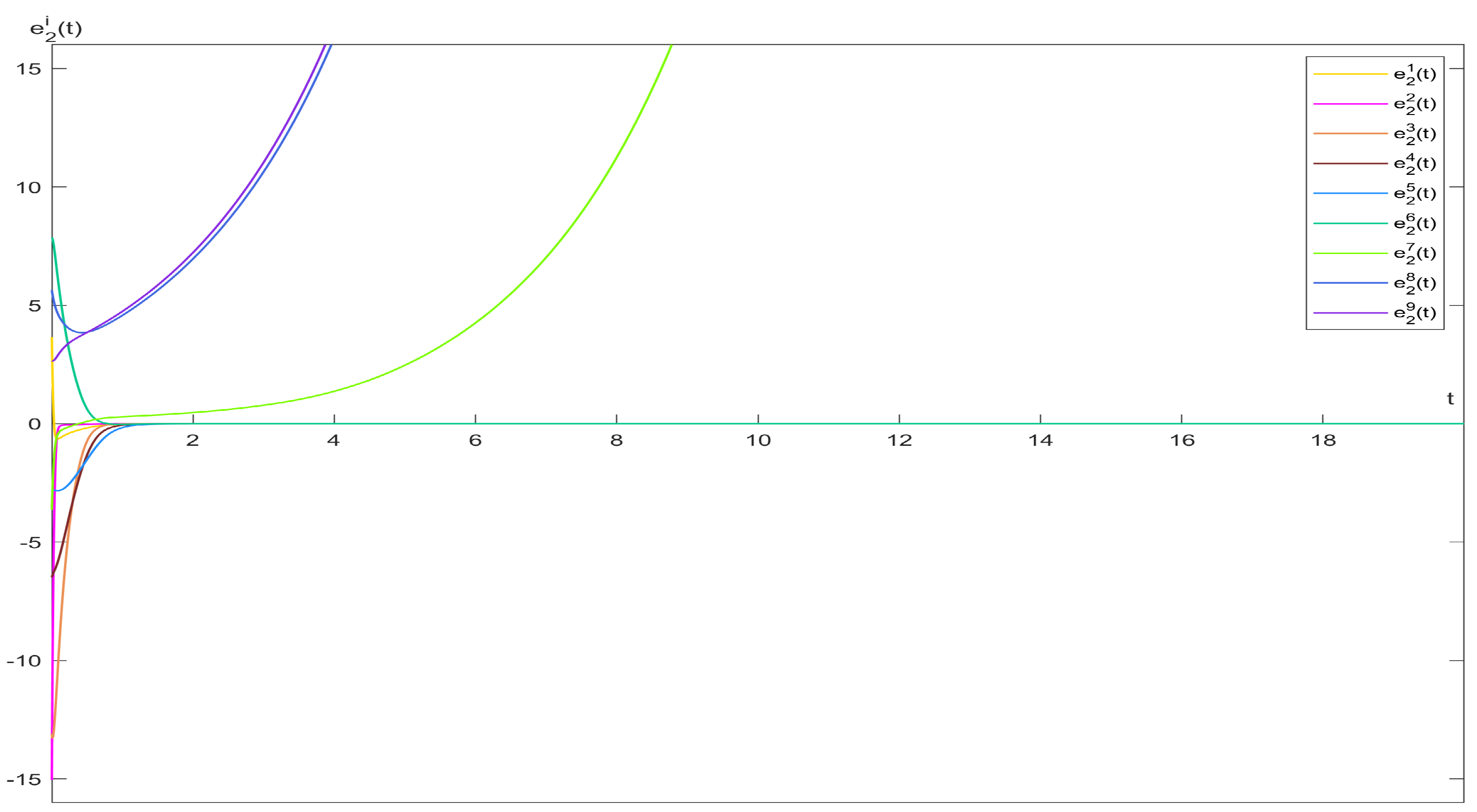
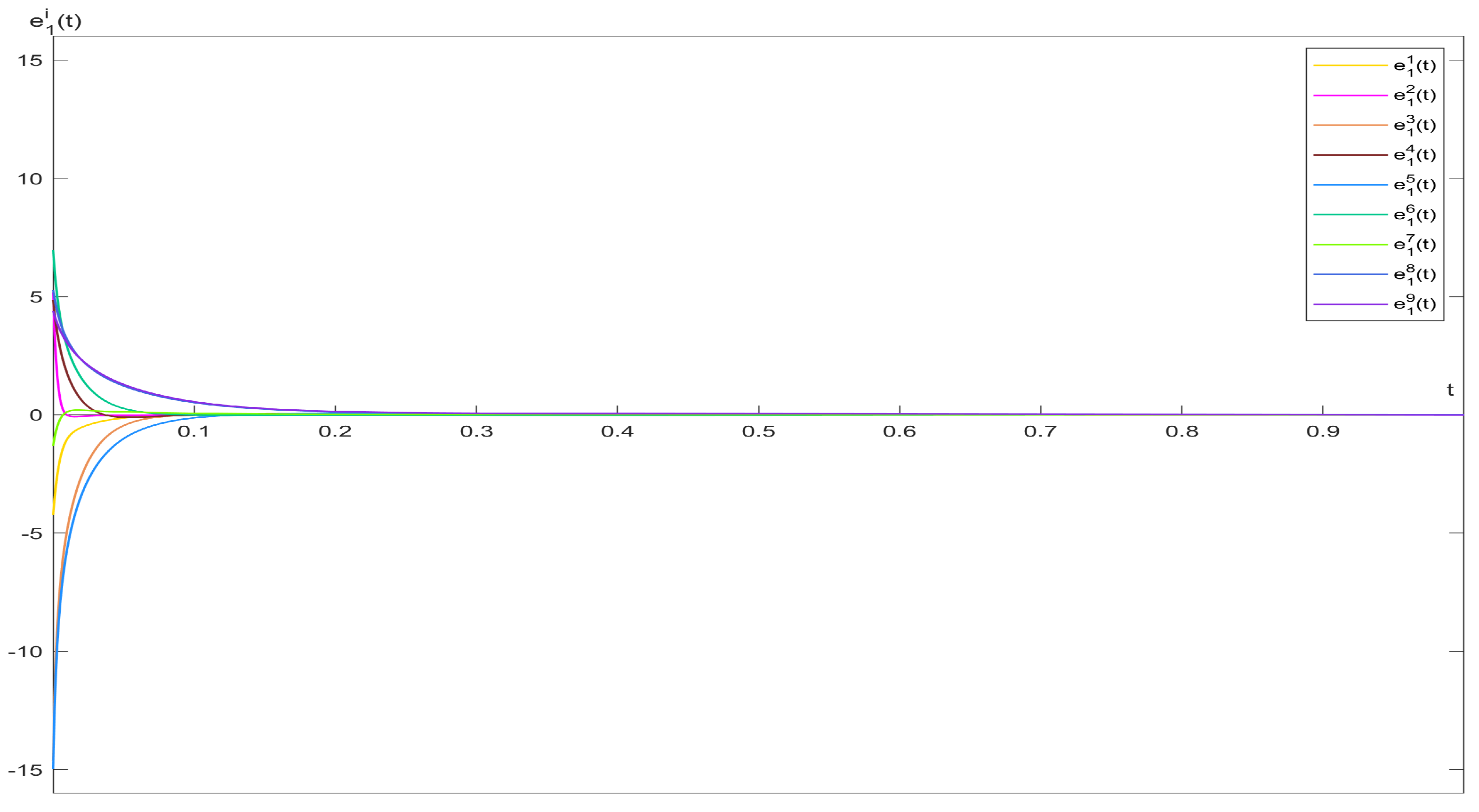
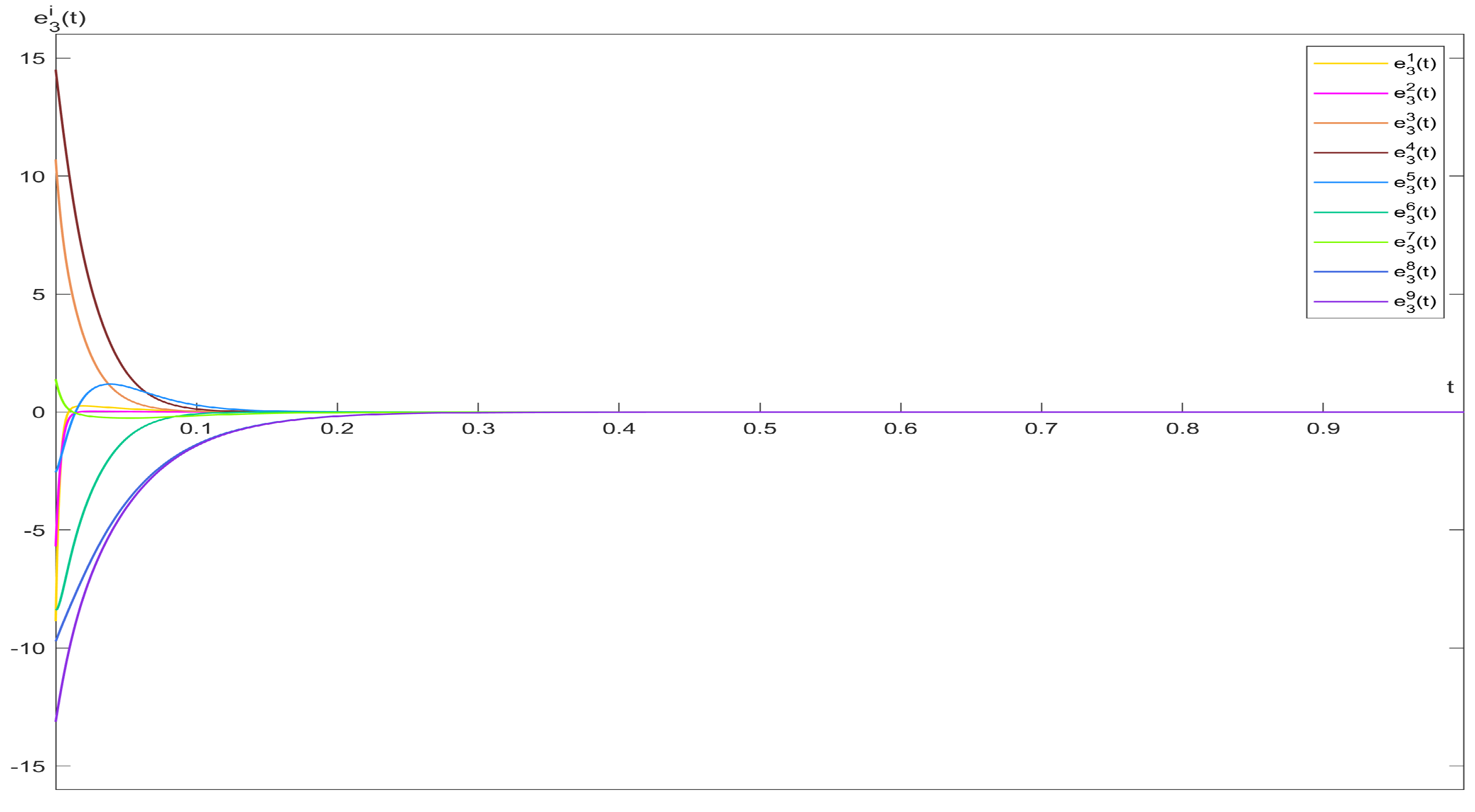
Obviously, . It is easy to verify that (A1) holds with and , (A2) holds with and , . Moreover, is equal to and for and , respectively, . All the requirements of Corollary 1 are met. Therefore, it follows Corollary 1 that the network (17) achieves clustering component synchronization with respect to the specified components and . Figure 1, Figure 2 and Figure 3 show the time history of the components of the error variables corresponding to the pinning controlled network (17). It can be seen that the first and third components of the error variables tend to 0 when , respectively, while the second component of the error variables does not. All these indicate that the network (17) achieves clustering component synchronization with respect to the specified components and .
Figure 1.
The time history of .
Figure 2.
The time history of .
Figure 3.
The time history of .
Example 2.
Consider a nonlinearly coupled complex network composed of 10 nodes with index set . Suppose these nodes are split into two clusters: and , and the node dynamics of the two clusters, respectively, are the 3-D neural network and the Chua’s circuit, which are described by
and
where , , , and matrices B and T are, respectively, defined by
Choose , , the coupling configuration matrix
and the nonlinear coupling function for .
Let and be the target trajectories with initial values and , respectively. Now, we investigate the pinning controlled network
where is defined by (7) with .
Let , and . In what follows, we will verify that the pinning controlled network (18) can achieve cluster synchronization.
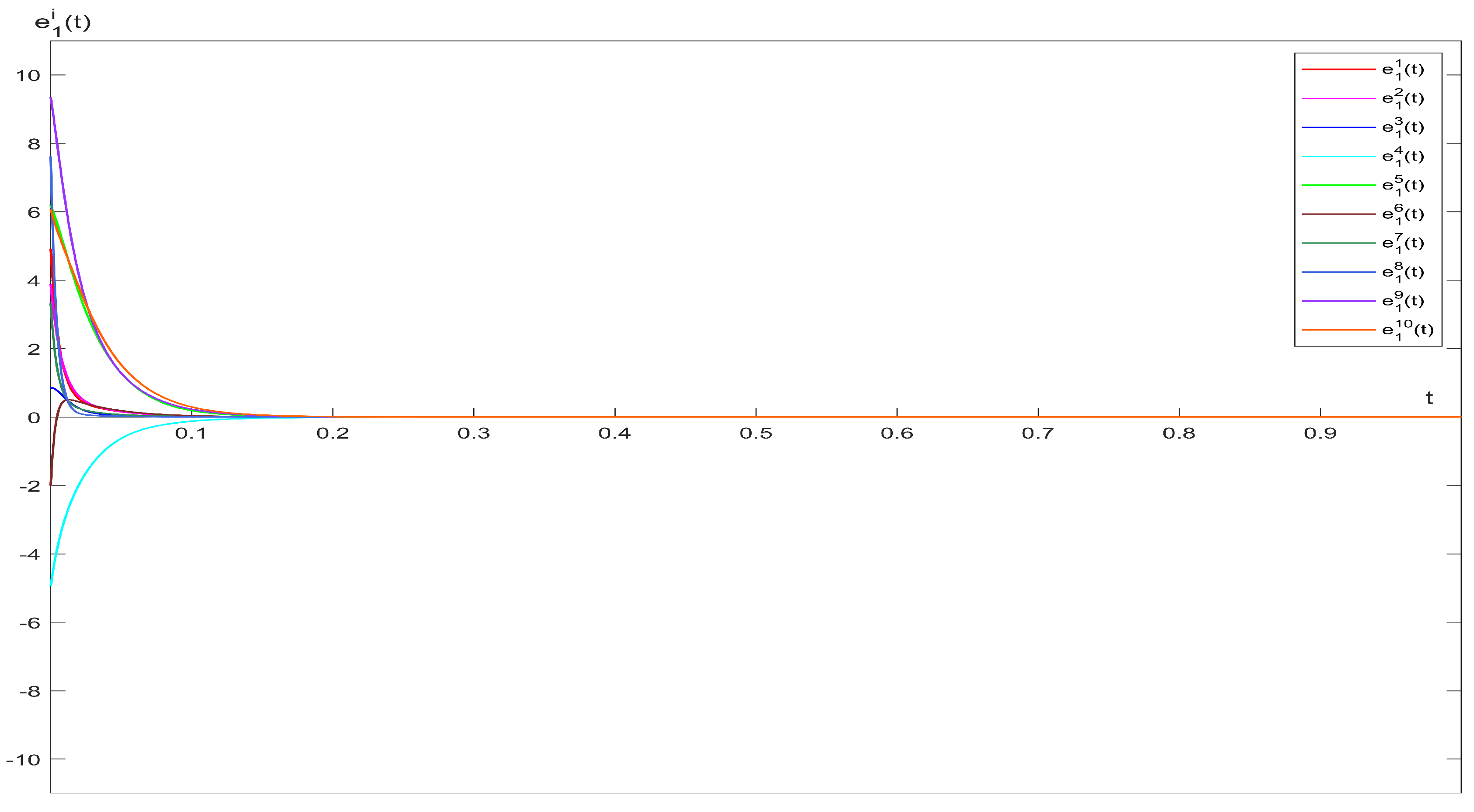
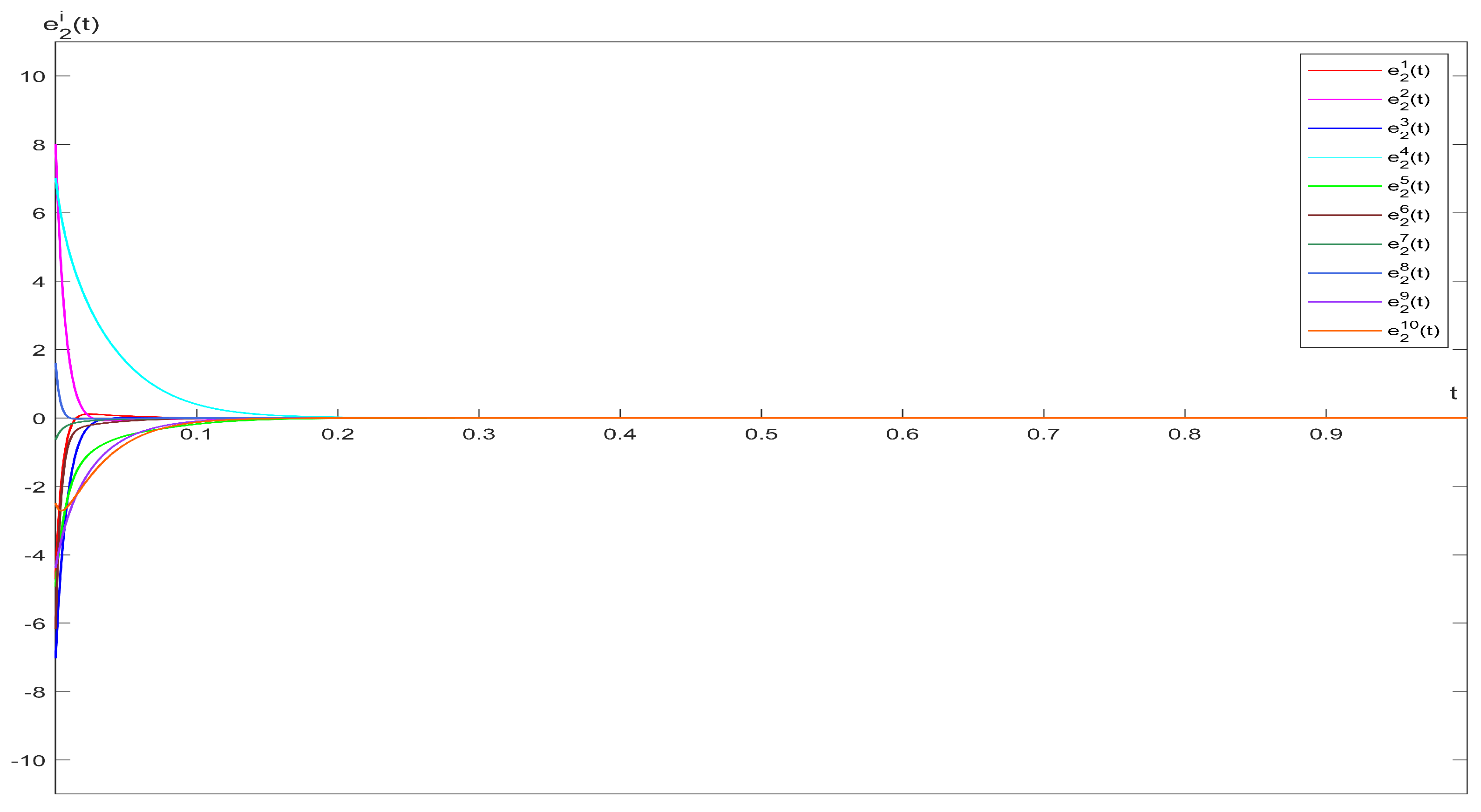
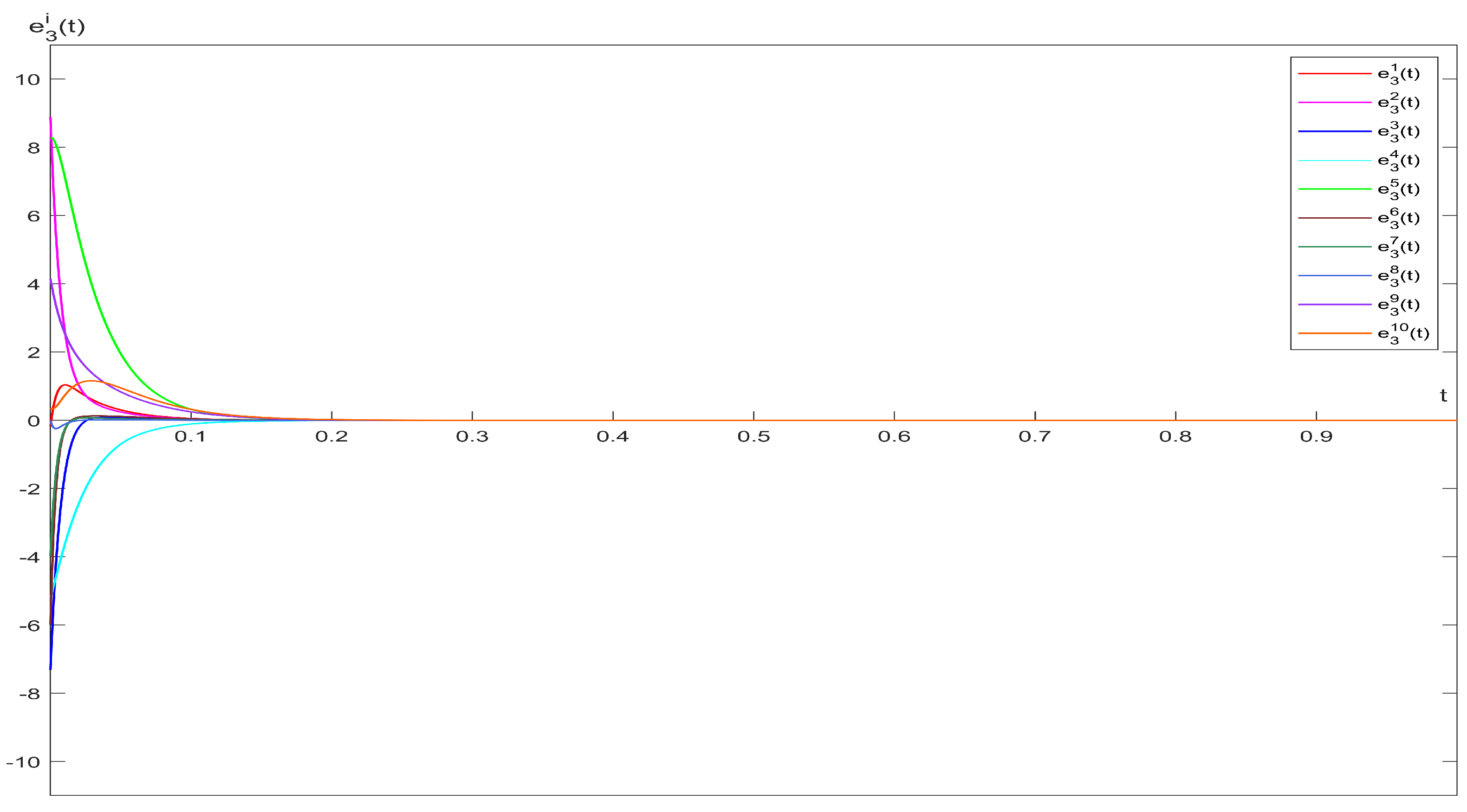
It is easy to verify that , (A1) holds with and , and (A2) holds with and , . Moreover, for and . All the conditions of Corollary 2 are fulfilled. Therefore, it follows Corollary 2 that the network (18) achieves cluster synchronization. Figure 4, Figure 5 and Figure 6 show the time history of the components of the error variables corresponding to the pinning controlled network (18). It can be seen that all the components of the error variables tend to 0 when . These indicate that the network (18) achieves cluster synchronization.
Figure 4.
The time history of .
Figure 5.
The time history of .
Figure 6.
The time history of .
5. Conclusions
In this paper, the problem of clustering component synchronization of nonlinearly coupled complex networks with nonidentical nodes and asymmetric couplings is investigated. With the use of matrix analysis and stability theory, some criteria for clustering component synchronization are established. Two numerical simulation examples are also provided to show the effectiveness of the theoretical results obtained.
Author Contributions
Conceptualization, J.-P.S. and J.L.; methodology, J.L.; software, J.L.; validation, J.L.; formal analysis, J.-P.S. and J.L.; investigation, J.L.; data curation, J.L.; writing—original draft preparation, J.L.; writing—review and editing, J.-P.S. and J.L.; visualization, J.L.; supervision, J.-P.S.; project administration, J.-P.S.; funding acquisition, J.-P.S. All authors have read and agreed to the published version of the manuscript.
Funding
This work is supported by the National Natural Science Foundation of China under Grant 12361039.
Data Availability Statement
No new data were created or analyzed in this study. Data sharing is not applicable to this article.
Conflicts of Interest
The authors declare no conflicts of interest.
References
- Liu, X.; Chen, T. Synchronization analysis for nonlinearly-coupled complex networks with an asymmetrical coupling matrix. Phys. A Stat. Mech. Appl. 2008, 387, 4429–4439. [Google Scholar] [CrossRef]
- Zhang, L.; Lei, Y.; Wang, Y.; Chen, H. Generalized outer synchronization between non-dissipatively coupled complex networks with different-dimensional nodes. Appl. Math. Model. 2018, 55, 248–261. [Google Scholar] [CrossRef]
- Li, Y.; Zhang, J.; Lu, J.; Lou, J. Finite-time synchronization of complex networks with partial communication channels failure. Inf. Sci. 2023, 634, 539–549. [Google Scholar] [CrossRef]
- Abdurahman, A.; Abudusaimaiti, M.; Jiang, H. Fixed/predefined-time lag synchronization of complex-valued BAM neural networks with stochastic perturbations. Appl. Math. Comput. 2023, 444, 127811. [Google Scholar] [CrossRef]
- Syed Ali, M.; Stamov, G.; Stamova, I.; Ibrahim, T.F.; Dawood, A.A.; Osman Birkea, F.M. Global asymptotic stability and synchronization of fractional-order reaction–diffusion fuzzy BAM neural networks with distributed delays via hybrid feedback controllers. Mathematics 2023, 11, 4248. [Google Scholar] [CrossRef]
- Liang, Y.; Deng, Y.; Zhang, C. Outer synchronization of two muti-layer dynamical complex networks with intermittent pinning control. Neural Netw. 2023, 11, 3543. [Google Scholar] [CrossRef]
- Kumar, A.; Das, S.; Singha, S.; Rajeev. Quasi-projective synchronization of inertial complex-valued recurrent neural networks with mixed time-varying delay and mismatched parameters. Chaos Solitons Fractals 2023, 166, 112948. [Google Scholar] [CrossRef]
- Wei, C.; Wang, X.; Hui, M.; Zeng, Z. Quasi-synchronization of fractional multiweighted coupled neural networks via aperiodic intermittent control. IEEE Trans. Cybern. 2024, 54, 1671–1684. [Google Scholar] [CrossRef]
- Liu, X.; Chen, T. Cluster synchronization in directed networks via intermittent pinning control. IEEE Trans. Neural Netw. 2011, 22, 1009–1020. [Google Scholar] [CrossRef]
- Li, K.; Zhou, J.; Yu, W.; Small, M.; Fu, X. Adaptive cluster synchronization in networks with time-varying and distributed coupling delays. Appl. Math. Model. 2014, 38, 1300–1314. [Google Scholar] [CrossRef]
- Zhou, L.; Wang, C.; Du, S.; Zhou, L. Cluster synchronization on multiple nonlinearly coupled dynamical subnetworks of complex networks with nonidentical nodes. IEEE Trans. Neural Netw. Learn. Syst. 2017, 28, 570–583. [Google Scholar] [CrossRef]
- Liu, P.; Zeng, Z.; Wang, J. Asymptotic and finite-time cluster synchronization of coupled fractional-order neural networks with time delay. IEEE Trans. Neural Netw. Learn. Syst. 2020, 31, 4956–4967. [Google Scholar] [CrossRef]
- Della Rossa, F.; Pecora, L.; Blaha, K.; Shirin, A.; Klickstein, I.; Sorrentino, F. Symmetries and cluster synchronization in multilayer networks. Nat. Commun. 2020, 11, 3179. [Google Scholar] [CrossRef]
- Wang, Y.; Wu, Z. Cluster synchronization in variable-order fractional community network via intermittent control. Mathematics 2021, 9, 2596. [Google Scholar] [CrossRef]
- Wang, X.; Zhai, S.; Luo, G.; Huang, T. Cluster synchronization in a network of nonlinear systems with directed topology and competitive relationships. Appl. Math. Comput. 2022, 421, 126931. [Google Scholar] [CrossRef]
- Tong, L.; Liang, J.; Liu, Y. Generalized cluster synchronization of Boolean control networks with delays in both the states and the inputs. J. Frankl. Inst. 2022, 359, 206–223. [Google Scholar] [CrossRef]
- Lu, B.; Jiang, H.; Hu, C.; Abdurahman, A.; Liu, M. Adaptive pinning cluster synchronization of a stochastic reaction-diffusion complex network. Neural Netw. 2023, 166, 524–540. [Google Scholar] [CrossRef]
- Zhai, S.; Wang, X.; Zheng, Y. Cluster synchronization of a nonlinear network with fixed and switching topologies. IEEE Syst. J. 2023, 17, 3752–3761. [Google Scholar] [CrossRef]
- Liu, L.; Zhou, W.; Huang, C. Finite/Prescribed-time cluster synchronization of complex dynamical networks with multiproportional delays and asynchronous switching. IEEE Trans. Syst. Man Cybern. Syst. 2023, 53, 3683–3694. [Google Scholar] [CrossRef]
- Zhai, S.; Zheng, W.X. Stability conditions for cluster synchronization in directed networks of diffusively coupled nonlinear systems. IEEE Trans. Circuits Syst. I Regul. Pap. 2023, 70, 413–423. [Google Scholar] [CrossRef]
- Lin, L.; Cao, J.; Liu, X.; Lu, G.; Abdel-Aty, M. Cluster synchronization of finite-field networks. IEEE Trans. Cybern. 2024, 54, 635–640. [Google Scholar] [CrossRef]
- Hui, M.; Liu, X.; Zhu, S.; Cao, J. Event-triggered impulsive cluster synchronization of coupled reaction–diffusion neural networks and its application to image encryption. Neural Netw. 2024, 170, 46–54. [Google Scholar] [CrossRef]
- Wang, X.F.; Chen, G. Pinning control of scale-free dynamical networks. Phys. A Stat. Mech. Appl. 2002, 310, 521–531. [Google Scholar] [CrossRef]
- Wu, W.; Zhou, W.; Chen, T. Cluster synchronization of linearly coupled complex networks under pinning control. IEEE Trans. Circuits Syst. I Regul. Pap. 2009, 56, 829–839. [Google Scholar] [CrossRef]
- Feng, J.; Wang, J.; Xu, C.; Austin, F. Cluster synchronization of nonlinearly coupled complex networks via pinning control. Discret. Dyn. Nat. Soc. 2011, 2011, 262349. [Google Scholar] [CrossRef]
- Wang, Y.; Ma, Z.; Cao, J.; Alsaedi, A.; Alsaadi, F.E. Adaptive cluster synchronization in directed networks with nonidentical nonlinear dynamics. Complexity 2016, 21, 380–387. [Google Scholar] [CrossRef]
- Li, L.; Ho, D.W.C.; Cao, J.; Lu, J. Pinning cluster synchronization in an array of coupled neural networks under event-based mechanism. Neural Netw. 2016, 76, 1–12. [Google Scholar] [CrossRef]
- Zhang, X.; Zhou, W.; Karimi, H.R.; Sun, Y. Finite- and fixed-time cluster synchronization of nonlinearly coupled delayed neural networks via pinning control. IEEE Trans. Neural Netw. Learn. Syst. 2021, 32, 5222–5231. [Google Scholar] [CrossRef]
- Yang, Q.; Wu, H.; Cao, J. Pinning exponential cluster synchronization for fractional-order complex dynamical networks with switching topology and mode-dependent impulses. Neurocomputing 2021, 428, 182–194. [Google Scholar] [CrossRef]
- Liu, L.; Ding, X.; Zhou, W. Prescribed-time cluster synchronization of uncertain complex dynamical networks with switching via pinning control. Neurocomputing 2021, 419, 136–147. [Google Scholar] [CrossRef]
- Wang, J.; Liu, X. Cluster synchronization for multi-weighted and directed complex networks via pinning control. IEEE Trans. Circuits Syst. II Express Briefs 2022, 69, 1347–1351. [Google Scholar] [CrossRef]
- Fan, H.; Shi, K.; Zhao, Y. Pinning impulsive cluster synchronization of uncertain complex dynamical networks with multiple time-varying delays and impulsive effects. Phys. A Stat. Mech. Appl. 2022, 587, 126534. [Google Scholar] [CrossRef]
- Wei, J.; Zhang, C.; Guo, Y.; Wang, F. Cluster synchronization of stochastic two-layer delayed neural networks via pinning impulsive control. J. Appl. Math. Comput. 2024, 2024, 1–18. [Google Scholar] [CrossRef]
- Chen, Z.; Sun, Y.; Li, J.; Liu, M. Distributed fault-tolerant pinning control for cluster synchronization of multiple unmanned surface vehicles. Ocean Eng. 2024, 296, 116882. [Google Scholar] [CrossRef]
- Wu, B.; Ma, Z.; Wang, Y. Partial component consensus of leader-following multi-agent systems. Acta Phys. Sin. 2017, 66, 060201. [Google Scholar] [CrossRef]
- Li, F.; Ma, Z.; Duan, Q. Partial component synchronization on chaotic networks. Phys. A Stat. Mech. Appl. 2019, 515, 707–714. [Google Scholar] [CrossRef]
- Li, F.; Ma, Z.; Duan, Q. Clustering component synchronization in a class of unconnected networks via pinning control. Phys. A Stat. Mech. Appl. 2019, 525, 394–401. [Google Scholar] [CrossRef]
- Hu, W.; Zhang, W.; Ma, Z.; Li, K. Partial component consensus analysis of second-order and third-order nonlinear multi-agent systems. Phys. A Stat. Mech. Appl. 2022, 593, 126857. [Google Scholar] [CrossRef]
- Wang, Y.; Song, H.; Chen, G.; Ma, Z.; Cao, J. p components of cluster-lag consensus for second-order multiagent systems with adaptive controller on cooperative-competitive networks. IEEE Trans. Cybern. 2023, 53, 2852–2863. [Google Scholar] [CrossRef]
- Liao, X. Mathematical Theory of Stability and Its Application; Central China Normal University Press: Wuhan, China, 2001. [Google Scholar]
- Wu, J.; Jiao, L. Synchronization in complex delayed dynamical networks with nonsymmetric coupling. Phys. A Stat. Mech. Appl. 2007, 386, 513–530. [Google Scholar] [CrossRef]
- Wu, C.W.; Chua, L.O. Synchronization in an array of linearly coupled dynamical systems. IEEE Trans. Circuits Syst. I Fundam. Theory Appl. 1995, 42, 430–447. [Google Scholar] [CrossRef]
- Lütkepohl, H. Handbook of Matrices; Wiley: New York, NY, USA, 1996. [Google Scholar]
Disclaimer/Publisher’s Note: The statements, opinions and data contained in all publications are solely those of the individual author(s) and contributor(s) and not of MDPI and/or the editor(s). MDPI and/or the editor(s) disclaim responsibility for any injury to people or property resulting from any ideas, methods, instructions or products referred to in the content. |
© 2024 by the authors. Licensee MDPI, Basel, Switzerland. This article is an open access article distributed under the terms and conditions of the Creative Commons Attribution (CC BY) license (https://creativecommons.org/licenses/by/4.0/).