


Abstract
We consider a two-layer biological object consisting of layers with different thermophysical characteristics and subjected to laser radiation. Using the method of separation of variables and methods of control theory for finite-dimensional systems, we developed a constructive approach to constructing a control function for the thermal effect of a laser beam on a two-layer biomaterial. Under the controlled thermal influence of a laser beam, the distribution of the temperature state in a two-layer biomaterial transitions from the initial state to the final one during a given time period.
Keywords:
multilayer biological material; thermal effect of a laser beam; thermal process; boundary control; temperature state; method of separation of variables MSC:
93C95; 70Q05
1. Introduction
The study of problems in multilayer physical systems that are under the influence of concentrated or distributed sources requires considering appropriate and adequate mathematical models. At the same time, both mathematical models and research methods must be adequate.
The work in [1] presents a review of the literature on biomedical applications of lasers. It is impossible to imagine modern medicine without lasers [2,3]. The field of applying laser radiation goes far beyond the classical concepts of a laser, in particular in energy and electronics [4,5,6,7]. One of the many areas of biomedical application of lasers is their use as a tool to influence biological objects. Lasers provide the ability to precisely deliver large amounts of energy to limited areas of a material to achieve the desired response. Laser therapy can have a positive effect on the regeneration of periodontal tissues and improve the postoperative period due to its anti-inflammatory properties. Promising technical solutions and deeper knowledge about the interaction of lasers with tissues should allow the safe and effective use of laser exposure.
With the advent of new areas for applying laser radiation for the processing of biological materials, it has become necessary to develop methods for its influence and criteria for the parameters of laser emitters. Therefore, various mathematical models are being developed to solve various problems of laser influence and evaluate the results [1], in particular, the problem of choosing the modes of thermal impact of a laser beam on a biological environment. Following the authors of [1], we note that the mechanism of the effect of a laser beam on a biological environment has not yet been sufficiently studied. So, it is necessary to carry out further diversified studies on the search for laser radiation modes to develop the possibilities of laser influence and increase the effectiveness of the impact on the biological environment.
Laser therapy is increasingly recognized as a cancer treatment method due to the localized delivery of energy to tumor tissue [8]. Thermal effects on tissue, as well as damage to adjacent tissue, are still a potential problem. Therefore, mathematical modeling of laser-tissue interaction is a necessary part of clinical treatment planning. In [8], the temperature distribution during laser-induced thermotherapy in the treatment of cancer is studied using the example of a multilayer skin with an embedded tumor model. The work in [9] presents a theoretical model that simulates the thermal effects of laser radiation incident on biological tissue. The process of thermal diffusion (as well as scattering and absorption of the laser beam) in tissue is assessed using a numerical method. The work in [10] provides a theoretical analysis of thermal damage in biological tissues caused by laser irradiation. The obtained distribution of absorbed laser energy is included in the heat transfer equation in biological tissue to solve the temperature response. The influence of laser power, exposure time and beam size, as well as tissue absorption and scattering coefficients on the process of thermal damage, is considered.
This paper considers a multilayer biological material that is exposed to laser radiation. Such an object is a system with distributed parameters [11,12,13,14,15,16,17,18]. The mathematical model of the process of laser beam action on a multilayer biological material is described using partial differential heat conduction equations with boundary conditions for the beginning and end of laser heating, boundary conditions for the interaction of the outer layer of biological material and the environment and conjugation conditions between layers. The mathematical models of these objects are characterized as heterogeneous composite systems with distributed parameters; therefore, it is advisable to use methods for investigating the control problems of composite systems (of variable structure), which are addressed, in particular, in [19,20,21,22]. The scientific area of modeling the processes of laser beam impact on a multilayer biomaterial and the study of control problems for such models have not yet been sufficiently investigated in scientific publications.
This paper considers, as a multilayer system, an object consisting of two biological layers that are inhomogeneous in their thermophysical characteristics and subjected to laser radiation. It is assumed that the process of thermal action of a laser beam on a two-layer biomaterial is controlled as follows: by changing the temperature intensity of the laser beam at the upper (left) boundary of the two-layer biomaterial, we influence the thermal state in the two-layer biomaterial. This study aims to develop an analytical approach to constructing a control function for the thermal effect of a laser beam on a two-layer biomaterial under the influence of which the distribution of the temperature state transitions from a given initial state to a given final state at a given time interval. The work is related to the research carried out in [21].
2. Mathematical Model of a Two-Layer Biomaterial and Problem Statement
Let us consider a two-layer biological material infinite in coordinates x and y (Figure 1) with different thermophysical characteristics (thermal conductivity coefficients, mass density and heat capacity) of the layers.
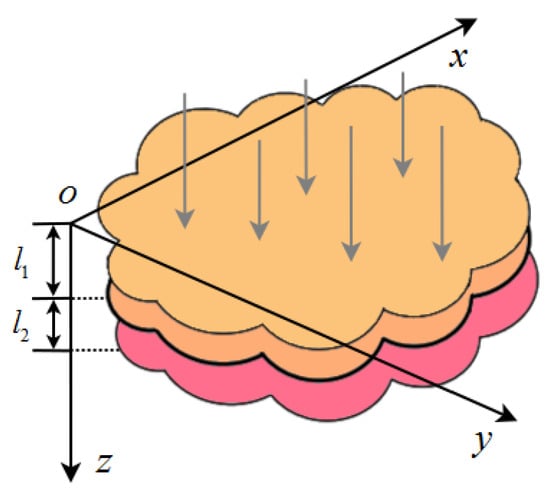
Figure 1.
Block diagram of the impact of a laser beam on a two-layer biological material.
According to the multilayer structure of the biomaterial [15,16,17,18], in the case when the thermal conductivity coefficients are constant, the differential equation of thermal conductivity is transformed into the system of the following differential equations of thermal conductivity:
where —mass density coefficient for the j-th layer of the biological material, (kg/m3); —heat capacity coefficient for the j-th layer of the biological material (J/(kg·K)); —temperature field for the j-th layer of the biological material (K); z—penetration depth of laser radiation in biological material (m); t—thermal exposure time (s); and —thermal conductivity factor for the j-th layer of the biological material (W/(m·K)).
Let us assume that the boundary conditions of the thermal effect on a two-layer biological material, respectively, are as follows
where —the temperature of the laser beam on the upper border of the two-layer biomaterial, which varies over time; —the temperature of the laser beam on the lower border of the two-layer biological material, which is considered known.
Let us introduce the layers matching conditions, which express the equalities of the continuity of the temperature fields along the time coordinate, and the conditions for the ideal thermal contact of the layers as follows:
It is assumed that the initial condition (at )
and final condition (at )
are set.
The thermal effect of a laser beam on a two-layer biomaterial is controlled as follows: by changing the intensity (temperature) of the laser beam on the upper border of the two-layer biomaterial, we influence the thermal state of the two-layer biomaterial. The boundary function is a control action (boundary control).
It is assumed that the admissible control belongs to . The function , , where we set , and the functions , belong to . It is also assumed that all functions are such that the following matching conditions are satisfied:
The control problem of the thermal effect of a laser beam on a two-layer biomaterial can be formulated as follows: find a control law , of the thermal effect of a laser beam on a two-layer biomaterial under the influence of which the distribution of the thermal state (1) at the time transitions from the initial state (4) to the specified end state (5) on a given time interval .
3. Reduction of the Problem to a Problem with Zero Boundary Conditions
We introduce the notation , . To solve the problem posed, we consider it expedient to introduce a new variable [21]
The replacement of variable (7) leads to the expansion or contraction of the segment with respect to point . In this case, instead of segment , we consider segment , where .
Note that, for convenience, after the replacement of variable (7), we keep all the above functions in their original notation. Thus, Equation (1) can be written in the form
Denote
Therefore, two identical Equations (8) with the function , , introduced in (9) will be written with the equation
with corresponding boundary conditions
with initial conditions
with final conditions
and with matching conditions at joining point of the areas
.
Given the inhomogeneity of the boundary conditions (11), the solution to Equation (10) will be in the form of the sum
where is a function with homogeneous boundary conditions
to be determined, and the function is the solution to (8), subject to
which has the form
Function satisfies the matching condition corresponding to (14) at joining point of the areas. Note that, according to (7), from condition (6), we have
Using the approaches given in [21,22], from the initial (12) and final (13) conditions, following the matching conditions, we obtain that the function should meet the following initial:
and final
conditions.
Solving the original problem is reduced to solving the problem of controlling the thermal effect of a laser beam on a two-layer biomaterial, which is defined by Equation (19) with homogeneous boundary conditions (16). The resulting problem is formulated as follows: find a control law , under the influence of which the distribution of the thermal state defined by Equation (19) with boundary conditions (16) transitions from the given initial state (24) to the final state (25) at a given time interval .
4. Solving the Problem
The solution to Equation (19), subject to the boundary conditions (16) and the consistency condition, is sought in the form
By presenting the functions , , in the form of Fourier series in the basis (), and substituting their values together with in Equations (19) and (20) and in conditions (21) and (22), we obtain that the Fourier coefficients satisfy a countable number of systems of ordinary differential equations
Here, the Fourier coefficients of functions , , , and are denoted by , , , and , respectively.
Now, taking into account the final conditions (30), we obtain that the functions , for each must meet the following relation:
Using the approaches given in [18,19,20], we obtain that the control function for each must satisfy the integral relation:
In practice, the first few n () relations (33) are usually chosen and the problem of control synthesis is solved using methods of control theory for finite-dimensional systems [23,24]. We will solve the problem following this approach. Therefore, for the first n relations, from (33), we will have
Here and below, “n” in the lower index of the letter means “for the first n” modes.
Relation (34) implies the validity of the following statement about complete controllability [23,24].
Proposition 1.
The control action satisfying the integral relation (34) can be represented in the form [22,23,24]
where is transposed matrix, is vector function for which
Here,
is a symmetric matrix for which . It follows from Formula (35) that there are many control functions that solve the boundary control problem.
Having function expressions , , from (28) and (31), we obtain an explicit expression for the function in the form
where
Note, in order not to use more cumbersome formulas, it is assumed that the vector function . However, in the case , from Formulas (35), (28) and (31), we obtain a formula similar to (37), which differs only in one term associated with the function . We believe that the case differs from the one considered only in a technical sense, and the obtained formulas have more cumbersome notations. Therefore, all further conclusions are given under the assumption .
From (26), we obtain an explicit expression for the function , .
5. Problem Solving for n = 2
Note that , where
The elements of the inverse matrix have the following explicit form:
Thus, we obtain
Given (39) and (40), function has the following form:
where functions at and at are presented as follows:
Thus, using the proposed approach, we constructed explicit expressions for the control function of the thermal process for , which solves the problem posed, and an explicit expression for the corresponding temperature distribution functions in the two-layer biomaterial.
6. Computational Experiment
Let, at and , the corresponding initial condition
and final condition
be specified.
Assume that the values (m), (m) are given. Then, we have , , , . Let us choose in the form
As can be seen from the above formulas, in particular (39) and (40), they are applicable for both linear and nonlinear forms of the function . For simplicity of numerical calculations, we take the function in the form (41).
We carry out calculations in two cases (for different parameter values and ).
6.1. Case 1
For (m2/s), (m2/s), we have (m). The values and were chosen for mathematical reasons as test ones. After performing variable substitution for the functions
and
Fourier coefficients (at ) are equal , , , . Then
The control function is
and
For a comparative analysis of the results obtained, further calculations are carried out for different time periods of laser exposure.
Calculations were performed for the values (c), (c), and (c). The values of the main parameters obtained as a result of calculations are given in Appendix A.
The behavior of the obtained temperature distribution function and the given function for the values of time instants is presented in Figure 2.
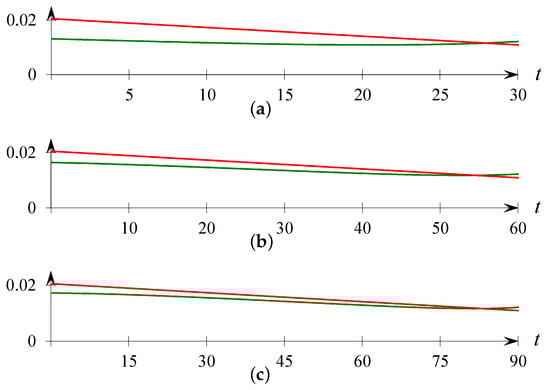
Figure 2.
Graph of functions (red line) and (green line): (a) Case of (s). (b) Case of (s). (c) (s).
To estimate the deviation modulus of the functions and , we denote
A comparative analysis of the results obtained is given in the Table 1.

Table 1.
Values .
Thus, the results of the numerical experiment show (see Table 1) that the value of the error decreases when the duration () of laser exposure increases.
6.2. Case 2
Leaving the same values for , , we chose (m2/s), (m2/s). For the calculations, the following values of the initial parameters were specified: , , , , , , , . These values were chosen to be close to the values from [25]. Then, (m). The Fourier coefficients for the functions and in this case are
Then, we obtain
The control function is
and
In this case, calculations were performed for values t = 180 (c) and t = 210 (c). The obtained values of the main parameters are given in Appendix B.
The behavior of the obtained temperature distribution function and the given function is presented in Figure 3.
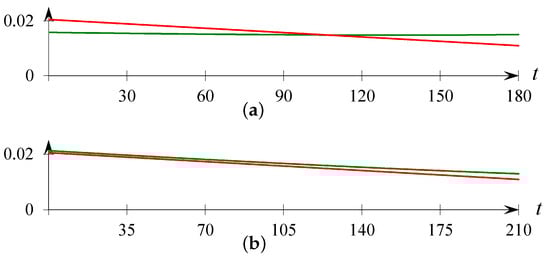
Figure 3.
Graph of functions (red line) and (green line): (a) Case of (s). (b) Case of (s).
Note that in this case, all calculations were also performed for the values 30, 60, 90. We do not give the parameter values for them so as not to overload the article with numerical values. A comparative analysis for these cases was performed and is given below.
Using the previously introduced notation , we choose and conduct a comparative analysis of the results. Some of the values for the selected range are presented in Table 2. We found that the value of decreases with increasing = 30, 60, 90, 180, 210.
Table 2.
Values .
In addition, calculations showed that it is advisable to further develop work related to the search for the value of that provides the minimum deviation of from at a fixed value of . We do not consider this extremal problem; this requires a separate study.
Thus, using the proposed approach, at , a comparative analysis was carried out for the constructed control function for the thermal process of laser exposure and some selected numerical values of the biomaterial parameters. A comparison of the results of a computational experiment showed that, under the found law of laser action, the value of the resulting temperature distribution function at the end of a two-layer biological material is quite close to the values of the given function . The computational experiment also showed that with increasing duration of laser exposure, the maximum modulus of deviation of the functions and decreases.
7. Conclusions
This paper considers the process of the effect of a laser beam on a two-layer biological material, the mathematical model of which is described using differential equations of thermal conductivity. Such a model is characterized as a composite dynamic system (of variable structure) with distributed parameters. By performing some substitution of variables, and then using the method of separation of variables and methods of the control theory for finite-dimensional systems, we developed a constructive approach to constructing a control function for the thermal effect of a laser beam on a two-layer biomaterial. Under the constructed controlled thermal effect of a laser beam, the distribution of the temperature state of a two-layer biomaterial transitions from the initial state to the final state at a given time interval. The constructiveness of the developed approach is illustrated by a specific example with a performed computational experiment and subsequent analysis of the results. The results obtained, even for the first two modes, show that under the influence of the constructed boundary controls of the thermal effect of the laser beam on a two-layer biomaterial, the distribution function of the temperature state at the border of the two-layer biological material is quite close to the given desired function. The proposed approach, using the Fourier method, can be extended to other non-one-dimensional processes.
Author Contributions
Conceptualization, V.B.; methodology, V.B.; software, S.S.; validation, V.B. and S.S.; formal analysis, V.B. and S.S.; investigation, V.B. and S.S.; resources, V.B. and S.S.; data curation, V.B. and S.S.; writing—original draft preparation, V.B. and S.S.; writing—review and editing, V.B. and S.S.; visualization, V.B. and S.S.; supervision, V.B. and S.S.; project administration, V.B. and S.S.; funding acquisition, V.B. and S.S. All authors have read and agreed to the published version of the manuscript.
Funding
The research by S.S. was carried out under State Assignment Project (no. FWEU-2021-0006) of the Fundamental Research Program of the Russian Federation 2021–2030 using the resources of the High-Temperature Circuit Multi-Access Research Center (Ministry of Science and Higher Education of the Russian Federation, project no 13.CKP.21.0038).
Data Availability Statement
Data are contained within the article.
Conflicts of Interest
The authors declare no conflicts of interest. The funders had no role in the design of the study; in the collection, analyses, or interpretation of data; in the writing of the manuscript; or in the decision to publish the results.
Appendix A
For (s), we obtain , , , , .
Therefore, the matrix has the form
, , , ,
, , , ,
, , , , , , , , .
For (s), the values of , are , , the elements of matrix are equal , , , and the matrix has the following form:
, , , ,
, , , , , , , .
At the value of (s), the calculations showed the following results: , , , , ,
, , , ,
, , , , , , , , , , , , .
References
- Shangina, O.R.; Gaynutdinova, R.D. Interaction of laser radiation with biological tissues. Pract. Med. 2019, 17, 24–27. (In Russian) [Google Scholar] [CrossRef]
- Elagin, V.V.; Shakhova, M.A.; Karabut, M.M.; Kuznetsova, D.S.; Bredikhin, V.I.; Prodanets, N.N.; Snopova, L.B.; Baskina, O.S.; Shakhov, A.V.; Kamensky, V.A. Evaluation of Cutting Properties of a Laser Scalpel with Heavily Absorbing Coatings of an Optical Fiber. Sovrem. Tehnol. Med. 2015, 7, 55–60. [Google Scholar] [CrossRef][Green Version]
- Skobelkin, O.K. Lasers in Surgery; Meditsina: Moscow, Russia, 1989; 256p. (In Russian) [Google Scholar]
- Privalov, V.E.; Turkin, V.A.; Shemanin, V.G. Lasers and green energy. Lasers Meas. Inf. 2022, 2, 5–11. (In Russian) [Google Scholar] [CrossRef]
- Kumar, R.; Pérez del Pino, A.; Sahoo, S.; Kumar Singh, R.; Tan, W.K.; Kar, K.K.; Matsuda, A.; Joanni, E. Laser processing of graphene and related materials for energy storage: State of the art and future prospects. Prog. Energy Combust. Sci. 2022, 91, 100981. [Google Scholar] [CrossRef]
- Gupta, M.C.; Carlson, D.E. Laser processing of materials for renewable energy applications. MRS Energy Sustain. 2015, 2, 2. [Google Scholar] [CrossRef]
- Son, E.E.; Sheindlin, M.A. Lasers in high-temperature energy materials. Proc. Russ. Acad. Sci. Energy 2011, 5, 88–103. (In Russian) [Google Scholar]
- Wongchadakul, P.; Rattanadecho, P. Mathematical modeling of multilayered skin with embedded tumor through combining laser ablation and nanoparticles: Effects of laser beam area, wavelength, intensity, tumor absorption coefficient and its position. Int. J. Heat Technol. 2021, 39, 89–100. [Google Scholar] [CrossRef]
- Cummins, L.; Nauenberg, M. Thermal effects of laser radiation in biological tissue. Biophys. J. 1983, 42, 99–102. [Google Scholar] [CrossRef]
- Zhou, J.; Chen, J.K.; Zhang, Y. Theoretical analysis of thermal damage in biological tissues caused by laser irradiation. Mol. Cell. Biomech. 2007, 4, 27–39. [Google Scholar] [PubMed]
- Belozerov, L.G.; Kireev, V.A. Composite Shells under Force and Thermal Effects; Fizmatlit: Moscow, Russia, 2003; 388p. (In Russian) [Google Scholar]
- Gubin, A.I.; Malaya, Y.A. Mathematical modeling of thermal processes during laser processing of materials based on the nonlinear hyperbolic equation of heat conduction. In Tekhnichna Teplofizika i Promislova Teploenergetika; New Ideology: Dnipropetrovsk, Ukraine, 2011; Volume 3, pp. 72–85. (In Russian) [Google Scholar]
- Svet, E.V. The nonstationary problem of heat conduction in three-dimensional formulation for laminated plates with complex shape. Bull. NTU KhPI 2013, 63, 122–131. (In Russian) [Google Scholar]
- Yamaoka, N.; Sugie, J. Multilayer structures of second-order linear differential equations of Euler type and their application to nonlinear oscillations Ukr. Math. J. 2006, 58, 1935–1949. [Google Scholar]
- Megel, Y.E.; Levkin, D.A. Mathematical model of thermal heating of a multilayer microbiological object. East Eur. J. Adv. Technol. 2012, 3/4, 4–7. (In Russian) [Google Scholar]
- Shupikov, A.N.; Buzko, Y.P.; Smetankina, N.V.; Ugrimov, S.V. Non-Stationary Oscillations of Multilayer Plates and Shells and Their Optimization; Scientific Publication; Publishing House of KhNEU: Kharkov, Ukraine, 2004; 252p. (In Russian) [Google Scholar]
- Pyatkov, S.G. Certain inverse problems for parabolic equations. J. Math. Sci. 2008, 150, 2422–2433. [Google Scholar] [CrossRef]
- Kantor, B.Y.; Smetankina, N.V.; Shupikov, A.N. Analysis of non-stationary temperature fields in laminated strips and plates. Int. J. Solids Struct. 2001, 38, 8673–8684. [Google Scholar] [CrossRef]
- Barseghyan, V.R. Control of Stage by Stage Changing Linear Dynamic Systems. Yugosl. J. Oper. Res. 2012, 22, 31–39. [Google Scholar] [CrossRef]
- Barseghyan, V.R. On the controllability and observability of linear dynamic systems with variable structure. In Proceedings of the 2016 International Conference “Stability and Oscillations of Nonlinear Control Systems” (Pyatnitskiy’s Conference), STAB 2016, Moscow, Russia, 1–3 June 2016. [Google Scholar]
- Barseghyan, V.R. The Problem of Boundary Control of Displacement at Two Ends by the Process of Oscillation of a Rod Consisting of Two Sections of Different Density and Elasticity. Mech. Solids 2023, 58, 483–491. [Google Scholar] [CrossRef]
- Barseghyan, V.; Solodusha, S. On the Optimal Control Problem for Vibrations of the Rod/String Consisting of Two Non-Homogeneous Sections with the Condition at an Intermediate Time. Mathematics 2022, 10, 4444. [Google Scholar] [CrossRef]
- Barseghyan, V.R.; Barseghyan, T.V. On an Approach to the Problems of Control of Dynamic System with Nonseparated Multipoint Conditions. Autom. Remote Control 2015, 76, 549–559. [Google Scholar] [CrossRef]
- Zubov, V.I. Lectures on Control Theory; Nauka: Moscow, Russia, 1975. (In Russian) [Google Scholar]
- Mispahov, I.S.; Magomedov, D.A. Mathematical model of the thermoelectric system for short-term storage and transportation of biological material. Bull. Dagestan State Tech. Univ. Tech. Sci. 2012, 26, 7–15. (In Russian) [Google Scholar]
Disclaimer/Publisher’s Note: The statements, opinions and data contained in all publications are solely those of the individual author(s) and contributor(s) and not of MDPI and/or the editor(s). MDPI and/or the editor(s) disclaim responsibility for any injury to people or property resulting from any ideas, methods, instructions or products referred to in the content. |
© 2024 by the authors. Licensee MDPI, Basel, Switzerland. This article is an open access article distributed under the terms and conditions of the Creative Commons Attribution (CC BY) license (https://creativecommons.org/licenses/by/4.0/).