Abstract
On the basis of K. Kuratowski’s definitions of a topological structure with a closure or interior operator, the concept of a modal topological structure (MTS) with one of these operators was introduced by the author. This new structure was illustrated with examples with intuitionistic fuzzy topological operators from both examples, and for this reason, these structures were named intuitionistic fuzzy MTSs (IFMTSs). In a series of papers, the author introduced some modifications and extensions to the IFMTSs, e.g., intuitionistic fuzzy temporal topological structures, intuitionistic fuzzy level topological structures and others, and intuitionistic fuzzy multi modal topological structures and others. In the present paper, four new examples of intuitionistic fuzzy multi modal topological structures are given. On their base, the concepts of a modal multi-topological structure and of a multi-modal multi-topological structure are introduced and illustrated with examples from the area of the intuitionistic fuzzy sets—intuitionistic fuzzy modal multi-topological structure with a closure or an interior operator; and intuitionistic fuzzy multi-modal multi-topological structure with one of these operators. Two intuitionistic fuzzy topological operators are defined. Their basic properties are studied and they are used in the new structures.
Keywords:
intuitionistic fuzzy operation; intuitionistic fuzzy operator; intuitionistic fuzzy set; intuitionistic fuzzy topological structure MSC:
03E72
1. Introduction
The first steps in the creation of intuitionistic fuzzy topology were conducted by A. Ban, D. Čoker, M. Demirgi, F.G. Lupiañez, T.K. Mondal, and S.K. Samanta in [1,2,3,4,5,6,7,8,9]. After these papers, a new series of studies was published, e.g., in [10,11,12,13,14,15,16,17,18,19,20,21,22,23,24,25,26,27,28,29,30,31,32,33,34,35,36,37,38]. All were devoted to giving intuitionistic fuzzy interpretations of objects from ordinary topology.
In the middle of 2022, the author suggested a new direction for the research in the area of intuitionistic fuzzy topology. The aim was to give an intuitionistic fuzzy interpretation of the concept of a topological structure and to find its suitable examples. As a result, as mentioned below, some types of topological structures were generated and their properties were studied.
In [39], K. Kuratowski described topological structures based on the topological operators from closure (-, -) and interior (-, -) types (see also, e.g., [6,7,40,41]). Their extensions are the modal topological structures (MTSs) introduced by the author in [42], with the addition of the modal operators: ♢ (“possibility”) from -type or □ (“necessity”) from -type (see, e.g., [43,44,45]). In [42], the MTSs were illustrated with two examples from the area of intuitionistic fuzzy sets (IFSs; see, e.g., [46])—extensions of fuzzy sets of L. Zadeh [47]—and due to this, they were called “Intuitionistic Fuzzy MTSs” (IFMTSs). In them, the topological and the modal operators have intuitionistic fuzzy forms, discussed in [46].
Later, the IFMTSs were extended in some directions, one of which to intuitionistic fuzzy bimodal topological structures (IF2MTSs, see [48]), and one of which to intuitionistic fuzzy multi-modal topological structures, which, hereafter, will be denoted by “IFmMTSs” (cf. [49], where their abbreviation is “IFMMTS”).
Here, following the ideas from [42,49], we will introduce the concept of modal multi topological structures (MmTSs). In them, some different topological operators from -type and/or -types will exist simultaneously by analogy with the IFmMTSs.
In Section 2, short remarks over IFSs, MTSs, and IFMTSs will be given. In Section 3, two new topological operators from - and -types will be introduced, and two examples for IFmMTSs will be given. In Section 4, the concept of modal multi topological structures (MmTSs) will be introduced and illustrated with four examples of IFMmTSs. In Section 5, on the basis of all previous definitions, the concept of multi-modal multi-topological structures (mMmTSs) will be given and illustrated with four intuitionistic fuzzy mMmTSs (IFmMmTSs). Some perspectives on the development of the new topological objects will be discussed in the conclusion. There, some possible applications of the new topological structures will be discussed as an object of future research.
2. Preliminaries
First, following [46], we give some necessary definitions about intuitionistic fuzzy sets (IFSs).
With the set E, everywhere below we will denote a fixed universe.
Definition 1.
The set
is called an IFS if the functions and define the degrees of membership and of non-membership of an element , respectively, to the set A, and for each :
Let .
Below, for simplicity, instead of , we will write A.
In [46], different intuitionistic fuzzy (IF) relations, operations, and operators from modal, topological, and other types are defined over IFSs. Here, we will use only the following five. “iff” is an abbreviation of “if and only if”.
Definition 2.
For two given IFSs A and B:
The modifications of the IF modal operators “possibility” (-) and “necessity” (-) are the following operators, introduced in [50] by analogy with the operators and defined in [46].
Definition 3.
For each IFS A:
For them, in [50], it is proved that for each IFS A and for each :
Following [42], we give some necessary definitions about MTSs and IFMTSs.
Let E be a fixed universe. We define the special sets.
Definition 4.
For each fixed set E:
and
i.e., this is the set of all IFSs over set E.
Let X be a fixed set of subsets. let be operators of a -type and of an -type, related to operations , respectively; let be modal operators from a -type and of an -type, respectively. Let the following equalities hold:
Definition 5.
The structures -IFMTS, -IFMTS, -IFMTS, and -IFMTS satisfy the following conditions for every two IFSs :
| -IFMTS | -IFMTS | |||
| CC1 | II1 | |||
| CC2 | II2 | |||
| CC3 | II3 | |||
| CC4 | II4 | |||
| CC5 | II5 | |||
| CC6 | II6 | |||
| CC7 | II7 | |||
| CC8 | II8 | |||
| CC9 | II9 |
| -IFMTS | -IFMTS | |||
| CI1 | IC1 | |||
| CI2 | IC2 | |||
| CI3 | IC3 | |||
| CI4 | IC4 | |||
| CI5 | IC5 | |||
| CI6 | IC6 | |||
| CI7 | IC7 | |||
| CI8 | IC8 | |||
| CI9 | IC9 |
In [50], it is proved that for each universe E and for each :
- -
- is a -IFMTS;
- -
- is an -IFMTS;
- -
- is a -IFMTS;
- -
- is an -IF2MTS.
3. New Four Examples for Intuitionistic Fuzzy Multi-Modal Topological Structures
First, we define two new IF topological operators that are modifications and extensions of the standard IF topological operators “closure” (-) and “interior” (-) (see [46]) defined by
The new operators have the forms:
where .
Obviously, for each IFS A:
For them, we can directly check that for each IFS A and for each :
and therefore operator is from the -type and operator is from the -type (the other properties that characterize these operators as their types will be discussed below). In addition
and
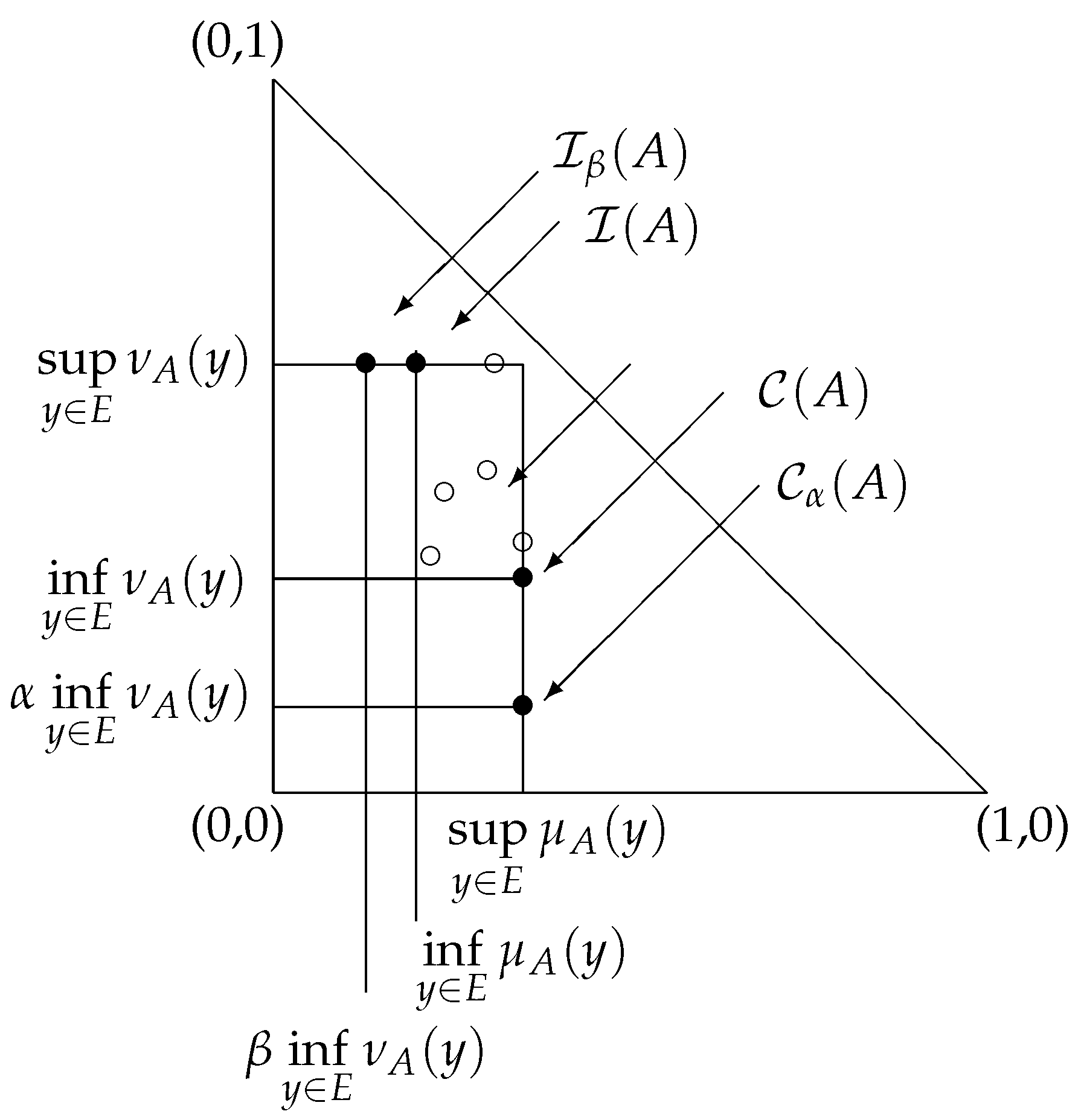
The geometrical interpretations of both new operators are shown in Figure 1 (cf. [46]).
Figure 1.
Geometrical interpretations of operators represented by points • over IFS A, with elements represented by ∘.
Second, we must mention that in [46] the following concept is defined: the IFS is a proper IFS iff there exists element such that , i.e., Let us call this IFS weak proper IFS. Now, we can call a given IFS strong proper IFS iff, for each, .
Let the following hold true for the strong proper IFS A:
Let be an arbitrary number and
Below, we will change conditions CC3 and CI3 with the weak conditions CC3* and CI3* with the form
By analogy, let, for ψ ∈ (1 − ω, 1],
and let us change conditions II3 and IC3 with the weak conditions II3* and IC3* with the form
Third, we prove the following theorem.
Theorem 1.
For each universe E:
- (a)
- is a -IFMTS;
- (b)
- is a -IFMTS;
- (c)
- is an -IFMTS;
- (d)
- is an -IFMTS.
Proof.
Let the IFSs , .
(a) The check of conditions CC1–CC4 are analogous but different from those in [42], while the checks of conditions CC5–CC8 are the same as in [50] and for this reason we omit them here.
- CC1.
- CC2.
- CC3*.
- CC4.
- Having in mind that and are constants, we obtain:
- CC9.
(b) The checks of conditions CI1–CI4 are as above. The checks of conditions CI5–CI8 are the same as in [50], and for this reason we omit them. Therefore, we must check only condition CI9:
The checks of (c) and (d) are similar. □
Fourth, following [49], we will define the concept of an IFmMTS.
The IFmMTS, or more precisely fntuitionistic fuzzy ()-modal topological structure, (IF()MTS) is an object with the following form:
where are IF-modal operators. The components of an IF()MTS must satisfy the conditions with numbers 1–4 for the topological operator, the conditions with numbers 5–8 for each one of the modal operators, the condition with number 9 (but for the topological operator and for each one of the modal operators), and a new condition (number 10) that has the following form: for each IFS A,
where the relation “⊂” denotes a strong inclusion. Its sense is to show that the modal operators are well ordered.
Let the real numbers be given, so that
Theorem 2.
For each universe E, and are IF()-MTSs.
Proof.
The checks of the first nine conditions for the - and for the -types of structures are conducted in Theorem 1 and in [42]. So, we must prove that the IF-modal operators give different values and that they are ordered as (1).
Hence,
and
Now, having in mind (1), we must prove that
Really,
(from )
(from )
Hence, the sequence of inclusions (1) is true, and both structures are IF()MTSs from - and -type, respectively. □
4. Intuitionistic Fuzzy Modal Multi-Topological Structures
First, we will introduce the concept of a modal multi-topological structure (MmTS), or more precisely, a modal ()-topological structure (M()-TSs). It is an object with the following form:
where are -topological operators, are -topological operators, are integers, and ∇ are the operations that generate the -operators and -operators, respectively, and ∘ is a modal operator. The components of an M()TS must satisfy the conditions with numbers 1–4 for each one of the topological operators from both types, the conditions with numbers 5–8 for the modal operator from both types, the condition with number 9 for the modal operator and for each one of the topological operators, and for each IFS A, the new condition (with number 11) that has the following form:
Its sense is to show that the topological operators are well ordered.
Let the real numbers be given, so that
These two sequences will be used below for enumeration of the interior and closure operators, respectively.
Theorem 3.
Proof.
The checks of the first eight conditions for the - and for the -types of structures are conducted in Theorem 1 and in [42] for arbitrary - and -operators. So, we must prove that the IF-topological operators are different and that they are ordered as in (4).
Therefore,
and
Now, having in mind (4), we must prove that
It is true because
(from )
(from )
Hence, the sequence of inclusions (4) is true and both structures are IFM()TSs from - and -type, respectively. □
5. Intuitionistic Fuzzy Multi-Modal Multi-Topological Structures
On the basis of the definitions from the previous two sections, here, first, we will introduce the concept of a multi-modal multi-topological structure, or more precisely, ()-,odal ()-topological structure ()-M()-TSs). It is the object with the following form:
where are -topological operators, are -topological operators, are integers, and ∇ are operators generated the -operator and the -operator, respectively, and are IF-modal operators. The components of an ()-M()TS must satisfy the conditions with numbers 1–4 for each one of the topological operators from both types, the conditions with numbers 5–8 for each one of the modal operators of both types, and for each IFS A, the conditions with numbers 9–11, i.e., the inequalities (1) and (4), must hold.
Theorem 4.
The proof follows from the proofs of Theorems 2 and 3. Also, from these, it follows the validity of the next assertion that is equivalent to Theorem 4.
6. Conclusions
In [42], following [51,52], the idea for maps and atlases generated by different topological structures was joint universe was formulated. These maps and atlases are similar but different from these in differential geometry. Now, we provide additional details about this idea in the IF-case.
When we have a set of -IFMTSs,
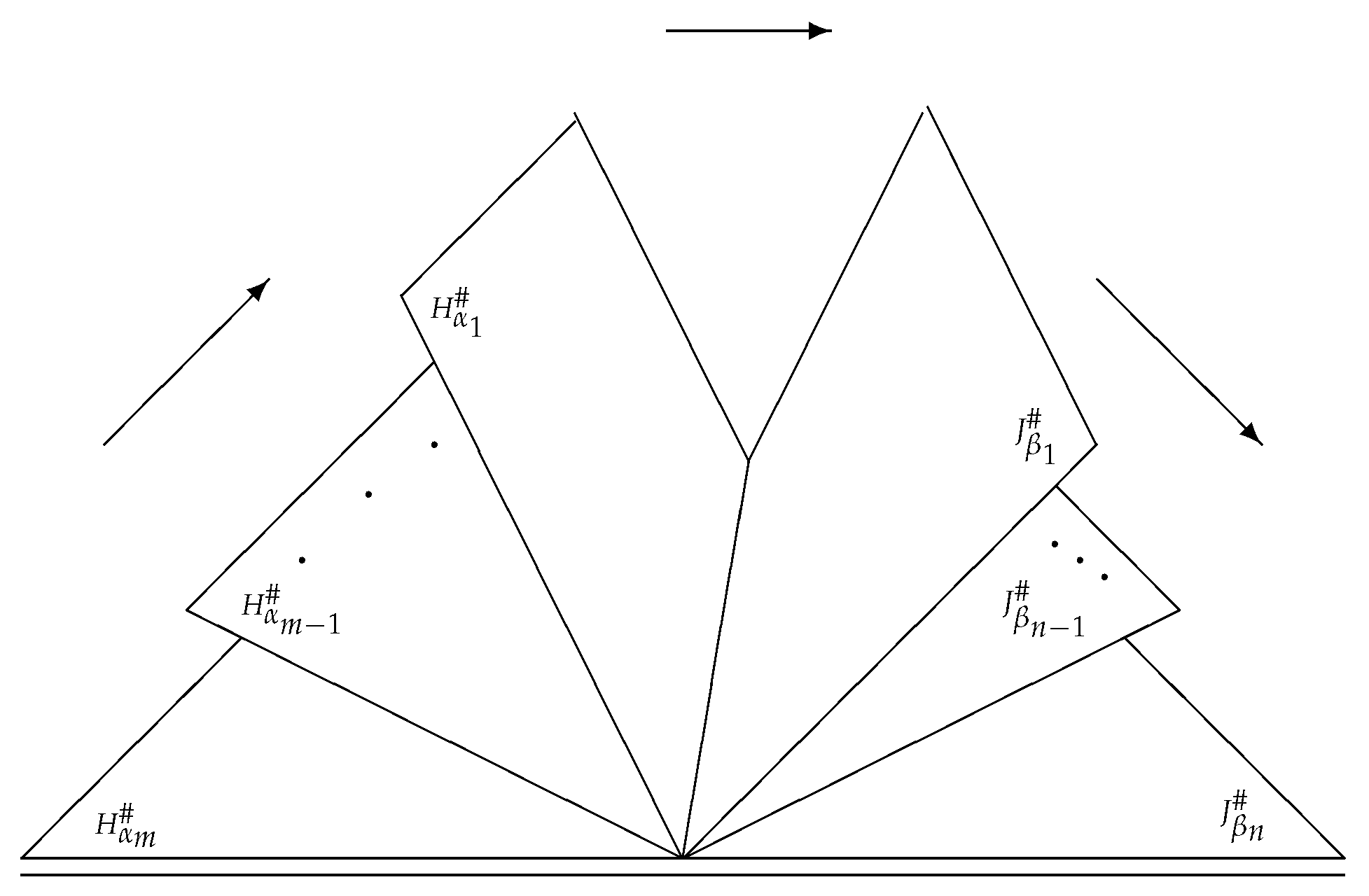
and when the modal operators satisfy (1), then we can interpret each one of these structures as a map. Therefore, these structures can be ordered (see Figure 2) and numbered by function , e.g., as follows:
Figure 2.
Atlas with maps generated by modal operators .
Hence, the arguments of the modal operators can generate a pagination of the set of maps, i.e., we obtain an -atlas
over the fixed universe. Analogously, we can construct an -atlas.
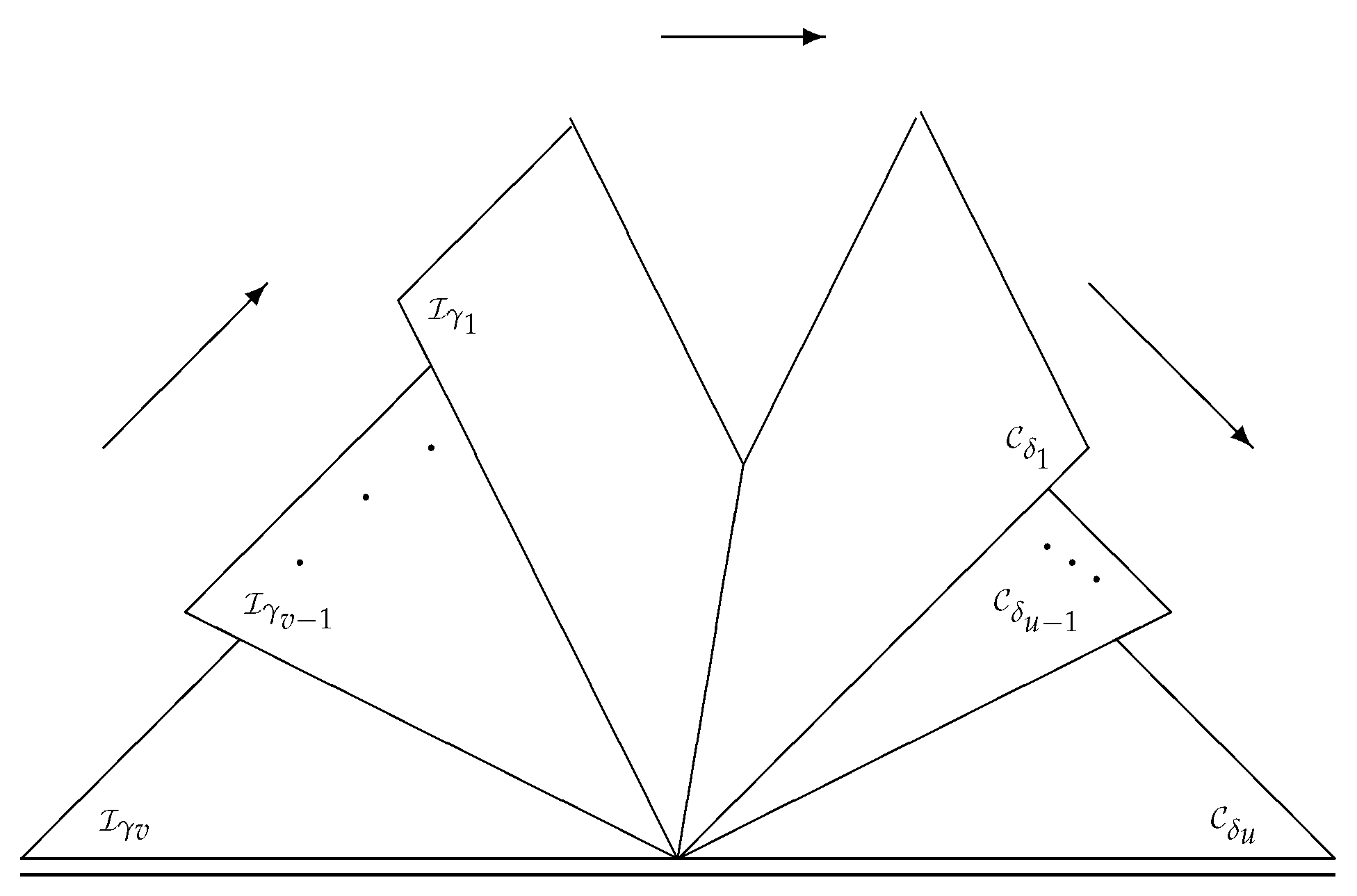
In the same way, we can proceed in the case of IFMmTSs (see Figure 3).
Figure 3.
Atlas with maps generated by topological operators .
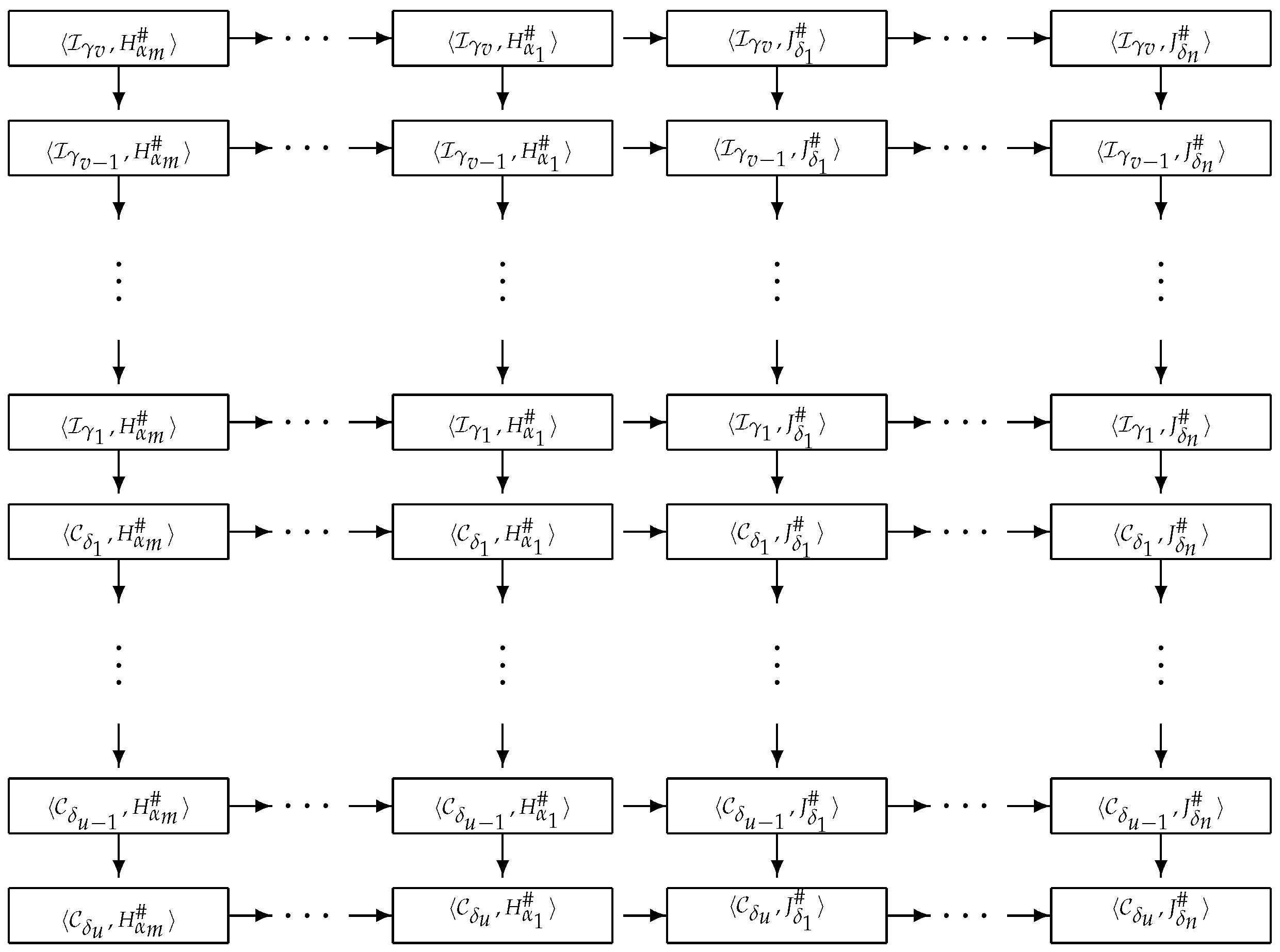
Finally, we can perform pagination with pairs of numbers—the number of the topological operator and the number of the modal operator. For the geometrical interpretation, we must assume that the separate pages of the atlas are tiered and ordered, e.g., as is shown in Figure 4.
Figure 4.
Atlas with maps generated by the topological and modal operators.
It will be interesting if this idea is developed in future.
Another direction for near-future research will be related to a representation of graph structures as IF()-M()-TSs. In this case, the universe will contain a set of graph vertices. Each vertex and each arc will have its own intuitionistic fuzzy degrees of an existence and a non-existence, and the topological and modal operators will change these degrees in a corresponding way.
The author hopes that in the near future, a new procedure for multi-criteria, multi-person decision-making will be introduced that extends the procedure from [53] and that generates its own IFmMmTS.
Funding
This research was realized in the framework of project KP-06-N22-1/2018 “Theoretical research and applications of InterCriteria Analysis”.
Data Availability Statement
Data are contained within the article.
Acknowledgments
I wish to express my gratitude to the remarks of the anonymous reviewers which improved significantly the quality of the paper.
Conflicts of Interest
The author declares no conflict of interest.
References
- Ban, A.I. Convex intuitionistic fuzzy sets. Notes Intuit. Fuzzy Sets 1997, 3, 66–76. [Google Scholar]
- Coker, D. An introduction to intuitionistic fuzzy topological spaces. Fuzzy Sets Syst. 1997, 88, 81–89. [Google Scholar] [CrossRef]
- Coker, D. On topological structures using intuitionistic fuzzy sets. Notes Intuit. Fuzzy Sets 1997, 3, 138–142. [Google Scholar]
- Coker, D.; Demirci, M. An Introduction to intuitionistic fuzzy points. Notes Intuit. Fuzzy Sets 1995, 1, 79–84. [Google Scholar]
- Coker, D.; Demirci, M. An Introduction to Intuitionistic Topological Spaces in Sostak’s Sense. BUSEFAL 1996, 67, 67–76. [Google Scholar]
- Lupiañez, F.G. Separation in intuitionistic fuzzy topological spaces. Int. J. Pure Appl. Math. 2004, 17, 29–34. [Google Scholar]
- Lupiañez, F.G. On intuitionistic fuzzy topological spaces. Kybernetes 2006, 35, 743–747. [Google Scholar] [CrossRef]
- Lupiañez, F.G. Nets and filters in intuitionistic fuzzy topological spaces. Inf. Sci. 2006, 176, 2396–2404. [Google Scholar] [CrossRef]
- Mondal, T.K.; Samanta, S.K. Topology of interval-valued intuitionistic fuzzy sets. Fuzzy Sets Syst. 2001, 119, 483–494. [Google Scholar] [CrossRef]
- Duan, J.; Li, X. Similarity of intuitionistic fuzzy sets and its applications. Int. J. Approx. Reason. 2021, 137, 166–180. [Google Scholar] [CrossRef]
- El-Latif, A.; Khalaf, M. Connectedness in Intuitionistic Fuzzy Topological Spaces in Sostak’s Sense. Ital. J. Pure Appl. Math. 2015, 35, 649–668. [Google Scholar]
- Haydar Es, A.; Coker, D. More on fuzzy compactness in intuitionistic fuzzy topological spaces. Notes Intuit. Fuzzy Sets 1996, 2, 4–10. [Google Scholar]
- Kim, J.; Lim, P.K.; Lee, J.G.; Hur, K. Annals of Fuzzy Mathematics and Informatics. Ann. Fuzzy Math. Inform. 2018, 15, 29–46. [Google Scholar]
- Kim, Y.C.; Abbas, S.E. Connectedness in Intuitionistic Fuzzy Topological Spaces. Commun. Korean Math. Soc. 2005, 20, 117–134. [Google Scholar] [CrossRef][Green Version]
- Kutlu, F.; Bilgin, T. Temporal Intuitionistic Fuzzy Topology in Sostak’s Sense. Notes Intuit. Fuzzy Sets 2015, 21, 63–70. [Google Scholar]
- Kutlu, F.; Atan, O.; Bilgin, T. Distance Measure, Similarity Measure. Entropy and Inclusion Measure for Temporal Intuitionistic Fuzzy Sets. In Proceedings of the IFSCOM’2016, Mersin, Turkey, 29 August–1 September 2016; pp. 130–148. [Google Scholar]
- Kutlu, F.; Ramadan, A.; Bilgin, T. On Compactness in Temporal Intuitionistic Fuzzy Sostak Topology. Notes Intuit. Fuzzy Sets 2016, 22, 46–62. [Google Scholar]
- Kutlu, F. On Separation Axioms in Temporal Intuitionistic Fuzzy Sostak Topology. Notes Intuit. Fuzzy Sets 2017, 23, 21–30. [Google Scholar]
- Lee, S.J.; Lee, E.P. The category of intuitionistic fuzzy topological spaces. Bull. Korean Math. Soc. 2000, 37, 63–76. [Google Scholar]
- Milles, S. The Lattice of Intuitionistic Fuzzy Topologies Generated by Intuitionistic Fuzzy Relations. Appl. Appl. Math. 2020, 15, 942–956. [Google Scholar]
- Mondal, K.; Samanta, S.K. A study on intuitionistic fuzzy topological spaces. Notes Intuit. Fuzzy Sets 2003, 9, 1–32. [Google Scholar]
- Özbakir, O.; Coker, D. Fuzzy multifunctions in intuitionistic fuzzy topological spaces. Notes Intuit. Fuzzy Sets 1999, 5, 1–5. [Google Scholar]
- Park, J.H. Intuitionistic fuzzy metric spaces. Chaos Solitons Fractals 2004, 22, 1039–1046. [Google Scholar] [CrossRef]
- Rajarajeswari, P.; Moorthy, R.K. Intuitionistic fuzzy completely weakly generalized continuous mappings. Notes Intuit. Fuzzy Sets 2012, 18, 25–36. [Google Scholar]
- Roopkumar, R.; Kalaivani, C. Continuity of intuitionistic fuzzy proper functions on intuitionistic smooth fuzzy topological spaces. Notes Intuit. Fuzzy Sets 2010, 16, 1–21. [Google Scholar]
- Saadati, R. On the intuitionistic fuzzy topological (metric and normed) spaces. arXiv 2005, arXiv:math/0501149v1. [Google Scholar]
- Saadati, R.; Park, J.H. On the intuitionistic fuzzy topological spaces. Chaos Solitons Fractals 2006, 27, 331–334. [Google Scholar] [CrossRef]
- Salama, A.; Alblowi, S. Intuitionistic Fuzzy Ideals Topological Spaces. Adv. Fuzzy Math. 2012, 7, 51–60. [Google Scholar]
- Samanta, S.K.; Mondal, T.K. Intuitionistic Gradation of Openness: Intuitionistic Fuzzy Topology. BUSEFAL 1997, 73, 8–17. [Google Scholar]
- Thakur, S.; Chaturvedi, R. Generalized continuity in intuitionistic fuzzy topological spaces. Notes Intuit. Fuzzy Sets 2006, 12, 38–44. [Google Scholar]
- Tiwari, S. On relationships among intuitionistic fuzzy approximation operators, intuitionistic fuzzy topology and intuitionistic fuzzy automata. Notes Intuit. Fuzzy Sets 2010, 16, 1–9. [Google Scholar]
- Wu, W.-Z.; Zhou, L. On intuitionistic fuzzy topologies based on intuitionistic fuzzy reflexive and transitive relations. Soft Comput. 2011, 15, 1183–1194. [Google Scholar] [CrossRef]
- Yan, C.; Wang, X. Intuitionistic I-fuzzy topological spaces. Czechoslov. Math. J. 2010, 60, 233–252. [Google Scholar] [CrossRef]
- Yılmaz, S.; Cuvalcıoglu, G. On Level Operators for Temporal Intuitionistic Fuzzy Sets. Notes Intuiti. Fuzzy Sets 2014, 20, 6–15. [Google Scholar]
- Yongfa, H.; Changjun, J. Some properties of intuitionistic fuzzy metric spaces. Notes Intuiti. Fuzzy Sets 2004, 10, 18–26. [Google Scholar]
- Zhao, H.; Li, S.; Chen, G. Further study on (L,M)-fuzzy topologies and (L,M)-fuzzy neighborhood operators. Iran. J. Fuzzy Syst. 2014, 11, 109–123. [Google Scholar]
- Zhao, H.; Li, S.; Chen, G. (L,M)-fuzzy topological groups. J. Intell. Fuzzy Syst. 2014, 26, 1517–1526. [Google Scholar] [CrossRef]
- Zia, B.; Malik, A.; Saba, M.G.A.; Tabasam, R. The topological properties of intuitionistic fuzzy rough sets. J. Intell. Fuzzy Syst. 2019, 38, 795–807. [Google Scholar]
- Kuratowski, K. Topology; Academic Press: New York, NY, USA, 1966; Volume 1. [Google Scholar]
- Bourbaki, N. Éléments De Mathématique, Livre III: Topologie Générale, 3rd ed.; Chapitre 1: Structures Topologiques; Chapitre 2: Structures Uniformes; Herman: Paris, France, 1960. (In French) [Google Scholar]
- Munkres, J. Topology; Prentice Hall Inc.: Upper Saddle River, NJ, USA, 2000. [Google Scholar]
- Atanassov, K. Intuitionistic Fuzzy Modal Topological Structure. Mathematics 2022, 10, 3313. [Google Scholar] [CrossRef]
- Feys, R. Modal Logics; Gauthier: Paris, France, 1965. [Google Scholar]
- Blackburn, P.; van Bentham, J.; Wolter, F. Modal Logic; North Holland: Amsterdam, The Netherlands, 2006. [Google Scholar]
- Mints, G. A Short Introduction to Modal Logic; University of Chicago Press: Chicago, IL, USA, 1992. [Google Scholar]
- Atanassov, K. On Intuitionistic Fuzzy Sets Theory; Springer: Berlin/Heidelberg, Germany, 2012. [Google Scholar]
- Zadeh, L. Fuzzy sets. Inf. Control 1965, 8, 338–353. [Google Scholar] [CrossRef]
- Atanassov, K. Intuitionistic fuzzy bimodal topological structures. Notes Intuit. Fuzzy Sets 2023, 29, 133–143. [Google Scholar] [CrossRef]
- Atanassov, K. Intuitionistic fuzzy multi modal topological structures. In Proceedings of the 21th Workshop on Intuitionistic Fuzzy Sets and Generalized Nets, Warszawa, Poland, 20–21 October 2023; Springer: Cham, Switzerland, 2024. [Google Scholar]
- Atanassov, K. Intuitionistic Fuzzy Modal Topological Structures Based on Two New Intuitionistic Fuzzy Modal Operators. J. Mult. Valued Log. Soft Comput. 2023, 41, 227–240. [Google Scholar]
- Gromoll, D.; Klingenberg, W.; Mryer, W. Riemannsche Geometrie in Grossen; Springer: Berlin/Heidelberg, Germany, 1968. [Google Scholar]
- Sternberg, S. Lectures on Differential Geometry; Prentice Hall: Englewood, NJ, USA, 1964. [Google Scholar]
- Atanassov, K.; Pasi, G.; Yager, R. Intuitionistic fuzzy interpretations of multi-criteria multi-person and multi-measurement tool decision making. Int. J. Syst. Sci. 2005, 36, 859–868. [Google Scholar] [CrossRef]
Disclaimer/Publisher’s Note: The statements, opinions and data contained in all publications are solely those of the individual author(s) and contributor(s) and not of MDPI and/or the editor(s). MDPI and/or the editor(s) disclaim responsibility for any injury to people or property resulting from any ideas, methods, instructions or products referred to in the content. |
© 2024 by the author. Licensee MDPI, Basel, Switzerland. This article is an open access article distributed under the terms and conditions of the Creative Commons Attribution (CC BY) license (https://creativecommons.org/licenses/by/4.0/).