

Abstract
Investigation of the generalized trigonometric and hyperbolic functions containing two parameters has been a very active research area over the last decade. We believe, however, that their monotonicity and convexity properties with respect to parameters have not been thoroughly studied. In this paper, we make an attempt to fill this gap. Our results are not complete; for some functions, we manage to establish (log)-convexity/concavity in parameters, while for others, we only managed the prove monotonicity, in which case we present necessary and sufficient conditions for convexity/concavity. In the course of the investigation, we found two hypergeometric representations for the generalized cosine and hyperbolic cosine functions which appear to be new. In the last section of the paper, we present four explicit integral evaluations of combinations of generalized trigonometric/hyperbolic functions in terms of hypergeometric functions.
Keywords:
generalized trigonometric functions; generalized hyperbolic functions; (p,q)-Laplacian; log-convexity; log-concavity; integral representation; hypergeometric function MSC:
33E30; 33E20; 26D07; 33C05
1. Introduction and Preliminaries
The class of functions nowadays known as the generalized trigonometric and hyperbolic functions can be traced back to the 1879 paper of Lundberg [1]. They were then rediscovered many times, typically in connection with the study of the “generalized circle” or as eigenfunctions of one-dimensional p-Laplacian. Details can be found in the book [2] by Lang and Edmunds. Earlier history has been described by Peetre and Lindquist; see [3,4]. The recently published textbook [5] makes the topic accessible to students. The generalized trigonometric functions containing two parameters appeared in the works of Ôtani [6] and Drábek and Manásevich [7] in connection with -Laplacian. Namely, these authors defined a two-parameter generalized sine function in [7] as the inverse function to the integral
with , and , where
Here and below, stands for the Gauss hypergeometric function ([8], Definition 2.1.5). and is Euler’s beta function ([8], Definition 1.1.3). Note that as and as while monotonically decreasing from infinity. The function is an increasing homeomorphism and its inverse is well defined. We can extend to by and further to by oddness and to the whole by periodicity ([9], (2.4)). It is known that this extension is continuously differentiable on and everywhere except at the points ([9], p. 49). The function is then defined naturally by
It is not hard to show using (1) that this implies
on the whole real line ([9], (2.7)) and we can drop the absolute values if we restrict our attention to the interval . Differentiating this identity with respect to y and using (2) after a little rearrangement, we obtain:
It was observed in [10] that using the change of variable in
we obtain the representation
The generalized hyperbolic -arcsine function is defined by
where , . Denote
Note that as and as . Miyakawa and Takeuchi observed in ([11], p. 3) that with and precisely when . The hyperbolic -sine is then defined as the inverse function to from (6):
Naturally,
so that
Differentiating this identity with respect to y and using (8) after a little rearrangement yields:
If and , then . Hence, substituting in (6), we obtain the formula
Now, making the change of variable
with endpoint correspondence , , we can rewrite it as (by changing back )
Note that as defined in (7), so that is defined on with values in .
The following hypergeometric representations seem to be new.
Lemma 1.
The following identities hold:
Proof.
Indeed, we obtain from (5) using substitution :
where we used the easily verifiable formula (derived by changing the variable in Euler’s representation ([8], Theorem 2.2.1) by direct term-wise integration of the binomial expansion)
Next, we apply the connection formula ([8], 2.3.13), which for the values of parameters in question reduces to (after application of the binomial theorem )
Substituting this into the above expression and simplifying, we arrive at (11).
Takeuchi [11,12,13] defined the following two-parameter generalizations of the tangent and hyperbolic tangent functions
and observed that their various properties are closer to those of the classical tangent and hyperbolic tangent functions than the properties of the functions
defined in [9]. Note also that and . We further contribute to the justification of this viewpoint by observing that the inverse functions , possess simple integral representations permitting application of Lemma 2 below to study monotonicity and convexity with respect to parameters. An integral representation of is obtained as follows. Dividing relation (3) restricted to by , we can cast it to the form:
Differentiation then yields:
where we applied (15) in the last equality (alternatively, one can differentiate (15) directly). This differentiation formula was first found in ([11], p. 16). Hence, for the inverse function, we obtain the representation
This representation is also seen from the connection formula , ([12], Theorem 2.1). In particular, writing for the conjugate exponent found from the equation , we will have [13] (p. 1006):
The literature on the two-parameter trigonometric and hyperbolic functions has grown rapidly over the last two decades and we will not attempt to survey it in this introduction. The reader is invited to consult the paper [14] for a historical overview, the introductory parts of [15,16,17], the survey [18] and the books [2,5] for numerous further references to more modern research and connections with various areas of mathematics. Inequalities for the generalized trigonometric functions with two parameters have been studied in [10,19] for fixed parameters. Research on convexity properties with respect to parameters is scarce. A few exceptions include [20], where Turán-type inequalities for the inverse trigonometric functions, also those with two parameters, were established, and our paper [15] concerned with functions with one parameter. Both are listed in the survey paper ([18], Section 5). The purpose of this note is two-fold. First, we investigate the monotonicity and convexity properties of the generalized trigonometric and hyperbolic functions with respect to their parameters p and q. We believe that these types of results have not previously appeared in the literature. This is shown in the subsequent Section 2. Second, we derive several integrals of the inverse and direct functions in terms of hypergeometric functions, which we also believe to be new. These results can be found in Section 3. Finally, our Lemma 1 above gives new representations for the inverse generalized cosine and hyperbolic cosine functions, which are useful both from the theoretical viewpoint and for an effective computation of these functions and their inverses.
2. Monotonicity and Convexity in Parameters
The following lemma will be our key tool for the forgoing investigation of the properties of the generalized trigonometric functions. Its proof is an exercise in calculus; details can be found in ([15], Lemma 1).
Lemma 2.
Suppose are convex subsets of . Suppose is strictly monotone on I for each fixed so that is well defined and monotone on for each fixed . Then, the following relations hold true:
where x on the right is related to y on the left by or .
Remark 1.
Formulas (22) and (23) can also be written in the following form:
and
We summarize the monotonicity properties in the following theorem.
Theorem 1.
The functions and are increasing on , while the functions , and are decreasing in the same interval for each fixed and . The functions and are increasing on for each fixed and . The functions , , , and are, generally speaking, not monotonic (i.e., for each of them, there exist values of y such that no monotonicity takes place).
Proof.
Note that . Hence, for the values of the argument , all functions specified in the theorem are well defined on and are given as the inverse functions to the integrals described in the introduction.
In a similar fashion, for from (6)
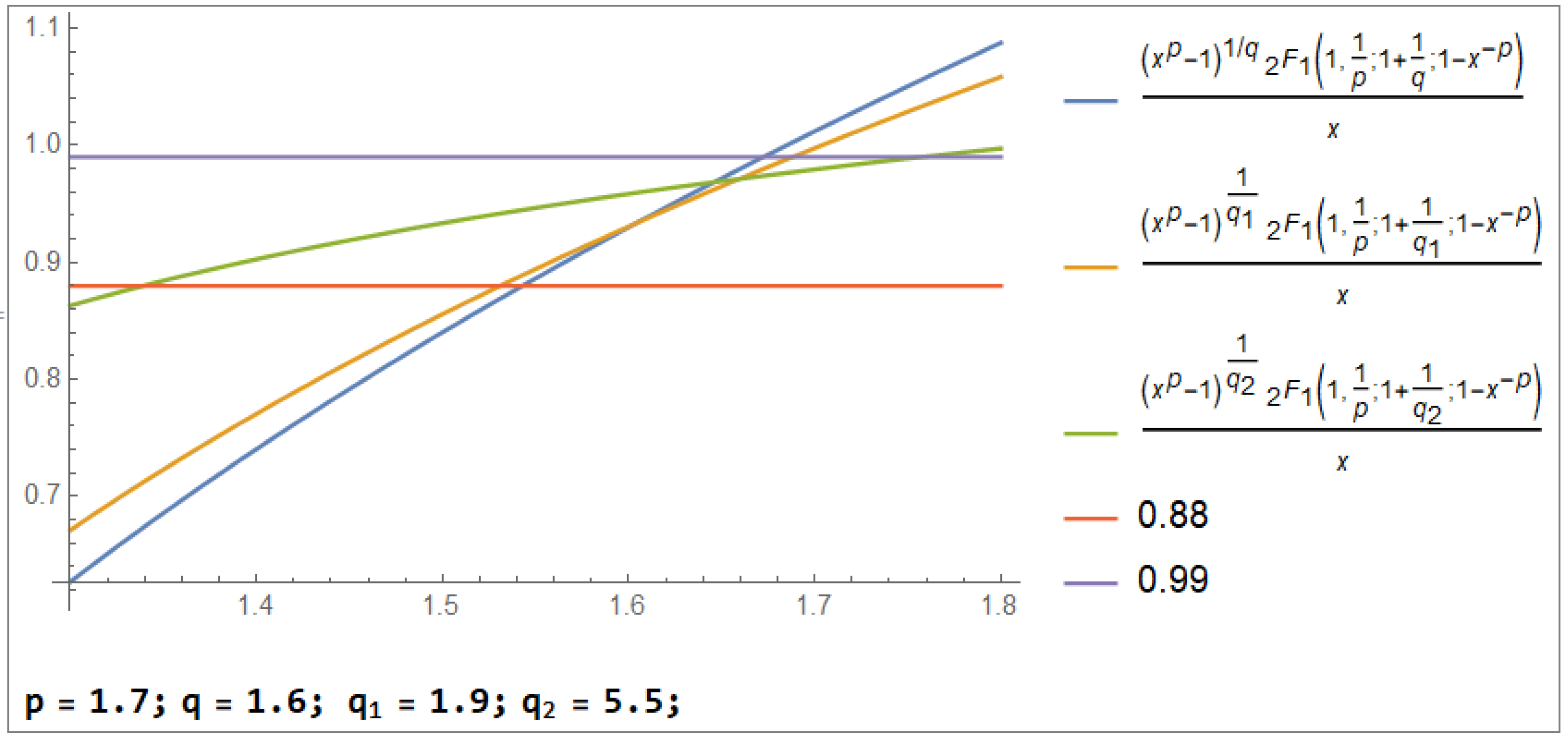
We omit similar verification of the monotonicity of the functions and with the signs of derivatives obvious from the resulting expressions. Numerical tests show that the functions , , , , are not monotonic. For example, Figure 1 shows that is not a monotone function for and y near 1, as we see that when , but when . This can be made rigorous by computation with guaranteed precision at fixed values of the argument and the second parameter. For another example, the derivative
changes sign with varying q if we take , .
Figure 1.
The figure shows graphs of the hyperbolic -arccosine at different values of q. By comparing the points of intersection of the graphs with the level lines and , one can notice the absence of monotonicity of the hyperbolic -cosine as a function of q.
According to Lemma 2, to prove that is decreasing, we need to show that
where
Differentiation using the Leibniz integral rule yields ():
□
We proceed with some standard definitions. A positive function f defined on a finite or infinite interval I is said to be logarithmically convex, or log-convex, if its logarithm is convex, or, equivalently,
The function f is log-concave if the above inequality is reversed. If the inequality is strict for , then the respective property is called strict. It can be seen from the definitions that log-convexity implies convexity and concavity implies log-concavity but not vice versa. We note in passing that convexity and related notions play a key role in optimization; see [21].
In the context of generalized trigonometric and hyperbolic functions, the function from Lemma 2 is given by an integral of a positive function of the form
which defines implicitly for .
Lemma 3.
Suppose is defined as the inverse to the integral of a positive function of the form (24). Then, convexity/concavity of is determined by the sign of the expression
while logarithmic convexity/concavity is determined by the sign of
In particular, if for all and , the following inequalities hold:
then the function is concave on . For logarithmic concavity, the following conditions are sufficient:
Proof.
Next, denote . Verifying the concavity/logarithmic concavity, we deal with the quadratic forms
or
These quadratic forms are clearly negative for all z if their respective discriminants and the leading coefficient are both negative. □
Corollary 1.
The function is concave (strictly concave) on for a fixed and a fixed iff for all
where
Corollary 2.
The function is concave (strictly concave) on for a fixed and a fixed iff for all
where
Recall that .
Corollary 3.
The function is log-convex (strictly log-convex) on for a fixed and a fixed iff for all
where
Corollary 4.
The function is log-convex (strictly log-convex) on for a fixed and a fixed iff for all
where
The main results of this section are the following theorems.
Theorem 2.
The function , defined as the inverse to the integral (20), is logarithmically concave on half-line .
Proof.
According to (20), the kernel of the integral representation of the inverse function is given by . Differentiation then yields
where the second equality is the definition of . Further,
To establish logarithmic convexity of by Lemma 3, it is sufficient to check that
Differentiating with respect to x and substituting , we obtain
Ascertaining by standard means that in the interval ; we conclude that , and as , this completes the proof of the logarithmic concavity of . □
The following lemma is a guise of monotone L’Hôspital rule [22]. See [15] (Lemma 2) for a detailed proof.
Lemma 4.
Suppose f, g are continuously differentiable on a finite interval , and on . If is decreasing on , then on .
The above lemma will be applied in the proof of the following theorem.
Theorem 3.
For each fixed and , the function is concave on . For each fixed and , the function is concave on .
Proof.
(i) According to Corollary 1, to prove concavity of , we need to show (29). Consider the quadratic
We need to show that for
Since the coefficient at is positive, this quadratic is positive for all real z if its discriminant D is negative. Compute
which is equivalent to
We have . Taking the derivative in x and rearranging, we obtain
We want to prove that . The expression in front of the parenthesis is negative. Therefore, we need to show that the expression in parenthesis is positive. But
and we have proved that . Therefore, is concave.
(ii) In order to prove concavity of we need to show (30). If we drop the first term in the above inequality, the expression on the left becomes smaller. Hence, if we can prove that it is still positive, we are finished. This amounts to showing that
We have
It is easy to check by differentiation that the function on the right decreases on . Clearly, and , so that we are in the position to apply Lemma 4, yielding
□
Theorem 4.
The function is log-convex on for any fixed and any fixed .
Proof.
We need to show that for any and any ,
where
Substituting the second expression for , writing and rearranging the first terms, we can rewrite the required inequality as
or, dividing by ,
Next, we will show that
Indeed, , on and
is decreasing. According to Lemma 4,
which is precisely (34). Hence, if we substitute the rightmost term in (33) by , we increase the right-hand side, so that the new inequality
is stronger than (33). Our next goal is to establish this inequality. Rearranging slightly, we obtain an equivalent form
Note first that if
then inequality (35) is trivially true. Hence, we assume that
Clearly, . Differentiating (35) with respect to x after substantial simplification, we obtain
so that is equivalent to
which is trivially true in view of (36). This proves (35) and we are finished. □
3. Evaluation of Some Integrals
In this section, the standard notation is used to denote the generalized hypergeometric function; see [8] (2.1.2). In the following theorem, we apply Feynman’s trick to evaluate the integrals of the generalized inverse trigonometric functions. In the subsequent corollary, we rewrite these integrals as integrals of certain combinations of direct functions. Note that somewhat similar but simpler integrals (having one free parameter less than ours) have been evaluated in [16] (Section 3).
Theorem 5.
Suppose , , . Then, the following integral evaluation holds:
If , , then the following integral evaluation holds:
If , , , then the following integral evaluation holds:
If , , and , then the following integral evaluation holds:
Proof.
The conditions for convergence of the integral in (37) follow from the asymptotic approximations
Denote
Differentiating with respect to s under the integral sign in view of (1) and Euler’s integral for the hypergeometric function [8] (Theorem 2.2.1), we obtain
As , term-wise integration and application of yield:
The conditions for convergence of the integral in (38) follow from the asymptotic approximations (the asymptotics at is only needed when )
Denote
Differentiating with respect to s under the integral sign in view of (5) and Euler’s integral for the hypergeometric function [8] (Theorem 2.2.1), we obtain
By changing the variable , we easily obtain:
Hence, we obtain by term-wise integration and an application of :
The conditions for convergence of the integral in (39) follow from the asymptotic approximations
Denote
Differentiating with respect to s under the integral sign in view of (6), we obtain
where the last equality is an application of the following guise of the Euler integral representation:
It is obtained by the change of variable in [8] (Theorem 2.2.1). Next, we apply the connection formula [8] (2.3.13), leading to
As , by term-wise integration and an application of , we arrive at
The conditions for convergence of the integral in (40) follow from the asymptotic approximations under the assumption (the asymptotics at is only needed when ):
Denote
Differentiating with respect to s under the integral sign in view of (10), we obtain by substitution and Euler’s integral for [8] (Theorem 2.2.1)
By substitution and Euler’s beta integral, we see that
and therefore,
Performing term-wise integration and applying the relation , we arrive at (40). □
Corollary 5.
Under the convergence conditions specified in Theorem 5, the following integral evaluations hold:
and
4. Conclusions
In this paper, we considered the generalized trigonometric and hyperbolic functions with two parameters. A short survey of their basic properties is presented in the introduction and it includes two presumably new representations for and in terms of the Gauss hypergeometric function. The main body of the paper is concerned with inequalities for the generalized trigonometric and hyperbolic functions, namely monotonicity and convexity in parameters. We establish monotonicity for all functions where it takes place and (logarithmic) convexity/concavity for (), , and . The final section is devoted to integral evaluations. We derive explicit formulas in terms of the generalized hypergeometric functions for four integrals of inverse and four related integrals of direct generalized trigonometric and hyperbolic functions.
Finally, let us mention some potential applications of the results of this paper. Applications in approximation theory have been considered in [23], where the basis properties of the generalized sine function with two parameters were examined. Next, as the generalized trigonometric functions are eigenfunctions of the one-dimensional -Laplacian, their properties may play a role when studying the eigenfunctions of the -Laplacian operator in higher dimensions. This class of operators is among the simplest nonlinear differential operators and is an important tool for modeling nonlinear phenomena.
Other potential applications include using generalized trigonometric and hyperbolic functions as activation functions for neural networks. In particular, the classical hyperbolic tangent function has been used in this capacity in neural network models; see [24] (Section 3). Adding two parameters p and q will give an additional degree of flexibility to such models, as they play an entirely different (and highly nonlinear) role from the weights of the model.
Author Contributions
Conceptualization, D.K. and E.P.; Methodology, D.K. and E.P.; Formal analysis, D.K. and E.P. All authors have read and agreed to the published version of the manuscript.
Funding
The work of the second author was supported by the state assignment of Institute of Applied Mathematics FEB RAS (No. 075-00459-24-00).
Data Availability Statement
The original contributions presented in the study are included in the article, further inquiries can be directed to the corresponding author.
Conflicts of Interest
The authors declare no conflicts of interest.
References and Note
- Lundberg, E. Om Hypergoniometriska Funktioner af Komplexa Variabla [On Hypergeometric Functions of Complex Variables], Stockholm, Sweden, 1879.
- Lang, J.; Edmunds, D.E. Eigenvalues, Embeddings and Generalised Trigonometric Functions. In Lecture Notes in Mathematics; Springer: Berlin/Heidelberg, Germany, 2011. [Google Scholar]
- Lindqvist, P. Some remarkable sine and cosine functions. Ricerche Mat. 1995, 44, 269–290. [Google Scholar]
- Lindqvist, P.; Peetre, J. P-arclength of the q-circle. Math. Student. 2003, 72, 139–145. [Google Scholar]
- Poodiack, R.D.; Wood, W.E. Squigonometry: The Study of Imperfect Circles. In Springer Undergraduate Mathematics Series; Springer: Berlin/Heidelberg, Germany, 2022. [Google Scholar]
- Ôtani, M. On certain second order ordinary differential equations associated with Sobolev-Poincare-type inequalities. Nonlinear Anal. Theory Methods Appl. 1984, 8, 1255–1270. [Google Scholar] [CrossRef]
- Drábek, P.; Manásevich, R. On the closed solution to some nonhomogeneous eigenvalue problems with p-Laplacian. Differ. Integral Equ. 1999, 12, 773–788. [Google Scholar] [CrossRef]
- Andrews, G.E.; Askey, R.; Roy, R. Special Functions; Cambridge University Press: Cambridge, UK, 1999. [Google Scholar]
- Edmunds, D.E.; Gurka, P.; Lang, J. Properties of generalized trigonometric functions. Approx. Theory. 2012, 164, 47–56. [Google Scholar] [CrossRef]
- Baricz, A.; Bhayo, B.A.; Klen, R. Convexity properties of generalized trigonometric and hyperbolic functions. Aequat. Math. 2015, 89, 473–484. [Google Scholar] [CrossRef]
- Miyakawa, H.; Takeuchi, S. Applications of a duality between generalized trigonometric and hyperbolic functions. J. Math. Anal. Appl. 2021, 502, 125241. [Google Scholar] [CrossRef]
- Miyakawa, H.; Takeuchi, S. Applications of a duality between generalized trigonometric and hyperbolic functions II. J. Math. Inequalities 2022, 16, 1571–1585. [Google Scholar] [CrossRef]
- Takeuchi, S. Multiple-angle formulas of generalized trigonometric functions with two parameters. J. Math. Anal. Appl. 2016, 444, 1000–1014. [Google Scholar] [CrossRef]
- Lindqvist, P.; Peetre, J. Comments on Erik Lundberg’s 1879 Thesis, Especially on the Work of Göran Dillner and His Infuence on Lundberg, Memorie dell (I.R.) Istituto Lombardo di Scienze e Lettere (ed Arti), Classe di Scienze Matematiche e Naturali; XXXI; Fasc. 1; Istituto Lombardo Accademia di Scienze e Lettere: Milano, Italy, 2004. [Google Scholar]
- Karp, D.B.; Prilepkina, E.G. Parameter convexity and concavity of generalized trigonometric functions. J. Math. Anal. Appl. 2015, 421, 370–382. [Google Scholar] [CrossRef]
- Kobayashi, H.; Takeuchi, S. Applications of generalized trigonometric functions with two parameters. Commun. Pure Appl. Anal. 2019, 18, 1509–1521. [Google Scholar] [CrossRef]
- Takeuchi, S. Applications of generalized trigonometric functions with two parameters II. Differ. Equ. Appl. 2019, 11, 563–575. [Google Scholar] [CrossRef]
- Yin, L.; Huang, L.-G.; Wang, Y.-L.; Lin, X.-L. A survey for generalized trigonometric and hyperbolic functions. J. Math. Inequalities 2019, 13, 833–854. [Google Scholar] [CrossRef]
- Bhayo, B.A.; Vuorinen, M. On generalized trigonometric functions with two parameters. J. Approx. Theory. 2012, 164, 1415–1426. [Google Scholar] [CrossRef]
- Baricz, A.; Bhayo, B.A.; Vuorinen, M.M. Turán type inequalities for generalized inverse trigonometric functions. Filomat 2015, 29, 303–313. [Google Scholar] [CrossRef]
- Boyd, S.; Vandenberghe, L. Convex Optimization, 7th Printing with Corrections; Cambridge University Press: Cambridge, UK, 2009. [Google Scholar]
- Pinelis, I. L’Hospital type rules for monotonicity. J. Inequalities Pure Appl. Math. 2006, 7, 40. [Google Scholar]
- Boulton, L.; Lord, G.J. Basis properties of the p,q-sine functions. Proc. R. Soc. A 2015, 471, 20140642. [Google Scholar] [CrossRef] [PubMed]
- Dubey, S.R.; Singh, S.K.; Chaudhuri, B.B. Activation functions in deep learning: A comprehensive survey and benchmark. Neurocomputing 2022, 503, 92–108. [Google Scholar] [CrossRef]
Disclaimer/Publisher’s Note: The statements, opinions and data contained in all publications are solely those of the individual author(s) and contributor(s) and not of MDPI and/or the editor(s). MDPI and/or the editor(s) disclaim responsibility for any injury to people or property resulting from any ideas, methods, instructions or products referred to in the content. |
© 2024 by the authors. Licensee MDPI, Basel, Switzerland. This article is an open access article distributed under the terms and conditions of the Creative Commons Attribution (CC BY) license (https://creativecommons.org/licenses/by/4.0/).