1. Introduction
Shifted surface splines are a kind of radial basis function (RBF) defined by
where
,
;
stands for the Euclidean norm of
x; log denotes the natural logarithm;
denotes the smallest integer not less than
m; and
are constants determined by the user. The primary concern of this paper is the optimal choice of
c, called the shape parameter.
The origin and significance of shifted surface splines were discussed in Luh [
1], and we omit them here. The generalized Fourier transform of
will be needed and is of the form
where
is a constant depending on
and
n (see Luh [
1]), and
is the modified Bessel function of the second kind (Abramowitz et al. [
2]).
Note that the odd-dimensional and even-dimensional parts of (1) share the same Fourier transform, and the former is just the multiquadrics. This means that, in some sense, multiquadrics are just a kind of shifted surface spline.
Based on an established theory of radial basis functions (Wendland et al. [
3,
4,
5,
6]), for any set of data points
, where
are arbitrary points in
and
are arbitrary real numbers, one can always construct a unique interpolating function passing through these data points, with a mild requirement that
be polynomially nondegenerate. The interpolator is of the form
where
are constants to be determined, and
p is a polynomial of degree
. The coefficients of
are simultaneously determined by solving the system of linear equations required by the interpolation. In this paper, we will let
and
. Hence,
, and
is a polynomial of degree one.
Computationally, the most time-consuming step of the interpolation is solving the system of linear equations. As for the quality of the interpolation, it greatly depends on the choice of the shape parameter
c. For odd dimensions, the choice of the shape parameter has been deeply studied in Luh [
7]. For even dimensions, we already have two papers Luh [
1,
8], where [
8] establishes a theoretically rigorous and practically useful approach for evenly spaced data points distributed in simplices, and [
1] deals with scattered data points from functions belonging to a function space denoted by
. In this paper we will focus on another space defined as follows.
Definition 1. For any , definewhere denotes the Fourier transform of f. This space plays an important role in the RBF collocation method of solving PDEs. As pointed out in Luh [
7], each function in a Sobolev space can be approximated by a
function, and each
function can be approximated by a function of the form (3). Since many important PDEs have solutions lying in a Sobolev space, one can use the RBF to handle PDEs well, as long as the solution lies in a Sobolev space. Consequently, the choice of the shape parameter
c contained in
will be very influential not only for function interpolation, but also for numerical PDEs.
As for the choice of the shape parameter, we totally discard the trial-and-error methods widely used by experts in this field. Instead, we predict its optimal value directly by theory. No search is needed. Hence, no algorithm is involved. This means that finding a suitable shape parameter in practical applications will become computationally very efficient. Of course, the reliability of our final results will be strictly investigated by experiments.
2. Materials and Methods
Our theory is based on function interpolation. The basic idea is that if the shape parameter
c is chosen well, the interpolation error bound should be very small. The
c value minimizing the error bound is supposed to be the optimal choice. In fact, we have already successfully established such a theory for function interpolation with a simplex domain and interpolation points evenly spaced in the domain, as can be seen in Luh [
8].
We are reluctant to refer too much to the complicated theory of [
8]. However, in order to make this paper self-contained, some necessary ingredients still have to be introduced here.
Our strict theory asks that the interpolation domain is a simplex. Each n-dimensional simplex in
has
vertices. Each point in the simplex can be expressed as a linear combination of the vertices, with non-negative coefficients, called its barycentric coordinates. The sum of the barycentric coordinates is equal to 1. Simplices are the fundamental geometric objects used in [
8], where the distribution of the interpolation points in a simplex is described according to a rule so that they are evenly spaced. In the rule, there is a parameter
k, called the degree. The number
k is proportional to the number of points. All these details can be seen in Fleming [
9]. As mentioned in [
8], the number of interpolation points of degree
k in a simplex is equal to the dimension of
, the space of n-variate polynomials of a degree less than or equal to
k. In this subsection, we use
N to denote this number, that is,
.
Besides simplices and the distribution of data points, two constants
and
should also be mentioned. They are defined in a very complicated way and are completely determined by
n and
in Equation (
1). In order to save space, we refer the reader directly to [
8].
The interpolated functions belong to the native space
. In order to avoid a digression, we refer the reader to Madych et al. [
5,
6] and Wendland [
3] for its complicated definition. The interpolation error of the native space functions from shifted surface splines is governed by the following theorem.
Theorem 1. Let h be as in Equation (1). For any positive number , there exist positive constants , completely determined by h and , such that for any n-dimensional simplex of diameter , any , and any , there exists a number r satisfying the property that , and for any n-dimensional simplex Q of diameter r, , there is an interpolating function as defined in Equation (3), such thatfor all x in Q, where C is defined byand c was defined in Equation (1). The function interpolates f at centers that are evenly spaced points of degree in Q, with . Here, is the h-norm of f in the native space. The numbers , and ω are given by , where m was defined in Equation (1),where λ is as in Equation (1), was defined in Equation (2), is the volume of the unit ball in , and . Remark 1. In the preceding theorem, the most noteworthy parameter is δ, which appears in Formula (4). This parameter indicates the number of data points used. The smaller δ is, the more data points will be used. As , the upper bound in (4) will converge to zero. Hence, δ functions as the well-known fill distance. We cannot say they are the same, although they are quite alike. Hence, one should be careful when using this theorem.
The error bound (4) cannot be used to choose the shape parameter c directly before its relation with c is made transparent. For this, we will adopt the function space defined in Definition 1, which is a subset of .
By Corollary 2.5 of Luh [
8], if
, the inequality (4) can be transformed into
where
. It can be clearly seen that the upper bound in (5) contains a function of
c. Let us denote it by MN(
c). Then,
For a fixed
,
where
and
(here,
is different from the
in (3)). Hence,
In fact, Formulae (5), (6) and (7) can be found in [
8]. We restated them just to make this paper easier to understand.
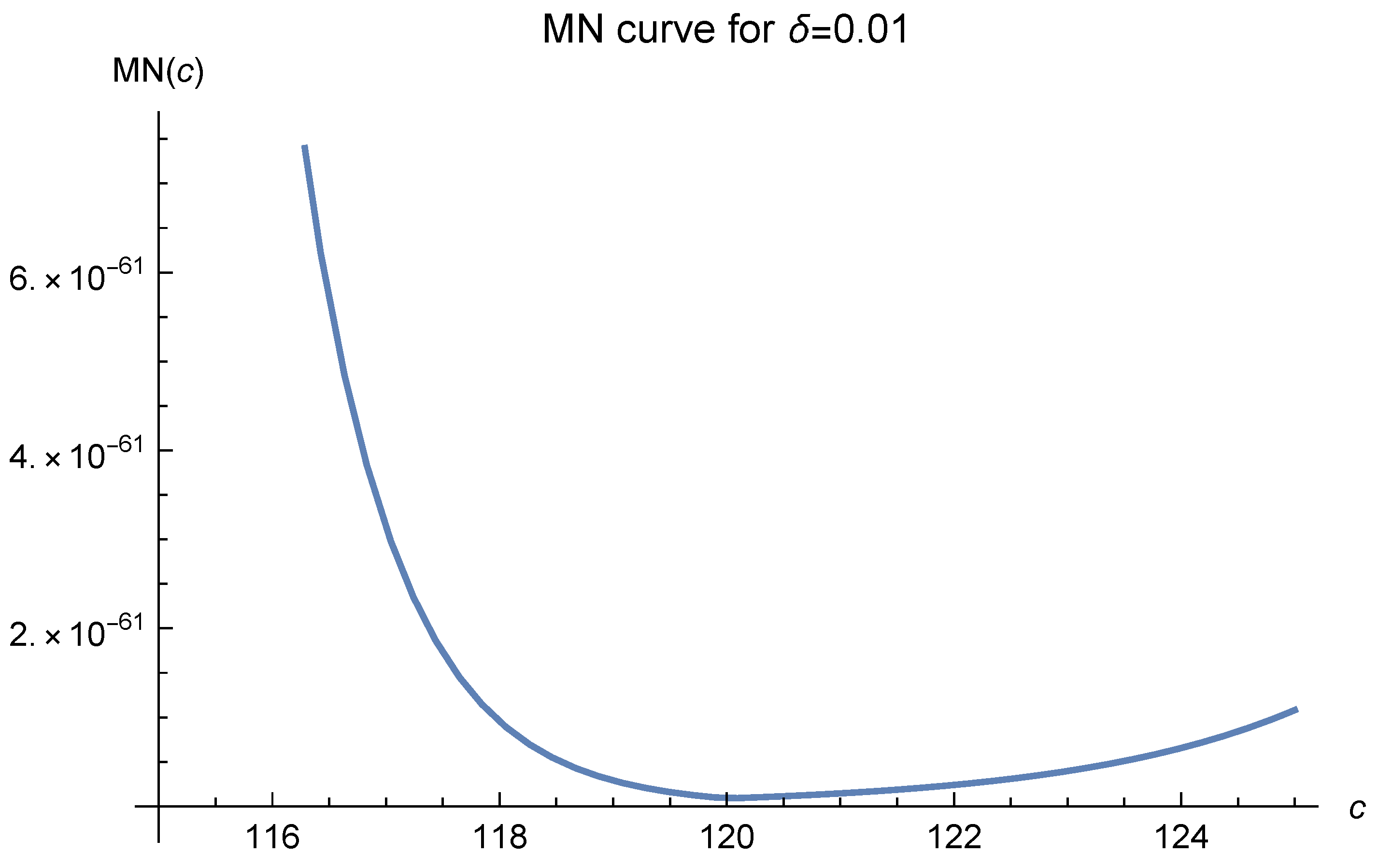
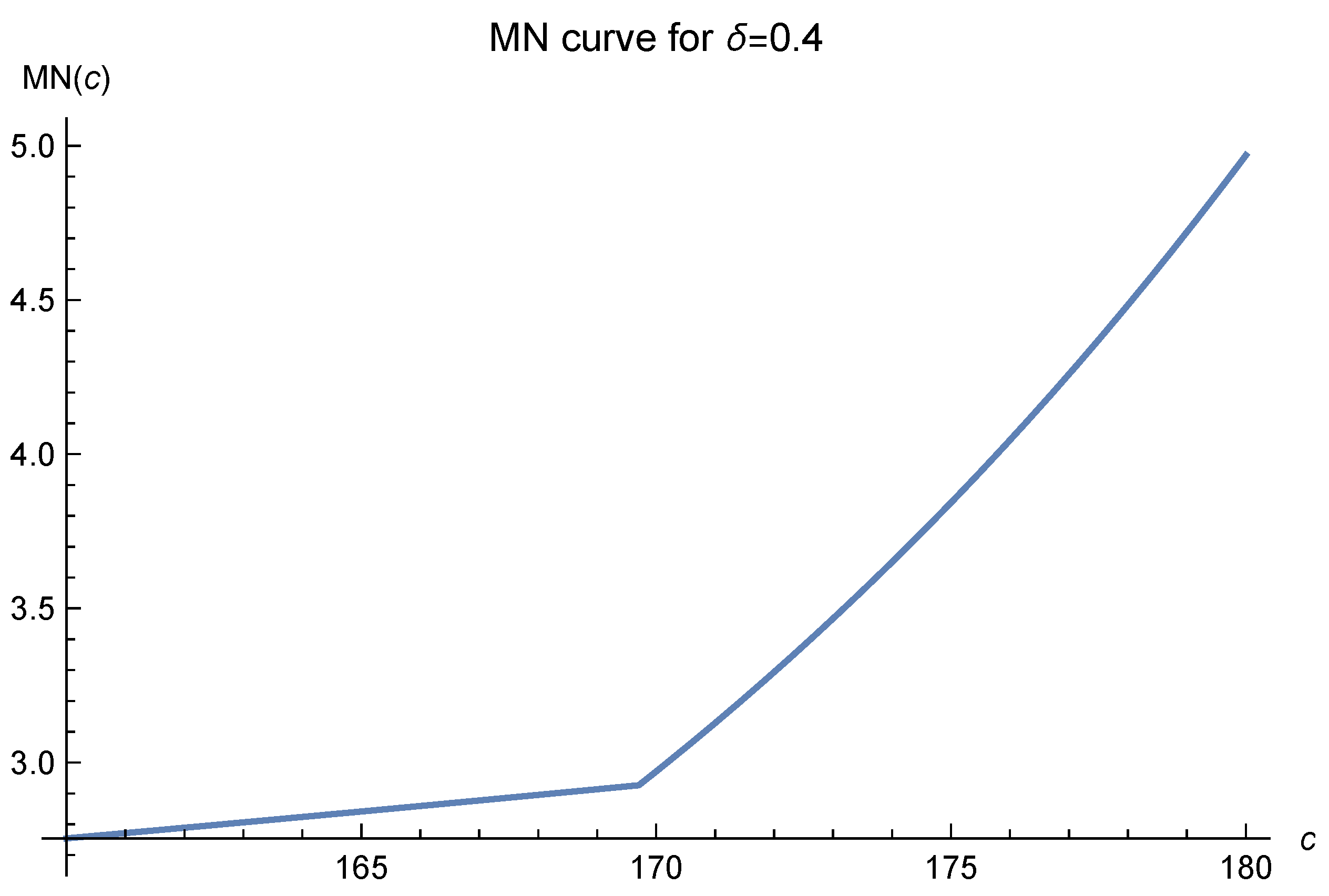
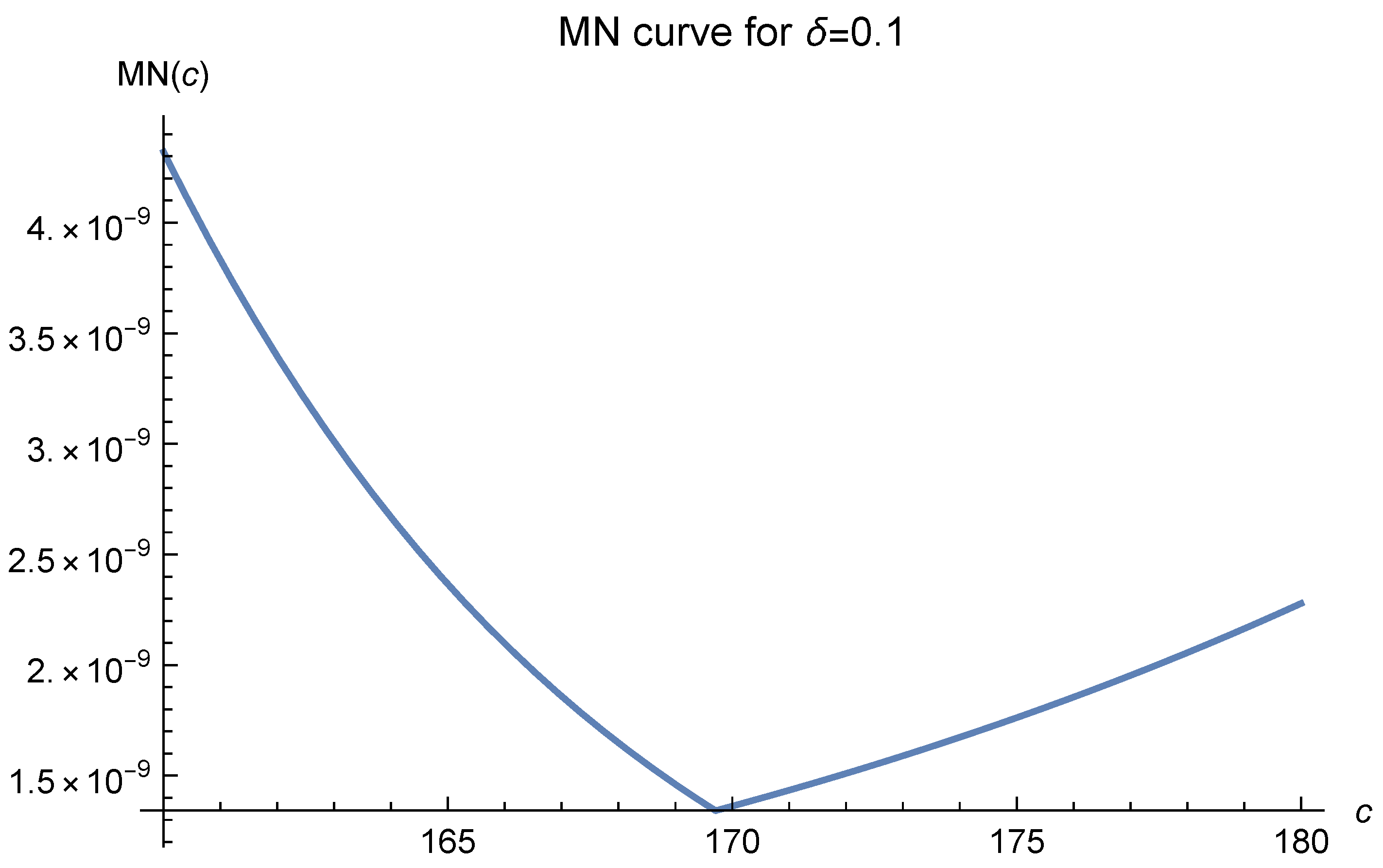
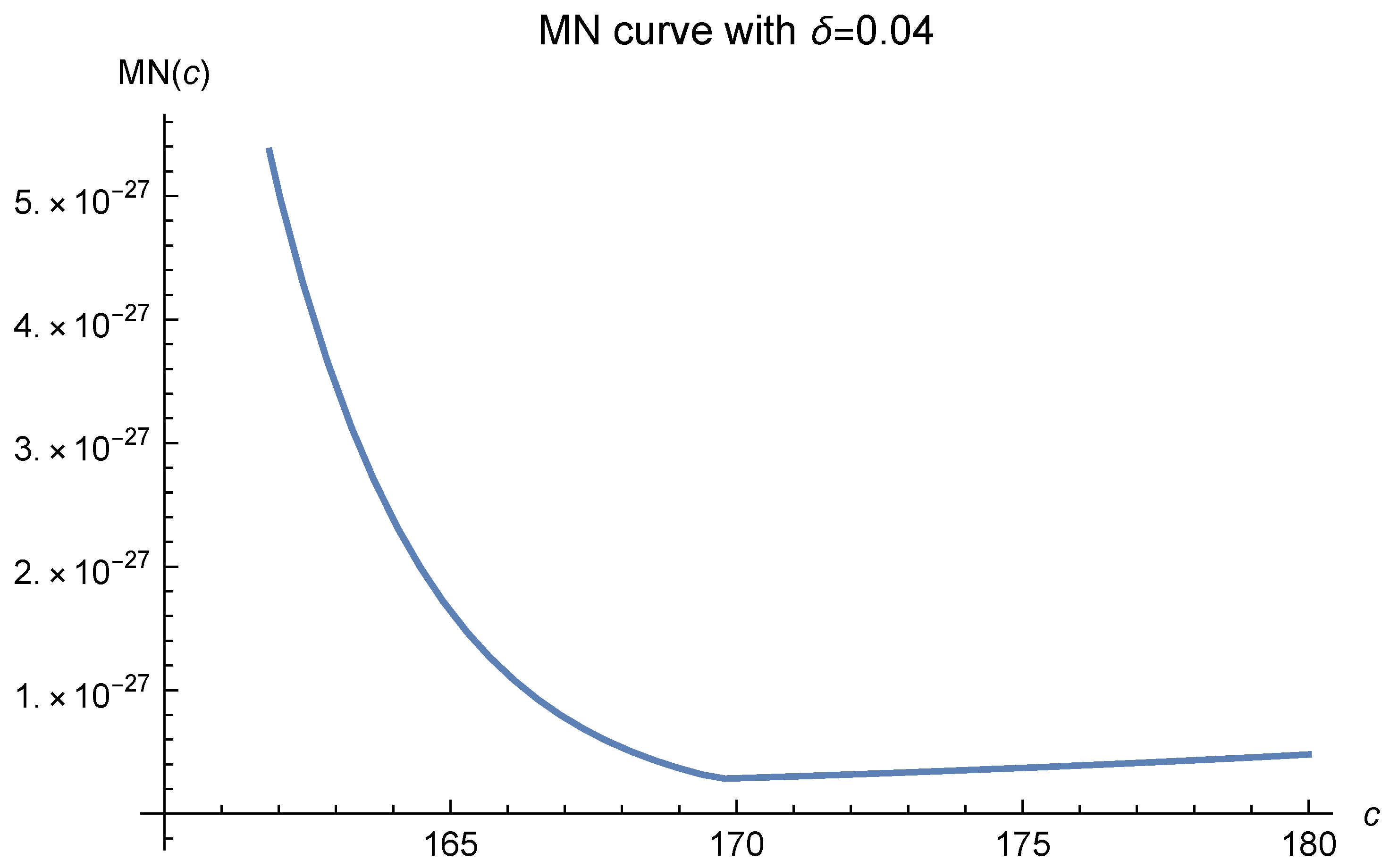
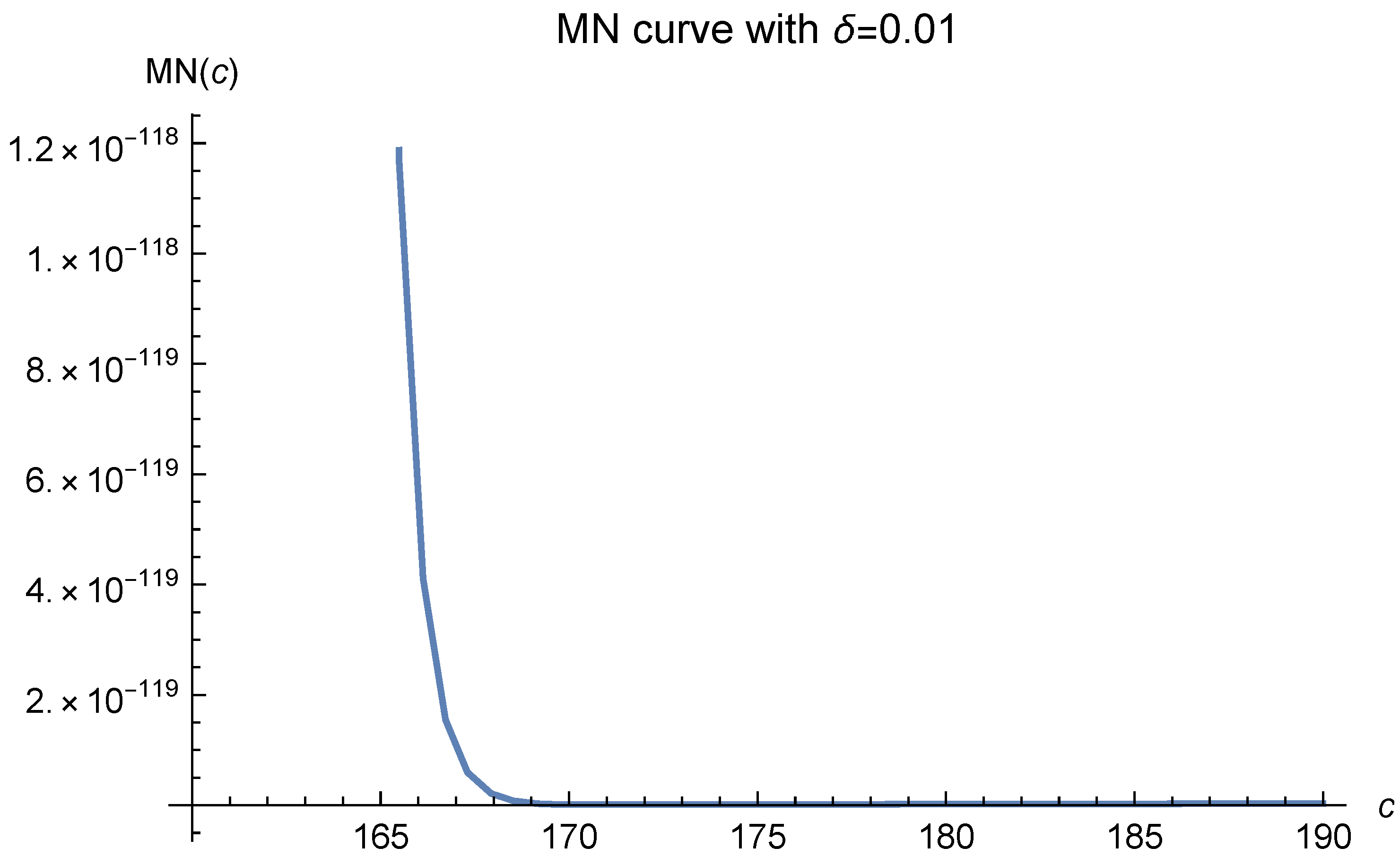
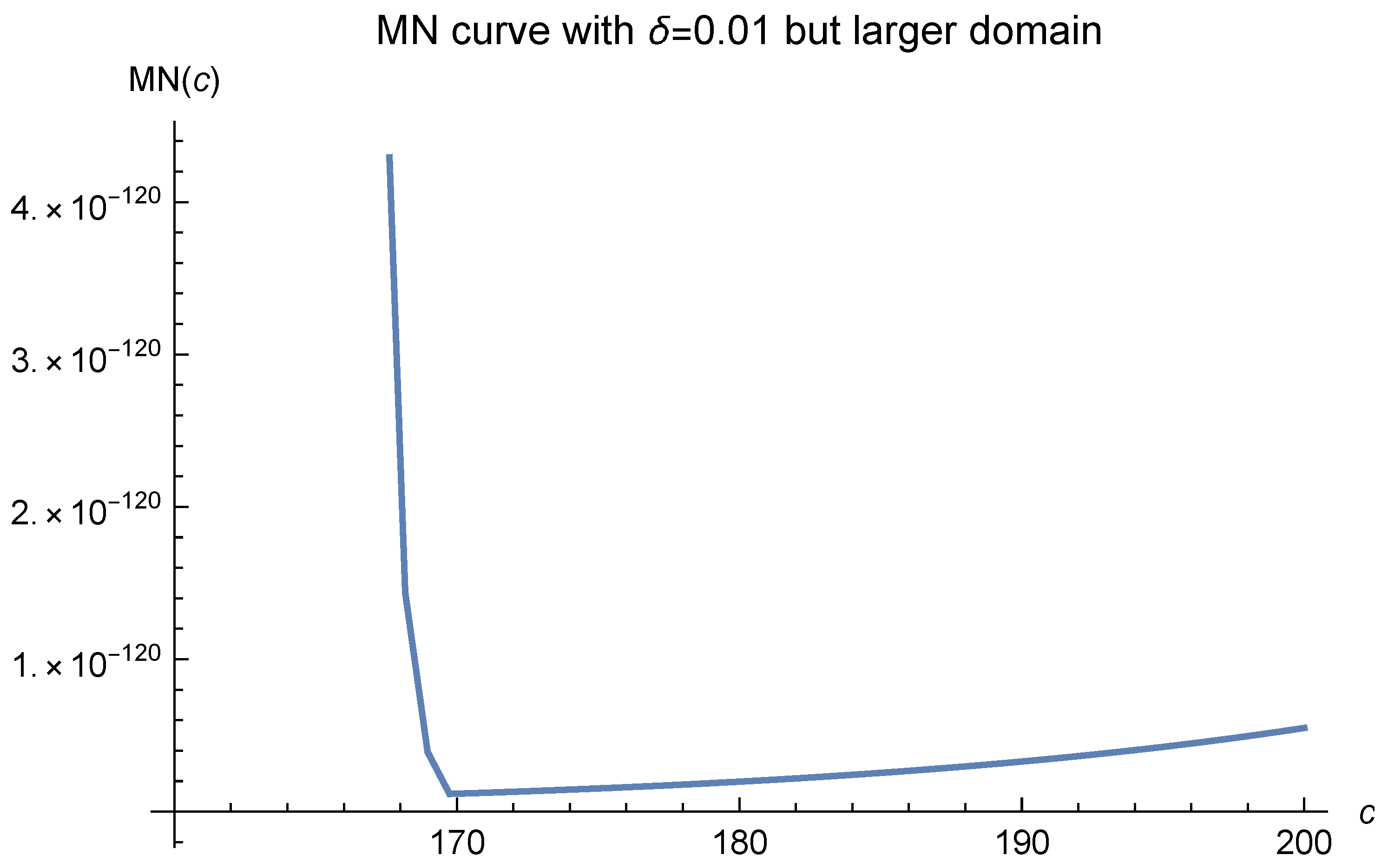
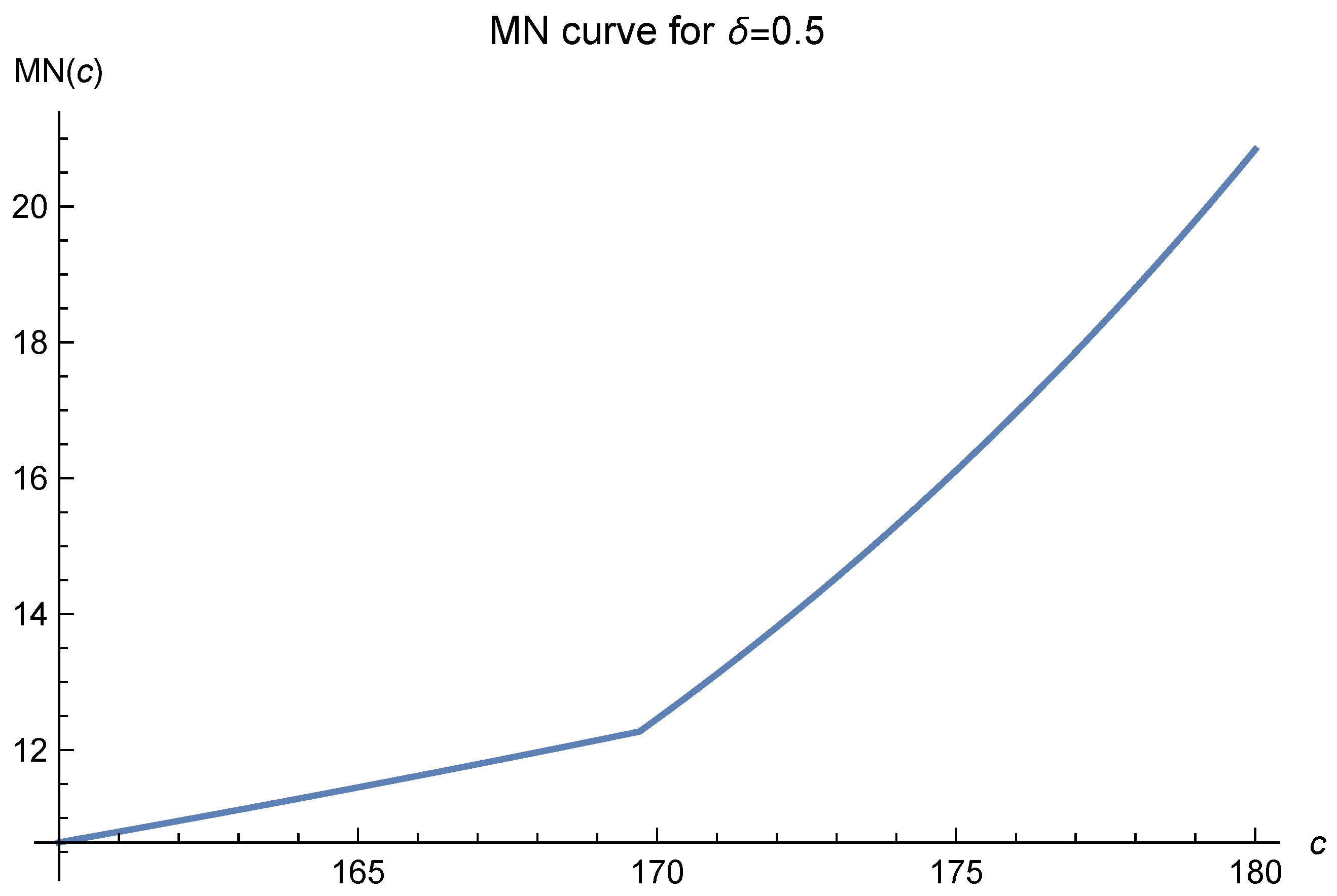
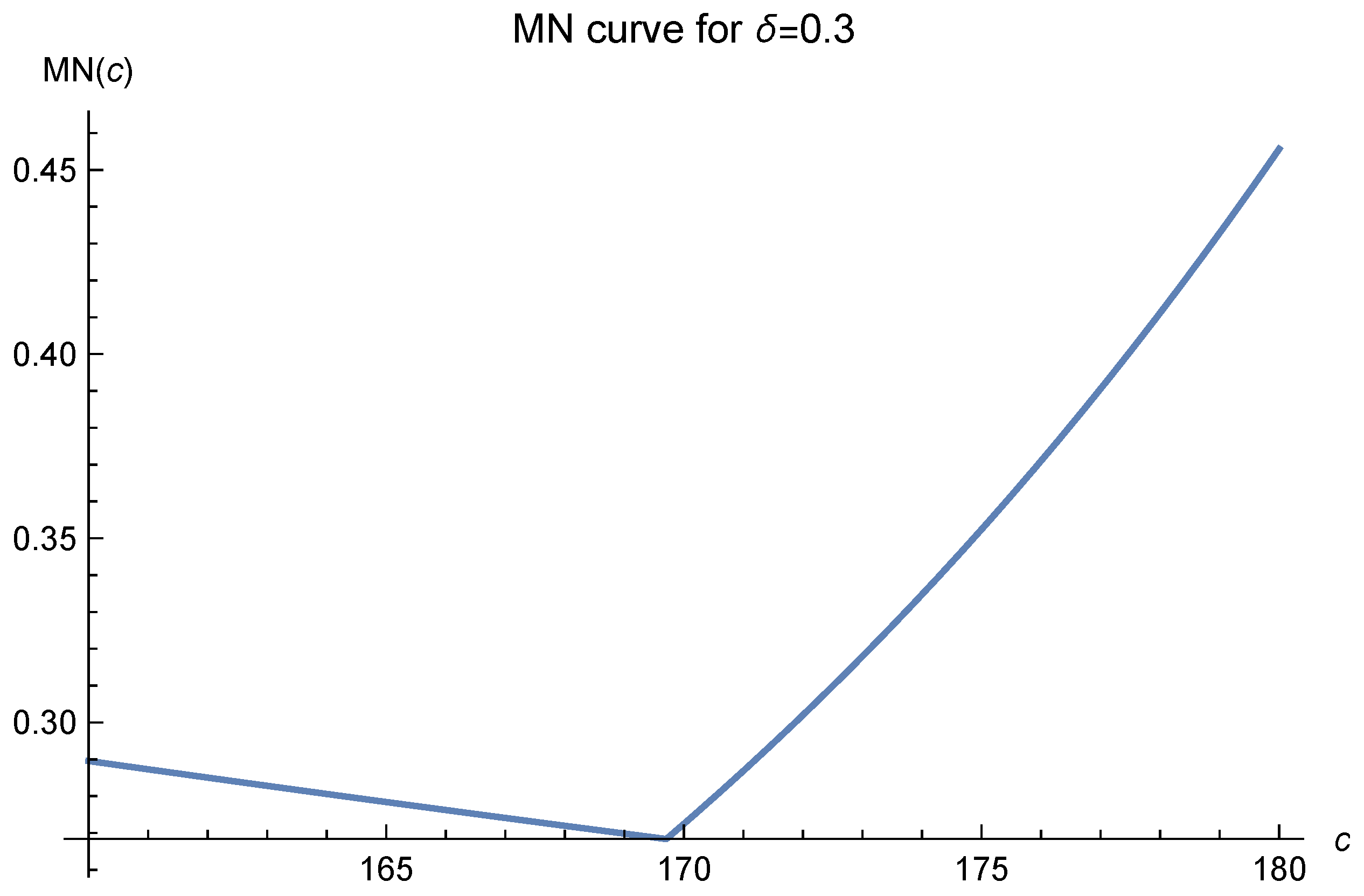
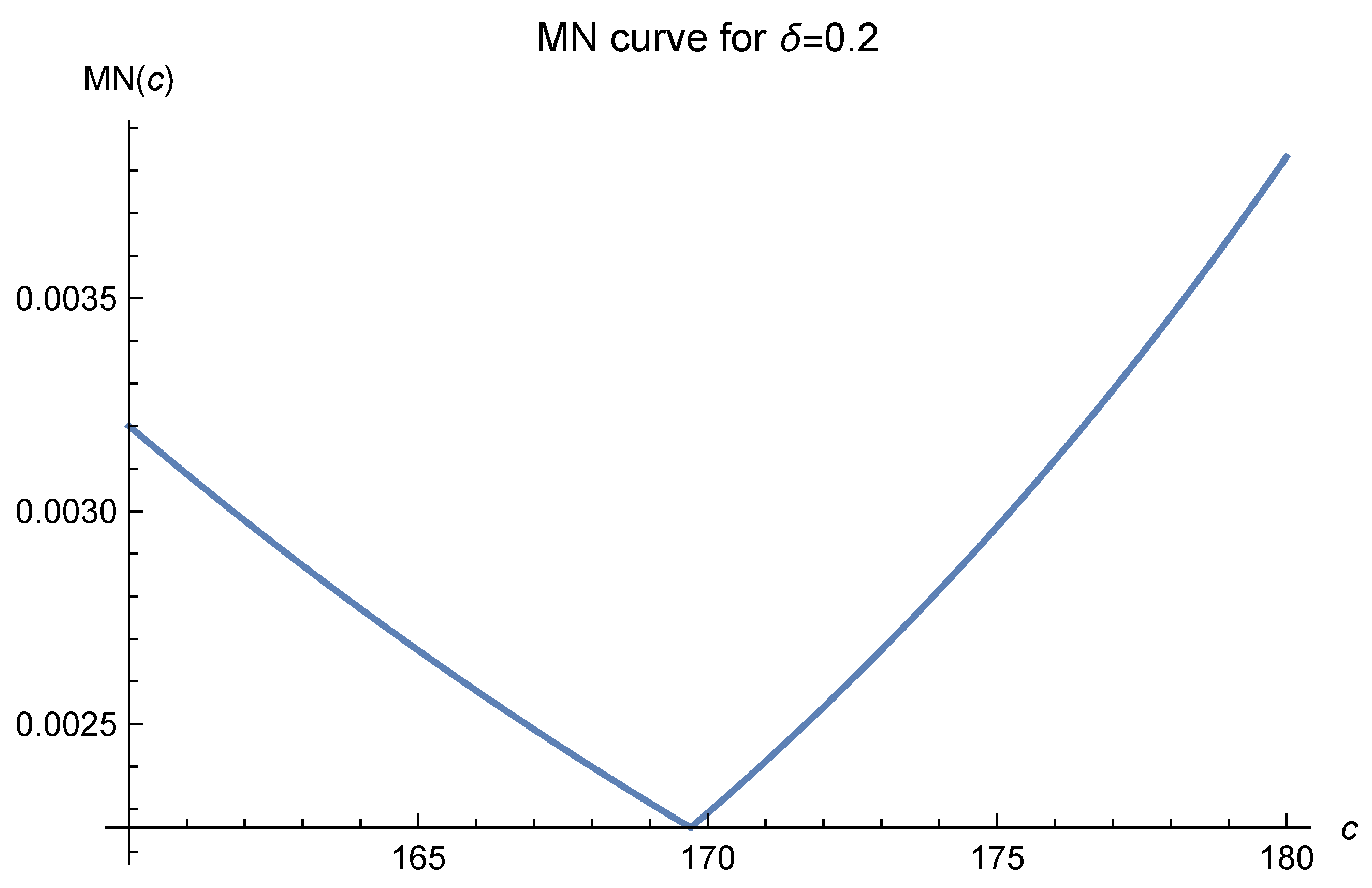
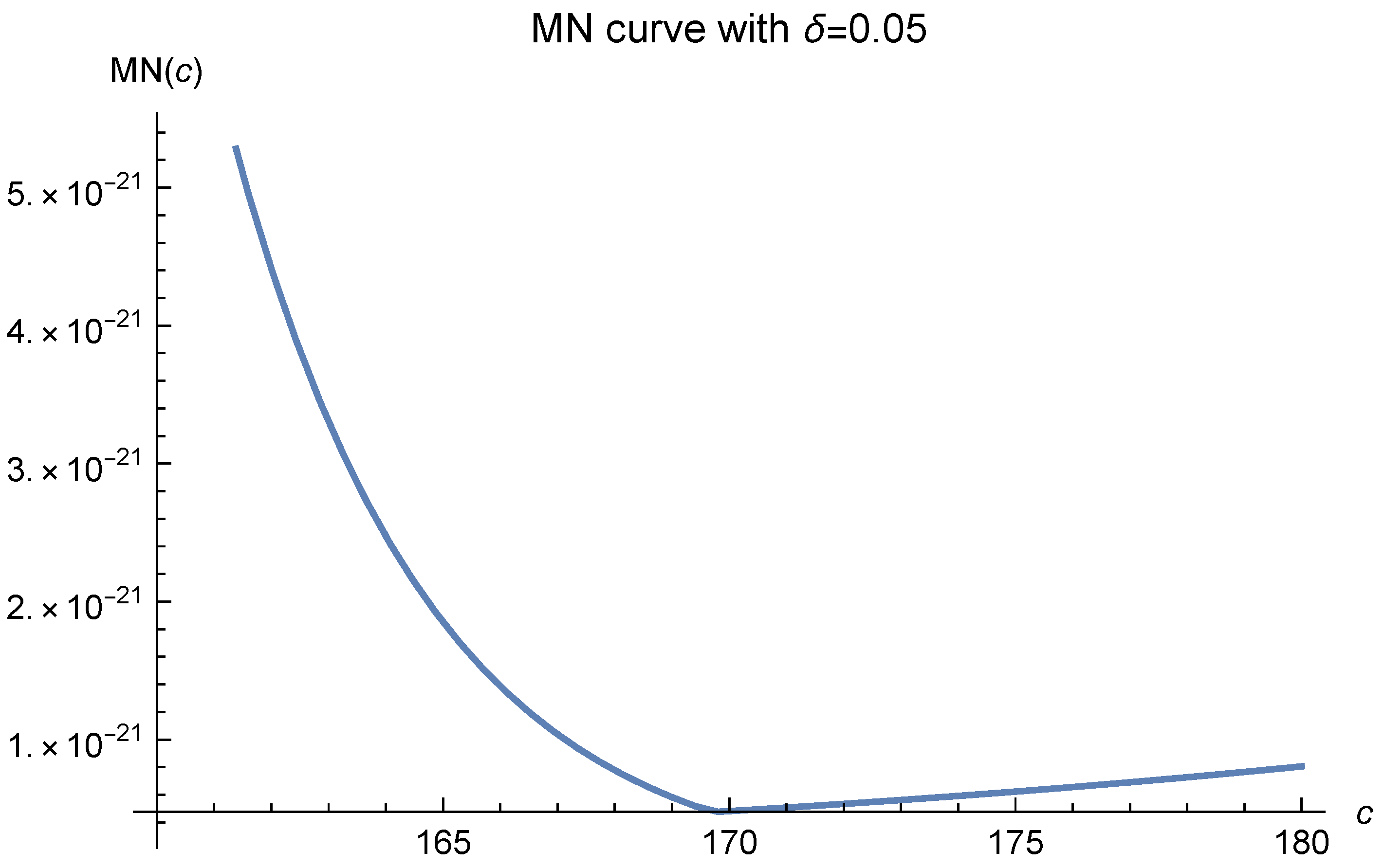
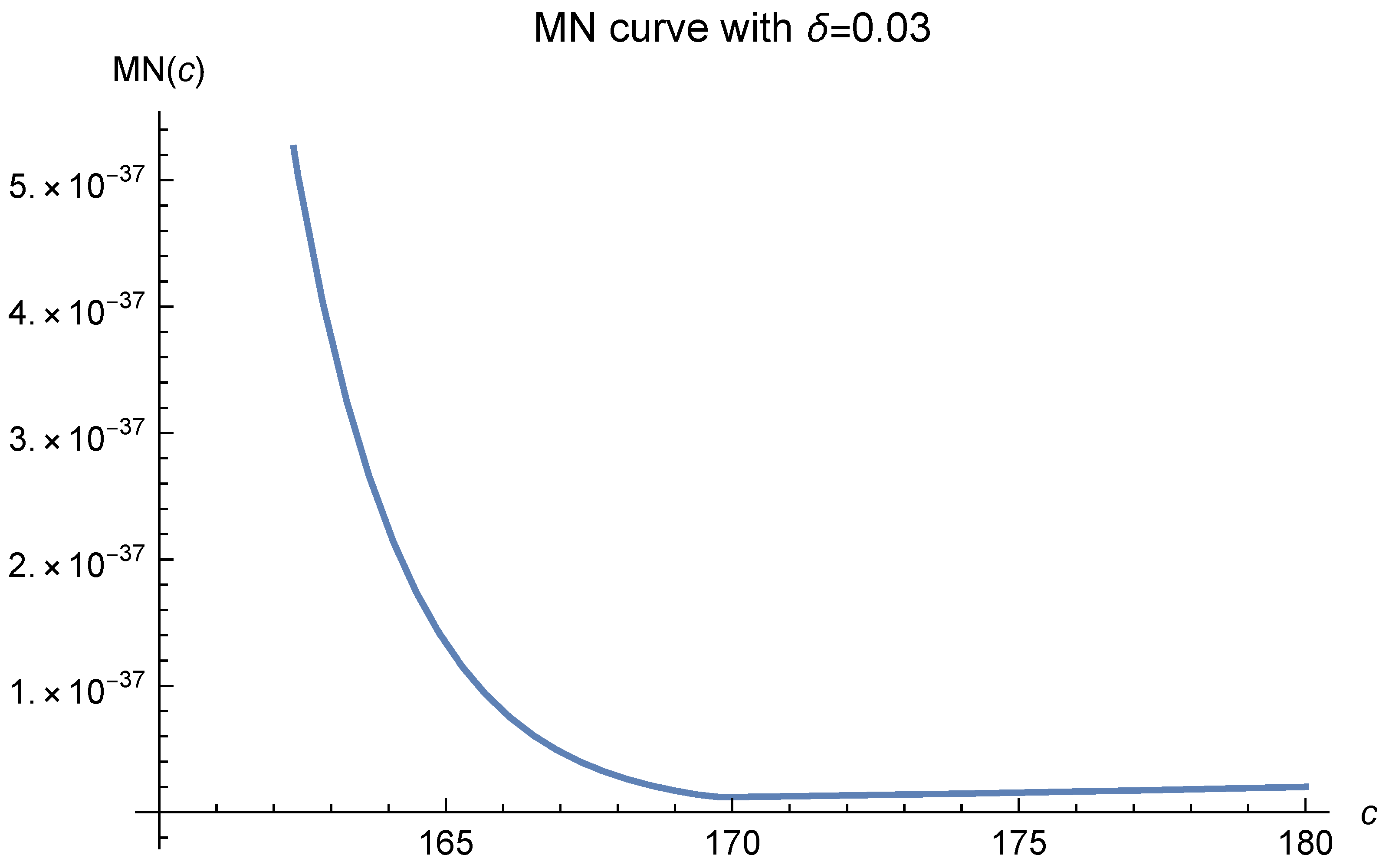
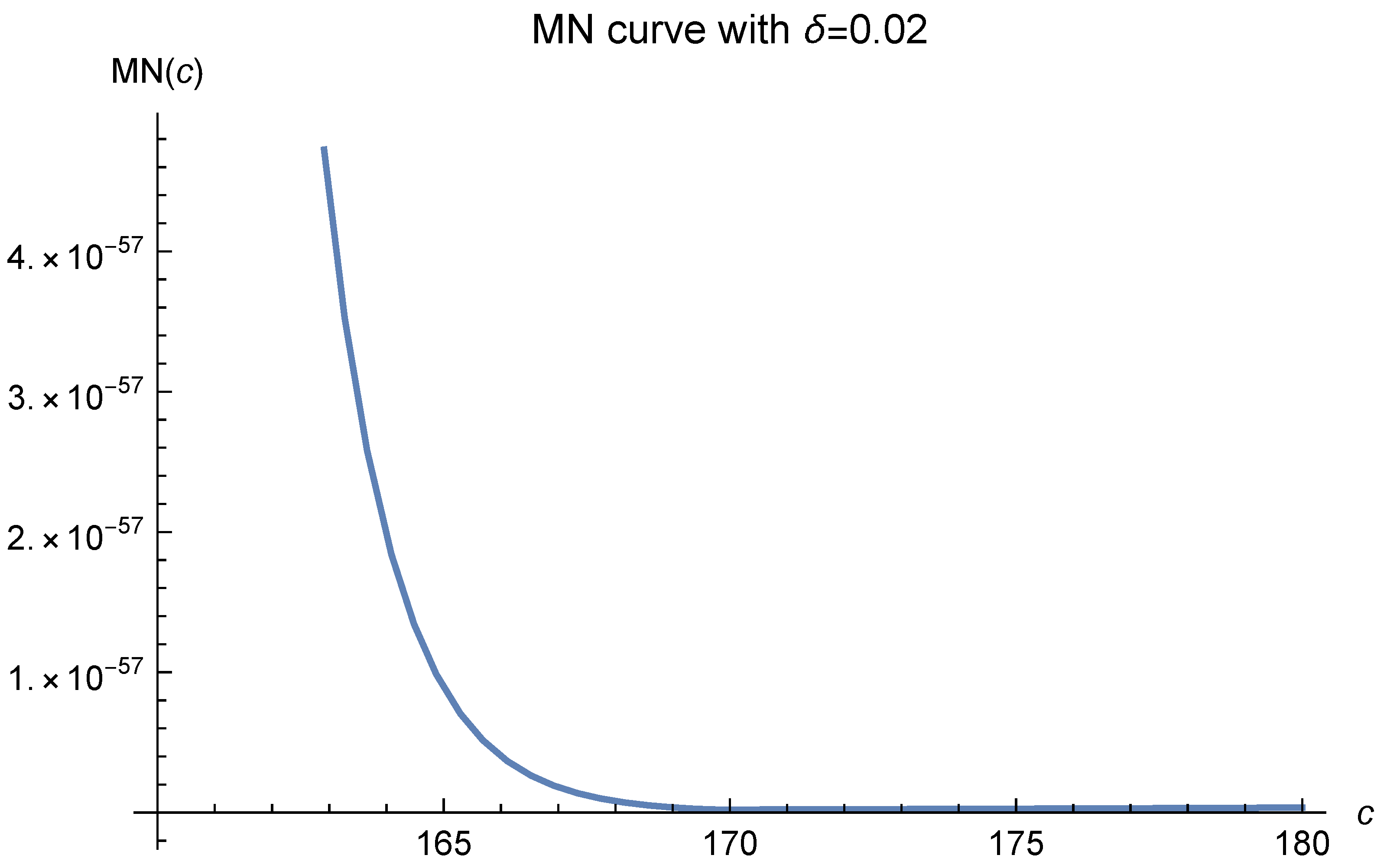
The graph of the MN function can be easily and efficiently sketched using Mathematica or Matlab. A typical example is shown in
Figure 1.
We assert that for , the optimal value of c is the value minimizing . Although in (7) it is required that , a large number of experiments have shown that the true optimal values never lie in the interval . Hence, we have essentially dealt with the entire interval .
The main purpose of this paper is to extend our theory to arbitrary domain shapes and scattered data points. This means that two severe requirements in Luh [
8] will be relaxed. Firstly, the interpolation domain need not be a simplex. Secondly, the centers (interpolation points) need not be evenly spaced. The reason for this is that the crucial functions defined in (1) and (3) are continuous, and the relaxation will greatly relieve the pain of using the MN function to choose the
c value optimally. For this, we still use the MN function defined in (7) to choose
c but interpret
just as the diameter of the domain and consider
to be just a parameter inversely proportional to the number of data points used. The remaining task is to test this by experiments.
Another key point is that, here, the function space
is just a subset of another space
adopted by Luh [
1]. Hence, the error bound presented in this paper is sharper than that of [
1]. This means that the interpolation here should be more accurate than that in [
1].
4. Discussion
Although we briefly mentioned the origin and significance of shifted surface splines in the Introduction, readers interested in this kind of radial basis function should refer to Dyn et al. [
10,
11,
12] for a more detailed understanding.
In fact, each smooth (infinitely differentiable) radial basis function contains a shape parameter whose choice is always a substantial problem. The first theoretical work dealing with this question can be seen in Madych [
13]. Although Madych could not effectively solve this question, his effort and intelligence are worthy of respect. In 1999 [
14], Rippa introduced a trial-and-error algorithm to handle this problem. Then, Fasshauer, in his famous book [
15], pointed out that only trial-and-error methods were available. Hence, how to theoretically predict the optimal value has been an open question in the field of RBFs (radial basis functions).
The function space
adopted in this paper is smaller than the space
adopted in Luh [
1]. Hence, the error bound is sharper and leads to more accurate function interpolation. Another important property of
is that it serves as a bridge between Sobolev-space functions and radial basis functions (RBFs), as explained in the paragraph following Definition 1. Hence, we are now in the position to handle PDEs whose solutions lie in a Sobolev space.