Abstract
This paper discusses the dissipative filtering problem for discrete-time nonlinear networked systems with dynamic quantization and data packet dropouts. The Takagi–Sugeno (T–S) fuzzy model is employed to approximate the considered nonlinear plant. Both the measurement and performance outputs are assumed to be quantized by the dynamic quantizers before being transmitted. Moreover, the Bernoulli stochastic variables are utilized to characterize the effects of data packet dropouts on the measurement and performance outputs. The purpose of this paper is to design full- and reduced-order filters, such that the stochastic stability and dissipative filtering performance for the filtering error system can be guaranteed. The collaborative design conditions for the desired filter and the dynamic quantizers are expressed in the form of linear matrix inequalities. Finally, simulation results are used to illustrate the feasibility of the proposed filtering scheme.
MSC:
93C42
1. Introduction
In recent years, there has been a surge in academic interest in networked systems. The fundamental reason is that, due to their benefits of low cost, easy maintenance, and high reliability, networked systems are gradually replacing traditional control systems and taking center stage in the development of control systems [1]. Nowadays, networked systems are used in industries such as autonomous vehicles, industrial process control, smart homes, and others, with great success [2]. However, because of network restrictions, networked systems invariably generate some issues such as quantization, data packet dropouts, and so on [3]. These issues not only cause networked systems to run less efficiently, but they additionally possess the potential to cause instability. One of the primary sources of these issues is signal quantization inaccuracy and data packet dropouts. Among them, one of these causes of networked systems’ poor operating efficiency and instability is quantization error. Therefore, it is crucial to deal with the analysis and design problems for networked systems subject to signal quantization and data packet dropouts. Over the past several years, a great number of achievements have been reported on these topics. The analysis and design problems for networked systems with quantization were addressed in [4,5,6,7,8,9,10,11]. The analysis and design problems for networked systems with data packet dropouts were studied in [8,9,10,11,12].
As is well known, nonlinearities exist in many practical physical systems [13]. Therefore, nonlinear control systems have attracted the attention of many scholars. As an effective means to deal with nonlinear systems, the Takagi–Sugeno (T–S) fuzzy model approach has received extensive attention from many international scholars and a series of important results have been published in the open literature (see, e.g., [14,15,16] and references therein). In recent years, based on the T–S fuzzy model approach, the study on networked systems has also attracted attention and some important results have been achieved (see, e.g., [17,18,19,20] and references therein). Particularly, based on the T–S fuzzy model approach, the control problem of nonlinear networked systems with quantization was studied in [21,22,23,24,25,26] and the control problem of nonlinear networked systems subject to data packet dropouts was addressed in [27,28,29].
In addition, the filtering problem is considered to be an important issue in the study of control theory because the state variables that can reflect the inside of the system are not always available in the vast majority of practical systems. Scholars at home and abroad have undertaken enormous research on the filtering problem and many significant results have been proposed. For linear networked systems, the filter design problem was researched in [30,31,32]. For nonlinear systems, the resilient mixed and energy-to-peak filtering problem and the filtering problem with D stability constraints were addressed based on the T–S fuzzy model approach in [33] and [34], respectively. For nonlinear networked systems, based on the T–S fuzzy model approach, the event-triggered filtering problem was addressed with the effect of weighted try-once-discard protocol in [35]. Particularly, based on the T–S fuzzy model approach, the filtering problem for nonlinear networked systems with the effect of quantization was investigated in [36,37,38,39,40,41] and the filtering problem for nonlinear networked systems with the effects of data packet dropouts was considered in [39,40,41,42,43]. However, it should be noted that most of the above literature is about filtering. As pointed out in [23,44], the dissipative performance is more general than the performance. As a result, the study of the dissipative filtering problem is significant for nonlinear networked systems. As far as the author knows, there is no relevant research on the dissipative filtering problem for nonlinear discrete-time networked systems under the effects of dynamic quantization and data packet dropouts on the measurement output and the performance output, simultaneously, which motivated the current research.
This paper considered the quantized dissipative filtering problem of discrete-time nonlinear networked systems with data packet dropouts based on the T–S fuzzy model strategy. The primary contributions of this paper can be summarized as follows.
- (1)
- According to the T–S fuzzy model approach, the dissipative filtering problem is investigated for discrete-time nonlinear networked systems subject to dynamic quantization and data packet dropouts.
- (2)
- In this paper, both the effects of dynamic quantization and data packet dropouts on the measurement output and performance output are considered, simultaneously. Moreover, a more general adjusting strategy is proposed for the dynamic parameter of the dynamic quantizer.
- (3)
- By introducing a dimension adjustment matrix, the design conditions for both the desired full- and reduced-order dissipative filters are proposed in the unified framework of linear matrix inequalities.
The rest of this paper is organized as follows. The filtering problem to be investigated is formulated in Section 2. In Section 3, the main results on the design of the dissipative filter with dynamic quantization and data packet dropouts are presented. In Section 4, an example is provided to demonstrate the effectiveness of the developed filtering strategy. Finally, the conclusion of this paper is provided in Section 5.
Notations: The notations used in this paper are standard. and indicate the n-dimensional Euclidean space and the set of all real matrices of dimension , respectively. I is used to denote the identity matrix with compatible dimensions. stands for Euclidean vector norm. The symbols and ∗ are utilized to denote block-diagonal matrix and symmetric element in the matrix, respectively. and represent the transpose matrix and inverse matrix of matrix A, respectively. stands for the smallest eigenvalue of the matrix A and denotes the space of the square integrable vectors over .
2. Problem Formulation
2.1. Nonlinear Plant
In this paper, a discrete-time T–S fuzzy model is used to approximate the nonlinear plant under consideration and ith is formulated as follows
Plant Rule i: IF is and is and … and is , THEN
where with and are the fuzzy sets, s stands for the number of fuzzy rules, and stands for the premise variable. and stand for the system state and the measurement output, respectively, stands for the performance output, and stands for the noise signal belonging to . , , , , , and are the system matrices.
Denote
where is the grade of membership of in .
Throughout this paper, it is assumed that
Let
Then
Moreover, the T–S fuzzy model can be further represented as
where
2.2. Dynamic Quantizers and Data Dropouts
In order to reduce the frequency of information exchange and the burden of communication, the measurement output and the performance output will be quantized by the dynamic quantizer developed in [6], respectively. According to [6], the quantized measurement output and the quantized performance output can be formulated as
In (7), stands for the dynamic parameter of the quantizer and stands for a static quantizer satisfying
where stands for the range of the quantizer and denotes the bound of the quantization error.
As an important challenge in networked systems, the effects of data packet dropouts will also be considered in this paper. Two independent Bernoulli stochastic variables and will be employed to characterize the effects of data packet dropouts on the quantized measurement output and quantized performance output. In this way, the measurement output and performance output signals received by the filter can be indicated as
This implies that the quantized measurement output (quantized performance output) is successfully transmitted when (), and that the quantized measurement output (quantized performance output) is unsuccessfully transmitted when (). Moreover, we assume that and satisfy
with known constants and .
Remark 1.
As claimed in [38,43], in the study of the filtering problem for networked systems, both the measurement and performance outputs should be transmitted by an unreliable communication network. Therefore, the effects of both the dynamic quantization and data packet dropouts on the measurement and performance outputs are considered in this paper. In contrast with the results in [38] where only the effects of quantization are considered, and the results in [43] where only the effects of data packet dropouts are considered, the problem studied in this paper is more general for networked systems.
2.3. Filtering Error Systems
In this paper, the structure of the employed filter is provided as
where denotes the state of the filter and stands for the output of the filter. , , and stand for the parameters of the designed filter. The structure of the filter in (13) is general, which can be utilized to investigate the full-order filtering problem with and the reduced-order filtering problem with .
Then, we can express the filtering error system as
where , , and
Next, we will provide the definitions on the dissipativity and stochastic stability of the filtering error system (14), which will be needed in the process of dissipative filtering performance analysis.
Definition 1
([27,37,43]). For any initial condition , if there exists a matrix such that
holds. Then, the filtering error system in (14) is stochastically stable with .
Definition 2
([44]). For zero initial condition, the filtering error system in (14) is strictly dissipative with the dissipativity performance bound , such that
holds with . In (16), , , and are known matrices and with .
3. Main Results
3.1. Filtering Performance Analysis
In this subsection, it is assumed that the filter (13) studied in this paper is known. Based on the Lyapunov approach, a significant dissipative filtering performance analysis criterion for the filtering error system (14) will be presented in the following theorem.
Theorem 1.
Suppose that the quantization ranges and , the quantization error bounds and , and the constants , , , , , , , satisfying and are provided. The filtering error system in (14) is stochastically stable with the provided dissipative filtering performance γ, if there exist matrix , positive scalars , , , and satisfying
where
, , , , , , , , , , and the adjusting strategy for the dynamic parameters and are provided as:
Proof.
For the filtering error system (14), the Lyapunov function is established as
Then, one can be obtain that
where and
As in [4], based on the online adjusting strategy in (19) and the conditions in (8) and (17), we have
which can be further expressed as
with
By utilizing the Schur complement to (18), we obtain
According to the S-Procedure in [6,36], we have that based on (21), (23), and (24), i.e.,
Then, by summing up (25) from to with , one can obtain
By considering and , we have
Therefore, according to Definition 2, one can obtain that the given dissipative filtering performance bound of the filtering error system in (14) can be guaranteed.
Next, for , the stochastic stability of the filtering error system in (14) will be discussed.
For , the inequality in (25) reduces to
By considering the fact that , we have that
where and
Based on (29), it can be obtained that
By calculating the mathematical expectation of (30) on both sides and summing up both sides of (30) from to with , one can obtain that
which is equivalent to
For , we have that and . Then, based on inequality in (32), it can be obtained that
with .
According to , it can be deduced that , which implies that . Based on the above discussions, we have that . Therefore, for , one can obtain that the filtering error system in (14) is stochastically stable in accordance with Definition 1. □
Remark 2.
As pointed out in [4], the adjusting strategy for the dynamic parameters and proposed in (19) is more general than the one in [6,11,36] and the one in [21,37]. The adjusting strategy in [6,11,36] can be obtained from the one in (19) by choosing and the adjusting strategy in [21,37] can be obtained from the one in (19) by choosing , , and . Moreover, another advantage of the adjusting strategy in (19) is that the constant is independent of the matrix inequality (18).
3.2. Filter Design
Based on the results developed in Theorem 1, the design results characterized by linear matrix inequalities for the desired filter in (13) will be proposed in the following theorem.
Theorem 2.
Suppose that the quantization ranges and , the quantization error bounds and , the dimension adjustment matrix K, and the constants , , , , , , , satisfying and are provided. In the presence of the adjusting strategy for the dynamic parameters and provided in (19) with the inequality in (17), the filtering error system in (14) is stochastically stable with the provided dissipative filtering performance γ, if there exist matrices , , , , , , , , nonsingular matrix , and positive scalars , satisfying
where
Moreover, the parameters for the filter (13) can be obtained by
Proof.
For the nonsingular matrix G, based on and , we have that
By considering (36) and performing congruence transformation to (18) by with and , it can be obtained that
where
We assume , with is nonsingular and define , , and , the inequality in (37) can be expressed as
Next, some discussions on the main results in this paper will be provided.
Remark 3.
In Theorem 2, for the provided dimension adjustment matrix K, both the full-order dissipative filter and the reduced-order dissipative filter design results are presented in a unified framework characterized by linear matrix inequalities, which can be effectively solved by the LMI toolbox. In general, the dimension adjustment matrix K can be chosen as for full-order dissipative filter and for reduced-order dissipative filter.
Remark 4.
The deign results proposed in Theorem 2 on the dissipative filter for nonlinear networked systems with dynamic quantization and data packet dropouts are general. By selecting , , and , the deign results proposed in Theorem 2 can be utilized to design the filter. By selecting , , and , the deign results proposed in Theorem 2 can be utilized to design the passive filter. By selecting , , and with , the deign results proposed in Theorem 2 can be utilized to design the mixed passive/ filter.
Remark 5.
Based on the results in [8,21], we know that a feasible adjusting rule is necessary for the dynamic parameter due to the use of the unreliable transmission communication network. As in [4], the adjusting rule for the dynamic parameter in this paper is proposed as
where and the function denotes the maximum integer that is not bigger than ℏ.
Remark 6.
According to the conclusions in [23], we have that the numerical complexity of the design results proposed in Theorem 2 is closely related to the number of variables and the number of rows . Moreover, the deign conditions in Theorem 2 can be solved in polynomial time with complexity proportional to , where and .
Remark 7.
In general, , , , are provided parameters for dynamic quantizers and , are provided parameters for data packet dropouts. However, how to deal with the dissipative filtering problem with the unknown parameters , , , , , and is still a open problem, which needs further study. Moreover, it should be noted that the conservatism of the results proposed in Theorem 2 can be further reduced by employing the fuzzy Lyapunov function strategy in [15] and introducing slack matrix variables via Lemma 4 in [45].
4. Simulation Example
In this section, we will show that the proposed dissipative filtering strategy is effective via a practical example.
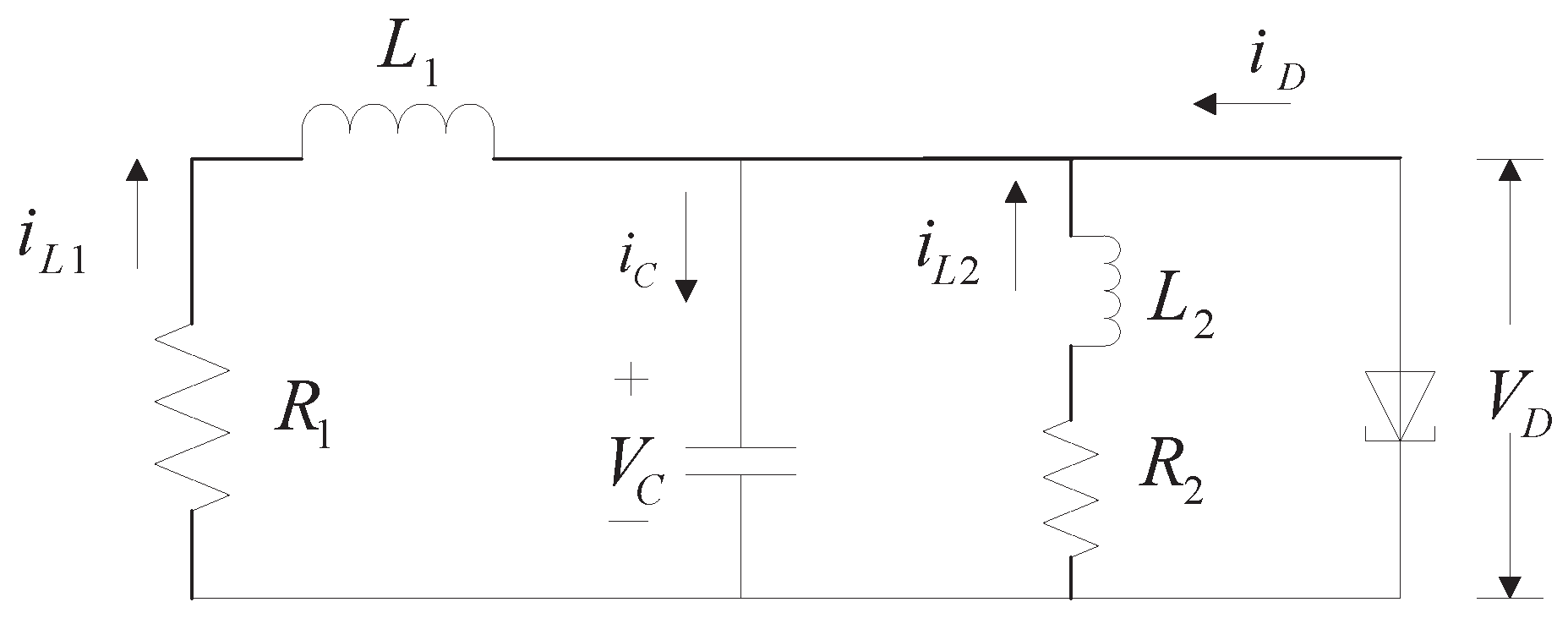
Consider the tunnel diode circuit depicted in Figure 1, which is also employed to study the – fuzzy filtering problem for nonlinear networked systems with dynamic quantization in [36]. As in [36], by choosing , , and , state equations for the tunnel diode circuit can be represented as
Figure 1.
Tunnel diode circuit.
In this paper, we assume that , , , , , , , , and , i.e., . Then, the nonlinear tunnel diode circuit in (39) can be approximated by the following continuous-time T–S fuzzy model:
where
Moreover, the membership functions can be provided as
By setting the sampling period , we have that
and other relative matrices are supposed to be
By applying Theorem 2 with , , , , , , , , , , , and , the related parameters for the desired full-order dissipative filter can be obtained as
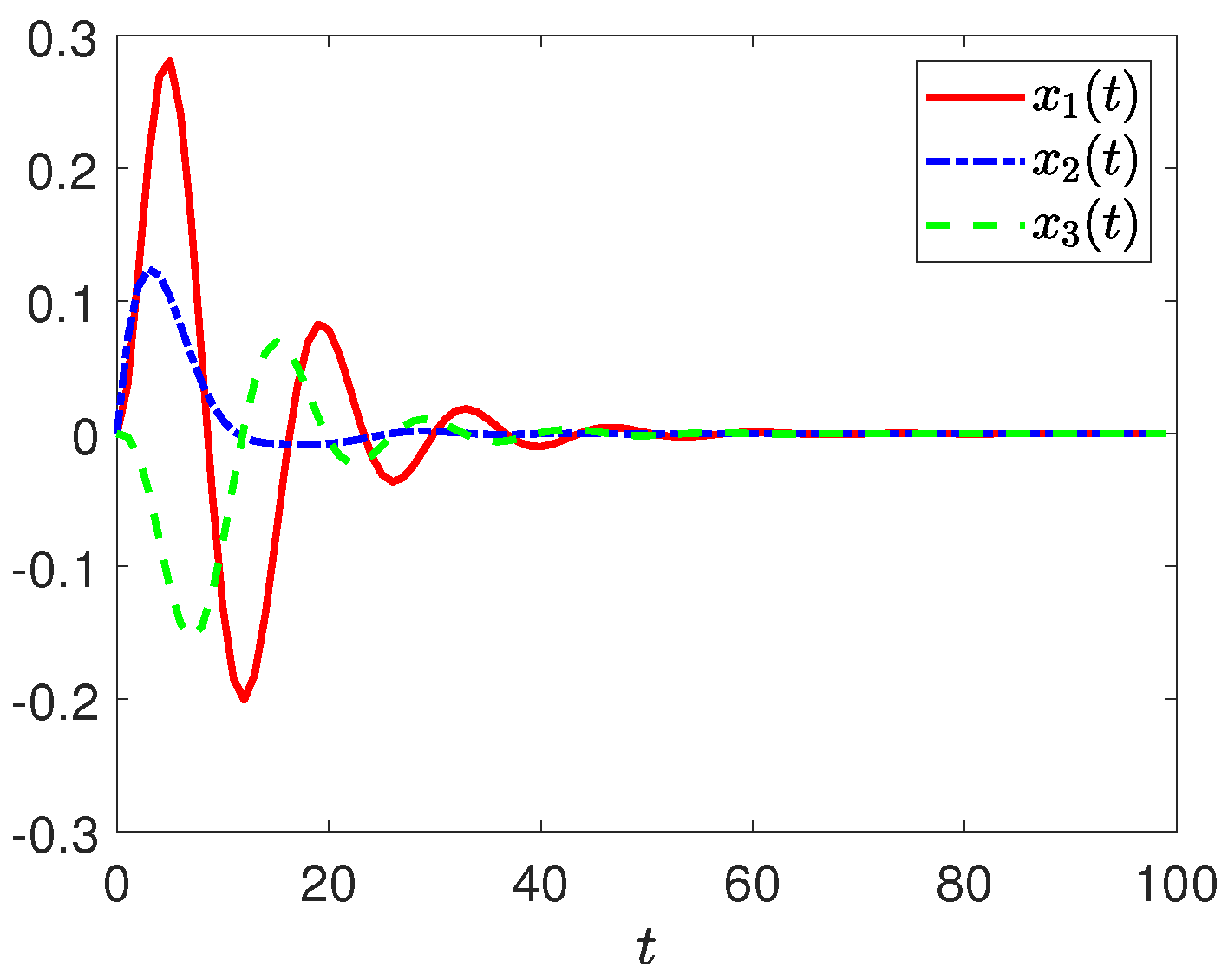
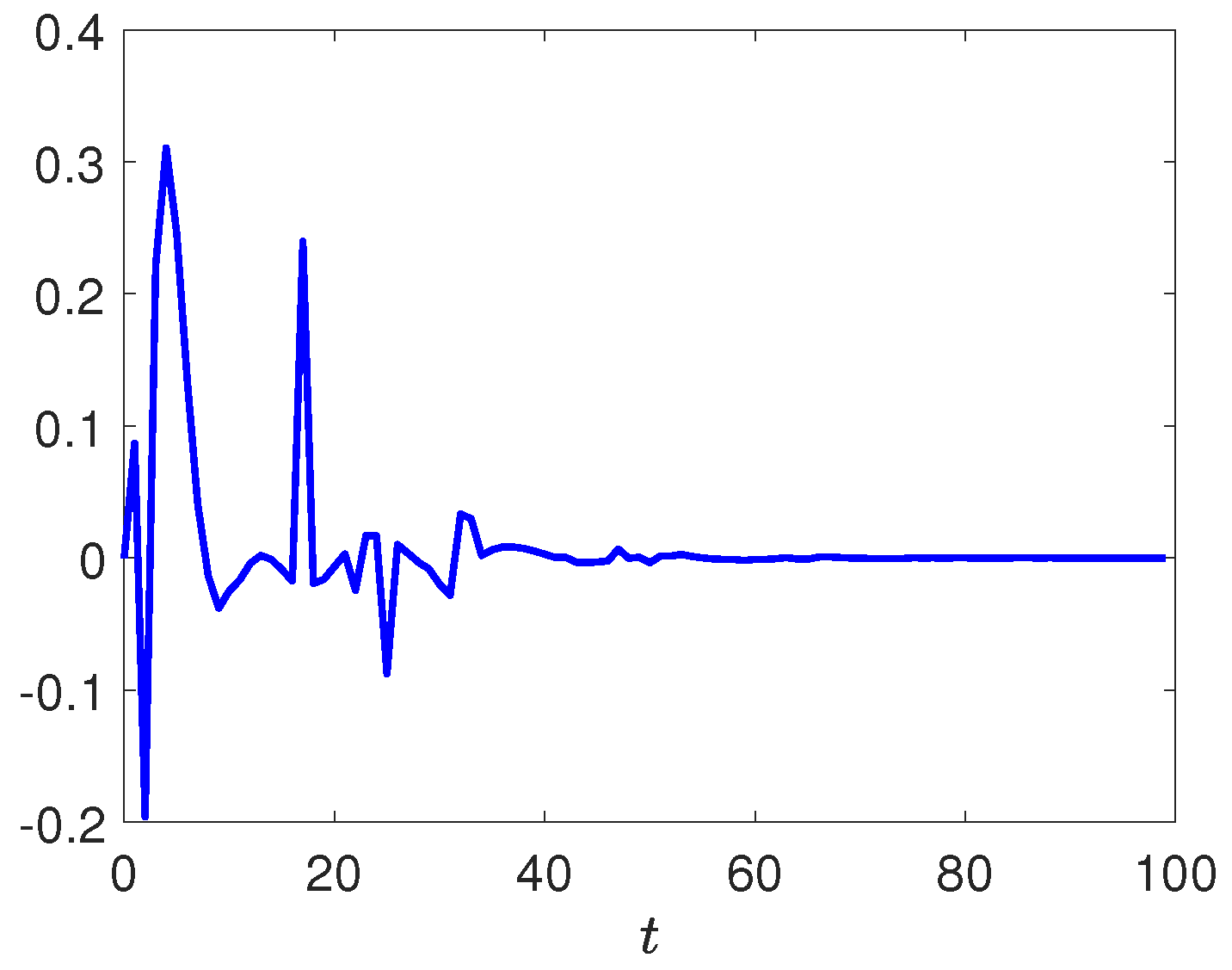
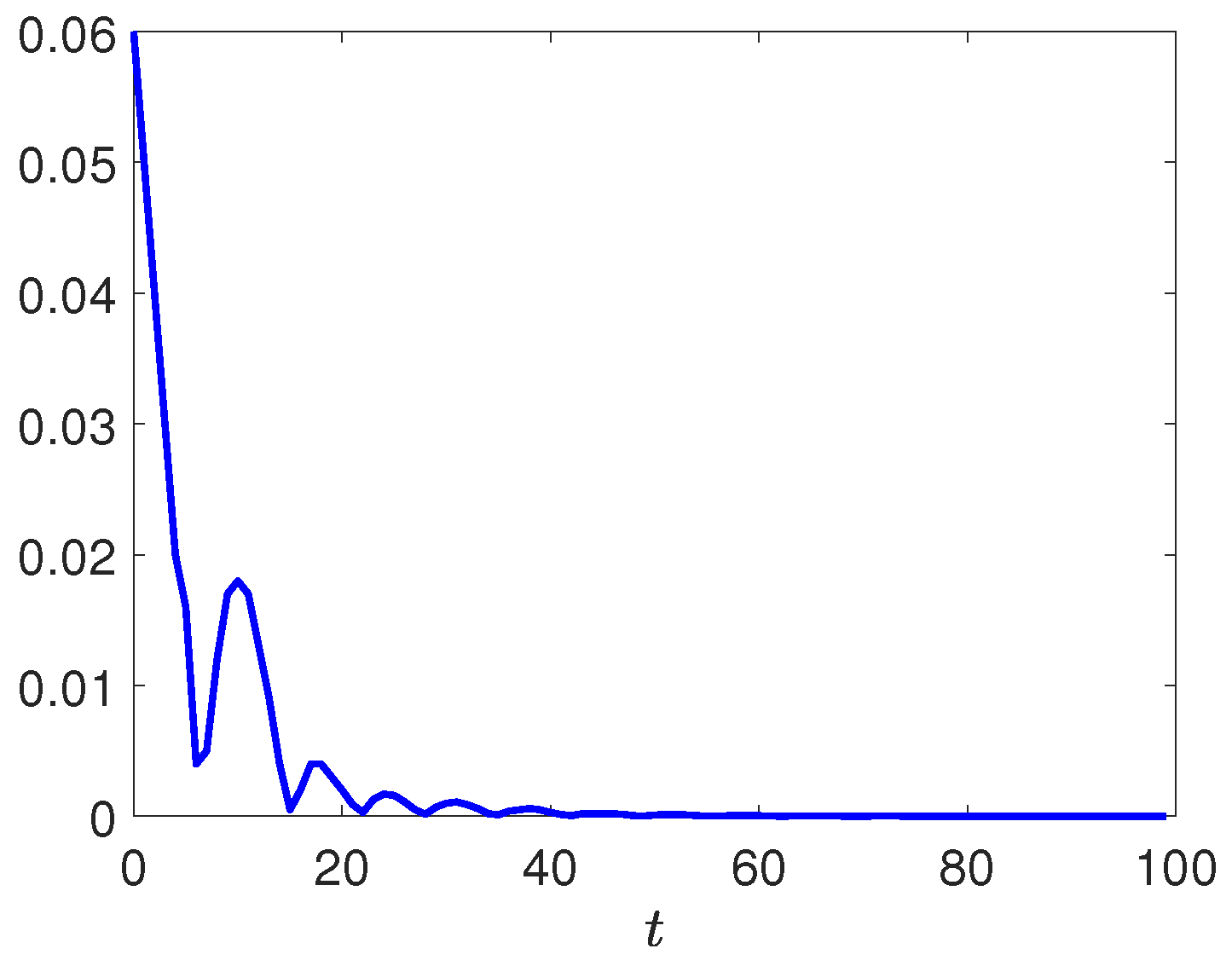
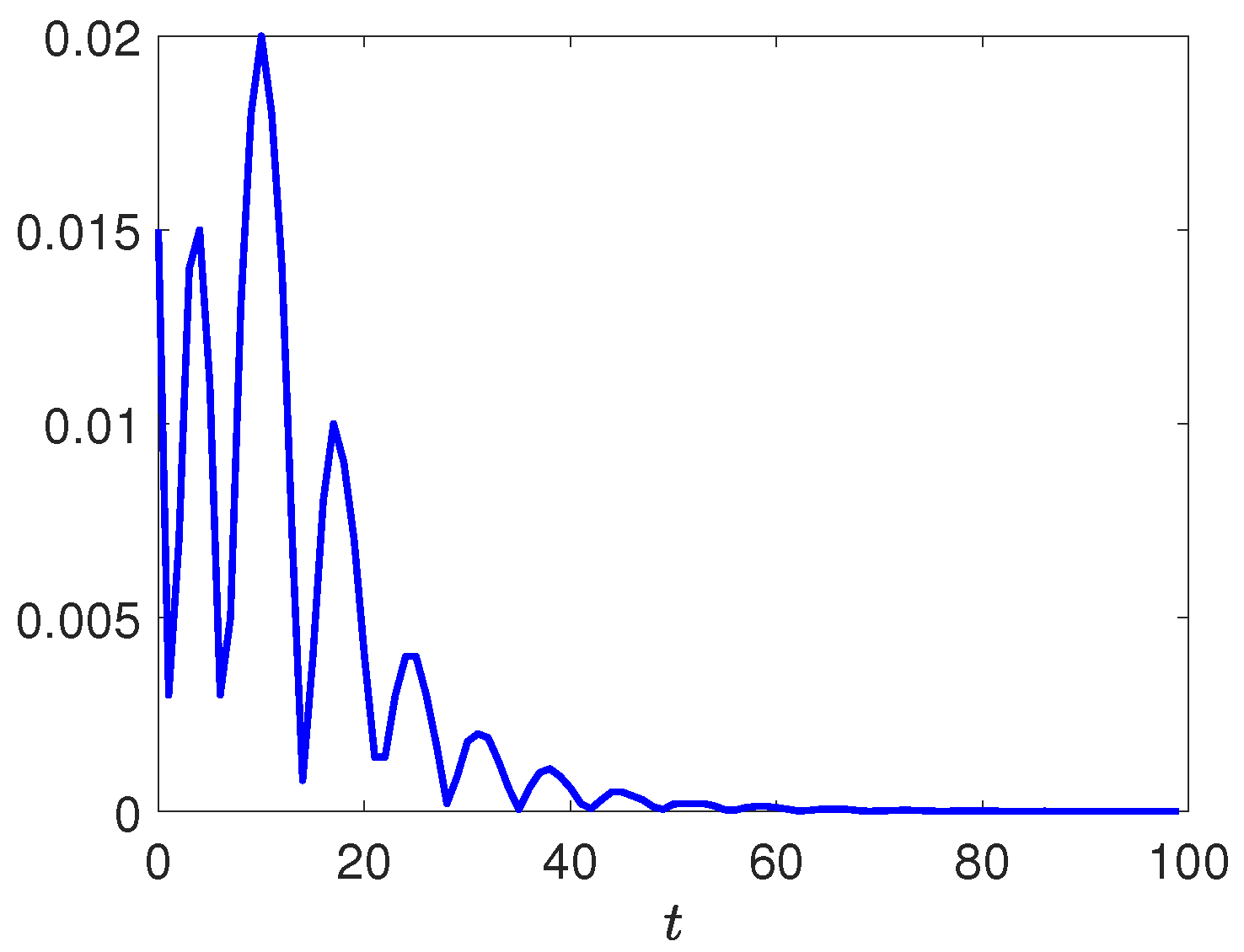
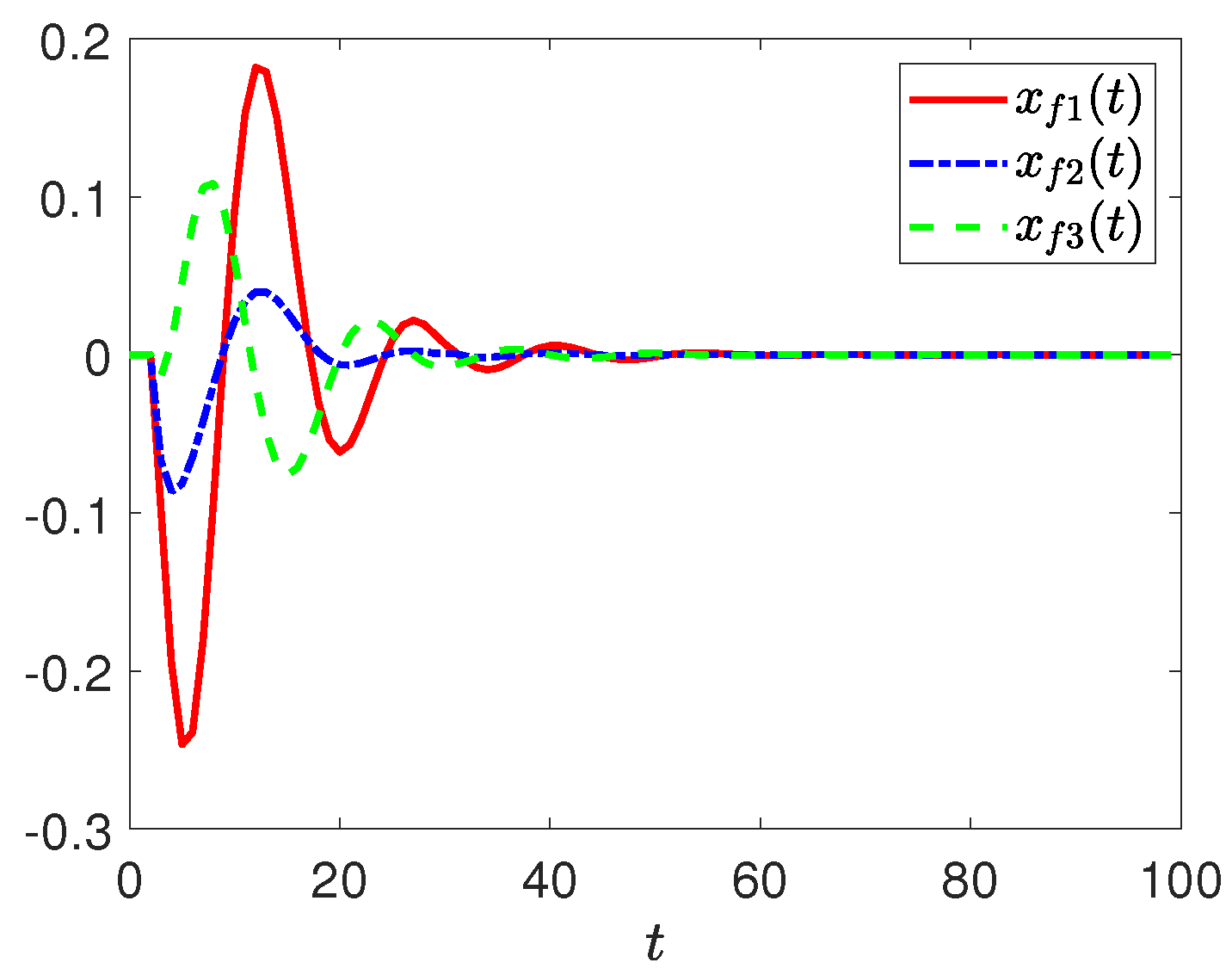
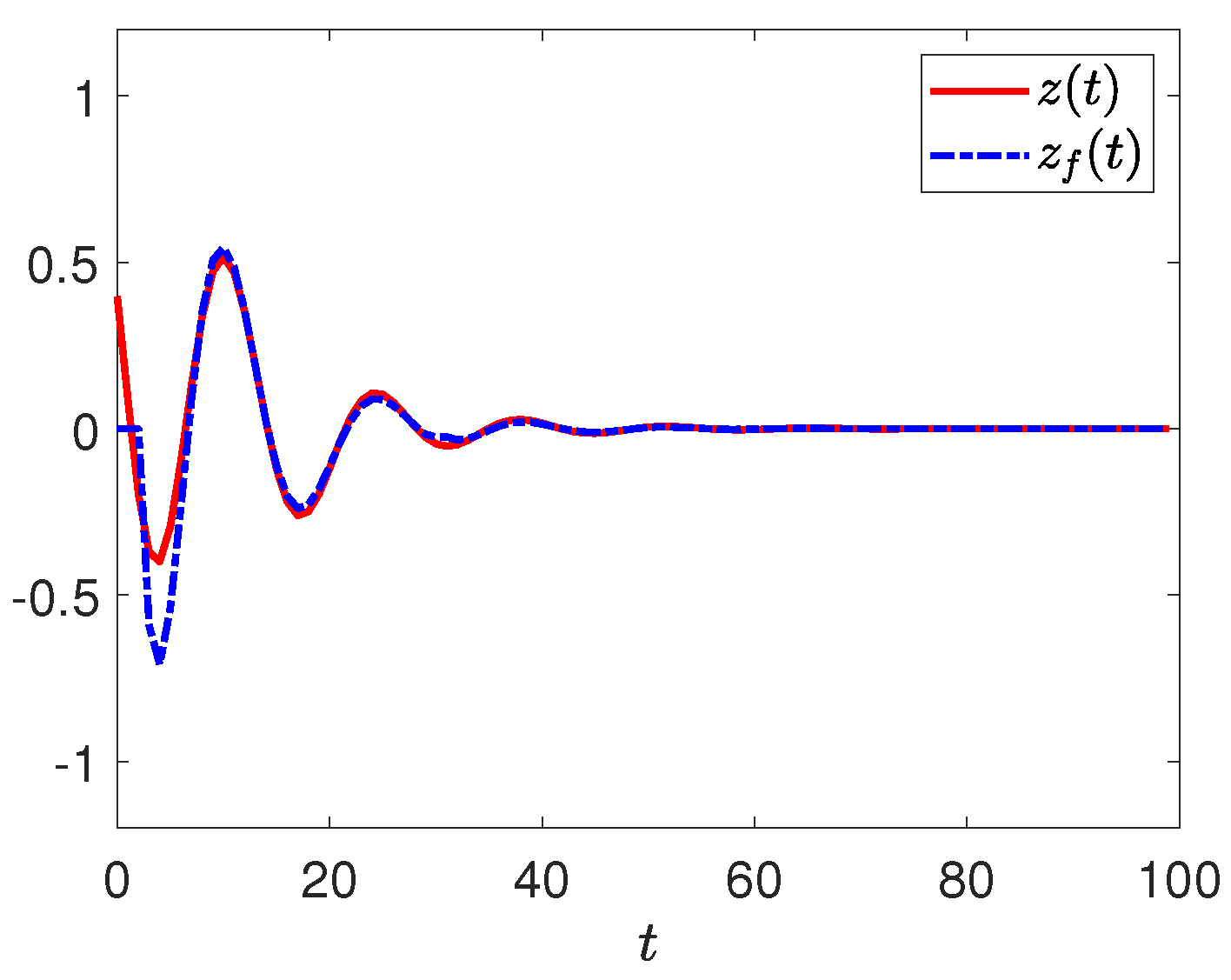
For the simulation, we assume that and . The simulation results are presented in Figure 2, Figure 3, Figure 4, Figure 5, Figure 6 and Figure 7, where the responses of and are indicated in Figure 2 and Figure 3, respectively, Figure 4 plots the responses of and , Figure 5 shows the trajectory of , and the trajectories of the dynamic parameters and are shown in Figure 6 and Figure 7, respectively. The simulation results presented in Figure 2, Figure 3, Figure 4, Figure 5, Figure 6 and Figure 7 demonstrate that the proposed dissipative filter design approach in this paper is effective.
Figure 2.
The response of .
Figure 3.
The response of .
Figure 4.
The responses of and .
Figure 5.
The trajectory of .
Figure 6.
The trajectory of the dynamic parameter .
Figure 7.
The trajectory of the dynamic parameter .
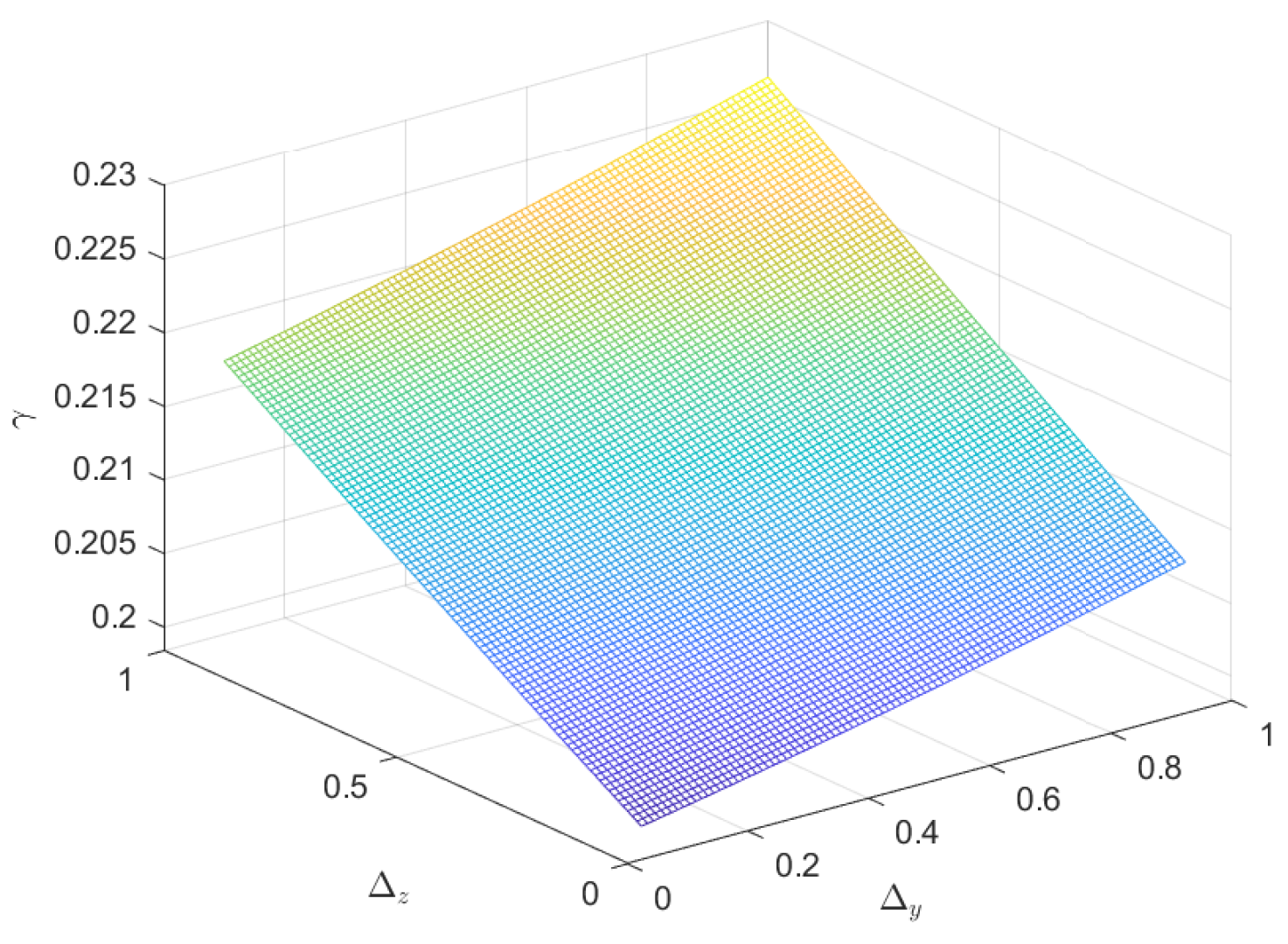
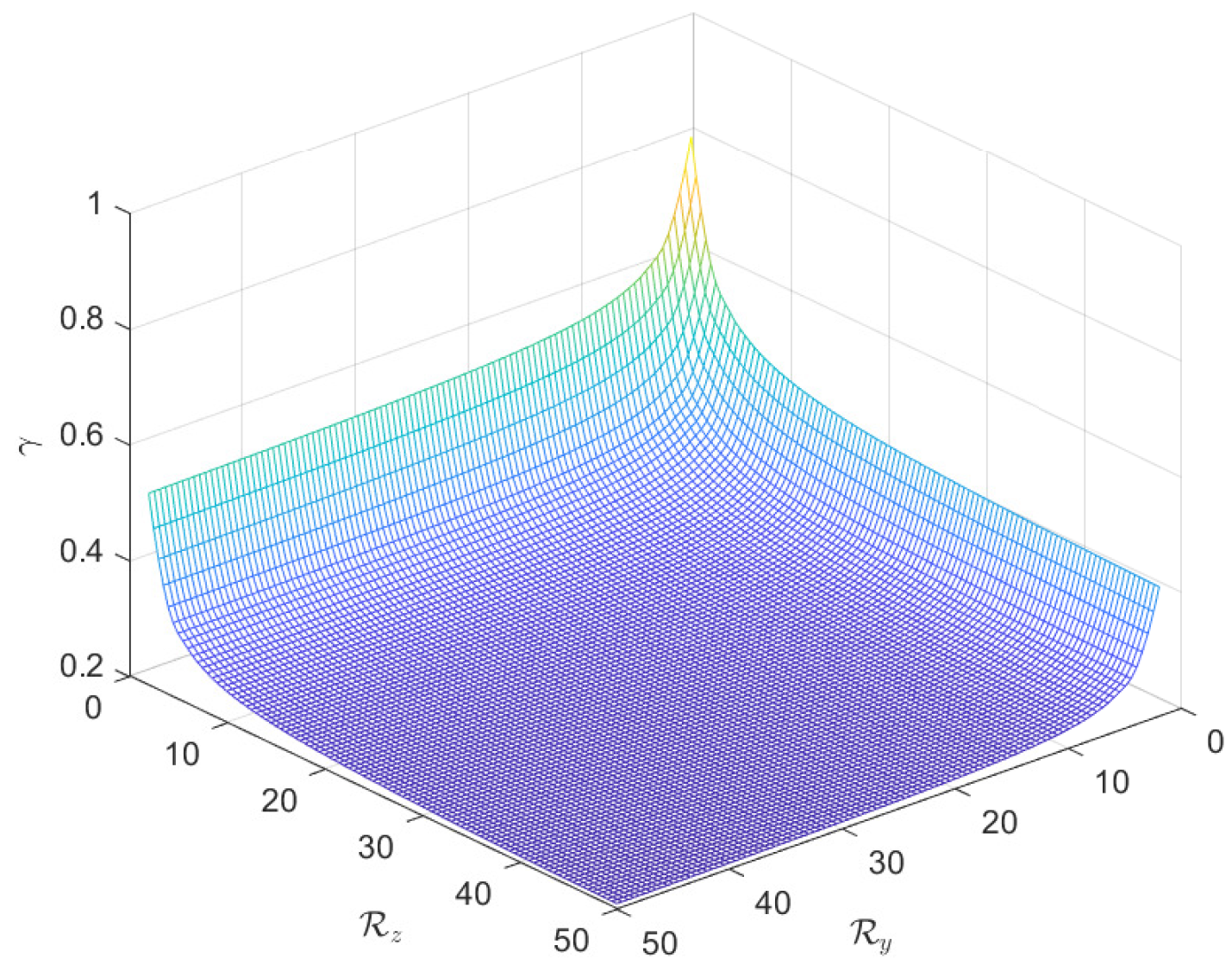
Next, the tunnel diode circuit system (39) will be utilized to investigate the filter design problem according to the results developed in Theorem 2, and the other parameters without detailed definition are same as the first case. Firstly, the effects of quantization error bound () and quantization range () on the optimized filtering performance will be studied with , , and . The optimized filtering performances computed by Theorem 2 with different quantization error bound () and quantization range () are shown in Figure 8 and Figure 9, respectively. As expected, one can observe that increases as the quantization range () decreases and increases as the quantization error bound () increases. Moreover, it is well known that a higher filter order will lead to less design conservatism, i.e., a smaller optimized filtering performance . Then, we demonstrate this proposition. In the presence of different filter order , the optimized filtering performances computed by Theorem 2 with different quantization error bounds and quantization ranges are shown in Table 1 and Table 2, respectively.
Figure 8.
Optimized filtering performance with different quantization error bound ().
Figure 9.
Optimized filtering performance with different quantization error ().
Table 1.
Optimized filtering performance with different quantization error bounds.
Table 2.
Optimized filtering performance with different quantization ranges.
Comparative Explanations: In this paper, the developed filtering strategy can effectively solve both the full- and reduced-order dissipative filtering problems for the nonlinear tunnel diode circuit system in (39) with the effects of dynamic quantization and data packet dropouts based on the T–S fuzzy model strategy. In contrast with the existing results, the main advantages of the proposed filtering strategy can be summarized in the following three aspects.
(1) The proposed dissipative filtering strategy in this paper is more general than the existing results on fuzzy filtering for nonlinear networked systems in [34,35,37,39,40,41,42], because it can also be utilized to deal with several kinds of filtering problems, including passive, , and mixed passive/ filtering problems for the nonlinear tunnel diode circuit system (39). Particularly, both the effects of dynamic quantization and data packet dropouts on the measurement output and the performance output have been considered simultaneously; it implies that the problem addressed in this paper is more in agreement with practical circumstances than the ones considered in [36,38,41,42,43].
(2) In contrast with the quantized filtering problem considered in [38,41], the dynamical quantization methodology employed herein is more general. This is mainly because the stochastic stability of the filtering error system can be ensured under a finite number of quantization levels. By choosing the relevant parameters, the online adjusting strategies in [36,39] can be obtained from the one developed in (17) and (19), which implies that the adjusting strategy for the dynamic parameters () provided in this paper is more general. Moreover, simulation results in Figure 6 and Figure 7 show that the adjustment of the dynamic parameters can be realized based on the online adjusting strategy developed in this paper.
(3) In contrast with the existing results of the filtering problem for networked systems where only full-order filtering problems [34,35,38,39,41] or reduced-order filtering problems [46] were considered, the developed filtering strategy can effectively solve both the full- and reduced-order filtering problems, which is more general. Moreover, different from the results in [36], this example illustrates that both full- and reduced-order filtering problems have been solved in the unified framework of linear matrix inequalities by introducing a dimension adjustment matrix K.
5. Conclusions
In this paper, the dissipative filtering problem has been addressed for discrete-time nonlinear networked systems with dynamic quantization and data packet dropouts based on the T–S fuzzy strategy. Both the effects of dynamic quantization and data packet dropouts have been taken into consideration in both communication channels from the plant to the filter and from the filter to the plant. The sufficient design conditions for both the desired full- and reduced-order dissipative filters have been established in the unified framework of linear matrix inequalities, which guarantees the stochastic stability and the predefined dissipative filtering performance for the filtering error system subject to dynamic quantization and data packet dropouts. In addition, a practical simulation example has been employed to show the effectiveness of the proposed dissipative filtering approach.
However, it is well known that communication delays and cyber attacks, as important challenges in networked systems, are also considered to be unavoidable in practical cases. In this paper, we have only addressed dynamic quantization and data packet dropouts, and the study of the dissipative fuzzy filtering problem for nonlinear networked systems with the simultaneous consideration of dynamic quantization, data packet dropouts, communication delays, and cyber attacks deserves further investigation.
Author Contributions
Conceptualization, S.J. and Z.L.; formal analysis, S.J. and Z.L.; methodology, S.J. and Z.L.; funding acquisition, Z.L.; investigation, writing—original draft preparation and editing, and writing—review and editing, S.J., C.L. and Z.L.; software, S.J. and C.L. All authors have read and agreed to the published version of the manuscript.
Funding
This work was supported in part by the National Natural Science Foundation of China under Grant 62003006, in part by the Science and Technology Project of Hebei Education Department under Grant BJK2022053, in part by the Langfang Youth Talent Support Program under Grant LFBJ202202, in part by the Graduate Innovation Support Program in Hebei Province (CXZ ZSS2024142), and in part by the Graduate Innovation Support Program in North China Institute of Aerospace Engineering under Grant YKY-2023-25.
Institutional Review Board Statement
Not applicable.
Informed Consent Statement
Not applicable.
Data Availability Statement
Data sharing not applicable.
Conflicts of Interest
The authors declare no conflicts of interest.
References
- Liu, J.; Dong, Y.; Zha, L.; Tian, E.; Xie, X. Event-based security tracking control for networked control systems against stochastic cyber-attacks. Inf. Sci. 2022, 612, 306–321. [Google Scholar] [CrossRef]
- Zha, L.; Liao, R.; Liu, J.; Xie, X.; Tian, E.; Cao, J. Dynamic event-triggered output feedback control for networked systems subject to multiple cyber attacks. IEEE Trans. Cybern. 2022, 52, 13800–13808. [Google Scholar] [CrossRef] [PubMed]
- Zhang, X.M.; Han, Q.L.; Ge, X.; Ding, D.; Ding, L.; Yue, D.; Peng, C. Networked control systems: A survey of trends and techniques. IEEE CAA J. Autom. Sin. 2020, 7, 1–17. [Google Scholar] [CrossRef]
- Xiong, J.; Chang, X.H.; Park, J.H.; Li, Z.M. Nonfragile fault-tolerant control of suspension systems subject to input quantization and actuator fault. Int. J. Robust Nonlinear Control 2020, 30, 6720–6743. [Google Scholar] [CrossRef]
- Liberzon, D. Hybrid feedback stabilization of systems with quantized signals. Automatica 2003, 39, 1543–1554. [Google Scholar] [CrossRef]
- Chang, X.H.; Xiong, J.; Li, Z.M.; Park, J.H. Quantized static output feedback control for discrete-time systems. IEEE Trans. Industr. Inf. 2018, 14, 3426–3435. [Google Scholar] [CrossRef]
- Yu, K.; Chang, X.H. Quantized output feedback resilient control of uncertain systems under hybrid cyber attacks. Int. J. Adapt. Control Signal Process. 2022, 36, 2954–2970. [Google Scholar] [CrossRef]
- Niu, Y.; Ho, D.W.C. Control strategy with adaptive quantizer’s parameters under digital communication channels. Automatica 2014, 50, 2665–2671. [Google Scholar] [CrossRef]
- Su, L.; Chesi, G. Robust stability of uncertain linear systems with input and output quantization and packet loss. Automatica 2018, 87, 267–273. [Google Scholar] [CrossRef]
- Wu, C.; Zhao, X.; Xia, W.; Liu, J.; Başar, T. -gain analysis for dynamic event-triggered networked control systems with packet losses and quantization. Automatica 2021, 129, 109587. [Google Scholar] [CrossRef]
- Li, Z.M.; Chang, X.H. Robust control for networked control systems with randomly occurring uncertainties: Observer-based case. ISA Trans. 2018, 83, 13–24. [Google Scholar] [CrossRef] [PubMed]
- Wang, Z.; Yang, F.; Ho, D.W.C.; Liu, X. Robust control for networked systems with random packet losses. IEEE Trans. Syst. Man Cybern. B Cybern. 2007, 37, 916–924. [Google Scholar] [CrossRef] [PubMed]
- Shen, H.; Hu, X.; Wang, J.; Cao, J.; Qian, W. Non-fragile synchronization for Markov jump singularly perturbed coupled neural networks subject to double-layer switching regulation. IEEE Trans. Neural Netw. Learn. Syst. 2023, 34, 2682–2692. [Google Scholar] [CrossRef] [PubMed]
- Nguyen, T.B.; Song, H.K. Further results on robust output-feedback dissipative control of Markovian jump fuzzy systems with model uncertainties. Mathematics 2022, 10, 3620. [Google Scholar] [CrossRef]
- Tanaka, K.; Wang, H.O. Fuzzy Control Systems Design and Analysis: A Linear Matrix Inequality Approach; Wiley: New York, NY, USA, 2001. [Google Scholar]
- Chang, X.H.; Jing, Y.W.; Gao, X.Y.; Liu, X.P. tracking control design of T–S fuzzy systems. Control Decis. 2008, 23, 329–332. (In Chinese) [Google Scholar]
- Liu, J.; Gong, E.; Zha, L.; Tian, E.; Xie, X. Observer-based security fuzzy control for nonlinear networked systems under weighted try-once-discard protocol. IEEE Trans. Fuzzy Syst. 2023, 31, 3853–3865. [Google Scholar] [CrossRef]
- Yao, H.; Gao, F. Design of observer and dynamic output feedback control for fuzzy networked systems. Mathematics 2022, 11, 148. [Google Scholar] [CrossRef]
- Liu, J.; Ke, J.; Liu, J.; Xie, X.; Tian, E. Secure event-triggered control for IT-2 fuzzy networked systems with stochastic communication protocol and FDI attacks. IEEE Trans. Fuzzy Syst. 2023. in press. Available online: https://ieeexplore.ieee.org/abstract/document/10265199 (accessed on 27 September 2023).
- Qiu, J.; Gao, H.; Ding, S.X. Recent advances on fuzzy-model-based nonlinear networked control systems: A survey. IEEE Trans. Ind. Electron. 2016, 63, 1207–1217. [Google Scholar] [CrossRef]
- Chang, X.H.; Yang, C.; Xiong, J. Quantized fuzzy output feedback control for nonlinear systems with adjustment of dynamic parameters. IEEE Trans. Syst. Man Cybern. Syst. 2019, 49, 2005–2015. [Google Scholar] [CrossRef]
- Zha, L.; Huang, T.; Liu, J.; Xie, X.; Tian, E. Outlier-resistant quantized control for T–S fuzzy systems under multi-channel-enabled round-robin protocol and deception attacks. Int. J. Robust Nonlinear Control 2023, 33, 10916–10931. [Google Scholar] [CrossRef]
- Li, Z.M.; Park, J.H. Dissipative fuzzy tracking control for nonlinear networked systems with quantization. IEEE Trans. Syst. Man Cybern. Syst. 2020, 50, 5130–5141. [Google Scholar] [CrossRef]
- Wang, J.; Yang, C.; Xia, J.; Wu, Z.G.; Shen, H. Observer-based sliding mode control for networked fuzzy singularly perturbed systems under weighted try-once-discard protocol. IEEE Trans. Fuzzy Syst. 2022, 30, 1889–1899. [Google Scholar] [CrossRef]
- Liu, J.; Wei, L.; Xie, X.; Tian, E.; Fei, S. Quantized stabilization for T–S fuzzy systems with hybrid-triggered mechanism and stochastic cyber-attacks. IEEE Trans. Fuzzy Syst. 2018, 26, 3820–3834. [Google Scholar] [CrossRef]
- Zheng, Q.; Xu, S.; Du, B. Quantized guaranteed cost output feedback control for nonlinear networked control systems and its applications. IEEE Trans. Fuzzy Syst. 2022, 30, 2402–2411. [Google Scholar] [CrossRef]
- Gao, H.; Zhao, Y.; Chen, T. fuzzy control of nonlinear systems under unreliable communication links. IEEE Trans. Fuzzy Syst. 2009, 17, 265–278. [Google Scholar]
- Qiu, J.; Feng, G.; Gao, H. Fuzzy-model-based piecewise static-output-feedback controller design for networked nonlinear systems. IEEE Trans. Fuzzy Syst. 2010, 18, 919–934. [Google Scholar] [CrossRef]
- Li, H.; Wu, C.; Jing, X.; Wu, L. Fuzzy tracking control for nonlinear networked systems. IEEE Trans. Cybern. 2017, 47, 2020–2031. [Google Scholar] [CrossRef]
- Liu, J.; Wang, Y.; Cao, J.; Yue, D.; Xie, X. Secure adaptive-event-triggered filter design with input constraint and hybrid cyber attack. IEEE Trans. Cybern. 2021, 51, 4000–4010. [Google Scholar] [CrossRef]
- Gao, H.; Chen, T. estimation for uncertain systems with limited communication capacity. IEEE Trans. Autom. Control 2007, 52, 2070–2084. [Google Scholar] [CrossRef]
- Liu, J.; Gong, E.; Zha, L.; Xie, X.; Tian, E. Outlier-resistant recursive security filtering for multirate networked systems under fading measurements and round-robin protocol. IEEE Trans. Control Netw. Syst. 2023. in press. Available online: https://ieeexplore.ieee.org/abstract/document/10068263 (accessed on 13 March 2023).
- Zheng, Q.; Xu, S.; Du, B. Asynchronous resilent state estimation of switched fuzzy systems with multiple state impulsive jumps. IEEE Trans. Cybern. 2023, 53, 7966–7979. [Google Scholar] [CrossRef]
- Chang, X.H. filter design for T–S fuzzy systems with D stability constraints. Control. Decis. 2011, 26, 1051–1055. (In Chinese) [Google Scholar]
- Liu, J.; Zha, L.; Tian, E.; Xie, X. Interval type-2 fuzzy-model-based filtering for nonlinear systems with event-triggering weighted try-once-discard protocol and cyber-attacks. IEEE Trans. Fuzzy Syst. 2023. in press. Available online: https://ieeexplore.ieee.org/abstract/document/10221224 (accessed on 16 August 2023).
- Chang, X.H.; Li, Z.M.; Park, J.H. Fuzzy generalized filtering for nonlinear discrete-time systems with measurement quantization. IEEE Trans. Syst. Man Cybern. Syst. 2018, 48, 2419–2430. [Google Scholar] [CrossRef]
- Li, Z.M.; Xiong, J. Event-triggered fuzzy filtering for nonlinear networked systems with dynamic quantization and stochastic cyber attacks. ISA Trans. 2022, 121, 53–62. [Google Scholar] [CrossRef] [PubMed]
- Chang, X.H.; Wang, Y.M. Peak-to-peak filtering for networked nonlinear DC motor systems with quantization. IEEE Trans. Ind. Inf. 2018, 14, 5378–5388. [Google Scholar] [CrossRef]
- Chang, X.H.; Liu, Y. Robust filtering for vehicle sideslip angle with quantization and data dropouts. IEEE Trans. Veh. Technol. 2020, 69, 10435–10445. [Google Scholar] [CrossRef]
- Zhao, X.Y.; Chang, X.H. filtering for nonlinear discrete-time singular systems in encrypted state. Neural Process. Lett. 2023, 55, 2843–2866. [Google Scholar] [CrossRef]
- Zhang, C.; Feng, G.; Gao, H.; Qiu, J. filtering for nonlinear discrete-time systems subject to quantization and packet dropouts. IEEE Trans. Fuzzy Syst. 2011, 19, 353–365. [Google Scholar] [CrossRef]
- Gao, H.; Zhao, Y.; Lam, J.; Chen, K.E. fuzzy filtering of nonlinear systems with intermittent measurements. IEEE Trans. Fuzzy Syst. 2009, 17, 291–300. [Google Scholar]
- Chang, X.H.; Liu, Q.; Wang, Y.M.; Xiong, J. Fuzzy peak-to-peak filtering for networked nonlinear systems with multipath data packet dropouts. IEEE Trans. Fuzzy Syst. 2018, 27, 436–446. [Google Scholar] [CrossRef]
- Liu, Y.; Guo, B.Z.; Park, J.H.; Lee, S. Event-based reliable dissipative filtering for T–S fuzzy systems with asynchronous constraints. IEEE Trans. Fuzzy Syst. 2017, 26, 2089–2098. [Google Scholar] [CrossRef]
- Chang, X.H.; Park, J.H.; Zhou, J. Robust static output feedback control design for linear systems with polytopic uncertainties. Syst. Control Lett. 2015, 85, 23–32. [Google Scholar] [CrossRef]
- Cai, L.J.; Chang, X.H. Reduced-order filtering for discrete-time singular systems under fading channels. Int. J. Syst. Sci. 2023, 54, 99–112. [Google Scholar] [CrossRef]
Disclaimer/Publisher’s Note: The statements, opinions and data contained in all publications are solely those of the individual author(s) and contributor(s) and not of MDPI and/or the editor(s). MDPI and/or the editor(s) disclaim responsibility for any injury to people or property resulting from any ideas, methods, instructions or products referred to in the content. |
© 2024 by the authors. Licensee MDPI, Basel, Switzerland. This article is an open access article distributed under the terms and conditions of the Creative Commons Attribution (CC BY) license (https://creativecommons.org/licenses/by/4.0/).