1. Introduction
Navier–Stokes systems, which describe the movement of a fluid, have been the subject of research by many authors. Here, we only note the monographs [
1,
2,
3], which are fundamental and have become classic works on this topic. In many applications, there is a need to study boundary value problems in domains with moving boundaries known as non-cylindrical domains [
4,
5,
6,
7,
8,
9,
10,
11,
12,
13,
14].
For problems involving degenerate domains, earlier, in [
15,
16,
17,
18,
19], we used the method of cutting off a family of neighborhoods of the degeneracy point of a domain. For the resulting family of boundary value problems, we applied a one-to-one transformation of them to problems in cylindrical domains and established their unique solvability in Sobolev classes. As a result, we obtained the unique solvability of a family of boundary value problems for truncated non-degenerate domains. This transformation introduced additional terms, causing the coefficients of the equations become dependent on the independent variables. In the work presented, we do things completely differently. Here, we use spectral decomposition and a priori estimates to solve the boundary value problems under study without the need for these preliminiary transformations. However, when establishing a priori estimates, additional difficulties arise due to the presence of normal derivatives on the boundary of the desired functions in integral identities that replace differential equations, boundary conditions, and initial conditions. In this work, we managed to overcome these and other emerging difficulties.
We also want to mention recent works [
20,
21] devoted to the study of the three-dimensional Navier–Stokes equation, the results of which may be of interest to readers.
First, in this paper, we study the solvability of the initial-boundary value problem for a 3D linearized system of Navier–Stokes equations in a truncated cone:
with a homogeneous Dirichlet boundary and initial conditions. We use the basis
, which is an independent system of functions in the solution space for a 3D linearized system of Stokes equations in the case of a unit ball. The existence of such a basis, for example, follows from the result of the work ([
3], Chapter 1, Section 2.6). A time parameter
t is introduced, subject to the following constraint:
and the family of balls
which forms the truncated cone
By applying the aforementioned result on the basis of the unit ball to the problem with balls of variable radii, changing according to a linear law with respect to the time variable
t, we obtain a time-dependent basis, i.e.,
It should be noted that the constructed basis will ensure the fulfillment of the incompressibility condition:
and, on the generatrix of the truncated cone of homogeneous Dirichlet boundary conditions,
Next, using the Faedo–Galerkin method, we establish, in Sobolev classes, the unique solvability of the initial-boundary value problem for a 3D time-dependent Stokes equations in a truncated cone. For this purpose, a priori estimates for Galerkin approximations are established and formulated in the form of a series of lemmas, and the passage to the limit is carried out using the methods of function theory and functional analysis. A priori estimates are found for the solution of the initial problem posed for a domain represented by a truncated cone. The latest a priori estimates allow us to obtain statements about the uniqueness and, additionally, about the differential properties of the desired solution. Next, the result regarding the unique solvability of the problem for a truncated cone is used to prove the main result of the work: the unique solvability of the boundary value problem for the 3D linearized system of Navier–Stokes equations in the degenerate domain represented by a cone. In conclusion, we indicate how the results obtained in the work can be developed for a degenerate curvilinear cone when the radii of the cone sections change according to the nonlinear law
. We present a set of requirements that are sufficient to impose on the function
.
2. Statement of the Initial-Boundary Value Problem and Boundary Value Problem for a Three-Dimensional Linearized Navier–Stokes System in Domains Represented by a Truncated Cone and a Cone, Respectively
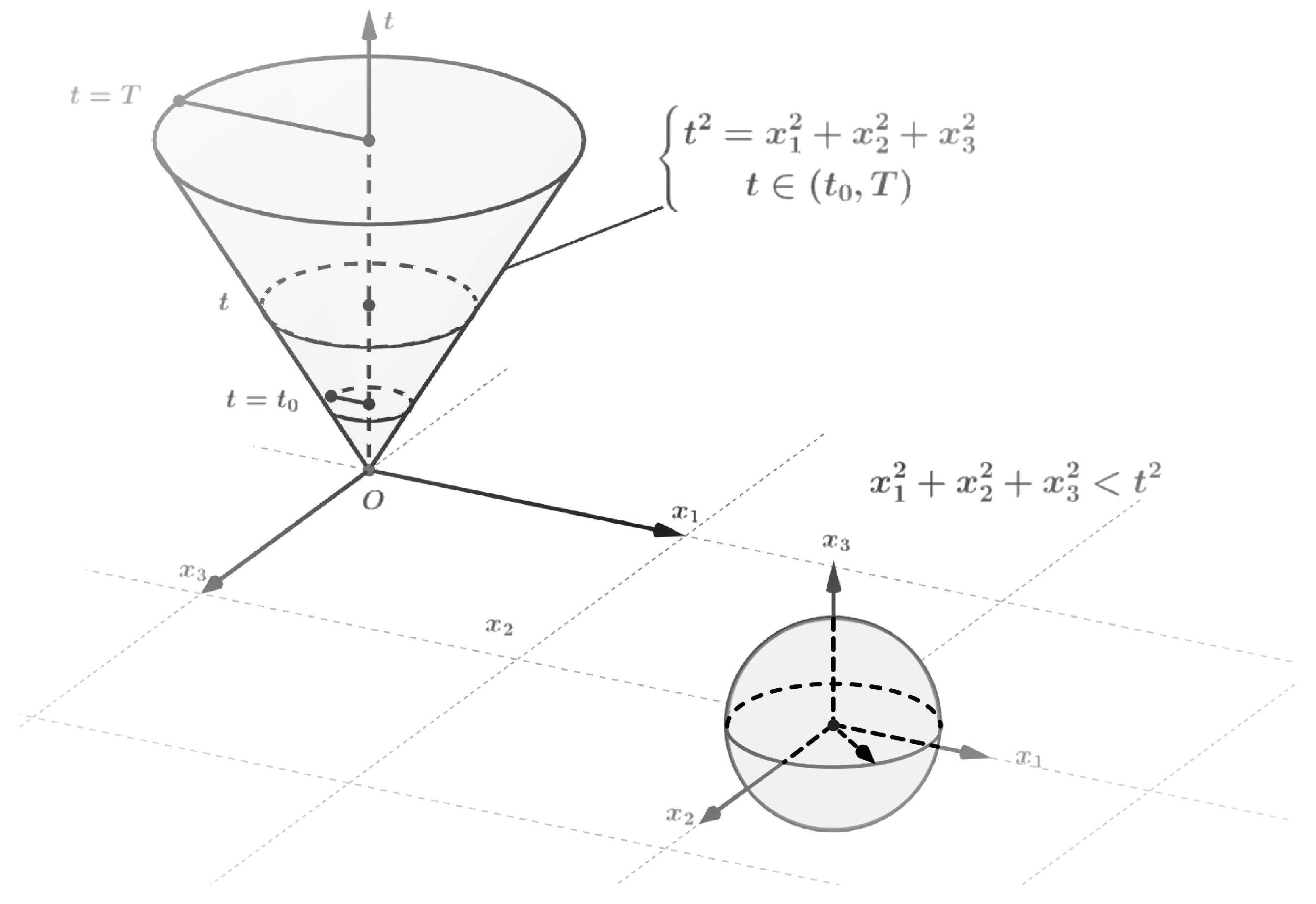
Let be a truncated cone, and be the section (representing a ball with radius equal to t) of the cone for any fixed with boundary ; is the generatrix of the truncated cone. Along with the truncated cone, we define the cone with a vertex at the origin, is the generatrix of the cone, and is the section of the cone Q for any fixed .
For any fixed
, the boundary of the section
of the cone
Figure 1, can be represented, for example, in the form
where
Obviously, there are other representations different from (
1). For definiteness, throughout the work, we will use the Representation (
1) of a sphere, the surface of a ball of radius
t.
In the truncated cone
, we consider the initial-boundary value problem for the linear three-dimensional Navier–Stokes equation of determining the vector function
and scalar function
:
Along with problem (
4)–(
7), we will also study the boundary value problem in the cone
Q of determining the vector function
and scalar function
:
It should be noted that, in the boundary value problem (
8)–(
10), there is no initial condition (
7), since the lower base of the cone degenerates into a point (the vertex of the cone).
According to the monographs [
1,
2,
3], we will give the designations of the spaces necessary in the work. For each
, we introduce the notations of spaces
, and
used in studying the solvability of the initial-boundary value problem (
4)–(
7), and which we will use in the future:
The following dense embeddings take place:
and
are inner products in spaces
and
respectively. The Helmholtz decomposition of space
:
where
and the “prime” symbol denotes a topologically dual space.
Using the introduced spaces, we will give meaningful formulations of the problems studied in the work.
Problem 1 (Truncated cone)
. Let Establish the unique solvability of the initial-boundary value problem (
4)–(
7)
in the space , . Problem 2 (Cone)
. Let in problem (
8)–(
10)
Establish the unique solvability of the boundary value problem (
8)–(
10)
in the space In what follows, we first prove the unique solvability of Problem 1 for a truncated cone (Theorem 2).
Section 3,
Section 4 and
Section 5 are devoted to the proof of Theorem 2. Using the statement of Theorem 2, we prove the unique solvability of Problem 2 (Theorem 3). The work ends with a brief conclusion.
3. Galerkin Approximations
Let, for each
, the system of functions
be a basis in the space
, i.e., in particular, for each function
and for each
, the following equalities take place:
and, for each
k, there exists a function
such that the equations with the spectral parameter from (
12) are satisfied. Thus, we assume that the basis is composed of the eigenfunctions of the spectral problem (
12), which is orthonormal.
In the future, we will need the following proposition:
Let a variational formulation of the spectral problem for the Stokes operator be given:
where
are inner products in the spaces
and
respectively. Obviously, the eigenfunctions
and eigenvalues
will depend on the time variable
t. As is known, problem (
11) is interpreted as follows: for each
k, there exists
, such that
Let the section
of the cone
be transformed into a ball of constant radius equal to one,
. We achieve this goal by the following transformation of independent variables:
Thus, we have proved the following.
Proposition 1. The elements of the basis are differentiable with respect to t, i.e., there is a partial derivative Then, by virtue of (
13) and the replacement
statements of the spectral problems (
11) and (
12) for the Stokes operator take the form, respectively,
where
are inner products in the spaces
and
respectively, and the eigenvalues
are constant, i.e.,
. The designations of the spaces
and
correspond to the domain
which are defined in the same way as the spaces
and
for the domain
.
Now, we can show that the partial derivative of the eigenfunction
with respect to the variable
t exists. Namely, according to (
14), we have
since, according to (
14), we have
Let us move on to Galerkin approximations. It should be noted that we considered similar issues in [
7,
8,
9,
15,
16,
17,
18,
19]. Using this basis, to solve the initial-boundary value problem (
4)–(
7), we introduce Galerkin approximations:
where the functions
are unknown and must be determined. Then, scalarly multiplying Equation (
4) by
in the space
and taking into account the incompressibility conditions (
5) and boundary conditions (
6), as well as the Galerkin approximations (
19), we obtain a system of
N ordinary differential equations for unknown functions
,
:
where
and, according to (
17), we obtain
or
where the following equality is used:
Let us write the system (
23) in matrix form:
where the matrices
and vectors
are given by the following formulas:
Further, since, for each fixed variable value of
t from the interval
, the system of functions
is linearly independent, then, from the initial condition (
7), we directly obtain
Since, for each
, the matrix
is a Gram matrix, it is invertible for each fixed
and, from (
24) and (
25), we obtain the following Cauchy problem:
According to the well-known Caratheodory theorem ([
22], Chapter 1, paragraph 1) for the Cauchy problem (
26) with measurable coefficients, the following lemma takes place.
Lemma 1. The Cauchy problem (
26)
has a unique absolutely continuous solution Using this solution, we find an explicit formula for the Galerkin approximation (
19), for which we will establish a priori estimates in the next section.
4. A Priori Estimates for Galerkin Approximations
We multiply equation (
23) by
and add the resulting
N-equations by index
l. Then, considering the equality (
19) and the relations (
21)–(
22), we obtain
Next, we will use the validity of the following proposition.
Proposition 2. If, for the time being, we assume that the boundary conditions (
6)
are inhomogeneous, then, taking into account the representation of the sphere (
1)–(
3)
for the ball , the first term on the left side of equality (
27)
will be written as follows:where, using ([23], paragraph. 626, formula (5), p. 257), from (
28)
, we obtainwhere the differential of the surface on the sphere is determined by the formula If the boundary conditions (
6)
are satisfied, i.e., they are homogeneous, then, from (
28)
, we obtainwhere the term in (28) is identically equal to zero. In our case, according to equality (
30), identity (
27) will be written as
By virtue of equality (
31), applying Gronwall’s lemma, we establish the validity of the following lemma.
Lemma 2. For the Galerkin approximation (
19)
of the initial-boundary value Problem (
4)–(
7)
, the following a priori estimate is valid:where the constant value does not depend on N and t. Lemma 2 allows us to establish the following theorem on the weak solvability of the initial-boundary value problems (
4)–(
7) ([
3], chapter III, §1, Theorem 1.1).
Theorem 1. Let Then, the initial-boundary value problem (
4)–(
7)
has a unique solution , such thatand the following a priori estimates hold:where the constants and depend only on the measure of the domain Ω, and T. From (
33) and the estimates (
34) of Theorem 1, the following corollary follows.
Corollary 1. Let Then, according to the Trace theorem, the following estimates hold:where is the unit outward normal to the boundary . Now, let us establish a stronger a priori estimate contained in the statement of the following lemma.
Lemma 3. For the Galerkin approximation (
19)
of the initial-boundary value problems (
4)–(
7)
, the following a priori estimate is valid:where the constant value does not depend on N and t. First of all, let us make the following propositions, which will be taken into account in the proof of Lemma 3.
Proposition 3. According to Theorem 1.5 from ([3], chapter I, §1), for each the orthogonal complement (to in the space ) decomposes into the direct product , where Then, the following equalities hold true:where is the unit outward normal to the boundary , and, according to the statements of Lemma 2 and inequalities (
35)–(
36)
from Corollary 1, we obtain the following estimate: Further, considering the spectral problem (
12), we have:
or, multiplying the previous equalities by
and summing the resulting expressions over the index
l, we obtain:
Further, from (
39)–(
41), as well as (
33) and the estimates (
34) of Theorem 1, we conclude that the vector function
is bounded in the space
for
and its norm is bounded by the norm
for
where
.
Proposition 4. The following relation holds true: Further, from (
34) and (
41)–(
43), respectively, we have:
Proposition 5. The first term in (57) can be written as Proof of Proposition 5. The equality (
45) follows from the following relations: from the boundary condition (
6),
we obtain
where
i.e., the vector
has the representation
Thus, from (
46)–(
51), we have the relation
and
(
50), respectively, for + and −.
Finally, using the relation (
52), we obtain the required equality (
45). □
The details of further transformations are summarized in the following proposition.
Proposition 6. If the boundary conditions (
6)
are satisfied, i.e., they are homogeneous, then, for the first term on the left-hand side of (
57)
, we will havewhere, using ([23], sec. 626, formula (5), p. 257), for the surface differential on the sphere we obtain Next, from (
53)
, we obtain Now, from (
57) and (
54), it directly follows that
Remark 1. We have already established the estimates for the terms in the second row and the last term of relation (
55)
. These are given by expressions (
33)–(
36), (
39)–(
42)
, and (
44)
. Therefore, it is sufficient to only establish the estimates for the two boundary integrals on the right-hand side of the equality in relation (
55). For this purpose, it will be convenient to introduce the following notations for the sets:
Let us establish the estimate for the first term on the right-hand side of the equality in (
55). Using the interpolation inequality from ([
24], Theorem 5.9, pp. 140–141), we have
It should be noted that we can establish a similar estimate to (
56) for the second term on the right-hand side of the equality in (
55) as well.
Proof of Lemma 3. In (
20), by replacing the factor
with
, we obtain
Let
. Using the relations from Proposition 3, multiplying the equality (
57) by
and summing the resulting
N equations over the index
l, we obtain
Now, using (
41)–(
44), from (
58), we obtain
Here, we used Propositions 5 and 6.
From (
58), using the estimates (
34), (
35), and (
37), as well as (
41) and (
42), we obtain the statement of Lemma 3 for the case when
.
Now, let
. In this case, we additionally need to estimate the following term (see Equation (
39)):
The necessary estimates for the factors in (
60) follow from (
35) and (
36). Thus, we obtain the statement of Lemma 3 for the case when
.
Thus, according to (
56) and Remark 1, from (
55), we obtain
Next, in Equation (
61), by applying the Cauchy
-inequality and Gronwall’s inequality, we establish the required a priori estimate (
38). □
Lemma 4. For the Galerkin approximation (
19)
of the initial-boundary value problem (
4)–(
7)
, the following a priori estimate holds:where the constant is independent of N and t. Proof of Lemma 4. Taking into account the validity of equality (
21), we replace the factor
in (
27) with
. Since, for the cross-section of the cone
, the inequality
holds, we obtain
Here, the following relation is used:
Furthermore, according to the assertion of Theorem 1, for the last term in (
63), we have the estimates
and, accordingly, by Lemma 2, we obtain
Using the estimates (
64)–(
65), as well as relation (
45), from (
63), we obtain
Next, based on the estimate (
56), from (
66), it follows
Using the assertions of Lemmas 2 and 3 to estimate the terms
and
in the right-hand side of (
67), respectively, as well as Gronwall’s lemma, from (
67), we establish the required estimate of Lemma 4. □
7. Conclusions
In this work, the unique solvability of the initial-boundary value problem for the 3D time-dependent Stokes system in the truncated cone
is investigated. The unique solvability of the boundary value problem in the case of a cone, when the domain
Q of independent variables
degenerates at the initial moment of time at the top of the cone, is separately studied. The results of the work can also be developed for the case when the lengths of the radii of sections
of the cone
Q change according to the nonlinear law
. In this case, it is enough to impose the following conditions on the function
:
and the differential of the surface
(
29), in this case, on the sphere
, will be determined by the formula
It should be noted that, in the case we considered in this work, Obviously, conditions and are met.