


Abstract
Let be two real numbers such that , and let be two parameters defined on the domain of a function, for example, f. Based on the well known Hölder inequality, we propose a generic inequality of the form and show that many basic special functions, such as the gamma and polygamma functions, Riemann zeta function, beta function and Gauss and confluent hypergeometric functions, satisfy this type of inequality. In this sense, we also present some particular inequalities for the Gauss and confluent hypergeometric functions to confirm the main obtained inequalities.
Keywords:
Hölder inequality; gamma and beta functions; Gauss and confluent hypergeometric functions; Riemann zeta function MSC:
26D15; 26D20; 33C05; 33C20; 33B15; 33B20
1. Introduction
Mathematical inequalities, which strengthen the connection of mathematical sciences with applied sciences such as physics, engineering, numerical analysis and statistics, have been widely used in many fields, such as convex analysis, convex programming, approximation theory, special functions, fractional analysis and quantum analysis, and have also brought new orientations to these fields. One of these inequalities is the well-known Hölder inequality, which plays a significant role in different branches of mathematical sciences [1,2].
Let denote a weighted space of p-power integrable functions with the standard norm
where is a positive function on the interval , and let denote a weighted discrete space of p-power functions with the norm
where is a positive jump function on the counter set .
Throughout this paper, we assume that are two real numbers such that . For two given functions in a linear normed space, the weighted Hölder inequality [3]
can be indicated in a continuous space as
and in a discrete space as
If and also
where are free parameters, inequalities (1) and (2), respectively, change to
and
In this paper, we apply inequalities (4) and (5) to obtain new types of inequalities for many basic special functions. First, by noting (5), we derive an inequality for the Riemann zeta function with infinite series representation. Then, in Section 2.2 and Section 2.3, we respectively obtain new inequalities for gamma and polygamma functions with integral representations. Finally, in Section 2.4, Section 2.5 and Section 2.6, we introduce new types of inequality for some multi-argument functions such as the beta, Gauss and confluent hypergeometric functions. In this sense, some particular inequalities are given for the first time for very important Gauss and confluent hypergeometric series.
2. Results
In 2012, we proposed a generic inequality of the form [4]
where are real parameters and is a specific function, and then applied it to some special functions. Recently, in [5], we modified inequality (6) to
whose generalization is in the form
If in (7), and , it clearly changes to
Noting Hölder inequality (4) and (5), an extension of inequality (7) can be proposed as follows:
whose generalization is as follows:
Noting (8), the equivalent forms of (9) and (10) are, respectively,
and
in which and as before.
In this section, we show that many basic special functions would satisfy inequalities of types (9) and (10), and/or their equivalent forms (11) and (12).
2.1. An Inequality for the Riemann Zeta Function
For , the Riemann zeta function [6] is defined by
By substituting into (5) for , one obtains
which means
provided that .
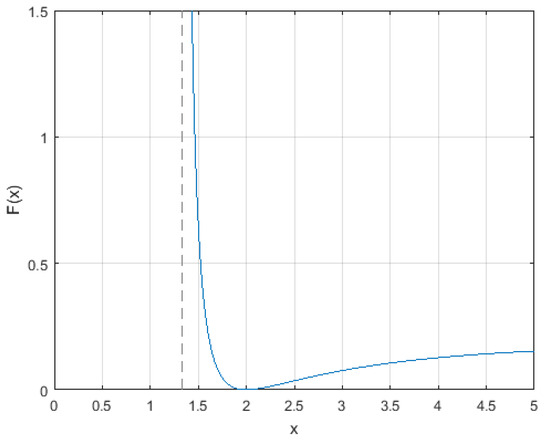
In order to graphically illustrate the correctness of inequality (14), we can first define the two-variable function
and show that its plot is always positive on the domain .
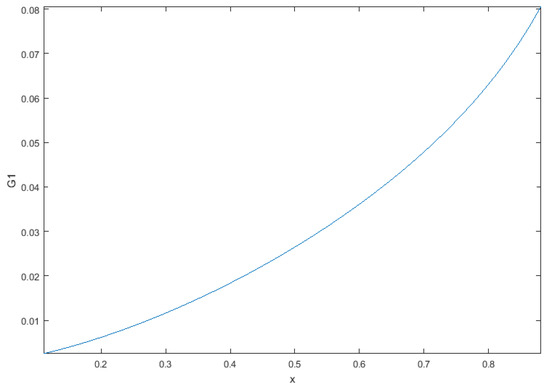
For instance, replacing shows that the univariate function
is always positive on the real interval according to Figure 1.
Figure 1.
Positivity of on .
2.2. An Inequality of Type (9) or (11) for the Gamma Function
As the integral representation of the gamma function is
For , if we replace
and in (4), then
leading to
which is equivalent to
For example, replacing and in (15) gives
Similar to the previous example, in order to graphically illustrate the correctness of inequality (16), one can define the two-variable function
and show that its plot is always positive on the triangular domain .
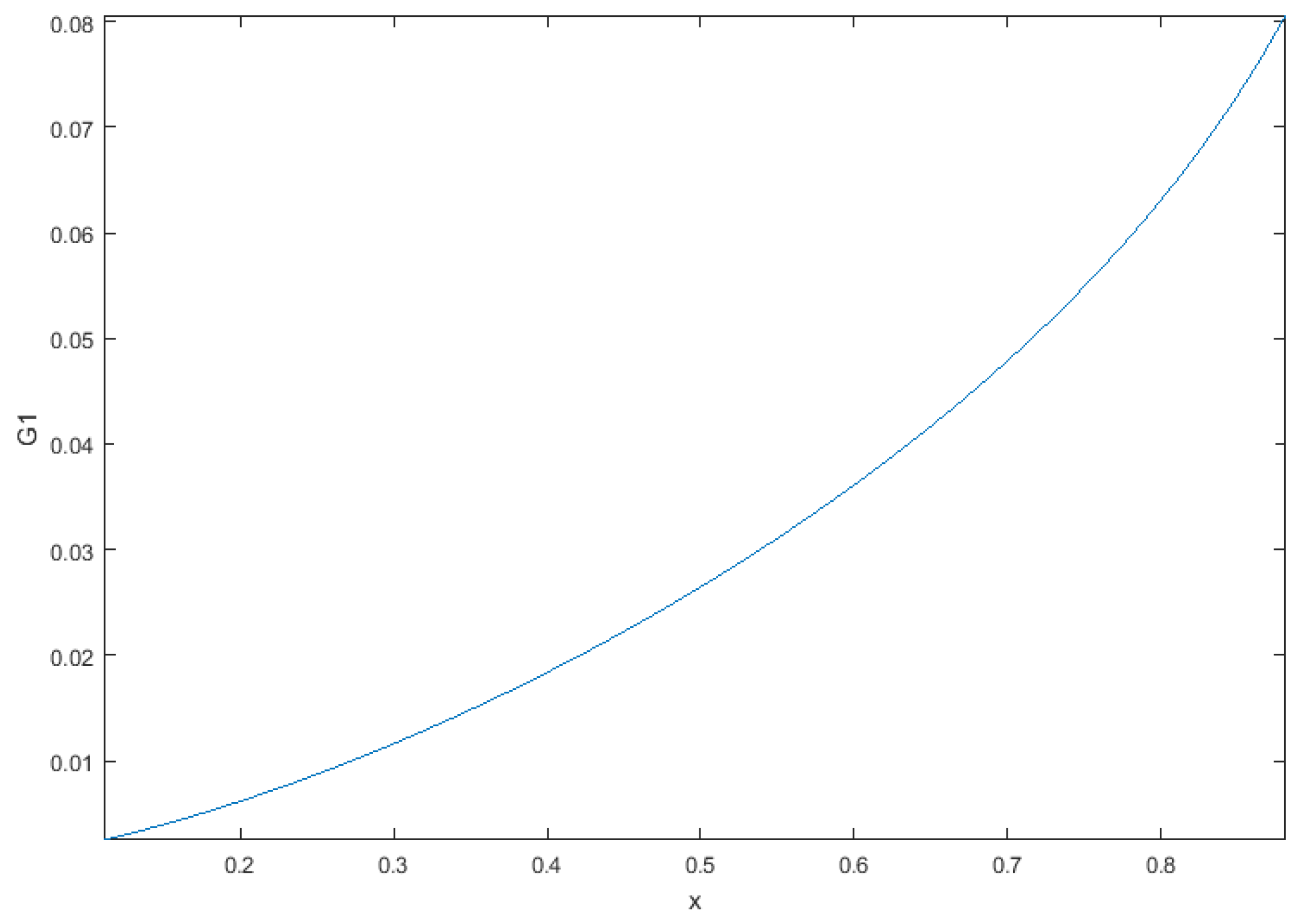
As a very particular sample, for , Figure 2 shows the positivity of
on the real interval .
Figure 2.
Positivity of on .
2.3. An Inequality for the Polygamma Function
The polygamma function , known as the n-th derivative of the Psi function
has an integral representation [6] of the form
For , if
and are replaced in (4), then the inequality
yields
which is equivalent to
2.4. An Inequality of Type (10) or (12) for the Beta Function
By considering the integral representation of the beta function
and replacing
and
in (4), the following inequality
is derived which is equivalent to
provided that and .
Another shape of (18) is as follows:
2.5. An Inequality for the Gauss Hypergeometric Function
The hypergeometric series
is convergent for all (where and ) whose integral representation is denoted by
The importance of the Gauss hypergeometric function is that many special functions can directly be represented in terms of it, e.g., see [7]. Hence, finding an inequality for this important function will cause us to automatically find an inequality for many applied functions.
In order to apply (20) for deriving a straightforward inequality of type (10) for the Gauss hypergeometric function (19), we first substitute
into (4) to obtain
which is equivalent to
and can be simplified as
where , and .
Note that the equality is achieved in (21) when , and .
Finally, if , and , (21) changes to the standard form
which is the most general inequality for Gauss hypergeometric series in the literature as far as we know.
Interesting cases in (22) are when the parameters p and q take special values. For instance, for and , (22) changes to
Also, for the standard case , we have
This is a good point to consider some particular cases of inequality (23).
Example 1.
Noting (23), the inequality
is equivalent to
according to the following identities derived from the site [8]:
and
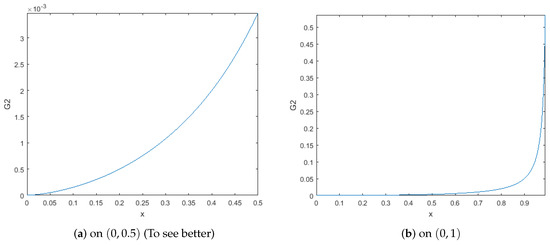
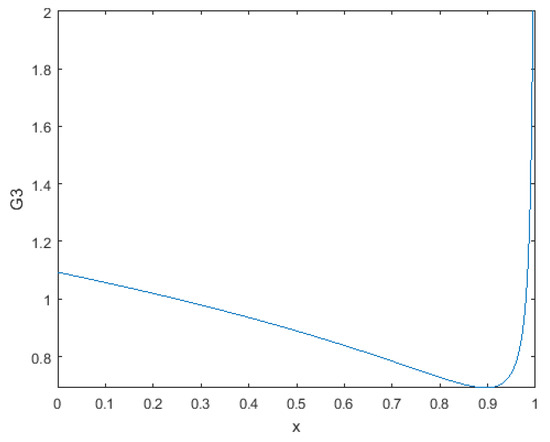
In this regard, Figure 3 shows the positivity of the function
graphically on the interval .
Figure 3.
Positivity of on .
Example 2.
Referring to (23),
is equivalent to
as we have [8]
and
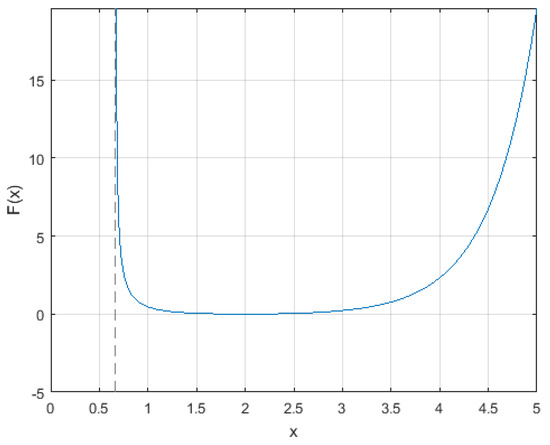
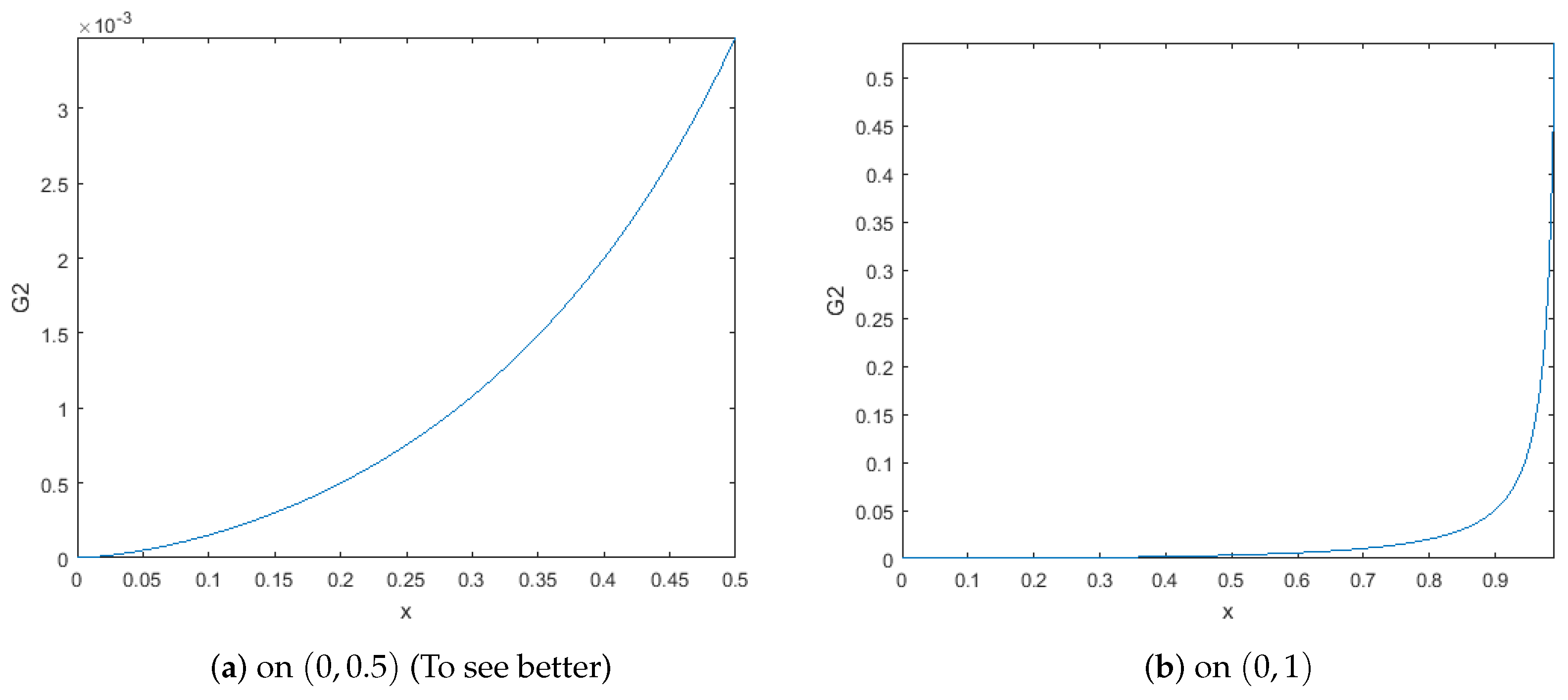
In this sense, Figure 4 shows the positivity of the function
graphically on the interval .
Figure 4.
Positivity of .
2.6. An Inequality for the Confluent Hypergeometric Function
The hypergeometric series
is convergent for any (where ), whose integral representation is denoted by
In order to apply (30) for deriving a straightforward inequality of type (10) for the confluent hypergeometric function (29), we first substitute
into (4) to obtain
which is equivalent to
where , and .
Also, if and , (31) changes to the standard form
As before, interesting cases in (33) are when the parameters p and q take special values. For instance, if and , then (33) changes to
It is now possible to consider many particular cases for inequality (34).
Example 5.
Noting that [8]
and
in which denotes the upper incomplete gamma function
according to the inequality
we obtain
which is equivalent to
Note that indicates the error function as follows:
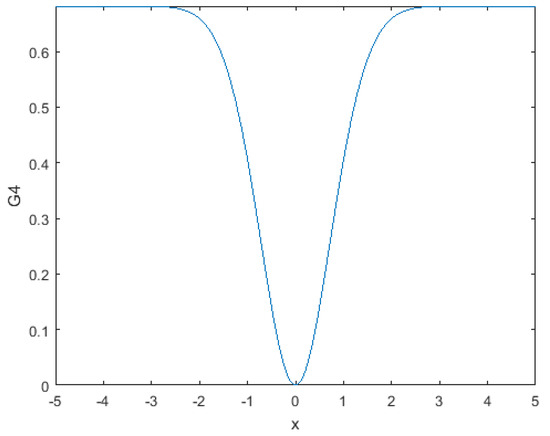
In this sense, Figure 6 shows the positivity of the function
graphically on the real axis .
Figure 6.
Positivity of on .
3. Conclusions
In this work, based on the well-known Hölder inequality, we introduced a generic inequality for continuous functions and showed that many basic special functions, such as the gamma and polygamma functions, Riemann zeta function, beta function and Gauss and confluent hypergeometric functions satisfy this type of inequality. We also obtained some particular inequalities for the Gauss and confluent hypergeometric functions to confirm our main obtained inequalities.
Author Contributions
Investigation, M.M.-J. and Z.M.; validation, M.M.-J., Z.M. and N.S.; conceptualization, M.M.-J. and Z.M.; methodology, M.M.-J., Z.M. and N.S.; formal analysis, M.M.-J., Z.M. and N.S.; funding acquisition, N.S.; writing—review and editing, M.M.-J., Z.M. and N.S.; writing—original draft preparation, M.M.-J. and Z.M. All authors contributed equally to this work. All authors have read and agreed to the published version of the manuscript.
Funding
The work of the first author has been supported by the Alexander von Humboldt Foundation under grant number Ref 3.4-IRN-1128637-GF-E. Partial financial support of this work under Grant No. RGPIN-2024-05913 from the Natural Sciences and Engineering Research Council of Canada is gratefully acknowledged by the third author.
Data Availability Statement
Data sharing is not applicable to this article as no new data were created or analyzed in this study.
Conflicts of Interest
The authors declare that they have no competing interests.
References
- Agarwal, P.; Dragomir, S.S.; Jleli, M.; Samet, B. (Eds.) Advances in Mathematical Inequalities and Applications; Springer: Singapore, 2018. [Google Scholar]
- Pachpatte, B.G. Mathematical Inequalities; Elsevier: Amsterdam, The Netherlands, 2005. [Google Scholar]
- Mitrinovic, D.S.; Pecaric, J.E.; Fink, A.M. Classical and New Inequalities in Analysis; Kluwer Academic: Dordrecht, The Netherlands, 1993. [Google Scholar]
- Masjed-Jamei, M. A main inequality for several special functions. Comput. Math. Appl. 2010, 60, 1280–1289. [Google Scholar] [CrossRef] [Scilit]
- Masjed-Jamei, M. A generic inequality for basic special functions. Integral. Trans. Spec. Funct. 2023, 34, 384–398. [Google Scholar] [CrossRef] [Scilit]
- Prudnikov, A.P.; Brychkov, Y.A.; Marichev, O.I. Integrals and Series: More Special Functions; Gordon and Breach: New York, NY, USA, 1990; Volume 3. [Google Scholar]
- Masjed-Jamei, M. Special Functions and Generalized Sturm-Liouville Problems; Springer Nature: Cham, Switzerland, 2020. [Google Scholar]
- Available online: https://functions.wolfram.com (accessed on 24 September 2024).
- Chen, C.P.; Malesević, B. Inequalities related to certain inverse trigonometric and inverse hyperbolic functions. RACSAM 2020, 114, 105. [Google Scholar] [CrossRef] [Scilit]
- Chen, X.D.; Nie, L.; Huang, W. New inequalities between the inverse hyperbolic tangent and the analogue for corresponding functions. J. Inequal. Appl. 2020, 2020, 131. [Google Scholar] [CrossRef] [Scilit]
- Chesneau, C.; Bagul, Y.J. On a reverse trigonometric Masjed-Jamei inequality. Asia Pac. J. Math. 2021, 35, 33–37. [Google Scholar]
- Zhu, L.; Malesević, B. Natural approximation of Masjed-Jamei’s inequality. RACSAM 2020, 114, 25. [Google Scholar] [CrossRef] [Scilit]
Disclaimer/Publisher’s Note: The statements, opinions and data contained in all publications are solely those of the individual author(s) and contributor(s) and not of MDPI and/or the editor(s). MDPI and/or the editor(s) disclaim responsibility for any injury to people or property resulting from any ideas, methods, instructions or products referred to in the content. |
© 2024 by the authors. Licensee MDPI, Basel, Switzerland. This article is an open access article distributed under the terms and conditions of the Creative Commons Attribution (CC BY) license (https://creativecommons.org/licenses/by/4.0/).