

Abstract
To facilitate the parallel development of the structures and properties of two-parameter quantum groups with those of one-parameter quantum groups, this paper primarily elucidates the interrelations and distinctions between the derivation algebras of these two types of quantum groups. Additionally, we also proposed a method for deriving the derivation algebra of one-parameter quantum groups from known two-parameter quantum group derivations, and vice versa.
Keywords:
two-parameter quantum groups; one-parameter quantum groups; iterated Ore extension; derivations MSC:
17B3; 81R50
1. Introduction
In 1985, Drinfel’d introduced the concept of quantum groups while investigating the quantum Yang–Baxter equation [1]. Over the past three decades, scholars have extensively explored and demonstrated the significant influence of quantum group theory across diverse domains of mathematics and physics. In 1990, Kulish introduced a two-parameter quantum group utilizing the constant solution of the Yang–Baxter equation.
Benkart and Witherspoon studied the two-parameter quantum groups and through down–up algebra [2,3]. Bergeron, Gao and Hu extended this analysis to two-parameter quantum orthogonal and symplectic groups [4,5]. Subsequently, Hu and Shi investigated the two-parameter quantum group for exceptional types [6]; Hu and Wang further developed the -type [7].
In particular, Hu and Pei presented a simplified definition for a class of two-parameter quantum groups , demonstrating that the two-parameter quantum groups can be obtained from the one-parameter quantum group by twisting the multiplication via an explicit Hopf 2-cocycle [8,9].
In 2015, building on Lusztig’s work, Fan and Li constructed another version of the two-parameter quantum group using simple perverse sheaves [10]. This geometric construction provides a new representation of the generators and generation relationships of two-parameter quantum group .
In the study of quantum groups, derivations may be used to describe some deformation or evolution of quantum groups, or to reveal relationships between quantum groups and other algebraic structures. In this paper, our main focus is to explore the connection between derivative algebras of one-parameter quantum groups and derivation algebras of two-parameter quantum groups, where one-parameter and two-parameter quantum groups correspond to simple Lie algebras of the same finite type. Unlike previous studies of derivation algebra of a quantum group, a key contribution of this study is the establishment of the structure of derivation algebra of an iterated Ore extension, so that through this structure, we can obtain the derivation algebra of any quantum group, thus building a bridge for understanding the relationship between the derivative algebras of single-parameter quantum groups and two-parameter quantum groups.
In Section 4, we initially derive the corresponding one-parameter quantum group derivation algebra from the derivation algebra of the two-parameter quantum group. This process is relatively straight forward. Conversely, constructing a two-parameter quantum group from a one-parameter quantum group is complex, thus making it challenging to construct the derivation algebra of a two-parameter quantum group from that of a one-parameter quantum group. Finally, we employ the method proposed by Fan and Li to construct two-parameter quantum groups from one-parameter quantum groups. Building upon this approach, we derive the derivation algebra of a two-parameter quantum group from that of a one-parameter quantum group.
2. Preliminaries
Before delving into the main topic of this article, we will first review some pertinent preparatory knowledge to ensure that readers are equipped for subsequent discussions. In this section, we fix the notations that will be used throughout this paper. For any , let
and , .
2.1. The Algebras and
This subsection introduces the definitions of one-parameter quantum groups and two-parameter quantum groups, which will serve as the foundation for our subsequent research and analysis.
Let be a finite-dimensional simple Lie algebra over a field and be an associated Cartan matrix, there exists a diagonal matrix such that and . Let be such that q is not a unit root.
Definition 1.
The one-parameter quantum group is a unital associative algebra over by generators , , , and relations
The above content described the generators and generating relations for one-parameter quantum groups. Next, let us review the generators and generating relations for two-parameter quantum groups.
Let be the set of simple roots, be the set of roots and positive roots. Let be the rational functions field in two variables over . Let , for and be the Euler bilinear form on defined by
Definition 2.
The two-parameter quantum group is a unital associative algebra over generated by , , , , subject to the relations:
Let (resp., ) be the subalgebra of generated by the elements (resp., ) for , and is subalgebra of generated by for . Moreover, we know
Similary, Let (resp., ) be the subalgebra of generated by the elements (resp., ) for , and the subalgebra of generated by , for , we have
In this paper, our primary focus is on the derivation algebras of the positive parts of both one-parameter and two-parameter quantum groups.
2.2. Iterated Ore Extension
This subsection will furnish the definitions and properties of iterative Ore extensions, crucial for the subsequent discussion regarding the derivation algebra of quantum groups.
Let R be a ring. An Ore extension is a ring with elements of the form , and multiplication satisfying for all , where is an endomorphism of R and is a -derivation of R, i.e.,
Definition 3.
An iterated Ore extension is an Ore extension where for all , and are a ring endomorphism and a -derivation of ⋯. Elements in this extension have the form , .
Let us review the concept of quantum root vectors in quantum groups and the exchange relationship.
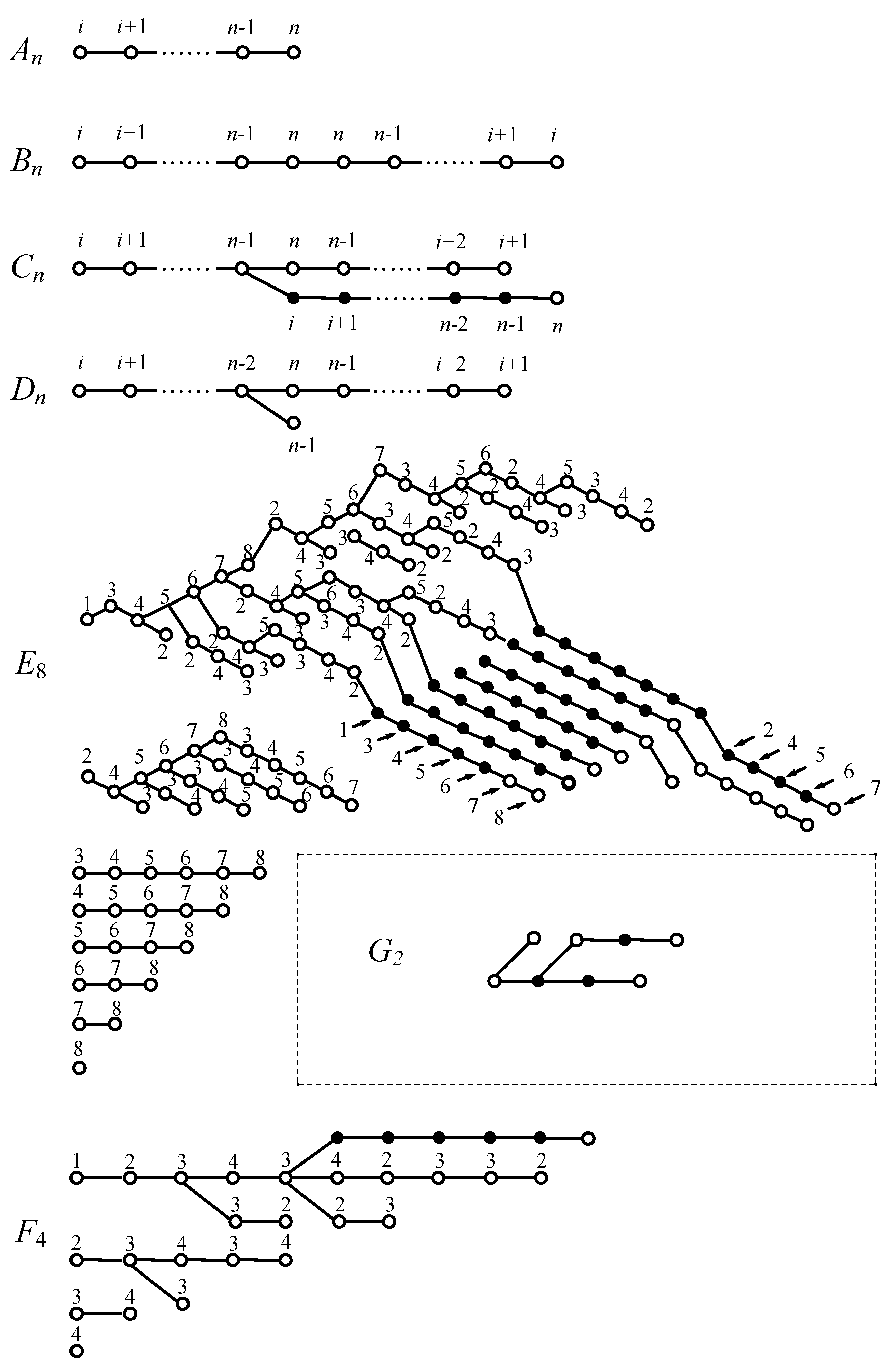
Let be a finite dimensional simple Lie algebra, be a positive root system of the complex simple Lie algebra of and . The following lemma holds.
Lemma 1
([11]). For each of the trees in Figure 1, the set of words determined by the Lyndon paths in the tree is the complete set of standard Lyndon words for the corresponding finite-dimensional simple Lie algebra.
Figure 1.
The tree given standard Lyndon paths. The root of each tree is the leftmost vertex.
Assuming that , and are the quantum root vectors corresponding to and , respectively. We have that consists of quantum root vectors and the set of products forms a basis for . If i and j are two integers such that , then we can obtain
where , , and is the inner product of and . Similarly, and are the quantum root vectors corresponding to and , respectively. The two-parameter quantum group contains a set of quantum root vector and the products form a basis of . If i and j are two integers such that , then we can obtain
where , .
Based on the Definition 3, in conjunction with Equations (2) and (3), it is evident that the following lemma is valid.
Lemma 2.
and are two skew polynomial rings, which can be expressed as
where the ’s are -linear automorphisms and the ’s are -linear -derivations such that for , and ; for , and .
In [9], Hu and Pei offer a more straightforward definition for a class of two-parameter quantum groups, denoted as , associated with semisimple Lie algebras. They do so by employing the Euler form and further elucidate the connection between two-parameter quantum groups and the one-parameter Drinfel’d–Jimbo quantum group. More specifically, In the subsequent lemma, they detail the method of deriving a one-parameter quantum group from a two-parameter one by adjusting the parameters.
Lemma 3.
Let , . Then, modulo is the Hopf ideal generated by is isomorphic to the standard one-parameter quantum group .
3. Derivations of Iterated Ore Extension
Drawing on the foundational principles outlined in Section 2, it is clear that both one-parameter quantum groups and two-parameter quantum groups can be characterized as iterated Ore extensions. As a result, the central objective of this section is to clarify the structural underpinnings of the derivative algebra associated with iterative Ore extensions. This elucidation forms a crucial basis for delving deeper into the relationships between the derivation algebra of one-parameter quantum groups and two-parameter quantum groups.
Definition 4
([12]). Let R be an algebra over the field , and δ be a linear transformation over R. If δ satisfies the following conditions:
then δ is called a derivation of R.
Example 1.
Let R be a polynomial ring over the complex field , δ be a mapping over R, and satisfying the following:
so δ is a derivative on R.
Let be a special type of iterated Ore extension, for ,
where . It is worth noting that and are all iterated Ore extensions of this type.
We give a mapping , which is mapped from to and satisfies =
Theorem 1.
If is a special type of iterated Ore extension, then the derivation of can be uniquely written in the following form:
for some , and where and
Proof.
Let D be the derivation of ; we have
where is the mapping from to . In fact, we know for . Based on the definition of derivations, there is
Since D is a bilinear mapping; thus, we have
then does not include , so that
From this, by comparing coefficients of (9), when , there is , and when , there is . Similarly, in Equation (10), when , holds, and when , .
In Equation (11), there is . Since , we obtain
Under the above results, we further discuss the action of mapping . We can characterize in two situations.
We first suppose that contains only one generator and its exponent is 1, i.e., for . Therefore, we would have
Next, we will prove by using mathematical induction that .
Suppose that for , then
it can be concluded that . We thus obtain
where . The proof is complete. □
4. The Relationship between and
In this section, we delve into the structure of the derivative algebra of one-parameter quantum groups and two-parameter quantum groups. This exploration is aimed at inspiring further research on the relationship between the derivations of these two types of quantum groups.
4.1. Derivations of Quantum Groups
As and are iterated Ore extensions, this means that the derivations of or have the following structure: , where is the quantum root vector of or .
For the convenience of subsequent operations, we first provide a proposition.
Proposition 1.
Let be the center of and D be a derivation of ; then, for all , is a derivation of .
Proof.
Since , we have
This is precisely the assertion of the proposition. □
Theorem 2.
Let be the positive part of the two-parameter quantum group corresponding to ; then, each derivation D of must be written in the following form:
where , , , and the following equation holds:
Proof.
Based on Lemma 2, the positive part of the two-parameter quantum group constitutes an iterated Ore extension. Let be the quantum root vectors of and represent the derivation of ; we have
and
By consolidating Proposition 1, we can conclude that
Therefore, we can conclude that any outer derivation of can be expressed in the form of . It can be seen from this that the theorem proof is completed. □
For convenience, in subsequent studies, we will denote by the symbol .
Theorem 3.
Let D be the derivation of a two-parameter quantum group as shown in Equation (21); then, the derivation of the one-parameter quantum group corresponding to can be uniquely written in the following form:
where , .
Proof.
Let be the derivations of and
According to Lemma 3, when and , there is . Let
be a mapping from to ; so, we have
Let be a map on and ; then, we prove that are derivations of . According to the definition of , we can obtain
From the above results, we can know that are the derivations of . According to Proposition 1, if , then is also a derivation of . Therefore, we obtain that all outer derivations of have the form of , where . Therefore, all derivations of can be uniquely written in the form of Equation (22). □
Example 2.
Suppose is a finite-dimensional complex simple Lie algebra of -type, the Cartan matrix for the -type Lie algebra is
Moreover, it can be deduced that is a -algebra generated by generators and , satisfying the following relationship:
Based on the standard Lyndon basis presented in Figure 1, we can obtain an ordering of the positive roots of : , which corresponds to the quantum root vectors in :
and there is an exchange relationship:
In the above exchange relationship, when , we have is and , we have is ; in other cases, . Therefore, assuming that D is a derivation of , there is , , and
The fundamental solution system can be derived by solving Equations (14) and (15): and . We introduce the following notations: , with :
Let and be derivations corresponding to two fundamental solution systems; therefore, there are
Then, each derivation Dof can be written in the following form:
where .
According to Theorem 3, there exist two mappings and on , such that
Therefore, the derivation of can be written as
where and .
Next, we need to verify that every derivation of can be expressed as shown in Equation (17). Suppose is any derivation of .
By combining Theorem 1 and applying on and , respectively, it can be determined that
We can obtain the fundamental solution system by solving Equations (18) and (19): and .
Let and be the derivatives corresponding to the fundamental solution system; therefore,
Clearly, and , so it can be concluded that the derivations of can be expressed as
where and .
4.2. Obtain Der from Der
It is worth noting that while it is relatively easy to derive a one-parameter quantum group from a two-parameter quantum group, the reverse process of obtaining a two-parameter quantum group from a one-parameter quantum group is usually more challenging. Therefore, in order to facilitate future research, this section begins with a review of the definition and key properties of the two-parameter quantum group introduced by Fan and Li.
Let I be a finite set, and fix a matrix satisfying the following conditions:
- (i)
- , for all ;
- (ii)
- for all ;
- (iii)
- The greatest common divisor of all is equal to 1.
Connect matrix with three bilinear forms on :
Definition 5.
Let be the matrix as described above. The two-parameter quantum group associated to Ω is an associative -algebra with 1 generated by symbols , , , , and subject to the following relations:
where .
In reference [10], the author compared the algebraic structure with the two-parameter quantum group defined in Definition 2 and concluded that when and , the Serre relations of the algebraic are entirely consistent with those given in Definition 2. Therefore, our primary focus will be on studying how to derive the derivation algebra of from that of .
We denote by the positive part of the quantum group over ; it is the free - algebra. Let be a positive root system of the complex simple Lie algebra of , and . Let be the quantum root vector of and satisfy the exchange relation (2).
Theorem 4.
Let be the positive part of the one-parameter quantum group corresponding to ; then, each derivation D of must be written in the following form:
where , , , and , and the following equation holds:
Proof.
The proof for Theorem 4 mirrors that of Theorem 2; thus, we will not present a detailed proof. □
Theorem 5.
If are the derivations of and , then there exists a mapping , where are the derivations of , and each derivation of can be uniquely written in the following form:
where , .
Proof.
Let ; according to Theorem 4 in reference [10], the bialgebra structure of can be naturally extended to . We define a new multiplication “∘” on by
for any homogeneous elements , where is defined in (20).
Since are quantum root vectors of and satisfy Equation (2), the following formula holds for the algebra :
If is the derivation of , then we have
Therefore, we can conclude that if is a derivation of , then acting on must be a derivation of .
According to the given assumption, represents the derivation of , with . Referring to Proposition 4, we can determine that are the derivation of , where , , Based on this, we can conclude that the theorem is valid. □
Example 3.
Suppose is a finite-dimensional complex simple Lie algebra of -type. Moreover, it can be deduced that is a -algebra generated by generators and , and satisfies the following relationship:
On the other hand, correspond to the quantum root vectors , , , in :
And there is an exchange relationship:
Suppose D is a derivation of . Since is an iterated Ore extension, there is , . Therefore, we have
The fundamental solution system can be derived by solving Equations (24) and (27): and . Let and be derivations corresponding to two fundamental solution systems; therefore, there are
Then, each derivation D of can be written in the following form:
where . Let ; the bialgebra structure of can be naturally extended to . According to Theorem 5, there exist two mappings and on , such that
Therefore, the derivation of can be written as
where and .
Similar to the conclusion in Example 2, we can verify that each derivation of can be represented as Equation (27).
5. Conclusions
In conclusion, this paper gives the derivation algebraic structure of a special class of iterated Ore extension, and discusses the relationship between derivation of one-parameter quantum groups and derivation of two-parameter quantum groups. Our results provide a new perspective for understanding the derivation algebra of quantum groups. Despite the important progress made in this paper, the application of derivation algebras to broader quantum groups needs to be further explored. For example, the derivation has a close relationship with the automorphism group of quantum groups; this relationship will help us gain a deeper understanding of quantum groups and their intrinsic properties of algebraic structures.
Author Contributions
Methodology, Y.Z.; validation, Y.Z. and X.T.; writing—original draft, Y.Z.; writing—review and editing, X.T. All authors have read and agreed to the published version of the manuscript.
Funding
This work has received funding from the National Natural Science Foundation of China (No. 12271085), the Heilongjiang Provincial Natural Science Foundation (No. LH2020 A020), and the Central University Basic Research Business Fund-Doctoral Research Innovation Fund Project (No. 3072022GIP2404).
Data Availability Statement
The original contributions presented in the study are included in the article, further inquiries can be directed to the corresponding author.
Conflicts of Interest
The authors declare no conflict of interest.
References
- Drinfel’D, V. Hopf algebras and quantum Yang-Baxter equation. Dokl. Akad. 1985, 32, 254–258. [Google Scholar]
- Benkart, G.; Witherspoon, S. A Hopf structure for down-up algebras. Math. Z. 2001, 238, 523–553. [Google Scholar] [CrossRef]
- Benkart, G.; Witherspoon, S. Quantum group actions, twisting elements, and deformations of algebras. J. Pure Appl. Algebra 2007, 208, 371–389. [Google Scholar] [CrossRef]
- Bergeron, N.; Yun, G.; Hu, N. Drinfel’d doubles and Lusztig’s symmetries of two-parameter quantum groups. J. Algebra 2006, 301, 378–405. [Google Scholar] [CrossRef]
- Bergeron, N.; Yun, G.; Hu, N. Representations of two-parameter quantum orthogonal groups and symplectic groups. AMS/IP Stud. Adv. Math. 2007, 39, 1–21. [Google Scholar]
- Hu, N.; Shi, Q. The two-parameter quantum group of exceptional type G2 and Lusztig’s symmetries. Pac. J. Math. 2007, 230, 327–345. [Google Scholar] [CrossRef]
- Hu, N.; Wang, X. Convex PBW-type Lyndon bases and restricted two-parameter quantum groups of type B. J. Geom. Phys. 2010, 6, 430–453. [Google Scholar] [CrossRef]
- Hu, N.; Pei, Y. Notes on two-parameter quantum groups (II). Commun. Algebra 2012, 40, 3202–3220. [Google Scholar] [CrossRef]
- Hu, N.; Pei, Y. Notes on two-parameter quantum groups, (I). Sci. China Ser. Math. 2008, 51, 1101–1110. [Google Scholar] [CrossRef]
- Fan, Z.; Li, Y. Two-Parameter quantum algebras, canonical bases, and categorifications. Int. Math. Res. Not. 2015, 16, 7016–7062. [Google Scholar] [CrossRef][Green Version]
- Lalonde, P.; Arun, R. Standard Lyndon bases of Lie algebras and enveloping algebras. Trans. Am. Math. Soc. 1995, 347, 1821–1830. [Google Scholar] [CrossRef]
- Elle, S. Classification of relation types of Ore extensions of dimension 5. Commun. Ina. 2017, 45, 1323–1346. [Google Scholar] [CrossRef][Green Version]
Disclaimer/Publisher’s Note: The statements, opinions and data contained in all publications are solely those of the individual author(s) and contributor(s) and not of MDPI and/or the editor(s). MDPI and/or the editor(s) disclaim responsibility for any injury to people or property resulting from any ideas, methods, instructions or products referred to in the content. |
© 2024 by the authors. Licensee MDPI, Basel, Switzerland. This article is an open access article distributed under the terms and conditions of the Creative Commons Attribution (CC BY) license (https://creativecommons.org/licenses/by/4.0/).


