Article

A Political Radicalization Framework Based on Moral Foundations Theory

by
Ruben Interian
Institute of Computing, University of Campinas (UNICAMP), Campinas 13083-852, SP, Brazil
Mathematics 2024, 12(13), 2121; https://doi.org/10.3390/math12132121
Submission received: 20 May 2024 / Revised: 10 June 2024 / Accepted: 18 June 2024 / Published: 6 July 2024
(This article belongs to the Special Issue Modeling and Simulation of Social-Behavioral Phenomena)

Abstract

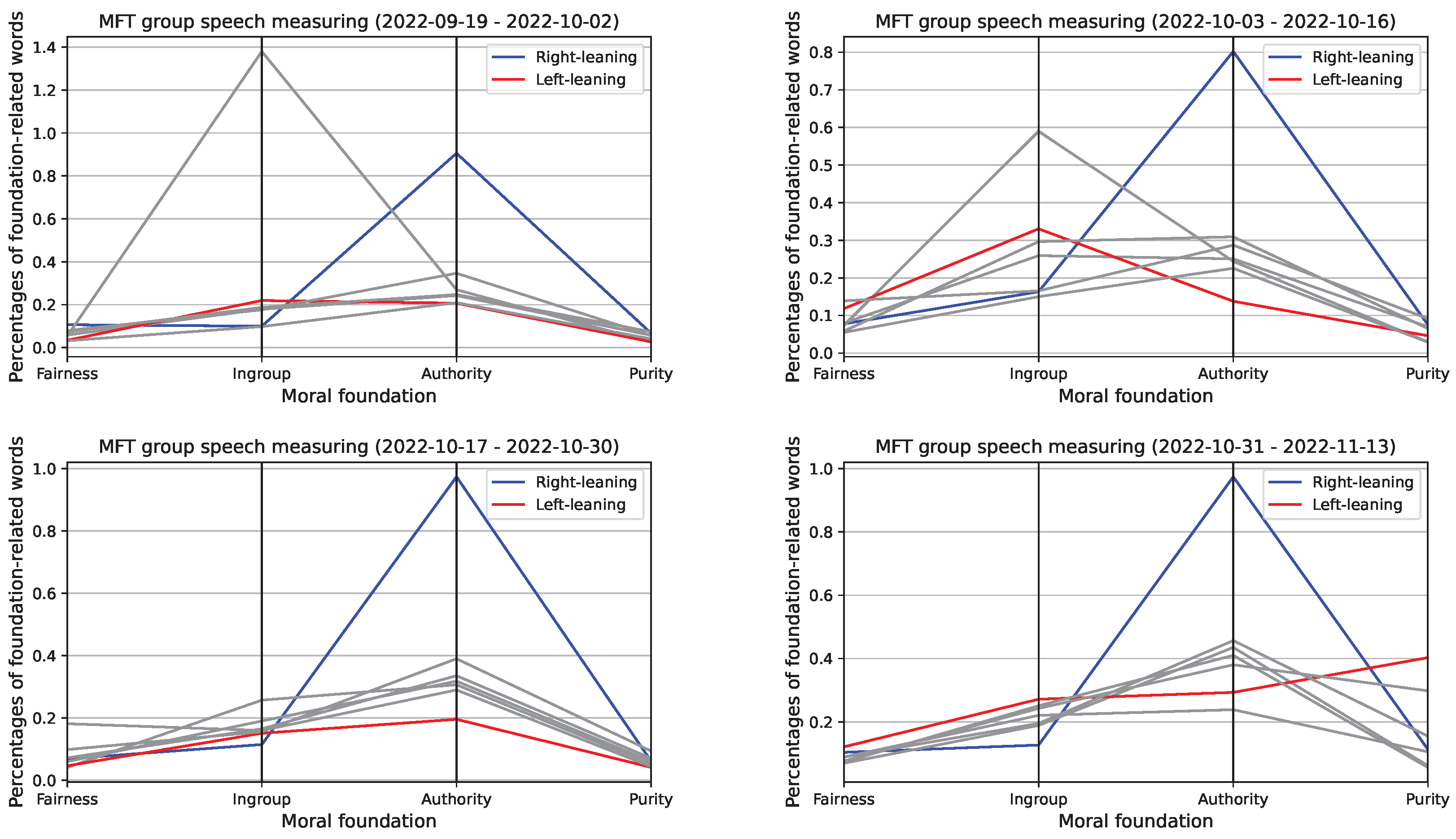
Moral foundations theory proposes that individuals with conflicting political views base their behavior on different principles chosen from a small group of universal moral foundations. This study proposes using a set of widely accepted moral foundations (fairness, in-group loyalty, authority, and purity) as proxies to determine the degree of radicalization of online communities. A fifth principle, care, is generally surpassed by others that are higher in the radicalized groups’ moral hierarchy. Moreover, the presented data-driven methodological framework proposes an alternative way to measure whether a community complies with a certain moral principle or foundation: not evaluating its speech, but its behavior through the interactions of its individuals, establishing a bridge between the structural features of the interaction network and the intensity of communities’ radicalization regarding the considered moral foundations. Two foundations were assessed using the network’s structural characteristics: in-group loyalty measured by group-level modularity, and authority evaluated using group domination, for detecting potential hierarchical substructures within the network. By analyzing a set of Pareto-optimal groups regarding a multidimensional moral relevance scale, the most radicalized communities were identified among those considered extreme in some of their attitudes or views. An application of the proposed framework is illustrated using real-world datasets. The radicalized communities’ behavior exhibited increasing isolation, and their authorities and leaders showed growing domination over their audience. Differences were also detected between users’ behavior and speech, showing that individuals tended to share more “extreme” in-group content than they publish: extreme views get more likes on social media.
Keywords: radicalization; moral foundations theory; online communities; interaction networks; Pareto frontier radicalization; moral foundations theory; online communities; interaction networks; Pareto frontier