Abstract
A two-step Lagrange–Galerkin scheme for the shallow water equations with a transmission boundary condition (TBC) is presented. First, we show the experimental order of convergence to see the second-order accuracy in time realized by the two-step methods for conservative and non-conservative material derivatives along the trajectory of fluid particles. Second, we observe the effect of the TBC in a simple domain, and the artificial reflection is removed significantly when the wave touches the TBC. Third, we apply the scheme to a practical domain with islands, namely, the Bay of Bengal region, and observe the effect of the TBC again for the practical domain; the artificial reflections are removed significantly from the transmission boundaries on open sea boundaries. We also study the effect of a position of an open sea boundary with the TBC and reveal that it is sufficiently small to neglect. The numerical results in this study show that the scheme has the following properties: (i) the same advantages of Lagrange–Galerkin methods (the CFL-free robustness for convection-dominated problems and the symmetry of the matrices for the system of linear equations); (ii) second-order accuracy in time by the two-step methods; (iii) mass preservation of the function for the water level from the reference height (until the contact with the transmission boundaries of the wave); and (iv) no significant artificial reflection from the transmission boundaries. The numerical results by the scheme presented in this paper are for the flat bottom topography of the domain. In the next part of this work, Part II, the scheme will be applied to rapidly varying bottom surfaces and a real bottom topography of the Bay of Bengal region.
Keywords:
shallow water equations; two-step Lagrange–Galerkin scheme; second order in time; transmission boundary condition; Bay of Bengal; bottom topography MSC:
65M25; 65M60; 76D05; 76B15
1. Introduction
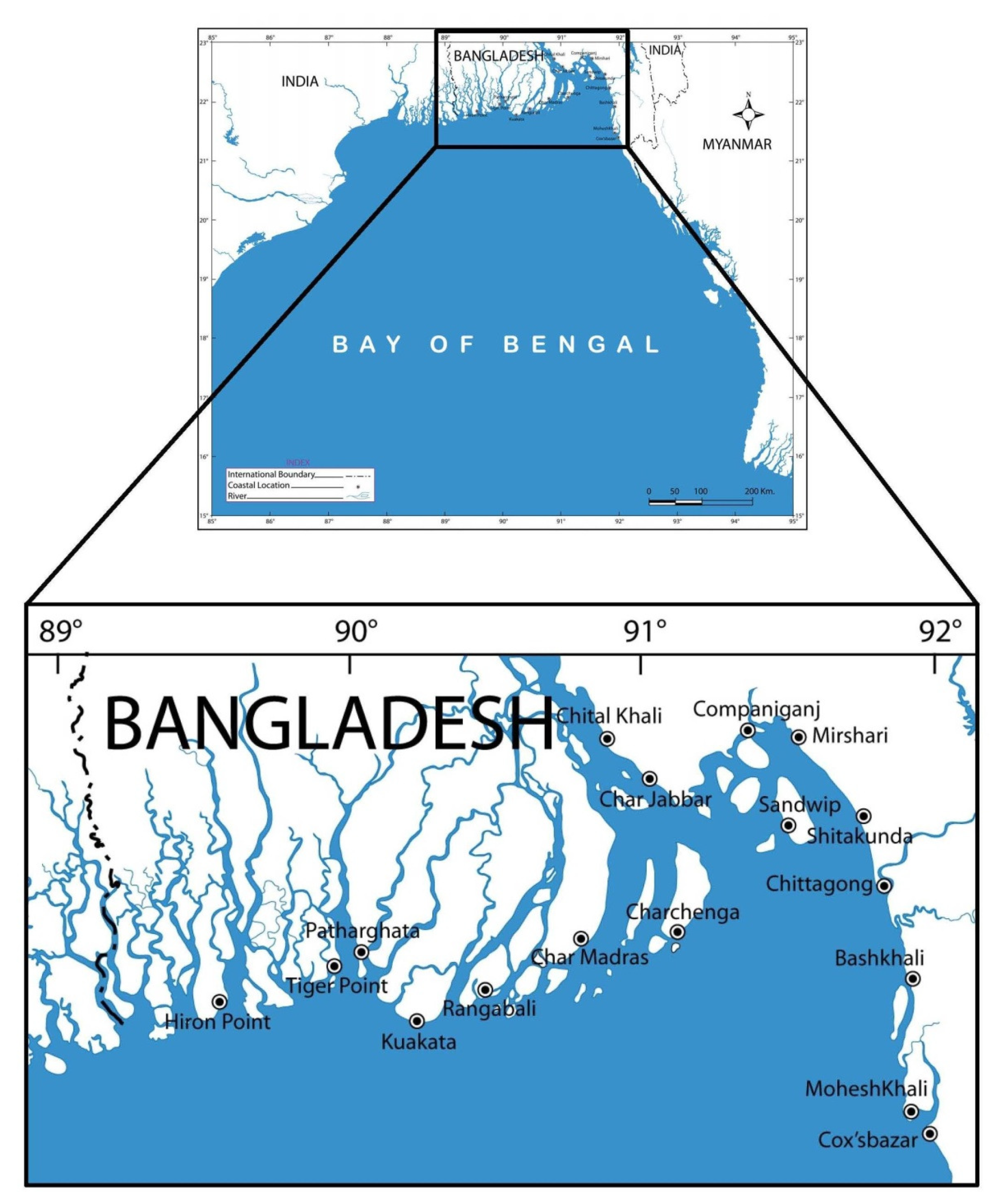
The system of shallow water equations (SWEs) is one of the most common models for describing fluid flow in rivers, channels, estuaries, and coastal areas, and is often used for simulating tsunamis and storm surges in oceanic phenomena. Natural disasters like tsunamis, cyclones, and storm surges cause a tremendous loss of lives and properties in the coastal areas in several regions. According to [1], statistics show that about 5% of the global tropical cyclones form over the Bay of Bengal, and, on average, five to six storms form in this region every year, but with 80% of the global casualties. The significant factors behind the heavy casualties are the shallow coastal water, thickly populated low-lying islands, highly curved coastal and island boundaries, river discharge, high astronomical tidal range, and favorable cyclone track, cf. [2] and Figure 1. That is why an effective storm surge prediction model and method are highly desired for the coastal region of Bangladesh to minimize the resulting damage from storm surges.
Figure 1.
The Bay of Bengal region.
Studies focusing on the Bay of Bengal region are found in [1,2,3,4,5,6,7,8] and references therein. Almost all the researchers implemented SWEs with a radiation-type boundary condition for open sea boundaries. Although for real problems, the finite element method is more suitable than the finite difference method because of the advantages of handling complex physical domains, geometries, or boundary conditions, as far as we know, there is no study to solve SWEs employing a transmission boundary condition (TBC) for the Bay of Bengal region using the finite element method except [9,10].
Since a bounded computational domain is needed to compute the SWEs in a practical coastal region, e.g., the Bay of Bengal, we set an artificial boundary in the open sea, called the open boundary, which is a part of the boundary of the domain. Let be the velocity (averaged in -direction), the total wave height, the water level from the reference height, and > the depth of the water level from the reference height. On the coastal boundary, it is natural to have the reflection, which is realized by the Dirichlet boundary condition, , and, on the open boundary, an artificial boundary condition is required so that the wave passes through the boundary without any reflection, as the boundary is set artificially on the open sea. Most open boundary conditions proposed in the literature are based on or modifications of the Sommerfeld radiation boundary condition (RBC) [11] whose typical form is
for the gravity constant > and the outward unit normal vector n. The condition (1) is derived by considering the SWEs in one-dimensional space essentially and assuming that the velocity u on the open boundary is for the wave propagation speed V and that V is given by . Due to some limitations of the RBC for oblique flows, many researchers suggested and implemented modified boundary conditions for open boundaries similar to the RBC, cf., e.g., [12,13,14]. Kanayama and Dan [15] also employed an open boundary condition of the form,
for a constant >, which removes the artificial reflection from the open boundary significantly. The condition (2) is comparable to the RBC as Equation (2) is obtained by replacing with in Equation (1), where the relation holds if is satisfied. In fact, the numerical results by the TBC and the RBC are similar, cf. Appendix B. On the other hand, the TBC is more reasonable than the RBC for the theoretical stability study of the system of the SWEs from the viewpoint of energy as presented in Murshed et al. [9] and Murshed [10], while it is still a partial study (but practically useful), cf. Remark 6 for a brief review of the theoretical results. Based on the stability study, we employ the TBC in this paper and observe the effect of the TBC (or the RBC) for the passing wave in addition to the effect of the Dirichlet boundary condition for the reflection wave. These observations are basic but necessary for the development of a scheme for SWEs.
The system of the SWEs consists of two equations, a pure convection equation for the total wave height and a modified Navier–Stokes momentum equation for the velocity derived by taking the average of function values in -direction, cf. [9,16], which include the material derivatives in conservative and non-conservative forms, respectively. For a time step size , let . The so-called Lagrange–Galerkin method is the finite element method combined with the idea of the method of characteristics; the non-conservative and conservative material derivatives are discretized as, for a scalar-valued function and a velocity u, cf., e.g., [17,18,19,20],
respectively, which are first-order approximations in time, where is an upwind point of x with respect to and is the Jacobian determinant of the mapping . In general, the Lagrange–Galerkin method has two advantages; (i) the CFL-free robustness for convection-dominated problems and (ii) the symmetry of the resulting coefficient matrices for the system of linear equations. In addition to the four pioneering works above, many authors have proposed the ideas of this type of approximation in the context of the finite element method, cf. [21,22,23,24,25,26,27,28,29,30,31,32,33,34,35,36,37,38,39,40,41,42,43,44,45,46,47,48] and references therein. When we focus on the SWEs, to the best of our knowledge, Murshed et al. [9] and Murshed [10] firstly solved the SWEs with a TBC by a (single-step) Lagrange–Galerkin scheme of first-order in time for a flat bottom topography. Recently, a two-step mass-preserving Lagrange–Galerkin scheme of second order in time for conservative convection-diffusion problems has been proposed and analyzed with error estimates in [49].
In this paper, we present a new two-step Lagrange–Galerkin scheme to solve the SWEs together with a TBC, which is of second order in time and maintains the two advantages of the Lagrange–Galerkin methods, i.e., the CFL-free robustness and the symmetry of the resulting matrices. The two material derivatives are discretized based on the ideas of two-step methods proposed for the non-conservative form in [17,21,24,40] and the conservative form in [49]. Firstly, preparing an artificial exact solution, we observe our scheme’s experimental order of convergence (EOC) to see the second-order accuracy in time on a simple (square) domain. Since long (real-)time computations on a mesh refined locally are needed in practical problems, the CFL-free second-order accuracy in time of our scheme is a significant advantage, enabling us to employ a more extensive time increment compared with first-order numerical methods. Secondly, we observe the effect of the TBC on a simple (square) domain, and the artificial reflections are kept from the Dirichlet boundaries and removed significantly from the transmission boundaries. Thirdly, our scheme is applied to the Bay of Bengal region, which is non-convex, includes islands, and is, therefore, a complex domain. We again observe the effect of the TBC for this realistic domain. The artificial reflections are removed significantly from the transmission boundaries, which are set on open sea boundaries. We also study the effect of a position of an open sea boundary with the TBC and reveal that it is sufficiently small to neglect. In [9], energy estimates for the SWEs were given, where the -norm of the water level from the reference height was an important value related to the potential energy. Focusing on the energy and the mass of the water level function, we observe the -norm and the mass of the water level function, which show the effectiveness of the TBC.
From the computations, we show that our new scheme has the following properties; (i) the same advantages of Lagrange–Galerkin methods; (ii) second-order accuracy in time; (iii) mass preservation of the function of the water level from the reference height (until the contact with the transmission boundaries of the wave); and (iv) no significant artificial reflection from the transmission boundaries. We mention again that the TBC is employed in this paper based on the theoretical stability study in [9,10], while the numerical results by the TBC and the RBC are similar.
All of the numerical results in this paper, Part I, are for the flat bottom topography, and the non-homogeneous bottom topography will be studied in our forthcoming paper, Part II.
The outline of this paper is as follows. Section 2 presents a two-step Lagrange–Galerkin scheme for the SWEs together with a TBC, which is of second order in time. In Section 3, numerical results for simple square domains are shown to observe the second-order accuracy in time and the effect of TBC. In Section 4, our scheme is applied to the Bay of Bengal region, where the domain is non-convex and complex. In Section 5, conclusions are given. The data for choosing the constant required in the TBC and a comparison of the TBC with the RBC are given in Appendix A and Appendix B, respectively.
2. A Two-Step Lagrange–Galerkin Scheme
We introduce some notations to be used in this paper. is a bounded spatial domain in , is the boundary of , and is a temporal domain in for a positive constant T. We use the Lebesgue space and the Sobolev space . For any normed space X with its norm , we define function spaces and consisting of X-valued functions in and , respectively. Let be the inner product in , i.e., for . We employ the same notation to represent the inner product for scalar-, vector-, and matrix-valued functions. Let be the tensor product defined by for .
2.1. Statement of the Problem
Our problem is to find such that
where the total wave height and the velocity are denoted by and , respectively, the water level from the reference height and the depth of water level from the reference height, i.e., bottom topography, are represented by and , respectively, a pair of external forces is given by , a pair of initial values is given by , density and viscosity constants of water are denoted by and , the gravity constant is given by , the strain-rate tensor is defined by
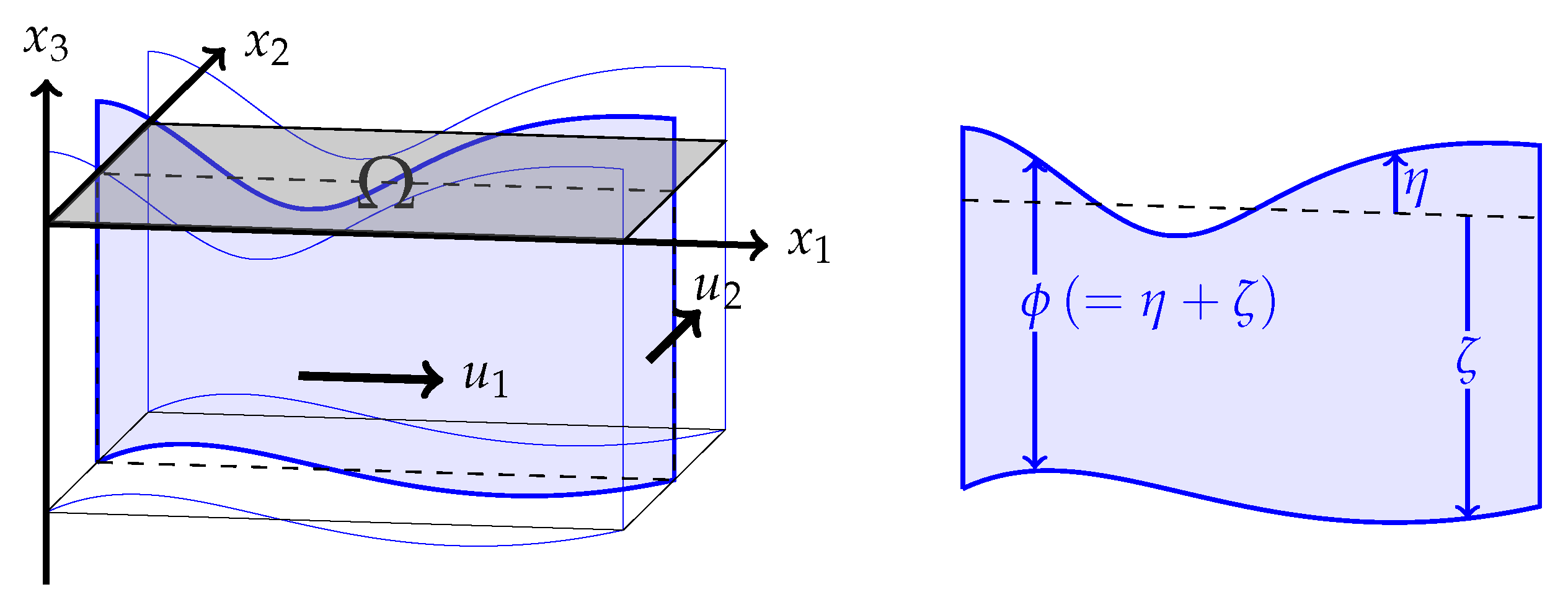
and the outward unit normal vector is denoted by , cf. Figure 2. We suppose that the boundary is divided into two non-overlapping parts, and , i.e., and , where the subscripts “” and “” imply Dirichlet and transmission boundaries, respectively. A positive constant is chosen suitably to remove the artificial reflection, and, throughout this paper, we employ , which is determined based on numerical experiments given in Appendix A. We consider homogeneous flat bottom topography in this paper, Part I, and non-homogeneous bottom topography in our forthcoming paper, Part II.
Figure 2.
Diagrams for the problem; left: the domain and the velocity ; right: the total wave height .
2.2. Presentation of the Scheme
Let , ,
for a function , and . We introduce a -dependent function, , defined by
Assume , and . A weak formulation to problem (3) is to find such that, for ,
with the initial condition , where the bilinear forms and are defined by
Now, we present our scheme for solving problem (3). Let be a partition of by triangular elements, h be the maximum diameter of , and be an approximated domain. Although it holds that in general, we assume throughout the paper to avoid the complexity of introducing many symbols. We define finite element spaces, , and , corresponding to , Y and by
for , and set , where is the space of polynomial functions of degree on . In this paper, we employ , and the function is assumed to be a piecewise linear function.
Let be a time increment, a total number of time steps, and a time at n-th time step. For , we define mappings and by
For and , we define an operator by, for ,
where
The composition of functions is represented by the symbol ∘, i.e.,
and the function is defined by
which is a second-order temporal approximation of if u is sufficiently smooth. We also define, for ,
where
The two-step Lagrange–Galerkin scheme is to find such that, for ,
with an initial condition
where the Lagrange interpolation operator is denoted by , which is also used for the vector-valued function , i.e., .
Remark 1.
Scheme (5) is equivalent to
for the first step , and
for general steps .
Remark 2.
We have the following notes.
- We need and due to the lack of the functions and for , which are used for and for .
- The two-step methods in conservative and non-conservative forms, and , are developed and analyzed for convection-diffusion problems in [17,49].
- It is discussed in [40,49] that the one-time use of first-order single-step methods, and , has no loss of convergence order in discrete version of -norm for a conservative convection-diffusion equation and the Navier–Stokes equations, respectively.
- The so-called quadrilateral elements , e.g., bilinear and biquadratic elements, with a partition of , , by rectangles are also available for and .
Remark 3.
Suppose that the pair is a smooth solution to Equation (3) and that . Then, the truncation errors of the Equations (5a) and (5b) are of second order in time, i.e.,
as and are second-order approximations of the conservative and non-conservative material derivatives, respectively, i.e.,
and the evaluation point is , cf. [40,49].
Remark 4.
Suppose that Ω is convex and , that ϕ is known and smooth, that there exist positive constants and such that for any , and . Then, the unknown function of problem (3) is only u, and we can prove stability and error estimates for the velocity if u is smooth enough, i.e., there exist positive constants and independent of h and such that, for any pair with and , the solution to scheme (5) whose is replaced with satisfies and by induction argument similar to the proof of the stability and error estimates of a scheme for the Navier–Stokes equations in [40].
3. Numerical Results in Square Domains
In this section, numerical results via FreeFem++ [50] with (piecewise linear, P1-element) are presented to see the experimental order of convergence (EOC) and the effect of the TBC in square domains, where both of the systems of linear equations for Equations (5a) and (5b) are solved by the LU decomposition method in FreeFem++. We call scheme (5) LG2, and also call scheme (5) replacing and with and , respectively, LG1 [9,10], which is a (single-step) Lagrange–Galerkin scheme of first order in time.
3.1. Experimental Order of Convergence
We solve Examples 1 and 2 below by LG1 and LG2 and compare the experimental orders of convergence (EOCs).
Example 1
(). In problem (3), we set , , , , and the function , , f and F are given so that the exact solution is
Example 2
(). In Example 1, we replace and with and , respectively.
For a numerical solution and its exact solution , we introduce notations of errors, , , defined by
where is a norm given by
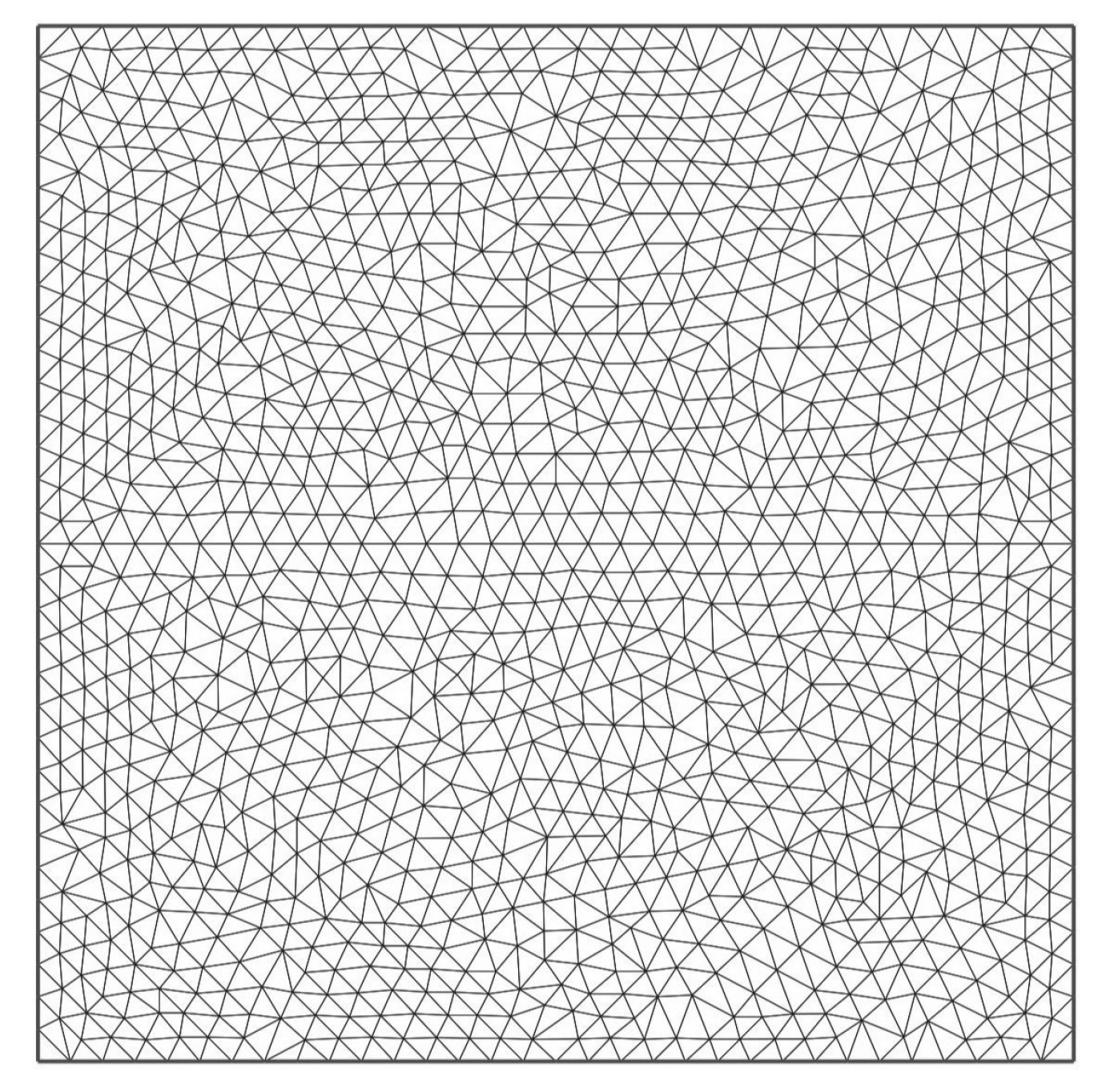
Let N be a division number of each side of the unit square domain and a representative mesh size. We prepare non-uniform triangulations of , , for and 256, cf. Figure 3 for .
Figure 3.
A sample mesh with for Example 1.
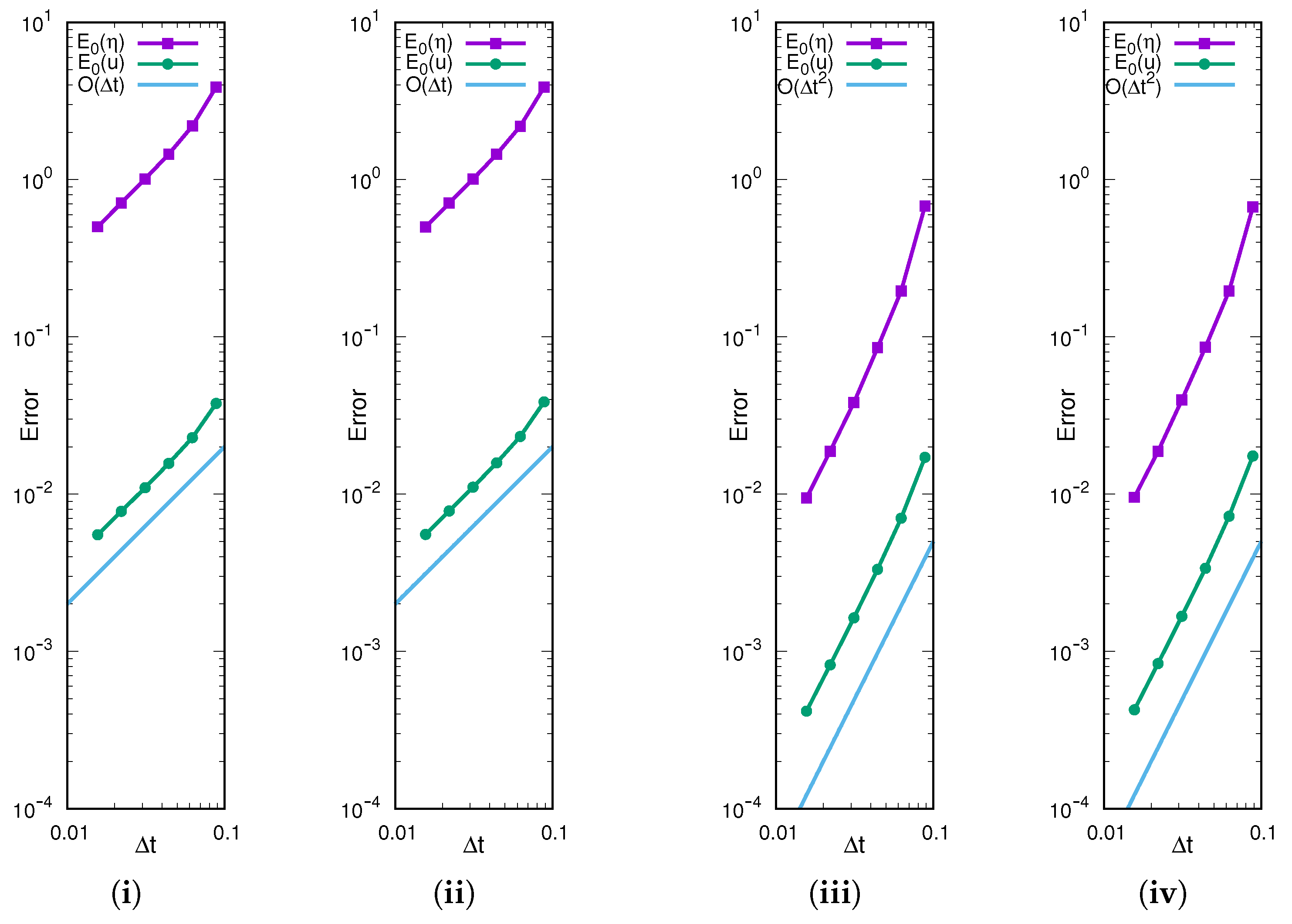
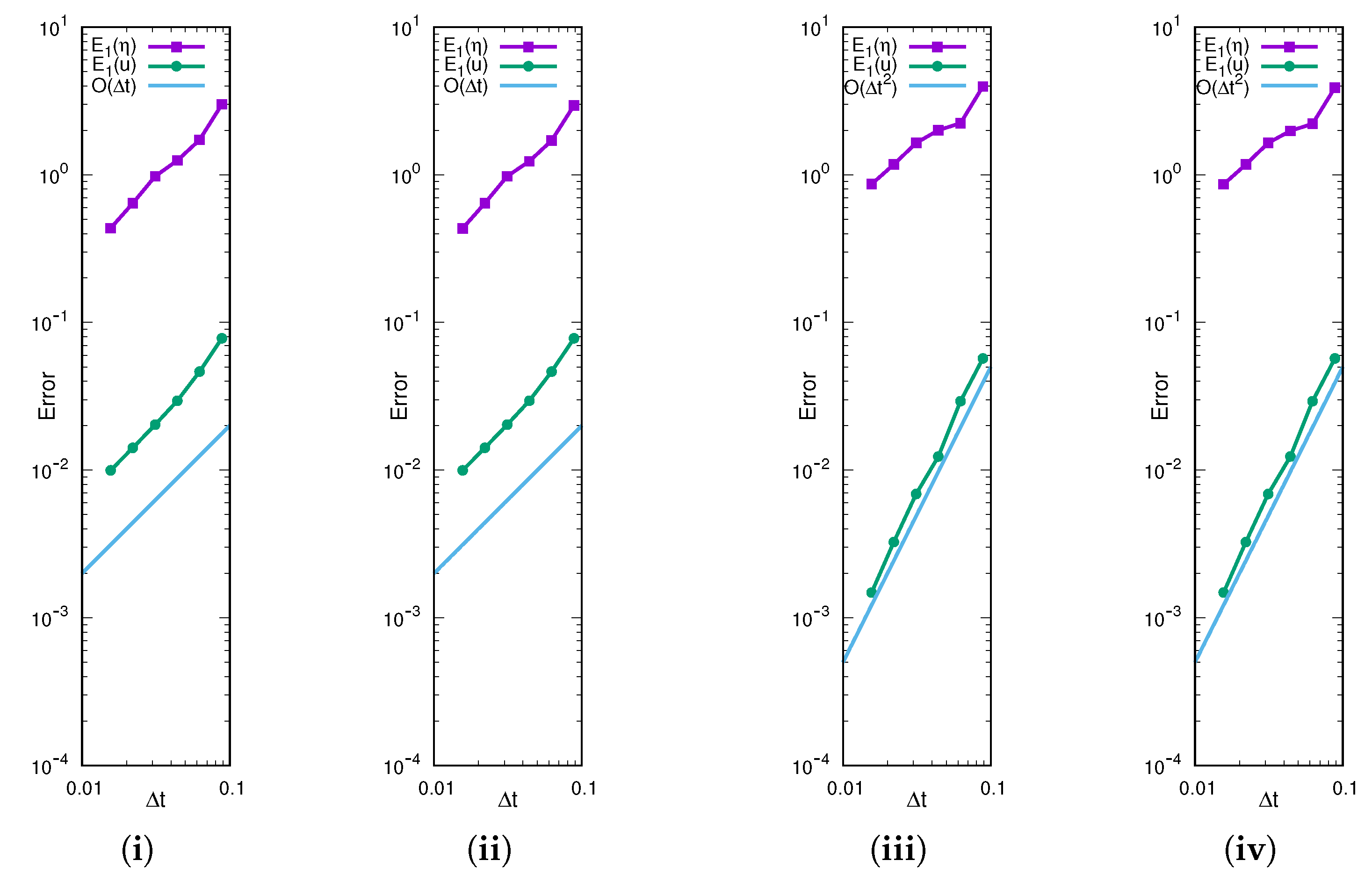
Choosing , we compute the errors, and , , by LG1 and LG2. Figure 4 and Figure 5 show graphs of the errors of and , respectively, in logarithmic scale by LG1 for Example 1 (i) and Example 2 (ii), and by LG2 for Example 1 (iii) and Example 2 (iv), and the values of errors and their EOCs are given in Table 1 and Table 2. We observe that LG2 is of second order in time numerically and that the order is higher than that of LG1. Although is not of second order in time, it is natural as Equation (3a) for does not include any diffusion term.
Figure 4.
Graphs of errors and in logarithmic scale by LG1 for Example 1 (i) and Example 2 (ii), and by LG2 for Example 1 (iii) and Example 2 (iv).
Figure 5.
Graphs of errors and in logarithmic scale by LG1 for Example 1 (i) and Example 2 (ii), and by LG2 for Example 1 (iii) and Example 2 (iv).
Table 1.
Values of and , , by schemes LG1 and LG2 for Example 1 ().
Table 2.
Values of and , , by schemes LG1 and LG2 for Example 2 ().
Remark 5.
Lagrange–Galerkin schemes are basically CFL-free, and our scheme also has this property. In fact, the CFL number in this computation is for as the maximum velocity U is 1 and the is chosen as .
3.2. Effect of the TBC
We consider the following example to see the effect of the TBC.
Example 3.
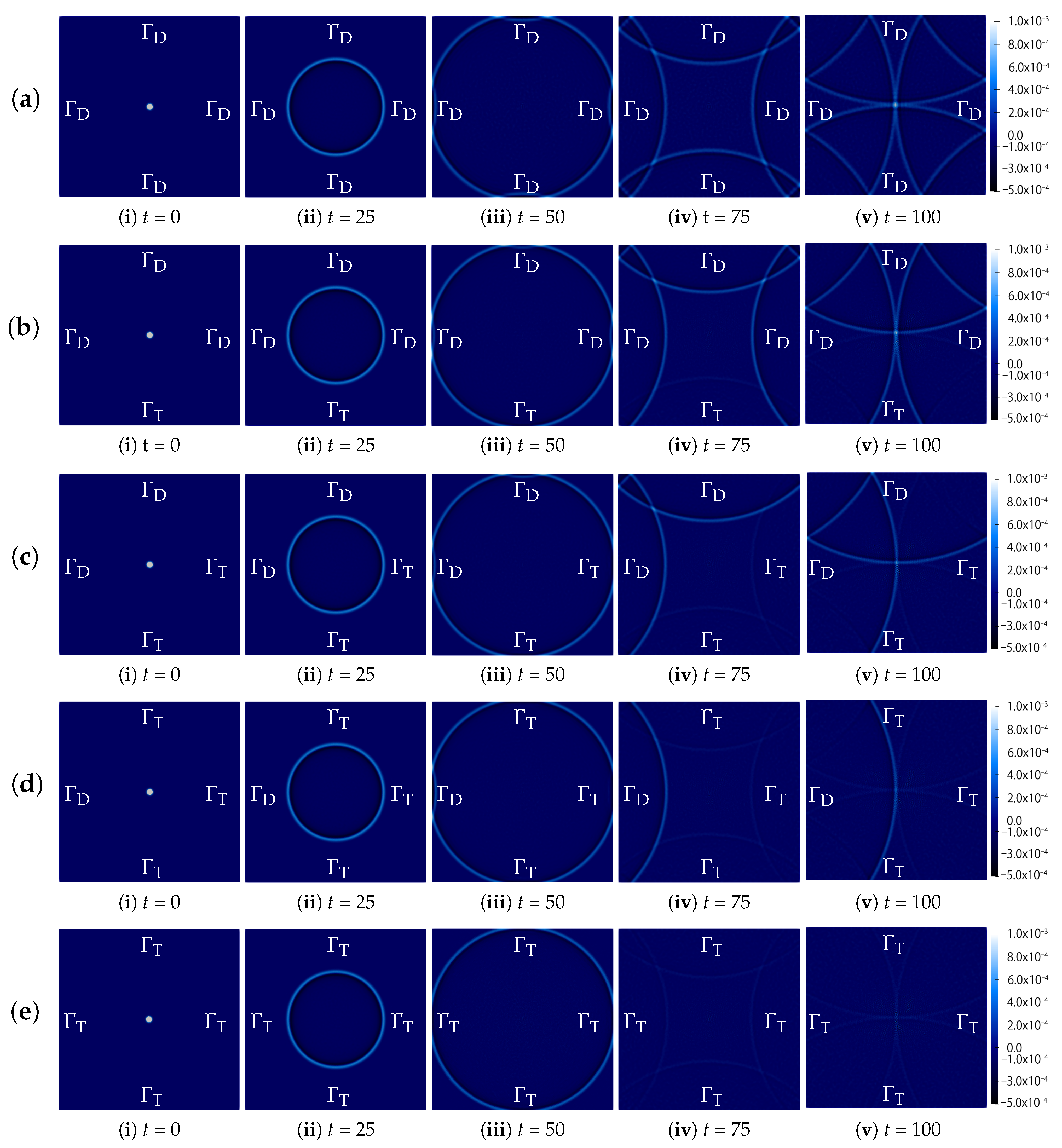
In problem (3), we set , , , , , , , and . We consider five cases of ,
- (a)
- , i.e., ,
- (b)
- (bottom), ,
- (c)
- (right and bottom), ,
- (d)
- (right, bottom and top), ,
- (e)
- .
We solve Example 3 by LG2. Figure 6 shows the color contours of for , , cf. (i)–(v), for the five cases, (a)–(e). We can see the effect of the boundary conditions; the artificial reflection is observed and removed significantly when the wave touches the Dirichlet and the transmission boundaries, respectively. Thus, LG2 works well for the SWEs with and without the TBC in the simple square domain.
Figure 6.
Color contours of by LG2 with and without the TBC for the five cases, (a–e), in Example 3.
4. Application to the Bay of Bengal
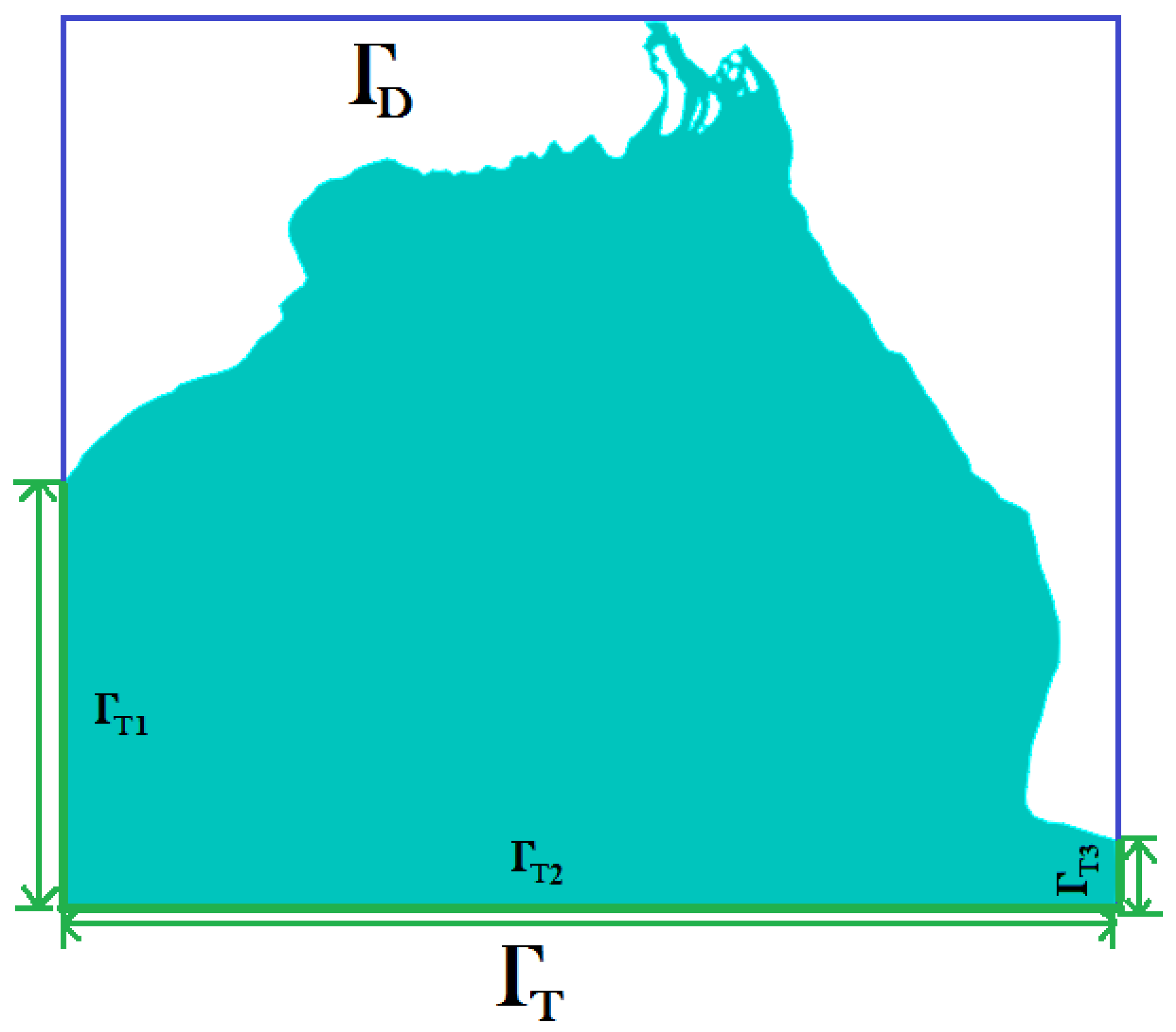
In this section, we apply LG2, i.e., scheme (5) discussed in Section 2.2, to a computational domain of the Bay of Bengal region, cf. Figure 7, which is an approximate domain of the original, cf. Figure 1. All the computations are performed via FreeFem++ [50].
Figure 7.
The domain for the Bay of Bengal region with the information of boundaries, and used in Example 4.
4.1. Numerical Simulation with and without the TBC
We set the following example.
Example 4.
Let Ω be the domain shown in Figure 7. The domain is considered from 0 to in the horizontal direction and 0 to in the vertical direction. We employ two boundary conditions, the Dirichlet boundary condition on and the TBC on , cf. Figure 7. We set on the coastal and island boundaries and on the artificial boundaries for the open sea. As shown in Figure 7, there are three artificial boundaries on the open sea, i.e., . In problem (3), we set , , , , , , , , and .
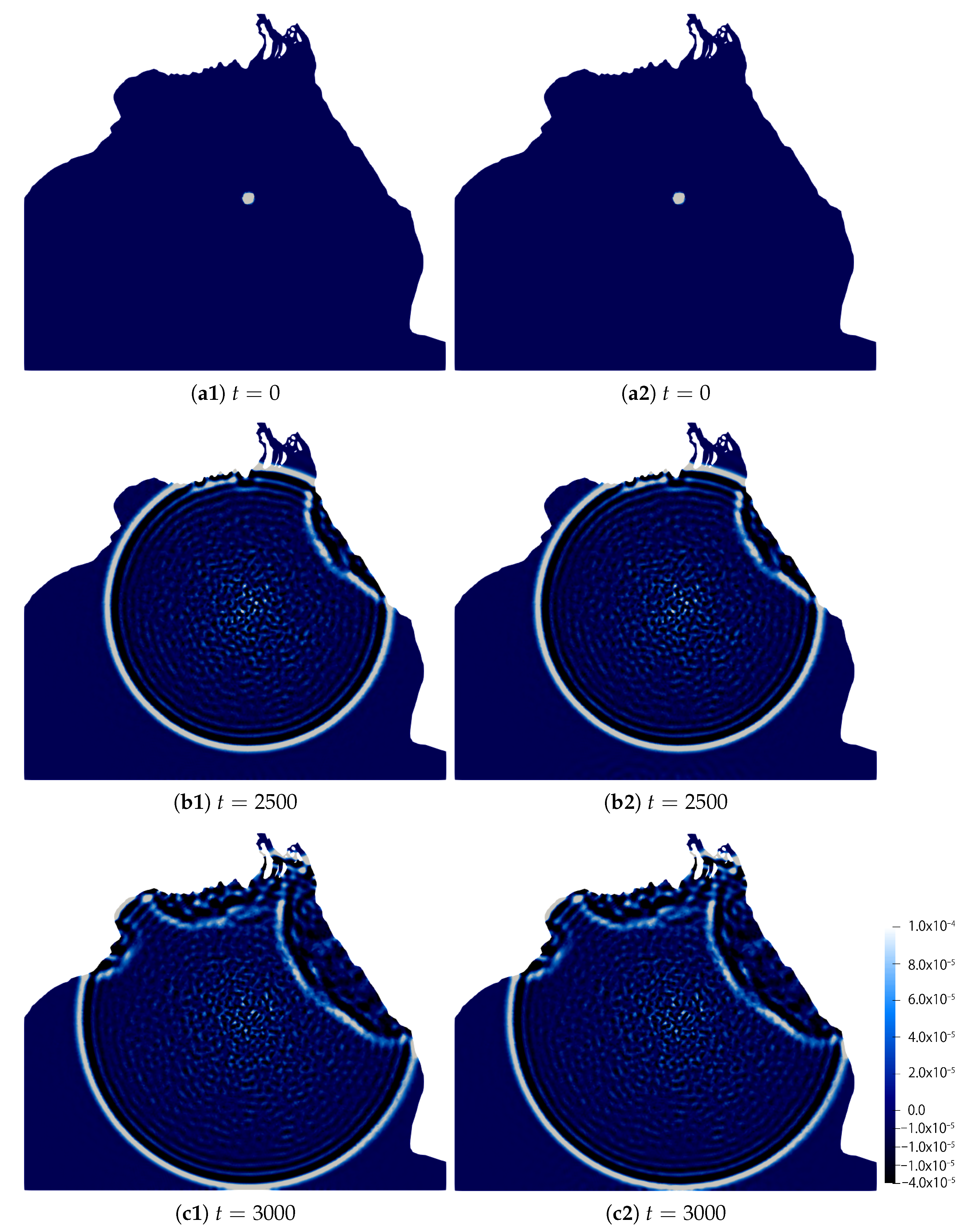
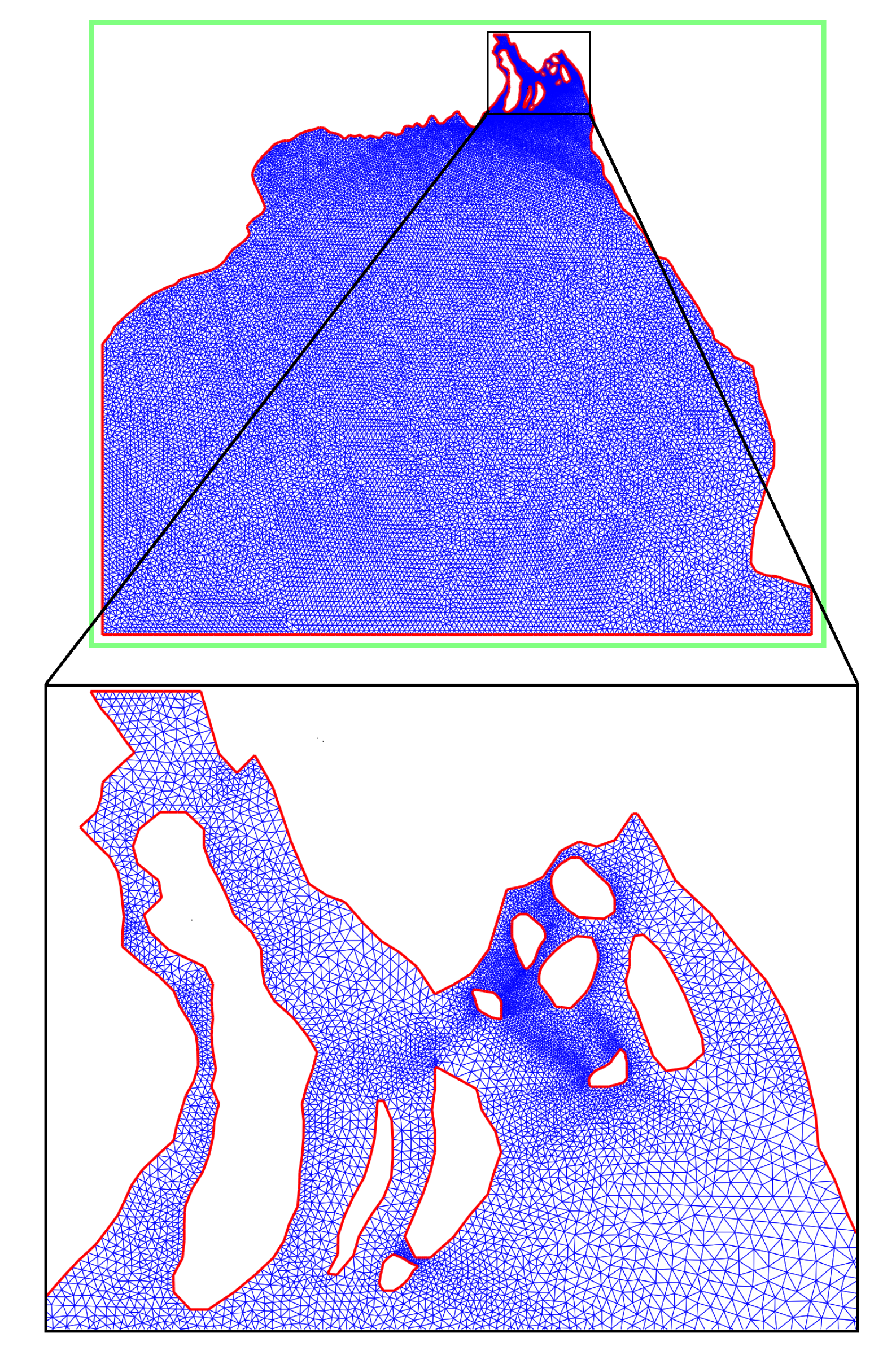
We prepare a triangular mesh of the domain as shown in Figure 8, where the numbers of elements and nodal points are and , respectively. Then, a numerical simulation is done by LG2 with []. The results at and 5000 [] are presented in Figure 9 and Figure 10. In the figures, for comparison to see the effect of the TBC, we compute Example 4 by replacing with and put it on the left. From Figure 9, we can see that a circular wave is created at around the point p, that it propagates towards the boundary over time, that reflections are found when the wave touches , and that the results with (left) and (right) are similar. From Figure 10, we can observe that artificial reflections on the open sea boundaries are significantly removed when the wave touches , cf. the right figures. Thus, LG2 works well for a simple (square) domain and this complex domain, the Bay of Bengal region, which is non-convex and includes islands.
Figure 8.
The mesh for the Bay of Bengal region used for Example 4.
Figure 9.
Contour plot of by LG2 with (left) and (right) on the Bay of Bengal for and .
Figure 10.
Contour plot of by LG2 with (left) and (right) on the Bay of Bengal for and .
For any (smooth) solution to problem (3), we define the total energy by
where is the kinetic energy, and is the potential energy. Then, it is worthy to note that the following energy estimate holds, cf. ([9] Corollary 3.3-(i)),
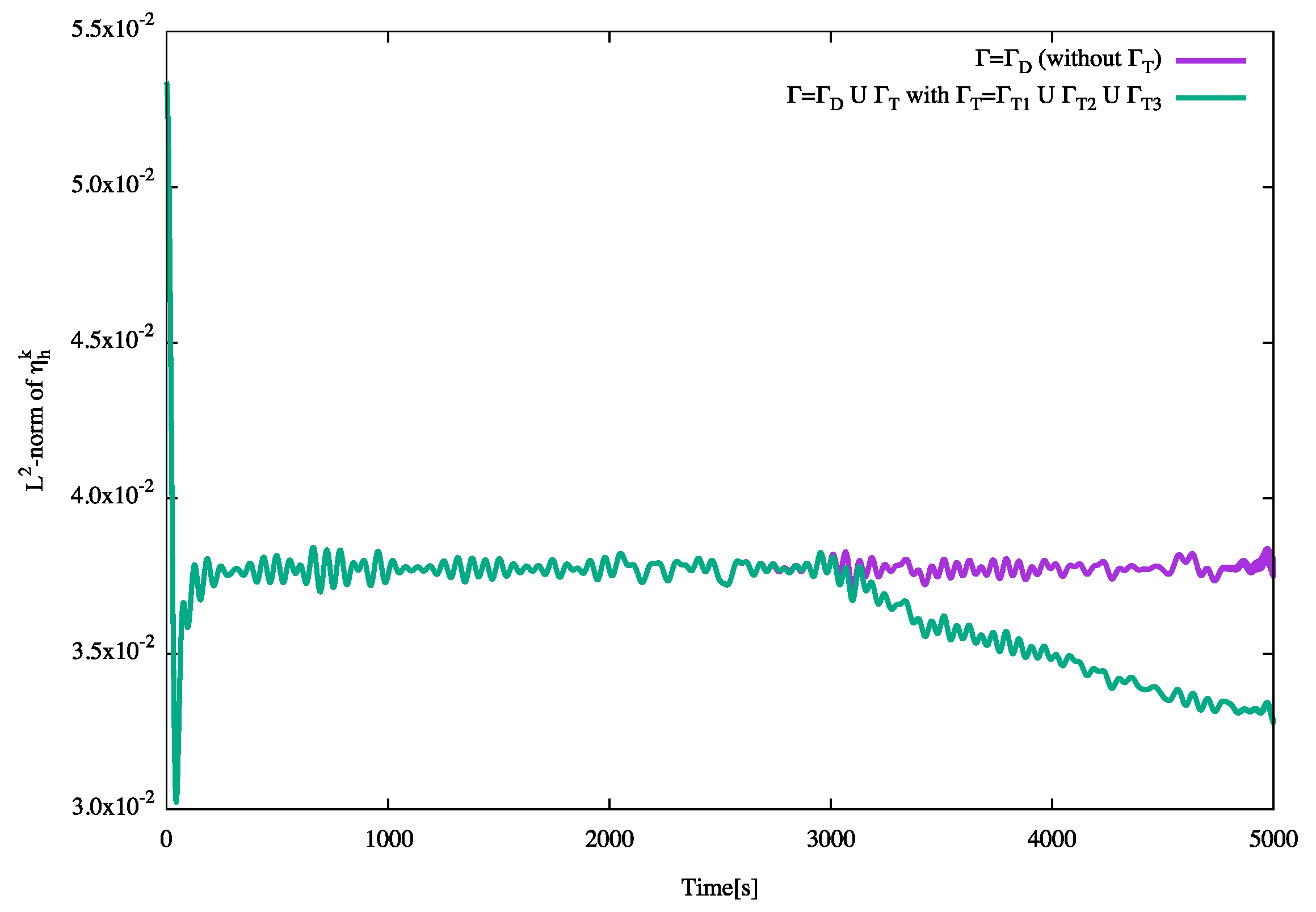
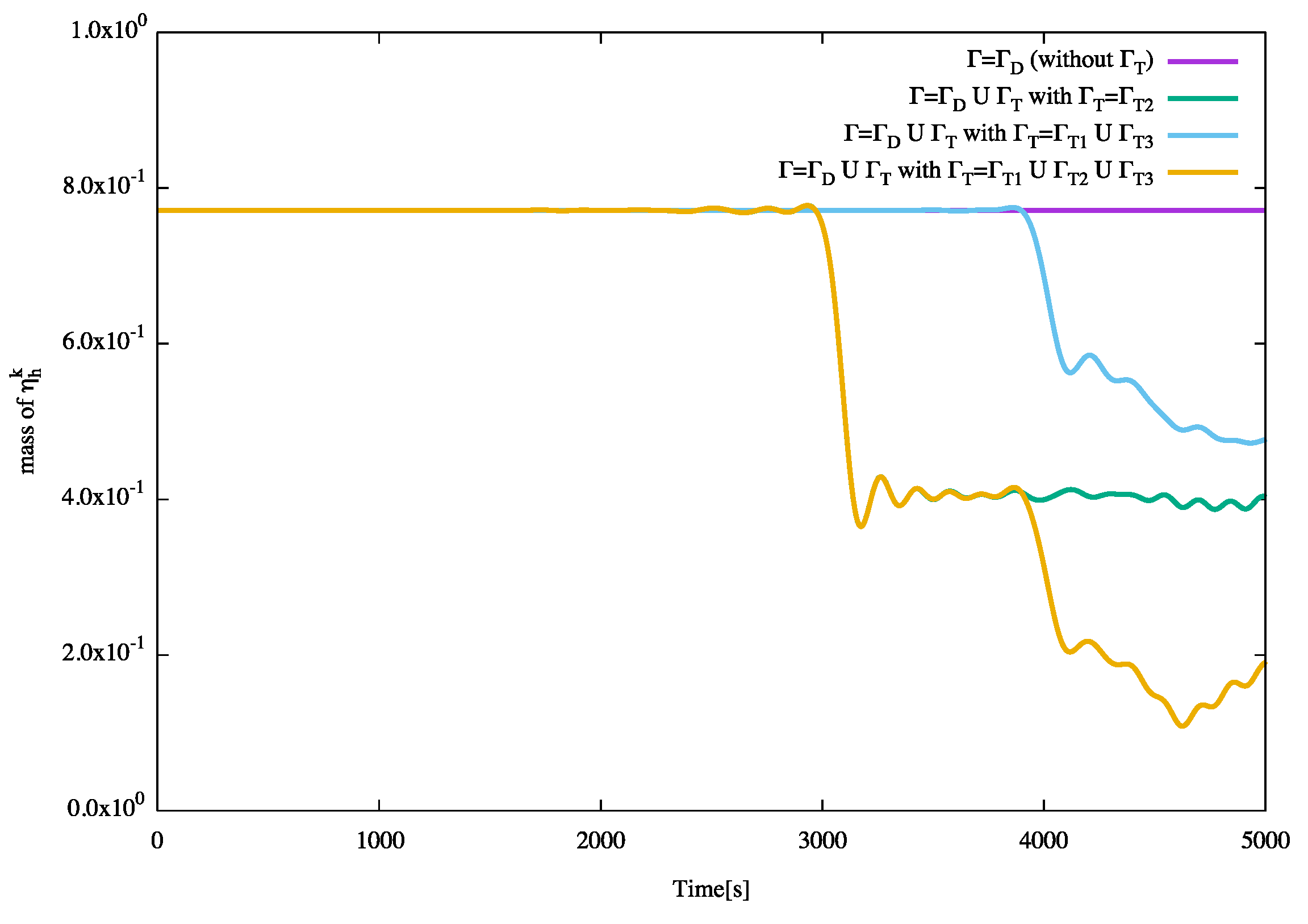
Here, focusing on and the mass of , i.e., , we present the values of the -norm of , i.e, , and the mass of , i.e., , in Figure 11 and Figure 12, respectively. In principle, we can say that the TBC works well numerically if and decrease around the time that the wave touches the transmission boundaries. Figure 11 shows graphs of for the two cases, with and without the transmission boundaries, i.e., and , respectively. Figure 12 shows the graphs of for the four cases of (transmission) boundaries, (i) no transmission boundary, i.e., , (ii) one transmission boundary, i.e., , (iii) two transmission boundaries, i.e., , and (iv) three transmission boundaries, i.e., . From Figure 11 and Figure 12, we can see that there are decreasing phenomena of the value of -norm as well as the value of the mass when the TBC is imposed. From Figure 9, we can see that the wave touches the transmission boundary at time around [s]; that is why, the mass of decreases drastically from around 3000 [s] to 3200 [s], cf. Figure 12 (yellow and green lines). Again, the mass started to decrease between the period from around 4000 [s] to 4500 [s], cf. Figure 12, since the wave reached the transmission boundary and , cf. Figure 10.
Figure 11.
Graphs of with respect to time for Example 4 with and without .
Figure 12.
Graphs of the mass of with respect to time for Example 4 with the following four settings; no transmission boundary, i.e., (purple), one transmission boundary, i.e., (green), two transmission boundaries, i.e., (blue), and three transmission boundaries, i.e., (yellow).
Remark 6.
We recall the results in [9] and mention the advantage of the TBC Equation (3e) on the stability under the assumption on .
- (i)
- The last term in the RHS of (7) is obviously non-positive. From the TBC Equation (3e), i.e., , we observe that the second term in the RHS of Equation (7) is non-positive:Since it is numerically observed in [9] that the second term is dominant from the viewpoint of the energy , cf. ([9] (Remark 3.5)), we can expect that this non-positivity derived from the TBC Equation (3e) improves the stability of the SWEs Equation (3).
- (ii)
- Let us additionally introduce a theorem ([9] (Theorem 3.4)). Suppose that there exists such thatThen, the summation of the first and second terms in the RHS of Equation (7) is non-positive, i.e.,in particular,
- (iii)
- (iv)
- We have compared our results by the TBC () and a modified TBC () with those by the RBC:The results by the three boundary conditions are not significantly different as presented in Appendix B. We note that condition (9) is the well-known RBC, cf., e.g., [8], and that the modified TBC is obtained by replacing ζ with in Equation (9), where the relation holds if is satisfied.
4.2. Effect of Position of a Transmission Boundary
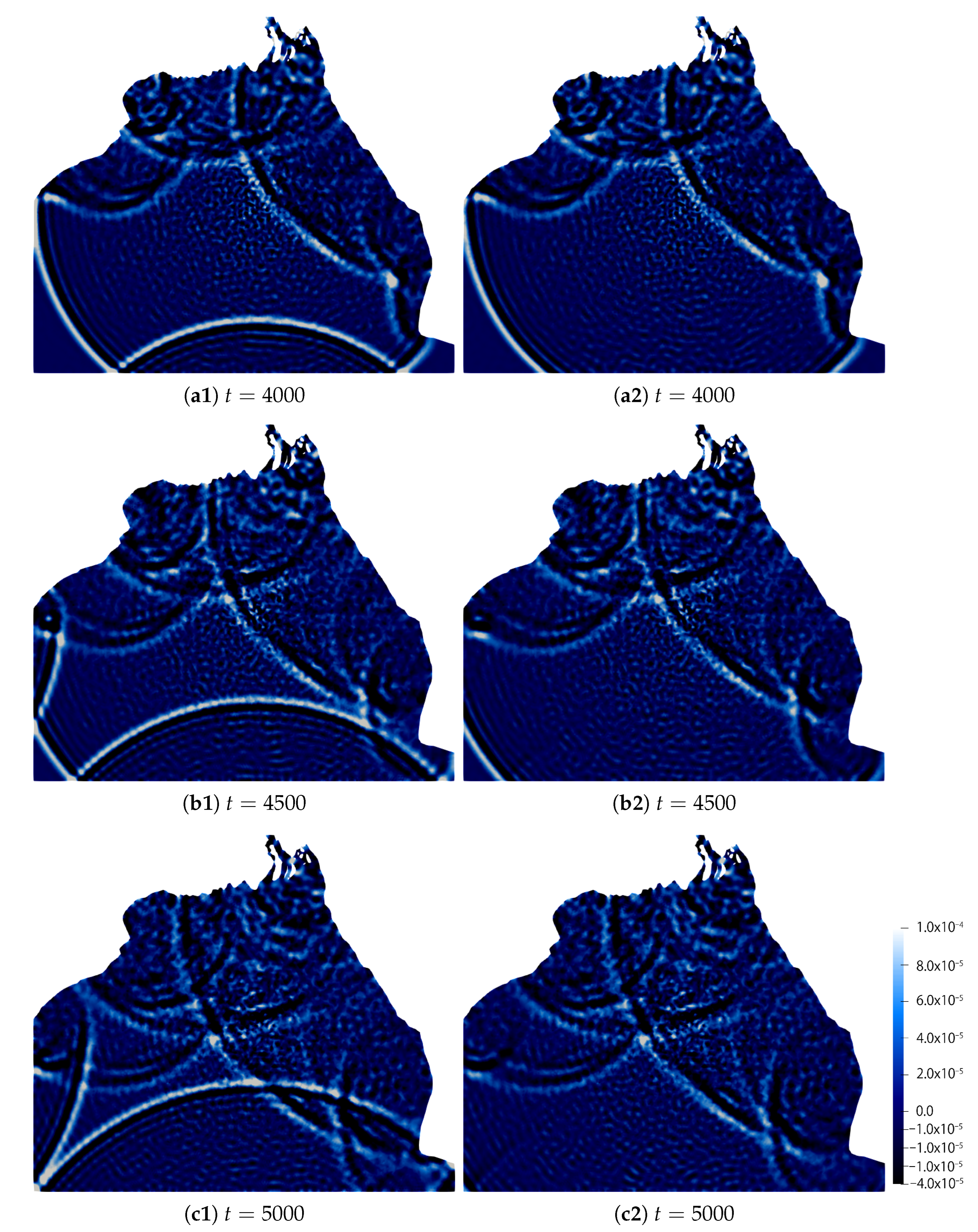
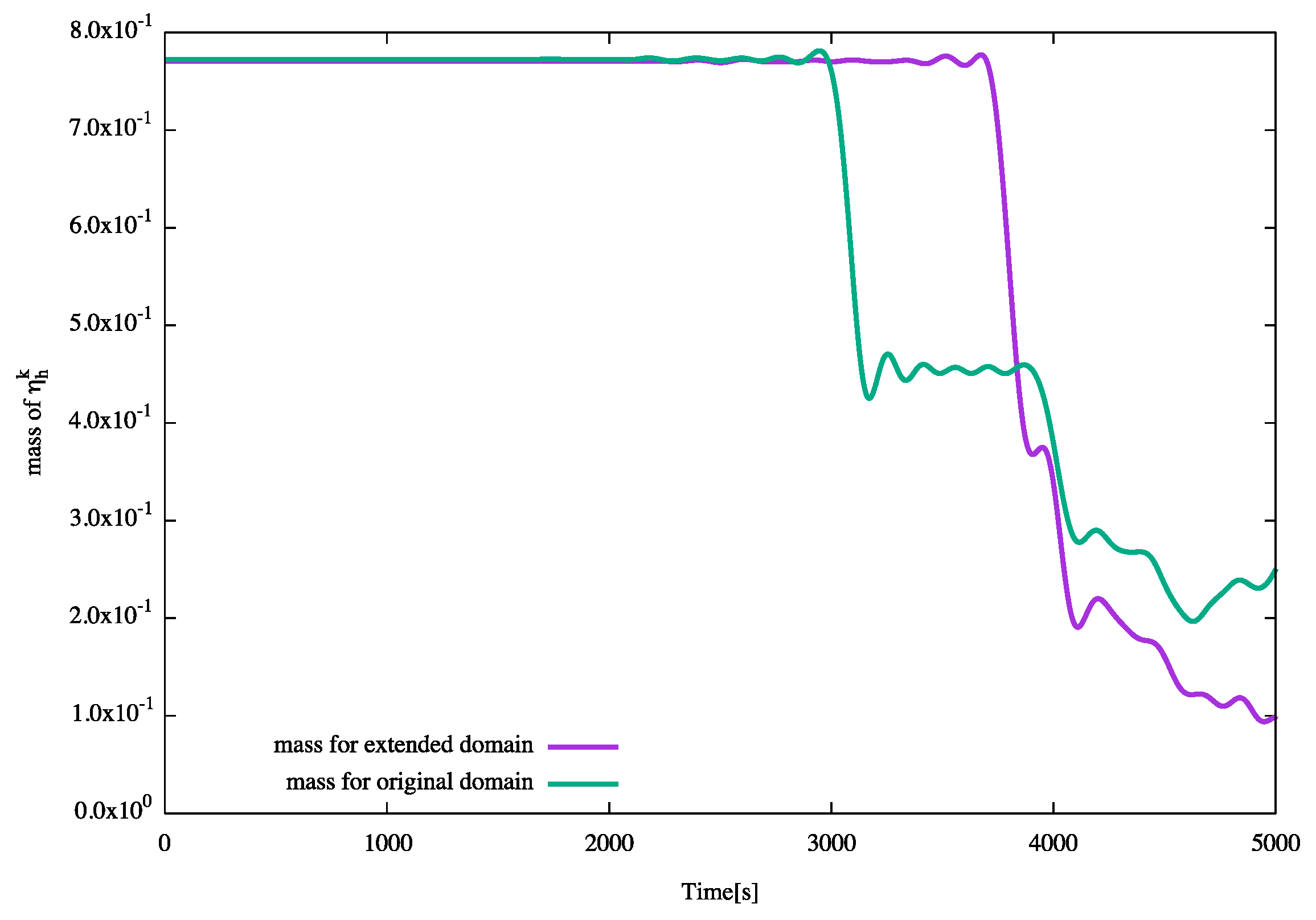
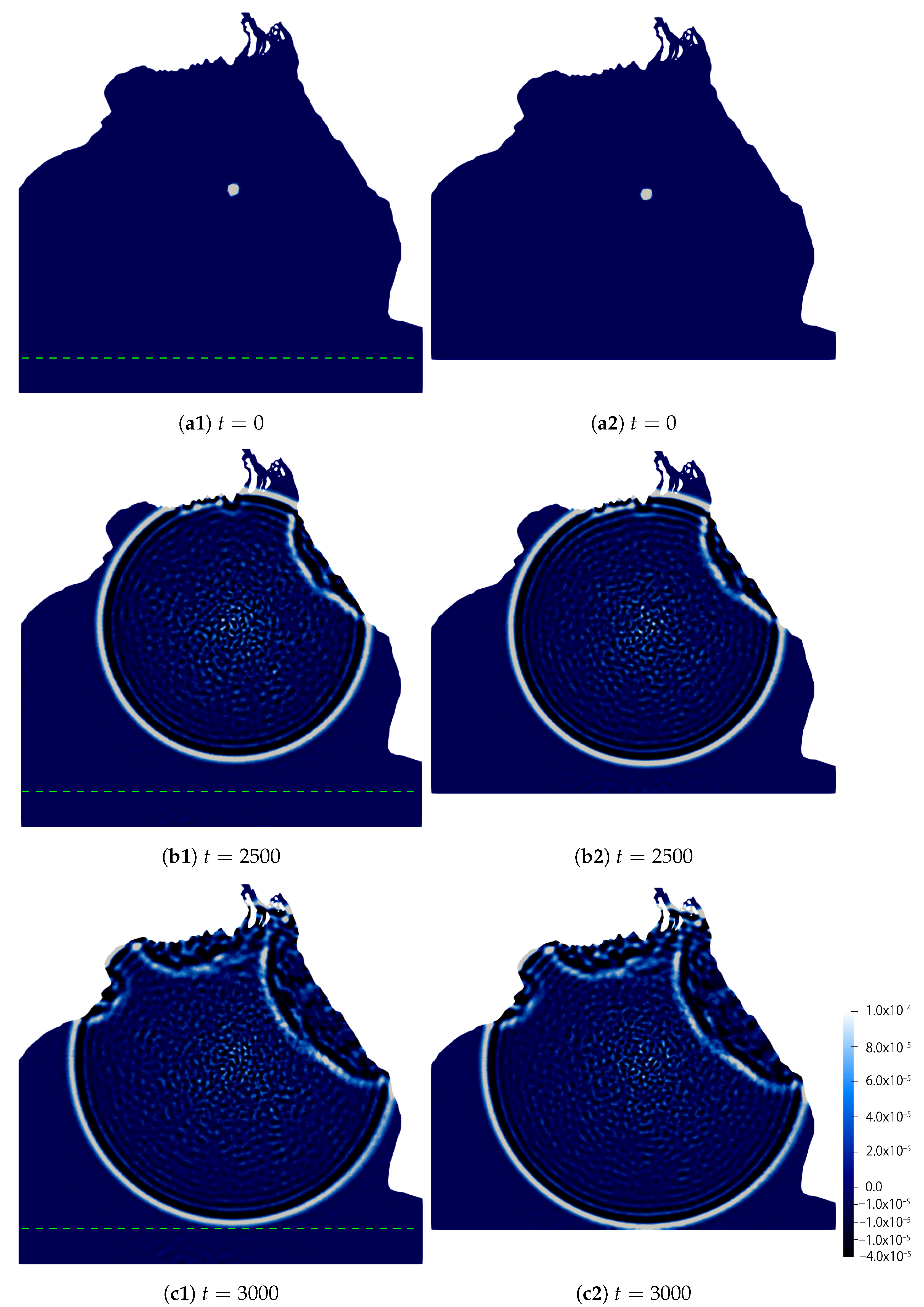
We consider Example 4 again to see the effect of the TBC with an extension of the domain (), where the size of the domain in the vertical direction is extended from to , i.e., extension. We employ the same boundary conditions on for both original and extended domains, where . We compare the numerical results for the extended domain with the ones for the original domain, cf. Figure 13 and Figure 14, where the left and right figures show the results for the extended and original domains, respectively. It is observed that there is no significant effect of the vertical position of the bottom transmission boundary . We also computed the mass of for both domains, cf. Figure 15. From Figure 15, we can see that the mass of started to decrease at time for the original domain, cf. Figure 13c2, while the mass of started to decrease at time for the extended domain, cf. Figure 14b1, because the wave touches the boundary at these times ( and ) for the original and extended domains, respectively. A similar decreasing property of mass of can be observed from Figure 15 when the wave touches the transmission boundaries. The results confirm that the TBC works well numerically and that we can choose the vertical position of the bottom transmission boundary without significant effect.
Figure 13.
Contour plot of by LG2 with for the extended domain (left) and for the original domain (right) on the Bay of Bengal for and . The green dotted lines in the left figures indicate the position of the bottom boundary of the original domain.
Figure 14.
Contour plot of by LG2 with for the extended domain (left) and for the original domain (right) on the Bay of Bengal for and .
Figure 15.
Graphs of the mass of for the extended and original domain with a TBC.
5. Conclusions
We have presented a two-step Lagrange–Galerkin scheme for the shallow water equations with a TBC. For the scheme, the EOCs have been computed (cf. Examples 1 and 2 in Section 3.1) and the second-order accuracy in time has been confirmed. From numerical experiments on a simple square domain (cf. Example 3 in Section 3.2), it has been observed that the effect of the TBC works well. Our scheme has been applied to a realistic domain, the Bay of Bengal, and numerical experiments have been performed for two different types of boundary conditions, i.e., with and without the TBC (cf. Section 4.1). There have been no significant reflections from and the wave has passed through while reflections have been observed from , and, in the graphs of and the mass of (cf. Figure 11 and Figure 12), natural decays of the values of as well as the mass of have been observed when the TBC is imposed. In addition, for the domain extended by 100 [] in the vertical direction, it has been confirmed that there is no significant effect of changing the position of the transmission boundary (cf. Section 4.2). From these numerical experiments, we conclude that our two-step Lagrange–Galerkin scheme, cf. Equation (5), works well numerically not only for a simple domain but also for a complex domain with the TBC if the bottom topography is flat. We note that the TBC is employed in this paper based on the theoretical stability study in [9,10], while the numerical results by the TBC and the RBC are similar (cf. Appendix B). In our forthcoming paper, Part II, the scheme will be applied to rapidly varying bottom surfaces and a real bottom topography of the Bay of Bengal region to investigate the effect of non-homogeneity of the bottom topography. In addition to the effect of the non-homogeneous bottom topography, there are other effects for developing an accurate storm surge prediction, e.g., the Coriolis and the bottom friction forces and the wind stresses, which will be the future work.
Author Contributions
M.M.R. and H.N. wrote the main manuscript text. M.M.M., M.K. and H.N. contributed to the study conceptualization. M.M.R., E.R.W. and H.N. contributed to the development and implementation of the high-order scheme. All authors have read and agreed to the published version of the manuscript.
Funding
M.M.R. is supported by the Japanese Government (Monbukagakusho: MEXT) Scholarship. This work is partially supported by JSPS KAKENHI Grant Numbers JP20KK0058, JP21H00999, JP20H00117, JP20H01812, JP18H01135, JP21H04431, and JP20H01823, and JST CREST Grant Number JPMJCR2014.
Data Availability Statement
Data can be available on request.
Conflicts of Interest
The authors declare no conflict of interest.
Abbreviations
The following abbreviations are used in this manuscript:
| RBC | Radiation boundary condition |
| TBC | Transmission boundary condition |
| SWEs | Shallow water equations |
| EOC | Experimental order of convergence |
| LG1 | Single-step Lagrange–Galerkin scheme of first order in time |
| LG2 | Two-step Lagrange–Galerkin scheme of second order in time |
Appendix A. Choice of c0
Based on [9], focusing on the potential energy , cf. Equation (6), we perform numerical experiments for the choice of for two cases with the following settings:
- -
- Case I (the square domain). In problem (3), we set , , , , , , , , , and . We employ discretization parameters, , and .
- -
- Case II (the Bay of Bengal). The parameters are the same as Example 4 except the value of . We employ the same mesh and in Section 4.

For , let be a norm of defined by
We compute the two cases for , and . The results are shown in Table A1 and imply that, for both cases, we have minimum values of for .
Table A1.
Values of and .
Table A1.
Values of and .
| Value of | Case I (the Square Domain) | Case II (the Bay of Bengal) |
|---|---|---|
| 13.55 | ||
| 13.54 | ||
| 13.5342 | ||
| 13.5323 | ||
| 13.5319 | ||
| 13.5328 | ||
| 13.5354 | ||
| 13.5375 | ||
Appendix B. Comparison with Radiation Type Open Boundary Condition
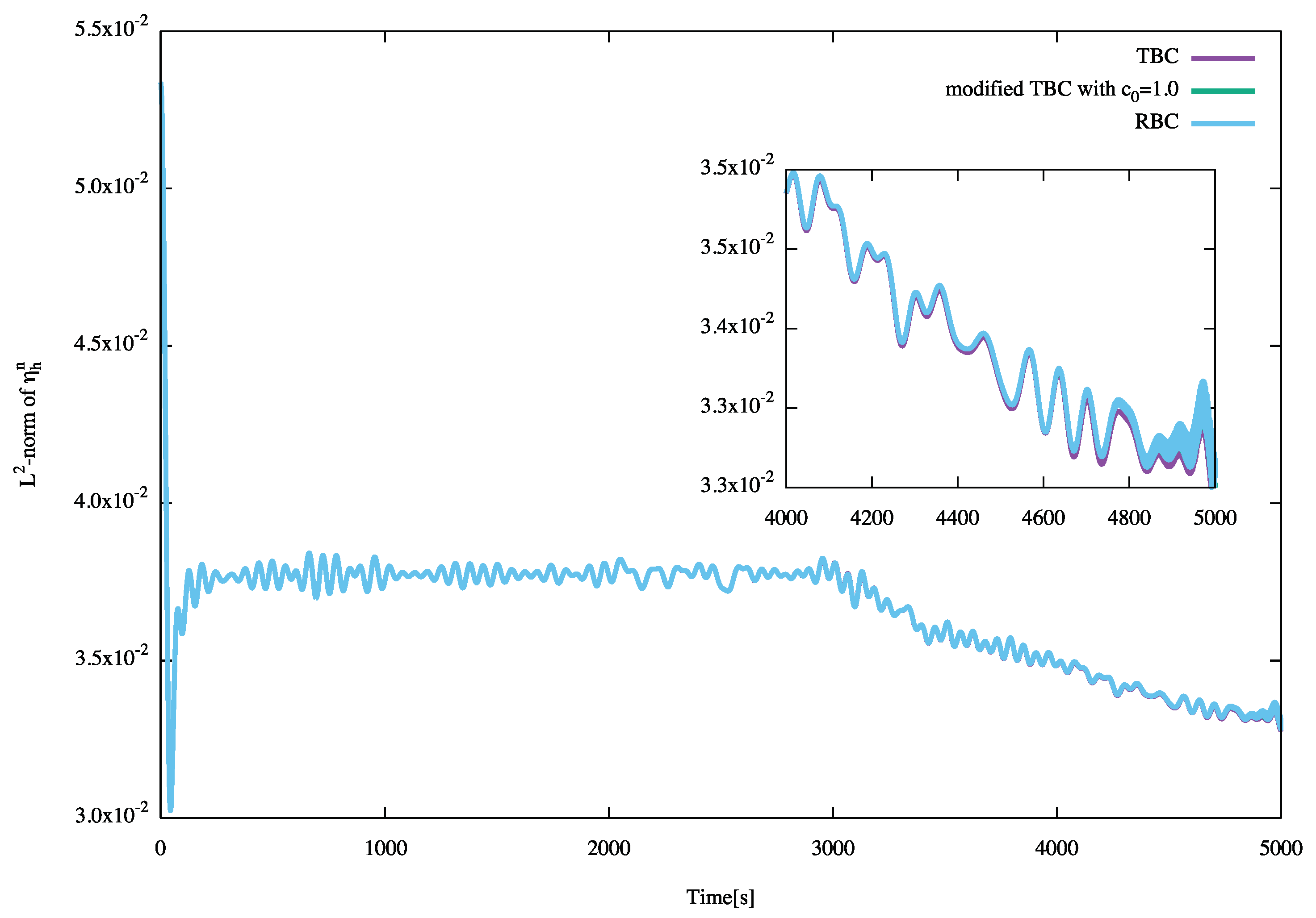
For the comparison, we consider the same problem settings of Case I and Case II in Appendix A. We compare the TBC (with ) and a modified TBC (with ) with the RBC Equation (9) used for the Bay of Bengal in [1,2,3,4,5,6,7,8] by focusing on the values of . Table A2 shows the values, which are all similar, while the smallest value is obtained by the TBC (with ) employed in this paper. Figure A1 shows the graphs of for further information.
Table A2.
Valuesof for different boundary conditions for Case I and Case II.
Table A2.
Valuesof for different boundary conditions for Case I and Case II.
| Boundary Condition | Case I (the Square Domain) | Case II (the Bay of Bengal) |
|---|---|---|
| TBC | 13.5316 | |
| modified TBC with | 13.5328 | |
| RBC | 13.5334 | |
Figure A1.
Graphs of -norm of for different boundary conditions for Case II (the Bay of Bengal).
References
- Debsarma, S.K. Simulations of storm surges in the Bay of Bengal. Mar. Geod. 2009, 32, 178–198. [Google Scholar] [CrossRef]
- Das, P.K. Prediction Model for Storm Surges in the Bay of Bengal. Nature 1972, 239, 211–213. [Google Scholar] [CrossRef]
- Johns, B. Numerical simulation of storm surges in the Bay of Bengal. In Monsoon Dynamics; Cambridge University Press: Cambridge, UK, 1981; pp. 689–706. [Google Scholar]
- Roy, G.; Kabir, A.H.; Mandal, M.; Haque, M. Polar coordinates shallow water storm surge model for the coast of Bangladesh. Dyn. Atmos. Ocean. 1999, 29, 397–413. [Google Scholar] [CrossRef]
- Paul, G.C.; Ismail, A.I.M. Tide–surge interaction model including air bubble effects for the coast of Bangladesh. J. Frankl. Inst. 2012, 349, 2530–2546. [Google Scholar] [CrossRef]
- Paul, G.C.; Ismail, A.I.M. Contribution of offshore islands in the prediction of water levels due to tide–surge interaction for the coastal region of Bangladesh. Nat. Hazards 2013, 65, 13–25. [Google Scholar] [CrossRef]
- Paul, G.C.; Senthilkumar, S.; Pria, R. Storm surge simulation along the Meghna estuarine area: An alternative approach. Acta Oceanol. Sin. 2018, 37, 40–49. [Google Scholar] [CrossRef]
- Dube, S.; Sinha, P.; Roy, G. Numerical simulation of storm surges in Bangladesh using a bay-river coupled model. Coast. Eng. 1986, 10, 85–101. [Google Scholar] [CrossRef]
- Murshed, M.M.; Futai, K.; Kimura, M.; Notsu, H. Theoretical and numerical studies for energy estimates of the shallow water equations with a transmission boundary condition. Discret. Contin. Dyn. Syst.-S 2021, 14, 1063–1078. [Google Scholar] [CrossRef]
- Murshed, M.M. Theoretical and Numerical Studies of the Shallow Water Equations with a Transmission Boundary Condition. Ph.D. Thesis, Kanazawa University, Kanazawa, Japan, 2019. [Google Scholar]
- Sommerfeld, A. Partial Differential Equations: Lectures in Theoretical Physics; Academic Press: Cambridge, MA, USA, 1949; Volume 6. [Google Scholar]
- Orlanski, I. A simple boundary condition for unbounded hyperbolic flows. J. Comput. Phys. 1976, 21, 251–269. [Google Scholar] [CrossRef]
- Røed, L.P.; Cooper, C.K. Open Boundary Conditions in Numerical Ocean Models. Adv. Phys. Oceanogr. Numer. Model. 1986, 186, 411–436. [Google Scholar]
- Jensen, T.G. Open boundary conditions in stratified ocean models. J. Mar. Syst. 1998, 16, 297–322. [Google Scholar] [CrossRef]
- Kanayama, H.; Dan, H. Tsunami Propagation from the open sea to the coast. In Tsunami; IntechOpen: London, UK, 2016. [Google Scholar]
- Kanayama, H.; Dan, H. A finite element scheme for two-layer viscous shallow-water equations. Jpn. J. Ind. Appl. Math. 2006, 23, 163–191. [Google Scholar] [CrossRef]
- Ewing, R.; Russell, T. Multistep Galerkin methods along characteristics for convection-diffusion problems. In Advances in Computer Methods for Partial Differential Equations IV; Vichnevetsky, R., Stepleman, R., Eds.; IMACS: New Brunswick, NJ, USA, 1981; pp. 28–36. [Google Scholar]
- Douglas, J.J.; Russell, T.F. Numerical Methods for Convection-Dominated Diffusion Problems Based on Combining the Method of Characteristics with Finite Element or Finite Difference Procedures. SIAM J. Numer. Anal. 1982, 19, 871–885. [Google Scholar] [CrossRef]
- Pironneau, O. On the transport-diffusion algorithm and its applications to the Navier-Stokes equations. Numer. Math. 1982, 38, 309–332. [Google Scholar] [CrossRef]
- Rui, H.; Tabata, M. A mass-conservative characteristic finite element scheme for convection-diffusion problems. J. Sci. Comput. 2010, 43, 416–432. [Google Scholar] [CrossRef]
- Ewing, R.; Russell, T.; Wheeler, M. Simulation of miscible displacement using mixed methods and a modified method of characteristics. In Proceedings of the Seventh Reservoir Simulation Symposium; Society of Petroleum Engineers of AIME: San Francisco, CA, USA, 1983; pp. 71–81. [Google Scholar]
- Süli, E. Convergence and nonlinear stability of the Lagrange-Galerkin method for the Navier-Stokes equations. Numer. Math. 1988, 53, 459–483. [Google Scholar] [CrossRef]
- Pironneau, O. Finite Element Methods for Fluids; John Wiley & Sons: Chichester, UK, 1989. [Google Scholar]
- Boukir, K.; Maday, Y.; Métivet, B.; Razafindrakoto, E. A high-order characteristics/finite element method for the incompressible Navier–Stokes equations. Int. J. Numer. Methods Fluids 1997, 25, 1421–1454. [Google Scholar] [CrossRef]
- Achdou, Y.; Guermond, J.L. Convergence analysis of a finite element projection/Lagrange–Galerkin method for the incompressible Navier–Stokes equations. SIAM J. Numer. Anal. 2000, 37, 799–826. [Google Scholar] [CrossRef]
- Rui, H.; Tabata, M. A second order characteristic finite element scheme for convection-diffusion problems. Numer. Math. 2002, 92, 161–177. [Google Scholar] [CrossRef]
- Bermúdez, A.; Nogueiras, M.R.; Vázquez, C. Numerical analysis of convection-diffusion-reaction problems with higher order characteristics/finite elements. Part I: Time Discretization. SIAM J. Numer. Anal. 2006, 44, 1829–1853. [Google Scholar] [CrossRef]
- Bermúdez, A.; Nogueiras, M.R.; Vázquez, C. Numerical analysis of convection-diffusion-reaction problems with higher order characteristics/finite elements. Part II: Fully discretized scheme and quadrature formulas. SIAM J. Numer. Anal. 2006, 44, 1854–1876. [Google Scholar] [CrossRef]
- Chrysafinos, K.; Walkington, N.J. Lagrangian and moving mesh methods for the convection diffusion equation. ESAIM Math. Model. Numer. Anal. 2008, 42, 25–55. [Google Scholar] [CrossRef]
- Notsu, H. Numerical computations of cavity flow problems by a pressure stabilized characteristic-curve finite element scheme. Trans. Jpn. Soc. Comput. Eng. Sci. 2008, 2008, 20080032. [Google Scholar]
- Pironneau, O.; Tabata, M. Stability and convergence of a Galerkin-characteristics finite element scheme of lumped mass type. Int. J. Numer. Methods Fluids 2010, 64, 1240–1253. [Google Scholar] [CrossRef]
- Benítez, M.; Bermúdez, A. A second order characteristics finite element scheme for natural convection problems. J. Comput. Appl. Math. 2011, 235, 3270–3284. [Google Scholar] [CrossRef]
- Benítez, M.; Bermúdez, A. Numerical analysis of a second order pure Lagrange–Galerkin method for convection-diffusion problems. Part I: Time discretization. SIAM J. Numer. Anal. 2012, 50, 858–882. [Google Scholar] [CrossRef]
- Benítez, M.; Bermúdez, A. Numerical analysis of a second order pure Lagrange–Galerkin method for convection-diffusion problems. Part II: Fully discretized scheme and numerical results. SIAM J. Numer. Anal. 2012, 50, 2824–2844. [Google Scholar] [CrossRef]
- Bermejo, R.; Saavedra, L. Modified Lagrange–Galerkin methods of first and second order in time for convection-diffusion problems. Numer. Mathematik 2012, 120, 601–638. [Google Scholar] [CrossRef]
- Bermejo, R.; Gálan del Sastre, P.; Saavedra, L. A second order in time modified Lagrange–Galerkin finite element method for the incompressible Navier–Stokes equations. SIAM J. Numer. Anal. 2012, 50, 3084–3109. [Google Scholar] [CrossRef]
- Notsu, H.; Rui, H.; Tabata, M. Development and L2-Analysis of a Single-Step Characteristics Finite Difference Scheme of Second Order in Time for Convection-Diffusion Problems. J. Algorithms Comput. Technol. 2013, 7, 343–380. [Google Scholar] [CrossRef]
- Notsu, H.; Tabata, M. Error Estimates of a Pressure-Stabilized Characteristics Finite Element Scheme for the Oseen Equations. J. Sci. Comput. 2015, 65, 940–955. [Google Scholar] [CrossRef]
- Notsu, H.; Tabata, M. Error estimates of a stabilized Lagrange–Galerkin scheme for the Navier–Stokes equations. ESAIM Math. Model. Numer. Anal. 2016, 50, 361–380. [Google Scholar] [CrossRef]
- Notsu, H.; Tabata, M. Error Estimates of a Stabilized Lagrange–Galerkin Scheme of Second-Order in Time for the Navier–Stokes Equations. In Mathematical Fluid Dynamics, Present and Future Springer Proceedings in Mathematics & Statistics; Springer: Berlin, Germany, 2016; pp. 497–530. [Google Scholar]
- Tabata, M.; Uchiumi, S. A genuinely stable Lagrange–Galerkin scheme for convection-diffusion problems. Jpn. J. Ind. Appl. Math. 2016, 33, 121–143. [Google Scholar] [CrossRef]
- Lukáčová-Medviďová, M.; Notsu, H.; She, B. Energy dissipative characteristic schemes for the diffusive Oldroyd-B viscoelastic fluid. Int. J. Numer. Methods Fluids 2015, 81, 523–557. [Google Scholar] [CrossRef]
- Lukáčová-Medvid’ová, M.; Mizerová, H.; Notsu, H.; Tabata, M. Numerical analysis of the Oseen-type Peterlin viscoelastic model by the stabilized Lagrange–Galerkin method, Part I: A linear scheme. ESAIM Math. Model. Numer. Anal. 2017, 51, 1637–1661. [Google Scholar] [CrossRef]
- Lukáčová-Medvid’ová, M.; Mizerová, H.; Notsu, H.; Tabata, M. Numerical analysis of the Oseen-type Peterlin viscoelastic model by the stabilized Lagrange–Galerkin method, Part II: A nonlinear scheme. ESAIM Math. Model. Numer. Anal. 2017, 51, 1663–1689. [Google Scholar] [CrossRef]
- Tabata, M.; Uchiumi, S. An exactly computable Lagrange–Galerkin scheme for the Navier–Stokes equations and its error estimates. Math. Comput. 2018, 87, 39–67. [Google Scholar] [CrossRef]
- Uchiumi, S. A viscosity-independent error estimate of a pressure-stabilized Lagrange–Galerkin scheme for the Oseen problem. J. Sci. Comput. 2019, 80, 834–858. [Google Scholar] [CrossRef]
- Colera, M.; Carpio, J.; Bermejo, R. A nearly-conservative high-order Lagrange–Galerkin method for the resolution of scalar convection-dominated equations in non-divergence-free velocity fields. Comput. Methods Appl. Mech. Eng. 2020, 372, 113366. [Google Scholar] [CrossRef]
- Colera, M.; Carpio, J.; Bermejo, R. A nearly-conservative, high-order, forward Lagrange–Galerkin method for the resolution of scalar hyperbolic conservation laws. Comput. Methods Appl. Mech. Eng. 2021, 376, 113654. [Google Scholar] [CrossRef]
- Futai, K.; Kolbe, N.; Notsu, H.; Suzuki, T. A mass-preserving two-step Lagrange–Galerkin scheme for convection-diffusion problems. J. Sci. Comput. 2022, 92, 37. [Google Scholar] [CrossRef]
- Hecht, F. New development in FreeFem++. J. Numer. Math. 2012, 20, 251–265. [Google Scholar] [CrossRef]
Disclaimer/Publisher’s Note: The statements, opinions and data contained in all publications are solely those of the individual author(s) and contributor(s) and not of MDPI and/or the editor(s). MDPI and/or the editor(s) disclaim responsibility for any injury to people or property resulting from any ideas, methods, instructions or products referred to in the content. |
© 2023 by the authors. Licensee MDPI, Basel, Switzerland. This article is an open access article distributed under the terms and conditions of the Creative Commons Attribution (CC BY) license (https://creativecommons.org/licenses/by/4.0/).