

Abstract
In this work, we reveal some distributional characteristics of concomitants of generalized order statistics (GOS) with parameters that are pairwise different, arising from iterated Farlie–Gumbel–Morgenstern (IFGM) family of bivariate distributions. Additionally, the joint distribution and product moments of concomitants of GOS for this family are discussed. Moreover, some well-known information measures, i.e., extropy, cumulative residual extropy (CRJ), and negative cumulative extropy (NCJ), are derived. Applications of these results are given for order statistics, record values, and progressive type-II censored order statistics with uniform marginals distributions. Additionally, the issue of estimating the CRJ and NCJ is looked into, utilizing the empirical technique and the concomitant of GOS. Finally, bivariate real-world data sets have been analyzed for illustrative purposes, and the performance of the proposed method is quite satisfactory.
Keywords:
generalized order statistics; progressive type-II censored order statistics; IFGM family; extropy; cumulative residual extropy; negative cumulative extropy MSC:
62G05; 62G30; 94A15; 94A17
1. Introduction
In recent decades, statisticians have become increasingly interested in modeling bivariate data. Bivariate distributions can be found in many forms, but it is important to find those that are based on marginal distributions. By using families of bivariate distributions, we are able to model a large number of datasets easily. In this regard, the Farlie-Gumbel-Morgenstern (FGM) family of bivariate distributions is the most useful and widely used. With this family, it is easy to see the marginals’ dependence structure. As a result, many researchers have modified this model in order to achieve better correlations between variables. This model and its generalizations have been the subject of many remarkable works. Among these researchers are [1,2,3,4,5,6], among others.
The generalized FGM denoted by IFGM with a single iteration has the cumulative distribution function (CDF) and probability density function (PDF), which are given by [5] as
where and are the marginal PDF and CDF of random variables (RVs) X and Y, respectively, while and are the survival functions (SFs). The natural parameter space is convex (cf. [5]). Applications of the family IFGM in the reliability theory were described by [4] who demonstrated that utilizing IFGM distributions, rather than FGM distributions, for these applications yields more accurate findings. It is important to note that the IFGM model is more tractable and adaptable. As a result, there are a number of compelling arguments in favor of employing the model IFGM
Tests on materials and their strength, reliability, lifetime, and other factors are carried out in a non-descending order; thus, we must take into account numerous models of ascendingly ordered RVs. The model of generalized order statistics (GOS) was introduced by [7] as a unified model for ascendingly ordered RVs. The GOS model contains many important models of ordered RVs, such as order statistics (OS), record values, sequential OS, and progressive type-II censored OS (POS-II). The RVs are called GOS based on absolutely continuous CDF with the PDF if their joint PDF (JPDF) has the form
where The parameters are defined by
In this work, we focus only on the parameters , which are pairwise different, i.e., With this assumption, we obtain a very wide subclass of GOS, which contains m-GOS (when ), OS, and record values. The PDF of the rth GOS and the JPDF of rth and sth GOS, respectively, are given by
where and (cf. [8]).
The concept of concomitants of OS was introduced by [9] for the first time. In problems of selection and prediction, the concomitants are of interest. [10] provided a comprehensive review of the concomitants of OS. One of the most critical applications of concomitants of OS and record value is the sampling approach known as ranking set sampling. Particularly, when the primary RV Y is expensive and complex to measure, while the secondary RV X is inexpensive and straightforward. Let be a random sample from a bivariate CDF The concomitant of the rth GOS, is the Y value associated with There are many works on the concomitants of m-GOS (see [3,11,12,13,14,15]). However, only a few studies have been looked at the concomitants of GOS in a general setting. Accordingly, [16] investigated the distribution of concomitants of GOS from FGM bivariate distributions. In addition, various information measures for concomitant GOS were established under a general framework by [1]. Lastly, the concomitants of dual GOS in the Bairamov–Kotz–Becki FGM family were examined by [2]. In this paper, we will extend the recent work of [12] to concomitants of GOS under a general framework of the family IFGM
The idea of information–theoretic entropy was first introduced by [17], and it is essential in a number of disciplines, including financial analysis, data compression, molecular biology, hydrology, meteorology, computer science, and information theory. There are clear relationships between the measurement uncertainty of RVs, which is used in many fields, and other key data and reliability measurements. Extropy (J), a dual function that complements Shannon entropy, was proposed by [18]. This measure of uncertainty has received a lot of attention over the last five years (see [6]).
Recently, a number of authors have become interested in the J measure and its uses. The lower bounds for the J measure of OS and record values, monotone qualities, and certain characterization results were all covered by [19]. In addition, [20] concentrated on the leftover J measure of OS. The J measure estimators were examined by [21] with applications in testing uniformity. In the FGM family, [12] looked at the measurements of J for concomitants of m-GOS. Moreover, [22,23] nonparametric’s calculation of the residual J measure of concomitants of m-GOS using actual and simulated COVID-19 viral data is presented. Finally, [24] provided a description of compressive sensing utilizing ranked set sampling’s J measure.
The cumulative residual extropy (CRJ) was proposed by [25] in analogy with (5) as a measure of the uncertainty of RVs. The CRJ is defined as
It is clear that is always non-positive. Hence, the negative CRJ (NCRJ) can be presented as (cf. [26])
Recently, [27] discussed some properties and applications of negative cumulative extropy (NCE) in analogy with (5), defined as
Allowing some of the important models in many branches of statistics to use some of the key models in these GOS simply in this general framework. Examining the concomitant of GOS is a crucial practical way to sort the bivariate data in this situation. Some useful models from the GOS model, such as the POSs, are not included in these submodels. The POS-II model is an essential tool for obtaining data from lifetime testing, since it enables the experimenter to save money by allowing live units to be removed early and simply by used in later tests. Additionally, it enables a balance between the time commitment and the observance of some extreme principles. One of the statistical applications of the J measure is to score the forecasting distributions using the total log scoring rule. Moreover, the aforesaid theoretical and practical importance of measure J and its related measures are defined in (5)–(8) to provide sufficient motivation to study and reveal concomitants of GOS under a general framework from the family IFGM
The rest of this paper is structured as follows: Section 2 reveals some distributional characteristics of concomitants of GOS based on the IFGM family under a general framework. As an example, POS-II under uniform distribution is given. In Section 3, the joint distribution, joint moment generating function (JMGF), and product moments of concomitants of GOS of this family are obtained. We also studied some measures such as J, CRJ, and NCJ for in the IFGM family in Section 4. Moreover, we discussed the problem of estimating the NCRJ and NCJ by employing the empirical NCRJ and NCJ for concomitants of GOS in Section 5. Additionally, for demonstrative purposes, bivariate real-world data sets are analyzed in Section 6, and the performance of the suggested strategy is extremely excellent. Finally, the conclusion is covered in Section 7.
2. Distributional Characteristics of Concomitants of GOS Based on IFGM
In this section, the distributional characteristics of concomitant GOS based on IFGM model with parameters that are pairwise different are obtained. Recurrence relations between single moments of concomitants are carried out. As an example, the POS-II with uniform marginal distributions is discussed.
The PDF, CDF, and SF expressions for for any arbitrary marginal distribution based on the IFGM model are obtained in the following theorem.
Theorem 1.
Let be the concomitant of rth GOS from IFGM with RV has the CDF Then, the PDF, CDF, and SF of are given by
where and .
Proof.
First, for every positive real number consider the integration
By using the transformation we obtain
Then, by considering the definition of and incorporating (12) in the above integrations, the required result directly follows. Finally, by some simple algebra, we can derive the CDF and SF of □
Remark 1.
By using Theorem 1, the marginal hazard rate function (HRF) of is given by
If the RVs stated above are taken to be the lifetime of system components or human lives at specific ages, then can be employed in reliability theory.
Using Theorem 1, we can now calculate the MGF and the moments of , based on IFGM for any random distribution. Relying on (9), the MGF of , based on IFGM, is given by
where , and are the MGFs of the RVs , and respectively. Thus, by using (13) the ℓth moment of based on IFGM is given by
where , and
In general, if is a function of y, then (9) yields
provided the expectations exist.
The following theorem gives a useful general recurrence relation for
Theorem 2.
Let be a function of Then, we obtain
Proof.
Using the relations and we obtain
where () and () are defined via Theorem 1, then
In the same manner, we obtain
which completes the proof. □
In most lifetime trials, accurate product lifetime data cannot be observed due to time and money constraints, so we have suppressed data instead. The POS-II is one of the most significant censoring strategies.
Example 1.
Let be a continuous bivariate CDF. Furthermore, let be POS-II with general scheme where identical units are placed on a lifetime test. Ref. [28] derived the PDF of the concomitant of the POS-II by
where and is the PDF of the concomitant of the minimum OS from a sample of size Now, let be IFGM with uniform marginals. Then, and Thus, we can write
Therefore, the PDF of is given by
3. JPDF of Concomitants of GOS Based on IFGM
The following theorem gives the JPDF of the concomitants of GOS in IFGM under a general setting.
Theorem 3.
Let and be the concomitant of rth and sth GOS from IFGM with RV has the CDF Then the JPDF of and are given by
where and are defined by replacing r with s in and , respectively,
and
Proof.
First, consider the following integration:
Taking the transformation , we obtain
By using the obvious relations and and carrying out some algebra, we obtain
Since,
Now, by using (15), with and for and with and for we obtain, after some algebra,
Finally, in the same manner, we can derive , and which completes the proof. □
As a direct consequence of Theorem 3, the JMGF of concomitants and based on IFGM are given by
The product moment , is obtained directly from (16) as
4. Some Measures for Based on IFGM
In this section, the measures of J, CRJ, and NCJ for the concomitant of GOS based on the IFGM family under a general framework are derived. An application is given for the concomitants of OS and record values for some well-known distributions such as uniform, exponential, and Weibull distributions.
4.1. Measure of J for Based on IFGM()
Let is the rth concomitant of GOS; then, from (5) and (9), the J measure is given by
where U is a uniformly RV on , is the J of the RV , and is the derivative of , with respect to i.e., .
All the results for m-GOS can be considered as a special case of GOS under the general framework (see Remark 1.1 in [16]), so consider the following two cases:
- Case 1: The m-GOS become OS if and . The PDF of the concomitant of the rth OS is given by (cf. [4])where , . According (17), the J of is
- Case 2: If and , the m-GOS become upper record values. Suppose be a sequence of bivariate RVs from a continuous distribution. If is the sequence of upper record values in the sequence of X’s, then the Y, which corresponds with the rth record value, will be referred the concomitant of the rth record value, denoted by Hence, the PDF for has been acquired (cf. [4])where and According to (17), the J measure of is
In the following examples, we present some well-known distributions, such as exponential and Weibull distributions of
Example 2.
Suppose that X and Y have exponential distributions from IFGM (IFGM-ED) (i.e., . According to (17), we obtain the J in as follows
Example 3.
Suppose that X and Y have Weibull distribution from IFGM (IFGM-WD) (i.e., ). After simple algebra, we obtain the J in as follows
4.2. Measure of CRJ for Based on IFGM()
For the concomitant of rth GOS, from (6) and (9), the CRJ measure is given by
where is the CRJ of the RV Y.
In the examples below, we show the uniform and Weibull distributions of
Example 4.
Suppose that X and Y have uniform distributions from IFGM (IFGM-UD) (i.e., ). According to (20), we obtain the CRJ in as follows:
Example 5.
Suppose that X and Y have IFGM-WD, then we obtain the CRJ in as follows:
4.3. Measure of NCJ for Based on IFGM()
5. Empirical Measures for Based on IFGM()
In this section, we use empirical estimators to calculate the NCRJ and NCJ for concomitant The mean and variance of the empirical NCRJ and NCJ of OS and record values are given.
5.1. Empirical NCRJ
We will now look at the problem of using the empirical NCRJ to estimate the NCRJ for concomitants. Let be a sequence from the IFGM family. Using the relation (7), the empirical NCRJ of may be calculated as follows:
where are sample spacings based on ordered random samples
Let us consider the following examples to give the mean and variance of and
Example 6.
If is a random sample from IFGM-ED, the sample spacings are independent and exponentially distributed, with a mean (for more details, see [29]). According to [30], the empirical NCRJ mean and variance based on are as follows:
Example 7.
The sample spacings for IFGM-UD with are independent of the beta distribution with parameters 1 and n. According to [30], the mean and variance of empirical NCRJ based on are as follows:
5.2. Empirical NCJ
In this subsection, using the empirical NCJ to estimate the NCJ for concomitants. Let be a sequence from IFGM family. The empirical NCJ of is given by
Example 8.
If is a random sample from IFGM-ED. The empirical NCJ mean and variance, based on , are as follows:
Example 9.
The sample spacings for IFGM-UD. The mean and variance of empirical NCJ, based on , are as follows:
The values of and Var, based on IFGM-ED by computing (22) and (23), are shown in Table 1. From Table 1, the following characteristics can be taken.
Table 1.
and Var from IFGM-ED.
- 1.
- Generally, with fixed n and the values of and Var decrease as the value of increases.
- 2.
- In general, fixing n and yields and Var, which decreases as the value of increases.
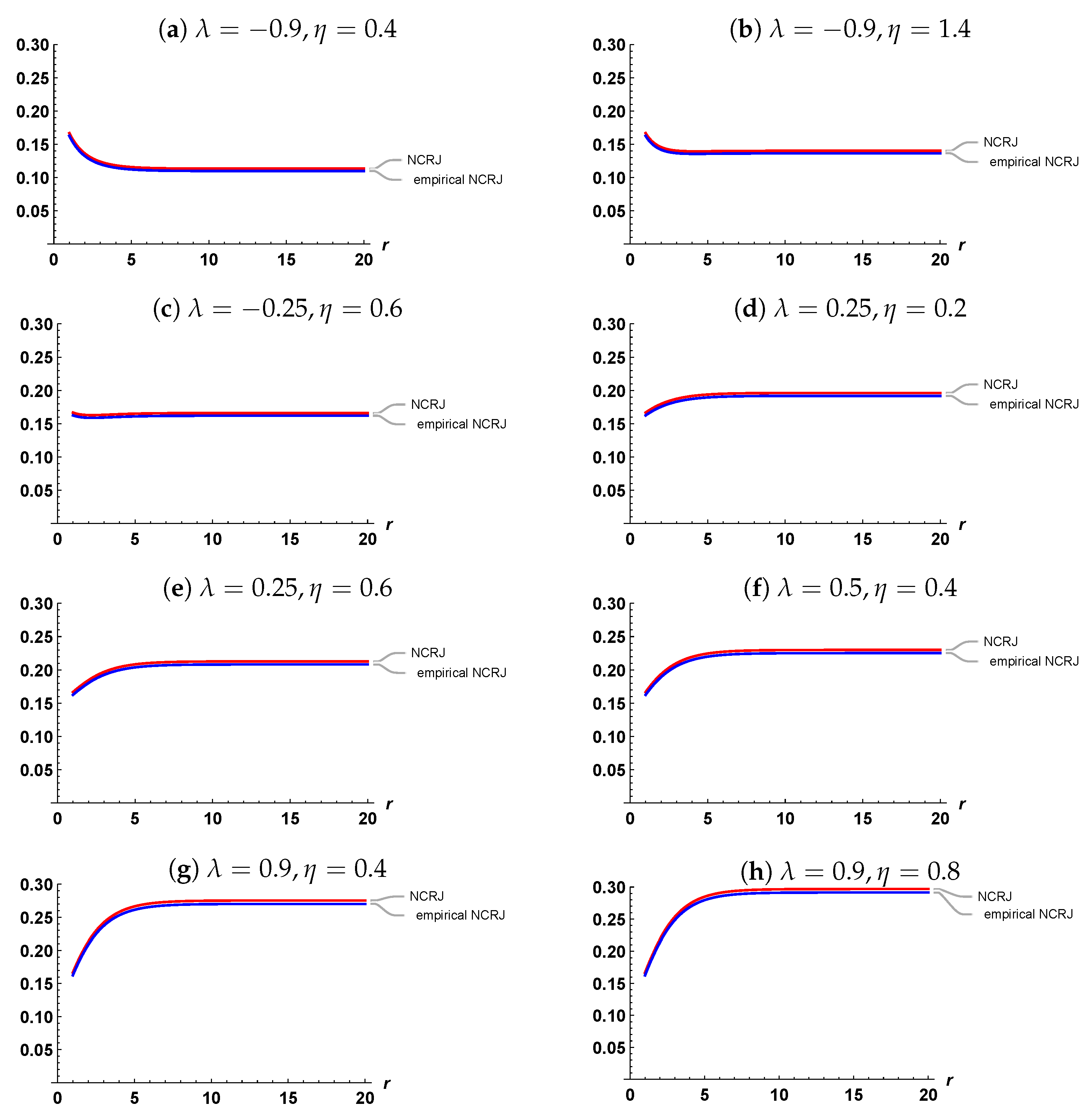
The relationship between NCRJ and empirical NCRJ of from IFGM-UD at is depicted in Figure 1. The following properties can be extracted from Figure 1.
Figure 1.
Representation of NCRJ and empirical NCRJ based on from IFGM-UD.
- 1.
- Generally, the empirical NCRJ and NCRJ have similar values with all values of the parameter space
- 2.
- The empirical NCRJ and NCRJ increase as increases.
- 3.
- With the increase in the values of r, stability occurs in the values of both NCRJ and empirical NCRJ.
6. An Application
This section examines the CRJ measure using analyses of actual data sets. Ref. [31] provide the economic data set, which comprises of 31 annual time series observations, covering the period from 1980 to 2010, on the following response variable: GDP growth Y and exports of products and services These data were first gathered by the OECD National Accounts data and the World Bank National Accounts data. One of the key reasons for choosing to use economic data for the current study may have been the fact that economics is a significant business in many developed and developing countries. In order to increase GPA growth and exports of goods and services, the government is keen. The data is relevant to the distribution based on FGM copula and its generalizations, including IFGM, since the correlation between data is 0.2709. Here, we shall suggest three bivariate distributions to fit the data: IFGM-WD, IFGM-gamma distribution (IFGM-GD), and IFGM-generalized exponential distribution (IFGM-GED). By using the MLE method based on IFGM-WD, IFGM-GD, and IFGM-GED, we estimate the four parameters in the Weibull DF , the gamma DF and the generalized exponential DF and is incomplete gamma function, in addition to the shape parameters and Moreover, the AIC and BIC are computed in Table 2, so the bivariate IFGM-GED distribution fits better the data. Table 3 examines the CRJ measure for the model estimated IFGM-WD for the concomitants i.e., the concomitants of the lower extreme, upper extreme, and central values. This table shows that each of the CRJ measures has a maximum value at lower extremes.
Table 2.
Parameter estimation for IFGM distributions.
Table 3.
for IFGM-WD.
7. Conclusions
While the range of the correlation coefficient for the IFGM is similar to that of other generalizations of FGM (such as the Huang-Kotz FGM), it beats most of these generalizations, due to its flexibility and simplicity. The PDFs employed in this study were always linear combinations of other simpler distributions because of this benefit. Consequently, this fact gives a satisfactory motivation to deal with IFGM, rather than Huang-Kotz FGM. As a result, for every arbitrary distribution, we showed a variety of distributional properties of the concomitant of GOS based on IFGM under the general setting. Last, but not least, the concomitant of GOS based on IFGM have the joint CDF and product moments. One important complementary dual measure of Shannon entropy is extropy (J), which plays a vital role in the scoring of forecasting distributions, risk measures, and independence. Moreover, some well-known information measures, i.e., J, CRJ, and NCJ, are derived. For OS, record values, and POS-II with uniform marginal distributions are used to show applications of these findings. To address the issue of calculating the CRJ and NCJ, the empirical technique is combined with concomitant of GOS. For illustrative purposes, bivariate real-world data sets have been analyzed, and the performance of the proposed method is entirely satisfactory. From these real-world data sets, we show that the IFGM is flexible in fitting, especially in the variables with the lowest correlation coefficient. We were able to obtain information related to GDP growth Y based on the exports of goods and services X by using the concomitants of OS (as an important practical kind to order the bivariate data). We show that these data are more suitable for IFGM-GED.
In discussing the potential for further research, two issues are taken into account. As a first step, we can apply the findings of this research to a weighted extropy. This shift-dependent information metric gives larger values of RVs a higher weight (see [32]). The second future research objective is to estimate these measures using classical and Bayesian methods. A significant amount of attention was paid to Bayesian methods in the literature for example [33,34,35].
Author Contributions
Conceptualization, I.A.H., S.A.A. and M.A.A.E.; Methodology, I.A.H., M.A.A., S.A.A. and M.A.A.E.; Software, I.A.H.; Validation, M.A.A., S.A.A. and M.A.A.E.; Formal analysis, M.A.A.E.; Investigation, M.A.A.; Resources, S.A.A.; Data curation, I.A.H. and S.A.A.; Writing—original draft, M.A.A.E.; Writing—review & editing, I.A.H., M.A.A. and M.A.A.E. All authors have read and agreed to the published version of the manuscript.
Funding
This research received no external funding.
Institutional Review Board Statement
Not applicable.
Informed Consent Statement
Not applicable.
Data Availability Statement
The simulated data used to support the findings of this study are included within the article.
Acknowledgments
The authors are grateful to the editor and the anonymous five reviewers for their careful and diligent reading, which substantially improved the readability and presentation.
Conflicts of Interest
The authors declare no conflict of interest.
Abbreviations
The following abbreviations are used in this manuscript:
| CDF | Cumulative distribution function |
| Probability density function | |
| GOS | Generalized order statistics |
| POS-II | Progressive type-II censored order statistics |
| J | Extropy |
| CRJ | Cumulative residual extropy |
| NCRJ | Negative cumulative residual extropy |
| NCJ | Negative cumulative extropy |
References
- Abd Elgawad, M.A.; Barakat, H.M.; Xiong, S.; Alyami, S.A. Information measures for generalized order statistics and their concomitants under general framework from Huang-Kotz FGM bivariate distribution. Entropy 2021, 23, 335. [Google Scholar] [CrossRef]
- Abd Elgawad, M.A.; Alawady, M.A. On concomitants of generalized order statistics from generalized FGM family under a general setting. Math. Slovaca 2022, 72, 507–526. [Google Scholar] [CrossRef]
- Alawady, M.A.; Barakat, H.M.; Abd Elgawad, M.A. Concomitants of generalized order statistics from bivariate Cambanis family of distributions under a general setting. Bull. Malays. Math. Sci. Soc. 2021, 44, 3129–3159. [Google Scholar] [CrossRef]
- Barakat, H.M.; Nigm, E.M.; Alawady, M.A.; Husseiny, I.A. Concomitants of order statistics and record values from iterated of FGM bivariate-generalized exponential distribution. Revstat 2019, 19, 291–307. [Google Scholar]
- Huang, J.S.; Kotz, S. Correlation structure in iterated Farlie-Gumbel-Morgenstern distributions. Biometrika 1984, 71, 633–636. [Google Scholar]
- Husseiny, I.A.; Barakat, H.M.; Mansour, G.M.; Alawady, M.A. Information measures in record and their concomitants arising from Sarmanov family of bivariate distributions. J. Comp. Appl. Math. 2022, 408, 114120. [Google Scholar] [CrossRef]
- Kamps, U. A Concept of Generalized Order Statistics; Teubner: Stuttgart, Germany, 1995. [Google Scholar]
- Kamps, U.; Cramer, E. On distribution of generalized order statistics. Statistics 2001, 35, 269–280. [Google Scholar] [CrossRef]
- David, H.A. Concomitants of order statistics. Bull. Int. Stat. Inst. 1973, 45, 295–300. [Google Scholar]
- David, H.A.; Nagaraja, H.N. Concomitants of Order Statistics. In Handbook of Statistics; Balakrishnan, N., Rao, C.R., Eds.; Elsevier: Amsterdam, The Netherlands, 1998; Volume 16, pp. 487–513. [Google Scholar]
- Alawady, M.A.; Barakat, H.M.; Xiong, S.; Abd Elgawad, M.A. Concomitants of generalized order statistics from iterated Farlie-Gumbel-Morgenstern type bivariate distribution. Comm. Stat. Theory Methods 2022, 51, 5488–5504. [Google Scholar] [CrossRef]
- Almaspoor, Z.; Jafari, A.A.; Tahmasebi, S. Measures of extropy for concomitants of generalized order statistics in morgenstern family. J. Stat. Theory Appl. 2022, 21, 1–20. [Google Scholar] [CrossRef]
- Barakat, H.M.; Husseiny, I.A. Some information measures in concomitants of generalized order statistics under iterated FGM bivariate type. Quaest. Math. 2021, 44, 581–598. [Google Scholar] [CrossRef]
- Barakat, H.M.; Nigm, E.M.; Husseiny, I.A. Measures of information in order statistics and their concomitants for the single iterated Farlie-Gumbel-Morgenstern bivariate distribution. Math. Popul. Stud. 2021, 28, 154–175. [Google Scholar] [CrossRef]
- Beg, M.I.; Ahsanullah, M. Concomitants of generalized order statistics from Farlie-Gumbel-Morgenstern distributions. Statist. Methodol. 2008, 5, 1–20. [Google Scholar] [CrossRef]
- Mohie El-Din, M.M.; Amein, M.M.; Mohamed, M.S. Concomitants of case-II of generalized order statistics from Farlie-Gumbel-Morgenstern distributions. J. Stat. Appl. Pro. 2015, 3, 345–353. [Google Scholar]
- Shannon, C.E. A mathematical theory of communication. Bell System Technical J. 1948, 27, 379–423. [Google Scholar] [CrossRef]
- Lad, F.; Sanfilippo, G.; Agro, G. Extropy: Complementary dual of entropy. Stat. Sci. 2015, 30, 40–58. [Google Scholar] [CrossRef]
- Qiu, G. The extropy of order statistics and record values. Stat. Probab. Lett. 2017, 120, 52–60. [Google Scholar] [CrossRef]
- Qiu, G.; Jia, K. The residual extropy of order statistics. Stat. Probab. Lett. 2018, 133, 15–22. [Google Scholar] [CrossRef]
- Qiu, G.; Jia, K. Extropy estimators with applications in testing uniformity. J. Nonparametric Stat. 2018, 30, 182–196. [Google Scholar] [CrossRef]
- Mohamed, M.S.; Abdulrahman, A.T.; Almaspoor, Z.; Yusuf, M. Ordered variables and their concomitants under extropy via COVID-19 data application. Complexity 2021, 2021, 6491817. [Google Scholar] [CrossRef]
- Mohamed, M.S.; Barakat, H.M.; Alyami, S.A.; Abd Elgawad, M.A. Cumulative residual tsallis entropy-based test of uniformity and some new findings. Mathematics 2022, 10, 771. [Google Scholar] [CrossRef]
- Tahmasebi, S.; Kazemi, M.R.; Keshavarz, A.; Jafari, A.A.; Buono, F. Compressive sensing using extropy measures of ranked set sampling. Math. Slovaca 2023, 73, 245–262. [Google Scholar]
- Jahanshahi, S.; Zarei, H.; Khammar, A. On cumulative residual extropy. Probab. Eng. Inf. Sci. 2020, 34, 605–625. [Google Scholar] [CrossRef]
- Husseiny, I.A.; Syam, A.H. The extropy of concomitants of generalized order statistics from Huang-Kotz-Morgenstern bivariate distribution. J. Math. 2022, 2022, 6385998. [Google Scholar] [CrossRef]
- Tahmasebi, S.; Toomaj, A. On negative cumulative extropy with applications. Commun. Stat. Theory Methods 2021, 51, 5025–5047. [Google Scholar] [CrossRef]
- Bairamov, I.; Eryilmaz, S. Spacings, exceedances and concomitants in progressive type-II censoring scheme. J. Statist. Plann. Inference 2006, 136, 527–536. [Google Scholar] [CrossRef]
- Chandler, K.N. The distribution and frequency of record values. J. Roy. Statist. Soc. Ser. B 1952, 14, 220–228. [Google Scholar] [CrossRef]
- Pyke, R. Spacings. J. Roy. Stat. Soc. Ser. B 1965, 27, 395–436. [Google Scholar] [CrossRef]
- El-Sherpieny, E.A.; Muhammed, H.Z.; Almetwally, E.M. FGM bivariate Weibull distribution. In Proceedings of the Annual Conference in Statistics (53rd), Computer Science, and Operations Research, Institute of Statistical Studies and Research, Cairo University, Cairo, Egypt, 3–5 December 2018; pp. 55–77. [Google Scholar]
- Balakrishnan, N.; Buono, F.; Longobardi, M. On weighted extropies. Commun. Stat. Theory Methods 2022, 51, 6250–6267. [Google Scholar] [CrossRef]
- Ahmadi, K.; Akbari, M.; Raqab, M.Z. Objective Bayesian estimation for the differential entropy measure under generalized half-normal distribution. Bull. Malays. Math. Sci. Soc. 2023, 46, 39. [Google Scholar] [CrossRef]
- Ramos, E.; Egbon, O.A.; Ramos, P.L.; Rodrigues, F.A.; Louzada, F. Objective Bayesian analysis for the differential entropy of the Gamma distribution. arXiv 2020, arXiv:2012.14081. [Google Scholar]
- Shakhatreh, M.K.; Dey, S.; Alodat, M.T. Objective Bayesian analysis for the differential entropy of the Weibull distribution. Appl. Math. Model. 2021, 89, 314–332. [Google Scholar] [CrossRef]
Disclaimer/Publisher’s Note: The statements, opinions and data contained in all publications are solely those of the individual author(s) and contributor(s) and not of MDPI and/or the editor(s). MDPI and/or the editor(s) disclaim responsibility for any injury to people or property resulting from any ideas, methods, instructions or products referred to in the content. |
© 2023 by the authors. Licensee MDPI, Basel, Switzerland. This article is an open access article distributed under the terms and conditions of the Creative Commons Attribution (CC BY) license (https://creativecommons.org/licenses/by/4.0/).



