1. Introduction
A refinable function is defined recursively through a functional equation usually called refinement or scaling equation. In its general form, the refinement equation can be written as [
1,
2]
where the compactly supported real sequence
,
, is the refinement mask associated with
and
with
being the dilation matrix. It is known that if
then there exists a unique distribution solution to the refinement equation such that
, where
denotes the Fourier transform of the function
[
1,
3].
Refinable functions are the building blocks for the construction of wavelets. In fact, a wavelet
can be derived by a refinable function as
where
is the wavelet mask, which can be designed in order to obtain
W satisfying prescribed properties [
2,
4,
5,
6,
7].
Refinable functions and wavelets find applications in several fields. In signal and image processing, they are a well-established tool for constructing filter banks for denoising, compression, feature extractions, to name a few applications [
5,
6]. In geometric modeling, refinable functions give rise to efficient algorithms for constructing surfaces of arbitrary topology, with applications in industrial design, computer graphics, 3D animation [
8,
9]. In approximation theory, the refinement functions are used to create nested sequences of approximation spaces that can be used to construct adaptive approximations of operators for the solution of differential problems [
10,
11,
12,
13,
14].
The analytic expression of refinable functions and associated wavelets is available in only a very few cases. However, they can be evaluated exactly, up to machine precision, at the
M-adic points
,
, using recursively Equations (
1) and (
3), provided that the values on the integers
,
, are given. It is well known that the values on the integers of a refinable function and its derivatives can be obtained by solving an eigenvalue/eigenvector problem for a matrix whose entries depend only on the mask [
5,
15]. The aim of this paper is to describe in detail how to construct this matrix and how to obtain the values of the refinable function and its derivatives from the eigenvectors. Interestingly, the integrals of the product of refinable functions can also be evaluated exactly, up to machine precision, by solving an eigenvalue/eigenvector problem that depends only on the mask [
15]. We will show how to construct the eigenvalue problem for these integrals and give some examples. Since a wavelet is a linear combination of the translates of a refinable function (see (
3)), integrals of product of wavelets can be easily derived from integrals of refinable functions. We want to emphasize that the exact evaluation of integrals of refinable functions and wavelets is especially important when using adaptive wavelet methods for the solution of differential problems, for instance, for the evaluation of the connection coefficients in the wavelet Galerkin method.
The paper is organized as follows. In
Section 2, we recall some basic facts about refinable functions and subdivision schemes. A subdivision scheme is a recursive algorithm constructed from the refinement mask, whose properties are closely related to the properties of the associated refinable function. In this section, we also show how to construct the eigenvalue/eigenvector problem for the exact evaluation of the values of a refinable function and of its derivatives on the integers. The core of the paper is
Section 3 where we detail the procedure for the exact evaluation of integrals of products of refinable functions and of their derivatives. As an illustrative example, in
Section 4, this procedure is applied to evaluate integrals of pseudo-splines. Finally, in
Section 5, we discuss results and conclusions.
3. Exact Evaluation of Integrals of Refinable Functions
In this section, we are interested in the exact evaluation of integrals of type
where
and
,
, with
. We assume
satisfies the stability condition (
10) and
is a compactly supported mask. When
, the above integrals can be written as
where
is the characteristic function of the interval
. Since
is also a refinable function, at the end, we have to evaluate the integrals of products of integer translates and dilates of refinable functions and their derivatives over the whole
. We first consider the case
.
Let us define the function
We note that the values
,
, i.e., the values of
on the integers, coincide with the integrals (
28) for
and
. It turns out that
is a
-variate refinable function with refinement mask [
15]
where
and
is the mask of the characteristic function. Since the mask
is compactly supported, the mask
is compactly supported too, and so is
. Thus, the integrals for
can be evaluated by solving the eigenvalue/eigenvector problem (
24) for the mask
. If
is a stable refinable function, the solution to the eigenvector problem is unique [
15].
For the integrals involving derivatives of refinable functions, we notice that
so that the integrals are the entries of the eigenvector corresponding to the eigenvalue
. Unfortunately, for
, the uniqueness of the eigenvector is not guaranteed nor can it be retrieved by imposing conditions (
23).
Provided that the symbol
can be factorized as
an easy way to evaluate the integrals (
32) is to substitute the derivatives
,
by the finite difference Formula (
16). If the difference symbols
are associated with a convergent subdivision scheme, Equation (
16) gives
where
and
are the refinable functions associated with the difference masks
respectively. Since
is a refinable function, the values on the integers
,
, can be obtained by solving the eigenvalue/eigenvector problem (
24) with mask
When
, we can use the change of the integration variable
and the refinement equation for
into the integrals (
28) to obtain
where
are the coefficients of the mask associated with
(see (
31)). Using repeatedly the refinement equation for
in the above equation, we obtain
where
. Thus, the integrals (
28) can be expressed as a sum of integrals with
.
3.1. Integrals of Univariate Refinable Functions on Finite Intervals
In this section, we focus on the evaluation of the integrals
where
is a finite interval with dyadic rational length and
is a stable univariate refinable function associated with the compactly supported mask
Without loss of generality, we can assume .
If
or
, by the change of integration variable
, it is easy to show that
. Thus, except for the multiplicative factor
, the integrals are the values on the integers of the function
It is well known [
5,
15] that
is a refinable function with mask
so that its values on the integers are the entries of the unique eigenvector
corresponding to the eigenvalue 1 of the matrix
and such that
.
If both
and
are not contained in
, we can write the integral as
where
is the characteristic function of the interval
.
Using (
42) we obtain
where
and
is the refinement mask of
. Thus, it is sufficient to evaluate the integrals
which are non-zero only when
.
From
Section 3, we know that we can evaluate the integrals (
49) by solving the eigenvector problem
where
with
3.2. Integrals of Derivatives of Univariate Refinable Funcions
For integrals involving the first derivative
, i.e.,
we notice that they are the values on the integers of the partial derivative
(see (
29)).
Assuming
and substituting the differentiation formula (
15) in Equation (
52), we obtain
where
is the bivariate refinable function associated with the mask
and
is the univariate refinable function associated with the difference mask
. At the end, the integrals (
52) can be evaluated by solving the eigenvalue/eigenvector problem (
24) for
and taking the backward finite difference of the unique eigenvector corresponding to the eigenvalue 1.
Analogously, the integrals
can be evaluated by solving the eigenvalue/eigenvector problem (
24) with mask
and taking the backward finite difference
of the unique eigenvector corresponding to the eigenvalue 1.
4. Examples
As an example, we evaluate the integrals of the translates of the pseudo-splines, a family of compactly supported refinable functions which contains some well-known refinable functions as special cases. The pseudo-splines of type I were introduced in [
16]. Their symbol is defined as
It depends on the two integer parameters
with
. The pseudo-splines of type I are compactly supported on
and belong to
. When
, the symbol
coincides with the symbol associated with the cardinal B-splines, while
coincides with the symbol of the Daubechies family [
4]. The cardinal B-spline
is a piecewise polynomial of degree
with breakpoints on the integers. It is non-negative in its support
, it is centrally symmetric and it is refinable with mask [
17]
The pseudo-spline
is the Daubechies refinable function of order
m and is orthogonal and nonsymmetric. The mask coefficients do not have an explicit expression except for
. Their values computed up to order
can be found in [
4].
In [
18], the authors considered the pseudo-splines of type II, which are the autocorrelation of the pseudo-splines of type I. Their symbol is
The pseudo-splines of type II are symmetric, compactly supported on
and belong to
. When
, the symbol
coincides with the symbol associated with the cardinal B-splines of degree
, while
coincides with the symbol of the symmetric interpolatory schemes introduced in [
19]. The latter are associated with the interpolatory symmetric refinable functions
, which are compactly supported on
. We recall that interpolatory means that
for all integers
except for
when its value is 1. In particular, the symbol
corresponds to the mask of the four-point scheme
In the pseudo-spline family, only the cardinal B-splines have a known analytic form [
20] and therefore, in order to evaluate integrals of products of refinable functions for
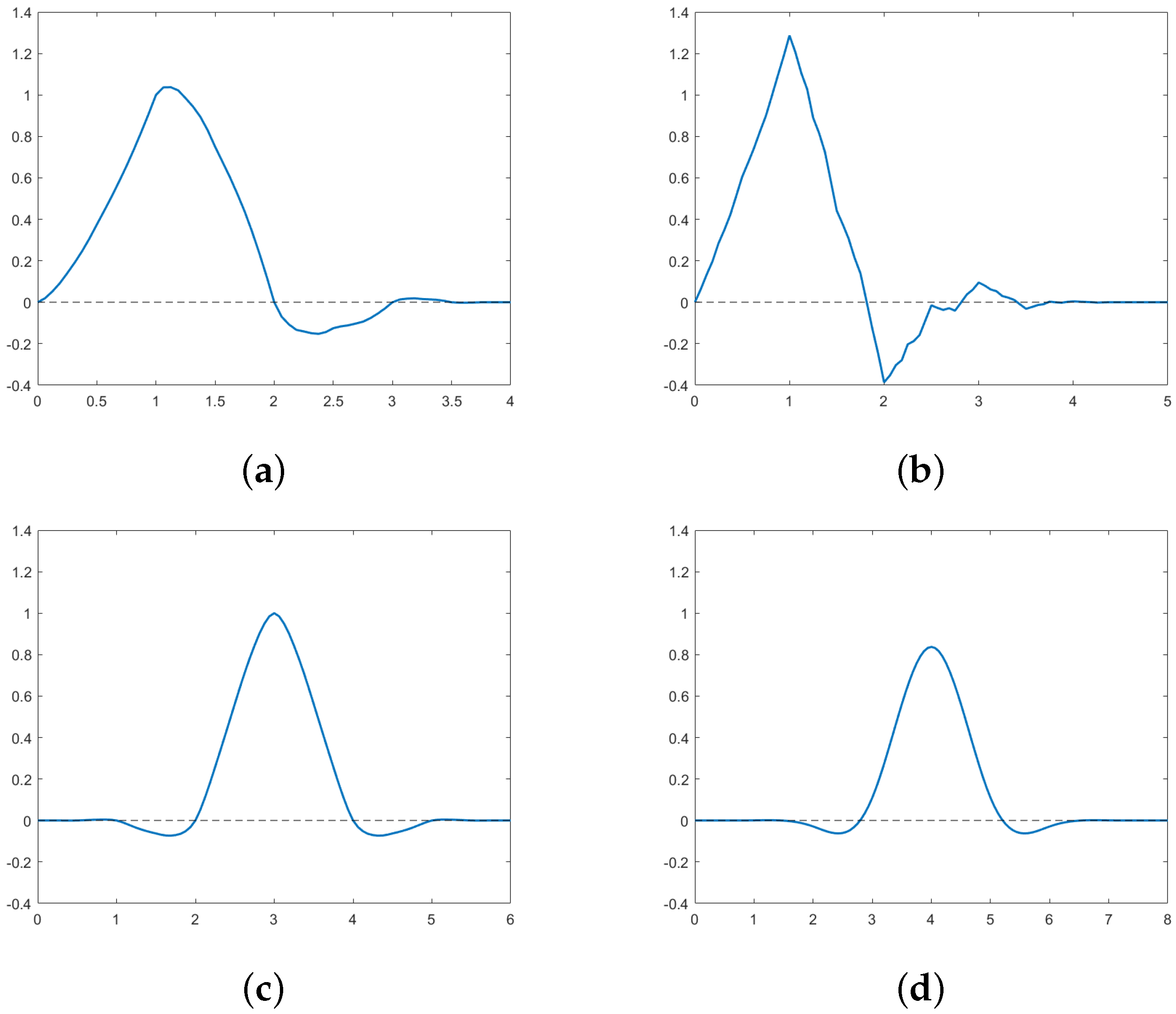
, the procedure described in the previous section must be evoked. Here, we evaluate the integrals of the pseudo-splines
for
and
for
. Starting from the values on the integers, we can use recursively the refinement equation to evaluate the pseudo-splines at the dyadic points
(see
Figure 1 where
).
In
Table 1 and
Table 2, the values of the integrals
,
, and
,
, evaluated up to machine precision, are listed.
In
Table 3 and
Table 4, the values of the integrals
,
, and
,
, evaluated up to machine precision, are listed.
In
Table 5 and
Table 6, the values of the integrals
,
,
, and
,
,
, evaluated up to machine precision, are listed. Since the pseudo-splines are centrally symmetric, the integrals for
can be obtained by the symmetry properties
In
Table 7 and
Table 8, the values of the integrals
,
,
, and
,
,
, evaluated up to machine precision, are shown. Also in this case, the integrals for
can be obtained by symmetry.
We notice that all the computations were performed in Matlab (version 2022b). The eigenvalue/eigenvector problem was solved with the function eig.
5. Conclusions
Except for the seminal paper by Dahmen and Micchelli [
15], the literature is scarce in terms of papers dealing with methods for the exact evaluation of the connection coefficients involving refinable functions and wavelets. In [
21], a similar reasoning is used to evaluate the connection coefficients of a wavelet Galerkin method but the evaluation of integrals involving derivatives of wavelets is a little cumbersome since the authors do not take advantage of the differentiation rule (
40). In [
22], the authors describe a method derived from [
23] for the exact evaluation of the integrals (
27). The drawback of the proposed method is that it gives rise to a linear system for which the existence and uniqueness of the solution are not guaranteed. Moreover, nothing is said about integrals involving boundary functions. On the other hand, since refinable functions can only be calculated on the dyadic points, for evaluating the integrals with quadrature rules, the Newton–Cotes formula should be employed, having the dyadic points as nodes. However, to obtain an accurate approximation, these formulas require a large number of nodes which would produce a loss of accuracy in the values of the refinable functions as they are calculated through the recursive use of Equation (
4).
Instead, our approach, which follows directly from [
15], allows to evaluate the integrals of both refinable functions and their derivatives by solving an eigenvalue/eigenvector problem that involves only the refinement masks. The conditions (
23), which guarantee the existence and uniqueness of the solution, can be easily imposed while, in the case of integrals of derivatives, the use of the differentiation rule (
40) avoids the difficulty of imposing further conditions.
The examples in
Section 4 show the effectiveness of the method in evaluating integrals of refinable functions whose explicit expressions is not known.
As a final remark, we note that the same procedure can be used to evaluate integrals of multivariate refinable functions and wavelets with any dilation matrix
M, while a generalization to integrals involving multiwavelets can be found in [
24].