Abstract
The time-independent performance of a micropolar nanofluid under the influence of magneto hydrodynamics and the existence of a porous medium on a stretching sheet has been investigated. Nano-sized particles were incorporated in the base fluid because of their properties such as their extraordinary heat-enhancing ability, which plays a very important role in modern nanotechnology, cooling electronic devices, various types of heat exchangers, etc. The effects of Brownian motion and thermophoresis are accounted for in this comprehensive study. Using similarity conversion, the leading equations based on conservation principles are non-dimensionalized with various parameters yielding a set of ODEs. The numerical approach boundary value problem fourth-order method (bvp4c) was implemented as listed in the MATLAB computational tool. The purpose of this examination was to study and analyze the influence of different parameters on velocity, micro-rotation, concentration, and temperature profiles. The primary and secondary velocities reduced against the higher inputs of boundary concentration, rotation, porosity, and magnetic parameters, however, the base fluid temperature distribution grows with the increasing values of these parameters. The micro-rotation distribution increased against the rising strength of the Lorentz force and a decline is reported against the growing values of the micropolar material and rotational parameters.
MSC:
35Q30; 76D05; 76R10
1. Introduction
Fluids with micro-structures are referred to as micropolar fluids. Physically, these fluids are constituted of randomly orientated particles suspended in viscous media. The model of this type of fluid can be utilized to illustrate the liquid crystals movement, suspension solutions, animal blood, colloidal liquids, etc. Micropolar theory has acquired a lot of attention in recent decades due to its numerous implementations in various industrial processes such as nuclear power plants, lubricant liquids in biological structures, less concentration suspension flux, polymer solution flows, turbulent shear, etc. [1,2]. The theory of micropolar fluids was first raised by Eringen [3]. In recent decades, studies performing excellent analyses of the applications and relevance of this sort of fluid have been conducted [4,5,6,7,8]. Ramya and Doh [9] studied the hydrodynamic impact of radiation on the dynamics of micropolar fluid subjects to gyrostatic microorganisms. They used gyrostatic microorganisms to prevent the possible sedimentation of tiny particles to enhance the effective heat transfer rate. Bilal et al. [10] investigated the micropolar nanofluid flow to observe the behavior of Brownian motion and thermophoresis on the dynamics of a base fluid. They found that the base fluid temperature enhanced due to the higher strength of the Brownian motion and thermophoresis.
Magneto hydradynamics (MHD) is described as the analysis of the magnetic attributes of conducting fluids. Due to their outstanding work on MHD in 1970, Hannes Alfven was bestowed the Nobel Prize. Various characteristics of these phenomena have aided their implementations in several fields including the physiological field, petroleum industry, mechanical engineering, and chemical engineering. These considerations are advantageous for magnetic resonance imaging, blood pumping, treating cancer tumors, metallurgical procedures, nuclear reactors, magnetic electro-catalysis, cooling thermal protection, etc. In their study, Jang et al. [11] performed the theoretical and experimental analysis of the magneto-hydradynamics micropump. Alsaedi et al. [12] numerically investigated the flow of the MHD hybrid nanofluid between two coaxial cylinders. The finite element analysis of the MHD rotational flux of Carreau Casson nanofluid with activation energy was performed by Ali et al. [13]. Nazeer et al. [14] investigated the electric osmotical flow of fluid of 3rd grade in a micro channel by magneto hydradynamics.
The phenomenon of mass and heat transport on surfaces that are embedded in a permeable medium has recently fascinated investigators and engineers, generating significant attention due to its many industrial and engineering applications including in underground water systems, electronic cooling, drying technology, catalytic reactors, geothermal systems, and insulation processes. Ahmad et al. [15] analyzed the mass and heat transport characteristics of aluminum oxide–copper hybrid nanoparticles flux by a permeable medium. Badruddin et al. [16] examined the conjugate thermal and mass transport in a vertically permeable cylinder. The convective heat transmission flux of nanoliquids in a porous medium was described by Hassan et al. [17]. Banerjee et al. [18] reported the permeable medium combustion applications and developments. Waini et al. [19] discussed the symmetrical solution of a hybrid nanoliquid flux using permeable medium.
In current research, the analysis of fluid in a rotating frame has become a charming matter. It has momentous applications in the fields of crystal development, gas turbine rotors, biomechanics, cosmic fluid dynamics, turbomechanics, crystal development, the food industry, and filtration processes. Wang [20] made the most significant contribution in this regard. Rajeswari et al. [21] delineated the time-dependent flux in the rotating fluid above the stretching surface. Rotating the micropolar fluid on the extending surface in the case of quadratic and linear convection significance in thermal management was investigated by Ali et al. [22]. Nadeem et al. [23] studied the numerical analysis of the CNTs’ water-based flux of micropolar fluid by a rotational frame. Kumar et al. [24] investigated the rotating frame analysis of ferro–nanoliquid reaction and radiation considering viscous dissipation and Joule heating. AI-Kouz et al. [25] examined the numerical analysis of Casson nanofluid 3D flux above the rotatory frame subject to a prescribed heated flow during viscous heating.
All the aforementioned studies limited their analysis to investigating the mass and heat transfer of the Newtonian fluid flow model subject to an extending surface, and showing that non-Newtonian nanofluids have wide-ranging applications in heat exchangers, plastic films, polymer extrusion, and many others industries. To the best of the authors’ knowledge, no studies have been communicated that have analyzed the micropolar rotational nanofluid flow above the stretching sheet horizontally subject to the Darcy–Forchheimer law and activation energy. The basic goal of this examination was to enhance the heat transportation with micropolar nanofluid. The novelties of this analysis were:
- (i)
- The non-Newtonian (micropolar) nanofluid with a water base fluid was analyzed;
- (ii)
- The MHD effect and micro-rotation of nanoparticles were assimilated.
- (iii)
- The Buongiorno model of nanofluid was implemented.
- (iv)
- The activation energy and porous medium were incorporated.
The authors observed that the elaborated problem has not been contemplated by the above-cited reports, whose analyses were instead motivated by the various applications of non-Newtonian micropolar nanofluids in modern technologies. The bvp4c technique was graphically applied to obtain the results. The results for the micro-rotation, velocity, Nusselt number, concentration of nanoparticles, temperature, and Sherwood number were presented via graphs.
2. Mathematical Formulation
The time-independent three-dimensional incompressible magnetohydrodynamics water-based micropolar nanofluid flow on a stretchable sheet with a rotational frame was assumed. Both forces went in opposite directions from one another and acted identically in the x direction to stretch the sheet at a speed of U(x). The magnetic field, denoted by , acted uniformly in the z direction. The ambient temperature and surface temperature were also considered and are represented by and , while and denote the ambient concentration and concentration of particles at the surface, respectively. The elaborated fluid problem was assumed to be stable and the particle agglomeration was ignored due to the stable fluid. The induced magnetic field was ignored because the magnetic Reynolds number is was excessively small and the strength of the magnetic field was not excessively strong; as such, the Ohmic dissipation and Hall’s current were also ignored [26]. The geometry of the problem is shown in Figure 1.
Figure 1.
Physical model and coordinate system.
We subjected the water-based nanofluid to nano-sized particles to improve the thermal conductivity of the base fluid.Under the above assumptions, the leading equations are as follows [27,28,29]:
Here, , and are the velocity components acting in the x, y, and z directions, respectively. C and T denote the nanoparticle concentration and nanoliquid temperature. N, , , , D, represent the micro-rotation, kinematic viscosity, electric conductivity, density, solute diffusibility, and diffusion of heat, respectively, and the per unit mass inertia are j, k, . The relevant boundary conditions are:
The following similarity transformation was used to begin the examination [29,30]:
By the use of the similarity transformation, Equation (1) is identically satisfied. In view of Equations (8) and (9), Equations (2)–(7) are converted into the following nonlinear ODEs:
with the boundary conditions
where—in Equations (10)–(15)—∇ is a dimensionless micropolar material parameter [31]; the rotatory and porosity parameters are represented by ; , M, , , , , , and denote the magnetic parameter, Forchheimer number, Prandtl number, Schmidt number, reaction rate, thermophoresis parameter, and Brownian motion, respectively, which are defined as:
The skin friction coefficient expressions along x axis and y axis, the local Nusselt number, and Sherwood number are, respectively, defined as:
where the skin friction tensor at the wall is (x direction) and (y direction), the wall heat transfer is , and the mass flux from the sheet is . Thanks to the similarity transformation Equations (8) and (9), we obtain:
Finally, we have
where is the local Reynolds number that is defined as .
3. Results and Discussion
The solution for the developed ODEs (10)–(15) related to constraints is required to show the physical analysis of this problem and the bvp4c method is used to graphically solve the problem. A detailed computational process is used to check the influence of different parameters on primary and secondary velocity (, ), micro-rotation distribution , temperature and concentration . Furthermore, the (Nusselt number) and , (skin friction coefficients) and (Sherwood number) are graphically detected. A comparison of outcomes was carried out in order to certify the use of the technique as shown in Table 1 and Table 2. An excellent relation between already existing outcomes is observed. The recent analysis’s estimation was performed using the following values of the involved parameters: , , , , , , , , , , , , , .
Table 1.
The comparison of and against rotating parameter when others involved parameters values are zero.
Table 2.
The comparison of against rotating and Prandtl number parameters when others involved parameters values are zero.
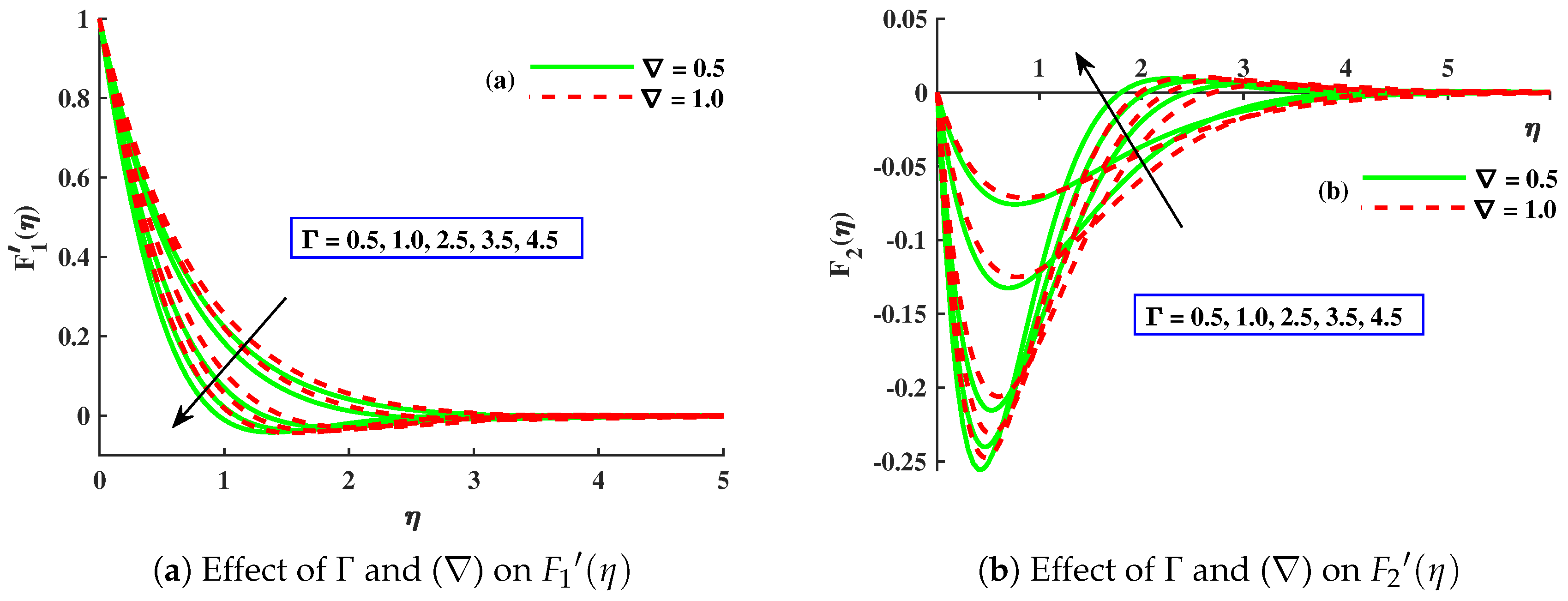
Figure 2a,b represents the impact of the rotating parameter and the material parameter ∇ on the primary velocity and the secondary velocity . This indicates that and are abated near the sheet and later on experience a variation when is increased. The primary velocity obtains a maximum value when . It is worth noting that, along the x axis, extending the sheet causes the momentum to rise in this direction, whereas momentum in the y direction is unsupported. As such, Figure 2a,b exhibit that is marginally influenced and is particularly influenced. While the primary velocity is boosted with the escalating values of the material parameter, the magnitude of the secondary velocity is decreased. Figure 3a,b depicts the effects of magnetic parameter M and the micropolar boundary parameter on the velocity profile. It is noted that the growing value of M causes the decline in and . This is correlated with the thickness of the boundary layer. This confirms the magnetic effect’s general behavior. Physically, increasing the value of the magnetic parameter means enhancing the drag force, i.e., the resistive force. As such, and are decreased. Furthermore, and are also decreased with amplified values of .
Figure 2.
Curves of along rotating parameter ( ) and material parameter (∇).
Figure 3.
Curves of along magnetic parameter (M) and boundary concentration parameter().
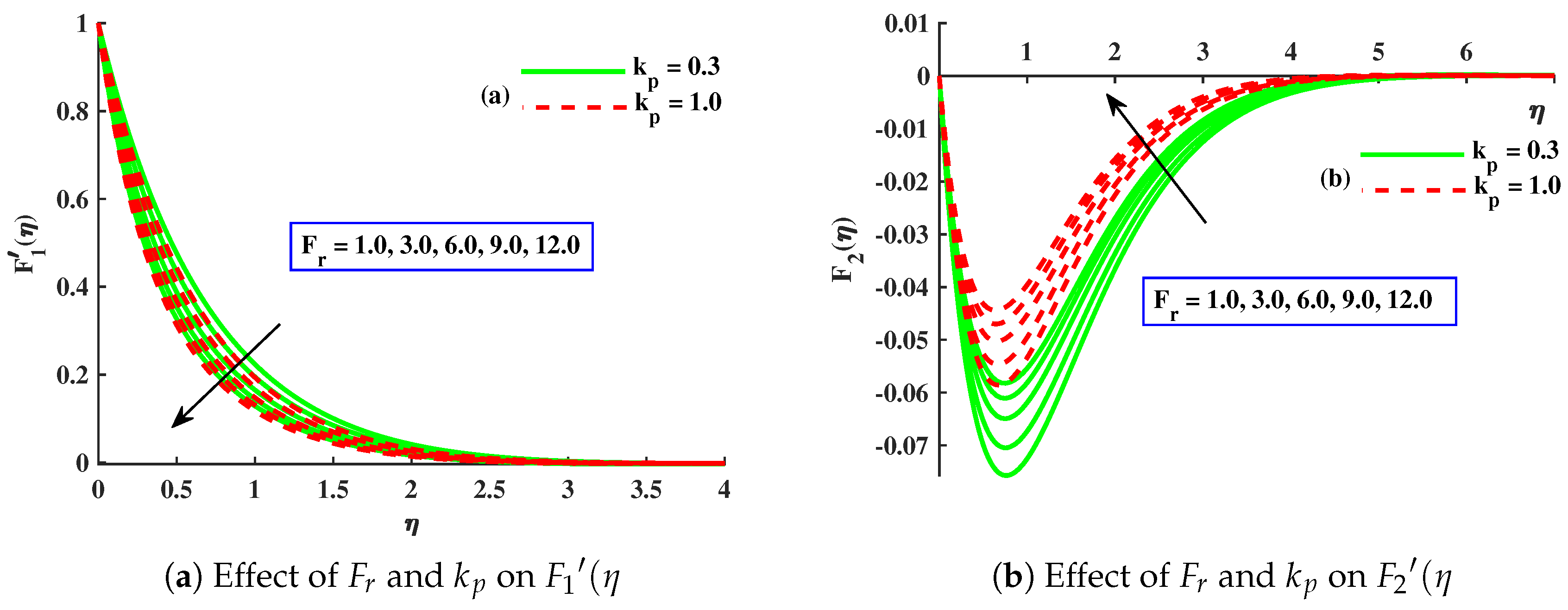
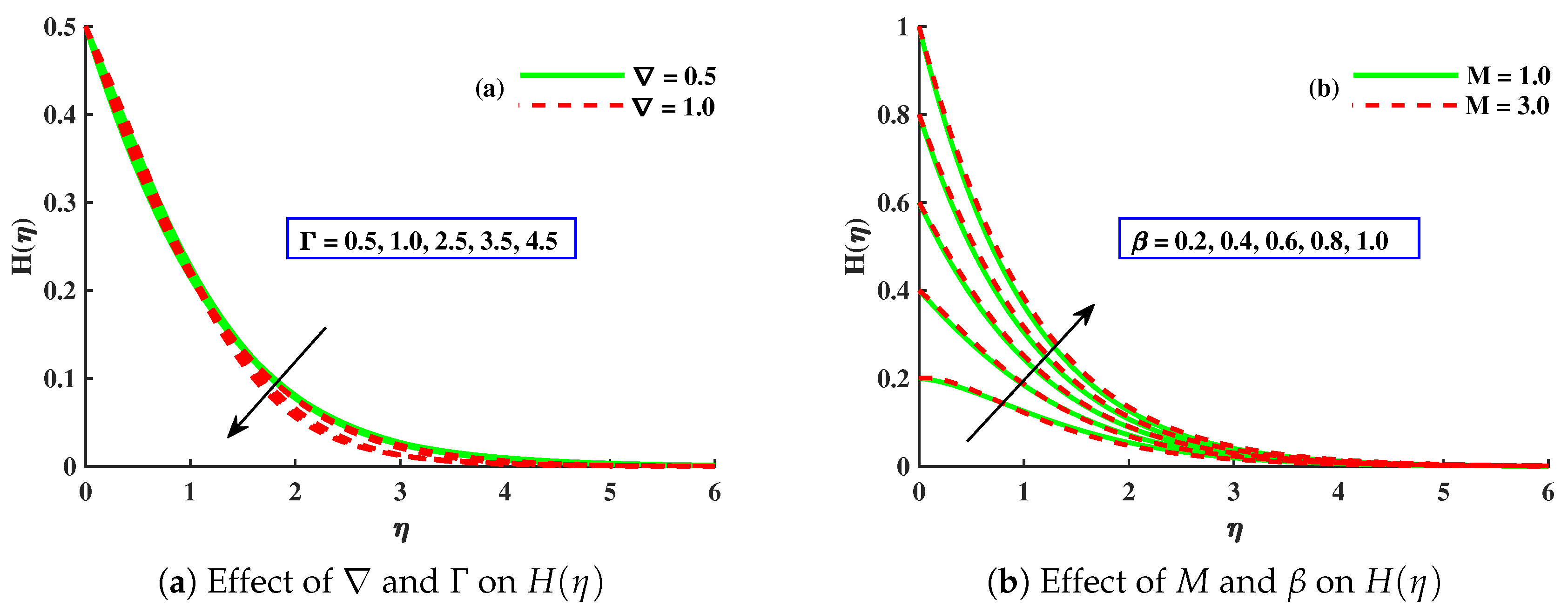
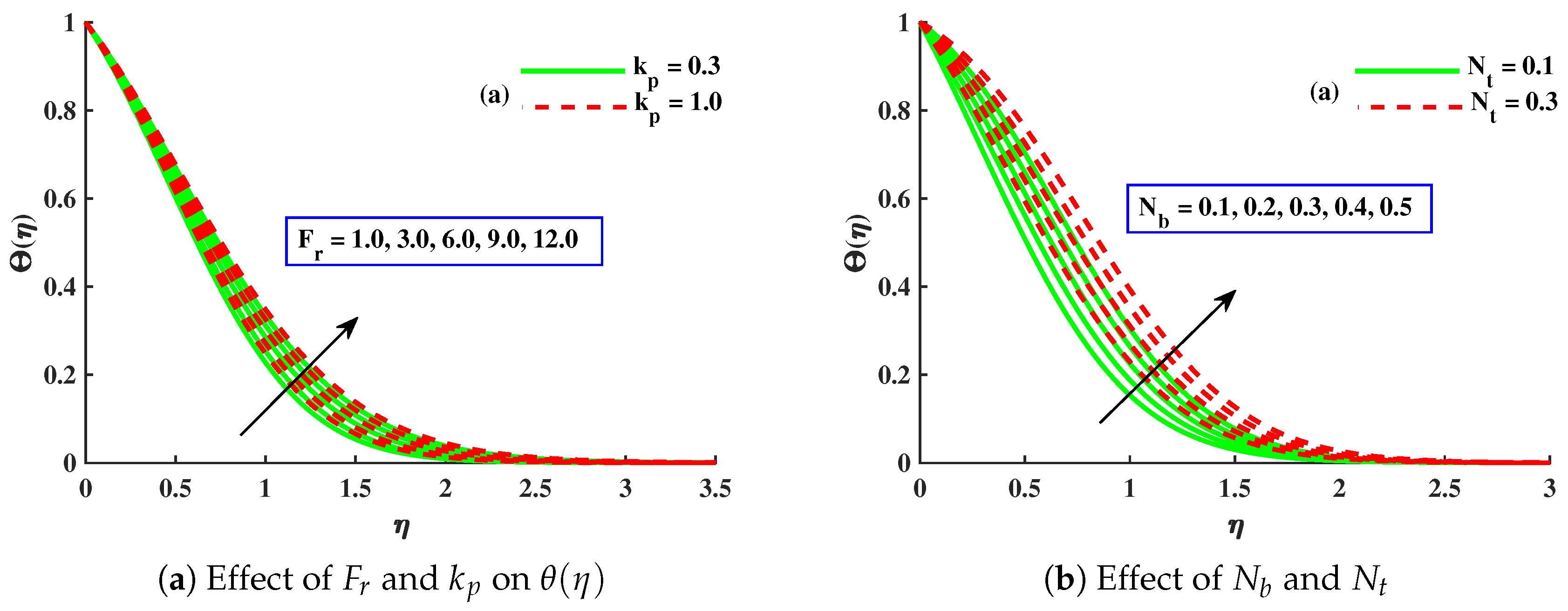
Figure 4a,b reveals the variation in and due to the Forchheimer number () and porosity factor (). and decreased with higher contributions from both parameters. Physically, the fluid becomes more viscous with the association of the porous medium and resistive force is created which slows down the primary and secondary velocities. The impacts of the material parameter, rotational parameter, magnetic parameter, and boundary concentration parameter on the micro-rotation distribution profile are shown in Figure 5a,b. With the effect of rising values of and ∇, the micro-rotation profile decreased, but with growing values of M and , increased. Figure 6 portrayed the effect of the (Forchheimer number) and (porosity factor) on the temperature profile. With an increasing value of both parameters, the temperature increases. Physically, the resistive forces are generates because of a permeable space due to which the fluid is dragged into a zone of the boundary layer, resulting in heat dissipation generating more heat in this zone. Therefore, is on rise with and . Figure 6b presented the implication of the parameters of Buongiorno’s model (Brownian motion and thermophoresis) on . Nanoparticles move from the hot zone to the cold zone due to the thermophoretic force and as a result, more heat transmission occurs in the region of the boundary layer. Similarly, a faster random movement of species particles in nanoliquids prompted the Brownian forces to enhance the thermal transportation. As such, the increment in temperature is reported in Figure 6b.
Figure 4.
Curves of along the Forchheimer number () and porosity factor ().
Figure 5.
Curves of along ∇, , M, and .
Figure 6.
Curves of along , , , and .
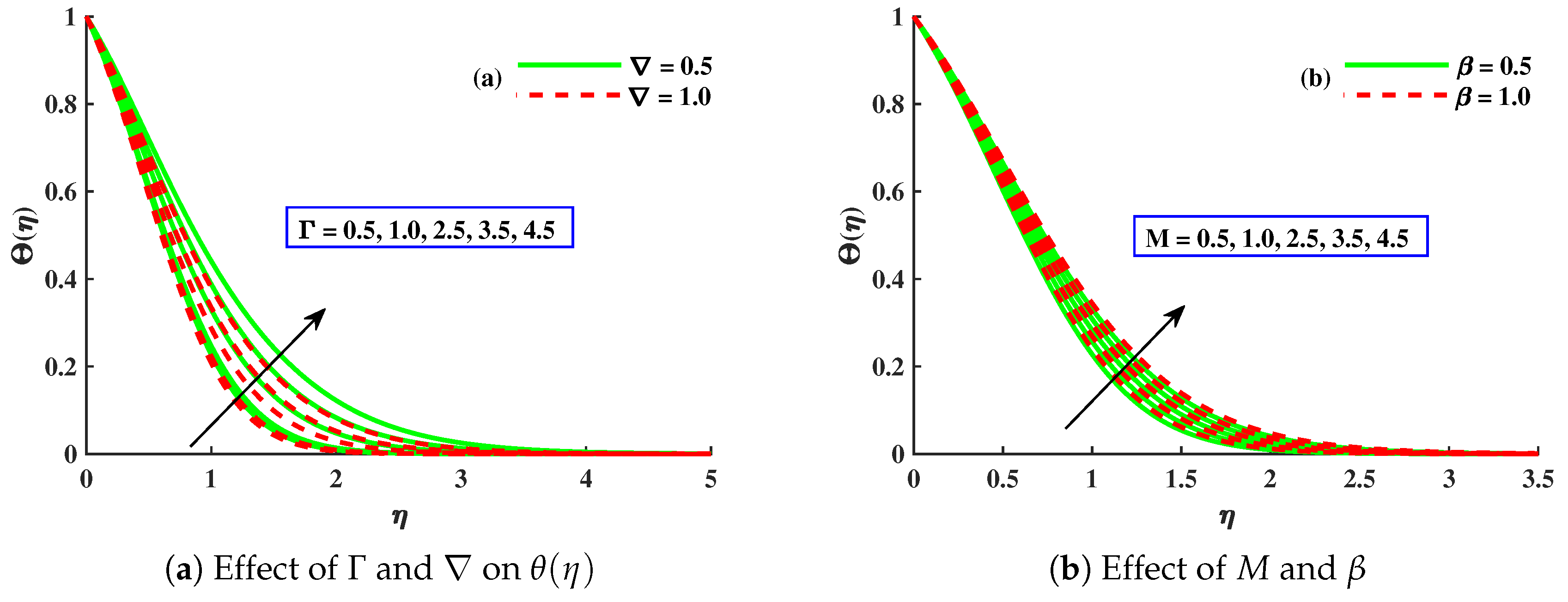
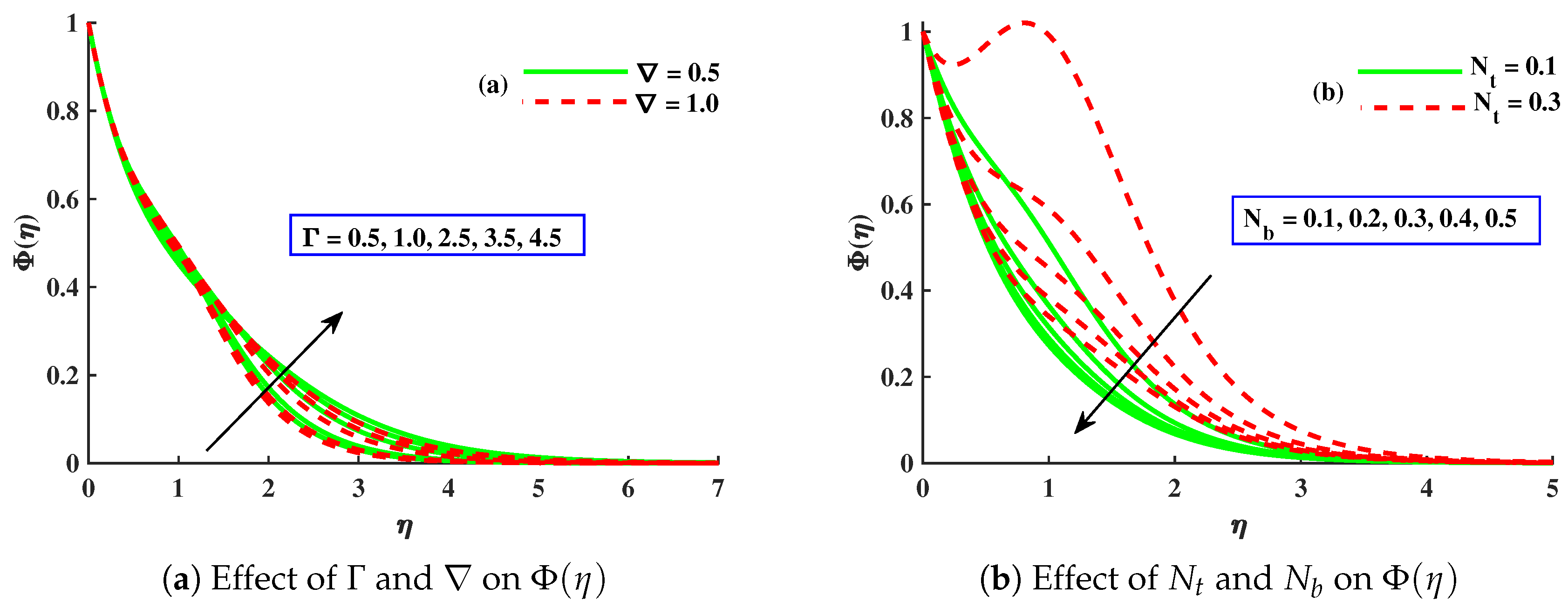
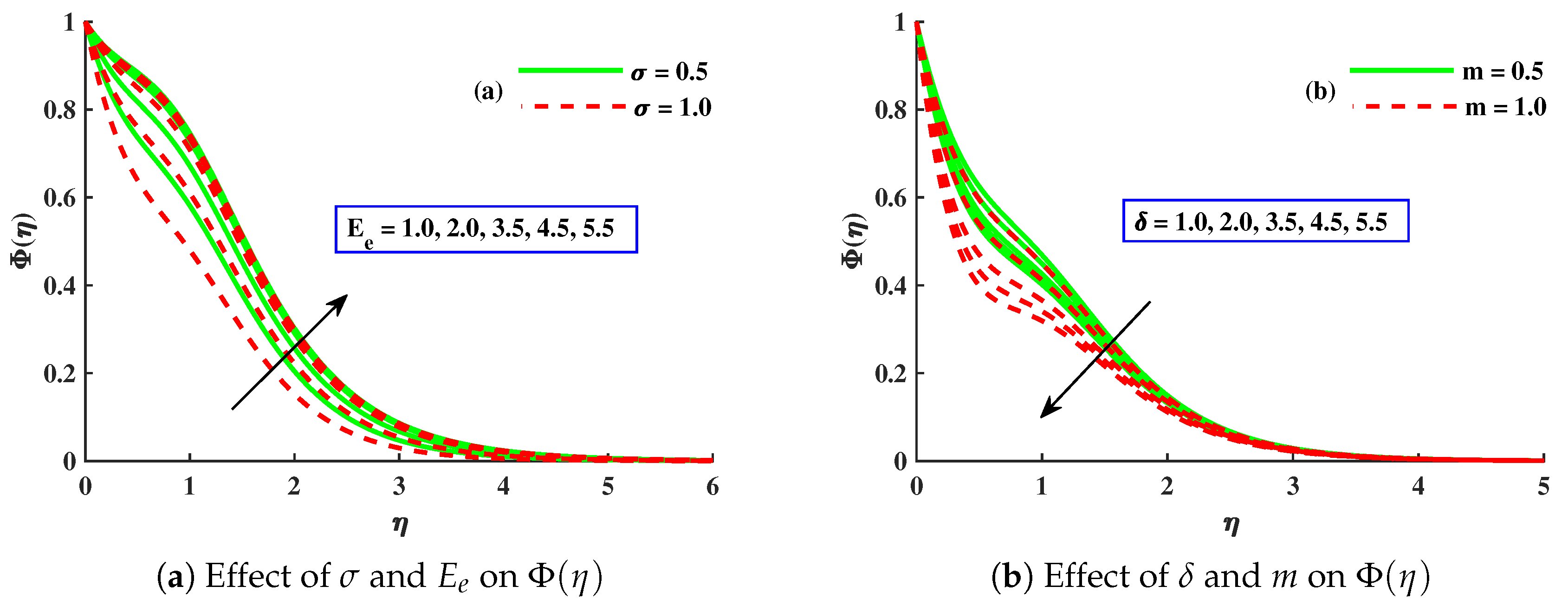
The impact of the rotational parameter and material parameter on the temperature of the nanofluid is sketched in Figure 7a. It increased with increasing values of the rotational parameter. The development in heat is satisfied on the basis of the higher diffusion processes because of increased rotation. It is noted that incremental values of ∇ cause a decrease in temperature. The effect of M and on is represented in Figure 7b. The temperature field is increased with amplified values of M and . With growing values of M, the fluid flux is stopped and dissipation appends to the thermal energy of the fluid. Figure 8a displayed the effect of ∇ and on . The concentration field decreased with increasing values of the material parameter, but rises on with incremented values of the rotational parameter. Variation in the concentration of the fluid due to and is illustrated by Figure 8b. It is clearly analyzed that a larger parameter discloses a decay in . However, with incremental values of , the concentration profile is increased. Physically, the Brownian motion aggravates the particles far off from the field zone and also warms the liquid in the boundary layer. As such, a reduction is observed in the concentration. With the increasing value of , the intense diffusion of particles in the host fluid results the expansion of the boundary layers of concentration. Thus, becomes magnified. Figure 9a demonstrates the outcome of the activation energy () and reaction rate constant (). The concentration distribution is increasingly activating the energy. Because aggrandizes, the modified Arrhenius function decays. This stimulates the generative chemical process, which raises the concentration of nanoparticles. While there is an opposite behavior for . By incremented values of , decreased. Figure 9b was organized to express the extent of the impact of the fitted rate constant and on the concentration of fluid. By increasing the values of both parameters, the concentration of the liquid reduced. Physically, the growing values of the fitted rate constantly increased the mathematical relation factor . The rise in this factor ultimately helps the disastrous chemical reaction which enhances the volume fraction profile of the nanoparticles.
Figure 7.
Curves of with , ∇, M and .
Figure 8.
Curves of with , ∇, , and .
Figure 9.
Curves of with , , and m.
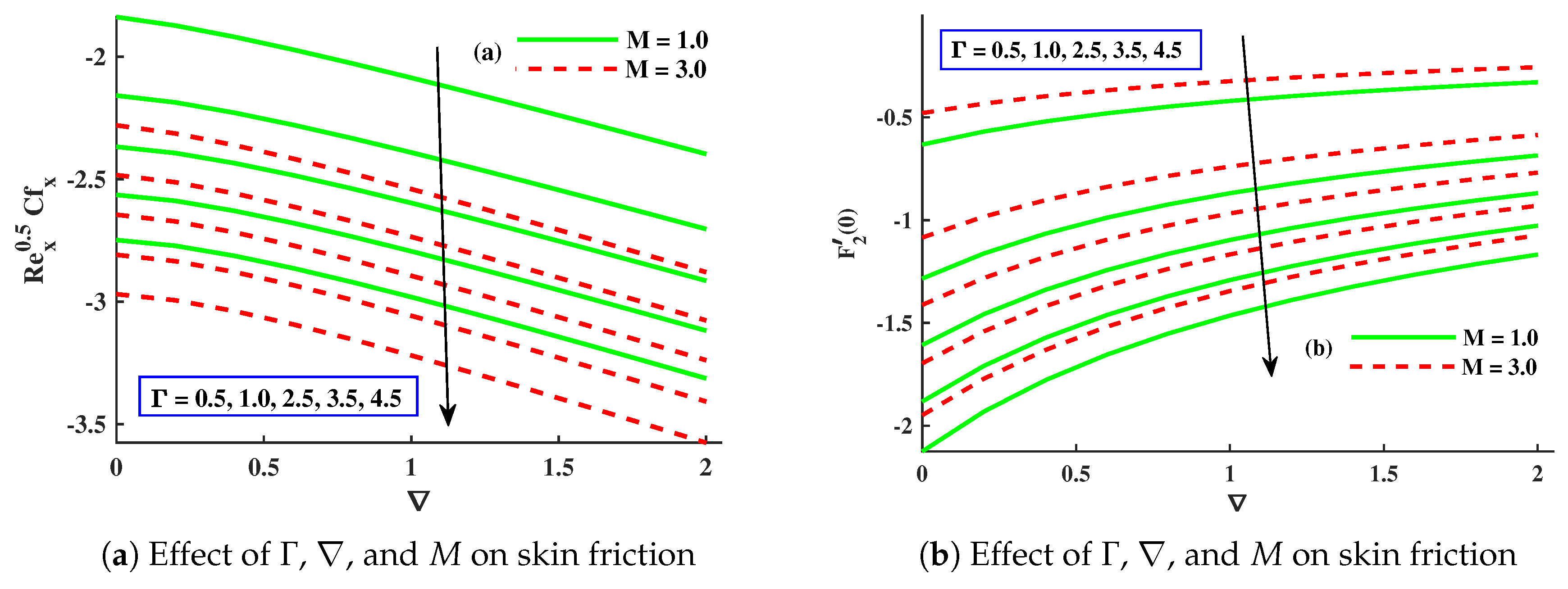
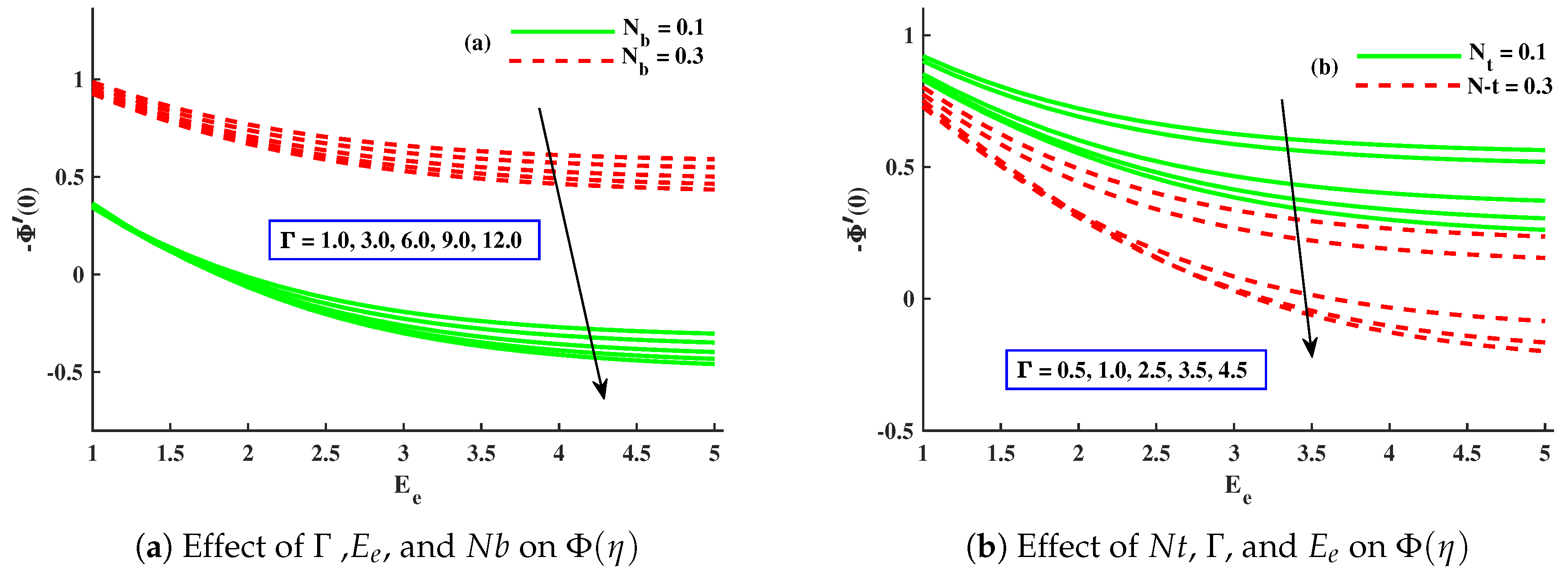
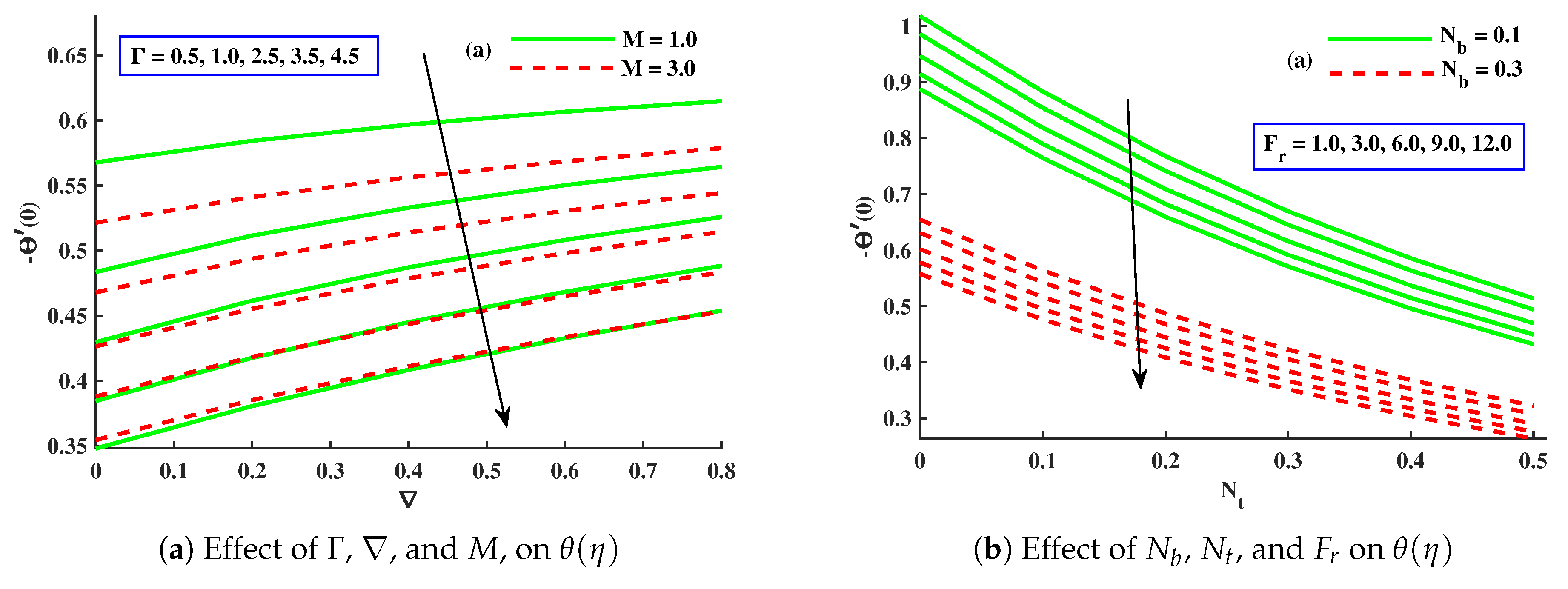
Figure 10a,b are drawn to present the fluctuation in and , which is subject to the parameters M, , and ∇, which were given different values. The skin friction coefficient () undergoes a notable decrease with the incremental values of M, , and ∇, while increased against M and ∇ but decreased against . The Nusselt numbers are sketched in Figure 11a,b. Figure 11a depicts that the magnitude of reduced with higher values of the magnetic parameter and the rotational parameter, but increased with larger values of the material parameter. With the rising strength of the Lorentz force, we also noticed the expected escalation in , since, by heating the nanofluid subject and thus giving it a very strong magnetic strength, there will be a heat transfer loss at the surface of the stretch sheet that will manifest in a decline in . The magnitude of Nusselt numbers lessened with larger inputs of the Forchheimer number, Brownian motion, and thermophoresis, as plotted in Figure 11b. Physically, we observed that, due to the greater resistance and viscosity between the nanoparticles which produce more heat, the magnitude of the Nusselt numbers declined. The influences of different parameters on are presented in Figure 12a,b. The magnitude of the Sherwood number is boosted with elevated values of but decreased against the activation energy and , as revealed in Figure 12a. Figure 12b discloses that the magnitude of reduced against , , and .
Figure 10.
Curves of skin friction with ∇, , and M.
Figure 11.
Curves of with , ∇, M, , , and .
Figure 12.
Curves of with , , , and .
4. Conclusions
In this article, 3D rotating water-based micropolar nanofluid flow above a linearly stretching surface was investigated and the bvp4c method was applied to analyze the enhancement of the heat transportation in the presence of the MHD rotating non-Newtonian nanofluid using a porous medium. The graphical outcomes for the velocity components, micro-rotation distribution, temperature, skin friction coefficient, particle concentration, Nusselt numbers, and Sherwood number were obtained. Some of the significant consequences are as follows:
- and decreased significantly with higher values of , , , M, and . However, displayed an increasing behavior for ∇ and a magnitude of with a decreasing behavior for ∇.
- The amplified values of concentration boundary parameter and Lorentz force enhanced the micro-rotation distribution, but displayed an opposite behavior against the growing values of material parameter.
- The thermal performance of the host fluid was enhanced against the growing strength of the Brownian motion, thermophoresis, and porous medium parameters, but the opposite trend was noticed against the dimensionless micropolar material parameter.
- With amplified values of , , and , the concentration profile was enhanced, while it was decreased against ∇, , , m, and .
- The magnitude of the Sherwood number displayed an increasing behavior against , but showed a decreasing behavior for , , and .
- The skin friction coefficient in the x direction decreased with a larger value of M, , and ∇, whilst the skin friction coefficient in the y direction increased due to enhancements in M and ∇ but decreased for .
- The magnitude of the Nusselt numbers was decreased with increasing contributions of , , , , and M, but increased against ∇.
Through this computational effort, we successfully elucidated the parametric impacts on the dynamics of micropolar nanofluid. In a future study, this study may be extended for various types of non-Newtonian fluid flow models. This study will be applicable in modern nanotechnology, the cooling of electronic devices, paper production, and with momentous applications in the industry and engineering fields.
Author Contributions
M.M.A.; Writing—original draft, A.A.H.; Data curation, B.A.; Writing—review & editing, S.M.; Validation, A.K.H.; Resources, and N.A.S.; supervision. All authors have read and agreed to the published version of the manuscript.
Funding
Princess Nourah bint Abdulrahman University Researchers Supporting Project number (PNURSP2023R132), Princess Nourah bint Abdulrahman University, Riyadh, Saudi Arabia.
Institutional Review Board Statement
Not applicable.
Informed Consent Statement
Not applicable.
Data Availability Statement
The numerical data used to support the findings of this study are included within the article.
Acknowledgments
Princess Nourah bint Abdulrahman University Researchers Supporting Project number (PNURSP2023R132), Princess Nourah bint Abdulrahman University, Riyadh, Saudi Arabia.
Conflicts of Interest
The authors declare no conflict of interest.
References
- Ali, U.; Irfan, M.; Rehman, K.U.; Alqahtani, A.S.; Malik, M.; Shatanawi, W. On the Cattaneo–Christov heat flux theory for mixed convection flow due to the rotating disk with slip effects. Waves Random Complex Media 2022, 10, 1–15. [Google Scholar] [CrossRef]
- Pattnaik, P.; Bhatti, M.; Mishra, S.; Abbas, M.A.; Bég, O.A. Mixed convective-radiative dissipative magnetized micropolar nanofluid flow over a stretching surface in porous media with double stratification and chemical reaction effects: ADM-Padé computation. J. Math. 2022, 2022, 9888379. [Google Scholar] [CrossRef]
- Eringen, A.C. Theory of micropolar fluids. J. Math. Mech. 1966, 16, 1–18. [Google Scholar] [CrossRef]
- Galdi, G.P.; Rionero, S. A note on the existence and uniqueness of solutions of the micropolar fluid equations. Int. J. Eng. Sci. 1977, 15, 105–108. [Google Scholar] [CrossRef]
- Bilal, M.; Saeed, A.; Gul, T.; Kumam, W.; Mukhtar, S.; Kumam, P. Parametric simulation of micropolar fluid with thermal radiation across a porous stretching surface. Sci. Rep. 2022, 12, 2542. [Google Scholar] [CrossRef]
- Ali, B.; Siddique, I.; Khan, I.; Masood, B.; Hussain, S. Magnetic dipole and thermal radiation effects on hybrid base micropolar CNTs flow over a stretching sheet: Finite element method approach. Results Phys. 2021, 25, 104145. [Google Scholar] [CrossRef]
- Pasha, P.; Mirzaei, S.; Zarinfar, M. Application of numerical methods in micropolar fluid flow and heat transfer in permeable plates. Alex. Eng. J. 2022, 61, 2663–2672. [Google Scholar] [CrossRef]
- Mohanty, B.; Mohanty, S.; Mishra, S.; Pattnaik, P. Analysis of entropy on the peristaltic transport of micropolar nanofluid: A simulation obtained using approximate analytical technique. Eur. Phys. J. Plus 2021, 136, 1–19. [Google Scholar] [CrossRef]
- Ramya, E.; Muthtamilselvan, M.; Doh, D.H. Absorbing/emitting radiation and slanted hydromagnetic effects on micropolar liquid containing gyrostatic microorganisms. Appl. Math. Comput. 2018, 324, 69–81. [Google Scholar] [CrossRef]
- Bilal, M.; Hussain, S.; Sagheer, M. Boundary layer flow of magneto-micropolar nanofluid flow with Hall and ion-slip effects using variable thermal diffusivity. Bull. Pol. Acad. Sci. Tech. Sci. 2017, 65. [Google Scholar] [CrossRef]
- Jang, J.; Lee, S.S. Theoretical and experimental study of MHD (magnetohydrodynamic) micropump. Sens. Actuators Phys. 2000, 80, 84–89. [Google Scholar] [CrossRef]
- Alsaedi, A.; Muhammad, K.; Hayat, T. Numerical study of MHD hybrid nanofluid flow between two coaxial cylinders. Alex. Eng. J. 2022, 61, 8355–8362. [Google Scholar] [CrossRef]
- Ali, B.; Rasool, G.; Hussain, S.; Baleanu, D.; Bano, S. Finite Element Study of Magnetohydrodynamics (MHD) and Activation Energy in Darcy–Forchheimer Rotating Flow of Casson Carreau Nanofluid. Processes 2020, 8, 1185. [Google Scholar] [CrossRef]
- Nazeer, M.; Hussain, F.; Khan, M.I.; El-Zahar, E.R.; Chu, Y.M.; Malik, M. Theoretical study of MHD electro-osmotically flow of third-grade fluid in micro channel. Appl. Math. Comput. 2022, 420, 126868. [Google Scholar] [CrossRef]
- Ahmad, S.; Ali, K.; Rizwan, M.; Ashraf, M. Heat and mass transfer attributes of copper–aluminum oxide hybrid nanoparticles flow through a porous medium. Case Stud. Therm. Eng. 2021, 25, 100932. [Google Scholar] [CrossRef]
- Badruddin, I.A.; Salman Ahmed, N.; Anqi, A.E.; Kamangar, S. Conjugate heat and mass transfer in a vertical porous cylinder. J. Thermophys. Heat Transf. 2019, 33, 548–558. [Google Scholar] [CrossRef]
- Hassan, M.; Marin, M.; Alsharif, A.; Ellahi, R. Convective heat transfer flow of nanofluid in a porous medium over wavy surface. Phys. Lett. A 2018, 382, 2749–2753. [Google Scholar] [CrossRef]
- Banerjee, A.; Paul, D. Developments and applications of porous medium combustion: A recent review. Energy 2021, 221, 119868. [Google Scholar] [CrossRef]
- Waini, I.; Ishak, A.; Pop, I. Symmetrical solutions of hybrid nanofluid stagnation-point flow in a porous medium. Int. Commun. Heat Mass Transf. 2022, 130, 105804. [Google Scholar] [CrossRef]
- Wang, C. Stretching a surface in a rotating fluid. Zeitschrift für Angewandte Mathematik und Physik ZAMP 1988, 39, 177–185. [Google Scholar] [CrossRef]
- Rajeswari, V.; Nath, G. Unsteady flow over a stretching surface in a rotating fluid. Int. J. Eng. Sci. 1992, 30, 747–756. [Google Scholar] [CrossRef]
- Ali, B.; Ahammad, N.A.; Awan, A.U.; Guedri, K.; Tag-ElDin, E.M.; Majeed, S. Dynamics of Rotating Micropolar Fluid over a Stretch Surface: The Case of Linear and Quadratic Convection Significance in Thermal Management. Nanomaterials 2022, 12, 3100. [Google Scholar] [CrossRef]
- Nadeem, S.; Abbas, N.; Elmasry, Y.; Malik, M. Numerical analysis of water based CNTs flow of micropolar fluid through rotating frame. Comput. Methods Programs Biomed. 2020, 186, 105194. [Google Scholar] [CrossRef]
- Kumar, R.; Kumar, R.; Shehzad, S.A.; Sheikholeslami, M. Rotating frame analysis of radiating and reacting ferro-nanofluid considering Joule heating and viscous dissipation. Int. J. Heat Mass Transf. 2018, 120, 540–551. [Google Scholar] [CrossRef]
- Al-Kouz, W.; Owhaib, W. Numerical analysis of Casson nanofluid three-dimensional flow over a rotating frame exposed to a prescribed heat flux with viscous heating. Sci. Rep. 2022, 12, 4256. [Google Scholar] [CrossRef]
- Ali, B.; Nie, Y.; Hussain, S.; Habib, D.; Abdal, S. Insight into the dynamics of fluid conveying tiny particles over a rotating surface subject to Cattaneo–Christov heat transfer, Coriolis force, and Arrhenius activation energy. Comput. Math. Appl. 2021, 93, 130–143. [Google Scholar] [CrossRef]
- Awan, A.U.; Ahammad, N.A.; Majeed, S.; Gamaoun, F.; Ali, B. Significance of hybrid nanoparticles, Lorentz and Coriolis forces on the dynamics of water based flow. Int. Commun. Heat Mass Transf. 2022, 135, 106084. [Google Scholar] [CrossRef]
- Ali, B.; Pattnaik, P.; Naqvi, R.A.; Waqas, H.; Hussain, S. Brownian motion and thermophoresis effects on bioconvection of rotating Maxwell nanofluid over a Riga plate with Arrhenius activation energy and Cattaneo-Christov heat flux theory. Therm. Sci. Eng. Prog. 2021, 23, 100863. [Google Scholar] [CrossRef]
- Javed, T.; Ahmad, I.; Abbas, Z.; Hayat, T. Rotating flow of a micropolar fluid induced by a stretching surface. Zeitschrift für Naturforschung A 2010, 65, 829–843. [Google Scholar] [CrossRef]
- Hayat, T.; Muhammad, T.; Mustafa, M.; Alsaedi, A. An optimal study for three-dimensional flow of Maxwell nanofluid subject to rotating frame. J. Mol. Liq. 2017, 229, 541–547. [Google Scholar] [CrossRef]
- Chamkha, A.J.; Jaradat, M.; Pop, I. Three-dimensional micropolar flow due to a stretching flat surface. Int. J. Fluid Mech. Res. 2003, 30, 357–366. [Google Scholar] [CrossRef]
- Nazar, R.; Amin, N.; Pop, I. Unsteady magneto-hydrodynamic transport of rotating Maxwell nanofluid flow on a stretching sheet with Cattaneo–Christov double diffusion and activation energy. Mech. Res. Commun. 2004, 31, 121–128. [Google Scholar] [CrossRef]
- Ali, B.; Nie, Y.; Hussain, S.; Manan, A.; Sadiq, M.T. TUnsteady boundary layer flow due to a stretching surface in a rotating fluid. Therm. Sci. Eng. Prog. 2020, 20, 100720. [Google Scholar] [CrossRef]
Disclaimer/Publisher’s Note: The statements, opinions and data contained in all publications are solely those of the individual author(s) and contributor(s) and not of MDPI and/or the editor(s). MDPI and/or the editor(s) disclaim responsibility for any injury to people or property resulting from any ideas, methods, instructions or products referred to in the content. |
© 2023 by the authors. Licensee MDPI, Basel, Switzerland. This article is an open access article distributed under the terms and conditions of the Creative Commons Attribution (CC BY) license (https://creativecommons.org/licenses/by/4.0/).