1. Introduction
Let
be the bounded and connected domain with the boundary
. We consider the following two-dimensional (2D) incompressible nonlinear unsteady Navier–Stokes equation (see [
1,
2,
3]).
Problem 1. Find and , satisfying
where stands for the vector of fluid velocity, p stands for the pressure, and , , stands for the last moment, , is the Reynolds number, and , , and are the known source term vector, initial value vector, and boundary value vector, respectively. The nonlinear unsteady Navier–Stokes equation is one of the most important equations in hydrodynamics and was successfully used to simulate lots of practical engineering problems (see [
1,
2,
3]). However, on account of its nonlinearity, in particular, when its calculation domain
is an irregular geometrical shape, or its initial value vector, or its source term vector, or its initial value vector, or its boundary value vector is complex, we can not find its analytical solutions, so we have to find its numerical solutions.
The Crank–Nicolson (CN) mixed finite element (FE) (MFE) (CNMFE) algorithm has unconditional stability and convergence and possesses the second time precision, so it is considered to be one of the most valid methods to solve the 2D unsteady Navier–Stokes equation about the vorticity–stream functions. However, it usually contains lots of unknowns. Thereby, the primary mission of this paper is to lower the unknowns of the CNMFE algorithm so as to alleviate the computing load, save the CPU runtime, ease off the rounding errors accumulating, and acquire the desired numerical solutions.
Numerous numerical experiments (see [
4,
5,
6,
7,
8,
9,
10,
11,
12,
13,
14]) have demonstrated that the proper orthogonal decomposition (POD) method is one of the most effective approaches to lessen the unknowns for numerical methods of the unsteady partial differential equations (PDEs). The POD method is a very old method; its predecessor is the principal vector analysis. The POD method is mainly to find a set of orthogonal bases for a given data set in a some least-squares sense, namely it is to look for the lower-dimensional optimal approximations for the set of known data. It was an eigenvector procedure technique, which was firstly addressed by Pearson in 1901 and was applied to extracting main ingredients in massive data (see [
15]). Pearson’s data mining is used at present. The fashionable name for such processed data is just the so-called “Big Data”. The method for snapshots of the POD was first proposed by Sirovich in 1987 (see [
16]).
Based on the effectiveness with which the POD method deals with data, the POD method has been broadly and resoundingly applied in various fields, such as atmospheric sciences and hydrodynamics (see [
17]), image recognition and signal procedures (see [
18]), together with statistics (see [
19]). However, for a long time, since 1987, the POD method was mainly applied to implementing the main vector analysis in statistics and researching the main behaviour in hydrodynamics. It was not until 2001 that the POD method was used by Kunisch and Volkweind to construct the Galerkin reduced-order methods for PDEs (see [
1,
20]). From that time on, the model order reduction and reduced basis for the numerical methods based on the POD for PDEs was rapidly developed and produced a significant efficiency for solving unsteady PDEs (see [
4,
5,
6,
7,
8,
9,
11,
12,
13,
14]). However, these model order reduction and reduced basis methods are mainly to lower the dimensionality of the FE subspaces, namely that the FE subspaces are replaced with the subspace generated by POD basis functions, resulting in the accuracy of the model order reduction and reduced basis methods being greatly influenced by the POD reduced order. In this paper, we adopt the POD method to reduce the dimensionality of the unknown solution coefficient vectors for the CNMFE method of the unsteady Navier–Stokes equation about the vorticity–stream functions and to construct the reduced-dimension recursive CNMFE (RDRCNMFE) method, which is completely different from the order reduction methods about FE subspaces above, including the reduced-order method in [
10]. In this case, we only lower the dimension of unknown CNMFE solution coefficient vectors so as to ensure that the basis functions and precision of the RDRCNMFE method are the same as the CNMFE one but with few unknowns.
Though the reduced-dimension models for the unknown coefficient vectors of FE solutions of the parabolic equation, hyperbolic equation, Sobolev equation, unsteady Stokes equation, and Rosenau equation were, respectively, established in [
21,
22,
23,
24,
25], the non-stationary Navier–Stokes equation is far more complex than the five types of equations in [
21,
22,
23,
24,
25] because it not only includes the pressure but also contains the fluid velocity vector and is nonlinear. Thereby, either the creation of the RDRCNMFE model or the theory analysis for the existence and stability as well as errors of the RDRCNMFE solutions would face more difficulties and need more skills than those in [
21,
22,
23,
24,
25]. However, the RDRCNMFE method for the unsteady Navier–Stokes equation has very important applications. So, it is of great value to study the RDRCNMFE method of the unsteady Navier–Stokes equation.
For this purpose, we first construct the CNMFE method with the second-order time precision, and the unconditional stability and convergence for the 2D unsteady Navier–Stokes equation for the vorticity–stream functions, and discuss the existence and stability as well as convergence for the CNMFE solutions in
Section 2. In addition, in
Section 3, we employ the POD method to construct the POD basis vectors and establish the RDRCNMFE method, and we adopt the matrix analysis to discuss the existence, stability, and convergence of the RDRCNMFE solutions. Afterwards, in
Section 4, we utilise some numerical simulations to reveal the effectiveness and feasibility of the RDRCNMFE method and validate that the numerical calculating results are accorded with the theoretical results. Finally, we epitomise the main conclusions in
Section 5.
2. The CNMFE Method for the Unsteady Navier–Stokes Equation
The Sobolev spaces and norms used herein are standard (see [
26]). For convenience’s sake, we suppose that
and
in the follow-up theories analysis.
2.1. The Time Semi-Discretised CN Scheme
On account of boundedness of the domain , the equation has a unique stream function satisfying and Moreover, there exists a vorticity function , satisfying . Therewith, Problem 1 may be converted into the following system of equations in regard to the vorticity–stream functions .
Problem 2. Find , satisfyingwhere and . Let represent the integer, let stand for the time step, and let and be, respectively, the approximations to and at . By using the CN method to discretise the first derivative of time in (2), the time semi-discretised CN scheme with the second-order accuracy in time may be expressed in the following.
Problem 3. Find , satisfyingwhere , is the inner product, , and . The following properties of
are known (see [
3]).
When
and
are given, it is obvious that Problem 3 is two relatively independent variational problems of standard elliptic equations about the unknowns
and
, so that there exists a unique set of solutions
satisfying the following unconditional stability:
where
c used a follow-up that is a general positive constant that is only dependent on
,
f,
, and
and is different in different places. Moreover, using Taylor’s formula, we can easily conclude that the set of solutions
⊂
has the second-order time accuracy, namely that
where
are the state of solution
for Problem 2 at
(
).
2.2. The Fully Discretised CNMFE Method
Let
be a regular triangulation on
and the
M-dimensional FE space
, generated by the orthonormal bases
under the inner product in
(where
are obtained by the standard orthogonalisation in Section 6.3 [
26]), be denoted by
where
is formed with
lth degree polynomials on
. Thus, the CNMFE format may be expressed in the following.
Problem 4. Find , satisfyingwhere and is Ritz-Projection, namely meets the following equation Noting that (7) and (8) in Problem 4 for the known and constitutes the standard system of elliptic problems, by standard FE method and the Lax–Milgram theorem, we can easily prove the following existence, stability, and convergence about the CNMFE solution of Problem 4.
Theorem 1. Problem 4 has a unique set of solutions satisfying the following unconditional stability:and error estimateswhere are the state of solution of Problem 2 at . Let
and
. Then, the solutions
for Problem 4 may be denoted by
Thus, Problem 4 may be written into the following matrix format.
Problem 5. Find and , satisfyingwhere , , is the identity matrix, , and is the inner product. Remark 1. When the spatial mesh parameter h, the time step , , , and Reynolds are appointed, two sets of the coefficient vectors and may be obtained by Problem 5. Therewith, the velocity CNMFE solutions () may be obtained with and . Generally, the dimension of the unknown solution coefficient vectors and for Problem 5 is so high that we have to lower their dimension by the POD method.
3. The RDRCNMFE Method for the Unsteady Navier–Stokes Equation
3.1. The Construction of POD Basis Vectors
We first find
L coefficient vectors
(
L) of Problem 5 at the first
L time steps and compose into an
snapshot matrices
. We then find the orthonormal eigenmatrix
rank
of
corresponding to the positive eigenvalues
. We may lastly obtain a set of POD bases
(
) from the initial
d vectors in
, satisfying the following property:
herein
and
is the Euclidian norm of vector
. Moreover, there holds the following estimates:
where
are the unit vectors whose
nth element equals 1. Hence,
is a set of optimal POD bases.
Remark 2. On account that the order of the matrix is greatly larger than the order of the matrix , namely that the number M of nodes in is greatly larger than the number L of snapshots, whereas the positive eigenvalues of both and are the same, we may first compute out the eigenvalues of and the relative eigenvectors , and then, by the formulas , we can easily obtain the eigenvectors corresponding to the positive eigenvalues of to make up a set of POD bases ().
3.2. The Establishment of RDRCNMFE Model
If we suppose that and , we can directly obtain the first coefficient vectors and of the RDRCNMFE solutions. Replacing the coefficient vector in Problem 5 with , by the invertibility of , we may set up the RDRCNMFE model in the following.
Problem 6. Find and , satisfyingwhere are the initial L solution vectors in Problem 5, and the matrices and are provided in Problem 5. Remark 3. Comparing Problem 6 with Problem 5, we can see that the CNMFE method (Problem 5) at each time step has M unknowns, while the RDRCNMFE method (Problem 6) at the same time step has only d unknowns , but they have the same basic function so that the RDRCNMFE method has the same accuracy as the classical CNMFE under the case that is sufficiently small, namely that, although the dimension of Problem 6 is greatly lowered, the accuracy of RDRCNMFE solutions remains unchanged. So, the RDRCNMFE method (Problem 6) is overtly superior over the CNMFE method (Problem 5). After () are found by Problem 6, the RDRCNMFE solutions of the velocity can be obtained by and . It is obvious that Problem 6 has a unique set of () so that the RDRCNMFE solutions of the velocity also uniquely exist.
3.3. The Stability and Convergence of the RDRCNMFE Solutions
To discuss the stability and convergence of the RDRCNMFE solutions needs the following two lemmas. The following lemma may be obtained from Lemmas 1.4.1 and 1.4.2 in [
27].
Lemma 1. If the matrix is positive semi-definite, is the identity matrix, and the real , then there holds the following estimates Using the matrix norm and Lemma 1.22 in [
26], we may directly obtain the following lemma.
Lemma 2. If is the inner product, are the FE basis functions, and consists of , then there holds the following estimates Especially, if consists of , then there holds and .
For the RDRCNMFE solutions, we have the following result of stability and convergence.
Theorem 2. If , namely that , then Problem 6 has a unique set of solutions satisfying the following stability: In addition, when , there holds the following error estimateswhere are the state of solution to Problem 2 at . Proof. (1) Prove the existence of solutions to Problem 6.
It follows from Problem 6 and Remark 3 that the RDRCNMFE solutions and () are uniquely existing.
(2) Analyse the stability of solutions to Problem 6.
Using
, we may rewrite Problem 6 into the following system of equations:
When
, noting that
, by Lemma 2 and (9) in Theorem 1, we obtain
When
, using Lemmas 1 and 2, from (21), we obtain
Summing for (25) from
to
n, and using Gronwall’s lemma and (23), we obtain
From (26) and the relationship between
and
, we obtain
Combining (23) and (24) with (26) and (27) yields (17).
(3) Analyse the errors of solutions to Problem 6.
While
, noting that
and
, by (16) and Lemma 2, we obtain
While
, setting
, using Lemmas 1 and 2, from (13) and (21), we obtain
Summing for (30) from
to
n, we obtain
Using Gronwall’s lemma and (28), we obtain
Noting that
and
, by (32) and Lemma 2, we obtain
where
Combining (10) with (28) and (33) yields (18), and (11) with (29) and (34) yields (19). Theorem 2 is proved. □
Noting that and , if we set and , and and , by Theorems 1 and 2, we obtain the following result.
Theorem 3. If the conditions of Theorem 2 hold, then the 2D unsteady Navier–Stokes equation has a unique set of the RDRCNMFE solutions , satisfying the following stabilityand error estimateswhere are the state of solution to Problem 1 at . Remark 4. On account of adopting the POD method to lower the dimensionality for the CNMFE method, the error estimates in Theorem 3 increase one factor more than those in Theorem 1, which may be used as the suggestion to determine the number of POD bases. In order to ensure the RDRCNMFE solutions with the desired accuracy, it is necessary that d is elected to meet . Numerous numerical simulations (see, e.g., [4,5,6,7,8,9,11,12,13,14,21,22,23,24,25]) have showed that the eigenvalues () of the symmetrical matrix are generally falling to zero quickly. Usually, when , there holds so that it has no effect on the total errors. 4. Numerical Simulations
Here, we employ some numerical simulations of the backwards-facing step flow to exhibit the superiority of the RDRCNMFE method established by the 2D unsteady Navier–Stokes equation for the vorticity–stream functions. The numerical simulation was carried out on the computer by using Matlab software.
The backwards-facing step flow herein is the same as that in Reference [
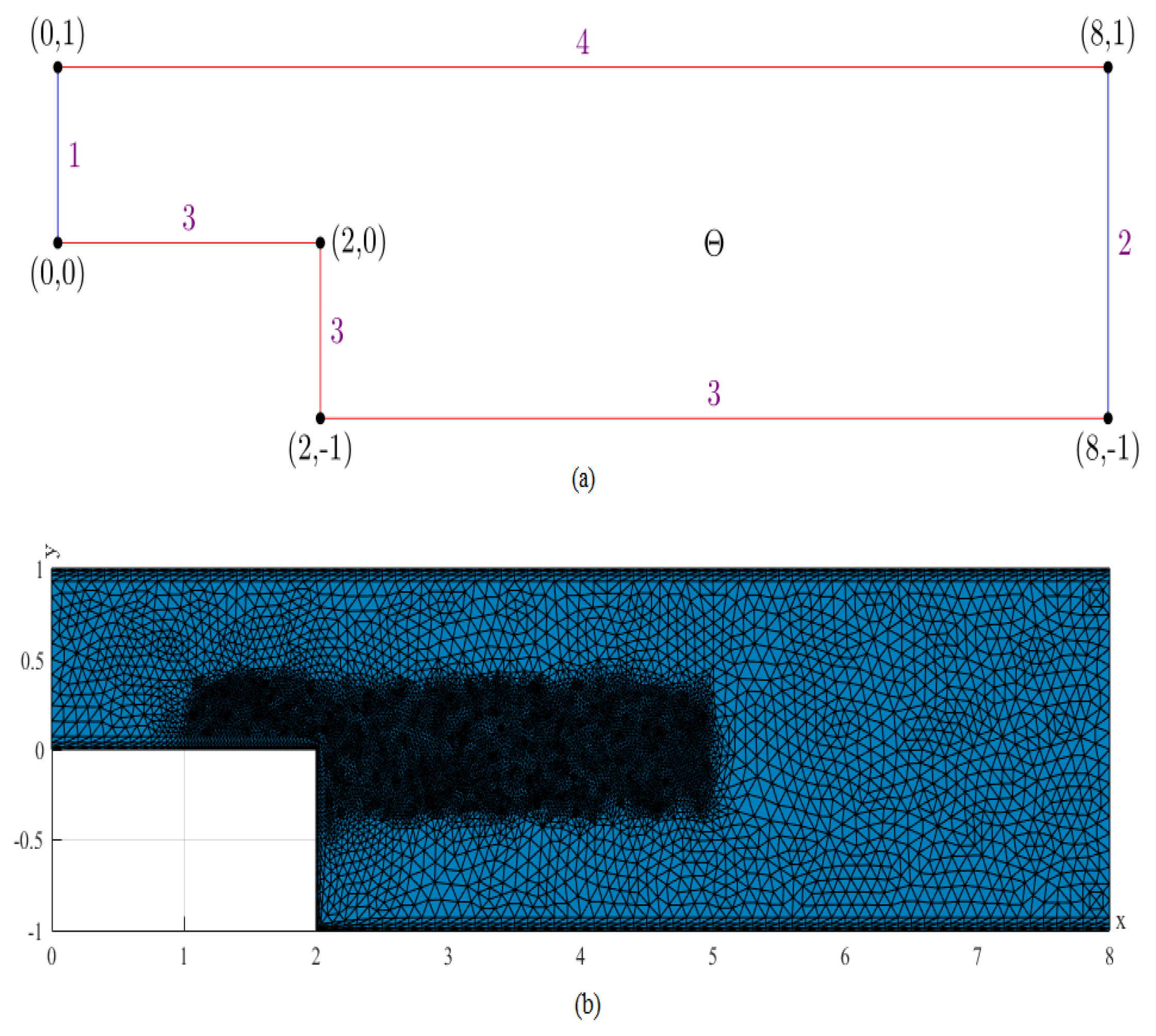
10]. In order to obtain the best numerical simulating result, mesh is refined near the corner. The flow state in the calculation domain
with boundary
is exhibited in
Figure 1a. The boundary line 1 is the inlet with the known initial velocity vector
, but boundary line 2 is a free outlet. The boundary lines 3 and 4 are two rigidity walls without flow. Both the body force vector
and the initial velocity
are equal to
.
Figure 1b is a graph for the triangular elements with the space mesh scale
on the calculation domain
. The FE subspace
consists of the piecewise linear polynomials, the Reynolds number
, and the time step
.
Noting that
and
and
are linear functions on each element
K, so
, by using the first and second equations in Problem 1, the approximate solutions of the pressure
p can be calculated with the following formula:
It follows that
where
or
and
on
. Moreover,
can also be calculated by the following formula:
We first obtain the initial 20 CNMFE vorticity coefficient vectors
(
20) by solving the CNMFE method at the initial 20 time steps and make up the snapshot matrix
. Then, according to the way in
Section 3.1, we calculate out the eigenvectors
corresponding to the eigenvalues
(arranged degressively) in the matrix
that satisfy
. Thereupon, we merely need to take the first six eigenvectors to generate a set of POD bases
with
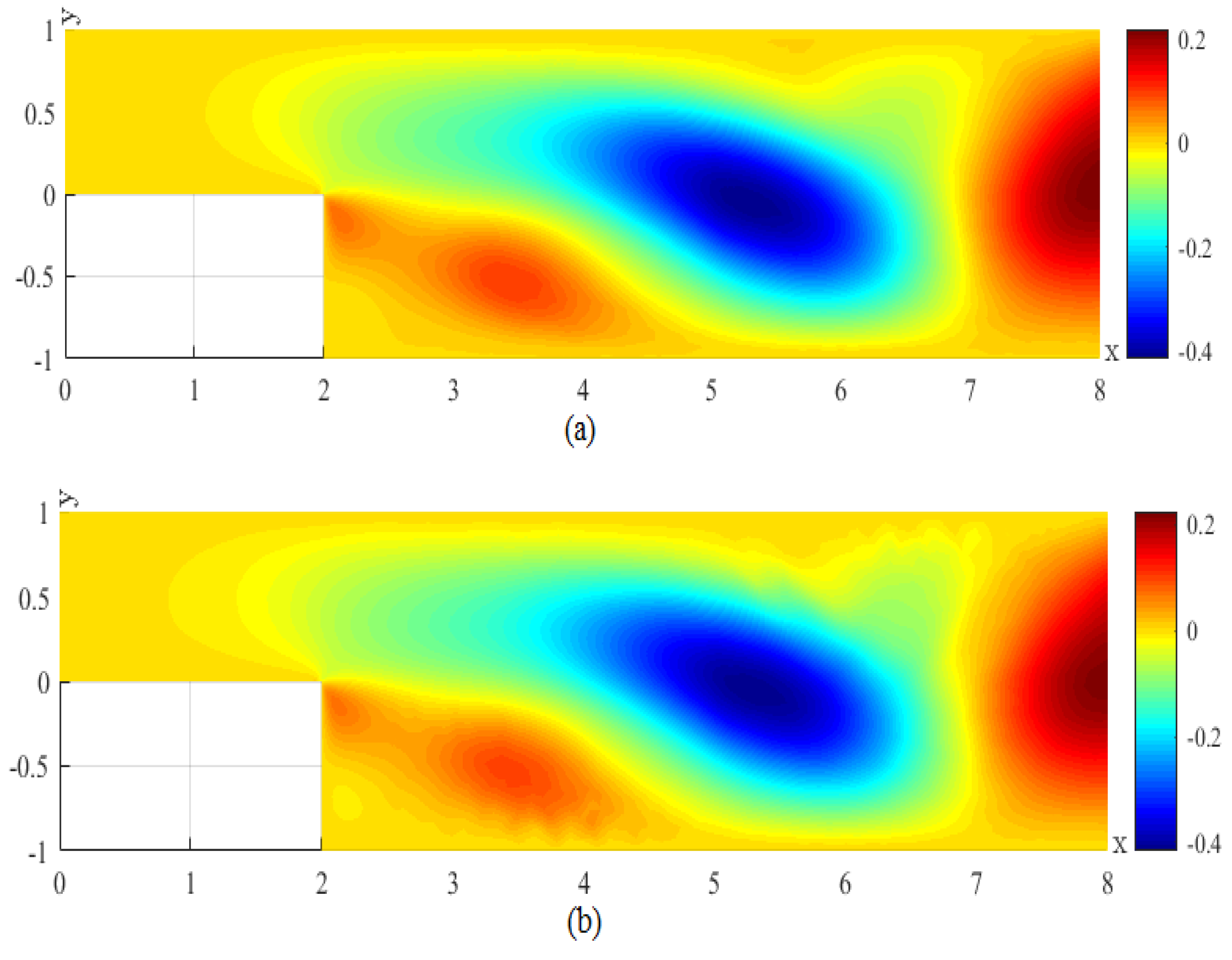
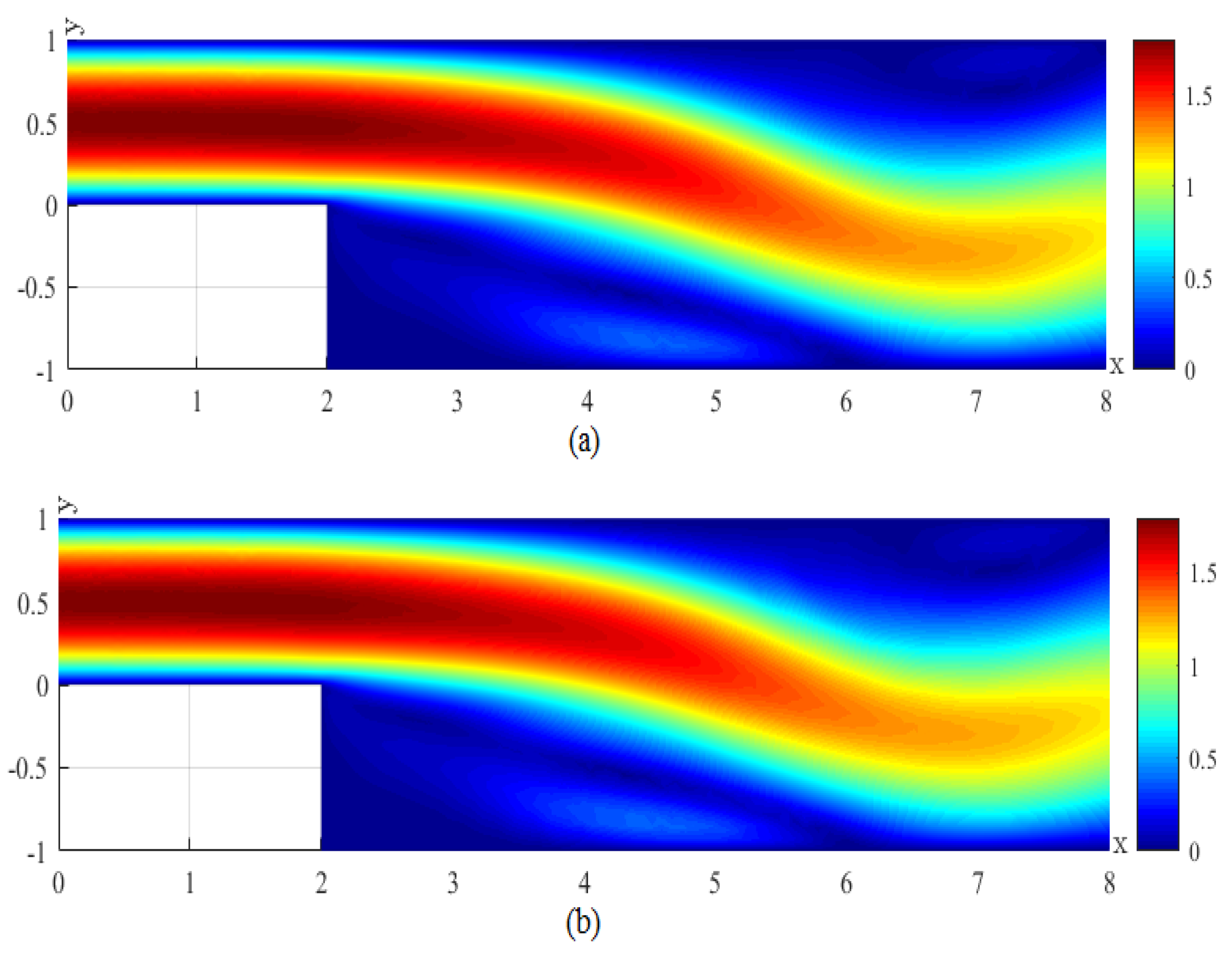
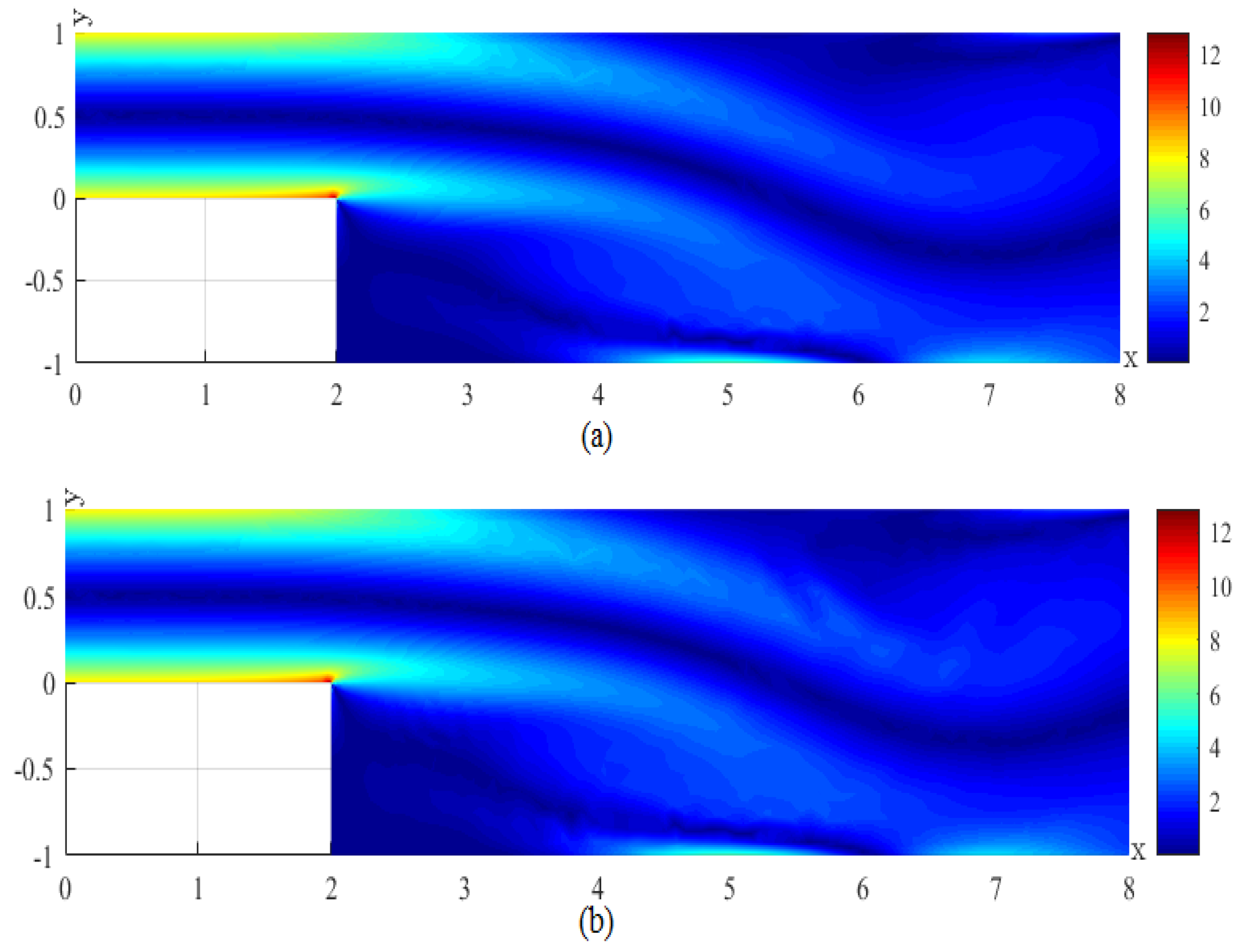
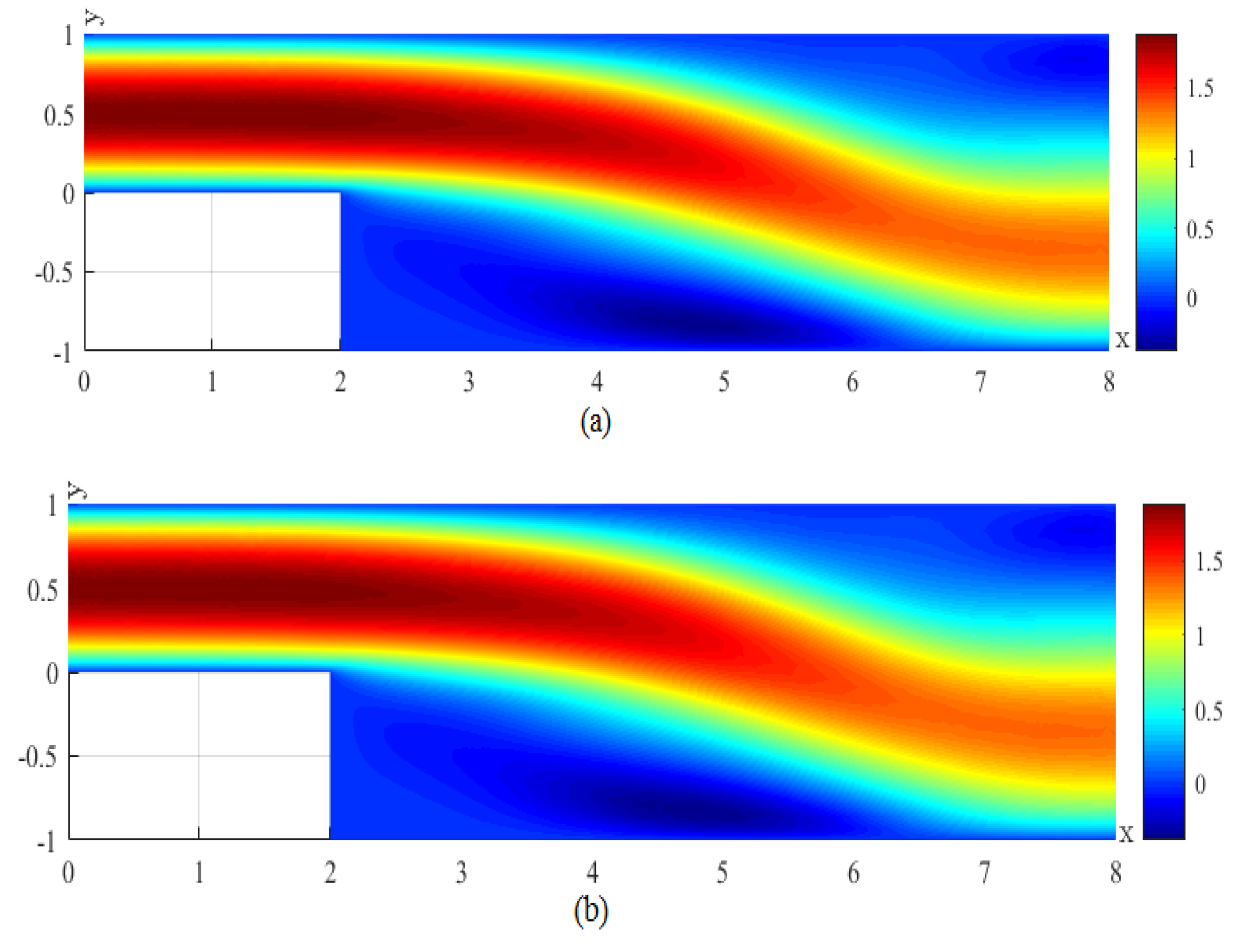
. Finally, we seek the RDRCNMFE solutions of the components of velocity, the velocity magnitude (
), and the pressure at
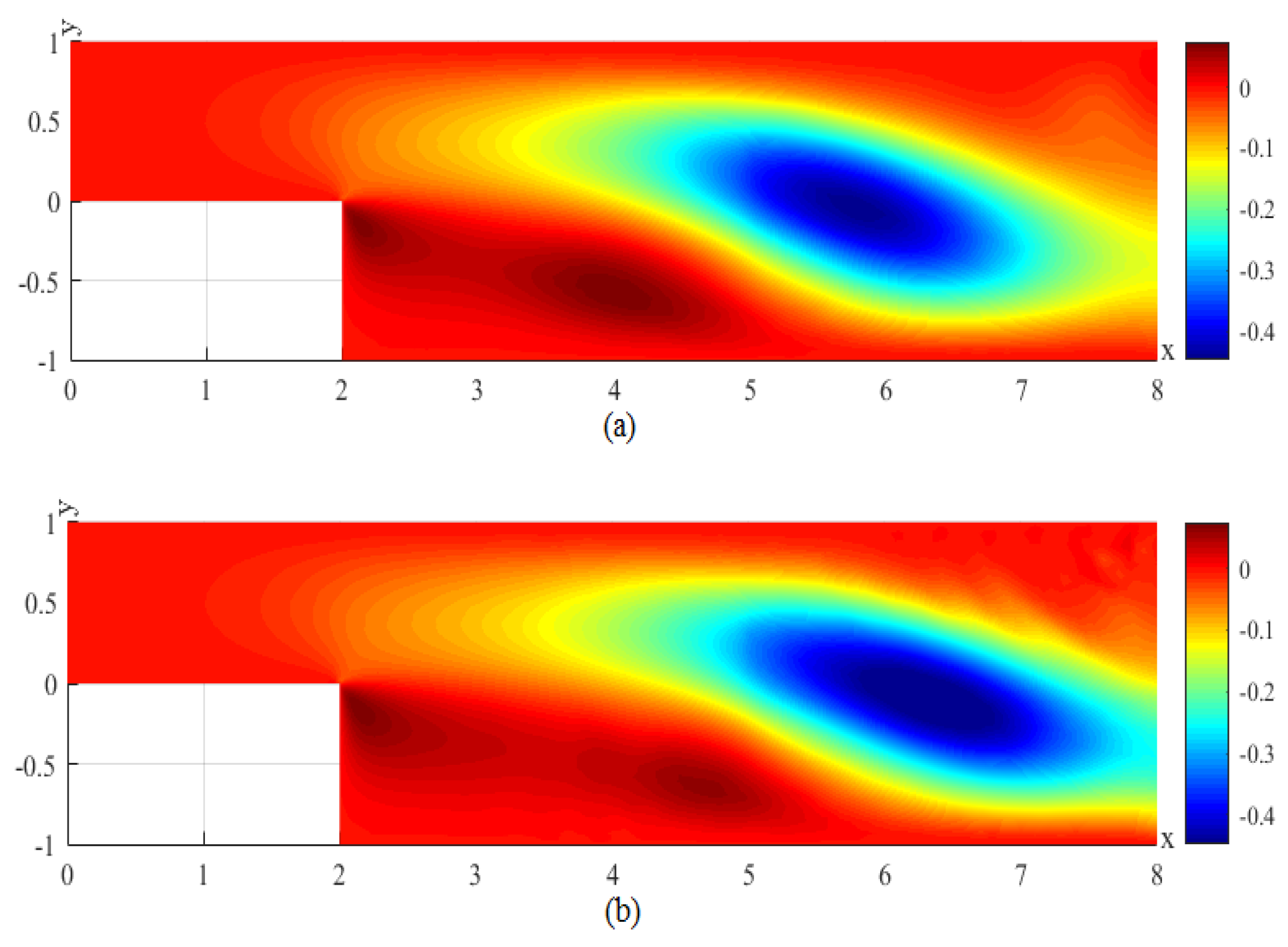
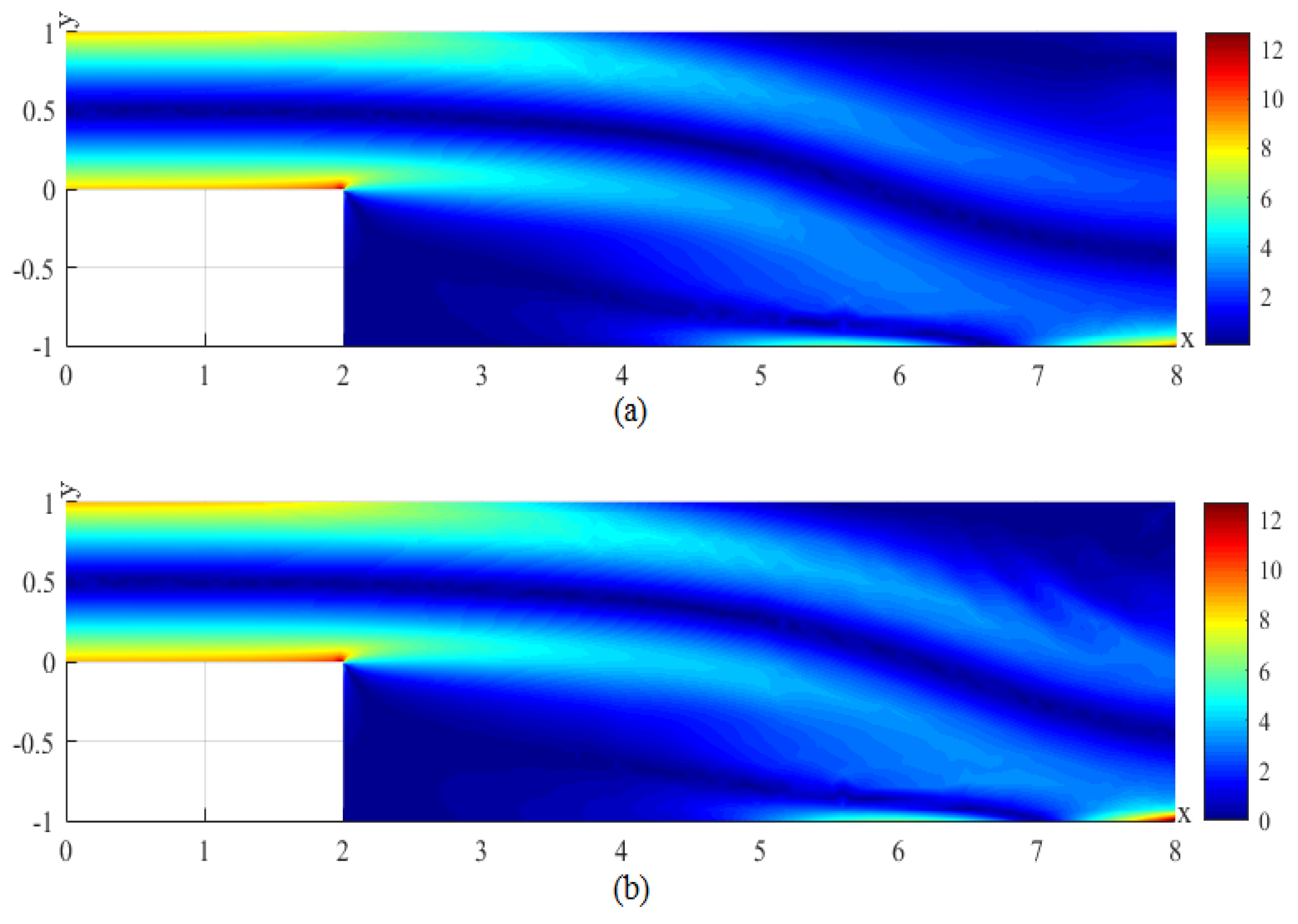
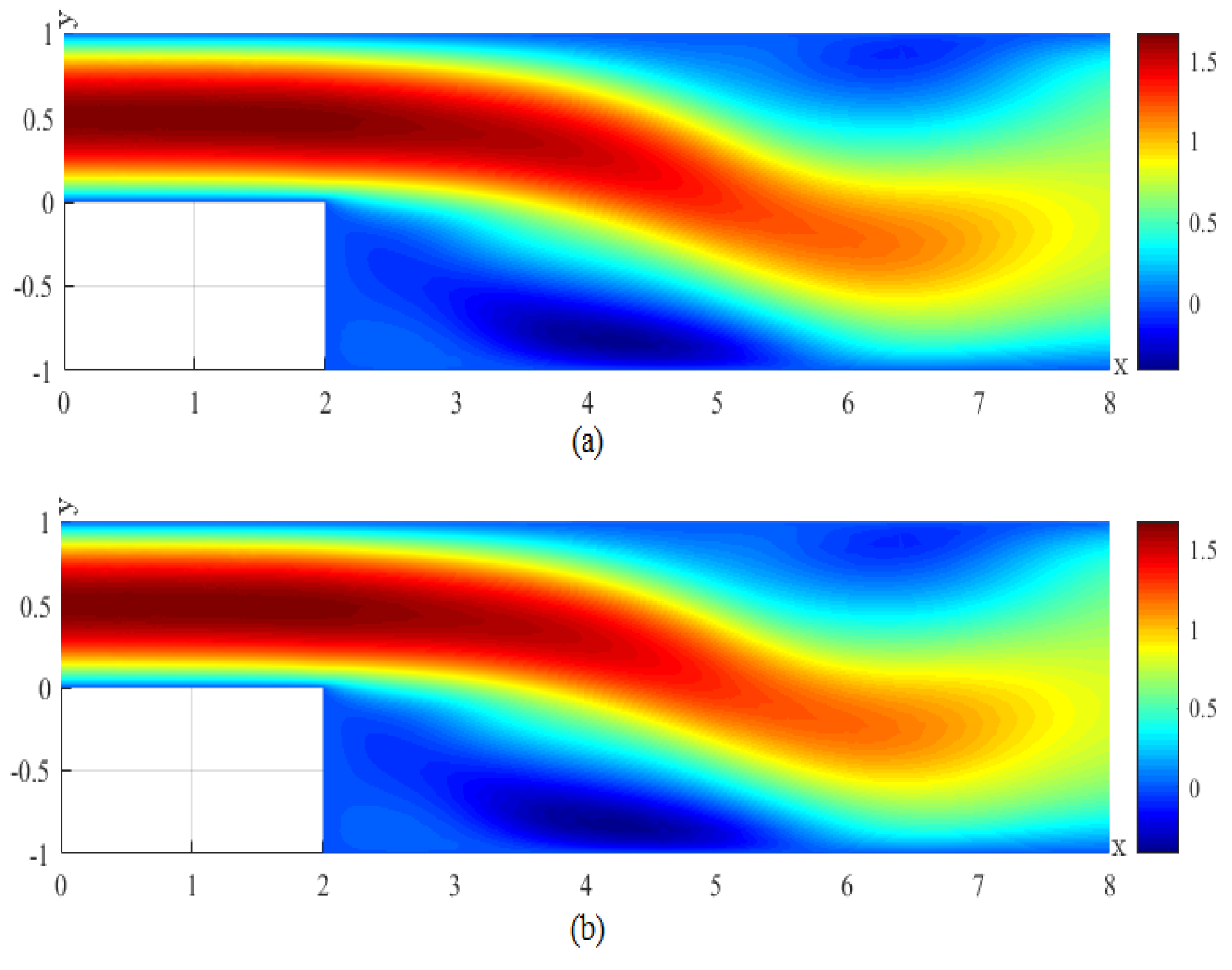
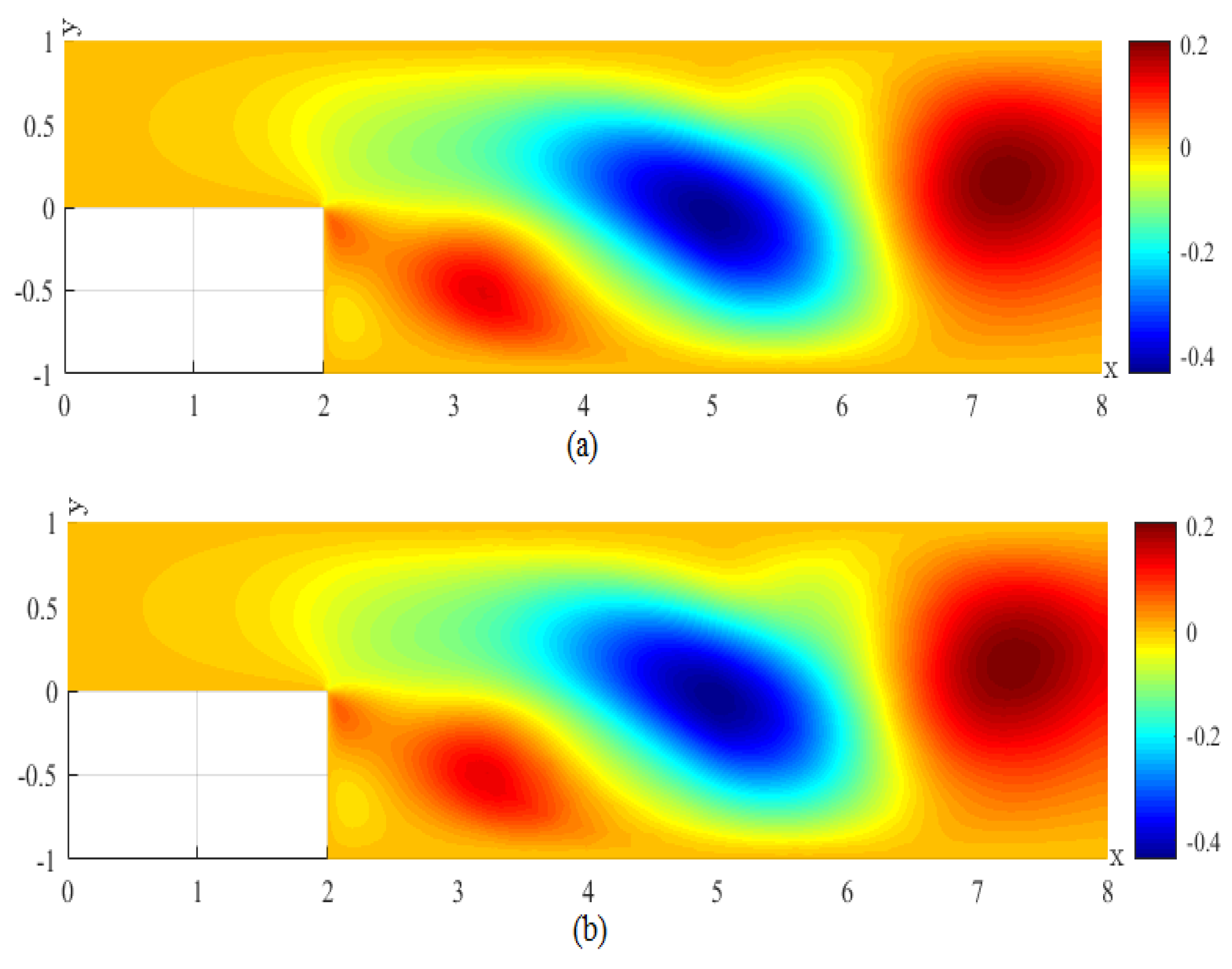
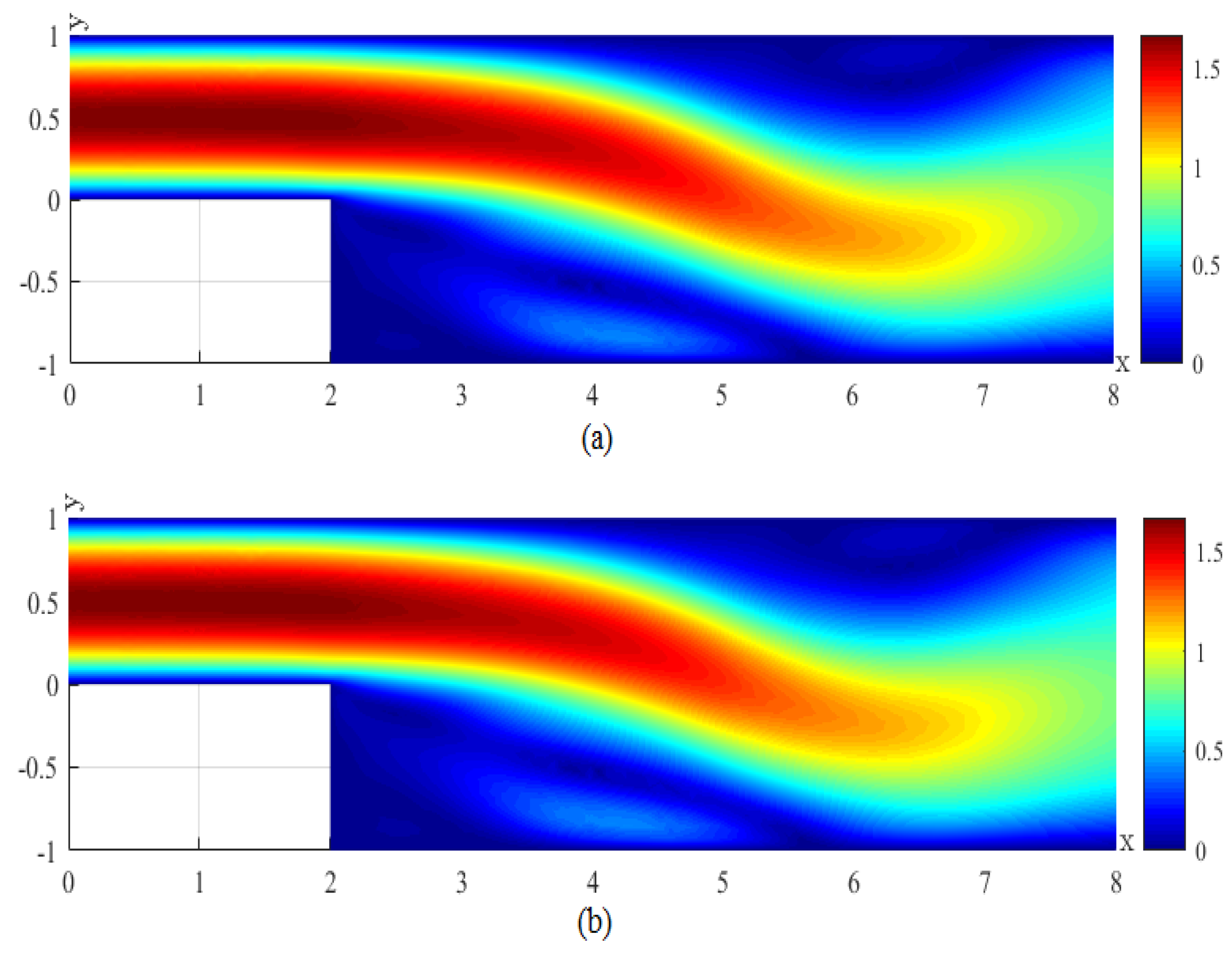
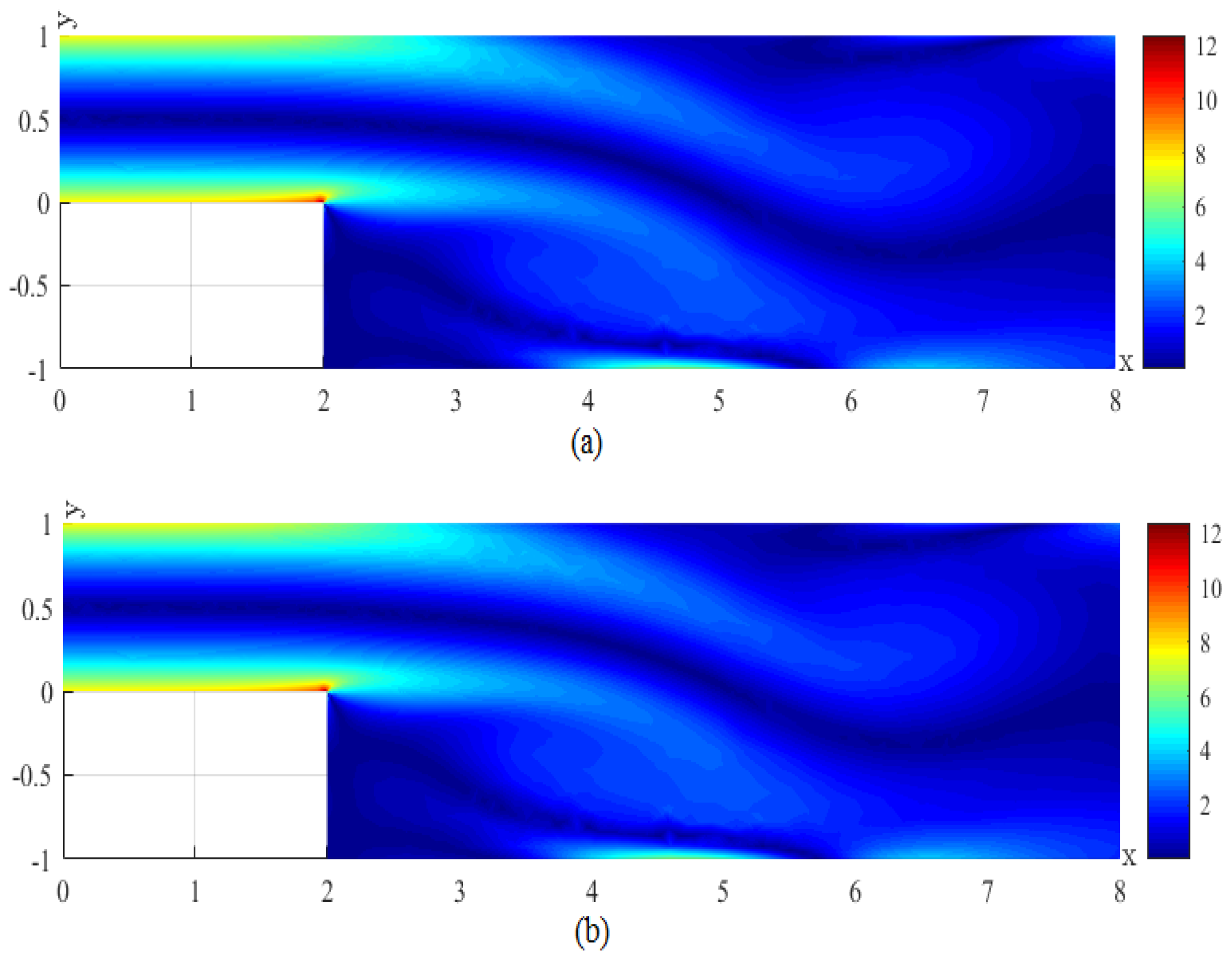
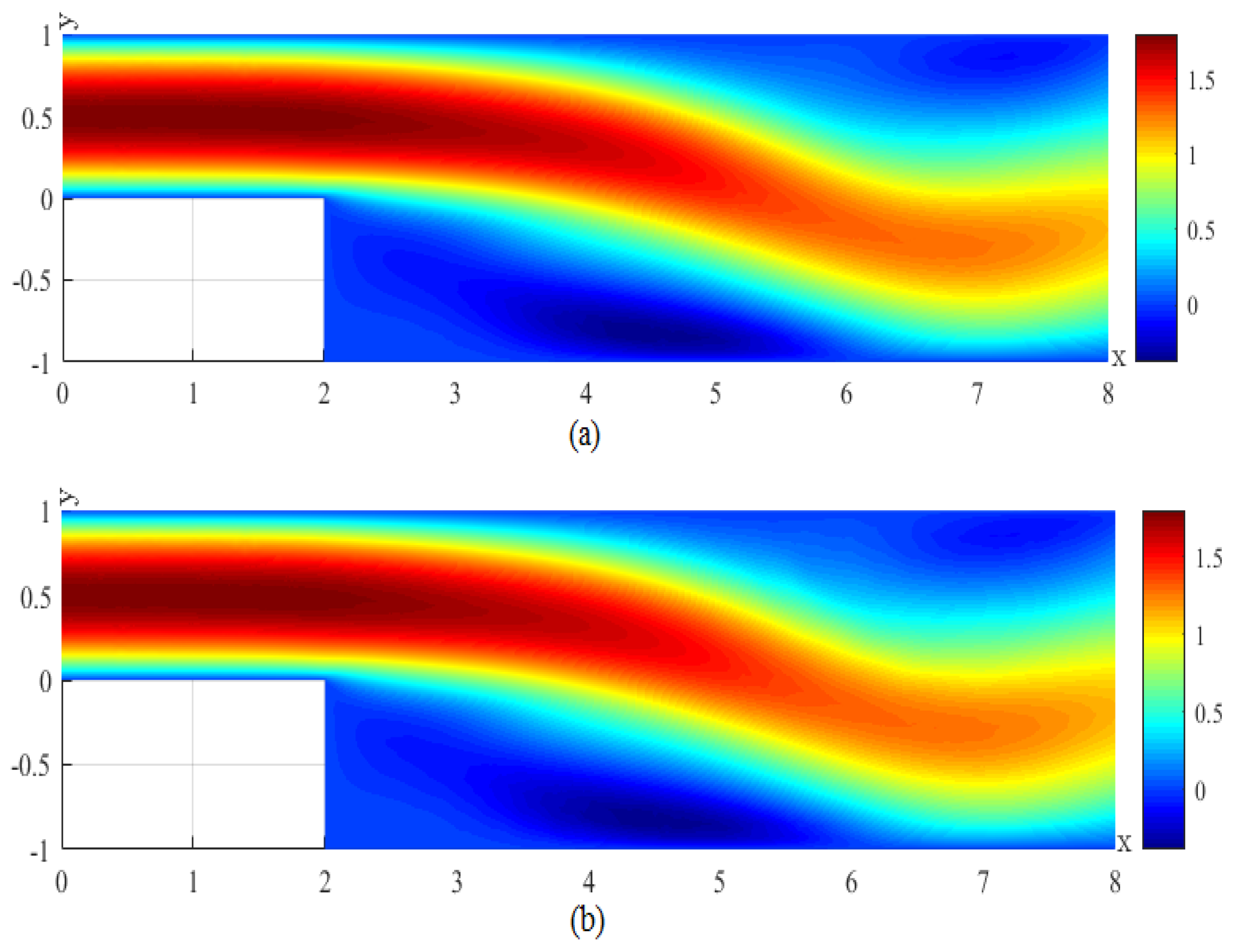
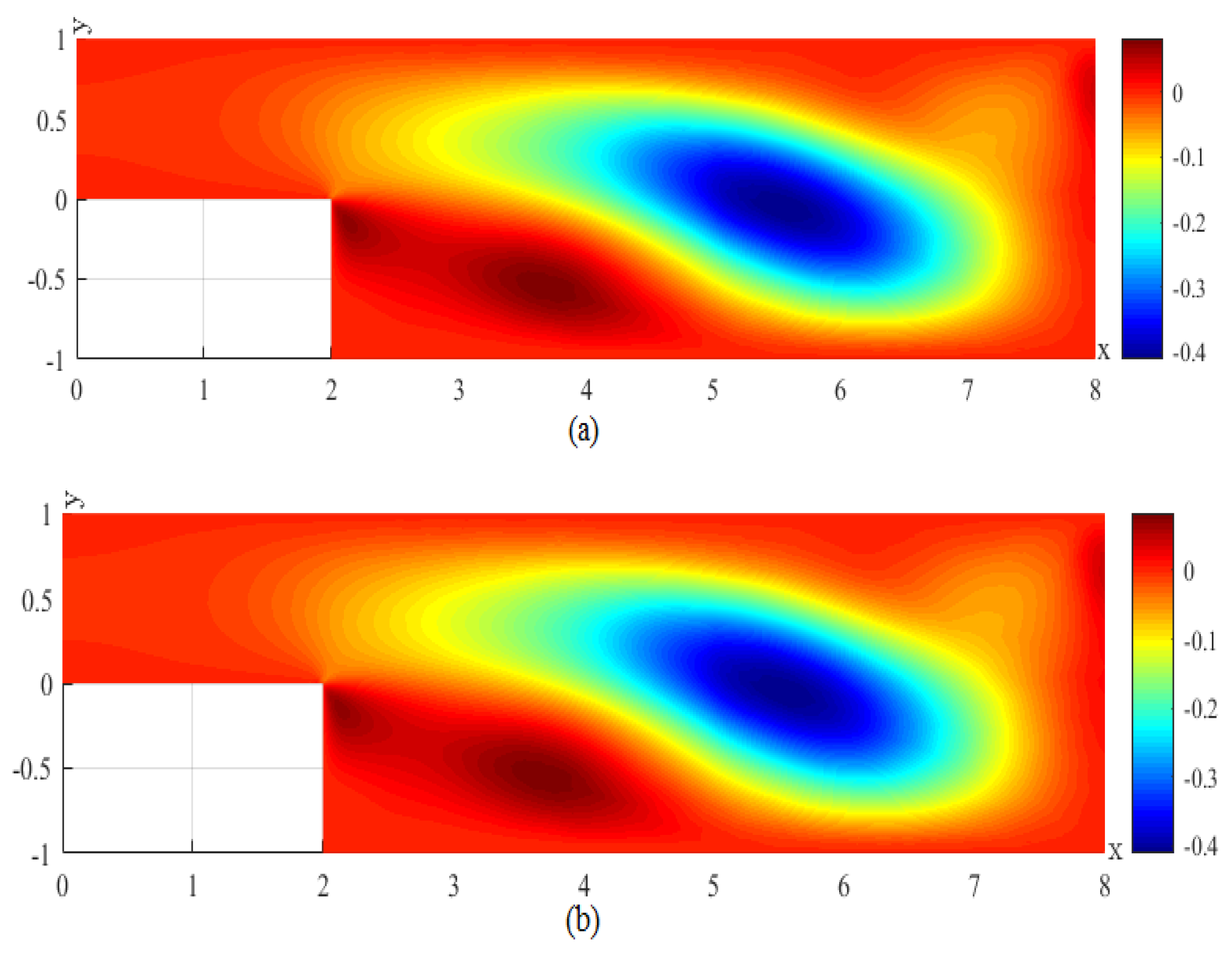
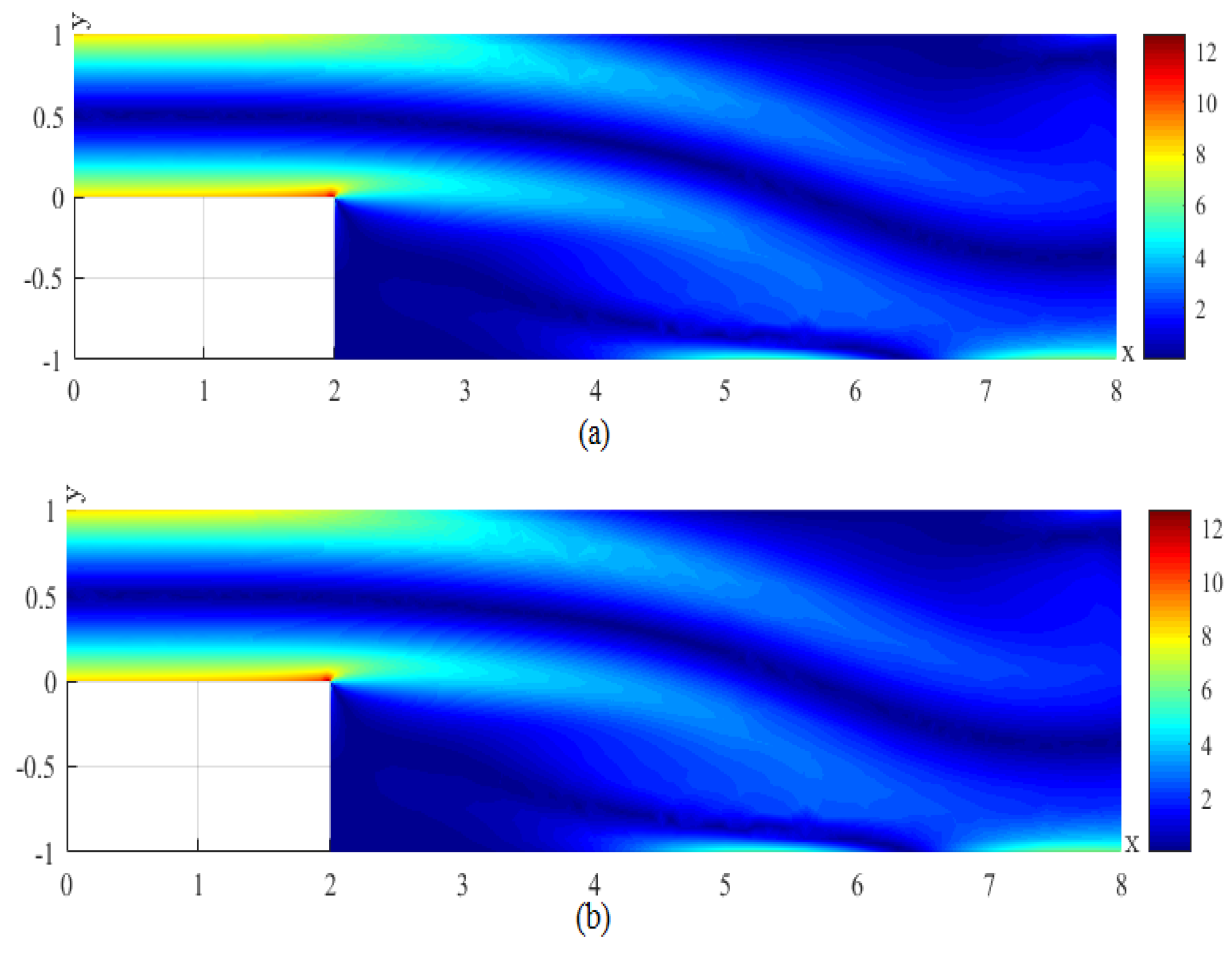
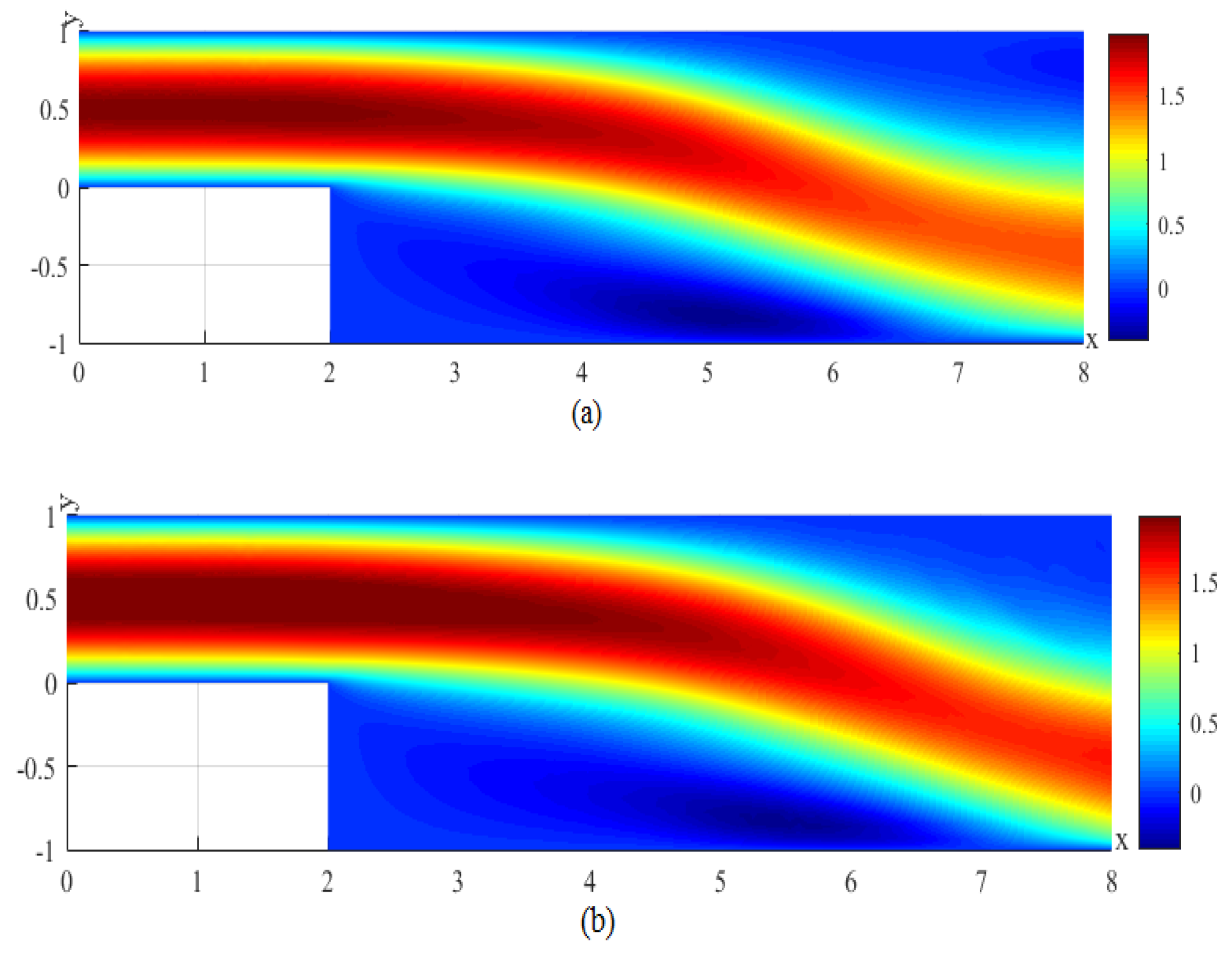
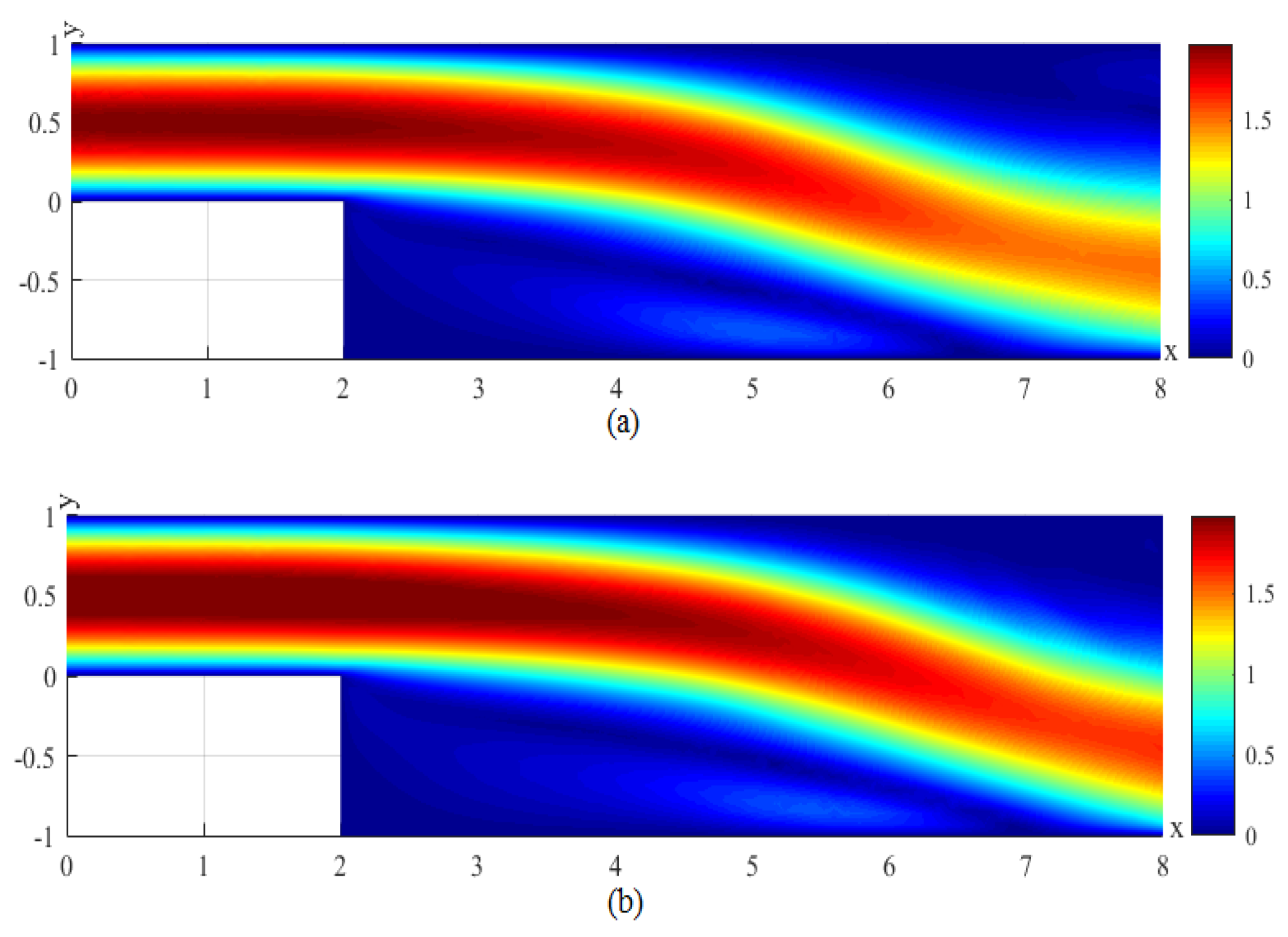
, 6, 8, and 10 by using Problem 6 and the formula (37), pictured in photo (b) of
Figure 2,
Figure 3,
Figure 4,
Figure 5,
Figure 6,
Figure 7,
Figure 8,
Figure 9,
Figure 10,
Figure 11,
Figure 12,
Figure 13,
Figure 14,
Figure 15,
Figure 16 and
Figure 17.
In order to compare the RDRCNMFE solutions with the CNMFE solutions, by solving Problem 5 and Formula (37), we also compute the CNMFE solutions of the components of the velocity, the velocity magnitude (
), and the pressure at
, 6, 8, and 10, pictured in photo (a) of
Figure 2,
Figure 3,
Figure 4,
Figure 5,
Figure 6,
Figure 7,
Figure 8,
Figure 9,
Figure 10,
Figure 11,
Figure 12,
Figure 13,
Figure 14,
Figure 15,
Figure 16 and
Figure 17 (where the negative value of
v is attributed in the negative
y-axis direction). Each pair in
Figure 2,
Figure 3,
Figure 4,
Figure 5,
Figure 6,
Figure 7,
Figure 8,
Figure 9,
Figure 10,
Figure 11,
Figure 12,
Figure 13,
Figure 14,
Figure 15,
Figure 16 and
Figure 17 is highly similar, which means that the numerical results of the RDRCNMFE method are sufficiently close to those of the CNMFE method.
In order to further explain the advantage of the RDRCNMFE method, we record the errors of the CNMFE and RDRCNMFE solutions, which are approximately computed by
and
, respectively, and the CPU running time that solves the RDRCNMFE method and the CNMFE method at
, and 1000, listed in
Table 1.
The data in
Table 1 show that the numerical computing errors for the RDRCNMFE solutions and the CNMFE solutions at four time levels are consistent with the theory errors
, but the RDRCNMFE method can fall off unknowns and shorten the CPU running time because the RDRCNMFE method has only 6 unknowns at each time step, while the CNMFE method has
unknowns at the same time step. The data in
Table 1 also exhibit that the CPU runtime for finding the RDRCNMFE solutions is far less than that for finding the CNMFE solutions, and it can save time by about a factor of 69. Hence, the RDRCNMFE method is undoubtedly superior over the CNMFE method.