1. Introduction
Let
H be a real Hilbert space and
be real valued functions. The convex bilevel minimization problem is a special kind of optimization problem where one problem is embedded within another. The outer level is the following constraint minimization problem:
where
is strongly convex with parameter
and a continuously differentiable function such that
is Lipschitz continuous with constant
while
is the nonempty set of minimizers of the inner level problem, given by
and sometimes we will use the notation
for
. The following assumptions are assumed for solving Problem (2).
- (i)
is a proper convex and lower semi-continuous function;
- (ii)
is a convex and differentiable function such that
is a Lipschitz continuous with constant
, that is,
The solution of (2) can be characterized by Theorem 16.3 of Bauschke and Combettes [
1] as follows:
where
is the subdifferential of
g and
is the gradient of
f. Moreover, Problem (2) is also characterized by the following fixed point problem:
where
and
. It is also known that
is a nonexpansive operator when
and
. The operator
is called the forward-backward operator of
f and
g with respect to c. Moreover, it is known that
is a point of minimizer of problem (1) if and only if
In the past decade, many researchers have proposed methods to find optimal solutions of Problem (2). Lions and Mercier [
2] introduced a simple algorithm, called Forward-Backward Splitting (FBS), for solving Problem (2). Their algorithm was given by
where
is the step-size and
.
In 1964, Polyak [
3] firstly introduced the inertial technique for accelerating the rate of convergence of the algorithm. Since then, this technique was widely used for this purpose.
In [
4], Beck and Teboulle employed the inertial technique to introduce a fast iterative shrinkage-thresholding algorithm (FISTA) for solving Problem (2) as follows:
They showed that the convergence behavior of FISTA is better than the others.
Recently, some authors, for instance, Bussaban et al. [
5], Puangpee and Suantai [
6] and Jailoka et al. [
7], employed the inertial technique to introduce common fixed point algorithms for a countable family of nonexpansive operators and established some convergence results under NST-condition (I), NST
-condition, and the condition (Z). They also applied their algorithms to solving some convex minimization problems.
In 2017, Sabach and Shtern [
8] introduced a new method, called Sequential Averaging Method (SAM), for solving a bilevel optimization problem. Such an algorithm was developed from [
9] for solving a certain class of fixed point problems. To solve the bilevel optimization Problems (1) and (2), the Bilevel Gradient sequential Averaging Method (BiG-SAM) was proposed in [
8]. Their algorithm was defined by Algorithm 1.
| Algorithm 1 Bilevel Gradient sequential Averaging Method (BiG-SAM) |
- (1)
Input: , , and - (2)
Initialization: . - (3)
General step: :
where is the gradient of .
|
They proved a strong convergence theorem of the sequence generated by BiG-SAM under some control conditions.
After that, Shehu et al. [
10] used the inertial technique for improving the convergence behavior of BiG-SAM. Their algorithm is known as the inertial Bilevel Gradient Sequential Averaging Method (iBiG-SAM). It was defined as follows (Algorithm 2):
| Algorithm 2 Inertial Bilevel Gradient sequential Averaging Method (iBiG-SAM) |
- (1)
Input: , , and . - (2)
Initialization: . - (3)
Step 1 For : - (4)
where is the gradient of .
|
In 2022, Duan and Zhang [
11] introduced a new algorithm based on the proximal gradient algorithm for solving a bilevel optimization problem. This algorithm is known as the alternated inertial Bilevel Gradient Sequential Averaging Method (aiBiG-SAM). It was defined as follows (Algorithm 3):
| Algorithm 3 The alternated inertial Bilevel Gradient Sequential Averaging Method (aiBiG-SAM) |
- (1)
Input: , and . Set . - (2)
Initialization: . - (3)
Step 1 For :
where k is odd, choose such that with defined by
- (4)
- (5)
Step 3 If , then stop.
|
They also proved a strong convergence result of the proposed method.
Motivated by these works, we are interested in proposing a new efficient algorithm for convex bilevel Problems (1) and (2). We establish and prove a convergence theorem of the proposed algorithm under some suitable conditions. We employ it for data prediction and classification. The paper is organized as follows. In
Section 2, we describe some notations and useful lemmas for the later sections. In
Section 3, we discuss and analyze the convergence of our proposed algorithm. In
Section 4, we present applications of the obtained fixed-point results in
Section 3 for solving regression and classification problems. Moreover, some numerical experiments on regression and classification problems are also given in
Section 4. Finally, we also give conclusions of the paper in
Section 5.
2. Preliminaries
Let
H be a real Hilbert space with norm
and inner product
, and
C be a nonempty closed convex subset of
H. Let
. An operator
is said to be
L-Lipschitz if
. If
T is Lipschitz continuous with a coefficient
, then
T is called a contraction. The operator
T is said to be
nonexpansive if
. We use
to denote the set of fixed points of
T, that is,
. The set of all common fixed points of a sequence of nonexpansive operators
of
C into itself is
. For finding a common fixed point of
, Takahashi [
12] introduced the
NST-condition as the following. Let
and
be families of nonexpansive operators of
C into itself with
, where
. A sequence
satisfies the
NST-condition (I) with
, if for any bounded sequence
in
C,
for all
. The sequence
satisfies the
NST-condition (I) with
T if
.
The following Lemma is useful for proving our main result.
Lemma 1 ([
5]).
Let f be a convex and differentiable function from H into with as a Lipschitz continuous with constant , and g is a proper convex and lower semi-continuous function from H into . Let and , where with as . Then satisfies the NST-condition (I) with T. Definition 1 ([
13,
14]).
A sequence with a nonempty common fixed point set is said to satisfy the condition (Z) if is a bounded sequence in H such thatit follows that every weak cluster point of belongs to . The following remark is obtained by demicloseness of where is the nonexpansive operator.
Remark 1. If is nonexpansive, the operator satisfies the NST-condition (I) with respect to T where T is the nonexpansive operator. Then satisfies the condition (Z).
Note that if
is a proper, lower semi-continuous and convex function, then the
exists and is unique for all
; see [
15]. We end this part with the following useful lemmas, which will be used in the later section.
Lemma 2 ([
16,
17]).
For any and , the following statements hold:- (1)
;
- (2)
;
- (3)
The identity in Lemma 2(3) implies that the following equality holds:for all and with . Lemma 3 ([
18]).
Let , , and such thatfor all . If the following conditions hold:- (i)
;
- (ii)
;
- (iii)
,
then .
Lemma 4 ([
19]).
Let be a sequence of real numbers which does not decrease at infinity in the sense that there exists a subsequence of , satisfying for all . Define the sequence of integers as follows:where such that . Then the following statements hold:- (i)
and ;
- (ii)
and for all .
Let
C be a nonempty closed convex subset of a Hilbert space
H and let
be a mapping. The metric projection onto
C, denoted by
, is defined for each
,
and is the unique element in
C such that
It is known that
for all
; see [
16].
3. Results
Throughout this section, we let and be families of nonexpansive operators on a real Hilbert space H such that and are a contraction mapping with a constant .
To find a common fixed point of a countable family of nonexpansive operators in a real Hilbert space, we first propose a new accelerated algorithm. Then, under certain conditions, we show a strong convergence theorem. Now, we are ready to introduce our accelerated algorithm as follows:
Theorem 1. Suppose that satisfies the condition (Z). Let be a sequence generated by Algorithm 4 which satisfies the following conditions:
- (i)
for some ;
- (ii)
and ;
- (iii)
.
Then converges strongly to an element , where .
| Algorithm 4 An Inertial Viscosity Modified Picard (IVMP) |
Initial. Take arbitrarily and . For , set
where . Step 1. Calculate , and using:
where , with . Then, update and return to Step 1. |
Proof. Let
be such that
. By the definition of
and
in Algorithm 4, for each
, we have
and
From (7) and (8), we obtain
Since
, by (6), we get that
. Thus, there is a constant
such that
. This implies
Let
. We show
. For
, we get
Suppose
for some
. It follows from (10) that
Since
, we obtain
which implies
By mathematical induction, we conclude that
for all
. Thus,
for all
. It follows that
is bounded, and so are
and
.
For each
, we have
By Lemma 2, we get
It follows from (7) with
that
Using (12),
From the above inequality, we get
and
So, we obtain
Now, we consider two cases for the covergence of the sequence
generated by Algorithm 4.
Case 1. There exists a
such that the sequence
is nonincreasing. Since
is bounded from below by zero,
exists. Using assumption
and
, we get that
. For applying this in Lemma 4, we need to show that
Using the fact of Lemma 2(3), we get
This implies that
It follows from the assumption and the convergence of the sequence
and
that
. For each
, we have
This implies that
. Let
Since
is bounded, we can choose a subsequence
of
such that
and
for some
. It follows from the condition (Z) of
that
.
Moreover, using
, we obtain
Thus,
It implies by (15) and the fact of
that
. From (14), using Lemma 4, we can conclude that
.
Case 2. Suppose that sequence
is not a monotone decreasing sequence for all
large enough. Set
So, there exists a subsequence
of
such that
for all
. In this case, we define
by
By Lemma 4, we obtain
for all
. Then,
The same as the argument in Case 1, we obtain
for all
. Hence
as
Similary, we have .
Since
and
, we obtain
Since
and
, it follows that
and hence
as
. It implies by
that
as
. Using Lemma 4, we obtain
as
. Hence
. The proof is complete. □
Now, we employ Algorithm 4 for solving Problem (1). We obtain the following result as a consequence of Theorem 1.
Theorem 2. Let be strongly convex with parameter and a continuously differentiable function such that is Lipschitz continuous with constant . Suppose that f and g satisfy the assumptions of (2). Let be a sequence of positive real numbers in such that as where and let be a sequence generated by Algorithm 5. Then converges strongly to .
| Algorithm 5 An Inertial Bilevel Gradient Modified Picard (IBiG-MP) |
Initial. Take arbitrarily and . For . Set
where . Step 1. Calculate , and as follows:
where , with . Then, update and return to Step 1. |
Proof. Let
and
. By Lemma 1 and Remark 1, we know that
satisfies the condition (Z). From Theorem 1, we get that
converges to
. Notice also that
is a
k-contraction with parameter
, whenever
. It remains to show that the variational inequality holds true. By using
and (5), for all
, we obtain
Thus,
is an optimal solution for the Problem (1). □
4. Application
In this section, we employ Algorithm 5 as a machine learning algorithm for regression, a graph of the Sine function and classification of some data by using a model of SLFNs (Single Hidden Layer Feedforward Neural Networks ) and Extreme Learning Machine. The MATLAB computing environment and an Intel Core-i5 gen 8 with 8 GB RAM(Integrated Electronics Corporation, Santa Clara, CA, USA) are used to perform all results.
We first recall a basic knowledge of the extreme learning machine for regression and classification problems. Moreover, we use the propose algorithm for solving these problems and compare the performance among Big-SAM, iBig-SAM and aiBig-SAM.
Extreme learning machine (ELM) [
20] is defined as follows: Let
be a training set of
N distinct samples,
is an input data and
is a target. A standard SLFNs with M hidden nodes and activation function
is given by
where
is the weight vector connected between the
j-th hidden node and the output node,
is the weight vector connected between the
j-th hidden node and the input node, and
is the bias. The aim of SLFNs is to predict these
N outputs such that
. That is,
We can rewrite the above system of linear equation by the following matrix equation:
where
The objective of an SLFNs is estimating , and for solving (18) while ELM aims to find only with randomly and .
The Problem (19) can be considered as the following convex minimization problem:
where
is called the regularization parameter. In Algorithm 5, we set
and
. We employ Algorithm 5 to solve convex bilevel optimization Problems (1) and (2) while the outer level function is defined by
.
4.1. Regression a Sine Function
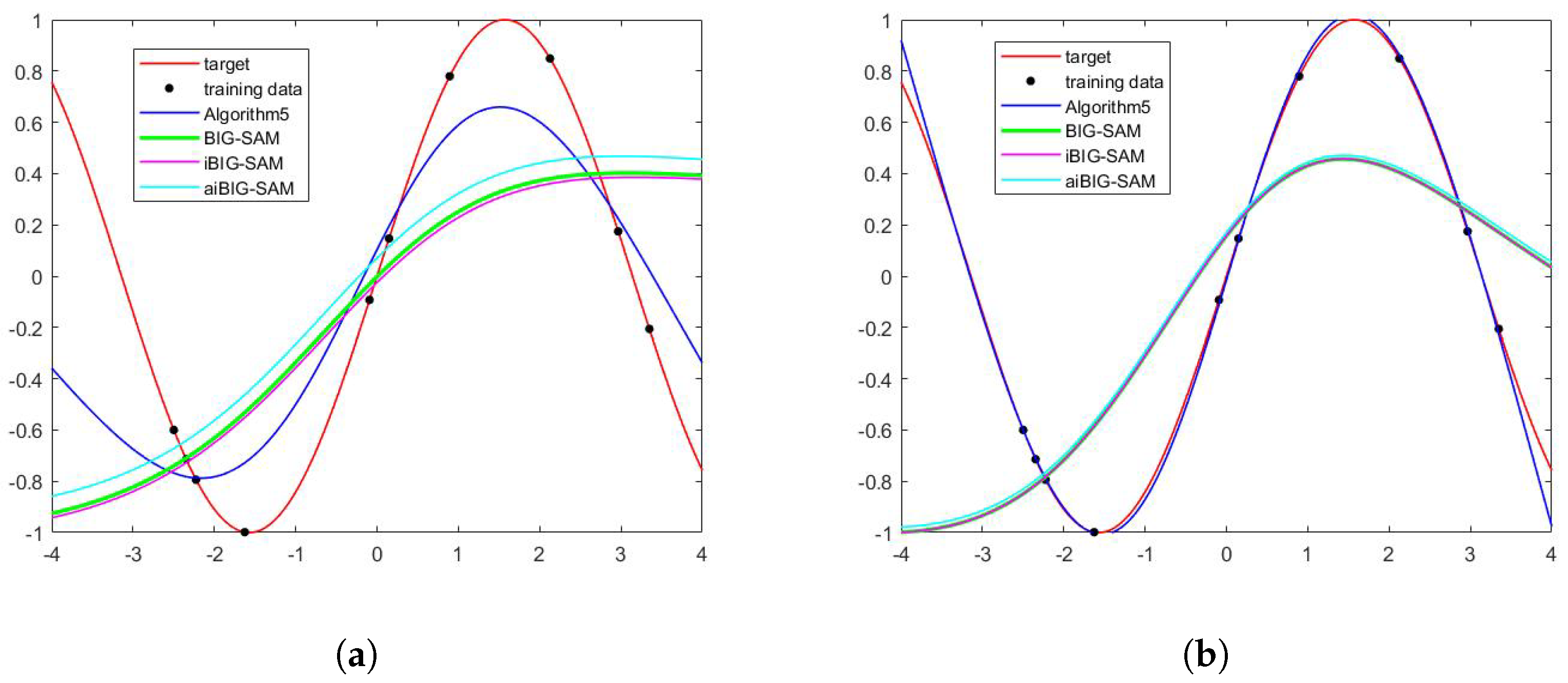
In our experiment for the regression of a graph of the Sine function, we construct a training set by randomly selecting 10 distinct data. we use sigmoid as our activation function. We also set the number of hidden nodes
, and regularization parameter
. In Algorithm 5, we set
. The Lipschitz constant
of gradient
f is computed by
. The values indicated in
Table 1 are used for all control settings. We evaluate the result by
We then obtain results compared to BIG-SAM, iBIG-SAM and aiBIG-SAM as in
Figure 1 and
Table 2.
Table 1 and
Figure 1 show that Algorithm 5 gives a better performance to predict a sine function than others while there is little difference in processing time.
4.2. Data Classification
Breast Cancer dataset [
21] The dataset contains 11 attributes. In this dataset, we classify 2 classes of data.
Heart Disease UCI dataset [
22] The dataset contains 14 attributes. There are two classes of this dataset.
Diabetes dataset [
23] The dataset contains 9 attributes. In this dataset, we classify 2 classes of data.
Iris dataset [
24] This dataset contains 3 classes of iris plant. The dataset contains 4 attributes. We aim to clasify each type of iris plant (
Iris versicolour,
Iris virginica and
Iris setosa).
Table 3 shows the number of attributes of each dataset and the number of the training set (around
of data) and testing set (remainder
of data).
We set all control parameters the same as in
Table 1 in
Section 4.1, the number of hidden nodes
, and activation function is sigmoid. Given a training set for each dataset as mentioned in
Table 3, An accuracy of the output data is calculated by
We compare the iteration number, accuracy train and accuracy test of Algorithm 5 with the others on each dataset as seen in
Table 4.
From
Table 4, Algorithm 5 has a better performance of accuracy than BIG-SAM, iBIG-SAM, aiBIG-SAM in all experiments conducted.