Abstract
The exact solutions of the nonlinear Schrödinger equation (NLSE) predict consistent novel applicable existences such as solitonic localized structures, rouge forms, and shocks that rely on physical phenomena to propagate. Theoretical explanations of randomly nonlinear new extension NLSE structure solutions have undergone stochastic mode examination. This equation enables accurate and efficient solutions capable of simulating developed solitonic structures with dynamic features. The generated random waves are a dynamically regulated system that are influenced by random water currents behaviour. It has been noticed that the stochastic parameter modulates the wave force and supplies the wave collapsing energy with related medium turbulence. It has been observed that noise effects can alter wave characteristics, which may lead to innovative astrophysics, physical density, and ocean waves.
MSC:
35C07; 35R60; 60H40; 35Q40
1. Introduction
The investigation of nonlinear stochastic partial differential equations (NSPDEs) is a vital topic that is employed in a variety of applications, such as new physics, biology, superfluids, image processing, optical fiber communications, plasma physics, and finance [1,2,3,4,5]. As a result, addressing NSPDEs is a exciting and current area of research. A common stochastic process that is both a martingale and a Markov process is the Wiener process, also known as Brownian motion [6]. The Wiener process is the foundation of stochastic calculus and, as such, is essential for modelling stochastic processes. It is a continuous process, the increments of which are chosen from a normal distribution for any time scale. The Wiener process is a frequently used stochastic process in dispersive situations [7,8]. Further, there is a crucial link between PDEs and stochastic processes. On the other hand, fractional Brownian dynamics via the stochastic anomalous diffusion methods play an important role in describing the considerable experimental observations of non-Brownian nonlinear diffusion for various length and time scales, from nano to interstellar spaces [9,10,11]. Using fractional Gaussian noise, Cherstvy et al. reported that the behaviors of ergodicity breaking for underdamped massive Brownian fractional motion for changing particle mass and trace length are in perfect accordance with the findings of stochastic computer simulations. The experimental community, that are using different single-particle tracking techniques and attempting to determine the level of nonergodicity for the recorded time series, may find the present results of interest [12].
The nonlinear models that are used the most frequently in the field of applied science are the nonlinear Schrodinger’s equations (NLSEs), due to their extensive range of applications [13,14,15,16]. An investigation of their soliton solutions is critical in nonlinear science studies because they aid in describing the physical mechanism of a complicated natural phenomenon, and this subject has become one of the most intriguing and incredibly active areas of research [17,18,19,20]. Recently, various new types of solitary solutions were produced through innovative applications of nonlinear equation models [21,22,23,24,25,26]. Studies on N-soliton solutions, which may result in lump and rogue wave solutions, have been conducted for modified Korteweg–De-Vries-type integrable equations and reduced integrable nonlinear Schrödinger-type equations. The appearance of NLSEs in optical solitons with nonlinearities might be considered a growing subject of research in nonlinear photonics [27,28]. In recent years, several different types of nonlinearities have been studied, including parabolic law, Kerr law, power law, polynomial law, and saturable law [29]. Islam et al. explain the parameters of wave dispersion and nonlinearity impacts on the solitonic KMNE properties. It was noted that the optical wave propagations are expressed by the bell, bright, dark, periodic, kink, and singular with dynamical features depending on the dispersion parameters [30]. The important solitonic applications of a GP equation in water wave and plasma physics, as a nonlinear unidirectional propagating wave model, have been theoretically investigated [31]. It was reported that the soliton nature is affected by free parameter and dispersion coefficients.
The paper will provide an overview of recent advances in statistical models based on NSPDEs. In terms of the Wiener process, we will pay particular attention to the new extension NLSE and discuss when and why such models are helpful. As motivating applications, the effect of the noise term on the behaviour of the solution will be considered. The proposed deterministic model is given in references [32,33,34,35] and we presented the stochastic form as follows:
symbolizes the nonlinear wave envelope, and ∗ represents complex conjugate. The first and second terms symbolize the temporal evolution of the wave and the disturbance of the dispersion that is given by the coefficient of a. The parameter b is distinct from the conventional Kerr law nonlinearity. The noise is a Brownian times derivative of and identifies noise amplitude [36]. Equation (1) depicts the bending of light beams, hole waves, oceanic rogue waves, and erbium atoms [34,35].
This research analyzes many aspects of noise’s influence on the new extension NLSE using Itô sense via the Wiener process. This is a vast and fascinating field, with active research in a variety of approaches. One of the topic’s fascinating features is its capacity to combine techniques from both classical and stochastic analysis [37]. We apply the unified technique [38] to produce some new stochastic solutions for the new extension NLSE. Compared to most existing methods, the recommended strategy has a number of benefits, including the avoidance of tedious computations and the generation of vital families of solutions. It is straightforward, dependable, and efficient. The proposed technique can be used as a box-solver for a number of natural science systems. Also, this method contains the rational solution which is important to describe the wave at critical points. The presented stochastic solutions for Equation (1) show a variety of crucial physical aspects, including erbium atoms, fiber communications, oceanic rogue waves, and the bending of light beams.
This work is arranged as follows. Section 2 gives the new extension NLSE via the Wiener process and its corresponding potential. Section 3 introduces the stochastic solutions utilizing a robust technique. The physical interpretation of the new extension NLSE equation’s solutions is provided in Section 4. The findings are then presented in Section 5.
2. Mathematical Analysis
Using the traveling wave solution [34]:
Here, and represent the wave numbers in x and y directions, is phase constant of soliton, represents the noise amplitude, and identifies wave speed, whereas and denote the inverse width of the soliton along the x- and y-directions and v denotes the soliton velocity. Equation (1) becomes
from the real part. Taking expectations on both sides gives
Indeed, , then Equation (4) becomes
On the other hand, the imaginary part gives
with a dispersion constraint
Equation (5) depicts an energy equation with potential
The model has an exact solution
3. The New Stochastic Solutions
4. Physical Interpretation
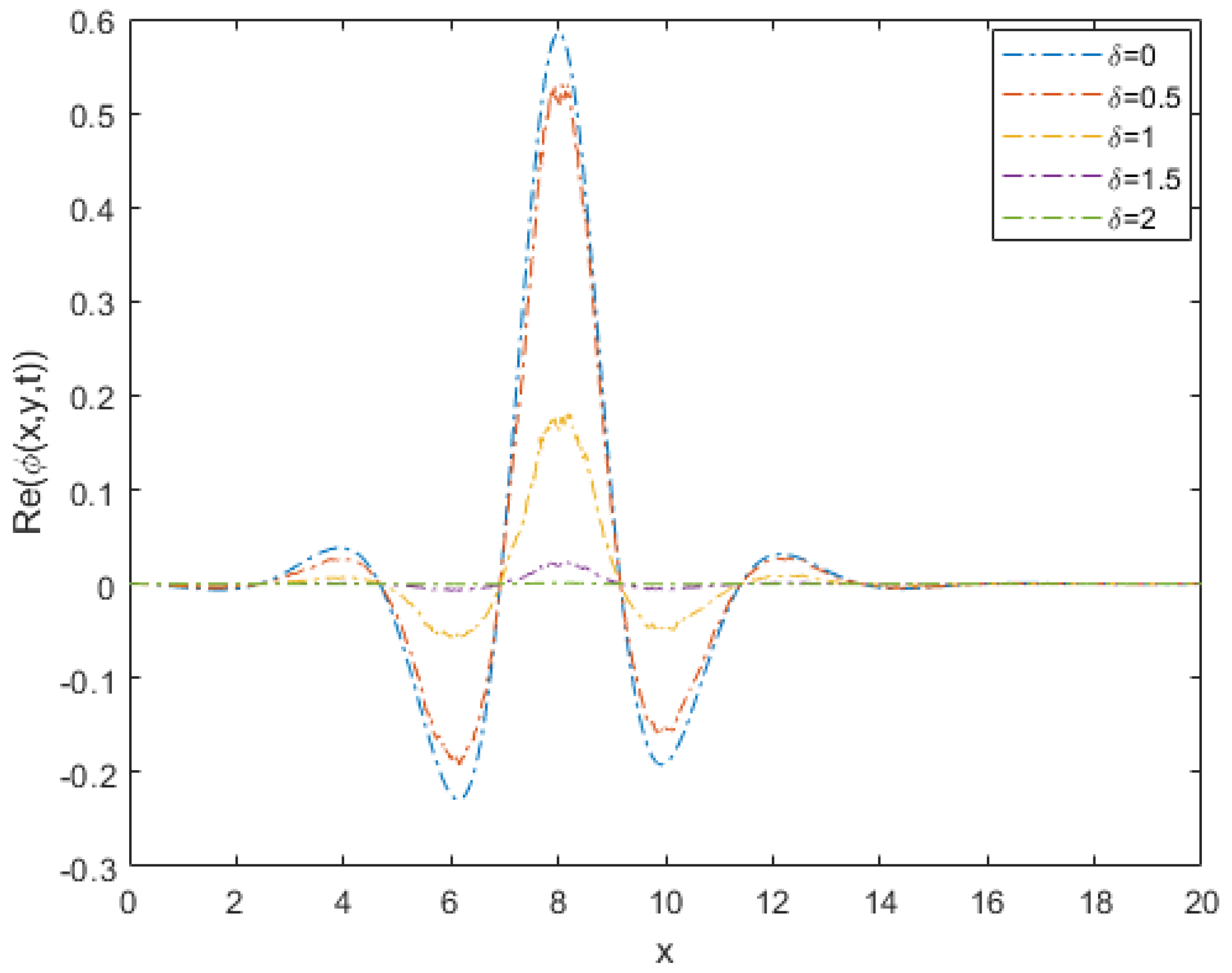
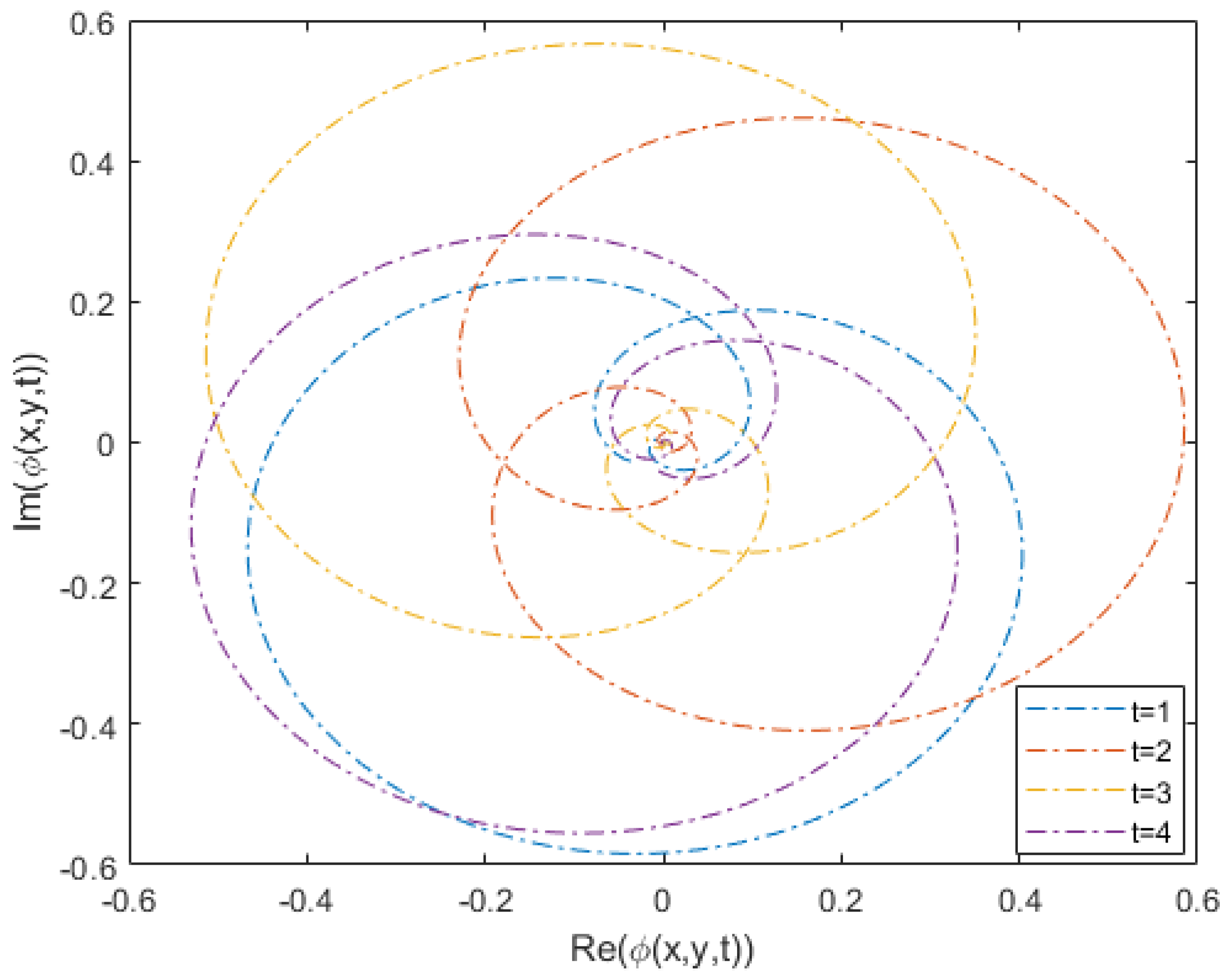
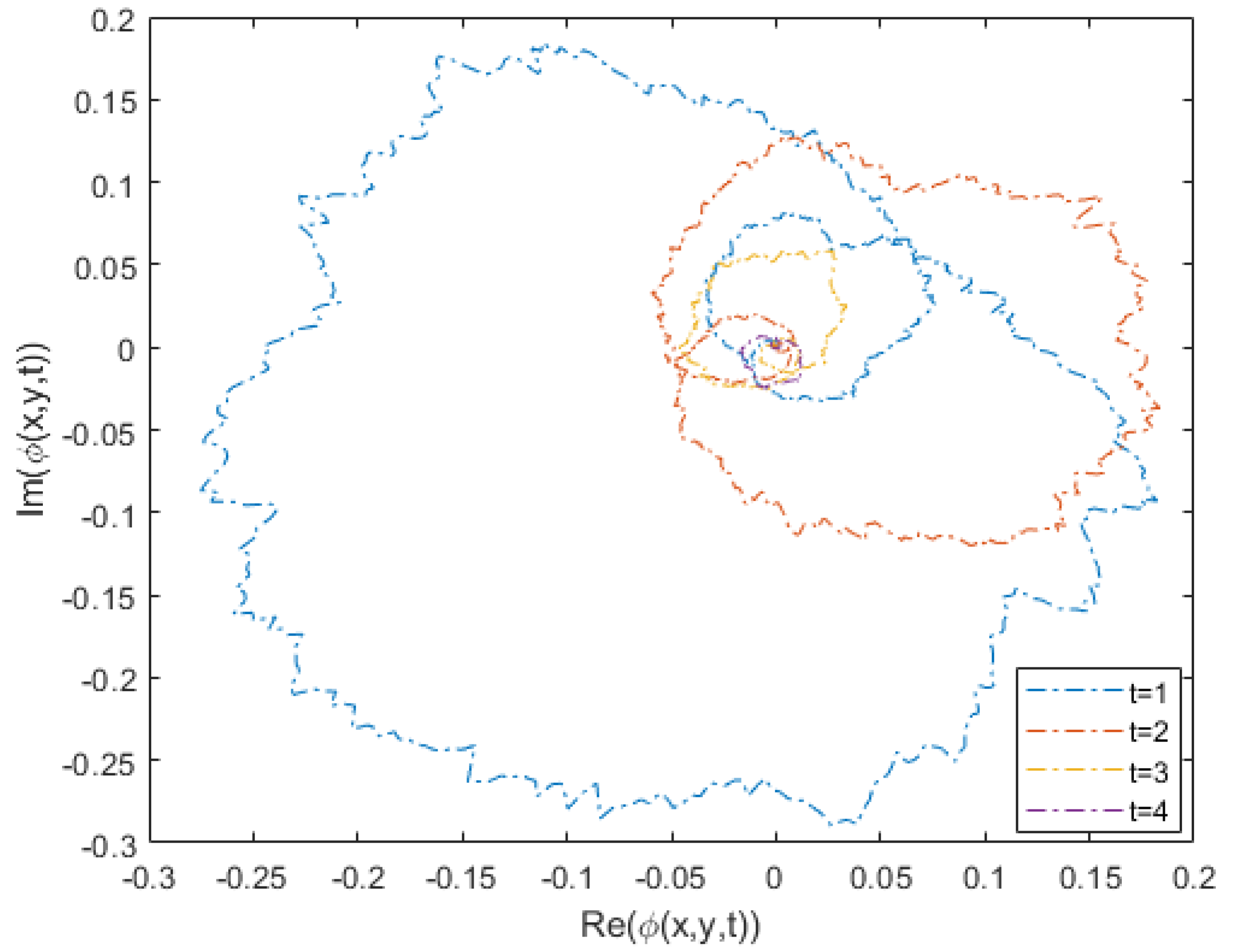
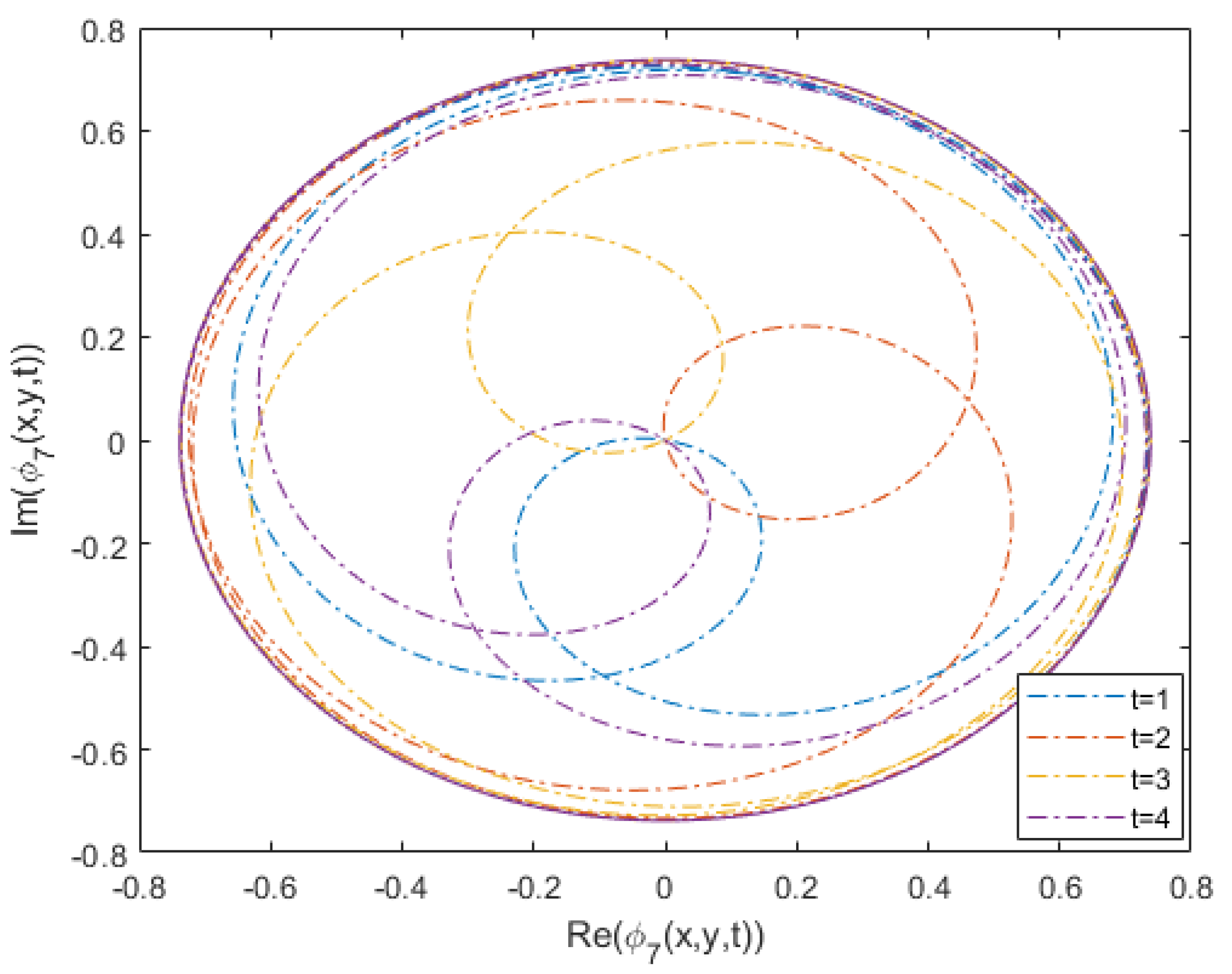
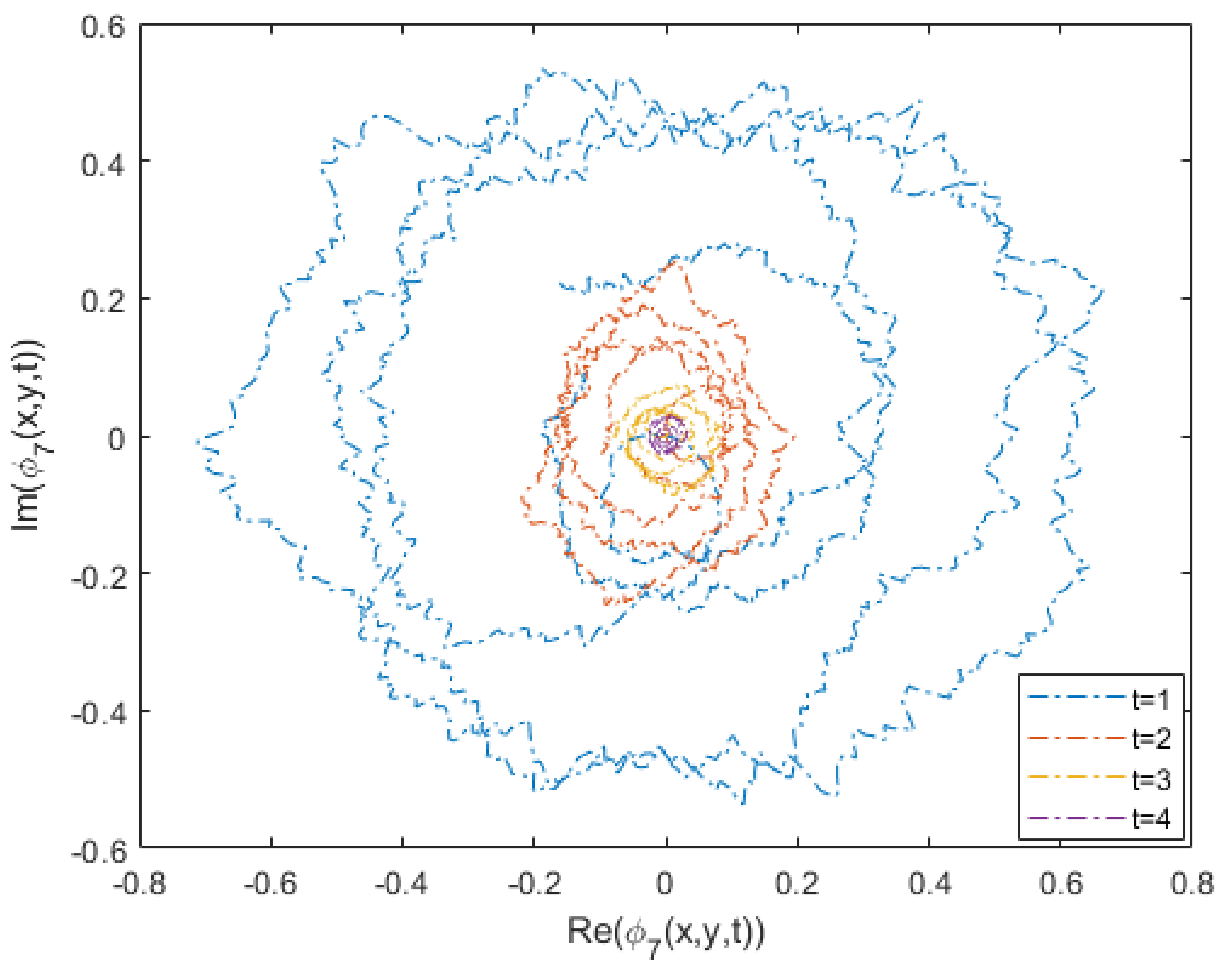
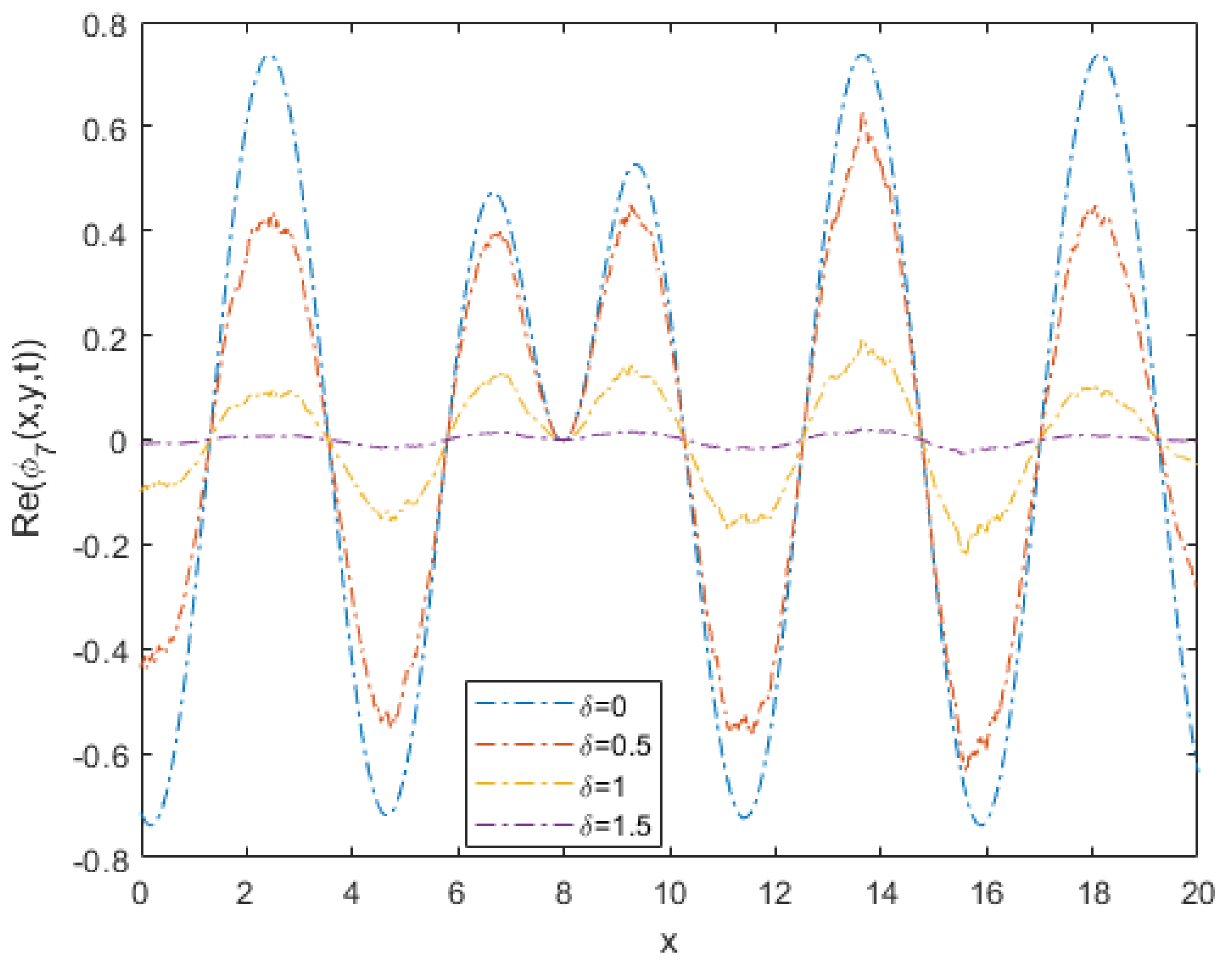
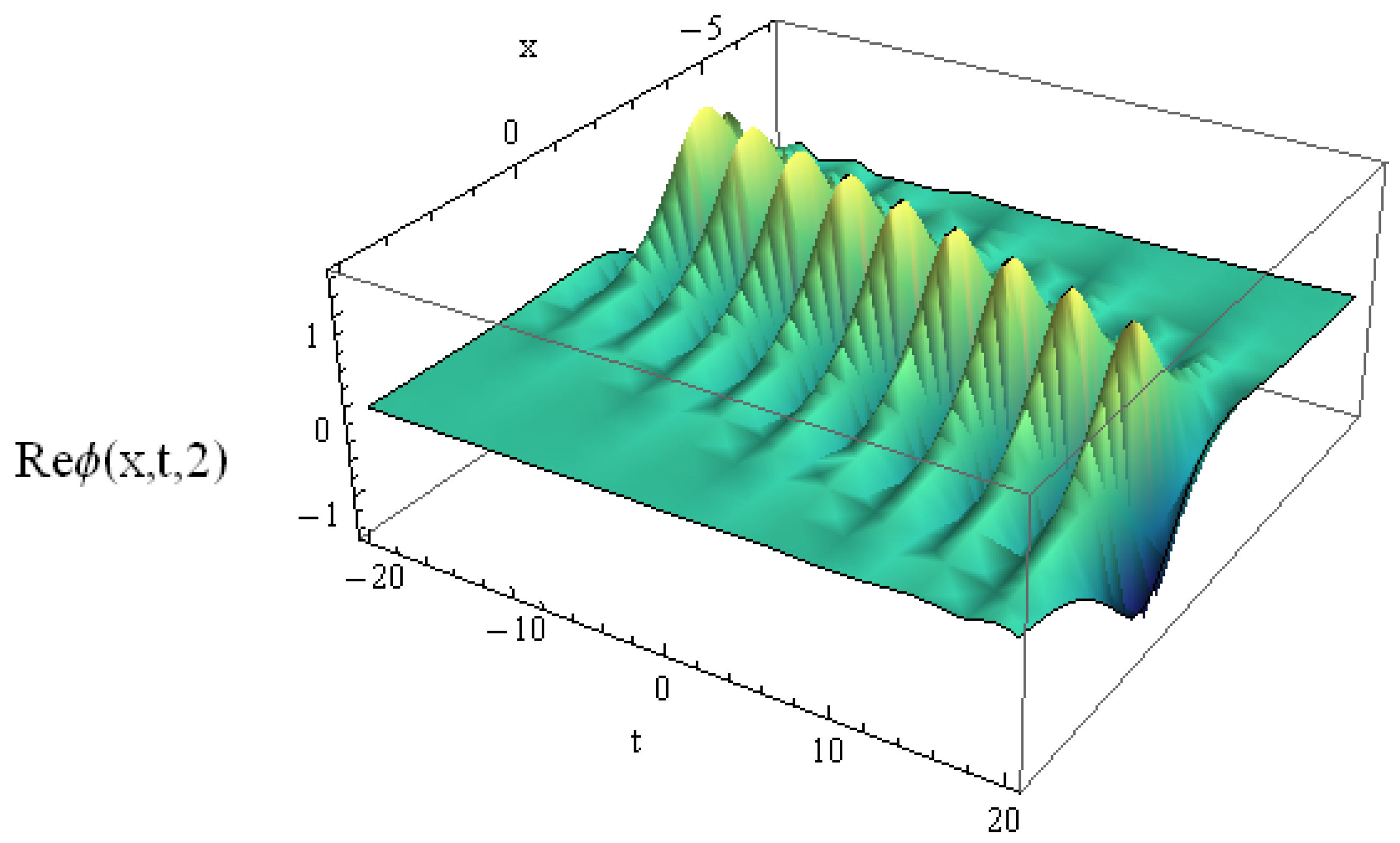
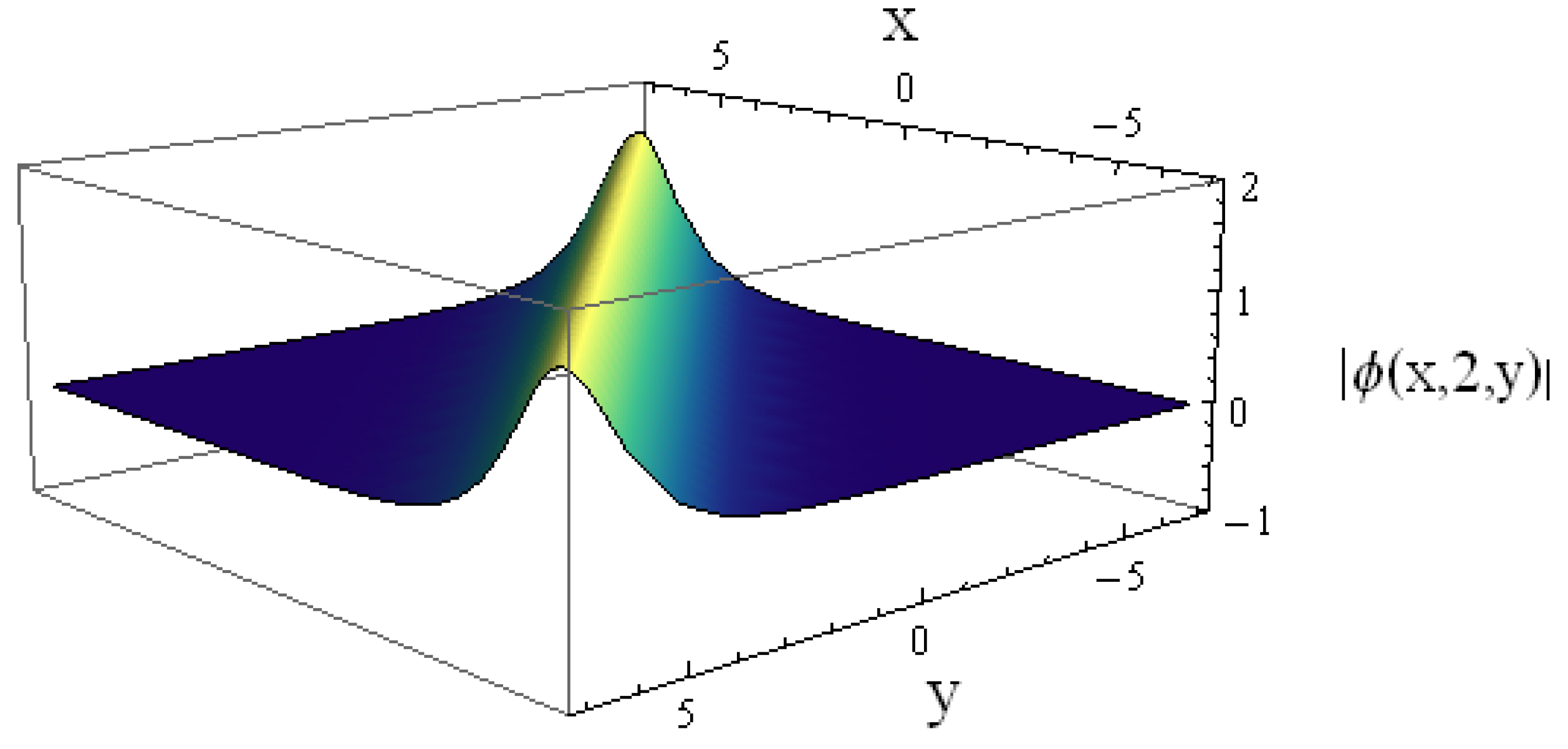
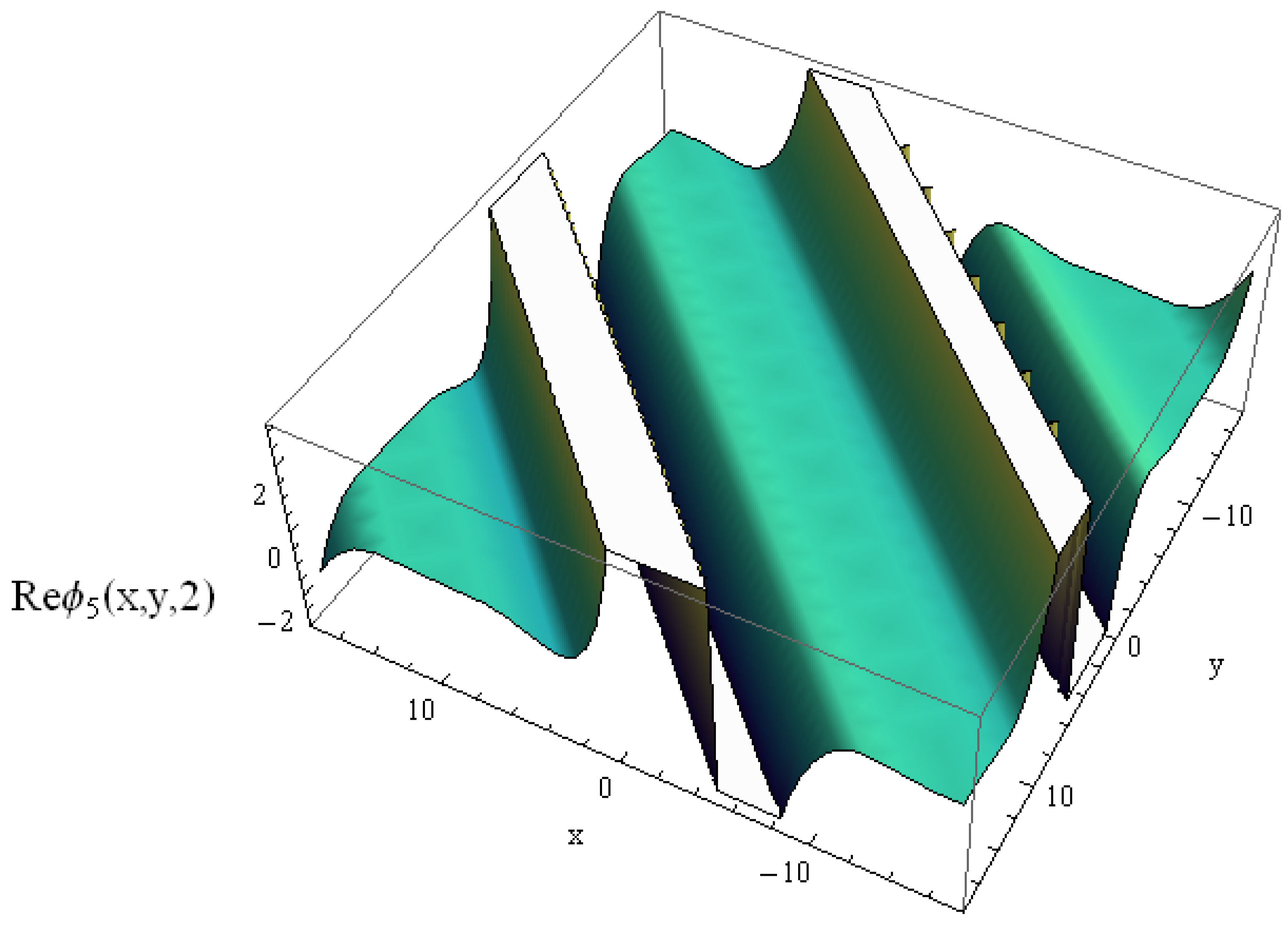
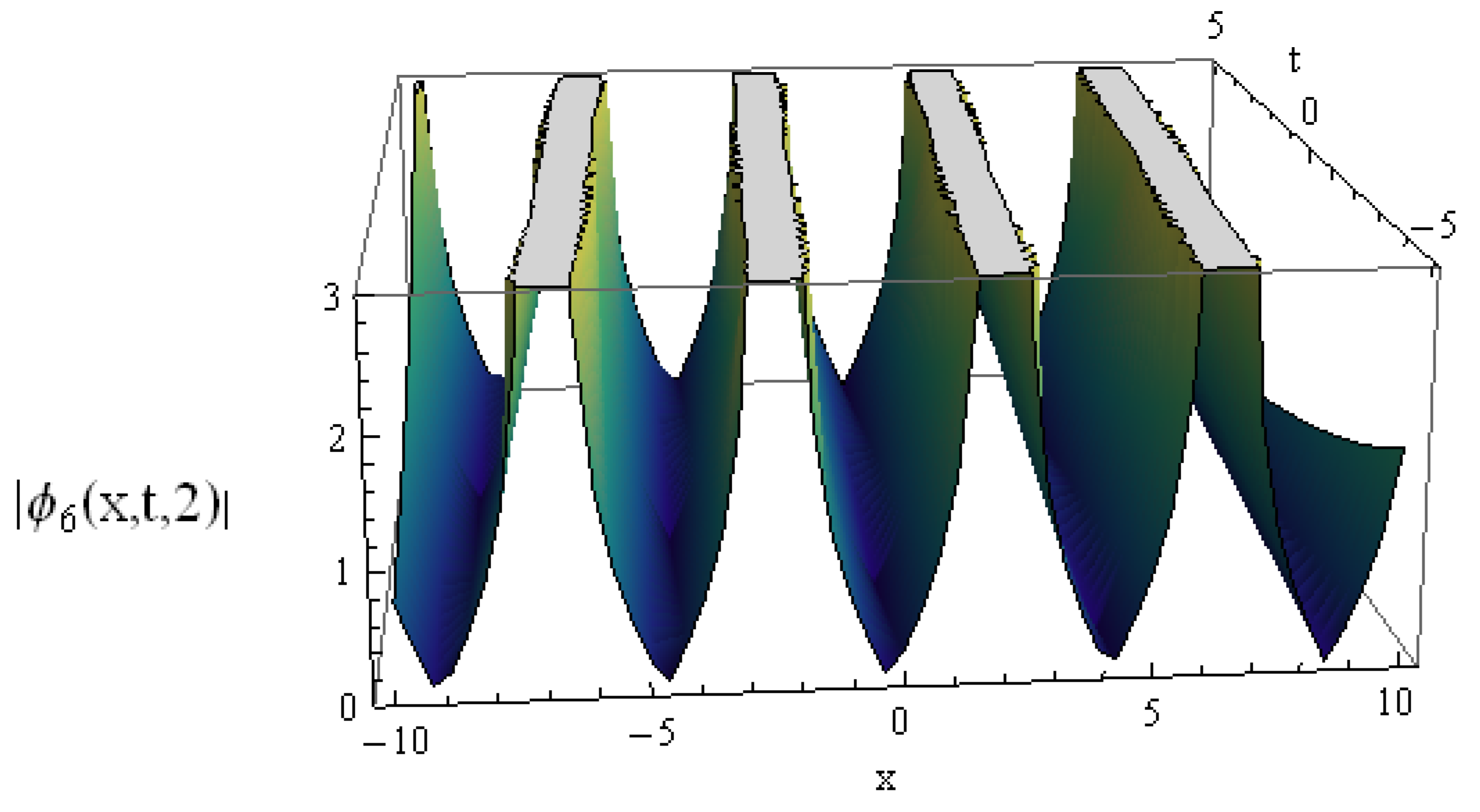
Here we present the mathematical analysis of our model (1), which characterized oceanic and hole waves, and produced accurate solitons, oscillatory disturbances, super solitons, and breathers formations. The model under investigation reduced to Equation (5). The expectations of (3) by transforms the model into a differential equation which was solved using a mathematical solver to give many important solitary solutions. We introduce some 2D and 3D graphs for some chosen solutions of Equation (1) for suitable parametric choices using Matlab release 18 and Mathematica release 13. Equation (9) represents a group of randomly generated solitons, as seen in Figure 1, Figure 2 and Figure 3. The mathematical method produces different effective solitary wave generations as Equations (11), (14), (15), (18), and (19). Equation (11) is a rational growing rapid explosive wave. Solutions (14) and (15) are periodic blow-up structures. Furthermore, solutions (18) and (19) are dissipative shock wave formations.
Figure 1.
Trajectory of for = 0.5, = 0.5, = 0.5, = 0.5, = 1.5, = 0, = 0.05, a = 2, b = −1.7.
Figure 2.
Trajectory of for = 0.5, = 0.5, = 0.5, = 0.5, = 1.5, = 1, = 0.05, a = 2, b = −1.7.
Figure 3.
Plot of with for = 0.5, = 0.5, = 0.5, = 0.5, = 1.5, = 0.05, a = 2, b = −1.7.
The rigorous randomness factor influences on structure, amplitude, band width, and soliton energy are given in Figure 1 and Figure 2. The ability of the abrupt wave collapse, which depends mainly on the impact of randomness, grows with increasing time t, as seen in Figure 2. At time , it was determined that the system almost totally collapses. When increases, we observe that the wave’s amplitude and width both shrink, and the wave starts to collapse, which is complete at , as shown in Figure 3. Also, the dark solution (18), which performs the dissipative pictures, was identified to be impacted by time t and the random variable , as illustrated in Figure 4, Figure 5 and Figure 6. The rate of collapse of the dissipative wave rises when t is increased, as shown in Figure 5. Additionally, as seen in Figure 6, the parameter induces the wave to collapse and convert into a distorted waveform with a limited amplitude.
Figure 4.
Trajectory of for = 0.5, = 0.5, = 0.5, = 0.5, = 1.5, = 0, = 0.05, a = −2, b = 1.7.
Figure 5.
Trajectory of for = 0.5, = 0.5, = 0.5, = 0.5, = 1.5, = 1, = 0.05, a = −2, b = 1.7.
Figure 6.
Plot of with for = 0.5, = 0.5, = 0.5, = 0.5, = 1.5, = 0.05, a = −2, b = 1.7.
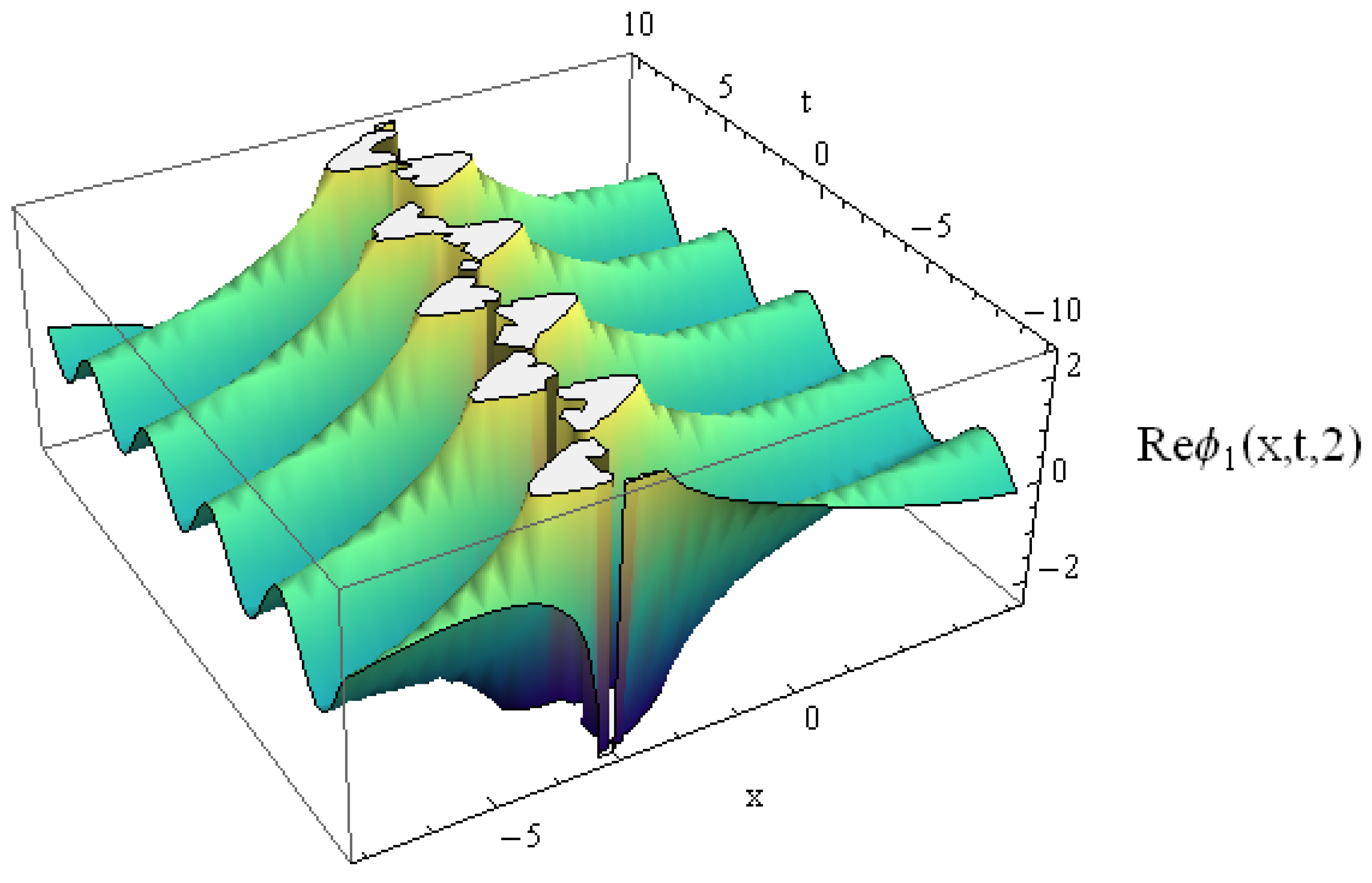
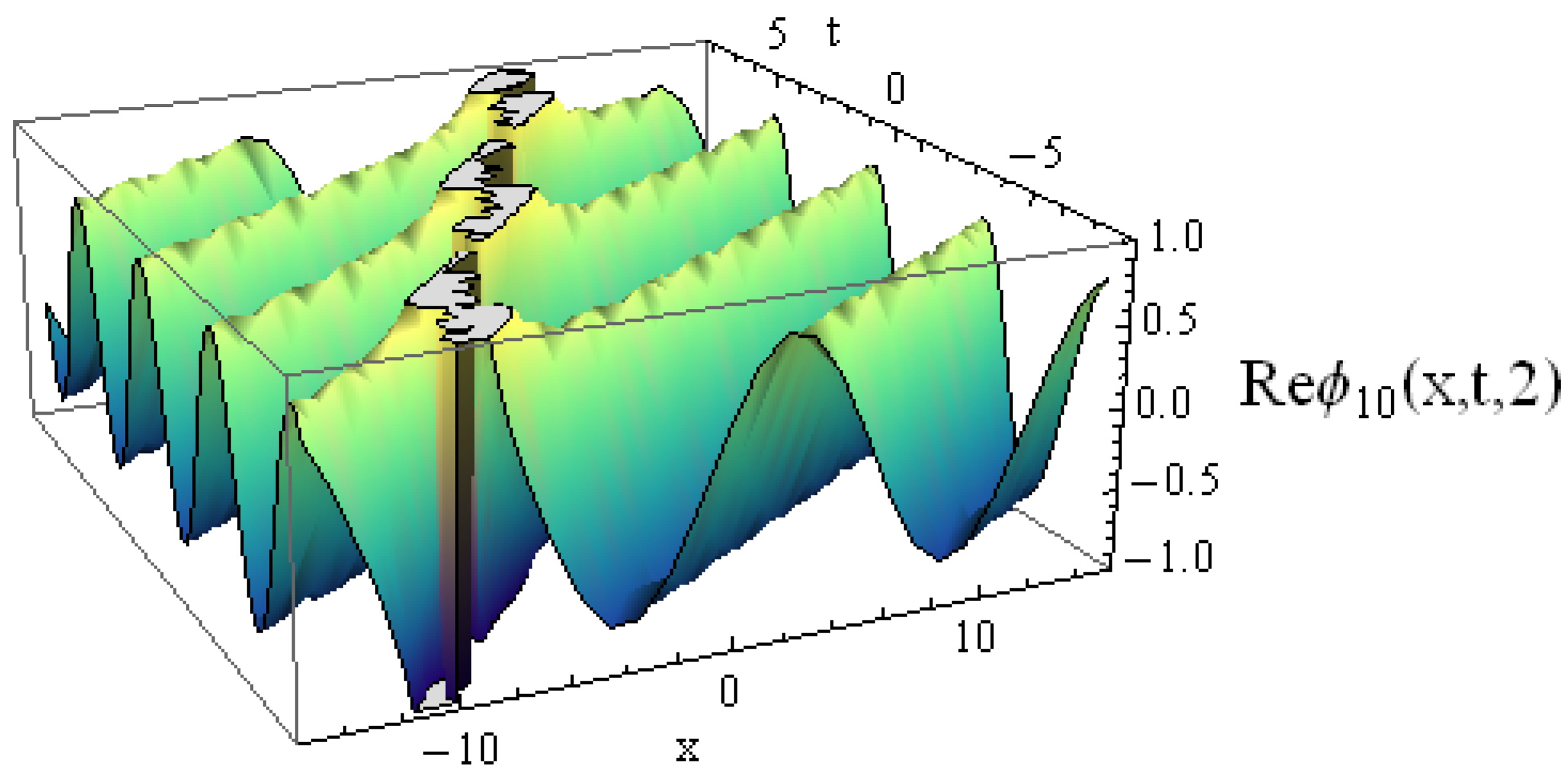
In being devoid of random impacts, the enormous significance of the numerous solitary properties of the investigated solutions must be examined. For example, Equation (9) provides breathers structures, and stationary and super solitons, as shown in Figure 7 and Figure 8. The solution (11) produces two wave structure types; the first type is a bright explosive envelope wave and the second is an explosive solitonic form, as depicted in Figure 9 and Figure 10.
Figure 7.
Plot of with for = 0.5, = 0.5, = 0.5, = 0.5, = 1.5, = 0, = 0.05, a = 2, b = −1.7.
Figure 8.
Plot of with for = 0.5, = 0.5, = 0.5, = 0.5, = 1.5, = 0, = 0.05, a = 2, b = −1.7.
Figure 9.
Plot of with for = 0.5, = 0.5, = 0.5, = 0.5, = 1.5, = 0, = 0.05, a = 2, b = 1.7.
Figure 10.
Plot of Re with for = 0.5, = 0.5, = 0.5, = 0.5, = 1.5, = 0, = 0.05, a = 2, b = 1.7.
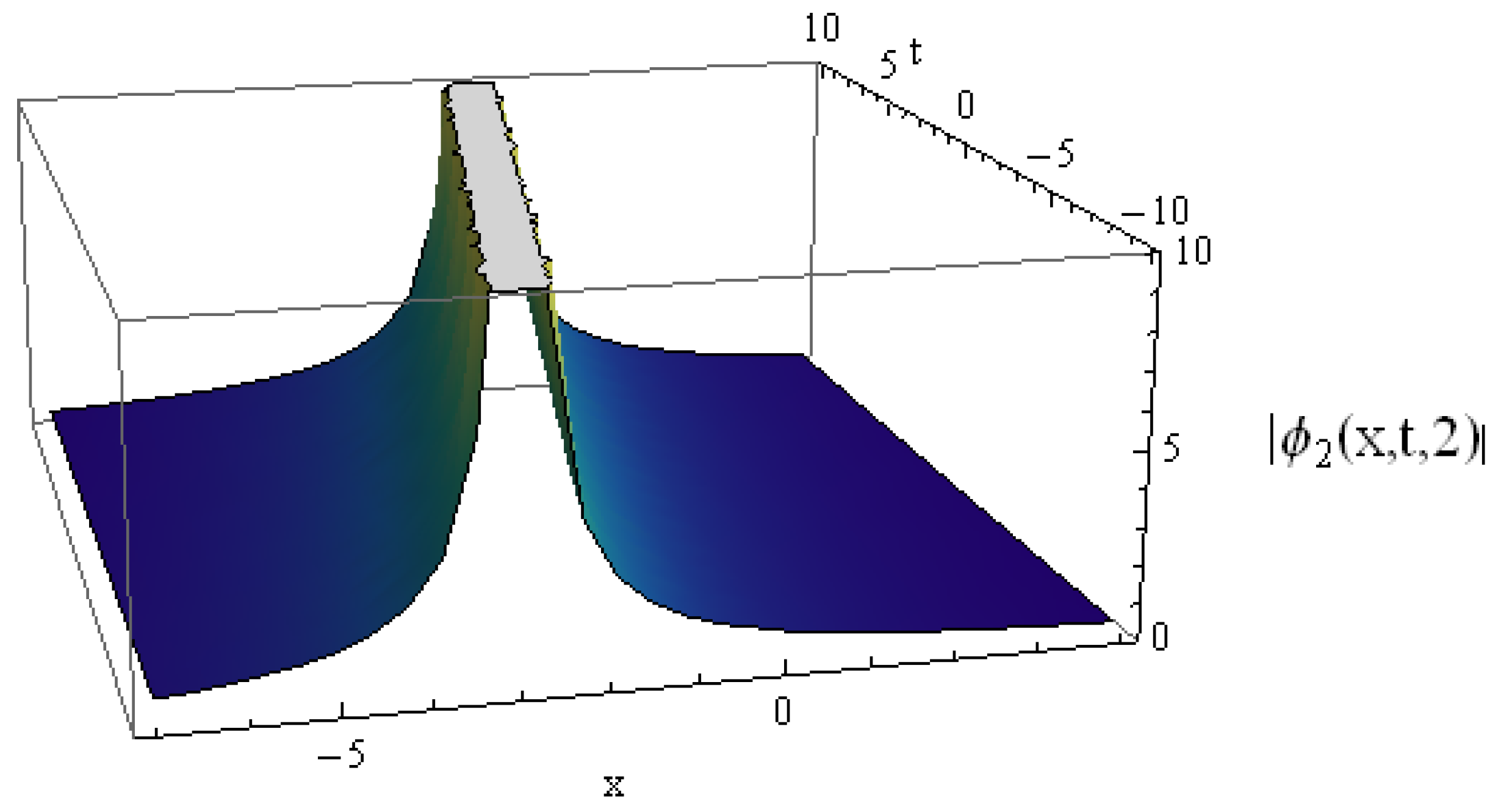
In contrast, the form (15) is regarded as one of the important physical aspects in the investigation of super-explosive forms and dissipative blow-up structures. Figure 11 and Figure 12 demonstrate the generation of the dissipative blow-up waveforms and rational super-explosive structures. Finally, Figure 13 describes the explosive envelopes of Equation (18) in x and t directions.
Figure 11.
Plot of Im with for = 0.1, = 0.5, = 0.5, = 0.5, = 0.5, = 1.5, = 0, = 0.05, a = 2, b = 1.7.
Figure 12.
Plot of Re with for = 0.5, = 0.5, = 0.5, = 0.5, = 1.5, = 0, = 0.05, a = 2, b = 1.7.
Figure 13.
Plot of with for = 0.5, = 0.5, = 0.5, = 0.5, = 1.5, = 0, = 0.05, a = −2, b = 1.7.
In summary, the characteristics of the stochastic nonlinear solitonic structures of the studied model with a stochastic noise term provoked the dynamical energy advantages of the obtained solitary envelopes and dissipative–dispersive waves.
5. Conclusions
The new extension NLSE model has been used to analyze the fundamental wave properties for exact stochastic solitary, blow-up dispersive–dissipative and super explosive shocks, and breather and explosive super structures. The Kerr nonlinearity coefficient affected the characteristic properties of the obtained solitary structures. The alterations of the stochastic noise in the obtained waveform amplitudes and energies have been examined. It was reported that the random influences can be demonstrated by some modulations in collapsing dissipative and dispersive explosive water structures. The noise stochastic parameter modulates and fluctuates the resulting wave, producing collapsing solitonic tails. The applications of these mathematical discussions might be utilized in sea-ocean wave applications.
Author Contributions
M.A.E.A.: Conceptualization, Software, Formal analysis, Writing—review editing. E.K.E.-S.: Conceptualization, Software, Formal analysis, Writing—review editing. Y.O.: Conceptualization, Data curation, Writing—original draft. N.F.A.: Conceptualization, Data curation, Writing—original draft. All authors have read and agreed to the published version of the manuscript.
Funding
The Deputyship for Research & Innovation in the Ministry of Education in Saudi Arabia funded this research work through the project number 445-9-174.
Data Availability Statement
The data used to support the findings of this study are included within the article.
Acknowledgments
The authors extend their appreciation to the Deputyship for Research & Innovation, Ministry of Education in Saudi Arabia for funding this research work through the project number 445-9-174.
Conflicts of Interest
The authors declare that they have no competing interest.
References
- Oksendal, B. Stochastic Differential Equations: An Introduction with Applications, 6th ed.; Springer: Berlin/Heidelberg, Germany, 2003. [Google Scholar]
- Dalal, N.; Greenhalgh, D.; Mao, X. A stochastic model for internal HIV dynamics. J. Math. Anal. Appl. 2008, 341, 1084–1101. [Google Scholar] [CrossRef]
- Mirzaee, F.; Rezaei, S.; Samadyar, N. Numerical solution of two-dimensional stochastic time-fractional sine-Gordon equation on non-rectangular domains using finite difference and meshfree methods. Eng. Anal. Bound. Elem. 2021, 12, 53–63. [Google Scholar] [CrossRef]
- Abdelrahman, M.A.E.; Refaey, H.A.; Alharthi, M.A. Investigation of new waves in chemical engineering. Phys. Scr. 2021, 96, 075218. [Google Scholar] [CrossRef]
- Alharbi, Y.F.; Abdelrahman, M.A.E.; Sohaly, M.A.; Inc, M. Stochastic treatment of the solutions for the resonant nonlinear Schrödinger equation with spatio-temporal dispersions and inter-modal using beta distribution. Eur. Phys. J. Plus 2020, 135, 368. [Google Scholar] [CrossRef]
- Karatzas, I.; Shreve, S.E. Brownian Motion and Stochastic Calculus, 2nd ed.; Springer: Berlin/Heidelberg, Germany, 1991. [Google Scholar]
- Pishro-Nik, H. Introduction to Probability, Statistics and Random Processes; Kappa Research, LLC: Blue Bell, PA, USA, 2014. [Google Scholar]
- Alharbi, Y.F.; El-Shewy, E.K.; Abdelrahman, M.A.E. New and effective solitary applications in Schrödinger equation via Brownian motion process with physical coefficients of fiber optics. AIMS Math. 2023, 8, 4126–4140. [Google Scholar] [CrossRef]
- Bodrova, A.S.; Chechkin, A.V.; Cherstvy, A.G.; Safdari, H.; Sokolov, I.M.; Metzler, R. Underdamped scaled Brownian motion: (non-)existence of the overdamped limit in anomalous diffusion. Sci. Rep. 2016, 6, 30520. [Google Scholar] [CrossRef] [PubMed]
- Safdari, H.; Cherstvy, A.G.; Chechkin, A.V.; Bodrova, A.; Metzler, R. Aging underdamped scaled Brownian motion: Ensemble- and time-averaged particle displacements, nonergodicity, and the failure of the overdamping approximation. Phys. Rev. E 2017, 95, 011120. [Google Scholar] [CrossRef] [PubMed]
- Wang, W.; Cherstvy, A.G.; Chechkin, A.V.; Thapa, S.; Seno, F.; Liu, X.; Metzler, R. Fractional Brownian motion with random diffusivity: Emerging residual nonergodicity below the correlation time. J. Phys. A 2020, 53, 474001. [Google Scholar] [CrossRef]
- Cherstvy, A.G.; Wang, W.; Metzler, R.; Sokolov, I.M. Inertia triggers nonergodicity of fractional Brownian motion. Phys. Rev. E 2021, 104, 024115. [Google Scholar] [CrossRef]
- Alharbi, A.; Almatrafi, M.B. Exact solitary wave and numerical solutions for geophysical KdV equation. J. King Saud. Univ. Sci. 2022, 34, 102087. [Google Scholar] [CrossRef]
- Abdelrahman, M.A.E.; Sohaly, M.A. Solitary waves for the nonlinear Schrödinger problem with the probability distribution function in stochastic input case. Eur. Phys. J. Plus 2017, 132, 339. [Google Scholar] [CrossRef]
- Abdelwahed, H.G.; El-Shewy, E.K.; Abdelrahman, M.A.E.; Alsarhana, A.F. On the physical nonlinear (n+1)-dimensional Schrödinger equation applications. Results Phys. 2021, 21, 103798. [Google Scholar] [CrossRef]
- Li, B.Q.; Ma, Y.L. Soliton resonances and soliton molecules of pump wave and Stokes wave for a transient stimulated Raman scattering system in optics. Eur. Phys. J. Plus 2022, 137, 1227. [Google Scholar] [CrossRef]
- Alharbi, A.; Almatrafi, M.B. New exact and numerical solutions with their stability for Ito in-tegro-differential equation via Riccati–Bernoulli sub-ODE method. J. Taibah Univ. Sci. 2020, 14, 1447–1456. [Google Scholar] [CrossRef]
- Ma, Y.L.; Li, B.Q. Kraenkel-Manna-Merle saturated ferromagnetic system: Darboux transformation and loop-like soliton ex-citations. Chaos Solitons Fractals 2022, 159, 112179. [Google Scholar] [CrossRef]
- Almatrafi, M.B.; Alharbi, A.; Tunç, C. Constructions of the soliton solutions to the good Boussinesq equation. Adv. Differ. Equ. 2020, 2020, 629. [Google Scholar] [CrossRef]
- Almatrafi, M.B. Solitary wave solutions to a fractional model using the improved modified extended tanh-function method. Fractal Fract. 2023, 7, 252. [Google Scholar] [CrossRef]
- Ma, W.X. Soliton hierarchies and soliton solutions of type (-λ*, -λ) reduced nonlocal nonlinear Schrödinger equations of arbitrary even order. Partial. Differ. Equ. Appl. Math. 2023, 7, 100515. [Google Scholar] [CrossRef]
- Ma, W.X. Inverse scattering for nonlocal reverse-time nonlinear Schrödinger Equations. Appl. Math. Lett. 2020, 102, 106161. [Google Scholar] [CrossRef]
- Ma, W.X.; Huang, Y.H.; Wang, F.D. Inverse scattering transforms and soliton solutions of nonlocal reverse-space nonlinear Schrödinger hierarchies. Stud. Appl. Math. 2020, 14, 563–585. [Google Scholar] [CrossRef]
- Ma, W.X. A novel kind of reduced integrable matrix mKdV equations and their binary darboux transformations. Mod. Phys. Lett. B 2022, 36, 2250094. [Google Scholar] [CrossRef]
- Ma, W.X. Matrix integrable fifth-order mKdV equations and their soliton solutions. Chin. Phys. B 2023, 32, 020201. [Google Scholar] [CrossRef]
- Alharbi, A. Numerical solutions to two-dimensional fourth order parabolic thin film equations using the Parabolic Monge-Ampere method. AIMS Math. 2023, 8, 16463–16478. [Google Scholar] [CrossRef]
- Agarwal, G.P. Nonlinear Fiber Optics; Academic Press: Cambridge, MA, USA, 2001. [Google Scholar]
- Arafat, S.M.Y.; Islam, S.M.R.; Rahman, M.M.; Saklayen, M.A. On nonlinear optical solitons of fractional Biswas-Arshed Model with beta derivative. Results Phys. 2023, 48, 106426. [Google Scholar] [CrossRef]
- Biswas, A.; Konar, S. Introduction to Non-Kerr Law Optical Solitons; CRC Press: Boca Raton, FL, USA, 2006. [Google Scholar]
- Islam, S.M.R.; Kumar, D.; Fendzi-Donfack, E.M.; Inc, M. Impacts of nonlinearity and wave dispersion parameters on the soliton pulses of the (2+1)-dimensional Kundu–Mukherjee–Naskar equation. Rev. Mex. Fis. 2022, 68, 061301. [Google Scholar] [CrossRef]
- Islam, S.M.R.; Khan, S.; Arafat, S.M.Y.; Akbar, M.A. Diverse analytical wave solutions of plasma physics and water wave Equations. Results Phys. 2022, 40, 105834. [Google Scholar] [CrossRef]
- Kundu, A.; Mukherjee, A.; Naskar, T. Modelling rogue waves through exact dynamical lump soliton controlled by ocean currents. Proc. R. Soc. A 2014, 470, 20130576. [Google Scholar] [CrossRef]
- Wen, X. Higher-order rational solutions for the (2+1)-dimensional KMN equation. Proc. Rom. Acad. Ser. A 2017, 18, 191–198. [Google Scholar]
- Ekici, M.; Sonmezoglua, A.; Biswas, A.; Belic, M.R. Optical solitons in (2+1)-Dimensions with Kundu-Mukherjee-Naskar equation by extended trial function scheme. Chin. J. Phys. 2019, 57, 72–77. [Google Scholar] [CrossRef]
- Biswas, A.; Yildirim, Y.; Yasar, E.; Zhou, Q.; Moshokoa, S.P.; Belic, M. Optical soliton perturbation with quadraticcubic nonlinearity using a couple of strategic algorithms. Chin. J. Phys. 2018, 56, 1990–1998. [Google Scholar] [CrossRef]
- Alkhidhr, H.A.; Abdelwahed, H.G.; Abdelrahman, M.A.E.; Alghanimb, S. Some solutions for a stochastic NLSE in the unstable and higher order dispersive environments. Results Phys. 2022, 34, 105242. [Google Scholar] [CrossRef]
- Fedrizzi, E. Partial Differential Equation and Noise; Probability [math.PR]; Université ParisDiderot—Paris VII: Paris, France, 2012. [Google Scholar]
- Abdelrahman, M.A.E.; AlKhidhr, H. A robust and accurate solver for some nonlinear partial differential equations and tow applications. Phys. Scr. 2020, 95, 065212. [Google Scholar] [CrossRef]
Disclaimer/Publisher’s Note: The statements, opinions and data contained in all publications are solely those of the individual author(s) and contributor(s) and not of MDPI and/or the editor(s). MDPI and/or the editor(s) disclaim responsibility for any injury to people or property resulting from any ideas, methods, instructions or products referred to in the content. |
© 2023 by the authors. Licensee MDPI, Basel, Switzerland. This article is an open access article distributed under the terms and conditions of the Creative Commons Attribution (CC BY) license (https://creativecommons.org/licenses/by/4.0/).