Distributionally Robust Reinsurance with Glue Value-at-Risk and Expected Value Premium


Abstract
:1. Introduction
2. Preliminaries
2.1. Risk Measures
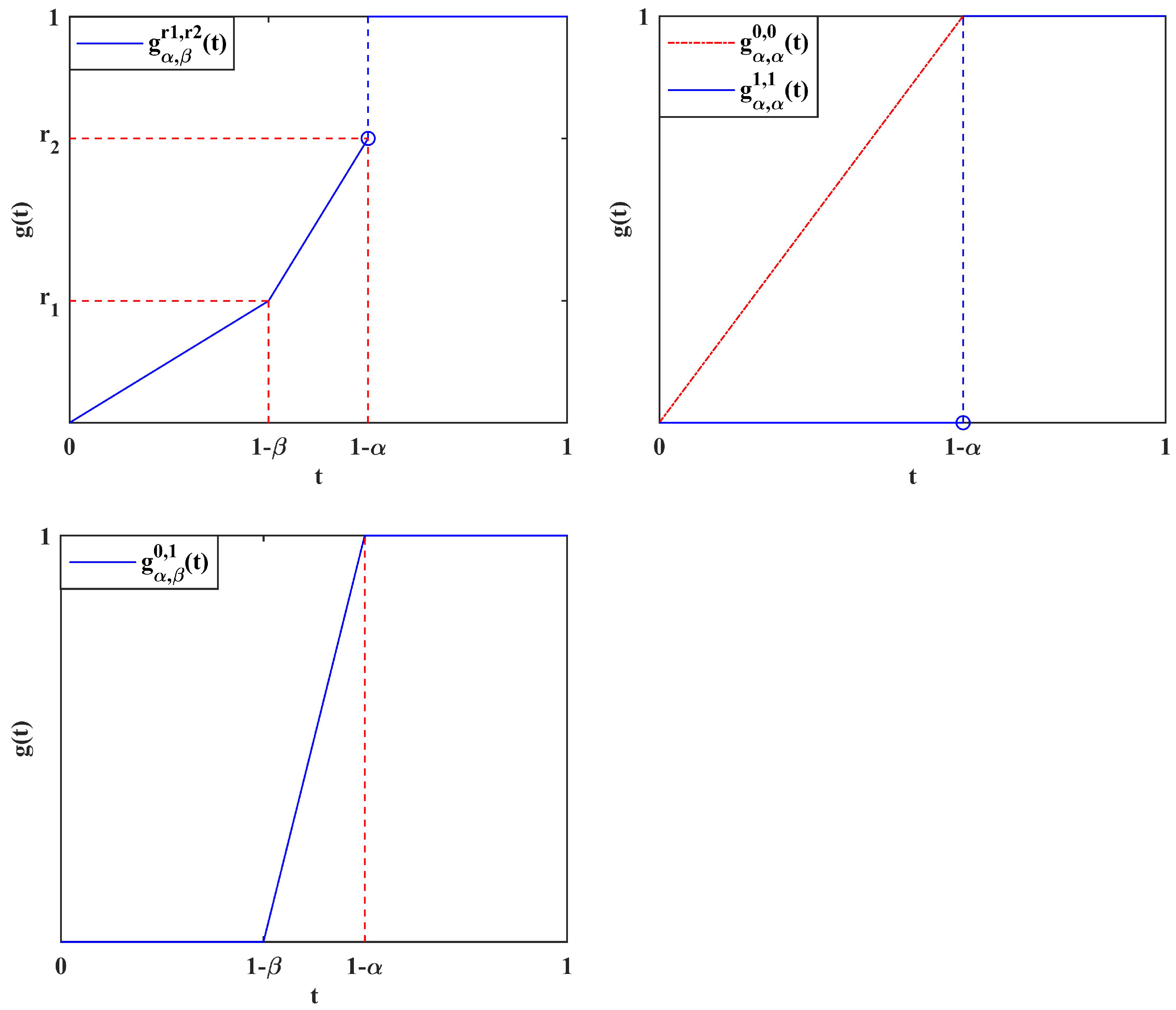
2.2. Distributionally Robust Reinsurance with GlueVaR
- (i)
- If , we have . Taking the derivative with respect to d, we haveFrom this, we can observe that . This implies that is decreasing for , and is increasing for . Since , it follows that . Consequently, is decreasing in .
- (ii)
- If , which implies , we haveThus, the derivative with respect to d isWe will demonstrate that is decreasing in d by considering the following three subcases.Subcase 1: .In this subcase, is decreasing for if and only if , whereBy Condition (4), we have and . Consequently, we can conclude that .Subcase 2: .In this subcase, is decreasing in if and only if . By utilizing condition (4), we can verify that .Subcase 3: .In this subcase, we have
- (iii)
- If , thenFrom this, we can observe that . Therefore, is decreasing for .
3. Main Results
3.1. The Problem Formulation
- (i)
- If , let be a uniform random variable such that U and X are comonotonic. Let , . Denote by for . Define a discrete random variableWe state that and . Indeed, obviously holds. Using Hölder’s inequality, we obtain thatHence, . By the definition of as in (7), we obtainwithand . By (7), , where . Consequently, . In a similar manner, we can confirm that and . Noting that implies , we conclude thatThe second equality holds because . Combining with the result follows. If , then , and . If , by Lemma 1, there exists a three-point distribution such that .
- (ii)
- If , let , and . Denote by . Define a discrete random variable as in Equation (7). Similar to the proof of (i), it is easy to show , , andwhere the inequality follows from . Noting that , the result follows. If , then , and . If , by Lemma 1, there exists a three-point distribution such . Then, the result follows.
- (iii)
- If , define a two-point random variableSimilar to case (i), we have and . For , definewhere . Note that , is continuous and increasing in . Next, we consider the following two subcases.
- (iii.a)
- If there exists an such that , then the distribution of is the desired two-point distribution.
- (iii.b)
- Otherwise, we have with . In this case, for , we definewith . Then and have the same distribution and . Noting that the variance is continuous in and , there exists an such that . Then the distribution of is the desired distribution .
- (i)
- If , then . By applying case (i) of the proof of Proposition 2, we obtain a three-point distribution in .
- (ii)
- If , then if , if , and . In this case, by applying case (ii) of the proof of Proposition 2, we obtain a three-point distribution in .
- (iii)
- If , then . In this case, we can apply case (iii) of the proof of Proposition 2. Specifically, we obtain a random variable defined by (9) with . By iterating this process, we can obtain a distribution in case (i), (ii), or case (iii.a) of the proof of Proposition 2, such that the objective function is not less than that of the original one.
- (i)
- If , let be a uniform random variable that is comonotonic with X. Define the events , , , and . Denote by for . We define a discrete random variable as follows:It can be stated that , , and . By applying the Hölder inequality, we obtain thatThus, . From the definition of , it follows thatSinceit follows that .If , then , and . If , by Lemma 2, there exists a four-point distribution such that and . Thus, we have .
- (ii)
- If , let be comonotonic with X. Let . Denote by for . Define a discrete random variable as in (7), and we can determine that .If , then , and . If , by Corollary 2, there exists a three-point distribution such that .
- (iii)
- If , the proof is similar to the proof of (iii) in Proposition 2, so we omit it here.
3.2. Worst-Case Value
- (i)
- If , then the worst-case value of problem (5) is
- (ii)
- If , then the worst-case value of problem (5) iswhere
3.3. Optimal Deductible
- (i)
- For , we havewhich is increasing and continuous in d for . Therefore, the optimal deductible is , and the optimal value is as follows:
- (ii)
- If , we haveThus, the derivative with respect to d iswhere and . Since and , we can derive the inequality . This can also be expressed equivalently as . Then, we can prove that for all . This implies that , and .
- (iii)
- If and , then we can conclude that , and the expression for is as follows:Then, the derivative with respect to d is given byOne can observe that is continuous for ; we will now consider the two subcases.
- (iii.1)
- If , which is equivalent to , then we have for all . Therefore, the optimal deductible is , and .
- (iii.2)
- If , or equivalently , we see that the second-order differentiation of with respect to d isNoting thatwith . Then, in the interval , there exists a unique such that . Furthermore, we have that for , and for . Consequently, initially decreases for and then increases for . Therefore, the minimum value of is attained at . Solving the equation , we can determine the value of , and
- (iv)
- If and , the proof is similar to case (iii), with the same optimal deductible and optimal value.
4. Conclusions
Author Contributions
Funding
Data Availability Statement
Conflicts of Interest
Appendix A. Proofs of Lemma 1 and Lemma 3
Appendix B. Proof of Theorem 1
- (i)
- For any , we have . Then, the optimization problem is equivalent to maximizingsubject toSolving the first two equations in (A6), we obtain thatAs , we have . Hence, the optimization problem (A5) is reduced tosubject towhere . The first- and second-order differentiations of with respect to d areandrespectively. Solving yields .
- (i.a)
- If , the feasible set in problem (A7) is empty. Therefore, we obtain
- (i.b)
- If , it can be verified that . We consider the following subcases:
- (1)
- (2)
- (3)
- (4)
- (ii)
- For any , we havewhereandThen, the optimization problem is equivalent to maximizing (A17) subject toDenoteBy , we can obtain thatSince and , we can deduce that . Therefore, the functionis a concave function. By conventional calculation, we find thatwhereIt can be easily verified that belongs to . Noting thatandwe can conclude that the optimization problem can be reduced tosubject toSolving the first constraint condition of (A19), the optimization problem (A18) can be further simplified towith . Next, we solve problem (A20) in two cases.
- (ii.a)
- If , then , and the maximum value of problem (A20) isThe corresponding distribution of X is
- (ii.b)
- If , then . If , the feasible set of equation (A20) is empty, and the maximum value is . If , since is decreasing in x, the maximizer of (A20) is , and the maximum value isThe corresponding distribution isIf , the maximizer is still , and the maximum value of (A20) isThen, if , the maximum value of h is given byIf , selecting the larger value between Equations (A15) and (A21) gives us the worst-case value as stated in Equation (14). If , we can confirm thatandChoosing the larger one between Equations (A16) and (A23), we obtain the worst-case value as stated in Equation (15).
References
- Borch, K. An attempt to determine the optimum amount of stop loss reinsurance. In Proceedings of the Transactions of the 16th International Congress of Actuaries I; 1960; pp. 597–610. [Google Scholar]
- Arrow, K.J. Uncertainty and the welfare economics of medical care. Am. Econ. Rev. 1963, 53, 941–973. [Google Scholar]
- Cai, J.; Tan, K.S. Optimal retention for a stop-loss reinsurance under the VaR and CTE risk measures. ASTIN Bullet. 2007, 37, 93–112. [Google Scholar] [CrossRef]
- Chi, Y.; Tan, K.S. Optimal reinsurance under VaR and CVaR risk measures: A simplified approach. ASTIN Bullet. 2011, 41, 487–509. [Google Scholar]
- Cui, W.; Yang, J.; Wu, L. Optimal reinsurance minimizing the distortion risk measure under general reinsurance premium principles. Insur. Math. Econ. 2013, 53, 74–85. [Google Scholar] [CrossRef]
- Cheung, K.C.; Sung, K.C.J.; Yam, S.C.P.; Yung, S.P. Optimal reinsurance under general law-invariant risk measures. Scand. Actuar. J. 2014, 72–91. [Google Scholar] [CrossRef]
- Cai, J.; Lemieux, C.; Liu, F. Optimal reinsurance from the perspectives of both an insurer and a reinsurer. ASTIN Bullet. 2016, 46, 815–849. [Google Scholar] [CrossRef]
- Cai, J.; Chi, Y. Optimal reinsurance designs based on risk measures: A review. Stat. Theor. Relat. Field. 2020, 4, 1–13. [Google Scholar] [CrossRef]
- Hu, X.; Yang, H.; Zhang, L. Optimal retention for a stop-loss reinsurance with incomplete information. Insur. Math. Econ. 2015, 65, 15–21. [Google Scholar] [CrossRef]
- Asimit, A.V.; Bignozzi, V.; Cheung, K.C.; Hu, J.; Kim, E.S. Robust and pareto optimality of insurance contracts. Eur. J. Oper. Res. 2017, 262, 720–732. [Google Scholar] [CrossRef]
- Liu, H.; Mao, T. Distributionally robust reinsurance with Value-at-Risk and Conditional Value-at-Risk. Insur. Math. Econ. 2022, 107, 393–417. [Google Scholar] [CrossRef]
- Xie, X.; Liu, H.; Mao, T.; Zhu, X.B. Distributionally robust reinsurance with expectile. ASTIN Bullet. 2023, 53, 129–148. [Google Scholar] [CrossRef]
- Belles-Sampera, J.; Guillén, M.; Santolino, M. Beyond Value-at-Risk: GlueVaR Distortion Risk Measures. Risk. Anal. 2014, 34, 121–134. [Google Scholar] [CrossRef] [PubMed]
- Belles-Sampera, J.; Guillén, M.; Santolino, M. The use of flexible quantile-based measures in risk assessment. Commun. Stat. Theor. M. 2016, 45, 1670–1681. [Google Scholar] [CrossRef]
- Zhu, D.; Yin, C. Optimal reinsurance policy under a new distortion risk measure. Commun. Stat. Theory Methods 2023, 52, 4151–4164. [Google Scholar] [CrossRef]
- Wang, R.; Zitikis, R. An axiomatic foundation for the expected shortfall. Manag. Sci. 2020, 67, 1413–1429. [Google Scholar] [CrossRef]
- Cont, R.; Deguest, R.; Scandolo, G. Robustness and sensitivity analysis of risk measurement procedures. Quant. Financ. 2010, 10, 593–606. [Google Scholar] [CrossRef]
- Wang, S. Premium calculation by transforming the layer premium density. ASTIN Bullet. 1996, 26, 71–92. [Google Scholar] [CrossRef]
- Denuit, M.; Dhaene, J.; Goovaerts, M.J.; Kaas, R. Actuarial Theory for Dependent Risks: Measures, Orders and Models; John Wiley & Sons: Ltd.: London, UK, 2005. [Google Scholar]
- Dhaene, J.; Vanduffel, S.; Goovaerts, M.J.; Kaas, R.; Tang, Q.; Vyncke, D. Risk measures and comonotonicity: A review. Stoch. Model. 2006, 22, 573–606. [Google Scholar] [CrossRef]

Disclaimer/Publisher’s Note: The statements, opinions and data contained in all publications are solely those of the individual author(s) and contributor(s) and not of MDPI and/or the editor(s). MDPI and/or the editor(s) disclaim responsibility for any injury to people or property resulting from any ideas, methods, instructions or products referred to in the content. |
© 2023 by the authors. Licensee MDPI, Basel, Switzerland. This article is an open access article distributed under the terms and conditions of the Creative Commons Attribution (CC BY) license (https://creativecommons.org/licenses/by/4.0/).
Share and Cite
Lv, W.; Wei, L. Distributionally Robust Reinsurance with Glue Value-at-Risk and Expected Value Premium. Mathematics 2023, 11, 3923. https://doi.org/10.3390/math11183923
Lv W, Wei L. Distributionally Robust Reinsurance with Glue Value-at-Risk and Expected Value Premium. Mathematics. 2023; 11(18):3923. https://doi.org/10.3390/math11183923
Chicago/Turabian StyleLv, Wenhua, and Linxiao Wei. 2023. "Distributionally Robust Reinsurance with Glue Value-at-Risk and Expected Value Premium" Mathematics 11, no. 18: 3923. https://doi.org/10.3390/math11183923
APA StyleLv, W., & Wei, L. (2023). Distributionally Robust Reinsurance with Glue Value-at-Risk and Expected Value Premium. Mathematics, 11(18), 3923. https://doi.org/10.3390/math11183923