Abstract
This paper studies a linear regression model in which the errors are asymptotically almost negatively associated (AANA, in short) random variables. Firstly, the central limit theorem for AANA sequences of random variables is established. Then, we use the central limit theorem to investigate the asymptotic normality of the M-estimator for the unknown parameters. Some results for independent and negatively associated (NA, in short) random variables are extended to the case of AANA setting. Finally, a simulation is carried out to verify the asymptotic normality of the M-estimator in the model.
MSC:
62F12; 62J05
1. Introduction
A lot of researchers have derived the asymptotic properties of the estimators in linear regression models with independent random errors, which are not reasonable in many applications. Therefore, it is of great significance to study linear regression models with dependent errors.
Consider the following linear regression model:
where is an unknown regression parameter vector, is a known explanatory vector, are the scalar response variables, and the errors are asymptotically almost negatively associated random variables.
In many situations, the assumption that random variables are independent is not suitable, so people often study dependent random variables. AANA random variables are widely used. Independent and NA random variables are special AANA random variables. The concept of AANA sequences was proposed by Chandra and Ghosal [1].
Definition 1
([1]). A random sequence is said to be asymptotically almost negatively associated (AANA, in short) if a non-negative sequence exists, such that:
for all and for all coordinate wise non-decreasing continuous functions and whenever variances exist. refers to the mixing coefficients.
Many results on the AANA sequences of random variables have been achieved. The family of AANA sequences contains NA (in particular, independent) sequences (with ) and some more random sequences (see [1]). The following two examples are AANA sequences but not NA: (see [1]) and (see [2]), where are random variables, and as . Some Rosenthal-type inequalities for AANA sequences are obtained in [3]. More studies on AANA sequences of random variables can be found in [4,5,6].
M-estimation include LS and LAD estimation as special cases. In order to investigate the location parameter model, Huber [7] first introduced M-estimation. Huber [8] extended M-estimation to a generalized linear model and proposed the following definition.
Definition 2
([8]). Assume that is some suitable function on . The M-estimator of is defined by:
A series of useful results using M-estimation have been derived by various researchers. Under independent errors, the consistency and asymptotic normality, the methods and theories of linear hypothesis testing, and the linear representation of the M-estimator were discussed more comprehensively in [9,10,11,12,13]. Wu [14] studied the consistency of the M-estimator in a linear model with NA errors. More studies on M-estimation can be found in [15,16,17,18].
However, we have not found studies which focus on the asymptotic normality of the M-estimator in a linear regression model whose errors are AANA in the literature. Therefore, this article considers the linear regression model with AANA errors. The main novelties of this paper are as follows. Firstly, we use moment inequalities to establish the central limit theorem for AANA sequences, which extend the corresponding results for NA sequences to AANA sequences. Secondly, we use the central limit theorem to study the asymptotic normality of the M-estimators of the unknown parameters. The results extend the corresponding ones for independent and some dependent errors. At last, we carried out a simulation to verify the validity of the results.
The remainder of this paper is organized as follows. In Section 2, the central limit theorem for AANA random sequences is derived. In Section 3, the asymptotic normality of the M-estimators of unknown parameters is investigated under some mild conditions. In Section 4, a simulated study is presented to support the results. In Section 5, we conclude the paper.
In the paper, let be a positive constant whose values may vary at different places. stands for independent and identically distributed. and . means “defined as”. is the Euclidean norm.
2. Central Limit Theorem for AANA Random Sequences
To derive the asymptotic normality of M-estimators of unknown parameters, we give an important conclusion in this section first and call it the central limit theorem for AANA random sequences.
Theorem 1.
Assume that is an identically distributed AANA random sequence with mixing coefficients and the following conditions are satisfied:
- (A1) , ;
- (A2)
- (A3) there exists a strictly increasing natural numbers sequence , for , such that:
- (A4) ; Then,where , , , , and stands for convergence in distribution.
Remark 1.
In Theorem 1, except for the extra condition (), other conditions are the same as that of Theorem 2.2 in Su and Chi [19].
As independent and NA sequences are special AANA sequences, we can easily obtain the following corollaries.
Corollary 1.
Let be an random sequence, as the conditions ()–() are satisfied, and then conclusion (5) holds.
Corollary 2
([19]). Let be an identically distributed NA random sequence, as the conditions ()–() are satisfied, and then conclusion (5) holds.
To prove Theorem 1, we need the following lemmas.
Lemma 1
([3]). If is an AANA sequence whose mixing coefficients are , then so is , where are non-increasing or non-decreasing functions.
Lemma 2
([3]). Let be an AANA sequence of zero mean with mixing coefficients , then there exists a positive constant depending only on , such that:
for any and , where .
Lemma 3
([20]). Let be an random sequence with and for and all . Assume that is twice derivative and . Then,
where and is the standard normal distribution function.
Lemma 4
([21]). If is an AANA sequence with zero mean and mixing coefficients , satisfying , , then
where .
Lemma 5.
Let be an AANA sequence with mixing coefficients . Assume that and are absolutely continuous, bounded and real on with and . Then,
for all and for all coordinate wise non-decreasing continuous functions whenever the variances exist, where .
Proof.
The proof is similar to that of the Lemma 3.5 in Zhang [22], with taking the place of its . We omit the details here. □
Lemma 6.
Let be an AANA sequence with mixing coefficients . If , then
for any real , .
Proof.
We proceed the proof by induction on . The result is true for trivially and is true for by Lemma 5 and (see [23]). We assume that the result is true for . For , we can suppose that for some , and , for , while for .
Write and . Then,
Noting that:
Therefore, from the induction hypothesis, it follows that:
This completes the proof of Lemma 6. □
Proof of Theorem 1.
where the definition of is as follows:
By (3), we have for sufficiently large . From (4), we know that as , thus we have for all sufficiently large . By Lemma 2, we obtain that for each
as . Hence, to prove (5), we only need to prove
as .
For each , we denote:
Then, , and are non-decreasing functions on . Thus, by Lemma 1, we derive that , and are all AANA sequences, and
Therefore, it follows by Lemma 2 with that:
From we know that:
Thus, for each , we have:
Since
Using the Cauchy–Schwarz inequality and Lemma 2 with , it follows that:
as . Hence, we derive by (3) that:
By (6)–(10), we know that to prove (5), we only need to prove:
as .
It is easy to show that in Theorem 1, if
then
Write
Then, is an AANA random sequence (the proof is similar to that of Theorem 2.2 in Su and Chi [19]). Now, we take a sequence of independent random variables , such that and are identically distributed for all .
Let . By (11), we obtain that to prove Theorem 1, we only need to prove:
Denote:
By (12), we know that as . Hence,
By (10), we have:
Thus,
as .
Therefore, in order to prove (13), we only need to show that:
as for all . We will apply Lemma 3 to prove (15).
Let
For given and any , we construct two functions:
Both of the two functions are three times derivative and satisfy the following conditions:
- (1)
- (2)
- (3)
- For the of condition ().
for , let be a real function on and define:
In fact, for , there exist functions satisfying the above conditions (see [20]). For , let:
then they satisfy the above conditions. For each , it follows that:
So, we have
and
where
Thus, to prove (15), we only need to prove:
as , where .
Next, we will prove (17) for and fixed . By the property of , we have:
From the definition of and , we obtain that:
and is bounded in . Thus, . Let
It follows that:
Denote
By the independence among and the identical distribution between and , we have:
where is defined by (16). From lemma 6, it follows that:
as .
By (14), we have:
It is easily to obtain that
Hence, it follows that
from the Parsevar’s formula (see [24]) (17) and (18).
When , it is obviously that . When , let ; then we obtain that as from (17).
Let
By (19), we have:
From the definitions of and , we get . Thus,
and then
as .
When similar to the proof of (20), we have , , and as .
This completes the proof of Theorem 1. □
3. Asymptotic Normality of M-Estimator
For the model (1), we suppose that is a non-monotonic convex function on with left derivatives and right derivatives . Select , such that for any and write .
Theorem 2.
In the model (1), suppose that is an AANA sequence of identically distributed random variables with mixing coefficients , and the following conditions are satisfied:
- ;
- there exists a finite functionwith and positive derivative at .
- and
- there exists a such that is a -order positive definite matrix as and as ;
- ;
- as ;
Then,
Remark 2.
In Theorem 2, except for the extra condition (), other conditions are the same as that of Theorem 1.1 in Rao and Zhao [25].
As independent and NA sequences are special AANA sequences, we can easily obtain the following corollaries.
Corollary 3
([25]). In the model (1), let be an random sequence. Assume that conditions ()–() are satisfied. Then, conclusion (23) holds.
Corollary 4.
In the model (1), let be an identically distributed NA random sequence. Assume that conditions ()–() are satisfied. Then, conclusion (23) holds.
To prove Theorem 2, we need the following lemmas.
Lemma 7
([26]). Let be an open convex subset in and be a list of random convex functions on . Assume that is a real function on , such that
for all as . Then, is a convex function on and
for all compact subsets of as , where stands for almost sure convergence.
Lemma 8.
In the model (1), suppose that all the conditions of Theorem 2 hold. Then,
and
for all constant , where represents the maximum absolute value of each component of vector and stands for convergence in probability.
Proof.
Denote
By , we have as . So, for each fixed , we obtain that as . From , there exist a bunch of positive numbers, and , such that:
as .
There is no effect on the consequence of whether is positive or negative. Without loss of generality, we suppose . From the condition (), Lemma 4, the Schwarz inequality, and , it follows that:
Thus, we have:
Therefore, Lemma 8 follows from Lemma 7. □
Proof of Theorem 2.
Let , . Then, we can rewrite model (1) as:
Then, and as . Let be the M-estimator of . We can easily obtain that , where is the M-estimator of in the model (1). Since and , proving
shows that
Without loss of generality, we suppose that the true parameter in the model (1), then . Hence, to prove (25), we only need to prove:
Denote . Let be any -dimensional unit column vector, then . Suppose , otherwise we can discuss it in positive and negative terms. By Theorem 1, we have:
And applying the Cramer–Wold theorem, it follows that:
From this, we conclude that is bounded in probability. That is, for each , there exists a constant , such that:
as . By Lemma 8, we obtain that for each
as , where is the indicative function of set . By (27) and (28), we have
for sufficiently large . From this and the convex property of , we obtain
for sufficiently large .
By the arbitrariness of and , we derive that:
as . Thus, Theorem 2 follows form (26) and (29).
Then, proving Theorem 2 is complete. □
4. Numerical Simulation
In this section, we will carry out a simulation to verify the asymptotic normality of the M-estimator in a linear regression model with AANA errors.
An AANA sequence is given as follows:
where are random variables and . The sequence is an AANA sequence but not an NA sequence (see [1]).
We will simulate a regression model:
where is a standard uniform distribution , and the random errors are given by sequence 1.
A derivative function of function is given by:
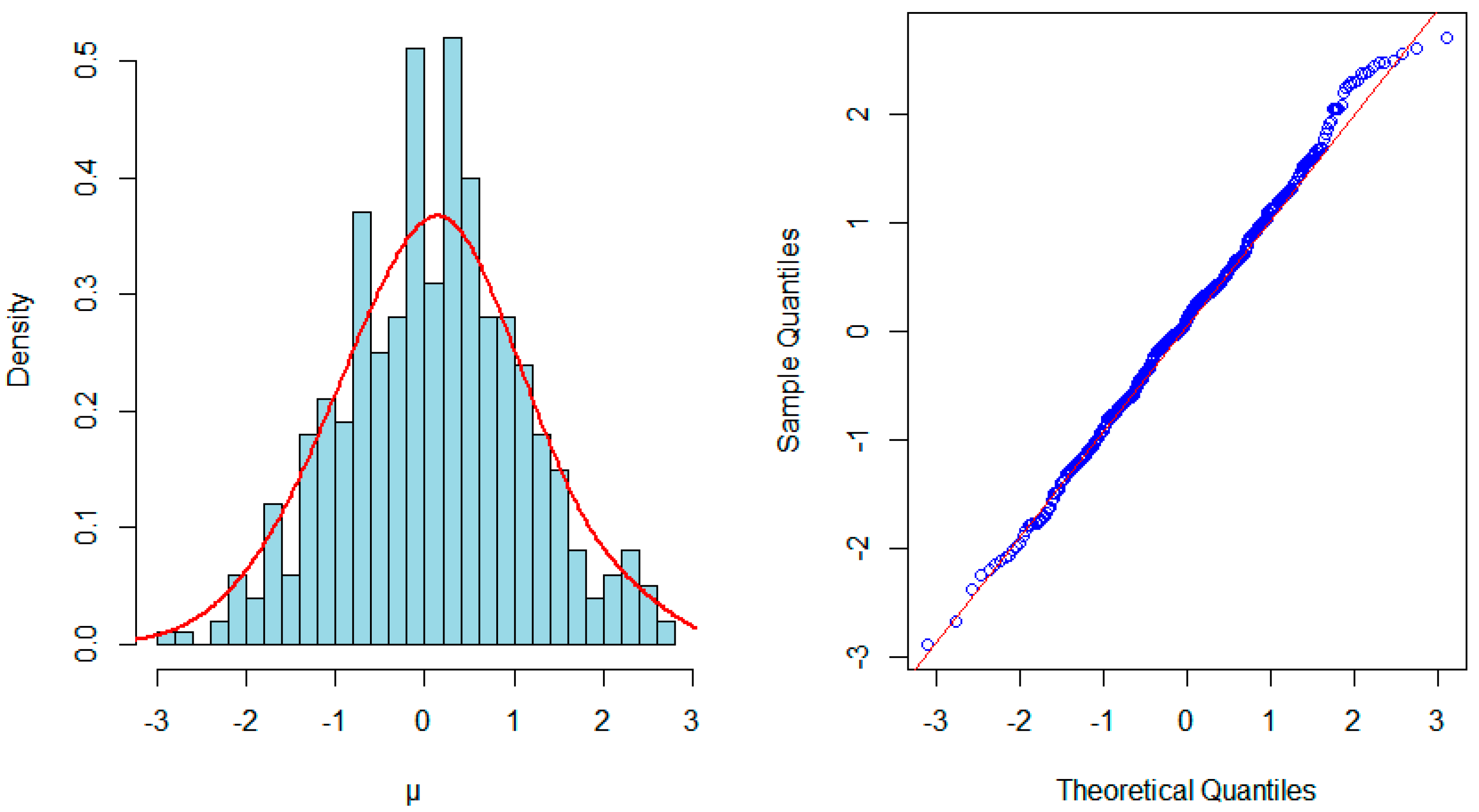
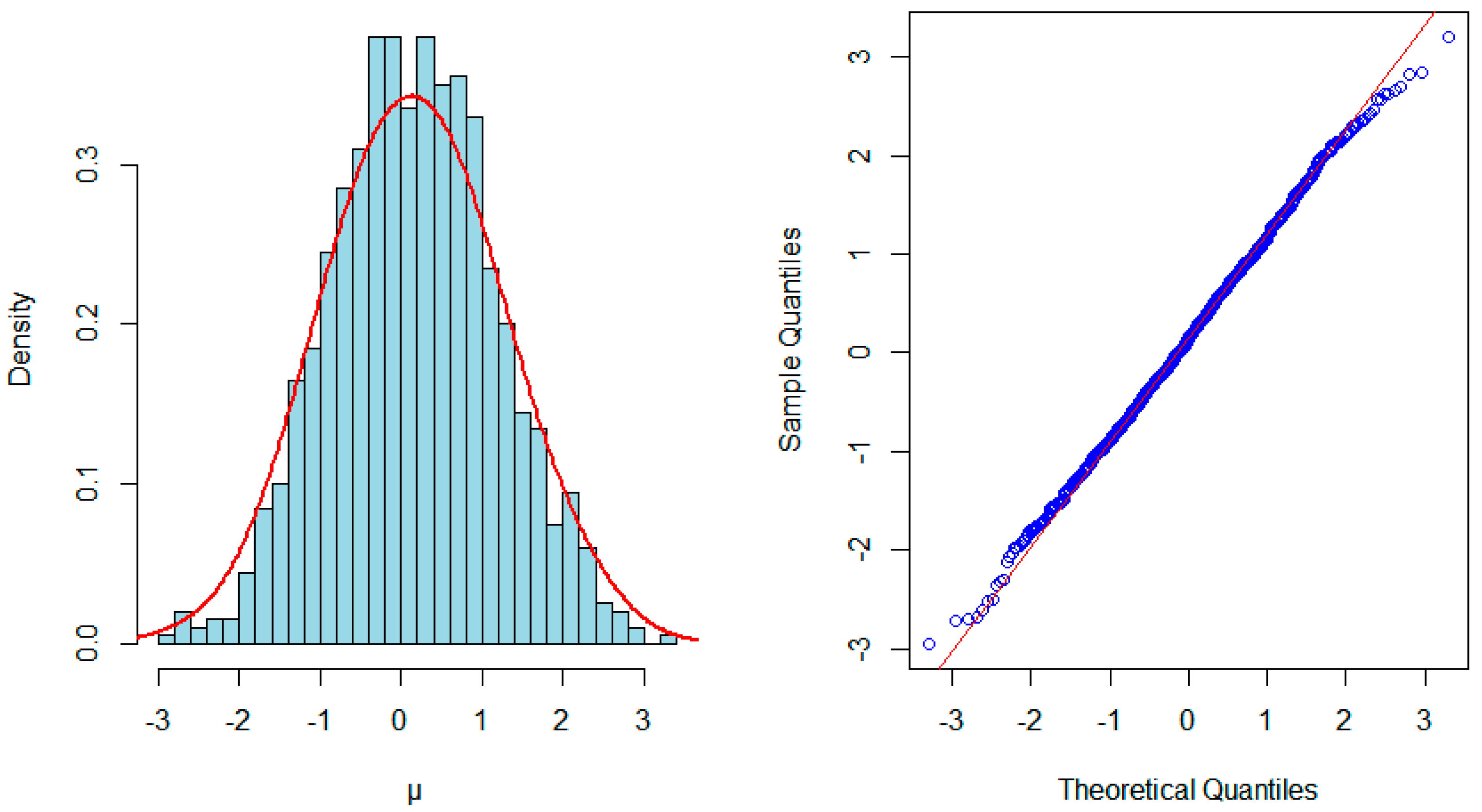
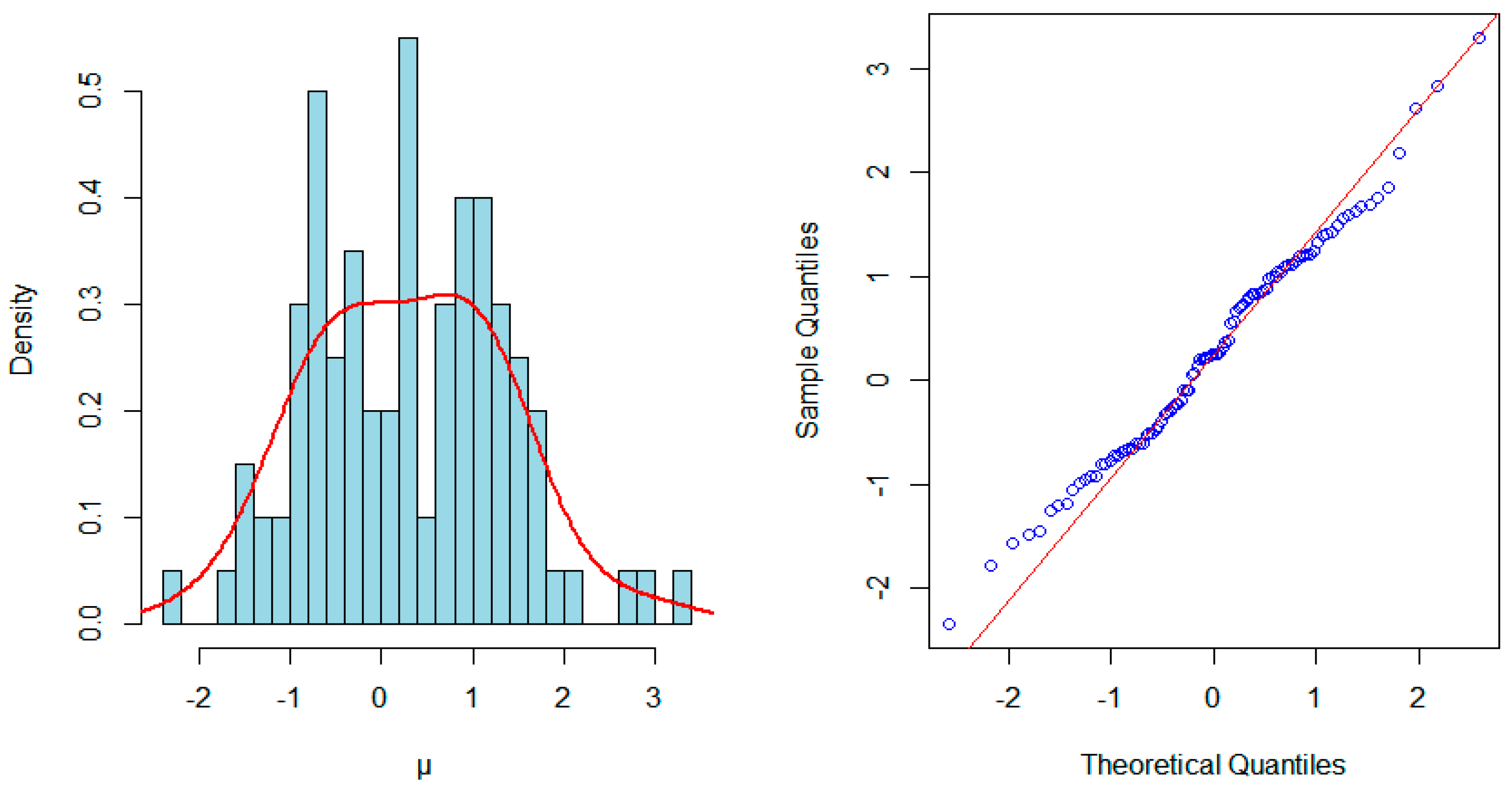
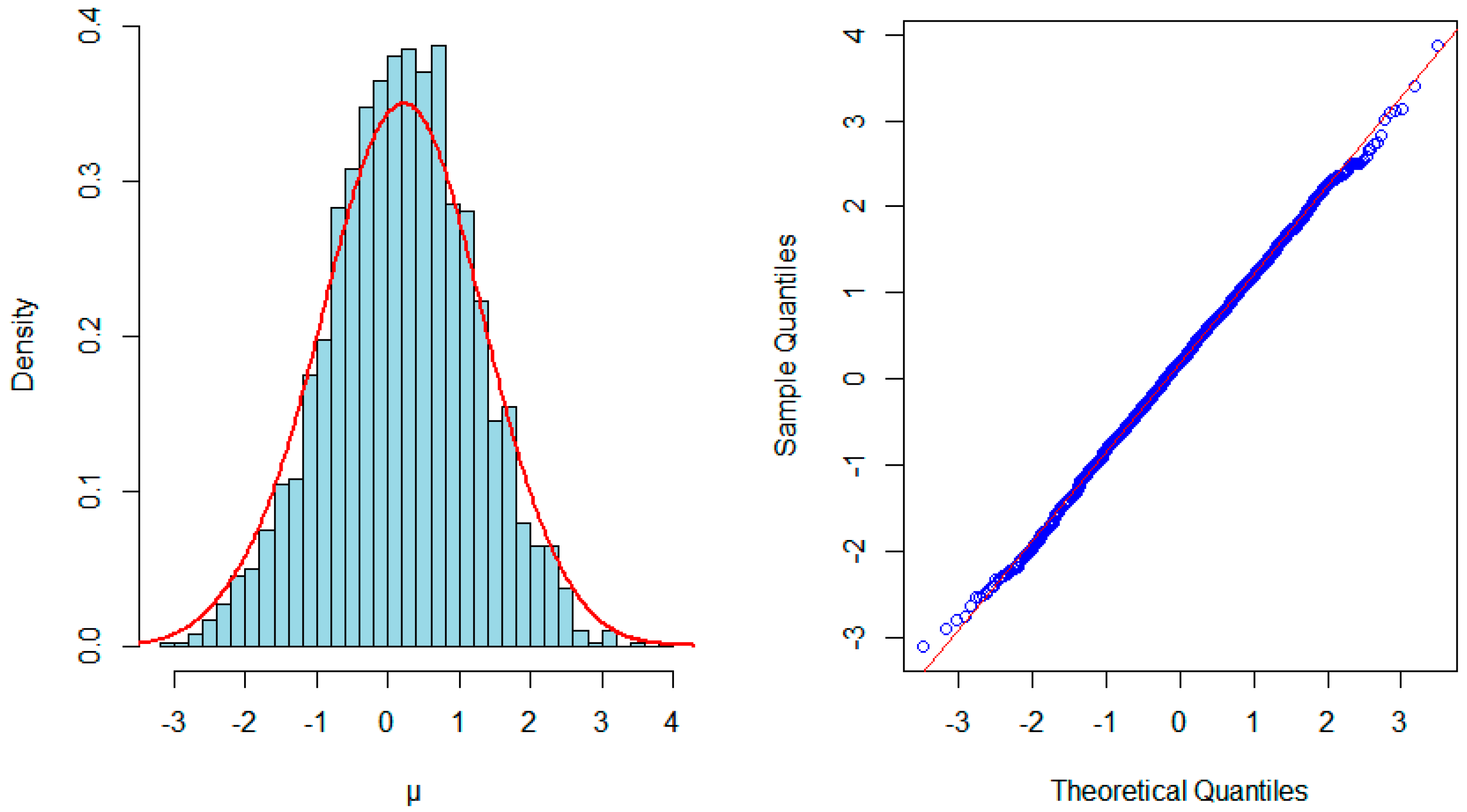
(see [27]). The sample sizes are taken as , , , and , respectively. We use R software to compute 1000 times and present the histograms and Quantile–Quantile plots of it in Figure 1, Figure 2, Figure 3 and Figure 4. The red curve in Figure 1 is the kernel density estimate curve, and the red straight line is the reference line whose slope is standard deviation and intercept is mean. The red curves and straight lines in the following figures are also the same meaning.
Figure 1.
Histogram and normal Q-Q plot of with .
Figure 2.
Histogram and normal Q-Q plot of with .
Figure 3.
Histogram and normal Q-Q plot of with .
Figure 4.
Histogram and normal Q-Q plot of with .
5. Conclusions
In this article, we mainly study the asymptotic properties of the estimators in the model (1). Many scholars have obtained the asymptotic properties of the estimators in linear models whose errors are independent (see [9,25]). However, the errors are not independent in many applications. In this paper, we suppose that the errors are AANA random variables, which include independent and NA random variables as special cases. The asymptotic normality of M-estimators for the unknown parameters is investigated under some suitable conditions, and the central limit theorem for AANA sequences of random variables is also derived. The results extend the corresponding ones of independent and NA random variables (see [19]). In addition, for model (1), a simulation is carried out to investigate the numerical performance. The aim of our work was to construct general mixing conditions under the classical setting. Although it might be interesting future work, we do not address sequences that have long-range dependence (see [28,29,30]) herein, where the limiting behavior is no longer classical. This is an interesting subject to investigate the limit properties of the estimators in regression models with long-range dependence errors in future studies.
Funding
This work was supported by the Scientific Research Project of Hubei Provincial Department of Education (No. Q20233003) and the Foundation for Innovative Research Team of Hubei Provincial Department of Education (No. T2022034).
Data Availability Statement
Not applicable.
Conflicts of Interest
The author declares no conflict of interest.
References
- Chandra, T.K.; Ghosal, S. Extensions of the strong law of number of Marcinkiewicz and Zygmund for dependent variables. Acta Math. Hung. 1996, 71, 327–336. [Google Scholar] [CrossRef]
- Chandra, T.K.; Ghosal, S. The strong law of number for weighted averages under dependence assumptions. J. Theor. Probab. 1996, 19, 797–809. [Google Scholar] [CrossRef]
- Yuan, D.M.; An, J. Rosenthal type inequalities for asymptotically almost negatively associated random variables and applications. Sci. China Ser. A 2009, 52, 1887–1904. [Google Scholar] [CrossRef]
- Hu, X.P.; Fang, G.H.; Zhu, D.J. Strong convergence properties for asymptotically almost negatively associated sequence. Discret. Dyn. Nat. Soc. 2012, 2012, 562838. [Google Scholar] [CrossRef]
- Tang, X.F. Some strong laws of large numbers for weighted sums of asymptotically almost negatively associated random variables. J. Inequalities Appl. 2013, 2013, 4. [Google Scholar] [CrossRef]
- Zhang, Y.; Liu, X.S.; Hu, H.C. Weak consistency of M-estimator in linear regression model with asymptotically almost negatively associated errors. Commun. Stat.-Theory Methods 2020, 49, 2800–2816. [Google Scholar] [CrossRef]
- Huber, P.J. Robust estimation of a location parameter. Ann. Math. Statist. 1964, 35, 73–101. [Google Scholar] [CrossRef]
- Huber, P.J. Robust regression: Asymptotics, conjectures and Monte Carlo. Ann. Stat. 1973, 1, 799–821. [Google Scholar] [CrossRef]
- Chen, X.R.; Zhao, L.C. M-Methods in Linear Models; Shanghai Scientific and Technical Publishers: Shanghai, China, 1996. [Google Scholar]
- Huber, P.J.; Ronchetti, E.M. Robust Statistics, 2nd ed.; John Wiley & Sons: New Jersey, NJ, USA, 2009. [Google Scholar]
- Hu, H.C.; Zhang, Y.; Pan, X. Asymptotic normality of DHD estimators in a partially linear model. Stat. Pap. 2016, 57, 567–587. [Google Scholar] [CrossRef]
- Goryainov, A.V.; Goryainov, V.B. M-estimates of autoregression with random coefficients. Autom. Remote Control 2018, 79, 1409–1421. [Google Scholar] [CrossRef]
- Linke, Y.Y.; Sakhanenko, A.I. Conditions of asymptotic normality of one-step M-estimators. J. Math. Sci. 2018, 230, 95–111. [Google Scholar] [CrossRef]
- Wu, Q.Y. Strong consistency of M estimator in linear model for negatively associated samples. J. Syst. Sci. Complex. 2006, 19, 592–600. [Google Scholar] [CrossRef]
- Fan, J. Moderate deviations for M-estimators in linear model with-mixing errors. Acta Math. Sin. 2012, 28, 1275–1294. [Google Scholar] [CrossRef]
- Cui, H.J.; He, X.M.; Kai, W.N. M-estimation for linear models with spatially-correlated errors. Stat. Probab. Lett. 2004, 66, 383–393. [Google Scholar] [CrossRef]
- Muhammad, S.; Sohail, C.; Babar, I. On Some new ridge M-estimators for linear regression models under various error distributions. Pak. J. Stat. 2021, 37, 369–391. [Google Scholar]
- Muhammad, S.; Sohail, C.; Muhammad, A. New quantile based ridge M-estimator for linear regression models with multicollinearity and outliers. Commun. Stat. Simul. Comput. 2023, 52, 1418–1435. [Google Scholar]
- Su, C.; Chi, X. Some results on CLT for nonstationary NA sequences. Acta Math. Appl. Sin. 1998, 21, 9–21. [Google Scholar]
- Butzer, P.L.; Hahn, L. General theorems on rates of convergence in distribution of random variables. 1: General Limit Theorem. J. Multivar. Anal. 1978, 8, 181–201. [Google Scholar] [CrossRef]
- Yuan, D.M.; An, J. Laws of large numbers for Ces’aro alpha-integrable random variables under dependence condition AANA or AQSI. Acta Math. Sin. 2012, 28, 1103–1118. [Google Scholar] [CrossRef]
- Zhang, L.X. A functional central limit theorem for asymptotically negatively dependent random fields. Acta. Math. Hung. 2000, 86, 237–259. [Google Scholar] [CrossRef]
- Ledoux, M.; Talagrand, M. Probability in Banach Space; Springer: Berlin, Germany, 1991. [Google Scholar]
- Petrov, V.V. Limit Theorem for the Sum of Independent Random Variables; Science Publishers: Beijing, China, 1987. [Google Scholar]
- Rao, C.R.; Zhao, L.C. Approximation to the distribution of M-estimates in linear models by randomly weighted bootstrap. Sankhy Ser. A 1992, 54, 323–331. [Google Scholar]
- Anderson, P.K.; Gill, R.D. Cox’s regression model for counting processes: A large sample study. Ann. Stat. 1982, 15, 1100–1120. [Google Scholar] [CrossRef]
- Huber, P.J. Finite sample breakdown of M-and P-estimators. Ann. Stat. 1984, 12, 119–126. [Google Scholar] [CrossRef]
- Düker, M.C. Limit theorems in the context of multivariate long-range dependence. Stoch. Process. Appl. 2020, 130, 5394–5425. [Google Scholar] [CrossRef]
- Kouritzin, M.A.; Sounak, P. On almost sure limit theorems for heavy-tailed products of long-range dependent linear processes. Stoch. Process. Appl. 2022, 152, 208–232. [Google Scholar]
- Bai, S.Y.; Taqqu, M.S. Multivariate limit theorems in the context of long range dependence. J. Time Ser. Anal. 2013, 34, 717–743. [Google Scholar] [CrossRef]
Disclaimer/Publisher’s Note: The statements, opinions and data contained in all publications are solely those of the individual author(s) and contributor(s) and not of MDPI and/or the editor(s). MDPI and/or the editor(s) disclaim responsibility for any injury to people or property resulting from any ideas, methods, instructions or products referred to in the content. |
© 2023 by the author. Licensee MDPI, Basel, Switzerland. This article is an open access article distributed under the terms and conditions of the Creative Commons Attribution (CC BY) license (https://creativecommons.org/licenses/by/4.0/).