Abstract
In this paper, we present a constructive description of the function space of all real-valued functions on by presenting a partition of it into 28 distinct blocks and a closed-form formula for the representative function of each of them. Each block contains elements that share common features in terms of the cardinality of their sets of continuity and differentiability. Alongside this classification, we introduce the concept of the Connection, which reveals a special relationship structure between the well-known representatives of four of the blocks: the Cantor function, the Dirichlet function, the Thomae function, and the Weierstrass function. Despite the significance of this field, several perspectives remain unexplored.
Keywords:
real-valued functions; cardinals; Cantor function; Thomae function; Weierstrass function; Dirichlet function; partition MSC:
05A18; 26A15; 26A21; 26A24; 26A30; 03E10
From the paradise, that Cantor created for us, no-one shall be able to expel us.
(David Hilbert-1925)
1. Introduction
1.1. Real Valued Functions
The theory of functions of a real variable was first treated by the Italian mathematician Ulisse Dini in 1878 [1]. This theory was constructed through the enlargement and deepening of set theory and was later developed separately and in parallel with its mentioned parent theory [1]. The development of this theory can be divided into three periods: the first period (1867–1902) saw extensive investigation into various topics of classical analysis, such as integrals, derivatives, and point set theory; the second period (1902–1930) marked the solidification of the theory of functions of a real variable as an independent mathematical discipline; and the third period (1930-present) is characterized by the study of the theory of real-valued functions in connection with functional analysis [1].
1.2. Motivation
The function space of all real-valued functions on the real line () is an infinite-dimensional vector space with a nonconstructive basis. It encompasses various types of functions with pathological and chaotic structures. Here, we refer to the term “pathological” in the sense of contradicting features with perceived human intuition. Furthermore, we refer to the term “chaotic” in the context of dynamical systems where, at any neighborhood of a given point in the function domain, there is an unpredictable change in the values of the function [2]. As researchers’ attention has shifted from pure existential mathematics to constructive mathematics [3,4], mathematicians have made numerous attempts to focus on special subsets of this vast vector space (e.g., all real-valued continuous functions [5]) or to classify this vector space using novel ancillary concepts. Examples of such classifications include those based on (i) set theory (surjective, injective, bijective, etc.), (ii) operators (additive, multiplicative, even, odd, etc.), (iii) topology (continuous, open, closed, etc.), (iv) properties concerning real numbers (differentiable, smooth, convex, etc.), and (v) measurability (Borel status, Baire status, etc.) [6,7,8].
This work presents another attempt to describe the vector space of real-valued functions on the real line from a constructive mathematics perspective. Specifically, it aims to classify the elements of this vector space using their associated information on cardinality, continuity, and differentiability. Furthermore, based on this classification, it establishes a particular relationship among four of them: the Cantor function, the Dirichlet function, the Thomae function, and the Weierstrass function.
1.3. Study Outline
This paper is divided into four sections. The first section provides the necessary preliminaries in set theory, linear algebra, and special functions, which are essential for the following sections. In the second section, we discuss the partition of into 28 blocks of functions, presenting constructive examples for each block. The third section focuses on the relationship between these 28 blocks of functions using graph theory, with a specific emphasis on the four main plausible functions. Finally, we conclude the work with a discussion section on the current results and future directions.
2. Preliminaries
Readers who have studied the key topics of Analysis and Linear Algebra are well-equipped with the following notations, definitions, and results in the areas of “Set Theory” [9,10,11], “Linear Algebra” [9,12,13,14], and “Special Functions” [15,16,17,18,19,20,21,22].
2.1. Set Theory
Proposition 1.
Let denote the set of real numbers and Then, A is empty, non-empty finite, denumerable, or uncountable. In these cases, we denote the cardinality of A by or respectively.
Remark 1.
Henceforth, we assume there are only four types of subsets in the real line given Proposition 1, considering all non-empty finite sets of one category with common symbol “n” as their cardinal number.
Proposition 2.
(i) Let be uncountable and Then, or is uncountable.
(ii) Let Then,
Proposition 3.
Let C be the ternary Cantor set, i.e., . Then, one can write where is the disjoint union of intervals of the form each of the length
Remark 2.
Given we have
2.2. Linear Algebra
Definition 1.
Let denote the set of real numbers. We define (i) (ii) ; and (iii)
Remark 3.
The function space equipped with conventional addition + and scalar multiplication • constitutes the vector space In addition, the vector spaces , and are its sub-spaces.
Proposition 4.
Given the sets introduced in Definition 1, we have (i) (ii) (iii) and (iv)
Proposition 5.
2.3. Special Functions
Definition 2.
Given indicator function and the ternary Cantor set Then, the Cantor function the Dirichlet function the Thomae function and the Weierstrass function are defined on a closed-unit interval as:
Remark 4.
We note that the definitions of the above functions have straightforward extension from the closed unit interval to the entire real line. Also, the introduced Weierstrass function here is a special case of the general form for
Definition 3.
Let C be the ternary Cantor set, be the Dirichlet function, and Then, for the triangular function given by and the transformed cosine function given by , we define two functions and on the real line as
Remark 5.
While the triangular function is continuous everywhere and has no derivative at points the linear transformed cosine function is differentiable everywhere and, in particular, its derivative at points is zero. These properties are inherited by the associated functions and respectively.
3. Main Results
3.1. Partition of with Scenario Classification & Examples
We present a constructive perspective of the function space by its blockization in three parts: (i) Existence of the Blocks, (ii) Construction of the Blocks, and, (iii) Size of the Blocks.
3.1.1. Existence of the Blocks
We start by partitioning the function space into a finite number of blocks using the intersectionality of three concepts: “cardinal number”, “continuity”, and “differentiability”. Here, two real-valued functions defined on belong to the same block if and only if their associated set of continuities, discontinuities, differentiabilities, and non-differentiabilities have the same cardinal number, explained in detail below.
Definition 4.
Let , with associated sets of continuities and the associated sets of differentiabilities Then, f is equivalent to g in structure, denoted by , whenever (i) (ii) (iii) and (iv)
It is trivial that in Definition 4 is an equivalence relation on Hence, it induces a partition on it as follows.
Theorem 1.
The function space may be partitioned into 28 unique distinct blocks:
Proof.
First, let and consider its set of continuity points . Then, given by an application of Proposition 2 (i), it follows that at least or is uncountable. Subsequently, by Proposition 2 (ii), there are seven different scenarios for the cardinality of the pair , including or A similar argument for the set of differentiabilities with the same seven blocks holds. Secondly, by multiplication principle, it appears that there are blocks of functions. However, by two applications of Proposition 2 (ii) for and and for and only blocks exist. Table 1 lists these blocks. □
Table 1.
List of 28 representatives blocks of partition of .
Corollary 1.
Each of the blocks of functions with the most chaotic structure () and functions of the least chaotic structure () constitutes only 3.5% (1/28) of all blocks. Hence, 93% of blocks of functions fall between these two opposite extremes. Furthermore, the vector space of everywhere-continuous functions on the real line () constitutes 25% (7/28) of all blocks.
3.1.2. Construction of the Blocks
We now consider the proposed blocks in Theorem 1 and investigate the existence of at least one explicit closed form function as the representative of each block, as shown below.
Theorem 2.
There is at least one constructive example representing each of 28 unique distinct blocks of functions in
Proof.
We consider the ith row in the Table 1 and find a closed-form representative function . Table 2 lists all the functions. It is straightforward for the reader to check that each function satisfies the associated block requirements. □
Table 2.
List of 28 representative functions for each of the 28 blocks .
Remark 6.
The block of functions with the least chaotic structure () represented by the identity function I in the Table 2 lists many well-known functions, including all polynomials , the trigonometric functions and the exponential function and the Volterra’s function [23].
Remark 7.
The ternary Cantor set appears in the construction of representatives of of the blocks. This shows that the ternary Cantor set has remarkable presence in the representative blocks of the space of real-valued functions on the real line.
Remark 8.
The four well-known functions and show up in of the blocks where, for given representative function , at least one of is one of these four functions.
3.1.3. Size of the Blocks
We now consider the the problem of cardinality calculation of each presented block in Theorem 1. In the spirit of having some hints on the their sizes from information presented in Proposition 4, we investigate this in two steps as follows.
Lemma 1.
Let and . Then,
(i)
(ii)
Proof.
First, given we have Hence, proving claim (ii) yields proving claim (i). Secondly, to prove claim (ii), let be countable. Then, given [24], we have Consequently, Finally, using the recent result, it is sufficient to consider the 1-1 mapping:
This completes the proof. □
Theorem 3.
Proof.
First, let . Then, we can extend f to by . A straightforward verification shows that . Thus, given the 1-1 mapping
we have . This yields . Next, let and define by for . Then, using the CDF of the normal distribution we have for respectively. Thus, given the 1-1 mapping
we have implying for .
Secondly, let and consider the modified in Table 2 by for . Thus, given the 1-1 mapping
we have implying for .
Thirdly, let Then, using function in the Table 2, we have Hence, given the 1-1 mapping
we have for respectively. Next, given for and Lemma 1 (ii), we have for . Accordingly, by the last two inequalities on the cardinals, it follows that: In particular, for , we have
This completes the proof. □
Remark 9.
The cardinality of of the blocks is , while that of of blocks is This indicates that the cardinal number c has almost double frequency of that of cardinal number in representing the size of blocks of the space of real-valued functions on the real line.
3.2. The Connection between Real-Valued Functions on
3.2.1. The Relationship between the 28 Representative Functions
In the previous section, we observed that any given function belongs to one of the 28 blocks of its partitions. Now, one may wonder how to connect these key functions. Trivially, the equivalence relation induced by the aforementioned partition is unhelpful in this regard. Hence, we consider an alternative approach. We begin with a definition:
Definition 5.
Given two functions is called connected to , denoted by , whenever, for some function we have
Remark 10.
Additional restrictions on g: When in Definition 5, is transformed into the induced equivalence relation by the above partition in the Theorem 1; Furthermore, if g is a positive everywhere-differentiable function on , the aforementioned relation becomes an equivalence relation.
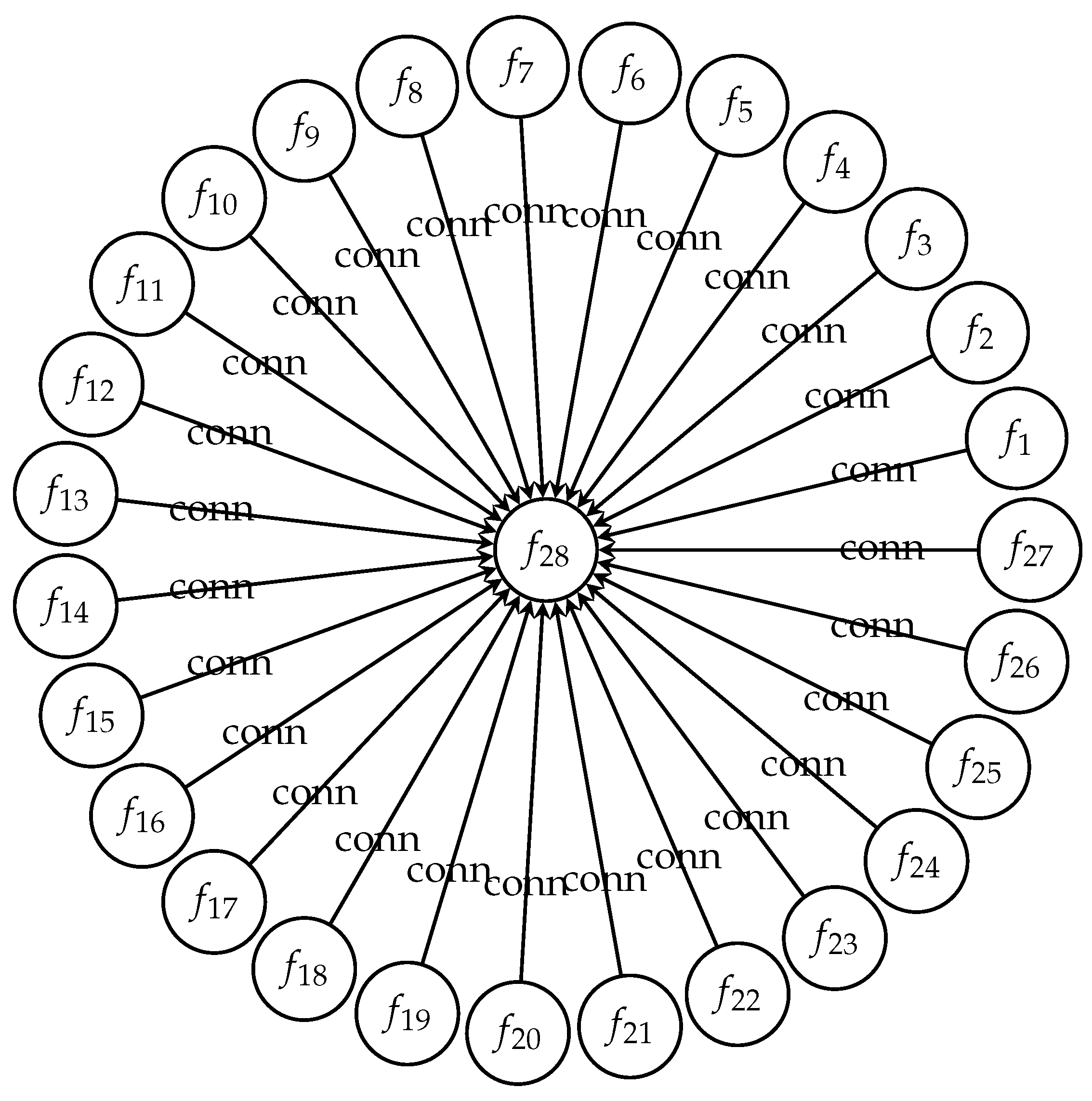
It is trivial that, in Theorem 1, for all Figure 1 presents these relationships. As shown, the block of everywhere-differentiable functions is the sink node with the highest in-degree connectivity among all blocks of functions.
Figure 1.
The (incomplete) graphical presentation of the relationship between all representatives of blocks of and the identity function.
3.2.2. The Relationship between the Big Four
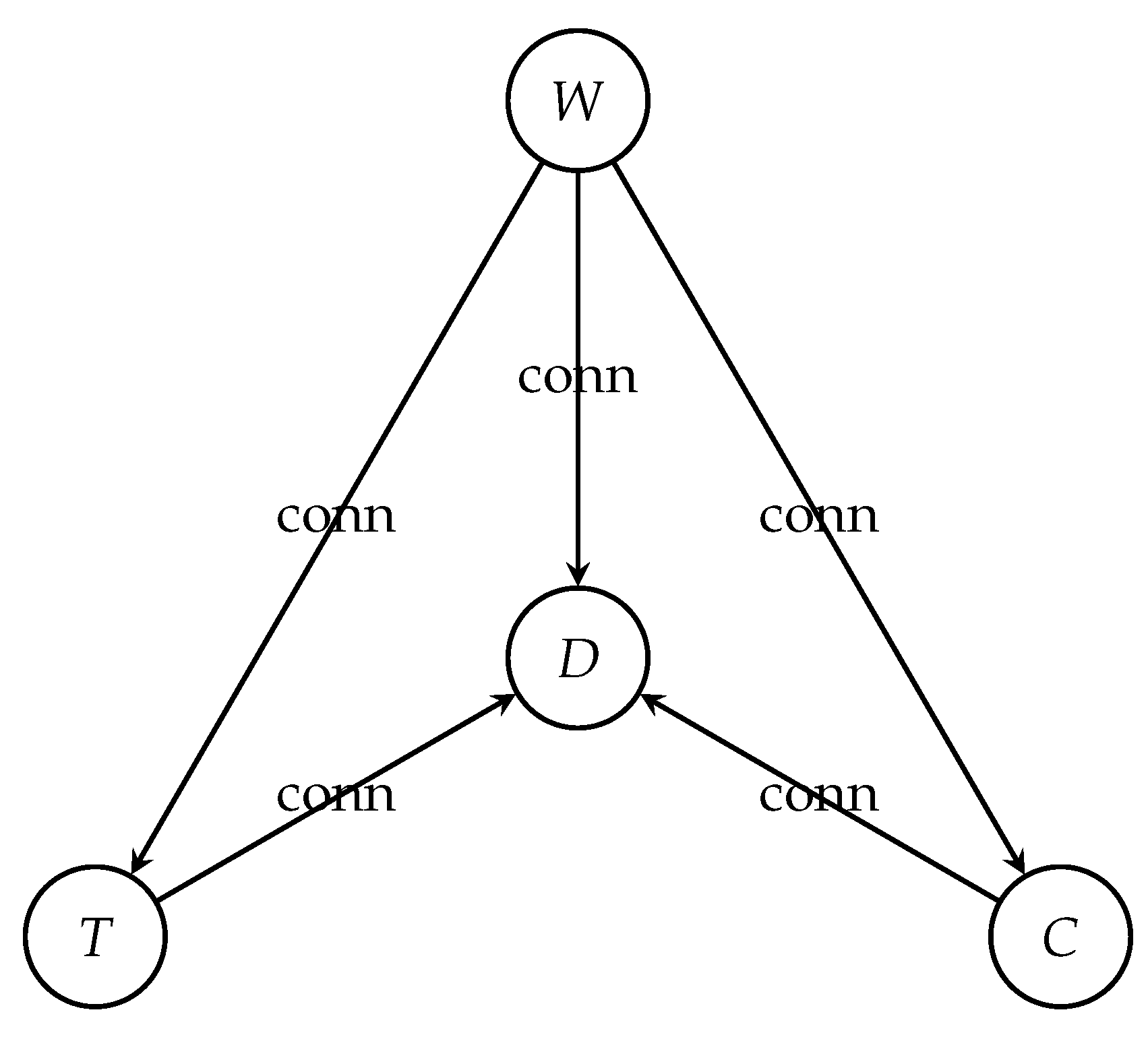
As there are potential scenarios for the complete graph in Figure 1, finding the relationships between all nodes of the graph appears to be a tedious and difficult task. However, we can identify the relationships between four of them, i.e., and where there are only potential scenarios. Equipped with Definition 5, we have the following.
Theorem 4.
Given the above notations and definitions, we have (i) (ii) (iii) (iv) and (v)
Proof.
It is sufficient for each case to present the g function in Definition 5 as follows: (i) ; (ii) ; (iii)–(v) dense in . □
Figure 2 presents a graphical overview of the results in Theorem 4. As is shown, the Weierstrass function (W) is the source-universal node with the highest out-degree connectivity; the Cantor function (C) and the Thomae function (T) are the bridging nodes; and the Dirichlet function (D) is the sink node with the highest in-degree connectivity.
Figure 2.
The graphical presentation of the relationship between well-known functions: the Cantor function (C), the Dirichlet function (D), the Thomae function (T), and the Weierstrass function (W).
4. Discussion
4.1. Summary & Contributions
This work presented a finite partition of the function spaces of all real-valued functions on based on cardinality, continuity, and differentiability, along with constructive examples representing each block of the partition. In particular, it showed that the well-known Cantor function, the Dirichlet function, the Thomae function, and the Weierstrass function each represented a unique block of this partition. An additional aspect that adds more importance to these four functions is that they collectively appeared in the representation of almost two-thirds of the blocks. Furthermore, the concept of Connection among real-valued functions was introduced, and the unique connection relation between the mentioned functions was investigated.
Finally, this work’s findings add more prominence to the Cantor set C as well. While it had a remarkable presence in the construction of the representative functions of blocks, its size (e.g., Cardinal number c) had the highest presence in the set of sizes of the representative blocks.
4.2. Limitations & Future Work
The limitations in this work are clear, and they open up new perspectives for further investigations. Firstly, we merged the cardinal number of all finite subsets of with given symbol While this inaccuracy is a minimal price to pay for enabling the creation of the aforementioned finite partition, it should be noted. Secondly, the presented graph in Figure 1 needs to be completed for all its involved nodes. Thirdly, the connection relation in Definition 5 is not an equivalence, making it suboptimal. One open problem in this regard is investigating the results in Figure 1 and Figure 2 when considering the equivalence relations mentioned in Remark 10. Finally, it is worth exploring how the equivalence relation in Definition 4 influences the structure and the number of blocks in the presented partition. When one presents a new equivalence relation on the function space by replacing some key features in the Definition 4 (such as continuity and differentiability) with other properties of real-valued functions on the real line (such as integrability, measurability, etc.), the structure and number of the blocks of the presented partition may change. This modification opens doors to many other uncultivated areas of partition representation of the function space
4.3. Conclusions
This work presented a constructive and finite partition-based description of the function space of all real-valued functions on which has formerly been characterized by its pure existential infinite dimensional base. Additionally, it presented the concept of the “Connection” between elements of this space.
Funding
This research received no external funding.
Institutional Review Board Statement
Not applicable.
Informed Consent Statement
Not applicable.
Data Availability Statement
Not applicable.
Acknowledgments
The author is grateful to the journal reviewers for their constructive comments and suggestions on the first draft of the manuscript.
Conflicts of Interest
The author declares no conflict of interest.
References
- Medvedev, F.A. Scenes from the History of Real Functions, 1st ed.; Birkhäuser Basel eBooks; Springer: Basel, Switzerland, 1991; pp. 11–14. [Google Scholar]
- Mayo-Wilson, C. Structural Chaos. Philos. Sci. 2015, 82, 1236–1247. [Google Scholar] [CrossRef]
- Waaldijk, F. On the Foundations of Constructive Mathematics–Especially in Relation to the Theory of Continuous Functions. Found. Sci. 2005, 10, 249–324. [Google Scholar] [CrossRef]
- Troelstra, A.S.; van Dalen, D. Constructivism in Mathematics: An Introduction, 1st ed.; Two Volumes; Elsevier Science: Amsterdam, The Netherlands, 1988. [Google Scholar]
- Pugh, C.C. Real Mathematical Analysis, 1st ed.; Undergraduate texts in mathematics; Springer Science Business Media: New York, NY, USA, 2002; pp. 223–225. [Google Scholar]
- Hairer, E.; Wanner, G. Analysis by Its History, 1st ed.; Springer Science+Business Media, LLC.: New York, NY, USA, 2008. [Google Scholar]
- Stillwell, J. The Real Numbers: An Introduction to Set Theory and Analysis, 1st ed.; Springer: Basel, Switzerland, 2013. [Google Scholar]
- Royden, H.L.; Fitzpatrick, P. Real Analysis, 5th ed.; Pearson: Upper Saddle River, NJ, USA, 2023. [Google Scholar]
- Lin, S.T.; Lin, Y. Set Theory with Applications, 2nd ed.; Manner Publishing Company Inc.: Tampa, FL, USA, 1981; pp. 147–149. [Google Scholar]
- Soltanifar, M. On A Sequence of Cantor Fractals. Rose-Hulman Undergrad. Math. J. 2006, 7, 9. [Google Scholar]
- Soltanifar, M. A Different Description of A Family of Middle-a Cantor Sets. Am. J. Undergrad. Res. 2006, 5, 9–12. [Google Scholar] [CrossRef]
- Lipshutz, S. Schaum’s Ouline of Theory and Problems of Linear Algebra, SI ed.; McGraw Hill International: Singapore, 1981; pp. 64, 83. [Google Scholar]
- Ventre, A.G.S. Calculus and Linear Algebra: Fundamentals and Applications; Springer: Basel, Switzerland, 2023; p. 338. [Google Scholar]
- Aron, R.M.; Gurariy, V.I.; Seoane, J. Lineability and spaceability of sets of functions on R. Proc. Am. Math. Soc. 2004, 133, 795–803. [Google Scholar] [CrossRef]
- Dunham, W. The Calculus Gallery: Masterpieces from Newton to Lebesgue; Princeton University Press: Princeton, NJ, USA, 2018; pp. 100, 142, 149. [Google Scholar]
- Bass, R.F. Real Analysis for Graduate Students, 2nd ed.; Createspace Independent Publishing: Scotts Valley, CA, USA, 2013; pp. 28–29. [Google Scholar]
- Gelbaum, B.R.; Olmsted, J.M.H. Counterexamples in Analysis; Courier Corporation; Dover Publications, Inc.: Mineola, NY, USA, 2003; pp. 22, 27, 38–39. [Google Scholar]
- Bourchtein, A.; Bourchtein, L. Counterexamples: From Elementary Calculus to the Beginnings of Analysis; CRC Press: Boca Raton, FL, USA, 2014; pp. 37, 45, 65. [Google Scholar]
- Dovgoshey, O.; Martio, O.; Ryazanov, V.; Vuorinen, M. The Cantor function. Expo. Math. 2006, 24, 1–37. [Google Scholar] [CrossRef]
- Beatty, T.; Hansen, B. Pringsheim Convergence and the Dirichlet Function. Adv. Pure Math. 2016, 6, 441–445. [Google Scholar] [CrossRef][Green Version]
- Beanland, K.; Roberts, J.W.; Stevenson, C. Modifications of Thomae’s function and differentiability. Am. Math. Mon. 2009, 116, 531–535. [Google Scholar] [CrossRef]
- Johnsen, J. Simple Proofs of Nowhere-Differentiability for Weierstrass’s Function and Cases of Slow Growth. J. Fourier Anal. Appl. 2010, 16, 17–33. [Google Scholar] [CrossRef]
- Bressoud, D. A Radical Approach to Lebesgue’s Theory of Integration; Cambridge University Press/Mathematical Association of America: Cambridge, MA, USA, 2008; pp. 91–94. [Google Scholar]
- Hodel, R. “Chapter 1: Cardinal Functions I.” Handbook of Set-Theoretic Topology; Elsevier Science Publishers B.V.: Amsterdam, The Netherlands, 1984; pp. 39–40. [Google Scholar]
Disclaimer/Publisher’s Note: The statements, opinions and data contained in all publications are solely those of the individual author(s) and contributor(s) and not of MDPI and/or the editor(s). MDPI and/or the editor(s) disclaim responsibility for any injury to people or property resulting from any ideas, methods, instructions or products referred to in the content. |
© 2023 by the author. Licensee MDPI, Basel, Switzerland. This article is an open access article distributed under the terms and conditions of the Creative Commons Attribution (CC BY) license (https://creativecommons.org/licenses/by/4.0/).