


Abstract
The exploration of contractive inequalities which do not imply the continuity of the mapping at fixed points was an interesting open problem for quite some time. A significant amount of progress was made in the last two decades towards the solution of this problem. In the current paper, we attempt to address the question of discontinuity at fixed point with the help of F-contractions in a metric space. We establish a common fixed-point (CFP) result for such contractive mappings and investigate its discontinuity at the CFP. A fixed-circle result is also obtained consequently.
Keywords:
discontinuity; fixed point; common fixed point; F-contraction; complete metric space; fixed-circle MSC:
47H10; 54H25; 54E50
1. Introduction and Preliminaries
The well-known contractive inequality due to Stefan Banach forces the mapping to be continuous. However, the investigation of discontinuity at fixed points was initiated by Kannan in his 1968–69 papers [1,2]. All the familiar mappings at that point of time exhibited continuity at the fixed points in spite of the fact that they admitted points of discontinuity within their domains [3,4,5]. In 1977, Rhoades [6] presented a comparative study of 250 contractive definitions and noticed that many of those definitions did not imply the continuity of the mappings in their respective domains. Motivated by this, in 1988, Rhoades [7] posed the open problem of exploring contractive definitions which do not compel the mapping to be continuous at fixed points. Pant [8], in 1999, gave a positive answer to this exploration by constructing mappings which exhibited discontinuity at their fixed points.
Fixed-point results for mappings with discontinuity are well sought-after because of their wide variety of applications in neural networks, character recognition, and the solution of non-negative sparse approximation problems [9,10,11,12,13]. Recently, this study gained immense popularity and various authors have provided affirmative solution to the problem posed by Rhoades (see Bisht and Rakocević [14], Pant et al. [15], Tas and Ozgur [16], Ozgur and Tas [17]).
In this paper, we attempt to address the issue of discontinuity at fixed point with the help of a class of F-contractive mappings in a metric space (MS). Throughout this manuscript, we use the standard symbol ⟹ to denote “implies”.
In 2012, Wardowski [18] defined the concept of F-contraction as follows.
Definition 1.
Let be a function which satisfies the following:
- (F1)
- F is strictly increasing;
- (F2)
- For each sequence , if and only if
- (F3)
- There is such that
Let denote the class of all such functions F. If is an MS, then a self-map is said to be an F-contraction if there exist , , such that for all ,
We divide the main results of this paper into two sections. The first section deals with a CFP result where the mappings under consideration are discontinuous at the CFP. In the second section, we present a fixed-circle result without assuming completeness of the MS. For some more interesting relevant works, we refer to [19,20,21,22,23,24].
2. Common Fixed Point with Discontinuity of the Contraction
In this section, we establish a CFP result and study discontinuity at the CFP.
The following notation will be used.
Theorem 1.
Let be a complete MS and be a pair of self-maps such that there exist and satisfying
- (i)
- for all , where has the property for each ;
- (ii)
- For a given , there exist such that implies that .
Then, the pair possesses a CFP, say ω, and , for each . Moreover, Φ and Ψ happen to be discontinuous at ω if and only if or .
Proof.
Fix such that and . Construct the sequence by and for . We denote .
Using of the hypothesis, we have
Now,
If , then using condition of the hypothesis and a property of , we have that , which is a contradiction. Thus, we must have .
So, from (2),
Similarly, one can show that
Using mathematical induction, we obtain that
Thus, is a strictly decreasing sequence of positive reals and hence converges to, say d. If possible, suppose that . Obviously, there exists such that for , we have
Using of the hypothesis and the fact that , we have that for all , which contradicts (3). Thus, we have .
Next, using a similar technique as in [17] we can show that is Cauchy.
Since is complete, there exists a point such that as . In addition, we have that and as .
Next, we show that is a CFP of and .
If possible, suppose that . From condition of the hypothesis and generalizing inequality (1), we have that
Letting in the last inequality, we have that
which is a contradiction. Hence, . Similarly, it follows that . Thus, is a CFP of and .
To prove the next part, let and .
Using definition of , we have that
Again, using definition of , we have that
The converse of this part can also be proved using similar techniques.
Hence, at least one and is discontinuous at if and only if or . □
Remark 1.
If in the above theorem, we obtain a fixed point result.
Below, we provide an example to validate Theorem 1.
Example 1.
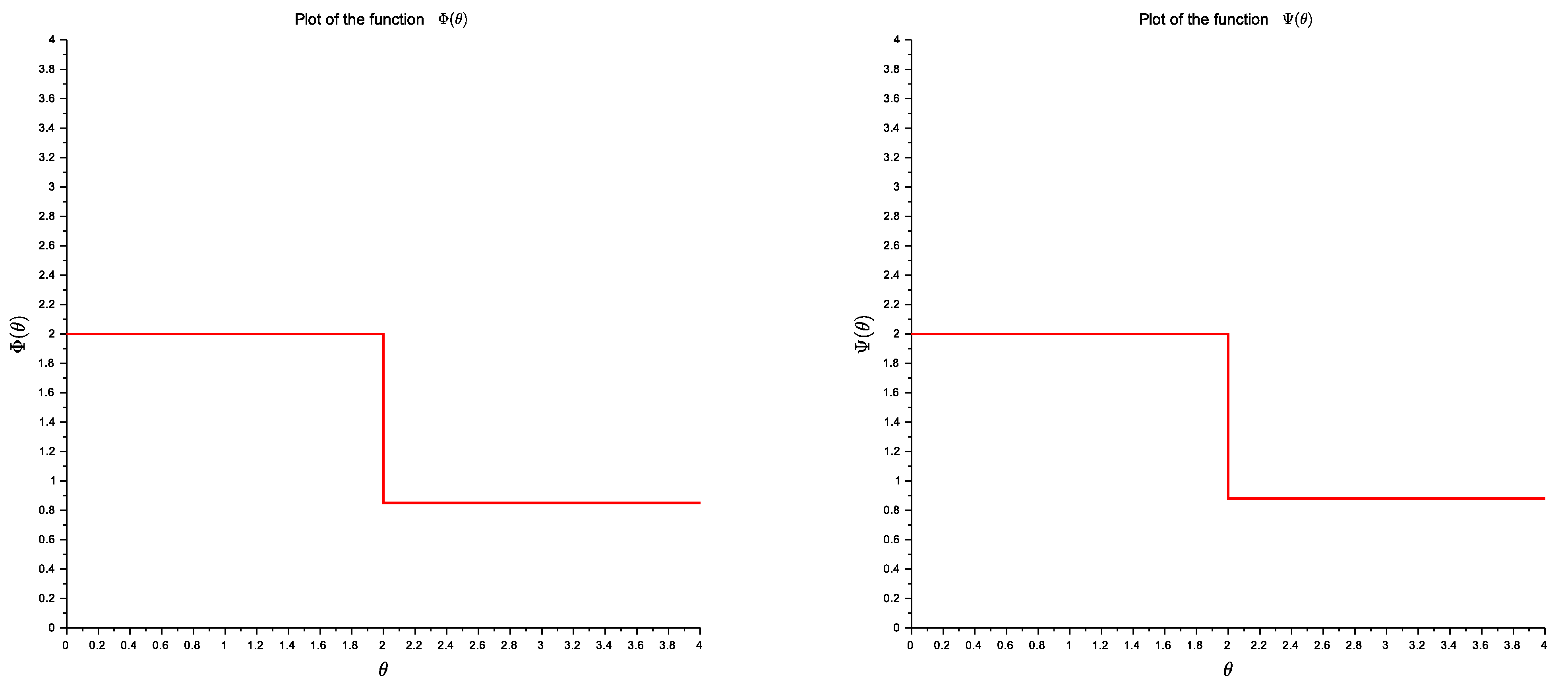
Let be endowed with the usual metric η. Define by
and
Then, is a CFP of and both the mappings are discontinuous at (see Figure 1).
Figure 1.
Plot of the functions and .
Φ and Ψ satisfy condition of Theorem 1 with , , and
Further, satisfy condition (ii) of Theorem 1 with
We also observe that and .
3. A Fixed-Circle Result
In situations when the fixed point of a self-map is not unique, the study of geometric properties of fixed points becomes important. In certain cases, the fixed set of a mapping happens to be the unit circle and sometimes the fixed set contains a circle. Such findings initiated the study of fixed-circle problems.
In this section, we present a fixed-circle result by dropping the completeness of the MS.
We shall use the following notation which was recently used by Ozgur and Tas [17] to describe some interesting fixed circle-problems, where is a self-map on the MS.
By , we denote a circle , whereas by , we denote a disk .
Theorem 2.
Let be an MS and be a self-map. Define . If there exist , and satisfying
- (i)
- For all , there exists such that
- (ii)
- For all ,where has the property for each .
Then, and is a fixed circle of Φ. Further, the disk is fixed by Φ. In addition, Φ is discontinuous at if and only if .
Proof.
Let and so that . By condition of the hypothesis, we have that
Rest of the proof can be obtained in a similar manner as in the proof of Theorem 2.3 in [17]. □
The next example shows that the converse of Theorem 2 is not true in general.
Example 2.
Let and be defined as
where .
Then, Φ does not satisfy condition for any and , and , .
However, Φ fixes every circle with .
4. Conclusions and Future Work
In the current work, we presented some new results on discontinuity at fixed points with the help of F-contractive inequalities. Bisht and Pant [25] elucidated actual physical circumstances on the applicability of such discontinuity results. The McCulloch–Pitts model is a widely sought-after and prominent model in Artificial Intelligence and Biology, which describes algorithms for neural networks to reduce and optimize the aberration of neurons from its limiting equilibrium condition. Such a stabilization can be modeled with the help of fixed points of some specific mappings. The functions derived from this procedure exhibit discontinuity at a fixed point the reason of which is a jump in the threshold frequency. Therefore, these discontinuity results always have potential application in neural networks. We refer to the works listed in [26,27,28] for details about these models. Obtaining multivalued analogues of the current results using the framework as in [29,30] and the analogues in terms of enriched contractions as in [31] are also interesting suggested future work.
Funding
This research received no external funding.
Institutional Review Board Statement
Not applicable.
Informed Consent Statement
Not applicable.
Data Availability Statement
Not applicable.
Acknowledgments
The author expresses his hearty gratitude to all the learned referees for their constructive comments which have improved the manuscript. The graphs in this manuscript have been created by the free and open-source software SciLab-6.1.0.
Conflicts of Interest
The author declares that he has no known competing financial interests or personal relationships with anyone that could have appeared to influence the work reported in this paper.
References
- Kannan, R. Some results on fixed points. Bull. Calc. Math. Soc. 1968, 60, 71–77. [Google Scholar]
- Kannan, R. Some results on fixed points—II. Am. Math. Mon. 1969, 76, 405–408. [Google Scholar]
- Boyd, D.W.; Wong, J.S. On nonlinear contractions. Proc. Am. Math. Soc. 1969, 20, 458–464. [Google Scholar] [CrossRef]
- Ćirić, L. On contraction type mappings. Math. Balk. 1971, 1, 52–57. [Google Scholar]
- Ćirić, L. A generalization of Banach’s contraction principle. Proc. Am. Math. Soc. 1974, 45, 267–273. [Google Scholar] [CrossRef] [Green Version]
- Rhoades, B.E. A comparison of various definitions of contractive mappings. Trans. Am. Math. Soc. 1977, 226, 257–290. [Google Scholar] [CrossRef]
- Rhoades, B.E. Contractive definitions and continuity. Contemp. Math. 1988, 42, 233–245. [Google Scholar]
- Pant, R. Discontinuity and fixed points. J. Math. Anal. Appl. 1999, 240, 284–289. [Google Scholar] [CrossRef] [Green Version]
- Forti, M.; Nistri, P. Global convergence of neural networks with discontinuous neuron activations. IEEE Trans. Circuits Syst. I Fundam. Theory Appl. 2003, 50, 1421–1435. [Google Scholar] [CrossRef]
- Nie, X.; Zheng, W.X. On Multistability of competitive neural networks with discontinuous activation functions. In Proceedings of the 4th Australian Control Conference (AUCC), Canberra, Australia, 17–18 November 2014; pp. 245–250. [Google Scholar]
- Nie, X.; Zheng, W.X. Multistability of neural networks with discontinuous non-monotonic piecewise linear activation functions and time-varying delays. Neural Netw. 2015, 65, 65–79. [Google Scholar] [CrossRef]
- Nie, X.; Zheng, W.X. Dynamical behaviors of multiple equilibria in competitive neural networks with discontinuous nonmonotonic piecewise linear activation functions. IEEE Trans. Cybernatics 2015, 46, 679–693. [Google Scholar] [CrossRef] [PubMed]
- Wu, H.; Shan, C. Stability analysis for periodic solution of BAM neural networks with discontinuous neuron activations and impulses. Appl. Math. Model. 2017, 33, 2564–2574. [Google Scholar] [CrossRef]
- Bisht, R.K.; Rakocević, V. Generalized Meir-Keeler type contractions and discontinuity at fixed point. Fixed Point Theory 2018, 19, 57–64. [Google Scholar] [CrossRef]
- Pant, R.P.; Ozgur, N.; Tas, N. On discontinuity problem at fixed point. Bull. Malays. Math. Sci. Soc. 2020, 43, 499–517. [Google Scholar] [CrossRef]
- Tas, N.; Ozgur, N. A new contribution to discontinuity at fixed point. Fixed Point Theory 2019, 20, 715–728. [Google Scholar] [CrossRef] [Green Version]
- Ozgur, N.; Tas, N. New discontinuity results at fixed point on metric spaces. J. Fixed Point Theory Appl. 2021, 23, 1–14. [Google Scholar] [CrossRef]
- Wardowski, D. Fixed points of a new type of contractive mappings in complete metric space. Fixed Point Theory Appl. 2012, 2012, 94. [Google Scholar] [CrossRef] [Green Version]
- Acar, O. Some fixed-point results via mix-type contractive condition. J. Funct. Spaces 2021, 2021, 5512254. [Google Scholar] [CrossRef]
- Afassinou, K.; Mebawondu, A.A.; Abbas, H.A.; Narain, O.K. Existence of solution of differential and Riemann-Liouville equation via fixed point approach in complex valued b-metric spaces. Aust. J. Math. Anal. Appl. 2021, 18, 1–15. [Google Scholar]
- Ćirić, L. Some Recent Results in Metrical Fixed Point Theory; University of Belgrade: Beograd, Serbia, 2003. [Google Scholar]
- Debnath, P. A new extension of Kannan’s fixed point theorem via F-contraction with application to integral equations. Asian-Eur. J. Math. 2021, 2250123. [Google Scholar] [CrossRef]
- Debnath, P.; Konwar, N.; Radenović, S. Metric Fixed Point Theory: Applications in Science, Engineering and Mathematical Sciences; Springer: Singapore, 2021. [Google Scholar]
- Mebawondu, A.A.; Izuchukwu, C.; Aremu, K.O.; Mewomo, O.T. Some fixed point results for a generalized TAC-Suzuki-Berinde type F-contractions in b-metric spaces. Appl. Math. E-Notes 2019, 19, 629–653. [Google Scholar]
- Bisht, R.K.; Pant, R.P. A remark on discontinuity at fixed point. J. Math. Anal. Appl. 2017, 445, 1239–1242. [Google Scholar] [CrossRef]
- Cromme, L.J. Fixed point theorems for discontinuous functions and applications. Nonlinear Anal. 1997, 30, 1527–1534. [Google Scholar] [CrossRef]
- Cromme, L.J.; Diener, I. Fixed point theorems for discontinuous mapping. Math. Program. 1991, 51, 257–267. [Google Scholar] [CrossRef]
- Todd, M.J. The Computation of Fixed Points and Applications; Springer: New York, NY, USA, 1976. [Google Scholar]
- Debnath, P. Banach, Kannan, Chatterjea, and Reich-type contractive inequalities for multivalued mappings and their common fixed points. Math. Meth. Appl. Sci. 2022, 45, 1587–1596. [Google Scholar] [CrossRef]
- Debnath, P. Optimization through best proximity points for multivalued F-contractions. Miskolc Math. Notes 2021, 22, 143–151. [Google Scholar] [CrossRef]
- Debnath, P. New common fixed point theorems for Gornicki-type mappings and enriched contractions. Sao Paulo J. Math. Sci. 2022, in press. [Google Scholar] [CrossRef]
Publisher’s Note: MDPI stays neutral with regard to jurisdictional claims in published maps and institutional affiliations. |
© 2022 by the author. Licensee MDPI, Basel, Switzerland. This article is an open access article distributed under the terms and conditions of the Creative Commons Attribution (CC BY) license (https://creativecommons.org/licenses/by/4.0/).

