Abstract
Domination in graphs has been extensively studied and adopted in many real life applications. The monitoring electrical power system is a variant of a domination problem called power domination problem. Another variant is the zero forcing problem. Determining minimum cardinality of a power dominating set and zero forcing set in a graph are the power domination problem and zero forcing problem, respectively. Both problems are -complete. In this paper, we compute the power domination number and the zero forcing number for fully connected cubic networks.
Keywords:
dominating set; power dominating set; zero forcing set; electrical power network; fully connected cubic networks MSC:
05C69
1. Introduction
Monitoring electrical power systems by placing as few Phase Measurement Units (PMUs) at selected regions in the system is modeled as a graph theoretic problem. The cost of such a synchronized devise is very high, and hence it is required to fetch the smallest set of devices while maintaining the ability to supervise the entire system. In 2002, Hayens et al. [1] considered this problem as the power domination problem in graphs, which is a variation of the domination problem. An electric power network is designed by a graph where the vertices represent the electric nodes and the edges are associated with the transmission lines joining two electrical nodes. In 2012, Paul Dorbec et al. [2] presented the idea of a k-power domination problem, which is a generalization of power domination problem in graphs.
A graph is defined as a nonempty set of vertices together with a set of edges joining certain pairs of vertices. Vertices u and v are said to be adjacent if u and v are the end vertices of an edge in G. For , the set of all vertices adjacent to u are said to be in the neighbors of u and is denoted by . Then, the closed neighborhood of u is defined as .
A subset in a graph is said to be a domination set G if every vertex in V is either in S or is adjacent to some vertices in S [1]. In 2002, Haynes et al. introduced power domination by formulating propagation rules in terms of vertices and edges in a graph.
Let G be a graph with a vertex set V. Let . Vertices monitored by K at level i, , inductively are as follows:
- .
- , .
At some stage, if K monitors the entire vertex set V, we say that K is a power dominating set of G. The minimum cardinality of power dominating set of G is called the power domination number of G and is denoted by [3].
The zero forcing process can be treated as a coloring process on the vertices of the graph. If vertex x is colored red and exactly one neighbor y of x is green, then change the color of y to red, and we say that x forces y. A zero forcing set for G is a subset of vertices H such that if initially the vertices in H are colored red and the remaining vertices are colored green, then repeated application of the above process can color all vertices of G red. The cardinality of a minimum zero forcing set of G is represented by [3]. It is customary to address ’red vertices’ as monitored vertices and the ’green vertices’ as unmonitored vertices.
The power domination problem is NP-complete [1]. Bounds on the power domination number for any graph G were obtained in [1]. The power domination problem studied for trees [1] and grids [4], split graphs [5]. Barrera et al. [6] studied Power domination in petersen graphs. Cockayne et al. [7] presented new concepts of domination in graphs. Chen et al. [8] investigated networks with complete connection. Dorbec et al. [9] defined power domination in product graphs. Ho et al. [10] given hamiltonian connectivity in fully connected cubic networks. Kosari et al. [11,12] studied double roman domination and total domination in graphs. Xu et al. [13] introduced power domination in block graphs. Zhao et al. [14] presented new results of power domination in graph theory.
2. Fully Connected Cubic Networks (FCCNs)
are networks that provide excellent expandability. Optical and electronic technologies can be utilized in to build a new hybrid computer architecture.
Let . of level denoted by , is defined recursively as follows [15]:
- has the set of integers modulo 8 as the node set and all ordered pairs as the edge set.
- When is built from eight node-disjoint copies of by adding 28 edges. Specifically, if, for , we let denote a copy of with each node being prefixed with k, then is defined by:,For is named an -level sub- of , or simply a sub- of , if there is no uncertainty.
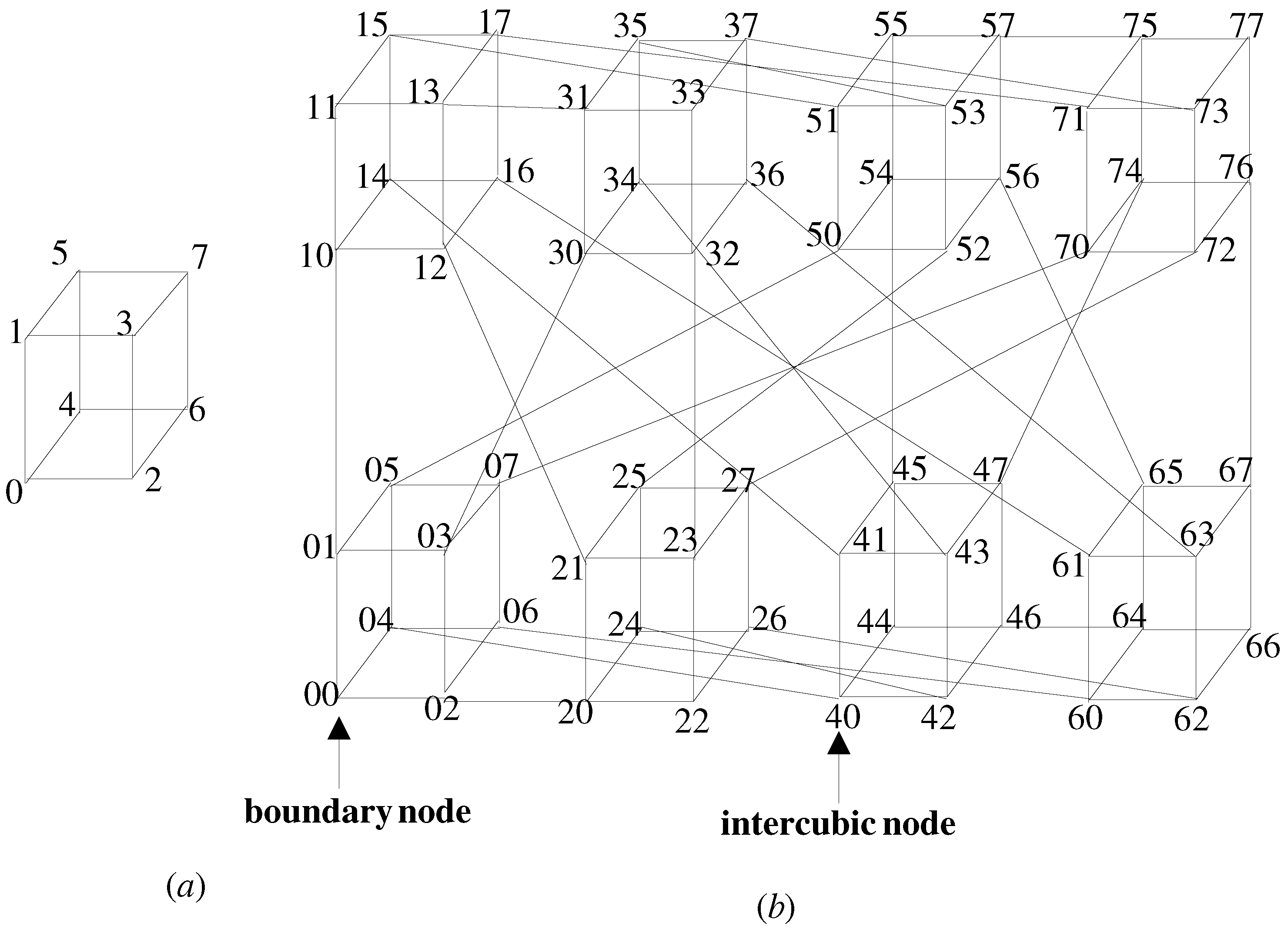
- Given an , a boundary node is a node of the form . An is an edge of the form . Each of is of degree 4 except the boundary nodes of degree 3. Obviously, has seven and one boundary node for and [15] (see Figure 1).
Figure 1. FCCNs (a) (b) with as boundary nodes.
Note: In what follows, we denote by .
Remark 1.
has nodes, eight of which degree 3 and the rest nodes of degree 4. has edges. Its diameter is . For , each level i contains node disjoint copies of . This implies that there are node disjoint copies of in .
3. Main Results
In this section, we compute PDN and ZFN for .
3.1. Power Domination in
We obtain lower bounds for the of , and prove that the bounds are sharp.
Lemma 1.
The power domination number of is at least 4. In other words .
Proof.
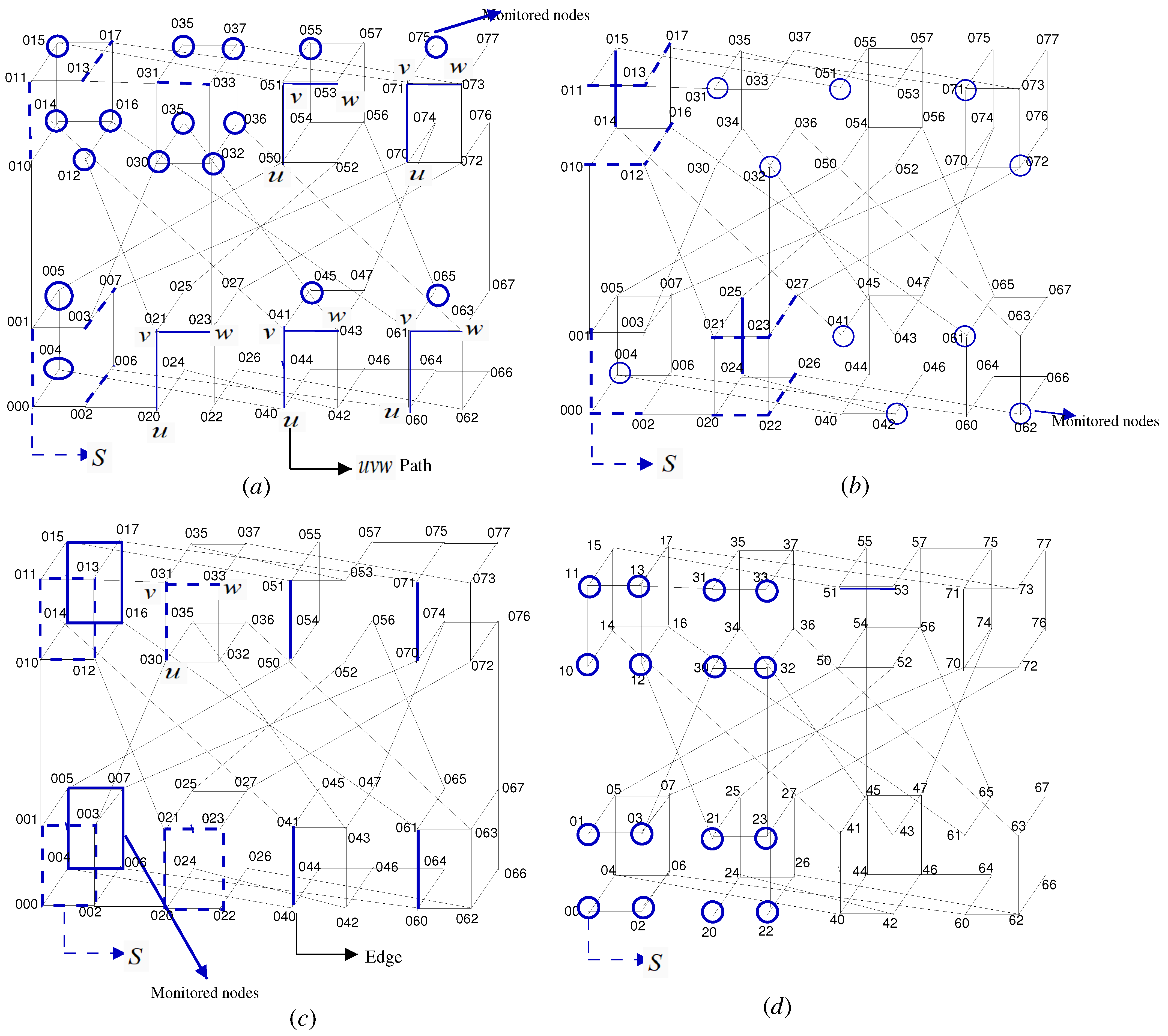
contains eight node disjoint copies of , say . Let S be a of G. We claim that . Suppose , any node in is neighbor to at most one node of . This implies that every node in is neighbor to at least three unmonitored nodes, a contradiction. Therefore, (see Figure 2a). Suppose . Then, S can monitor at most two nodes of , each of which is neighbor to at least two unmonitored nodes, a contradiction. Therefore, (see Figure 2b).
Figure 2.
Circled vertices indicates in (a–d) be a PDS of .
Suppose . Then, S can monitor at most three nodes of each . No three nodes in induce an independent set. Hence, these three nodes induce an edge and an isolated node. Then, each end node of the edge is neighbor to two unmonitored nodes, and the independent node is neighbor to three unmonitored nodes, a contradiction (see Figure 2c). On the other hand, if three nodes induce a path say, , then u and w are neighbor to two unmonitored nodes each and v is neighbor to exactly one unmonitored node, which in turn is neighbor to at least two unmonitred nodes, a contradiction (see Figure 2d). Therefore, . Hence, nodes in S are in at least 4 copies of . Therefore, . □
Lemma 2.
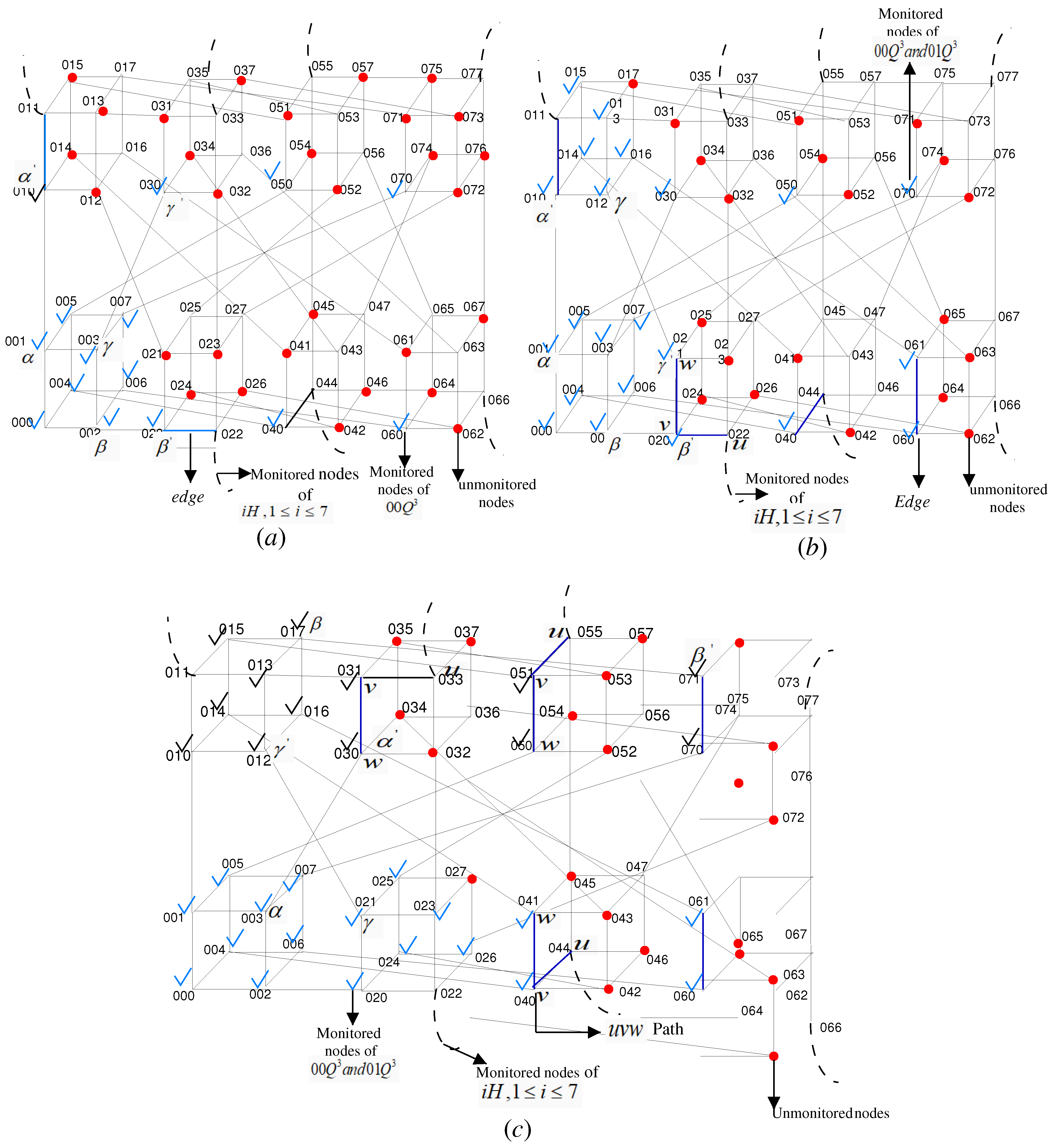
Let S be a PDS of and H be a subgraph of isomorphic to . Then, .
Proof.
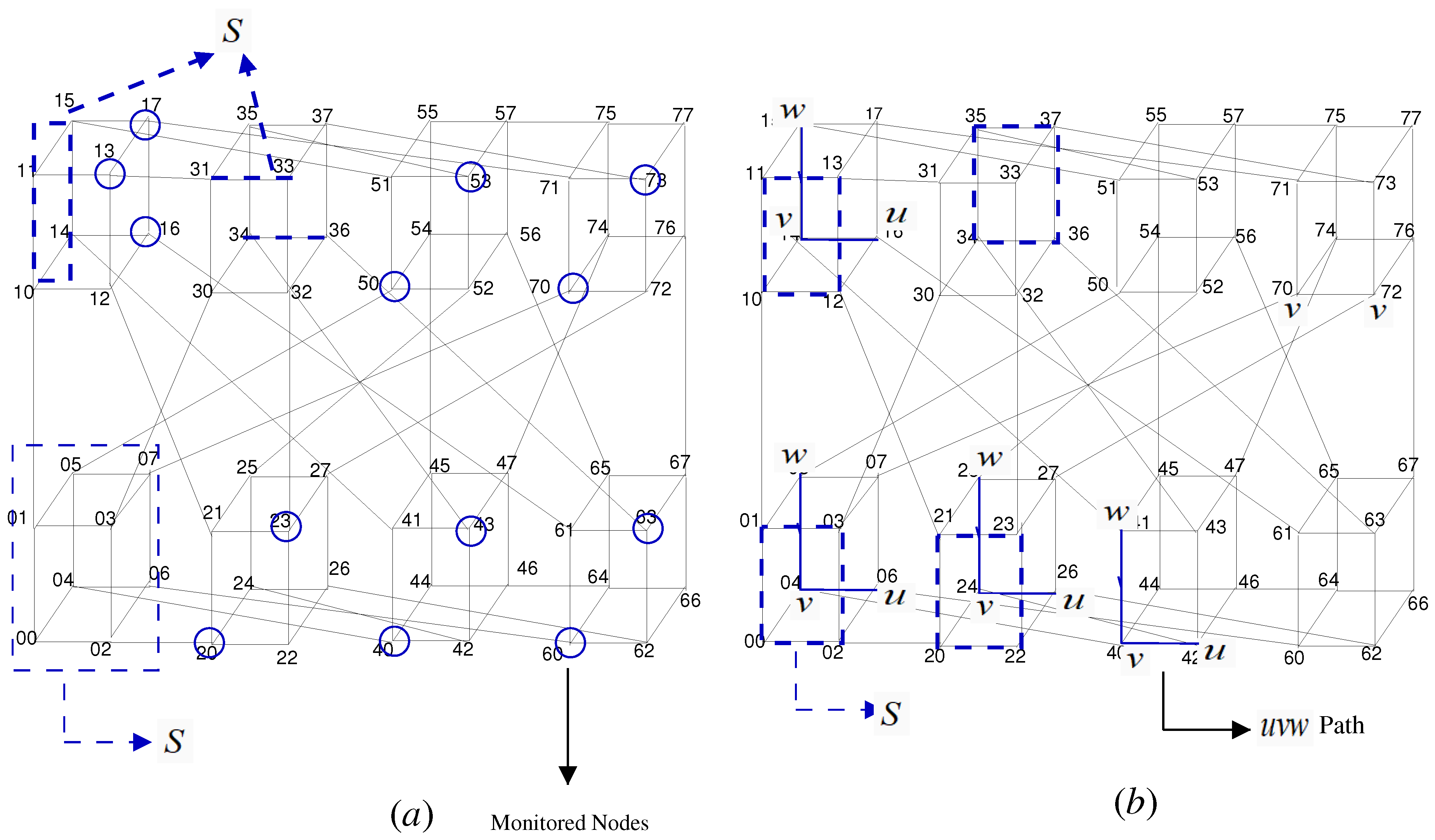
is composed of eight copies of , denoted by . Further, each contains 8 cubes as subgraphs each denoted by . Consider . Let . The worst case arises when all the 7 intercubic nodes , of are monitored by nodes of S not in . Suppose . Let . Without loss of generality, let be in . Suppose and . Let and be the intercubic edges in with and in and , respectively, . Even if are neighbors, each of and is neighbor to two distinct unmonitored nodes in , a contradiction (see Figure 3a).
Figure 3.
Circled vertices indicates in (a–c) be a PDS of of .
Suppose are in and is in . Assume that and . Let and be the intercubic edges in with and in and , respectively, . Even if and induce a path, then and are neighbors to two unmonitored nodes each and is neighbor to exactly one unmonitored node, which in turn is adjacent to at least two unmonitored nodes, a contradiction (see Figure 3b).
Suppose and . Let and . Let and be the intercubic edges in with and in and , respectively, . Even if and induce a path, the nodes and are neighbor to two unmonitored nodes each and is neighbor to exactly one unmonitored node, which in turn is neighbor to at least two unmonitored nodes, a contradiction. Therefore, (see Figure 3c). □
Lemma 3.
The power domination number of is at least . In other words, .
Proof.
We prove the result by induction on r. We consider the case when . contains eight node disjoint copies of , say . Let S be a PDS of . We claim that . By Lemma 1 and Lemma 2, there are at least 4 nodes in each copy of to monitor . Hence, . Therefore, .
Assume the result is true for . That is, . Consider the case when . Let S be a PDS . We have to prove that . Suppose not, let . In , there are node disjoint copies of . With the deletion of one node from S in a copy of H, there is at least one node say, monitored by intercubic edges. With this monitored node u, we claim that 3 nodes in , one each in 3 copies of say , are not sufficient to monitor all nodes in any of . In the worst case, suppose all the nodes in the copy of containing u are all already monitored, then, the saturated node in has two unmonitored nodes neighbor to it, a contradiction. Thus, . Therefore, . □
Radix-lexicographic ordering:
Name the nodes of as follows:
- (i)
- Name the nodes of as 1 digit radix number, say by lexicographic order.
- (ii)
- Name the nodes of , as 2 digit radix number, .
- (iii)
- Inductively, name the nodes of , as r digit radix number, (see Figure 1).
The following is the Algorithm 1.
| Algorithm 1 PD Algorithm |
| Input: , with radix-lexicographic ordering. Algorithm: Select in and let in . Inductively select in . Output: , . |
Proof of Correctness.
Let be a PDS of . Consider where times. Then, node in say, where is neighbor to exactly one unmonitored node say, where . Now . Then, for every node . Now . Similarly, . Thus, . Inductively, we arrive at . □
PD Algorithm (Algorithm 1) together with Lemma 3 imply the following theorem.
Theorem 1.
The power domination number of , is . In otherwords .
3.2. Zero Forcing in
The PD process on a graph G is choosing a set and applying the ZF process to the closed neighborhood of S. The set S is a PDS of G if and only if is a ZFS for G.
The following theorem was proved in 2015 by Ferrero et al. [3], which shows the relationship between ZFS and PDS.
Theorem 2
([3]). Let G be a graph with no isolated vertices, and let be a PDS for G. Then .
Theorem 3
([3]). Let G be a graph. Then, and this bound is tight.
In what follows, we obtain a sharp lower bound for the zero forcing number of .
Lemma 4.
The zeoro forcing number of is at least 16. In other words, .
Proof.
contains eight node disjoint copies of , say . Let S be a ZFS of G. We claim that . Suppose . Then, S can monitor at most two nodes of , each of which is neighbor to at least 2 unmonitored nodes, a contradiction. Therefore, (see Figure 2b).
Suppose . Then, S can monitor at most three nodes of each . No three nodes in induce an independent set. Hence, these three nodes induce an edge and an isolated node. Each end node of the edge is neighbor to 2 unmonitored nodes and the independent vertex is neighbor to three unmonitored nodes, a contradiction (see Figure 2c). On the other hand, if three nodes induce a path, say , then u and w are neighbor to 2 unmonitored nodes each and v is neighbor to exactly one node, which in turn is neighbor to at least 2 unmonitored nodes, a contradiction (see Figure 2d). Therefore, .
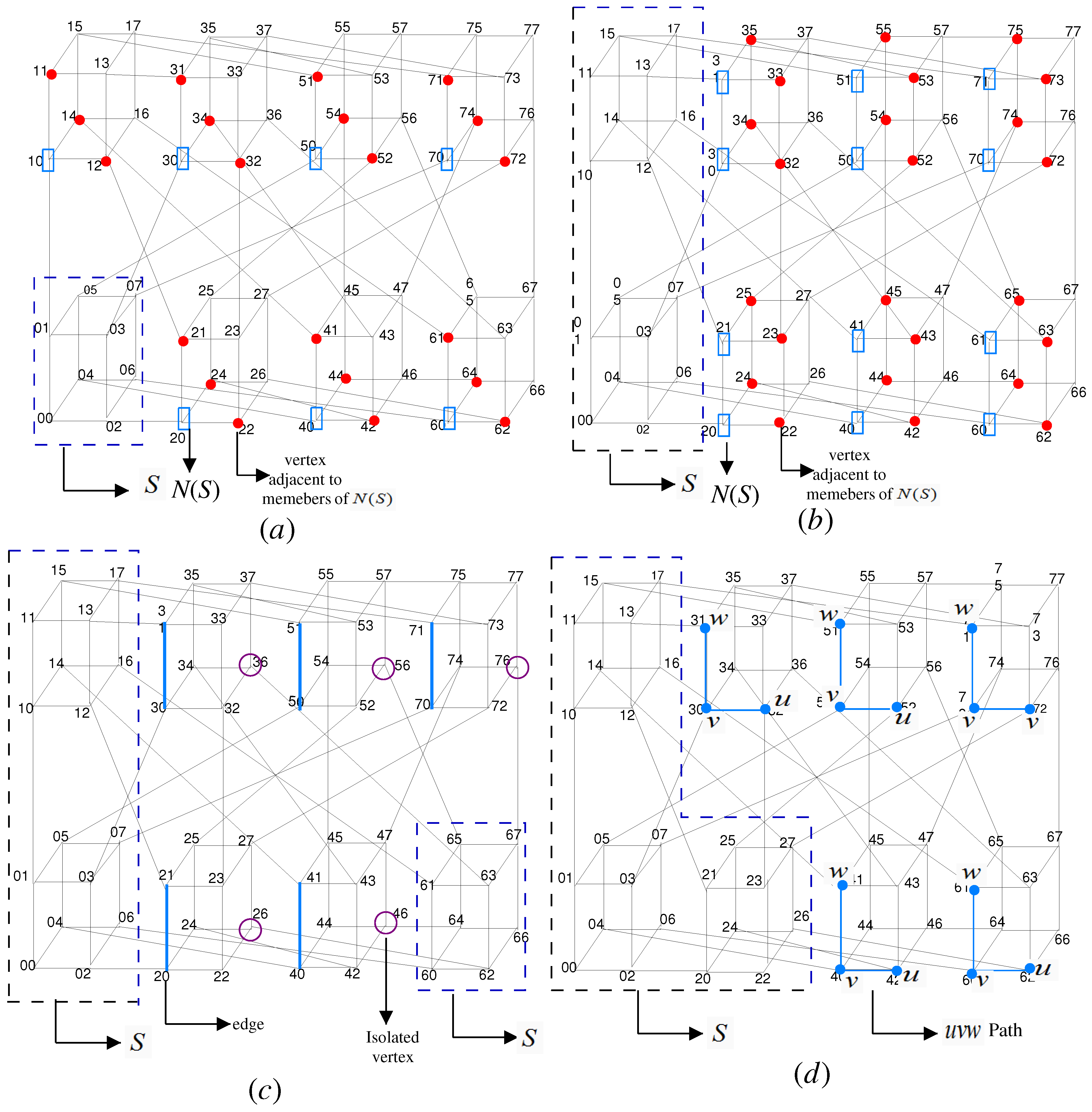
Suppose , where and . A induces four cycles and B induces two independent edges. Even if all nodes of and are monitored, S can color at most two independent nodes in as red, and each node labeled as in is neighbor to 2 unmonitored nodes, a contradiction. Therefore, (see Figure 4a).
Figure 4.
Circled vertices indicates in (a,b) be a zero forcing sets of .
Suppose , where . induces a four cycle. Then, S can induce a path say, in . Then, the end nodes of a path say, u and w are neighbor to 2 unmonitored nodes each and v is neighbor to exactly one unmonitored node which in turn is neighbor to at least 2 unmonitored nodes, a contradiction. This implies that, . Therefore, (see Figure 4b). Hence, nodes in S are in consecutive 4 cycle of at least 4 consecutive copies of . □
Lemma 5.
Let S be a zero forcing set of . Let H be a subgraph of isomorphic to . Then, .
Proof.
is composed of eight copies of , denoted by . Taking into account the symmetric nature of , without loss of generality consider . Let . The worst case arises when all the 7 intercubic nodes , of are monitored nodes of S not in . Suppose .
Let , where , each induces an edge and an independent set. Even if all nodes of and are monitored and S induces a path, say in or , then u and w are neighbor to 2 unmonitored nodes each and v is neighbor to exactly one unmonitored node, which in turn is neighbor to at least 2 unmonitored nodes, a contradiction. Therefore, (see Figure 5a).
Figure 5.
(a–c) of (d) Zero forcing sets of .
Let , where , each induce a path say, . Even if all nodes of and are monitored and suppose S induces an independent set in . Then, the independent node is neighbor to 3 unmonitored nodes, a contradiction. Therefore, (see Figure 5b).
Let , where . Even if, all nodes of and are monitored and S induces an edge in . Then, the node labeled as 23 in , and end nodes of a path say, in and each end node of an edge in is neighbor to at least 2 unmonitored nodes, a contradiction. Therefore, (see Figure 5c). □
Lemma 6.
The zero forcing number of is at least . In other words, .
Proof.
We prove the result by induction on r. We consider the case when . contains eight node disjoint copies of , say . Let S be a ZFS of . We claim that . By Lemmas 4 and 5, there are at least 16 nodes in each copy of to monitor all nodes of . Hence, . Therefore, .
Assume the result is true for . That is, . Consider the case when . Let S be a ZFS of . We have to prove that . Suppose not, let . In , there are node disjoint copies of . With the deletion of one node from S in a copy of , there is at least one node, say monitored by intercubic edges. With this monitored node u, we claim that 15 nodes in , four each in 3 copies of say , and 3 in are not sufficient to monitor all nodes in any of . In the worst case, suppose all the nodes in the copy of containing u are all already monitored, then the monitored node in has 2 unmonitored nodes adjacent to it, a contradiction. Thus, . Therefore, . □
The following is the Algorithm 2.
| Algorithm 2 ZF Algorithm |
| Input: , with radix-lexicographic ordering. Algorithm: Select in and let in . See Figure 5d. Inductively select in . Output: . |
Proof of Correctness.
Let be a ZF of . Let , where times. Every node is neighbor to exactly one unmonitored node which in turn forces exactly one unmonitored node say, where . Then, every node is neighbor to exactly one unmonitored node, which in turn forces exactly one unmonitored node say, where . In the next step, each node in A is neighbor to exactly one green node, which in turn forces exactly one green node, say where . Now, , where times is a ZFS of . This implies that . □
ZF Algorithm (Algorithm 2) together with Lemma 6 imply the following theorem.
Theorem 4.
The zero forcing number of , is . In other words, .

4. Conclusions
In this paper, we have obtained the PDN and ZFN for the fully connected cubic networks , identifying classes of graphs for which is an open problem. Another interesting line of research would be to determine the zero forcing number of networks such as hypercubes and circulant networks.
Author Contributions
Conceptualization, Y.R., S.K. and J.A.; methodology, J.A., I.R. and H.R.; validation, S.K., J.A. and I.R.; formal analysis, H.R. and I.R.; investigation, Y.R., J.A., I.R. and H.R.; data curation, Y.R., S.K., J.A., I.R. and H.R.; writing—original draft preparation, Y.R., S.K., J.A., I.R. and H.R.; writing—review and editing, J.A., I.R. and H.R.; visualization, Y.R., S.K. and H.R.; supervision, Y.R.; project administration, Y.R., S.K. and H.R.; funding acquisition, Y.R. All authors have read and agreed to the published version of the manuscript.
Funding
This work was supported by the National Key R & D Program of China (Grant 2018YFB1005100), the National Natural Science Foundation of China (No. 62172116), and the Guangzhou Academician and Expert Workstation (No. 20200115-9).
Institutional Review Board Statement
Not applicable.
Informed Consent Statement
Not applicable.
Data Availability Statement
Not applicable.
Conflicts of Interest
The authors declare no conflict of interest.
Abbreviations
The following abbreviations are used in this manuscript:
| PD | Power Domination |
| PDS | Power Dominating Set |
| PDN | Power Domination Number |
| ZF | Zero Forcing |
| ZFS | Zero Forcing Set |
| ZFN | Zero Forcing Number |
| FCCN | Fully Connected Cubic Networks |
| ICV | Intercubic Vertices |
| ICE | Intercubic Edges |
References
- Haynes, T.W.; Hedetniemi, S.M.; Hedetniemi, S.T.; Henning, M.A. Power domination in graphs applied to electrical power networks. SIAM J. Discret. Math. 2002, 15, 519–529. [Google Scholar] [CrossRef]
- Chang, G.J.; Dorbec, P.; Montassier, M.; Raspud, A. Generalized power domination of graphs. Discret. Appl. Math. 2012, 160, 1691–1698. [Google Scholar] [CrossRef]
- Benson, K.F.; Ferrero, D.; Flagg, M.; Furst, V.; Hogben, L.; Vasilevskak, V.; Wissman, B. Zero forcing and power domination for graph products. arXiv 2017, arXiv:1510.02421. [Google Scholar]
- Dorfling, M.; Henning, M. A note on Power domination problem in graphs. Discret. Appl. Math. 2006, 154, 1023–1027. [Google Scholar] [CrossRef][Green Version]
- Liao, C.S.; Lee, D.T. Power domination problems in graphs. Comput. Comb. Lect. Notes Comput. Sci. 2005, 3595, 818–828. [Google Scholar]
- Barrera, R.; Ferrero, D. Power domination in cylinders, tori, and the generalized Petersen Graphs. Networks 2009, 58, 43–49. [Google Scholar] [CrossRef]
- Cockayne, E.J.; Hedetniemi, S.T. Towards a theory of domination in graphs. Networks 1977, 7, 247–261. [Google Scholar] [CrossRef]
- Chen, G.H.; Hwang, S.C.; Huang, H.L.; Su, M.Y.; Duh, D.R. A general broadcasting scheme for recursive networks with complete connection. Parallel Comput. 2001, 27, 1273–1278. [Google Scholar] [CrossRef]
- Dorbec, P.; Mollard, M.; Klavzar, S.; Spacapan, S. Power domination in product graphs. SIAM J. Discret. Math. 2008, 22, 554–567. [Google Scholar] [CrossRef]
- Ho, T.Y.; Lin, C.K. Fault-tolerant hamiltonian connectivity and fault-tolerant hamiltonianicity of the fully connected cubic networks. J. Inf. Sci. Eng. 2009, 25, 1855–1862. [Google Scholar]
- Kosari, S.; Shao, Z.; Sheikholeslami, S.M.; Mustapha, C.R. Double roman domination graphs with minimum degree at least two and no C5-cycle. Graphs Comb. 2022, 38, 1–16. [Google Scholar] [CrossRef]
- Kosari, S.; Shao, Z.; Khoeliar, R.; Sheikholeslami, S.M.; Hao, G. On a conjucture concerning total domination subdivision number in graphs. AKCE Int. J. Graphs Comb. 2021, 18, 154–157. [Google Scholar] [CrossRef]
- Xu, G.J.; Kang, L.Y.; Shan, E.F.; Zhao, M. Power domination in block graphs. Theor. Comput. Sci. 2006, 359, 299–305. [Google Scholar] [CrossRef]
- Zhao, M.; Kang, L.; Chang, G. Power domination in graphs. Discret. Math. 2006, 306, 1812–1816. [Google Scholar] [CrossRef]
- Yanga, X.; Megson, G.M.; Evans, D.J. An oblivious shortest-path routing algorithm for fully connected cubic networks. J. Parallel Distrib. Comput. 2006, 66, 1294–1303. [Google Scholar] [CrossRef]
Publisher’s Note: MDPI stays neutral with regard to jurisdictional claims in published maps and institutional affiliations. |
© 2022 by the authors. Licensee MDPI, Basel, Switzerland. This article is an open access article distributed under the terms and conditions of the Creative Commons Attribution (CC BY) license (https://creativecommons.org/licenses/by/4.0/).