Application of Machine Learning to Study the Association between Environmental Factors and COVID-19 Cases in Mississippi, USA


Abstract
1. Introduction
2. Materials and Methods
2.1. Data Sources
2.2. Analytical Procedures
2.3. Machine Learning Model
3. Results
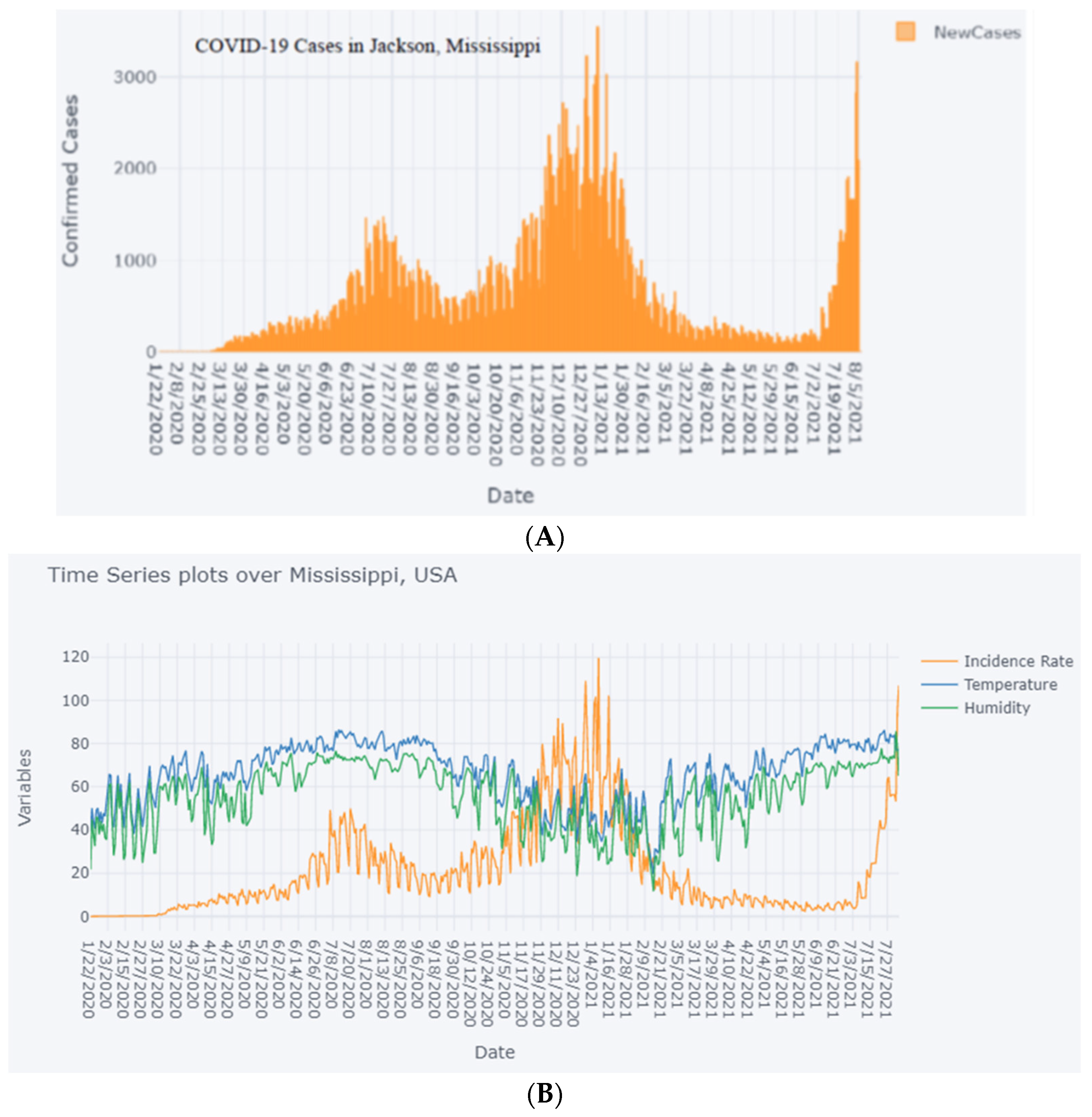
3.1. Time Series Analysis Results
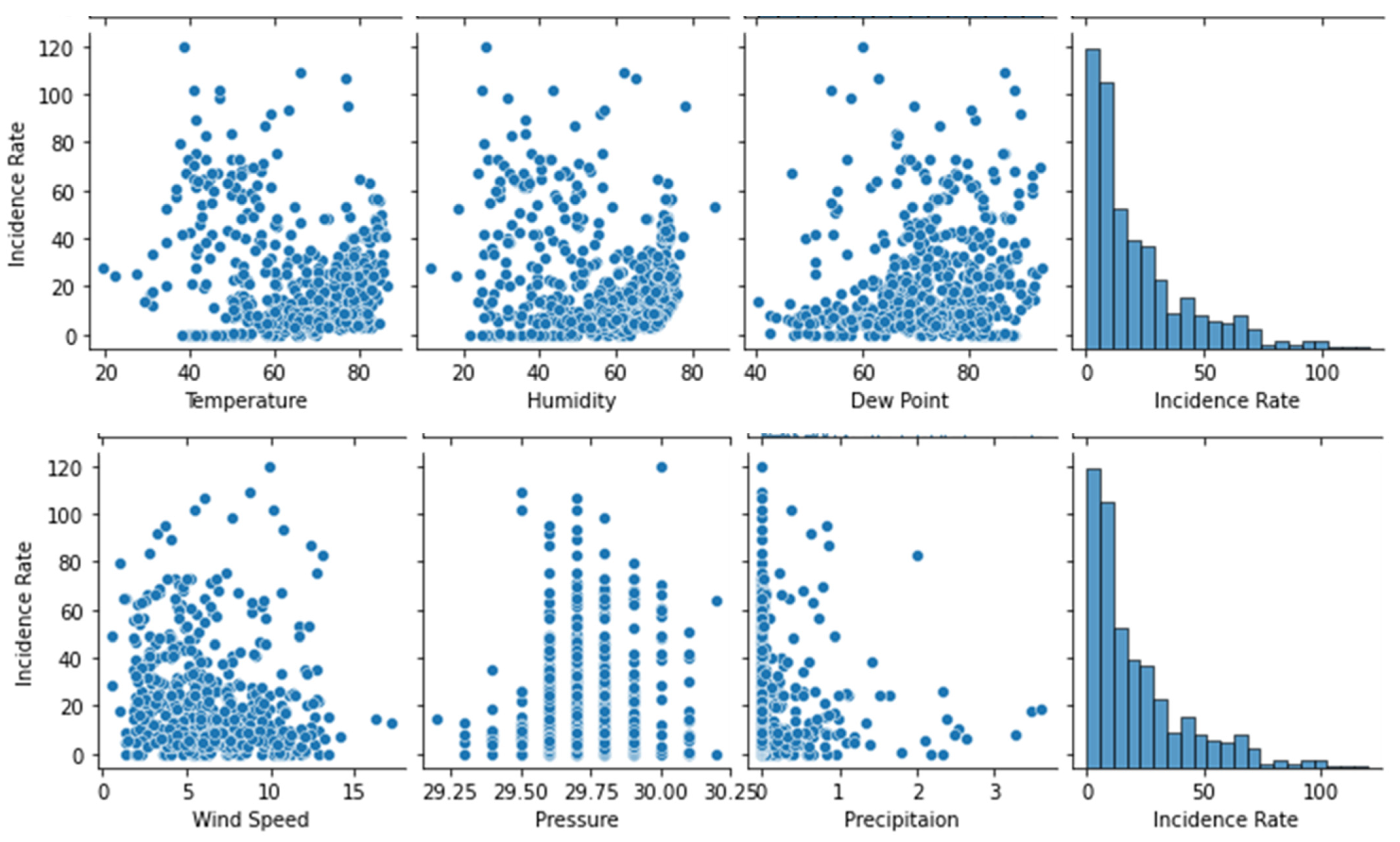
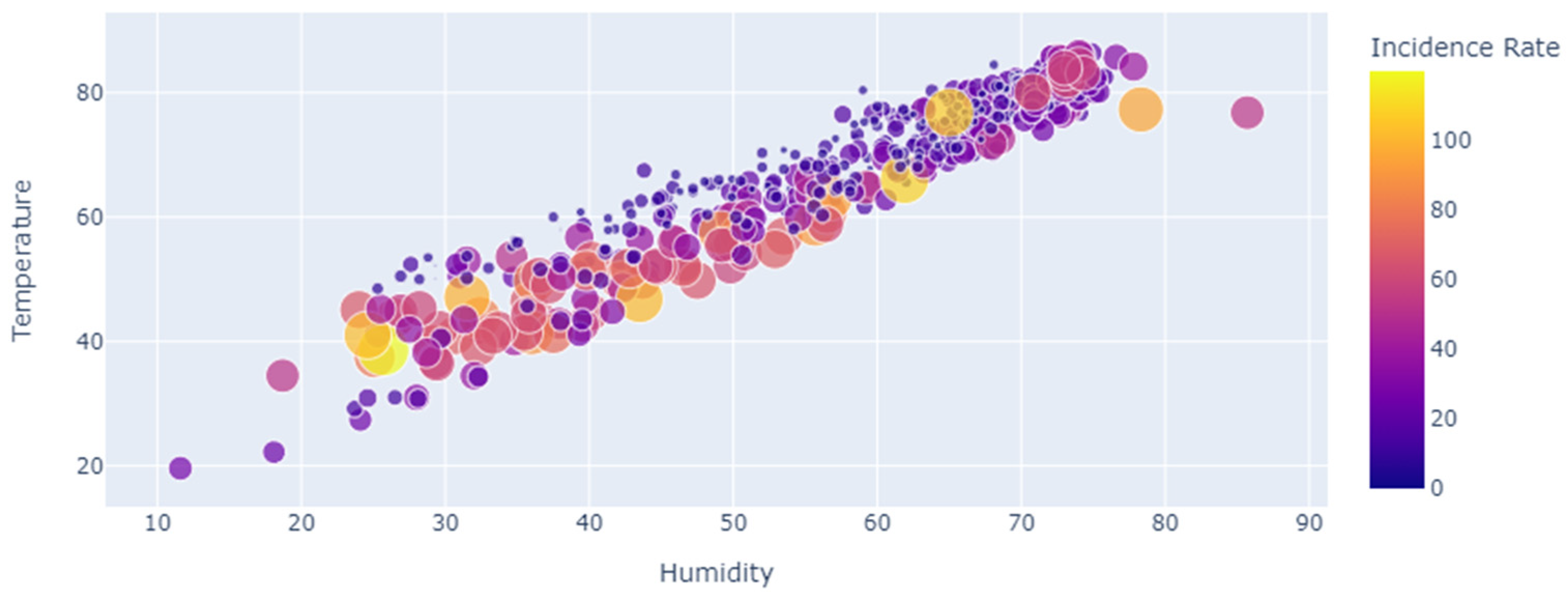
3.2. Exploratory Data Analysis Results
3.3. Cross-Correlation Analysis Results
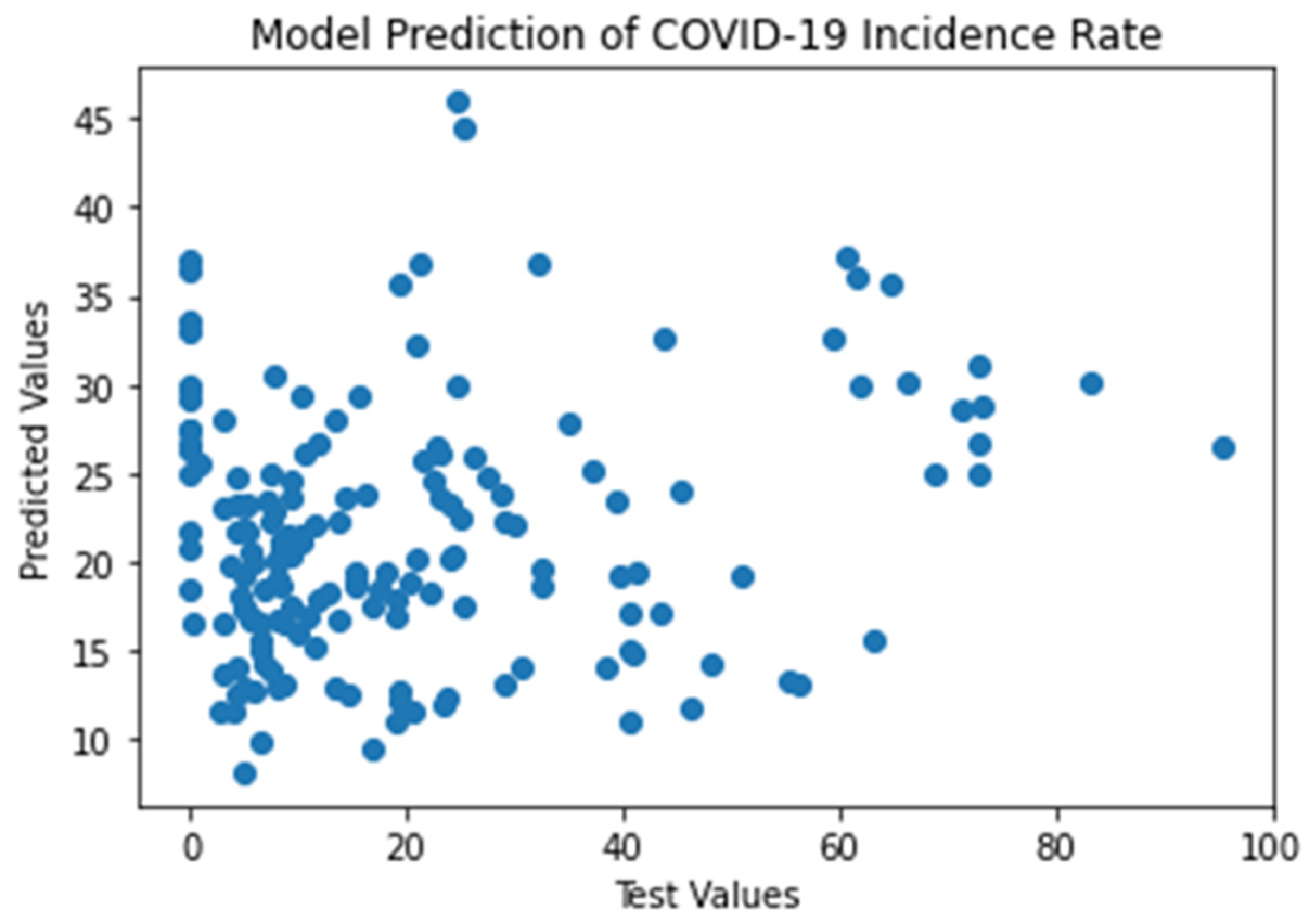
3.4. Machine Learning Model Results
4. Discussion
5. Conclusions
Author Contributions
Funding
Acknowledgments
Conflicts of Interest
References
- Zhang, Y.Z.; Holmes, E.C. A genomic perspective on the origin and emergence of SARS-CoV-2. Cell 2020, 181, 223–227. [Google Scholar] [CrossRef] [Scilit] [PubMed]
- Morens, D.M.; Fauci, A.S. Emerging pandemic diseases: How we got to COVID-19. Cell 2020, 182, 1077–1092. [Google Scholar] [CrossRef] [Scilit] [PubMed]
- WHO Director-General’s Opening Remarks at the Media Briefing on COVID19—11 March 2020. Available online: https://www.who.int/director-general/speeches/detail/who-director-general-s-opening-remarks-at-the-media-briefing-on-covid-19---11-march-2020 (accessed on 22 November 2021).
- CDC Museum COVID-19 Timeline. Available online: https://www.cdc.gov/museum/timeline/covid19.html#Early-2020 (accessed on 22 November 2021).
- D’Angelo, G.; Palmieri, F. Knowledge elicitation based on genetic programming for nondestructive testing of critical aerospace systems. Future Gener. Comput. Syst. 2020, 102, 633–642. [Google Scholar] [CrossRef] [Scilit]
- Niccolai, A.; Caputo, D.; Chieco, L.; Grimaccia, F.; Mussetta, M. Machine Learning-Based Detection Technique for NDT in Industrial Manufacturing. Mathematics 2021, 9, 1251. [Google Scholar] [CrossRef] [Scilit]
- Wernick, N.M.; Yang, Y.; Brankov, J.B.; Yourganov, G.; Strother, S.C. Machine Learning in Medical Imaging. IEEE Signal Process. Mag. 2010, 27, 25–38. [Google Scholar] [CrossRef] [Scilit] [PubMed]
- Kushwaha, S.; Bahl, S.; Bagha, A.K.; Parmar, K.S.; Javaid, M.; Haleem, A.; Singh, R.P. Significant Applications of Machine Learning for COVID-19 Pandemic. J. Ind. Integr. Manag. 2020, 5, 453–479. [Google Scholar] [CrossRef] [Scilit]
- Pinter, G.; Felde, I.; Mosavi, A.; Ghamisi, P.; Gloaguen, R. COVID-19 Pandemic Prediction for Hungary; A Hybrid Machine Learning Approach. Mathematics 2020, 8, 890. [Google Scholar] [CrossRef] [Scilit]
- Assaf, D.; Gutman, Y.; Neuman, Y.; Segal, G.; Amit, S.; Gefen-Halevi, S.; Shilo, N.; Epstein, A.; Mor-Cohen, R.; Biber, B.; et al. Utilization of machine-learning models to accurately predict the risk for critical COVID-19. Intern. Emerg. Med. 2020, 15, 1435–1443. [Google Scholar] [CrossRef] [Scilit] [PubMed]
- Dairi, A.; Harrou, F.; Zeroual, A.; Hittawe, M.M.; Sun, Y. Comparative study of machine learning methods for COVID-19 transmission forecasting. J. Biomed. Inform. 2021, 118, 103791. [Google Scholar] [CrossRef] [Scilit] [PubMed]
- Marr, L.C.; Tang, J.W.; Van Mullekom, J.; Lakdawala, S.S. Mechanistic insights into the effect of humidity on airborne influenza virus survival, transmission, and incidence. J. R. Soc. Interface 2019, 16, 20180298. [Google Scholar] [CrossRef] [Scilit] [PubMed]
- Park, J.E.; Son, W.S.; Ryu, Y.; Choi, S.B.; Kwon, O.; Ahn, I. Effects of temperature, humidity, and diurnal temperature range on influenza incidence in a temperate region. Influenza Other Respir. Viruses 2020, 14, 11–18. [Google Scholar] [CrossRef] [Scilit] [PubMed]
- Hobday, R.A.; Dancer, S.J. Roles of sunlight and natural ventilation for controlling infection: Historical and current per-spectives. J. Hosp. Infect. 2013, 84, 271–282. [Google Scholar] [CrossRef] [Scilit] [PubMed]
- Rehman, Y.; Rehman, N. Association of climatic factors with COVID-19 in Pakistan. AIMS Public Health 2020, 7, 854–868. [Google Scholar] [CrossRef] [Scilit] [PubMed]
- Carlson, C.J.; Gomez, C.R.; Bansal, S.; Ryan, S.J. Misconceptions about weather and seasonality must not misguide COVID-19 response. Nat. Commun. 2020, 11, 4312. [Google Scholar] [CrossRef] [Scilit] [PubMed]
- Merow, C.; Urban, M.C. Seasonality and uncertainty in global COVID-19 growth rates. Proc. Natl. Acad. Sci. USA 2020, 117, 27456–27464. [Google Scholar] [CrossRef] [Scilit] [PubMed]
- Gupta, S.; Raghuwanshi, G.S.; Chanda, A. Effect of weather on COVID-19 spread in the US: A prediction model for India in 2020. Sci. Total Environ. 2020, 728, 138860. [Google Scholar] [CrossRef] [Scilit] [PubMed]
- Malki, Z.; Atlam, E.; Hassanien, A.E.; Dagnew, G.; Elhosseini, M.; Gad, I. Association between weather data and COVID-19 pandemic predicting mortality rate: Machine learning approaches. Chaos Solitons Fractals 2020, 138, 110137. [Google Scholar] [CrossRef] [Scilit] [PubMed]
- THE Covid Tracking Project, Jackson, Mississippi. Available online: https://covidtracking.com/data/state/mississippi (accessed on 22 November 2021).
- Weather Underground. Available online: https://www.wunderground.com/history/daily/us/ms/jackson/KJAN (accessed on 22 November 2021).
- Trappenberg, T.P. Machine learning with sklearn. In Fundamentals of Machine Learning; Oxford University Press: New York, NY, USA, 2019; pp. 38–65. [Google Scholar] [CrossRef] [Scilit]
- David, P. Introduction to scikit-learn. In Hands-on Scikit-Learn for Machine Learning Applications; Apress: New York, NY, USA, 2019; pp. 1–35. [Google Scholar] [CrossRef] [Scilit]
- Sci-Kit Learn. Available online: https://scikit-learn.org/stable/ (accessed on 20 April 2021).
- Python Libraries. Available online: https://towardsdatascience.com/top-10-python-libraries-for-data-science-cd82294ec266 (accessed on 20 April 2021).
- Sci-Kit 2. Available online: https://scikit-learn.org/stable/modules/linear_model.html (accessed on 20 April 2021).
- NVIDIA Xavier NX. Available online: https://developer.nvidia.com/embedded/learn/get-started-jetson-xavier-nx-devki (accessed on 20 April 2021).


| Date | Temperature °F | Humidity % | Dew Point °F | Wind Speed mph | Pressure Hg | Precipitation in | Incidence Rate |
|---|---|---|---|---|---|---|---|
| 1/22/2020 | 39.4 | 21.7 | 50.5 | 6.1 | 29.9 | 0 | 0.00 |
| 1/23/2020 | 50 | 44.8 | 82.8 | 7.3 | 29.6 | 0.02 | 0.00 |
| 1/24/2020 | 43.7 | 37.9 | 81.5 | 6.3 | 29.7 | 0.59 | 0.00 |
| 1/25/2020 | 40.6 | 32.5 | 75.7 | 1.4 | 29.8 | 0 | 0.00 |
| 1/26/2020 | 49 | 45.7 | 88.3 | 3.8 | 29.7 | 0.03 | 0.00 |
| 7/31/2021 | 83.1 | 74.3 | 73.4 | 2.1 | 29.7 | 0 | 56.16 |
| 8/1/2021 | 84 | 73 | 74.1 | 4.5 | 29.7 | 0 | 56.23 |
| 8/2/2021 | 76.8 | 85.7 | 72.2 | 5 | 29.7 | 0.02 | 53.15 |
| 8/3/2021 | 77.3 | 78.3 | 69.5 | 3.7 | 29.6 | 0.83 | 95.26 |
| 8/4/2021 | 76.8 | 65 | 63 | 6 | 29.7 | 0 | 106.85 |
| Temperature °F | Humidity % | Dew Point °F | Wind Speed mph | Pressure Hg | Precipitation in | Incidence Rate | |
|---|---|---|---|---|---|---|---|
| count | 561.00 | 561.00 | 561.00 | 561.00 | 561.00 | 549.00 | 561.00 |
| mean | 65.88 | 55.84 | 72.50 | 6.42 | 29.72 | 0.17 | 21.43 |
| std | 13.67 | 14.61 | 10.73 | 3.01 | 0.15 | 0.46 | 21.91 |
| min | 19.60 | 11.60 | 40.50 | 0.50 | 29.20 | 0.00 | 0.00 |
| 25% | 56.00 | 45.00 | 65.70 | 4.20 | 29.60 | 0.00 | 5.91 |
| 50% | 68.30 | 59.10 | 73.40 | 6.10 | 29.70 | 0.00 | 13.34 |
| 75% | 77.30 | 68.50 | 80.80 | 8.50 | 29.80 | 0.06 | 29.62 |
| max | 86.40 | 85.70 | 93.50 | 17.20 | 30.20 | 3.61 | 119.75 |
| Temperature | Humidity | Dew Point | Wind Speed | Pressure | Precipitation | Incidence Rate | |
|---|---|---|---|---|---|---|---|
| Temperature | 1.000 | 0.944 | 0.079 | −0.086 | −0.442 | −0.002 | −0.222 |
| Humidity | 0.944 | 1.000 | 0.394 | −0.041 | −0.551 | 0.083 | −0.148 |
| Dew Point | 0.079 | 0.394 | 1.000 | 0.080 | −0.448 | 0.262 | 0.143 |
| Wind Speed | −0.086 | −0.041 | 0.080 | 1.000 | −0.184 | 0.198 | −0.155 |
| Pressure | −0.442 | −0.551 | −0.448 | −0.184 | 1.000 | −0.255 | 0.089 |
| Precipitation | −0.002 | 0.083 | 0.262 | 0.198 | −0.255 | 1.000 | −0.049 |
| Incidence Rate | −0.222 | −0.148 | 0.143 | −0.155 | 0.089 | −0.049 | 1.000 |
| Quantity | Value |
|---|---|
| Sample Size | 556 |
| B1; Humidity effect | 0.92 |
| B2; Temperature effect | −1.3 |
| B0; Intercept | 55.64 |
| Mean absolute error | 15.25 |
| Mean squared error | 457.04 |
| RMSE | 21.38 |
| R2 score | 0.053 |
Publisher’s Note: MDPI stays neutral with regard to jurisdictional claims in published maps and institutional affiliations. |
© 2022 by the authors. Licensee MDPI, Basel, Switzerland. This article is an open access article distributed under the terms and conditions of the Creative Commons Attribution (CC BY) license (https://creativecommons.org/licenses/by/4.0/).
Share and Cite
Tuluri, F.; Remata, R.; Walters, W.L.; Tchounwou, P.B. Application of Machine Learning to Study the Association between Environmental Factors and COVID-19 Cases in Mississippi, USA. Mathematics 2022, 10, 850. https://doi.org/10.3390/math10060850
Tuluri F, Remata R, Walters WL, Tchounwou PB. Application of Machine Learning to Study the Association between Environmental Factors and COVID-19 Cases in Mississippi, USA. Mathematics. 2022; 10(6):850. https://doi.org/10.3390/math10060850
Chicago/Turabian StyleTuluri, Francis, Reddy Remata, Wilbur L. Walters, and Paul. B. Tchounwou. 2022. "Application of Machine Learning to Study the Association between Environmental Factors and COVID-19 Cases in Mississippi, USA" Mathematics 10, no. 6: 850. https://doi.org/10.3390/math10060850
APA StyleTuluri, F., Remata, R., Walters, W. L., & Tchounwou, P. B. (2022). Application of Machine Learning to Study the Association between Environmental Factors and COVID-19 Cases in Mississippi, USA. Mathematics, 10(6), 850. https://doi.org/10.3390/math10060850